Amit Pande  Senior User Experience Manager, Oracle  [email_address] ,  [email_address]   Adesh Singh Senior Interaction Design Lead, Oracle Ecosystem building opportunities – Design Education in IIT system (Presented at ADEX, IIT Kanpur)
Agenda About Oracle User Experience A brief history of our IIT association Some reflections Future ecosystem building opportunities Some interesting opportunity spaces
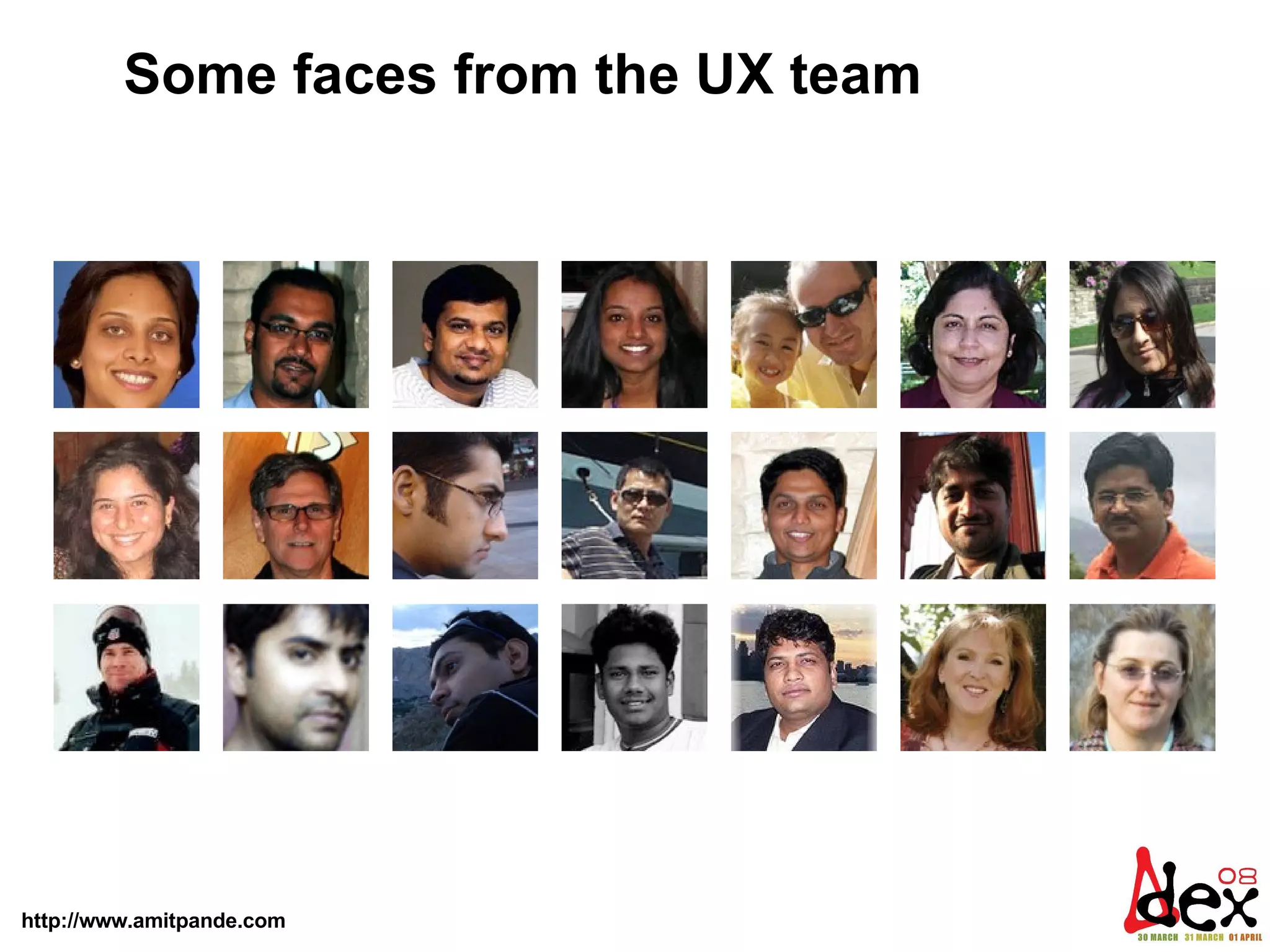
Some faces from the UX team
About Oracle User Experience Oracle User Experience established in 1995 ( http://usableapps.oracle.com ) India User Experience and Design practices setup in 2004  Over 150 user experience professionals, 18 usability labs Backgrounds in Design, HCI, Ethnography, Psychology User Centered Design process with empirical basis Not  just  pretty User Interfaces, entire User Experience with a focus on end user and business productivity  Some current work areas  Design driven innovation across industry domains & platforms R&D for emerging markets
A brief history of our partnership Oracle User Experience established in 1995, India User Experience and Design practices setup in 2004 ( http://usableapps.oracle.com )  Hiring and Internships – History of working with Interaction Design and Usability professionals from different IITs and supported diploma projects through its India operations  Research - Oracle UX has been in discussions with IIT and other institutions to identify research collaboration opportunities Knowledge exchange - Students from different Design Programs have visited Oracle facilities as part of their Industrial Tours Faculty visits and workshops – Our UX professionals have volunteered and taught Interaction Design and User Experience courses at IIT/NID Community building – Through associations such as UPA and CHI city events have connected students with professionals
The good news Design schools are taking leadership in introducing new courses and starting new hybrid disciplines  Design programs and industry are beginning to collaborate to discuss curricula, projects and research  All IITs have in place excellent physical infrastructure for joint research and innovation oriented collaboration  There are bright and enthusiastic students and faculty and working professionals who are eager to collaborate on some of the ‘big’ questions We’re able to make it to events like these!
Other reflections The rest of the world is moving fast on design – India’s services industry has a ‘back office’ and ‘tech-hub’ focus – Indian design faces competition from both West and East Students and corporations can often both be shortsighted and have misconceptions about the other side The research to market pipeline needs to be stronger - Internationally, Silicon Valley has a history of investing in research collaborations and taking inventions to market  There are still gaps in industry requirements and existing academic curricula – though often only in specific areas Most collaboration initiatives often depend a lot on individual leadership and industry enthusiasts  In the daily grind of work, after these kinds of events collaboration and research go on the backburner!
So lets peer into the future now..  The technology/information era is reaching its limits and the conceptual/experience era is upon us  This is an era of Automation and Abundance and speed – but technology in itself is slowly becoming a utility Globally economic competitiveness now largely depends on the ability to innovate and incubate new products and services This incubation and innovation requires fresh design and systems thinking  IIT and other design education programs are uniquely positioned to play a much larger role and  catalyze  India’s economic future  IIT and other design programs can invest in building ‘ecosystems’ - stretching from point design solutions to Infrastructures and policies => IIT and other ecosystems should take on large problems because they have the scale, resources and leverage to succeed
Ecosystem building – 1 year view Internships Internships/projects during semesters & of longer duration Student/faculty/professionals collaborating on ‘live’ projects Responsible leadership to track, shepherd, execute projects  Content is already out there - share knowledge openly about books, papers, references that are being used Skills  Communication and soft skills focus Management skills – teaching full product ownership, not just ownership of the ‘design’ outcomes/deliverables  Host events at IITs and other schools to disseminate design – Barcamps, Hackday style of unconferences
Ecosystem building – multi year view Embrace virtual tech to reduce dependence on travel Leverage existing academic/corporate environments for remote collaboration – conference calls, WebEx, blogs Research Minimize bureaucracy around MOU’s, budgets and resource sharing Start research partnerships by focusing on small scale, relevant problems before tackling larger ones  Explore ‘open’ collaboration through business models such as  ‘Innocentive’ ( www.innocentive.com )  Explore and leverage industry partnerships that provide IITs with interesting case studies (Asian SMB firms) Collaborate more with social science schools
Ecosystem Opportunity I – Media/Tech Innovation India’s growth in IT and telecom was heavily fueled by outsourcing and distributed product development  Recent focus on in-market product incubation and since the big guys move slowly, huge opportunity to create  products and services for the local and regional market  Internet based products (Zoho/Salesforce.com) can be setup for near-zero cost due to availability of programming infrastructure and network effects Consumer/media product opportunities exist across the board - for mobility India is the perfect ‘learning lab’. Services (distribution, last mile gaps) also provide an off-the-scale opportunity
Ecosystem Opportunity II – Social Innovation India’s ascendancy to the league of economic superpowers (US, China, Germany, Japan) depends not only on its ability to innovate on technology and media  The biggest social and business opportunity in India for the next several decades is ‘Infrastructure’  Whether hard (rail, airports, national security) or soft (high end services, customer orientation) – there are huge gaps and there are not enough entrepreneurs to fill these gaps  There is a once-in-a-lifetime opportunity for entrepreneurs and companies to design around social and market opportunities within Infrastructure (for e.g.:  www.kiva.org )
Thank you

Ecosystem building for Indian Design & User Experience Education

  • 1.
    Amit Pande Senior User Experience Manager, Oracle [email_address] , [email_address] Adesh Singh Senior Interaction Design Lead, Oracle Ecosystem building opportunities – Design Education in IIT system (Presented at ADEX, IIT Kanpur)
  • 2.
    Agenda About OracleUser Experience A brief history of our IIT association Some reflections Future ecosystem building opportunities Some interesting opportunity spaces
  • 3.
    Some faces fromthe UX team
  • 4.
    About Oracle UserExperience Oracle User Experience established in 1995 ( http://usableapps.oracle.com ) India User Experience and Design practices setup in 2004 Over 150 user experience professionals, 18 usability labs Backgrounds in Design, HCI, Ethnography, Psychology User Centered Design process with empirical basis Not just pretty User Interfaces, entire User Experience with a focus on end user and business productivity Some current work areas Design driven innovation across industry domains & platforms R&D for emerging markets
  • 5.
    A brief historyof our partnership Oracle User Experience established in 1995, India User Experience and Design practices setup in 2004 ( http://usableapps.oracle.com ) Hiring and Internships – History of working with Interaction Design and Usability professionals from different IITs and supported diploma projects through its India operations Research - Oracle UX has been in discussions with IIT and other institutions to identify research collaboration opportunities Knowledge exchange - Students from different Design Programs have visited Oracle facilities as part of their Industrial Tours Faculty visits and workshops – Our UX professionals have volunteered and taught Interaction Design and User Experience courses at IIT/NID Community building – Through associations such as UPA and CHI city events have connected students with professionals
  • 6.
    The good newsDesign schools are taking leadership in introducing new courses and starting new hybrid disciplines Design programs and industry are beginning to collaborate to discuss curricula, projects and research All IITs have in place excellent physical infrastructure for joint research and innovation oriented collaboration There are bright and enthusiastic students and faculty and working professionals who are eager to collaborate on some of the ‘big’ questions We’re able to make it to events like these!
  • 7.
    Other reflections Therest of the world is moving fast on design – India’s services industry has a ‘back office’ and ‘tech-hub’ focus – Indian design faces competition from both West and East Students and corporations can often both be shortsighted and have misconceptions about the other side The research to market pipeline needs to be stronger - Internationally, Silicon Valley has a history of investing in research collaborations and taking inventions to market There are still gaps in industry requirements and existing academic curricula – though often only in specific areas Most collaboration initiatives often depend a lot on individual leadership and industry enthusiasts In the daily grind of work, after these kinds of events collaboration and research go on the backburner!
  • 8.
    So lets peerinto the future now.. The technology/information era is reaching its limits and the conceptual/experience era is upon us This is an era of Automation and Abundance and speed – but technology in itself is slowly becoming a utility Globally economic competitiveness now largely depends on the ability to innovate and incubate new products and services This incubation and innovation requires fresh design and systems thinking IIT and other design education programs are uniquely positioned to play a much larger role and catalyze India’s economic future IIT and other design programs can invest in building ‘ecosystems’ - stretching from point design solutions to Infrastructures and policies => IIT and other ecosystems should take on large problems because they have the scale, resources and leverage to succeed
  • 9.
    Ecosystem building –1 year view Internships Internships/projects during semesters & of longer duration Student/faculty/professionals collaborating on ‘live’ projects Responsible leadership to track, shepherd, execute projects Content is already out there - share knowledge openly about books, papers, references that are being used Skills Communication and soft skills focus Management skills – teaching full product ownership, not just ownership of the ‘design’ outcomes/deliverables Host events at IITs and other schools to disseminate design – Barcamps, Hackday style of unconferences
  • 10.
    Ecosystem building –multi year view Embrace virtual tech to reduce dependence on travel Leverage existing academic/corporate environments for remote collaboration – conference calls, WebEx, blogs Research Minimize bureaucracy around MOU’s, budgets and resource sharing Start research partnerships by focusing on small scale, relevant problems before tackling larger ones Explore ‘open’ collaboration through business models such as ‘Innocentive’ ( www.innocentive.com ) Explore and leverage industry partnerships that provide IITs with interesting case studies (Asian SMB firms) Collaborate more with social science schools
  • 11.
    Ecosystem Opportunity I– Media/Tech Innovation India’s growth in IT and telecom was heavily fueled by outsourcing and distributed product development Recent focus on in-market product incubation and since the big guys move slowly, huge opportunity to create products and services for the local and regional market Internet based products (Zoho/Salesforce.com) can be setup for near-zero cost due to availability of programming infrastructure and network effects Consumer/media product opportunities exist across the board - for mobility India is the perfect ‘learning lab’. Services (distribution, last mile gaps) also provide an off-the-scale opportunity
  • 12.
    Ecosystem Opportunity II– Social Innovation India’s ascendancy to the league of economic superpowers (US, China, Germany, Japan) depends not only on its ability to innovate on technology and media The biggest social and business opportunity in India for the next several decades is ‘Infrastructure’ Whether hard (rail, airports, national security) or soft (high end services, customer orientation) – there are huge gaps and there are not enough entrepreneurs to fill these gaps There is a once-in-a-lifetime opportunity for entrepreneurs and companies to design around social and market opportunities within Infrastructure (for e.g.: www.kiva.org )
  • 13.