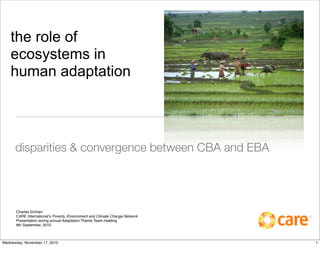
the role of
    ecosystems in
    human adaptation


      disparities & convergence between CBA and EBA


       Charles Ehrhart
       CARE Internationalʼs Poverty, Environment and Climate Change Network
       Presentation during annual Adaptation Theme Team meeting
       8th September, 2010


Wednesday, November 17, 2010                                                  1
ecosystems and human wellbeing

       the Millennium Ecosystems Assessment
       (United Nations, 2001 - 2005) was a
       milestone in recognising linkages

       the MA identified critical ecosystem
       services, namely:

             Supporting,

             Provisioning,

             Regulating and

             Cultural services...

       and linked them to key constituents of
       human well-being including, security,
       basic material for a good life, health and
       good social relations


Wednesday, November 17, 2010                        2
!
Wednesday, November 17, 2010       3
ecosystems and human wellbeing


             healthy ecosystems sustain goods
             and services for humans, provide
             livelihood opportunities, and
             enhance human resilience to climate
             related shocks and stresses in many
             direct and indirect ways

             rapidly growing human population,
             changing lifestyles and socio-
             economic development often result
             in unsustainable exploitation of
             ecosystems

             climate change is placing major
             strains on ecosystems


Wednesday, November 17, 2010                       4
Community-Based Adaptation (CBA)


             the goal of CBA is to build the
             resilience of individuals, households,
             communities and societies from the
             ground up

             action is based on local priorities
             (taking into account social
             heterogeneity)

             it starts with local knowledge but also
             seeks to integrate scientific knowledge
             into decision making processes

             operates at multiple levels and can be
             large scale - so long as communities
             remain at the centre of planning and
             action


Wednesday, November 17, 2010                           5
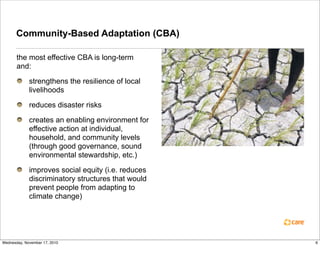
Community-Based Adaptation (CBA)

       the most effective CBA is long-term
       and:

             strengthens the resilience of local
             livelihoods

             reduces disaster risks

             creates an enabling environment for
             effective action at individual,
             household, and community levels
             (through good governance, sound
             environmental stewardship, etc.)

             improves social equity (i.e. reduces
             discriminatory structures that would
             prevent people from adapting to
             climate change)


Wednesday, November 17, 2010                        6
ecosystems in the context of CBA

             CBA frequently deals with natural
             resources (and often prioritises
             improved NRM-related activities)

             CBA is frequently concerned with the
             continuing flow of environmental goods
             and services

             however, it rarely takes a holistic
             approach to working with complex
             ecosystems...


Wednesday, November 17, 2010                          7
CBA in practice

              example of including natural
              resource management activities:
              well... just about any CBA project
              that is promoting resilient livelihoods
              is going to be dealing with
              sustainable natural resource
              managament

              example of operating at multiple
              levels: CARE’s Reducing
              Vulnerability to Climate Change
              (RVCC) project in Bangladesh
              worked in communities but ALSO
              helped 14 Union Parishads develop
              adaptation plans and undertook
              national level advocacy on growing
              salinity and decreasing access to
              potable water


Wednesday, November 17, 2010                                                                                                                                        8
The project took an integrated approach to vulnerability reduction, focusing on raising awareness of climate change and associated vulnerability areas, promoting
concrete actions by households and communities to reduce their vulnerability, and advocating with government at multiple levels for appropriate action to reduce
vulnerability to climate change.

RVCC recognized that grassroots actions are not enough, and worked with local, regional and national government to promote action to reduce climate-related
vulnerability.
EbA in the Convention on Biological Diversity (CBD)

              Ecosystem-based Adaptation (EbA)
              means different things to different
              people.

              sometimes, it is about using
              biodiversity and ecosystem services
              as part of an overall adaptation
              strategy to help people adapt to the
              adverse effects of climate.

              the practice that, “integrates the
              sustainable use of biodiversity and
              ecosystem services into an overall
              adaptation strategy”


Wednesday, November 17, 2010                                                                                                                                         9
The CBD promotes EbA as, potentially, a cost-effective solution that can “generate social, economic and cultural co-benefits and contribute to the conservation of
biodiversity.” The emphasis is on the “sustainable management, conservation and restoration of ecosystems to provide services that help people adapt to both
current climate variability, and climate change.”
Ecosystem-based Adaptation in practice

       but, frequently, its about targeting
       the most valuable conservation
       areas (e.g. Protected Areas) and
       focusing on activities that will
       reduce the vulnerability of
       species or biological
       communities to the impacts of
       climate change.


Wednesday, November 17, 2010                    10
CBA and EbA, side-by-side


                                CBA                                                                      EbA
      ‣ Targets the most vulnerable human ‣ Frequently targets priority conservation
            communities                                                       areas (which may be sparsely populated)

      ‣ Often focuses on activities to                                  ‣ Often focuses on activities to reduce the
            reduce the vulnerability of people in                             vulnerability of endangered species or
            marginalised social groups                                        biological communities

      ‣ Sometimes incorporates “southern” ‣ In practice, often reflects a “northern”
            environmental agendas (e.g.                                       environmental agenda (e.g. biodiversity
            ensuring the continuity of                                        conservation)
            environmental goods and services)

      ‣ Has an explicit social agenda that                              ‣ Rarely (if ever?) includes an explicit social
            frequently includes good                                          agenda
            governance and social equality


Wednesday, November 17, 2010                                                                                                                            11
Some people say that EbA and CBA are really the same thing by different names. But while some descriptions of EbA have much in common, EbA currently looks
very different in practice. Moreover, their analysis of the underlying causes of vulnerability are almost inevitably different.
conclusions

             EbA and CBA are not the same thing
             by different names

             most development-oriented NGOs
             would not find it possible to embrace
             an ecosystem “based” approach to
             adaptation...

             for practical and ethical reasons, our
             “base” is and must remain
             communities

       however, most of us would agree that:

             an “ecosystem perspective” should be
             applied to all adaptation responses to
             ensure they are environmentally
             sound

             in many cases, ecosystem adaptation
             has an important part to play in CBA

Wednesday, November 17, 2010                          12
unequal burden and the equity principle

       “Climate change affects us all, but it does
       not affect us all equally. The poorest and
       most vulnerable - those who have done
       the least to contribute to global warming -
       are bearing the brunt of the impact.”

             - UN Secretary General, Ban Ki Moon

      The UNFCCC’s equity principle acknowledges
      that:

            some countries have contributed more than
            others to the problem

            some countries are more vulnerable to the
            impacts of CC than others...

            ...typically, these are poorer countries that
            have contributed least to the causes of CC.


Wednesday, November 17, 2010                                                                                                                                       13
The unequal burden of the effects of climate change is reflected in article 3 of the UNFCCC (referred to as “the equity article”). It stipulates that parties should
protect the climate system “on the basis of equity and in accordance with their common but differentiated responsibilities and respective capabilities”; that
developed countries “should take the lead in combating climate change and the adverse effects thereof” and that full consideration should be given to the needs of
developing countries, especially “those that are particularly vulnerable to the adverse effects of climate change” and “that would have to bear a disproportionate or
abnormal burden under the Convention”. Giving operational meaning to the “equity principle” is a key challenge in ongoing climate change negotiations.
the equity principle & implications for adaptation action

             as per the UNFCCC’s “equity principle,”
             historical high emitters have agreed to
             help vulnerable [countries/populations]
             deal with the costs of climate change...

             for most southern governments and
             civil society organisations, this is about
             dealing with the human costs of climate
             change.

             CARE and many other development-
             oriented NGOs believe biodiversity and
             ecosystem services have a critical role
             to play in overarching strategies to help
             people adapt to the adverse effects of
             climate change.


Wednesday, November 17, 2010                                       14
More information:
      www.careclimatechange.org


Wednesday, November 17, 2010      15

Ecosystem and Community-based Adaptation, 2010

  • 1.
    the role of ecosystems in human adaptation disparities & convergence between CBA and EBA Charles Ehrhart CARE Internationalʼs Poverty, Environment and Climate Change Network Presentation during annual Adaptation Theme Team meeting 8th September, 2010 Wednesday, November 17, 2010 1
  • 2.
    ecosystems and humanwellbeing the Millennium Ecosystems Assessment (United Nations, 2001 - 2005) was a milestone in recognising linkages the MA identified critical ecosystem services, namely: Supporting, Provisioning, Regulating and Cultural services... and linked them to key constituents of human well-being including, security, basic material for a good life, health and good social relations Wednesday, November 17, 2010 2
  • 3.
  • 4.
    ecosystems and humanwellbeing healthy ecosystems sustain goods and services for humans, provide livelihood opportunities, and enhance human resilience to climate related shocks and stresses in many direct and indirect ways rapidly growing human population, changing lifestyles and socio- economic development often result in unsustainable exploitation of ecosystems climate change is placing major strains on ecosystems Wednesday, November 17, 2010 4
  • 5.
    Community-Based Adaptation (CBA) the goal of CBA is to build the resilience of individuals, households, communities and societies from the ground up action is based on local priorities (taking into account social heterogeneity) it starts with local knowledge but also seeks to integrate scientific knowledge into decision making processes operates at multiple levels and can be large scale - so long as communities remain at the centre of planning and action Wednesday, November 17, 2010 5
  • 6.
    Community-Based Adaptation (CBA) the most effective CBA is long-term and: strengthens the resilience of local livelihoods reduces disaster risks creates an enabling environment for effective action at individual, household, and community levels (through good governance, sound environmental stewardship, etc.) improves social equity (i.e. reduces discriminatory structures that would prevent people from adapting to climate change) Wednesday, November 17, 2010 6
  • 7.
    ecosystems in thecontext of CBA CBA frequently deals with natural resources (and often prioritises improved NRM-related activities) CBA is frequently concerned with the continuing flow of environmental goods and services however, it rarely takes a holistic approach to working with complex ecosystems... Wednesday, November 17, 2010 7
  • 8.
    CBA in practice example of including natural resource management activities: well... just about any CBA project that is promoting resilient livelihoods is going to be dealing with sustainable natural resource managament example of operating at multiple levels: CARE’s Reducing Vulnerability to Climate Change (RVCC) project in Bangladesh worked in communities but ALSO helped 14 Union Parishads develop adaptation plans and undertook national level advocacy on growing salinity and decreasing access to potable water Wednesday, November 17, 2010 8 The project took an integrated approach to vulnerability reduction, focusing on raising awareness of climate change and associated vulnerability areas, promoting concrete actions by households and communities to reduce their vulnerability, and advocating with government at multiple levels for appropriate action to reduce vulnerability to climate change. RVCC recognized that grassroots actions are not enough, and worked with local, regional and national government to promote action to reduce climate-related vulnerability.
  • 9.
    EbA in theConvention on Biological Diversity (CBD) Ecosystem-based Adaptation (EbA) means different things to different people. sometimes, it is about using biodiversity and ecosystem services as part of an overall adaptation strategy to help people adapt to the adverse effects of climate. the practice that, “integrates the sustainable use of biodiversity and ecosystem services into an overall adaptation strategy” Wednesday, November 17, 2010 9 The CBD promotes EbA as, potentially, a cost-effective solution that can “generate social, economic and cultural co-benefits and contribute to the conservation of biodiversity.” The emphasis is on the “sustainable management, conservation and restoration of ecosystems to provide services that help people adapt to both current climate variability, and climate change.”
  • 10.
    Ecosystem-based Adaptation inpractice but, frequently, its about targeting the most valuable conservation areas (e.g. Protected Areas) and focusing on activities that will reduce the vulnerability of species or biological communities to the impacts of climate change. Wednesday, November 17, 2010 10
  • 11.
    CBA and EbA,side-by-side CBA EbA ‣ Targets the most vulnerable human ‣ Frequently targets priority conservation communities areas (which may be sparsely populated) ‣ Often focuses on activities to ‣ Often focuses on activities to reduce the reduce the vulnerability of people in vulnerability of endangered species or marginalised social groups biological communities ‣ Sometimes incorporates “southern” ‣ In practice, often reflects a “northern” environmental agendas (e.g. environmental agenda (e.g. biodiversity ensuring the continuity of conservation) environmental goods and services) ‣ Has an explicit social agenda that ‣ Rarely (if ever?) includes an explicit social frequently includes good agenda governance and social equality Wednesday, November 17, 2010 11 Some people say that EbA and CBA are really the same thing by different names. But while some descriptions of EbA have much in common, EbA currently looks very different in practice. Moreover, their analysis of the underlying causes of vulnerability are almost inevitably different.
  • 12.
    conclusions EbA and CBA are not the same thing by different names most development-oriented NGOs would not find it possible to embrace an ecosystem “based” approach to adaptation... for practical and ethical reasons, our “base” is and must remain communities however, most of us would agree that: an “ecosystem perspective” should be applied to all adaptation responses to ensure they are environmentally sound in many cases, ecosystem adaptation has an important part to play in CBA Wednesday, November 17, 2010 12
  • 13.
    unequal burden andthe equity principle “Climate change affects us all, but it does not affect us all equally. The poorest and most vulnerable - those who have done the least to contribute to global warming - are bearing the brunt of the impact.” - UN Secretary General, Ban Ki Moon The UNFCCC’s equity principle acknowledges that: some countries have contributed more than others to the problem some countries are more vulnerable to the impacts of CC than others... ...typically, these are poorer countries that have contributed least to the causes of CC. Wednesday, November 17, 2010 13 The unequal burden of the effects of climate change is reflected in article 3 of the UNFCCC (referred to as “the equity article”). It stipulates that parties should protect the climate system “on the basis of equity and in accordance with their common but differentiated responsibilities and respective capabilities”; that developed countries “should take the lead in combating climate change and the adverse effects thereof” and that full consideration should be given to the needs of developing countries, especially “those that are particularly vulnerable to the adverse effects of climate change” and “that would have to bear a disproportionate or abnormal burden under the Convention”. Giving operational meaning to the “equity principle” is a key challenge in ongoing climate change negotiations.
  • 14.
    the equity principle& implications for adaptation action as per the UNFCCC’s “equity principle,” historical high emitters have agreed to help vulnerable [countries/populations] deal with the costs of climate change... for most southern governments and civil society organisations, this is about dealing with the human costs of climate change. CARE and many other development- oriented NGOs believe biodiversity and ecosystem services have a critical role to play in overarching strategies to help people adapt to the adverse effects of climate change. Wednesday, November 17, 2010 14
  • 15.
    More information: www.careclimatechange.org Wednesday, November 17, 2010 15