Final Review!
What is the study of economics? How to meet  unlimited wants  with  scarce resources Economists study how to meet people’s unlimited wants with scarce, available resources
THE FACT THAT WE MUST DEAL WITH SCARCITY FORCES US TO MAKE CHOICES CONSTANTLY Trade-off: the choice that one makes whenever making economic decisions Opportunity cost: the cost of the next best alternative when one choice is made, ex) money, time, resources, etc).
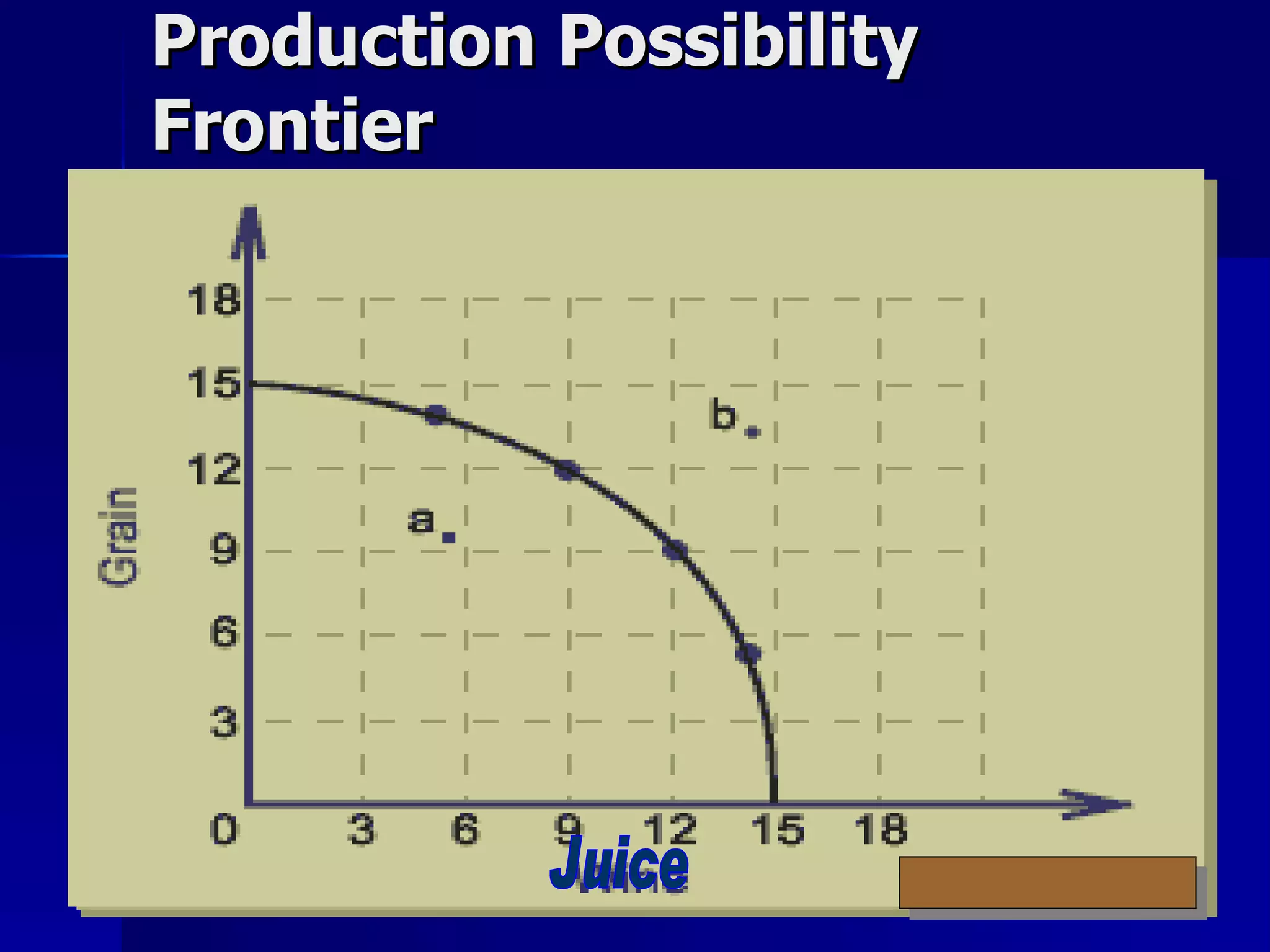
Production Possibilities Frontier A graphical representation of how an economy makes decisions on what to produce. Production Possibilities Curve shows the choices a country can make with respect to its available resources.
Production Possibility Frontier Juice
Production Possibility Frontier The PPF shows all efficient combinations of output, when the factors of production are used to their full potential.  As more of one product is produced, increasingly larger amounts of the other product must be given up. the opportunity cost increases as one moves toward either extreme on the curve of production possibilities.
Tools economists use Economists demonstrate real-world relationships using  economic models Economists use the term  efficiency  to measure marginal costs, and the term  productivit y to measure production levels.
Know the different economic systems How do these systems answer the basic economic questions? 1) What to produce 2) How to produce it? 3) For whom to produce?
Traditional Economies 1) What to produce?  Whatever ritual, habit or custom dictates 2) How to produce? However ritual, habit or custom dictate 3) For whom to produce? For whomever ritual, habit or custom dictate Examples: Australian aborigines, the Mbuti of Central Africa, The Inuit
Command Economies 1) What to produce? Whatever the government says to produce 2) How to produce? However the government tells you to produce 3) For whom to produce? For whomever the government tells you to produce (ideally the entire society) Examples: Cuba, North Korea
Market Economy Basic economic questions answered by consumers Dollars=Votes What to produce? Whatever consumers want (demand) How to produce? However business owners want, usually at maximum efficiency (production possibility frontier) in order to maximize profits For whom to produce? For whomever will buy it
Examples of market economies The U.S. Canada, U.K., France, Germany, etc. Remember these aren’t completely free market system.  There is a level of government control and regulation, therefore : these are  MIXED ECONOMIC SYSTEMS .
The 4 factors of production Land : Gifts of the earth/Natural resources (oil, diamonds, etc.) Labor : people who work Capital (goods) : The things needed to produce a good or service (sewing machine, oven, etc.) Entrepreneur : Risk-taking individual who organizes the other 3 factors of production in order to make a profit
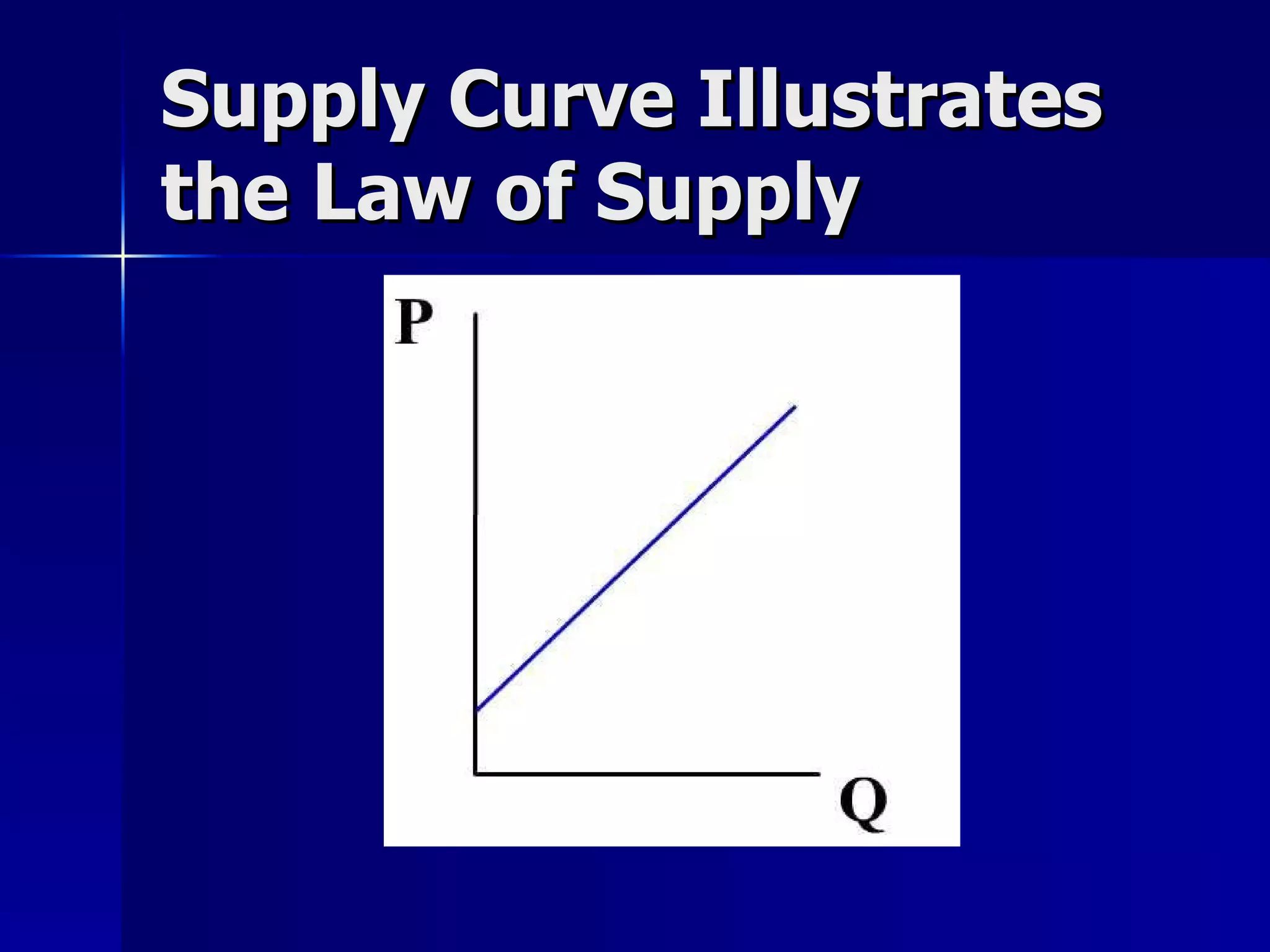
Law of Supply As Price goes up, quantity will go up As Price goes down, quantity goes down
Supply Curve Illustrates the Law of Supply
Supply Elasticity Supply can be:  Elastic Inelastic Unit Elastic
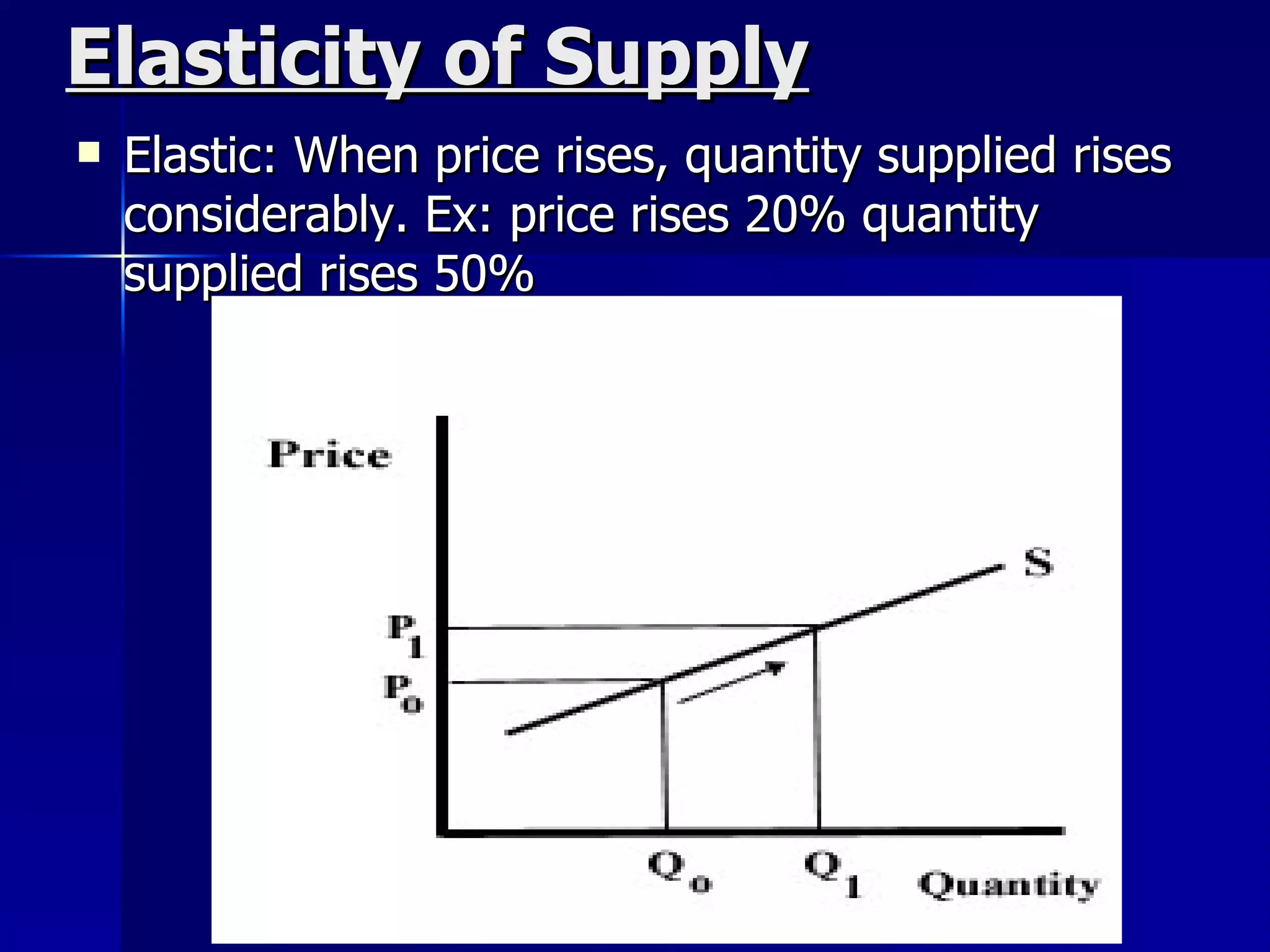
Elasticity of Supply Elastic: When price rises, quantity supplied rises considerably. Ex: price rises 20% quantity supplied rises 50%
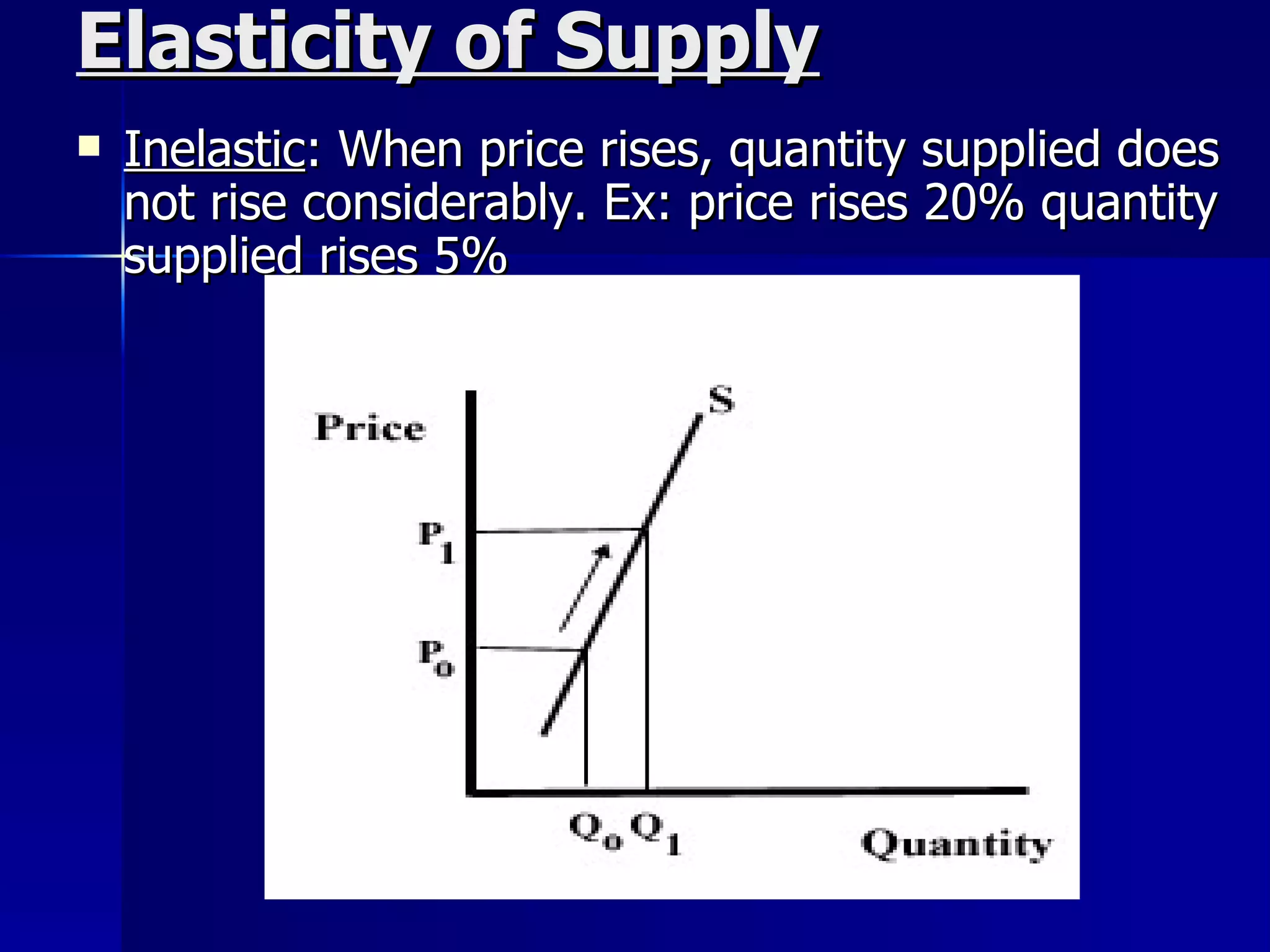
Elasticity of Supply Inelastic : When price rises, quantity supplied does not rise considerably. Ex: price rises 20% quantity supplied rises 5%
Elasticity of Supply Unit Elastic :  When price rises, quantity supplied rises proportionally. Ex: price rises 20% quantity supplied rises 20%
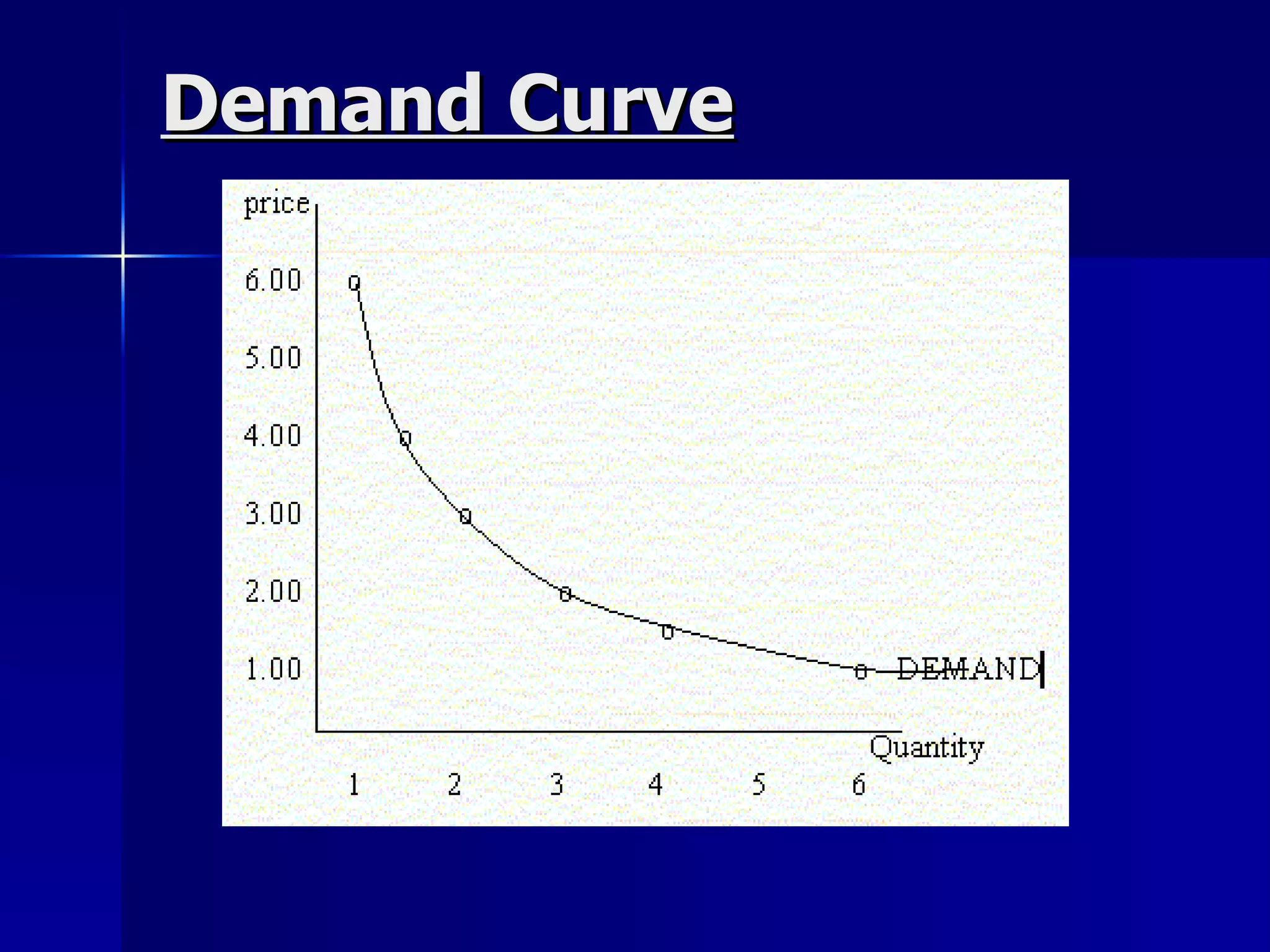
Law of Demand As the price of a product decreases, the demand for the product will increase.  This is an example of an inverse relationship.
Demand Curve
Elasticity Elastic: As the price for a product decreases by half, the demand for the product increases 100%.  More than proportional!
Elasticity Inelastic As the price for a product increases by 25%, the demand for the product decreases by 10%.  Less than proportional!
Elasticity Unit Elastic As the price of the product triples, the demand for the product decreases by 300%.  Proportional!
If prices were to stay the same, what then could change demand?
Compliments Compliments are goods that are related.  You need to have both in order to use them
Compliments If the price of DVD players goes down, then the demand for DVD’s goes up If the price of Gillette razor handles goes up, then the demand for the razor blades goes down
Substitutes The demand for a product tends to decrease if the price of its substitute decreases What are some substitute products?
Substitutes If the price of butter goes up, then the demand for margarine will go up. If the price of sugar goes up, then the demand for Splenda© will go up
Utility & Demand Utility: The usefulness or satisfaction one gets from consuming a good or service  (one slice of pizza is good) Marginal utility: The extra usefulness or satisfaction one gets from consuming a good or service  (two slices of pizza is better) Diminishing marginal utility: the more we consume of something, the less satisfying or useful it becomes  (eating an entire pizza makes one feel sick)
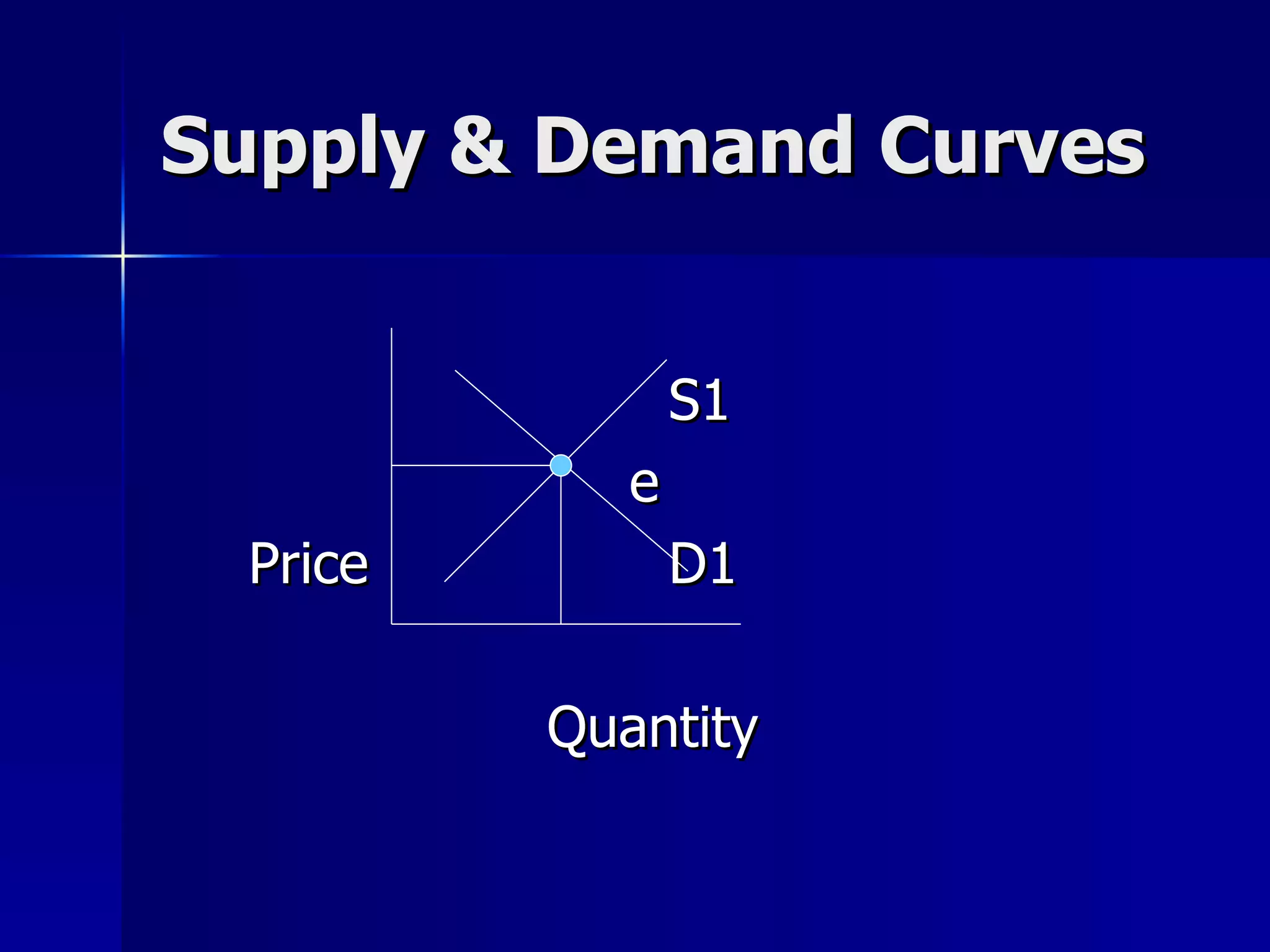
Supply & Demand Curves S1   e Price D1   Quantity
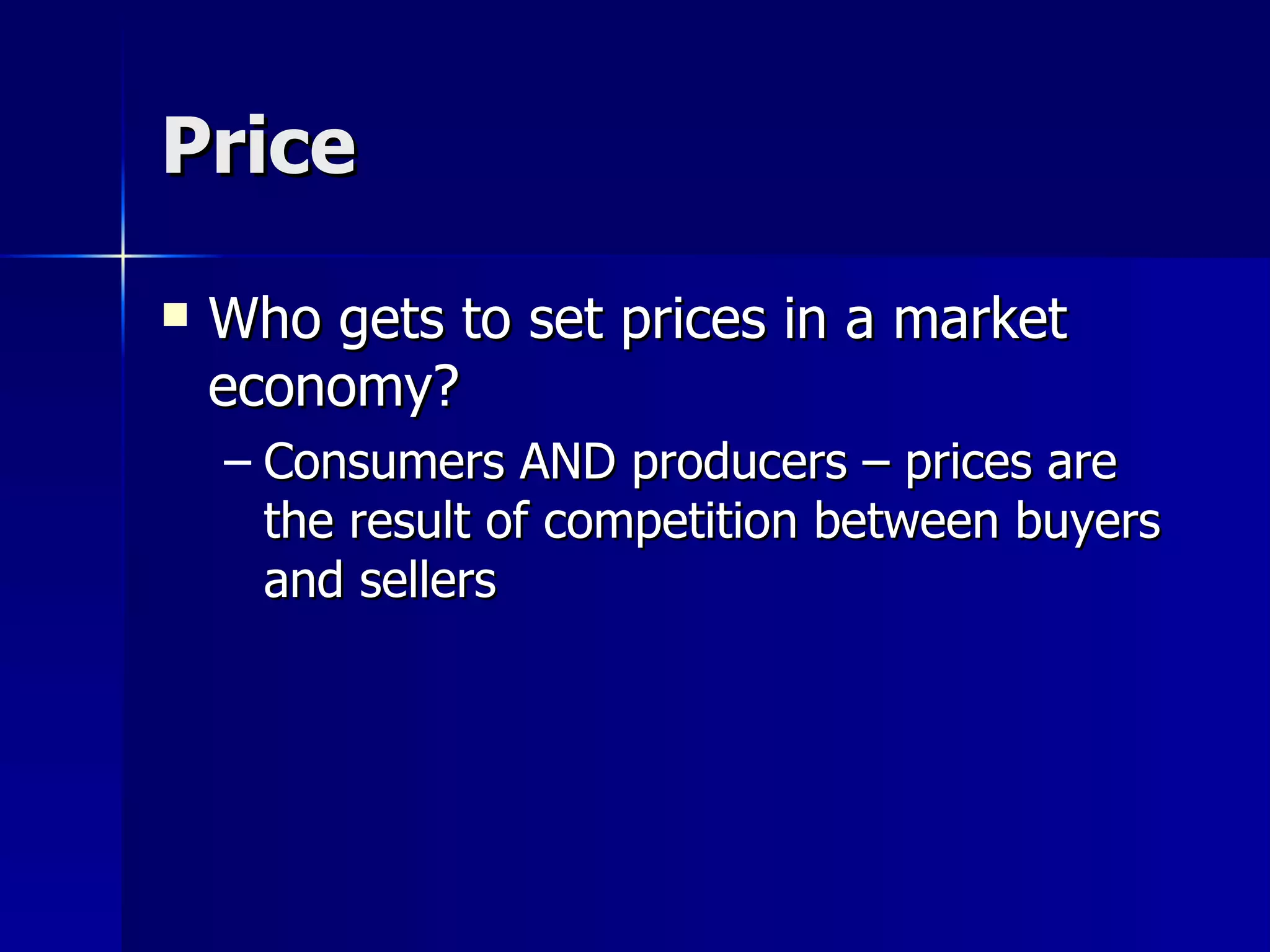
Price Who gets to set prices in a market economy? Consumers AND producers – prices are the result of competition between buyers and sellers
Circular Flow of Economic Activity Factor Market Producer Product Market Consumer Goods   &Services Land Labor Capital Land, Labor, Capital Goods & Services   $ $ $ $ $ $$$$$$$ $ $ $ $ $ $$$$$$$$$
Businesses may be organized in a variety of ways 1) Sole Proprietorship 2) Partnership 3) Corporation
Sole Proprietorships The most common form of business organization in the United States  The most profitable of all business organizations This is a business owned and run by one person Smallest size of business organization
Partnerships Types of partnerships General Partnerships:  all partners are responsible for the management and financial obligation of the business (most common form of partnership) Limited Partnerships : at least one partner is not active in the daily running of the business
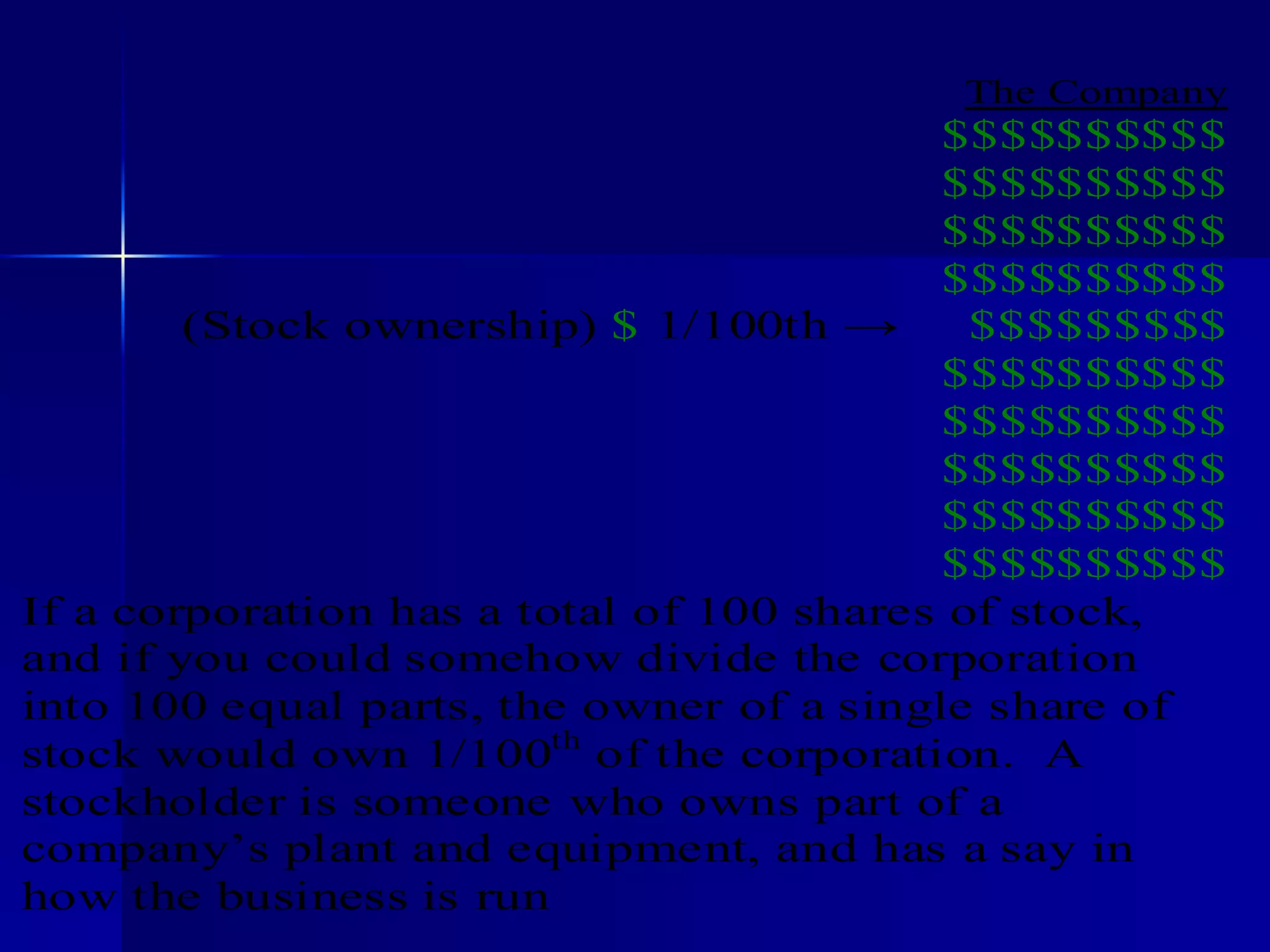
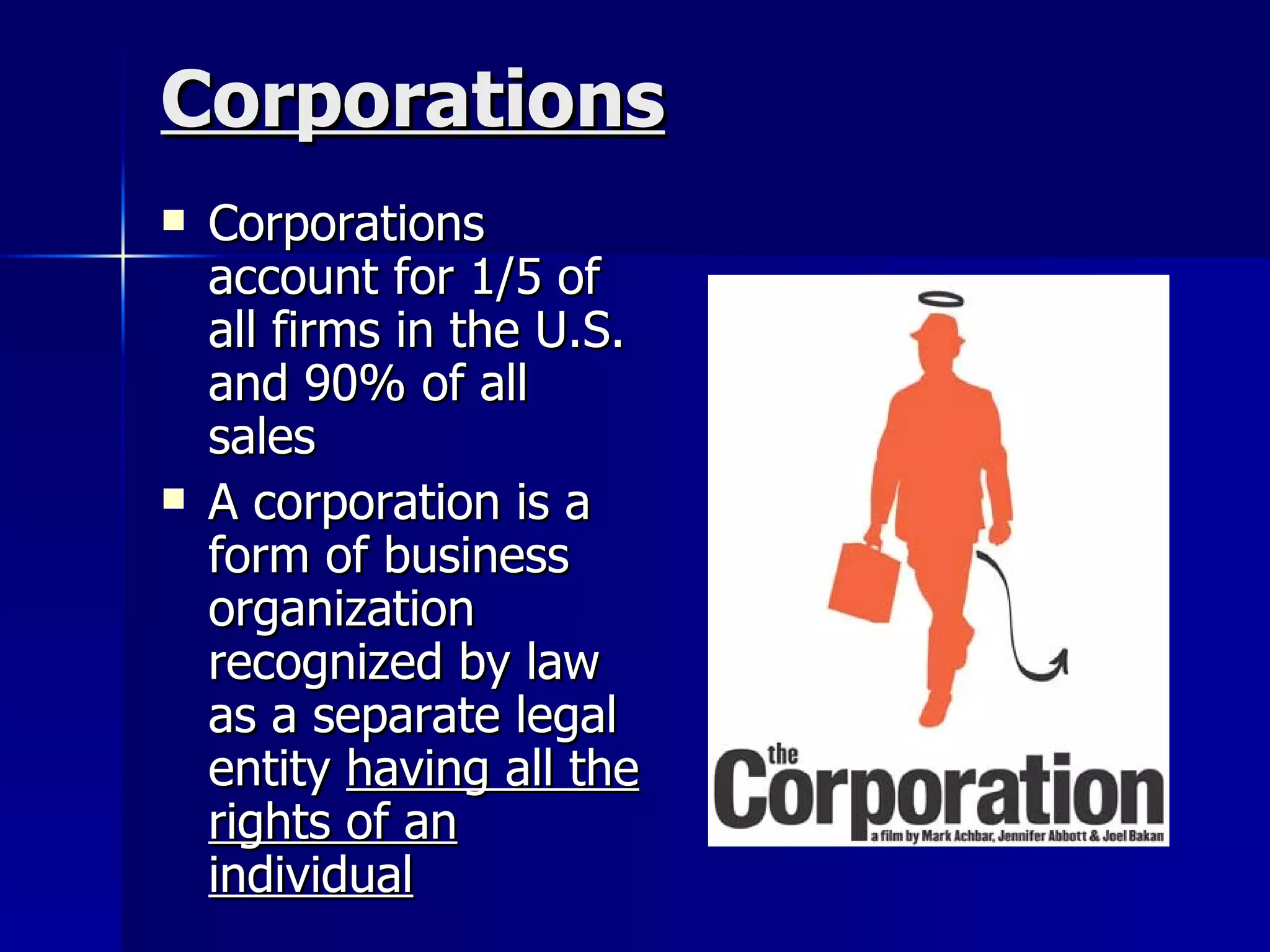
Corporations Corporations account for 1/5 of all firms in the U.S. and 90% of all sales A corporation is a form of business organization recognized by law as a separate legal entity  having all the rights of an individual
Forming a Corporation People must ask the government for permission to  incorporate This is done through a corporate  charter  which is a government document giving individuals the right to incorporate
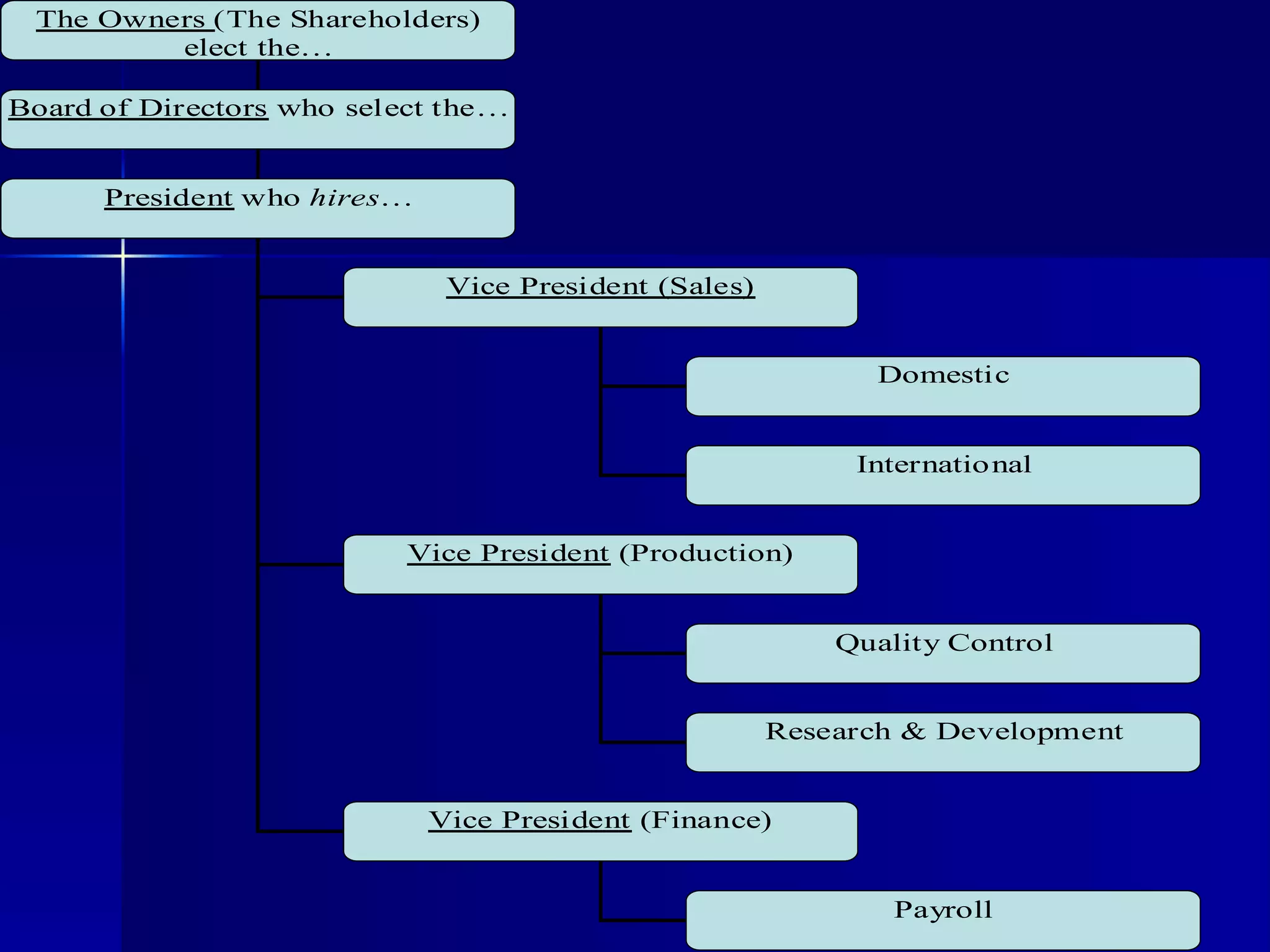
Corporate Formation…cont’ A corporate charter specifies the number of shares of  stock , or ownership certificates in the firm These shares are sold to investors who are called  stockholders  or  shareholders If the company is successful, it will issue a  dividend  a check representing a portion of corporate earnings to each stockholder
 
 
The Role of Government 1) To  protect  the consumer from dangerous products and unscrupulous businesspeople (USDA, FDA, OSHA, etc.) 2) To  provide  the consumer with goods and services and to  consume  goods and services from producers. Provider: streets, parks, education, buses, garbage pickup, etc. Consumer: the government is now the second largest consuming sector of society, second only to the actual consumer sector
Promoter of National Goals The government modifies the economic systems to promote its goals.  Social security, child labor laws, minimum wage laws, etc.
We live in a modified economic system People carry on their economic activity freely, but are subject to some government intervention and regulation This is not a laissez-faire economy
One form of government regulation is the Securities and Exchange Commission (SEC) SEC: The federal agency that regulates activity in the securities markets, and protects the public against malpractice by broker-dealers.  They regulate the stock market
Consumer vs. Capital Goods Consumer good: A good intended for use by consumers, ex: car or telephone Capital good: A good used by businesses to produce other goods, ex: robotic arm for car factory, microchip for phone
Public Goods An economic good that is consumed by the public or collectively 1) National defense 2) 3) 4)
Public Goods Public goods  are products everyone consumes The market does not supply such goods because it produces only items that can be withheld if people refuse to pay for them If public goods are to be supplied, the government usually has to provide them.
Privatization Taking things that were public goods and selling them to private companies
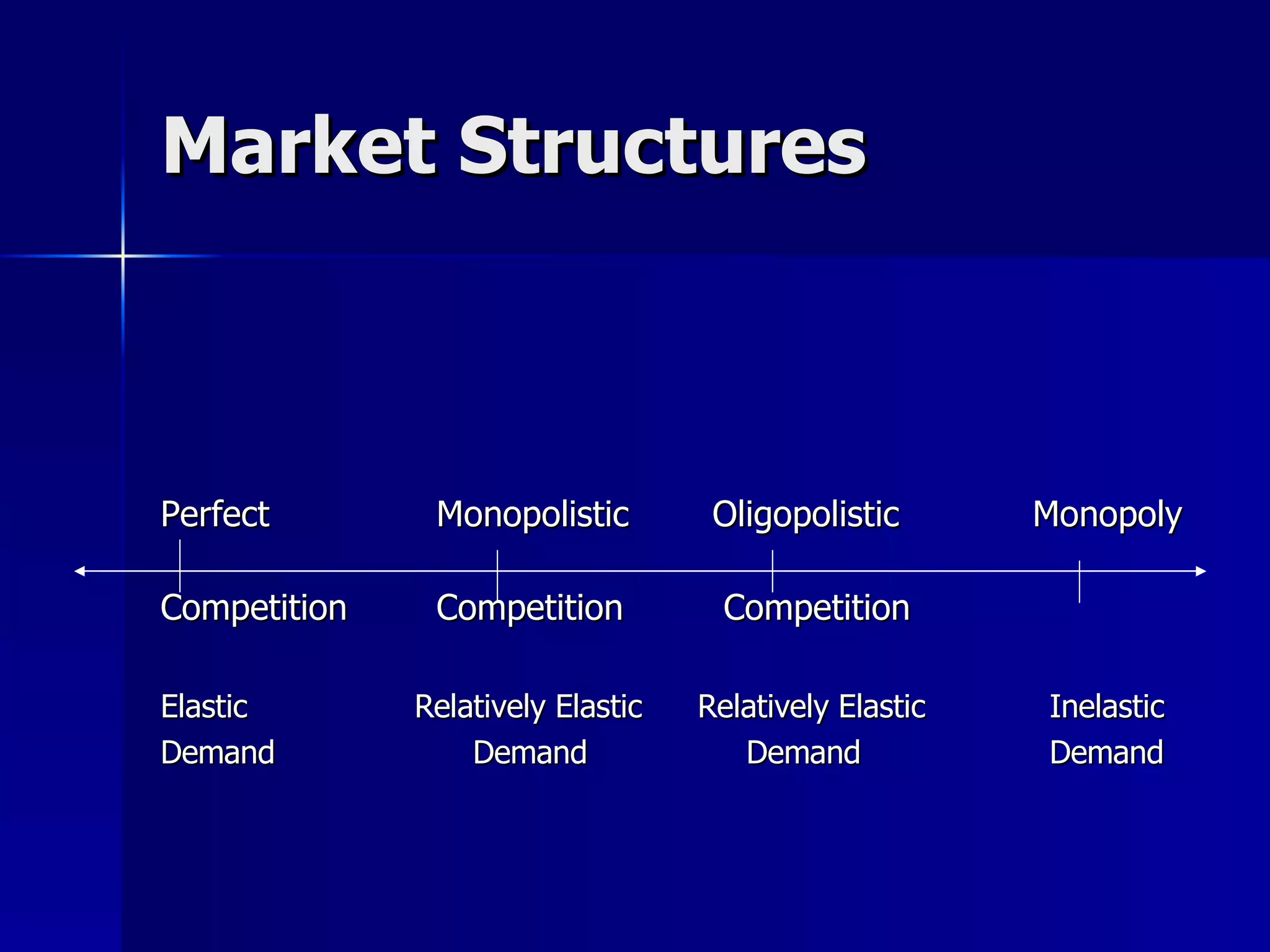
Market Structures Perfect   Monopolistic   Oligopolistic    Monopoly Competition   Competition   Competition Elastic Relatively Elastic    Relatively Elastic Inelastic Demand   Demand   Demand   Demand
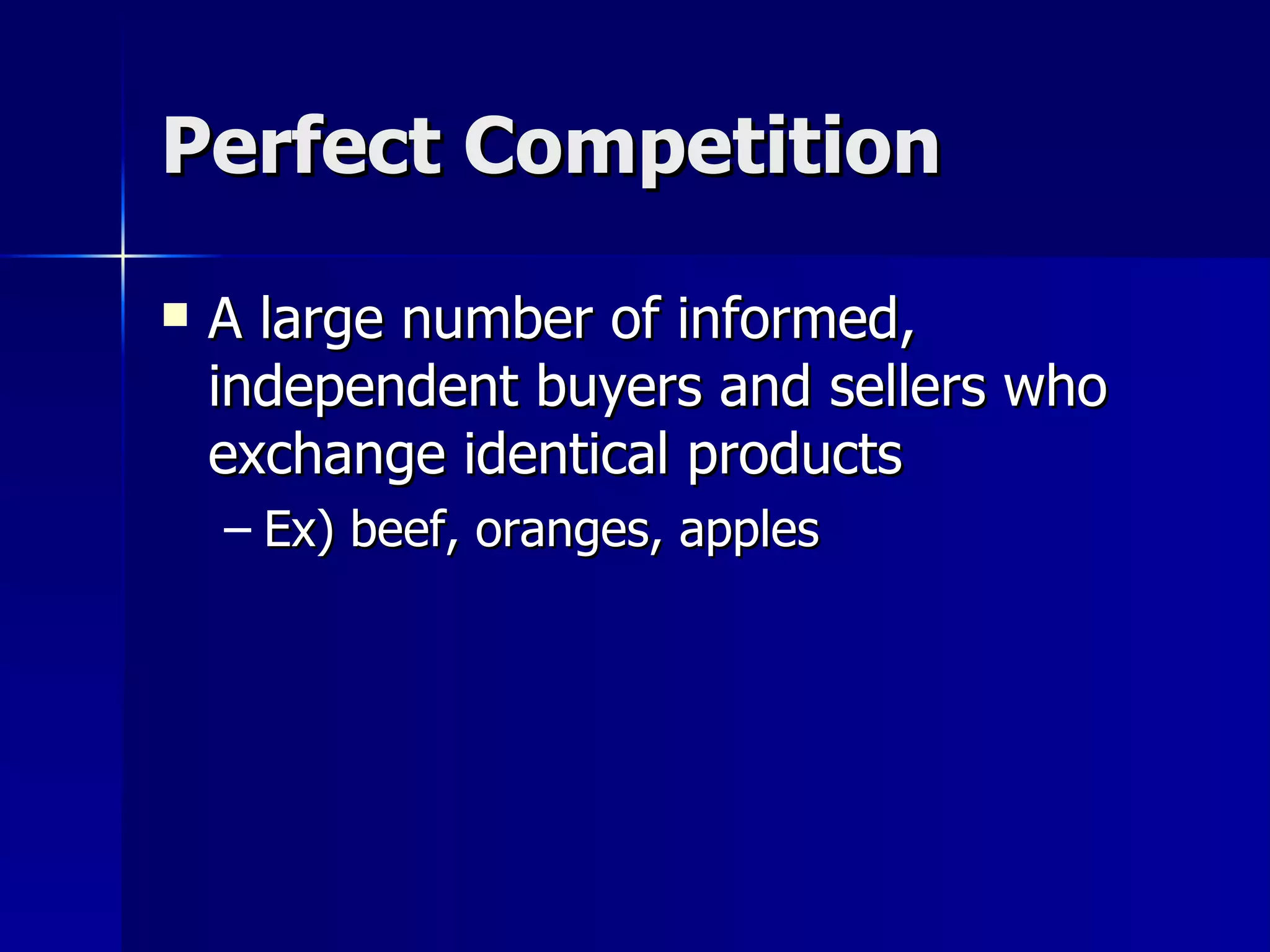
Perfect Competition A large number of informed, independent buyers and sellers who exchange identical products Ex) beef, oranges, apples
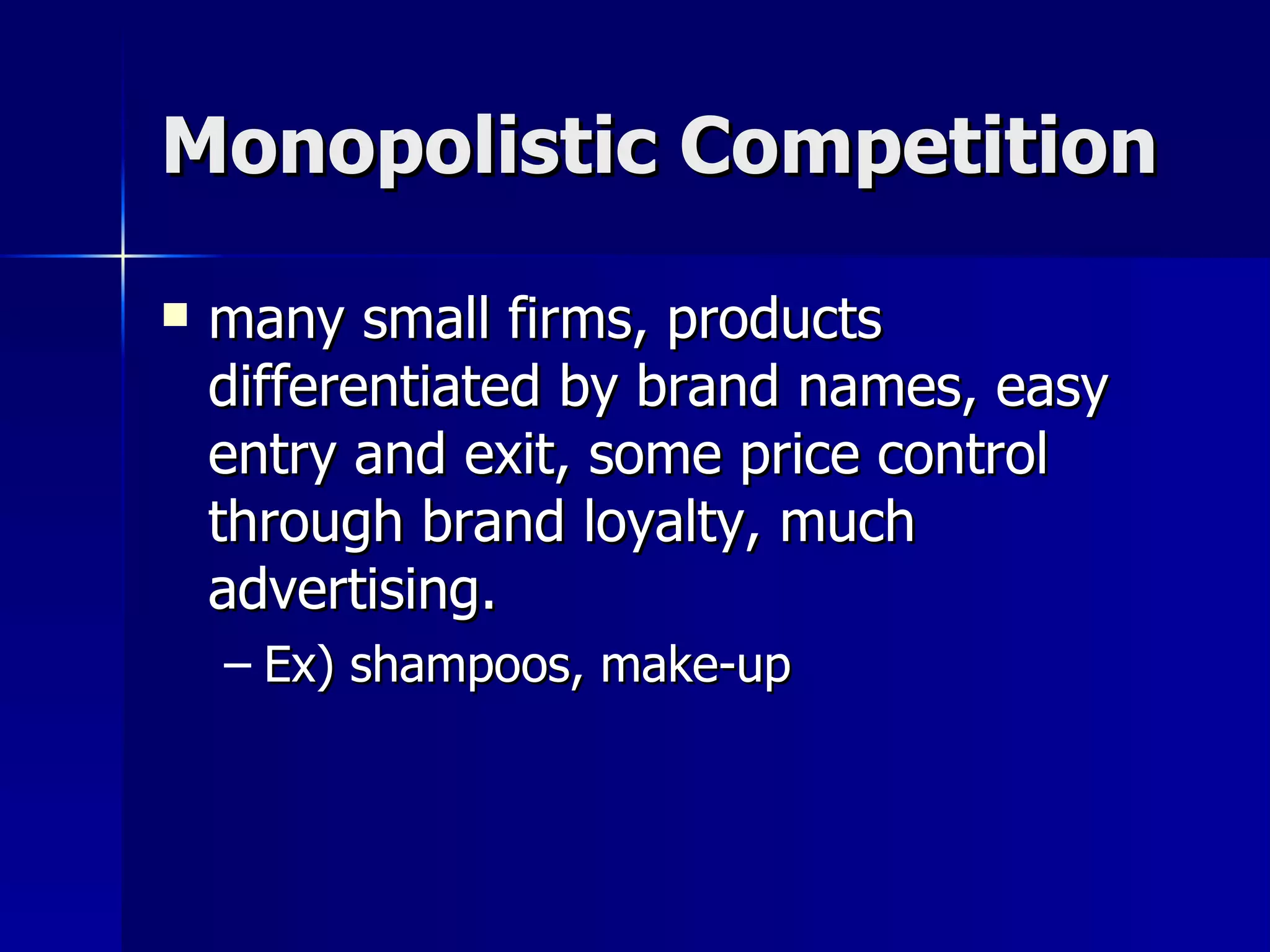
Monopolistic Competition many small firms, products differentiated by brand names, easy entry and exit, some price control through brand loyalty, much advertising. Ex) shampoos, make-up
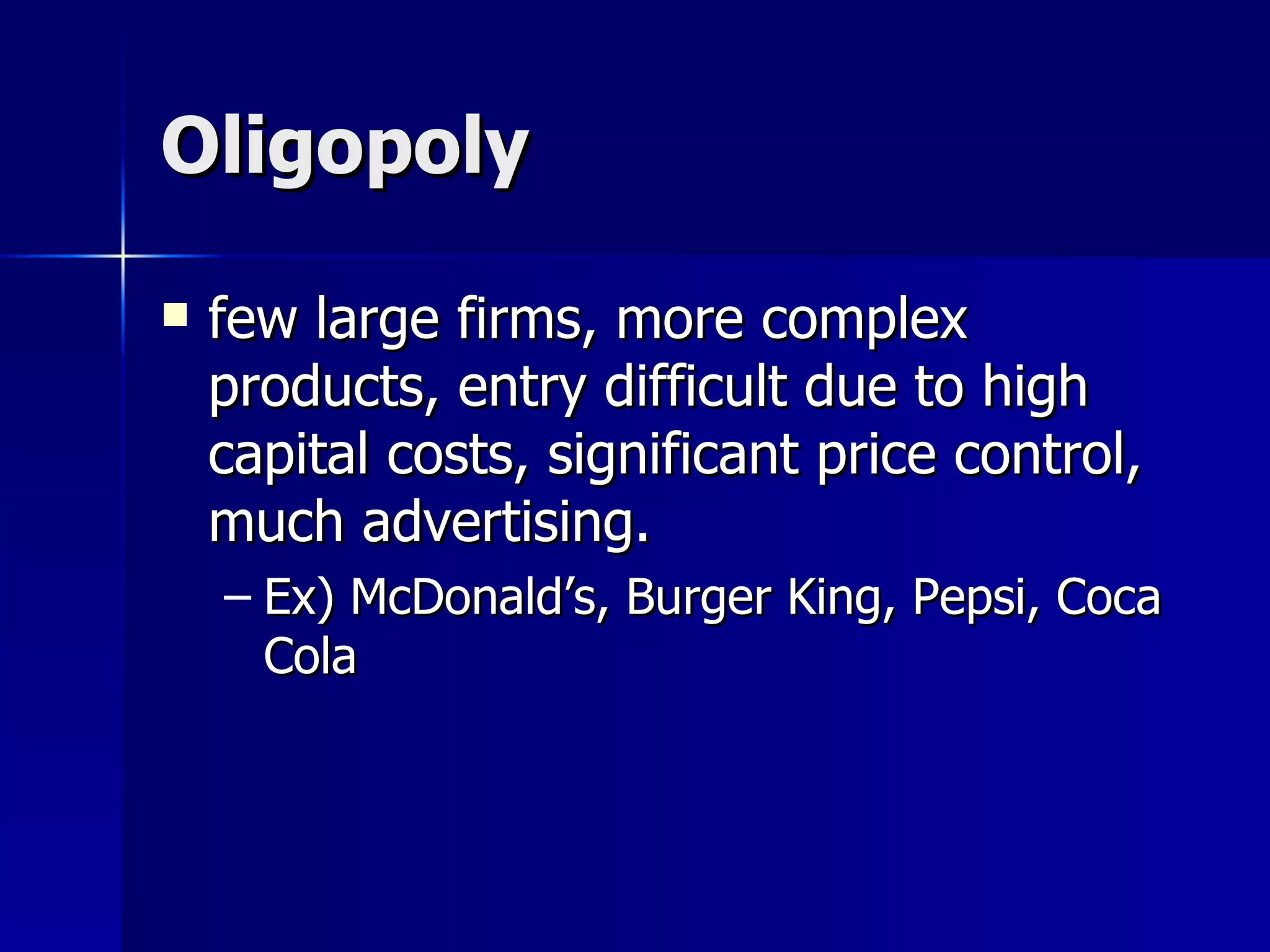
Oligopoly few large firms, more complex products, entry difficult due to high capital costs, significant price control, much advertising. Ex) McDonald’s, Burger King, Pepsi, Coca Cola
Monopoly single large firm, unique product, blocked entry, absolute price control. Ex) utility companies: National Fuel, National Grid
Natural Monopolies Natural monopolies are legal in the United States, and are apparent in all areas of the country.  Some examples include National Fuel and other utility companies. Natural monopolies only work where the good involved has an inelastic demand where people have to buy even if prices go up!
What are the causes of Market Failures? Inadequate information Inadequate competition Immobile resources Prices do not reflect the costs of production
What are externalities? An unintended side effect that either benefits or harms a third party
Negative externality An unintended side effect that harms a third party Example new airport built, people who live near that airport are bothered by the noise and traffic
Positive externality An unintended side effect that benefits a third party Example new airport built, restaurants and hotels near that airport see an increase in business
The cost of doing business Fixed costs/overhead: The costs businesses incur even when not producing anything Examples: Rent, executive salaries, taxes and  depreciation  (wear and tear on  capital goods  used in production)
Variable cost A cost that changes with business output, labor, raw materials, utilities A factory wants to increase production, so they add a third shift.  How will their variable costs increase?
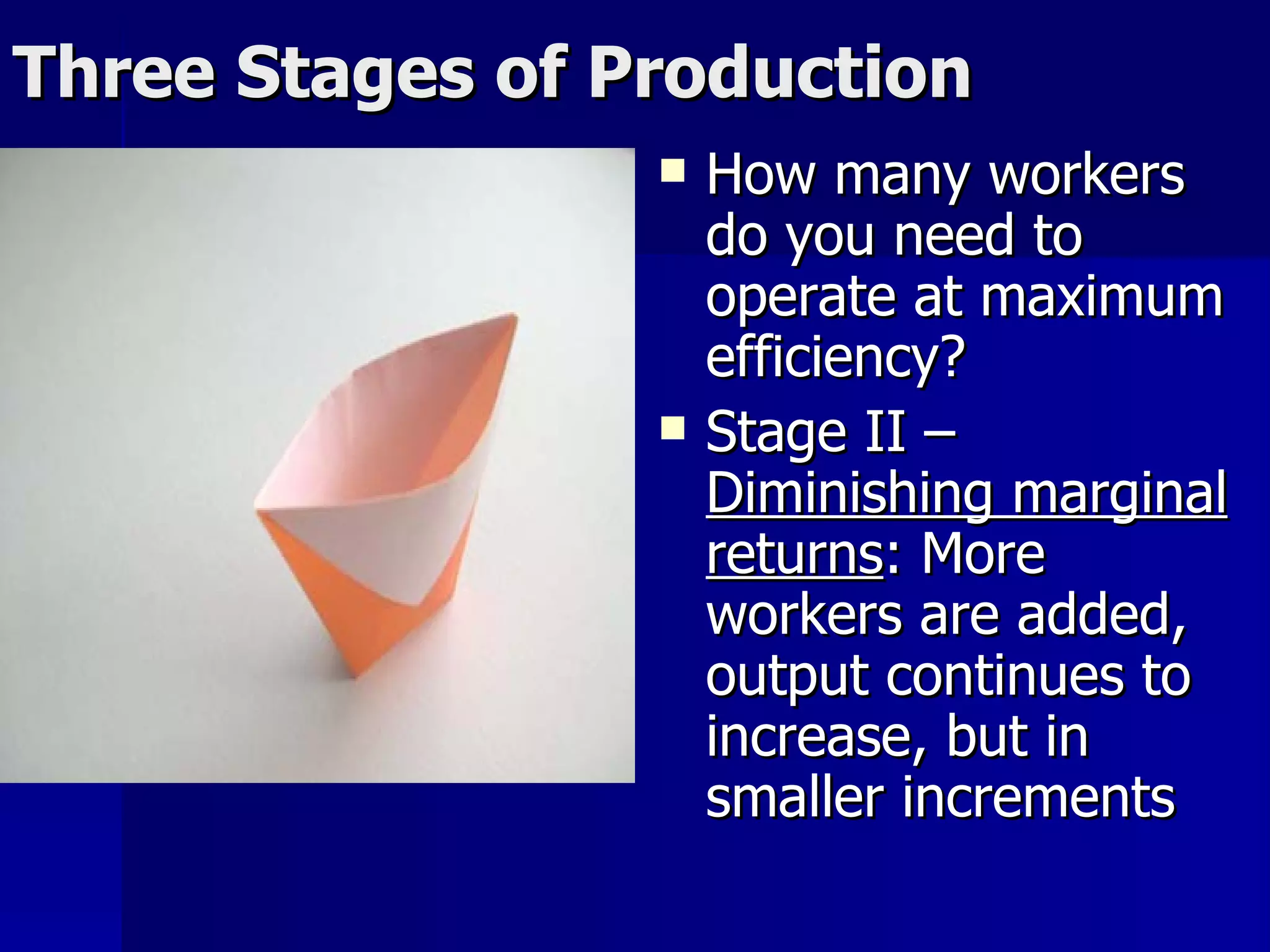
The stages of production
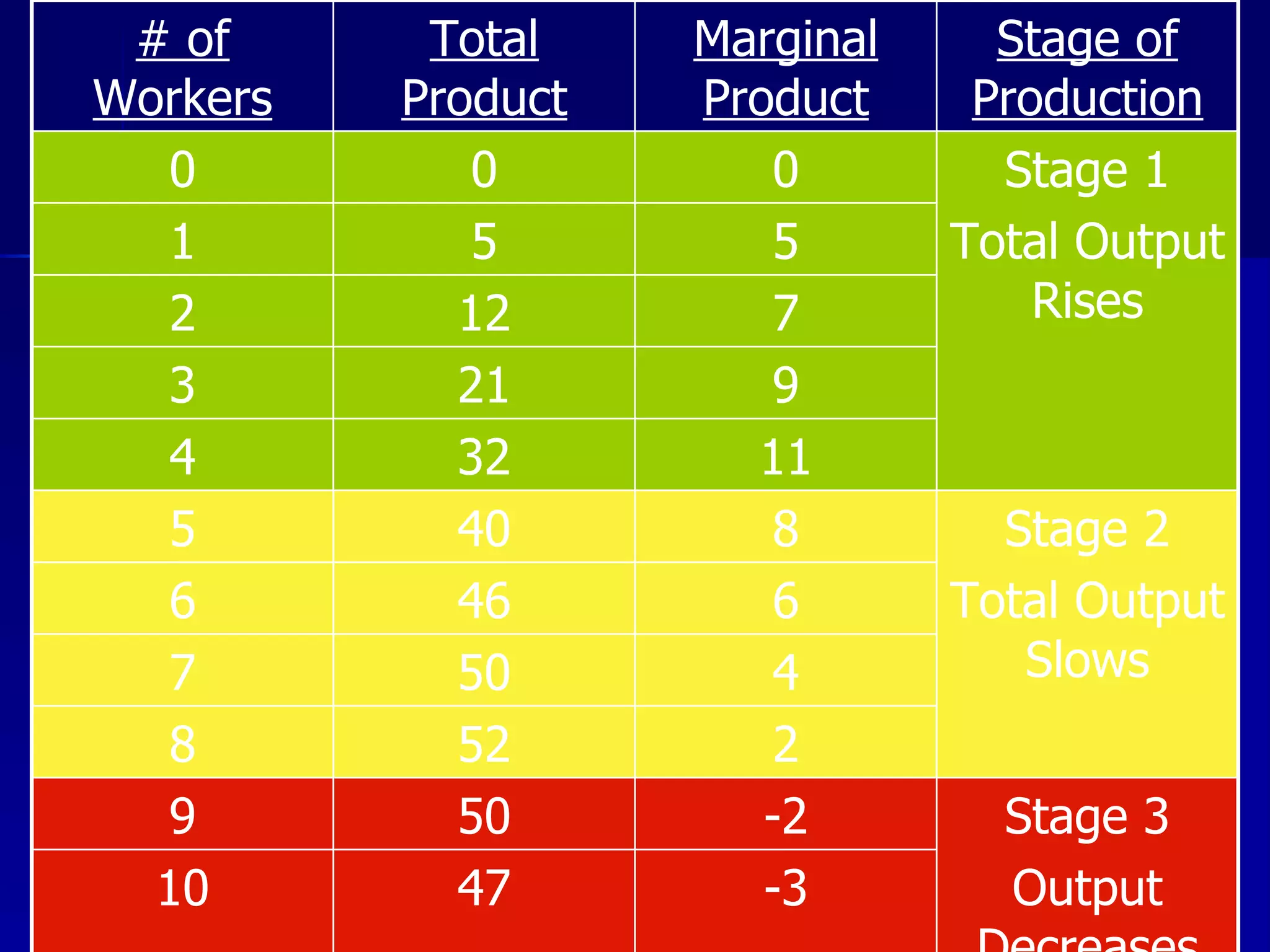
Three Stages of Production How many workers do you need to operate at maximum efficiency? Stage I –  Increasing returns : first, there are more resources than workers (inefficient), as more workers are hired, production becomes more and more efficient (more workers are added, output increases)
Three Stages of Production How many workers do you need to operate at maximum efficiency? Stage II –  Diminishing marginal returns : More workers are added, output continues to increase, but in smaller increments
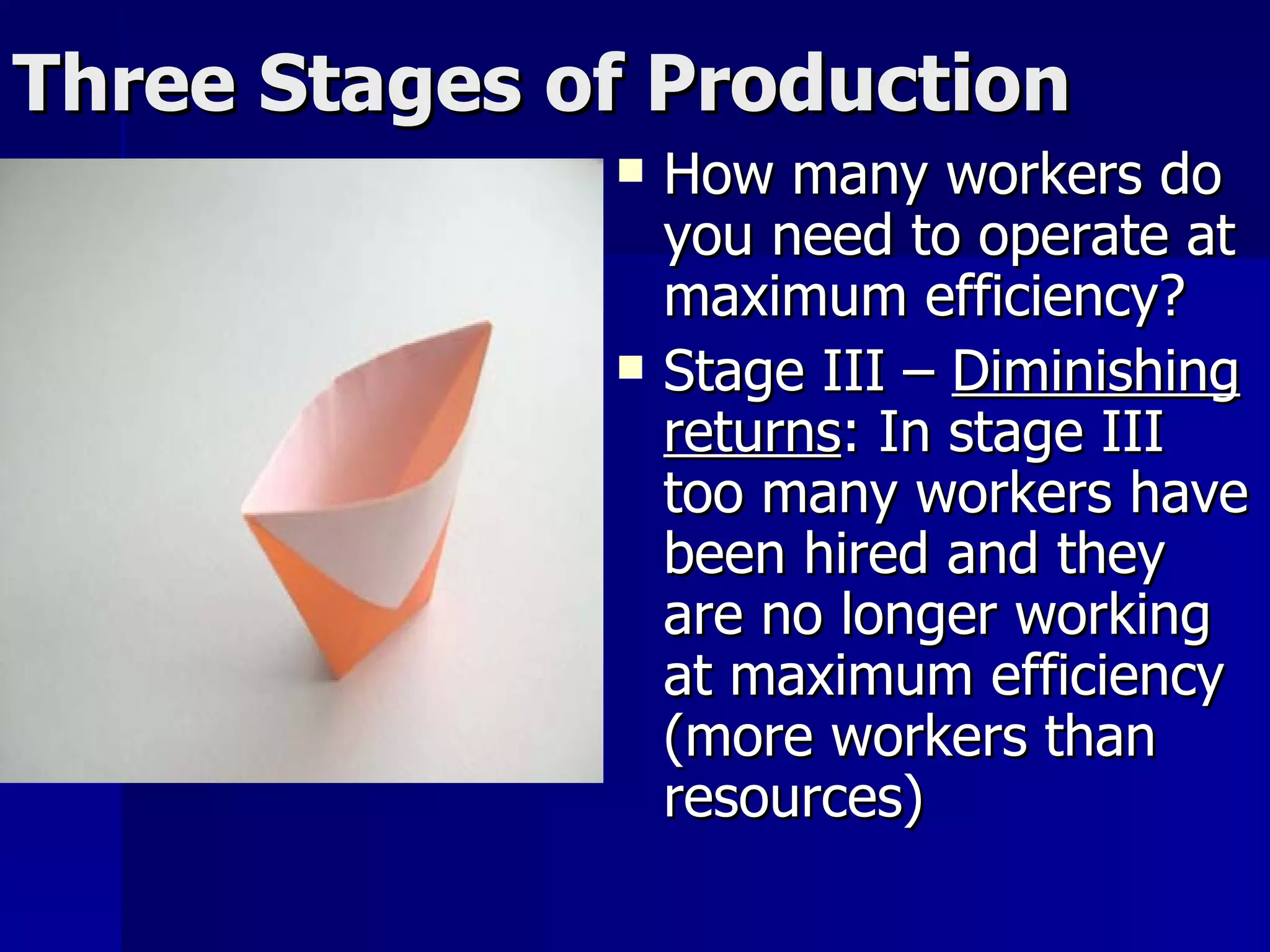
Three Stages of Production How many workers do you need to operate at maximum efficiency? Stage III –  Diminishing returns : In stage III too many workers have been hired and they are no longer working at maximum efficiency (more workers than resources)
-3 47 10 Stage 3 Output Decreases -2 50 9 2 52 8 4 50 7 6 46 6 Stage 2 Total Output Slows 8 40 5 11 32 4 9 21 3 7 12 2 5 5 1 Stage 1 Total Output Rises 0 0 0 Stage of Production Marginal Product Total Product # of Workers
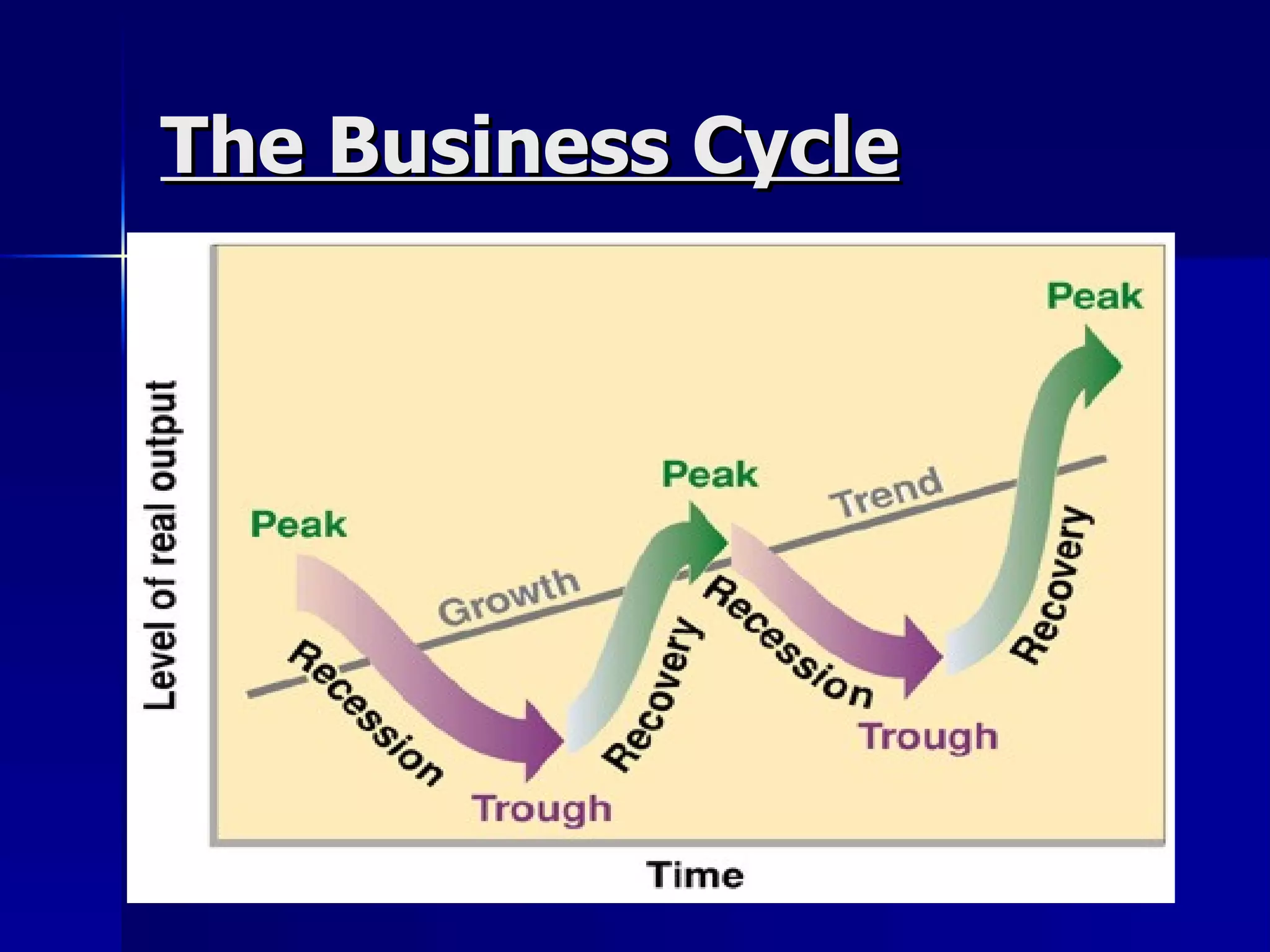
The Business Cycle
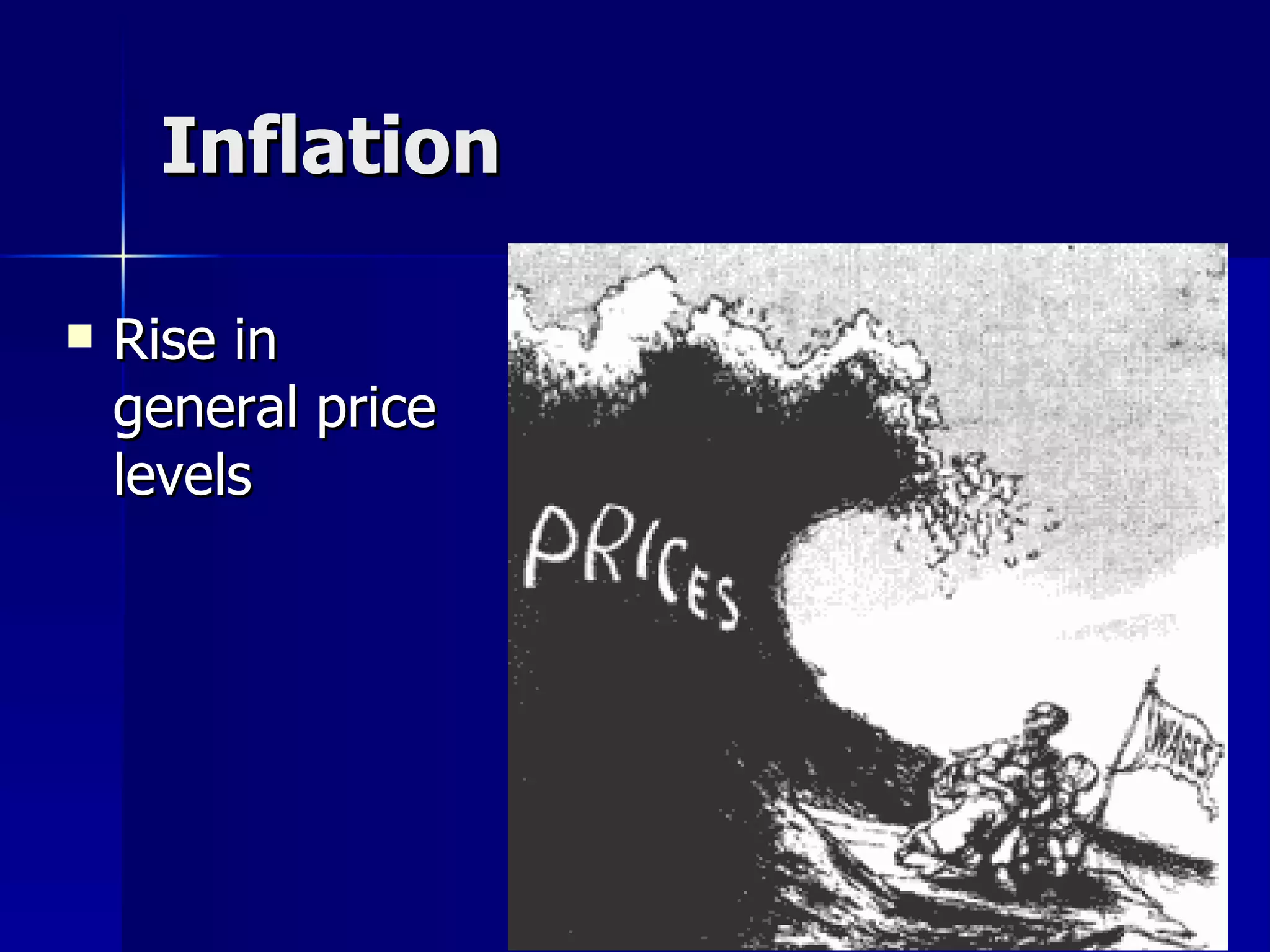
Inflation Rise in general price levels
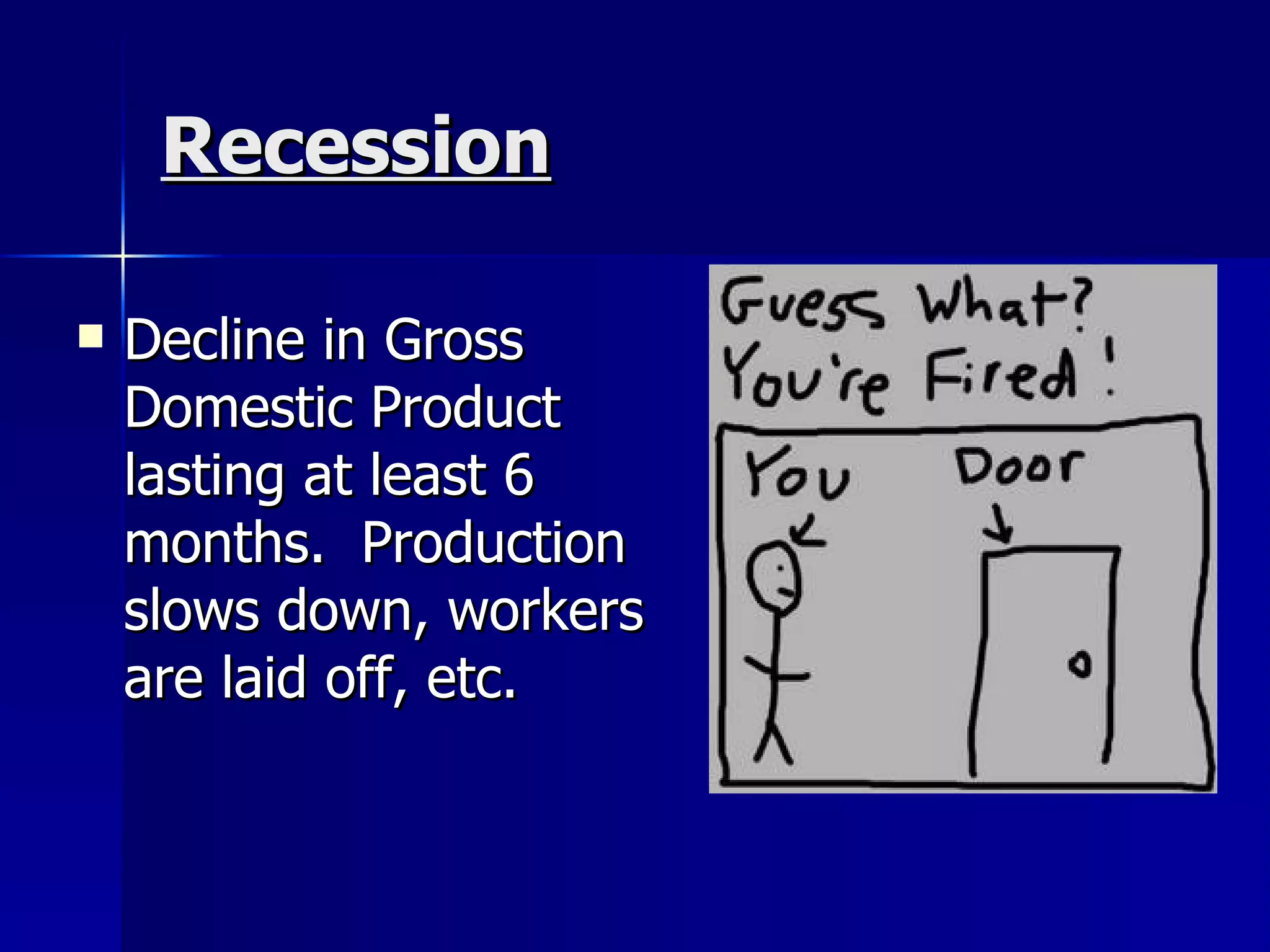
Recession Decline in Gross Domestic Product lasting at least 6 months.  Production slows down, workers are laid off, etc.
How does the FED try to control inflation and recession? 1) Discount interest rate 2) Fractional reserve requirement
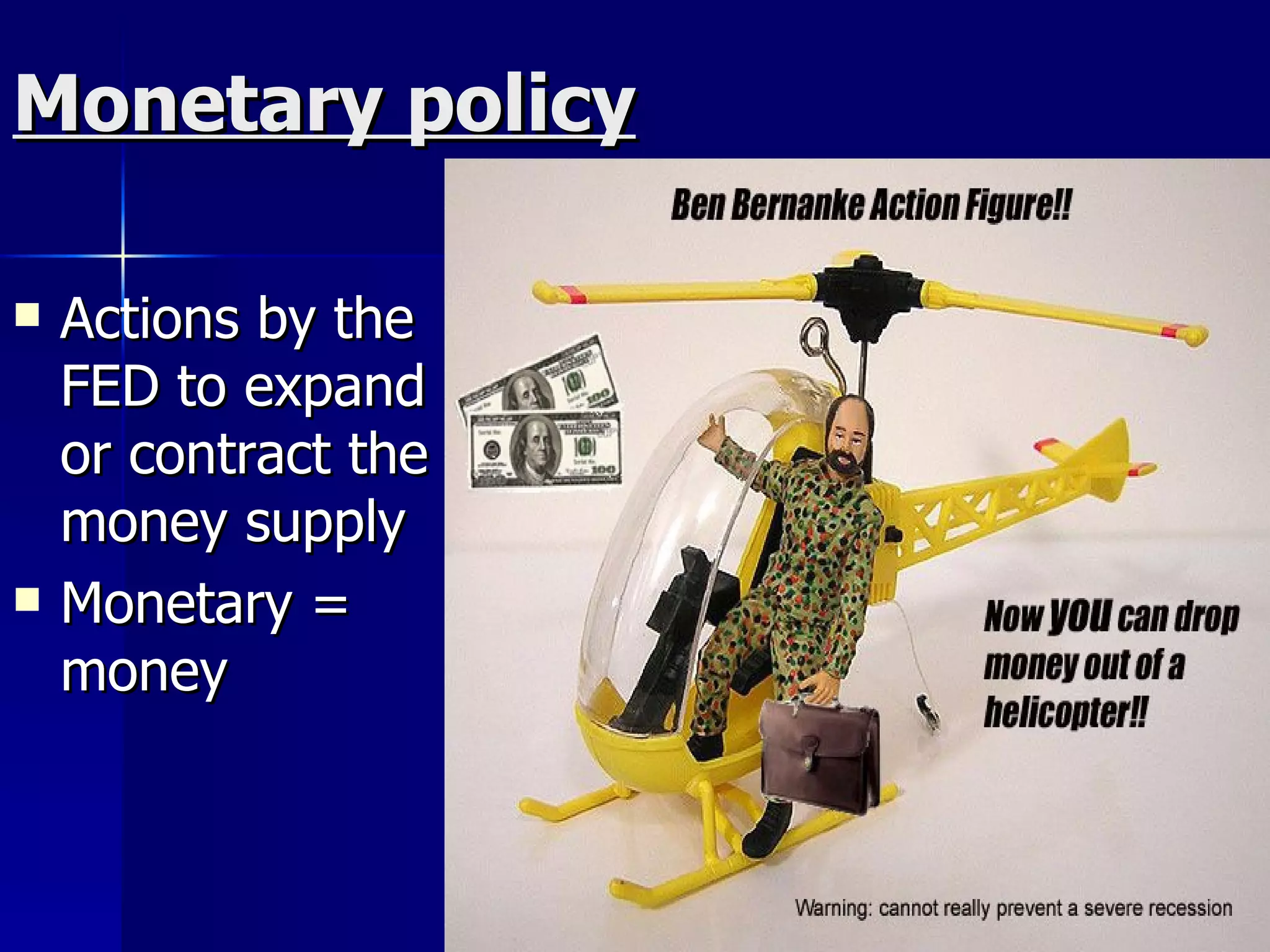
Monetary policy Actions by the FED to expand or contract the money supply Monetary = money
Discount Interest rate The FED loans money to banks at a percentage of interest, the bank then loans consumers money at a higher percentage to consumers. Example FED loans M&T money at 4%, M&T loans consumers money at 6%.
Discount Interest Rate So, when times are bad (recession, not enough money in circulation), the FED lowers the discount interest rate.  That way, the bank lowers their interest rate, then people borrow and spend more money
Discount Interest Rate When times are too good (inflation, too much money in circulation) the FED raises the discount interest rate. That way, the bank raises their interest rate, then people borrow and spend less money
Fractional Reserve Requirement The FED requires banks to keep a portion of their deposits on reserve. For example, The Fed may require banks to keep 10% of their total deposits on reserve. That means the bank can loan out 90% of their money
Fractional Reserve Requirement During  inflationary  periods, there is too much money in circulation, so the FED  raises  the Fractional reserve requirement so that banks have less money to lend out During a  recessionary  period, there is too little money in circulation, so the FED  lowers  the fractional reserve requirement so that banks have more money to lend out.
To freely trade or not to freely trade? Free trader There should be no barriers to trade between nations Protectionist Countries should use tools like tariffs and quotas to protect their farmers and producers from cheap, foreign goods
Protectionism Tariff: A tax on foreign goods  Quota: A limit on the number of a particular foreign good that can be imported
Comparative Advantage International trade is based on the idea of comparative advantage. Comparative advantage is the idea that some places are better at producing particular things than other places
How much is the dollar worth? When the US dollar is compared to other countries’ currency, that is called the  foreign exchange rate . For example, one Euro ( €) is currently worth $1.4877

High School Economics, Final Review

  • 1.
  • 2.
    What is thestudy of economics? How to meet unlimited wants with scarce resources Economists study how to meet people’s unlimited wants with scarce, available resources
  • 3.
    THE FACT THATWE MUST DEAL WITH SCARCITY FORCES US TO MAKE CHOICES CONSTANTLY Trade-off: the choice that one makes whenever making economic decisions Opportunity cost: the cost of the next best alternative when one choice is made, ex) money, time, resources, etc).
  • 4.
    Production Possibilities FrontierA graphical representation of how an economy makes decisions on what to produce. Production Possibilities Curve shows the choices a country can make with respect to its available resources.
  • 5.
  • 6.
    Production Possibility FrontierThe PPF shows all efficient combinations of output, when the factors of production are used to their full potential. As more of one product is produced, increasingly larger amounts of the other product must be given up. the opportunity cost increases as one moves toward either extreme on the curve of production possibilities.
  • 7.
    Tools economists useEconomists demonstrate real-world relationships using economic models Economists use the term efficiency to measure marginal costs, and the term productivit y to measure production levels.
  • 8.
    Know the differenteconomic systems How do these systems answer the basic economic questions? 1) What to produce 2) How to produce it? 3) For whom to produce?
  • 9.
    Traditional Economies 1)What to produce? Whatever ritual, habit or custom dictates 2) How to produce? However ritual, habit or custom dictate 3) For whom to produce? For whomever ritual, habit or custom dictate Examples: Australian aborigines, the Mbuti of Central Africa, The Inuit
  • 10.
    Command Economies 1)What to produce? Whatever the government says to produce 2) How to produce? However the government tells you to produce 3) For whom to produce? For whomever the government tells you to produce (ideally the entire society) Examples: Cuba, North Korea
  • 11.
    Market Economy Basiceconomic questions answered by consumers Dollars=Votes What to produce? Whatever consumers want (demand) How to produce? However business owners want, usually at maximum efficiency (production possibility frontier) in order to maximize profits For whom to produce? For whomever will buy it
  • 12.
    Examples of marketeconomies The U.S. Canada, U.K., France, Germany, etc. Remember these aren’t completely free market system. There is a level of government control and regulation, therefore : these are MIXED ECONOMIC SYSTEMS .
  • 13.
    The 4 factorsof production Land : Gifts of the earth/Natural resources (oil, diamonds, etc.) Labor : people who work Capital (goods) : The things needed to produce a good or service (sewing machine, oven, etc.) Entrepreneur : Risk-taking individual who organizes the other 3 factors of production in order to make a profit
  • 14.
    Law of SupplyAs Price goes up, quantity will go up As Price goes down, quantity goes down
  • 15.
    Supply Curve Illustratesthe Law of Supply
  • 16.
    Supply Elasticity Supplycan be: Elastic Inelastic Unit Elastic
  • 17.
    Elasticity of SupplyElastic: When price rises, quantity supplied rises considerably. Ex: price rises 20% quantity supplied rises 50%
  • 18.
    Elasticity of SupplyInelastic : When price rises, quantity supplied does not rise considerably. Ex: price rises 20% quantity supplied rises 5%
  • 19.
    Elasticity of SupplyUnit Elastic : When price rises, quantity supplied rises proportionally. Ex: price rises 20% quantity supplied rises 20%
  • 20.
    Law of DemandAs the price of a product decreases, the demand for the product will increase. This is an example of an inverse relationship.
  • 21.
  • 22.
    Elasticity Elastic: Asthe price for a product decreases by half, the demand for the product increases 100%. More than proportional!
  • 23.
    Elasticity Inelastic Asthe price for a product increases by 25%, the demand for the product decreases by 10%. Less than proportional!
  • 24.
    Elasticity Unit ElasticAs the price of the product triples, the demand for the product decreases by 300%. Proportional!
  • 25.
    If prices wereto stay the same, what then could change demand?
  • 26.
    Compliments Compliments aregoods that are related. You need to have both in order to use them
  • 27.
    Compliments If theprice of DVD players goes down, then the demand for DVD’s goes up If the price of Gillette razor handles goes up, then the demand for the razor blades goes down
  • 28.
    Substitutes The demandfor a product tends to decrease if the price of its substitute decreases What are some substitute products?
  • 29.
    Substitutes If theprice of butter goes up, then the demand for margarine will go up. If the price of sugar goes up, then the demand for Splenda© will go up
  • 30.
    Utility & DemandUtility: The usefulness or satisfaction one gets from consuming a good or service (one slice of pizza is good) Marginal utility: The extra usefulness or satisfaction one gets from consuming a good or service (two slices of pizza is better) Diminishing marginal utility: the more we consume of something, the less satisfying or useful it becomes (eating an entire pizza makes one feel sick)
  • 31.
    Supply & DemandCurves S1 e Price D1 Quantity
  • 32.
    Price Who getsto set prices in a market economy? Consumers AND producers – prices are the result of competition between buyers and sellers
  • 33.
    Circular Flow ofEconomic Activity Factor Market Producer Product Market Consumer Goods &Services Land Labor Capital Land, Labor, Capital Goods & Services $ $ $ $ $ $$$$$$$ $ $ $ $ $ $$$$$$$$$
  • 34.
    Businesses may beorganized in a variety of ways 1) Sole Proprietorship 2) Partnership 3) Corporation
  • 35.
    Sole Proprietorships Themost common form of business organization in the United States The most profitable of all business organizations This is a business owned and run by one person Smallest size of business organization
  • 36.
    Partnerships Types ofpartnerships General Partnerships: all partners are responsible for the management and financial obligation of the business (most common form of partnership) Limited Partnerships : at least one partner is not active in the daily running of the business
  • 37.
    Corporations Corporations accountfor 1/5 of all firms in the U.S. and 90% of all sales A corporation is a form of business organization recognized by law as a separate legal entity having all the rights of an individual
  • 38.
    Forming a CorporationPeople must ask the government for permission to incorporate This is done through a corporate charter which is a government document giving individuals the right to incorporate
  • 39.
    Corporate Formation…cont’ Acorporate charter specifies the number of shares of stock , or ownership certificates in the firm These shares are sold to investors who are called stockholders or shareholders If the company is successful, it will issue a dividend a check representing a portion of corporate earnings to each stockholder
  • 40.
  • 41.
  • 42.
    The Role ofGovernment 1) To protect the consumer from dangerous products and unscrupulous businesspeople (USDA, FDA, OSHA, etc.) 2) To provide the consumer with goods and services and to consume goods and services from producers. Provider: streets, parks, education, buses, garbage pickup, etc. Consumer: the government is now the second largest consuming sector of society, second only to the actual consumer sector
  • 43.
    Promoter of NationalGoals The government modifies the economic systems to promote its goals. Social security, child labor laws, minimum wage laws, etc.
  • 44.
    We live ina modified economic system People carry on their economic activity freely, but are subject to some government intervention and regulation This is not a laissez-faire economy
  • 45.
    One form ofgovernment regulation is the Securities and Exchange Commission (SEC) SEC: The federal agency that regulates activity in the securities markets, and protects the public against malpractice by broker-dealers. They regulate the stock market
  • 46.
    Consumer vs. CapitalGoods Consumer good: A good intended for use by consumers, ex: car or telephone Capital good: A good used by businesses to produce other goods, ex: robotic arm for car factory, microchip for phone
  • 47.
    Public Goods Aneconomic good that is consumed by the public or collectively 1) National defense 2) 3) 4)
  • 48.
    Public Goods Publicgoods are products everyone consumes The market does not supply such goods because it produces only items that can be withheld if people refuse to pay for them If public goods are to be supplied, the government usually has to provide them.
  • 49.
    Privatization Taking thingsthat were public goods and selling them to private companies
  • 50.
    Market Structures Perfect Monopolistic Oligopolistic Monopoly Competition Competition Competition Elastic Relatively Elastic Relatively Elastic Inelastic Demand Demand Demand Demand
  • 51.
    Perfect Competition Alarge number of informed, independent buyers and sellers who exchange identical products Ex) beef, oranges, apples
  • 52.
    Monopolistic Competition manysmall firms, products differentiated by brand names, easy entry and exit, some price control through brand loyalty, much advertising. Ex) shampoos, make-up
  • 53.
    Oligopoly few largefirms, more complex products, entry difficult due to high capital costs, significant price control, much advertising. Ex) McDonald’s, Burger King, Pepsi, Coca Cola
  • 54.
    Monopoly single largefirm, unique product, blocked entry, absolute price control. Ex) utility companies: National Fuel, National Grid
  • 55.
    Natural Monopolies Naturalmonopolies are legal in the United States, and are apparent in all areas of the country. Some examples include National Fuel and other utility companies. Natural monopolies only work where the good involved has an inelastic demand where people have to buy even if prices go up!
  • 56.
    What are thecauses of Market Failures? Inadequate information Inadequate competition Immobile resources Prices do not reflect the costs of production
  • 57.
    What are externalities?An unintended side effect that either benefits or harms a third party
  • 58.
    Negative externality Anunintended side effect that harms a third party Example new airport built, people who live near that airport are bothered by the noise and traffic
  • 59.
    Positive externality Anunintended side effect that benefits a third party Example new airport built, restaurants and hotels near that airport see an increase in business
  • 60.
    The cost ofdoing business Fixed costs/overhead: The costs businesses incur even when not producing anything Examples: Rent, executive salaries, taxes and depreciation (wear and tear on capital goods used in production)
  • 61.
    Variable cost Acost that changes with business output, labor, raw materials, utilities A factory wants to increase production, so they add a third shift. How will their variable costs increase?
  • 62.
    The stages ofproduction
  • 63.
    Three Stages ofProduction How many workers do you need to operate at maximum efficiency? Stage I – Increasing returns : first, there are more resources than workers (inefficient), as more workers are hired, production becomes more and more efficient (more workers are added, output increases)
  • 64.
    Three Stages ofProduction How many workers do you need to operate at maximum efficiency? Stage II – Diminishing marginal returns : More workers are added, output continues to increase, but in smaller increments
  • 65.
    Three Stages ofProduction How many workers do you need to operate at maximum efficiency? Stage III – Diminishing returns : In stage III too many workers have been hired and they are no longer working at maximum efficiency (more workers than resources)
  • 66.
    -3 47 10Stage 3 Output Decreases -2 50 9 2 52 8 4 50 7 6 46 6 Stage 2 Total Output Slows 8 40 5 11 32 4 9 21 3 7 12 2 5 5 1 Stage 1 Total Output Rises 0 0 0 Stage of Production Marginal Product Total Product # of Workers
  • 67.
  • 68.
    Inflation Rise ingeneral price levels
  • 69.
    Recession Decline inGross Domestic Product lasting at least 6 months. Production slows down, workers are laid off, etc.
  • 70.
    How does theFED try to control inflation and recession? 1) Discount interest rate 2) Fractional reserve requirement
  • 71.
    Monetary policy Actionsby the FED to expand or contract the money supply Monetary = money
  • 72.
    Discount Interest rateThe FED loans money to banks at a percentage of interest, the bank then loans consumers money at a higher percentage to consumers. Example FED loans M&T money at 4%, M&T loans consumers money at 6%.
  • 73.
    Discount Interest RateSo, when times are bad (recession, not enough money in circulation), the FED lowers the discount interest rate. That way, the bank lowers their interest rate, then people borrow and spend more money
  • 74.
    Discount Interest RateWhen times are too good (inflation, too much money in circulation) the FED raises the discount interest rate. That way, the bank raises their interest rate, then people borrow and spend less money
  • 75.
    Fractional Reserve RequirementThe FED requires banks to keep a portion of their deposits on reserve. For example, The Fed may require banks to keep 10% of their total deposits on reserve. That means the bank can loan out 90% of their money
  • 76.
    Fractional Reserve RequirementDuring inflationary periods, there is too much money in circulation, so the FED raises the Fractional reserve requirement so that banks have less money to lend out During a recessionary period, there is too little money in circulation, so the FED lowers the fractional reserve requirement so that banks have more money to lend out.
  • 77.
    To freely tradeor not to freely trade? Free trader There should be no barriers to trade between nations Protectionist Countries should use tools like tariffs and quotas to protect their farmers and producers from cheap, foreign goods
  • 78.
    Protectionism Tariff: Atax on foreign goods Quota: A limit on the number of a particular foreign good that can be imported
  • 79.
    Comparative Advantage Internationaltrade is based on the idea of comparative advantage. Comparative advantage is the idea that some places are better at producing particular things than other places
  • 80.
    How much isthe dollar worth? When the US dollar is compared to other countries’ currency, that is called the foreign exchange rate . For example, one Euro ( €) is currently worth $1.4877