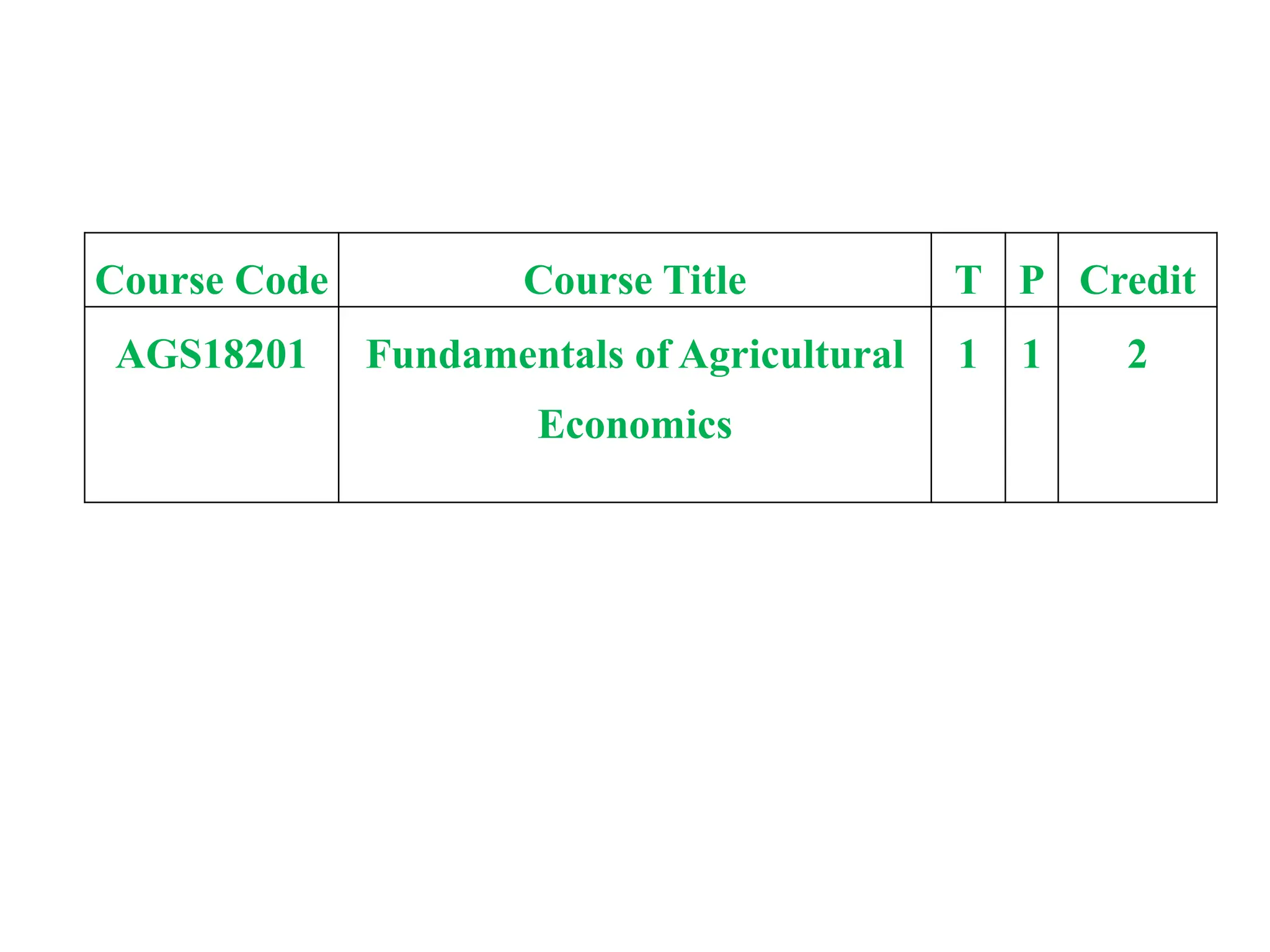
Course Code Course Title T P Credit
AGS18201 Fundamentals of Agricultural
Economics
1 1 2
Economics: Meaning, scope and subject matter, definitions,
activities, approaches to economic analysis; micro and macro
economics, positive and normative economics. Nature of
economic theory; rationality assumption, concept of
equilibrium, economic laws as generalization of human
behavior.
Lecture 1
Introduction
 For example, a farmer can grow paddy, sugarcane, banana, cotton etc.
in his garden land. But he has to choose a crop depending upon the
availability of irrigation water.
 Taking right decision among the alternatives of choice from the scarce
resource.
 Economics is the science that deals with production, exchange and
consumption of various commodities in economic systems.
 How scarce resources can be used to increase wealth and human
welfare.
 Scarcity induces people to make choices among alternatives, and the
knowledge of economics is used to take right decision.
Conti..
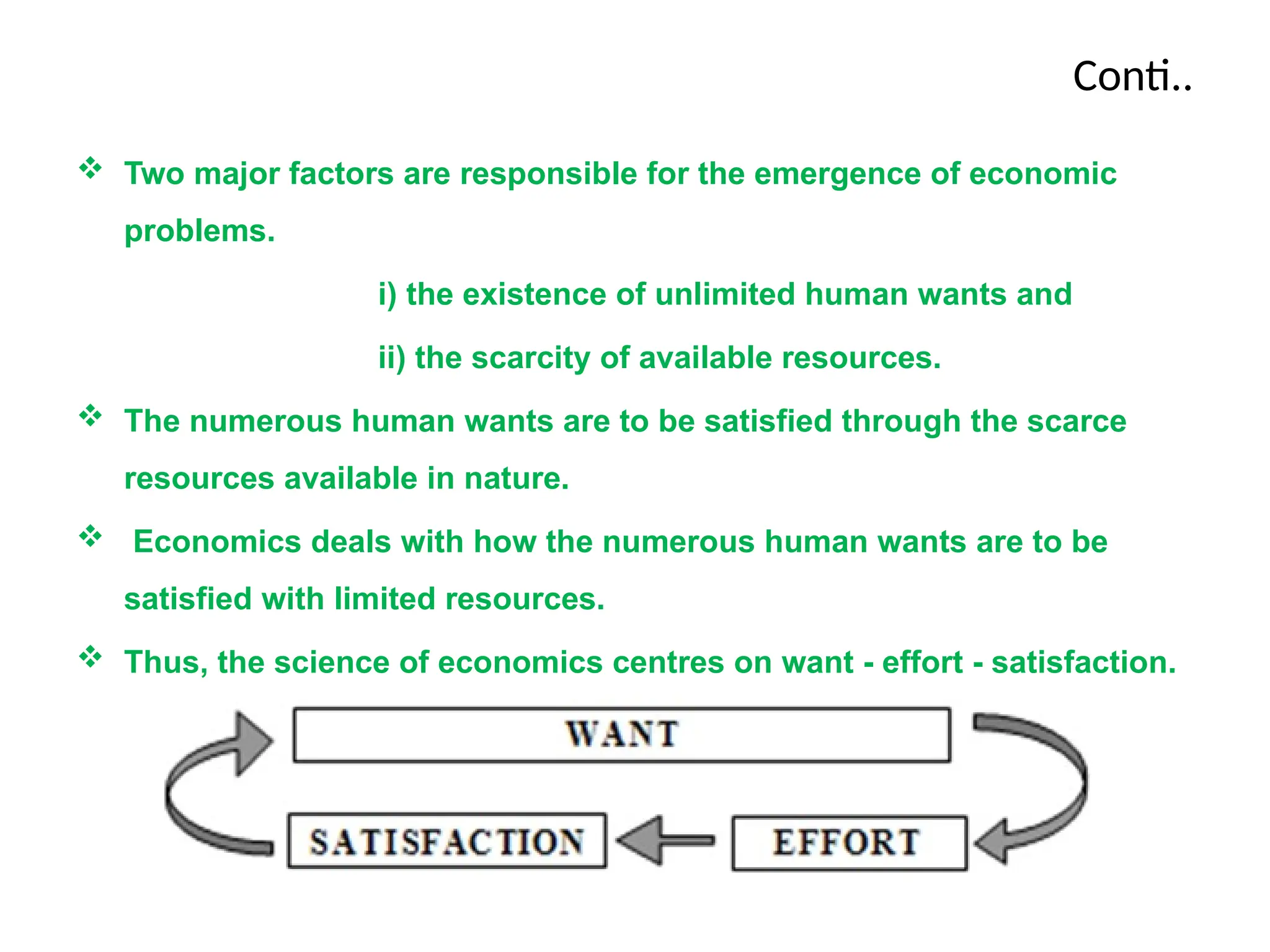
 Two major factors are responsible for the emergence of economic
problems.
i) the existence of unlimited human wants and
ii) the scarcity of available resources.
 The numerous human wants are to be satisfied through the scarce
resources available in nature.
 Economics deals with how the numerous human wants are to be
satisfied with limited resources.
 Thus, the science of economics centres on want - effort - satisfaction.
Definition of Economics
 The word ‘Economics’ was derived from two Greek words.
 oikos (a house) and nemein (to manage) which would mean ‘managing an household’ using
the limited funds available.
Political economy (Before 1776)
i.) Wealth Definition
 Adam smith (1723 - 1790), in his book “An Inquiry into Nature and Causes of Wealth of
Nations” (1776) defined economics as the science of wealth.
 Explained how a nation’s wealth is created.
 Individual in the society wants to promote only his own gain and in this, he is led by an
“invisible hand” to promote the interests of the society though he has no real intention to
promote the society’s interests.
Criticism:
 Smith defined economics only in terms of wealth and not in terms of human welfare.
 Ruskin and Carlyle condemned economics as a ‘dismal science’,
 Hence, wealth definition was rejected and the emphasis was shifted from ‘wealth’ to ‘welfare’.
ii) Welfare Definition
 Alfred Marshall (1842 - 1924) wrote a book “Principles of Economics”
(1890)
 According to Marshall, economics is a study of mankind in the
ordinary business of life, i.e., economic aspect of human life.
 Marshall makes a distinction between two types of things, viz. material
things and immaterial things. Material things are those that can be
seen, felt and touched, (E.g.) book, rice etc. Immaterial things are
those that cannot be seen, felt and touched.
 Marshall considered only the material things that are capable of
promoting welfare of people.
Criticism:
 Services of a doctor, a teacher and so on, also promote welfare of the people.
 Marshall makes a distinction between
(i) Things that are capable of promoting welfare of people
(ii) Things that are not capable of promoting welfare of people.
(E.g.) liquor, that is not capable of promoting welfare but commands a price, comes
under the purview of economics.
 Marshall’s definition is based on the concept of welfare. But there is no clear-
cut definition of welfare.
 Welfare varies from person to person, country to country and one period to
another.
 Welfare means happiness or comfortable living conditions of an individual or
group of people.
 Welfare is dependent not only on the stock of wealth possessed but also on
political, social and cultural activities of the nation.
iii) Scarcity Definition
Lionel Robbins “An Essay on the Nature and Significance of Economic
Science” in 1932.
“Economics is a science which studies human behaviour as a
relationship between ends and means which have alternative uses”.
The major features of Robbins’ definition are as follows:
a) Ends refer to human wants. Human beings have unlimited number of
wants.
b) Resources or means, on the other hand, are limited or scarce in
supply.
Thus, economics, according to Robbins, is a science of choice.
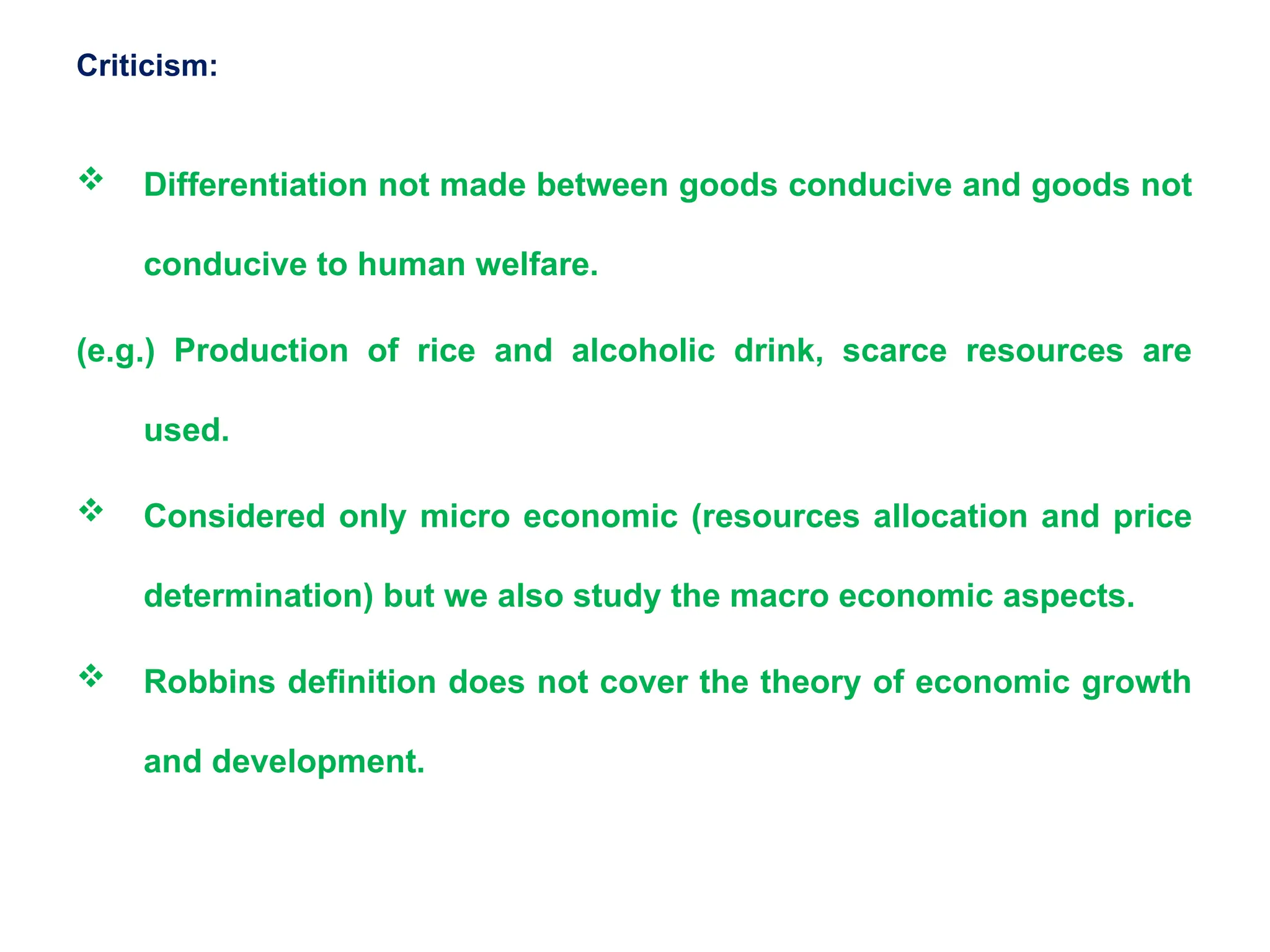
Criticism:
 Differentiation not made between goods conducive and goods not
conducive to human welfare.
(e.g.) Production of rice and alcoholic drink, scarce resources are
used.
 Considered only micro economic (resources allocation and price
determination) but we also study the macro economic aspects.
 Robbins definition does not cover the theory of economic growth
and development.
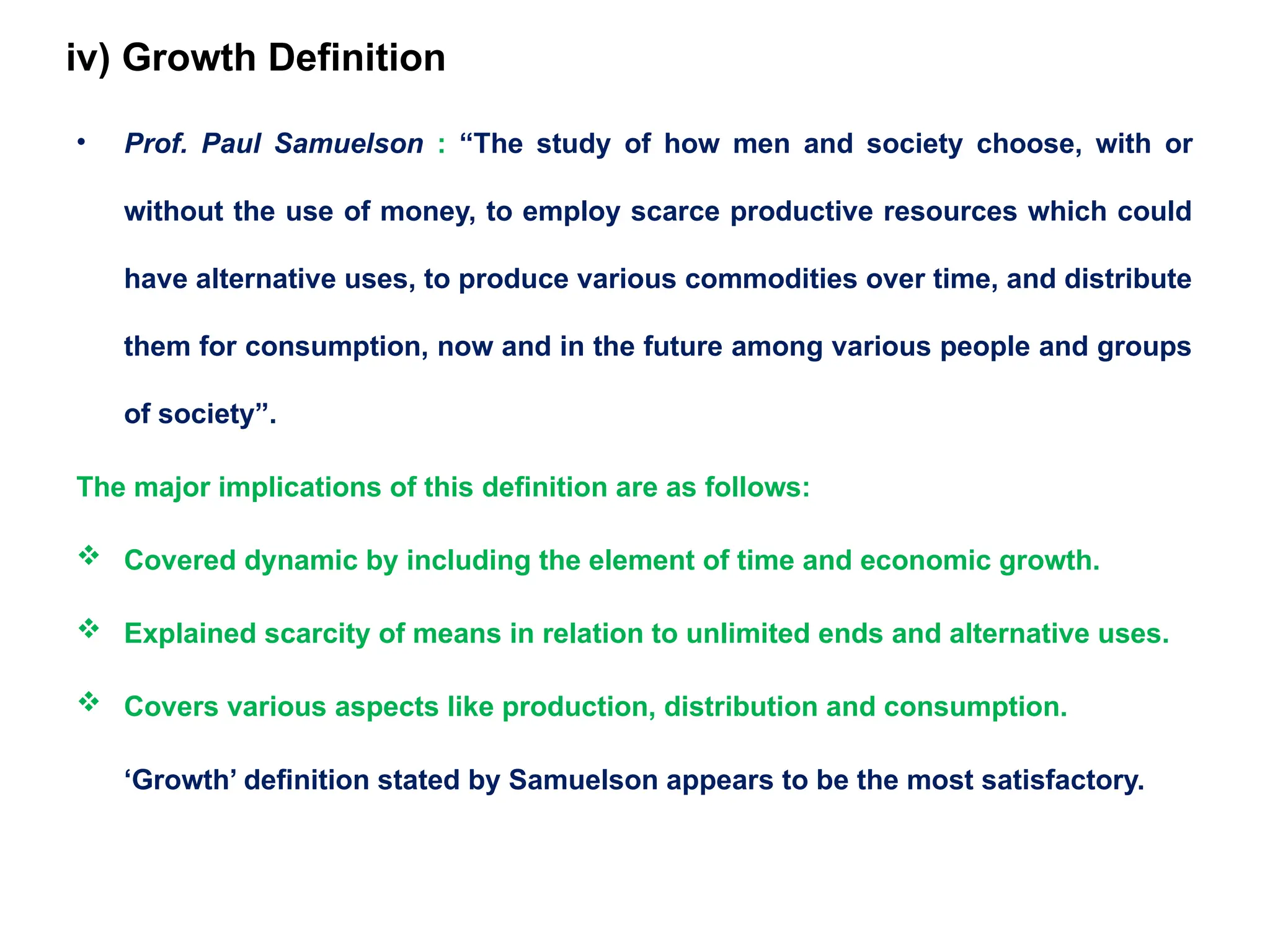
iv) Growth Definition
• Prof. Paul Samuelson : “The study of how men and society choose, with or
without the use of money, to employ scarce productive resources which could
have alternative uses, to produce various commodities over time, and distribute
them for consumption, now and in the future among various people and groups
of society”.
The major implications of this definition are as follows:
 Covered dynamic by including the element of time and economic growth.
 Explained scarcity of means in relation to unlimited ends and alternative uses.
 Covers various aspects like production, distribution and consumption.
‘Growth’ definition stated by Samuelson appears to be the most satisfactory.
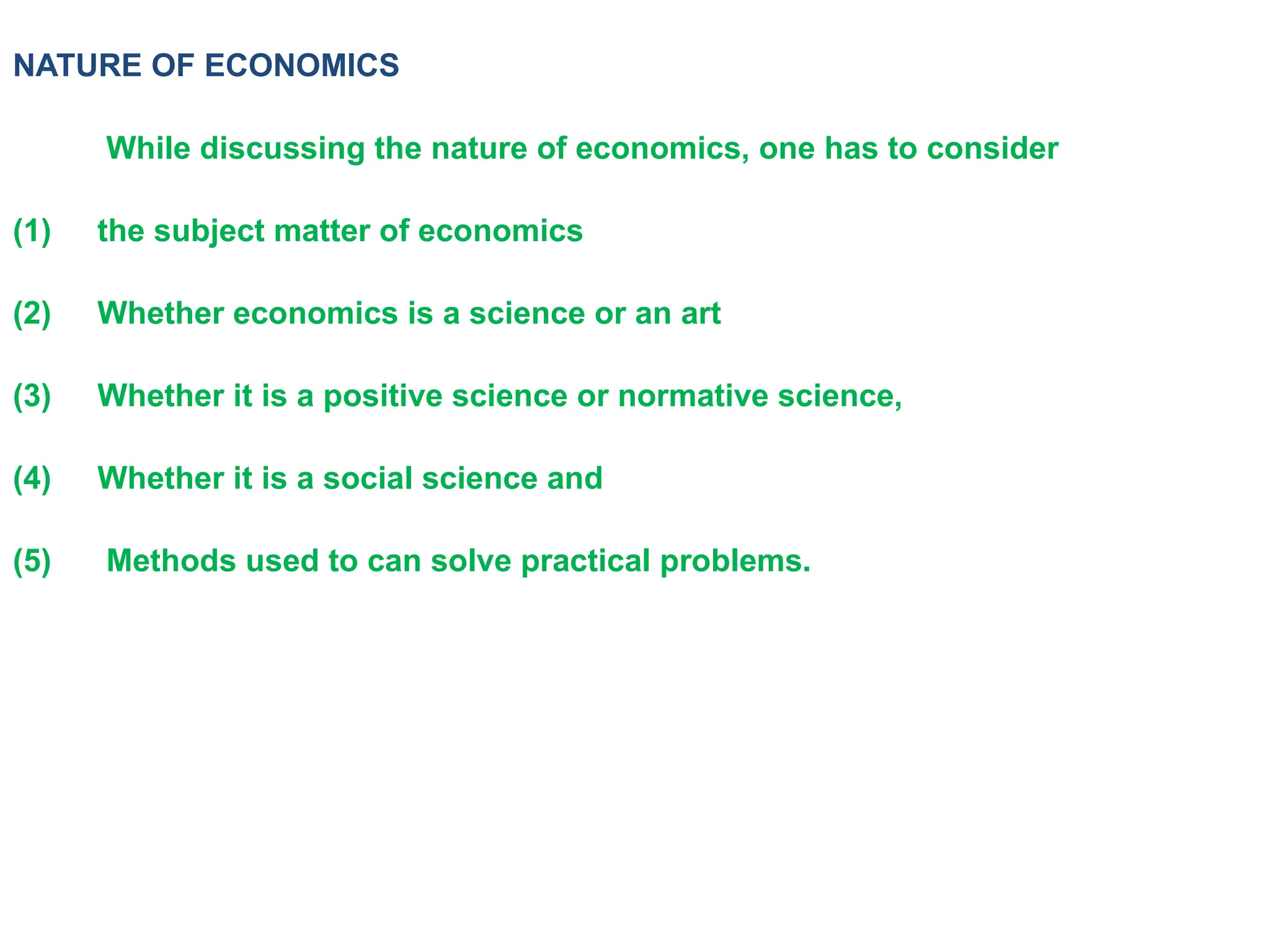
NATURE OF ECONOMICS
While discussing the nature of economics, one has to consider
(1) the subject matter of economics
(2) Whether economics is a science or an art
(3) Whether it is a positive science or normative science,
(4) Whether it is a social science and
(5) Methods used to can solve practical problems.
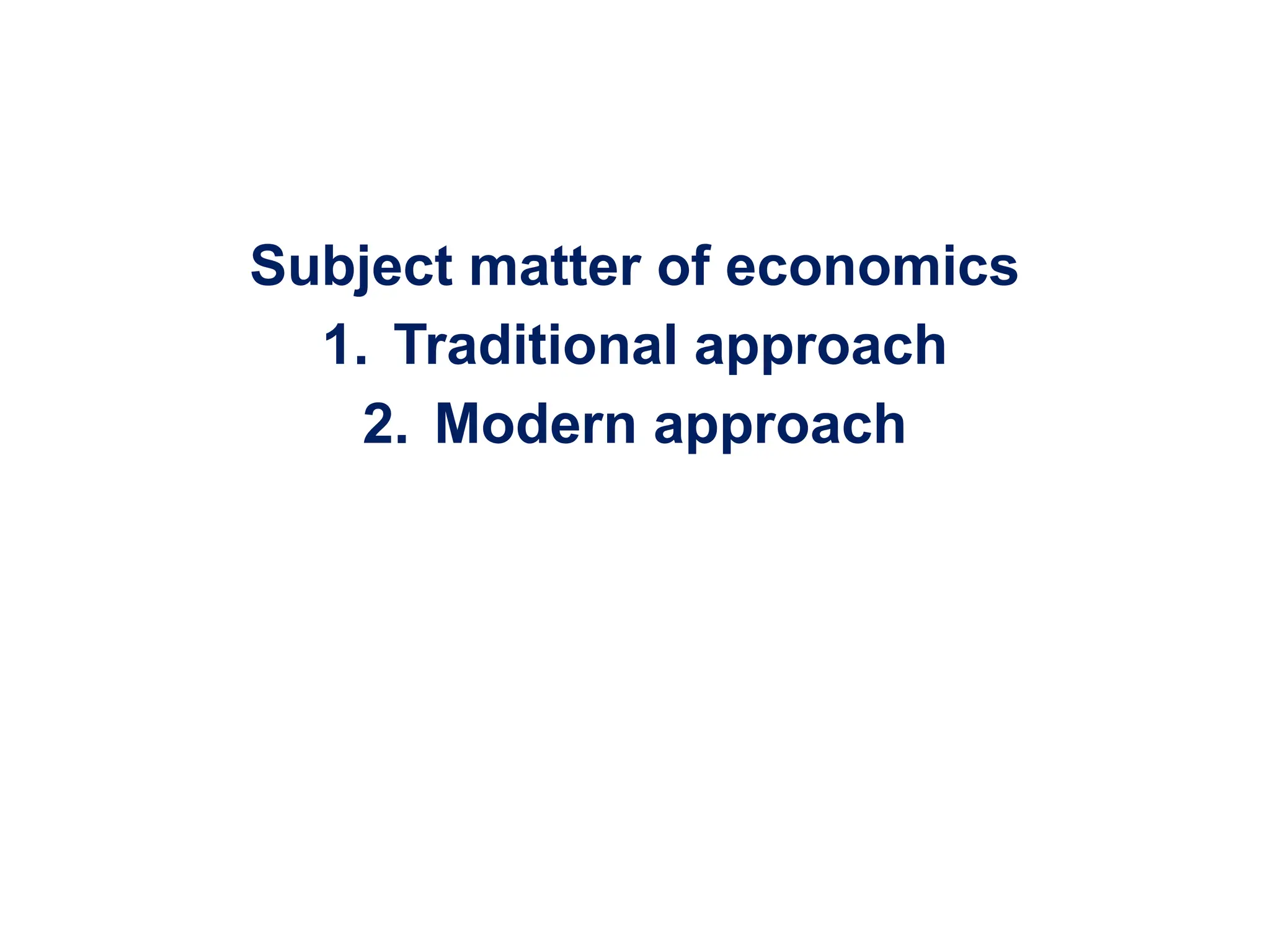
Subject matter of economics
1. Traditional approach
2. Modern approach
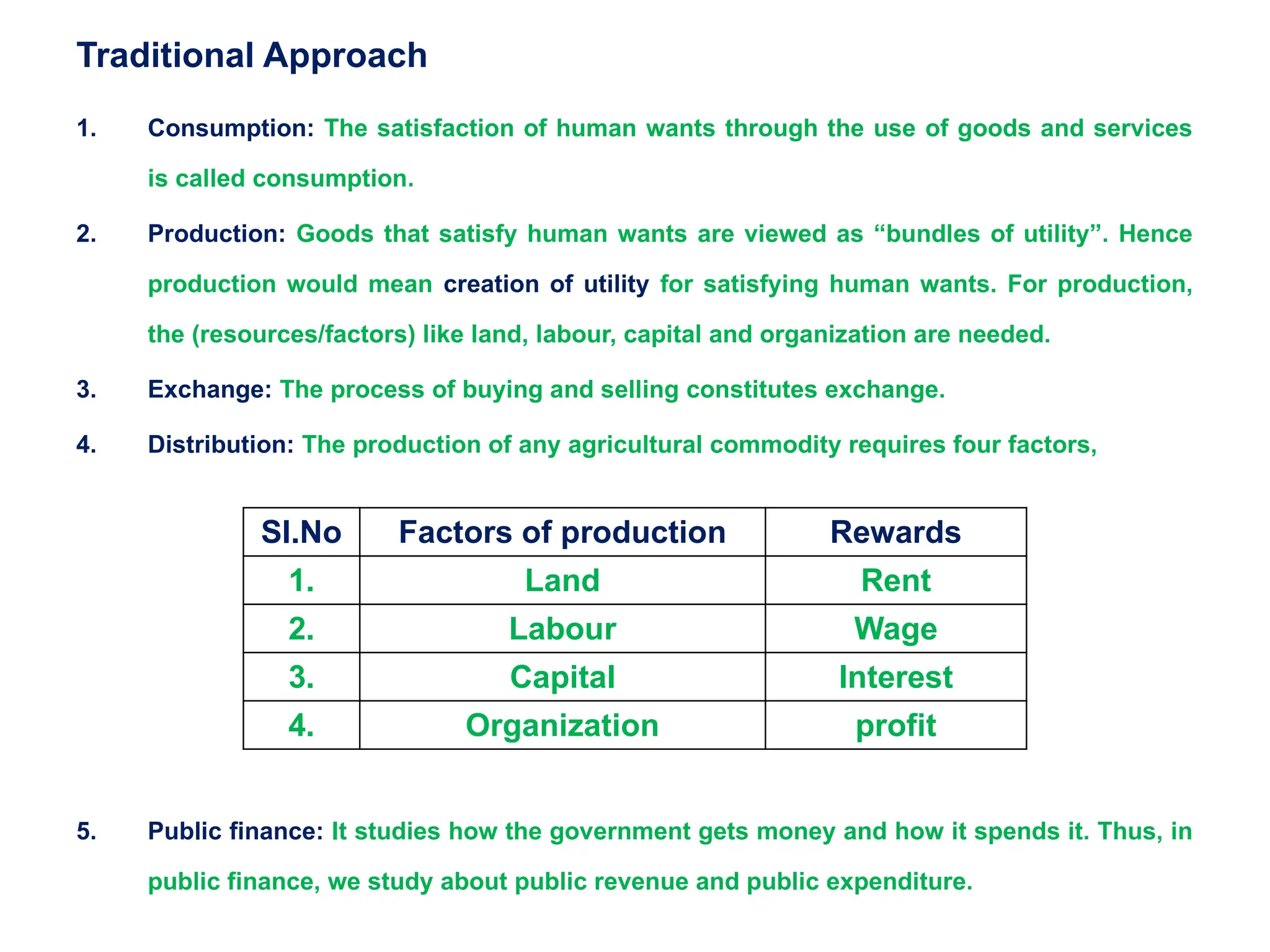
Traditional Approach
1. Consumption: The satisfaction of human wants through the use of goods and services
is called consumption.
2. Production: Goods that satisfy human wants are viewed as “bundles of utility”. Hence
production would mean creation of utility for satisfying human wants. For production,
the (resources/factors) like land, labour, capital and organization are needed.
3. Exchange: The process of buying and selling constitutes exchange.
4. Distribution: The production of any agricultural commodity requires four factors,
5. Public finance: It studies how the government gets money and how it spends it. Thus, in
public finance, we study about public revenue and public expenditure.
Sl.No Factors of production Rewards
1. Land Rent
2. Labour Wage
3. Capital Interest
4. Organization profit
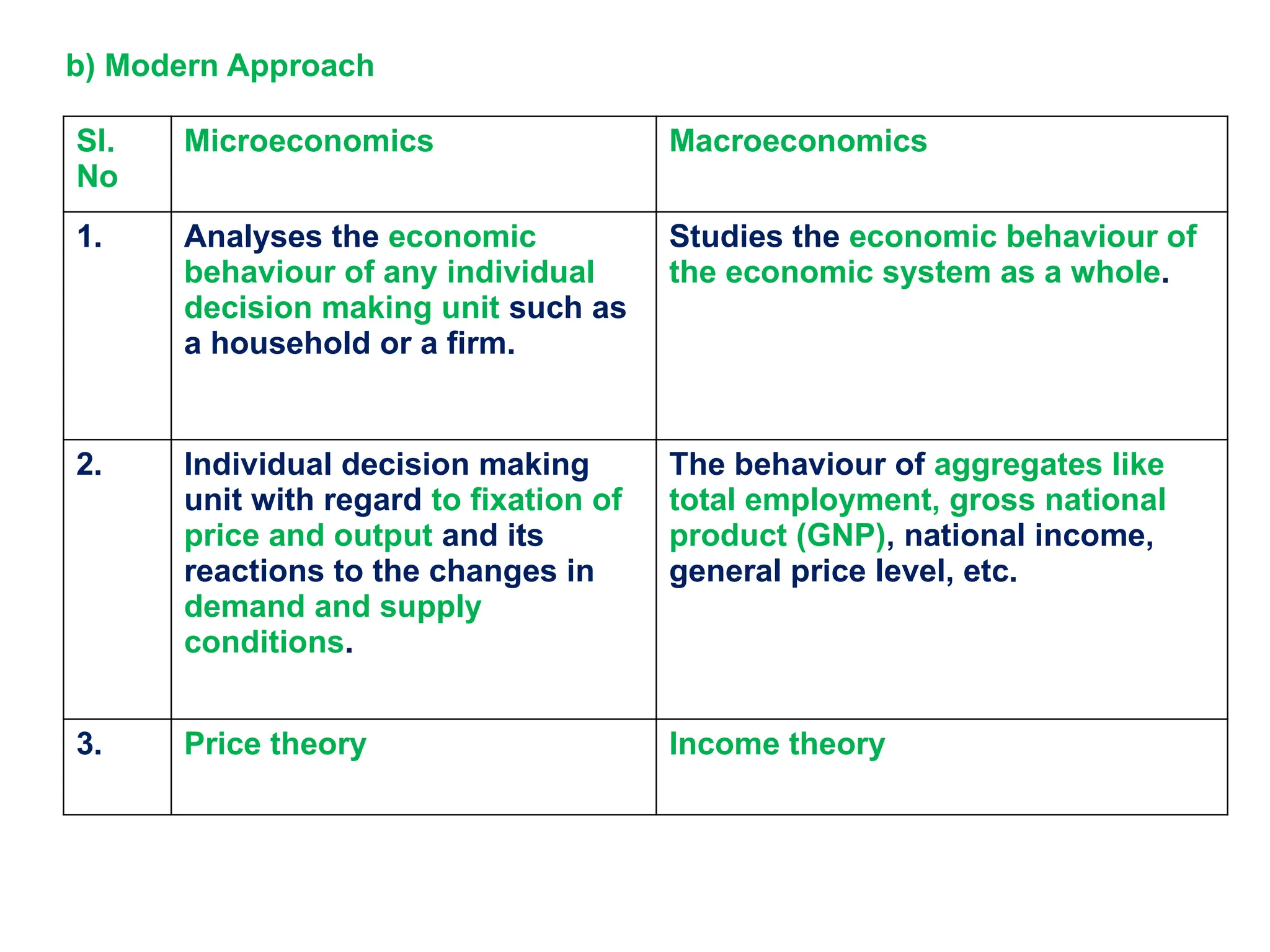
b) Modern Approach
Sl.
No
Microeconomics Macroeconomics
1. Analyses the economic
behaviour of any individual
decision making unit such as
a household or a firm.
Studies the economic behaviour of
the economic system as a whole.
2. Individual decision making
unit with regard to fixation of
price and output and its
reactions to the changes in
demand and supply
conditions.
The behaviour of aggregates like
total employment, gross national
product (GNP), national income,
general price level, etc.
3. Price theory Income theory
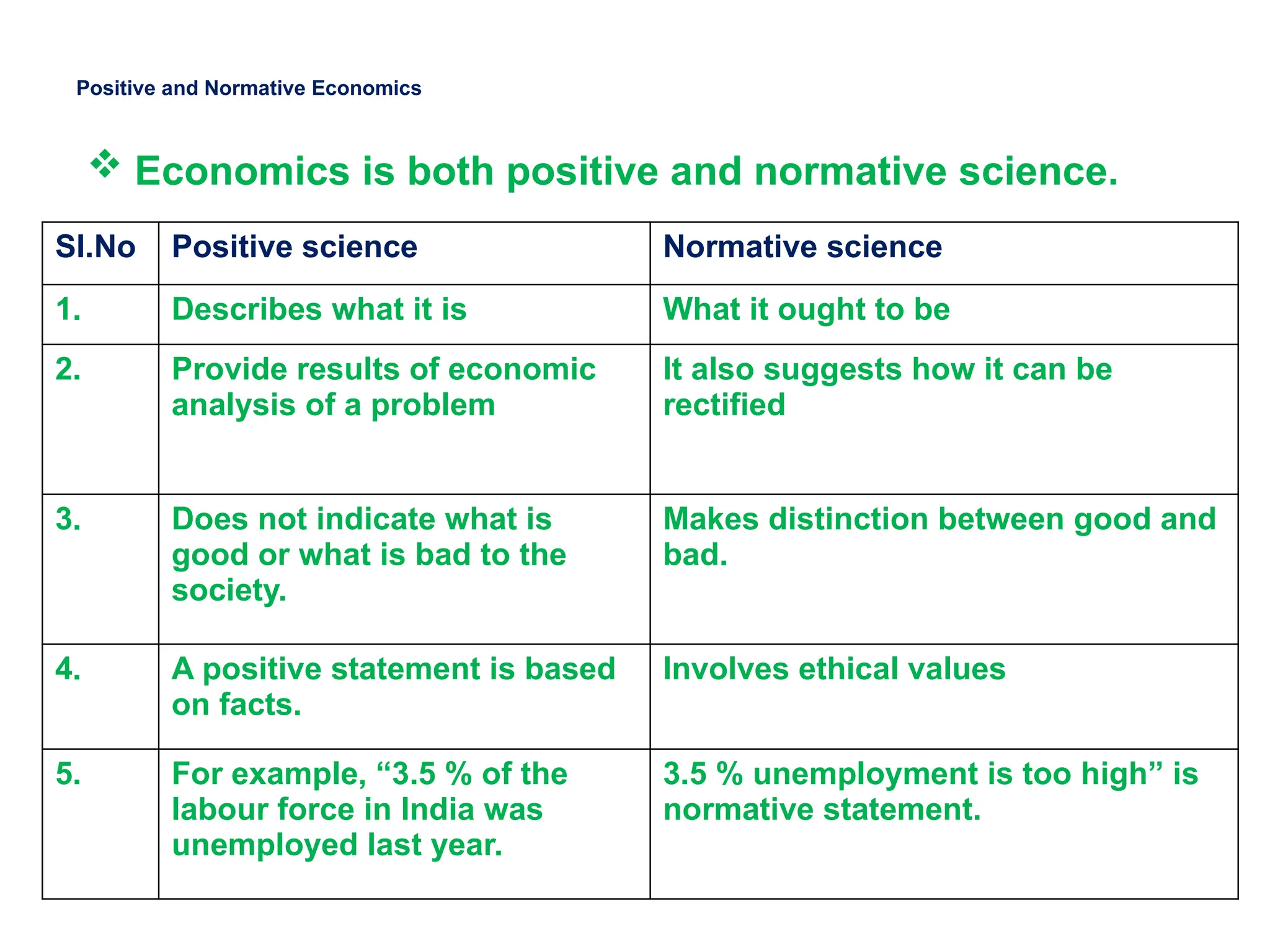
Positive and Normative Economics
 Economics is both positive and normative science.
Sl.No Positive science Normative science
1. Describes what it is What it ought to be
2. Provide results of economic
analysis of a problem
It also suggests how it can be
rectified
3. Does not indicate what is
good or what is bad to the
society.
Makes distinction between good and
bad.
4. A positive statement is based
on facts.
Involves ethical values
5. For example, “3.5 % of the
labour force in India was
unemployed last year.
3.5 % unemployment is too high” is
normative statement.
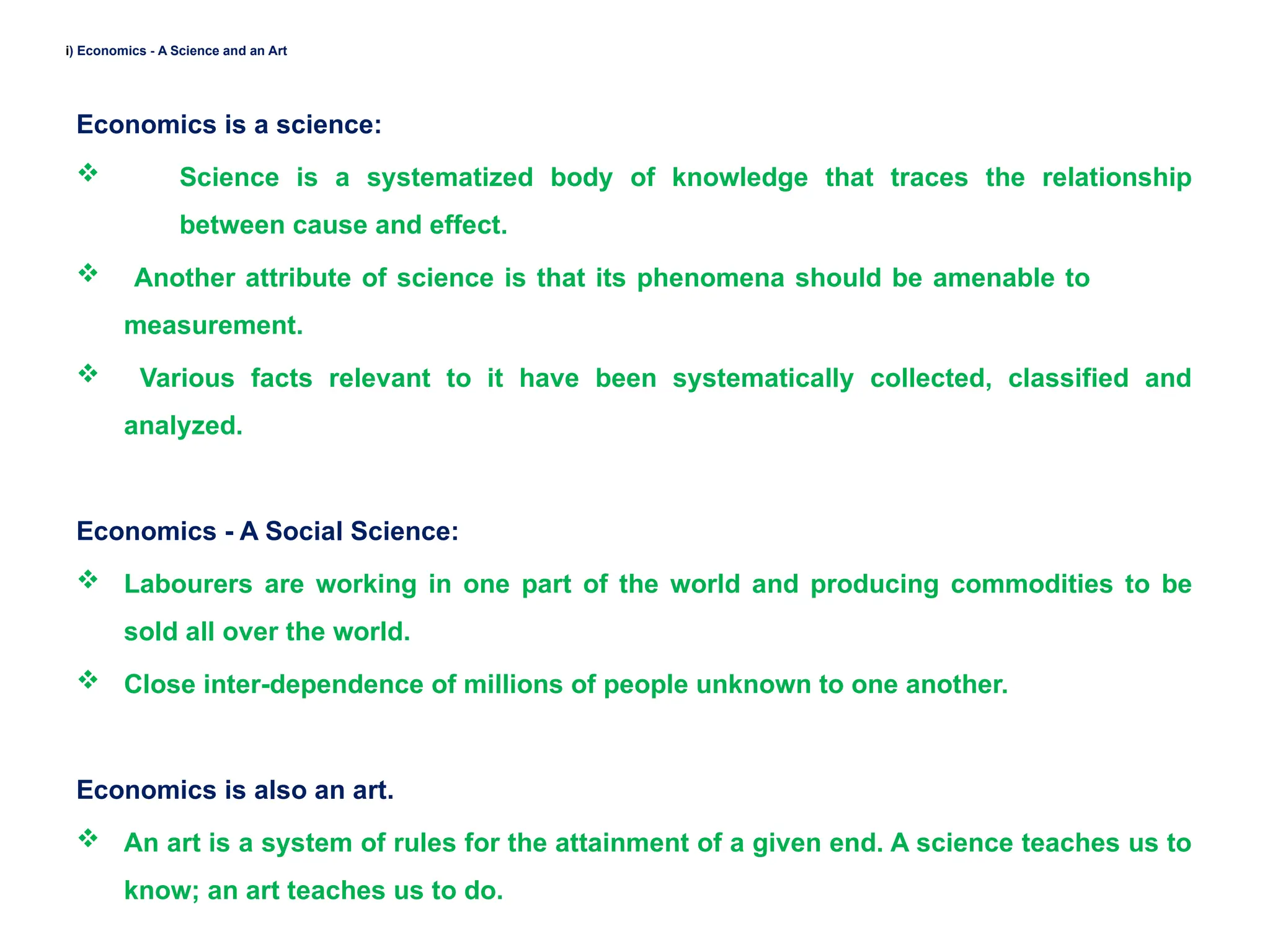
i) Economics - A Science and an Art
Economics is a science:
 Science is a systematized body of knowledge that traces the relationship
between cause and effect.
 Another attribute of science is that its phenomena should be amenable to
measurement.
 Various facts relevant to it have been systematically collected, classified and
analyzed.
Economics - A Social Science:
 Labourers are working in one part of the world and producing commodities to be
sold all over the world.
 Close inter-dependence of millions of people unknown to one another.
Economics is also an art.
 An art is a system of rules for the attainment of a given end. A science teaches us to
know; an art teaches us to do.
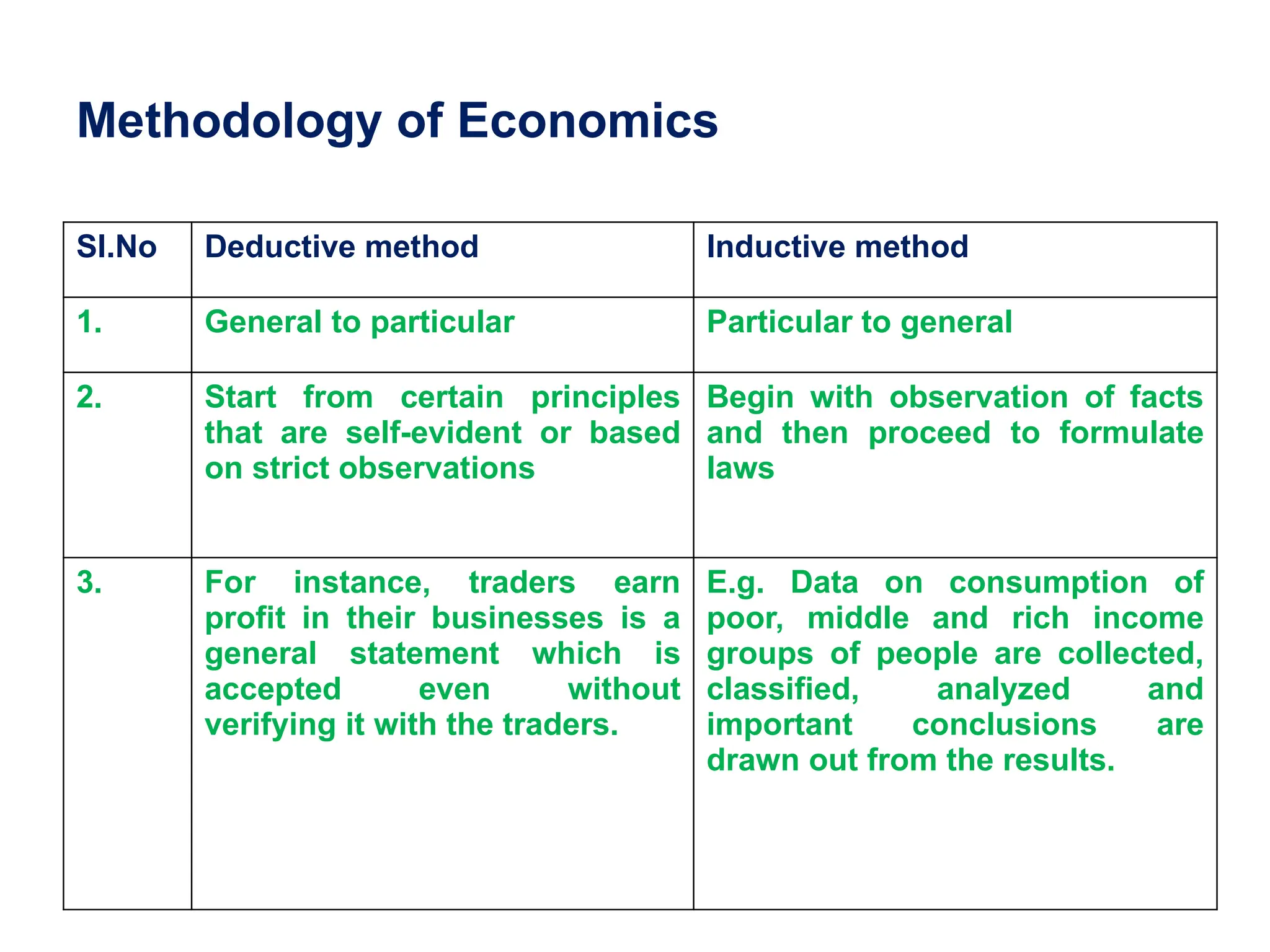
Methodology of Economics
Sl.No Deductive method Inductive method
1. General to particular Particular to general
2. Start from certain principles
that are self-evident or based
on strict observations
Begin with observation of facts
and then proceed to formulate
laws
3. For instance, traders earn
profit in their businesses is a
general statement which is
accepted even without
verifying it with the traders.
E.g. Data on consumption of
poor, middle and rich income
groups of people are collected,
classified, analyzed and
important conclusions are
drawn out from the results.
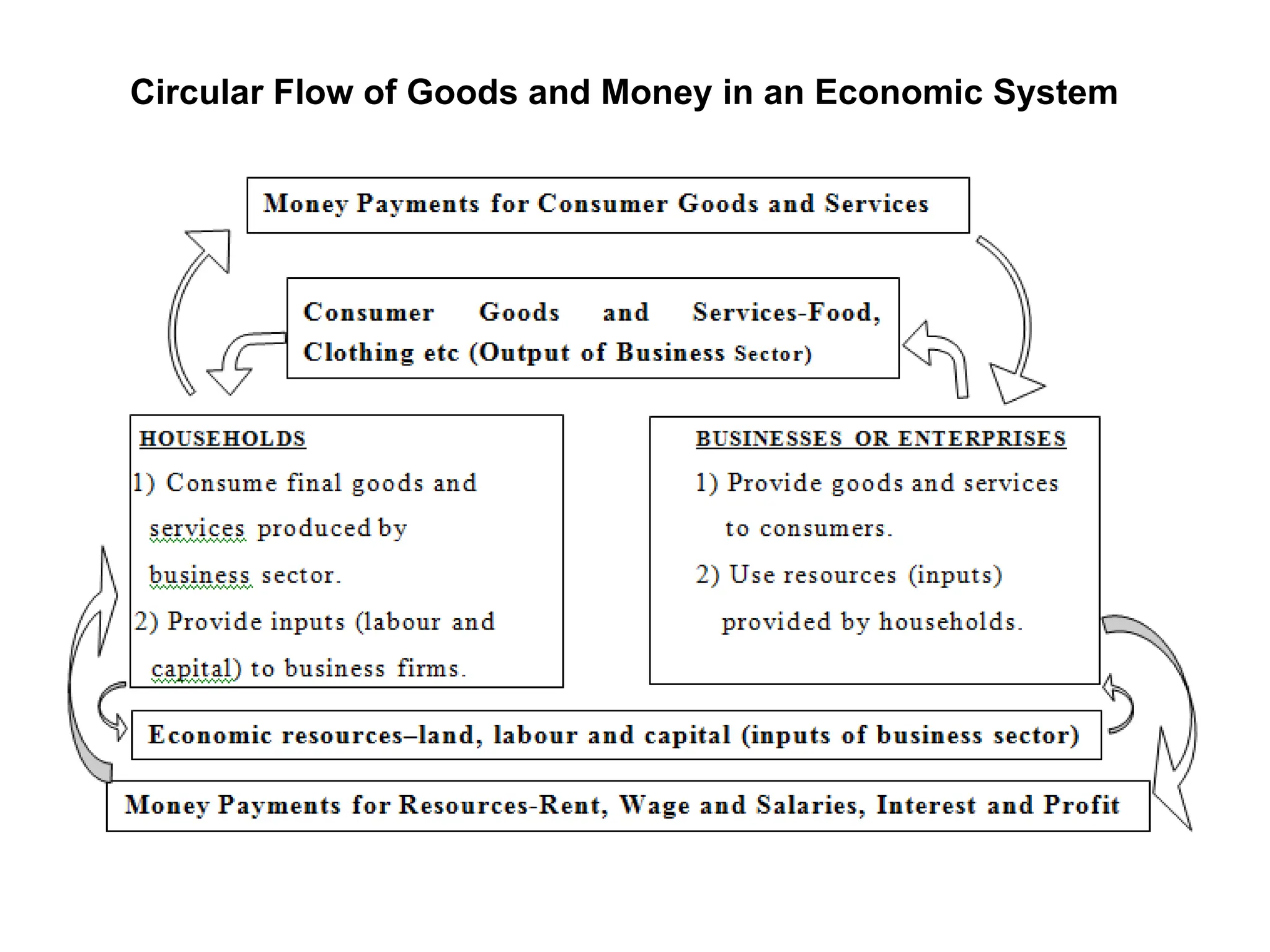
Circular Flow of Goods and Money in an Economic System
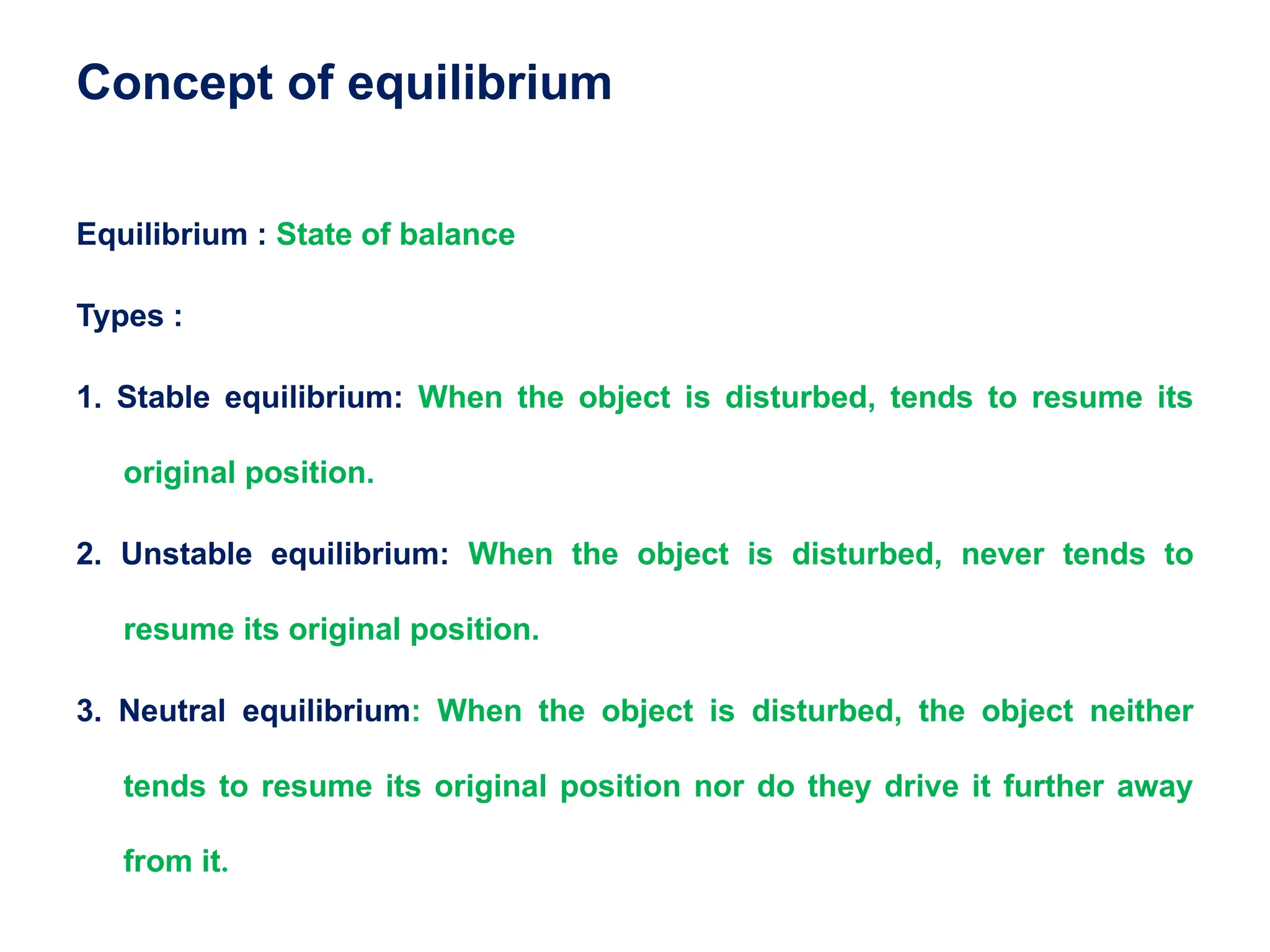
Concept of equilibrium
Equilibrium : State of balance
Types :
1. Stable equilibrium: When the object is disturbed, tends to resume its
original position.
2. Unstable equilibrium: When the object is disturbed, never tends to
resume its original position.
3. Neutral equilibrium: When the object is disturbed, the object neither
tends to resume its original position nor do they drive it further away
from it.
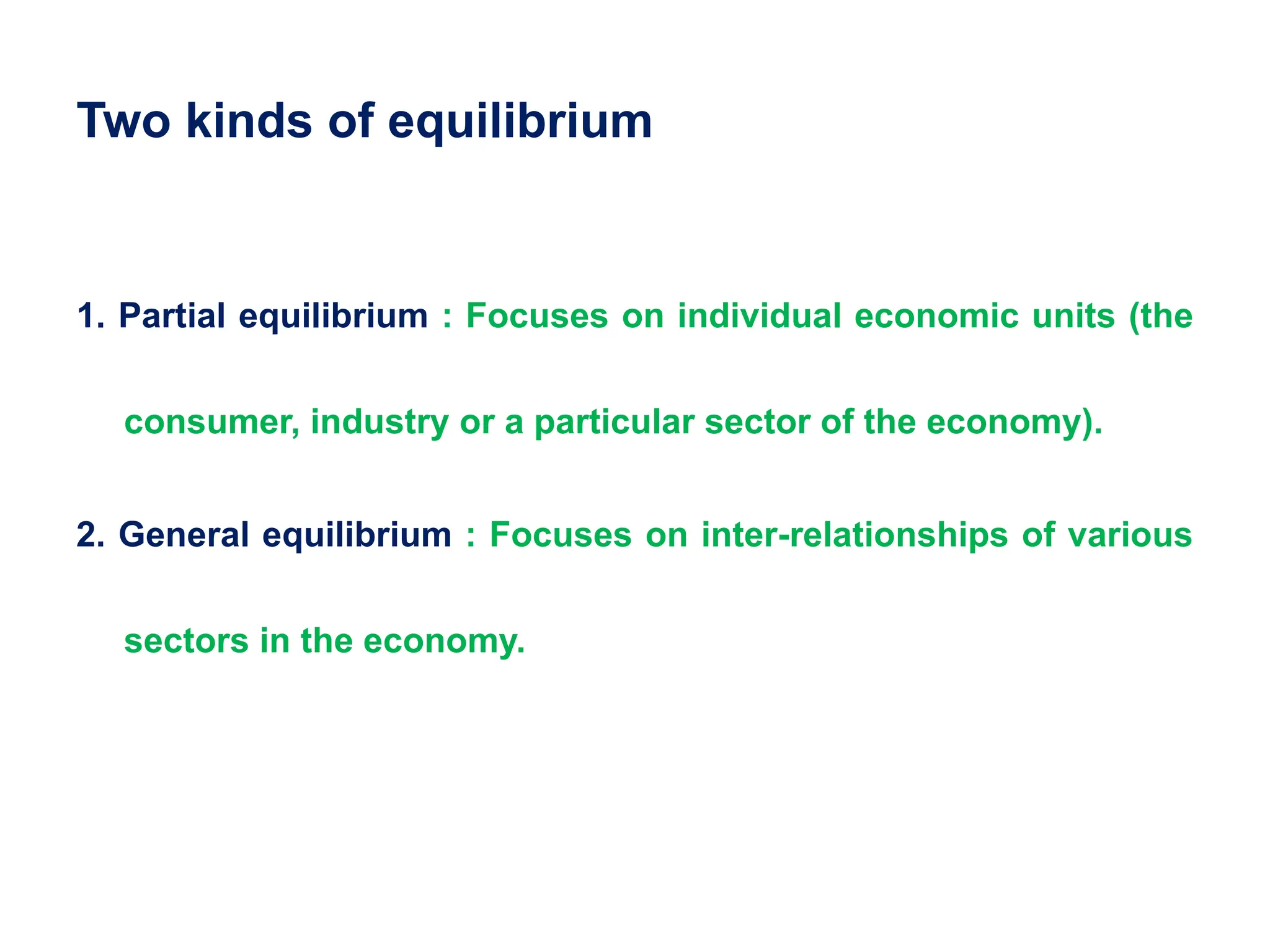
Two kinds of equilibrium
1. Partial equilibrium : Focuses on individual economic units (the
consumer, industry or a particular sector of the economy).
2. General equilibrium : Focuses on inter-relationships of various
sectors in the economy.

Introduction of Agricultural Economics - basic concept

  • 1.
    Course Code CourseTitle T P Credit AGS18201 Fundamentals of Agricultural Economics 1 1 2
  • 2.
    Economics: Meaning, scopeand subject matter, definitions, activities, approaches to economic analysis; micro and macro economics, positive and normative economics. Nature of economic theory; rationality assumption, concept of equilibrium, economic laws as generalization of human behavior. Lecture 1
  • 3.
    Introduction  For example,a farmer can grow paddy, sugarcane, banana, cotton etc. in his garden land. But he has to choose a crop depending upon the availability of irrigation water.  Taking right decision among the alternatives of choice from the scarce resource.  Economics is the science that deals with production, exchange and consumption of various commodities in economic systems.  How scarce resources can be used to increase wealth and human welfare.  Scarcity induces people to make choices among alternatives, and the knowledge of economics is used to take right decision.
  • 4.
    Conti..  Two majorfactors are responsible for the emergence of economic problems. i) the existence of unlimited human wants and ii) the scarcity of available resources.  The numerous human wants are to be satisfied through the scarce resources available in nature.  Economics deals with how the numerous human wants are to be satisfied with limited resources.  Thus, the science of economics centres on want - effort - satisfaction.
  • 5.
    Definition of Economics The word ‘Economics’ was derived from two Greek words.  oikos (a house) and nemein (to manage) which would mean ‘managing an household’ using the limited funds available. Political economy (Before 1776) i.) Wealth Definition  Adam smith (1723 - 1790), in his book “An Inquiry into Nature and Causes of Wealth of Nations” (1776) defined economics as the science of wealth.  Explained how a nation’s wealth is created.  Individual in the society wants to promote only his own gain and in this, he is led by an “invisible hand” to promote the interests of the society though he has no real intention to promote the society’s interests. Criticism:  Smith defined economics only in terms of wealth and not in terms of human welfare.  Ruskin and Carlyle condemned economics as a ‘dismal science’,  Hence, wealth definition was rejected and the emphasis was shifted from ‘wealth’ to ‘welfare’.
  • 6.
    ii) Welfare Definition Alfred Marshall (1842 - 1924) wrote a book “Principles of Economics” (1890)  According to Marshall, economics is a study of mankind in the ordinary business of life, i.e., economic aspect of human life.  Marshall makes a distinction between two types of things, viz. material things and immaterial things. Material things are those that can be seen, felt and touched, (E.g.) book, rice etc. Immaterial things are those that cannot be seen, felt and touched.  Marshall considered only the material things that are capable of promoting welfare of people.
  • 7.
    Criticism:  Services ofa doctor, a teacher and so on, also promote welfare of the people.  Marshall makes a distinction between (i) Things that are capable of promoting welfare of people (ii) Things that are not capable of promoting welfare of people. (E.g.) liquor, that is not capable of promoting welfare but commands a price, comes under the purview of economics.  Marshall’s definition is based on the concept of welfare. But there is no clear- cut definition of welfare.  Welfare varies from person to person, country to country and one period to another.  Welfare means happiness or comfortable living conditions of an individual or group of people.  Welfare is dependent not only on the stock of wealth possessed but also on political, social and cultural activities of the nation.
  • 8.
    iii) Scarcity Definition LionelRobbins “An Essay on the Nature and Significance of Economic Science” in 1932. “Economics is a science which studies human behaviour as a relationship between ends and means which have alternative uses”. The major features of Robbins’ definition are as follows: a) Ends refer to human wants. Human beings have unlimited number of wants. b) Resources or means, on the other hand, are limited or scarce in supply. Thus, economics, according to Robbins, is a science of choice.
  • 9.
    Criticism:  Differentiation notmade between goods conducive and goods not conducive to human welfare. (e.g.) Production of rice and alcoholic drink, scarce resources are used.  Considered only micro economic (resources allocation and price determination) but we also study the macro economic aspects.  Robbins definition does not cover the theory of economic growth and development.
  • 10.
    iv) Growth Definition •Prof. Paul Samuelson : “The study of how men and society choose, with or without the use of money, to employ scarce productive resources which could have alternative uses, to produce various commodities over time, and distribute them for consumption, now and in the future among various people and groups of society”. The major implications of this definition are as follows:  Covered dynamic by including the element of time and economic growth.  Explained scarcity of means in relation to unlimited ends and alternative uses.  Covers various aspects like production, distribution and consumption. ‘Growth’ definition stated by Samuelson appears to be the most satisfactory.
  • 11.
    NATURE OF ECONOMICS Whilediscussing the nature of economics, one has to consider (1) the subject matter of economics (2) Whether economics is a science or an art (3) Whether it is a positive science or normative science, (4) Whether it is a social science and (5) Methods used to can solve practical problems.
  • 12.
    Subject matter ofeconomics 1. Traditional approach 2. Modern approach
  • 13.
    Traditional Approach 1. Consumption:The satisfaction of human wants through the use of goods and services is called consumption. 2. Production: Goods that satisfy human wants are viewed as “bundles of utility”. Hence production would mean creation of utility for satisfying human wants. For production, the (resources/factors) like land, labour, capital and organization are needed. 3. Exchange: The process of buying and selling constitutes exchange. 4. Distribution: The production of any agricultural commodity requires four factors, 5. Public finance: It studies how the government gets money and how it spends it. Thus, in public finance, we study about public revenue and public expenditure. Sl.No Factors of production Rewards 1. Land Rent 2. Labour Wage 3. Capital Interest 4. Organization profit
  • 14.
    b) Modern Approach Sl. No MicroeconomicsMacroeconomics 1. Analyses the economic behaviour of any individual decision making unit such as a household or a firm. Studies the economic behaviour of the economic system as a whole. 2. Individual decision making unit with regard to fixation of price and output and its reactions to the changes in demand and supply conditions. The behaviour of aggregates like total employment, gross national product (GNP), national income, general price level, etc. 3. Price theory Income theory
  • 15.
    Positive and NormativeEconomics  Economics is both positive and normative science. Sl.No Positive science Normative science 1. Describes what it is What it ought to be 2. Provide results of economic analysis of a problem It also suggests how it can be rectified 3. Does not indicate what is good or what is bad to the society. Makes distinction between good and bad. 4. A positive statement is based on facts. Involves ethical values 5. For example, “3.5 % of the labour force in India was unemployed last year. 3.5 % unemployment is too high” is normative statement.
  • 16.
    i) Economics -A Science and an Art Economics is a science:  Science is a systematized body of knowledge that traces the relationship between cause and effect.  Another attribute of science is that its phenomena should be amenable to measurement.  Various facts relevant to it have been systematically collected, classified and analyzed. Economics - A Social Science:  Labourers are working in one part of the world and producing commodities to be sold all over the world.  Close inter-dependence of millions of people unknown to one another. Economics is also an art.  An art is a system of rules for the attainment of a given end. A science teaches us to know; an art teaches us to do.
  • 17.
    Methodology of Economics Sl.NoDeductive method Inductive method 1. General to particular Particular to general 2. Start from certain principles that are self-evident or based on strict observations Begin with observation of facts and then proceed to formulate laws 3. For instance, traders earn profit in their businesses is a general statement which is accepted even without verifying it with the traders. E.g. Data on consumption of poor, middle and rich income groups of people are collected, classified, analyzed and important conclusions are drawn out from the results.
  • 18.
    Circular Flow ofGoods and Money in an Economic System
  • 19.
    Concept of equilibrium Equilibrium: State of balance Types : 1. Stable equilibrium: When the object is disturbed, tends to resume its original position. 2. Unstable equilibrium: When the object is disturbed, never tends to resume its original position. 3. Neutral equilibrium: When the object is disturbed, the object neither tends to resume its original position nor do they drive it further away from it.
  • 20.
    Two kinds ofequilibrium 1. Partial equilibrium : Focuses on individual economic units (the consumer, industry or a particular sector of the economy). 2. General equilibrium : Focuses on inter-relationships of various sectors in the economy.