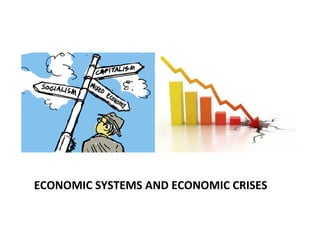
ECONOMIC SYSTEMS AND ECONOMIC CRISES
Economy is based on people’s necessities. If
there is a necessity of something, someone can
think of making money by fulfilling this
necessity:
- If the necessity is a material thing (a good),
the best way of fulfilling it is to produce what
people need.
- If the necessity is not a material thing, but a s
service, the best way of fulfilling it is to offer or
provide the service people need.
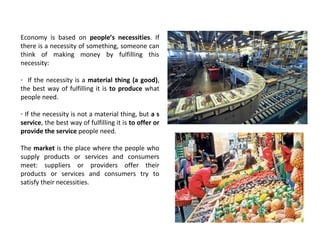
The market is the place where the people who
supply products or services and consumers
meet: suppliers or providers offer their
products or services and consumers try to
satisfy their necessities.
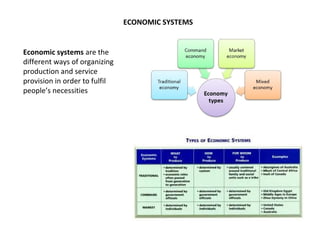
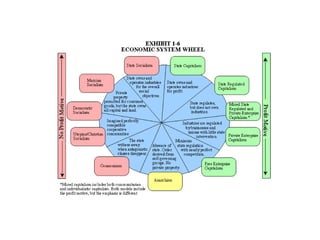
Economic systems are the
different ways of organizing
production and service
provision in order to fulfil
people’s necessities
ECONOMIC SYSTEMS
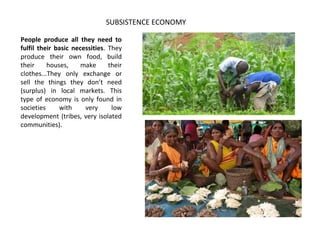
People produce all they need to
fulfil their basic necessities. They
produce their own food, build
their houses, make their
clothes...They only exchange or
sell the things they don’t need
(surplus) in local markets. This
type of economy is only found in
societies with very low
development (tribes, very isolated
communities).
SUBSISTENCE ECONOMY
MARKET ECONOMY OR CAPITALISM
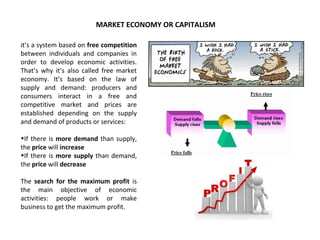
it’s a system based on free competition
between individuals and companies in
order to develop economic activities.
That’s why it’s also called free market
economy. It’s based on the law of
supply and demand: producers and
consumers interact in a free and
competitive market and prices are
established depending on the supply
and demand of products or services:
•If there is more demand than supply,
the price will increase
•If there is more supply than demand,
the price will decrease
The search for the maximum profit is
the main objective of economic
activities: people work or make
business to get the maximum profit.
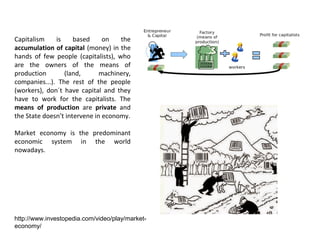
Capitalism is based on the
accumulation of capital (money) in the
hands of few people (capitalists), who
are the owners of the means of
production (land, machinery,
companies...). The rest of the people
(workers), don´t have capital and they
have to work for the capitalists. The
means of production are private and
the State doesn’t intervene in economy.
Market economy is the predominant
economic system in the world
nowadays.
http://www.investopedia.com/video/play/market-
economy/
Theoretically in a market economy prices are
established according to the law of supply and
demand and the State doesn’t intervene in
economy. But this is not really true:
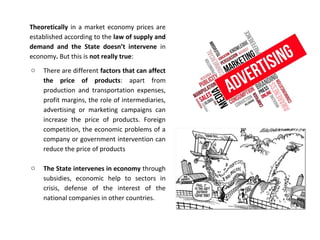
o There are different factors that can affect
the price of products: apart from
production and transportation expenses,
profit margins, the role of intermediaries,
advertising or marketing campaigns can
increase the price of products. Foreign
competition, the economic problems of a
company or government intervention can
reduce the price of products
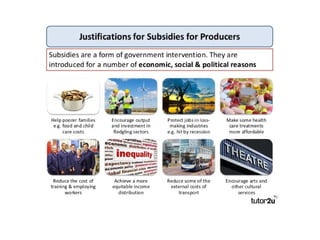
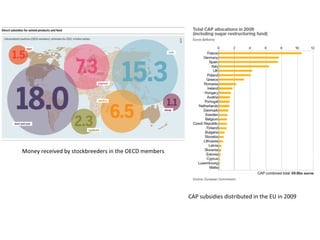
o The State intervenes in economy through
subsidies, economic help to sectors in
crisis, defense of the interest of the
national companies in other countries.
Money received by stockbreeders in the OECD members
CAP subsidies distributed in the EU in 2009
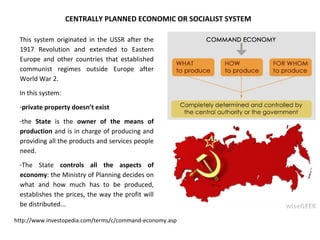
CENTRALLY PLANNED ECONOMIC OR SOCIALIST SYSTEM
This system originated in the USSR after the
1917 Revolution and extended to Eastern
Europe and other countries that established
communist regimes outside Europe after
World War 2.
In this system:
-private property doesn’t exist
-the State is the owner of the means of
production and is in charge of producing and
providing all the products and services people
need.
-The State controls all the aspects of
economy: the Ministry of Planning decides on
what and how much has to be produced,
establishes the prices, the way the profit will
be distributed...
http://www.investopedia.com/terms/c/command-economy.asp
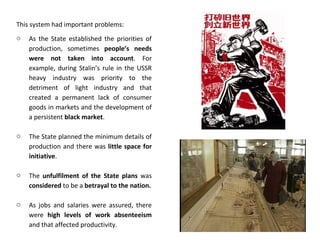
This system had important problems:
o As the State established the priorities of
production, sometimes people’s needs
were not taken into account. For
example, during Stalin’s rule in the USSR
heavy industry was priority to the
detriment of light industry and that
created a permanent lack of consumer
goods in markets and the development of
a persistent black market.
o The State planned the minimum details of
production and there was little space for
initiative.
o The unfulfilment of the State plans was
considered to be a betrayal to the nation.
o As jobs and salaries were assured, there
were high levels of work absenteeism
and that affected productivity.
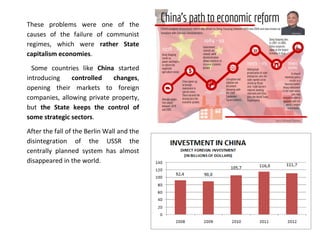
These problems were one of the
causes of the failure of communist
regimes, which were rather State
capitalism economies.
Some countries like China started
introducing controlled changes,
opening their markets to foreign
companies, allowing private property,
but the State keeps the control of
some strategic sectors.
After the fall of the Berlin Wall and the
disintegration of the USSR the
centrally planned system has almost
disappeared in the world.
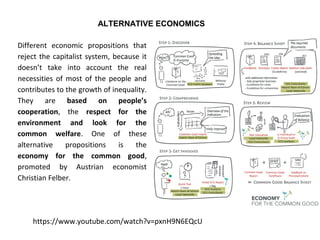
ALTERNATIVE ECONOMICS
Different economic propositions that
reject the capitalist system, because it
doesn’t take into account the real
necessities of most of the people and
contributes to the growth of inequality.
They are based on people’s
cooperation, the respect for the
environment and look for the
common welfare. One of these
alternative propositions is the
economy for the common good,
promoted by Austrian economist
Christian Felber.
https://www.youtube.com/watch?v=pxnH9N6EQcU
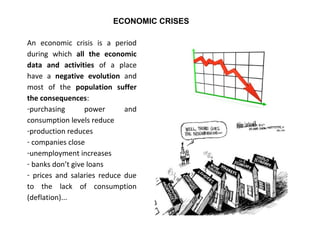
An economic crisis is a period
during which all the economic
data and activities of a place
have a negative evolution and
most of the population suffer
the consequences:
-purchasing power and
consumption levels reduce
-production reduces
- companies close
-unemployment increases
- banks don’t give loans
- prices and salaries reduce due
to the lack of consumption
(deflation)...
ECONOMIC CRISES
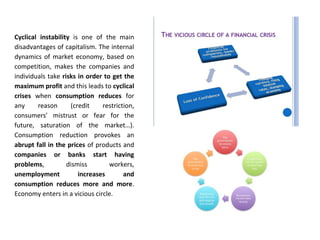
Cyclical instability is one of the main
disadvantages of capitalism. The internal
dynamics of market economy, based on
competition, makes the companies and
individuals take risks in order to get the
maximum profit and this leads to cyclical
crises when consumption reduces for
any reason (credit restriction,
consumers’ mistrust or fear for the
future, saturation of the market…).
Consumption reduction provokes an
abrupt fall in the prices of products and
companies or banks start having
problems, dismiss workers,
unemployment increases and
consumption reduces more and more.
Economy enters in a vicious circle.
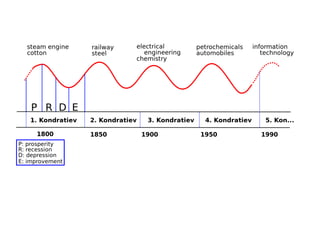
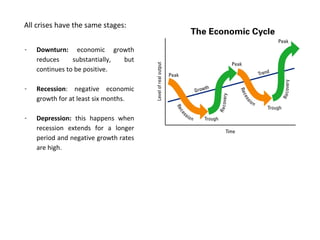
- Downturn: economic growth
reduces substantially, but
continues to be positive.
- Recession: negative economic
growth for at least six months.
- Depression: this happens when
recession extends for a longer
period and negative growth rates
are high.
All crises have the same stages:
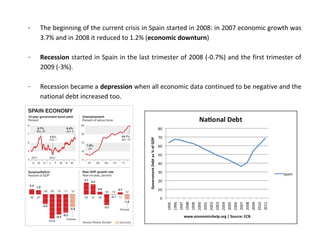
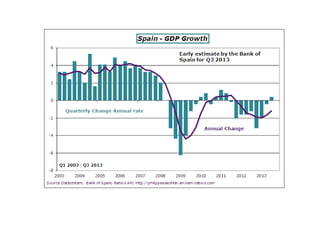
- The beginning of the current crisis in Spain started in 2008: in 2007 economic growth was
3.7% and in 2008 it reduced to 1.2% (economic downturn)
- Recession started in Spain in the last trimester of 2008 (-0.7%) and the first trimester of
2009 (-3%).
- Recession became a depression when all economic data continued to be negative and the
national debt increased too.
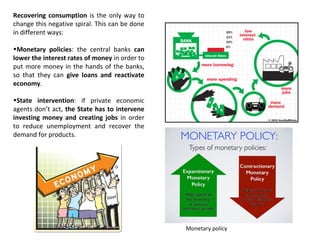
Recovering consumption is the only way to
change this negative spiral. This can be done
in different ways:
•Monetary policies: the central banks can
lower the interest rates of money in order to
put more money in the hands of the banks,
so that they can give loans and reactivate
economy.
•State intervention: if private economic
agents don’t act, the State has to intervene
investing money and creating jobs in order
to reduce unemployment and recover the
demand for products.
Monetary policy

Economic systems and economic crises

  • 1.
    ECONOMIC SYSTEMS ANDECONOMIC CRISES
  • 2.
    Economy is basedon people’s necessities. If there is a necessity of something, someone can think of making money by fulfilling this necessity: - If the necessity is a material thing (a good), the best way of fulfilling it is to produce what people need. - If the necessity is not a material thing, but a s service, the best way of fulfilling it is to offer or provide the service people need. The market is the place where the people who supply products or services and consumers meet: suppliers or providers offer their products or services and consumers try to satisfy their necessities.
  • 3.
    Economic systems arethe different ways of organizing production and service provision in order to fulfil people’s necessities ECONOMIC SYSTEMS
  • 5.
    People produce allthey need to fulfil their basic necessities. They produce their own food, build their houses, make their clothes...They only exchange or sell the things they don’t need (surplus) in local markets. This type of economy is only found in societies with very low development (tribes, very isolated communities). SUBSISTENCE ECONOMY
  • 6.
    MARKET ECONOMY ORCAPITALISM it’s a system based on free competition between individuals and companies in order to develop economic activities. That’s why it’s also called free market economy. It’s based on the law of supply and demand: producers and consumers interact in a free and competitive market and prices are established depending on the supply and demand of products or services: •If there is more demand than supply, the price will increase •If there is more supply than demand, the price will decrease The search for the maximum profit is the main objective of economic activities: people work or make business to get the maximum profit.
  • 7.
    Capitalism is basedon the accumulation of capital (money) in the hands of few people (capitalists), who are the owners of the means of production (land, machinery, companies...). The rest of the people (workers), don´t have capital and they have to work for the capitalists. The means of production are private and the State doesn’t intervene in economy. Market economy is the predominant economic system in the world nowadays. http://www.investopedia.com/video/play/market- economy/
  • 8.
    Theoretically in amarket economy prices are established according to the law of supply and demand and the State doesn’t intervene in economy. But this is not really true: o There are different factors that can affect the price of products: apart from production and transportation expenses, profit margins, the role of intermediaries, advertising or marketing campaigns can increase the price of products. Foreign competition, the economic problems of a company or government intervention can reduce the price of products o The State intervenes in economy through subsidies, economic help to sectors in crisis, defense of the interest of the national companies in other countries.
  • 10.
    Money received bystockbreeders in the OECD members CAP subsidies distributed in the EU in 2009
  • 11.
    CENTRALLY PLANNED ECONOMICOR SOCIALIST SYSTEM This system originated in the USSR after the 1917 Revolution and extended to Eastern Europe and other countries that established communist regimes outside Europe after World War 2. In this system: -private property doesn’t exist -the State is the owner of the means of production and is in charge of producing and providing all the products and services people need. -The State controls all the aspects of economy: the Ministry of Planning decides on what and how much has to be produced, establishes the prices, the way the profit will be distributed... http://www.investopedia.com/terms/c/command-economy.asp
  • 12.
    This system hadimportant problems: o As the State established the priorities of production, sometimes people’s needs were not taken into account. For example, during Stalin’s rule in the USSR heavy industry was priority to the detriment of light industry and that created a permanent lack of consumer goods in markets and the development of a persistent black market. o The State planned the minimum details of production and there was little space for initiative. o The unfulfilment of the State plans was considered to be a betrayal to the nation. o As jobs and salaries were assured, there were high levels of work absenteeism and that affected productivity.
  • 13.
    These problems wereone of the causes of the failure of communist regimes, which were rather State capitalism economies. Some countries like China started introducing controlled changes, opening their markets to foreign companies, allowing private property, but the State keeps the control of some strategic sectors. After the fall of the Berlin Wall and the disintegration of the USSR the centrally planned system has almost disappeared in the world.
  • 14.
    ALTERNATIVE ECONOMICS Different economicpropositions that reject the capitalist system, because it doesn’t take into account the real necessities of most of the people and contributes to the growth of inequality. They are based on people’s cooperation, the respect for the environment and look for the common welfare. One of these alternative propositions is the economy for the common good, promoted by Austrian economist Christian Felber. https://www.youtube.com/watch?v=pxnH9N6EQcU
  • 15.
    An economic crisisis a period during which all the economic data and activities of a place have a negative evolution and most of the population suffer the consequences: -purchasing power and consumption levels reduce -production reduces - companies close -unemployment increases - banks don’t give loans - prices and salaries reduce due to the lack of consumption (deflation)... ECONOMIC CRISES
  • 16.
    Cyclical instability isone of the main disadvantages of capitalism. The internal dynamics of market economy, based on competition, makes the companies and individuals take risks in order to get the maximum profit and this leads to cyclical crises when consumption reduces for any reason (credit restriction, consumers’ mistrust or fear for the future, saturation of the market…). Consumption reduction provokes an abrupt fall in the prices of products and companies or banks start having problems, dismiss workers, unemployment increases and consumption reduces more and more. Economy enters in a vicious circle.
  • 18.
    - Downturn: economicgrowth reduces substantially, but continues to be positive. - Recession: negative economic growth for at least six months. - Depression: this happens when recession extends for a longer period and negative growth rates are high. All crises have the same stages:
  • 19.
    - The beginningof the current crisis in Spain started in 2008: in 2007 economic growth was 3.7% and in 2008 it reduced to 1.2% (economic downturn) - Recession started in Spain in the last trimester of 2008 (-0.7%) and the first trimester of 2009 (-3%). - Recession became a depression when all economic data continued to be negative and the national debt increased too.
  • 21.
    Recovering consumption isthe only way to change this negative spiral. This can be done in different ways: •Monetary policies: the central banks can lower the interest rates of money in order to put more money in the hands of the banks, so that they can give loans and reactivate economy. •State intervention: if private economic agents don’t act, the State has to intervene investing money and creating jobs in order to reduce unemployment and recover the demand for products. Monetary policy