
Introduction to
Economic
Systems
MD. ALAUDDIN
LECTURER OF ECONOMICS
UTTARA UNIVERSITY
What is Economic System
 All human needs and wants are centralized in economic
welfare.
 The way to address such economic problems is called
Economic System.
 In other words, the economic rules and regulations along
with the environmental factors by which overall economic
activities of a country are conducted is called the
economic system.
 Since each society’s way is different from each other, so
there are different economic systems prevail in the world.
2
Different Economic
Systems
 Traditional Economic System
 Market Economic System
 Socialist Economic System
 Mixed Economic System
 Islamic Economic System
3
Traditional Economic
System
 Before the invention of money people in ancient
civilizations or small communities use to barter for goods.
 Bartering is the process of trading one good for another.
 The problem with bartering is that its not always easy to
find the person who has the good you want and often it
can mean carrying a heavy load in order to make a
trade.
4
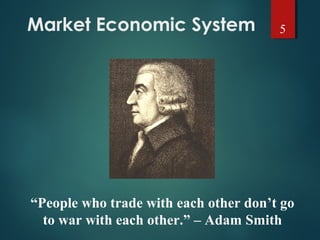
Market Economic System 5
“People who trade with each other don’t go
to war with each other.” – Adam Smith
Market Economy
 As long ago as ancient Egypt humans
began to use forms of money to trade for
goods and with the free trade of goods
arose what is now known as the market
economic system.
 In a market economy, producers make
goods based on the amount demand they
perceive to exist among consumers.
 Consumers in turn pay for items based on
their supply.
 For instance, gold is greatly demanded by
people across the world, but its supply is
limited. Therefore, gold is expensive.
6
Characteristics of Market
Economies
 Private Property Rights: In a market economy
individual can own land, factories and other
properties. The ownership and transfer rights
are ensured by law.
 Private Sector initiative: Individual can acquire
resources from production, establish mills and
factories, from trades and businesses
according to their choice and facilities
available. There is no government intervention
or control.
7
Characteristics of Market
Economies
 Automatic pricing system: all economic functions are
regulated through automatic pricing system. The price of a
commodity is determined by demand and supply, and
production and consumption are based on pricing system.
 Freedom of consumers: every consumer can enjoy any
commodity according to his ability, desire and choice. The
producers produce goods according to the demand of
consumers.
 Profit earning: In market economic system, the ultimate
objective of all production is to earn profit. If there is
possibility of more profit, there will be more investment.
Consequently, there may be more production of some
goods and less production in other cases.
8
Market Economy= Capitalism
 Another word for market economic systems is
capitalism.
 Capitalism is an economic and political ideology
written about by an 18th
century thinker- Adam Smith in
a book entitled “The Wealth of Nations.”
 Smith claimed that the more the people of different
people trade with each other the less likely they are to
go to war.
 Moreover, he claimed that the government must not
interfere with the economy or it may disrupt trade and
people’s ability to prosper. Smith claimed that instead
of a government running an economy an “invisible
free hand” known as a market would.
9
Criticism of Market Economies
 Market economies often result in unequal societies
where there are a few very wealthy individuals and
many poor people.
 Market economies often encourage free trade that
enables large private companies to exploit the
laborers or the resources of less-developed nations.
For instance, most of the clothing worn by Americans is
made in China by workers who earn less than a $1 an
hour.
 Market economies often result in economic
monopolies (when one company controls a business
sector) that stop competition and result in higher
prices
10
Karl Marx was the founder of the communist/
command economy ideology.
11
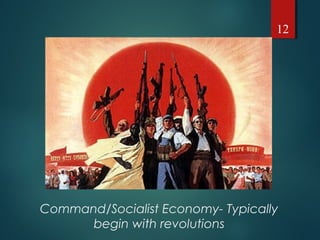
Command/Socialist Economy- Typically
begin with revolutions
12
Command/Socialist
Economy
 Critics of market economies claimed that
capitalism was a form of “class warfare.”
 They claimed that capitalism/ market
economies resulted in a few people ruling
over the masses.
 In order to end capitalism/ market economies
critics claimed that a revolution was needed
to redistribute goods equally.
 This revolution came to be known as
communism and its economy was known as a
command economy.
 In a command economy the government
controls all aspects of the economy.
13
Features of Socialist
Economy
 State ownership of wealth: In a Socialist system, state ownership
exists over land, mills and factories, minerals and other
resources. The general public of the country or the state is the
owner of the wealth. Whatever is earned from these resources is
spent for the society.
 Absence of individual initiative: Initiative means taking steps in
production or trades and commerce. In socialism, all the
factors of production are under the control of the state. So
there is no individual initiative in matters of establishing industrial
factories or carrying out trades and businesses, etc. as a result
of there is no scope of making any individual profit. All activities
relating to industry, agriculture, trade and commerce, etc. are
carried out at the initiative of the state.
14
Features of Socialist
Economy
 Central planning: All economic activities are performed by
the instruction of the central planning authority. The
planning authority decides over the commodities and
their quantity that are to be produced and also the
method of production.
 Limitation of the freedom of consumer: Production and
import of goods and commodities take place at the
initiative of government according to the needs of the
society. For this reason, consumers can not spend money
purchase goods of any type in sufficient quantities
according to their choice. That is why, it is said that
freedom of consumer in socialism is limited.
15
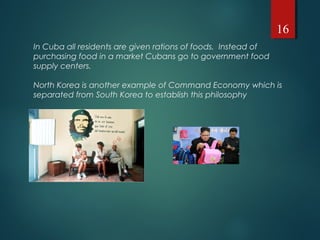
In Cuba all residents are given rations of foods. Instead of
purchasing food in a market Cubans go to government food
supply centers.
North Korea is another example of Command Economy which is
separated from South Korea to establish this philosophy
16
Criticism of Socialist
Economies
 Socialist economies are inefficient and reward
unproductive workers.
 Since workers are awarded the same amount of
money for doing every job workers aren’t productive.
 It results in shadow/illegal markets. Because the
government controls the distribution of goods, rather
than consumers and producers individuals begin to
sell things illegally.
 Command economies cease to stay competitive in
the world because competition and
entrepreneurship is discouraged.
17
Mixed Economy
Mixed economies exist somewhere between command and
market economies. In a mixed economy the government tends
to own major industries like utilities, health care and major
manufacturing industries; however, individuals own most small
businesses. Mixed economies tend to tax their citizens more than
market economies, but less than socialist economies.
18
Features of a Mixed
Economy
 The government controls large industries, while
private individuals control small businesses.
 Citizens are taxed heavily to provide all citizens a
social safety net such as welfare, free university
tuition and free health care.
 Property is controlled by both the government and
private individuals.
 Workers tend to be somewhat less productive than
those in market economies, but less product then
those in command economies.
 Consumers generally have a wide variety choices.
19
Islamic Economy
 Islamic Economic system is an Ideology of economics based on
the teachings of Islam that takes a middle ground between the
systems of Socialism and Capitalism.
 Advocates of Islamic economics generally describe it as a "third
way", an ideal mean with none of the drawbacks of the other
two systems.
 Among the claims made for an Islamic economic system by
Islamic activists and revivalists are that the Gap between the
Rich and the Poor will be reduced and prosperity enhanced by
such means as the discouraging of the hoarding of
wealth, taxing wealth (through zakat) but not trade, exposing
lenders to risk through Profit Sharing and venture
capital, discouraging of hoarding of food for speculation, and
other sinful activities such as unlawful confiscation of land.
20
What about Bangladesh?
 Mixed Economy?
21

Economic Systems

  • 1.
  • 2.
    What is EconomicSystem  All human needs and wants are centralized in economic welfare.  The way to address such economic problems is called Economic System.  In other words, the economic rules and regulations along with the environmental factors by which overall economic activities of a country are conducted is called the economic system.  Since each society’s way is different from each other, so there are different economic systems prevail in the world. 2
  • 3.
    Different Economic Systems  TraditionalEconomic System  Market Economic System  Socialist Economic System  Mixed Economic System  Islamic Economic System 3
  • 4.
    Traditional Economic System  Beforethe invention of money people in ancient civilizations or small communities use to barter for goods.  Bartering is the process of trading one good for another.  The problem with bartering is that its not always easy to find the person who has the good you want and often it can mean carrying a heavy load in order to make a trade. 4
  • 5.
    Market Economic System5 “People who trade with each other don’t go to war with each other.” – Adam Smith
  • 6.
    Market Economy  Aslong ago as ancient Egypt humans began to use forms of money to trade for goods and with the free trade of goods arose what is now known as the market economic system.  In a market economy, producers make goods based on the amount demand they perceive to exist among consumers.  Consumers in turn pay for items based on their supply.  For instance, gold is greatly demanded by people across the world, but its supply is limited. Therefore, gold is expensive. 6
  • 7.
    Characteristics of Market Economies Private Property Rights: In a market economy individual can own land, factories and other properties. The ownership and transfer rights are ensured by law.  Private Sector initiative: Individual can acquire resources from production, establish mills and factories, from trades and businesses according to their choice and facilities available. There is no government intervention or control. 7
  • 8.
    Characteristics of Market Economies Automatic pricing system: all economic functions are regulated through automatic pricing system. The price of a commodity is determined by demand and supply, and production and consumption are based on pricing system.  Freedom of consumers: every consumer can enjoy any commodity according to his ability, desire and choice. The producers produce goods according to the demand of consumers.  Profit earning: In market economic system, the ultimate objective of all production is to earn profit. If there is possibility of more profit, there will be more investment. Consequently, there may be more production of some goods and less production in other cases. 8
  • 9.
    Market Economy= Capitalism Another word for market economic systems is capitalism.  Capitalism is an economic and political ideology written about by an 18th century thinker- Adam Smith in a book entitled “The Wealth of Nations.”  Smith claimed that the more the people of different people trade with each other the less likely they are to go to war.  Moreover, he claimed that the government must not interfere with the economy or it may disrupt trade and people’s ability to prosper. Smith claimed that instead of a government running an economy an “invisible free hand” known as a market would. 9
  • 10.
    Criticism of MarketEconomies  Market economies often result in unequal societies where there are a few very wealthy individuals and many poor people.  Market economies often encourage free trade that enables large private companies to exploit the laborers or the resources of less-developed nations. For instance, most of the clothing worn by Americans is made in China by workers who earn less than a $1 an hour.  Market economies often result in economic monopolies (when one company controls a business sector) that stop competition and result in higher prices 10
  • 11.
    Karl Marx wasthe founder of the communist/ command economy ideology. 11
  • 12.
  • 13.
    Command/Socialist Economy  Critics ofmarket economies claimed that capitalism was a form of “class warfare.”  They claimed that capitalism/ market economies resulted in a few people ruling over the masses.  In order to end capitalism/ market economies critics claimed that a revolution was needed to redistribute goods equally.  This revolution came to be known as communism and its economy was known as a command economy.  In a command economy the government controls all aspects of the economy. 13
  • 14.
    Features of Socialist Economy State ownership of wealth: In a Socialist system, state ownership exists over land, mills and factories, minerals and other resources. The general public of the country or the state is the owner of the wealth. Whatever is earned from these resources is spent for the society.  Absence of individual initiative: Initiative means taking steps in production or trades and commerce. In socialism, all the factors of production are under the control of the state. So there is no individual initiative in matters of establishing industrial factories or carrying out trades and businesses, etc. as a result of there is no scope of making any individual profit. All activities relating to industry, agriculture, trade and commerce, etc. are carried out at the initiative of the state. 14
  • 15.
    Features of Socialist Economy Central planning: All economic activities are performed by the instruction of the central planning authority. The planning authority decides over the commodities and their quantity that are to be produced and also the method of production.  Limitation of the freedom of consumer: Production and import of goods and commodities take place at the initiative of government according to the needs of the society. For this reason, consumers can not spend money purchase goods of any type in sufficient quantities according to their choice. That is why, it is said that freedom of consumer in socialism is limited. 15
  • 16.
    In Cuba allresidents are given rations of foods. Instead of purchasing food in a market Cubans go to government food supply centers. North Korea is another example of Command Economy which is separated from South Korea to establish this philosophy 16
  • 17.
    Criticism of Socialist Economies Socialist economies are inefficient and reward unproductive workers.  Since workers are awarded the same amount of money for doing every job workers aren’t productive.  It results in shadow/illegal markets. Because the government controls the distribution of goods, rather than consumers and producers individuals begin to sell things illegally.  Command economies cease to stay competitive in the world because competition and entrepreneurship is discouraged. 17
  • 18.
    Mixed Economy Mixed economiesexist somewhere between command and market economies. In a mixed economy the government tends to own major industries like utilities, health care and major manufacturing industries; however, individuals own most small businesses. Mixed economies tend to tax their citizens more than market economies, but less than socialist economies. 18
  • 19.
    Features of aMixed Economy  The government controls large industries, while private individuals control small businesses.  Citizens are taxed heavily to provide all citizens a social safety net such as welfare, free university tuition and free health care.  Property is controlled by both the government and private individuals.  Workers tend to be somewhat less productive than those in market economies, but less product then those in command economies.  Consumers generally have a wide variety choices. 19
  • 20.
    Islamic Economy  IslamicEconomic system is an Ideology of economics based on the teachings of Islam that takes a middle ground between the systems of Socialism and Capitalism.  Advocates of Islamic economics generally describe it as a "third way", an ideal mean with none of the drawbacks of the other two systems.  Among the claims made for an Islamic economic system by Islamic activists and revivalists are that the Gap between the Rich and the Poor will be reduced and prosperity enhanced by such means as the discouraging of the hoarding of wealth, taxing wealth (through zakat) but not trade, exposing lenders to risk through Profit Sharing and venture capital, discouraging of hoarding of food for speculation, and other sinful activities such as unlawful confiscation of land. 20
  • 21.
    What about Bangladesh? Mixed Economy? 21