What is an economy?
An economy or economic system, is
the way a nation makes economic
choices about how the nation will use
its resources to produce and distribute
goods and services in a society.
Choices
 Everyday ,in our country and countries
around the world, business owners,
consumers, workers, and governments
must make choices about using scarce
resources.
 Together these choices create an economy.
 These choices fall into three groups:
Basic economic choices:
What goods and services should be
produced?
 How should the goods and services be
produced?
 Who receives and consumes these goods
and services.
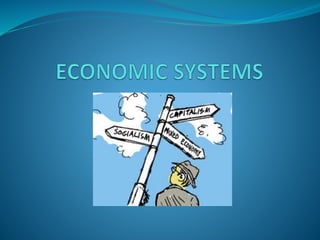
Three types of economic systems:
 These questions are answered by the type of
economic system a nation has. There are
three types of economies:
1. Capitalist economy
2. Socialist economy
3. Mixed economy
Capitalist economy(free market
economy)
 Capitalist economy is one in which factors of
production are privately owned and managed and in
which production takes place on the initiative for
earning profits.
 It is a free economy in which government interference
is not found.
 In this the consumers decide what should be
produced, business determine how the products will
be produced.
 Ex. The united states, Japan, Western Europe
Features of free market economy
A. Economic freedom: individuals have the right to
choose.
B. Competition: more than one producer of
good/services insures choices.
C. Private property: individuals have the right to own
their own property, including business.
D. Profit motive: individuals are driven by a desire to
profit(make money)
E. Freedom to enterprise: everybody is free to engage
in whatever economic activity he pleases.
Socialist economy (controlled economy)
 All material means of production i.e. land, capital
and mines etc. are owned by the whole community
represented by the state.
 The state decides the size and direction of the
investment.
 The state works for the welfare of the society and
profit motive is not important for it.
 Ex. Communist countries (China, North korea,
Cuba)
Features of socialist economy:
 Collective ownership of means of production: In
this economy, all the production are state owned.
 Centrally planned economy: All basic decisions
pertaining to what, how and for whom are decided by
the centrally planned authority.
 Economic equalities: a socialist state strives to
achieve economic equality.
 Lack of competition: it avoid all sorts of competition
and rivalry as between different production units.
Mixed economy
 An economic system, which contains of both
private and public sectors, is called mixed
economy.
 It permits coexistence of controlled and market
economy.
 The concept of mixed economy was given by
J.M.Keynes.
 Ex. India
Features of mixed economy:
 Coexistence of both private and public sector: all
economic decisions are partly taken by state and partly
taken by the private entrepreneurs.
 Planned economy: the government has a clear and
definite economic plan.
 Balanced regional development: public sector
enterprises may be located in the backward regions so
as to ensure its development.
 Dual system of pricing: in private sector price is
decided by the help of price mechanism on the other
hand on govt. sector prices are fixed by the govt.
Thank you

Economic systems

  • 2.
    What is aneconomy? An economy or economic system, is the way a nation makes economic choices about how the nation will use its resources to produce and distribute goods and services in a society.
  • 3.
    Choices  Everyday ,inour country and countries around the world, business owners, consumers, workers, and governments must make choices about using scarce resources.  Together these choices create an economy.  These choices fall into three groups:
  • 4.
    Basic economic choices: Whatgoods and services should be produced?  How should the goods and services be produced?  Who receives and consumes these goods and services.
  • 5.
    Three types ofeconomic systems:  These questions are answered by the type of economic system a nation has. There are three types of economies: 1. Capitalist economy 2. Socialist economy 3. Mixed economy
  • 6.
    Capitalist economy(free market economy) Capitalist economy is one in which factors of production are privately owned and managed and in which production takes place on the initiative for earning profits.  It is a free economy in which government interference is not found.  In this the consumers decide what should be produced, business determine how the products will be produced.  Ex. The united states, Japan, Western Europe
  • 7.
    Features of freemarket economy A. Economic freedom: individuals have the right to choose. B. Competition: more than one producer of good/services insures choices. C. Private property: individuals have the right to own their own property, including business. D. Profit motive: individuals are driven by a desire to profit(make money) E. Freedom to enterprise: everybody is free to engage in whatever economic activity he pleases.
  • 8.
    Socialist economy (controlledeconomy)  All material means of production i.e. land, capital and mines etc. are owned by the whole community represented by the state.  The state decides the size and direction of the investment.  The state works for the welfare of the society and profit motive is not important for it.  Ex. Communist countries (China, North korea, Cuba)
  • 9.
    Features of socialisteconomy:  Collective ownership of means of production: In this economy, all the production are state owned.  Centrally planned economy: All basic decisions pertaining to what, how and for whom are decided by the centrally planned authority.  Economic equalities: a socialist state strives to achieve economic equality.  Lack of competition: it avoid all sorts of competition and rivalry as between different production units.
  • 10.
    Mixed economy  Aneconomic system, which contains of both private and public sectors, is called mixed economy.  It permits coexistence of controlled and market economy.  The concept of mixed economy was given by J.M.Keynes.  Ex. India
  • 11.
    Features of mixedeconomy:  Coexistence of both private and public sector: all economic decisions are partly taken by state and partly taken by the private entrepreneurs.  Planned economy: the government has a clear and definite economic plan.  Balanced regional development: public sector enterprises may be located in the backward regions so as to ensure its development.  Dual system of pricing: in private sector price is decided by the help of price mechanism on the other hand on govt. sector prices are fixed by the govt.
  • 12.