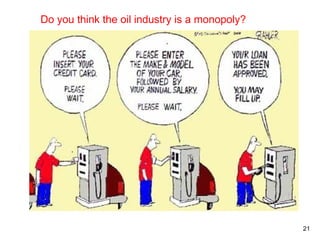
I do not have an opinion on whether any particular industry is a monopoly. This document provides an overview of different types of economic systems and the key characteristics of each.
What is anEconomy?
• An economy, or
economic system, is the
way a nation makes
economic choices about
how the nation will use its
resources to produce and
distribute goods and
services.
2
3.
Resources
• Also calledfactors of production, are
all the things used in producing goods
and services. They fall into four
categories:
1. Land
2. Labor
3. Capital
4. Entrepreneurship
3
4.
Land refersto everything on Earth that is in its natural
state, or Earth's natural resources.
Labor refers to all the people who work in the
economy.
Capital includes money needed to start and operate a
business. At a national
level, capital includes infrastructure, such as roads,
ports, sanitation facilities,
and utilities.
Entrepreneurship refers to the skills of people who
are willing to risk their time and money to run a
business.
4
5.
Scarcity
• The differencebetween wants and
needs and available resources.
• Example: Most underdeveloped
nations have natural resources, but do
not have capital or skilled labor to
develop them.
5
6.
Choices
Every day,in our country and countries
around the world, business owners,
consumers, workers, and governments
must make choices about using scarce
resources.
Together these choices create an
economy.
These choices fall into three groups:
6
7.
Basic Economic Choices:
WHAT goods and services should be
produced?
HOW should the goods and services be
produced?
WHO receives and consumes these
goods and services.
7
8.
Four Types ofEconomic
Systems:
These questions are answered by the type
of economic system a nation has. There
are four types of economies:
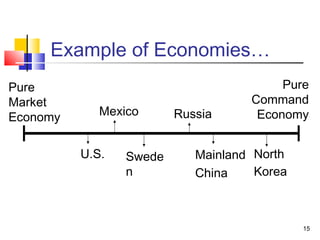
1. Pure Market Economy
2. Pure Command Economy
3. Traditional Economy
4. Mixed Economy
Let’s review each of these types of economies.
8
9.
Pure Market Economy
NO government involvement in economic
decisions. Private firms account for all
production.
Consumers decide WHAT should be
produced. They do this through the
purchases they make.
Businesses determine HOW the products will
be produced. They must be competitive.
WHO buys the products? The people with the
most money are able to buy more goods and
services.
9
10.
Problems
Difficulty enforcingproperty
rights - no laws.
Some people have few resources to sell -
no minimum income.
Some firms try to monopolize markets -
conspiring and price fixing.
No public goods. - national defense?
10
11.
Pure Command Economy
All resources are government-owned.
One person (dictator) or a group of officials
decide WHAT products are needed.
The government runs all businesses, controls
all employment, and decides HOW goods and
services will be produced.
The government decides WHO receives the
products that are produced.
11
12.
Problems
Consumers getlow priority.
Little freedom of choice – few
products.
Resources owned by the state
are often wasted – individuals
don’t care if they don’t own it.
12
13.
Traditional Economy
Economyis shaped largely by custom or
religion.
Customs and religion determine the
WHO, WHAT, and HOW.
Example: India has a caste system which
restricts occupational choice. (A social
class separated from others by
distinctions of hereditary rank, profession,
or wealth.)
13
14.
Mixed Economy
Mosteconomies in the world today are
mixed.
Classification is based on how much
government intervention there is.
In the U.S. the government accounts for
about 1/3 of all U.S. economic activity.
14
Government Philosophies
Countriesalso have different
philosophies of government which
reflect not only the laws and rules, but
how individuals are treated.
There are three political philosophies:
1. Capitalism
2. Socialism
3. Communism
16
17.
Capitalism
Capitalism featuresprivate
ownership of businesses and
marketplace competition.
It is the same as a free enterprise
system.
The political system most frequently
associated with capitalism is
democracy.
17
18.
Socialism
• The maingoal of socialism is to keep
prices low for all people and to provide
employment for many.
• The government runs key industries,
generally in telecommunications, mining,
transportation, and banking.
• Socialist countries tend to have more
social services.
18
19.
Communism
Have atotalitarian form of government; this
means that the government runs
everything and makes all decisions.
Theoretically, there is no unemployment in
communist countries.
The government decides the type of
schooling people will receive and also tells
them where to live.
19
20.
Economies in Transition
Many countries are in transition from either
communism or socialism to capitalism.
Privatization is a common aspect of
transition from a command economy to
free enterprise system. Privatization means
state-owned industries are sold to private
individuals
and companies.
20