Joffre Balce
Philorum 4 March 2014
Economic Secularism
The Case of the Victim at Fault
You shouldn’t
have been there!
Insh’Allah!
Shouldn’t there be
an investigation?
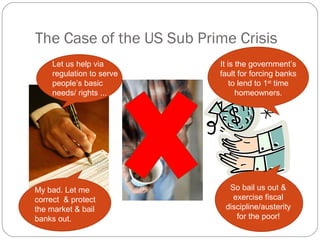
The Case of the US Sub Prime Crisis
It is the government’s
fault for forcing banks
to lend to 1st
time
homeowners.
So bail us out &
exercise fiscal
discipline/austerity
for the poor!
Let us help via
regulation to serve
people’s basic
needs/ rights ...
My bad. Let me
correct & protect
the market & bail
banks out.
Political Secularism
Separation of Church & State
Freedom of & from Religion
George Jacob Holyoake (1817 -1906)
Hard: rejection of religion
Soft: skepticism of claims; demand for evidence & facts
US & French Revolution
The end of state religion
A Bit of History
Maharajah Ranjit Singh: Not a Western Phenomenon
Punjab, 1st
Half of 19 CE
To overcome the caste system
Western Age of Enlightenment
French Revolution 18th
CE
To check the collaboration between Church & Royalty against
the interest of the larger society
Aspirations of a Secular Society
Refuses to commit itself as a whole to any one view of the nature
of the universe and the role of man in it.
Is not homogeneous, but is pluralistic.
Is tolerant. It widens the sphere of private decision-making.
While every society must have some common aims, which implies
there must be agreed on methods of problem-solving, and a
common framework of law; in a secular society these are as
limited as possible.
Problem solving is approached rationally, through examination of
the facts. While the secular society does not set any
overall aim, it helps its members realize their aims.
Is a society without any official images. Nor is there a common
ideal type of behaviour with universal application.
The Idea of a Secular Society, D. L.
Munby, London, Oxford University
Press, 1963, pp. 14–32.
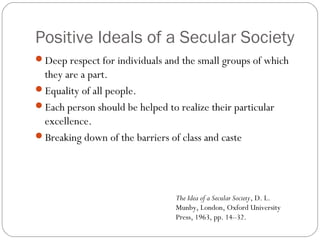
Positive Ideals of a Secular Society
Deep respect for individuals and the small groups of which
they are a part.
Equality of all people.
Each person should be helped to realize their particular
excellence.
Breaking down of the barriers of class and caste
The Idea of a Secular Society, D. L.
Munby, London, Oxford University
Press, 1963, pp. 14–32.
Interpretations
Not atheism or an aversion
to religion
More free, critical &
creative thinking
Political neutrality &
impartiality
The right to question &
explore/present
alternative solutions
Historical Parallels
US & French Revolution
that led to Political
Secularism
Royalty
Church
Commoners
Outnumbered & Practically a
Disenfranchised Voter
Global Financial Crisis that
must lead to Economic
Secularism
Government
Corporations
Workforce
Work is a Commodity, Not a
Right
Solutions then & Now
Declaration of the Rights
of Man
Necessary for human
dignity
Rights are not endowed by
a god or governments
Inherent, intrinsic &
inalienable to man
Universal in acceptance &
respect
Universal & Equal Suffrage
Legal & Operational
Definition of a Human
Corporations & other
institutions are NOT
human beings whose rights
do not supercede or
subordinate a human’s
Must be decided by the
people through science
Citizen’s Dividend/ Basic
Safety Net
Reforms Needed
De-Commercializing the
Exercise of Suffrage
Stop Commodifying
Rights. Uphold Them!
By all means, protest!
Repeal the Legal Fiction of
Corporate Personhood
The right to profit does
not trump the right to a
dignified life
Democratising the
Management of the
Currency & Treasury
Direct Representation but
Non-Partisan
Balance Needs &
Debasement of Currency
Fiscal Reforms
Land Value Taxation
Citizen’s Dividend
FOR YOUR CONSIDERATION
THANKYOU!
Education is not
filling a bucket, but
lighting a fire.
~ William Butler Yeats
Damn the gods!
Learn to make your
own fire!

Economic Secularism

  • 1.
    Joffre Balce Philorum 4March 2014 Economic Secularism
  • 2.
    The Case ofthe Victim at Fault You shouldn’t have been there! Insh’Allah! Shouldn’t there be an investigation?
  • 3.
    The Case ofthe US Sub Prime Crisis It is the government’s fault for forcing banks to lend to 1st time homeowners. So bail us out & exercise fiscal discipline/austerity for the poor! Let us help via regulation to serve people’s basic needs/ rights ... My bad. Let me correct & protect the market & bail banks out.
  • 4.
    Political Secularism Separation ofChurch & State Freedom of & from Religion George Jacob Holyoake (1817 -1906) Hard: rejection of religion Soft: skepticism of claims; demand for evidence & facts US & French Revolution The end of state religion
  • 5.
    A Bit ofHistory Maharajah Ranjit Singh: Not a Western Phenomenon Punjab, 1st Half of 19 CE To overcome the caste system Western Age of Enlightenment French Revolution 18th CE To check the collaboration between Church & Royalty against the interest of the larger society
  • 6.
    Aspirations of aSecular Society Refuses to commit itself as a whole to any one view of the nature of the universe and the role of man in it. Is not homogeneous, but is pluralistic. Is tolerant. It widens the sphere of private decision-making. While every society must have some common aims, which implies there must be agreed on methods of problem-solving, and a common framework of law; in a secular society these are as limited as possible. Problem solving is approached rationally, through examination of the facts. While the secular society does not set any overall aim, it helps its members realize their aims. Is a society without any official images. Nor is there a common ideal type of behaviour with universal application. The Idea of a Secular Society, D. L. Munby, London, Oxford University Press, 1963, pp. 14–32.
  • 7.
    Positive Ideals ofa Secular Society Deep respect for individuals and the small groups of which they are a part. Equality of all people. Each person should be helped to realize their particular excellence. Breaking down of the barriers of class and caste The Idea of a Secular Society, D. L. Munby, London, Oxford University Press, 1963, pp. 14–32.
  • 8.
    Interpretations Not atheism oran aversion to religion More free, critical & creative thinking Political neutrality & impartiality The right to question & explore/present alternative solutions
  • 9.
    Historical Parallels US &French Revolution that led to Political Secularism Royalty Church Commoners Outnumbered & Practically a Disenfranchised Voter Global Financial Crisis that must lead to Economic Secularism Government Corporations Workforce Work is a Commodity, Not a Right
  • 10.
    Solutions then &Now Declaration of the Rights of Man Necessary for human dignity Rights are not endowed by a god or governments Inherent, intrinsic & inalienable to man Universal in acceptance & respect Universal & Equal Suffrage Legal & Operational Definition of a Human Corporations & other institutions are NOT human beings whose rights do not supercede or subordinate a human’s Must be decided by the people through science Citizen’s Dividend/ Basic Safety Net
  • 11.
    Reforms Needed De-Commercializing the Exerciseof Suffrage Stop Commodifying Rights. Uphold Them! By all means, protest! Repeal the Legal Fiction of Corporate Personhood The right to profit does not trump the right to a dignified life Democratising the Management of the Currency & Treasury Direct Representation but Non-Partisan Balance Needs & Debasement of Currency Fiscal Reforms Land Value Taxation Citizen’s Dividend
  • 12.
    FOR YOUR CONSIDERATION THANKYOU! Educationis not filling a bucket, but lighting a fire. ~ William Butler Yeats Damn the gods! Learn to make your own fire!