 Definition
 Former secular states
 Constitutional secular states
 Former secular states
 Constitutional secular states
 Ambiguous states
 Origin
 History
 Pakistan as a secular state
 Objectives of resolution of Pakistan
 Critiques of concept
 references
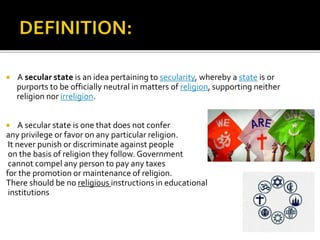
 A secular state is an idea pertaining to secularity, whereby a state is or
purports to be officially neutral in matters of religion, supporting neither
religion nor irreligion.
 A secular state is one that does not confer
any privilege or favor on any particular religion.
It never punish or discriminate against people
on the basis of religion they follow. Government
cannot compel any person to pay any taxes
for the promotion or maintenance of religion.
There should be no religious instructions in educational
institutions
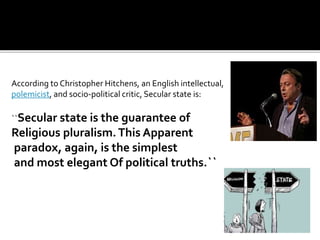
According to Christopher Hitchens, an English intellectual,
polemicist, and socio-political critic, Secular state is:
``Secular state is the guarantee of
Religious pluralism.This Apparent
paradox, again, is the simplest
and most elegant Of political truths.``
 A secular state is a concept of secularism, whereby a state or
country purports to be officially neutral in matters of religion,
supporting neither religion nor irreligion
 A secular state also claims to treat all its citizens equally regardless
of religion
 It claims to avoid preferential treatment for a citizen from a
particular religion/non-religion over other religions/non-religion.
 Secular states do not have a state religion or equivalent although
the absence of a state religion does not necessarily mean that a
state is fully secular; however, a true secular state should
steadfastly maintain national governance without influence from
religious factions; i.e. Separation of church and state.
 Confederate States of America (1861–1865)
 Democratic Republic of Afghanistan (1978–1980)
 Imperial State of Iran (1925–1941, 1953–1979)
 Iraq (1932–2005)
 Samoa (1962–2017) Samoa (1962–2017)
 France
 Mexico
 South Korea
 Turkey
These are considered constitutionally secular
although their secularism varies.
 Argentina
 Armenia
 United States
 United Kingdom
 Tonga
 Thailand
 Switzerland
 Armenia
 EI Salvador
 Bangladesh
 Sri Lanka
 Seychelles
 Romania
 Norway
 India
 Nepal
 Nauru
 Myanmar
 Malaysia
 Laos
 Kiribati
 Israel
 Ireland
 Indonesia
 Georgia
 Finland
 Canada
 Brazil
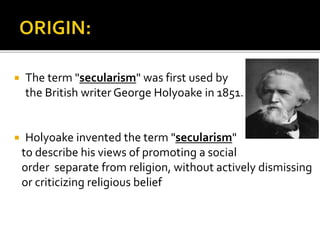
 The term "secularism" was first used by
the British writer George Holyoake in 1851.
 Holyoake invented the term "secularism"
to describe his views of promoting a social
order separate from religion, without actively dismissing
or criticizing religious belief
 Among the earliest documentations of a secular form of
thought is seen in the Charvaka system of philosophy in
India, which held direct perception, empiricism, and
conditional inference as proper sources of knowledge,
and sought to reject the prevailing religious practices of
that time
 Secularism emerged in the West with
the establishment of reason over
religious faith as human reason was
gradually liberated from unquestioned subjection to the
dominion of religion and superstitions
 Charvaka also known as
Lokāyata, is an ancient
school of Indian
materialism.
 Secularism first appeared in the West in the Classical
philosophy and politics of ancient Greece.
 It disappeared for a time after the decline of the Classical
world, but resurfaced after a millennium and a half in
the Renaissance and the Reformation.
Renaissance
was a period in European
history marking the transition
from the Middle
Ages to modernity and
covering the 15th and 16th
centuries
REFORMATION was a major movement within
Western Christianity in 16th-century Europe that
posed a religious and political challenge to the
Catholic Church and in particular to papal
authority, arising from what were perceived to
be errors, abuses, and discrepancies by the
Catholic Church
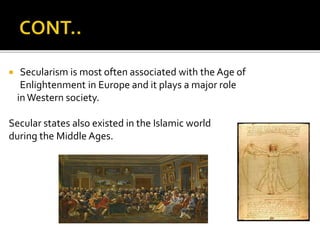
 Secularism is most often associated with the Age of
Enlightenment in Europe and it plays a major role
inWestern society.
Secular states also existed in the Islamic world
during the Middle Ages.
 A major impact on the idea of state religious liberty came
from the writings of John Locke who, in his A Letter
ConcerningToleration, argued in favor of religious toleration.
 He argued that government must treat all
citizens and all religions equally, and that it
can restrict actions, but not the religious intent
behind them.
 Separation of state from religion resulted in establishment of
secularist organization.
 In accord with the belief in the separation of church and
state, secularists tend to prefer that politicians make
decisions for secular rather than religious reasons. In this
respect, policy decisions pertaining to topics like, Abortion,
Contraception, Embryonic Stem Cell Research, Same-sex
Marriage, Sex Education are prominently focused upon by
American secularist organizations such as the Center for
Inquiry
 The concept of the Two-NationTheory on which Pakistan
was founded, was largely based on Muslim nationalism.
 Secularism in Pakistan went from being
a matter of practice in law by the
Government of Pakistan to a political
movement opposing the Islamization
policies of the military dictator General
Zia-ul-Haq in the 1980s.
 The supporters of Islamisation on the other hand assert that
Pakistan was founded as a Muslim state and that in its status
as an Islamic republic, it must thereby implement Islamic
laws, known as Shariat
 one of Pakistan's most popular media outlets, Dawn, was
originally founded by Jinnah and identifies as secular.
 Other popular media outlets like ExpressTribune, Daily
Times and PakistanToday also identify on a liberal and
progressive platform.
 In 1956, the state adopted the name of the "Islamic Republic
of Pakistan", declaring Islam as the official religion, but did
not take any further measures to adopt Islamic laws.
 The country's military rulers General Ayub Khan(1958–1969)
and GeneralYahya Khan (1969–1971) continued a secularist
tradition and repressed much of Islamist political activism.
 In this context, it is imperative to understand the true
meaning of the word “Secular”.
 Having said this, we see three main features of western
secularism:
(1) freedom of religion, i.e., no compulsion of beliefs
(2) equal status for all religions
(3) no interference by the state in religious matters or by the
church in the affairs of the state, in other words separation of
the state and the church.
Sovereignty belongs to Allah alone but He has delegated it to
the State of Pakistan through its people for being exercised
within the limits prescribed by Him as a sacred trust.
 The State shall exercise its powers and authority through the
elected representatives of the people.
 The principles of democracy, freedom, equality, tolerance and
social justice, as enunciated by Islam, shall be fully observed.
 Muslims shall be enabled to order their lives in the
individual and collective spheres in accordance with the
teachings of Islam as set out in the Quran and Sunnah.
 Provision shall be made for the religious minorities to
freely profess and practice their religions and develop
their cultures.
 It allows people from different religions to exist together at
the least common denominator, ensuring all their beliefs and
rights.
 It allows government to function on the basis of rational
discourse rather than religious dogma
 It allows more rights and freedoms to women, who are
generally assigned to subservient roles in many belief
systems.
 A “secular” state, not discriminating between different beliefs
unless they led to oppressive, discriminatory or murderous
attacks on others enabled people to live in a degree of peace
and freedom.
 It promotes scientific and material advancement as this
requires free rational discourse
 Secular states provide guarantee of religious freedom to all
sections of society.
 A secular state is great, because it allows all people,
regardless of their religion to be equally part of the country.
There is no institutional discrimination against a religious
minority.
 Modern secular countries are some of the most peaceful and
tolerant societies.The top performing countries in the Global
Peace Index all have a very strong emphasis on secular state.
The Global Peace Index gauges global peace using three broad
themes:
 The level of safety and security in society
 The extent of domestic and international conflict
 The degree of militarization.
Factors are both internal such as levels of violence and crime
within the country and external such as military expenditure and
wars.
GLOBAL PEACE INDEX
 In political terms, secularism is a movement towards the
separation of religion and government (often termed
the separation of church and state.
 This can refer to reducing ties between a government and
a state religion, replacing laws based on scripture (such
as Halakha, and Sharia) with civil laws, and eliminating
discrimination on the basis of religion.
 Each state may find its own unique policy prescriptions.These
may include separation, careful monitoring and regulation of
organized religion such as in France,Turkey, and others.
 According to modern sociology,
``Most societies become increasingly secular as the result
of social, economic development and progress, rather than
through the actions of a dedicated secular movement``.
 DEFINITION:
https://en.wikipedia.org/wiki/Secular_state#:~:text=A%20secu
lar%20state%20is%20an,supporting%20neither%20religion%2
0nor%20irreligion.
 VIDEO;
https://www.youtube.com/watch?v=7PFvdqmkoVo
 PAKISTAN AS A SECULAR STATE:
https://www.worldscientific.com/doi/abs/10.1142/97898142823
83_0012
Secular state

Secular state

  • 2.
     Definition  Formersecular states  Constitutional secular states  Former secular states  Constitutional secular states  Ambiguous states  Origin  History  Pakistan as a secular state  Objectives of resolution of Pakistan  Critiques of concept  references
  • 3.
     A secularstate is an idea pertaining to secularity, whereby a state is or purports to be officially neutral in matters of religion, supporting neither religion nor irreligion.  A secular state is one that does not confer any privilege or favor on any particular religion. It never punish or discriminate against people on the basis of religion they follow. Government cannot compel any person to pay any taxes for the promotion or maintenance of religion. There should be no religious instructions in educational institutions
  • 4.
    According to ChristopherHitchens, an English intellectual, polemicist, and socio-political critic, Secular state is: ``Secular state is the guarantee of Religious pluralism.This Apparent paradox, again, is the simplest and most elegant Of political truths.``
  • 5.
     A secularstate is a concept of secularism, whereby a state or country purports to be officially neutral in matters of religion, supporting neither religion nor irreligion  A secular state also claims to treat all its citizens equally regardless of religion  It claims to avoid preferential treatment for a citizen from a particular religion/non-religion over other religions/non-religion.  Secular states do not have a state religion or equivalent although the absence of a state religion does not necessarily mean that a state is fully secular; however, a true secular state should steadfastly maintain national governance without influence from religious factions; i.e. Separation of church and state.
  • 8.
     Confederate Statesof America (1861–1865)  Democratic Republic of Afghanistan (1978–1980)  Imperial State of Iran (1925–1941, 1953–1979)  Iraq (1932–2005)  Samoa (1962–2017) Samoa (1962–2017)
  • 9.
     France  Mexico South Korea  Turkey These are considered constitutionally secular although their secularism varies.
  • 10.
     Argentina  Armenia United States  United Kingdom  Tonga  Thailand  Switzerland  Armenia  EI Salvador  Bangladesh  Sri Lanka  Seychelles  Romania  Norway  India  Nepal  Nauru  Myanmar  Malaysia  Laos  Kiribati  Israel  Ireland  Indonesia  Georgia  Finland  Canada  Brazil
  • 11.
     The term"secularism" was first used by the British writer George Holyoake in 1851.  Holyoake invented the term "secularism" to describe his views of promoting a social order separate from religion, without actively dismissing or criticizing religious belief
  • 12.
     Among theearliest documentations of a secular form of thought is seen in the Charvaka system of philosophy in India, which held direct perception, empiricism, and conditional inference as proper sources of knowledge, and sought to reject the prevailing religious practices of that time  Secularism emerged in the West with the establishment of reason over religious faith as human reason was gradually liberated from unquestioned subjection to the dominion of religion and superstitions  Charvaka also known as Lokāyata, is an ancient school of Indian materialism.
  • 13.
     Secularism firstappeared in the West in the Classical philosophy and politics of ancient Greece.  It disappeared for a time after the decline of the Classical world, but resurfaced after a millennium and a half in the Renaissance and the Reformation. Renaissance was a period in European history marking the transition from the Middle Ages to modernity and covering the 15th and 16th centuries REFORMATION was a major movement within Western Christianity in 16th-century Europe that posed a religious and political challenge to the Catholic Church and in particular to papal authority, arising from what were perceived to be errors, abuses, and discrepancies by the Catholic Church
  • 14.
     Secularism ismost often associated with the Age of Enlightenment in Europe and it plays a major role inWestern society. Secular states also existed in the Islamic world during the Middle Ages.
  • 15.
     A majorimpact on the idea of state religious liberty came from the writings of John Locke who, in his A Letter ConcerningToleration, argued in favor of religious toleration.  He argued that government must treat all citizens and all religions equally, and that it can restrict actions, but not the religious intent behind them.
  • 16.
     Separation ofstate from religion resulted in establishment of secularist organization.  In accord with the belief in the separation of church and state, secularists tend to prefer that politicians make decisions for secular rather than religious reasons. In this respect, policy decisions pertaining to topics like, Abortion, Contraception, Embryonic Stem Cell Research, Same-sex Marriage, Sex Education are prominently focused upon by American secularist organizations such as the Center for Inquiry
  • 17.
     The conceptof the Two-NationTheory on which Pakistan was founded, was largely based on Muslim nationalism.  Secularism in Pakistan went from being a matter of practice in law by the Government of Pakistan to a political movement opposing the Islamization policies of the military dictator General Zia-ul-Haq in the 1980s.  The supporters of Islamisation on the other hand assert that Pakistan was founded as a Muslim state and that in its status as an Islamic republic, it must thereby implement Islamic laws, known as Shariat
  • 18.
     one ofPakistan's most popular media outlets, Dawn, was originally founded by Jinnah and identifies as secular.  Other popular media outlets like ExpressTribune, Daily Times and PakistanToday also identify on a liberal and progressive platform.  In 1956, the state adopted the name of the "Islamic Republic of Pakistan", declaring Islam as the official religion, but did not take any further measures to adopt Islamic laws.  The country's military rulers General Ayub Khan(1958–1969) and GeneralYahya Khan (1969–1971) continued a secularist tradition and repressed much of Islamist political activism.
  • 19.
     In thiscontext, it is imperative to understand the true meaning of the word “Secular”.
  • 20.
     Having saidthis, we see three main features of western secularism: (1) freedom of religion, i.e., no compulsion of beliefs (2) equal status for all religions (3) no interference by the state in religious matters or by the church in the affairs of the state, in other words separation of the state and the church.
  • 21.
    Sovereignty belongs toAllah alone but He has delegated it to the State of Pakistan through its people for being exercised within the limits prescribed by Him as a sacred trust.  The State shall exercise its powers and authority through the elected representatives of the people.  The principles of democracy, freedom, equality, tolerance and social justice, as enunciated by Islam, shall be fully observed.
  • 22.
     Muslims shallbe enabled to order their lives in the individual and collective spheres in accordance with the teachings of Islam as set out in the Quran and Sunnah.  Provision shall be made for the religious minorities to freely profess and practice their religions and develop their cultures.
  • 25.
     It allowspeople from different religions to exist together at the least common denominator, ensuring all their beliefs and rights.  It allows government to function on the basis of rational discourse rather than religious dogma  It allows more rights and freedoms to women, who are generally assigned to subservient roles in many belief systems.  A “secular” state, not discriminating between different beliefs unless they led to oppressive, discriminatory or murderous attacks on others enabled people to live in a degree of peace and freedom.
  • 26.
     It promotesscientific and material advancement as this requires free rational discourse  Secular states provide guarantee of religious freedom to all sections of society.  A secular state is great, because it allows all people, regardless of their religion to be equally part of the country. There is no institutional discrimination against a religious minority.
  • 27.
     Modern secularcountries are some of the most peaceful and tolerant societies.The top performing countries in the Global Peace Index all have a very strong emphasis on secular state. The Global Peace Index gauges global peace using three broad themes:  The level of safety and security in society  The extent of domestic and international conflict  The degree of militarization. Factors are both internal such as levels of violence and crime within the country and external such as military expenditure and wars. GLOBAL PEACE INDEX
  • 29.
     In politicalterms, secularism is a movement towards the separation of religion and government (often termed the separation of church and state.  This can refer to reducing ties between a government and a state religion, replacing laws based on scripture (such as Halakha, and Sharia) with civil laws, and eliminating discrimination on the basis of religion.  Each state may find its own unique policy prescriptions.These may include separation, careful monitoring and regulation of organized religion such as in France,Turkey, and others.
  • 30.
     According tomodern sociology, ``Most societies become increasingly secular as the result of social, economic development and progress, rather than through the actions of a dedicated secular movement``.
  • 31.