2	 Chapter 1  What Is Economics?
Because we can’t get everything we want, we must
make choices. You can’t afford both a laptop and an
iPhone, so you must choose which one to buy. You
can’t spend tonight both studying for your next test
and going to the movies, so again, you must choose
which one to do. Governments can’t spend a tax dol­
lar on both national defense and environmental pro­
tection, so they must choose how to spend that dollar.
Your choices must somehow be made consistent
with the choices of others. If you choose to buy a lap­
top, someone else must choose to sell it. Incentives rec­­
oncile choices. An incentive is a reward that encourages
an action or a penalty that discourages one. Prices act
as incentives. If the price of a laptop is too high, more
will be offered for sale than people want to buy. And if
the price is too low, fewer will be offered for sale than
people want to buy. But there is a price at which
choices to buy and sell are consistent.
Economics is the social science that studies
the choices that individuals, businesses,
governments, and entire societies make as
they cope with scarcity and the incentives
that influence and reconcile those choices.
The subject has two parts:
■	 Microeconomics
■	 Macroeconomics
Microeconomics is the study of the choices that indi­
viduals and businesses make, the way these choices
interact in markets, and the influence of governments.
Some examples of microeconomic questions are: Why
are people downloading more movies? How would a
tax on e-commerce affect eBay?
Macroeconomics is the study of the performance of
the national economy and the global economy. Some
examples of macroeconomic questions are: Why
is the U.S. unemployment rate so high? Can the
Federal Reserve make our economy expand by cut­
ting interest rates?
	◆ Definition of Economics
A fundamental fact dominates our lives: We want
more than we can get. Our inability to get everything
we want is called scarcity. Scarcity is universal. It con­
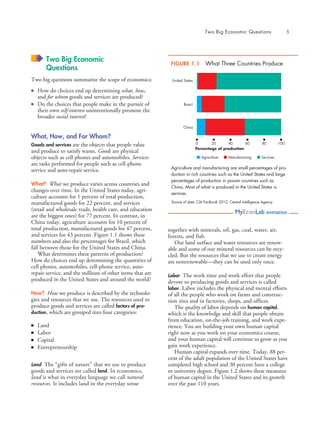
fronts all living things. Even parrots face scarcity!
Not only do I want a cracker—we all want a cracker!
© The New Yorker Collection 1985
Frank Modell from cartoonbank.com. All Rights Reserved.
Think about the things that you want and the
scarcity that you face. You want to go to a good
school, college, or university. You want to live in a
well-equipped, spacious, and comfortable home. You
want the latest smart phone and the fastest Internet
connection for your laptop or iPad. You want some
sports and recreational gear—perhaps some new run­
ning shoes, or a new bike. You want much more time
than is available to go to class, do your homework,
play sports and games, read novels, go to the movies,
listen to music, travel, and hang out with your
friends. And you want to live a long and healthy life.
What you can afford to buy is limited by your
­income and by the prices you must pay. And your
time is limited by the fact that your day has 24 hours.
You want some other things that only govern­
ments provide. You want to live in a safe neighbor­
hood in a peaceful and secure world, and enjoy the
benefits of clean air, lakes, rivers, and oceans.
What governments can afford is limited by the
taxes they collect. Taxes lower people’s incomes and
compete with the other things they want to buy.
What everyone can get—what society can get—is
limited by the productive resources available. These
resources are the gifts of nature, human labor and
ingenuity, and all the previously produced tools and
equipment.
Review Quiz
1	 List some examples of the scarcity that you face.
2	 Find examples of scarcity in today’s headlines.
3	 Find an example of the distinction between
­microeconomics and macroeconomics in
­today’s headlines.
You can work these questions in Study
Plan 1.1 and get instant feedback. MyEconLab
Two Big Economic Questions       3
together with minerals, oil, gas, coal, water, air,
­forests, and fish.
Our land surface and water resources are renew­
able and some of our mineral resources can be recy­
cled. But the resources that we use to create energy
are nonrenewable—they can be used only once.
Labor  The work time and work effort that people
devote to producing goods and services is called
­labor. Labor includes the physical and mental efforts
of all the people who work on farms and construc­
tion sites and in factories, shops, and offices.
The quality of labor depends on human capital,
which is the knowledge and skill that people obtain
from education, on-the-job training, and work expe­
rience. You are building your own human capital
right now as you work on your economics course,
and your human capital will continue to grow as you
gain work experience.
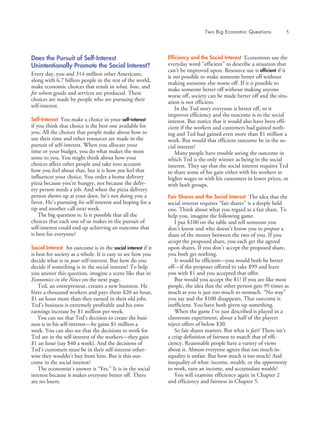
Human capital expands over time. Today, 88 per­
cent of the adult population of the United States have
completed high school and 30 percent have a college
or university degree. Figure 1.2 shows these measures
of human capital in the United States and its growth
over the past 110 years.
	◆ Two Big Economic
Questions
Two big questions summarize the scope of economics:
■	 How do choices end up determining what, how,
and for whom goods and services are produced?
■	 Do the choices that people make in the pursuit of
their own self-interest unintentionally promote the
broader social interest?
What, How, and For Whom?
Goods and services are the objects that people value
and produce to satisfy wants. Goods are physical
­objects such as cell phones and automobiles. Services
are tasks performed for people such as cell-phone
­service and auto-repair service.
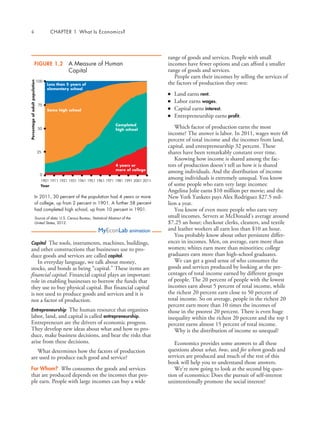
What?  What we produce varies across countries and
changes over time. In the United States today, agri­
culture accounts for 1 percent of total production,
manufactured goods for 22 percent, and services
(retail and wholesale trade, health care, and education
are the biggest ones) for 77 percent. In contrast, in
China today, agriculture accounts for 10 percent of
total production, manufactured goods for 47 percent,
and services for 43 percent. Figure 1.1 shows these
numbers and also the percentages for Brazil, which
fall between those for the United States and China.
What determines these patterns of production?
How do choices end up determining the quantities of
cell phones, automobiles, cell-phone service, auto-
repair service, and the millions of other items that are
produced in the United States and around the world?
How?  How we produce is described by the technolo­
gies and resources that we use. The resources used to
produce goods and services are called factors of pro-
duction, which are grouped into four categories:
■	 Land
■	 Labor
■	 Capital
■	 Entrepreneurship
Land  The “gifts of nature” that we use to produce
goods and services are called land. In economics,
land is what in everyday language we call natural
resources. It includes land in the everyday sense
100806040200
Percentage of production
China
Agriculture Manufacturing Services
Brazil
United States
Figure 1.1  What Three Countries Produce
Agriculture and manufacturing are small percentages of pro­
duction in rich countries such as the United States and large
percentages of production in poorer countries such as
China. Most of what is produced in the United States is
services.
Source of data: CIA Factbook 2012, Central Intelligence Agency.
MyEconLab animation
4	 Chapter 1  What Is Economics?
range of goods and services. People with small
­incomes have fewer options and can afford a smaller
range of goods and services.
People earn their incomes by selling the services of
the factors of production they own:
■	 Land earns rent.
■	 Labor earns wages.
■	 Capital earns interest.
■	 Entrepreneurship earns profit.
Which factor of production earns the most
­income? The answer is labor. In 2011, wages were 68
percent of total income and the incomes from land,
capital, and entrepreneurship 32 percent. These
shares have been remarkably constant over time.
Knowing how income is shared among the fac­
tors of production doesn’t tell us how it is shared
among individuals. And the distribution of income
among individuals is extremely unequal. You know
of some people who earn very large incomes:
Angelina Jolie earns $10 million per movie; and the
New York Yankees pays Alex Rodriguez $27.5 mil­
lion a year.
You know of even more people who earn very
small incomes. Servers at McDonald’s average around
$7.25 an hour; checkout clerks, cleaners, and textile
and leather workers all earn less than $10 an hour.
You probably know about other persistent differ­
ences in incomes. Men, on average, earn more than
women; whites earn more than minorities; college
graduates earn more than high-school graduates.
We can get a good sense of who consumes the
goods and services produced by looking at the per­
centages of total income earned by different groups
of people. The 20 percent of people with the lowest
incomes earn about 5 percent of total income, while
the richest 20 percent earn close to 50 percent of
­total income. So on average, people in the richest 20
percent earn more than 10 times the incomes of
those in the poorest 20 percent. There is even huge
inequality within the richest 20 percent and the top 1
percent earns almost 15 percent of total income.
Why is the distribution of income so unequal?
Economics provides some answers to all these
questions about what, how, and for whom goods and
services are produced and much of the rest of this
book will help you to understand those answers.
We’re now going to look at the second big ques­
tion of economics: Does the pursuit of self-interest
unintentionally promote the social interest?
Capital  The tools, instruments, machines, buildings,
and other constructions that businesses use to pro­
duce goods and services are called capital.
In everyday language, we talk about money,
stocks, and bonds as being “capital.” These items are
financial capital. Financial capital plays an important
role in enabling businesses to borrow the funds that
they use to buy physical capital. But financial capital
is not used to produce goods and services and it is
not a factor of production.
Entrepreneurship  The human resource that organizes
labor, land, and capital is called entrepreneurship.
Entrepreneurs are the drivers of economic progress.
They develop new ideas about what and how to pro­
duce, make business decisions, and bear the risks that
arise from these decisions.
What determines how the factors of production
are used to produce each good and service?
For Whom?  Who consumes the goods and services
that are produced depends on the incomes that peo­
ple earn. People with large incomes can buy a wide
Percentageofadultpopulation
4 years or
more of college
Completed
high school
Less than 5 years of
elementary school
Some high school
1901 1911 200119911921 1931 1941 1951 1961 1971 1981
Year
2011
75
100
50
25
0
Figure 1.2  A Measure of Human
Capital
In 2011, 30 percent of the population had 4 years or more
of college, up from 2 percent in 1901. A further 58 percent
had completed high school, up from 10 percent in 1901.
Source of data: U.S. Census Bureau, Statistical Abstract of the
United States, 2012.
MyEconLab animation
Two Big Economic Questions       5
Efficiency and the Social Interest  Economists use the
everyday word “efficient” to describe a situation that
can’t be improved upon. Resource use is efficient if it
is not possible to make someone better off without
making someone else worse off. If it is possible to
make someone better off without making anyone
worse off, society can be made better off and the situ­
ation is not efficient.
In the Ted story everyone is better off, so it
­improves efficiency and the outcome is in the social
interest. But notice that it would also have been effi­
cient if the workers and customers had gained noth­
ing and Ted had gained even more than $1 million a
week. But would that efficient outcome be in the so­
cial interest?
Many people have trouble seeing the outcome in
which Ted is the only winner as being in the social
interest. They say that the social interest requires Ted
to share some of his gain either with his workers in
higher wages or with his customers in lower prices, or
with both groups.
Fair Shares and the Social Interest  The idea that the
social interest requires “fair shares” is a deeply held
one. Think about what you regard as a fair share. To
help you, imagine the following game.
I put $100 on the table and tell someone you
don’t know and who doesn’t know you to propose a
share of the money between the two of you. If you
accept the proposed share, you each get the agreed
upon shares. If you don’t accept the proposed share,
you both get nothing.
It would be efficient—you would both be better
off—if the proposer offered to take $99 and leave
you with $1 and you accepted that offer.
But would you accept the $1? If you are like most
people, the idea that the other person gets 99 times as
much as you is just too much to stomach. “No way”
you say and the $100 disappears. That outcome is
inefficient. You have both given up something.
When the game I’ve just described is played in a
classroom experiment, about a half of the players
­reject offers of below $30.
So fair shares matters. But what is fair? There isn’t
a crisp definition of fairness to match that of effi­
ciency. Reasonable people have a variety of views
about it. Almost everyone agrees that too much in­
equality is unfair. But how much is too much? And
inequality of what: income, wealth, or the opportunity
to work, earn an income, and accumulate wealth?
You will examine efficiency again in Chapter 2
and efficiency and fairness in Chapter 5.
Does the Pursuit of Self-Interest
Unintentionally Promote the Social Interest?
Every day, you and 314 million other Americans,
along with 6.7 billion people in the rest of the world,
make economic choices that result in what, how, and
for whom goods and services are produced. These
choices are made by people who are pursuing their
self-interest.
Self-Interest  You make a choice in your self-interest
if you think that choice is the best one available for
you. All the choices that people make about how to
use their time and other resources are made in the
pursuit of self-interest. When you allocate your
time or your budget, you do what makes the most
sense to you. You might think about how your
choices affect other people and take into account
how you feel about that, but it is how you feel that
influences your choice. You order a home delivery
pizza because you’re hungry, not because the deliv­
ery person needs a job. And when the pizza delivery
person shows up at your door, he’s not doing you a
favor. He’s pursuing his self-interest and hoping for a
tip and another call next week.
The big question is: Is it possible that all the
choices that each one of us makes in the pursuit of
self-interest could end up achieving an outcome that
is best for everyone?
Social Interest  An outcome is in the social interest if it
is best for society as a whole. It is easy to see how you
decide what is in your self-interest. But how do you
decide if something is in the social interest? To help
you answer this question, imagine a scene like that in
Economics in the News on the next page.
Ted, an entrepreneur, creates a new business. He
hires a thousand workers and pays them $20 an hour,
$1 an hour more than they earned in their old jobs.
Ted’s business is extremely profitable and his own
earnings increase by $1 million per week.
You can see that Ted’s decision to create the busi­
ness is in his self-interest—he gains $1 million a
week. You can also see that the decisions to work for
Ted are in the self-interest of the workers—they gain
$1 an hour (say $40 a week). And the decisions of
Ted’s customers must be in their self-interest other­
wise they wouldn’t buy from him. But is this out­
come in the social interest?
The economist’s answer is “Yes.” It is in the social
interest because it makes everyone better off. There
are no losers.

Microeconomics macroeconomics & basic economic questions

  • 1.
    2 Chapter 1 What Is Economics? Because we can’t get everything we want, we must make choices. You can’t afford both a laptop and an iPhone, so you must choose which one to buy. You can’t spend tonight both studying for your next test and going to the movies, so again, you must choose which one to do. Governments can’t spend a tax dol­ lar on both national defense and environmental pro­ tection, so they must choose how to spend that dollar. Your choices must somehow be made consistent with the choices of others. If you choose to buy a lap­ top, someone else must choose to sell it. Incentives rec­­ oncile choices. An incentive is a reward that encourages an action or a penalty that discourages one. Prices act as incentives. If the price of a laptop is too high, more will be offered for sale than people want to buy. And if the price is too low, fewer will be offered for sale than people want to buy. But there is a price at which choices to buy and sell are consistent. Economics is the social science that studies the choices that individuals, businesses, governments, and entire societies make as they cope with scarcity and the incentives that influence and reconcile those choices. The subject has two parts: ■ Microeconomics ■ Macroeconomics Microeconomics is the study of the choices that indi­ viduals and businesses make, the way these choices interact in markets, and the influence of governments. Some examples of microeconomic questions are: Why are people downloading more movies? How would a tax on e-commerce affect eBay? Macroeconomics is the study of the performance of the national economy and the global economy. Some examples of macroeconomic questions are: Why is the U.S. unemployment rate so high? Can the Federal Reserve make our economy expand by cut­ ting interest rates? ◆ Definition of Economics A fundamental fact dominates our lives: We want more than we can get. Our inability to get everything we want is called scarcity. Scarcity is universal. It con­ fronts all living things. Even parrots face scarcity! Not only do I want a cracker—we all want a cracker! © The New Yorker Collection 1985 Frank Modell from cartoonbank.com. All Rights Reserved. Think about the things that you want and the scarcity that you face. You want to go to a good school, college, or university. You want to live in a well-equipped, spacious, and comfortable home. You want the latest smart phone and the fastest Internet connection for your laptop or iPad. You want some sports and recreational gear—perhaps some new run­ ning shoes, or a new bike. You want much more time than is available to go to class, do your homework, play sports and games, read novels, go to the movies, listen to music, travel, and hang out with your friends. And you want to live a long and healthy life. What you can afford to buy is limited by your ­income and by the prices you must pay. And your time is limited by the fact that your day has 24 hours. You want some other things that only govern­ ments provide. You want to live in a safe neighbor­ hood in a peaceful and secure world, and enjoy the benefits of clean air, lakes, rivers, and oceans. What governments can afford is limited by the taxes they collect. Taxes lower people’s incomes and compete with the other things they want to buy. What everyone can get—what society can get—is limited by the productive resources available. These resources are the gifts of nature, human labor and ingenuity, and all the previously produced tools and equipment. Review Quiz 1 List some examples of the scarcity that you face. 2 Find examples of scarcity in today’s headlines. 3 Find an example of the distinction between ­microeconomics and macroeconomics in ­today’s headlines. You can work these questions in Study Plan 1.1 and get instant feedback. MyEconLab
  • 2.
    Two Big EconomicQuestions       3 together with minerals, oil, gas, coal, water, air, ­forests, and fish. Our land surface and water resources are renew­ able and some of our mineral resources can be recy­ cled. But the resources that we use to create energy are nonrenewable—they can be used only once. Labor  The work time and work effort that people devote to producing goods and services is called ­labor. Labor includes the physical and mental efforts of all the people who work on farms and construc­ tion sites and in factories, shops, and offices. The quality of labor depends on human capital, which is the knowledge and skill that people obtain from education, on-the-job training, and work expe­ rience. You are building your own human capital right now as you work on your economics course, and your human capital will continue to grow as you gain work experience. Human capital expands over time. Today, 88 per­ cent of the adult population of the United States have completed high school and 30 percent have a college or university degree. Figure 1.2 shows these measures of human capital in the United States and its growth over the past 110 years. ◆ Two Big Economic Questions Two big questions summarize the scope of economics: ■ How do choices end up determining what, how, and for whom goods and services are produced? ■ Do the choices that people make in the pursuit of their own self-interest unintentionally promote the broader social interest? What, How, and For Whom? Goods and services are the objects that people value and produce to satisfy wants. Goods are physical ­objects such as cell phones and automobiles. Services are tasks performed for people such as cell-phone ­service and auto-repair service. What?  What we produce varies across countries and changes over time. In the United States today, agri­ culture accounts for 1 percent of total production, manufactured goods for 22 percent, and services (retail and wholesale trade, health care, and education are the biggest ones) for 77 percent. In contrast, in China today, agriculture accounts for 10 percent of total production, manufactured goods for 47 percent, and services for 43 percent. Figure 1.1 shows these numbers and also the percentages for Brazil, which fall between those for the United States and China. What determines these patterns of production? How do choices end up determining the quantities of cell phones, automobiles, cell-phone service, auto- repair service, and the millions of other items that are produced in the United States and around the world? How?  How we produce is described by the technolo­ gies and resources that we use. The resources used to produce goods and services are called factors of pro- duction, which are grouped into four categories: ■ Land ■ Labor ■ Capital ■ Entrepreneurship Land  The “gifts of nature” that we use to produce goods and services are called land. In economics, land is what in everyday language we call natural resources. It includes land in the everyday sense 100806040200 Percentage of production China Agriculture Manufacturing Services Brazil United States Figure 1.1  What Three Countries Produce Agriculture and manufacturing are small percentages of pro­ duction in rich countries such as the United States and large percentages of production in poorer countries such as China. Most of what is produced in the United States is services. Source of data: CIA Factbook 2012, Central Intelligence Agency. MyEconLab animation
  • 3.
    4 Chapter 1 What Is Economics? range of goods and services. People with small ­incomes have fewer options and can afford a smaller range of goods and services. People earn their incomes by selling the services of the factors of production they own: ■ Land earns rent. ■ Labor earns wages. ■ Capital earns interest. ■ Entrepreneurship earns profit. Which factor of production earns the most ­income? The answer is labor. In 2011, wages were 68 percent of total income and the incomes from land, capital, and entrepreneurship 32 percent. These shares have been remarkably constant over time. Knowing how income is shared among the fac­ tors of production doesn’t tell us how it is shared among individuals. And the distribution of income among individuals is extremely unequal. You know of some people who earn very large incomes: Angelina Jolie earns $10 million per movie; and the New York Yankees pays Alex Rodriguez $27.5 mil­ lion a year. You know of even more people who earn very small incomes. Servers at McDonald’s average around $7.25 an hour; checkout clerks, cleaners, and textile and leather workers all earn less than $10 an hour. You probably know about other persistent differ­ ences in incomes. Men, on average, earn more than women; whites earn more than minorities; college graduates earn more than high-school graduates. We can get a good sense of who consumes the goods and services produced by looking at the per­ centages of total income earned by different groups of people. The 20 percent of people with the lowest incomes earn about 5 percent of total income, while the richest 20 percent earn close to 50 percent of ­total income. So on average, people in the richest 20 percent earn more than 10 times the incomes of those in the poorest 20 percent. There is even huge inequality within the richest 20 percent and the top 1 percent earns almost 15 percent of total income. Why is the distribution of income so unequal? Economics provides some answers to all these questions about what, how, and for whom goods and services are produced and much of the rest of this book will help you to understand those answers. We’re now going to look at the second big ques­ tion of economics: Does the pursuit of self-interest unintentionally promote the social interest? Capital  The tools, instruments, machines, buildings, and other constructions that businesses use to pro­ duce goods and services are called capital. In everyday language, we talk about money, stocks, and bonds as being “capital.” These items are financial capital. Financial capital plays an important role in enabling businesses to borrow the funds that they use to buy physical capital. But financial capital is not used to produce goods and services and it is not a factor of production. Entrepreneurship  The human resource that organizes labor, land, and capital is called entrepreneurship. Entrepreneurs are the drivers of economic progress. They develop new ideas about what and how to pro­ duce, make business decisions, and bear the risks that arise from these decisions. What determines how the factors of production are used to produce each good and service? For Whom?  Who consumes the goods and services that are produced depends on the incomes that peo­ ple earn. People with large incomes can buy a wide Percentageofadultpopulation 4 years or more of college Completed high school Less than 5 years of elementary school Some high school 1901 1911 200119911921 1931 1941 1951 1961 1971 1981 Year 2011 75 100 50 25 0 Figure 1.2  A Measure of Human Capital In 2011, 30 percent of the population had 4 years or more of college, up from 2 percent in 1901. A further 58 percent had completed high school, up from 10 percent in 1901. Source of data: U.S. Census Bureau, Statistical Abstract of the United States, 2012. MyEconLab animation
  • 4.
    Two Big EconomicQuestions       5 Efficiency and the Social Interest  Economists use the everyday word “efficient” to describe a situation that can’t be improved upon. Resource use is efficient if it is not possible to make someone better off without making someone else worse off. If it is possible to make someone better off without making anyone worse off, society can be made better off and the situ­ ation is not efficient. In the Ted story everyone is better off, so it ­improves efficiency and the outcome is in the social interest. But notice that it would also have been effi­ cient if the workers and customers had gained noth­ ing and Ted had gained even more than $1 million a week. But would that efficient outcome be in the so­ cial interest? Many people have trouble seeing the outcome in which Ted is the only winner as being in the social interest. They say that the social interest requires Ted to share some of his gain either with his workers in higher wages or with his customers in lower prices, or with both groups. Fair Shares and the Social Interest  The idea that the social interest requires “fair shares” is a deeply held one. Think about what you regard as a fair share. To help you, imagine the following game. I put $100 on the table and tell someone you don’t know and who doesn’t know you to propose a share of the money between the two of you. If you accept the proposed share, you each get the agreed upon shares. If you don’t accept the proposed share, you both get nothing. It would be efficient—you would both be better off—if the proposer offered to take $99 and leave you with $1 and you accepted that offer. But would you accept the $1? If you are like most people, the idea that the other person gets 99 times as much as you is just too much to stomach. “No way” you say and the $100 disappears. That outcome is inefficient. You have both given up something. When the game I’ve just described is played in a classroom experiment, about a half of the players ­reject offers of below $30. So fair shares matters. But what is fair? There isn’t a crisp definition of fairness to match that of effi­ ciency. Reasonable people have a variety of views about it. Almost everyone agrees that too much in­ equality is unfair. But how much is too much? And inequality of what: income, wealth, or the opportunity to work, earn an income, and accumulate wealth? You will examine efficiency again in Chapter 2 and efficiency and fairness in Chapter 5. Does the Pursuit of Self-Interest Unintentionally Promote the Social Interest? Every day, you and 314 million other Americans, along with 6.7 billion people in the rest of the world, make economic choices that result in what, how, and for whom goods and services are produced. These choices are made by people who are pursuing their self-interest. Self-Interest  You make a choice in your self-interest if you think that choice is the best one available for you. All the choices that people make about how to use their time and other resources are made in the pursuit of self-interest. When you allocate your time or your budget, you do what makes the most sense to you. You might think about how your choices affect other people and take into account how you feel about that, but it is how you feel that influences your choice. You order a home delivery pizza because you’re hungry, not because the deliv­ ery person needs a job. And when the pizza delivery person shows up at your door, he’s not doing you a favor. He’s pursuing his self-interest and hoping for a tip and another call next week. The big question is: Is it possible that all the choices that each one of us makes in the pursuit of self-interest could end up achieving an outcome that is best for everyone? Social Interest  An outcome is in the social interest if it is best for society as a whole. It is easy to see how you decide what is in your self-interest. But how do you decide if something is in the social interest? To help you answer this question, imagine a scene like that in Economics in the News on the next page. Ted, an entrepreneur, creates a new business. He hires a thousand workers and pays them $20 an hour, $1 an hour more than they earned in their old jobs. Ted’s business is extremely profitable and his own earnings increase by $1 million per week. You can see that Ted’s decision to create the busi­ ness is in his self-interest—he gains $1 million a week. You can also see that the decisions to work for Ted are in the self-interest of the workers—they gain $1 an hour (say $40 a week). And the decisions of Ted’s customers must be in their self-interest other­ wise they wouldn’t buy from him. But is this out­ come in the social interest? The economist’s answer is “Yes.” It is in the social interest because it makes everyone better off. There are no losers.