PRESENTED BY:- 
AQIB KHAN
INTRODUCTION 
 In previous days, all business or commercial transactions was done 
manually. Every time paper work is important. But e-commerce totally 
changes the concept of traditional commerce. 
 Now a day, growing business world more tends to use e-commerce. Due 
to fast access and less effort , e-commerce is becoming more and more 
popular.
E-COMMERCE 
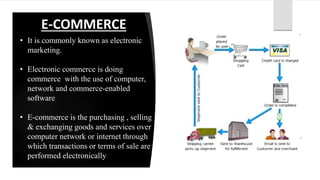
• It is commonly known as electronic 
marketing. 
• Electronic commerce is doing 
commerce with the use of computer, 
network and commerce-enabled 
software 
• E-commerce is the purchasing , selling 
& exchanging goods and services over 
computer network or internet through 
which transactions or terms of sale are 
performed electronically
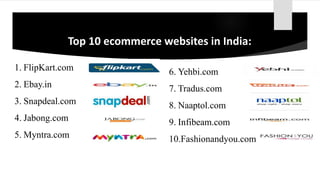
Top 10 ecommerce websites in India: 
1. FlipKart.com 
2. Ebay.in 
3. Snapdeal.com 
4. Jabong.com 
5. Myntra.com 
6. Yehbi.com 
7. Tradus.com 
8. Naaptol.com 
9. Infibeam.com 
10.Fashionandyou.com
E-COMMERCE IN INDIA 
 By 2016, the current number of shoppers 
in India will double to 40 million, and 
their spending will more than quadruple 
to US$8.5 billion. 
 Fashion ecommerce doubled last year, and 
will see 400 percent growth by 2016 
 E-commerce sales in India are currently 
dominated by local sites such as flipkart, 
snapdeal and jabong.
ADVANTAGES OF E-COMMERCE 
• It tries to reduce cost of product or 
services 
• Consumers have an access to a wider 
range of products 
• E-commerce covers large 
geographical area to advertise or to 
publish 
• As a online market, it does not has 
time limit. E-commerce serves 24 
hours marketing
DISADVANTAGED OF E-COMMERCE 
 The user first requires to understand, learn new technologies 
 In business, face to face communication is must sometimes 
 Unable to examine products personally 
 There are possibilities of credit card number theft.
TYPES OF E-COMMERCE 
• B2B (Business-to-Business) 
• B2C (Business-to-Consumer) 
• C2C (Consumer-to- 
Consumer)
B2B E-COMMERCE 
Business-to-business (b2b) 
describes commerce transactions 
between business, such as between 
a manufacturer and a whole seller 
or between a whole seller and a 
retailers 
Example: 
Intel selling microprocessor to Dell
B2C E-COMMERCE 
Business to Consumers involves 
selling of goods and services to 
consumers by a business. It 
allows the consumers to browse 
the catalog, choose the product 
and order it online. 
Example: 
Dell selling me a laptop
C2C E-COMMERCE 
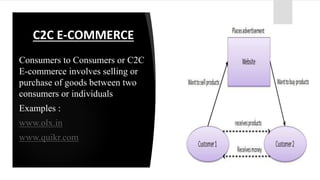
Consumers to Consumers or C2C 
E-commerce involves selling or 
purchase of goods between two 
consumers or individuals 
Examples : 
www.olx.in 
www.quikr.com
Conclusion 
 "E-commerce is an evolution" 
ecommerce is more then just an online shop selling goods…. 
Businesses make huge savings by more efficient interaction with 
their suppliers or buyers
THANK YOU

E commerce

  • 1.
  • 2.
    INTRODUCTION  Inprevious days, all business or commercial transactions was done manually. Every time paper work is important. But e-commerce totally changes the concept of traditional commerce.  Now a day, growing business world more tends to use e-commerce. Due to fast access and less effort , e-commerce is becoming more and more popular.
  • 3.
    E-COMMERCE • Itis commonly known as electronic marketing. • Electronic commerce is doing commerce with the use of computer, network and commerce-enabled software • E-commerce is the purchasing , selling & exchanging goods and services over computer network or internet through which transactions or terms of sale are performed electronically
  • 4.
    Top 10 ecommercewebsites in India: 1. FlipKart.com 2. Ebay.in 3. Snapdeal.com 4. Jabong.com 5. Myntra.com 6. Yehbi.com 7. Tradus.com 8. Naaptol.com 9. Infibeam.com 10.Fashionandyou.com
  • 6.
    E-COMMERCE IN INDIA  By 2016, the current number of shoppers in India will double to 40 million, and their spending will more than quadruple to US$8.5 billion.  Fashion ecommerce doubled last year, and will see 400 percent growth by 2016  E-commerce sales in India are currently dominated by local sites such as flipkart, snapdeal and jabong.
  • 7.
    ADVANTAGES OF E-COMMERCE • It tries to reduce cost of product or services • Consumers have an access to a wider range of products • E-commerce covers large geographical area to advertise or to publish • As a online market, it does not has time limit. E-commerce serves 24 hours marketing
  • 8.
    DISADVANTAGED OF E-COMMERCE  The user first requires to understand, learn new technologies  In business, face to face communication is must sometimes  Unable to examine products personally  There are possibilities of credit card number theft.
  • 9.
    TYPES OF E-COMMERCE • B2B (Business-to-Business) • B2C (Business-to-Consumer) • C2C (Consumer-to- Consumer)
  • 10.
    B2B E-COMMERCE Business-to-business(b2b) describes commerce transactions between business, such as between a manufacturer and a whole seller or between a whole seller and a retailers Example: Intel selling microprocessor to Dell
  • 11.
    B2C E-COMMERCE Businessto Consumers involves selling of goods and services to consumers by a business. It allows the consumers to browse the catalog, choose the product and order it online. Example: Dell selling me a laptop
  • 12.
    C2C E-COMMERCE Consumersto Consumers or C2C E-commerce involves selling or purchase of goods between two consumers or individuals Examples : www.olx.in www.quikr.com
  • 13.
    Conclusion  "E-commerceis an evolution" ecommerce is more then just an online shop selling goods…. Businesses make huge savings by more efficient interaction with their suppliers or buyers
  • 14.