• Muhammad Faraz
E-COMMERCE
SOCIAL MEDIA
AS A
MARKETING TOOL
AND
E-COMMERCE
As
MARKETING
TOOL
“E-COMMERCE”
“ E-Commerce is the purchasing,
selling and exchanging goods and
services over computer networks (
Internet ) through which transaction of
sales are performed electronically.”
E-Commerce enhances promotion of
products and services through direct,
information-rich, and interactive
contact with customers.
ADVANTAGES OF ECOMMERCE:
1. No Need for a Physical Store
• Since there is no need for a physical
store, ecommerce businesses save
on one of the biggest cost overheads
that retailers have to bear.
2. Lots of Choices
• Since there are no shelf size or store
size limitations, ecommerce
businesses are able to list many
different items.
3. Access to Stores Located Remotely
• Especially for people who are not
situated in major urban centers, this
can be a big advantage. Likewise
ecommerce opens new markets for
ecommerce businesses.
DISADNATAGES OF ECOMMERCE:
1. Inability to Experience the Product
Before Purchase:
There are many products that
consumers want to touch, feel, hear,
taste and smell before they buy.
Ecommerce takes away that luxury.
2. Need for an Internet Access Device
• Ecommerce can only be transacted
with the help of an Internet access
device such as a computer or a
smartphone.
3. Need for an Internet Connection
• Not just does one need an access
device, one also needs Internet
connectivity to participate in
ecommerce.
CHARACTERSTICS OF ECOMMERCE
TECHONOLOGY:
• Ease of automated processing;
• Immediacy of result;
• Openness and accessibility of
payment processes;
• Loss of collateral information;
• Globalization; and
• Emergence of new business models
TYPES OF E-COMMERCE:
There are various types of E-Commerce but
the most common types are:
 Business To Customer (B2C)
 Business To Business (B2B)
 Consumer To Consumer (C2C)
 Government To Citizen (G2C)
BUSINESS TO BUSINESS:
Business-to-business (B2B) describes commerce
transactions between businesses, such as between
a manufacturer and a wholesaler, or between a
wholesaler and a retailer.
Example:
Intel selling micro processors to Dell
BUSINESS TO CONSUMER:
Business To Consumer is a transaction that occurs
between a company and a consumer, as opposed to
a transaction between companies (called B2B).
Example:
Dell selling me a laptop from its
own website
CONSUMER TO CONSUMER:
Consumer To Consumer is a transaction that takes
place between one consumer to another through
various websites.
Example:
Some examples are OLX, EBay etc
GOVERNMENT TO CITIZEN:
Government To Citizen includes all interactions
between government and its citizen that takes place
electronically.
Example:
National savings prize bonds.
COMPONENTS OF E-COMMERCE:
Electronic Catalog
Shopping Cart
Payment
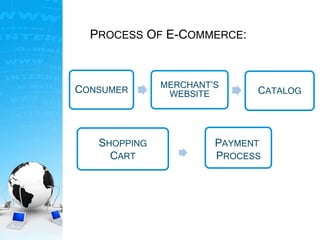
PROCESS OF E-COMMERCE:
CONSUMER
MERCHANT’S
WEBSITE CATALOG
SHOPPING
CART
PAYMENT
PROCESS
SOCIAL MEDIA
As
MARKETING
TOOL
 SOCIAL MEDIA:
Social media like Facebook, Twitter etc
has become a great platform for
advertisement and product promotion.
1
2
What is Social Media?
3
Social Media Strategy
Social Media Marketing Tools
Agenda
Social Media Tools
• Casual Tone & Style
• Organization Profile
• Wall Posts (interactive)
• Like
• Suggest to Friends
Uses:
Announcements
Events
Comments
Photos
Tips
Conversations
•Professional
•Recruit
•Network
•Learn best practices
•Share job tips
•Monitor issues
•Prospect
•Find Opportunities
•Uploading Videos
- Captions and descriptions
- Tagging
- Categorizing
•Building Community
- Favorite
- Likes
- Subscribing to other channels
•Talk to people about their interest
•Quick alerts
•Share useful links
•Give advice, blog posts, pictures etc
•Give advice, blog p
FRIENDS AND FRIENDS OF FRIENDS
E-Commerce
E-Commerce

E-Commerce

  • 2.
  • 3.
  • 4.
  • 5.
    “E-COMMERCE” “ E-Commerce isthe purchasing, selling and exchanging goods and services over computer networks ( Internet ) through which transaction of sales are performed electronically.” E-Commerce enhances promotion of products and services through direct, information-rich, and interactive contact with customers.
  • 6.
    ADVANTAGES OF ECOMMERCE: 1.No Need for a Physical Store • Since there is no need for a physical store, ecommerce businesses save on one of the biggest cost overheads that retailers have to bear.
  • 7.
    2. Lots ofChoices • Since there are no shelf size or store size limitations, ecommerce businesses are able to list many different items.
  • 8.
    3. Access toStores Located Remotely • Especially for people who are not situated in major urban centers, this can be a big advantage. Likewise ecommerce opens new markets for ecommerce businesses.
  • 9.
    DISADNATAGES OF ECOMMERCE: 1.Inability to Experience the Product Before Purchase: There are many products that consumers want to touch, feel, hear, taste and smell before they buy. Ecommerce takes away that luxury.
  • 10.
    2. Need foran Internet Access Device • Ecommerce can only be transacted with the help of an Internet access device such as a computer or a smartphone.
  • 11.
    3. Need foran Internet Connection • Not just does one need an access device, one also needs Internet connectivity to participate in ecommerce.
  • 12.
    CHARACTERSTICS OF ECOMMERCE TECHONOLOGY: •Ease of automated processing; • Immediacy of result; • Openness and accessibility of payment processes; • Loss of collateral information; • Globalization; and • Emergence of new business models
  • 13.
    TYPES OF E-COMMERCE: Thereare various types of E-Commerce but the most common types are:  Business To Customer (B2C)  Business To Business (B2B)  Consumer To Consumer (C2C)  Government To Citizen (G2C)
  • 14.
    BUSINESS TO BUSINESS: Business-to-business(B2B) describes commerce transactions between businesses, such as between a manufacturer and a wholesaler, or between a wholesaler and a retailer. Example: Intel selling micro processors to Dell
  • 15.
    BUSINESS TO CONSUMER: BusinessTo Consumer is a transaction that occurs between a company and a consumer, as opposed to a transaction between companies (called B2B). Example: Dell selling me a laptop from its own website
  • 16.
    CONSUMER TO CONSUMER: ConsumerTo Consumer is a transaction that takes place between one consumer to another through various websites. Example: Some examples are OLX, EBay etc
  • 17.
    GOVERNMENT TO CITIZEN: GovernmentTo Citizen includes all interactions between government and its citizen that takes place electronically. Example: National savings prize bonds.
  • 18.
    COMPONENTS OF E-COMMERCE: ElectronicCatalog Shopping Cart Payment
  • 19.
    PROCESS OF E-COMMERCE: CONSUMER MERCHANT’S WEBSITECATALOG SHOPPING CART PAYMENT PROCESS
  • 20.
  • 21.
     SOCIAL MEDIA: Socialmedia like Facebook, Twitter etc has become a great platform for advertisement and product promotion.
  • 22.
    1 2 What is SocialMedia? 3 Social Media Strategy Social Media Marketing Tools Agenda
  • 23.
  • 24.
    • Casual Tone& Style • Organization Profile • Wall Posts (interactive) • Like • Suggest to Friends Uses: Announcements Events Comments Photos Tips Conversations
  • 25.
    •Professional •Recruit •Network •Learn best practices •Sharejob tips •Monitor issues •Prospect •Find Opportunities
  • 26.
    •Uploading Videos - Captionsand descriptions - Tagging - Categorizing •Building Community - Favorite - Likes - Subscribing to other channels
  • 27.
    •Talk to peopleabout their interest •Quick alerts •Share useful links •Give advice, blog posts, pictures etc •Give advice, blog p
  • 28.