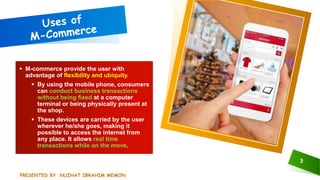
 M-commerce provide the user with
advantage of flexibility and ubiquity.
 By using the mobile phone, consumers
can conduct business transactions
without being fixed at a computer
terminal or being physically present at
the shop.
 These devices are carried by the user
wherever he/she goes, making it
possible to access the internet from
any place. It allows real time
transactions while on the move.
PRESENTED BY NUZHAT IBRAHIM MEMON
3
 convenience to the user.
 Contacted at virtually anytime and anywhere
 Reduces transaction cost
 Reduces the time to order.
 Streamline business process.
 Provides global reach.
 Conduct business 24 x 7
 Flexibility of accessing the information.
 Payment can be done using the mobile devices
itself.
 Useful to deliver time critical and emergency
information.
 location based application to receive relevant
information.
 Customized alerts can be easily received.
 Instant connectivity and available of faster 3G
services.
 Timely information can reach the user.
PRESENTED BY NUZHAT IBRAHIM MEMON
4
 Limited screen size.
 Limits the types of file and data transfer.
 User interface is less convenient, compared
to PC
 Limited computing power, memory and
storage capacity
 Less secured as compared to wired network.
 Offers limited bandwidth.
 High cost of establishing mobile and
wireless broadband.
PRESENTED BY NUZHAT IBRAHIM MEMON
5
PRESENTED BY NUZHAT IBRAHIM MEMON
6
 Mobile Marketing and Advertising: location
based mobile ads to target consumers
 Mobile Ticketing : www.irctc.co.in [Username,
Password]
 Mobile Auctions : Bidding process while on the
move , built gateways & interface to access auction
site in mobile device [Example: eBay.com]
 Mobile Entertainment : Entertainment librabries
[pay-per-download, pay-per-event or subscription
basis]
 Mobile Purchase : Online shopping in mobile
version of Ecommerce site [Example: filpkart]
 Mobile Financial Services : Bank and financial
institute [Example: umobile for android by Union
bank]
 Mobile Information Services : News service,
Stock market, Sports news, Financial records,
Traffic information
 Location and search service: Buy desired product
from nearby area or city based on user’s current
location.
 To get directions to particular place
PRESENTED BY NUZHAT IBRAHIM MEMON
8
 The significant growth of M-Commerce with wireless handheld devices: PDA’s, Cellular
phone and pocket PC’s
 Although mobile commerce enables access to goods and services regardless of the
location of buyer or seller, in many situations the specific location of the buyer and
seller is important to the transaction.
 Today various location-specific applications and services are emerging. These
applications track the user’s location in order to deliver a service or product.
 The use of technologies which provide the location information for business
purposes is known as L-commerce.
 The technology uses the geographical location of the mobile device to determine which
applications are appropriate based on that area. It enables users to log their locations,
track the location of another person, and find places such as a bank or restaurant.
 The technology works by using signals from GPS, cellular and Wi-Fi sources.
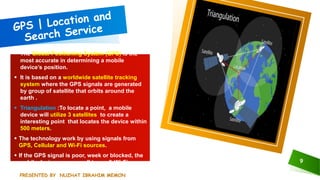
 The Global Positioning System (GPS) is the
most accurate in determining a mobile
device’s position.
 It is based on a worldwide satellite tracking
system where the GPS signals are generated
by group of satellite that orbits around the
earth .
 Triangulation :To locate a point, a mobile
device will utilize 3 satellites to create a
interesting point that locates the device within
500 meters.
 The technology work by using signals from
GPS, Cellular and Wi-Fi sources.
 If the GPS signal is poor, week or blocked, the
mobile device can use cell tower & Wi-Fi
PRESENTED BY NUZHAT IBRAHIM MEMON
9
PRESENTED BY NUZHAT IBRAHIM MEMON
10
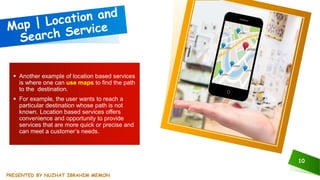
 Another example of location based services
is where one can use maps to find the path
to the destination.
 For example, the user wants to reach a
particular destination whose path is not
known. Location based services offers
convenience and opportunity to provide
services that are more quick or precise and
can meet a customer’s needs.
PRESENTED BY NUZHAT IBRAHIM MEMON
11
 Information or Directory services - Dynamic
yellow pages automatically inform the users
about the nearest restaurants, Parking facility,
Traffic updates
 Tracking services - Tracking assets, friends,
cars, children
 Emergency services - Medical ambulance,
Search and rescue mission
 Advertising promotion - targeted ads,
promotional messages, customer
identification in a store
 Mapping – Creating maps of specific
geographical location
 Navigation – Plotting route from one place to
another.
Std 12 Computer Chapter 5 Introduction to Mcommerce (Part 1)

Std 12 Computer Chapter 5 Introduction to Mcommerce (Part 1)

  • 3.
     M-commerce providethe user with advantage of flexibility and ubiquity.  By using the mobile phone, consumers can conduct business transactions without being fixed at a computer terminal or being physically present at the shop.  These devices are carried by the user wherever he/she goes, making it possible to access the internet from any place. It allows real time transactions while on the move. PRESENTED BY NUZHAT IBRAHIM MEMON 3
  • 4.
     convenience tothe user.  Contacted at virtually anytime and anywhere  Reduces transaction cost  Reduces the time to order.  Streamline business process.  Provides global reach.  Conduct business 24 x 7  Flexibility of accessing the information.  Payment can be done using the mobile devices itself.  Useful to deliver time critical and emergency information.  location based application to receive relevant information.  Customized alerts can be easily received.  Instant connectivity and available of faster 3G services.  Timely information can reach the user. PRESENTED BY NUZHAT IBRAHIM MEMON 4
  • 5.
     Limited screensize.  Limits the types of file and data transfer.  User interface is less convenient, compared to PC  Limited computing power, memory and storage capacity  Less secured as compared to wired network.  Offers limited bandwidth.  High cost of establishing mobile and wireless broadband. PRESENTED BY NUZHAT IBRAHIM MEMON 5
  • 6.
    PRESENTED BY NUZHATIBRAHIM MEMON 6  Mobile Marketing and Advertising: location based mobile ads to target consumers  Mobile Ticketing : www.irctc.co.in [Username, Password]  Mobile Auctions : Bidding process while on the move , built gateways & interface to access auction site in mobile device [Example: eBay.com]  Mobile Entertainment : Entertainment librabries [pay-per-download, pay-per-event or subscription basis]  Mobile Purchase : Online shopping in mobile version of Ecommerce site [Example: filpkart]  Mobile Financial Services : Bank and financial institute [Example: umobile for android by Union bank]  Mobile Information Services : News service, Stock market, Sports news, Financial records, Traffic information  Location and search service: Buy desired product from nearby area or city based on user’s current location.  To get directions to particular place
  • 8.
    PRESENTED BY NUZHATIBRAHIM MEMON 8  The significant growth of M-Commerce with wireless handheld devices: PDA’s, Cellular phone and pocket PC’s  Although mobile commerce enables access to goods and services regardless of the location of buyer or seller, in many situations the specific location of the buyer and seller is important to the transaction.  Today various location-specific applications and services are emerging. These applications track the user’s location in order to deliver a service or product.  The use of technologies which provide the location information for business purposes is known as L-commerce.  The technology uses the geographical location of the mobile device to determine which applications are appropriate based on that area. It enables users to log their locations, track the location of another person, and find places such as a bank or restaurant.  The technology works by using signals from GPS, cellular and Wi-Fi sources.
  • 9.
     The GlobalPositioning System (GPS) is the most accurate in determining a mobile device’s position.  It is based on a worldwide satellite tracking system where the GPS signals are generated by group of satellite that orbits around the earth .  Triangulation :To locate a point, a mobile device will utilize 3 satellites to create a interesting point that locates the device within 500 meters.  The technology work by using signals from GPS, Cellular and Wi-Fi sources.  If the GPS signal is poor, week or blocked, the mobile device can use cell tower & Wi-Fi PRESENTED BY NUZHAT IBRAHIM MEMON 9
  • 10.
    PRESENTED BY NUZHATIBRAHIM MEMON 10  Another example of location based services is where one can use maps to find the path to the destination.  For example, the user wants to reach a particular destination whose path is not known. Location based services offers convenience and opportunity to provide services that are more quick or precise and can meet a customer’s needs.
  • 11.
    PRESENTED BY NUZHATIBRAHIM MEMON 11  Information or Directory services - Dynamic yellow pages automatically inform the users about the nearest restaurants, Parking facility, Traffic updates  Tracking services - Tracking assets, friends, cars, children  Emergency services - Medical ambulance, Search and rescue mission  Advertising promotion - targeted ads, promotional messages, customer identification in a store  Mapping – Creating maps of specific geographical location  Navigation – Plotting route from one place to another.