ENGLISH
TEACHING
METHODS
Presented by:
Paula Ayala
Erick Acosta
Ajila Simone
Miguel Tumbaico
Overview
Grammar and
translation method.
Direct method.
Natural approach.
Audio lingual
approach.
The communicative
approach
1. Grammar and Translation
Method
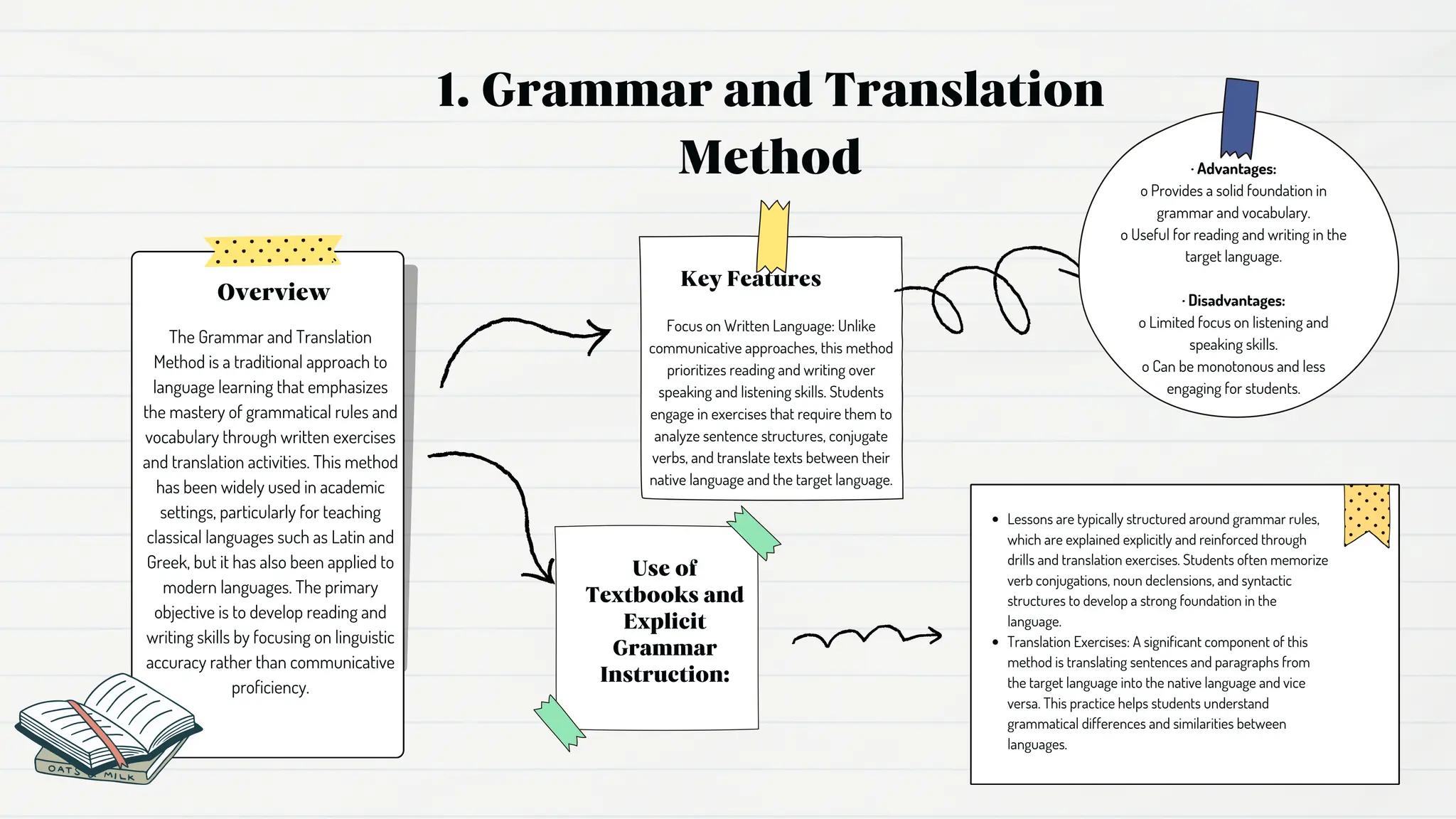
Overview
The Grammar and Translation
Method is a traditional approach to
language learning that emphasizes
the mastery of grammatical rules and
vocabulary through written exercises
and translation activities. This method
has been widely used in academic
settings, particularly for teaching
classical languages such as Latin and
Greek, but it has also been applied to
modern languages. The primary
objective is to develop reading and
writing skills by focusing on linguistic
accuracy rather than communicative
proficiency.
Key Features
Focus on Written Language: Unlike
communicative approaches, this method
prioritizes reading and writing over
speaking and listening skills. Students
engage in exercises that require them to
analyze sentence structures, conjugate
verbs, and translate texts between their
native language and the target language.
Use of
Textbooks and
Explicit
Grammar
Instruction:
Lessons are typically structured around grammar rules,
which are explained explicitly and reinforced through
drills and translation exercises. Students often memorize
verb conjugations, noun declensions, and syntactic
structures to develop a strong foundation in the
language.
Translation Exercises: A significant component of this
method is translating sentences and paragraphs from
the target language into the native language and vice
versa. This practice helps students understand
grammatical differences and similarities between
languages.
· Advantages:
o Provides a solid foundation in
grammar and vocabulary.
o Useful for reading and writing in the
target language.
· Disadvantages:
o Limited focus on listening and
speaking skills.
o Can be monotonous and less
engaging for students.
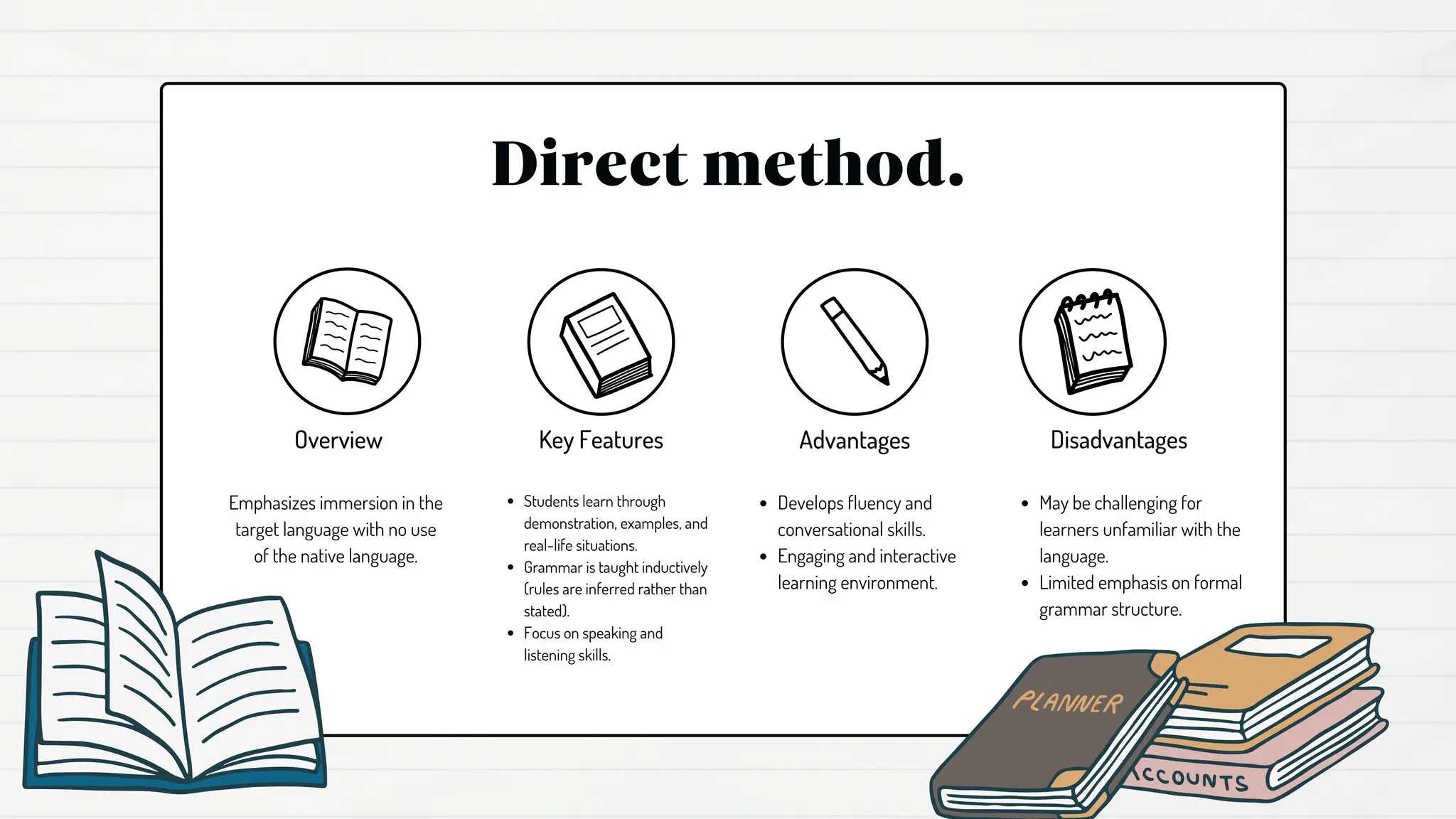
Direct method.
Emphasizes immersion in the
target language with no use
of the native language.
Students learn through
demonstration, examples, and
real-life situations.
Grammar is taught inductively
(rules are inferred rather than
stated).
Focus on speaking and
listening skills.
Develops fluency and
conversational skills.
Engaging and interactive
learning environment.
May be challenging for
learners unfamiliar with the
language.
Limited emphasis on formal
grammar structure.
Overview Key Features Advantages Disadvantages
Focus on comprehension before
production (listening and
understanding come before
speaking).
A low-stress environment to facilitate
learning.
Emphasis on meaningful
communication rather than formal
grammar.
Reduces anxiety and
encourages a more relaxed
learning atmosphere.
Promotes long-term
retention of language skills.
Natural approach.
Context
Developed by Stephen
Krashen and Tracy Terrell,
emphasizing natural
language acquisition
similar to first language
learning. Key Features
Advantages
Disadvantages
Some learners may
need more structured
grammar instruction.
Progress can be slower
without focused
practice.
Audio-Lingual Approach
Based on behaviorist theory, this
method uses repetition and
reinforcement to teach language.
Emphasis on oral skills through
listening and speaking drills.
Use of dialogues, pattern
practices, and mimicking.
Grammar is taught implicitly
through repeated exposure.
Key Features
Effective for developing
pronunciation and listening skills.
Builds a habit of correct language
use through repetition.
Advantages
Limited focus on reading and
writing.
Can be repetitive and may not
facilitate creative language use.
Overview Disadvantages
The Communicative Approach
Focuses on teaching language
through communication and
real-life contexts..
Emphasis on interaction as the
primary means of language learning.
Use of authentic materials and tasks
that reflect real-life situations.
Encouragement of listening,
speaking, reading, and writing skills
together.
Key Features
Prepares learners for real-world
communication.
Engages students through
meaningful activities.
Advantages
Requires skilled teachers who can
create interactive environments.
May lead to an insufficient focus
on grammar if not balanced
appropriately.
Overview Disadvantages
Conclusions
WHEN COMPILING YOUR GUIDE, CONSIDER INCLUDING EXAMPLES,
KEY THEORISTS, AND ANY RELEVANT PEDAGOGICAL IMPLICATIONS
TO PROVIDE A WELL-ROUNDED UNDERSTANDING OF EACH
METHODOLOGY. ADDITIONALLY, YOU MIGHT INCLUDE CURRENT
TRENDS IN LANGUAGE TEACHING THAT DRAW FROM THESE
TRADITIONAL METHODS.
Thank's For
Watching

English Teaching Methods.pdf_Grammar and translation method. Direct method. Natural approach. Audio lingual approach. The communicative approach

  • 1.
  • 2.
    Overview Grammar and translation method. Directmethod. Natural approach. Audio lingual approach. The communicative approach
  • 3.
    1. Grammar andTranslation Method Overview The Grammar and Translation Method is a traditional approach to language learning that emphasizes the mastery of grammatical rules and vocabulary through written exercises and translation activities. This method has been widely used in academic settings, particularly for teaching classical languages such as Latin and Greek, but it has also been applied to modern languages. The primary objective is to develop reading and writing skills by focusing on linguistic accuracy rather than communicative proficiency. Key Features Focus on Written Language: Unlike communicative approaches, this method prioritizes reading and writing over speaking and listening skills. Students engage in exercises that require them to analyze sentence structures, conjugate verbs, and translate texts between their native language and the target language. Use of Textbooks and Explicit Grammar Instruction: Lessons are typically structured around grammar rules, which are explained explicitly and reinforced through drills and translation exercises. Students often memorize verb conjugations, noun declensions, and syntactic structures to develop a strong foundation in the language. Translation Exercises: A significant component of this method is translating sentences and paragraphs from the target language into the native language and vice versa. This practice helps students understand grammatical differences and similarities between languages. · Advantages: o Provides a solid foundation in grammar and vocabulary. o Useful for reading and writing in the target language. · Disadvantages: o Limited focus on listening and speaking skills. o Can be monotonous and less engaging for students.
  • 4.
    Direct method. Emphasizes immersionin the target language with no use of the native language. Students learn through demonstration, examples, and real-life situations. Grammar is taught inductively (rules are inferred rather than stated). Focus on speaking and listening skills. Develops fluency and conversational skills. Engaging and interactive learning environment. May be challenging for learners unfamiliar with the language. Limited emphasis on formal grammar structure. Overview Key Features Advantages Disadvantages
  • 5.
    Focus on comprehensionbefore production (listening and understanding come before speaking). A low-stress environment to facilitate learning. Emphasis on meaningful communication rather than formal grammar. Reduces anxiety and encourages a more relaxed learning atmosphere. Promotes long-term retention of language skills. Natural approach. Context Developed by Stephen Krashen and Tracy Terrell, emphasizing natural language acquisition similar to first language learning. Key Features Advantages Disadvantages Some learners may need more structured grammar instruction. Progress can be slower without focused practice.
  • 6.
    Audio-Lingual Approach Based onbehaviorist theory, this method uses repetition and reinforcement to teach language. Emphasis on oral skills through listening and speaking drills. Use of dialogues, pattern practices, and mimicking. Grammar is taught implicitly through repeated exposure. Key Features Effective for developing pronunciation and listening skills. Builds a habit of correct language use through repetition. Advantages Limited focus on reading and writing. Can be repetitive and may not facilitate creative language use. Overview Disadvantages
  • 7.
    The Communicative Approach Focuseson teaching language through communication and real-life contexts.. Emphasis on interaction as the primary means of language learning. Use of authentic materials and tasks that reflect real-life situations. Encouragement of listening, speaking, reading, and writing skills together. Key Features Prepares learners for real-world communication. Engages students through meaningful activities. Advantages Requires skilled teachers who can create interactive environments. May lead to an insufficient focus on grammar if not balanced appropriately. Overview Disadvantages
  • 8.
    Conclusions WHEN COMPILING YOURGUIDE, CONSIDER INCLUDING EXAMPLES, KEY THEORISTS, AND ANY RELEVANT PEDAGOGICAL IMPLICATIONS TO PROVIDE A WELL-ROUNDED UNDERSTANDING OF EACH METHODOLOGY. ADDITIONALLY, YOU MIGHT INCLUDE CURRENT TRENDS IN LANGUAGE TEACHING THAT DRAW FROM THESE TRADITIONAL METHODS.
  • 9.