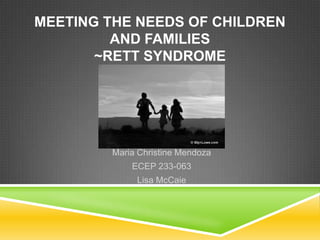
MEETING THE NEEDS OF CHILDREN
         AND FAMILIES
       ~RETT SYNDROME


        Maria Christine Mendoza
            ECEP 233-063
             Lisa McCaie
SCENARIO
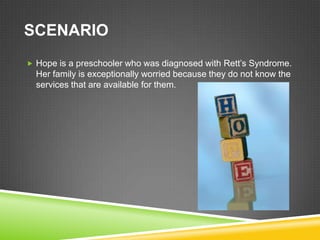
 Hope is a preschooler who was diagnosed with Rett’s Syndrome.
  Her family is exceptionally worried because they do not know the
  services that are available for them.
NEEDS
             Hope                          Family
 Inclusive environment           More information about Rett
 Love                             Syndrome
                                     Resources
 Care
                                     Agencies
 Support
                                  Services available
 Physiotherapist/Occupational
                                  Guidance
  Therapist/Speech and
  Language Therapist              Social Worker
WHAT IS RETT SYNDROME?


     http://www.youtube.com/watch?v=d2Rv8JLH
     85I
RETT SYNDROME
 A childhood neurodevelopmental disorder
 Primarily in girls
 Caused by mutations on the X chromosome on a gene called
    MECP2
   The first symptom is the loss of muscle tone
   Problems crawling or walking
   Diminished eye contact
   The child will lose purposeful use of her hands and the ability to
    speak.
   Compulsive hand movements such as wringing and washing
   Loss of functional use of the hands.
   The inability to perform motor functions is the most disabling feature
    of Rett Syndrome, interfering with every body movement, including
    eye gaze, and speech.
HOW IS IT MANIFESTED?
 a period of normal development between 6-18 months
 normal head circumference at birth followed by a slowing of the rate of head
    growth with age (starting between 6 months and 4 years)
   loss of purposeful hand skills at age 1-4 years
   shakiness of the torso, which may involve the limbs, particularly when the
    child is upset or agitated
   unsteady, stiff-legged gait
   breathing difficulties (hyperventilation, apnea, air swallowing)
   seizures (approximately 80% have epilepsy)
   teeth grinding and difficulty chewing
   intellectual development appears to be severely delayed, but true intelligence
    is hard to measure
   impaired expressive and receptive language
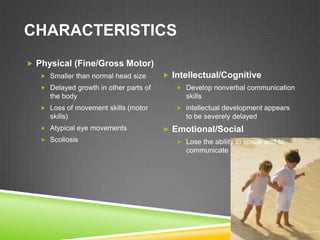
CHARACTERISTICS
 Physical (Fine/Gross Motor)
    Smaller than normal head size       Intellectual/Cognitive
    Delayed growth in other parts of       Develop nonverbal communication
     the body                                 skills
    Loss of movement skills (motor         intellectual development appears
     skills)                                  to be severely delayed
    Atypical eye movements              Emotional/Social
    Scoliosis                              Lose the ability to speak and to
                                              communicate
MODIFICATIONS
MODIFICATIONS IN CHILD CARE
 Large/open space
    This will allow Hope to move freely with or without wheelchair. Since ―up to
      50% of children (with Rett Syndrome) are capable of walking‖ some of them
      would require a walking device for them to move around (i.e wheelchair).
      Even for those who are capable of waking would require a large and open
      space because of their compulsive hand movements. Remove any barriers
      (foam mats, carpet, pillows, toys, etc) or reposition them in a place where it is
      not obstructing her movements. Also, children with Rett Syndrome have the
      possibility of having a seizure, therefore, having an open space can diminish
      other injuries.
 Custom designed tables
    If Hope is going to be in a wheelchair, tables with comfort curves is needed.
      This will allow her to comfortably participate in table activities and have social
      interaction during lunch/snack time.
MODIFICATIONS IN CHILD CARE
 Adjust the height of the shelf
    Refrain from putting toys/learning tools too high or too low for all the children
      to reach.
 Avoid putting things on top of the shelf
    Considering the atypical movements of her hands, toys/learning tools on top
      of the shelf may fall
 Put sign language pictures around the child care
    Children with Rett Syndrome lose their ability to speak, therefore, sign
      language will be the main means of communication. This will also teach other
      children how to communicate with Hope.
MODIFICATIONS IN CHILD CARE
 Ramps/Automatic doors
    Ramps and automatic doors will enable Hope to move freely around the child
      care and have her independence.
 Pillows on the floor
    Having pillows around the room (without obstructing the walk ways) will help
      during seizures. Also, having soft surfaces can prevent injuries from slip and
      falls.
 Appropriate toys/materials/equipment
    Stabilize, enhancing and simplify toys/materials around the room so that they
      can participate in play.
        Stabilize blocks by gluing velcro on it, so that it stands when they build a tower.
        Children with Rett Syndrome will lose their hand functions., therefore, adding texture
          to buttons can make it more accessible for Hope.
        Simplify/reduce the number of puzzles to help Hope complete a task.
MODIFICATIONS IN CHILD CARE
 More time for transition
    Hope may need extra help during transitions, therefore, allowing more time
      will make sure that she can participate in other activities without the delay.
      Use visuals/signals and remain consistent during transitions.
 Staff support
    With the consent from the parents (Form 14), have an staff (specialist for
      children with special needs) that can assist Hope through out the day and
      work with her one-on-one.
 Label all areas/materials in the room with words and pictures.
 Post a pictorial schedule for Hope and other children to see.
TEACHING STRATEGIES
 Incorporate some sign language while interacting with Hope/the children
 Simplify language
 Find an age appropriate book that will help children learn more about Rett
    Syndrome
   Have books/audio-visual materials that portray children with special needs
   Encourage daily physical activity
   Prompting and fading
   Be optimistic/enthusiastic/willing to support Hope
   Motivate/acknowledge/celebrate Hope’s success
   Visuals
   First/then board
   Choice board
OTHER CHILDREN
 Encourage them to help Hope
    For example: putting on shoes, moving around the room, putting away toys,
     and so on.
 Peer modelling
HOPE’S FAMILY
 Have a wheelchair accessible environment at home
    Ramps, open space, etc.

 Wheelchair accessible car
 Encourage conversations
 Physical activities
RESOURCES
RESOURCES
1.   Ontario Rett Syndrome Association
2.   Holland Bloorview Kids Rehabilitation Hospital
3.   Centennial Infant and Child Care
4.   Aisling Discoveries Child and Family Centre
5.   Adventure Place Child and Family Centre
6.   Connectability
7.   Children’s Rehabilitation Centre ALGOMA
8.   findasocialworker.ca
WHO IS ONTARIO RETT SYNDROME
ASSOCIATION?
 http://rett.ca/
 The Ontario Rett Syndrome Association (O.R.S.A.) is a volunteer,
  not-for-profit charity for parents, caregivers, researchers, medical
  professionals and other interested support agencies and
  individuals. O.R.S.A. became incorporated in 1991. Its Board of
  Directors is comprised of parents and caring citizens. O.R.S.A.
  provides information through a website, a newsletter and
  conferences. Support is provided to families regionally. The
  association funds Canadian research projects, two Rett
  Syndrome Clinics, a resource centre and the Canadian Rett
  Syndrome Registry. O.R.S.A. advocates to the needs of
  individuals with Rett syndrome and their families provincially and
  nationally.
WHAT DOES O.R.S.A DO?
 The Ontario Rett Syndrome Association (O.R.S.A.) exists to
  ensure that children and adults with Rett Syndrome are enabled
  to achieve their full potential and enjoy the highest quality of life
  within their community.
HOW DOES O.R.S.A HELP?
 Provide all new parents/guardians membership with a complimentary
    parent package that includes the Silent Angel DVD and Rett
    Syndrome Handbook
   Host conferences and medical symposiums
   Operate a Resource Centre
   Provide an information-based web site and newsletter
   Fund and support the Children’s Hospital of Eastern Ontario’s and
    Thames Valley Children’s Centre’s Rett Syndrome Clinics
   Host regional activities to provide caring support and networking
    opportunities
   Assist with connecting families to the Rett Syndrome Clinics, the
    Canadian Rett Syndrome Registry, regional representatives, other
    families and supports
   Provide funding for research
CONTACT INFORMATION
 Ontario Rett Syndrome Association P.O. Box 50030 London,
  ON N6A 6H8
 Telephone: (519) 474-6877
WHO IS HOLLAND BLOORVIEW KIDS
REHABILITATION HOSPITAL?
 http://www.hollandbloorview.ca/
 Holland Bloorview Kids Rehabilitation Hospital (formerly Bloorview Kids Rehab) is Canada’s
    largest children’s rehabilitation hospital.
   Our vision is to create a world of possibility for kids with disability.
   We pioneer treatments, technologies, therapies and real-world programs that give children
    with disabilities the tools to participate fully in life.
   Holland Bloorview serves about 7,000 children each year, with about 600 inpatient admissions
    and 58,000 outpatient visits. Holland Bloorview is a world-class teaching hospital fully affiliated
    with the University of Toronto. We train future health-care specialists in the field of childhood
    disability. The Bloorview Research Institute is located onsite, allowing us to integrate cutting-
    edge research and teaching with frontline care to improve children’s quality of life.
   Our state-of-the-art building has been recognized by the International Academy for Design and
    Health as ―an inspirational building…which speaks to a child’s right to participate in our
    society.‖
   We see children with cerebral palsy, acquired brain injury, muscular dystrophy, amputation,
    epilepsy, spina bifida, arthritis, cleft-lip and palate, autism and other developmental disabilities.
    A small number of our clients have complex chronic diseases that require round-the-clock
    medical care.
OUTPATIENT REFERRAL
CONTACT INFORMATION
 Holland Bloorview Kids Rehabilitation Hospital
  150 Kilgour Road
  Toronto, Ontario, Canada
  M4G 1R8
 Tel: 416-425-6220
  Toll Free: 1-800-363-2440
 Fax:
    General Information: 416-425-6591
    Confidential Client/Patient Information: 416-425-5709
    Confidential Employee Information: 416-424-3868
    Financial Information: 416-422-7039
WHO IS CENTENNIAL INFANT AND
CHILD CARE?
 http://cicc.ca/
 Centennial Infant and Child Centre is committed to the development and
  education of young children with developmental challenges. Centennial
  focuses on the individual needs of each child and family through early
  intervention at home, in our integrated preschool and kindergarten programs,
  and through participation in community programs. Centennial values and
  builds on the unique abilities and strengths of children with special needs,
  and encourages all of them to develop the confidence and skills to find their
  place in the world.
 A Day at the Centre
     We help children with special needs begin to learn strategies which will help them to
       develop and function as independently as possible in society. Staff and families set goals
       through which these strategies will be achieved. All aspects of a child’s development are
       considered. We believe the goals are best accomplished through an individualized
       program. In our preschool this is enhanced with a one-to-one adult/child ratio and with the
       inclusion of normally developing children. We work directly with families to lend emotional
       support and to encourage the optimal development of each child. This is an on-going
       process in which the staff and the family learn from each other.
SERVICES
 We help children with special needs begin to learn strategies
  which will help them to develop and function as independently as
  possible in society. Staff and families set goals through which
  these strategies will be achieved. All aspects of a child’s
  development are considered. We believe the goals are best
  accomplished through an individualized program. In our preschool
  this is enhanced with a one-to-one adult/child ratio and with the
  inclusion of normally developing children. We work directly with
  families to lend emotional support and to encourage the optimal
  development of each child. This is an on-going process in which
  the staff and the family learn from each other.
COST
 Tuition Fees
    Preschool Morning Program: Current fee – $550.00 per month, for the 2012-
     2013 school year
     Preschool Morning Program: $575 per month, for the 2013-2014 school year
     Preschool Afternoon Program: $475 per month, for the 2013-2014 school year
 Subsidies are available through Toronto Children’s Services
CONTACT INFORMATION
 Centennial Infant and Child    Centennial Infant and Child
  Centre
                                  Centre Foundation
 1580 Yonge Street
  Toronto, Ontario               1580 Yonge Street, Suite 300
  M4T 1Z8                         Toronto, Ontario
 Tel: 416 935-0200               M4T 1Z8
  Fax: 416 935-0300
                                 Tel: 416 935-1200
 Executive Director: Barbara
  Hannah                          Fax: 416 935-0300
  Manager of Centre               Helen Smith:
  Operations: Kim Clarke: 416     hsmith@cicc.on.ca
  935-0200 ext. 231
  Office Manager : Pam            ext: 233
  McNamara: 416 935-0200 ext.     Jessica Field:
  230                             jfield@cicc.on.ca
                                  ext: 241
AISLING DISCOVERIES CHILD AND
FAMILY CENTRE
 http://www.aislingdiscoveries.on.ca/
 Aisling Discoveries Child and Family Centre provides service to
  children from birth to twelve who are experiencing or are at risk of
  developing social, emotional or behavioural problems.
 The Centre is committed to promoting and strengthening the
  emotional and social well-being of children and their families,
  through a variety of prevention, intervention and treatment
  services. Families are an important part of the treatment and
  decision making process. We strive to make services accessible
  and culturally sensitive.
WHO ARE WE?
 Aisling Discoveries Child and Family Centre provides responsive
  services in partnership with families and communities to
  strengthen the social and emotional well-being of children and
  promote their healthy development.
 We are accredited by Children’s Mental Health Ontario. Our
  services are for children from birth to twelve years of age who
  have social, emotional or behavioural problems and their families.
 We are located in east Toronto and services are predominately
  provided in the communities of East York and Scarborough.
CONTACT INFORMATION
 325 Milner Avenue, Suite 110
    Scarborough, ON
    Canada, M1B 5N1
   Telephone: 416-321-5464
    Fax: 416-321-1510
    Email: mailus@aislingdiscoveries.on.ca
   Office Hours:
    Mon-Thurs. 9:00am-7:30pm
    Fri. 9:00am-4:00pm
   Executive Director: bkashima@aislingdiscoveries.on.ca
   For information about our services, contact our Intake staff at 416-
    321-5464, ext. 233.
ADVENTURE PLACE CHILD AND
FAMILY CENTRE
 http://www.adventureplace.ca/
 Adventure Place has been assisting young children and their families since
  1972. Our services are open to all families living in Toronto, North Quadrant,
  with children up to 12 years of age who are experiencing difficulties in one or
  more of the following areas:
     Development
     Learning
     Communication (Speech and Language)
     Behaviour
     Social and/or Emotional Functioning
     Attention and/or Regulatory Functioning
     Pervasive Developmental Disorders (ASD/PDD)
 Adventure Place is a registered charitable organization, fully accredited by
  Children’s Mental Health Ontario.
MORE INFORMATION
 Our Mission
    To provide comprehensive mental health, social, and developmental services
      dedicated to the well-being and success of children in their early years and to their
      families.
 Our Philosophy
    At Adventure Place, we believe that all children have the right to healthy
      development and to achieve their full potential.
 Our Goals
    To reduce the impact of difficulties and special needs.
      To help children achieve their potential by building on their strengths and self-
      esteem.
      To increase parental knowledge, competence, and confidence.
      To reduce family stress.
      To reduce the risk of longer term or more complex difficulties.
CONTACT INFORMATION
 Adventure Place
McNicoll Public School
155 McNicoll Avenue
Toronto, Ontario M2H 2C1
 Telephone: 416 744 7650
  Fax: 416 744 8055
 Main Office Hours of Operation
  Monday - Friday 8:30 am to 4:30 pm
 How to Access our Service
  Parent/legal guardian calls 416 744 7650 x.228
 http://connectability.ca/
 Welcome to ConnectABILITY a website and virtual community
  dedicated to lifelong learning and support for people who have an
  intellectual disability, their families and support networks. The core
  of our community is accessible, self-directed access to valuable
  information and tools, ready on demand.
GETTING TO KNOW CHILDREN'S
REHAB...
 Children’s Rehabilitation Centre – Algoma is one of twenty-one Children’s
  Treatment Centres across Ontario which provides programs and services to
  children and young people aged 0-18 years with long-term disabilities. Centre
  staff focus on helping children and youth reach their potential and
  independence in the areas of physical, perceptual, communication and/or
  developmental challenges.
 The Centre is an incorporated, non-profit charitable organization with
  accountabilities to a Board of Directors, the Ministry of Children and Youth
  Services and the Sault Ste. Marie and Algoma District Social Services
  Administration Boards.
 We are dedicated to supporting children and youth with special needs in the
  development of their potential and participation as valued members of the
  community.
 Family-centered care is at the heart of Children’s Rehabilitation Centre where
  children from the District of Algoma receive support from a wide range of
  health care and other professionals.
CONTACT INFORMATION
 CHILDREN’S REHABILITATION CENTRE ALGOMA
   SAULT STE. MARIE - HEAD OFFICE
    74 Johnson Avenue Sault Ste. Marie, ON P6C 2V5
    Tel: 705.759.1131         Toll Free: 1.855.759.1131
    Fax: 705.759.0783         Toll Free Fax: 1.855.759.0783
   OUR DISTRIC OFFICES ARE LOCATED AT:
    99 Spine Rd., Suite 301 Elliot Lake, ON P5A 3S9
    26 Sainte Marie St. Wawa, ON P0S 1K0
 What is findasocialworker.ca?
 findasocialworker.ca is an online directory of social workers in
  private practice in Canada. findasocialworker.ca is a project of the
  Ontario Association of Social Workers (OASW), and each social
  worker listed here is a member of their provincial social work
  association and regulatory body. This directory is provided as a
  free service to individuals or organizations wishing to locate and
  engage the services of a social worker, and all social workers
  listed have paid a fee to appear on this site.
RESOURCES
   Child care picture from Clip Art (Microsoft PowerPoint)                  http://www.rett.ca/index.php/about/who-is-o-r-s-a/
   Child picture from Clip Art (Microsoft PowerPoint)                       https://www.facebook.com/OntarioRettSyndromeAssociation
   Children picture from Clip Art (Microsoft PowerPoint)                    http://www.rett.ca/index.php/about/our-mission/
   ECEP 233 Weeks 1-9 Class Notes                                           http://www.rett.ca/index.php/about/our-services-how-we-help/
   ECEP 233—Meeting the Needs of Children with Special Needs                http://www.rett.ca/index.php/contact-us/
    Assignment Case Studies (2013)
                                                                             http://www.hollandbloorview.ca/about/index.php
   Family picture from Clip Art (Microsoft PowerPoint)
                                                                             http://www.hollandbloorview.ca/pages/documents/outpatient_referralform
   Hope picture from Clip Art (Microsoft PowerPoint)                         .pdf
   Information picture from Clip Art (Microsoft Power Point)                http://www.hollandbloorview.ca/pages/contactus.php
   List picture from Clip Art (Microsoft PowerPoint)                        http://cicc.ca/about-us
   Modification picture from Clip Art (Microsoft PowerPoint)                http://cicc.ca/services
   Needs picture from Clip Art (Microsoft Power Point)                      http://cicc.ca/preschool-program
   Resource pictures from Clip Art (Microsoft PowerPoint)                   http://cicc.ca/contact
   Teaching picture from Clip Art (Microsoft PowerPoint)                    http://www.aislingdiscoveries.on.ca/what_we_do/intro
   http://www.youtube.com/watch?v=d2Rv8JLH85I                               http://www.aislingdiscoveries.on.ca/who_we_are/intro
   http://connectability.ca/2011/10/06/rett-syndrome/                       http://www.aislingdiscoveries.on.ca/contact_us
   http://www.rettsyndrome.org/understanding-rett-syndrome/about-rett-      http://www.adventureplace.ca/about-us
    syndrome/what-is-rett-syndrome
                                                                             http://www.adventureplace.ca/about-us#accessibility
   http://connectability.ca/2011/10/06/rett-syndrome/
                                                                             http://www.adventureplace.ca/contact
   http://www.mayoclinic.com/health/rett-
    syndrome/DS00716/DSECTION=symptoms                                       http://connectability.ca/whats-inside/
   http://www.nomoretantrums.com/wp-content/uploads/2011/02/rett-           http://www.crcalgoma.ca/index.cfm?fuseaction=content&PageID=1099&
    syndrome-228x300.jpg                                                      PageCategory=2
                                                                             http://www.crcalgoma.ca/index.cfm?fuseaction=content&PageID=1008&
                                                                              PageCategory=6
                                                                             http://www.findasocialworker.ca/ON/en/About/AboutUs.asp

Ecep 233 -rett’s syndrome

  • 1.
    MEETING THE NEEDSOF CHILDREN AND FAMILIES ~RETT SYNDROME Maria Christine Mendoza ECEP 233-063 Lisa McCaie
  • 2.
    SCENARIO  Hope isa preschooler who was diagnosed with Rett’s Syndrome. Her family is exceptionally worried because they do not know the services that are available for them.
  • 3.
    NEEDS  Hope  Family  Inclusive environment  More information about Rett  Love Syndrome  Resources  Care  Agencies  Support  Services available  Physiotherapist/Occupational  Guidance Therapist/Speech and Language Therapist  Social Worker
  • 4.
    WHAT IS RETTSYNDROME? http://www.youtube.com/watch?v=d2Rv8JLH 85I
  • 5.
    RETT SYNDROME  Achildhood neurodevelopmental disorder  Primarily in girls  Caused by mutations on the X chromosome on a gene called MECP2  The first symptom is the loss of muscle tone  Problems crawling or walking  Diminished eye contact  The child will lose purposeful use of her hands and the ability to speak.  Compulsive hand movements such as wringing and washing  Loss of functional use of the hands.  The inability to perform motor functions is the most disabling feature of Rett Syndrome, interfering with every body movement, including eye gaze, and speech.
  • 6.
    HOW IS ITMANIFESTED?  a period of normal development between 6-18 months  normal head circumference at birth followed by a slowing of the rate of head growth with age (starting between 6 months and 4 years)  loss of purposeful hand skills at age 1-4 years  shakiness of the torso, which may involve the limbs, particularly when the child is upset or agitated  unsteady, stiff-legged gait  breathing difficulties (hyperventilation, apnea, air swallowing)  seizures (approximately 80% have epilepsy)  teeth grinding and difficulty chewing  intellectual development appears to be severely delayed, but true intelligence is hard to measure  impaired expressive and receptive language
  • 7.
    CHARACTERISTICS  Physical (Fine/GrossMotor)  Smaller than normal head size  Intellectual/Cognitive  Delayed growth in other parts of  Develop nonverbal communication the body skills  Loss of movement skills (motor  intellectual development appears skills) to be severely delayed  Atypical eye movements  Emotional/Social  Scoliosis  Lose the ability to speak and to communicate
  • 8.
  • 9.
    MODIFICATIONS IN CHILDCARE  Large/open space  This will allow Hope to move freely with or without wheelchair. Since ―up to 50% of children (with Rett Syndrome) are capable of walking‖ some of them would require a walking device for them to move around (i.e wheelchair). Even for those who are capable of waking would require a large and open space because of their compulsive hand movements. Remove any barriers (foam mats, carpet, pillows, toys, etc) or reposition them in a place where it is not obstructing her movements. Also, children with Rett Syndrome have the possibility of having a seizure, therefore, having an open space can diminish other injuries.  Custom designed tables  If Hope is going to be in a wheelchair, tables with comfort curves is needed. This will allow her to comfortably participate in table activities and have social interaction during lunch/snack time.
  • 10.
    MODIFICATIONS IN CHILDCARE  Adjust the height of the shelf  Refrain from putting toys/learning tools too high or too low for all the children to reach.  Avoid putting things on top of the shelf  Considering the atypical movements of her hands, toys/learning tools on top of the shelf may fall  Put sign language pictures around the child care  Children with Rett Syndrome lose their ability to speak, therefore, sign language will be the main means of communication. This will also teach other children how to communicate with Hope.
  • 11.
    MODIFICATIONS IN CHILDCARE  Ramps/Automatic doors  Ramps and automatic doors will enable Hope to move freely around the child care and have her independence.  Pillows on the floor  Having pillows around the room (without obstructing the walk ways) will help during seizures. Also, having soft surfaces can prevent injuries from slip and falls.  Appropriate toys/materials/equipment  Stabilize, enhancing and simplify toys/materials around the room so that they can participate in play.  Stabilize blocks by gluing velcro on it, so that it stands when they build a tower.  Children with Rett Syndrome will lose their hand functions., therefore, adding texture to buttons can make it more accessible for Hope.  Simplify/reduce the number of puzzles to help Hope complete a task.
  • 12.
    MODIFICATIONS IN CHILDCARE  More time for transition  Hope may need extra help during transitions, therefore, allowing more time will make sure that she can participate in other activities without the delay. Use visuals/signals and remain consistent during transitions.  Staff support  With the consent from the parents (Form 14), have an staff (specialist for children with special needs) that can assist Hope through out the day and work with her one-on-one.  Label all areas/materials in the room with words and pictures.  Post a pictorial schedule for Hope and other children to see.
  • 13.
    TEACHING STRATEGIES  Incorporatesome sign language while interacting with Hope/the children  Simplify language  Find an age appropriate book that will help children learn more about Rett Syndrome  Have books/audio-visual materials that portray children with special needs  Encourage daily physical activity  Prompting and fading  Be optimistic/enthusiastic/willing to support Hope  Motivate/acknowledge/celebrate Hope’s success  Visuals  First/then board  Choice board
  • 14.
    OTHER CHILDREN  Encouragethem to help Hope  For example: putting on shoes, moving around the room, putting away toys, and so on.  Peer modelling
  • 15.
    HOPE’S FAMILY  Havea wheelchair accessible environment at home  Ramps, open space, etc.  Wheelchair accessible car  Encourage conversations  Physical activities
  • 16.
  • 17.
    RESOURCES 1. Ontario Rett Syndrome Association 2. Holland Bloorview Kids Rehabilitation Hospital 3. Centennial Infant and Child Care 4. Aisling Discoveries Child and Family Centre 5. Adventure Place Child and Family Centre 6. Connectability 7. Children’s Rehabilitation Centre ALGOMA 8. findasocialworker.ca
  • 18.
    WHO IS ONTARIORETT SYNDROME ASSOCIATION?  http://rett.ca/  The Ontario Rett Syndrome Association (O.R.S.A.) is a volunteer, not-for-profit charity for parents, caregivers, researchers, medical professionals and other interested support agencies and individuals. O.R.S.A. became incorporated in 1991. Its Board of Directors is comprised of parents and caring citizens. O.R.S.A. provides information through a website, a newsletter and conferences. Support is provided to families regionally. The association funds Canadian research projects, two Rett Syndrome Clinics, a resource centre and the Canadian Rett Syndrome Registry. O.R.S.A. advocates to the needs of individuals with Rett syndrome and their families provincially and nationally.
  • 19.
    WHAT DOES O.R.S.ADO?  The Ontario Rett Syndrome Association (O.R.S.A.) exists to ensure that children and adults with Rett Syndrome are enabled to achieve their full potential and enjoy the highest quality of life within their community.
  • 20.
    HOW DOES O.R.S.AHELP?  Provide all new parents/guardians membership with a complimentary parent package that includes the Silent Angel DVD and Rett Syndrome Handbook  Host conferences and medical symposiums  Operate a Resource Centre  Provide an information-based web site and newsletter  Fund and support the Children’s Hospital of Eastern Ontario’s and Thames Valley Children’s Centre’s Rett Syndrome Clinics  Host regional activities to provide caring support and networking opportunities  Assist with connecting families to the Rett Syndrome Clinics, the Canadian Rett Syndrome Registry, regional representatives, other families and supports  Provide funding for research
  • 21.
    CONTACT INFORMATION  OntarioRett Syndrome Association P.O. Box 50030 London, ON N6A 6H8  Telephone: (519) 474-6877
  • 22.
    WHO IS HOLLANDBLOORVIEW KIDS REHABILITATION HOSPITAL?  http://www.hollandbloorview.ca/  Holland Bloorview Kids Rehabilitation Hospital (formerly Bloorview Kids Rehab) is Canada’s largest children’s rehabilitation hospital.  Our vision is to create a world of possibility for kids with disability.  We pioneer treatments, technologies, therapies and real-world programs that give children with disabilities the tools to participate fully in life.  Holland Bloorview serves about 7,000 children each year, with about 600 inpatient admissions and 58,000 outpatient visits. Holland Bloorview is a world-class teaching hospital fully affiliated with the University of Toronto. We train future health-care specialists in the field of childhood disability. The Bloorview Research Institute is located onsite, allowing us to integrate cutting- edge research and teaching with frontline care to improve children’s quality of life.  Our state-of-the-art building has been recognized by the International Academy for Design and Health as ―an inspirational building…which speaks to a child’s right to participate in our society.‖  We see children with cerebral palsy, acquired brain injury, muscular dystrophy, amputation, epilepsy, spina bifida, arthritis, cleft-lip and palate, autism and other developmental disabilities. A small number of our clients have complex chronic diseases that require round-the-clock medical care.
  • 23.
  • 24.
    CONTACT INFORMATION  HollandBloorview Kids Rehabilitation Hospital 150 Kilgour Road Toronto, Ontario, Canada M4G 1R8  Tel: 416-425-6220 Toll Free: 1-800-363-2440  Fax:  General Information: 416-425-6591  Confidential Client/Patient Information: 416-425-5709  Confidential Employee Information: 416-424-3868  Financial Information: 416-422-7039
  • 25.
    WHO IS CENTENNIALINFANT AND CHILD CARE?  http://cicc.ca/  Centennial Infant and Child Centre is committed to the development and education of young children with developmental challenges. Centennial focuses on the individual needs of each child and family through early intervention at home, in our integrated preschool and kindergarten programs, and through participation in community programs. Centennial values and builds on the unique abilities and strengths of children with special needs, and encourages all of them to develop the confidence and skills to find their place in the world.  A Day at the Centre  We help children with special needs begin to learn strategies which will help them to develop and function as independently as possible in society. Staff and families set goals through which these strategies will be achieved. All aspects of a child’s development are considered. We believe the goals are best accomplished through an individualized program. In our preschool this is enhanced with a one-to-one adult/child ratio and with the inclusion of normally developing children. We work directly with families to lend emotional support and to encourage the optimal development of each child. This is an on-going process in which the staff and the family learn from each other.
  • 26.
    SERVICES  We helpchildren with special needs begin to learn strategies which will help them to develop and function as independently as possible in society. Staff and families set goals through which these strategies will be achieved. All aspects of a child’s development are considered. We believe the goals are best accomplished through an individualized program. In our preschool this is enhanced with a one-to-one adult/child ratio and with the inclusion of normally developing children. We work directly with families to lend emotional support and to encourage the optimal development of each child. This is an on-going process in which the staff and the family learn from each other.
  • 27.
    COST  Tuition Fees  Preschool Morning Program: Current fee – $550.00 per month, for the 2012- 2013 school year Preschool Morning Program: $575 per month, for the 2013-2014 school year Preschool Afternoon Program: $475 per month, for the 2013-2014 school year  Subsidies are available through Toronto Children’s Services
  • 28.
    CONTACT INFORMATION  CentennialInfant and Child  Centennial Infant and Child Centre Centre Foundation  1580 Yonge Street Toronto, Ontario  1580 Yonge Street, Suite 300 M4T 1Z8 Toronto, Ontario  Tel: 416 935-0200 M4T 1Z8 Fax: 416 935-0300  Tel: 416 935-1200  Executive Director: Barbara Hannah Fax: 416 935-0300 Manager of Centre Helen Smith: Operations: Kim Clarke: 416 hsmith@cicc.on.ca 935-0200 ext. 231 Office Manager : Pam ext: 233 McNamara: 416 935-0200 ext. Jessica Field: 230 jfield@cicc.on.ca ext: 241
  • 29.
    AISLING DISCOVERIES CHILDAND FAMILY CENTRE  http://www.aislingdiscoveries.on.ca/  Aisling Discoveries Child and Family Centre provides service to children from birth to twelve who are experiencing or are at risk of developing social, emotional or behavioural problems.  The Centre is committed to promoting and strengthening the emotional and social well-being of children and their families, through a variety of prevention, intervention and treatment services. Families are an important part of the treatment and decision making process. We strive to make services accessible and culturally sensitive.
  • 30.
    WHO ARE WE? Aisling Discoveries Child and Family Centre provides responsive services in partnership with families and communities to strengthen the social and emotional well-being of children and promote their healthy development.  We are accredited by Children’s Mental Health Ontario. Our services are for children from birth to twelve years of age who have social, emotional or behavioural problems and their families.  We are located in east Toronto and services are predominately provided in the communities of East York and Scarborough.
  • 31.
    CONTACT INFORMATION  325Milner Avenue, Suite 110 Scarborough, ON Canada, M1B 5N1  Telephone: 416-321-5464 Fax: 416-321-1510 Email: mailus@aislingdiscoveries.on.ca  Office Hours: Mon-Thurs. 9:00am-7:30pm Fri. 9:00am-4:00pm  Executive Director: bkashima@aislingdiscoveries.on.ca  For information about our services, contact our Intake staff at 416- 321-5464, ext. 233.
  • 32.
    ADVENTURE PLACE CHILDAND FAMILY CENTRE  http://www.adventureplace.ca/  Adventure Place has been assisting young children and their families since 1972. Our services are open to all families living in Toronto, North Quadrant, with children up to 12 years of age who are experiencing difficulties in one or more of the following areas:  Development  Learning  Communication (Speech and Language)  Behaviour  Social and/or Emotional Functioning  Attention and/or Regulatory Functioning  Pervasive Developmental Disorders (ASD/PDD)  Adventure Place is a registered charitable organization, fully accredited by Children’s Mental Health Ontario.
  • 33.
    MORE INFORMATION  OurMission  To provide comprehensive mental health, social, and developmental services dedicated to the well-being and success of children in their early years and to their families.  Our Philosophy  At Adventure Place, we believe that all children have the right to healthy development and to achieve their full potential.  Our Goals  To reduce the impact of difficulties and special needs. To help children achieve their potential by building on their strengths and self- esteem. To increase parental knowledge, competence, and confidence. To reduce family stress. To reduce the risk of longer term or more complex difficulties.
  • 34.
    CONTACT INFORMATION  AdventurePlace McNicoll Public School 155 McNicoll Avenue Toronto, Ontario M2H 2C1  Telephone: 416 744 7650 Fax: 416 744 8055  Main Office Hours of Operation Monday - Friday 8:30 am to 4:30 pm  How to Access our Service Parent/legal guardian calls 416 744 7650 x.228
  • 35.
     http://connectability.ca/  Welcometo ConnectABILITY a website and virtual community dedicated to lifelong learning and support for people who have an intellectual disability, their families and support networks. The core of our community is accessible, self-directed access to valuable information and tools, ready on demand.
  • 36.
    GETTING TO KNOWCHILDREN'S REHAB...  Children’s Rehabilitation Centre – Algoma is one of twenty-one Children’s Treatment Centres across Ontario which provides programs and services to children and young people aged 0-18 years with long-term disabilities. Centre staff focus on helping children and youth reach their potential and independence in the areas of physical, perceptual, communication and/or developmental challenges.  The Centre is an incorporated, non-profit charitable organization with accountabilities to a Board of Directors, the Ministry of Children and Youth Services and the Sault Ste. Marie and Algoma District Social Services Administration Boards.  We are dedicated to supporting children and youth with special needs in the development of their potential and participation as valued members of the community.  Family-centered care is at the heart of Children’s Rehabilitation Centre where children from the District of Algoma receive support from a wide range of health care and other professionals.

  • 37.
    CONTACT INFORMATION  CHILDREN’SREHABILITATION CENTRE ALGOMA  SAULT STE. MARIE - HEAD OFFICE 74 Johnson Avenue Sault Ste. Marie, ON P6C 2V5 Tel: 705.759.1131 Toll Free: 1.855.759.1131 Fax: 705.759.0783 Toll Free Fax: 1.855.759.0783  OUR DISTRIC OFFICES ARE LOCATED AT: 99 Spine Rd., Suite 301 Elliot Lake, ON P5A 3S9 26 Sainte Marie St. Wawa, ON P0S 1K0
  • 38.
     What isfindasocialworker.ca?  findasocialworker.ca is an online directory of social workers in private practice in Canada. findasocialworker.ca is a project of the Ontario Association of Social Workers (OASW), and each social worker listed here is a member of their provincial social work association and regulatory body. This directory is provided as a free service to individuals or organizations wishing to locate and engage the services of a social worker, and all social workers listed have paid a fee to appear on this site.
  • 39.
    RESOURCES  Child care picture from Clip Art (Microsoft PowerPoint)  http://www.rett.ca/index.php/about/who-is-o-r-s-a/  Child picture from Clip Art (Microsoft PowerPoint)  https://www.facebook.com/OntarioRettSyndromeAssociation  Children picture from Clip Art (Microsoft PowerPoint)  http://www.rett.ca/index.php/about/our-mission/  ECEP 233 Weeks 1-9 Class Notes  http://www.rett.ca/index.php/about/our-services-how-we-help/  ECEP 233—Meeting the Needs of Children with Special Needs  http://www.rett.ca/index.php/contact-us/ Assignment Case Studies (2013)  http://www.hollandbloorview.ca/about/index.php  Family picture from Clip Art (Microsoft PowerPoint)  http://www.hollandbloorview.ca/pages/documents/outpatient_referralform  Hope picture from Clip Art (Microsoft PowerPoint) .pdf  Information picture from Clip Art (Microsoft Power Point)  http://www.hollandbloorview.ca/pages/contactus.php  List picture from Clip Art (Microsoft PowerPoint)  http://cicc.ca/about-us  Modification picture from Clip Art (Microsoft PowerPoint)  http://cicc.ca/services  Needs picture from Clip Art (Microsoft Power Point)  http://cicc.ca/preschool-program  Resource pictures from Clip Art (Microsoft PowerPoint)  http://cicc.ca/contact  Teaching picture from Clip Art (Microsoft PowerPoint)  http://www.aislingdiscoveries.on.ca/what_we_do/intro  http://www.youtube.com/watch?v=d2Rv8JLH85I  http://www.aislingdiscoveries.on.ca/who_we_are/intro  http://connectability.ca/2011/10/06/rett-syndrome/  http://www.aislingdiscoveries.on.ca/contact_us  http://www.rettsyndrome.org/understanding-rett-syndrome/about-rett-  http://www.adventureplace.ca/about-us syndrome/what-is-rett-syndrome  http://www.adventureplace.ca/about-us#accessibility  http://connectability.ca/2011/10/06/rett-syndrome/  http://www.adventureplace.ca/contact  http://www.mayoclinic.com/health/rett- syndrome/DS00716/DSECTION=symptoms  http://connectability.ca/whats-inside/  http://www.nomoretantrums.com/wp-content/uploads/2011/02/rett-  http://www.crcalgoma.ca/index.cfm?fuseaction=content&PageID=1099& syndrome-228x300.jpg PageCategory=2  http://www.crcalgoma.ca/index.cfm?fuseaction=content&PageID=1008& PageCategory=6  http://www.findasocialworker.ca/ON/en/About/AboutUs.asp

Editor's Notes

  • #2 Family Walk: http://www.flickr.com/photos/glynlowe/7589898380/
  • #3 ECEP 233—Meeting the Needs of Children with Special Needs Assignment Case Studies (2013)Hope picture from Clip Art (Microsoft PowerPoint)
  • #4 Needs picture from Clip Art (Microsoft Power Point)
  • #5 http://www.youtube.com/watch?v=d2Rv8JLH85I
  • #6 http://connectability.ca/2011/10/06/rett-syndrome/http://www.rettsyndrome.org/understanding-rett-syndrome/about-rett-syndrome/what-is-rett-syndromeInformation picture from Clip Art (Microsoft Power Point)
  • #7 http://connectability.ca/2011/10/06/rett-syndrome/List picture from Clip Art (Microsoft PowerPoint)
  • #8 http://www.mayoclinic.com/health/rett-syndrome/DS00716/DSECTION=symptomsChild picture from Clip Art (Microsoft PowerPoint)
  • #9 Modification picture from Clip Art (Microsoft PowerPoint)
  • #10 ECEP 233 Week 3 Class NotesChild care picture from Clip Art (Microsoft PowerPoint)
  • #11 Child care picture from Clip Art (Microsoft PowerPoint)
  • #12 Child care picture from Clip Art (Microsoft PowerPoint)ECEP 233 Week 5 Class Notes
  • #13 Child care picture from Clip Art (Microsoft PowerPoint)ECEP 233 Week 5 Class Notes
  • #14 Teaching picture from Clip Art (Microsoft PowerPoint)
  • #15 Children picture from Clip Art (Microsoft PowerPoint)
  • #16 Family picture from Clip Art (Microsoft PowerPoint)
  • #17 Resource pictures from Clip Art (Microsoft PowerPoint)
  • #18 List picture from Clip Art (Microsoft PowerPoint)
  • #19 http://www.rett.ca/index.php/about/who-is-o-r-s-a/https://www.facebook.com/OntarioRettSyndromeAssociation
  • #20 http://www.rett.ca/index.php/about/our-mission/https://www.facebook.com/OntarioRettSyndromeAssociation
  • #21 http://www.rett.ca/index.php/about/our-services-how-we-help/https://www.facebook.com/OntarioRettSyndromeAssociation
  • #22 http://www.rett.ca/index.php/contact-us/https://www.facebook.com/OntarioRettSyndromeAssociation
  • #23 http://www.hollandbloorview.ca/about/index.php
  • #24 http://www.hollandbloorview.ca/pages/documents/outpatient_referralform.pdf
  • #25 http://www.hollandbloorview.ca/pages/contactus.php
  • #26 http://cicc.ca/about-us
  • #27 http://cicc.ca/services
  • #28 http://cicc.ca/preschool-program
  • #29 http://cicc.ca/contact
  • #30 http://www.aislingdiscoveries.on.ca/what_we_do/intro
  • #31 http://www.aislingdiscoveries.on.ca/who_we_are/intro
  • #32 http://www.aislingdiscoveries.on.ca/contact_us
  • #33 http://www.adventureplace.ca/about-us
  • #34 http://www.adventureplace.ca/about-us#accessibility
  • #35 http://www.adventureplace.ca/contact
  • #36 http://connectability.ca/whats-inside/
  • #37 http://www.crcalgoma.ca/index.cfm?fuseaction=content&PageID=1099&PageCategory=2
  • #38 http://www.crcalgoma.ca/index.cfm?fuseaction=content&PageID=1008&PageCategory=6
  • #39 http://www.findasocialworker.ca/ON/en/About/AboutUs.asp