HR’s ad agency.
Increasing Market Value Through Talent
Windy City Summit │Chicago, IL │ May 25, 2016
HR’s ad agency. 2
Agenda
1) Focal Point – Employer Brand and Employee
Engagement
2) The Villain – The Perfect Storm
3) Definitions
4) Solutions
N. Robert Johnson, APR
Practice Leader, Workforce Communications
Increasing Market Value Through Talent
HR’s ad agency. 3
Employer Brand and Employee
Engagement
HR’s ad agency. 4
Increasing Market Value Through Talent
Banking institutions with an engaged
workforce and a stronger employer brand
outperform their peers.
HR’s ad agency. 5
Increasing Market Value Through Talent
How So?
1) They attract and retain higher quality talent
2) Their people are more productive
3) They spend less on HR
But, what’s the connection to market value?
HR’s ad agency. 6
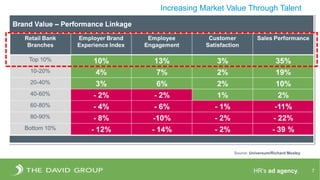
Increasing Market Value Through Talent
“The full value of talent comes from how talent
choices affect those outside the
organization, not just inside.” – Dave Ulrich
Translation
In addition to being great employees, higher quality talent that is
engaged build stronger customer relationships which leads to
higher market value.
Source: Taking Stock of Your Talent, Workforce, Dave Ulrich, February 2016
HR’s ad agency. 7
Increasing Market Value Through Talent
Source: Universum/Richard Mosley
HR’s ad agency. 8
Increasing Market Value Through Talent
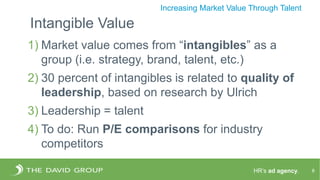
Intangible Value
1) Market value comes from “intangibles” as a
group (i.e. strategy, brand, talent, etc.)
2) 30 percent of intangibles is related to quality of
leadership, based on research by Ulrich
3) Leadership = talent
4) To do: Run P/E comparisons for industry
competitors
HR’s ad agency. 9
Increasing Market Value Through Talent
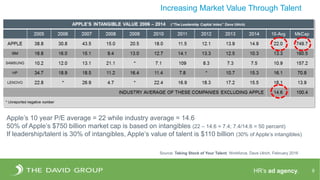
Apple’s 10 year P/E average = 22 while industry average = 14.6
50% of Apple’s $750 billion market cap is based on intangibles (22 – 14.6 = 7.4; 7.4/14.6 = 50 percent)
If leadership/talent is 30% of intangibles, Apple’s value of talent is $110 billion (30% of Apple’s intangibles)
Source: Taking Stock of Your Talent, Workforce, Dave Ulrich, February 2016
HR’s ad agency. 10
Increasing Market Value Through Talent
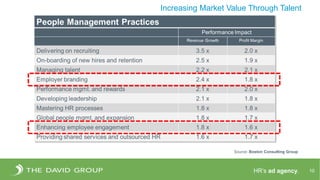
Source: Boston Consulting Group
HR’s ad agency. 11
Perfect Storm
HR’s ad agency. 12
Increasing Market Value Through Talent
Warning: Perfect Storm Ahead
The impact of an improving economy, talent
mobility, weaker employer-employee
connections, and a consumer-driven
communications world increases the difficulty of
attracting and keeping critical talent.
HR’s ad agency. 13
Increasing Market Value Through Talent
The State of Talent
1) Talent has more employment options than ever (small
business, gig-economy, start-ups)
2) Talent will research a new employment opportunity just as
they research everything else (consumer-driven behavior)
3) Talent has a heightened experience expectation in our
brand interactions, as well as shorter attention spans
4) Talent, generally speaking, is less connected to current
employers
HR’s ad agency. 14
Increasing Market Value Through Talent
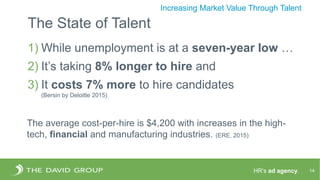
1) While unemployment is at a seven-year low …
2) It’s taking 8% longer to hire and
3) It costs 7% more to hire candidates
(Bersin by Deloitte 2015)
The average cost-per-hire is $4,200 with increases in the high-
tech, financial and manufacturing industries. (ERE, 2015)
The State of Talent
HR’s ad agency. 15
Increasing Market Value Through Talent
The State of Talent
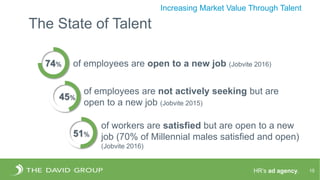
74% of employees are open to a new job (Jobvite 2016)
45%
of employees are not actively seeking but are
open to a new job (Jobvite 2015)
51%
of workers are satisfied but are open to a new
job (70% of Millennial males satisfied and open)
(Jobvite 2016)
HR’s ad agency. 16
Increasing Market Value Through Talent
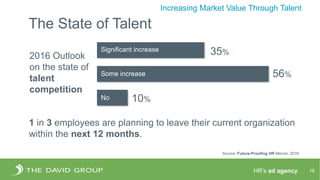
2016 Outlook
on the state of
talent
competition
Significant increase 35%
Some increase 56%
No 10%
1 in 3 employees are planning to leave their current organization
within the next 12 months.
Source: Future-Proofing HR Mercer, 2016
The State of Talent
HR’s ad agency. 17
Increasing Market Value Through Talent
An unstable workforce erodes culture and is
extraordinarily expensive.
• Increases HR spending (recruitment, rehire,
interventions, etc.)
• Decreases productivity and engagement (both
within individual role and throughout the
unit/group)
Impact
HR’s ad agency. 18
Increasing Market Value Through Talent
The average cost of turnover is between 90%
and 200% of an exiting employee’s base
salary and represents 12% of a company’s
operating budget.
Source: Fortune 100 Best Companies to Work For® 2016
Impact
HR’s ad agency. 19
Increasing Market Value Through Talent
A disengaged employee costs an organization
approximately $3,400 for every $10,000 in
annual salary. Disengaged employees cost
the American economy up to $350 billion per
year due to lost productivity.
Source: Gallup Organization
Impact
HR’s ad agency. 20
Increasing Market Value Through Talent
But, here’s the good news: On average, the
Fortune 100 Best Companies see half of the
voluntary turnover of their industry peers.
Source: Fortune 100 Best Companies to Work For® 2016
Impact
HR’s ad agency. 21
Increasing Market Value Through Talent
There is a direct connection between trust and
purpose; and engagement and retention. Research
shows that employees feel a great workplace is
one where …
• There is trust between employees and employer
• Employees take pride in their work
• Employees enjoy the people they work with
Source: Fortune 100 Best Companies to Work For® 2016
HR’s ad agency. 22
Increasing Market Value Through Talent
Employees who want to stay for a long time
report:
• My work has special meaning, it’s not just
a job
• When I look at what we accomplish, I have
a sense of pride
• I feel I make a difference here
Source: Fortune 100 Best Companies to Work For® 2016
HR’s ad agency. 23
Increasing Market Value Through Talent
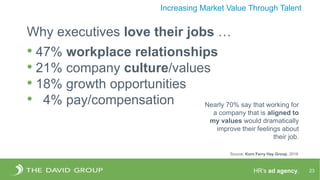
Why executives love their jobs …
• 47% workplace relationships
• 21% company culture/values
• 18% growth opportunities
• 4% pay/compensation Nearly 70% say that working for
a company that is aligned to
my values would dramatically
improve their feelings about
their job.
Source: Korn Ferry Hay Group, 2016
HR’s ad agency. 24
Increasing Market Value Through Talent
1) People are looking to connect in a deeper,
more meaningful way with their
employers
2) They will connect when there is alignment
with mission, culture and values
3) This creates pressure to define and
articulate culture, mission and values
HR’s ad agency. 25
Definitions
HR’s ad agency. 26
Increasing Market Value Through Talent
Employees’ commitment to the
organization and willingness to give extra
effort to their employer.
Employee Engagement
HR’s ad agency. 27
Increasing Market Value Through Talent
Line of Sight + Commitment
(I know what I have
to do and why)
(I have the commitment, motivation
and I’m empowered to do what I
have to)
Employee Engagement
HR’s ad agency. 28
Increasing Market Value Through Talent
Employer branding is the story of you as an
employer.
But, it’s a story of your employment
experience as formed and told by the
everyday experiences of your employees.
Employer Brand
HR’s ad agency. 29
Increasing Market Value Through Talent
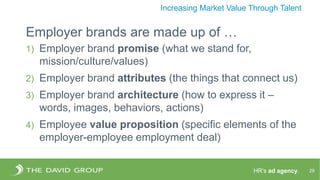
Employer brands are made up of …
1) Employer brand promise (what we stand for,
mission/culture/values)
2) Employer brand attributes (the things that connect us)
3) Employer brand architecture (how to express it –
words, images, behaviors, actions)
4) Employee value proposition (specific elements of the
employer-employee employment deal)
HR’s ad agency. 30
Increasing Market Value Through Talent
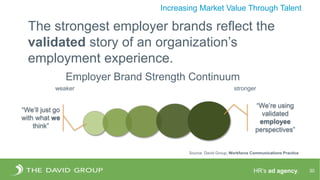
The strongest employer brands reflect the
validated story of an organization’s
employment experience.
Employer Brand Strength Continuum
weaker stronger
“We’ll just go
with what we
think”
“We’re using
validated
employee
perspectives”
Source: David Group, Workforce Communications Practice
HR’s ad agency. 31
Solutions
HR’s ad agency. 32
Increasing Market Value Through Talent
Embrace the Fortune 100 Best Companies
to Work For® model and create a great work
environment, one that attracts and engages.
But, understand that it’s much more than just
advertising, marketing and communications.
HR’s ad agency. 33
Increasing Market Value Through Talent
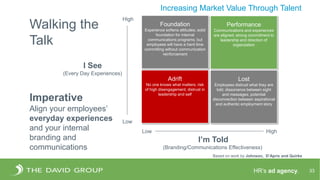
Walking the
Talk
I See
(Every Day Experiences)
Imperative
Align your employees’
everyday experiences
and your internal
branding and
communications
Based on work by Johnson, D’Aprix and Quirke
High
Low
Foundation
Experience softens attitudes; solid
foundation for internal
communications programs; but
employees will have a hard time
committing without communication
reinforcement
Performance
Communications and experiences
are aligned; strong commitment to
leadership and direction of
organization
Adrift
No one knows what matters; risk
of high disengagement; distrust in
leadership and self
Lost
Employees distrust what they are
told; dissonance between sight
and messages; potential
disconnection between aspirational
and authentic employment story
Low High
I’m Told
(Branding/Communications Effectiveness)
HR’s ad agency. 34
Increasing Market Value Through Talent
Among the Things I’m Told
• Leadership communications
• What manager/supervisor says
• Rewards communications
• Statements of mission and values
• “State of the business” communications
• Employer branding messaging
Among the Things I See
• Leadership behavior
• Manager/Supervisor does
• Rewards given out
• Workplace decisions
• “State of the business” seen
• Employer branding experiences
• What colleagues say
• What friends say
• What peers say
• Reputation in community
See – Told Differences
HR’s ad agency. 35
Increasing Market Value Through Talent
1) As deeply as possible, understand your workforce (the
elements of “walk” versus “talk”)
2) Use employer branding to define and communicate your
mission, culture and values throughout the employee lifecycle*
3) Use internal communications to connect and drive
engagement
1) Pay particular attention to on-boarding messages and
reinforcements
4) Become active listeners and accept the principles of “all-way”
communication
* Lifecycle found in Addendum
HR’s ad agency. 36
Increasing Market Value Through Talent
Employee Understanding
Among the ways to better understand your employees …
• Employee engagement surveys
• Focus groups and stakeholder interviews
• Stay and exit interviews
• Communications audits and testing
• Reputation monitoring and assessments
• On-going active listening programs
HR’s ad agency. 37
Increasing Market Value Through Talent
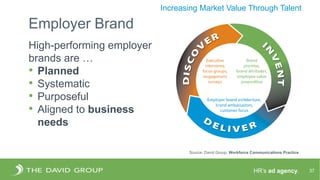
High-performing employer
brands are …
• Planned
• Systematic
• Purposeful
• Aligned to business
needs
Source: David Group, Workforce Communications Practice
Employer Brand
HR’s ad agency.
The power of
internal
communications
Retain great
people
Help great
people
accomplish
great things
Empower
great people
to tell your
great story
Create a
great
workplace
environment
38
Increasing Market Value Through Talent
Employee Communications
High-performing employee
communications are [also] …
• Planned
• Systematic
• Purposeful
• Aligned to business needs
HR’s ad agency. 39
Increasing Market Value Through Talent
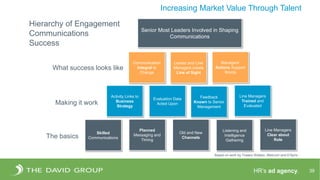
Hierarchy of Engagement
Communications
Success
Senior Most Leaders Involved in Shaping
Communications
What success looks like
Communication
Integral to
Change
Leader and Line
Managers create
Line of Sight
Managers’
Actions Support
Words
Making it work
Activity Links to
Business
Strategy
Evaluation Data
Acted Upon
Feedback
Known to Senior
Management
Line Managers
Trained and
Evaluated
The basics
Skilled
Communications
Planned
Messaging and
Timing
Old and New
Channels
Listening and
Intelligence
Gathering
Line Managers
Clear about
Role
Based on work by Towers Watson, Melcrum and D’Aprix
HR’s ad agency. 40
Increasing Market Value Through Talent
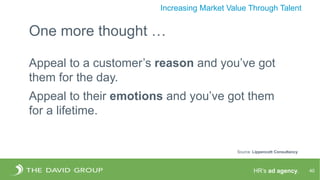
One more thought …
Appeal to a customer’s reason and you’ve got
them for the day.
Appeal to their emotions and you’ve got them
for a lifetime.
Source: Lippencott Consultancy
HR’s ad agency. 41
N. Robert Johnson
Practice Leader, Workforce Communications
216.685.4486 │nrjohnson@davidgroup.com
davidgroup.com
The David Group Inc. All rights reserved.
HR’s ad agency. 42
Contact
N. Robert Johnson, APR
Practice Leader, Workforce Communications
The David Group
216.685.4486 (direct) 216.410.5258 (cell)
nrjohnson@davidgroup.com
www.davidgroup.com
HR’s ad agency.
HR’s ad agency.
We apply advertising and marketing practices to
help organizations attract and retain talent.
The focus of The David Group’s workforce
communications practice is to strengthen
employer brands, engage people and cut the
cost of talent.
43
HR’s ad agency. 44
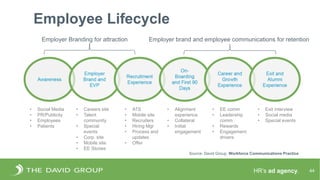
Employer Branding for attraction Employer brand and employee communications for retention
• Social Media
• PR/Publicity
• Employees
• Patients
• Careers site
• Talent
community
• Special
events
• Corp. site
• Mobile site
• EE Stories
• ATS
• Mobile site
• Recruiters
• Hiring Mgr
• Process and
updates
• Offer
• Alignment
experience
• Collateral
• Initial
engagement
• EE comm
• Leadership
comm
• Rewards
• Engagement
drivers
• Exit interview
• Social media
• Special events
Source: David Group, Workforce Communications Practice
Employee Lifecycle

Increasing Market Value Through Talent

  • 1.
    HR’s ad agency. IncreasingMarket Value Through Talent Windy City Summit │Chicago, IL │ May 25, 2016
  • 2.
    HR’s ad agency.2 Agenda 1) Focal Point – Employer Brand and Employee Engagement 2) The Villain – The Perfect Storm 3) Definitions 4) Solutions N. Robert Johnson, APR Practice Leader, Workforce Communications Increasing Market Value Through Talent
  • 3.
    HR’s ad agency.3 Employer Brand and Employee Engagement
  • 4.
    HR’s ad agency.4 Increasing Market Value Through Talent Banking institutions with an engaged workforce and a stronger employer brand outperform their peers.
  • 5.
    HR’s ad agency.5 Increasing Market Value Through Talent How So? 1) They attract and retain higher quality talent 2) Their people are more productive 3) They spend less on HR But, what’s the connection to market value?
  • 6.
    HR’s ad agency.6 Increasing Market Value Through Talent “The full value of talent comes from how talent choices affect those outside the organization, not just inside.” – Dave Ulrich Translation In addition to being great employees, higher quality talent that is engaged build stronger customer relationships which leads to higher market value. Source: Taking Stock of Your Talent, Workforce, Dave Ulrich, February 2016
  • 7.
    HR’s ad agency.7 Increasing Market Value Through Talent Source: Universum/Richard Mosley
  • 8.
    HR’s ad agency.8 Increasing Market Value Through Talent Intangible Value 1) Market value comes from “intangibles” as a group (i.e. strategy, brand, talent, etc.) 2) 30 percent of intangibles is related to quality of leadership, based on research by Ulrich 3) Leadership = talent 4) To do: Run P/E comparisons for industry competitors
  • 9.
    HR’s ad agency.9 Increasing Market Value Through Talent Apple’s 10 year P/E average = 22 while industry average = 14.6 50% of Apple’s $750 billion market cap is based on intangibles (22 – 14.6 = 7.4; 7.4/14.6 = 50 percent) If leadership/talent is 30% of intangibles, Apple’s value of talent is $110 billion (30% of Apple’s intangibles) Source: Taking Stock of Your Talent, Workforce, Dave Ulrich, February 2016
  • 10.
    HR’s ad agency.10 Increasing Market Value Through Talent Source: Boston Consulting Group
  • 11.
    HR’s ad agency.11 Perfect Storm
  • 12.
    HR’s ad agency.12 Increasing Market Value Through Talent Warning: Perfect Storm Ahead The impact of an improving economy, talent mobility, weaker employer-employee connections, and a consumer-driven communications world increases the difficulty of attracting and keeping critical talent.
  • 13.
    HR’s ad agency.13 Increasing Market Value Through Talent The State of Talent 1) Talent has more employment options than ever (small business, gig-economy, start-ups) 2) Talent will research a new employment opportunity just as they research everything else (consumer-driven behavior) 3) Talent has a heightened experience expectation in our brand interactions, as well as shorter attention spans 4) Talent, generally speaking, is less connected to current employers
  • 14.
    HR’s ad agency.14 Increasing Market Value Through Talent 1) While unemployment is at a seven-year low … 2) It’s taking 8% longer to hire and 3) It costs 7% more to hire candidates (Bersin by Deloitte 2015) The average cost-per-hire is $4,200 with increases in the high- tech, financial and manufacturing industries. (ERE, 2015) The State of Talent
  • 15.
    HR’s ad agency.15 Increasing Market Value Through Talent The State of Talent 74% of employees are open to a new job (Jobvite 2016) 45% of employees are not actively seeking but are open to a new job (Jobvite 2015) 51% of workers are satisfied but are open to a new job (70% of Millennial males satisfied and open) (Jobvite 2016)
  • 16.
    HR’s ad agency.16 Increasing Market Value Through Talent 2016 Outlook on the state of talent competition Significant increase 35% Some increase 56% No 10% 1 in 3 employees are planning to leave their current organization within the next 12 months. Source: Future-Proofing HR Mercer, 2016 The State of Talent
  • 17.
    HR’s ad agency.17 Increasing Market Value Through Talent An unstable workforce erodes culture and is extraordinarily expensive. • Increases HR spending (recruitment, rehire, interventions, etc.) • Decreases productivity and engagement (both within individual role and throughout the unit/group) Impact
  • 18.
    HR’s ad agency.18 Increasing Market Value Through Talent The average cost of turnover is between 90% and 200% of an exiting employee’s base salary and represents 12% of a company’s operating budget. Source: Fortune 100 Best Companies to Work For® 2016 Impact
  • 19.
    HR’s ad agency.19 Increasing Market Value Through Talent A disengaged employee costs an organization approximately $3,400 for every $10,000 in annual salary. Disengaged employees cost the American economy up to $350 billion per year due to lost productivity. Source: Gallup Organization Impact
  • 20.
    HR’s ad agency.20 Increasing Market Value Through Talent But, here’s the good news: On average, the Fortune 100 Best Companies see half of the voluntary turnover of their industry peers. Source: Fortune 100 Best Companies to Work For® 2016 Impact
  • 21.
    HR’s ad agency.21 Increasing Market Value Through Talent There is a direct connection between trust and purpose; and engagement and retention. Research shows that employees feel a great workplace is one where … • There is trust between employees and employer • Employees take pride in their work • Employees enjoy the people they work with Source: Fortune 100 Best Companies to Work For® 2016
  • 22.
    HR’s ad agency.22 Increasing Market Value Through Talent Employees who want to stay for a long time report: • My work has special meaning, it’s not just a job • When I look at what we accomplish, I have a sense of pride • I feel I make a difference here Source: Fortune 100 Best Companies to Work For® 2016
  • 23.
    HR’s ad agency.23 Increasing Market Value Through Talent Why executives love their jobs … • 47% workplace relationships • 21% company culture/values • 18% growth opportunities • 4% pay/compensation Nearly 70% say that working for a company that is aligned to my values would dramatically improve their feelings about their job. Source: Korn Ferry Hay Group, 2016
  • 24.
    HR’s ad agency.24 Increasing Market Value Through Talent 1) People are looking to connect in a deeper, more meaningful way with their employers 2) They will connect when there is alignment with mission, culture and values 3) This creates pressure to define and articulate culture, mission and values
  • 25.
    HR’s ad agency.25 Definitions
  • 26.
    HR’s ad agency.26 Increasing Market Value Through Talent Employees’ commitment to the organization and willingness to give extra effort to their employer. Employee Engagement
  • 27.
    HR’s ad agency.27 Increasing Market Value Through Talent Line of Sight + Commitment (I know what I have to do and why) (I have the commitment, motivation and I’m empowered to do what I have to) Employee Engagement
  • 28.
    HR’s ad agency.28 Increasing Market Value Through Talent Employer branding is the story of you as an employer. But, it’s a story of your employment experience as formed and told by the everyday experiences of your employees. Employer Brand
  • 29.
    HR’s ad agency.29 Increasing Market Value Through Talent Employer brands are made up of … 1) Employer brand promise (what we stand for, mission/culture/values) 2) Employer brand attributes (the things that connect us) 3) Employer brand architecture (how to express it – words, images, behaviors, actions) 4) Employee value proposition (specific elements of the employer-employee employment deal)
  • 30.
    HR’s ad agency.30 Increasing Market Value Through Talent The strongest employer brands reflect the validated story of an organization’s employment experience. Employer Brand Strength Continuum weaker stronger “We’ll just go with what we think” “We’re using validated employee perspectives” Source: David Group, Workforce Communications Practice
  • 31.
    HR’s ad agency.31 Solutions
  • 32.
    HR’s ad agency.32 Increasing Market Value Through Talent Embrace the Fortune 100 Best Companies to Work For® model and create a great work environment, one that attracts and engages. But, understand that it’s much more than just advertising, marketing and communications.
  • 33.
    HR’s ad agency.33 Increasing Market Value Through Talent Walking the Talk I See (Every Day Experiences) Imperative Align your employees’ everyday experiences and your internal branding and communications Based on work by Johnson, D’Aprix and Quirke High Low Foundation Experience softens attitudes; solid foundation for internal communications programs; but employees will have a hard time committing without communication reinforcement Performance Communications and experiences are aligned; strong commitment to leadership and direction of organization Adrift No one knows what matters; risk of high disengagement; distrust in leadership and self Lost Employees distrust what they are told; dissonance between sight and messages; potential disconnection between aspirational and authentic employment story Low High I’m Told (Branding/Communications Effectiveness)
  • 34.
    HR’s ad agency.34 Increasing Market Value Through Talent Among the Things I’m Told • Leadership communications • What manager/supervisor says • Rewards communications • Statements of mission and values • “State of the business” communications • Employer branding messaging Among the Things I See • Leadership behavior • Manager/Supervisor does • Rewards given out • Workplace decisions • “State of the business” seen • Employer branding experiences • What colleagues say • What friends say • What peers say • Reputation in community See – Told Differences
  • 35.
    HR’s ad agency.35 Increasing Market Value Through Talent 1) As deeply as possible, understand your workforce (the elements of “walk” versus “talk”) 2) Use employer branding to define and communicate your mission, culture and values throughout the employee lifecycle* 3) Use internal communications to connect and drive engagement 1) Pay particular attention to on-boarding messages and reinforcements 4) Become active listeners and accept the principles of “all-way” communication * Lifecycle found in Addendum
  • 36.
    HR’s ad agency.36 Increasing Market Value Through Talent Employee Understanding Among the ways to better understand your employees … • Employee engagement surveys • Focus groups and stakeholder interviews • Stay and exit interviews • Communications audits and testing • Reputation monitoring and assessments • On-going active listening programs
  • 37.
    HR’s ad agency.37 Increasing Market Value Through Talent High-performing employer brands are … • Planned • Systematic • Purposeful • Aligned to business needs Source: David Group, Workforce Communications Practice Employer Brand
  • 38.
    HR’s ad agency. Thepower of internal communications Retain great people Help great people accomplish great things Empower great people to tell your great story Create a great workplace environment 38 Increasing Market Value Through Talent Employee Communications High-performing employee communications are [also] … • Planned • Systematic • Purposeful • Aligned to business needs
  • 39.
    HR’s ad agency.39 Increasing Market Value Through Talent Hierarchy of Engagement Communications Success Senior Most Leaders Involved in Shaping Communications What success looks like Communication Integral to Change Leader and Line Managers create Line of Sight Managers’ Actions Support Words Making it work Activity Links to Business Strategy Evaluation Data Acted Upon Feedback Known to Senior Management Line Managers Trained and Evaluated The basics Skilled Communications Planned Messaging and Timing Old and New Channels Listening and Intelligence Gathering Line Managers Clear about Role Based on work by Towers Watson, Melcrum and D’Aprix
  • 40.
    HR’s ad agency.40 Increasing Market Value Through Talent One more thought … Appeal to a customer’s reason and you’ve got them for the day. Appeal to their emotions and you’ve got them for a lifetime. Source: Lippencott Consultancy
  • 41.
    HR’s ad agency.41 N. Robert Johnson Practice Leader, Workforce Communications 216.685.4486 │nrjohnson@davidgroup.com davidgroup.com The David Group Inc. All rights reserved.
  • 42.
    HR’s ad agency.42 Contact N. Robert Johnson, APR Practice Leader, Workforce Communications The David Group 216.685.4486 (direct) 216.410.5258 (cell) nrjohnson@davidgroup.com www.davidgroup.com
  • 43.
    HR’s ad agency. HR’sad agency. We apply advertising and marketing practices to help organizations attract and retain talent. The focus of The David Group’s workforce communications practice is to strengthen employer brands, engage people and cut the cost of talent. 43
  • 44.
    HR’s ad agency.44 Employer Branding for attraction Employer brand and employee communications for retention • Social Media • PR/Publicity • Employees • Patients • Careers site • Talent community • Special events • Corp. site • Mobile site • EE Stories • ATS • Mobile site • Recruiters • Hiring Mgr • Process and updates • Offer • Alignment experience • Collateral • Initial engagement • EE comm • Leadership comm • Rewards • Engagement drivers • Exit interview • Social media • Special events Source: David Group, Workforce Communications Practice Employee Lifecycle