1
Employee Value Proposition
Make the Most of your HR Investment
2
Workshop Goal:
What is an
Employee Value Proposition?
3
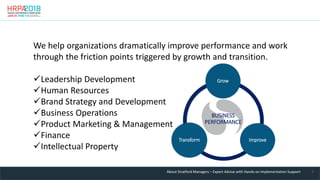
BUSINESS
PERFORMANCE
Grow
Improve
Transform
About Stratford Managers Expert Advise with Hands-on Implementation Support
–
We help organizations dramatically improve performance and work
through the friction points triggered by growth and transition.
Leadership Development
Human Resources
Brand Strategy and Development
Business Operations
Product Marketing & Management
Finance
Intellectual Property
4
Some Recent Clients
5
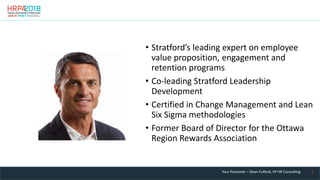
Your Presenter Dean Fulford, VP HR Consulting
–
• Stratford’s leading expert on employee
value proposition, engagement and
retention programs
• Co-leading Stratford Leadership
Development
• Certified in Change Management and Lean
Six Sigma methodologies
• Former Board of Director for the Ottawa
Region Rewards Association
6
7
8
• Talent shortages
• Multiple generations in workforce
• Constrained budgets
Business Issues Being Faced Today
9
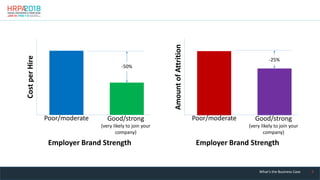
Cost
per
Hire
Poor/moderate Good/strong
(very likely to join your
company)
Employer Brand Strength
Amount
of
Attrition
Poor/moderate Good/strong
(very likely to join your
company)
Employer Brand Strength
-50%
-25%
What’s the Business Case
10
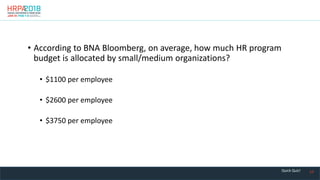
• According to BNA Bloomberg, on average, how much HR program
budget is allocated by small/medium organizations?
• $1100 per employee
• $2600 per employee
• $3750 per employee
Quick Quiz!
11
• Assume 200 person organization
• Median HR expenditure =
$2600/ee*
• Assume 20% misdirection
• Gives HR $104,000 to invest!
Misdirected Program Spending
12
Put Your Money Where THEIR
Mouths Are
13
• Informs your investment in ALL
your HR programs
• Identifies a winning employment
strategy that can inform your
leadership strategy and tactics
The ROI for Conducing an EVP Review
14
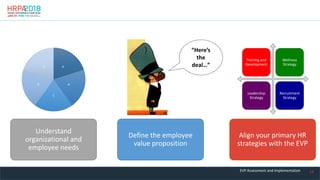
Understand
organizational and
employee needs
Define the employee
value proposition
Align your primary HR
strategies with the EVP
A
B
C
D
E
“Here’s
the
deal…”
Training and
Development
Wellness
Strategy
Leadership
Strategy
Recruitment
Strategy
EVP Assessment and Implementation
15
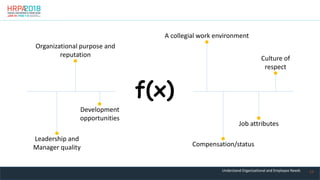
Compensation/status
Organizational purpose and
reputation
Development
opportunities
Culture of
respect
Leadership and
Manager quality
A collegial work environment
Job attributes
f(x)
Understand Organizational and Employee Needs
16
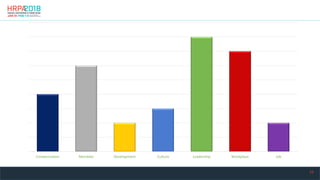
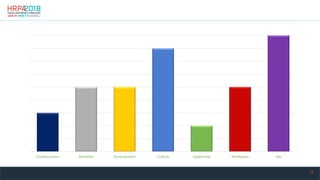
Compensation Mandate Development Culture Leadership Workplace Job
17
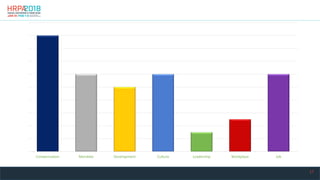
Compensation Mandate Development Culture Leadership Workplace Job
18
Compensation Mandate Development Culture Leadership Workplace Job
19
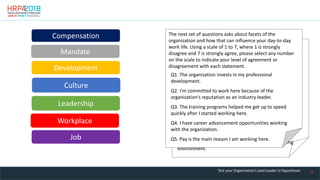
Q9. Working in a global company makes my role more
interesting.
Q8. To me, a diverse workforce is an important
characteristic of the organization.
Q7. I have a clear career roadmap at the organization.
Q6. I receive constructive feedback about my
performance from my manager.
Q10. The communication I receive enables me to stay
informed about our corporate strategy.
Q12. I like that my workplace has an informal working
environment.
Q11. I have the opportunity to put forward ideas and
know that they will be considered.
Compensation
Mandate
Development
Culture
Workplace
Leadership
Job
Q2. I'm committed to work here because of the
organization’s reputation as an industry leader.
Q1. The organization invests in my professional
development.
Q4. I have career advancement opportunities working
with the organization.
Q3. The training programs helped me get up to speed
quickly after I started working here.
The next set of questions asks about facets of the
organization and how that can influence your day-to-day
work life. Using a scale of 1 to 7, where 1 is strongly
disagree and 7 is strongly agree, please select any number
on the scale to indicate your level of agreement or
disagreement with each statement.
Q5. Pay is the main reason I am working here.
Test your Organization’s (and Leader’s) Hypotheses
20
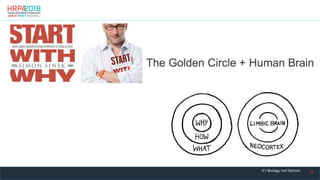
It’s Biology, not Opinion
21
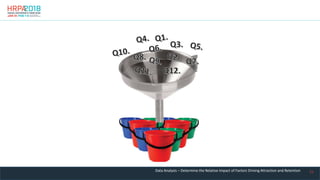
Data Analysis – Determine the Relative Impact of Factors Driving Attraction and Retention
22
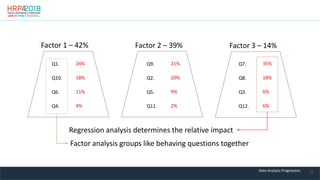
Q2.
Q9.
Q8.
Q1.
Q4.
Q7.
Q3.
Q6.
Q10.
Q12.
Q11.
Q5.
Factor 1 – 42% Factor 2 – 39% Factor 3 – 14%
20%
21%
18%
24%
4%
35%
6%
11%
18%
6%
2%
9%
Factor analysis groups like behaving questions together
Regression analysis determines the relative impact
Data Analysis Progression
23
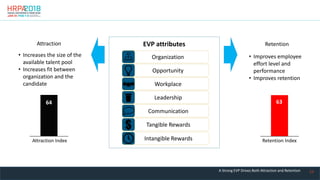
Organization
Opportunity
Workplace
Leadership
Communication
Tangible Rewards
Intangible Rewards
EVP attributes Retention
Attraction
• Increases the size of the
available talent pool
• Increases fit between
organization and the
candidate
• Improves employee
effort level and
performance
• Improves retention
Retention Index
Attraction Index
64 63
A Strong EVP Drives Both Attraction and Retention
24
All Factors are not Drivers
25
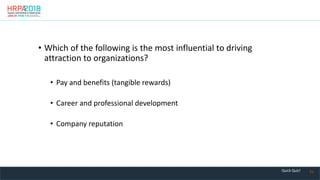
• Which of the following is the most influential to driving
attraction to organizations?
• Pay and benefits (tangible rewards)
• Career and professional development
• Company reputation
Quick Quiz!
26
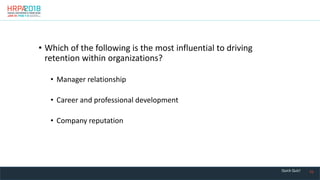
• Which of the following is the most influential to driving
retention within organizations?
• Manager relationship
• Career and professional development
• Company reputation
Quick Quiz!
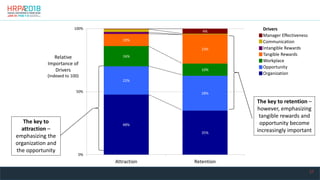
27
48%
35%
22%
28%
16%
10%
10%
23%
4%
0%
50%
100%
Attraction Retention
Relative
Importance of
Drivers
(Indexed to 100)
Drivers
Manager Effectiveness
Communication
Intangible Rewards
Tangible Rewards
Workplace
Opportunity
Organization
The key to
attraction –
emphasizing the
organization and
the opportunity
The key to retention –
however, emphasizing
tangible rewards and
opportunity become
increasingly important
28
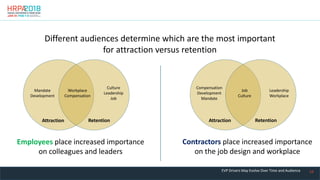
Mandate
Development
Workplace
Compensation
Culture
Leadership
Job
Attraction Retention
Employees place increased importance
on colleagues and leaders
Compensation
Development
Mandate
Job
Culture
Leadership
Workplace
Attraction Retention
Contractors place increased importance
on the job design and workplace
EVP Drivers May Evolve Over Time and Audience
Different audiences determine which are the most important
for attraction versus retention
29
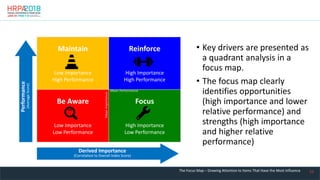
• Key drivers are presented as
a quadrant analysis in a
focus map.
• The focus map clearly
identifies opportunities
(high importance and lower
relative performance) and
strengths (high importance
and higher relative
performance)
Derived Importance
(Correlation to Overall Index Score)
Performance
(Average
Score)
Maintain
Low Importance
High Performance
Reinforce
High Importance
High Performance
Be Aware
Low Importance
Low Performance
Focus
High Importance
Low Performance
Mean
Importance
Mean Performance
The Focus Map – Drawing Attention to Items That Have the Most Influence
30
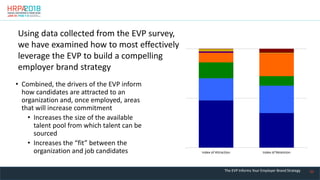
• Combined, the drivers of the EVP inform
how candidates are attracted to an
organization and, once employed, areas
that will increase commitment
• Increases the size of the available
talent pool from which talent can be
sourced
• Increases the “fit” between the
organization and job candidates Index of Attraction Index of Retention
The EVP Informs Your Employer Brand Strategy
Using data collected from the EVP survey,
we have examined how to most effectively
leverage the EVP to build a compelling
employer brand strategy
31
Let’s Look Deeper
32
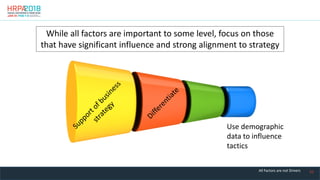
All Factors are not Drivers
While all factors are important to some level, focus on those
that have significant influence and strong alignment to strategy
Use demographic
data to influence
tactics
33
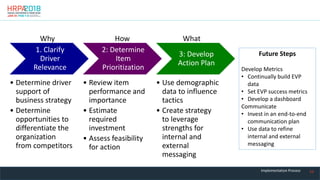
1. Clarify
Driver
Relevance
• Determine driver
support of
business strategy
• Determine
opportunities to
differentiate the
organization
from competitors
2: Determine
Item
Prioritization
• Review item
performance and
importance
• Estimate
required
investment
• Assess feasibility
for action
3: Develop
Action Plan
• Use demographic
data to influence
tactics
• Create strategy
to leverage
strengths for
internal and
external
messaging
Future Steps
Develop Metrics
• Continually build EVP
data
• Set EVP success metrics
• Develop a dashboard
Communicate
• Invest in an end-to-end
communication plan
• Use data to refine
internal and external
messaging
Implementation Process
Why How What
34
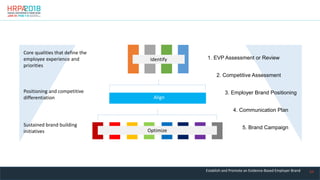
Sustained brand building
initiatives
Positioning and competitive
differentiation
Core qualities that define the
employee experience and
priorities
1. EVP Assessment or Review
2. Competitive Assessment
3. Employer Brand Positioning
4. Communication Plan
5. Brand Campaign
Identify
Align
Optimize
Establish and Promote an Evidence-Based Employer Brand
35
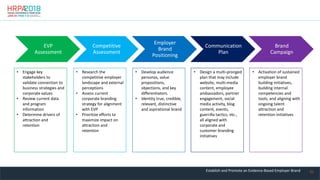
EVP
Assessment
Competitive
Assessment
Employer
Brand
Positioning
Communication
Plan
Brand
Campaign
• Engage key
stakeholders to
validate connection to
business strategies and
corporate values
• Review current data
and program
information
• Determine drivers of
attraction and
retention
• Research the
competitive employer
landscape and external
perceptions
• Assess current
corporate branding
strategy for alignment
with EVP
• Prioritize efforts to
maximize impact on
attraction and
retention
• Develop audience
personas, value
propositions,
objections, and key
differentiators.
• Identity true, credible,
relevant, distinctive
and aspirational brand
• Design a multi-pronged
plan that may include
website, multi-media
content, employee
ambassadors, partner
engagement, social
media activity, blog
content, events,
guerrilla tactics, etc.,
all aligned with
corporate and
customer branding
initiatives
• Activation of sustained
employer brand
building initiatives,
building internal
competencies and
tools, and aligning with
ongoing talent
attraction and
retention initiatives
Establish and Promote an Evidence-Based Employer Brand
36
Make data your friend!
Fuel your investment decisions with
employee opinion!

EVP3.pdf

  • 1.
    1 Employee Value Proposition Makethe Most of your HR Investment
  • 2.
    2 Workshop Goal: What isan Employee Value Proposition?
  • 3.
    3 BUSINESS PERFORMANCE Grow Improve Transform About Stratford ManagersExpert Advise with Hands-on Implementation Support – We help organizations dramatically improve performance and work through the friction points triggered by growth and transition. Leadership Development Human Resources Brand Strategy and Development Business Operations Product Marketing & Management Finance Intellectual Property
  • 4.
  • 5.
    5 Your Presenter DeanFulford, VP HR Consulting – • Stratford’s leading expert on employee value proposition, engagement and retention programs • Co-leading Stratford Leadership Development • Certified in Change Management and Lean Six Sigma methodologies • Former Board of Director for the Ottawa Region Rewards Association
  • 6.
  • 7.
  • 8.
    8 • Talent shortages •Multiple generations in workforce • Constrained budgets Business Issues Being Faced Today
  • 9.
    9 Cost per Hire Poor/moderate Good/strong (very likelyto join your company) Employer Brand Strength Amount of Attrition Poor/moderate Good/strong (very likely to join your company) Employer Brand Strength -50% -25% What’s the Business Case
  • 10.
    10 • According toBNA Bloomberg, on average, how much HR program budget is allocated by small/medium organizations? • $1100 per employee • $2600 per employee • $3750 per employee Quick Quiz!
  • 11.
    11 • Assume 200person organization • Median HR expenditure = $2600/ee* • Assume 20% misdirection • Gives HR $104,000 to invest! Misdirected Program Spending
  • 12.
    12 Put Your MoneyWhere THEIR Mouths Are
  • 13.
    13 • Informs yourinvestment in ALL your HR programs • Identifies a winning employment strategy that can inform your leadership strategy and tactics The ROI for Conducing an EVP Review
  • 14.
    14 Understand organizational and employee needs Definethe employee value proposition Align your primary HR strategies with the EVP A B C D E “Here’s the deal…” Training and Development Wellness Strategy Leadership Strategy Recruitment Strategy EVP Assessment and Implementation
  • 15.
    15 Compensation/status Organizational purpose and reputation Development opportunities Cultureof respect Leadership and Manager quality A collegial work environment Job attributes f(x) Understand Organizational and Employee Needs
  • 16.
    16 Compensation Mandate DevelopmentCulture Leadership Workplace Job
  • 17.
    17 Compensation Mandate DevelopmentCulture Leadership Workplace Job
  • 18.
    18 Compensation Mandate DevelopmentCulture Leadership Workplace Job
  • 19.
    19 Q9. Working ina global company makes my role more interesting. Q8. To me, a diverse workforce is an important characteristic of the organization. Q7. I have a clear career roadmap at the organization. Q6. I receive constructive feedback about my performance from my manager. Q10. The communication I receive enables me to stay informed about our corporate strategy. Q12. I like that my workplace has an informal working environment. Q11. I have the opportunity to put forward ideas and know that they will be considered. Compensation Mandate Development Culture Workplace Leadership Job Q2. I'm committed to work here because of the organization’s reputation as an industry leader. Q1. The organization invests in my professional development. Q4. I have career advancement opportunities working with the organization. Q3. The training programs helped me get up to speed quickly after I started working here. The next set of questions asks about facets of the organization and how that can influence your day-to-day work life. Using a scale of 1 to 7, where 1 is strongly disagree and 7 is strongly agree, please select any number on the scale to indicate your level of agreement or disagreement with each statement. Q5. Pay is the main reason I am working here. Test your Organization’s (and Leader’s) Hypotheses
  • 20.
  • 21.
    21 Data Analysis –Determine the Relative Impact of Factors Driving Attraction and Retention
  • 22.
    22 Q2. Q9. Q8. Q1. Q4. Q7. Q3. Q6. Q10. Q12. Q11. Q5. Factor 1 –42% Factor 2 – 39% Factor 3 – 14% 20% 21% 18% 24% 4% 35% 6% 11% 18% 6% 2% 9% Factor analysis groups like behaving questions together Regression analysis determines the relative impact Data Analysis Progression
  • 23.
    23 Organization Opportunity Workplace Leadership Communication Tangible Rewards Intangible Rewards EVPattributes Retention Attraction • Increases the size of the available talent pool • Increases fit between organization and the candidate • Improves employee effort level and performance • Improves retention Retention Index Attraction Index 64 63 A Strong EVP Drives Both Attraction and Retention
  • 24.
    24 All Factors arenot Drivers
  • 25.
    25 • Which ofthe following is the most influential to driving attraction to organizations? • Pay and benefits (tangible rewards) • Career and professional development • Company reputation Quick Quiz!
  • 26.
    26 • Which ofthe following is the most influential to driving retention within organizations? • Manager relationship • Career and professional development • Company reputation Quick Quiz!
  • 27.
    27 48% 35% 22% 28% 16% 10% 10% 23% 4% 0% 50% 100% Attraction Retention Relative Importance of Drivers (Indexedto 100) Drivers Manager Effectiveness Communication Intangible Rewards Tangible Rewards Workplace Opportunity Organization The key to attraction – emphasizing the organization and the opportunity The key to retention – however, emphasizing tangible rewards and opportunity become increasingly important
  • 28.
    28 Mandate Development Workplace Compensation Culture Leadership Job Attraction Retention Employees placeincreased importance on colleagues and leaders Compensation Development Mandate Job Culture Leadership Workplace Attraction Retention Contractors place increased importance on the job design and workplace EVP Drivers May Evolve Over Time and Audience Different audiences determine which are the most important for attraction versus retention
  • 29.
    29 • Key driversare presented as a quadrant analysis in a focus map. • The focus map clearly identifies opportunities (high importance and lower relative performance) and strengths (high importance and higher relative performance) Derived Importance (Correlation to Overall Index Score) Performance (Average Score) Maintain Low Importance High Performance Reinforce High Importance High Performance Be Aware Low Importance Low Performance Focus High Importance Low Performance Mean Importance Mean Performance The Focus Map – Drawing Attention to Items That Have the Most Influence
  • 30.
    30 • Combined, thedrivers of the EVP inform how candidates are attracted to an organization and, once employed, areas that will increase commitment • Increases the size of the available talent pool from which talent can be sourced • Increases the “fit” between the organization and job candidates Index of Attraction Index of Retention The EVP Informs Your Employer Brand Strategy Using data collected from the EVP survey, we have examined how to most effectively leverage the EVP to build a compelling employer brand strategy
  • 31.
  • 32.
    32 All Factors arenot Drivers While all factors are important to some level, focus on those that have significant influence and strong alignment to strategy Use demographic data to influence tactics
  • 33.
    33 1. Clarify Driver Relevance • Determinedriver support of business strategy • Determine opportunities to differentiate the organization from competitors 2: Determine Item Prioritization • Review item performance and importance • Estimate required investment • Assess feasibility for action 3: Develop Action Plan • Use demographic data to influence tactics • Create strategy to leverage strengths for internal and external messaging Future Steps Develop Metrics • Continually build EVP data • Set EVP success metrics • Develop a dashboard Communicate • Invest in an end-to-end communication plan • Use data to refine internal and external messaging Implementation Process Why How What
  • 34.
    34 Sustained brand building initiatives Positioningand competitive differentiation Core qualities that define the employee experience and priorities 1. EVP Assessment or Review 2. Competitive Assessment 3. Employer Brand Positioning 4. Communication Plan 5. Brand Campaign Identify Align Optimize Establish and Promote an Evidence-Based Employer Brand
  • 35.
    35 EVP Assessment Competitive Assessment Employer Brand Positioning Communication Plan Brand Campaign • Engage key stakeholdersto validate connection to business strategies and corporate values • Review current data and program information • Determine drivers of attraction and retention • Research the competitive employer landscape and external perceptions • Assess current corporate branding strategy for alignment with EVP • Prioritize efforts to maximize impact on attraction and retention • Develop audience personas, value propositions, objections, and key differentiators. • Identity true, credible, relevant, distinctive and aspirational brand • Design a multi-pronged plan that may include website, multi-media content, employee ambassadors, partner engagement, social media activity, blog content, events, guerrilla tactics, etc., all aligned with corporate and customer branding initiatives • Activation of sustained employer brand building initiatives, building internal competencies and tools, and aligning with ongoing talent attraction and retention initiatives Establish and Promote an Evidence-Based Employer Brand
  • 36.
    36 Make data yourfriend! Fuel your investment decisions with employee opinion!