Structure of the Earth
B.A. I
Dr. Uma Kant Singh
Department of Geography
Shree Baldev P. G. College Baragaon, Varanasi
E mail: druksingh2001@gmail.com
Structure of the Earth
• The Earth is made
up of 3 main
layers:
– Core
– Mantle
– Crust
Inner core
Outer core
Mantle
Crust
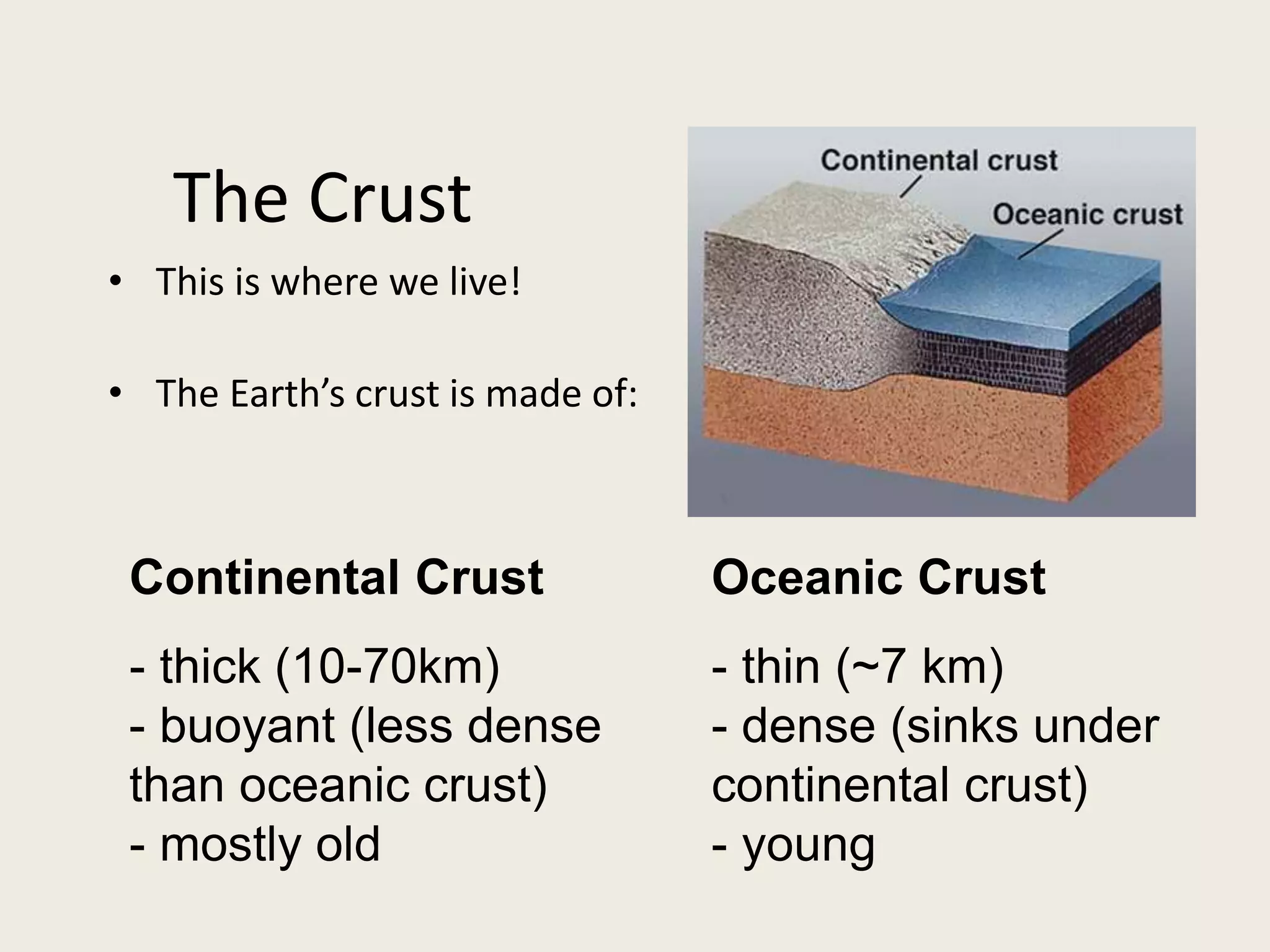
The Crust
• This is where we live!
• The Earth’s crust is made of:
Continental Crust
- thick (10-70km)
- buoyant (less dense
than oceanic crust)
- mostly old
Oceanic Crust
- thin (~7 km)
- dense (sinks under
continental crust)
- young
Crust and Lithosphere
Earth’s outer surface is its crust; a cold, thin, brittle
outer shell made of rock. The crust is very thin,
relative to the radius of the planet. There are two
very different types of crust, each with its own
distinctive physical and chemical properties.
Oceanic crust is composed of magma that erupts on
the seafloor to create basalt lava flows or cools
deeper down to create the intrusive igneous rock
gabbro. Sediments, primarily muds and the shells of
tiny sea creatures, coat the seafloor. Sediment is
thickest near the shore where it comes off the
continents in rivers and on wind currents.
Continental crust is made up of many different types of
igneous, metamorphic, and sedimentary rocks. The average
composition is granite, which is much less dense than the
marfic igneous rocks of the oceanic crust. Because it is thick
and has relatively low density, continental crust rises higher
on the mantle than oceanic crust, which sinks into the
mantle to form basins. When filled with water, these basins
form the planet’s oceans. The lithosphere is the outermost
mechanical layer, which behaves as a brittle, rigid solid. The
lithosphere is about 100 kilometers thick. The definition of
the lithosphere is based on how earth materials behave, so
it includes the crust and the uppermost mantle, which are
both brittle. Since it is rigid and brittle, when stresses act
on the lithosphere, it breaks. This is what we experience as
an earthquake.
Mantle
The two most important things about the mantle are:
(1) it is made of solid rock, and (2) it is hot. Scientists
know that the mantle is made of rock based on
evidence from seismic waves, heat flow, and
meteorites. The properties fit the ultramafic rock
peridotite, which is made of the iron- and
magnesium-rich silicate minerals. Peridotite is rarely
found at Earth’s surface. Scientists know that the
mantle is extremely hot because of the heat flowing
outward from it and because of its physical
properties. Heat flows in two different ways within
the Earth: conduction and convection.
Conduction is defined as the heat transfer that
occurs through rapid collisions of atoms, which
can only happen if the material is solid. Heat
flows from warmer to cooler places until all are
the same temperature. The mantle is hot mostly
because of heat conducted from the core.
Convection is the process of a material that can
move and flow may develop convection
currents. Convection in the mantle is the same
as convection in a pot of water on a stove.
Core
At the planet’s center lies a dense metallic core.
Scientists know that the core is metal for a few
reasons. The density of Earth’s surface layers is much
less than the overall density of the planet, as
calculated from the planet’s rotation. If the surface
layers are less dense than average, then the interior
must be denser than average. Calculations indicate
that the core is about 85 percent iron metal with
nickel metal making up much of the remaining 15
percent. Also, metallic meteorites are thought to be
representative of the core. If Earth’s core were not
metal, the planet would not have a magnetic field.
Metals such as iron are magnetic, but rock,
which makes up the mantle and crust, is not.
Scientists know that the outer core is liquid
and the inner core is solid because S-waves
stop at the inner core. The strong magnetic
field is caused by convection in the liquid
outer core. Convection currents in the outer
core are due to heat from the even hotter
inner core. The heat that keeps the outer core
from solidifying is produced by the breakdown
of radioactive elements in the inner core.
How do we know what the Earth is
made of?
• Geophysical surveys: seismic, gravity, magnetics,
electrical, geodesy
– Acquisition: land, air, sea and satellite
– Geological surveys: fieldwork, boreholes, mines
Thanks

Structure of the earth

  • 1.
    Structure of theEarth B.A. I Dr. Uma Kant Singh Department of Geography Shree Baldev P. G. College Baragaon, Varanasi E mail: druksingh2001@gmail.com
  • 2.
    Structure of theEarth • The Earth is made up of 3 main layers: – Core – Mantle – Crust Inner core Outer core Mantle Crust
  • 4.
    The Crust • Thisis where we live! • The Earth’s crust is made of: Continental Crust - thick (10-70km) - buoyant (less dense than oceanic crust) - mostly old Oceanic Crust - thin (~7 km) - dense (sinks under continental crust) - young
  • 5.
    Crust and Lithosphere Earth’souter surface is its crust; a cold, thin, brittle outer shell made of rock. The crust is very thin, relative to the radius of the planet. There are two very different types of crust, each with its own distinctive physical and chemical properties. Oceanic crust is composed of magma that erupts on the seafloor to create basalt lava flows or cools deeper down to create the intrusive igneous rock gabbro. Sediments, primarily muds and the shells of tiny sea creatures, coat the seafloor. Sediment is thickest near the shore where it comes off the continents in rivers and on wind currents.
  • 6.
    Continental crust ismade up of many different types of igneous, metamorphic, and sedimentary rocks. The average composition is granite, which is much less dense than the marfic igneous rocks of the oceanic crust. Because it is thick and has relatively low density, continental crust rises higher on the mantle than oceanic crust, which sinks into the mantle to form basins. When filled with water, these basins form the planet’s oceans. The lithosphere is the outermost mechanical layer, which behaves as a brittle, rigid solid. The lithosphere is about 100 kilometers thick. The definition of the lithosphere is based on how earth materials behave, so it includes the crust and the uppermost mantle, which are both brittle. Since it is rigid and brittle, when stresses act on the lithosphere, it breaks. This is what we experience as an earthquake.
  • 7.
    Mantle The two mostimportant things about the mantle are: (1) it is made of solid rock, and (2) it is hot. Scientists know that the mantle is made of rock based on evidence from seismic waves, heat flow, and meteorites. The properties fit the ultramafic rock peridotite, which is made of the iron- and magnesium-rich silicate minerals. Peridotite is rarely found at Earth’s surface. Scientists know that the mantle is extremely hot because of the heat flowing outward from it and because of its physical properties. Heat flows in two different ways within the Earth: conduction and convection.
  • 8.
    Conduction is definedas the heat transfer that occurs through rapid collisions of atoms, which can only happen if the material is solid. Heat flows from warmer to cooler places until all are the same temperature. The mantle is hot mostly because of heat conducted from the core. Convection is the process of a material that can move and flow may develop convection currents. Convection in the mantle is the same as convection in a pot of water on a stove.
  • 9.
    Core At the planet’scenter lies a dense metallic core. Scientists know that the core is metal for a few reasons. The density of Earth’s surface layers is much less than the overall density of the planet, as calculated from the planet’s rotation. If the surface layers are less dense than average, then the interior must be denser than average. Calculations indicate that the core is about 85 percent iron metal with nickel metal making up much of the remaining 15 percent. Also, metallic meteorites are thought to be representative of the core. If Earth’s core were not metal, the planet would not have a magnetic field.
  • 10.
    Metals such asiron are magnetic, but rock, which makes up the mantle and crust, is not. Scientists know that the outer core is liquid and the inner core is solid because S-waves stop at the inner core. The strong magnetic field is caused by convection in the liquid outer core. Convection currents in the outer core are due to heat from the even hotter inner core. The heat that keeps the outer core from solidifying is produced by the breakdown of radioactive elements in the inner core.
  • 11.
    How do weknow what the Earth is made of? • Geophysical surveys: seismic, gravity, magnetics, electrical, geodesy – Acquisition: land, air, sea and satellite – Geological surveys: fieldwork, boreholes, mines
  • 12.