LIGHTNING
An abrupt electro-static discharge
 from cloud to cloud or,
 from cloud to earth
 accompanied by a FLASH
Separation and Accumulation of Electrical
Charges in the clouds via micro- and macro-
physical
During rain storms Clouds get electrically
charged
LIGHTNING…
• Negative charges are near and +ve charges
away from, the ground
• When the charges build up enough Electrons
tend to move towards the +ve charges
• air gets ionized and the discharge path
becomes a plasma with high conductivity
• This discharge is in jumps called “stepped-up
leaders”
How lightning occurs ?
• The movement is along the path of “least
resistance” and hence Zig-Zag Form
• When electrons approach the +ve charges,
leaders (called streamers) develop towards
the center of positive charge
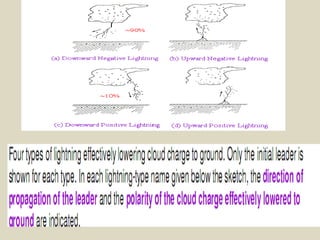
• Downward leaders start from the clouds and
upward leaders from the earth
• The two leaders join causing a “stroke”
How lightning occurs ?
• Up leaders causing strokes are called return
strokes
• Point of intersection of two leaders (about 10~
30M from the center of the +ve charges” is
the “center of the stroke
• Large amount of heat is dissipated, producing
FLASH & THUNDER
Lightning parameters
• Cloud potential - very small to 100 MV
• Charge in a cloud - very small to > 300 C
• Lightning flash - Has many strokes – upto 40
-Typically 4 to 5 strokes/Flash
- Peak current is highest for the first stroke
• Current in a lightning discharge to ground -
negative stroke – 200 kA
positive stroke – 300 kA
• Rate of rise – 1011 A/s (max) = 100 kA/μs
• More than 70% of the strokes are negative
• Number of strokes/second – 2000 to 5000 (all over the
world)
Lightning characteristics
• 1 ~ 100 kA Current
• Few hundred micro second duration
• Very rapid current rise (up to 1010A/sec)
• Average Dissipated Energy ~ 55 KW Hr
• Velocity : 1/3 speed of light
• Rise is fast 1~ 50 µS ec
• Decay is slow: Time for half the max. value
50~250 µ sec
Characteristics Lightning
Fast Rise of
current
means:
Inductance of
wires and skin
effects of the
conductors
Characteristics Lightning..
• Frequency of thunderstorm occurrence 0.1T ~
0.2 T, Where T: Number of thunderstorm
days/year/sq.Km)
• Only some thunderstorms are dangerous
• Lightning is purely a random phenomenon
• Researches being conducted for diverting
lightning
Protection scheme
• Capture the lightning strike.
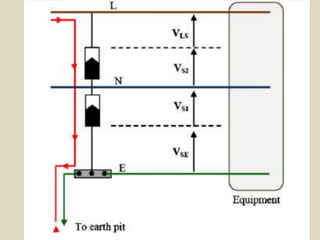
• Safely convey this energy to ground
• Dissipate energy into a low impedance
grounding system
• Bond all ground points together.
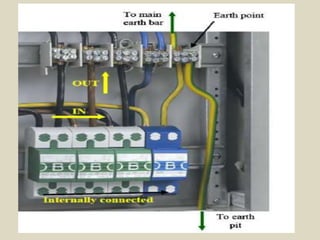
• Protect incoming AC power feeders.
• Protect low voltage data/telecommunications
circuits.
Function of lightning arrestor
The purpose of an arrestor is to
• launch a successful up-leader before any other
point on the structure to be protected
• There by “Guide the charges to discharge
through a safe passage to the ground, and
dissipate the energy”
Lightning Arrestors Models..,
• Lighting Rod (Franklin Rod)
• Rolling Sphere
• Parabolic-like lightning charge “Collection
Volume” method
• A conducting Rod (Franklin Rod) with sharp tip
protrudes the installation.
• It offers a “Cone of Protection” as shown in
another slide
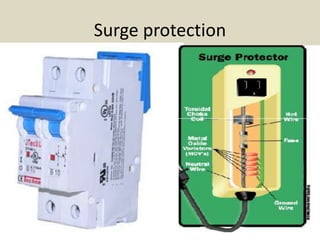
MOV
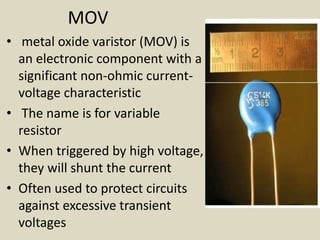
• metal oxide varistor (MOV) is
an electronic component with a
significant non-ohmic current-
voltage characteristic
• The name is for variable
resistor
• When triggered by high voltage,
they will shunt the current
• Often used to protect circuits
against excessive transient
voltages
MOV…
• stacks of MOV as the nonlinear element
• virtually no current to flow during steady state
operation and very large amounts to flow
during over voltages
• 90% of all MOVs: ZnO
• The disks-shaped blocks of ZnO are made by a
process involving grinding, mixing, pressing,
and sintering
• number of disks depend on dielectic
properties of the material
Surge protection
Thank you

Earthing

  • 1.
    LIGHTNING An abrupt electro-staticdischarge  from cloud to cloud or,  from cloud to earth  accompanied by a FLASH Separation and Accumulation of Electrical Charges in the clouds via micro- and macro- physical During rain storms Clouds get electrically charged
  • 9.
    LIGHTNING… • Negative chargesare near and +ve charges away from, the ground • When the charges build up enough Electrons tend to move towards the +ve charges • air gets ionized and the discharge path becomes a plasma with high conductivity • This discharge is in jumps called “stepped-up leaders”
  • 10.
    How lightning occurs? • The movement is along the path of “least resistance” and hence Zig-Zag Form • When electrons approach the +ve charges, leaders (called streamers) develop towards the center of positive charge • Downward leaders start from the clouds and upward leaders from the earth • The two leaders join causing a “stroke”
  • 11.
    How lightning occurs? • Up leaders causing strokes are called return strokes • Point of intersection of two leaders (about 10~ 30M from the center of the +ve charges” is the “center of the stroke • Large amount of heat is dissipated, producing FLASH & THUNDER
  • 12.
    Lightning parameters • Cloudpotential - very small to 100 MV • Charge in a cloud - very small to > 300 C • Lightning flash - Has many strokes – upto 40 -Typically 4 to 5 strokes/Flash - Peak current is highest for the first stroke • Current in a lightning discharge to ground - negative stroke – 200 kA positive stroke – 300 kA • Rate of rise – 1011 A/s (max) = 100 kA/μs • More than 70% of the strokes are negative • Number of strokes/second – 2000 to 5000 (all over the world)
  • 14.
    Lightning characteristics • 1~ 100 kA Current • Few hundred micro second duration • Very rapid current rise (up to 1010A/sec) • Average Dissipated Energy ~ 55 KW Hr • Velocity : 1/3 speed of light • Rise is fast 1~ 50 µS ec • Decay is slow: Time for half the max. value 50~250 µ sec
  • 15.
    Characteristics Lightning Fast Riseof current means: Inductance of wires and skin effects of the conductors
  • 16.
    Characteristics Lightning.. • Frequencyof thunderstorm occurrence 0.1T ~ 0.2 T, Where T: Number of thunderstorm days/year/sq.Km) • Only some thunderstorms are dangerous • Lightning is purely a random phenomenon • Researches being conducted for diverting lightning
  • 17.
    Protection scheme • Capturethe lightning strike. • Safely convey this energy to ground • Dissipate energy into a low impedance grounding system • Bond all ground points together. • Protect incoming AC power feeders. • Protect low voltage data/telecommunications circuits.
  • 18.
    Function of lightningarrestor The purpose of an arrestor is to • launch a successful up-leader before any other point on the structure to be protected • There by “Guide the charges to discharge through a safe passage to the ground, and dissipate the energy”
  • 19.
    Lightning Arrestors Models.., •Lighting Rod (Franklin Rod) • Rolling Sphere • Parabolic-like lightning charge “Collection Volume” method • A conducting Rod (Franklin Rod) with sharp tip protrudes the installation. • It offers a “Cone of Protection” as shown in another slide
  • 21.
    MOV • metal oxidevaristor (MOV) is an electronic component with a significant non-ohmic current- voltage characteristic • The name is for variable resistor • When triggered by high voltage, they will shunt the current • Often used to protect circuits against excessive transient voltages
  • 22.
    MOV… • stacks ofMOV as the nonlinear element • virtually no current to flow during steady state operation and very large amounts to flow during over voltages • 90% of all MOVs: ZnO • The disks-shaped blocks of ZnO are made by a process involving grinding, mixing, pressing, and sintering • number of disks depend on dielectic properties of the material
  • 28.
  • 31.