Lightning
Protection
System Design
Introduction to
Lightning
Phenomena
Lightning Phenomena
 Lightning is a natural phenomenon formed by electrostatic discharges through the atmosphere between two
electrically charged regions, either within the cloud or between the cloud and the ground.
 The process of lightning formation involves several stages and mechanisms.
Lightning Stages
 Stage 1: The Formation of Electric Charges:
 The formation of electric charges in the atmosphere is due
mainly to the ionization of air molecules by cosmic rays.
 On colliding with air molecules, they produce a shower of
lighter particles, some of which are charged.
 Within a thundercloud, the rapid upward and downward
movement of water droplets and ice crystals can separate
and concentrate these charges.
 The negative charges accumulate at the bottom part of the
cloud and the positive charges towards the top.
Lightning Stages
 Stage 2: Formation of a Stepped Leader:
 As the charge separation intensifies, a negatively charged region
called a "stepped leader" begins to extend from the cloud
toward the ground.
 This invisible channel is not the actual lightning bolt but is the
path through which the lightning will eventually travel.
 As the stepped leader approaches the ground, it creates a
strong electric field that induces a positive electrical charge in
objects on the ground.
 These positive charges form upward-moving "streamers" from
the ground towards the stepped leader.
 The positive charges are initiated from tall objects on the
ground, such as trees, buildings, or even people.
Lightning Stages
 In the early stages of development, air acts as an insulator
between the positive and negative charges in the cloud
and between the cloud and the ground.
 Dielectric strength of air = 30 kV/cm.
 When the opposite charges build up enough, this insulating
capacity of the air breaks down and there is a rapid
discharge of electricity that we know as lightning.
 Trees are full of sap which is laden with salts and sugars and
is a pretty good conductor (Not wood).
Lightning Stages
 Stage 3: Lightning Bolt:
 When the stepped leader and streamers connect, a pathway is established for
the flow of electrical current.
 This pathway is called the "return stroke."
 The return stroke is the visible part of the lightning bolt that we see. It moves
rapidly from the ground to the cloud and carries a large surge of electrical
energy.
Forked lightning
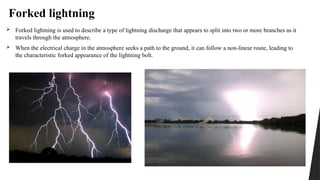
 Forked lightning is used to describe a type of lightning discharge that appears to split into two or more branches as it
travels through the atmosphere.
 When the electrical charge in the atmosphere seeks a path to the ground, it can follow a non-linear route, leading to
the characteristic forked appearance of the lightning bolt.
Lightning
 It's important to note that lightning can also occur within a cloud or between different parts of the same
cloud.
 This phenomenon is known as "intra-cloud" or "cloud-to-cloud" lightning.
Lightning Phenomena
Lightning
Effects and
Damages
Lightning Effects and Damages
 Physical damage:
 If lightning strikes a building, the concrete is
heated and can be blown off a building.
 Lightning strikes contain an intense amount of heat and
current that can easily damage buildings, structures,
equipment, and other objects.
Lightning Effects and Damages
 Electromagnetic field effect:
 A lightning strike always carries an electromagnetic pulse
(EMP) that creates a momentary power surge.
 While the surge only lasts a short time, it has the potential to
carry a large amount of voltage into the circuit, making all
appliances connected to an electrical system susceptible to over-
voltage damage.
 Advanced electronics are more susceptible since they have
smaller
components that are more sensitive to higher voltages.
 If your home suffers a direct lightning hit, the power surge
caused by it will almost instantaneously fry all your electronics
that are plugged in.
 These indirect effects are much more common than direct strikes
because the effective radius of a lightning strike is so much
larger than the small area the lightning directly strikes.
 A strike could indirectly damage electronics even
hundreds of meters away.
Lightning Effects and Damages (IEC 62305-1)
Lightning Effects and Damages
Lightning
Waveform
Lightning Waveform
 A typical lightning flash is about 300
million Volts and about 30,000 Amps.
 The peak current for over 98% of all cloud-
to-ground (CG) lightning strikes ranged
between 5 kA - 200 kA.
 About 1% of all lightning strikes exceed
200 kA, and about 1% of all positive
lightning strikes (0.1% of all strikes) may
exceed 350 kA.
Lightning Voltage Waveform
 A lightning impulse voltage is a unidirectional voltage that rises rapidly to a maximum value and then
decays
slowly.
 Any impulse wave is defined as T1/T2, Vp.
 Vp is the peak value of the impulse waveform.
 T1 is the front time or peak time or time to reach peak value.
 T2 is tail time or time to half peak.
Lightning Current Waveform
 Two types of current waves are considered by the IEC standards:
 10/350 µs wave: to characterize the current waves from a direct lightning stroke (Test type 1).
 8/20 µs wave: to characterize the current waves from an indirect lightning stroke (Test type
2).
 The 8/20 µs for impulse current surge and 1.2/50 µs for impulse voltage surge.
Lightning Waveform
Lightning
Protection
System
Lightning Protection System
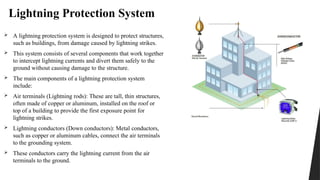
 A lightning protection system is designed to protect structures,
such as buildings, from damage caused by lightning strikes.
 This system consists of several components that work together
to intercept lightning currents and divert them safely to the
ground without causing damage to the structure.
 The main components of a lightning protection system
include:
 Air terminals (Lightning rods): These are tall, thin structures,
often made of copper or aluminum, installed on the roof or
top of a building to provide the first exposure point for
lightning strikes.
 Lightning conductors (Down conductors): Metal conductors,
such as copper or aluminum cables, connect the air terminals
to the grounding system.
 These conductors carry the lightning current from the air
terminals to the ground.
Lightning Protection System – Source: CIKIT ltd
Lightning Protection System
 Ground connections (electrodes): These components connect
the lightning protection system to the ground, ensuring a
safe path for the lightning currents.
 Bonding: This process involves connecting all conductive parts
of a building, such as the lightning protection system, electrical
system, and grounding system, to ensure equalization of
electrical potential and prevent arcing or side-flashing within
the building.
 Surge protection: These electrical devices are installed in or
on a building's electrical components and are designed to
protect electrical equipment from the electrical surge that
occurs when lightning strikes a nearby power line.
 Lightning strike recorder: To record the number of lightning
events.
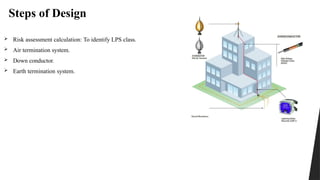
Steps of Design
 Risk assessment calculation: To identify LPS class.
 Air termination system.
 Down conductor.
 Earth termination system.
Risk
Assessment
Calculation
Risk Assessment Calculation - NFPA-780
 A lightning risk assessment is an evaluation of whether a
building and its surrounding environment are at risk of a
lightning strike and determines whether the structure requires
a lightning protection system to mitigate the risk of damage
and injury.
 Manual Method (equations and tables method), as per:
 IEC 62305-2 (International Electrotechnical Commission).
 NFPA780 (the National Fire Protection Association).
 Software Method,
 Excel Sheets Method,
 Online Calculators Method.
Risk Assessment Calculation - NFPA-780
Factor Definition
Nd Expected yearly lightning strike frequency to the structure
Nc Tolerable lightning strike frequency to the structure
Ng Average flash density in the region per year ( strike/km^2/year)
Ae Equivalent collective area of the structure in km^2
C1 Environmental coefficient
C2 Structure coefficient
C3 Structure contents coefficient
C4 Structure occupancy coefficient
C5 Lightning consequence coefficient
Risk Assessment Calculation - NFPA-780
 𝐴𝑒 = 𝐿𝑊 + 6𝐻(𝐿 + 𝑊) + 9𝜋𝐻2
 𝐴𝑒 ∶ 𝐶𝑜𝑙𝑙𝑒𝑐𝑡𝑖𝑜𝑛 𝐴𝑟𝑒𝑎 𝑜𝑓 𝑇ℎ𝑒
𝐵𝑢𝑖𝑙𝑑𝑖𝑛𝑔.
 𝐿 ∶ 𝑀𝑎𝑥𝑖𝑚𝑢𝑚 𝐿𝑒𝑛𝑔𝑡ℎ 𝑜𝑓 𝑇ℎ𝑒
𝐵𝑢𝑖𝑙𝑑𝑖𝑛𝑔.
 H ∶ 𝑀𝑎𝑥𝑖𝑚𝑢𝑚 𝐻𝑒𝑖𝑔ℎ𝑡 𝑜𝑓 𝑇ℎ𝑒
𝐵𝑢𝑖𝑙𝑑𝑖𝑛𝑔.
 𝑊: 𝑀𝑎𝑥𝑖𝑚𝑢𝑚 𝑊𝑖𝑑𝑡ℎ 𝑜𝑓 𝑇ℎ𝑒
𝐵𝑢𝑖𝑙𝑑𝑖𝑛𝑔.
�
�
 𝑁𝑔 = 0.04
∗ 𝑇1.25
 𝑇𝑑: 𝐴𝑛𝑛𝑢𝑎𝑙 𝐴𝑣𝑒𝑟𝑎𝑔𝑒
𝑇ℎ𝑢𝑛𝑑𝑒𝑟 𝐷𝑎𝑦𝑠.
Risk Assessment Calculation - NFPA-780
 𝑁𝑑 = 𝑁𝑔 ∗ 𝐴𝑒 ∗ 𝐶1 ∗ 10−6
 𝑁𝑑: 𝐸𝑥𝑝𝑒𝑐𝑡𝑒𝑑 𝐿𝑖𝑔ℎ𝑡𝑛𝑖𝑛𝑔
𝐹𝑟𝑒𝑞𝑢𝑒𝑛𝑐𝑦.

1.5∗10−
3
𝑁𝑐 = 𝐶=𝐶 ∗𝐶
∗𝐶 ∗𝐶
2 3 4
5
 𝑁𝑐: 𝐴𝑐𝑐𝑒𝑝𝑡𝑒𝑑 𝐿𝑖𝑔ℎ𝑡𝑛𝑖𝑛𝑔
𝐹𝑟𝑒𝑞𝑢𝑒𝑛𝑐𝑦.
Risk Assessment Calculation - NFPA-780
 𝑁𝑑 ≤ 𝑁𝑐 →
𝑂𝑝𝑡𝑖𝑜𝑛𝑎𝑙.
 𝑁𝑑 > 𝑁𝑐 →
𝑅𝑒𝑞𝑢𝑖𝑟𝑒𝑑.
 𝐿𝑖𝑔ℎ𝑡𝑖𝑛𝑖𝑛𝑔 𝑝𝑟𝑜𝑡𝑒𝑐𝑡𝑖𝑜𝑛 𝑒𝑓𝑓𝑖𝑐𝑖𝑒𝑛𝑐𝑦
= 𝐸 = 1 − 𝑁𝑐
𝑁
𝑑
Risk Assessment Calculation – IEC 62305
 Sizing Efficiency: This refers to the ability of the LPS to
protect against the maximum values of lightning
current.
 In the IEC 62305 series, four lightning protection levels
(LPL I, LPL II, LPL III, and LPL IV) are introduced,
and the design rules are based on the LPS being able to
protect against these maximum values.
 Interception Efficiency: This refers to the ability of the
LPS to protect against the minimum values of lightning
current.
 It ensures that the system can intercept the lowest levels
of current to provide comprehensive protection against
lightning strikes.
 Summarized Efficiency: This is the overall effectiveness
of the LPS, considering both the sizing and the
interception efficiencies.
 It provides a summary of how well the system can
protect a structure against the full range of lightning
currents, from the minimum to the maximum
Risk
Assessment
Online Software
and Excel
Risk Assessment Calculation – Online Software
 𝑃𝑟𝑎𝑐𝑡𝑖𝑐𝑎𝑙 𝐸𝑥𝑎𝑚𝑝𝑙𝑒 𝑏𝑦 𝑆𝑐ℎ𝑖𝑟𝑡𝑒𝑐
Online Software.
Risk Assessment Calculation – Excel Sheet
 𝑃𝑟𝑎𝑐𝑡𝑖𝑐𝑎𝑙 𝐸𝑥𝑎𝑚𝑝𝑙𝑒 𝑏𝑦
𝐸𝑥𝑐𝑒𝑙 𝑆ℎ𝑒𝑒𝑡.
Air
Termination
Design
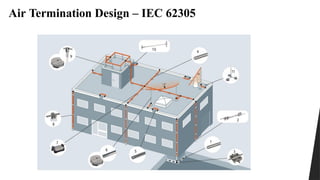
Air Termination – IEC 62305-3
 The purpose of the air termination system is to capture the
lightning discharge current at a desired point and then
safely dissipate it via down conductors to earth.
 The positioning of air termination systems shall meet
the positioning spelled out in the standards.
 Systems of the lightning protection system, special attention
must be paid to the protection of corners and edges of the
structure to be protected.
 Most importantly, air-termination systems must be mounted at
corners and edges.
 There are three methods used to determine the arrangement
and the position of the air-termination systems.
Conventional Franklin Rod
Rolling Sphere Lightning
Rolling Sphere Method – Source: Loehr
Methods of Protection Using an Air Termination System
 By "rolling" a sphere of a radius equivalent to
the distance that is determined by the amplitude
of the lightning current on a structure, the points
where the circumference of the sphere touches
the structure (red areas) the structure may be
vulnerable to lightning strikes.
 The areas (blue) where the sphere has not
touched the structure are less vulnerable to
lightning strikes.
Rolling Sphere Protective Angle Meshed Conductor Network
 Using the rolling sphere
principle on a meshed conductor
network the mesh must be
mounted a distance above the
roof plane, to make sure the
rolling sphere does not touch the
roof plane.
 This is a mathematical simplification of
the rolling sphere method where the
areas in green and magenta must be
equal.
 This is achieved by rolling the sphere
up against a finial and scribing a line
(red) whereby the area of "protection"
(green) equals the "unprotected area"
(magenta).
Air Termination Systems
Air Termination – IEC 62305-3
Rolling Sphere
Method
Rolling Sphere Method
 The rolling sphere method is the universal method
of design particularly recommended for
geometrically complicated applications.
Rolling Sphere Method – Source: CIKIT ltd
Rolling Sphere- Vertical Air Termination
(2𝑟ℎ −
ℎ2).
 Distance between two rods = d =
2
 h is the height of the rod.
 r is the rolling sphere radius.
Rolling Sphere Method – Penetration Distance
 When designing the air termination system for a building or a roof-mounted structure, the penetration depth of
the rolling sphere between two air termination rods becomes a decisive factor.
4
 p = r − (𝑟2
− 𝑑2
)
 p = penetration distance (meters)
 r = radius of the rolling sphere (meters)
 d = distance between two air termination rods
Rolling Sphere Method – Penetration Distance
 The height of the air-termination rods Δh must always be greater than the value of the penetration depth p
determined, and hence greater than the sag of the rolling sphere.
 This additional height of the air-termination rod ensures that the rolling sphere does not touch the object to be
protected.
Rolling Sphere Method – Source (Dehn)
Mesh Method
Mesh Method – Source: CIKIT ltd
Vertical Termination Must Be Added in PV System
Mesh Grid - Horizontal Air
Termination
Mesh Grid - Horizontal Air Termination
Mesh Grid - Horizontal Air
Termination
 This lightning protection, derived from the Faraday cage,
consists of meshed conductors that cover the roof and walls of
the structure to be protected.
 It is used for the protection of plane (flat) roof structures and
should not be used on curved surfaces.
 Air terminals are positioned around the edge of the roof and
on high points.
 Meshed conductor network usually uses a bare copper strip
(25×3 mm for example) which will be supported at equal
intervals.
 Air-termination conductors are positioned on:
 Roof edge lines.
 Roof overhangs.
 Roof edge lines, if the roof slope exceeds 1/10.
Mesh Grid - Horizontal Air
Termination
Mesh Grid - Horizontal Air
Termination
Mesh Method
Mesh Grid - Horizontal Air Termination + Vertical Air
Termination
Mesh Grid - Horizontal Air
Termination
Important Note
Important Note
 It can be seen that this distance is 0.31, 0.83, 1.24 and
1.66 m for mesh method grids spaced to requirements of
LPL I, II, III and IV respectively.
Structural LPS (Structural Lightning Rod)
 Natural components may be used for part of the mesh grid, or even the entire grid system if the required
minimum
dimensions for natural components of the air-termination system comply with the following conditions.
 When metallic roofs are being considered as a natural air termination arrangement, BS 6651 gives guidance on
the minimum thickness and type of material under consideration.
 Metal pipes and tanks on roofs can be used.
Protective
Angle Method
Protection Angle Method - Vertical Air Termination
 This is a mathematical simplification of the rolling sphere
method where the areas in green “G” and magenta “M” must be
equal.
 This is achieved by rolling the sphere up against a finial and
scribing a line (red) whereby the area of “protection”
(green) equals the “unprotected area” (magenta).
 α is the “Protective Angle”.
Protection Angle Method - Vertical Air Termination
 The protective angle method is best used on simple structures.
Additionally, the protective angle method is only valid up to
heights equal to the radius of the rolling sphere as defined by
the class of LPS for the structure.
 The protection angle method is mostly used to supplement the
mesh method, protecting items protruding from the plane
surface (roof-mounted structures like antennas, and ventilation
pipes).
Protection Angle Method - Vertical Air Termination
Method 3: Protection Angle Method - Vertical Air
Termination
Protection Angle Method - Vertical Air Termination
Protective Angle Method – Source: CIKIT ltd
Example on Vertical Air Termination
 The correct placement of finials and re-checking of the rolling sphere will protect the entire structure.
 The finials are bonded with a ridge conductor as shown. This ridge conductor’s recommended support center is
every 1000mm.
 Imagine a straight line along the ridge of a roof. At intervals of 1000mm, there would be points where the ridge
conductor is anchored or supported to the structure. This spacing is recommended to provide structural stability
and proper functioning of the lightning protection system.
 The IEC does not specify a minimum length of finial. In practice a minimum of 0.5m.
 The correct design length is determined by the protective angle that the finials will provide to the sides of the
Protection Angle Method - Vertical Air Termination
Limitation of Protective Angle Method
 When the structure/air rod/mast, relative to the reference plane, is greater in height than the appropriate rolling
sphere
radius, the zone of protection afforded by the protection angle is no longer valid
Examples of
Design
Air Termination Design – IEC 62305
Protection Angle Method - Vertical Air Termination
Vertical Air Termination
Early Streamer
System
Active Air Termination Using Early Streamer
 During a storm, when propagation field conditions
are favorable, an OPR ESE air terminal will
generate an upward leader.
 This upward leader from the OPR tip propagates
toward the downward leader from the cloud at an
average speed of 1 m/µs.
 Early Streamer Emission (ESE) System is not
approved by NFPA, IEEE, or IEC.
 Only NFC 17-102 (French Standard) has
approved
the ESE system.
 There are some cases of failure of this system and
hence, many nations/ international community is
yet to approve this.
Early Streamer - ABB
Down Conductors
Design
Down Conductors Design
 To provide a connection between the air termination
system and the earthing system.
Down Conductors Design
 A minimum of two down conductors spaced around the
perimeter should be used on a structure wherever possible
the down conductors should be installed on the exposed
corners of the structure.
 The down conductor should be run in the most direct
route to the earth system.
 Avoid sharp bends and corners.
 The recommended fastening of down conductors is
1000mm centers.
Cross-sectional
Area of Conductors
and Accessories of
the System
Cross-Sectional Area of Different Components
Recommended C.S.A - Furse
 The following sizes are suitable for most above-ground lightning protection systems:
 Flat Tape Conductor: 25 x 3 mm bare copper tape, or 25 x 3mm PVC covered tape
 Solid Circular Conductor: 8 mm diameter bare or PVC covered solid circular copper
conductor
 Stranded Conductor: 70 mm² bare or PVC covered stranded copper conductor
Air Terminal (1000x15mm)
Air Rod Base for Copper
Tape
Air Rod Base for Stranded Conductors
Air Rod Brackets & Rod to Conductor Coupling
Multiple Point & Strike Pad
Free Standing Air Termination
Clamps
Clamps
Clamps
Metallic Conductor Clips
Earth Bars and Disconnecting Links
 Standard Furse earth bars are available in a variety of lengths, but all consist of a 50 mm wide by 6 mm thick copper
bar.
 An earth bar is a common point for grouping together earth continuity and equipotential bonding, while a
disconnecting link is used to temporarily break the connection between the earth bar and the earth rods for testing
purposes.
Earth Bars
Earthing System
 The process in which the instantaneous discharge of the
electrical energy takes place by transferring charges
directly to the earth.
Earthing System
T.O.C: Top of Concrete – TOPR: Rooftop

training on Lightning Course Slides.pptx

  • 1.
  • 2.
  • 3.
    Lightning Phenomena  Lightningis a natural phenomenon formed by electrostatic discharges through the atmosphere between two electrically charged regions, either within the cloud or between the cloud and the ground.  The process of lightning formation involves several stages and mechanisms.
  • 4.
    Lightning Stages  Stage1: The Formation of Electric Charges:  The formation of electric charges in the atmosphere is due mainly to the ionization of air molecules by cosmic rays.  On colliding with air molecules, they produce a shower of lighter particles, some of which are charged.  Within a thundercloud, the rapid upward and downward movement of water droplets and ice crystals can separate and concentrate these charges.  The negative charges accumulate at the bottom part of the cloud and the positive charges towards the top.
  • 5.
    Lightning Stages  Stage2: Formation of a Stepped Leader:  As the charge separation intensifies, a negatively charged region called a "stepped leader" begins to extend from the cloud toward the ground.  This invisible channel is not the actual lightning bolt but is the path through which the lightning will eventually travel.  As the stepped leader approaches the ground, it creates a strong electric field that induces a positive electrical charge in objects on the ground.  These positive charges form upward-moving "streamers" from the ground towards the stepped leader.  The positive charges are initiated from tall objects on the ground, such as trees, buildings, or even people.
  • 6.
    Lightning Stages  Inthe early stages of development, air acts as an insulator between the positive and negative charges in the cloud and between the cloud and the ground.  Dielectric strength of air = 30 kV/cm.  When the opposite charges build up enough, this insulating capacity of the air breaks down and there is a rapid discharge of electricity that we know as lightning.  Trees are full of sap which is laden with salts and sugars and is a pretty good conductor (Not wood).
  • 7.
    Lightning Stages  Stage3: Lightning Bolt:  When the stepped leader and streamers connect, a pathway is established for the flow of electrical current.  This pathway is called the "return stroke."  The return stroke is the visible part of the lightning bolt that we see. It moves rapidly from the ground to the cloud and carries a large surge of electrical energy.
  • 8.
    Forked lightning  Forkedlightning is used to describe a type of lightning discharge that appears to split into two or more branches as it travels through the atmosphere.  When the electrical charge in the atmosphere seeks a path to the ground, it can follow a non-linear route, leading to the characteristic forked appearance of the lightning bolt.
  • 9.
    Lightning  It's importantto note that lightning can also occur within a cloud or between different parts of the same cloud.  This phenomenon is known as "intra-cloud" or "cloud-to-cloud" lightning.
  • 10.
  • 11.
  • 12.
    Lightning Effects andDamages  Physical damage:  If lightning strikes a building, the concrete is heated and can be blown off a building.  Lightning strikes contain an intense amount of heat and current that can easily damage buildings, structures, equipment, and other objects.
  • 13.
  • 14.
    Lightning Effects andDamages  Electromagnetic field effect:  A lightning strike always carries an electromagnetic pulse (EMP) that creates a momentary power surge.  While the surge only lasts a short time, it has the potential to carry a large amount of voltage into the circuit, making all appliances connected to an electrical system susceptible to over- voltage damage.  Advanced electronics are more susceptible since they have smaller components that are more sensitive to higher voltages.  If your home suffers a direct lightning hit, the power surge caused by it will almost instantaneously fry all your electronics that are plugged in.  These indirect effects are much more common than direct strikes because the effective radius of a lightning strike is so much larger than the small area the lightning directly strikes.  A strike could indirectly damage electronics even hundreds of meters away.
  • 15.
    Lightning Effects andDamages (IEC 62305-1)
  • 16.
  • 17.
  • 18.
    Lightning Waveform  Atypical lightning flash is about 300 million Volts and about 30,000 Amps.  The peak current for over 98% of all cloud- to-ground (CG) lightning strikes ranged between 5 kA - 200 kA.  About 1% of all lightning strikes exceed 200 kA, and about 1% of all positive lightning strikes (0.1% of all strikes) may exceed 350 kA.
  • 19.
    Lightning Voltage Waveform A lightning impulse voltage is a unidirectional voltage that rises rapidly to a maximum value and then decays slowly.  Any impulse wave is defined as T1/T2, Vp.  Vp is the peak value of the impulse waveform.  T1 is the front time or peak time or time to reach peak value.  T2 is tail time or time to half peak.
  • 20.
    Lightning Current Waveform Two types of current waves are considered by the IEC standards:  10/350 µs wave: to characterize the current waves from a direct lightning stroke (Test type 1).  8/20 µs wave: to characterize the current waves from an indirect lightning stroke (Test type 2).  The 8/20 µs for impulse current surge and 1.2/50 µs for impulse voltage surge.
  • 21.
  • 22.
  • 23.
    Lightning Protection System A lightning protection system is designed to protect structures, such as buildings, from damage caused by lightning strikes.  This system consists of several components that work together to intercept lightning currents and divert them safely to the ground without causing damage to the structure.  The main components of a lightning protection system include:  Air terminals (Lightning rods): These are tall, thin structures, often made of copper or aluminum, installed on the roof or top of a building to provide the first exposure point for lightning strikes.  Lightning conductors (Down conductors): Metal conductors, such as copper or aluminum cables, connect the air terminals to the grounding system.  These conductors carry the lightning current from the air terminals to the ground.
  • 24.
    Lightning Protection System– Source: CIKIT ltd
  • 25.
  • 26.
    Lightning Protection System Ground connections (electrodes): These components connect the lightning protection system to the ground, ensuring a safe path for the lightning currents.  Bonding: This process involves connecting all conductive parts of a building, such as the lightning protection system, electrical system, and grounding system, to ensure equalization of electrical potential and prevent arcing or side-flashing within the building.  Surge protection: These electrical devices are installed in or on a building's electrical components and are designed to protect electrical equipment from the electrical surge that occurs when lightning strikes a nearby power line.  Lightning strike recorder: To record the number of lightning events.
  • 27.
    Steps of Design Risk assessment calculation: To identify LPS class.  Air termination system.  Down conductor.  Earth termination system.
  • 28.
  • 29.
    Risk Assessment Calculation- NFPA-780  A lightning risk assessment is an evaluation of whether a building and its surrounding environment are at risk of a lightning strike and determines whether the structure requires a lightning protection system to mitigate the risk of damage and injury.  Manual Method (equations and tables method), as per:  IEC 62305-2 (International Electrotechnical Commission).  NFPA780 (the National Fire Protection Association).  Software Method,  Excel Sheets Method,  Online Calculators Method.
  • 30.
    Risk Assessment Calculation- NFPA-780 Factor Definition Nd Expected yearly lightning strike frequency to the structure Nc Tolerable lightning strike frequency to the structure Ng Average flash density in the region per year ( strike/km^2/year) Ae Equivalent collective area of the structure in km^2 C1 Environmental coefficient C2 Structure coefficient C3 Structure contents coefficient C4 Structure occupancy coefficient C5 Lightning consequence coefficient
  • 31.
    Risk Assessment Calculation- NFPA-780  𝐴𝑒 = 𝐿𝑊 + 6𝐻(𝐿 + 𝑊) + 9𝜋𝐻2  𝐴𝑒 ∶ 𝐶𝑜𝑙𝑙𝑒𝑐𝑡𝑖𝑜𝑛 𝐴𝑟𝑒𝑎 𝑜𝑓 𝑇ℎ𝑒 𝐵𝑢𝑖𝑙𝑑𝑖𝑛𝑔.  𝐿 ∶ 𝑀𝑎𝑥𝑖𝑚𝑢𝑚 𝐿𝑒𝑛𝑔𝑡ℎ 𝑜𝑓 𝑇ℎ𝑒 𝐵𝑢𝑖𝑙𝑑𝑖𝑛𝑔.  H ∶ 𝑀𝑎𝑥𝑖𝑚𝑢𝑚 𝐻𝑒𝑖𝑔ℎ𝑡 𝑜𝑓 𝑇ℎ𝑒 𝐵𝑢𝑖𝑙𝑑𝑖𝑛𝑔.  𝑊: 𝑀𝑎𝑥𝑖𝑚𝑢𝑚 𝑊𝑖𝑑𝑡ℎ 𝑜𝑓 𝑇ℎ𝑒 𝐵𝑢𝑖𝑙𝑑𝑖𝑛𝑔. � �  𝑁𝑔 = 0.04 ∗ 𝑇1.25  𝑇𝑑: 𝐴𝑛𝑛𝑢𝑎𝑙 𝐴𝑣𝑒𝑟𝑎𝑔𝑒 𝑇ℎ𝑢𝑛𝑑𝑒𝑟 𝐷𝑎𝑦𝑠.
  • 32.
    Risk Assessment Calculation- NFPA-780  𝑁𝑑 = 𝑁𝑔 ∗ 𝐴𝑒 ∗ 𝐶1 ∗ 10−6  𝑁𝑑: 𝐸𝑥𝑝𝑒𝑐𝑡𝑒𝑑 𝐿𝑖𝑔ℎ𝑡𝑛𝑖𝑛𝑔 𝐹𝑟𝑒𝑞𝑢𝑒𝑛𝑐𝑦.  1.5∗10− 3 𝑁𝑐 = 𝐶=𝐶 ∗𝐶 ∗𝐶 ∗𝐶 2 3 4 5  𝑁𝑐: 𝐴𝑐𝑐𝑒𝑝𝑡𝑒𝑑 𝐿𝑖𝑔ℎ𝑡𝑛𝑖𝑛𝑔 𝐹𝑟𝑒𝑞𝑢𝑒𝑛𝑐𝑦.
  • 33.
    Risk Assessment Calculation- NFPA-780  𝑁𝑑 ≤ 𝑁𝑐 → 𝑂𝑝𝑡𝑖𝑜𝑛𝑎𝑙.  𝑁𝑑 > 𝑁𝑐 → 𝑅𝑒𝑞𝑢𝑖𝑟𝑒𝑑.  𝐿𝑖𝑔ℎ𝑡𝑖𝑛𝑖𝑛𝑔 𝑝𝑟𝑜𝑡𝑒𝑐𝑡𝑖𝑜𝑛 𝑒𝑓𝑓𝑖𝑐𝑖𝑒𝑛𝑐𝑦 = 𝐸 = 1 − 𝑁𝑐 𝑁 𝑑
  • 34.
    Risk Assessment Calculation– IEC 62305  Sizing Efficiency: This refers to the ability of the LPS to protect against the maximum values of lightning current.  In the IEC 62305 series, four lightning protection levels (LPL I, LPL II, LPL III, and LPL IV) are introduced, and the design rules are based on the LPS being able to protect against these maximum values.  Interception Efficiency: This refers to the ability of the LPS to protect against the minimum values of lightning current.  It ensures that the system can intercept the lowest levels of current to provide comprehensive protection against lightning strikes.  Summarized Efficiency: This is the overall effectiveness of the LPS, considering both the sizing and the interception efficiencies.  It provides a summary of how well the system can protect a structure against the full range of lightning currents, from the minimum to the maximum
  • 35.
  • 36.
    Risk Assessment Calculation– Online Software  𝑃𝑟𝑎𝑐𝑡𝑖𝑐𝑎𝑙 𝐸𝑥𝑎𝑚𝑝𝑙𝑒 𝑏𝑦 𝑆𝑐ℎ𝑖𝑟𝑡𝑒𝑐 Online Software.
  • 37.
    Risk Assessment Calculation– Excel Sheet  𝑃𝑟𝑎𝑐𝑡𝑖𝑐𝑎𝑙 𝐸𝑥𝑎𝑚𝑝𝑙𝑒 𝑏𝑦 𝐸𝑥𝑐𝑒𝑙 𝑆ℎ𝑒𝑒𝑡.
  • 38.
  • 39.
    Air Termination –IEC 62305-3  The purpose of the air termination system is to capture the lightning discharge current at a desired point and then safely dissipate it via down conductors to earth.  The positioning of air termination systems shall meet the positioning spelled out in the standards.  Systems of the lightning protection system, special attention must be paid to the protection of corners and edges of the structure to be protected.  Most importantly, air-termination systems must be mounted at corners and edges.  There are three methods used to determine the arrangement and the position of the air-termination systems.
  • 40.
  • 41.
  • 42.
    Rolling Sphere Method– Source: Loehr
  • 43.
    Methods of ProtectionUsing an Air Termination System  By "rolling" a sphere of a radius equivalent to the distance that is determined by the amplitude of the lightning current on a structure, the points where the circumference of the sphere touches the structure (red areas) the structure may be vulnerable to lightning strikes.  The areas (blue) where the sphere has not touched the structure are less vulnerable to lightning strikes. Rolling Sphere Protective Angle Meshed Conductor Network  Using the rolling sphere principle on a meshed conductor network the mesh must be mounted a distance above the roof plane, to make sure the rolling sphere does not touch the roof plane.  This is a mathematical simplification of the rolling sphere method where the areas in green and magenta must be equal.  This is achieved by rolling the sphere up against a finial and scribing a line (red) whereby the area of "protection" (green) equals the "unprotected area" (magenta).
  • 44.
  • 45.
  • 46.
  • 47.
    Rolling Sphere Method The rolling sphere method is the universal method of design particularly recommended for geometrically complicated applications.
  • 48.
    Rolling Sphere Method– Source: CIKIT ltd
  • 49.
    Rolling Sphere- VerticalAir Termination (2𝑟ℎ − ℎ2).  Distance between two rods = d = 2  h is the height of the rod.  r is the rolling sphere radius.
  • 50.
    Rolling Sphere Method– Penetration Distance  When designing the air termination system for a building or a roof-mounted structure, the penetration depth of the rolling sphere between two air termination rods becomes a decisive factor. 4  p = r − (𝑟2 − 𝑑2 )  p = penetration distance (meters)  r = radius of the rolling sphere (meters)  d = distance between two air termination rods
  • 51.
    Rolling Sphere Method– Penetration Distance  The height of the air-termination rods Δh must always be greater than the value of the penetration depth p determined, and hence greater than the sag of the rolling sphere.  This additional height of the air-termination rod ensures that the rolling sphere does not touch the object to be protected.
  • 52.
    Rolling Sphere Method– Source (Dehn)
  • 53.
  • 54.
    Mesh Method –Source: CIKIT ltd
  • 55.
    Vertical Termination MustBe Added in PV System
  • 56.
    Mesh Grid -Horizontal Air Termination
  • 57.
    Mesh Grid -Horizontal Air Termination
  • 58.
    Mesh Grid -Horizontal Air Termination  This lightning protection, derived from the Faraday cage, consists of meshed conductors that cover the roof and walls of the structure to be protected.  It is used for the protection of plane (flat) roof structures and should not be used on curved surfaces.  Air terminals are positioned around the edge of the roof and on high points.  Meshed conductor network usually uses a bare copper strip (25×3 mm for example) which will be supported at equal intervals.  Air-termination conductors are positioned on:  Roof edge lines.  Roof overhangs.  Roof edge lines, if the roof slope exceeds 1/10.
  • 59.
    Mesh Grid -Horizontal Air Termination
  • 60.
    Mesh Grid -Horizontal Air Termination
  • 61.
  • 62.
    Mesh Grid -Horizontal Air Termination + Vertical Air Termination
  • 63.
    Mesh Grid -Horizontal Air Termination
  • 64.
  • 65.
    Important Note  Itcan be seen that this distance is 0.31, 0.83, 1.24 and 1.66 m for mesh method grids spaced to requirements of LPL I, II, III and IV respectively.
  • 66.
    Structural LPS (StructuralLightning Rod)  Natural components may be used for part of the mesh grid, or even the entire grid system if the required minimum dimensions for natural components of the air-termination system comply with the following conditions.  When metallic roofs are being considered as a natural air termination arrangement, BS 6651 gives guidance on the minimum thickness and type of material under consideration.  Metal pipes and tanks on roofs can be used.
  • 67.
  • 68.
    Protection Angle Method- Vertical Air Termination
  • 69.
    Protection Angle Method- Vertical Air Termination  This is a mathematical simplification of the rolling sphere method where the areas in green “G” and magenta “M” must be equal.  This is achieved by rolling the sphere up against a finial and scribing a line (red) whereby the area of “protection” (green) equals the “unprotected area” (magenta).  α is the “Protective Angle”.
  • 70.
    Protection Angle Method- Vertical Air Termination
  • 71.
    Protection Angle Method- Vertical Air Termination  The protective angle method is best used on simple structures. Additionally, the protective angle method is only valid up to heights equal to the radius of the rolling sphere as defined by the class of LPS for the structure.  The protection angle method is mostly used to supplement the mesh method, protecting items protruding from the plane surface (roof-mounted structures like antennas, and ventilation pipes).
  • 72.
    Protection Angle Method- Vertical Air Termination
  • 73.
    Protection Angle Method- Vertical Air Termination
  • 74.
    Method 3: ProtectionAngle Method - Vertical Air Termination
  • 75.
    Protection Angle Method- Vertical Air Termination
  • 76.
    Protective Angle Method– Source: CIKIT ltd
  • 77.
    Example on VerticalAir Termination  The correct placement of finials and re-checking of the rolling sphere will protect the entire structure.  The finials are bonded with a ridge conductor as shown. This ridge conductor’s recommended support center is every 1000mm.  Imagine a straight line along the ridge of a roof. At intervals of 1000mm, there would be points where the ridge conductor is anchored or supported to the structure. This spacing is recommended to provide structural stability and proper functioning of the lightning protection system.  The IEC does not specify a minimum length of finial. In practice a minimum of 0.5m.  The correct design length is determined by the protective angle that the finials will provide to the sides of the
  • 78.
    Protection Angle Method- Vertical Air Termination
  • 79.
    Limitation of ProtectiveAngle Method  When the structure/air rod/mast, relative to the reference plane, is greater in height than the appropriate rolling sphere radius, the zone of protection afforded by the protection angle is no longer valid
  • 80.
  • 81.
  • 82.
    Protection Angle Method- Vertical Air Termination
  • 83.
    Protection Angle Method- Vertical Air Termination
  • 84.
    Protection Angle Method- Vertical Air Termination
  • 85.
    Protection Angle Method- Vertical Air Termination
  • 86.
  • 87.
  • 88.
  • 89.
    Active Air TerminationUsing Early Streamer  During a storm, when propagation field conditions are favorable, an OPR ESE air terminal will generate an upward leader.  This upward leader from the OPR tip propagates toward the downward leader from the cloud at an average speed of 1 m/µs.  Early Streamer Emission (ESE) System is not approved by NFPA, IEEE, or IEC.  Only NFC 17-102 (French Standard) has approved the ESE system.  There are some cases of failure of this system and hence, many nations/ international community is yet to approve this.
  • 90.
  • 91.
  • 92.
    Down Conductors Design To provide a connection between the air termination system and the earthing system.
  • 93.
    Down Conductors Design A minimum of two down conductors spaced around the perimeter should be used on a structure wherever possible the down conductors should be installed on the exposed corners of the structure.  The down conductor should be run in the most direct route to the earth system.  Avoid sharp bends and corners.  The recommended fastening of down conductors is 1000mm centers.
  • 94.
    Cross-sectional Area of Conductors andAccessories of the System
  • 95.
    Cross-Sectional Area ofDifferent Components
  • 96.
    Recommended C.S.A -Furse  The following sizes are suitable for most above-ground lightning protection systems:  Flat Tape Conductor: 25 x 3 mm bare copper tape, or 25 x 3mm PVC covered tape  Solid Circular Conductor: 8 mm diameter bare or PVC covered solid circular copper conductor  Stranded Conductor: 70 mm² bare or PVC covered stranded copper conductor
  • 97.
  • 98.
    Air Rod Basefor Copper Tape
  • 99.
    Air Rod Basefor Stranded Conductors
  • 100.
    Air Rod Brackets& Rod to Conductor Coupling
  • 101.
    Multiple Point &Strike Pad
  • 102.
    Free Standing AirTermination
  • 103.
  • 104.
  • 105.
  • 106.
  • 107.
  • 108.
  • 109.
  • 110.
    Earth Bars andDisconnecting Links  Standard Furse earth bars are available in a variety of lengths, but all consist of a 50 mm wide by 6 mm thick copper bar.  An earth bar is a common point for grouping together earth continuity and equipotential bonding, while a disconnecting link is used to temporarily break the connection between the earth bar and the earth rods for testing purposes.
  • 111.
  • 112.
    Earthing System  Theprocess in which the instantaneous discharge of the electrical energy takes place by transferring charges directly to the earth.
  • 113.
  • 114.
    T.O.C: Top ofConcrete – TOPR: Rooftop