HIGH VOLTAGE ENGINEERING
Lightning
Dr.S.Sangeetha,
Associate Professor /EEE
Sri Ramakrishna Institute of Technology
Coimbatore-10.
Lightning
• Lightning is a discharge of electricity. A single stroke of
lightning can heat the air around it to 30,000°C (54,000°F)
• This extreme heating causes the air to expand explosively fast.
• As ice crystals high within a thunderstorm cloud flow up and
down in the turbulent air, they crash into each other.
• Small negatively charged particles called electrons are knocked
off some ice and added to other ice as they crash past each
other.
• This separates the positive (+) and negative (-) charges of the
cloud. The top of the cloud becomes positively charged while
the base of the cloud becomes negatively charged.
2
Lightning
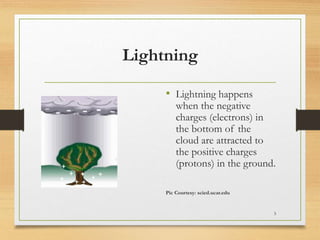
• Lightning happens
when the negative
charges (electrons) in
the bottom of the
cloud are attracted to
the positive charges
(protons) in the ground.
Pic Courtesy: scied.ucar.edu
3
Lightning
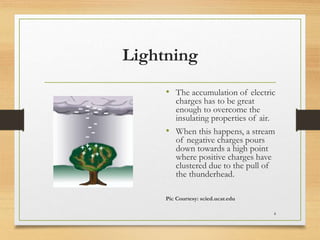
• The accumulation of electric
charges has to be great
enough to overcome the
insulating properties of air.
• When this happens, a stream
of negative charges pours
down towards a high point
where positive charges have
clustered due to the pull of
the thunderhead.
Pic Courtesy: scied.ucar.edu
4
Lightning
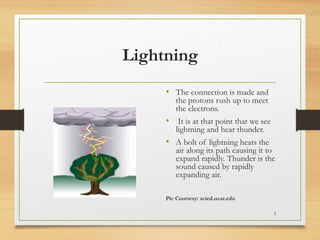
• The connection is made and
the protons rush up to meet
the electrons.
• It is at that point that we see
lightning and hear thunder.
• A bolt of lightning heats the
air along its path causing it to
expand rapidly. Thunder is the
sound caused by rapidly
expanding air.
Pic Courtesy: scied.ucar.edu
5
6
Pic Courtesy:University of Waikato
Stepped Leader
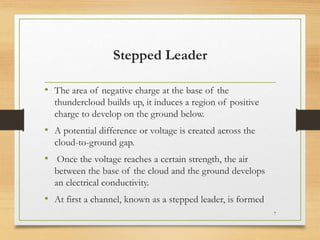
• The area of negative charge at the base of the
thundercloud builds up, it induces a region of positive
charge to develop on the ground below.
• A potential difference or voltage is created across the
cloud-to-ground gap.
• Once the voltage reaches a certain strength, the air
between the base of the cloud and the ground develops
an electrical conductivity.
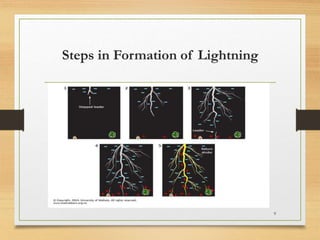
• At first a channel, known as a stepped leader, is formed
7
Stepped Leader
• It is invisible to the naked eye, this allows electrons to
move from the cloud to the ground.
• It is called a stepped leader because it travels in 50 to 100
m sections, with a slight pause in between, to the ground.
• As it nears the ground, a positively charged streamer fires
upwards from the ground to connect with it.
• Once connected, electrons from the cloud can flow to the
ground and positive charges can flow from the ground to
the cloud.
• It is this flow of charge that is the visible lightning stroke.
8
Steps in Formation of Lightning
9
Mechanism of lightning flash
• Pilot streamer and Stepped leader
• Ground streamer and return stroke
• Subsequent strokes
10
Characteristics of lightning
strokes
• Current-time characteristics
• Time to peak or Rate of rise
• Probability distribution of current and time
• Wave shapes of lightning voltage and current
11
Lightning current
• Short front time - 10µs
• Tail time – several ms.
• 50% lightning stroke current – greater than 7.5kA/µs.
• 10% lightning strokes current – exceeds 25 kA/µs.
• Stroke current above half value – more than 30µs.
12
Surge voltage
• Maximum surge voltage in transmission line – 5MV
• Most of the surge voltage is less than 1000 kV on line.
• Front time – 2 to 10 µs
• Tail time – 20 to 100 µs
• Rate of rise of voltage – 1MV/ µs
13
Thank you
14

Lightning

  • 1.
    HIGH VOLTAGE ENGINEERING Lightning Dr.S.Sangeetha, AssociateProfessor /EEE Sri Ramakrishna Institute of Technology Coimbatore-10.
  • 2.
    Lightning • Lightning isa discharge of electricity. A single stroke of lightning can heat the air around it to 30,000°C (54,000°F) • This extreme heating causes the air to expand explosively fast. • As ice crystals high within a thunderstorm cloud flow up and down in the turbulent air, they crash into each other. • Small negatively charged particles called electrons are knocked off some ice and added to other ice as they crash past each other. • This separates the positive (+) and negative (-) charges of the cloud. The top of the cloud becomes positively charged while the base of the cloud becomes negatively charged. 2
  • 3.
    Lightning • Lightning happens whenthe negative charges (electrons) in the bottom of the cloud are attracted to the positive charges (protons) in the ground. Pic Courtesy: scied.ucar.edu 3
  • 4.
    Lightning • The accumulationof electric charges has to be great enough to overcome the insulating properties of air. • When this happens, a stream of negative charges pours down towards a high point where positive charges have clustered due to the pull of the thunderhead. Pic Courtesy: scied.ucar.edu 4
  • 5.
    Lightning • The connectionis made and the protons rush up to meet the electrons. • It is at that point that we see lightning and hear thunder. • A bolt of lightning heats the air along its path causing it to expand rapidly. Thunder is the sound caused by rapidly expanding air. Pic Courtesy: scied.ucar.edu 5
  • 6.
  • 7.
    Stepped Leader • Thearea of negative charge at the base of the thundercloud builds up, it induces a region of positive charge to develop on the ground below. • A potential difference or voltage is created across the cloud-to-ground gap. • Once the voltage reaches a certain strength, the air between the base of the cloud and the ground develops an electrical conductivity. • At first a channel, known as a stepped leader, is formed 7
  • 8.
    Stepped Leader • Itis invisible to the naked eye, this allows electrons to move from the cloud to the ground. • It is called a stepped leader because it travels in 50 to 100 m sections, with a slight pause in between, to the ground. • As it nears the ground, a positively charged streamer fires upwards from the ground to connect with it. • Once connected, electrons from the cloud can flow to the ground and positive charges can flow from the ground to the cloud. • It is this flow of charge that is the visible lightning stroke. 8
  • 9.
    Steps in Formationof Lightning 9
  • 10.
    Mechanism of lightningflash • Pilot streamer and Stepped leader • Ground streamer and return stroke • Subsequent strokes 10
  • 11.
    Characteristics of lightning strokes •Current-time characteristics • Time to peak or Rate of rise • Probability distribution of current and time • Wave shapes of lightning voltage and current 11
  • 12.
    Lightning current • Shortfront time - 10µs • Tail time – several ms. • 50% lightning stroke current – greater than 7.5kA/µs. • 10% lightning strokes current – exceeds 25 kA/µs. • Stroke current above half value – more than 30µs. 12
  • 13.
    Surge voltage • Maximumsurge voltage in transmission line – 5MV • Most of the surge voltage is less than 1000 kV on line. • Front time – 2 to 10 µs • Tail time – 20 to 100 µs • Rate of rise of voltage – 1MV/ µs 13
  • 14.