1
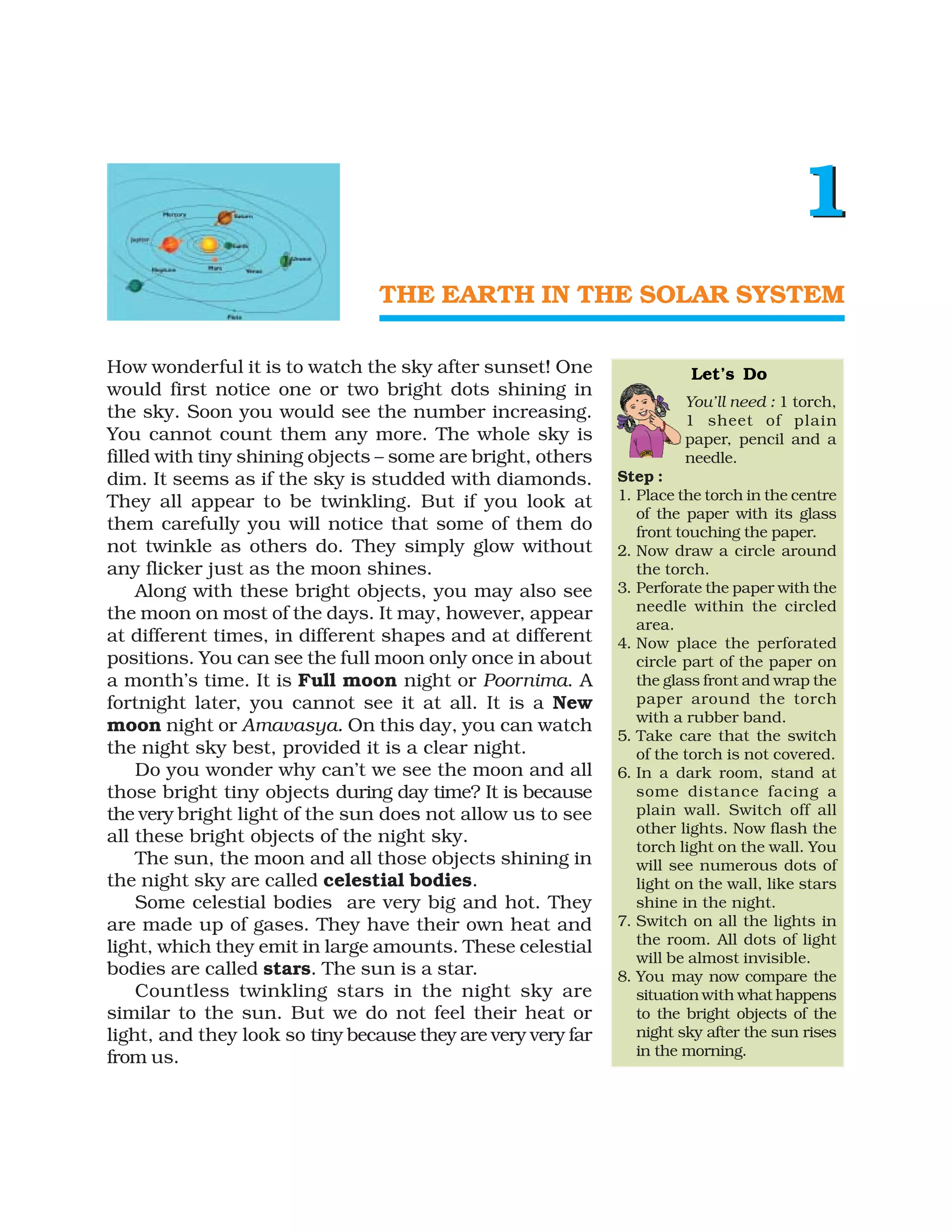
                                 THE EARTH IN THE SOLAR SYSTEM

How wonderful it is to watch the sky after sunset! One                  Let’s Do
would first notice one or two bright dots shining in
                                                                       You’ll need : 1 torch,
the sky. Soon you would see the number increasing.                     1 sheet of plain
You cannot count them any more. The whole sky is                       paper, pencil and a
filled with tiny shining objects – some are bright, others             needle.
dim. It seems as if the sky is studded with diamonds.         Step :
They all appear to be twinkling. But if you look at           1. Place the torch in the centre
                                                                 of the paper with its glass
them carefully you will notice that some of them do              front touching the paper.
not twinkle as others do. They simply glow without            2. Now draw a circle around
any flicker just as the moon shines.                             the torch.
     Along with these bright objects, you may also see        3. Perforate the paper with the
                                                                 needle within the circled
the moon on most of the days. It may, however, appear
                                                                 area.
at different times, in different shapes and at different      4. Now place the perforated
positions. You can see the full moon only once in about          circle part of the paper on
a month’s time. It is Full moon night or Poornima. A             the glass front and wrap the
fortnight later, you cannot see it at all. It is a New           paper around the torch
                                                                 with a rubber band.
moon night or Amavasya. On this day, you can watch
                                                              5. Take care that the switch
the night sky best, provided it is a clear night.                of the torch is not covered.
     Do you wonder why can’t we see the moon and all          6. In a dark room, stand at
those bright tiny objects during day time? It is because         some distance facing a
the very bright light of the sun does not allow us to see        plain wall. Switch off all
                                                                 other lights. Now flash the
all these bright objects of the night sky.
                                                                 torch light on the wall. You
     The sun, the moon and all those objects shining in          will see numerous dots of
the night sky are called celestial bodies.                       light on the wall, like stars
     Some celestial bodies are very big and hot. They            shine in the night.
are made up of gases. They have their own heat and            7. Switch on all the lights in
                                                                 the room. All dots of light
light, which they emit in large amounts. These celestial
                                                                 will be almost invisible.
bodies are called stars. The sun is a star.                   8. You may now compare the
     Countless twinkling stars in the night sky are              situation with what happens
similar to the sun. But we do not feel their heat or             to the bright objects of the
light, and they look so tiny because they are very very far      night sky after the sun rises
from us.                                                         in the morning.
You must have noticed that all
                                                  objects look smaller when seen from a
                                                  distance. How small an aeroplane looks
                                                  when it is flying at a great height!
                                                      While watching the night sky, you
                                                  may notice various patterns formed by
                                                  different groups of stars. These are
                                                  called constellations. Ursa Major or
                                                  Big Bear is one such constellation. One
                                                  of the most easily recognisable
                                                  constellation is the small bear or
                                                  Saptarishi (Sapta-seven, rishi-sages). It
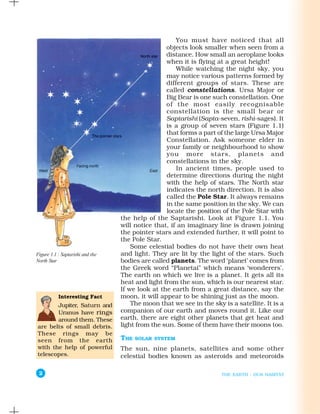
                                                  is a group of seven stars (Figure 1.1)
                                                  that forms a part of the large Ursa Major
                                                  Constellation. Ask someone elder in
                                                  your family or neighbourhood to show
                                                  you more stars, planets and
                                                  constellations in the sky.
                                                      In ancient times, people used to
                                                  determine directions during the night
                                                  with the help of stars. The North star
                                                  indicates the north direction. It is also
                                                  called the Pole Star. It always remains
                                                  in the same position in the sky. We can
                                                  locate the position of the Pole Star with
                                  the help of the Saptarishi. Look at Figure 1.1. You
                                  will notice that, if an imaginary line is drawn joining
                                  the pointer stars and extended further, it will point to
                                  the Pole Star.
                                      Some celestial bodies do not have their own heat
Figure 1.1 : Saptarishi and the   and light. They are lit by the light of the stars. Such
North Star                        bodies are called planets. The word ‘planet’ comes from
                                  the Greek word “Planetai” which means ‘wonderers’.
                                  The earth on which we live is a planet. It gets all its
                                  heat and light from the sun, which is our nearest star.
                                  If we look at the earth from a great distance, say the
           Interesting Fact       moon, it will appear to be shining just as the moon.
       Jupiter, Saturn and            The moon that we see in the sky is a satellite. It is a
       Uranus have rings          companion of our earth and moves round it. Like our
       around them. These         earth, there are eight other planets that get heat and
are belts of small debris.        light from the sun. Some of them have their moons too.
These rings may be
seen from the earth               THE   SOLAR SYSTEM
with the help of powerful         The sun, nine planets, satellites and some other
telescopes.                       celestial bodies known as asteroids and meteoroids

 2                                                                    THE EARTH : OUR HABITAT
THE EARTH IN THE SOLAR SYSTEM
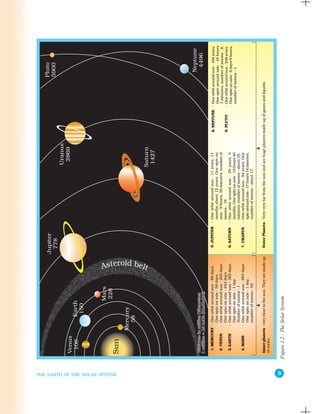
                                   1. MERCURY - One orbit around sun - 88 days,             5. JUPITER - One orbit around sun - 11 years, 11                8. NEPTUNE - One orbit around sun - 164 years.
                                                One spin on axis - 59 days.                              months about 12 years. One spin on                              One spin around axis - 16 hours
                                   2. VENUS   - One orbit around sun - 255 days.                         axis - 9 hours, 56 minutes, number of                           7 minutes, number of moons - 8.
                                                One spin on axis - 243 days                              moons - 16                                         9. PLUTO   - One orbit around sun - 248 years.
                                   3. EARTH   - One orbit around sun - 365 days.            6. SATURN - One orbit around sun - 29 years, 5                               One spin on axis - 6 days 9 hours,
                                                One spin on axis - 1 day                                 months. One spin on axis - 10 hours 40                          number of moons - 1
                                                Number of moons - 1                                      minutes, number of moons - about 18.
                                   4. MARS    - One orbit around sun - 687 days             7. URANUS - One orbit around sun - 84 years. One
                                                One spin on axis - 1 day,                                spin around axis - 17 hours 14 minutes,
                                                number of moons - 02                                     number of moons - about 17.


                                  Inner planets - very close to the sun. They are made up   Outer Planets - Very-very far from the sun and are huge planets made up of gases and liquids.
                                  of rocks.


     3
                                Figure 1.2 : The Solar System
Do you know?         form the solar system. We often call it a solar family,
                               with the sun as its Head.
           ‘Sol’ in Roman
           mythology is        The Sun
           the ‘Sungod’.
‘Solar’ means ‘related to      The sun is in the centre of the solar system. It is huge
the sun’. The family of the    and made up of extremely hot gases. It provides the
sun is, therefore, called      pulling force that binds the solar system. The sun is
the solar system. Write        the ultimate source of heat and light for the solar
down as many words using       system. But that tremendous heat is not felt so much
the word solar.                by us because despite being our nearest star, it is far
        Word Origin            away from us. The sun is about 150 million km away
                               from the earth.
        Many words used
        in a language may
                               Planets
        have been taken
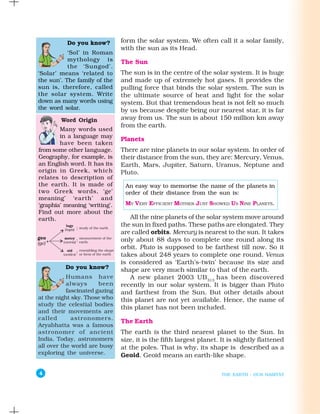
from some other language.      There are nine planets in our solar system. In order of
Geography, for example, is     their distance from the sun, they are: Mercury, Venus,
an English word. It has its    Earth, Mars, Jupiter, Saturn, Uranus, Neptune and
origin in Greek, which         Pluto.
relates to description of
the earth. It is made of        An easy way to memorise the name of the planets in
two Greek words, ‘ge’           order of their distance from the sun is:
meaning’ ‘earth’ and
‘graphia’ meaning ‘writing’.    MY VERY EFFICIENT MOTHER JUST SHOWED US NINE PLANETS.
Find out more about the
earth.                            All the nine planets of the solar system move around
                               the sun in fixed paths. These paths are elongated. They
                               are called orbits. Mercury is nearest to the sun. It takes
                               only about 88 days to complete one round along its
                               orbit. Pluto is supposed to be farthest till now. So it
                               takes about 248 years to complete one round. Venus
                               is considered as ‘Earth’s-twin’ because its size and
          Do you know?         shape are very much similar to that of the earth.
           Humans have            A new planet 2003 UB 313 has been discovered
           always      been    recently in our solar system. It is bigger than Pluto
           fascinated gazing   and farthest from the Sun. But other details about
at the night sky. Those who    this planet are not yet available. Hence, the name of
study the celestial bodies
                               this planet has not been included.
and their movements are
called       astronomers.
                               The Earth
Aryabhatta was a famous
astronomer of ancient          The earth is the third nearest planet to the Sun. In
India. Today, astronomers      size, it is the fifth largest planet. It is slightly flattened
all over the world are busy    at the poles. That is why, its shape is described as a
exploring the universe.        Geoid. Geoid means an earth-like shape.

4                                                                    THE EARTH : OUR HABITAT
Conditions favourable to support life are probably                               Do you know?
found only on the earth. The earth is neither too hot
                                                                                    Light travels at
nor too cold. It has water and air, which are very                                  the speed of
essential for our survival. The air has life-supporting                             about 300,000
gases like oxygen. Because of these reasons, the earth                              km per second.
is a unique planet in the solar system.                                   Yet, even with this speed,
    From the outer space, the earth appears blue                          the light of the sun takes
because its two-thirds surface is covered by water. It                    about eight minutes to
is, therefore, called a blue planet.                                      reach the earth.

The Moon
Our earth has only one
                                                                                 Interesting Fact
satellite, that is, the
moon. Its diametre is                                                            Neil Armstrong was
only one-quarter that of                                                         the first man to
the earth. It appears so                                                         step on the surface
big because it is nearer to                                               of the moon on 29 July
our planet than other                                                     1969. Find out whether
                                                                          any Indian has landed on
celestial bodies. It is
                                                                          the moon?
about 3,84,400 km away
from us. Now you can
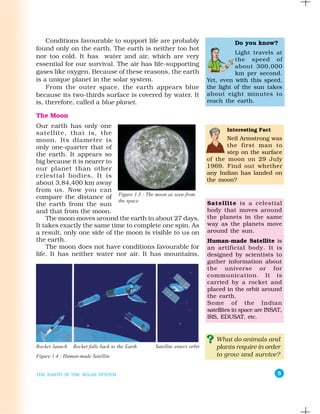
compare the distance of Figure 1.3 : The moon as seen from
                            the space
the earth from the sun                                                    Satellite is a celestial
and that from the moon.                                                   body that moves around
    The moon moves around the earth in about 27 days.                     the planets in the same
It takes exactly the same time to complete one spin. As                   way as the planets move
a result, only one side of the moon is visible to us on                   around the sun.
the earth.                                                                Human-made Satellite is
    The moon does not have conditions favourable for                      an artificial body. It is
life. It has neither water nor air. It has mountains,                     designed by scientists to
                                                                          gather information about
                                                                          the universe or for
                                                                          communication. It is
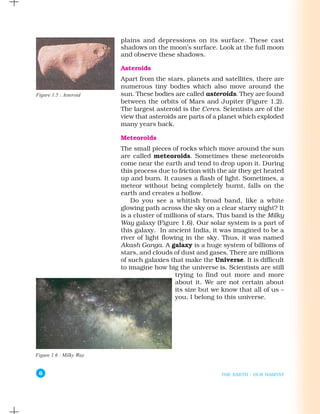
                                                                          carried by a rocket and
                                                                          placed in the orbit around
                                                                          the earth.
                                                                          Some of the Indian
                                                                          satellites in space are INSAT,
                                                                          IRS, EDUSAT, etc.


                                                                          ? What do animals and
Rocket launch   Rocket falls back to the Earth   Satellite enters orbit     plants require in order
Figure 1.4 : Human-made Satellite                                            to grow and survive?


THE EARTH IN THE SOLAR SYSTEM                                                                         5
plains and depressions on its surface. These cast
                         shadows on the moon’s surface. Look at the full moon
                         and observe these shadows.

                         Asteroids
                         Apart from the stars, planets and satellites, there are
                         numerous tiny bodies which also move around the
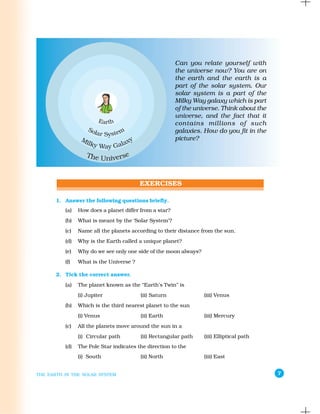
Figure 1.5 : Asteroid    sun. These bodies are called asteroids. They are found
                         between the orbits of Mars and Jupiter (Figure 1.2).
                         The largest asteroid is the Ceres. Scientists are of the
                         view that asteroids are parts of a planet which exploded
                         many years back.

                         Meteoroids
                         The small pieces of rocks which move around the sun
                         are called meteoroids. Sometimes these meteoroids
                         come near the earth and tend to drop upon it. During
                         this process due to friction with the air they get heated
                         up and burn. It causes a flash of light. Sometimes, a
                         meteor without being completely burnt, falls on the
                         earth and creates a hollow.
                             Do you see a whitish broad band, like a white
                         glowing path across the sky on a clear starry night? It
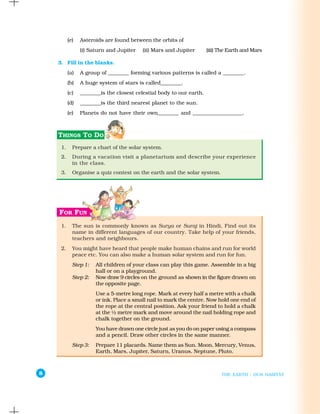
                         is a cluster of millions of stars. This band is the Milky
                         Way galaxy (Figure 1.6). Our solar system is a part of
                         this galaxy. In ancient India, it was imagined to be a
                         river of light flowing in the sky. Thus, it was named
                         Akash Ganga. A galaxy is a huge system of billions of
                         stars, and clouds of dust and gases. There are millions
                         of such galaxies that make the Universe. It is difficult
                         to imagine how big the universe is. Scientists are still
                                             trying to find out more and more
                                             about it. We are not certain about
                                             its size but we know that all of us –
                                             you, I belong to this universe.


Figure 1.6 : Milky Way


 6                                                          THE EARTH : OUR HABITAT
Can you relate yourself with
                                                        the universe now? You are on
                                                        the earth and the earth is a
                                                        part of the solar system. Our
                                                        solar system is a part of the
                                                        Milky Way galaxy which is part
                                                        of the universe. Think about the
                                                        universe, and the fact that it
                                                        contains millions of such
                                                        galaxies. How do you fit in the
                                                        picture?


       1. Answer the following questions briefly.
          (a)   How does a planet differ from a star?
          (b)   What is meant by the ‘Solar System’?
          (c)   Name all the planets according to their distance from the sun.
          (d)   Why is the Earth called a unique planet?
          (e)   Why do we see only one side of the moon always?
          (f)   What is the Universe ?

       2. Tick the correct answer.
          (a)   The planet known as the “Earth’s Twin” is
                (i) Jupiter              (ii) Saturn              (iii) Venus
          (b)   Which is the third nearest planet to the sun
                (i) Venus                (ii) Earth               (iii) Mercury
          (c)   All the planets move around the sun in a
                (i) Circular path        (ii) Rectangular path    (iii) Elliptical path
          (d)   The Pole Star indicates the direction to the
                (i) South                (ii) North               (iii) East


THE EARTH IN THE SOLAR SYSTEM                                                              7
(e)   Asteroids are found between the orbits of
                (i) Saturn and Jupiter   (ii) Mars and Jupiter        (iii) The Earth and Mars

    3. Fill in the blanks.
          (a)   A group of ________ forming various patterns is called a ________.
          (b)   A huge system of stars is called________.
          (c)   ________is the closest celestial body to our earth.
          (d)   ________is the third nearest planet to the sun.
          (e)   Planets do not have their own________ and ___________________.


     1.     Prepare a chart of the solar system.
     2.     During a vacation visit a planetarium and describe your experience
            in the class.
     3.     Organise a quiz contest on the earth and the solar system.


     1.     The sun is commonly known as Surya or Suraj in Hindi, Find out its
            name in different languages of our country. Take help of your friends,
            teachers and neighbours.
     2.     You might have heard that people make human chains and run for world
            peace etc. You can also make a human solar system and run for fun.
            Step 1:   All children of your class can play this game. Assemble in a big
                      hall or on a playground.
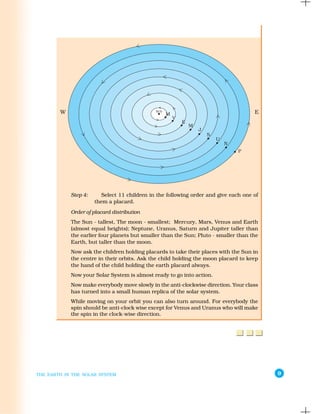
            Step 2:   Now draw 9 circles on the ground as shown in the figure drawn on
                      the opposite page.
                      Use a 5-metre long rope. Mark at every half a metre with a chalk
                      or ink. Place a small nail to mark the centre. Now hold one end of
                      the rope at the central position. Ask your friend to hold a chalk
                      at the ½ metre mark and move around the nail holding rope and
                      chalk together on the ground.
                      You have drawn one circle just as you do on paper using a compass
                      and a pencil. Draw other circles in the same manner.
            Step 3:   Prepare 11 placards. Name them as Sun. Moon, Mercury, Venus,
                      Earth, Mars, Jupiter, Saturn, Uranus, Neptune, Pluto.


8                                                                           THE EARTH : OUR HABITAT
Step 4:      Select 11 children in the following order and give each one of
                      them a placard.

            Order of placard distribution
            The Sun - tallest, The moon - smallest; Mercury, Mars, Venus and Earth
            (almost equal heights); Neptune, Uranus, Saturn and Jupiter taller than
            the earlier four planets but smaller than the Sun; Pluto - smaller than the
            Earth, but taller than the moon.
            Now ask the children holding placards to take their places with the Sun in
            the centre in their orbits. Ask the child holding the moon placard to keep
            the hand of the child holding the earth placard always.
            Now your Solar System is almost ready to go into action.
            Now make everybody move slowly in the anti-clockwise direction. Your class
            has turned into a small human replica of the solar system.
            While moving on your orbit you can also turn around. For everybody the
            spin should be anti-clock wise except for Venus and Uranus who will make
            the spin in the clock-wise direction.


THE EARTH IN THE SOLAR SYSTEM                                                             9

Earth in the solar system

  • 1.
    1 THE EARTH IN THE SOLAR SYSTEM How wonderful it is to watch the sky after sunset! One Let’s Do would first notice one or two bright dots shining in You’ll need : 1 torch, the sky. Soon you would see the number increasing. 1 sheet of plain You cannot count them any more. The whole sky is paper, pencil and a filled with tiny shining objects – some are bright, others needle. dim. It seems as if the sky is studded with diamonds. Step : They all appear to be twinkling. But if you look at 1. Place the torch in the centre of the paper with its glass them carefully you will notice that some of them do front touching the paper. not twinkle as others do. They simply glow without 2. Now draw a circle around any flicker just as the moon shines. the torch. Along with these bright objects, you may also see 3. Perforate the paper with the needle within the circled the moon on most of the days. It may, however, appear area. at different times, in different shapes and at different 4. Now place the perforated positions. You can see the full moon only once in about circle part of the paper on a month’s time. It is Full moon night or Poornima. A the glass front and wrap the fortnight later, you cannot see it at all. It is a New paper around the torch with a rubber band. moon night or Amavasya. On this day, you can watch 5. Take care that the switch the night sky best, provided it is a clear night. of the torch is not covered. Do you wonder why can’t we see the moon and all 6. In a dark room, stand at those bright tiny objects during day time? It is because some distance facing a the very bright light of the sun does not allow us to see plain wall. Switch off all other lights. Now flash the all these bright objects of the night sky. torch light on the wall. You The sun, the moon and all those objects shining in will see numerous dots of the night sky are called celestial bodies. light on the wall, like stars Some celestial bodies are very big and hot. They shine in the night. are made up of gases. They have their own heat and 7. Switch on all the lights in the room. All dots of light light, which they emit in large amounts. These celestial will be almost invisible. bodies are called stars. The sun is a star. 8. You may now compare the Countless twinkling stars in the night sky are situation with what happens similar to the sun. But we do not feel their heat or to the bright objects of the light, and they look so tiny because they are very very far night sky after the sun rises from us. in the morning.
  • 2.
    You must havenoticed that all objects look smaller when seen from a distance. How small an aeroplane looks when it is flying at a great height! While watching the night sky, you may notice various patterns formed by different groups of stars. These are called constellations. Ursa Major or Big Bear is one such constellation. One of the most easily recognisable constellation is the small bear or Saptarishi (Sapta-seven, rishi-sages). It is a group of seven stars (Figure 1.1) that forms a part of the large Ursa Major Constellation. Ask someone elder in your family or neighbourhood to show you more stars, planets and constellations in the sky. In ancient times, people used to determine directions during the night with the help of stars. The North star indicates the north direction. It is also called the Pole Star. It always remains in the same position in the sky. We can locate the position of the Pole Star with the help of the Saptarishi. Look at Figure 1.1. You will notice that, if an imaginary line is drawn joining the pointer stars and extended further, it will point to the Pole Star. Some celestial bodies do not have their own heat Figure 1.1 : Saptarishi and the and light. They are lit by the light of the stars. Such North Star bodies are called planets. The word ‘planet’ comes from the Greek word “Planetai” which means ‘wonderers’. The earth on which we live is a planet. It gets all its heat and light from the sun, which is our nearest star. If we look at the earth from a great distance, say the Interesting Fact moon, it will appear to be shining just as the moon. Jupiter, Saturn and The moon that we see in the sky is a satellite. It is a Uranus have rings companion of our earth and moves round it. Like our around them. These earth, there are eight other planets that get heat and are belts of small debris. light from the sun. Some of them have their moons too. These rings may be seen from the earth THE SOLAR SYSTEM with the help of powerful The sun, nine planets, satellites and some other telescopes. celestial bodies known as asteroids and meteoroids 2 THE EARTH : OUR HABITAT
  • 3.
    THE EARTH INTHE SOLAR SYSTEM 1. MERCURY - One orbit around sun - 88 days, 5. JUPITER - One orbit around sun - 11 years, 11 8. NEPTUNE - One orbit around sun - 164 years. One spin on axis - 59 days. months about 12 years. One spin on One spin around axis - 16 hours 2. VENUS - One orbit around sun - 255 days. axis - 9 hours, 56 minutes, number of 7 minutes, number of moons - 8. One spin on axis - 243 days moons - 16 9. PLUTO - One orbit around sun - 248 years. 3. EARTH - One orbit around sun - 365 days. 6. SATURN - One orbit around sun - 29 years, 5 One spin on axis - 6 days 9 hours, One spin on axis - 1 day months. One spin on axis - 10 hours 40 number of moons - 1 Number of moons - 1 minutes, number of moons - about 18. 4. MARS - One orbit around sun - 687 days 7. URANUS - One orbit around sun - 84 years. One One spin on axis - 1 day, spin around axis - 17 hours 14 minutes, number of moons - 02 number of moons - about 17. Inner planets - very close to the sun. They are made up Outer Planets - Very-very far from the sun and are huge planets made up of gases and liquids. of rocks. 3 Figure 1.2 : The Solar System
  • 4.
    Do you know? form the solar system. We often call it a solar family, with the sun as its Head. ‘Sol’ in Roman mythology is The Sun the ‘Sungod’. ‘Solar’ means ‘related to The sun is in the centre of the solar system. It is huge the sun’. The family of the and made up of extremely hot gases. It provides the sun is, therefore, called pulling force that binds the solar system. The sun is the solar system. Write the ultimate source of heat and light for the solar down as many words using system. But that tremendous heat is not felt so much the word solar. by us because despite being our nearest star, it is far Word Origin away from us. The sun is about 150 million km away from the earth. Many words used in a language may Planets have been taken from some other language. There are nine planets in our solar system. In order of Geography, for example, is their distance from the sun, they are: Mercury, Venus, an English word. It has its Earth, Mars, Jupiter, Saturn, Uranus, Neptune and origin in Greek, which Pluto. relates to description of the earth. It is made of An easy way to memorise the name of the planets in two Greek words, ‘ge’ order of their distance from the sun is: meaning’ ‘earth’ and ‘graphia’ meaning ‘writing’. MY VERY EFFICIENT MOTHER JUST SHOWED US NINE PLANETS. Find out more about the earth. All the nine planets of the solar system move around the sun in fixed paths. These paths are elongated. They are called orbits. Mercury is nearest to the sun. It takes only about 88 days to complete one round along its orbit. Pluto is supposed to be farthest till now. So it takes about 248 years to complete one round. Venus is considered as ‘Earth’s-twin’ because its size and Do you know? shape are very much similar to that of the earth. Humans have A new planet 2003 UB 313 has been discovered always been recently in our solar system. It is bigger than Pluto fascinated gazing and farthest from the Sun. But other details about at the night sky. Those who this planet are not yet available. Hence, the name of study the celestial bodies this planet has not been included. and their movements are called astronomers. The Earth Aryabhatta was a famous astronomer of ancient The earth is the third nearest planet to the Sun. In India. Today, astronomers size, it is the fifth largest planet. It is slightly flattened all over the world are busy at the poles. That is why, its shape is described as a exploring the universe. Geoid. Geoid means an earth-like shape. 4 THE EARTH : OUR HABITAT
  • 5.
    Conditions favourable tosupport life are probably Do you know? found only on the earth. The earth is neither too hot Light travels at nor too cold. It has water and air, which are very the speed of essential for our survival. The air has life-supporting about 300,000 gases like oxygen. Because of these reasons, the earth km per second. is a unique planet in the solar system. Yet, even with this speed, From the outer space, the earth appears blue the light of the sun takes because its two-thirds surface is covered by water. It about eight minutes to is, therefore, called a blue planet. reach the earth. The Moon Our earth has only one Interesting Fact satellite, that is, the moon. Its diametre is Neil Armstrong was only one-quarter that of the first man to the earth. It appears so step on the surface big because it is nearer to of the moon on 29 July our planet than other 1969. Find out whether any Indian has landed on celestial bodies. It is the moon? about 3,84,400 km away from us. Now you can compare the distance of Figure 1.3 : The moon as seen from the space the earth from the sun Satellite is a celestial and that from the moon. body that moves around The moon moves around the earth in about 27 days. the planets in the same It takes exactly the same time to complete one spin. As way as the planets move a result, only one side of the moon is visible to us on around the sun. the earth. Human-made Satellite is The moon does not have conditions favourable for an artificial body. It is life. It has neither water nor air. It has mountains, designed by scientists to gather information about the universe or for communication. It is carried by a rocket and placed in the orbit around the earth. Some of the Indian satellites in space are INSAT, IRS, EDUSAT, etc. ? What do animals and Rocket launch Rocket falls back to the Earth Satellite enters orbit plants require in order Figure 1.4 : Human-made Satellite to grow and survive? THE EARTH IN THE SOLAR SYSTEM 5
  • 6.
    plains and depressionson its surface. These cast shadows on the moon’s surface. Look at the full moon and observe these shadows. Asteroids Apart from the stars, planets and satellites, there are numerous tiny bodies which also move around the Figure 1.5 : Asteroid sun. These bodies are called asteroids. They are found between the orbits of Mars and Jupiter (Figure 1.2). The largest asteroid is the Ceres. Scientists are of the view that asteroids are parts of a planet which exploded many years back. Meteoroids The small pieces of rocks which move around the sun are called meteoroids. Sometimes these meteoroids come near the earth and tend to drop upon it. During this process due to friction with the air they get heated up and burn. It causes a flash of light. Sometimes, a meteor without being completely burnt, falls on the earth and creates a hollow. Do you see a whitish broad band, like a white glowing path across the sky on a clear starry night? It is a cluster of millions of stars. This band is the Milky Way galaxy (Figure 1.6). Our solar system is a part of this galaxy. In ancient India, it was imagined to be a river of light flowing in the sky. Thus, it was named Akash Ganga. A galaxy is a huge system of billions of stars, and clouds of dust and gases. There are millions of such galaxies that make the Universe. It is difficult to imagine how big the universe is. Scientists are still trying to find out more and more about it. We are not certain about its size but we know that all of us – you, I belong to this universe. Figure 1.6 : Milky Way 6 THE EARTH : OUR HABITAT
  • 7.
    Can you relateyourself with the universe now? You are on the earth and the earth is a part of the solar system. Our solar system is a part of the Milky Way galaxy which is part of the universe. Think about the universe, and the fact that it contains millions of such galaxies. How do you fit in the picture? 1. Answer the following questions briefly. (a) How does a planet differ from a star? (b) What is meant by the ‘Solar System’? (c) Name all the planets according to their distance from the sun. (d) Why is the Earth called a unique planet? (e) Why do we see only one side of the moon always? (f) What is the Universe ? 2. Tick the correct answer. (a) The planet known as the “Earth’s Twin” is (i) Jupiter (ii) Saturn (iii) Venus (b) Which is the third nearest planet to the sun (i) Venus (ii) Earth (iii) Mercury (c) All the planets move around the sun in a (i) Circular path (ii) Rectangular path (iii) Elliptical path (d) The Pole Star indicates the direction to the (i) South (ii) North (iii) East THE EARTH IN THE SOLAR SYSTEM 7
  • 8.
    (e) Asteroids are found between the orbits of (i) Saturn and Jupiter (ii) Mars and Jupiter (iii) The Earth and Mars 3. Fill in the blanks. (a) A group of ________ forming various patterns is called a ________. (b) A huge system of stars is called________. (c) ________is the closest celestial body to our earth. (d) ________is the third nearest planet to the sun. (e) Planets do not have their own________ and ___________________. 1. Prepare a chart of the solar system. 2. During a vacation visit a planetarium and describe your experience in the class. 3. Organise a quiz contest on the earth and the solar system. 1. The sun is commonly known as Surya or Suraj in Hindi, Find out its name in different languages of our country. Take help of your friends, teachers and neighbours. 2. You might have heard that people make human chains and run for world peace etc. You can also make a human solar system and run for fun. Step 1: All children of your class can play this game. Assemble in a big hall or on a playground. Step 2: Now draw 9 circles on the ground as shown in the figure drawn on the opposite page. Use a 5-metre long rope. Mark at every half a metre with a chalk or ink. Place a small nail to mark the centre. Now hold one end of the rope at the central position. Ask your friend to hold a chalk at the ½ metre mark and move around the nail holding rope and chalk together on the ground. You have drawn one circle just as you do on paper using a compass and a pencil. Draw other circles in the same manner. Step 3: Prepare 11 placards. Name them as Sun. Moon, Mercury, Venus, Earth, Mars, Jupiter, Saturn, Uranus, Neptune, Pluto. 8 THE EARTH : OUR HABITAT
  • 9.
    Step 4: Select 11 children in the following order and give each one of them a placard. Order of placard distribution The Sun - tallest, The moon - smallest; Mercury, Mars, Venus and Earth (almost equal heights); Neptune, Uranus, Saturn and Jupiter taller than the earlier four planets but smaller than the Sun; Pluto - smaller than the Earth, but taller than the moon. Now ask the children holding placards to take their places with the Sun in the centre in their orbits. Ask the child holding the moon placard to keep the hand of the child holding the earth placard always. Now your Solar System is almost ready to go into action. Now make everybody move slowly in the anti-clockwise direction. Your class has turned into a small human replica of the solar system. While moving on your orbit you can also turn around. For everybody the spin should be anti-clock wise except for Venus and Uranus who will make the spin in the clock-wise direction. THE EARTH IN THE SOLAR SYSTEM 9