GEOLOGIC TIME SCALE
Eleanor L. Cabungcag
Science Teacher,SHS
GEOLOGIC TIME SCALE
The age of Earth is recorded on rocks
which contains the remains and
traces of plants and animals that
have lived and died throughout
Earth’s History (fossils).
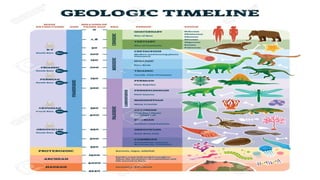
Rock records are illustrated on a
timeline called the Geologic time
Scale.
GEOLOGIC TIME SCALE
It is subdivided into hierarchal intervals,
the largest being EON, followed by
ERA, PERIOD, and EPOCH, respectively.
Subdivision of Geologic Time is based
from significant events in the Earth’s
History as interpreted from the rock
record.
How the time is scaled?
To establish the time scale,
scientists considered correct
succession of rocks which is
achieved through RELATIVE and
ABSOLUTE DATING TECHNIQUES.
TYPES OF DATING
ABSOLUTE DATING-scientists could assign specific
time units to mineral grains within a rock. It uses four
methods, namely: radiometric dating; amino-acid
dating; dendrochronology, and thermo-
luminescence.
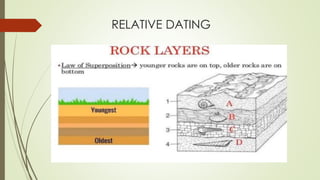
RELATIVE DATNG-it is based on the principle of
superposition. The layers on the bottom are said to
be the oldest and the layers above are the younger,
fossils that are found on the same layer are groups
that have lived together.
RELATIVE DATING
TYPES OF ABSOLUTE DATING
RADIOMETRIC DATING DENDROCHRONOLOGY
 Dates fossils through
determining the date
where the last time they
are heated.
 Method used to date
rocks and other objects
based on the decay rate
of radioactive isotopes.
AMINOACID DATING
 Determines the changes
in amino acid structure in
a specimen to date
fossils.
THERMOLUMINESCENCE
 Tree rings are examined
to date the exact year
they were formed.
GEOLOGIC TIME SCALE
FOUR MAJOR EONS
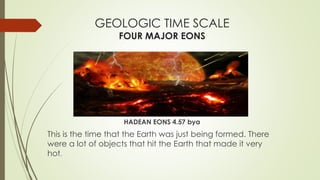
HADEAN EONS 4.57 bya
This is the time that the Earth was just being formed. There
were a lot of objects that hit the Earth that made it very
hot.
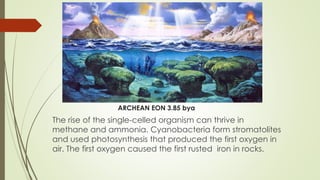
ARCHEAN EON 3.85 bya
The rise of the single-celled organism can thrive in
methane and ammonia. Cyanobacteria form stromatolites
and used photosynthesis that produced the first oxygen in
air. The first oxygen caused the first rusted iron in rocks.
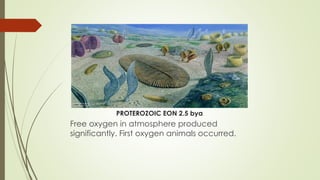
PROTEROZOIC EON 2.5 bya
Free oxygen in atmosphere produced
significantly. First oxygen animals occurred.
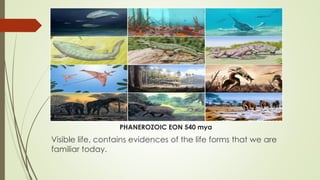
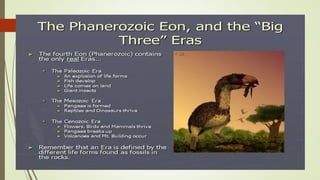
PHANEROZOIC EON 540 mya
Visible life, contains evidences of the life forms that we are
familiar today.
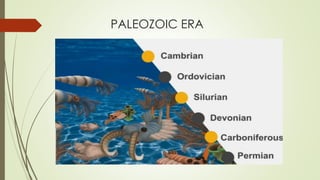
PALEOZOIC ERA
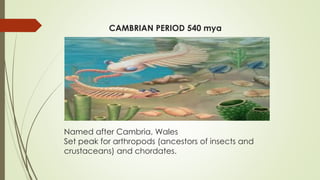
CAMBRIAN PERIOD 540 mya
Named after Cambria, Wales
Set peak for arthropods (ancestors of insects and
crustaceans) and chordates.
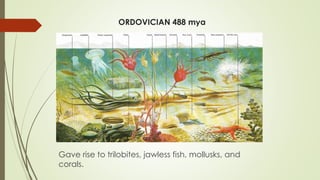
ORDOVICIAN 488 mya
Gave rise to trilobites, jawless fish, mollusks, and
corals.
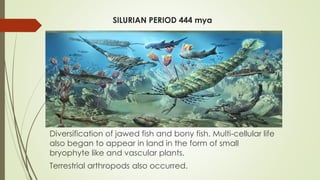
SILURIAN PERIOD 444 mya
Diversification of jawed fish and bony fish. Multi-cellular life
also began to appear in land in the form of small
bryophyte like and vascular plants.
Terrestrial arthropods also occurred.
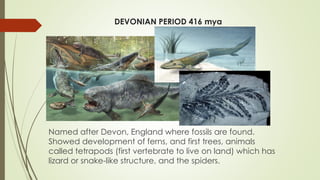
DEVONIAN PERIOD 416 mya
Named after Devon, England where fossils are found.
Showed development of ferns, and first trees, animals
called tetrapods (first vertebrate to live on land) which has
lizard or snake-like structure, and the spiders.
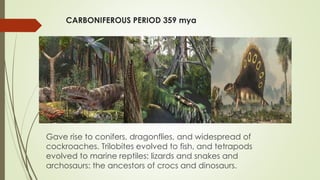
CARBONIFEROUS PERIOD 359 mya
Gave rise to conifers, dragonflies, and widespread of
cockroaches. Trilobites evolved to fish, and tetrapods
evolved to marine reptiles: lizards and snakes and
archosaurs: the ancestors of crocs and dinosaurs.
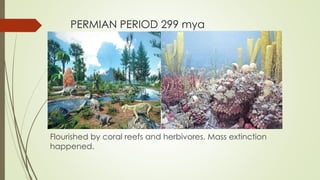
PERMIAN PERIOD 299 mya
Flourished by coral reefs and herbivores. Mass extinction
happened.
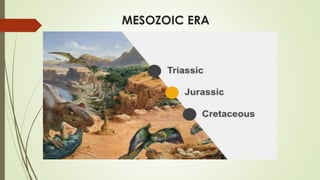
MESOZOIC ERA
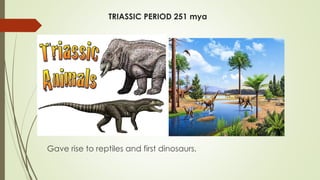
TRIASSIC PERIOD 251 mya
Gave rise to reptiles and first dinosaurs.
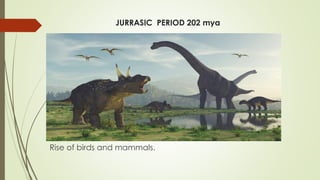
JURRASIC PERIOD 202 mya
Rise of birds and mammals.
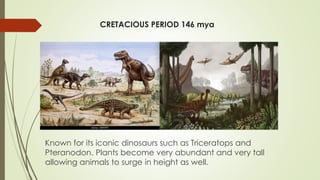
CRETACIOUS PERIOD 146 mya
Known for its iconic dinosaurs such as Triceratops and
Pteranodon. Plants become very abundant and very tall
allowing animals to surge in height as well.
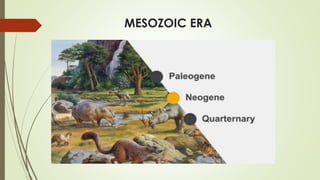
MESOZOIC ERA
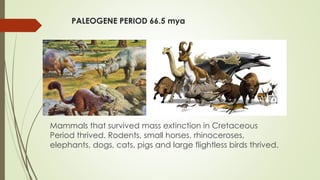
PALEOGENE PERIOD 66.5 mya
Mammals that survived mass extinction in Cretaceous
Period thrived. Rodents, small horses, rhinoceroses,
elephants, dogs, cats, pigs and large flightless birds thrived.
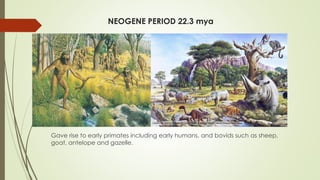
NEOGENE PERIOD 22.3 mya
Gave rise to early primates including early humans, and bovids such as sheep,
goat, antelope and gazelle.
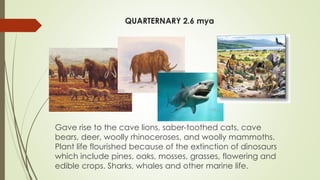
QUARTERNARY 2.6 mya
Gave rise to the cave lions, saber-toothed cats, cave
bears, deer, woolly rhinoceroses, and woolly mammoths.
Plant life flourished because of the extinction of dinosaurs
which include pines, oaks, mosses, grasses, flowering and
edible crops. Sharks, whales and other marine life.
Thank You for listening!

EARTH AND LIFE SCIENCE_GEOLOGIC TIME SCALE.pdf

  • 1.
    GEOLOGIC TIME SCALE EleanorL. Cabungcag Science Teacher,SHS
  • 2.
    GEOLOGIC TIME SCALE Theage of Earth is recorded on rocks which contains the remains and traces of plants and animals that have lived and died throughout Earth’s History (fossils). Rock records are illustrated on a timeline called the Geologic time Scale.
  • 4.
    GEOLOGIC TIME SCALE Itis subdivided into hierarchal intervals, the largest being EON, followed by ERA, PERIOD, and EPOCH, respectively. Subdivision of Geologic Time is based from significant events in the Earth’s History as interpreted from the rock record.
  • 5.
    How the timeis scaled? To establish the time scale, scientists considered correct succession of rocks which is achieved through RELATIVE and ABSOLUTE DATING TECHNIQUES.
  • 6.
    TYPES OF DATING ABSOLUTEDATING-scientists could assign specific time units to mineral grains within a rock. It uses four methods, namely: radiometric dating; amino-acid dating; dendrochronology, and thermo- luminescence. RELATIVE DATNG-it is based on the principle of superposition. The layers on the bottom are said to be the oldest and the layers above are the younger, fossils that are found on the same layer are groups that have lived together.
  • 7.
  • 8.
    TYPES OF ABSOLUTEDATING RADIOMETRIC DATING DENDROCHRONOLOGY  Dates fossils through determining the date where the last time they are heated.  Method used to date rocks and other objects based on the decay rate of radioactive isotopes. AMINOACID DATING  Determines the changes in amino acid structure in a specimen to date fossils. THERMOLUMINESCENCE  Tree rings are examined to date the exact year they were formed.
  • 9.
    GEOLOGIC TIME SCALE FOURMAJOR EONS HADEAN EONS 4.57 bya This is the time that the Earth was just being formed. There were a lot of objects that hit the Earth that made it very hot.
  • 10.
    ARCHEAN EON 3.85bya The rise of the single-celled organism can thrive in methane and ammonia. Cyanobacteria form stromatolites and used photosynthesis that produced the first oxygen in air. The first oxygen caused the first rusted iron in rocks.
  • 11.
    PROTEROZOIC EON 2.5bya Free oxygen in atmosphere produced significantly. First oxygen animals occurred.
  • 12.
    PHANEROZOIC EON 540mya Visible life, contains evidences of the life forms that we are familiar today.
  • 14.
  • 15.
    CAMBRIAN PERIOD 540mya Named after Cambria, Wales Set peak for arthropods (ancestors of insects and crustaceans) and chordates.
  • 16.
    ORDOVICIAN 488 mya Gaverise to trilobites, jawless fish, mollusks, and corals.
  • 17.
    SILURIAN PERIOD 444mya Diversification of jawed fish and bony fish. Multi-cellular life also began to appear in land in the form of small bryophyte like and vascular plants. Terrestrial arthropods also occurred.
  • 18.
    DEVONIAN PERIOD 416mya Named after Devon, England where fossils are found. Showed development of ferns, and first trees, animals called tetrapods (first vertebrate to live on land) which has lizard or snake-like structure, and the spiders.
  • 19.
    CARBONIFEROUS PERIOD 359mya Gave rise to conifers, dragonflies, and widespread of cockroaches. Trilobites evolved to fish, and tetrapods evolved to marine reptiles: lizards and snakes and archosaurs: the ancestors of crocs and dinosaurs.
  • 20.
    PERMIAN PERIOD 299mya Flourished by coral reefs and herbivores. Mass extinction happened.
  • 21.
  • 22.
    TRIASSIC PERIOD 251mya Gave rise to reptiles and first dinosaurs.
  • 23.
    JURRASIC PERIOD 202mya Rise of birds and mammals.
  • 24.
    CRETACIOUS PERIOD 146mya Known for its iconic dinosaurs such as Triceratops and Pteranodon. Plants become very abundant and very tall allowing animals to surge in height as well.
  • 25.
  • 26.
    PALEOGENE PERIOD 66.5mya Mammals that survived mass extinction in Cretaceous Period thrived. Rodents, small horses, rhinoceroses, elephants, dogs, cats, pigs and large flightless birds thrived.
  • 27.
    NEOGENE PERIOD 22.3mya Gave rise to early primates including early humans, and bovids such as sheep, goat, antelope and gazelle.
  • 28.
    QUARTERNARY 2.6 mya Gaverise to the cave lions, saber-toothed cats, cave bears, deer, woolly rhinoceroses, and woolly mammoths. Plant life flourished because of the extinction of dinosaurs which include pines, oaks, mosses, grasses, flowering and edible crops. Sharks, whales and other marine life.
  • 29.
    Thank You forlistening!