0 
SUMMEER INTRENSHIP PROJECT 
ON 
Selection and recruitment 
IN PARTIAL FULFILMENT OF FULL TIME, MBA PROGRAM 
(2013-2015) 
SUBMITTED TO: 
Dipak Hadiya (project coordinator) 
BK School of Business Management 
Gujarat University, Navrangpura, 
Ahmedabad-380009 
Phone: +917926304811 
info@bkschool.org.in 
SUBMITTED BY: 
Najeebullah Walijan hemat 
(11327)
ACKNOWLEDGEMENT 
“AS we can see the world is in progressing and development day by day it is all about helping each 
other human being’ no one is completed in this world, but all knee people try to learn something from 
the other in sample language the person who is our guide known as teacher 
The project report and this topic HUMAN RESOURCE PROCESS which I have selected was tough 
for me because it was my first project on HR so I collect information by the help of some people. 
There are those who help me to make this report and I am really appreciate o them who train me to 
takeover this project. i got the opportunity to thank all those who have help me to learn and got so 
money experience which will help me in my future life. 
First and the most honest person, I would like to say thank Mr. Ahmanduulah Tanha Noori the main 
manager of eagle vision for not only providing me the information and advice in my work, but he also 
motivating me during my training I really want to express my sincere and happiness for his gridline 
and support. He was always with me during the training process, and I am r1eally happy from the staff 
of eagle vision which they always welcome me a beach of thank to the staff of eagle vision. 
And I am also thankful from the staff of B K School of Management Studies and all the faculties 
which provide us such opportunities, specially Dipak Hadiya the project Coordinator. 
Najeeb Hemat 
1
2 
Table of content: page no. 
1. Chapter1. Introduction to the recruitment and selection …………………………… 3 
2. Objective, scope, mythology, source of data, limitations ………………………….. 3 to 6 
3. Chapter2. Company introduction and profile………………………………………… 6 to 9 
4. Chapter3 introduction and explanation of recruitments……………………………… 10 to 26 
5. Selection and selection process and all related issues ………………………………... 26 to 36 
6. Chapter4. Finding and analysis ………………………………………… 37 to 44 
7. Suggestion and recommendation ……………………………………………………. 45
Chapter1: 
INTRODUCTION 
IMPORTANCE OF RECRUITMENT & SELECTION PROCESS: 
Human Resources Management is concerned with human beings, who are the energetic elements of 
management. The success of any organization or an enterprise will depend upon the ability, strength 
and motivation of person’s working in it. The Human Resources Management refers to the systematic 
approach to the problems in any organization. It is concerned with recruitment, training and 
Development of personnel. Human resource is the most important asset of an organization. It ensures 
sufficient supply, proper quantity and as well as effective utilization of human resources. In order to 
meet human resources needs, and organization will have to plan in advance about the requirement and 
the sources, etc. The organization may also have to undertake recruiting select ing and training 
processes. Human Resources Management includes the inventory of present manpower in the 
organization. In cases sufficient number of persons is not available in the organization then external 
sources are also identified for employing them. Human Resources. Management lays emphasis on 
better working condition and also ensures the employment of proper work force. A part of Human 
Resources Management is assigned to personnel who perform some of the staffing function. The 
staffing process is a flow of events, which result in a continuous managing organizational position at, 
all levels from the top management to the operative’s level. This process includes manpower-planning, 
authorization for planning; developing sources of applicant evaluation of applications employment 
decision (selection) offers (placement) induction and orientation, transfers, demotions, promotions and 
separations. Manpower’s planning is a process of analyzing the present and future vacancies as a result 
of retirement, discharges, transfer, promotion, absence or other reasons. Recruitment is concerned with 
the process of attracting qualified and components personnel for different jobs. This includes the 
identification of existing sources of the labor market, the 14 development o f new sources and the need 
for attracting large number potential applications so that good selections may be possible 
3 
Selection process is concerned with the development of selection policies and procedure and 
the evaluation of potential employees in terms of job specifications. This process includes the 
development of application blanks, valid and reliable tests, interview techniques employee reversal 
systems, evaluations and selections of personnel in terms of jobs specifications the making up of final 
recommendations to the hire management and the sending of offers and rejection latter’s. 
OBJECTIVES OF THE STUDY 
To understand the current recruitment policies being followed at eagle vision Reconstruction Company 
Conducted this study to know how effectively it is being implemented in the organization
4 
1. To study the present recruitment policies at vision Reconstruction Company 
2. To study different method of recruitment and selection depending on the requirements of the 
organization. 
3. To find the relation weather jobs offered based on qualification to the employee in the 
organization. 
4. To study the level of job satisfactions in the organization. 
5. To study the changes of recruitment policies in recent time in the organization. 
6. To know how the company fulfills its manpower requirement 
Scope of study: 
1. The research is done to know the process of the HR on the eagle vision. 
2. The study may help the company to improve the HRD process in the organization 
3. Through the study we will get why some people going for foreign remonstration companies. 
Research mythology: 
Data collection 
Primary data: 
A detailed and well- structured questionnaire was presented to the managerial staff at the eagle vision 
company. Copy of the questionnaire being distributed to the employees at random to obtain their views 
Further discussion regarding recruitment policies were held with the HRD manager. 
Secondary data:
The secondary data was gather from academic texts and company profi le from company websi te. 
Sample design: 
Sample design is the most important aspect. All the findings and conclusions will stand out 
authentically only when the sampl ing in correct. Various criteria of sampl ing for my resear ch survey 
is as follows 
5 
Sampling Area Kabul city 
Sampling population 600 
Sampling size 200 
The study was conducted with size of 200 employees selected at random from both supervisory and 
management staff of the eagle vision Reconstruction Company. 
Research design: 
1. Data source : primary 
2. Research method : survey method 
3. Research technique : interviews, questionnaire 
4. Types of questionnaire : structure and unstructured 
5. Types of question : opened and closed ended 
6. Place : kabul 
Source of data:
The research is conducted with the help of questionnaire therefore the main source of 
information is the response of the respondents. In added to that I have taken help of the 
previous study conducted on this project topic or similar to this topic and I have also refer to 
the internet as well and collected the data. 
Analysis: 
The data collected through questionnaires distributed to the employees was analyzed and 
Limitations of the study: 
Every study and reached face some problem some of the problem which my study faced as follow . 
6 
1. The study conducted is restricted to the “Eagle vision Reconstruction Company.kabul” only 
2. Data accuracy of the study is based on the information given by the respondents. 
3. Data collected cannot be asserted to be free from errors because of bias on behalf of the 
respondents. 
4. As the sample size consisted of only 200 employees its accuracy has its limitation 
Chapter2: 
Company Introduction:- 
Eagle Vision Construction Company has been established by a group of renowned businessmen in a 
bid to help the rehabilitation process of the country that has left behind more than thirty years of war 
and civil unrests. The owners of EVCC enjoy good reputation due to their past and present careers, 
both professional – as shareholders in companies and businesses and personal –as respected members 
of the community. 
EVCC has all resources needed, financial capability, manpower and equipment and modern technology 
to provide construction and logistical services throughout the country. EVCC presently has two well-equipped 
offices providing construction and logistical services in Kabul and Kandahar Provinces and 
aims to expand the rich of its operations to other parts of the
Country. EVCC will soon be establishing its presence, initially, in the remaining five regional capitals, 
Jalalabad, Herat, Mazar-e Sharif, Gardiz and Kunduz. 
The construction and logistics activities are currently handled by and controlled from the two 
mentioned offices. Our services include, but are not limited to, provision of clean water, treatment of 
water plants, construction of offices and commercial building, road construction and construction of 
highway sand causeways as well as of schools hospitals and other specialized buildings; supplying all 
kinds of fuel directly from the major Russian and Central Asian refineries, supplying food and non-food 
7 
commodities and providing all kinds of logistical services. 
EVCC is run by a team of well experienced and professional engineers, managers and other support 
staff. It owns heavy machinery, construction equipment, transport vehicles and MHE Staff to 
implement any kind of construction and logistic projects. 
EVCC is working in the private sector and is a private owned for-profit organization. The company is 
led by a group of innovative and experienced board of directors and has sufficient financial capacity to 
work on any kind of medium to large volume projects. The services of an experienced management 
and of technical professionals are a key driver for the company’s growth. The details of the 
organizational structure, capabilities, technical professionals, management staff, equipment, machinery 
and human resources have been provided in this profile for a better assessment of the organizational 
and operational capabilities. 
The strategies objective of the government is capital works management framework are to ensure. 
1. Greater cost certainty award stage. 
2. Better value for money at all stages during project delivery, particularly. 
3. More efficient delivery of a project. 
Provided there is a comprehensive definition of client s requirement in term of output specification, 
and adequate pretender details design input, the new public works contract will enable the key 
objectives outlined above be achieved.
Mission statement: 
Eagle vision Construction Company is a leader in providing value-added construction services to the 
customers by creating a successful partnership with them throughout the construction process. Mission 
of the company is to establish lasting relation with the customer by exceeding their expectations and 
gaining their trust through exceptional performance by every member of the construction teams. 
Vision statement: 
The eagle vision, vision is to be the preeminent provider of superior construction services by 
consistently improving the quality of the product; to add value for clients through innovations, 
foresight, integrity, and aggressive performance, and to serve with character and purpose that brings 
honor to God 
SWOT Analysis: 
Regardless of whether you develop a full-blown strategic plan or not, you certainly want to do some 
planning for your businesses. Planning is about setting objective, prioritizing, allocating resource and 
establishing milestones to better manage your business. SWOT analysis techniques as strategic 
planning tool. The concept is simple and easy to apply to any business. SWOT stand for Strengths, 
Weakness, Opportunities and Threats usually the following questions can be asked in term of SWOT 
analysis. 
8 
1. Does your company have strengths that are an advantage over your completion? 
2. Are weaknesses unnecessarily holding you back? 
3. Are there opportunities within your market that you might pursue? 
4. Are there some unknown threats to your company that need to adderss?
Strengths: 
The company has certain strengths such as dominant market share, a highly skilled labor force or e can 
say that strong balance sheet. 
Whenever we want to know about the strengths of the company we should know the answer of the 
following questions. 
9 
 What is the company market share? 
 What are the company most successful lines of business? 
 Does the company have a pool of skilled employee? 
 Dose the company have strong financial position? 
Weakness: 
There are some weaknesses that the eagle vision facing. 
 Lack of financial resource, they have not enough finance to improve their mission in a proper 
way as they settled. 
 Lack of technology the way they need they do not have. 
Opportunity: 
There are more opportunities that let the eagle vision enjoy 
 As we said that the company is leader in Afghanistan in constricting. 
 There is more market share that they can enjoy. 
 Huge supplier it has more supplier who can supply raw material for them 
Threat: 
There are more threat for the company which it has to deal with it following are some of the threat
which eagle vision facing 
10 
 The political condition 
 Dynamic situations 
 Threat of competitors 
Chapter3: 
Recruitment:- 
Introduction: 
Recruitment forms the first in the process, which continues with selection and ceases 
with the placement of the candidate. It is the next step in the procurement function, the first 
being the manpower planning, Recruitment makes it possible to acquit the number and types of 
people necessary to ensure the continued operation of the organizat ion.” Recruitment is the 
discovering of potential applicants for actual or anticipated organizat ional vacancies”. 
Recruitment has been regarded as the most important function of personnel administration, 
Because unless the right type of people is hired, even the best plans, organizat ion charts and 
control systems would not do much good. 
Definition: 
“Recruitment is a process to discover the sources of manpower to meet the requirement of the 
Staffing schedule and to employ effective measures for attracting that manpower in adequate 
number to facilitate effective selection of an efficient working force”. 
Is the process of searching the candidates for employment and stimulating them to apply for job 
in the organizat ions recruitment is the activity that links the employers and the job seekers
Purpose and importance 
11 
 Determine the present and future requirements 
 Increase the pool of job candidates at 
minimum cost. 
 Reduce the probability of employee turn 
over 
 Increase the success rate of the selection process 
 Increase organizat ional and individual’ s effectiveness 
Effect: 
Positive Recruitment Process 
Attract highly qualified and competent people 
Ensure that the selected candidates stay longer with the company 
Make sure that there is match between cost and benefit 
Help the firm create more culturally diverse work-force 
Negative Recruitme nt Process 
Failure to generate qualified applicants 
There is no match between cost and benefit 
Extra cost on training and supervisio n 
Increases the entry level pay scales
12
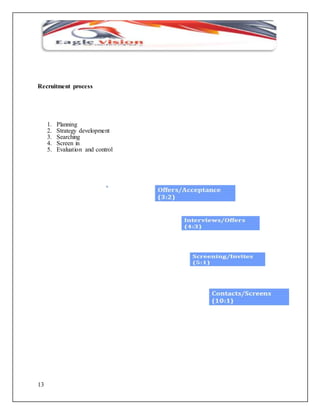
Recruitment process 
13 
1. Planning 
2. Strategy development 
3. Searching 
4. Screen in 
5. Evaluation and control
Objective of recruitment 
14 
To attract people with mult i-dimensio nal skills and experiences that suit the present and 
future organizational strategies so as to obtain a pool of suitable candidates for vacant 
posts. 
To induct outsiders with a new perspective to lead the company 
To infuse fresh blood at all levels of the organizat ion. 
To develop organizat ional culture that attracts competent people to the company. 
To use a fair process. 
To ensure that all recruitment activit ies contribute to company goals. 
To search for talent globally and not just within the company. 
To conduct recruitment activit ies in an efficient and cost effective manner. 
Employees’ recruitment 
In the working place is essential to a company’s long term success. By hiring correctly, 
an organization adds the talent it needs and can enjoy the benefits in increased productivity and 
morale. However this process is not simple and if the careful process of selection is not followed: 
you can be mired with poorly skilled, unmotivated and un-lo yal labor force which can impact
future profits as well as other employee behavior. 
Recruitment, Quite often this word stands alone when some gaming companies develop a human 
resources management strategy. An organization cannot develop a recruitment strategy without 
simultaneously for mulct ing an employee retention plan. Simply stated, it is one thing to attract 
workers, but quite another to retain them. 
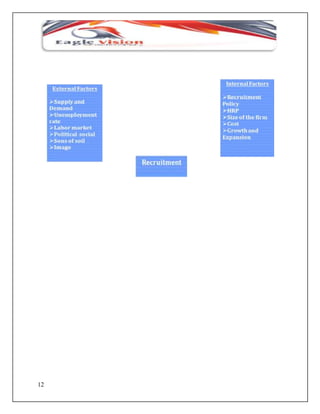
Factors affecting recruitment process 
All the organizations either its small or big size engaged to the recruitment process some of the factors 
which influence the recruitment process are as follow. 
1) The size of the organizat ion. 
2) The employment conditions in the community where the organizat ion is located. 
3) Working conditions, salary and benefit packages offered by the organizat ion. 
4) The rate of growth of the organization. 
5) Future expansio n program of the organizat ion. And 
6) Cultural and legal issues. 
7) Organizat ion’s ability to find and retain good performing people. 
Factors and source 
There are two source employees to recruit in the organization which will be discuses as follow, and 
also two sources of factors which influence the process 
15
Internal factors 
Employees from within the organizat ion are hired to fill a job vacancy. It is 
normally used for higher level jobs. 
The internal factors are: 
1 Company’s pay packages 
2 Quality of work life 
3 Organizat ion culture 
4 Career planning and growth 
5 Company’s size 
6 Company’s products/services 
7 Geographical spread of the company’s operations 
8 Company’s growth rate 
9 Role of trade unions 
10 Cost of recruitment 
11 Company’s name and fame. 
External factors 
16
The external factors are those which effect the organization externally 
The external factors are:- 
1 Socio-economic factors 
2 Supply and demand factors 
3 Emplo yment rate. 
4 Labor market conditions. 
5 Polit ical, legal and governmental factors 
6 Informat ion systems like employment exchanges /Tele-recruitment like internet. 
Advantages: 
17 
• Benefit s of new skills, new talents and new experiences to organizat ion 
• Compliance with reservat ion policy is easy 
• Scope for resentment, jealousies and heartburn are avoided 
Disadvantage s: 
• Better morale and motivat ion associated with internal recruit ing is denied to the 
organizat ion 
• It is costly
18 
• Chances of creeping in false positive and fake negative errors 
• Adjustment of new employees to the organizat ional culture takes longer time. 
Evaluations and control 
• Salaries for Recruiters 
• Management & professional time spent on preparing job descript ion, job specificat ion 
advertisements, liaison etc.. 
• Cost of advertisement 
• Cost of producing supporting literature 
• Recruitment overheads & administrative expenses 
• Cost of overtime & outsourcing 
Philosophies of recruitment 
• Tradit ional philosophy – to get as many people to apply for a job as possible 
• Waiting in queues 
• Job dissat isfact ion & employee turnover 
• Emphasis is on matching the needs of the organization to the needs of the applicants 
• Minimize employee turnover & enhance satisfact ion
Realistic job previews: 
19 
• Provides complete job related informat ion to the applicants so that they can make right 
decision before taking up jobs 
• Lower rate of employee turnover 
• High level of job satisfaction & performance 
• Beneficial for organizat ions hiring at the entry level 
Sources of recruitment: 
The various sources of external recruitment are: 
1. Advertising 
2. Emplo yment agencies 
3. Employee referrals 
4. Schools, colleges and professional institutions 
5. Labor unions 
6. Casual applicants
20 
7. Profess ional organizat ions or recruit ing firms or executive recruiters 
8. Indoctrinat ion seminars for college professors 
9. Unconsolidated applications 
10. Nepotism 
11. Leasing 
12. Voluntary organizat ions 
13. Computer data banks
21 
Recruitment policies 
A recruitment policy is concerned with quantity and qualificat ions of manpower. A well 
considered and pre-planned recruitment policy, based in corporate goals, study of environment 
and the corporate needs may avoid hasty of ill-considered decisions and may go a long way to 
man the organizat ion with the tight type of personnel. 
The most commonly adopted practice in an organizat ion is to centralize the recruitment and 
selection function. 
A “recruitment policy” in its broadest sense involves a commitment by the employer to such 
general principles as:- 
1 To find and employ the best qualified persons for each job. 
2 To retain the best and most promising to those hired. 
3 To offer promising opportunit ies for the life-t ime working careers. 
4 To provide programs and facilitates for personal growth on the job. 
The following factors should be taken into considerat ions in formulat ing recruitment policy. 
They are 
1. Government policies
22 
2. Personnel policies of other competing organization 
3. Organizat ion personnel policies 
4. Recruitment sources 
5. Recruitment need 
6. Recruitment costs 
7. Select ion criteria and preferences etc. 
Methods of recruitment: 
Recruitment can be broadly categorized under three namely, direct method, indirect method, and third 
party method. 
Direct method: 
One of the widely used direct methods is that of sending of recruiters to colleges and technical 
schools. Most college recruiting is done in co-operation with the placement office of a college. 
The placement office usually provides help in attraction students, arranging interviews, 
furnishing space, and providing student resumes. For managerial professional, and sales 
professional, campus recruit ing is an extensive operation. Persons reading for MBA or other 
technical diplomas are picked up in this manner. Many companies have found employees contact 
with the public a very effective method. Other direct methods include sending recruiters to 
conventions and seminars, setting up exhibits at fairs, and using mobile offices to go to the 
desired centers.
Indirect method: 
Indirect method usually involves advertising in news papers, on the radio, in trade and 
Professional journals, technical magazines and broachers. Advertis ing in newspapers and 
magazines, is the most frequent ly used methods, when qualified or experienced personnel are not 
available from other sources. Senior posts are largely filled by such methods when they cannot 
be filled by promotion from within. 
23 
Advertising is very useful for recruiting blue-collars and hourly workers as 
well as scientific, professional, and technical employees. Local newspapers can be a good source 
of blue-collar workers, clerical employees, and lower level administrative employees. 
Third party method: 
These include the use of commercial of private employment agencies, placement offices of 
schools colleges and professio nal associat ions, recruit ing firms, management consult ing firms, 
indoctrination seminar s for college for college professors and friends and relatives. 
Private employment agencies: 
They are the brokers who bring employers and employees together. The specializat ion of these 
Agencies enhances their capacities to interpret the needs of their client, to seek out
particular 
Types of persons, and to develop proficiency in recognizing the talent of specialized personnel. 
State public employment agencies: 
Also known as labor exchanges, they are the main agencies of public employment. They provide 
a clearing housing for jobs and job informat ion. These agencies provide a wide range of services-counseling, 
24 
assistance in getting jobs informat ion about labor market, labor and wage rates. 
Professional organization of recruitment firms: 
They maintain complete information records about employed executives. These firms are looked 
Up on as ‘headhunters’, ‘raider s’ and pirates by organizat ions which loose personnel 
through their efforts. However, these same organizat ions may employ “executive search 
firms” to help them find executive talent. These consult ing firms recommend persons of 
high caliber for managerial, marketing and production engineer’s posts. 
Trade union: 
Also provide manual and skilled workers in sufficient numbers.
25 
Tele-recruitment: 
The technological revolut ion in telecommunicat ion helped the organizat ion to 
Use internet as a source of recruitment. Organizat ion advertises the job vacancies 
through the World Wide Web (WWW) internet. The job seekers send their applications 
through e-mail or internet. Alternatively, job seekers place their CV’S in the 
world wide web/internet, which can be drawn by the perspective employers 
depending upon their requirements. 
Employee leasing 
Often called Staff outsourcing 
Useful to small & medium sized firms 
Reference check: 
1. The reference of the person should be checked before making a final decision. 
2. Check through a personal visit or a phone call directly to the applicant’s immediate
26 
Former supervisio n, if possible. 
3. Verify that the informat ion given to you is correct. 
4. Consider, with judgment, any negative comments you hear and what is not said. 
5. Checking references can bring to light significant information which may save you 
. Money and future inconvenience 
Recruitment Strategies: 
Findings Overview 
Organizat ions were asked what strategies they use to recruit both managerial/profess ional and 
Non-management candidates. For recruit ing managerial/professional candidates, the Internet is 
the most popular advertis ing medium, used by 76 percent of the organizat ions surveyed. 
Organizat ions regularly utilize internal resources (e.g., internal job postings and 
employee referrals) when recruit ing both internal and external candidates. Different kinds of 
agencies are used to recruit for positions at different levels. — Temporary and government 
agencies are used mainly to recruit non-management candidates. — Emplo yment 
agencies, colleges, and professio nal organizat ions are used more often to recruit 
managerial/pro fessio nal 
candidates. 
Organizational Offerings 
The quality of an organizat ion’s offerings affects its ability to attract job candidates.
Organizat ions believe they offer candidates a strong company reputation (69 percent) and 
high-quality benefits packages (65 percent) and learning opportunit ies (55 percent). 
Many organizat ions do not offer stock options (37 percent) or child care options (36 percent). 
Best Practices 
Organizations with the most effective recruit ing strategies were 15 to 19 percent more likely to 
offer candidates high-quality options such as: 
Barriers to Effective Recruitment and Selection: 
Findings Overview The surveyed organizations report that the top 
barriers to effective recruitment of candidates are: 
27 
Shortage of qualified applicants 
(62 percent). 
Competit ion for the same applicants 
(62 percent). 
Difficulty in finding and identifying applicants 
(48 percent). 
Selection: 
“Select ion is the process of examining the applicants with regard to their suitability for the given 
job or jobs, and choosing the best candidate and rejecting the others.” 
Good recruitment practices are only one key to generating a pool of top job candidates. Equally
important is having a strong basis from which to recruit. If an organizat ion’s policies and 
practices are unattractive to candidates, the organizat ion’s ability to generate good candidates 
will be limited regardles s of he specific recruitment practices they employee. 
But what policies and practice do “good” applicants find attractive? Unfortunately, there is no 
easy answer to this question because not all “good” applicants are alike, and research shows that 
organizat ion’s policies and the individual’ s characterist ics. 
Financial considerations, supply and demand, and other variables impact the recruitment process. 
Looking for a qualified person for the IT department is likely to require a broader and possibly 
more expensive search. Recruitment indicate that there is an increase in the use of the internet 
and interactive employment websites, such as searching web databases, placing online ads at 
various career sites, purchasing candidate informatio n from resume services, sending recruitment 
materials, to targeted individuals, and placing ads in newspapers can all yield positive results. 
Select ion is the process in which candidates for employment are divided in two classes-those 
application of these tools. Qualif ied applicants go on to the next hurdle, while the unqualified are 
eliminated”. Thus, an effective selection Programe is a non-random process because those 
selected have been chosen on the bases of the assumpt ion that they are more likely to be “better” 
employees than those who have been rejected. 
28 
Selection process 
The organizations can make use of more than one source for carrying out the recruitment 
Procedure. Once the recruit ing sources are identified, suitable candidates are called for the
Selection process. 
Significance of selection process: 
Definition: It is the process of different iat ion between applicants in order to identify (and hire) 
those with a greater likelihood of success in a job. Select ion of personnel to man the organizat ion 
is a crucial, complex and continuing function. The ability of an organization to attain its goals 
effectively and to develop in a dynamic environment largely depends upon the effectiveness of 
its selection program. If right personnel is selected the remaining functions of personnel 
management becomes easier, the employee contribut ion and commitment will be at an optimum 
level and employee- employer relat ions will be congenial. In an opposite situation where the 
right person is not selected, the remaining functions of personnel management, employee-employer 
29 
relations will not be effective. If the right person is selected, he becomes a valuable 
asset to the organizat ion. In case of faulty selection, the employee will become a liability to the 
organizat ion. 
who are to be offered employment and those who are not. The process might be called rejection, 
since more candidates may be turned away than hired. For this reason, selection is frequent ly 
described as a negative process, in contrast with the positive program of recruitment. 
According to Yoder:-“the hiring process is of one or many ‘go, no-go’ gauges. Candidates are 
screened by the
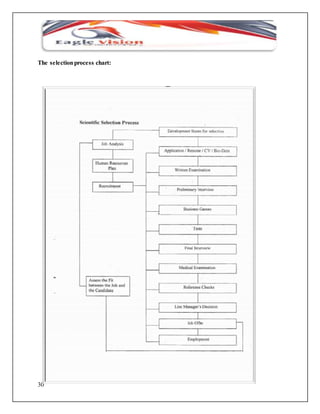
The selection process chart: 
30
Steps involved in the select ion process: 
A scientific selection procedure completes in 10 basic steps which are as follows: 
1. Applicat ion Form. 
2. Written Examinat ion. 
3. Preliminary Interview. 
4. Group Discussion. 
5. Tests. 
6. Final Interview. 
7. Medical Examinat ion. 
8. Reference Checks. 
9. Line Manager ’s Decisio n, and 
31
10. Emplo yment 
Testing in the selection process: 
32 
Testing represents an additional tool in the kit of the employment office. It 
supplements direct personal contracts in interviews of various types with a wide range of 
tests. All operate on the general theory that human behavior can best be forecast by 
sampling it. The test creates a situation in which the applicant reacts; reactions are 
regarded as useful samples of his behavior in the work he is applying. 
Formal testing programs have becomes increasingly common in modern selection. A 
major reason is their convenience. Another is their relatively low cost. Perhaps 
unfortunately, test results appeal to many managers because they provide quantitative 
measures of something. They ate, for this reason, more easily compared. They seem to 
bring the personalit ies of applicants down to a common denominator. Another reason for 
the growing use of tests is the fact that they have been and are the subject of extensive 
research. 
Types of employment tests
A simple classificat ion of the tests used in selection would distinguish five principal 
types, including achievement, aptitude, interest, personality, and combination tests. 
Achievement Tests: sample and measure the applicant’s accomplishments and 
developed abilit ies. They are performance tests; they ask the applicant’s 
accomplishments and developed abilit ies. They are performances tests; they ask the 
applicant to demonstrate certain knowledge skills. 
Aptitude tests: 
Measures an applicant’s capacity, his potential. Their simples form is the intelligence test, 
which 
Is intended to measure the ability to learn, to remember, and to reason. 
Interest test: 
Use selected questions or items to identify patterns of interests-areas in which the 
individua l shoes special concern, fascination and involvement. 
Personality test: 
Probe for the dominant qualit ies of the personality as a whole the combinat ion of 
aptitudes, interests, and usual mood and temperament. Whole the combination of 
aptitudes, interests, and usual mood and temperament. 
33
Guides to test: 
Dale s. Beach suggested the following guidelines for the employment test. 
1. Tests should be taken in addition to other selectio n techniques as entire can only 
provide informat ion about a part of total behavior of a candidate. 
2. Test informat ion should be taken into considerat ion to find out candidate’s weakness 
rather than strength. 
3. Tests are helpful in pocking a most likely successful group from a larger group 
rather than successful individuals. 
4. A test should be tested in one’s own organizat ion as “a valid test in one that measures. 
5. Tests can be held only in case of failure of other selection devices in providing 
satisfactory. 6. Test administrator s should not heavily depend upon test score in making 
decision regarding selection of a candidate. 
Relationship between tests score and job success is not always linear. Hence, decision-makers 
34 
should use the test score judicious ly.
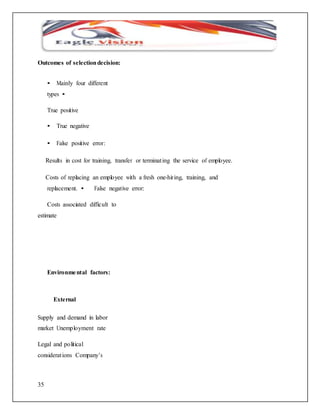
Outcomes of selection decision: 
35 
• Mainly four different 
types • 
True positive 
• True negative 
• False positive error: 
Results in cost for training, transfer or terminat ing the service of employee. 
Costs of replacing an employee with a fresh one-hir ing, training, and 
replacement. • False negative error: 
Costs associated difficult to 
estimate 
Environmental factors: 
External 
Supply and demand in labor 
market Unemployment rate 
Legal and political 
considerat ions Company’s
image 
36 
Internal 
Company’s 
policy Cost 
of hiring 
Concept of testing: 
1. Job analysis 
2. 
Reliabili 
ty 3. 
Validity 
TYPES OF TESTS: 
Intelligence tests include: sample learning, ability, the adaptability tests etc. 
1. Aptitudes test: 
Intell igent test 
Mechanical aptitudes
Psychomotor test 
Clerical aptitude test 
37 
2. Achievemen 
Job knowledge test 
Work sample test 
3. Situational 
Group test 
Discussion test 
4. Interest test 
5. Personality 
(a) Objective 
Test (b) 
Projective Test 
(b) Mechanical 
aptitude (c) 
Psychomotor 
(d) Clerical aptitude test 
Final interview: 
APPLICATION OF INTERVIEWS 
TYPE 
TYPE OF QUESTIONS 
USUAL APPLICATIONS 
Structured 
A predetermined checklist 
Useful for valid results,
38 
if questions, usually asked 
especially when dealing 
of all applicants. 
with large number of 
applicants. 
Unstructured 
Few, if any, planned 
Useful when the interview 
questions are made up 
tries to probe personal 
during the interview. 
details of the candidate 
analyzes why they are not 
right for the job. 
Mixed 
A combination of structured 
A realist ic approach that 
and unstructured questions, 
yields comparable answers 
which resembles what is a 
plus in depth insights. 
usually done in practice. 
Behavioral 
Quest ions limited to 
Useful to understand 
hypothetical situat ions. 
applicant’s reasoning and 
Evaluat ion is based on the 
analytical abilit ies under 
solut ion and approach of the 
modest stress. 
applicant. 
Stress 
A series of harsh, rapid fire 
Useful for stressful jobs, 
question intended to upset 
such as handling 
the applicant. 
complaints. 
Chapter4: 
My finding from eagle vision:
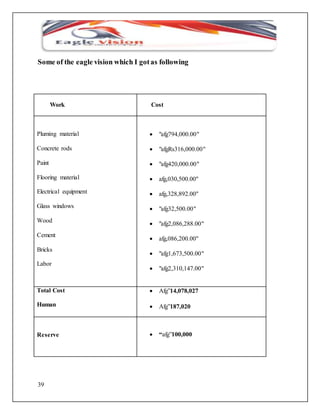
Some of the eagle vision which I got as following 
39 
Work 
Cost 
Pluming material 
Concrete rods 
Paint 
Flooring material 
Electrical equipment 
Glass windows 
Wood 
Cement 
Bricks 
Labor 
 "afg794,000.00" 
 "afgRs316,000.00" 
 "afg420,000.00" 
 afg,030,500.00" 
 afg,328,892.00" 
 "afg32,500.00" 
 "afg2,086,288.00" 
 afg,086,200.00" 
 "afg1,673,500.00" 
 "afg2,310,147.00" 
Total Cost 
Human 
 Afg”14,078,027 
 Afg”187,020 
Reserve 
 “afg”100,000
Total Price  “afg14,365,047 
40
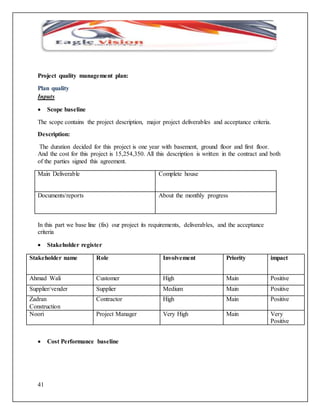
Project quality management plan: 
Plan quality 
Inputs 
 Scope baseline 
The scope contains the project description, major project deliverables and acceptance criteria. 
Description: 
The duration decided for this project is one year with basement, ground floor and first floor. 
And the cost for this project is 15,254,350. All this description is written in the contract and both 
of the parties signed this agreement. 
Main Deliverable Complete house 
Documents/reports About the monthly progress 
In this part we base line (fix) our project its requirements, deliverables, and the acceptance 
criteria 
 Stakeholder register 
Stakeholder name Role Involvement Priority impact 
Ahmad Wali Customer High Main Positive 
Supplier/vender Supplier Medium Main Positive 
Zadran 
Construction 
41 
Contractor High Main Positive 
Noori Project Manager Very High Main Very 
Positive 
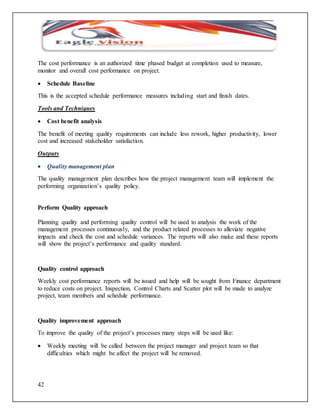
 Cost Performance baseline
The cost performance is an authorized time phased budget at completion used to measure, 
monitor and overall cost performance on project. 
 Schedule Baseline 
This is the accepted schedule performance measures including start and finish dates. 
Tools and Techniques 
 Cost benefit analysis 
The benefit of meeting quality requirements can include less rework, higher productivity, lower 
cost and increased stakeholder satisfaction. 
Outputs 
 Quality management plan 
The quality management plan describes how the project management team will implement the 
performing organization’s quality policy. 
Perform Quality approach 
Planning quality and performing quality control will be used to analysis the work of the 
management processes continuously, and the product related processes to alleviate negative 
impacts and check the cost and schedule variances. The reports will also make and these reports 
will show the project’s performance and quality standard. 
Quality control approach 
Weekly cost performance reports will be issued and help will be sought from Finance department 
to reduce costs on project. Inspection, Control Charts and Scatter plot will be made to analyze 
project, team members and schedule performance. 
Quality improvement approach 
To improve the quality of the project’s processes many steps will be used like: 
 Weekly meeting will be called between the project manager and project team so that 
42 
difficulties which might be affect the project will be removed.
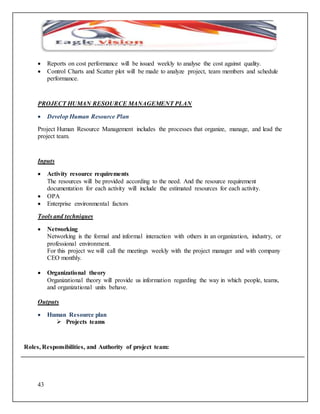
 Reports on cost performance will be issued weekly to analyse the cost against quality. 
 Control Charts and Scatter plot will be made to analyze project, team members and schedule 
43 
performance. 
PROJECT HUMAN RESOURCE MANAGEMENT PLAN 
 Develop Human Resource Plan 
Project Human Resource Management includes the processes that organize, manage, and lead the 
project team. 
Inputs 
 Activity resource requirements 
The resources will be provided according to the need. And the resource requirement 
documentation for each activity will include the estimated resources for each activity. 
 OPA 
 Enterprise environmental factors 
Tools and techniques 
 Networking 
Networking is the formal and informal interaction with others in an organization, industry, or 
professional environment. 
For this project we will call the meetings weekly with the project manager and with company 
CEO monthly. 
 Organizational theory 
Organizational theory will provide us information regarding the way in which people, teams, 
and organizational units behave. 
Outputs 
 Human Resource plan 
 Projects teams 
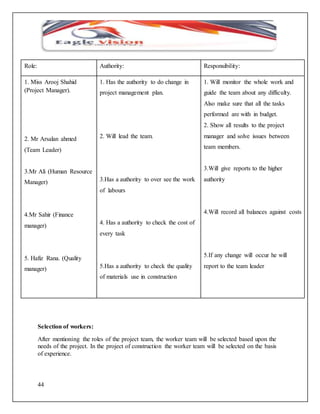
Roles, Responsibilities, and Authority of project team:
Role: Authority: Responsibility: 
1. Miss Arooj Shahid 
(Project Manager). 
2. Mr Arsalan ahmed 
(Team Leader) 
3.Mr Ali (Human Resource 
Manager) 
4.Mr Sahir (Finance 
manager) 
5. Hafiz Rana. (Quality 
manager) 
44 
1. Has the authority to do change in 
project management plan. 
2. Will lead the team. 
3.Has a authority to over see the work 
of labours 
4. Has a authority to check the cost of 
every task 
5.Has a authority to check the quality 
of materials use in construction 
1. Will monitor the whole work and 
guide the team about any difficulty. 
Also make sure that all the tasks 
performed are with in budget. 
2. Show all results to the project 
manager and solve issues between 
team members. 
3.Will give reports to the higher 
authority 
4.Will record all balances against costs 
5.If any change will occur he will 
report to the team leader 
Selection of workers: 
After mentioning the roles of the project team, the worker team will be selected based upon the 
needs of the project. In the project of construction the worker team will be selected on the basis 
of experience.
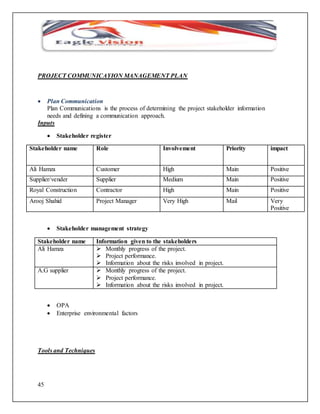
PROJECT COMMUNICAYION MANAGEMENT PLAN 
 Plan Communication 
45 
Plan Communications is the process of determining the project stakeholder information 
needs and defining a communication approach. 
Inputs 
 Stakeholder register 
Stakeholder name Role Involvement Priority impact 
Ali Hamza Customer High Main Positive 
Supplier/vender Supplier Medium Main Positive 
Royal Construction Contractor High Main Positive 
Arooj Shahid Project Manager Very High Mail Very 
Positive 
 Stakeholder management strategy 
Stakeholder name Information given to the stakeholders 
Ali Hamza  Monthly progress of the project. 
 Project performance. 
 Information about the risks involved in project. 
A.G supplier  Monthly progress of the project. 
 Project performance. 
 Information about the risks involved in project. 
 OPA 
 Enterprise environmental factors 
Tools and Techniques
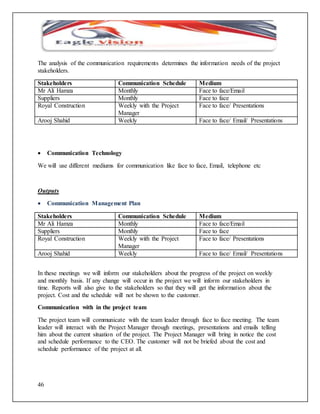
The analysis of the communication requirements determines the information needs of the project 
stakeholders. 
Stakeholders Communication Schedule Medium 
Mr Ali Hamza Monthly Face to face/Email 
Suppliers Monthly Face to face 
Royal Construction Weekly with the Project 
46 
Manager 
Face to face/ Presentations 
Arooj Shahid Weekly Face to face/ Email/ Presentations 
 Communication Technology 
We will use different mediums for communication like face to face, Email, telephone etc 
Outputs 
 Communication Management Plan 
Stakeholders Communication Schedule Medium 
Mr Ali Hamza Monthly Face to face/Email 
Suppliers Monthly Face to face 
Royal Construction Weekly with the Project 
Manager 
Face to face/ Presentations 
Arooj Shahid Weekly Face to face/ Email/ Presentations 
In these meetings we will inform our stakeholders about the progress of the project on weekly 
and monthly basis. If any change will occur in the project we will inform our stakeholders in 
time. Reports will also give to the stakeholders so that they will get the information about the 
project. Cost and the schedule will not be shown to the customer. 
Communication with in the project team 
The project team will communicate with the team leader through face to face meeting. The team 
leader will interact with the Project Manager through meetings, presentations and emails telling 
him about the current situation of the project. The Project Manager will bring in notice the cost 
and schedule performance to the CEO. The customer will not be briefed about the cost and 
schedule performance of the project at all.
47
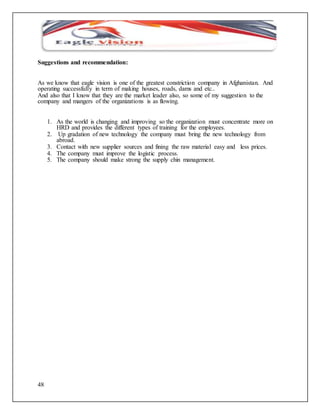
Suggestions and recommendation: 
As we know that eagle vision is one of the greatest constriction company in Afghanistan. And 
operating successfully in term of making houses, roads, dams and etc.. 
And also that I know that they are the market leader also, so some of my suggestion to the 
company and mangers of the organizations is as flowing. 
48 
1. As the world is changing and improving so the organization must concentrate more on 
HRD and provides the different types of training for the employees. 
2. Up gradation of new technology the company must bring the new technology from 
abroad. 
3. Contact with new supplier sources and fining the raw material easy and less prices. 
4. The company must improve the logistic process. 
5. The company should make strong the supply chin management.

Eagle Vision Kabul Afgh

  • 1.
    0 SUMMEER INTRENSHIPPROJECT ON Selection and recruitment IN PARTIAL FULFILMENT OF FULL TIME, MBA PROGRAM (2013-2015) SUBMITTED TO: Dipak Hadiya (project coordinator) BK School of Business Management Gujarat University, Navrangpura, Ahmedabad-380009 Phone: +917926304811 info@bkschool.org.in SUBMITTED BY: Najeebullah Walijan hemat (11327)
  • 2.
    ACKNOWLEDGEMENT “AS wecan see the world is in progressing and development day by day it is all about helping each other human being’ no one is completed in this world, but all knee people try to learn something from the other in sample language the person who is our guide known as teacher The project report and this topic HUMAN RESOURCE PROCESS which I have selected was tough for me because it was my first project on HR so I collect information by the help of some people. There are those who help me to make this report and I am really appreciate o them who train me to takeover this project. i got the opportunity to thank all those who have help me to learn and got so money experience which will help me in my future life. First and the most honest person, I would like to say thank Mr. Ahmanduulah Tanha Noori the main manager of eagle vision for not only providing me the information and advice in my work, but he also motivating me during my training I really want to express my sincere and happiness for his gridline and support. He was always with me during the training process, and I am r1eally happy from the staff of eagle vision which they always welcome me a beach of thank to the staff of eagle vision. And I am also thankful from the staff of B K School of Management Studies and all the faculties which provide us such opportunities, specially Dipak Hadiya the project Coordinator. Najeeb Hemat 1
  • 3.
    2 Table ofcontent: page no. 1. Chapter1. Introduction to the recruitment and selection …………………………… 3 2. Objective, scope, mythology, source of data, limitations ………………………….. 3 to 6 3. Chapter2. Company introduction and profile………………………………………… 6 to 9 4. Chapter3 introduction and explanation of recruitments……………………………… 10 to 26 5. Selection and selection process and all related issues ………………………………... 26 to 36 6. Chapter4. Finding and analysis ………………………………………… 37 to 44 7. Suggestion and recommendation ……………………………………………………. 45
  • 4.
    Chapter1: INTRODUCTION IMPORTANCEOF RECRUITMENT & SELECTION PROCESS: Human Resources Management is concerned with human beings, who are the energetic elements of management. The success of any organization or an enterprise will depend upon the ability, strength and motivation of person’s working in it. The Human Resources Management refers to the systematic approach to the problems in any organization. It is concerned with recruitment, training and Development of personnel. Human resource is the most important asset of an organization. It ensures sufficient supply, proper quantity and as well as effective utilization of human resources. In order to meet human resources needs, and organization will have to plan in advance about the requirement and the sources, etc. The organization may also have to undertake recruiting select ing and training processes. Human Resources Management includes the inventory of present manpower in the organization. In cases sufficient number of persons is not available in the organization then external sources are also identified for employing them. Human Resources. Management lays emphasis on better working condition and also ensures the employment of proper work force. A part of Human Resources Management is assigned to personnel who perform some of the staffing function. The staffing process is a flow of events, which result in a continuous managing organizational position at, all levels from the top management to the operative’s level. This process includes manpower-planning, authorization for planning; developing sources of applicant evaluation of applications employment decision (selection) offers (placement) induction and orientation, transfers, demotions, promotions and separations. Manpower’s planning is a process of analyzing the present and future vacancies as a result of retirement, discharges, transfer, promotion, absence or other reasons. Recruitment is concerned with the process of attracting qualified and components personnel for different jobs. This includes the identification of existing sources of the labor market, the 14 development o f new sources and the need for attracting large number potential applications so that good selections may be possible 3 Selection process is concerned with the development of selection policies and procedure and the evaluation of potential employees in terms of job specifications. This process includes the development of application blanks, valid and reliable tests, interview techniques employee reversal systems, evaluations and selections of personnel in terms of jobs specifications the making up of final recommendations to the hire management and the sending of offers and rejection latter’s. OBJECTIVES OF THE STUDY To understand the current recruitment policies being followed at eagle vision Reconstruction Company Conducted this study to know how effectively it is being implemented in the organization
  • 5.
    4 1. Tostudy the present recruitment policies at vision Reconstruction Company 2. To study different method of recruitment and selection depending on the requirements of the organization. 3. To find the relation weather jobs offered based on qualification to the employee in the organization. 4. To study the level of job satisfactions in the organization. 5. To study the changes of recruitment policies in recent time in the organization. 6. To know how the company fulfills its manpower requirement Scope of study: 1. The research is done to know the process of the HR on the eagle vision. 2. The study may help the company to improve the HRD process in the organization 3. Through the study we will get why some people going for foreign remonstration companies. Research mythology: Data collection Primary data: A detailed and well- structured questionnaire was presented to the managerial staff at the eagle vision company. Copy of the questionnaire being distributed to the employees at random to obtain their views Further discussion regarding recruitment policies were held with the HRD manager. Secondary data:
  • 6.
    The secondary datawas gather from academic texts and company profi le from company websi te. Sample design: Sample design is the most important aspect. All the findings and conclusions will stand out authentically only when the sampl ing in correct. Various criteria of sampl ing for my resear ch survey is as follows 5 Sampling Area Kabul city Sampling population 600 Sampling size 200 The study was conducted with size of 200 employees selected at random from both supervisory and management staff of the eagle vision Reconstruction Company. Research design: 1. Data source : primary 2. Research method : survey method 3. Research technique : interviews, questionnaire 4. Types of questionnaire : structure and unstructured 5. Types of question : opened and closed ended 6. Place : kabul Source of data:
  • 7.
    The research isconducted with the help of questionnaire therefore the main source of information is the response of the respondents. In added to that I have taken help of the previous study conducted on this project topic or similar to this topic and I have also refer to the internet as well and collected the data. Analysis: The data collected through questionnaires distributed to the employees was analyzed and Limitations of the study: Every study and reached face some problem some of the problem which my study faced as follow . 6 1. The study conducted is restricted to the “Eagle vision Reconstruction Company.kabul” only 2. Data accuracy of the study is based on the information given by the respondents. 3. Data collected cannot be asserted to be free from errors because of bias on behalf of the respondents. 4. As the sample size consisted of only 200 employees its accuracy has its limitation Chapter2: Company Introduction:- Eagle Vision Construction Company has been established by a group of renowned businessmen in a bid to help the rehabilitation process of the country that has left behind more than thirty years of war and civil unrests. The owners of EVCC enjoy good reputation due to their past and present careers, both professional – as shareholders in companies and businesses and personal –as respected members of the community. EVCC has all resources needed, financial capability, manpower and equipment and modern technology to provide construction and logistical services throughout the country. EVCC presently has two well-equipped offices providing construction and logistical services in Kabul and Kandahar Provinces and aims to expand the rich of its operations to other parts of the
  • 8.
    Country. EVCC willsoon be establishing its presence, initially, in the remaining five regional capitals, Jalalabad, Herat, Mazar-e Sharif, Gardiz and Kunduz. The construction and logistics activities are currently handled by and controlled from the two mentioned offices. Our services include, but are not limited to, provision of clean water, treatment of water plants, construction of offices and commercial building, road construction and construction of highway sand causeways as well as of schools hospitals and other specialized buildings; supplying all kinds of fuel directly from the major Russian and Central Asian refineries, supplying food and non-food 7 commodities and providing all kinds of logistical services. EVCC is run by a team of well experienced and professional engineers, managers and other support staff. It owns heavy machinery, construction equipment, transport vehicles and MHE Staff to implement any kind of construction and logistic projects. EVCC is working in the private sector and is a private owned for-profit organization. The company is led by a group of innovative and experienced board of directors and has sufficient financial capacity to work on any kind of medium to large volume projects. The services of an experienced management and of technical professionals are a key driver for the company’s growth. The details of the organizational structure, capabilities, technical professionals, management staff, equipment, machinery and human resources have been provided in this profile for a better assessment of the organizational and operational capabilities. The strategies objective of the government is capital works management framework are to ensure. 1. Greater cost certainty award stage. 2. Better value for money at all stages during project delivery, particularly. 3. More efficient delivery of a project. Provided there is a comprehensive definition of client s requirement in term of output specification, and adequate pretender details design input, the new public works contract will enable the key objectives outlined above be achieved.
  • 9.
    Mission statement: Eaglevision Construction Company is a leader in providing value-added construction services to the customers by creating a successful partnership with them throughout the construction process. Mission of the company is to establish lasting relation with the customer by exceeding their expectations and gaining their trust through exceptional performance by every member of the construction teams. Vision statement: The eagle vision, vision is to be the preeminent provider of superior construction services by consistently improving the quality of the product; to add value for clients through innovations, foresight, integrity, and aggressive performance, and to serve with character and purpose that brings honor to God SWOT Analysis: Regardless of whether you develop a full-blown strategic plan or not, you certainly want to do some planning for your businesses. Planning is about setting objective, prioritizing, allocating resource and establishing milestones to better manage your business. SWOT analysis techniques as strategic planning tool. The concept is simple and easy to apply to any business. SWOT stand for Strengths, Weakness, Opportunities and Threats usually the following questions can be asked in term of SWOT analysis. 8 1. Does your company have strengths that are an advantage over your completion? 2. Are weaknesses unnecessarily holding you back? 3. Are there opportunities within your market that you might pursue? 4. Are there some unknown threats to your company that need to adderss?
  • 10.
    Strengths: The companyhas certain strengths such as dominant market share, a highly skilled labor force or e can say that strong balance sheet. Whenever we want to know about the strengths of the company we should know the answer of the following questions. 9  What is the company market share?  What are the company most successful lines of business?  Does the company have a pool of skilled employee?  Dose the company have strong financial position? Weakness: There are some weaknesses that the eagle vision facing.  Lack of financial resource, they have not enough finance to improve their mission in a proper way as they settled.  Lack of technology the way they need they do not have. Opportunity: There are more opportunities that let the eagle vision enjoy  As we said that the company is leader in Afghanistan in constricting.  There is more market share that they can enjoy.  Huge supplier it has more supplier who can supply raw material for them Threat: There are more threat for the company which it has to deal with it following are some of the threat
  • 11.
    which eagle visionfacing 10  The political condition  Dynamic situations  Threat of competitors Chapter3: Recruitment:- Introduction: Recruitment forms the first in the process, which continues with selection and ceases with the placement of the candidate. It is the next step in the procurement function, the first being the manpower planning, Recruitment makes it possible to acquit the number and types of people necessary to ensure the continued operation of the organizat ion.” Recruitment is the discovering of potential applicants for actual or anticipated organizat ional vacancies”. Recruitment has been regarded as the most important function of personnel administration, Because unless the right type of people is hired, even the best plans, organizat ion charts and control systems would not do much good. Definition: “Recruitment is a process to discover the sources of manpower to meet the requirement of the Staffing schedule and to employ effective measures for attracting that manpower in adequate number to facilitate effective selection of an efficient working force”. Is the process of searching the candidates for employment and stimulating them to apply for job in the organizat ions recruitment is the activity that links the employers and the job seekers
  • 12.
    Purpose and importance 11  Determine the present and future requirements  Increase the pool of job candidates at minimum cost.  Reduce the probability of employee turn over  Increase the success rate of the selection process  Increase organizat ional and individual’ s effectiveness Effect: Positive Recruitment Process Attract highly qualified and competent people Ensure that the selected candidates stay longer with the company Make sure that there is match between cost and benefit Help the firm create more culturally diverse work-force Negative Recruitme nt Process Failure to generate qualified applicants There is no match between cost and benefit Extra cost on training and supervisio n Increases the entry level pay scales
  • 13.
  • 14.
    Recruitment process 13 1. Planning 2. Strategy development 3. Searching 4. Screen in 5. Evaluation and control
  • 15.
    Objective of recruitment 14 To attract people with mult i-dimensio nal skills and experiences that suit the present and future organizational strategies so as to obtain a pool of suitable candidates for vacant posts. To induct outsiders with a new perspective to lead the company To infuse fresh blood at all levels of the organizat ion. To develop organizat ional culture that attracts competent people to the company. To use a fair process. To ensure that all recruitment activit ies contribute to company goals. To search for talent globally and not just within the company. To conduct recruitment activit ies in an efficient and cost effective manner. Employees’ recruitment In the working place is essential to a company’s long term success. By hiring correctly, an organization adds the talent it needs and can enjoy the benefits in increased productivity and morale. However this process is not simple and if the careful process of selection is not followed: you can be mired with poorly skilled, unmotivated and un-lo yal labor force which can impact
  • 16.
    future profits aswell as other employee behavior. Recruitment, Quite often this word stands alone when some gaming companies develop a human resources management strategy. An organization cannot develop a recruitment strategy without simultaneously for mulct ing an employee retention plan. Simply stated, it is one thing to attract workers, but quite another to retain them. Factors affecting recruitment process All the organizations either its small or big size engaged to the recruitment process some of the factors which influence the recruitment process are as follow. 1) The size of the organizat ion. 2) The employment conditions in the community where the organizat ion is located. 3) Working conditions, salary and benefit packages offered by the organizat ion. 4) The rate of growth of the organization. 5) Future expansio n program of the organizat ion. And 6) Cultural and legal issues. 7) Organizat ion’s ability to find and retain good performing people. Factors and source There are two source employees to recruit in the organization which will be discuses as follow, and also two sources of factors which influence the process 15
  • 17.
    Internal factors Employeesfrom within the organizat ion are hired to fill a job vacancy. It is normally used for higher level jobs. The internal factors are: 1 Company’s pay packages 2 Quality of work life 3 Organizat ion culture 4 Career planning and growth 5 Company’s size 6 Company’s products/services 7 Geographical spread of the company’s operations 8 Company’s growth rate 9 Role of trade unions 10 Cost of recruitment 11 Company’s name and fame. External factors 16
  • 18.
    The external factorsare those which effect the organization externally The external factors are:- 1 Socio-economic factors 2 Supply and demand factors 3 Emplo yment rate. 4 Labor market conditions. 5 Polit ical, legal and governmental factors 6 Informat ion systems like employment exchanges /Tele-recruitment like internet. Advantages: 17 • Benefit s of new skills, new talents and new experiences to organizat ion • Compliance with reservat ion policy is easy • Scope for resentment, jealousies and heartburn are avoided Disadvantage s: • Better morale and motivat ion associated with internal recruit ing is denied to the organizat ion • It is costly
  • 19.
    18 • Chancesof creeping in false positive and fake negative errors • Adjustment of new employees to the organizat ional culture takes longer time. Evaluations and control • Salaries for Recruiters • Management & professional time spent on preparing job descript ion, job specificat ion advertisements, liaison etc.. • Cost of advertisement • Cost of producing supporting literature • Recruitment overheads & administrative expenses • Cost of overtime & outsourcing Philosophies of recruitment • Tradit ional philosophy – to get as many people to apply for a job as possible • Waiting in queues • Job dissat isfact ion & employee turnover • Emphasis is on matching the needs of the organization to the needs of the applicants • Minimize employee turnover & enhance satisfact ion
  • 20.
    Realistic job previews: 19 • Provides complete job related informat ion to the applicants so that they can make right decision before taking up jobs • Lower rate of employee turnover • High level of job satisfaction & performance • Beneficial for organizat ions hiring at the entry level Sources of recruitment: The various sources of external recruitment are: 1. Advertising 2. Emplo yment agencies 3. Employee referrals 4. Schools, colleges and professional institutions 5. Labor unions 6. Casual applicants
  • 21.
    20 7. Professional organizat ions or recruit ing firms or executive recruiters 8. Indoctrinat ion seminars for college professors 9. Unconsolidated applications 10. Nepotism 11. Leasing 12. Voluntary organizat ions 13. Computer data banks
  • 22.
    21 Recruitment policies A recruitment policy is concerned with quantity and qualificat ions of manpower. A well considered and pre-planned recruitment policy, based in corporate goals, study of environment and the corporate needs may avoid hasty of ill-considered decisions and may go a long way to man the organizat ion with the tight type of personnel. The most commonly adopted practice in an organizat ion is to centralize the recruitment and selection function. A “recruitment policy” in its broadest sense involves a commitment by the employer to such general principles as:- 1 To find and employ the best qualified persons for each job. 2 To retain the best and most promising to those hired. 3 To offer promising opportunit ies for the life-t ime working careers. 4 To provide programs and facilitates for personal growth on the job. The following factors should be taken into considerat ions in formulat ing recruitment policy. They are 1. Government policies
  • 23.
    22 2. Personnelpolicies of other competing organization 3. Organizat ion personnel policies 4. Recruitment sources 5. Recruitment need 6. Recruitment costs 7. Select ion criteria and preferences etc. Methods of recruitment: Recruitment can be broadly categorized under three namely, direct method, indirect method, and third party method. Direct method: One of the widely used direct methods is that of sending of recruiters to colleges and technical schools. Most college recruiting is done in co-operation with the placement office of a college. The placement office usually provides help in attraction students, arranging interviews, furnishing space, and providing student resumes. For managerial professional, and sales professional, campus recruit ing is an extensive operation. Persons reading for MBA or other technical diplomas are picked up in this manner. Many companies have found employees contact with the public a very effective method. Other direct methods include sending recruiters to conventions and seminars, setting up exhibits at fairs, and using mobile offices to go to the desired centers.
  • 24.
    Indirect method: Indirectmethod usually involves advertising in news papers, on the radio, in trade and Professional journals, technical magazines and broachers. Advertis ing in newspapers and magazines, is the most frequent ly used methods, when qualified or experienced personnel are not available from other sources. Senior posts are largely filled by such methods when they cannot be filled by promotion from within. 23 Advertising is very useful for recruiting blue-collars and hourly workers as well as scientific, professional, and technical employees. Local newspapers can be a good source of blue-collar workers, clerical employees, and lower level administrative employees. Third party method: These include the use of commercial of private employment agencies, placement offices of schools colleges and professio nal associat ions, recruit ing firms, management consult ing firms, indoctrination seminar s for college for college professors and friends and relatives. Private employment agencies: They are the brokers who bring employers and employees together. The specializat ion of these Agencies enhances their capacities to interpret the needs of their client, to seek out
  • 25.
    particular Types ofpersons, and to develop proficiency in recognizing the talent of specialized personnel. State public employment agencies: Also known as labor exchanges, they are the main agencies of public employment. They provide a clearing housing for jobs and job informat ion. These agencies provide a wide range of services-counseling, 24 assistance in getting jobs informat ion about labor market, labor and wage rates. Professional organization of recruitment firms: They maintain complete information records about employed executives. These firms are looked Up on as ‘headhunters’, ‘raider s’ and pirates by organizat ions which loose personnel through their efforts. However, these same organizat ions may employ “executive search firms” to help them find executive talent. These consult ing firms recommend persons of high caliber for managerial, marketing and production engineer’s posts. Trade union: Also provide manual and skilled workers in sufficient numbers.
  • 26.
    25 Tele-recruitment: Thetechnological revolut ion in telecommunicat ion helped the organizat ion to Use internet as a source of recruitment. Organizat ion advertises the job vacancies through the World Wide Web (WWW) internet. The job seekers send their applications through e-mail or internet. Alternatively, job seekers place their CV’S in the world wide web/internet, which can be drawn by the perspective employers depending upon their requirements. Employee leasing Often called Staff outsourcing Useful to small & medium sized firms Reference check: 1. The reference of the person should be checked before making a final decision. 2. Check through a personal visit or a phone call directly to the applicant’s immediate
  • 27.
    26 Former supervision, if possible. 3. Verify that the informat ion given to you is correct. 4. Consider, with judgment, any negative comments you hear and what is not said. 5. Checking references can bring to light significant information which may save you . Money and future inconvenience Recruitment Strategies: Findings Overview Organizat ions were asked what strategies they use to recruit both managerial/profess ional and Non-management candidates. For recruit ing managerial/professional candidates, the Internet is the most popular advertis ing medium, used by 76 percent of the organizat ions surveyed. Organizat ions regularly utilize internal resources (e.g., internal job postings and employee referrals) when recruit ing both internal and external candidates. Different kinds of agencies are used to recruit for positions at different levels. — Temporary and government agencies are used mainly to recruit non-management candidates. — Emplo yment agencies, colleges, and professio nal organizat ions are used more often to recruit managerial/pro fessio nal candidates. Organizational Offerings The quality of an organizat ion’s offerings affects its ability to attract job candidates.
  • 28.
    Organizat ions believethey offer candidates a strong company reputation (69 percent) and high-quality benefits packages (65 percent) and learning opportunit ies (55 percent). Many organizat ions do not offer stock options (37 percent) or child care options (36 percent). Best Practices Organizations with the most effective recruit ing strategies were 15 to 19 percent more likely to offer candidates high-quality options such as: Barriers to Effective Recruitment and Selection: Findings Overview The surveyed organizations report that the top barriers to effective recruitment of candidates are: 27 Shortage of qualified applicants (62 percent). Competit ion for the same applicants (62 percent). Difficulty in finding and identifying applicants (48 percent). Selection: “Select ion is the process of examining the applicants with regard to their suitability for the given job or jobs, and choosing the best candidate and rejecting the others.” Good recruitment practices are only one key to generating a pool of top job candidates. Equally
  • 29.
    important is havinga strong basis from which to recruit. If an organizat ion’s policies and practices are unattractive to candidates, the organizat ion’s ability to generate good candidates will be limited regardles s of he specific recruitment practices they employee. But what policies and practice do “good” applicants find attractive? Unfortunately, there is no easy answer to this question because not all “good” applicants are alike, and research shows that organizat ion’s policies and the individual’ s characterist ics. Financial considerations, supply and demand, and other variables impact the recruitment process. Looking for a qualified person for the IT department is likely to require a broader and possibly more expensive search. Recruitment indicate that there is an increase in the use of the internet and interactive employment websites, such as searching web databases, placing online ads at various career sites, purchasing candidate informatio n from resume services, sending recruitment materials, to targeted individuals, and placing ads in newspapers can all yield positive results. Select ion is the process in which candidates for employment are divided in two classes-those application of these tools. Qualif ied applicants go on to the next hurdle, while the unqualified are eliminated”. Thus, an effective selection Programe is a non-random process because those selected have been chosen on the bases of the assumpt ion that they are more likely to be “better” employees than those who have been rejected. 28 Selection process The organizations can make use of more than one source for carrying out the recruitment Procedure. Once the recruit ing sources are identified, suitable candidates are called for the
  • 30.
    Selection process. Significanceof selection process: Definition: It is the process of different iat ion between applicants in order to identify (and hire) those with a greater likelihood of success in a job. Select ion of personnel to man the organizat ion is a crucial, complex and continuing function. The ability of an organization to attain its goals effectively and to develop in a dynamic environment largely depends upon the effectiveness of its selection program. If right personnel is selected the remaining functions of personnel management becomes easier, the employee contribut ion and commitment will be at an optimum level and employee- employer relat ions will be congenial. In an opposite situation where the right person is not selected, the remaining functions of personnel management, employee-employer 29 relations will not be effective. If the right person is selected, he becomes a valuable asset to the organizat ion. In case of faulty selection, the employee will become a liability to the organizat ion. who are to be offered employment and those who are not. The process might be called rejection, since more candidates may be turned away than hired. For this reason, selection is frequent ly described as a negative process, in contrast with the positive program of recruitment. According to Yoder:-“the hiring process is of one or many ‘go, no-go’ gauges. Candidates are screened by the
  • 31.
  • 32.
    Steps involved inthe select ion process: A scientific selection procedure completes in 10 basic steps which are as follows: 1. Applicat ion Form. 2. Written Examinat ion. 3. Preliminary Interview. 4. Group Discussion. 5. Tests. 6. Final Interview. 7. Medical Examinat ion. 8. Reference Checks. 9. Line Manager ’s Decisio n, and 31
  • 33.
    10. Emplo yment Testing in the selection process: 32 Testing represents an additional tool in the kit of the employment office. It supplements direct personal contracts in interviews of various types with a wide range of tests. All operate on the general theory that human behavior can best be forecast by sampling it. The test creates a situation in which the applicant reacts; reactions are regarded as useful samples of his behavior in the work he is applying. Formal testing programs have becomes increasingly common in modern selection. A major reason is their convenience. Another is their relatively low cost. Perhaps unfortunately, test results appeal to many managers because they provide quantitative measures of something. They ate, for this reason, more easily compared. They seem to bring the personalit ies of applicants down to a common denominator. Another reason for the growing use of tests is the fact that they have been and are the subject of extensive research. Types of employment tests
  • 34.
    A simple classification of the tests used in selection would distinguish five principal types, including achievement, aptitude, interest, personality, and combination tests. Achievement Tests: sample and measure the applicant’s accomplishments and developed abilit ies. They are performance tests; they ask the applicant’s accomplishments and developed abilit ies. They are performances tests; they ask the applicant to demonstrate certain knowledge skills. Aptitude tests: Measures an applicant’s capacity, his potential. Their simples form is the intelligence test, which Is intended to measure the ability to learn, to remember, and to reason. Interest test: Use selected questions or items to identify patterns of interests-areas in which the individua l shoes special concern, fascination and involvement. Personality test: Probe for the dominant qualit ies of the personality as a whole the combinat ion of aptitudes, interests, and usual mood and temperament. Whole the combination of aptitudes, interests, and usual mood and temperament. 33
  • 35.
    Guides to test: Dale s. Beach suggested the following guidelines for the employment test. 1. Tests should be taken in addition to other selectio n techniques as entire can only provide informat ion about a part of total behavior of a candidate. 2. Test informat ion should be taken into considerat ion to find out candidate’s weakness rather than strength. 3. Tests are helpful in pocking a most likely successful group from a larger group rather than successful individuals. 4. A test should be tested in one’s own organizat ion as “a valid test in one that measures. 5. Tests can be held only in case of failure of other selection devices in providing satisfactory. 6. Test administrator s should not heavily depend upon test score in making decision regarding selection of a candidate. Relationship between tests score and job success is not always linear. Hence, decision-makers 34 should use the test score judicious ly.
  • 36.
    Outcomes of selectiondecision: 35 • Mainly four different types • True positive • True negative • False positive error: Results in cost for training, transfer or terminat ing the service of employee. Costs of replacing an employee with a fresh one-hir ing, training, and replacement. • False negative error: Costs associated difficult to estimate Environmental factors: External Supply and demand in labor market Unemployment rate Legal and political considerat ions Company’s
  • 37.
    image 36 Internal Company’s policy Cost of hiring Concept of testing: 1. Job analysis 2. Reliabili ty 3. Validity TYPES OF TESTS: Intelligence tests include: sample learning, ability, the adaptability tests etc. 1. Aptitudes test: Intell igent test Mechanical aptitudes
  • 38.
    Psychomotor test Clericalaptitude test 37 2. Achievemen Job knowledge test Work sample test 3. Situational Group test Discussion test 4. Interest test 5. Personality (a) Objective Test (b) Projective Test (b) Mechanical aptitude (c) Psychomotor (d) Clerical aptitude test Final interview: APPLICATION OF INTERVIEWS TYPE TYPE OF QUESTIONS USUAL APPLICATIONS Structured A predetermined checklist Useful for valid results,
  • 39.
    38 if questions,usually asked especially when dealing of all applicants. with large number of applicants. Unstructured Few, if any, planned Useful when the interview questions are made up tries to probe personal during the interview. details of the candidate analyzes why they are not right for the job. Mixed A combination of structured A realist ic approach that and unstructured questions, yields comparable answers which resembles what is a plus in depth insights. usually done in practice. Behavioral Quest ions limited to Useful to understand hypothetical situat ions. applicant’s reasoning and Evaluat ion is based on the analytical abilit ies under solut ion and approach of the modest stress. applicant. Stress A series of harsh, rapid fire Useful for stressful jobs, question intended to upset such as handling the applicant. complaints. Chapter4: My finding from eagle vision:
  • 40.
    Some of theeagle vision which I got as following 39 Work Cost Pluming material Concrete rods Paint Flooring material Electrical equipment Glass windows Wood Cement Bricks Labor  "afg794,000.00"  "afgRs316,000.00"  "afg420,000.00"  afg,030,500.00"  afg,328,892.00"  "afg32,500.00"  "afg2,086,288.00"  afg,086,200.00"  "afg1,673,500.00"  "afg2,310,147.00" Total Cost Human  Afg”14,078,027  Afg”187,020 Reserve  “afg”100,000
  • 41.
    Total Price “afg14,365,047 40
  • 42.
    Project quality managementplan: Plan quality Inputs  Scope baseline The scope contains the project description, major project deliverables and acceptance criteria. Description: The duration decided for this project is one year with basement, ground floor and first floor. And the cost for this project is 15,254,350. All this description is written in the contract and both of the parties signed this agreement. Main Deliverable Complete house Documents/reports About the monthly progress In this part we base line (fix) our project its requirements, deliverables, and the acceptance criteria  Stakeholder register Stakeholder name Role Involvement Priority impact Ahmad Wali Customer High Main Positive Supplier/vender Supplier Medium Main Positive Zadran Construction 41 Contractor High Main Positive Noori Project Manager Very High Main Very Positive  Cost Performance baseline
  • 43.
    The cost performanceis an authorized time phased budget at completion used to measure, monitor and overall cost performance on project.  Schedule Baseline This is the accepted schedule performance measures including start and finish dates. Tools and Techniques  Cost benefit analysis The benefit of meeting quality requirements can include less rework, higher productivity, lower cost and increased stakeholder satisfaction. Outputs  Quality management plan The quality management plan describes how the project management team will implement the performing organization’s quality policy. Perform Quality approach Planning quality and performing quality control will be used to analysis the work of the management processes continuously, and the product related processes to alleviate negative impacts and check the cost and schedule variances. The reports will also make and these reports will show the project’s performance and quality standard. Quality control approach Weekly cost performance reports will be issued and help will be sought from Finance department to reduce costs on project. Inspection, Control Charts and Scatter plot will be made to analyze project, team members and schedule performance. Quality improvement approach To improve the quality of the project’s processes many steps will be used like:  Weekly meeting will be called between the project manager and project team so that 42 difficulties which might be affect the project will be removed.
  • 44.
     Reports oncost performance will be issued weekly to analyse the cost against quality.  Control Charts and Scatter plot will be made to analyze project, team members and schedule 43 performance. PROJECT HUMAN RESOURCE MANAGEMENT PLAN  Develop Human Resource Plan Project Human Resource Management includes the processes that organize, manage, and lead the project team. Inputs  Activity resource requirements The resources will be provided according to the need. And the resource requirement documentation for each activity will include the estimated resources for each activity.  OPA  Enterprise environmental factors Tools and techniques  Networking Networking is the formal and informal interaction with others in an organization, industry, or professional environment. For this project we will call the meetings weekly with the project manager and with company CEO monthly.  Organizational theory Organizational theory will provide us information regarding the way in which people, teams, and organizational units behave. Outputs  Human Resource plan  Projects teams Roles, Responsibilities, and Authority of project team:
  • 45.
    Role: Authority: Responsibility: 1. Miss Arooj Shahid (Project Manager). 2. Mr Arsalan ahmed (Team Leader) 3.Mr Ali (Human Resource Manager) 4.Mr Sahir (Finance manager) 5. Hafiz Rana. (Quality manager) 44 1. Has the authority to do change in project management plan. 2. Will lead the team. 3.Has a authority to over see the work of labours 4. Has a authority to check the cost of every task 5.Has a authority to check the quality of materials use in construction 1. Will monitor the whole work and guide the team about any difficulty. Also make sure that all the tasks performed are with in budget. 2. Show all results to the project manager and solve issues between team members. 3.Will give reports to the higher authority 4.Will record all balances against costs 5.If any change will occur he will report to the team leader Selection of workers: After mentioning the roles of the project team, the worker team will be selected based upon the needs of the project. In the project of construction the worker team will be selected on the basis of experience.
  • 46.
    PROJECT COMMUNICAYION MANAGEMENTPLAN  Plan Communication 45 Plan Communications is the process of determining the project stakeholder information needs and defining a communication approach. Inputs  Stakeholder register Stakeholder name Role Involvement Priority impact Ali Hamza Customer High Main Positive Supplier/vender Supplier Medium Main Positive Royal Construction Contractor High Main Positive Arooj Shahid Project Manager Very High Mail Very Positive  Stakeholder management strategy Stakeholder name Information given to the stakeholders Ali Hamza  Monthly progress of the project.  Project performance.  Information about the risks involved in project. A.G supplier  Monthly progress of the project.  Project performance.  Information about the risks involved in project.  OPA  Enterprise environmental factors Tools and Techniques
  • 47.
    The analysis ofthe communication requirements determines the information needs of the project stakeholders. Stakeholders Communication Schedule Medium Mr Ali Hamza Monthly Face to face/Email Suppliers Monthly Face to face Royal Construction Weekly with the Project 46 Manager Face to face/ Presentations Arooj Shahid Weekly Face to face/ Email/ Presentations  Communication Technology We will use different mediums for communication like face to face, Email, telephone etc Outputs  Communication Management Plan Stakeholders Communication Schedule Medium Mr Ali Hamza Monthly Face to face/Email Suppliers Monthly Face to face Royal Construction Weekly with the Project Manager Face to face/ Presentations Arooj Shahid Weekly Face to face/ Email/ Presentations In these meetings we will inform our stakeholders about the progress of the project on weekly and monthly basis. If any change will occur in the project we will inform our stakeholders in time. Reports will also give to the stakeholders so that they will get the information about the project. Cost and the schedule will not be shown to the customer. Communication with in the project team The project team will communicate with the team leader through face to face meeting. The team leader will interact with the Project Manager through meetings, presentations and emails telling him about the current situation of the project. The Project Manager will bring in notice the cost and schedule performance to the CEO. The customer will not be briefed about the cost and schedule performance of the project at all.
  • 48.
  • 49.
    Suggestions and recommendation: As we know that eagle vision is one of the greatest constriction company in Afghanistan. And operating successfully in term of making houses, roads, dams and etc.. And also that I know that they are the market leader also, so some of my suggestion to the company and mangers of the organizations is as flowing. 48 1. As the world is changing and improving so the organization must concentrate more on HRD and provides the different types of training for the employees. 2. Up gradation of new technology the company must bring the new technology from abroad. 3. Contact with new supplier sources and fining the raw material easy and less prices. 4. The company must improve the logistic process. 5. The company should make strong the supply chin management.