


1
A
PROJECT REPORT
ON
“REVIEW OFRECRUITMENT AND SELECTION PROCESS AT
ROOMAN TECHNOLOGIES”
SUBMITTED TO UNIVERSITY OF KASHMIR (SOUTH CAMPUS)
IN PARTIAL FULFILLMENT OF 2 YEARS FULL TIME COURSE
MASTER IN BUSINESS ADMINISTRATION
Session 2015-2017
Internal guide: Submitted By:
Prof. Zahoor Ah Parry Umar Farooq
External guide: Roll no.(15036113030)
Smruti Rekha
2
Certificate of origin
I,hereby declared to the best of our knowledge and belief that the project report entitled as
“Review of Recruitment and Selection process at Rooman Technologies” being submitted to
the partial fulfillment of South Campus of Kashmir University, is not the same one, which has
already been submitted for the completion of Post Graduate degree at any University in India
I hereby declare that all this work is purely done by ourselves on primary and secondary data and
it totally free from any biasness to any individual or any group of people.
Signature
3
Acknowledgement
The success and final outcome of this project required a lot of guidance and assistance from
many people and we are extremely privileged to have got this all along the completion of our
project. All that we have done is only due to such supervision and assistance and we would not
forget to thank them.
First and foremost, we would like to thank God Almighty for giving us the strength, knowledge,
ability and opportunity to undertake this project and to persevere and complete it satisfactorily.
Without his blessings, this achievement would not have been possible.
I respect and thank Mr. Manish Kumar, for providing us an opportunity to do the project work in
Rooman Technologies and giving us all support and guidance from his team which made me
completes the project duly.We are extremely thankful to him for providing such a nice support
and guidance through his team, although he had busy schedule managing the corporate affairs.
I owe my deep gratitude to our project guide (Ms. Smruti) who took keen interest on our project
work and guided us all along, till the completion of our project work by providing all the
necessary information for developing a good system.
4
I would not forget to remember the entire team of Rooman Technologies for their
encouragement and more over for their timely support and guidance till the completion of our
project work.
I am thankful to and fortunate enough to get constant encouragement, support and guidance from
all Teaching staffs of South Campus, University of Kashmir especially Mrs.Irfana Baba
(Coordinator of Management Studies) and Mr. Shahid Sir(Faculty of South Campus) which
helped us in successfully completing our project work. Also, we would like to extend our sincere
esteems to all staff in library for their timely support.
my acknowledgement would be incomplete without thanking the biggest source of our strength,
our family. The blessings of our parents and the love and care of our sisters who never let things
get dull or boring, have all made a tremendous contribution in helping us to reach this stage in
our life. We thank them for putting up with us in difficult moments where we felt stumped and
for goading us on to follow our dream of getting this degree. This would not have been possible
without their unwavering and unselfish love and support given to us at all times.
5
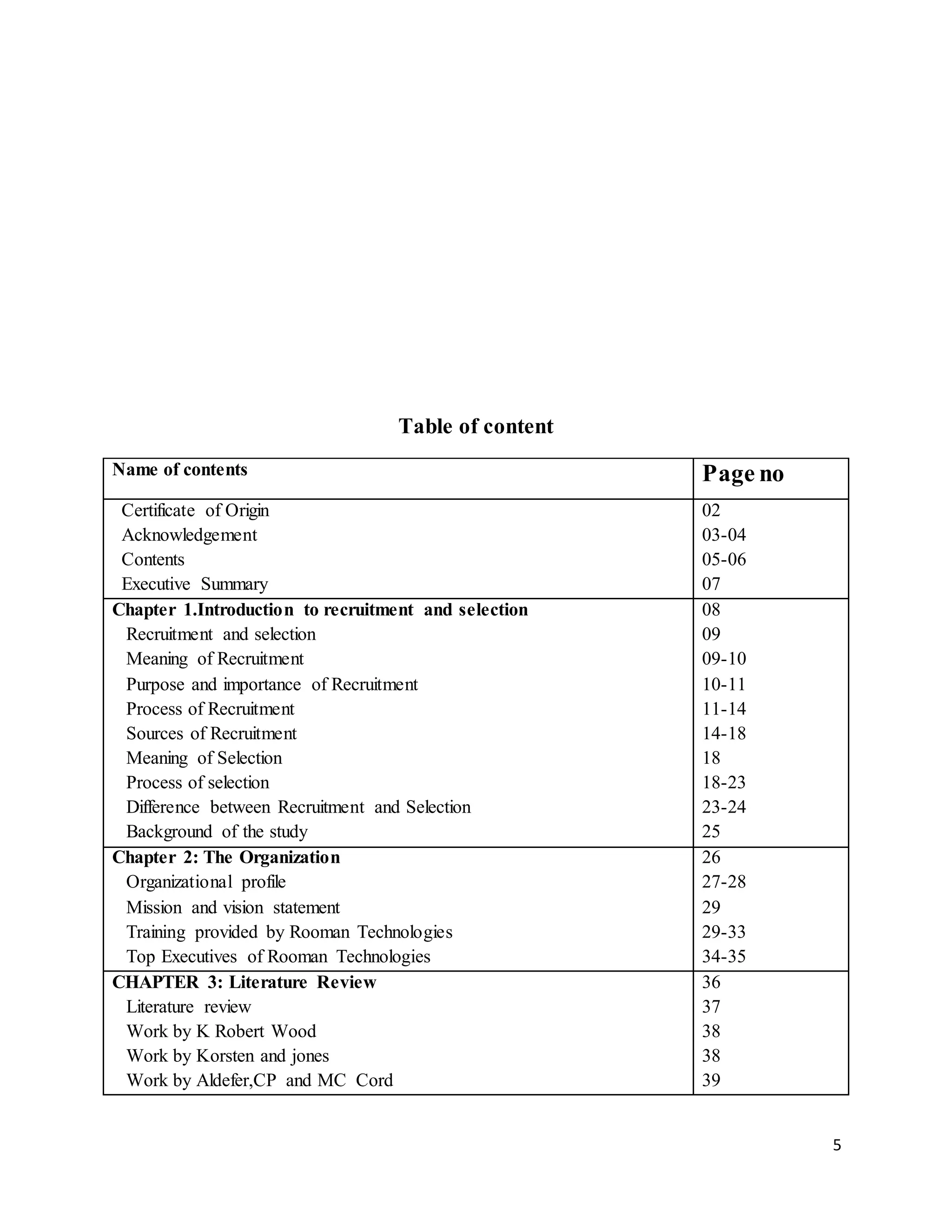
Table of content
Name of contents Page no
Certificate of Origin
Acknowledgement
Contents
Executive Summary
02
03-04
05-06
07
Chapter 1.Introduction to recruitment and selection
Recruitment and selection
Meaning of Recruitment
Purpose and importance of Recruitment
Process of Recruitment
Sources of Recruitment
Meaning of Selection
Process of selection
Difference between Recruitment and Selection
Background of the study
08
09
09-10
10-11
11-14
14-18
18
18-23
23-24
25
Chapter 2: The Organization
Organizational profile
Mission and vision statement
Training provided by Rooman Technologies
Top Executives of Rooman Technologies
26
27-28
29
29-33
34-35
CHAPTER 3: Literature Review
Literature review
Work by K Robert Wood
Work by Korsten and jones
Work by Aldefer,CP and MC Cord
36
37
38
38
39
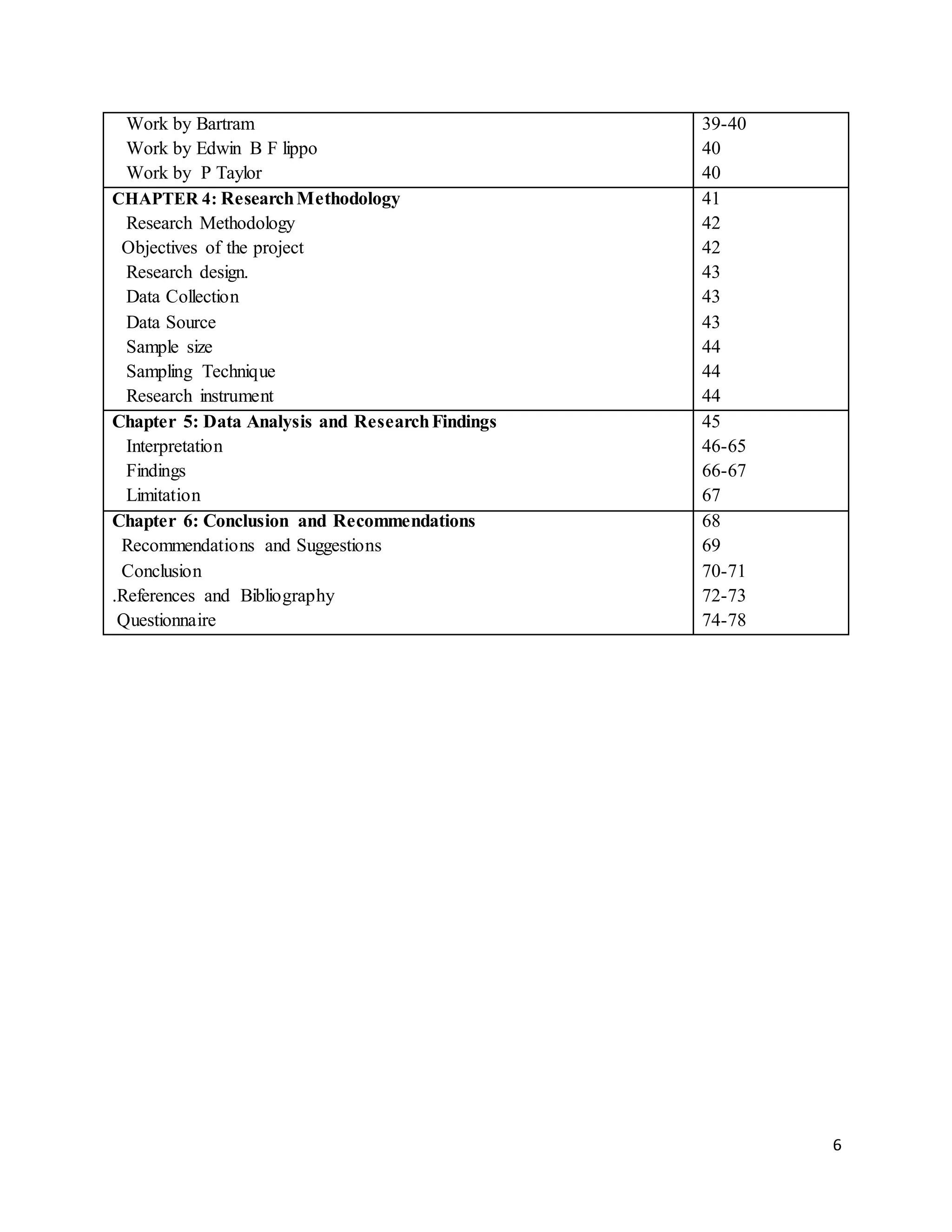
6
Work by Bartram
Work by Edwin B F lippo
Work by P Taylor
39-40
40
40
CHAPTER 4: ResearchMethodology
Research Methodology
Objectives of the project
Research design.
Data Collection
Data Source
Sample size
Sampling Technique
Research instrument
41
42
42
43
43
43
44
44
44
Chapter 5: Data Analysis and ResearchFindings
Interpretation
Findings
Limitation
45
46-65
66-67
67
Chapter 6: Conclusion and Recommendations
Recommendations and Suggestions
Conclusion
.References and Bibliography
Questionnaire
68
69
70-71
72-73
74-78
7
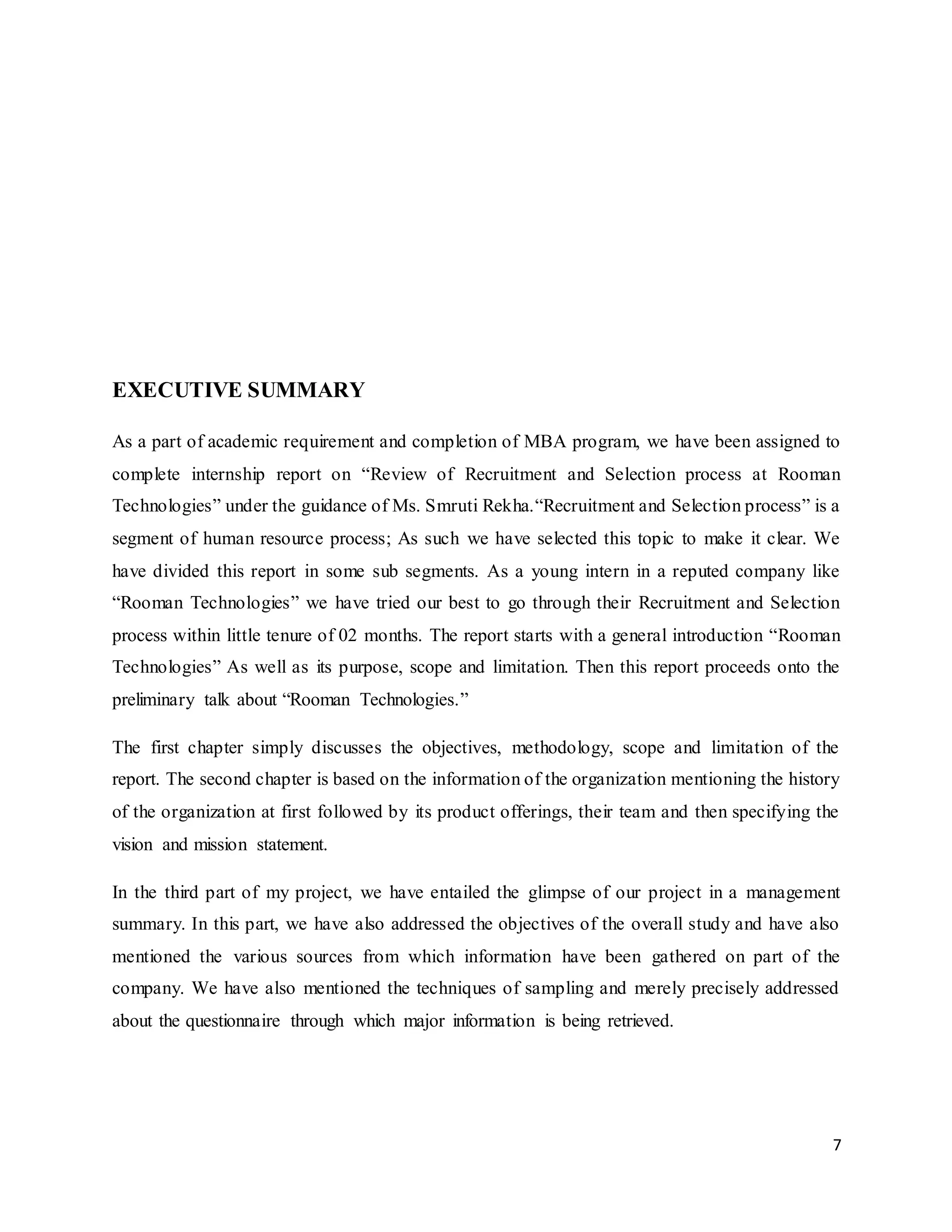
EXECUTIVE SUMMARY
As a part of academic requirement and completion of MBA program, we have been assigned to
complete internship report on “Review of Recruitment and Selection process at Rooman
Technologies” under the guidance of Ms. Smruti Rekha.“Recruitment and Selection process” is a
segment of human resource process; As such we have selected this topic to make it clear. We
have divided this report in some sub segments. As a young intern in a reputed company like
“Rooman Technologies” we have tried our best to go through their Recruitment and Selection
process within little tenure of 02 months. The report starts with a general introduction “Rooman
Technologies” As well as its purpose, scope and limitation. Then this report proceeds onto the
preliminary talk about “Rooman Technologies.”
The first chapter simply discusses the objectives, methodology, scope and limitation of the
report. The second chapter is based on the information of the organization mentioning the history
of the organization at first followed by its product offerings, their team and then specifying the
vision and mission statement.
In the third part of my project, we have entailed the glimpse of our project in a management
summary. In this part, we have also addressed the objectives of the overall study and have also
mentioned the various sources from which information have been gathered on part of the
company. We have also mentioned the techniques of sampling and merely precisely addressed
about the questionnaire through which major information is being retrieved.
8
Then comes to the fourth part of the project which discusses regarding the finding and analysis
of the overall subject. This part will throw light on the interpretation of the data and will further
cover up the limitation
of the study. Finally we shall reach to the conclusion which will cover the findings part and close
the topic by giving various recommendation and suggestions to the company.
Last but not the least, we will address many sources through which information was accessed
including Internet and published books.
CHAPTER -1
Introduction to Recruitment and Selection;
9
INTRODUCTION TO RECRUITMENT AND SELECTION
Recruitment is the process of attracting individuals on a timely basis in sufficient numbers and
with appropriate qualification, to apply for jobs within an organization. The process of searching
prospective employees with multidimensional skills and experience that suits organization
strategies in fundamental to the growth of the organization, this demands more comprehensive
strategic perspective recruitment. Organizations require the services of large number of
personnel, these personnel occupies the various positions created to the process of organization.
Each position of the organization has certain specific contributions to achieve the organizational
objectives. The recruitment process of the organizational has to be strong enough to attract and
select the potential candidates with right job specification. The recruitment process begins with
human resource planning and concludes with the selection of required number of candidates,
both HR staff and operating managers have responsibilities in the process.
“Right person for the right job is the basic principle in recruitment and selection. Every
organization should give attention to the selection of its manpower, especially its managers. The
operative manpower is equally important essential for the orderly working of an enterprise.
Every business organization /unit needs manpower for carrying different business activities
smoothly and efficiently and for this recruitment and selection of suitable candidates are
essential. Human resource management in an organization will not be possible if unsuitable
persons are selected and employment in a business unit.
RECRUITMENT
10
Meaning:
Recruitment means to estimate the available vacancies and to make suitable arrangements for
their selection and appointment. Recruitment is understood as the process of searching for and
obtaining applicants for the jobs, from among whom the right people can be selected.
A formal definition states, “It is the process of finding and attracting capable applicants for the
employment. The process begins when new recruits are sought and ends when their applicants
are submitted. The result is a pool of applicants from which new employees are selected”. In this,
the available vacancies are given wide publicity and suitable candidates are encouraged to
submit applications so as to have a pool of eligible candidates for scientific selection.
In recruitment, information is collected from interested candidates. For this different source such
as newspaper advertisement, employment exchanges, internal promotion, etc are used.
In the recruitment, a pool of eligible and interested candidates is created for selection of most
suitable candidates. Recruitment represents the first contact that a company makes with potential
employees
DEFINITION:
According to EDWIN FLIPPO, “Recruitment is the process of searching for Prospective
employees and stimulating them to apply for jobs in the organization.
Purpose and importance of Recruitment:
1. Determine the present and future requirements of the organization on conjunction with its
personnel-planning and job analysis activities.
2. Increase the pool of job candidates at minimum cost.
3. Help increase the success rate of the selection process by reducing the number of visibly under
qualified or overqualified job applicants..
11
4. Help reduce the probability that job applicants, once recruited and selected, will leave the
organization only after a short period of time
5. Meet the organization’s legal and social obligations regarding the composition of its work
force.
6. Begin identifying and preparing potential job applicants who will be appropriate candidates.
7. Increase organizational and individual effectiveness in the short term and long term.
8. Evaluate the effectiveness of various recruiting techniques and sources for all types of job
applicants.
9. Recruitment is a positive function in which publicity is given to the jobs available in the
organization and interested candidates are encouraged to submit applications for the purpose of
selection.
Recruitment Process:
Recruitment refers to the process of identifying and attracting job seekers so as to build a pool of
qualified job applicants. The process comprises five interrelated stages, viz.
1. Planning.
2. Strategy development.
3. Searching.
4. Screening.
5. Evaluation and control.
12
STAGE 1: RECRUITMENT PLANNING:
The first stage in the recruitment process is planning. Planning involves the translation of likely
job vacancies and information about the nature of these jobs into set of objectives or targets that
specify the (1) Numbers and (2) Types of applicants to be contacted.
Numbers of contact: Organization, nearly always, plan to attract more applicants than they will
hire. Some of those contacted will be uninterested, unqualified or both. Each time a recruitment
programme is contemplated; one task is to estimate the number of applicants necessary to fill all
vacancies with the qualified people.
Types of contacts: It is basically concerned with the types of people to be informed about job
openings. The type of people depends on the tasks and responsibilities involved and the
qualifications and experience expected. These details are available through job description and
job specification.
STAGE 2: STRATEGY DEVELOPMENT:
When it is estimated that what types of recruitment and how many are required then one has
concentrate in (1). Make or Buy employees. (2). Technological sophistication of recruitment and
selection devices. (3). Geographical distribution of labor markets comprising job seekers.(4).
Sources of recruitment. (5). Sequencing the activities in the recruitment process.
Make or Buy:
Organization must decide whether to hire le skilled employees and invest on training and
education programmes, or they can hire skilled labor and professional. Essentially, this is the,
make‟ or „buy‟ decision. Organizations, which hire skilled and professionals shall have to pay
more for these employees.
Technological Sophistication:
The second decision in strategy development relates to the methods used in recruitment and
selection. This decision is mainly influenced by the available technology. The advent of
computers has made it possible for employers to scan national and international applicant
13
qualification. Although impersonal, computers have given employers and job seekers a wider
scope of options in the initial screening stage.
STAGE 3: SEARCHING:
Once a recruitment plan and strategy are worked out, the search process can begin. Search
involves two steps:
A) Source activation and
B) Selling.
STEP 4: SCREENING:
Screening of applicants can be regarded as an integral part of the recruiting process, though
many view it as the first step in the selection process. Even the definition on recruitment, we
quoted in the beginning of this chapter, exclude screening from its scope. However, we have
included screening in recruitment for valid reasons. The selection process will begin after the
applications have been scrutinized and short-listed. Hiring of professors in a university is a
typical situation. Application received in response to advertisements is screened and only eligible
applicants are called for an interview. A selection committee comprising the Vice chancellor,
Registrar and subject experts conducts interview. Here, the recruitment process extends up to
screening the applications. The selection process commences only later.
Purpose of screening:
The purpose of screening is to remove from the recruitment process, at an early stage, those
applicants who are visibly unqualified for the job. Effective screening can save a great deal of
time and money.
In screening, clear job specifications are invaluable. It is both good practice and a legal necessity
that applicant’s qualification is judged on the basis of their knowledge, skills, abilities and
interest required to do the job.
14
STAGE 5: EVALUATION AND CONTROL:
Evaluation and control is necessary as considerable costs are incurred in the recruitment process.
The costs generally incurred are: -
1. Salaries for recruiters.
2. Management and professional time spent on preparing job description,
Job specifications, advertisements, agency liaison and so forth.
3. The cost of advertisements or other recruitment methods, that is, agency fees.
4. Recruitment overheads and administrative expenses.
5. Costs of overtime and outsourcing while the vacancies remain unfilled.
6. Cost of recruiting unsuitable candidates for the selection process.
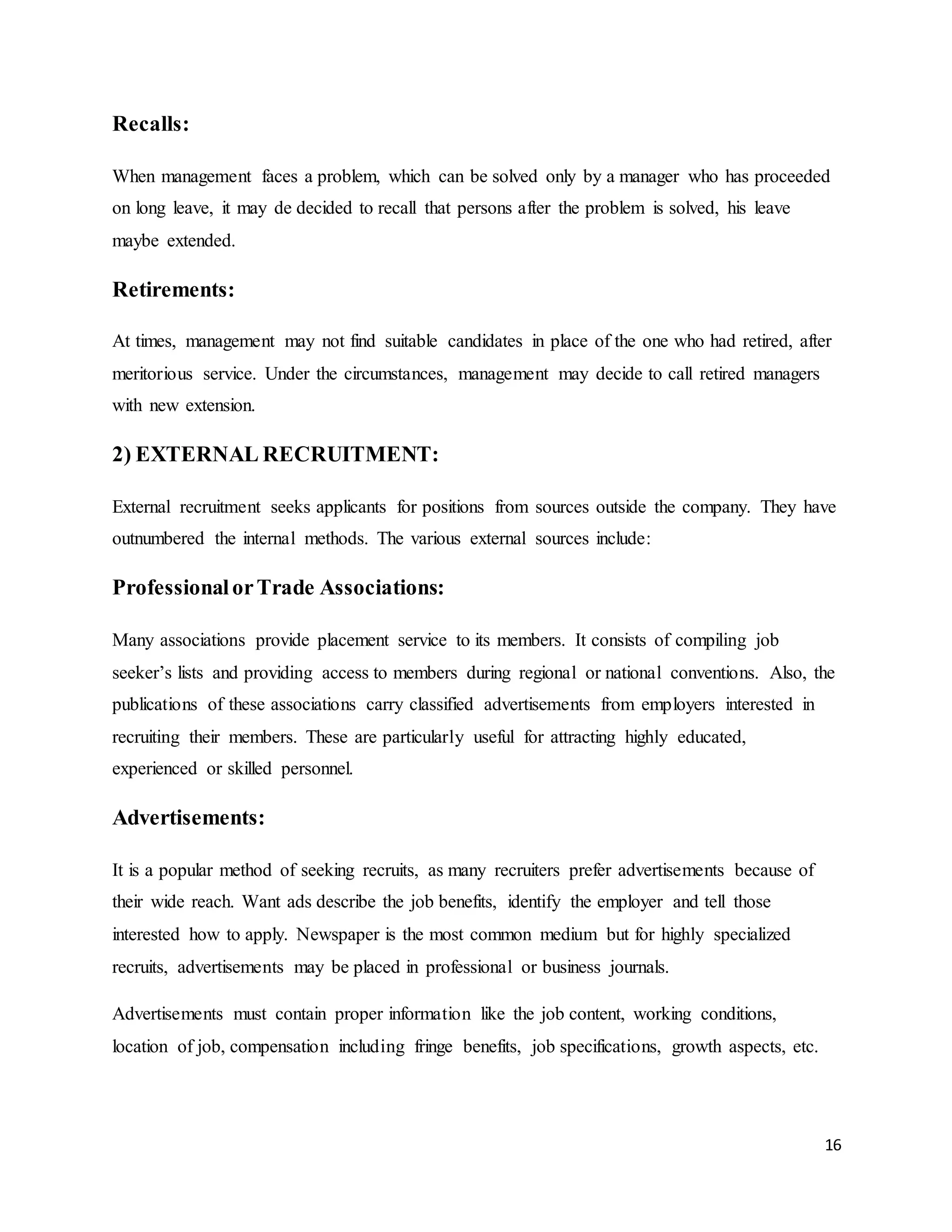
Sources ofRecruitment:
INTERNAL SOURCES EXTERNAL SOURCES
1 Promotion 1. Campus recruitment
2. Transfers 2. Press advertisement
3. Internal notification 3. Management consultancy service
4.Retirement 4. Deputation of personnel or transfer from one
enterprise to another
5. Former employees 5. Walk-ins, write-ins, talk-ins
The sources of recruitment can be broadly categorized into internal and external sources-
1) INTERNALRECRUITMENT:Internal recruitment seeks applicants for positions
from within the company. The various internal sources include:
15
2) Promotions and Transfers:Promotion is an effective means using job posting and
personnel records. Job posting requires notifying vacant positions by posting notices,
circulating publications or announcing at staff meetings and inviting employees to apply.
Personnel records help discover employees who are doing jobs below their educational
qualifications or skill levels. Promotions has many advantages like it is good public
relations, builds morale, encourages competent individuals who are ambitious, improves
the probability of good selection since information on the individual’s performance is
readily available, is cheaper than going outside to recruit, those chosen internally are
familiar with the organization thus reducing the orientation time and energy and also acts
as a training device for developing middle-level and top-level managers.
Employee referrals:
Employees can develop good prospects for their families and friends by acquainting them with
the advantages of a job with the company, furnishing them with introduction and encouraging
them to apply. This is a very effective means as many qualified people can be reached at a very
low cost to the company. The other advantages are that the employees would bring only those
referrals that they feel would be able to fit in the organization based on their own experience. In
this way, the organization can also fulfill social obligations and create goodwill.
Former Employees:
These include retired employees who are willing to work on a part-time basis, individuals who
left work and are willing to come back for higher compensations. Even retrenched employees are
taken up once again. The advantage here is that the people are already known to the organization
and there is no need to find out their past performance and character.
Dependents of deceasedemployees:Usually, banks follow this policy. If an employee
dies, his / her spouse or son or daughter is recruited in their place. This is usually an effective
way to fulfill social obligation and create goodwill.
16
Recalls:
When management faces a problem, which can be solved only by a manager who has proceeded
on long leave, it may de decided to recall that persons after the problem is solved, his leave
maybe extended.
Retirements:
At times, management may not find suitable candidates in place of the one who had retired, after
meritorious service. Under the circumstances, management may decide to call retired managers
with new extension.
2) EXTERNAL RECRUITMENT:
External recruitment seeks applicants for positions from sources outside the company. They have
outnumbered the internal methods. The various external sources include:
ProfessionalorTrade Associations:
Many associations provide placement service to its members. It consists of compiling job
seeker’s lists and providing access to members during regional or national conventions. Also, the
publications of these associations carry classified advertisements from employers interested in
recruiting their members. These are particularly useful for attracting highly educated,
experienced or skilled personnel.
Advertisements:
It is a popular method of seeking recruits, as many recruiters prefer advertisements because of
their wide reach. Want ads describe the job benefits, identify the employer and tell those
interested how to apply. Newspaper is the most common medium but for highly specialized
recruits, advertisements may be placed in professional or business journals.
Advertisements must contain proper information like the job content, working conditions,
location of job, compensation including fringe benefits, job specifications, growth aspects, etc.
17
Campus Recruitments:
Colleges, universities, research laboratories, sports fields and institutes are fertile ground for
recruiters, particularly the institutes. Campus Recruitment is going global with companies like
HLL, Citibank, HCL-HP, ANZ Grind lays, L&T, Motorola and Reliance looking for global
markets. Some companies recruit a given number of candidates from these institutes every year.
Campus recruitment is so much sought after that each college; university department or institute
will have a placement officer to handle recruitment functions.
However, it is often an expensive process, even if recruiting process produces job offers and
acceptances eventually.
Walk-ins, Write-ins and Talk-ins:
The most common and least expensive approach for candidates is direct applications, in which
job seekers submit unsolicited application letters or resumes. Direct applications can also provide
a pool of potential employees to meet future needs. From employees‟ viewpoint, walk-ins are
preferable as they are free from the hassles associated with other methods of recruitment. While
direct applications are particularly effective in filling entry level and unskilled vacancies, some
organizations compile pools of potential employees from direct applications for skilled positions.
Write-ins are those who send written enquiries. These job seekers are asked to complete
application forms for further processing. Talk-ins involves the job aspirants meeting the recruiter
(on Walk-ins, write-ins, an appropriated date) for detailed talks. No application is required to be
submitted to the recruiter.
Consultants:
They are in this profession for recruiting and selecting managerial and executive personnel. They
are useful as they have nationwide contacts and lend professionalism to the hiring process. They
also keep prospective employer and employee anonymous. However, the cost can be a deterrent
factor.
18
Head Hunters:
They are useful in specialized and skilled candidate working in a particular company. An agent is
sent to represent the recruiting company and offer is made to the candidate. This is a useful
source when both the companies involved are in the same field, and the employee is reluctant to
take the offer since he fears, that his company is testing his loyalty.
Radio, Televisionand Internet:
Radio and television are used to reach certain types of job applicants such as skilled workers.
Radio and television are used but sparingly, and that too, by government departments only.
However, there is nothing inherently desperate about using radio and television. It depends upon
what is said and how it is delivered. Internet is becoming a popular option for recruitment today.
There are specialized sites like naukri.com.
SELECTION:
Selection process is a decision making process. This step consists of a number of activities. A
candidate who fails to qualify for a particular step is not eligible for appearing for the subsequent
step. Employee selection is the process of putting right men on the right job. It is a procedure of
matching organizational requirements with the skills and qualifications of people. Effective
selection can be done only where there is effective matching. By selecting best candidate for the
required job, the organization will get quality performance of employees. Moreover, organization
will face less absenteeism and employee turnover problems. By selecting right candidate for the
required job, organization will also save time and money. Proper screening of candidates takes
place during selection procedure. All the potential candidates who apply for the given job are
tested.
SELECTION PROCESS:
19
Selection is a long process, commencing from the preliminary interview of the applicants and
ending with the contract of employment.
1. Preliminary test
2. Selection test
3. Employment interview
4. Reference and background
5. Analysis
6. Selection decision
7. Physical examination
8. Job offer
9. Employment contract
Step-1
PRELIMINARY INTERVIEW:
The applicants received from job seekers would be subject to scrutiny so as to eliminate
unqualified applicants. This is usually followed by a preliminary interview the purpose of which
is more or less the same as scrutiny of application, that is, eliminate of unqualified applicants.
Scrutiny enables the HR specialists to eliminate unqualified jobseekers based on the information
supplied in their application forms. Preliminary interview, on the other hand, helps reject misfits
for reason, which did not appear in the application forms.
Step-2
SELECTION TEST:
Job seekers who pass the screening and the preliminary interview are called for tests. Different
types of tests may be administered, depending on the job and the company
20
Generally, tests are used to determine the applicant’s ability, aptitude and personality.
The following are the type of tests taken:
1. Ability test
2. Aptitude test
3. Intelligence test
4. Interest test
5. Personality test
6. Projective test
7. General knowledge test
8. Perception test
9. Graphology test
10. Polygraph test
11. Medical test
Step-3
INTERVIEW:
The next step in the selection process is an interview. Interview is formal, in-depth conversation
conducted to evaluate the applicant’s acceptability. It is considered to be excellent selection
device. It is face-to-face exchange of view, ideas and opinion between the candidates and
interviewers. Basically, interview is nothing but an oral examination of candidates. Interview can
be adapted, skilled, managerial and profession employees.
Types of interview: -
Interviews can be of different types. There interviews employed by the companies.
Following are the various types of interview:-
21
1. Informal interview
2. Formal interview
3. Non directive interview
4. Depth interview
5. Stress interview
6. Group interview
7. Panel interview
8. Sequential interview
9. Structured interview
10. Unstructured interview
11. Mixed interview
12. Telephonic interview
Step-4
REFERENCE CHECK:
Many employers request names, addresses, and telephone numbers of references for the purpose
of verifying information and perhaps, gaining additional background information on an
applicant. Although listed on the application form, references are not usually checked until an
applicant has successfully reached the fourth stage of a sequential selection process. When the
labor market is very tight, organizations sometimes hire applicants before checking references.
STEP -5
SELECTION DECISION:
After obtaining information through the preceding steps, selection decision- the most critical of
all the steps- must be made. The other stages in the selection process have been used to narrow
the number of the candidates. The final decision has to be made the pool of individuals who pas
the tests, interviews and reference checks.
22
The view of the line manager will be generally considered in the final selection because it is
he/she who is responsible for the performance of the new employee. The HR manager plays a
crucial role in the final selection.
STEP 6:
PHYSICAL EXAMINATION:
After the selection decision and before the job offer is made, the candidate is required to undergo
a physical fitness test. A job offer is, often, contingent upon the candidate being declared fit after
the physical examination. The results of the medical fitness test are recorded in a statement and
are preserved in the Personal records. There are several objectives behind a physical test
Obviously, one reason for a physical test is to detect if the individual carries any infectious
disease. Secondly, the test assists in determining whether an applicant is physically fit to perform
the work. Thirdly, the physical examination information can be used to determine if there are
certain physical capabilities, which differentiate successful and less successful employees.
Finally, such an examination will protect the employer from workers compensation claims that
are not valid because the injuries or illness were present when the employee was hired.
STEP 7:
JOB OFFER:
The next step in the selection process is job offer to those applicants who have crossed all the
previous hurdles. Job offer is made through a letter of appointed. Such a letter generally contains
date by which the appointee must report on duty. The appointee must be given reasonable time
for reporting. Those is particularly necessary when he or she is already in employment, in which
case the appointee is required to obtain a relieving certificate from the previous employer.
The company may also want the individual to delay the date of reporting on duty. If the new
employee’s first job upon joining the company is to go on company until perhaps a week before
such training begins.
STEP 8:
CONTRACT OF EMPLOYMENT:
23
There is also a need for preparing a contract of employment. The basic information that should
be included in a written contract of employment will vary according to the level of the job, but
the following checklist sets out the typical headings:
1. Job title
2. Duties, including a parse such as “The employee will perform such duties and will be
responsible to such a person, as the company may from time to time direct”.
3. Date when continuous employment starts and the basis for calculating Service.
4. Rate of pay, allowance, overtime and shift rates, method of payments.
5. Hours of work including lunch break and overtime and shift arrangements.
6. Holiday arrangements:
7. Paid holidays per year.
8. Public holidays.
9. Special terms relating to rights to patent s and designs, confidential information and restraints
on trade after termination of employment.The drawback with the contracts is that it is almost to
enforce them. A Determined employee is bound to leave the organization, contract or no
contract.
STEP 9
CONCLUDING THE SELECTION PROCESS:
Contrary to popular perception, the selection process will not end with executing the
employment contract. There is another step – amore sensitive one reassuring those candidates
who have not selected, not because of any serious deficiencies in their personality, but because
their profile did not match the requirement of the organization. They must be told that those who
were selected were done purely on relative merit.
STEP -10.
EVALUATION OF SELECTION PROGRAMME:
The broad test of the effectiveness of the selection process is the quality of the personnel hired.
An organization must have competent and committed personnel.
24
0
Difference betweenRecruitment and Selection:
1. Recruitment is the process of searching for prospective candidates and motivating them to
apply for job in the organization. Whereas, selection is a process of choosing most suitable
candidates out of those, who are Interested and also qualified for job.
2. In the recruitment process, vacancies available are finalized, publicity is given to them and
applications are collected from interested candidates.
In the selection process, available applications are scrutinized. Tests, interview and medical
examination are conducted in order to select most suitable candidate.
3. In recruitment the purpose is to attract maximum numbers of suitable and interested
candidates through applications.
In selection process the purpose is that the best candidate out of those qualified and interested in
the appointment.
4. Recruitment is prior to selection. It creates proper base for actual selection.
Selection is next to recruitment. It is out of candidates’ available interest.
5. Recruitment is the positive function in which interested candidates are encouraged to submit
application.
Selection is a negative function in which unsuitable candidates are eliminated and the best one is
selected.
25
6. Recruitment is the short process. In recruitment publicity is given to vacancies and
applications are collected from different sources Selection is a lengthy process. It involves
scrutiny of applications, giving tests, arranging interviews and medical examination.
7. In recruitment services of expert is not required Whereas in selection, services of expert is
required
8. Recruitment is not costly. Expenditure is required mainly for advertising the posts.Selection is
a costly activity, as expenditure is needed for testing candidates and conduct of interview
BACKGROUND OF THE STUDY
This report is the analysis of the topic which is “A Review of Recruitment and Selection Process
at Rooman Technologies”. The report will critically analyze what are the sources of the
recruitment and selection process and will try to understand whether it is effective or some
loopholes are there which may get addressed and accordingly management can take action to
overcome those problems,
Objective
Technologies as the organization and analyze its process of recruitment and selection for their
employees. The report aims to illustrate the organization’s recruitment policies and provide a
clear picture of the whole process in order to understand and relate it to the concept of
recruitment and selection. This report also aims to discuss the findings and provide
recommendations in different parts of analysis based on questionnaire.
The main objectives for undertaking this project The objective of this report is to provide a brief
summary of Rooman are:
here can be scope for improvement.
26
cruitment.
CHAPTER: 2
THE ORGANIZATION
27
ORGANIZATIONAL PROFILE
ROOMAN was incorporated on June 9th 1999 as a Private Limited Company by two
entrepreneurial IT professionals, Mr. Manish Kumar and Mr. Nandagopal. ROOMAN began
with a vision of Globe very soon becoming Information based world. Its mission is to fulfill the
massive requirements of IT Industry, rendering IT education to broad spectrum of people, from
students seeking a career in computers to IT professionals requiring more advanced skills, from
managers giving careers a polished edge, to children using computers as a efficient tutor. We are
proud to be the pioneers in "Networking and Hardware". Just when everyone was bent upon
Software, we foresaw the tremendous potential in Hardware and Networking, and successfully
emerged as one of the best IT Company for Hardware and Networking Solutions and the best
institute for Networking and Hardware Training. Today the two sides of its business are equally
balanced. The expertise of its training is coupled with a strong commitment to provide the best
Networking and Hardware solutions. This has put Rooman in the unique position of deriving
synergies between Network Solutions and IT Training.
At Rooman, we have versatile, highly qualified and certified Networking and Hardware
Engineers with varied academic backgrounds. The teaching staffs are in the field with the total
understanding of the IT industry, its prospects and are provident enough to see to it that you are
equipped with the newest knowledge in the ever changing world of IT industry.
ON-LINE INTERACTIVE LEARNING:
28
We believe in On-line Interactive learning. That is to say, the issues, or doubts which students
often face, while sitting before a system, is cleared by our staff as soon as they surface. This way
our students learn more.
GET EXPERIENCED WHILE LEARNING:
After extensive learning, we subject our students to some Real Time situations (which is often
created by our staff) and student left alone, to handle the situation, to overcome the problem,
with his own solutions. In this way, he is getting experienced, even before the completion of
course and is very much ready to seek the job with tremendous confidence.
TEACHING STRATEGY:
There is a saying, which goes like "It takes lot of beatings to make a pot". here we literally
follow this method of beatings; Beatings it is now in the beginning- to beat the world later. Our
training is vigorous. At Rooman we run strict schedules and conduct several crucial tests so as to
prepare you for the challenges you are going to face in the IT world as soon as you step out of
Rooman.
TECHNICAL FACILITY:
Our labs are enormous and equipped with the latest systems available in the industry today. We
also have product maintenance engineers who see to it that our systems are fully functional at all
times. We have a good library, shelving books with latest versions and editions covering various
topics on Real Time situations and Troubleshooting, etc.
Rooman is the undisputed leader in the mission of building skilled and employable India.
Rooman operates through its 200 plus branches across Globe and offer vocational training
program in various sectors such as IT/ITES, Electronics, Telecom, Retail, Banking,
Manufacturing, Hospitality, Logistics etc.
IT Services division of Rooman offers quality network design, engineering, installation and
service using thoroughly reliable innovations in networking and communications technology.
Our areas of expertise includes Software Development, IOT based Application Development,
29
Network Design and Installation, Data Center Management, Virtualization and Cloud
Computing, Security Audit and consultancy
Missionand Vision statement
VISION STATEMENT
It has been our endeavor at the Rooman centre to be abreast with the latest and the best of
technologies and offer a range of courses in Networking and Internet Security.
MISSION STATEMENT
To reach out to the corner and nook of the country and help the students realize their full
potential, thus creating globally competitive IT professionals out of them. To provide
professional and up-to-date training in a caring, student-centric environment and equipping them
with leading-edge technical, vocational and language skills needed to secure satisfying and
rewarding careers in IT.
Training provided by Rooman Technologies
Training is the domain where Rooman Technology excels since decades. We have been
providing education to so many people
IT TRAINING
30
IT Training is the area where Rooman Technology excels since decades. IT Training is the
acquisition of skills, knowledge and competencies as a result of the teaching of vocational or
practical skills and knowledge that relate to specific useful competencies. Training has specific
goals of improving one's productivity, capacity, capability and performance.
IT Training develops skills for new technologies through hyper-personalized training, focused on
the needs of those attending the training course. Our IT-Trainers capable of doing so, with great
sense of humor, empathy, experience and up to date on the latest trends. They are the ones who
ensure the training is a success, by adapting the training courses to the different levels and needs
of the students.
VOCATIONAL TRAINING
Vocational skills have all the while been a part of the unorganized sector in India. Skills have
been developed ad hoc on a need basis across existing and emerging domains without any
structured standards and recognition through authentic certification.
The Government of India set up National Skill Development Corporation to understand the
industry requirements of Job Roles and their skill sets in order to standardize and structure
skilling, course content and certification across all verticals.
NSDC set up Sector Skill Councils (SSC) consisting of Industry Majors in all verticals who
framed Qualification Pack - National Occupational Standards (QP-NOS) covering their
respective Industry requirements at all levels applicable to all organizations.
Rooman trains individuals as per the QP-NOS and the trained candidates are assessed & certified
by the SSCs. This process ensures Jobs in whatever domain he/she has chosen to enter.
 NSDC MANDATE
With a view to enhance productivity NSDC in tandem with NVEQF has been founded on a PPP
model (Public Private Partnership) to skill/up-skill 500 million individuals across the country by
31
2022. This endeavor will directly add value to the GDP of the country and in turn reflect on the
BOP leading to Global supremacy of the Indian subcontinent by eliminating the gap between
campus output and industry requirement.
Some of the identified sectors for which SSCs (Sector Skill Councils) have been formed are
agriculture, automotive, BFSI, capital goods, construction, electronics, gems and jewelry, health
care, plumbing, IT-ITES, leather, media, retail, rubber, security and telecom.
 ROOMAN NSDC ALLIANCE
Rooman Technologies a premium NSDC partner has aligned itself to the SSCs of IT-ITES,
Telecom, Electronics, Retail, Automotive and BFSI offering them across its 150 odd retail and
on campus training centers. With a 10 year calendared schedule in direct relevance to the NSDC
dictum and mandate Rooman is scheduled to train, access and certify over 1 million individuals
by 2022 on the basis of Job roles.
CORPORATE TRAINING
Companies with trained employees have a distinct advantage over the competition.
 ABOUT ROOMAN
Rooman Technology is a premier Corporate Training Company with more than 50 branches in
India and abroad. We provide instructor-led certification and technical courses for computer
professionals. Rooman holds Redhat-Linux, Microsoft, CompTIA, Cisco, ISS Ec-council,
Checkpoint and many other Security courses that go beyond Certification; we expand our clients
knowledge and real world skills, in order to accelerate company profits.
 REAL-TIME SCENARIO
Our instructors have the hands-on experience in preparing IT professionals for the real world.
We have developed a training and certification solution that provides tangible results in an
32
efficient and cost effective manner. Additionally, our computer and networking labs have all the
latest equipment required to demonstrate the hands-on knowledge specific to your company's
need.
Our clients come to Rooman because they realize the power of live training and dynamic
instruction is far superior to their own self study or self directed e-learning solutions.
Some of the largest companies and government agencies in India send their employees to
Rooman. A corporate reference list is available upon request.
 CUSTOMIZE TO YOUR SPECIFICATION
Our program directors and course writers are available to work with you in developing a tailored
program to ensure we reach all of your objectives.
 Clientele
 Lab Outsourcing

GOVERNMENT SUPPORTED TRAINING
At state and central level, government commitment to skilling and up skilling the Indian youth
and workforce has resulted in a comprehensive framework of funding schemes and incentive
opportunities. As a result, participants are provided incentives by the Government to undertake
training and/or find that their courses are heavily subsidized.
High quality skills learning at certificate and diploma level is widely acknowledged as integral to
maintaining and increasing India's competitive advantage in a global marketplace. Given that
enhancing the productivity of the Indian workforce through Learning & Development is a key
responsibility of government, a range of complementary Central and state-based schemes now
serve to fund or subsidies the up skilling of employees across all industries.
33
Government-funded training is at the core of what we do and we are dedicated to providing
industry, regardless of age, with the skills and knowledge relevant to their job role as well as
assisting employers in building and training a motivated and skilled workforce.
Our programmers, aimed at anyone from the age 18 upwards, are extremely flexible and we can
work with you to identify shortages in skills and deliver tailor-made funded courses that will
overcome the shortfall. Our team of experts are committed to delivering bespoke training
programmers that will not only enhance your workforce but also transform your company to
become a more productive and successful business. In 2011, Rooman joined NSDC (National
Skill Development Corporation) as one of its training partners to accomplish NSDC mission of
skilling 150 Million people by 2022. Today, we are proud to be the pioneers in Vocational
Training extending our services in the sector of IT/ITES, Electronics, Telecom, Retail, BFSI,
Automotive, etc. Rooman is also authorized training partner of NCVT and executing Training
projects for Government of Karnataka, Jharkhand, Andhra Pradesh, and Telangana, UP, J&K,
Kerala, Orissa, Punjab and Maharashtra.
SKILL INDIA
The main goal is to create opportunities, space and scope for the development of the talents of
the Indian youth and to develop more of those sectors which have already been put under skill
development for the last so many years and also to identify new sectors for skill development.
The new program aims at providing training and skill development to 500 million youth of our
country by 2020, covering each and every village. Various schemes are also proposed to achieve
this objective.
SOFTWARE & MOBILE TRAINING
Companies with trained employees have a distinct advantage over the competition
 Android Apps development Training
 PHP Training
 Wordpress(CMS) Training
 Java Training
34
 IOT Training
Top Executives of RoomanTechnologies
MANISH KUMAR
CEO
Manish is the founder of Rooman Technologies. He is a Computer Engineer and alumni of IIM;
Bangalore He comes with over 15 years of experience in Networking and Security Training. He
has offered Training to many corporate in India and abroad like Microsoft, IBM, SUN, Data
craft, HP, AT&T, Nokia, Erickson, Cable and Wireless. He is qualified with advanced
International Certifications such as CCSI, CCSE, CCSA, ISS, CEH, CHFI, MCP, CCNA, CEI
and is also a Certified Lead Auditor. Now he manages the strategic planning and operations at
Rooman.
NANDAGOPAL
CTO
35
Nandagopal is a Science Graduate and the co-founder of Rooman. He started his career with the
inception of Rooman in 1999. Nandagopal handles the corporate Training division of Rooman
and has trained more than 10,000 corporate students on higher end technologies such as Firewall,
VPN, Intrusion Detection, Virtualization, Cloud Computing etc. With over 15 years of
experience he if personally credited with International certifications such as MCSE, CCNA,
CCSE, ISS-CS and ISS-CE.
T.R.KULKARNI
Director
With over 35 years of Government experience and Ex Director of KEONICS (Karnataka State
Electronics Development Corporation Limited) he has set up hundreds of training centers trained
almost 70,000 per year. He is a techno commercial expert and spearheads Government projects
in training and Enterprise Networking.
BHASKAR
Director-HR
Bhaskar is a science Graduate with Knowledge of Computer Hardware and Networking. He is
the co-founder of Rooman and is associated with Rooman since its inception. He is overseeing
the manpower logistic aspects of Government of India social initiatives such as NSDC, NCVT
etc. He looks after the HR and placements
36
Chapter 3:
LITERATURE REVIEW
37
LITERATURE REVIEW
Nowadays, every organization necessitates personnel planning as one of the most vital activities.
Human Resource Planning is, by far, an essential ingredient for the success of any organization
in the long run. There are a number of techniques that need to be followed by every organization
that guarantees that it possesses the right number and type of people, at the right time and right
place, so as to enable the organization to achieve its planned objectives. Commonly, the
objectives of Human Resource Planning department include resource, planning, recruitment and
selection, career planning, training and development, promotions, risk management, performance
appraisal, to name a few. Each of these objectives requires special attention and accurate
planning and execution.
It is of utmost importance for every organization to employ a right person on a right position.
And recruitment and selection plays a pivotal role during such situations. With shortage of skills
and the rapid spread of new technology exerting considerable pressure on how employers
perform recruitment and selection activities, it is recommended to conduct a step-by-step
strategic analysis of recruitment and selection processes. With reference to the current context,
this paper presents an incisive review of previous literature on the recruitment and selection
process. This paper is primarily based on an analysis of six pieces of literature conducted by
practitioners and researchers in the field of Human Resource management.
38
Various researchers have contributed to the field of HRM, and have offered intensive and
profound knowledge on the branches of HRM such as scientific recruitment and selection,
Manpower management, Job analysis, Need and purpose of Recruitment, and so on.
Literature Review:
Definition:
Edwin Flippo defines Recruitment and selection process as "A process of searching for
prospective employees and stimulating and encouraging them to apply for jobs in an
organization."
In simpler terms, recruitment and selection are concurrent processes and are void without each
other. They significantly differ from each other and are essential constituents of the organization.
It helps in discovering the potential and capabilities of applicants for expected or actual
organizational vacancies. It is a link between the jobs and those seeking jobs.
K. Robert Wood (2003)
This paper presents the detailed analysis of recruitment and selection of a leading telecom
company. The process of selection consists of three stages which are recruitment, screening and
selection. The research methodology uses data collection, sampling, and data analysis. The initial
research has been done using Observation, Questionnaire, and Personal interaction. Further,
newspapers clippings (Regular Articles on Current HR Trends in HT Power Jobs area of
Hindustan Times) have also been used to conclude the results.
39
Work by Korsten (2003) and Jones et al. (2006): According to Korsten (2003) and Jones et al.
(2006), Human Resource Management theories emphasize on techniques of recruitment and
selection and outline the benefits of interviews, assessment and psychometric examinations as
employee selection process. They further stated that recruitment process may be internal or
external or may also be conducted online. Typically, this process is based on the levels of
recruitment policies, job postings and details, advertising, job application and interviewing
process, assessment, decision making, formal selection and training (Korsten 2003).
Alderfer, C. P., & McCord, C. G. 1970.
Over the last thirty years, the amount of research on recruitment topics has increased
dramatically. Despite this increase, recent reviews of the recruitment literature often have had a
somewhat pessimistic tone. Reviewers have concluded that we still do not know a great deal
about why recruitment activities have the effects they do. In particular, recent reviews have
criticized many of the studies conducted for being poorly designed, narrow in focus, and not
grounded in theory. We believe that many of these criticisms are legitimate. We also believe that,
in order for future studies to result in a better understanding of the recruitment process, such
studies need to be designed with an appreciation of the complexity of the recruitment process
(i.e., the number of variables involved and the nature of their relationships). In this regard, we
offer an organizing framework of the recruitment process. In introducing this framework, we
draw upon theories from a variety of research domains and give considerable attention to process
variables (e.g., aplicant attention, message credibility, applicant self-insight) that mediate the
relationships between recruitment activities (e.g., recruiter behavior) and recruitment outcomes
(e.g., the number of applications generated). Having introduced an organizing framework, we
selectively review recruitment research, giving particular attention to the topics of recruitment
sources, recruiters, and realistic job previews. This review makes apparent a number of important
issues that recruitment research has yet to address.
( Bartram, 2004;)
40
The article considers current practice and merging trends in assessment in organisations.
Particular attention is paid to assessment for recruitment and selection, where the use of meta-
analysis techniques has radically changed the way in which psychological tests and other
selection techniques are viewed. The impact of the Internet on selection practice is also
discussed. For post-hire assessment, the impact of the need for organisations to undergo rapid
change is considered in relation to the importance of competency modelling. Some key areas
(leadership, 360-degree feedback) of post-hire assessment are reviewed. Issues for future
research are outlined. These include the need for better theory and models, together with the
need to move ahead of a reliance on old data sets. Finally, it is noted that much of the current
literature is based on research in the United States (with some from the United Kingdom and
other parts of Europe). Much of the research is also limited in applicability in that it is based on
large organisations. The need for more cross-cultural studies and the need to cover the full range
of work organisations (large to small; local to global; private to public sector) is emphasised
According to Edwin B Flippo
Recruitment is nothing but the process of searching the candidates for employment and then
stimulating them for jobs in the organization. It is the activity that links the employees and the
job seekers. It is also defined as the process of finding and attracting capable applicants for
employment. Itis the pool of applicants from which the new employees are selected. It can also
be defined as a process to discover sources of manpower to meet the requirement of the staffing
schedule and to employ effective measures for attracting the manpower in adequate numbers in
order to facilitate the effective selection of an efficient working force.
Taylor, P. (1998). Sevenstaff selection myths
This article outlines seven commonly held misconceptions about recruitment and selection
practices. Areas discussed include the validity of various recruitment and selection measures
(e.g., interviewing, reference checks), the conditions necessary to maximize the effectiveness of
these practices, and common mistaken perceptions of the interview process. This article is most
Useful for readers interested in workforce development theory and research.
41
CHAPTER 4;
RESEARCH METHODOLOGY
42
ResearchMethodology:
The study will be conducted to achieve the aforesaid objectives including both exploratory and
descriptive in nature and involve personal interviews that will be based on the questionnaire
format. A Research Methodology defines the purpose of the research, how it proceeds, how to
measure progress and what constitute success with respect to the objectives determined for
carrying out the research study.
Objectives of the project
Broad objective
The objective of the project is to analyze the recruitment and selection process at Rooman
Technologies. The project aims to have a detail look on the recruitment and selection process in
order to discuss the findings and also provide recommendation. As recruitment and selection
process is a key part of Human Resources, so the analysis of this project will give a proper and
clear idea on different aspects of recruitment and selection processes of organizations.
Specific objective
Those objectives are clearly mentioned below
43
 To understand the overall recruitment and selection process at Rooman Technologies
 To know about the behavior of employees regarding recruitment and selection process
 To know regarding satisfaction level of employee towards recruitment and selection
process
 To draw major findings, limitation, recommendation and suggestion along with
conclusion after studying the overall recruitment and selection process of company with
special reference to employees
RESEARCH DESIGN: Exploratory Research
A research design is the specification of methods and procedures for acquiring the information
needed to structure or solve the problem. It is the overall operational pattern or framework of the
project that stimulates what information is to be collected from which source and by what
procedure. On the basis of major purpose of our investigation the EXPLORATORY
RESEARCH was found to be most suitable. This kind of research has the primary objective of
development of insights into the problem. It studies the main area where the problem lies and
also tries to evaluate some appropriate courses of action.
Data Collection
Since my project is more of theoretical in nature, Data was the most important and vital aspect of
my project report. Data were collected from various sources and then critical analysis and
interpretation was done to reach the conclusion. Since process of recruitment has no direct
linkage with the financials, so there was a major focus on the qualitative aspect of the data rather
than quantitative aspect
Data Source
Not only the focus was on primary data but also was extended to the secondary data as well.
Hence the project was relayed on both the sources, primary and secondary in order to reach the
full coverage and scope of the project.
44
 Primary
The primary information was collected through face to face interview, observation and
participation in the recruitment and selection process. Majorly for primary source questionnaire
were distributed among the employees.
 Secondary
 The secondary information was collected through Magazines, Memorandum, books,
journals and some other relevant source. For collecting secondary information, Internet
played a major and critical role in accessing and retrieving the information,
Both primary and secondary data sources will be used to generate this report. Primary data
sources are scheduled survey, informal discussion with professionals and observation while
working in different desks. The secondary data sources are different published reports, manuals,
Magazines and different publications.
Sample size
Since there are only two offices of Rooman Technologies in Bangalore and the employee size is
also limited, therefore sample size was also reduced to only 40 respondents.
Sampling Technique
The specific type of non-probability sampling method was used for the data collection. The
sampling technique which was used in this project was none other than convenience sampling.
Since it was difficult to interact with each and every employee in Rooman Technologies due to
their busy schedule, so I simply distributed the questionnaire with those employees who were
readily available. These subjects were selected just because they were easiest to recruit for the
study and lots of obstacles were faced which acted as a limitation to have a coverage of entire
population.
ResearchInstruments
Closed-ended questions were drafted to collect the information from the respondents and
the total number of question was limited to 20. These questions were drafted in such a way
that will not reveal their personal information. Only those questions were asked which
45
were directly related to their personal experience regarding Recruitment and selection
process and the extent of their overall satisfaction with recruitment and selection process
followed by Rooman Technologies
Chapter 5;
DATA ANALYSIS AND RESEARCH FINDINGS
46
Interpretation
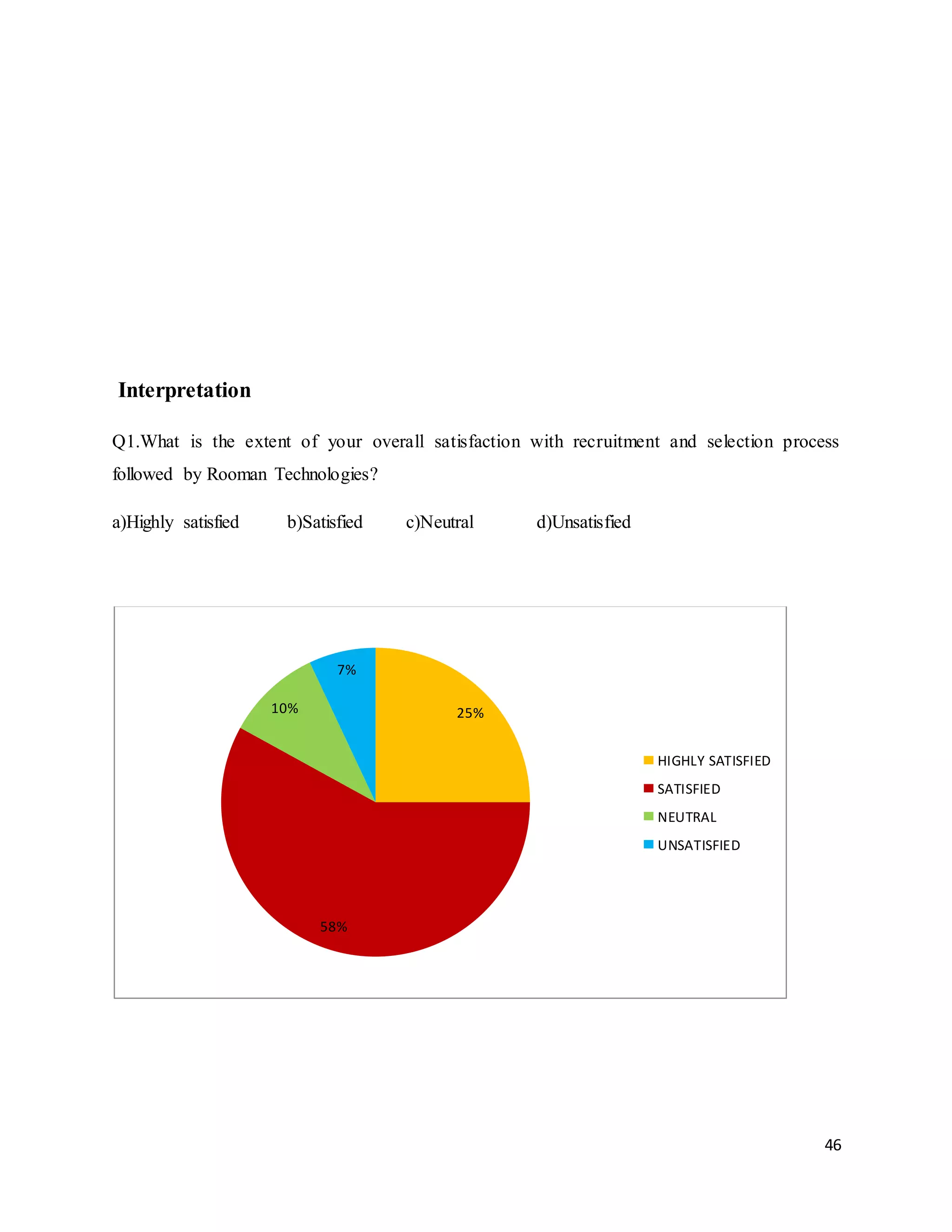
Q1.What is the extent of your overall satisfaction with recruitment and selection process
followed by Rooman Technologies?
a)Highly satisfied b)Satisfied c)Neutral d)Unsatisfied
25%
58%
10%
7%
HIGHLY SATISFIED
SATISFIED
NEUTRAL
UNSATISFIED
47
58% of employees satisfied with the overall satisfaction of recruitment and selection process
followed by Rooman technologies, 25% of employees are highly satisfied, 10% of employees
did not say whether they are satisfied or not. 7% of employees are totally unsatisfied with the
overall satisfaction of recruitment and selection process followed by Rooman technologies.
Rooman should focus in these areas to make recruitment and selection more efficient and
effective.
Q2.By which source you have been recruited in this organization?
a)Employee referral b)Recruitment agencies c)Campus recruitment d) Naukri.com
e)other
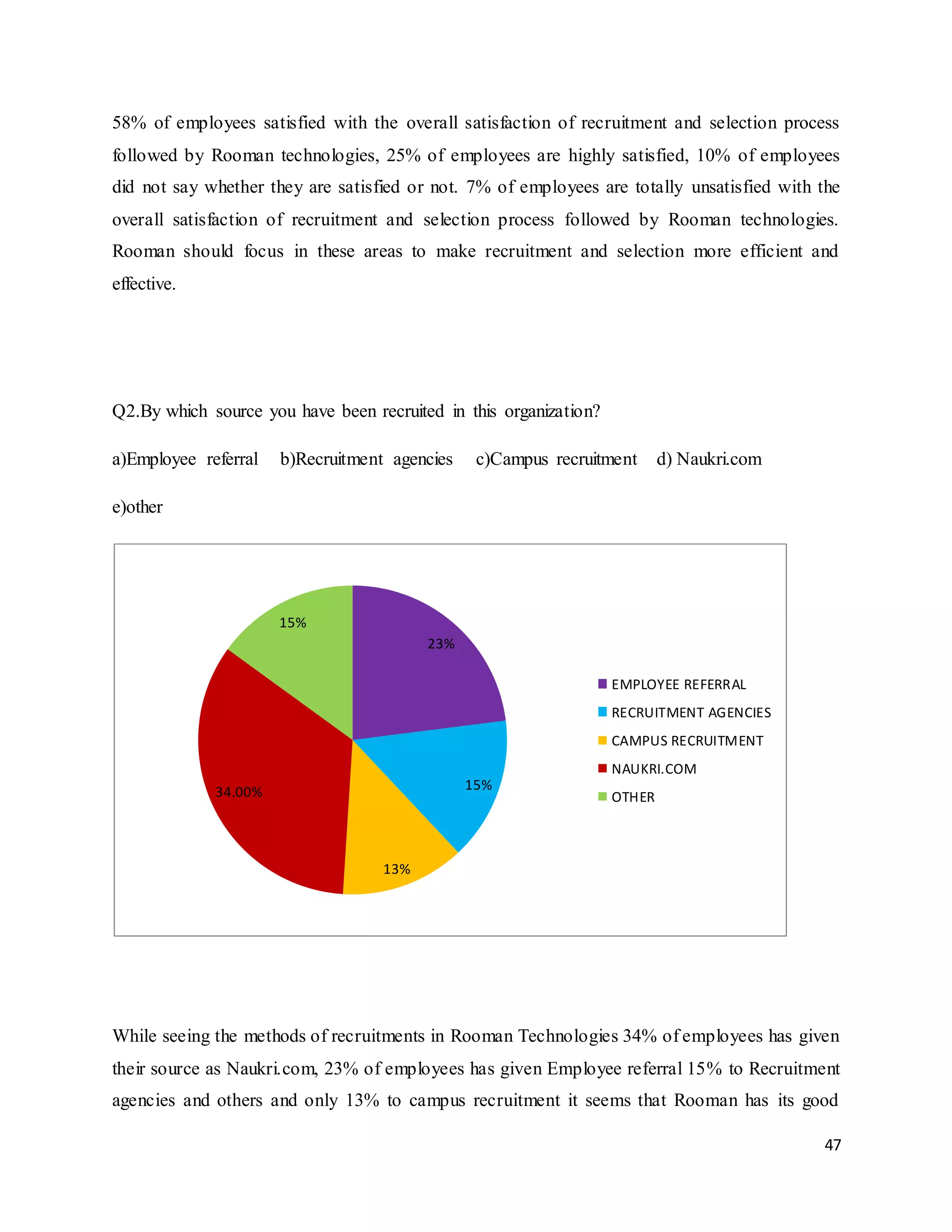
While seeing the methods of recruitments in Rooman Technologies 34% of employees has given
their source as Naukri.com, 23% of employees has given Employee referral 15% to Recruitment
agencies and others and only 13% to campus recruitment it seems that Rooman has its good
23%
15%
13%
34.00%
15%
EMPLOYEE REFERRAL
RECRUITMENT AGENCIES
CAMPUS RECRUITMENT
NAUKRI.COM
OTHER
48
presence on internet as most of employees quoted their source as Naukri.com. But Rooman
should place their presence in campuses as well in order to get well qualified candidates.
Q3.In your interview, how many rounds you faced during recruitment?
a)Only one b)1 to 3 c)3 to 5 d)More than 5
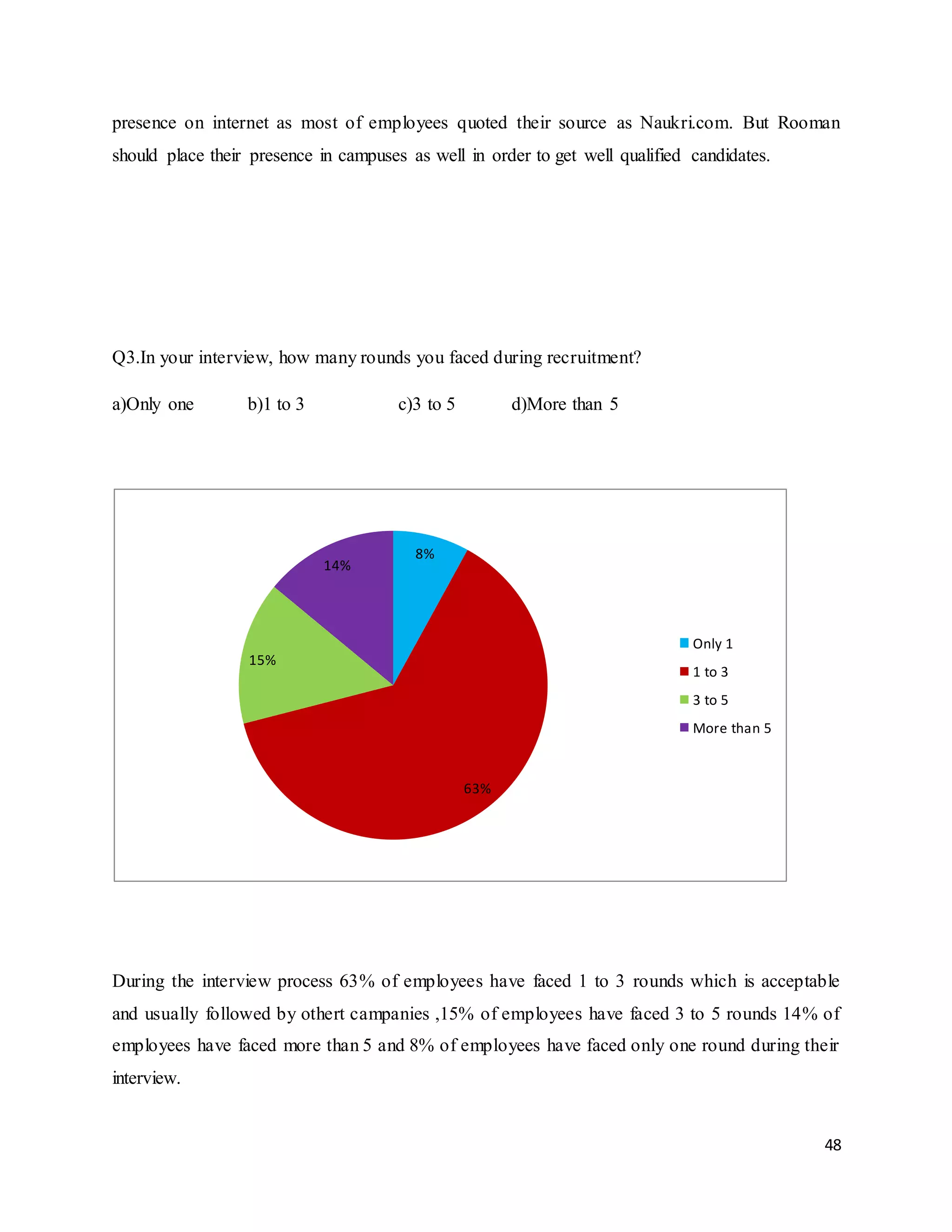
During the interview process 63% of employees have faced 1 to 3 rounds which is acceptable
and usually followed by othert campanies ,15% of employees have faced 3 to 5 rounds 14% of
employees have faced more than 5 and 8% of employees have faced only one round during their
interview.
8%
63%
15%
14%
Only 1
1 to 3
3 to 5
More than 5
49
Q4.Did HR clearly define the job description and job specifications in the recruitment process?
a)Yes b)No c)Not clearly
68%
3%
29%
YES
NO
NOT CLEARLY
50
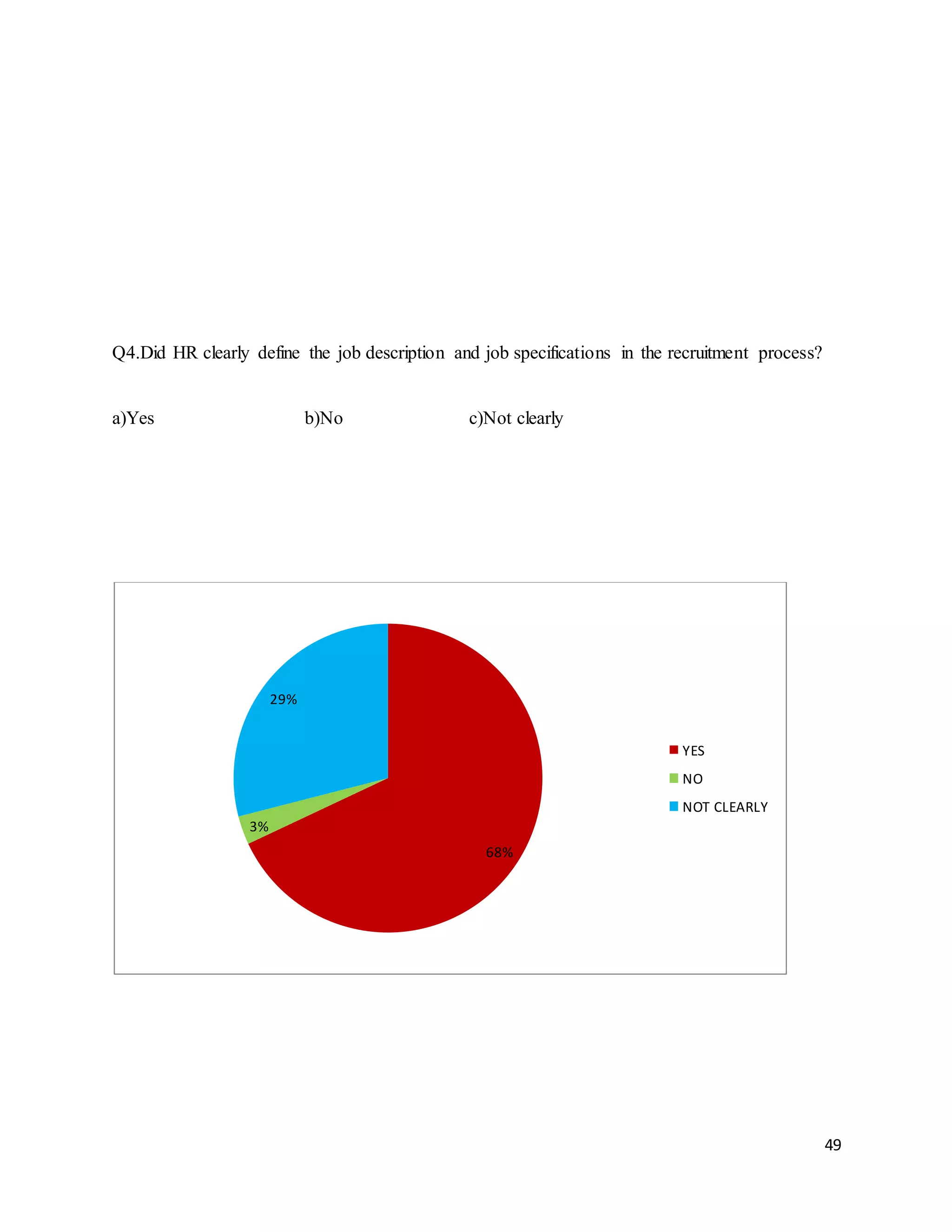
68% of employees are satisfied that HR had clearly defined them job description and job
specification, 39% of employees are not clear whether it is defined clearly or not and 3% 0f
employees said that HR had not defined them clear about their job description and job
specification.
Q5.Are you satisfied with the induction process?
a)Highly satisfied b)Satisfied c)Neutral d)Unsatisfied e)Highly unsatisfied
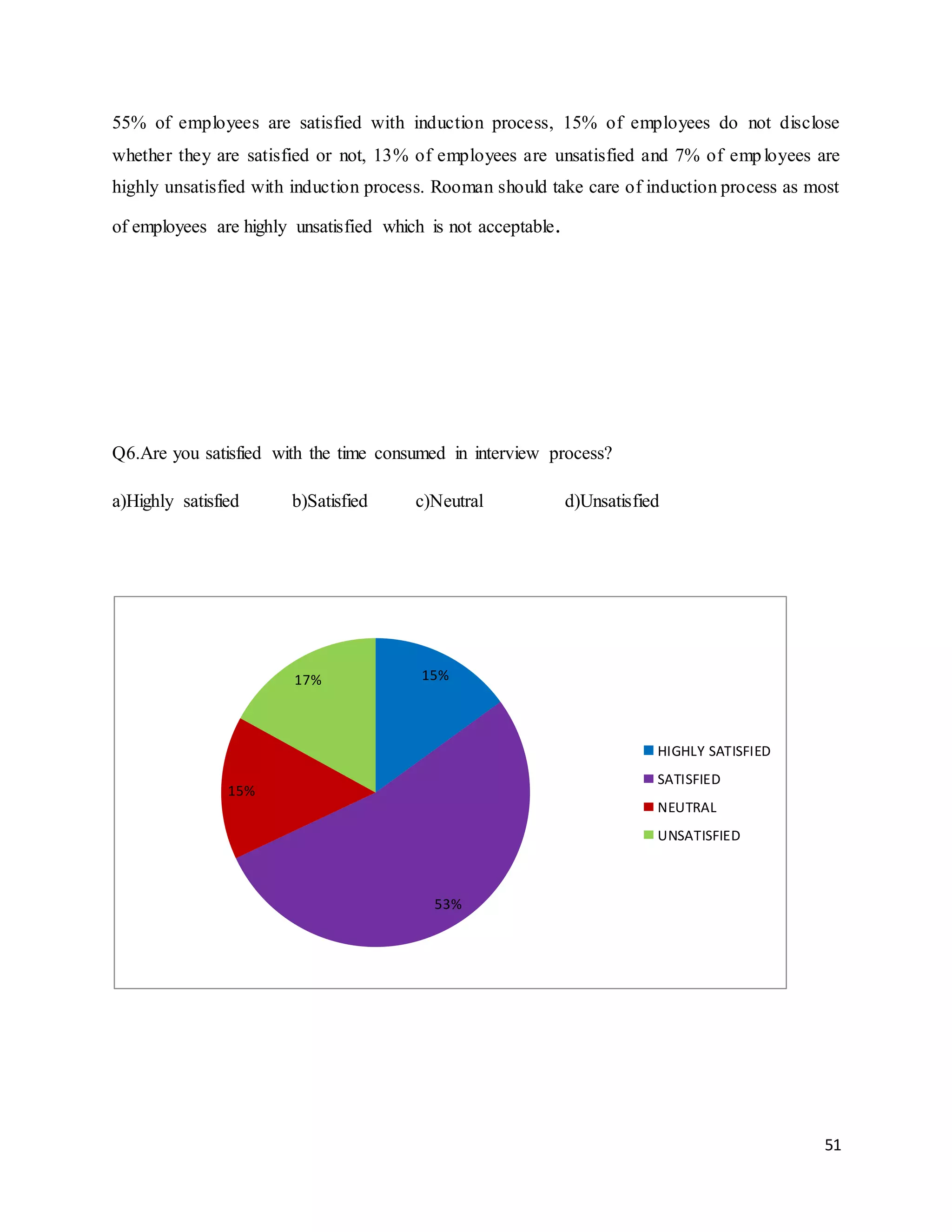
55.00%15%
13%
7%
STISFIED
NEUTRAL
UNSATISFIED
HIGHLY UNSATISFIED
51
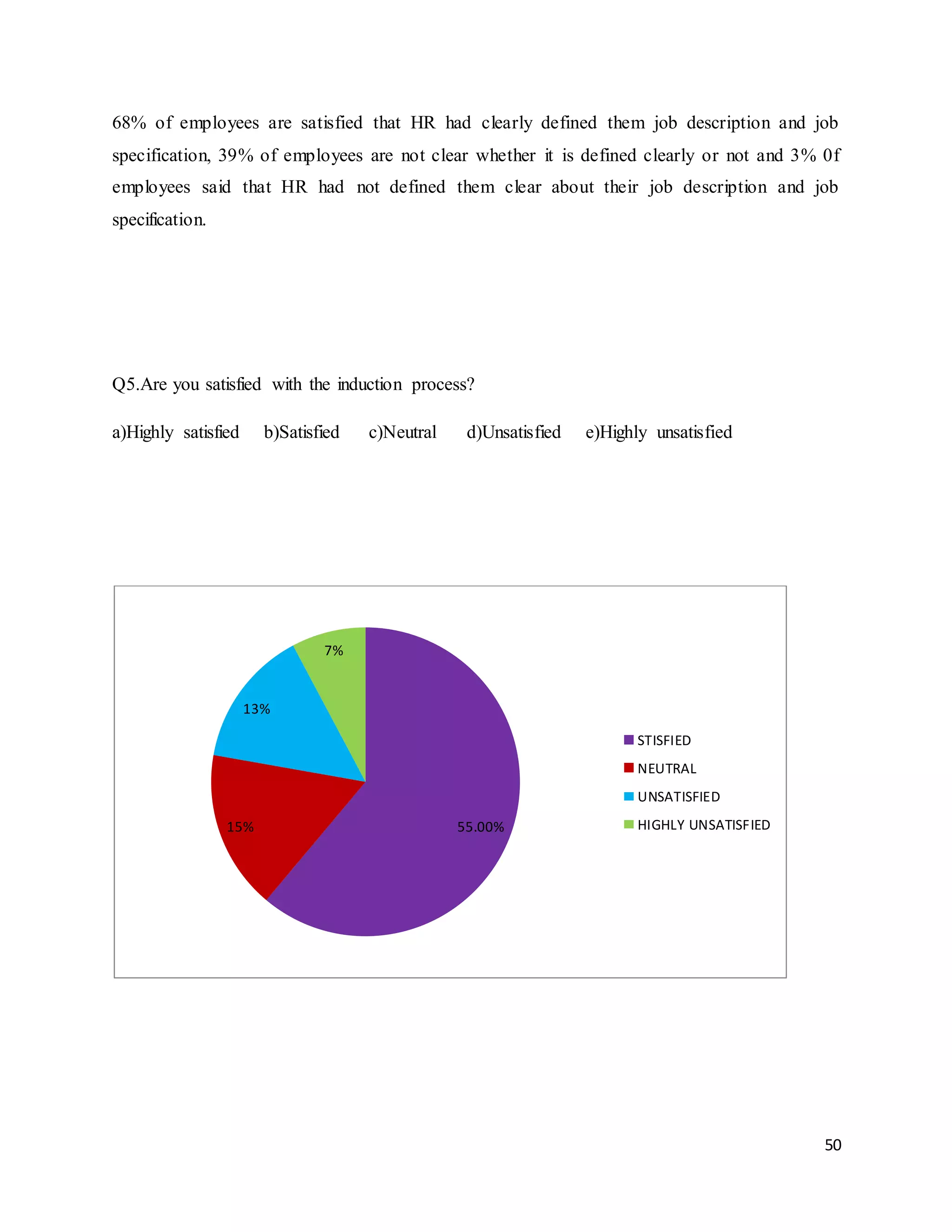
55% of employees are satisfied with induction process, 15% of employees do not disclose
whether they are satisfied or not, 13% of employees are unsatisfied and 7% of employees are
highly unsatisfied with induction process. Rooman should take care of induction process as most
of employees are highly unsatisfied which is not acceptable.
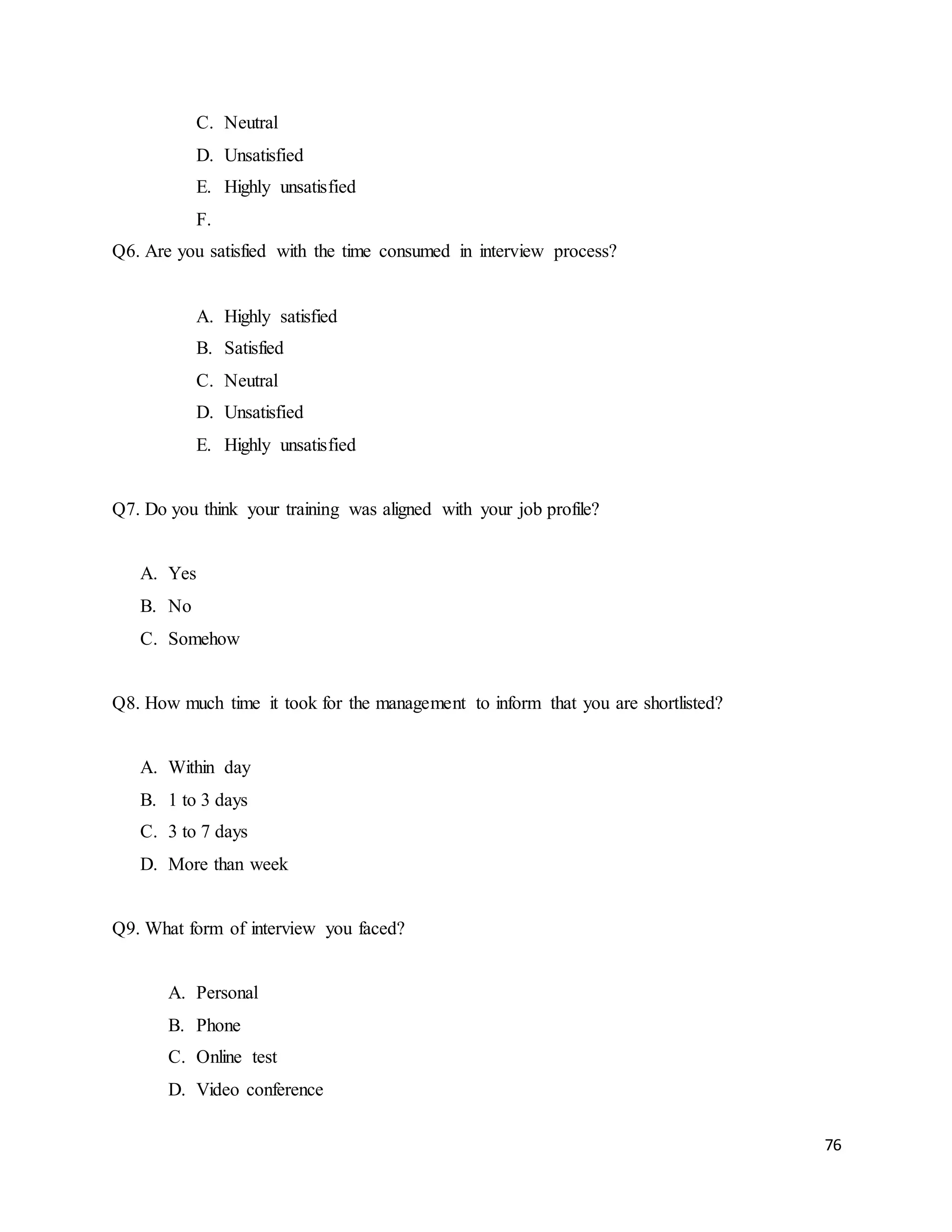
Q6.Are you satisfied with the time consumed in interview process?
a)Highly satisfied b)Satisfied c)Neutral d)Unsatisfied
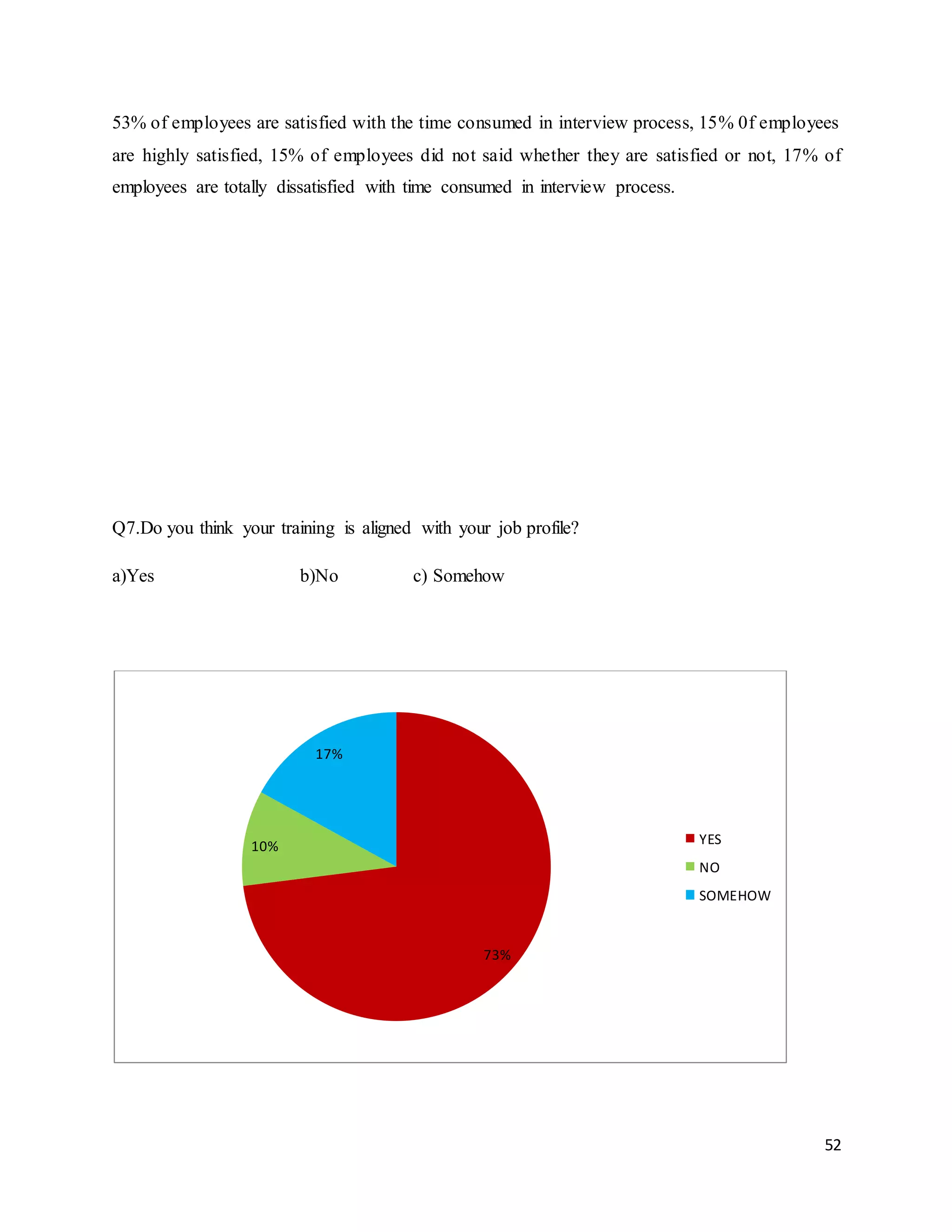
15%
53%
15%
17%
HIGHLY SATISFIED
SATISFIED
NEUTRAL
UNSATISFIED
52
53% of employees are satisfied with the time consumed in interview process, 15% 0f employees
are highly satisfied, 15% of employees did not said whether they are satisfied or not, 17% of
employees are totally dissatisfied with time consumed in interview process.
Q7.Do you think your training is aligned with your job profile?
a)Yes b)No c) Somehow
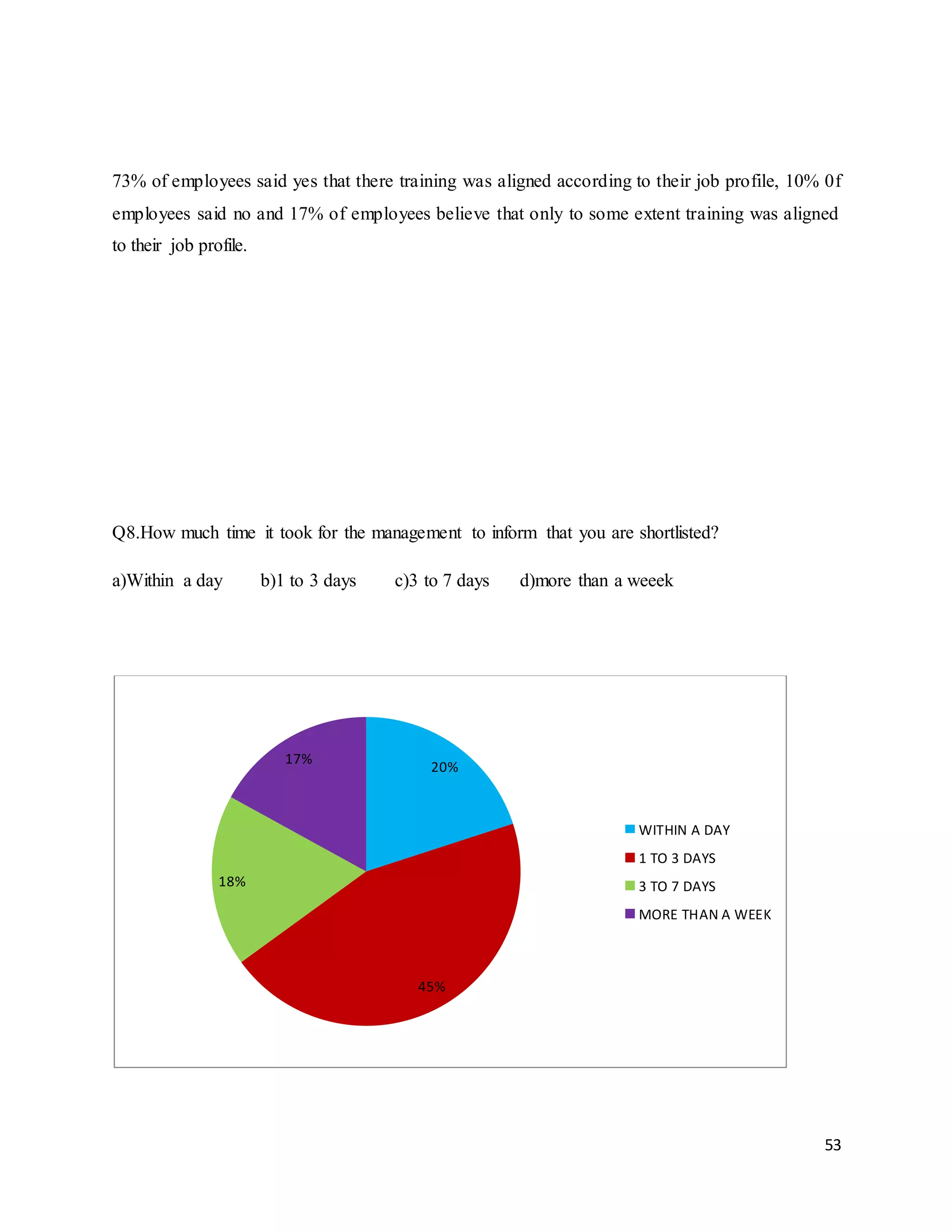
73%
10%
17%
YES
NO
SOMEHOW
53
73% of employees said yes that there training was aligned according to their job profile, 10% 0f
employees said no and 17% of employees believe that only to some extent training was aligned
to their job profile.
Q8.How much time it took for the management to inform that you are shortlisted?
a)Within a day b)1 to 3 days c)3 to 7 days d)more than a weeek
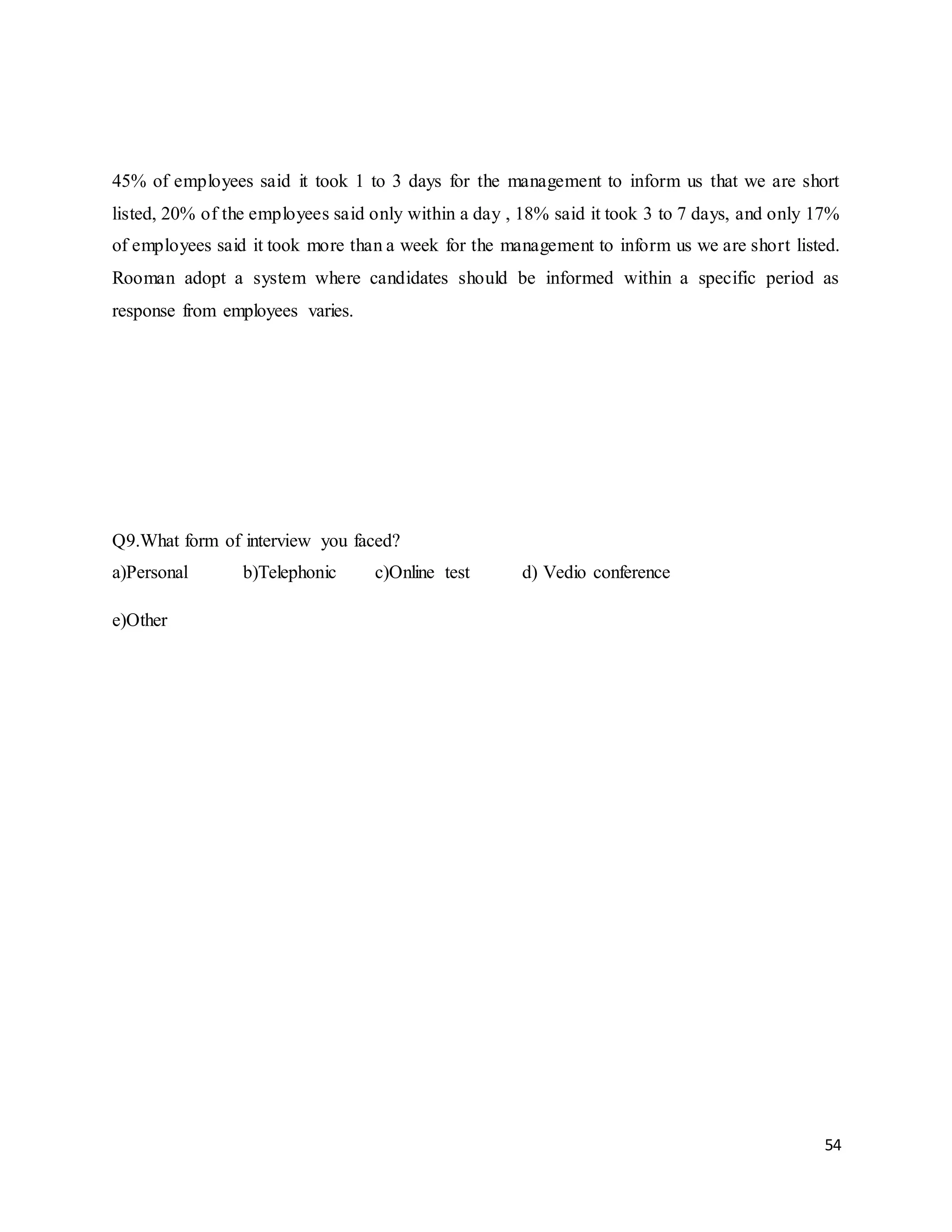
20%
45%
18%
17%
WITHIN A DAY
1 TO 3 DAYS
3 TO 7 DAYS
MORE THAN A WEEK
54
45% of employees said it took 1 to 3 days for the management to inform us that we are short
listed, 20% of the employees said only within a day , 18% said it took 3 to 7 days, and only 17%
of employees said it took more than a week for the management to inform us we are short listed.
Rooman adopt a system where candidates should be informed within a specific period as
response from employees varies.
Q9.What form of interview you faced?
a)Personal b)Telephonic c)Online test d) Vedio conference
e)Other
55
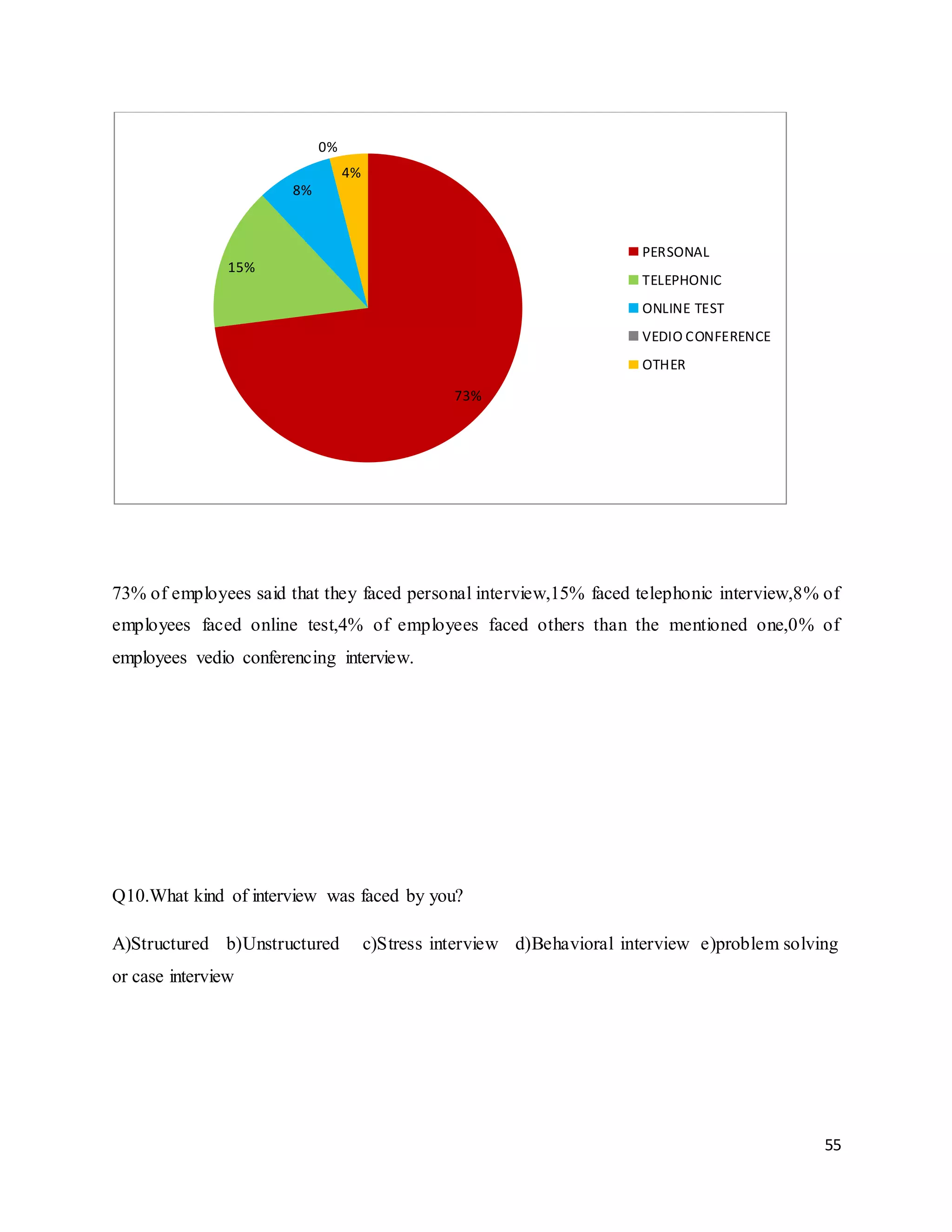
73% of employees said that they faced personal interview,15% faced telephonic interview,8% of
employees faced online test,4% of employees faced others than the mentioned one,0% of
employees vedio conferencing interview.
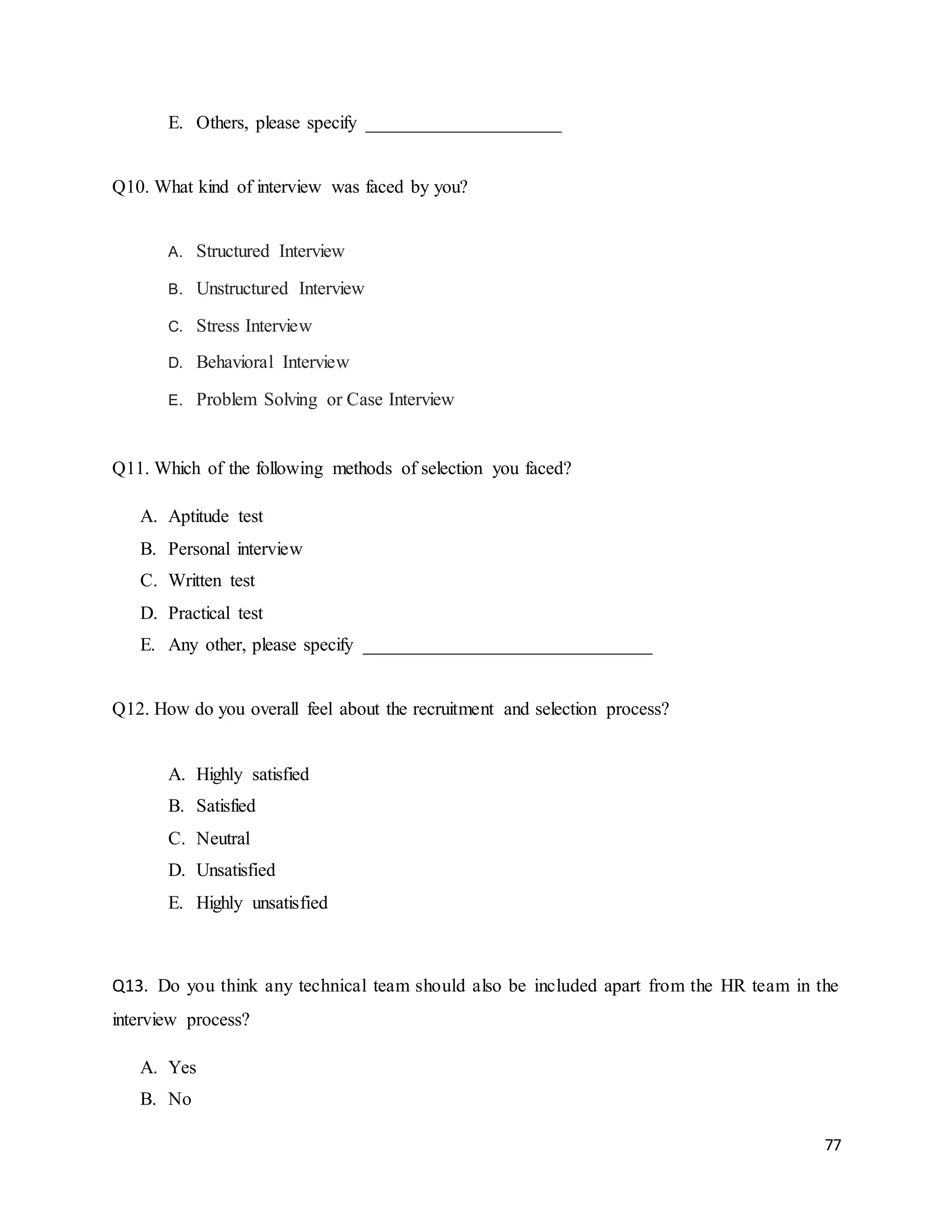
Q10.What kind of interview was faced by you?
A)Structured b)Unstructured c)Stress interview d)Behavioral interview e)problem solving
or case interview
73%
15%
8%
0%
4%
PERSONAL
TELEPHONIC
ONLINE TEST
VEDIO CONFERENCE
OTHER
56
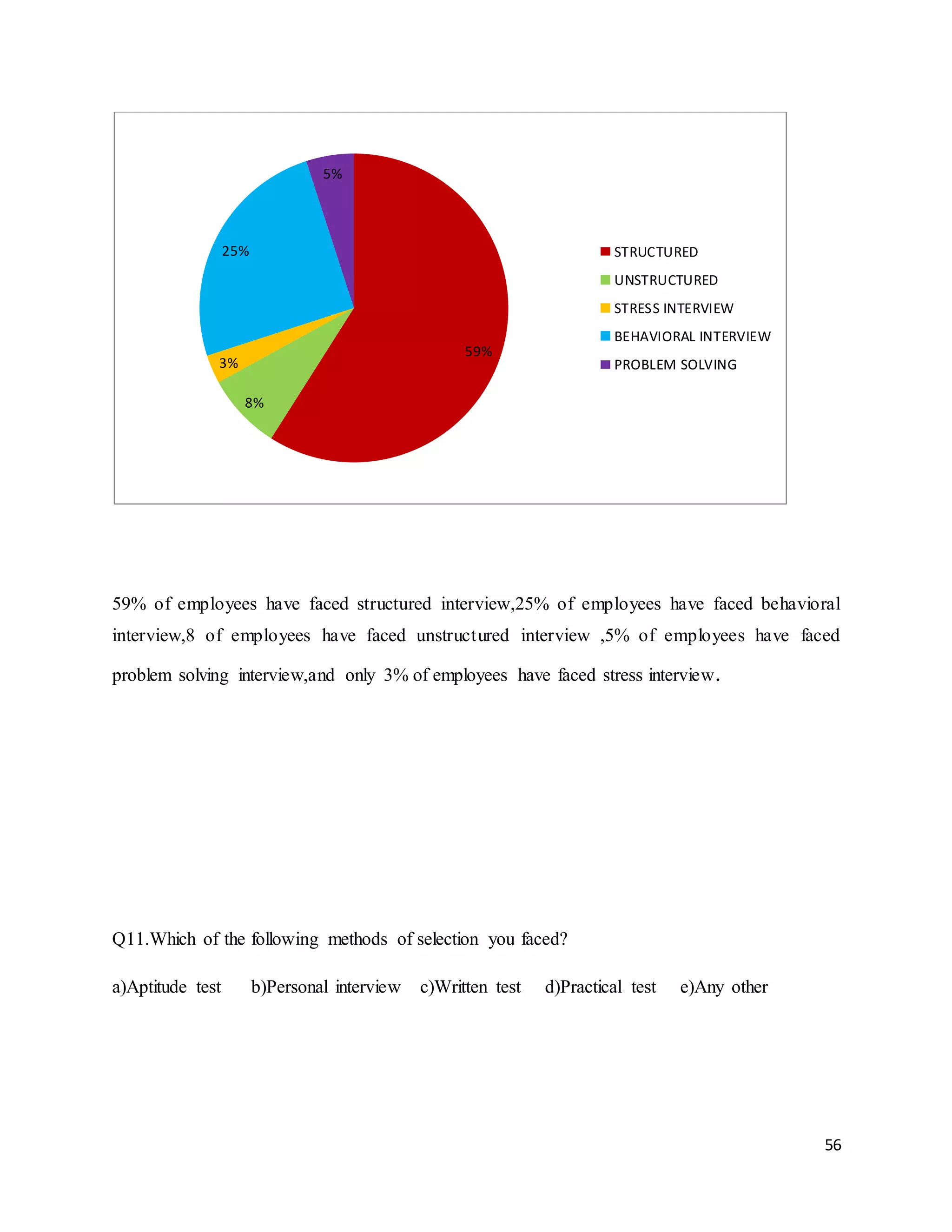
59% of employees have faced structured interview,25% of employees have faced behavioral
interview,8 of employees have faced unstructured interview ,5% of employees have faced
problem solving interview,and only 3% of employees have faced stress interview.
Q11.Which of the following methods of selection you faced?
a)Aptitude test b)Personal interview c)Written test d)Practical test e)Any other
59%
8%
3%
25%
5%
STRUCTURED
UNSTRUCTURED
STRESS INTERVIEW
BEHAVIORAL INTERVIEW
PROBLEM SOLVING
57
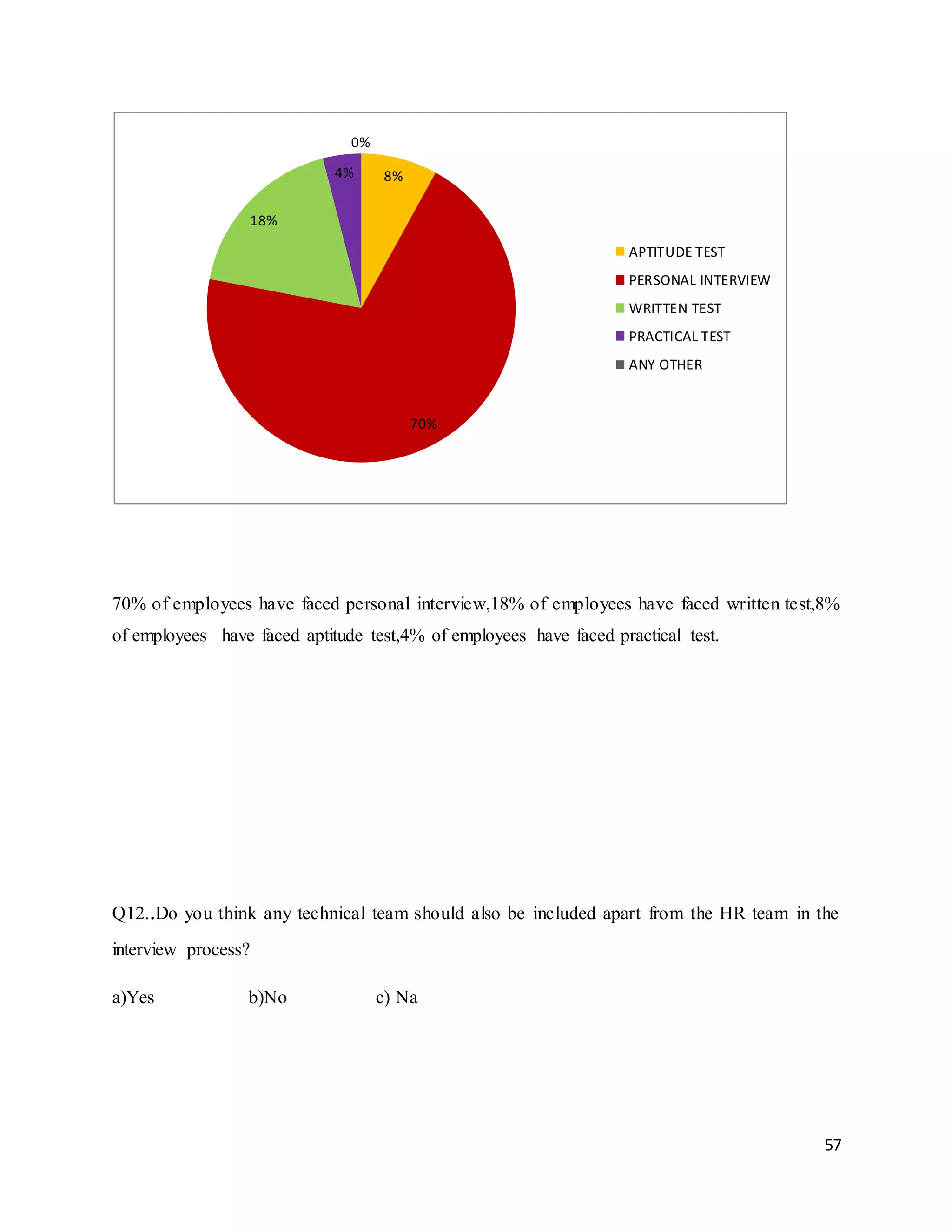
70% of employees have faced personal interview,18% of employees have faced written test,8%
of employees have faced aptitude test,4% of employees have faced practical test.
Q12..Do you think any technical team should also be included apart from the HR team in the
interview process?
a)Yes b)No c) Na
8%
70%
18%
4%
0%
APTITUDE TEST
PERSONAL INTERVIEW
WRITTEN TEST
PRACTICAL TEST
ANY OTHER
58
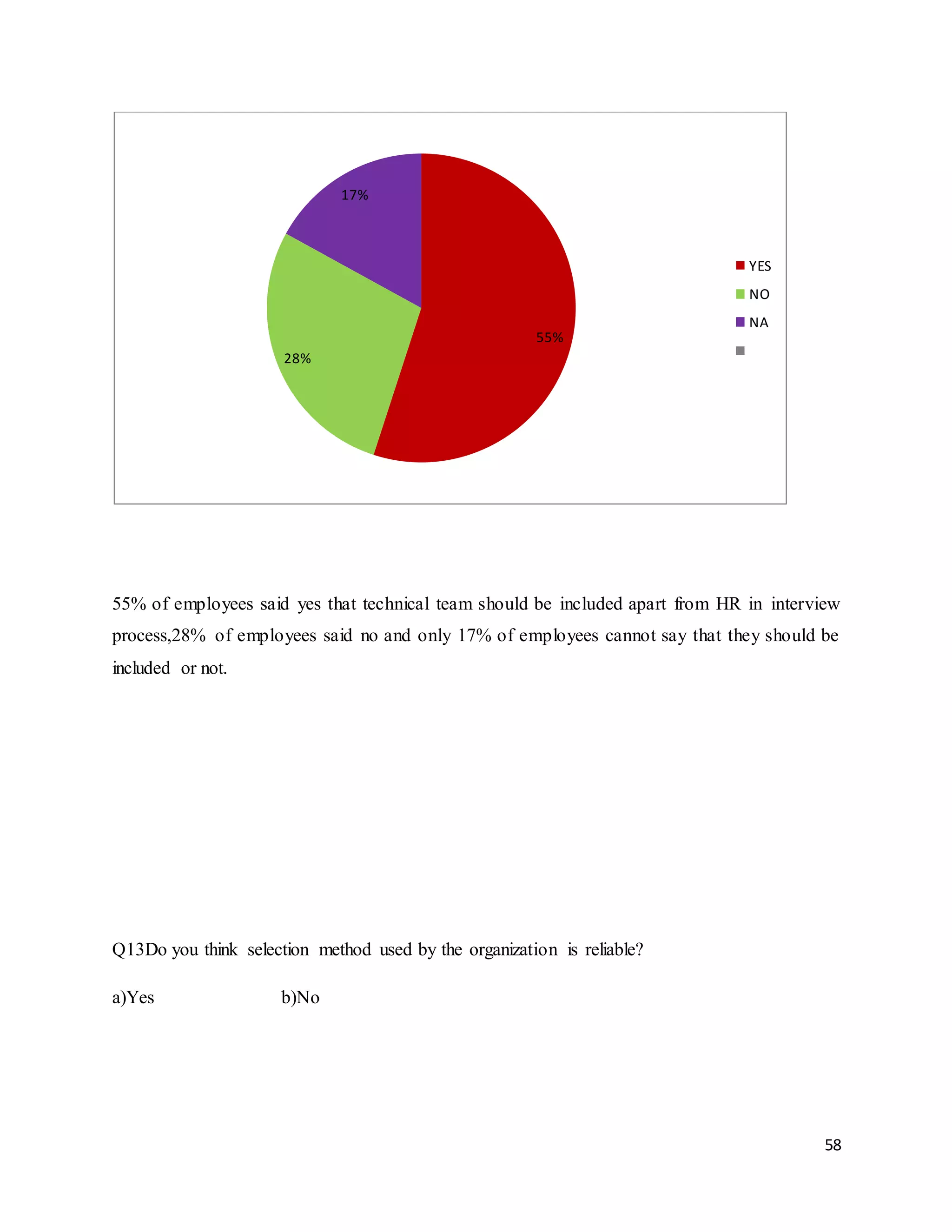
55% of employees said yes that technical team should be included apart from HR in interview
process,28% of employees said no and only 17% of employees cannot say that they should be
included or not.
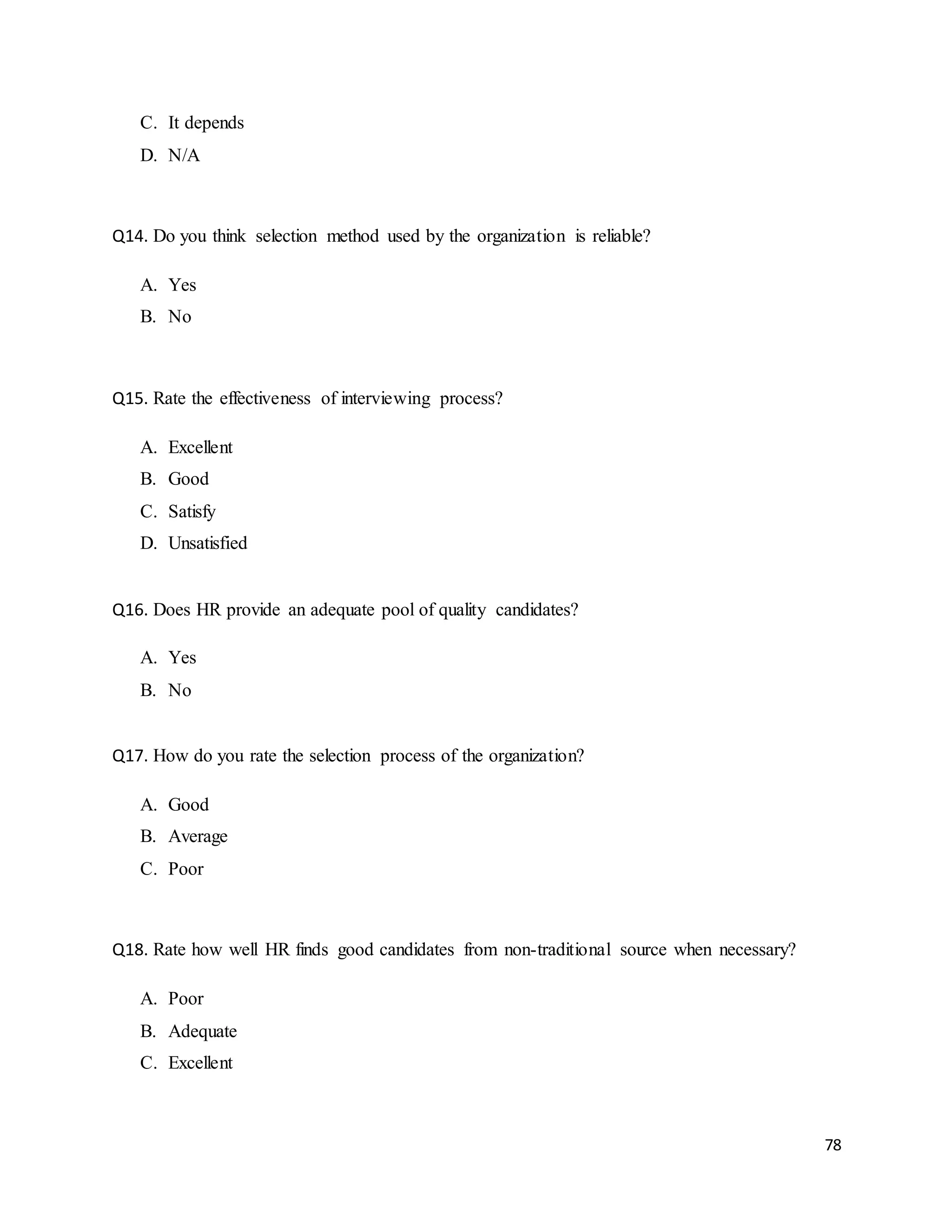
Q13Do you think selection method used by the organization is reliable?
a)Yes b)No
55%
28%
17%
YES
NO
NA
59
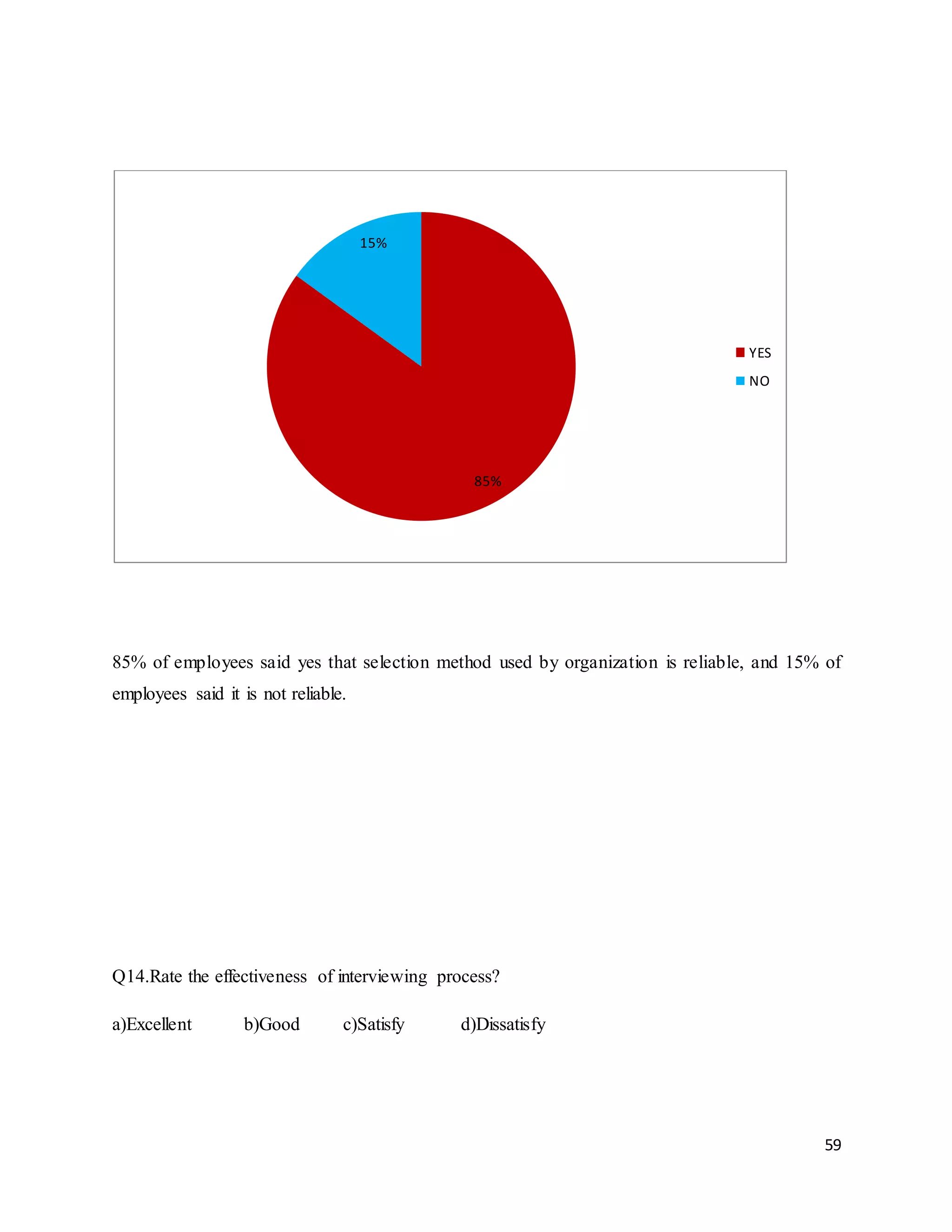
85% of employees said yes that selection method used by organization is reliable, and 15% of
employees said it is not reliable.
Q14.Rate the effectiveness of interviewing process?
a)Excellent b)Good c)Satisfy d)Dissatisfy
85%
15%
YES
NO
60
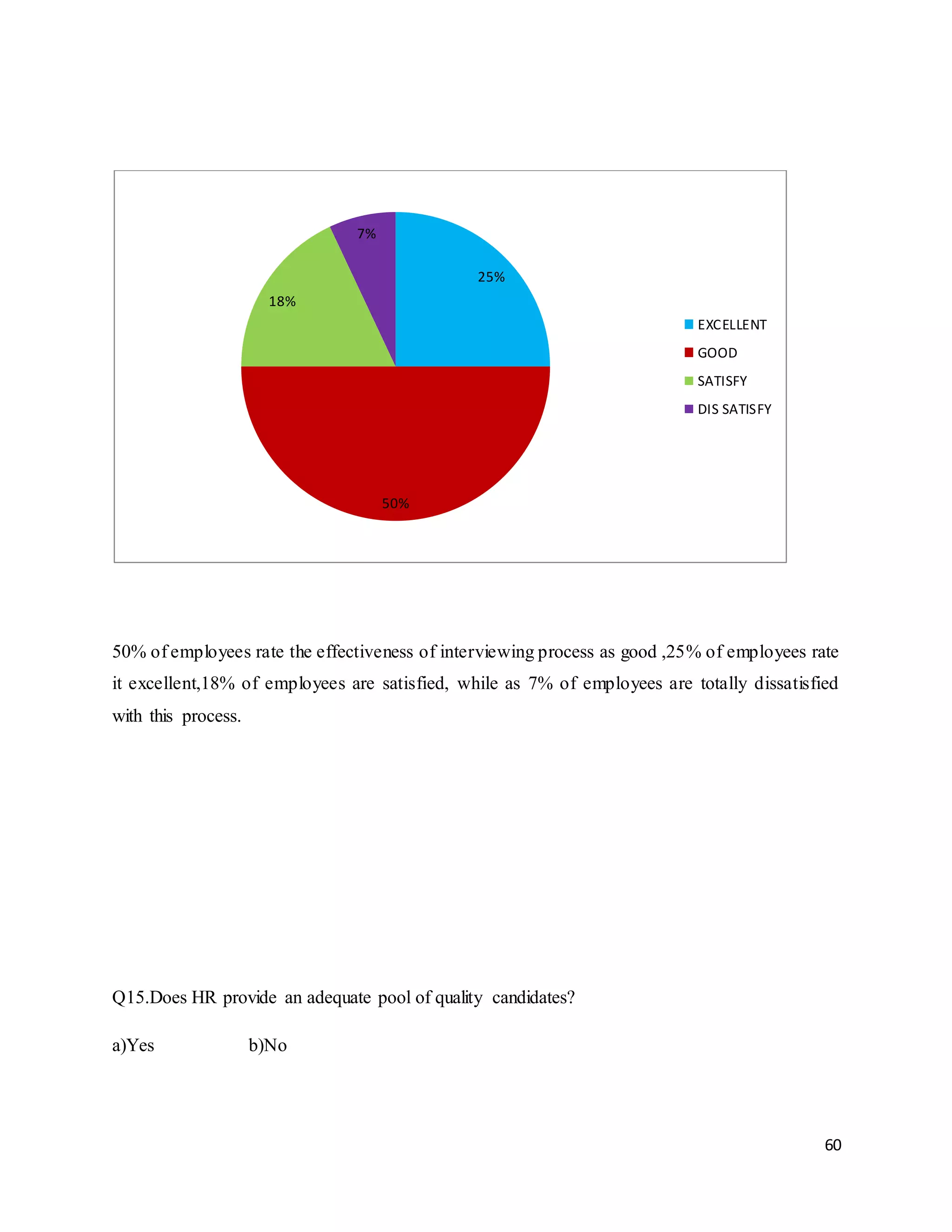
50% of employees rate the effectiveness of interviewing process as good ,25% of employees rate
it excellent,18% of employees are satisfied, while as 7% of employees are totally dissatisfied
with this process.
Q15.Does HR provide an adequate pool of quality candidates?
a)Yes b)No
25%
50%
18%
7%
EXCELLENT
GOOD
SATISFY
DIS SATISFY
61
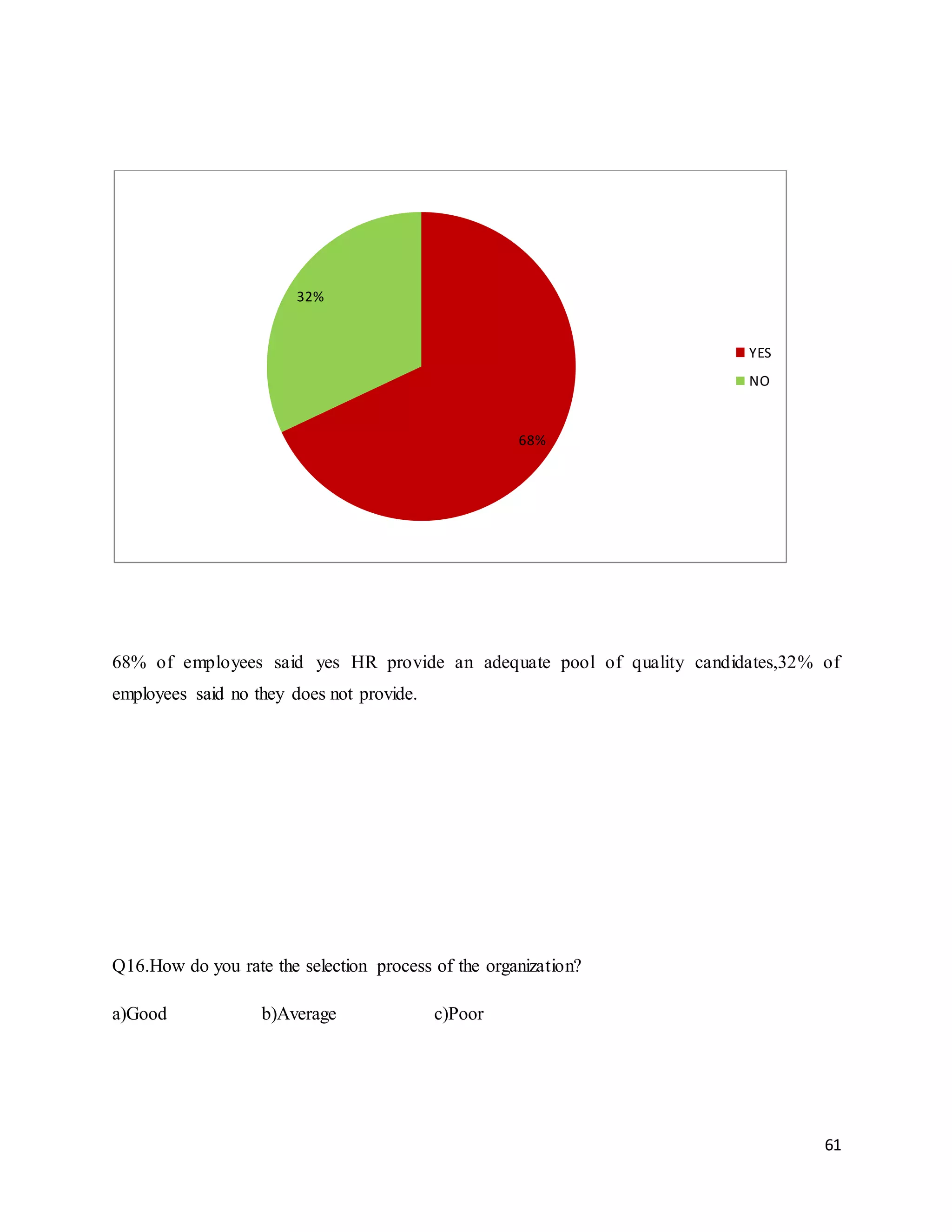
68% of employees said yes HR provide an adequate pool of quality candidates,32% of
employees said no they does not provide.
Q16.How do you rate the selection process of the organization?
a)Good b)Average c)Poor
68%
32%
YES
NO
62
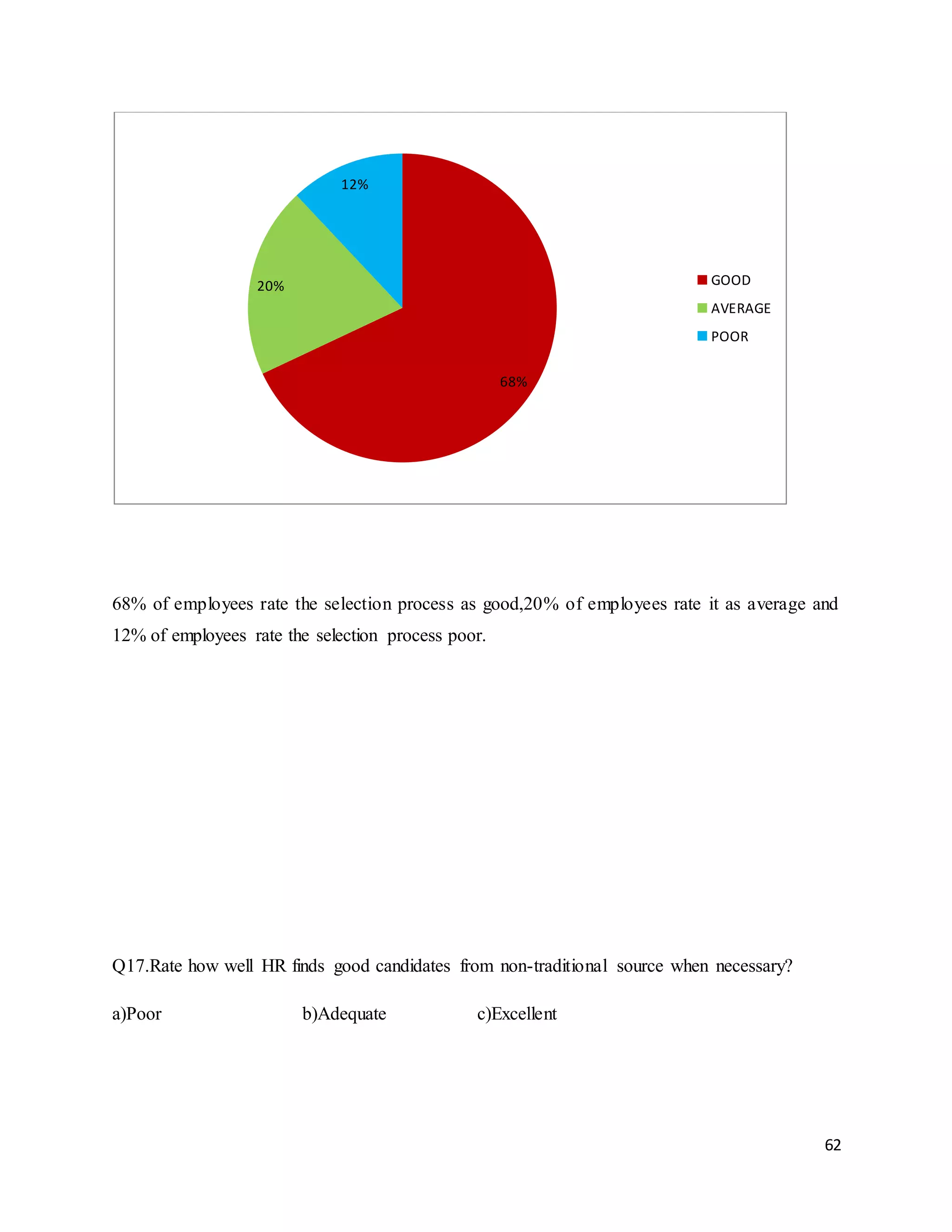
68% of employees rate the selection process as good,20% of employees rate it as average and
12% of employees rate the selection process poor.
Q17.Rate how well HR finds good candidates from non-traditional source when necessary?
a)Poor b)Adequate c)Excellent
68%
20%
12%
GOOD
AVERAGE
POOR
63
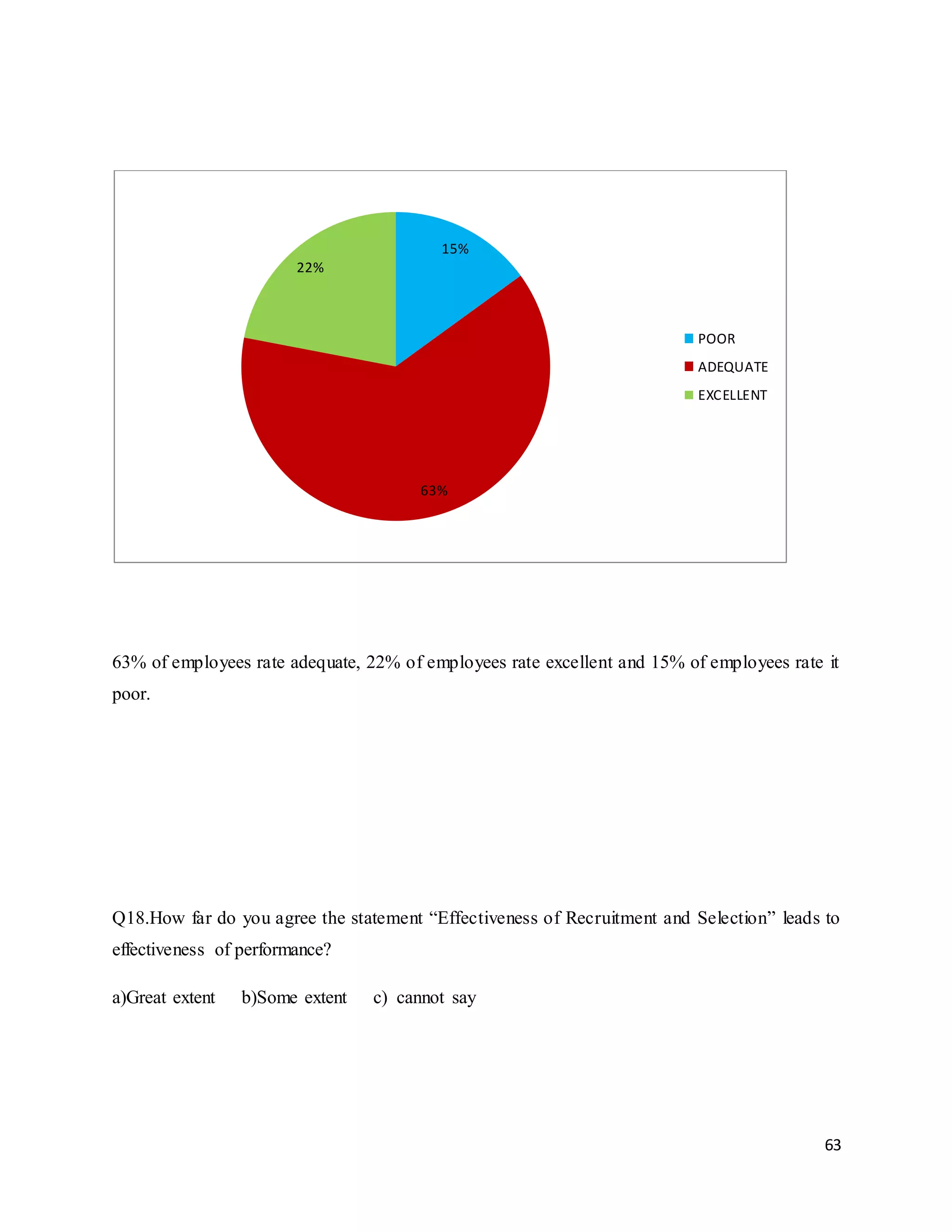
63% of employees rate adequate, 22% of employees rate excellent and 15% of employees rate it
poor.
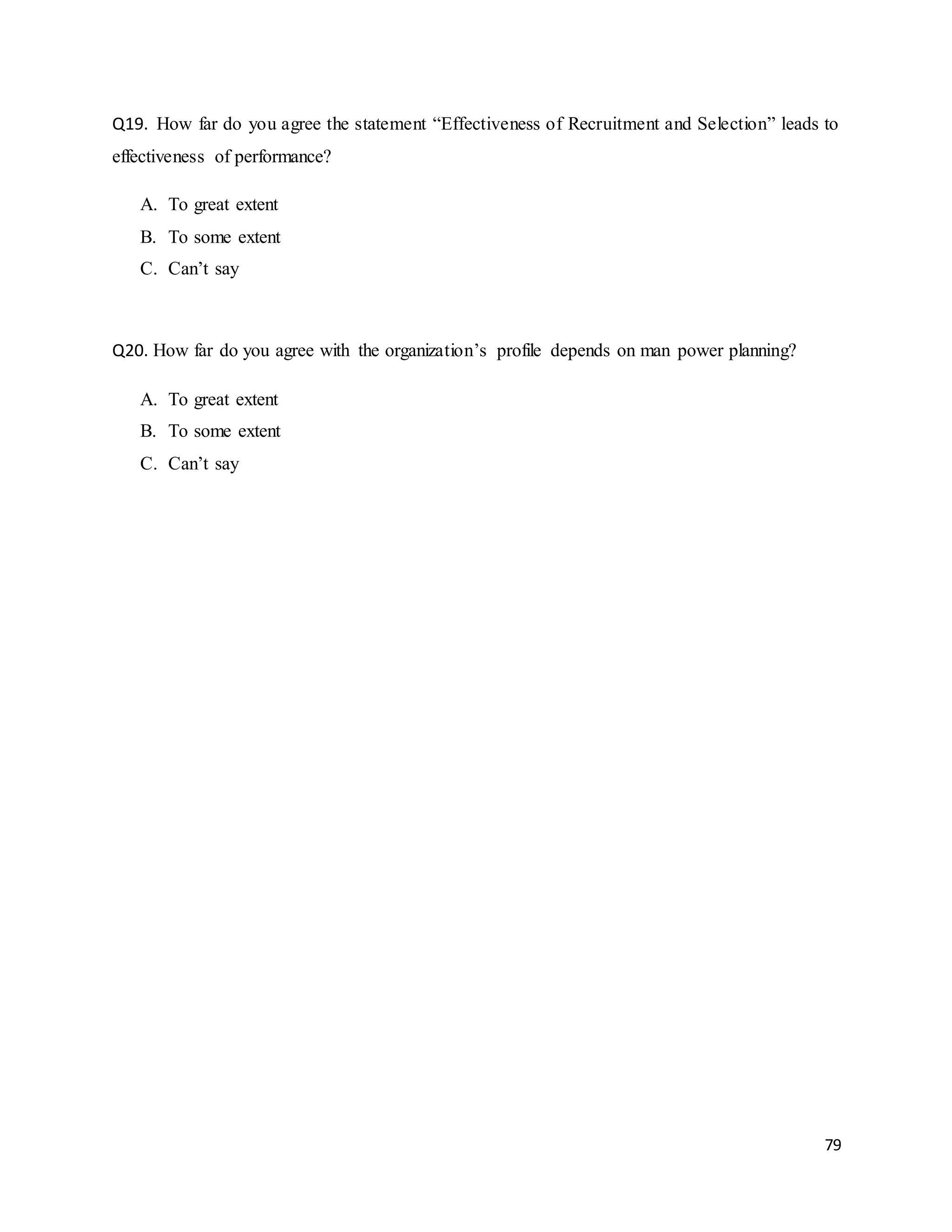
Q18.How far do you agree the statement “Effectiveness of Recruitment and Selection” leads to
effectiveness of performance?
a)Great extent b)Some extent c) cannot say
15%
63%
22%
POOR
ADEQUATE
EXCELLENT
64
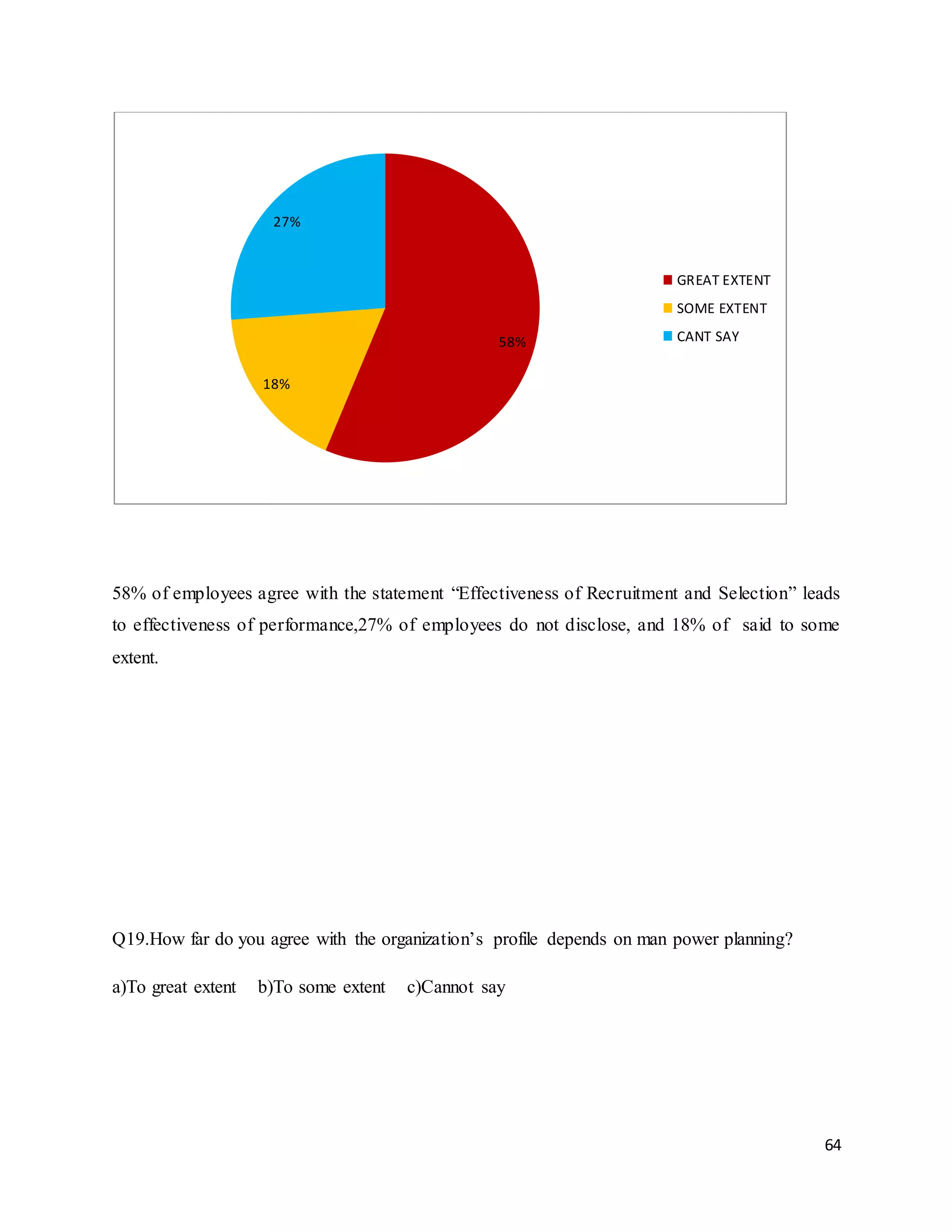
58% of employees agree with the statement “Effectiveness of Recruitment and Selection” leads
to effectiveness of performance,27% of employees do not disclose, and 18% of said to some
extent.
Q19.How far do you agree with the organization’s profile depends on man power planning?
a)To great extent b)To some extent c)Cannot say
58%
18%
27%
GREAT EXTENT
SOME EXTENT
CANT SAY
65
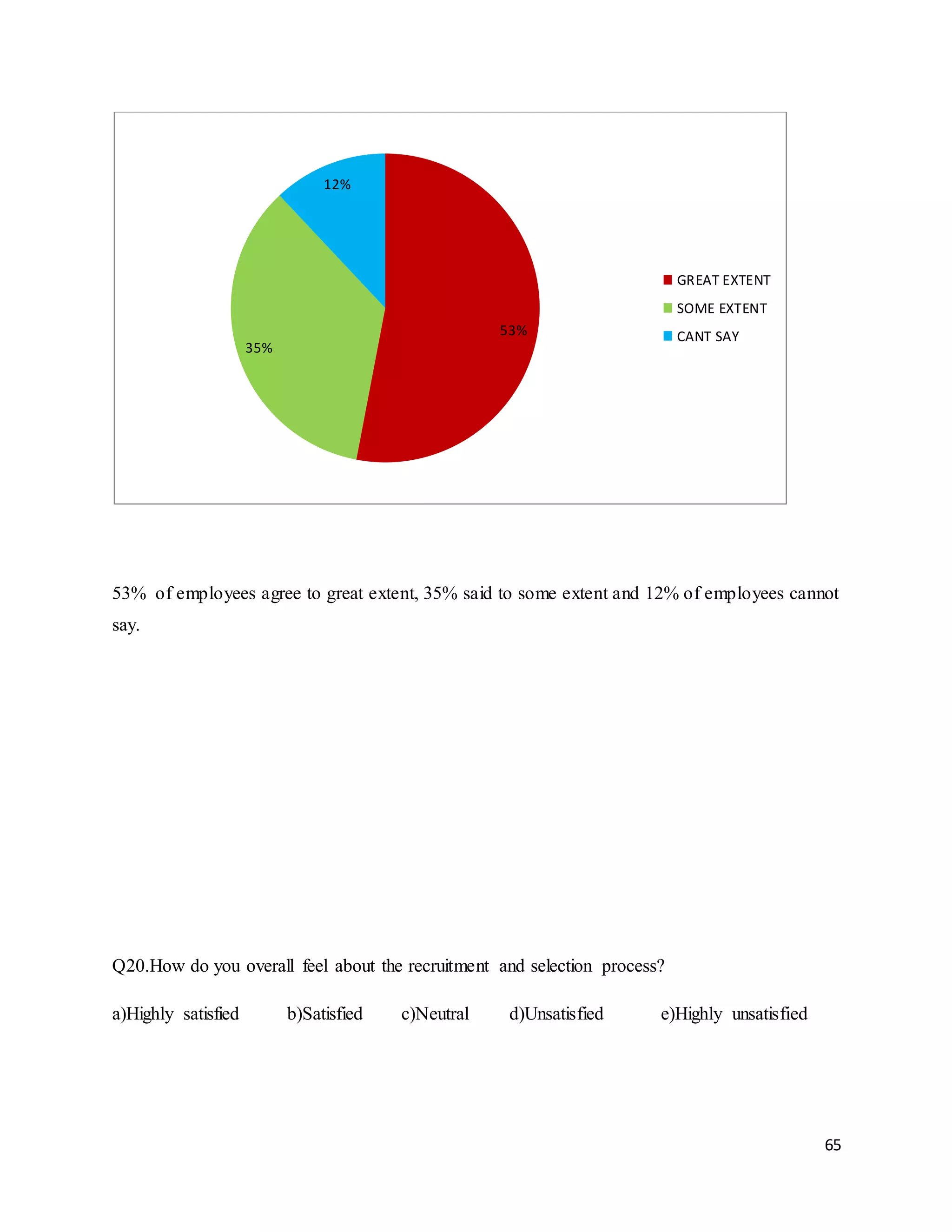
53% of employees agree to great extent, 35% said to some extent and 12% of employees cannot
say.
Q20.How do you overall feel about the recruitment and selection process?
a)Highly satisfied b)Satisfied c)Neutral d)Unsatisfied e)Highly unsatisfied
53%
35%
12%
GREAT EXTENT
SOME EXTENT
CANT SAY
66
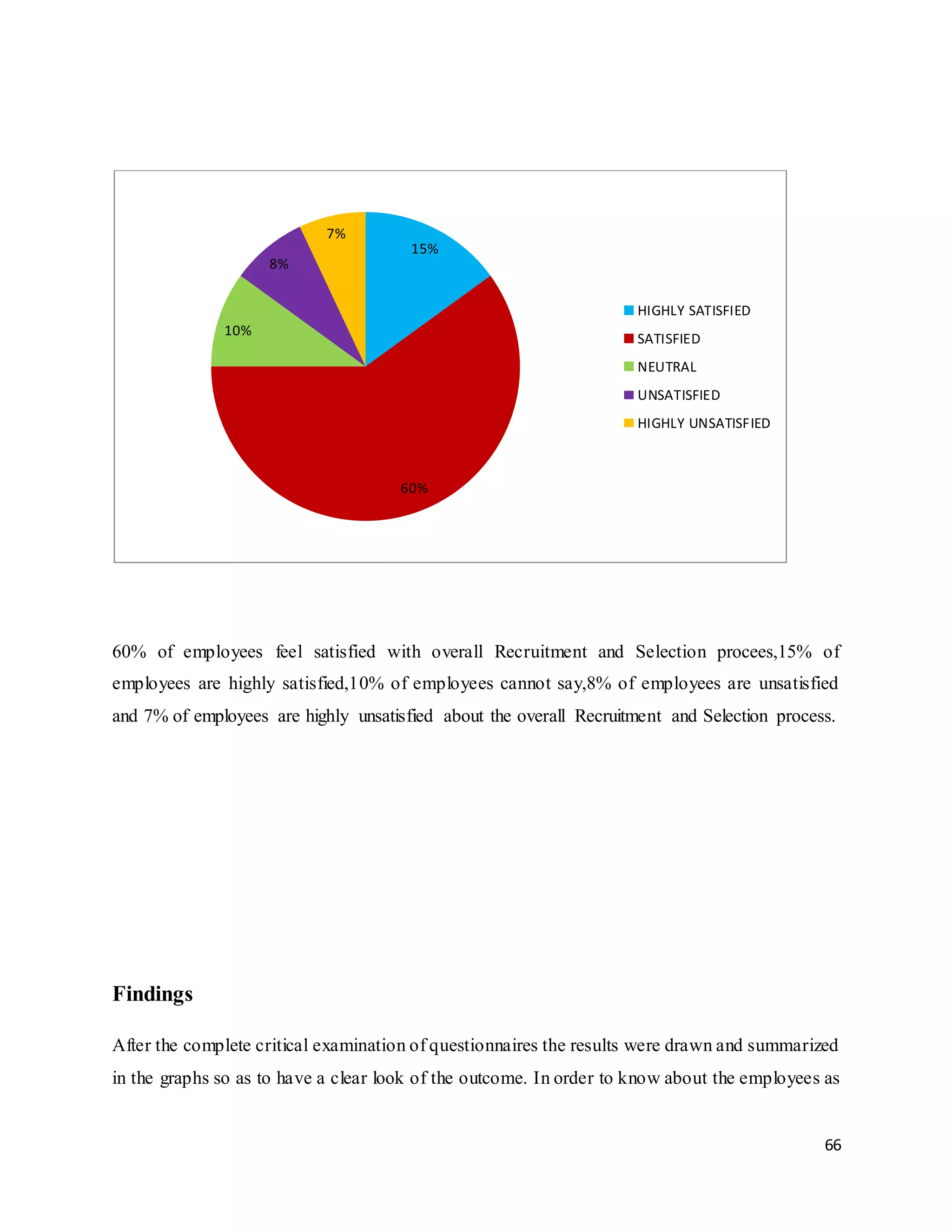
60% of employees feel satisfied with overall Recruitment and Selection procees,15% of
employees are highly satisfied,10% of employees cannot say,8% of employees are unsatisfied
and 7% of employees are highly unsatisfied about the overall Recruitment and Selection process.
Findings
After the complete critical examination of questionnaires the results were drawn and summarized
in the graphs so as to have a clear look of the outcome. In order to know about the employees as
15%
60%
10%
8%
7%
HIGHLY SATISFIED
SATISFIED
NEUTRAL
UNSATISFIED
HIGHLY UNSATISFIED
67
in how they feel about the Recruitment and selection programs at ROOMAN TECHNOLOGIES,
we planned to ask relevant questions in the questionnaire and on that basis, the graphs were
made so as to have a detailed and summarized knowledge about it.
The outcome that we reached after the graphical representation are described below
 Most of the employees at ROOMAN feel that the recruitment and selection process is
satisfactory in nature.
 From the graphs, it seems like ROOMAN have it good presence on the Internet as most
of the employees quoted the source as Naukri.com
 During the interviewing process, mostly employees have faced up to 3 rounds which is
acceptable and usually followed in other companies.
 The employees also seem well satisfied with the HR as HR has clearly mentioned the job
description and job specification in the process.
 The Induction process which is initiated by the company accommodates the satisfaction
of most of the employee..Employees are of the thoughts that the induction process at
ROOMAN is appropriately designed for the fresh joiners in order to have a clear cut
picture of their job profile.
 Employees feel that the time consumed by the interview process is subjected at its best.
 Most employees feel that the training through which they pass initially was aligned to the
job profile assigned to them.
 ROOMAN seems good advanced in informing the candidates whether they are being
shortlisted or not.
 ROOMAN majorly have put their focus on Personal interview and as well as structured
interview for selection process.
 Half of the employee to whom questionnaire were drawn feels that there should be a
technical team in interview process but which will depend on the job profile also.
 Employees at ROOMAN, draws the major conclusion that the selection method used by
the organization are reliable.
 Ratings in regard to interviewing and selection process are drafted as good by most of the
employees.
 The HR team at ROOMAN seems competent in their related work of area
68
 Employee concludes that Effectiveness of Recruitment and Selection” leads to great
extent of effectiveness of performance
Limitation
The study was very great in size and thorough study necessitating complete enumeration of the
organization and analysis of several issues.
Following are the limiting factors: -
 During the office hours, it was very difficult to collect the information from the
employees.
 Work shift was also one reason responsible for the difficulty in approaching the
employee.
 Some employee didn’t gave the appropriate and relevant information due to lack of
interest or due to lack of their depth knowledge of their job
 Most of the employee was hesitating in giving the frank answers.
 Time was also one of the factors which shorten the process.
69
CHAPTER 6;
RECOMMANDATIONS AND CONCLUSION
Recommendation and Suggestion
70
 Employees at ROOMAN seem well satisfied and pleased with the process of Recruitment
and Selection held by the company. ROOMAN should focus in these areas to make
Recruitment and Selection more efficient and effective.
 ROOMAN should place their presence in campuses as well in order to get the well
qualified candidates
 ROOMAN also should take care of the induction process as some of the employee seems
highly unsatisfied which is usually not acceptable.
 Major focus should also be laid down on the training process because any negative
response from the employee may harm the organization.
 ROOMAN should also adopt the system, where shortlisted candidates will be informed in
specific period of time as the response from the employees varies.
 It seems employees have majorly faced personal and structured interview. Adopting the
change in kind and type of interview will provide more qualified, competent and
deserving candidates.
 ROOMAN should include technical team in the interviewing process.
 Special importance should be laid on the realistic aspects of recruitment and selection.
 The whole process should be fair enough and the personal biases system should be
eliminated.
Conclusion
71
The human element of association is the most critical asset of an organization. Taking a closer
perspective -it is the very superiority of this asset that sets an association apart from the others,
the very factor that brings the organization’s image into fruition.
Thus, one can grab the strategic implications that the manpower of an organization has in
shaping the fortunes of an organization. This is where the balancing roles of Recruitment and
Selection come in. The job of these aspects in the current organization is a subject on which the
experts have pondered, deliberated and considered, taking into consideration the vital role that
they obviously play.
The essence of recruitment can be summed up as „the viewpoint of attracting as many applicants
as possible for given jobs. It gives an idea of what in the earlier times was directed by the whole
process and steps taken in the Recruitment process. Now days the main concern of an
organization is only to align the individuals with the specified needs of an organization. By
making this a main concern, an organization safeguards its interests and position. After all, a
satisfied workforce is a stable workforce which also ensures that an organization has credible and
reliable concert. Ina bid to highlight this subtle point, the project focuses many processes and
nuances one of the most significant activities of an organization.
The outcome of the recruitment procedure is basically a pool of applicants. Next to recruitment,
the sound step of activities in the HR procedure is the selection of capable and competent people.
As such, this process focuses on the differentiating between applicants so as to recognize – and
hire- those persons whose abilities are consistent with the organization’s requirements.
The person who reads will do well to note that the transition between the two activities is not
stringent. The two activities on the whole have one aim- to yield a perfect employee for the
organization. Nor are these plans classify. Every organization employs the process by keeping
the nature of the organization into well consideration.
In the end, this project accomplishes to deliver a comprehensive picture of Recruitment and
Selection and hopes to enable the reader to appreciate the various intricacies involved.
We learned a lot about the professional and a healthy atmosphere at ROOMAN which helped us
in our study and allowed us to thoroughly understand the pros and cons of Recruitment and
72
selection process which we are sure will be helpful to us in future. As human resource students,
it is compulsory for us to interact with each employee and understand each in their own unique
way and to approach them each in a different yet effective way. The dynamics and the
sensibilities of various employees, which we got to interact with, will come a long way in
helping us with Human Resource Development
References and Bibliography
REFERENCES:
73
K Ashwathappa, (1997) Human Resource and Personnel Management, Tata McGraw- Hill 131-
176
John M. Ivancevich, Human Resource Management, Tata McGraw- Hill, 2004
Steve Kneeland, (1999) Hiring People, discover an effective interviewing system; avoid hiring
the wrong person, recruit outstanding performers .
K. Robert Wood “Competency-Based Recruitment and Selection” Tata M.C.Graw-Mill
Publishing Company Limited New Delh
i.
Korten and jones ,(2003) Reinventing Human Resources Management: Challenges and New
Directions
Armstrong CP.(2006) Current Recruitment and Selection Practices: A National Survey of
Fortune 1000 Firms. North American Journal of Psycology ; 489-496.
Bartram, D. (2004). Assessment in organizations. Applied Psychology: An International Review,
53, 237-259
Taylor, P. (1998). Seven staff selection myths
Alderfer, C. P., & McCord, C. G. 1970. Personal and situational factors in the recruitment
interview. Journal of Applied Psychology, 54: 377–385
BIBLIOGRAPHY
NEWS PAPERS:
 TIMES OF INDIA
74
 THE ECONOMIC TIMES
MAGAZINES:
 BUSINESS WORLD
 BUSINESS TODAY
 INDIA TODAY
WEB:
 www.google.com
 www.learningmate.com
 www.Rooman.net
Questionnaire
Q1.What is the extent of your overall satisfaction with recruitment and selection process
followed by Rooman Technologies?
75
A. Highly satisfied
B. Satisfied
C. Neutral
D. Unsatisfied
E. Highly unsatisfied
Q2. What type of source used in recruitment and selection process?
A. Employee Referral
B. Recruitment agencies
C. Campus recruitment
D. Naukri.com
E. Others, please specify _______________________________
Q3. In your interview, how many rounds you faced during recruitment?
A. Only one
B. 1 to 3
C. 3 to 5
D. More than 5
Q4. Did HR clearly define the job description and job specifications in the recruitment process?
A. Yes
B. No
C. Not clearly
Q5. Are you satisfied with the induction process?
A. Highly satisfied
B. Satisfied
76
C. Neutral
D. Unsatisfied
E. Highly unsatisfied
F.
Q6. Are you satisfied with the time consumed in interview process?
A. Highly satisfied
B. Satisfied
C. Neutral
D. Unsatisfied
E. Highly unsatisfied
Q7. Do you think your training was aligned with your job profile?
A. Yes
B. No
C. Somehow
Q8. How much time it took for the management to inform that you are shortlisted?
A. Within day
B. 1 to 3 days
C. 3 to 7 days
D. More than week
Q9. What form of interview you faced?
A. Personal
B. Phone
C. Online test
D. Video conference
77
E. Others, please specify _____________________
Q10. What kind of interview was faced by you?
A. Structured Interview
B. Unstructured Interview
C. Stress Interview
D. Behavioral Interview
E. Problem Solving or Case Interview
Q11. Which of the following methods of selection you faced?
A. Aptitude test
B. Personal interview
C. Written test
D. Practical test
E. Any other, please specify _______________________________
Q12. How do you overall feel about the recruitment and selection process?
A. Highly satisfied
B. Satisfied
C. Neutral
D. Unsatisfied
E. Highly unsatisfied
Q13. Do you think any technical team should also be included apart from the HR team in the
interview process?
A. Yes
B. No
78
C. It depends
D. N/A
Q14. Do you think selection method used by the organization is reliable?
A. Yes
B. No
Q15. Rate the effectiveness of interviewing process?
A. Excellent
B. Good
C. Satisfy
D. Unsatisfied
Q16. Does HR provide an adequate pool of quality candidates?
A. Yes
B. No
Q17. How do you rate the selection process of the organization?
A. Good
B. Average
C. Poor
Q18. Rate how well HR finds good candidates from non-traditional source when necessary?
A. Poor
B. Adequate
C. Excellent
79
Q19. How far do you agree the statement “Effectiveness of Recruitment and Selection” leads to
effectiveness of performance?
A. To great extent
B. To some extent
C. Can’t say
Q20. How far do you agree with the organization’s profile depends on man power planning?
A. To great extent
B. To some extent
C. Can’t say

RECRUITMENT AND SELECTION PROCESS AT ROOMAN TECHNOLOGIES

  • 1.
    1 A PROJECT REPORT ON “REVIEW OFRECRUITMENTAND SELECTION PROCESS AT ROOMAN TECHNOLOGIES” SUBMITTED TO UNIVERSITY OF KASHMIR (SOUTH CAMPUS) IN PARTIAL FULFILLMENT OF 2 YEARS FULL TIME COURSE MASTER IN BUSINESS ADMINISTRATION Session 2015-2017 Internal guide: Submitted By: Prof. Zahoor Ah Parry Umar Farooq External guide: Roll no.(15036113030) Smruti Rekha
  • 2.
    2 Certificate of origin I,herebydeclared to the best of our knowledge and belief that the project report entitled as “Review of Recruitment and Selection process at Rooman Technologies” being submitted to the partial fulfillment of South Campus of Kashmir University, is not the same one, which has already been submitted for the completion of Post Graduate degree at any University in India I hereby declare that all this work is purely done by ourselves on primary and secondary data and it totally free from any biasness to any individual or any group of people. Signature
  • 3.
    3 Acknowledgement The success andfinal outcome of this project required a lot of guidance and assistance from many people and we are extremely privileged to have got this all along the completion of our project. All that we have done is only due to such supervision and assistance and we would not forget to thank them. First and foremost, we would like to thank God Almighty for giving us the strength, knowledge, ability and opportunity to undertake this project and to persevere and complete it satisfactorily. Without his blessings, this achievement would not have been possible. I respect and thank Mr. Manish Kumar, for providing us an opportunity to do the project work in Rooman Technologies and giving us all support and guidance from his team which made me completes the project duly.We are extremely thankful to him for providing such a nice support and guidance through his team, although he had busy schedule managing the corporate affairs. I owe my deep gratitude to our project guide (Ms. Smruti) who took keen interest on our project work and guided us all along, till the completion of our project work by providing all the necessary information for developing a good system.
  • 4.
    4 I would notforget to remember the entire team of Rooman Technologies for their encouragement and more over for their timely support and guidance till the completion of our project work. I am thankful to and fortunate enough to get constant encouragement, support and guidance from all Teaching staffs of South Campus, University of Kashmir especially Mrs.Irfana Baba (Coordinator of Management Studies) and Mr. Shahid Sir(Faculty of South Campus) which helped us in successfully completing our project work. Also, we would like to extend our sincere esteems to all staff in library for their timely support. my acknowledgement would be incomplete without thanking the biggest source of our strength, our family. The blessings of our parents and the love and care of our sisters who never let things get dull or boring, have all made a tremendous contribution in helping us to reach this stage in our life. We thank them for putting up with us in difficult moments where we felt stumped and for goading us on to follow our dream of getting this degree. This would not have been possible without their unwavering and unselfish love and support given to us at all times.
  • 5.
    5 Table of content Nameof contents Page no Certificate of Origin Acknowledgement Contents Executive Summary 02 03-04 05-06 07 Chapter 1.Introduction to recruitment and selection Recruitment and selection Meaning of Recruitment Purpose and importance of Recruitment Process of Recruitment Sources of Recruitment Meaning of Selection Process of selection Difference between Recruitment and Selection Background of the study 08 09 09-10 10-11 11-14 14-18 18 18-23 23-24 25 Chapter 2: The Organization Organizational profile Mission and vision statement Training provided by Rooman Technologies Top Executives of Rooman Technologies 26 27-28 29 29-33 34-35 CHAPTER 3: Literature Review Literature review Work by K Robert Wood Work by Korsten and jones Work by Aldefer,CP and MC Cord 36 37 38 38 39
  • 6.
    6 Work by Bartram Workby Edwin B F lippo Work by P Taylor 39-40 40 40 CHAPTER 4: ResearchMethodology Research Methodology Objectives of the project Research design. Data Collection Data Source Sample size Sampling Technique Research instrument 41 42 42 43 43 43 44 44 44 Chapter 5: Data Analysis and ResearchFindings Interpretation Findings Limitation 45 46-65 66-67 67 Chapter 6: Conclusion and Recommendations Recommendations and Suggestions Conclusion .References and Bibliography Questionnaire 68 69 70-71 72-73 74-78
  • 7.
    7 EXECUTIVE SUMMARY As apart of academic requirement and completion of MBA program, we have been assigned to complete internship report on “Review of Recruitment and Selection process at Rooman Technologies” under the guidance of Ms. Smruti Rekha.“Recruitment and Selection process” is a segment of human resource process; As such we have selected this topic to make it clear. We have divided this report in some sub segments. As a young intern in a reputed company like “Rooman Technologies” we have tried our best to go through their Recruitment and Selection process within little tenure of 02 months. The report starts with a general introduction “Rooman Technologies” As well as its purpose, scope and limitation. Then this report proceeds onto the preliminary talk about “Rooman Technologies.” The first chapter simply discusses the objectives, methodology, scope and limitation of the report. The second chapter is based on the information of the organization mentioning the history of the organization at first followed by its product offerings, their team and then specifying the vision and mission statement. In the third part of my project, we have entailed the glimpse of our project in a management summary. In this part, we have also addressed the objectives of the overall study and have also mentioned the various sources from which information have been gathered on part of the company. We have also mentioned the techniques of sampling and merely precisely addressed about the questionnaire through which major information is being retrieved.
  • 8.
    8 Then comes tothe fourth part of the project which discusses regarding the finding and analysis of the overall subject. This part will throw light on the interpretation of the data and will further cover up the limitation of the study. Finally we shall reach to the conclusion which will cover the findings part and close the topic by giving various recommendation and suggestions to the company. Last but not the least, we will address many sources through which information was accessed including Internet and published books. CHAPTER -1 Introduction to Recruitment and Selection;
  • 9.
    9 INTRODUCTION TO RECRUITMENTAND SELECTION Recruitment is the process of attracting individuals on a timely basis in sufficient numbers and with appropriate qualification, to apply for jobs within an organization. The process of searching prospective employees with multidimensional skills and experience that suits organization strategies in fundamental to the growth of the organization, this demands more comprehensive strategic perspective recruitment. Organizations require the services of large number of personnel, these personnel occupies the various positions created to the process of organization. Each position of the organization has certain specific contributions to achieve the organizational objectives. The recruitment process of the organizational has to be strong enough to attract and select the potential candidates with right job specification. The recruitment process begins with human resource planning and concludes with the selection of required number of candidates, both HR staff and operating managers have responsibilities in the process. “Right person for the right job is the basic principle in recruitment and selection. Every organization should give attention to the selection of its manpower, especially its managers. The operative manpower is equally important essential for the orderly working of an enterprise. Every business organization /unit needs manpower for carrying different business activities smoothly and efficiently and for this recruitment and selection of suitable candidates are essential. Human resource management in an organization will not be possible if unsuitable persons are selected and employment in a business unit. RECRUITMENT
  • 10.
    10 Meaning: Recruitment means toestimate the available vacancies and to make suitable arrangements for their selection and appointment. Recruitment is understood as the process of searching for and obtaining applicants for the jobs, from among whom the right people can be selected. A formal definition states, “It is the process of finding and attracting capable applicants for the employment. The process begins when new recruits are sought and ends when their applicants are submitted. The result is a pool of applicants from which new employees are selected”. In this, the available vacancies are given wide publicity and suitable candidates are encouraged to submit applications so as to have a pool of eligible candidates for scientific selection. In recruitment, information is collected from interested candidates. For this different source such as newspaper advertisement, employment exchanges, internal promotion, etc are used. In the recruitment, a pool of eligible and interested candidates is created for selection of most suitable candidates. Recruitment represents the first contact that a company makes with potential employees DEFINITION: According to EDWIN FLIPPO, “Recruitment is the process of searching for Prospective employees and stimulating them to apply for jobs in the organization. Purpose and importance of Recruitment: 1. Determine the present and future requirements of the organization on conjunction with its personnel-planning and job analysis activities. 2. Increase the pool of job candidates at minimum cost. 3. Help increase the success rate of the selection process by reducing the number of visibly under qualified or overqualified job applicants..
  • 11.
    11 4. Help reducethe probability that job applicants, once recruited and selected, will leave the organization only after a short period of time 5. Meet the organization’s legal and social obligations regarding the composition of its work force. 6. Begin identifying and preparing potential job applicants who will be appropriate candidates. 7. Increase organizational and individual effectiveness in the short term and long term. 8. Evaluate the effectiveness of various recruiting techniques and sources for all types of job applicants. 9. Recruitment is a positive function in which publicity is given to the jobs available in the organization and interested candidates are encouraged to submit applications for the purpose of selection. Recruitment Process: Recruitment refers to the process of identifying and attracting job seekers so as to build a pool of qualified job applicants. The process comprises five interrelated stages, viz. 1. Planning. 2. Strategy development. 3. Searching. 4. Screening. 5. Evaluation and control.
  • 12.
    12 STAGE 1: RECRUITMENTPLANNING: The first stage in the recruitment process is planning. Planning involves the translation of likely job vacancies and information about the nature of these jobs into set of objectives or targets that specify the (1) Numbers and (2) Types of applicants to be contacted. Numbers of contact: Organization, nearly always, plan to attract more applicants than they will hire. Some of those contacted will be uninterested, unqualified or both. Each time a recruitment programme is contemplated; one task is to estimate the number of applicants necessary to fill all vacancies with the qualified people. Types of contacts: It is basically concerned with the types of people to be informed about job openings. The type of people depends on the tasks and responsibilities involved and the qualifications and experience expected. These details are available through job description and job specification. STAGE 2: STRATEGY DEVELOPMENT: When it is estimated that what types of recruitment and how many are required then one has concentrate in (1). Make or Buy employees. (2). Technological sophistication of recruitment and selection devices. (3). Geographical distribution of labor markets comprising job seekers.(4). Sources of recruitment. (5). Sequencing the activities in the recruitment process. Make or Buy: Organization must decide whether to hire le skilled employees and invest on training and education programmes, or they can hire skilled labor and professional. Essentially, this is the, make‟ or „buy‟ decision. Organizations, which hire skilled and professionals shall have to pay more for these employees. Technological Sophistication: The second decision in strategy development relates to the methods used in recruitment and selection. This decision is mainly influenced by the available technology. The advent of computers has made it possible for employers to scan national and international applicant
  • 13.
    13 qualification. Although impersonal,computers have given employers and job seekers a wider scope of options in the initial screening stage. STAGE 3: SEARCHING: Once a recruitment plan and strategy are worked out, the search process can begin. Search involves two steps: A) Source activation and B) Selling. STEP 4: SCREENING: Screening of applicants can be regarded as an integral part of the recruiting process, though many view it as the first step in the selection process. Even the definition on recruitment, we quoted in the beginning of this chapter, exclude screening from its scope. However, we have included screening in recruitment for valid reasons. The selection process will begin after the applications have been scrutinized and short-listed. Hiring of professors in a university is a typical situation. Application received in response to advertisements is screened and only eligible applicants are called for an interview. A selection committee comprising the Vice chancellor, Registrar and subject experts conducts interview. Here, the recruitment process extends up to screening the applications. The selection process commences only later. Purpose of screening: The purpose of screening is to remove from the recruitment process, at an early stage, those applicants who are visibly unqualified for the job. Effective screening can save a great deal of time and money. In screening, clear job specifications are invaluable. It is both good practice and a legal necessity that applicant’s qualification is judged on the basis of their knowledge, skills, abilities and interest required to do the job.
  • 14.
    14 STAGE 5: EVALUATIONAND CONTROL: Evaluation and control is necessary as considerable costs are incurred in the recruitment process. The costs generally incurred are: - 1. Salaries for recruiters. 2. Management and professional time spent on preparing job description, Job specifications, advertisements, agency liaison and so forth. 3. The cost of advertisements or other recruitment methods, that is, agency fees. 4. Recruitment overheads and administrative expenses. 5. Costs of overtime and outsourcing while the vacancies remain unfilled. 6. Cost of recruiting unsuitable candidates for the selection process. Sources ofRecruitment: INTERNAL SOURCES EXTERNAL SOURCES 1 Promotion 1. Campus recruitment 2. Transfers 2. Press advertisement 3. Internal notification 3. Management consultancy service 4.Retirement 4. Deputation of personnel or transfer from one enterprise to another 5. Former employees 5. Walk-ins, write-ins, talk-ins The sources of recruitment can be broadly categorized into internal and external sources- 1) INTERNALRECRUITMENT:Internal recruitment seeks applicants for positions from within the company. The various internal sources include:
  • 15.
    15 2) Promotions andTransfers:Promotion is an effective means using job posting and personnel records. Job posting requires notifying vacant positions by posting notices, circulating publications or announcing at staff meetings and inviting employees to apply. Personnel records help discover employees who are doing jobs below their educational qualifications or skill levels. Promotions has many advantages like it is good public relations, builds morale, encourages competent individuals who are ambitious, improves the probability of good selection since information on the individual’s performance is readily available, is cheaper than going outside to recruit, those chosen internally are familiar with the organization thus reducing the orientation time and energy and also acts as a training device for developing middle-level and top-level managers. Employee referrals: Employees can develop good prospects for their families and friends by acquainting them with the advantages of a job with the company, furnishing them with introduction and encouraging them to apply. This is a very effective means as many qualified people can be reached at a very low cost to the company. The other advantages are that the employees would bring only those referrals that they feel would be able to fit in the organization based on their own experience. In this way, the organization can also fulfill social obligations and create goodwill. Former Employees: These include retired employees who are willing to work on a part-time basis, individuals who left work and are willing to come back for higher compensations. Even retrenched employees are taken up once again. The advantage here is that the people are already known to the organization and there is no need to find out their past performance and character. Dependents of deceasedemployees:Usually, banks follow this policy. If an employee dies, his / her spouse or son or daughter is recruited in their place. This is usually an effective way to fulfill social obligation and create goodwill.
  • 16.
    16 Recalls: When management facesa problem, which can be solved only by a manager who has proceeded on long leave, it may de decided to recall that persons after the problem is solved, his leave maybe extended. Retirements: At times, management may not find suitable candidates in place of the one who had retired, after meritorious service. Under the circumstances, management may decide to call retired managers with new extension. 2) EXTERNAL RECRUITMENT: External recruitment seeks applicants for positions from sources outside the company. They have outnumbered the internal methods. The various external sources include: ProfessionalorTrade Associations: Many associations provide placement service to its members. It consists of compiling job seeker’s lists and providing access to members during regional or national conventions. Also, the publications of these associations carry classified advertisements from employers interested in recruiting their members. These are particularly useful for attracting highly educated, experienced or skilled personnel. Advertisements: It is a popular method of seeking recruits, as many recruiters prefer advertisements because of their wide reach. Want ads describe the job benefits, identify the employer and tell those interested how to apply. Newspaper is the most common medium but for highly specialized recruits, advertisements may be placed in professional or business journals. Advertisements must contain proper information like the job content, working conditions, location of job, compensation including fringe benefits, job specifications, growth aspects, etc.
  • 17.
    17 Campus Recruitments: Colleges, universities,research laboratories, sports fields and institutes are fertile ground for recruiters, particularly the institutes. Campus Recruitment is going global with companies like HLL, Citibank, HCL-HP, ANZ Grind lays, L&T, Motorola and Reliance looking for global markets. Some companies recruit a given number of candidates from these institutes every year. Campus recruitment is so much sought after that each college; university department or institute will have a placement officer to handle recruitment functions. However, it is often an expensive process, even if recruiting process produces job offers and acceptances eventually. Walk-ins, Write-ins and Talk-ins: The most common and least expensive approach for candidates is direct applications, in which job seekers submit unsolicited application letters or resumes. Direct applications can also provide a pool of potential employees to meet future needs. From employees‟ viewpoint, walk-ins are preferable as they are free from the hassles associated with other methods of recruitment. While direct applications are particularly effective in filling entry level and unskilled vacancies, some organizations compile pools of potential employees from direct applications for skilled positions. Write-ins are those who send written enquiries. These job seekers are asked to complete application forms for further processing. Talk-ins involves the job aspirants meeting the recruiter (on Walk-ins, write-ins, an appropriated date) for detailed talks. No application is required to be submitted to the recruiter. Consultants: They are in this profession for recruiting and selecting managerial and executive personnel. They are useful as they have nationwide contacts and lend professionalism to the hiring process. They also keep prospective employer and employee anonymous. However, the cost can be a deterrent factor.
  • 18.
    18 Head Hunters: They areuseful in specialized and skilled candidate working in a particular company. An agent is sent to represent the recruiting company and offer is made to the candidate. This is a useful source when both the companies involved are in the same field, and the employee is reluctant to take the offer since he fears, that his company is testing his loyalty. Radio, Televisionand Internet: Radio and television are used to reach certain types of job applicants such as skilled workers. Radio and television are used but sparingly, and that too, by government departments only. However, there is nothing inherently desperate about using radio and television. It depends upon what is said and how it is delivered. Internet is becoming a popular option for recruitment today. There are specialized sites like naukri.com. SELECTION: Selection process is a decision making process. This step consists of a number of activities. A candidate who fails to qualify for a particular step is not eligible for appearing for the subsequent step. Employee selection is the process of putting right men on the right job. It is a procedure of matching organizational requirements with the skills and qualifications of people. Effective selection can be done only where there is effective matching. By selecting best candidate for the required job, the organization will get quality performance of employees. Moreover, organization will face less absenteeism and employee turnover problems. By selecting right candidate for the required job, organization will also save time and money. Proper screening of candidates takes place during selection procedure. All the potential candidates who apply for the given job are tested. SELECTION PROCESS:
  • 19.
    19 Selection is along process, commencing from the preliminary interview of the applicants and ending with the contract of employment. 1. Preliminary test 2. Selection test 3. Employment interview 4. Reference and background 5. Analysis 6. Selection decision 7. Physical examination 8. Job offer 9. Employment contract Step-1 PRELIMINARY INTERVIEW: The applicants received from job seekers would be subject to scrutiny so as to eliminate unqualified applicants. This is usually followed by a preliminary interview the purpose of which is more or less the same as scrutiny of application, that is, eliminate of unqualified applicants. Scrutiny enables the HR specialists to eliminate unqualified jobseekers based on the information supplied in their application forms. Preliminary interview, on the other hand, helps reject misfits for reason, which did not appear in the application forms. Step-2 SELECTION TEST: Job seekers who pass the screening and the preliminary interview are called for tests. Different types of tests may be administered, depending on the job and the company
  • 20.
    20 Generally, tests areused to determine the applicant’s ability, aptitude and personality. The following are the type of tests taken: 1. Ability test 2. Aptitude test 3. Intelligence test 4. Interest test 5. Personality test 6. Projective test 7. General knowledge test 8. Perception test 9. Graphology test 10. Polygraph test 11. Medical test Step-3 INTERVIEW: The next step in the selection process is an interview. Interview is formal, in-depth conversation conducted to evaluate the applicant’s acceptability. It is considered to be excellent selection device. It is face-to-face exchange of view, ideas and opinion between the candidates and interviewers. Basically, interview is nothing but an oral examination of candidates. Interview can be adapted, skilled, managerial and profession employees. Types of interview: - Interviews can be of different types. There interviews employed by the companies. Following are the various types of interview:-
  • 21.
    21 1. Informal interview 2.Formal interview 3. Non directive interview 4. Depth interview 5. Stress interview 6. Group interview 7. Panel interview 8. Sequential interview 9. Structured interview 10. Unstructured interview 11. Mixed interview 12. Telephonic interview Step-4 REFERENCE CHECK: Many employers request names, addresses, and telephone numbers of references for the purpose of verifying information and perhaps, gaining additional background information on an applicant. Although listed on the application form, references are not usually checked until an applicant has successfully reached the fourth stage of a sequential selection process. When the labor market is very tight, organizations sometimes hire applicants before checking references. STEP -5 SELECTION DECISION: After obtaining information through the preceding steps, selection decision- the most critical of all the steps- must be made. The other stages in the selection process have been used to narrow the number of the candidates. The final decision has to be made the pool of individuals who pas the tests, interviews and reference checks.
  • 22.
    22 The view ofthe line manager will be generally considered in the final selection because it is he/she who is responsible for the performance of the new employee. The HR manager plays a crucial role in the final selection. STEP 6: PHYSICAL EXAMINATION: After the selection decision and before the job offer is made, the candidate is required to undergo a physical fitness test. A job offer is, often, contingent upon the candidate being declared fit after the physical examination. The results of the medical fitness test are recorded in a statement and are preserved in the Personal records. There are several objectives behind a physical test Obviously, one reason for a physical test is to detect if the individual carries any infectious disease. Secondly, the test assists in determining whether an applicant is physically fit to perform the work. Thirdly, the physical examination information can be used to determine if there are certain physical capabilities, which differentiate successful and less successful employees. Finally, such an examination will protect the employer from workers compensation claims that are not valid because the injuries or illness were present when the employee was hired. STEP 7: JOB OFFER: The next step in the selection process is job offer to those applicants who have crossed all the previous hurdles. Job offer is made through a letter of appointed. Such a letter generally contains date by which the appointee must report on duty. The appointee must be given reasonable time for reporting. Those is particularly necessary when he or she is already in employment, in which case the appointee is required to obtain a relieving certificate from the previous employer. The company may also want the individual to delay the date of reporting on duty. If the new employee’s first job upon joining the company is to go on company until perhaps a week before such training begins. STEP 8: CONTRACT OF EMPLOYMENT:
  • 23.
    23 There is alsoa need for preparing a contract of employment. The basic information that should be included in a written contract of employment will vary according to the level of the job, but the following checklist sets out the typical headings: 1. Job title 2. Duties, including a parse such as “The employee will perform such duties and will be responsible to such a person, as the company may from time to time direct”. 3. Date when continuous employment starts and the basis for calculating Service. 4. Rate of pay, allowance, overtime and shift rates, method of payments. 5. Hours of work including lunch break and overtime and shift arrangements. 6. Holiday arrangements: 7. Paid holidays per year. 8. Public holidays. 9. Special terms relating to rights to patent s and designs, confidential information and restraints on trade after termination of employment.The drawback with the contracts is that it is almost to enforce them. A Determined employee is bound to leave the organization, contract or no contract. STEP 9 CONCLUDING THE SELECTION PROCESS: Contrary to popular perception, the selection process will not end with executing the employment contract. There is another step – amore sensitive one reassuring those candidates who have not selected, not because of any serious deficiencies in their personality, but because their profile did not match the requirement of the organization. They must be told that those who were selected were done purely on relative merit. STEP -10. EVALUATION OF SELECTION PROGRAMME: The broad test of the effectiveness of the selection process is the quality of the personnel hired. An organization must have competent and committed personnel.
  • 24.
    24 0 Difference betweenRecruitment andSelection: 1. Recruitment is the process of searching for prospective candidates and motivating them to apply for job in the organization. Whereas, selection is a process of choosing most suitable candidates out of those, who are Interested and also qualified for job. 2. In the recruitment process, vacancies available are finalized, publicity is given to them and applications are collected from interested candidates. In the selection process, available applications are scrutinized. Tests, interview and medical examination are conducted in order to select most suitable candidate. 3. In recruitment the purpose is to attract maximum numbers of suitable and interested candidates through applications. In selection process the purpose is that the best candidate out of those qualified and interested in the appointment. 4. Recruitment is prior to selection. It creates proper base for actual selection. Selection is next to recruitment. It is out of candidates’ available interest. 5. Recruitment is the positive function in which interested candidates are encouraged to submit application. Selection is a negative function in which unsuitable candidates are eliminated and the best one is selected.
  • 25.
    25 6. Recruitment isthe short process. In recruitment publicity is given to vacancies and applications are collected from different sources Selection is a lengthy process. It involves scrutiny of applications, giving tests, arranging interviews and medical examination. 7. In recruitment services of expert is not required Whereas in selection, services of expert is required 8. Recruitment is not costly. Expenditure is required mainly for advertising the posts.Selection is a costly activity, as expenditure is needed for testing candidates and conduct of interview BACKGROUND OF THE STUDY This report is the analysis of the topic which is “A Review of Recruitment and Selection Process at Rooman Technologies”. The report will critically analyze what are the sources of the recruitment and selection process and will try to understand whether it is effective or some loopholes are there which may get addressed and accordingly management can take action to overcome those problems, Objective Technologies as the organization and analyze its process of recruitment and selection for their employees. The report aims to illustrate the organization’s recruitment policies and provide a clear picture of the whole process in order to understand and relate it to the concept of recruitment and selection. This report also aims to discuss the findings and provide recommendations in different parts of analysis based on questionnaire. The main objectives for undertaking this project The objective of this report is to provide a brief summary of Rooman are: here can be scope for improvement.
  • 26.
  • 27.
    27 ORGANIZATIONAL PROFILE ROOMAN wasincorporated on June 9th 1999 as a Private Limited Company by two entrepreneurial IT professionals, Mr. Manish Kumar and Mr. Nandagopal. ROOMAN began with a vision of Globe very soon becoming Information based world. Its mission is to fulfill the massive requirements of IT Industry, rendering IT education to broad spectrum of people, from students seeking a career in computers to IT professionals requiring more advanced skills, from managers giving careers a polished edge, to children using computers as a efficient tutor. We are proud to be the pioneers in "Networking and Hardware". Just when everyone was bent upon Software, we foresaw the tremendous potential in Hardware and Networking, and successfully emerged as one of the best IT Company for Hardware and Networking Solutions and the best institute for Networking and Hardware Training. Today the two sides of its business are equally balanced. The expertise of its training is coupled with a strong commitment to provide the best Networking and Hardware solutions. This has put Rooman in the unique position of deriving synergies between Network Solutions and IT Training. At Rooman, we have versatile, highly qualified and certified Networking and Hardware Engineers with varied academic backgrounds. The teaching staffs are in the field with the total understanding of the IT industry, its prospects and are provident enough to see to it that you are equipped with the newest knowledge in the ever changing world of IT industry. ON-LINE INTERACTIVE LEARNING:
  • 28.
    28 We believe inOn-line Interactive learning. That is to say, the issues, or doubts which students often face, while sitting before a system, is cleared by our staff as soon as they surface. This way our students learn more. GET EXPERIENCED WHILE LEARNING: After extensive learning, we subject our students to some Real Time situations (which is often created by our staff) and student left alone, to handle the situation, to overcome the problem, with his own solutions. In this way, he is getting experienced, even before the completion of course and is very much ready to seek the job with tremendous confidence. TEACHING STRATEGY: There is a saying, which goes like "It takes lot of beatings to make a pot". here we literally follow this method of beatings; Beatings it is now in the beginning- to beat the world later. Our training is vigorous. At Rooman we run strict schedules and conduct several crucial tests so as to prepare you for the challenges you are going to face in the IT world as soon as you step out of Rooman. TECHNICAL FACILITY: Our labs are enormous and equipped with the latest systems available in the industry today. We also have product maintenance engineers who see to it that our systems are fully functional at all times. We have a good library, shelving books with latest versions and editions covering various topics on Real Time situations and Troubleshooting, etc. Rooman is the undisputed leader in the mission of building skilled and employable India. Rooman operates through its 200 plus branches across Globe and offer vocational training program in various sectors such as IT/ITES, Electronics, Telecom, Retail, Banking, Manufacturing, Hospitality, Logistics etc. IT Services division of Rooman offers quality network design, engineering, installation and service using thoroughly reliable innovations in networking and communications technology. Our areas of expertise includes Software Development, IOT based Application Development,
  • 29.
    29 Network Design andInstallation, Data Center Management, Virtualization and Cloud Computing, Security Audit and consultancy Missionand Vision statement VISION STATEMENT It has been our endeavor at the Rooman centre to be abreast with the latest and the best of technologies and offer a range of courses in Networking and Internet Security. MISSION STATEMENT To reach out to the corner and nook of the country and help the students realize their full potential, thus creating globally competitive IT professionals out of them. To provide professional and up-to-date training in a caring, student-centric environment and equipping them with leading-edge technical, vocational and language skills needed to secure satisfying and rewarding careers in IT. Training provided by Rooman Technologies Training is the domain where Rooman Technology excels since decades. We have been providing education to so many people IT TRAINING
  • 30.
    30 IT Training isthe area where Rooman Technology excels since decades. IT Training is the acquisition of skills, knowledge and competencies as a result of the teaching of vocational or practical skills and knowledge that relate to specific useful competencies. Training has specific goals of improving one's productivity, capacity, capability and performance. IT Training develops skills for new technologies through hyper-personalized training, focused on the needs of those attending the training course. Our IT-Trainers capable of doing so, with great sense of humor, empathy, experience and up to date on the latest trends. They are the ones who ensure the training is a success, by adapting the training courses to the different levels and needs of the students. VOCATIONAL TRAINING Vocational skills have all the while been a part of the unorganized sector in India. Skills have been developed ad hoc on a need basis across existing and emerging domains without any structured standards and recognition through authentic certification. The Government of India set up National Skill Development Corporation to understand the industry requirements of Job Roles and their skill sets in order to standardize and structure skilling, course content and certification across all verticals. NSDC set up Sector Skill Councils (SSC) consisting of Industry Majors in all verticals who framed Qualification Pack - National Occupational Standards (QP-NOS) covering their respective Industry requirements at all levels applicable to all organizations. Rooman trains individuals as per the QP-NOS and the trained candidates are assessed & certified by the SSCs. This process ensures Jobs in whatever domain he/she has chosen to enter.  NSDC MANDATE With a view to enhance productivity NSDC in tandem with NVEQF has been founded on a PPP model (Public Private Partnership) to skill/up-skill 500 million individuals across the country by
  • 31.
    31 2022. This endeavorwill directly add value to the GDP of the country and in turn reflect on the BOP leading to Global supremacy of the Indian subcontinent by eliminating the gap between campus output and industry requirement. Some of the identified sectors for which SSCs (Sector Skill Councils) have been formed are agriculture, automotive, BFSI, capital goods, construction, electronics, gems and jewelry, health care, plumbing, IT-ITES, leather, media, retail, rubber, security and telecom.  ROOMAN NSDC ALLIANCE Rooman Technologies a premium NSDC partner has aligned itself to the SSCs of IT-ITES, Telecom, Electronics, Retail, Automotive and BFSI offering them across its 150 odd retail and on campus training centers. With a 10 year calendared schedule in direct relevance to the NSDC dictum and mandate Rooman is scheduled to train, access and certify over 1 million individuals by 2022 on the basis of Job roles. CORPORATE TRAINING Companies with trained employees have a distinct advantage over the competition.  ABOUT ROOMAN Rooman Technology is a premier Corporate Training Company with more than 50 branches in India and abroad. We provide instructor-led certification and technical courses for computer professionals. Rooman holds Redhat-Linux, Microsoft, CompTIA, Cisco, ISS Ec-council, Checkpoint and many other Security courses that go beyond Certification; we expand our clients knowledge and real world skills, in order to accelerate company profits.  REAL-TIME SCENARIO Our instructors have the hands-on experience in preparing IT professionals for the real world. We have developed a training and certification solution that provides tangible results in an
  • 32.
    32 efficient and costeffective manner. Additionally, our computer and networking labs have all the latest equipment required to demonstrate the hands-on knowledge specific to your company's need. Our clients come to Rooman because they realize the power of live training and dynamic instruction is far superior to their own self study or self directed e-learning solutions. Some of the largest companies and government agencies in India send their employees to Rooman. A corporate reference list is available upon request.  CUSTOMIZE TO YOUR SPECIFICATION Our program directors and course writers are available to work with you in developing a tailored program to ensure we reach all of your objectives.  Clientele  Lab Outsourcing  GOVERNMENT SUPPORTED TRAINING At state and central level, government commitment to skilling and up skilling the Indian youth and workforce has resulted in a comprehensive framework of funding schemes and incentive opportunities. As a result, participants are provided incentives by the Government to undertake training and/or find that their courses are heavily subsidized. High quality skills learning at certificate and diploma level is widely acknowledged as integral to maintaining and increasing India's competitive advantage in a global marketplace. Given that enhancing the productivity of the Indian workforce through Learning & Development is a key responsibility of government, a range of complementary Central and state-based schemes now serve to fund or subsidies the up skilling of employees across all industries.
  • 33.
    33 Government-funded training isat the core of what we do and we are dedicated to providing industry, regardless of age, with the skills and knowledge relevant to their job role as well as assisting employers in building and training a motivated and skilled workforce. Our programmers, aimed at anyone from the age 18 upwards, are extremely flexible and we can work with you to identify shortages in skills and deliver tailor-made funded courses that will overcome the shortfall. Our team of experts are committed to delivering bespoke training programmers that will not only enhance your workforce but also transform your company to become a more productive and successful business. In 2011, Rooman joined NSDC (National Skill Development Corporation) as one of its training partners to accomplish NSDC mission of skilling 150 Million people by 2022. Today, we are proud to be the pioneers in Vocational Training extending our services in the sector of IT/ITES, Electronics, Telecom, Retail, BFSI, Automotive, etc. Rooman is also authorized training partner of NCVT and executing Training projects for Government of Karnataka, Jharkhand, Andhra Pradesh, and Telangana, UP, J&K, Kerala, Orissa, Punjab and Maharashtra. SKILL INDIA The main goal is to create opportunities, space and scope for the development of the talents of the Indian youth and to develop more of those sectors which have already been put under skill development for the last so many years and also to identify new sectors for skill development. The new program aims at providing training and skill development to 500 million youth of our country by 2020, covering each and every village. Various schemes are also proposed to achieve this objective. SOFTWARE & MOBILE TRAINING Companies with trained employees have a distinct advantage over the competition  Android Apps development Training  PHP Training  Wordpress(CMS) Training  Java Training
  • 34.
    34  IOT Training TopExecutives of RoomanTechnologies MANISH KUMAR CEO Manish is the founder of Rooman Technologies. He is a Computer Engineer and alumni of IIM; Bangalore He comes with over 15 years of experience in Networking and Security Training. He has offered Training to many corporate in India and abroad like Microsoft, IBM, SUN, Data craft, HP, AT&T, Nokia, Erickson, Cable and Wireless. He is qualified with advanced International Certifications such as CCSI, CCSE, CCSA, ISS, CEH, CHFI, MCP, CCNA, CEI and is also a Certified Lead Auditor. Now he manages the strategic planning and operations at Rooman. NANDAGOPAL CTO
  • 35.
    35 Nandagopal is aScience Graduate and the co-founder of Rooman. He started his career with the inception of Rooman in 1999. Nandagopal handles the corporate Training division of Rooman and has trained more than 10,000 corporate students on higher end technologies such as Firewall, VPN, Intrusion Detection, Virtualization, Cloud Computing etc. With over 15 years of experience he if personally credited with International certifications such as MCSE, CCNA, CCSE, ISS-CS and ISS-CE. T.R.KULKARNI Director With over 35 years of Government experience and Ex Director of KEONICS (Karnataka State Electronics Development Corporation Limited) he has set up hundreds of training centers trained almost 70,000 per year. He is a techno commercial expert and spearheads Government projects in training and Enterprise Networking. BHASKAR Director-HR Bhaskar is a science Graduate with Knowledge of Computer Hardware and Networking. He is the co-founder of Rooman and is associated with Rooman since its inception. He is overseeing the manpower logistic aspects of Government of India social initiatives such as NSDC, NCVT etc. He looks after the HR and placements
  • 36.
  • 37.
    37 LITERATURE REVIEW Nowadays, everyorganization necessitates personnel planning as one of the most vital activities. Human Resource Planning is, by far, an essential ingredient for the success of any organization in the long run. There are a number of techniques that need to be followed by every organization that guarantees that it possesses the right number and type of people, at the right time and right place, so as to enable the organization to achieve its planned objectives. Commonly, the objectives of Human Resource Planning department include resource, planning, recruitment and selection, career planning, training and development, promotions, risk management, performance appraisal, to name a few. Each of these objectives requires special attention and accurate planning and execution. It is of utmost importance for every organization to employ a right person on a right position. And recruitment and selection plays a pivotal role during such situations. With shortage of skills and the rapid spread of new technology exerting considerable pressure on how employers perform recruitment and selection activities, it is recommended to conduct a step-by-step strategic analysis of recruitment and selection processes. With reference to the current context, this paper presents an incisive review of previous literature on the recruitment and selection process. This paper is primarily based on an analysis of six pieces of literature conducted by practitioners and researchers in the field of Human Resource management.
  • 38.
    38 Various researchers havecontributed to the field of HRM, and have offered intensive and profound knowledge on the branches of HRM such as scientific recruitment and selection, Manpower management, Job analysis, Need and purpose of Recruitment, and so on. Literature Review: Definition: Edwin Flippo defines Recruitment and selection process as "A process of searching for prospective employees and stimulating and encouraging them to apply for jobs in an organization." In simpler terms, recruitment and selection are concurrent processes and are void without each other. They significantly differ from each other and are essential constituents of the organization. It helps in discovering the potential and capabilities of applicants for expected or actual organizational vacancies. It is a link between the jobs and those seeking jobs. K. Robert Wood (2003) This paper presents the detailed analysis of recruitment and selection of a leading telecom company. The process of selection consists of three stages which are recruitment, screening and selection. The research methodology uses data collection, sampling, and data analysis. The initial research has been done using Observation, Questionnaire, and Personal interaction. Further, newspapers clippings (Regular Articles on Current HR Trends in HT Power Jobs area of Hindustan Times) have also been used to conclude the results.
  • 39.
    39 Work by Korsten(2003) and Jones et al. (2006): According to Korsten (2003) and Jones et al. (2006), Human Resource Management theories emphasize on techniques of recruitment and selection and outline the benefits of interviews, assessment and psychometric examinations as employee selection process. They further stated that recruitment process may be internal or external or may also be conducted online. Typically, this process is based on the levels of recruitment policies, job postings and details, advertising, job application and interviewing process, assessment, decision making, formal selection and training (Korsten 2003). Alderfer, C. P., & McCord, C. G. 1970. Over the last thirty years, the amount of research on recruitment topics has increased dramatically. Despite this increase, recent reviews of the recruitment literature often have had a somewhat pessimistic tone. Reviewers have concluded that we still do not know a great deal about why recruitment activities have the effects they do. In particular, recent reviews have criticized many of the studies conducted for being poorly designed, narrow in focus, and not grounded in theory. We believe that many of these criticisms are legitimate. We also believe that, in order for future studies to result in a better understanding of the recruitment process, such studies need to be designed with an appreciation of the complexity of the recruitment process (i.e., the number of variables involved and the nature of their relationships). In this regard, we offer an organizing framework of the recruitment process. In introducing this framework, we draw upon theories from a variety of research domains and give considerable attention to process variables (e.g., aplicant attention, message credibility, applicant self-insight) that mediate the relationships between recruitment activities (e.g., recruiter behavior) and recruitment outcomes (e.g., the number of applications generated). Having introduced an organizing framework, we selectively review recruitment research, giving particular attention to the topics of recruitment sources, recruiters, and realistic job previews. This review makes apparent a number of important issues that recruitment research has yet to address. ( Bartram, 2004;)
  • 40.
    40 The article considerscurrent practice and merging trends in assessment in organisations. Particular attention is paid to assessment for recruitment and selection, where the use of meta- analysis techniques has radically changed the way in which psychological tests and other selection techniques are viewed. The impact of the Internet on selection practice is also discussed. For post-hire assessment, the impact of the need for organisations to undergo rapid change is considered in relation to the importance of competency modelling. Some key areas (leadership, 360-degree feedback) of post-hire assessment are reviewed. Issues for future research are outlined. These include the need for better theory and models, together with the need to move ahead of a reliance on old data sets. Finally, it is noted that much of the current literature is based on research in the United States (with some from the United Kingdom and other parts of Europe). Much of the research is also limited in applicability in that it is based on large organisations. The need for more cross-cultural studies and the need to cover the full range of work organisations (large to small; local to global; private to public sector) is emphasised According to Edwin B Flippo Recruitment is nothing but the process of searching the candidates for employment and then stimulating them for jobs in the organization. It is the activity that links the employees and the job seekers. It is also defined as the process of finding and attracting capable applicants for employment. Itis the pool of applicants from which the new employees are selected. It can also be defined as a process to discover sources of manpower to meet the requirement of the staffing schedule and to employ effective measures for attracting the manpower in adequate numbers in order to facilitate the effective selection of an efficient working force. Taylor, P. (1998). Sevenstaff selection myths This article outlines seven commonly held misconceptions about recruitment and selection practices. Areas discussed include the validity of various recruitment and selection measures (e.g., interviewing, reference checks), the conditions necessary to maximize the effectiveness of these practices, and common mistaken perceptions of the interview process. This article is most Useful for readers interested in workforce development theory and research.
  • 41.
  • 42.
    42 ResearchMethodology: The study willbe conducted to achieve the aforesaid objectives including both exploratory and descriptive in nature and involve personal interviews that will be based on the questionnaire format. A Research Methodology defines the purpose of the research, how it proceeds, how to measure progress and what constitute success with respect to the objectives determined for carrying out the research study. Objectives of the project Broad objective The objective of the project is to analyze the recruitment and selection process at Rooman Technologies. The project aims to have a detail look on the recruitment and selection process in order to discuss the findings and also provide recommendation. As recruitment and selection process is a key part of Human Resources, so the analysis of this project will give a proper and clear idea on different aspects of recruitment and selection processes of organizations. Specific objective Those objectives are clearly mentioned below
  • 43.
    43  To understandthe overall recruitment and selection process at Rooman Technologies  To know about the behavior of employees regarding recruitment and selection process  To know regarding satisfaction level of employee towards recruitment and selection process  To draw major findings, limitation, recommendation and suggestion along with conclusion after studying the overall recruitment and selection process of company with special reference to employees RESEARCH DESIGN: Exploratory Research A research design is the specification of methods and procedures for acquiring the information needed to structure or solve the problem. It is the overall operational pattern or framework of the project that stimulates what information is to be collected from which source and by what procedure. On the basis of major purpose of our investigation the EXPLORATORY RESEARCH was found to be most suitable. This kind of research has the primary objective of development of insights into the problem. It studies the main area where the problem lies and also tries to evaluate some appropriate courses of action. Data Collection Since my project is more of theoretical in nature, Data was the most important and vital aspect of my project report. Data were collected from various sources and then critical analysis and interpretation was done to reach the conclusion. Since process of recruitment has no direct linkage with the financials, so there was a major focus on the qualitative aspect of the data rather than quantitative aspect Data Source Not only the focus was on primary data but also was extended to the secondary data as well. Hence the project was relayed on both the sources, primary and secondary in order to reach the full coverage and scope of the project.
  • 44.
    44  Primary The primaryinformation was collected through face to face interview, observation and participation in the recruitment and selection process. Majorly for primary source questionnaire were distributed among the employees.  Secondary  The secondary information was collected through Magazines, Memorandum, books, journals and some other relevant source. For collecting secondary information, Internet played a major and critical role in accessing and retrieving the information, Both primary and secondary data sources will be used to generate this report. Primary data sources are scheduled survey, informal discussion with professionals and observation while working in different desks. The secondary data sources are different published reports, manuals, Magazines and different publications. Sample size Since there are only two offices of Rooman Technologies in Bangalore and the employee size is also limited, therefore sample size was also reduced to only 40 respondents. Sampling Technique The specific type of non-probability sampling method was used for the data collection. The sampling technique which was used in this project was none other than convenience sampling. Since it was difficult to interact with each and every employee in Rooman Technologies due to their busy schedule, so I simply distributed the questionnaire with those employees who were readily available. These subjects were selected just because they were easiest to recruit for the study and lots of obstacles were faced which acted as a limitation to have a coverage of entire population. ResearchInstruments Closed-ended questions were drafted to collect the information from the respondents and the total number of question was limited to 20. These questions were drafted in such a way that will not reveal their personal information. Only those questions were asked which
  • 45.
    45 were directly relatedto their personal experience regarding Recruitment and selection process and the extent of their overall satisfaction with recruitment and selection process followed by Rooman Technologies Chapter 5; DATA ANALYSIS AND RESEARCH FINDINGS
  • 46.
    46 Interpretation Q1.What is theextent of your overall satisfaction with recruitment and selection process followed by Rooman Technologies? a)Highly satisfied b)Satisfied c)Neutral d)Unsatisfied 25% 58% 10% 7% HIGHLY SATISFIED SATISFIED NEUTRAL UNSATISFIED
  • 47.
    47 58% of employeessatisfied with the overall satisfaction of recruitment and selection process followed by Rooman technologies, 25% of employees are highly satisfied, 10% of employees did not say whether they are satisfied or not. 7% of employees are totally unsatisfied with the overall satisfaction of recruitment and selection process followed by Rooman technologies. Rooman should focus in these areas to make recruitment and selection more efficient and effective. Q2.By which source you have been recruited in this organization? a)Employee referral b)Recruitment agencies c)Campus recruitment d) Naukri.com e)other While seeing the methods of recruitments in Rooman Technologies 34% of employees has given their source as Naukri.com, 23% of employees has given Employee referral 15% to Recruitment agencies and others and only 13% to campus recruitment it seems that Rooman has its good 23% 15% 13% 34.00% 15% EMPLOYEE REFERRAL RECRUITMENT AGENCIES CAMPUS RECRUITMENT NAUKRI.COM OTHER
  • 48.
    48 presence on internetas most of employees quoted their source as Naukri.com. But Rooman should place their presence in campuses as well in order to get well qualified candidates. Q3.In your interview, how many rounds you faced during recruitment? a)Only one b)1 to 3 c)3 to 5 d)More than 5 During the interview process 63% of employees have faced 1 to 3 rounds which is acceptable and usually followed by othert campanies ,15% of employees have faced 3 to 5 rounds 14% of employees have faced more than 5 and 8% of employees have faced only one round during their interview. 8% 63% 15% 14% Only 1 1 to 3 3 to 5 More than 5
  • 49.
    49 Q4.Did HR clearlydefine the job description and job specifications in the recruitment process? a)Yes b)No c)Not clearly 68% 3% 29% YES NO NOT CLEARLY
  • 50.
    50 68% of employeesare satisfied that HR had clearly defined them job description and job specification, 39% of employees are not clear whether it is defined clearly or not and 3% 0f employees said that HR had not defined them clear about their job description and job specification. Q5.Are you satisfied with the induction process? a)Highly satisfied b)Satisfied c)Neutral d)Unsatisfied e)Highly unsatisfied 55.00%15% 13% 7% STISFIED NEUTRAL UNSATISFIED HIGHLY UNSATISFIED
  • 51.
    51 55% of employeesare satisfied with induction process, 15% of employees do not disclose whether they are satisfied or not, 13% of employees are unsatisfied and 7% of employees are highly unsatisfied with induction process. Rooman should take care of induction process as most of employees are highly unsatisfied which is not acceptable. Q6.Are you satisfied with the time consumed in interview process? a)Highly satisfied b)Satisfied c)Neutral d)Unsatisfied 15% 53% 15% 17% HIGHLY SATISFIED SATISFIED NEUTRAL UNSATISFIED
  • 52.
    52 53% of employeesare satisfied with the time consumed in interview process, 15% 0f employees are highly satisfied, 15% of employees did not said whether they are satisfied or not, 17% of employees are totally dissatisfied with time consumed in interview process. Q7.Do you think your training is aligned with your job profile? a)Yes b)No c) Somehow 73% 10% 17% YES NO SOMEHOW
  • 53.
    53 73% of employeessaid yes that there training was aligned according to their job profile, 10% 0f employees said no and 17% of employees believe that only to some extent training was aligned to their job profile. Q8.How much time it took for the management to inform that you are shortlisted? a)Within a day b)1 to 3 days c)3 to 7 days d)more than a weeek 20% 45% 18% 17% WITHIN A DAY 1 TO 3 DAYS 3 TO 7 DAYS MORE THAN A WEEK
  • 54.
    54 45% of employeessaid it took 1 to 3 days for the management to inform us that we are short listed, 20% of the employees said only within a day , 18% said it took 3 to 7 days, and only 17% of employees said it took more than a week for the management to inform us we are short listed. Rooman adopt a system where candidates should be informed within a specific period as response from employees varies. Q9.What form of interview you faced? a)Personal b)Telephonic c)Online test d) Vedio conference e)Other
  • 55.
    55 73% of employeessaid that they faced personal interview,15% faced telephonic interview,8% of employees faced online test,4% of employees faced others than the mentioned one,0% of employees vedio conferencing interview. Q10.What kind of interview was faced by you? A)Structured b)Unstructured c)Stress interview d)Behavioral interview e)problem solving or case interview 73% 15% 8% 0% 4% PERSONAL TELEPHONIC ONLINE TEST VEDIO CONFERENCE OTHER
  • 56.
    56 59% of employeeshave faced structured interview,25% of employees have faced behavioral interview,8 of employees have faced unstructured interview ,5% of employees have faced problem solving interview,and only 3% of employees have faced stress interview. Q11.Which of the following methods of selection you faced? a)Aptitude test b)Personal interview c)Written test d)Practical test e)Any other 59% 8% 3% 25% 5% STRUCTURED UNSTRUCTURED STRESS INTERVIEW BEHAVIORAL INTERVIEW PROBLEM SOLVING
  • 57.
    57 70% of employeeshave faced personal interview,18% of employees have faced written test,8% of employees have faced aptitude test,4% of employees have faced practical test. Q12..Do you think any technical team should also be included apart from the HR team in the interview process? a)Yes b)No c) Na 8% 70% 18% 4% 0% APTITUDE TEST PERSONAL INTERVIEW WRITTEN TEST PRACTICAL TEST ANY OTHER
  • 58.
    58 55% of employeessaid yes that technical team should be included apart from HR in interview process,28% of employees said no and only 17% of employees cannot say that they should be included or not. Q13Do you think selection method used by the organization is reliable? a)Yes b)No 55% 28% 17% YES NO NA
  • 59.
    59 85% of employeessaid yes that selection method used by organization is reliable, and 15% of employees said it is not reliable. Q14.Rate the effectiveness of interviewing process? a)Excellent b)Good c)Satisfy d)Dissatisfy 85% 15% YES NO
  • 60.
    60 50% of employeesrate the effectiveness of interviewing process as good ,25% of employees rate it excellent,18% of employees are satisfied, while as 7% of employees are totally dissatisfied with this process. Q15.Does HR provide an adequate pool of quality candidates? a)Yes b)No 25% 50% 18% 7% EXCELLENT GOOD SATISFY DIS SATISFY
  • 61.
    61 68% of employeessaid yes HR provide an adequate pool of quality candidates,32% of employees said no they does not provide. Q16.How do you rate the selection process of the organization? a)Good b)Average c)Poor 68% 32% YES NO
  • 62.
    62 68% of employeesrate the selection process as good,20% of employees rate it as average and 12% of employees rate the selection process poor. Q17.Rate how well HR finds good candidates from non-traditional source when necessary? a)Poor b)Adequate c)Excellent 68% 20% 12% GOOD AVERAGE POOR
  • 63.
    63 63% of employeesrate adequate, 22% of employees rate excellent and 15% of employees rate it poor. Q18.How far do you agree the statement “Effectiveness of Recruitment and Selection” leads to effectiveness of performance? a)Great extent b)Some extent c) cannot say 15% 63% 22% POOR ADEQUATE EXCELLENT
  • 64.
    64 58% of employeesagree with the statement “Effectiveness of Recruitment and Selection” leads to effectiveness of performance,27% of employees do not disclose, and 18% of said to some extent. Q19.How far do you agree with the organization’s profile depends on man power planning? a)To great extent b)To some extent c)Cannot say 58% 18% 27% GREAT EXTENT SOME EXTENT CANT SAY
  • 65.
    65 53% of employeesagree to great extent, 35% said to some extent and 12% of employees cannot say. Q20.How do you overall feel about the recruitment and selection process? a)Highly satisfied b)Satisfied c)Neutral d)Unsatisfied e)Highly unsatisfied 53% 35% 12% GREAT EXTENT SOME EXTENT CANT SAY
  • 66.
    66 60% of employeesfeel satisfied with overall Recruitment and Selection procees,15% of employees are highly satisfied,10% of employees cannot say,8% of employees are unsatisfied and 7% of employees are highly unsatisfied about the overall Recruitment and Selection process. Findings After the complete critical examination of questionnaires the results were drawn and summarized in the graphs so as to have a clear look of the outcome. In order to know about the employees as 15% 60% 10% 8% 7% HIGHLY SATISFIED SATISFIED NEUTRAL UNSATISFIED HIGHLY UNSATISFIED
  • 67.
    67 in how theyfeel about the Recruitment and selection programs at ROOMAN TECHNOLOGIES, we planned to ask relevant questions in the questionnaire and on that basis, the graphs were made so as to have a detailed and summarized knowledge about it. The outcome that we reached after the graphical representation are described below  Most of the employees at ROOMAN feel that the recruitment and selection process is satisfactory in nature.  From the graphs, it seems like ROOMAN have it good presence on the Internet as most of the employees quoted the source as Naukri.com  During the interviewing process, mostly employees have faced up to 3 rounds which is acceptable and usually followed in other companies.  The employees also seem well satisfied with the HR as HR has clearly mentioned the job description and job specification in the process.  The Induction process which is initiated by the company accommodates the satisfaction of most of the employee..Employees are of the thoughts that the induction process at ROOMAN is appropriately designed for the fresh joiners in order to have a clear cut picture of their job profile.  Employees feel that the time consumed by the interview process is subjected at its best.  Most employees feel that the training through which they pass initially was aligned to the job profile assigned to them.  ROOMAN seems good advanced in informing the candidates whether they are being shortlisted or not.  ROOMAN majorly have put their focus on Personal interview and as well as structured interview for selection process.  Half of the employee to whom questionnaire were drawn feels that there should be a technical team in interview process but which will depend on the job profile also.  Employees at ROOMAN, draws the major conclusion that the selection method used by the organization are reliable.  Ratings in regard to interviewing and selection process are drafted as good by most of the employees.  The HR team at ROOMAN seems competent in their related work of area
  • 68.
    68  Employee concludesthat Effectiveness of Recruitment and Selection” leads to great extent of effectiveness of performance Limitation The study was very great in size and thorough study necessitating complete enumeration of the organization and analysis of several issues. Following are the limiting factors: -  During the office hours, it was very difficult to collect the information from the employees.  Work shift was also one reason responsible for the difficulty in approaching the employee.  Some employee didn’t gave the appropriate and relevant information due to lack of interest or due to lack of their depth knowledge of their job  Most of the employee was hesitating in giving the frank answers.  Time was also one of the factors which shorten the process.
  • 69.
    69 CHAPTER 6; RECOMMANDATIONS ANDCONCLUSION Recommendation and Suggestion
  • 70.
    70  Employees atROOMAN seem well satisfied and pleased with the process of Recruitment and Selection held by the company. ROOMAN should focus in these areas to make Recruitment and Selection more efficient and effective.  ROOMAN should place their presence in campuses as well in order to get the well qualified candidates  ROOMAN also should take care of the induction process as some of the employee seems highly unsatisfied which is usually not acceptable.  Major focus should also be laid down on the training process because any negative response from the employee may harm the organization.  ROOMAN should also adopt the system, where shortlisted candidates will be informed in specific period of time as the response from the employees varies.  It seems employees have majorly faced personal and structured interview. Adopting the change in kind and type of interview will provide more qualified, competent and deserving candidates.  ROOMAN should include technical team in the interviewing process.  Special importance should be laid on the realistic aspects of recruitment and selection.  The whole process should be fair enough and the personal biases system should be eliminated. Conclusion
  • 71.
    71 The human elementof association is the most critical asset of an organization. Taking a closer perspective -it is the very superiority of this asset that sets an association apart from the others, the very factor that brings the organization’s image into fruition. Thus, one can grab the strategic implications that the manpower of an organization has in shaping the fortunes of an organization. This is where the balancing roles of Recruitment and Selection come in. The job of these aspects in the current organization is a subject on which the experts have pondered, deliberated and considered, taking into consideration the vital role that they obviously play. The essence of recruitment can be summed up as „the viewpoint of attracting as many applicants as possible for given jobs. It gives an idea of what in the earlier times was directed by the whole process and steps taken in the Recruitment process. Now days the main concern of an organization is only to align the individuals with the specified needs of an organization. By making this a main concern, an organization safeguards its interests and position. After all, a satisfied workforce is a stable workforce which also ensures that an organization has credible and reliable concert. Ina bid to highlight this subtle point, the project focuses many processes and nuances one of the most significant activities of an organization. The outcome of the recruitment procedure is basically a pool of applicants. Next to recruitment, the sound step of activities in the HR procedure is the selection of capable and competent people. As such, this process focuses on the differentiating between applicants so as to recognize – and hire- those persons whose abilities are consistent with the organization’s requirements. The person who reads will do well to note that the transition between the two activities is not stringent. The two activities on the whole have one aim- to yield a perfect employee for the organization. Nor are these plans classify. Every organization employs the process by keeping the nature of the organization into well consideration. In the end, this project accomplishes to deliver a comprehensive picture of Recruitment and Selection and hopes to enable the reader to appreciate the various intricacies involved. We learned a lot about the professional and a healthy atmosphere at ROOMAN which helped us in our study and allowed us to thoroughly understand the pros and cons of Recruitment and
  • 72.
    72 selection process whichwe are sure will be helpful to us in future. As human resource students, it is compulsory for us to interact with each employee and understand each in their own unique way and to approach them each in a different yet effective way. The dynamics and the sensibilities of various employees, which we got to interact with, will come a long way in helping us with Human Resource Development References and Bibliography REFERENCES:
  • 73.
    73 K Ashwathappa, (1997)Human Resource and Personnel Management, Tata McGraw- Hill 131- 176 John M. Ivancevich, Human Resource Management, Tata McGraw- Hill, 2004 Steve Kneeland, (1999) Hiring People, discover an effective interviewing system; avoid hiring the wrong person, recruit outstanding performers . K. Robert Wood “Competency-Based Recruitment and Selection” Tata M.C.Graw-Mill Publishing Company Limited New Delh i. Korten and jones ,(2003) Reinventing Human Resources Management: Challenges and New Directions Armstrong CP.(2006) Current Recruitment and Selection Practices: A National Survey of Fortune 1000 Firms. North American Journal of Psycology ; 489-496. Bartram, D. (2004). Assessment in organizations. Applied Psychology: An International Review, 53, 237-259 Taylor, P. (1998). Seven staff selection myths Alderfer, C. P., & McCord, C. G. 1970. Personal and situational factors in the recruitment interview. Journal of Applied Psychology, 54: 377–385 BIBLIOGRAPHY NEWS PAPERS:  TIMES OF INDIA
  • 74.
    74  THE ECONOMICTIMES MAGAZINES:  BUSINESS WORLD  BUSINESS TODAY  INDIA TODAY WEB:  www.google.com  www.learningmate.com  www.Rooman.net Questionnaire Q1.What is the extent of your overall satisfaction with recruitment and selection process followed by Rooman Technologies?
  • 75.
    75 A. Highly satisfied B.Satisfied C. Neutral D. Unsatisfied E. Highly unsatisfied Q2. What type of source used in recruitment and selection process? A. Employee Referral B. Recruitment agencies C. Campus recruitment D. Naukri.com E. Others, please specify _______________________________ Q3. In your interview, how many rounds you faced during recruitment? A. Only one B. 1 to 3 C. 3 to 5 D. More than 5 Q4. Did HR clearly define the job description and job specifications in the recruitment process? A. Yes B. No C. Not clearly Q5. Are you satisfied with the induction process? A. Highly satisfied B. Satisfied
  • 76.
    76 C. Neutral D. Unsatisfied E.Highly unsatisfied F. Q6. Are you satisfied with the time consumed in interview process? A. Highly satisfied B. Satisfied C. Neutral D. Unsatisfied E. Highly unsatisfied Q7. Do you think your training was aligned with your job profile? A. Yes B. No C. Somehow Q8. How much time it took for the management to inform that you are shortlisted? A. Within day B. 1 to 3 days C. 3 to 7 days D. More than week Q9. What form of interview you faced? A. Personal B. Phone C. Online test D. Video conference
  • 77.
    77 E. Others, pleasespecify _____________________ Q10. What kind of interview was faced by you? A. Structured Interview B. Unstructured Interview C. Stress Interview D. Behavioral Interview E. Problem Solving or Case Interview Q11. Which of the following methods of selection you faced? A. Aptitude test B. Personal interview C. Written test D. Practical test E. Any other, please specify _______________________________ Q12. How do you overall feel about the recruitment and selection process? A. Highly satisfied B. Satisfied C. Neutral D. Unsatisfied E. Highly unsatisfied Q13. Do you think any technical team should also be included apart from the HR team in the interview process? A. Yes B. No
  • 78.
    78 C. It depends D.N/A Q14. Do you think selection method used by the organization is reliable? A. Yes B. No Q15. Rate the effectiveness of interviewing process? A. Excellent B. Good C. Satisfy D. Unsatisfied Q16. Does HR provide an adequate pool of quality candidates? A. Yes B. No Q17. How do you rate the selection process of the organization? A. Good B. Average C. Poor Q18. Rate how well HR finds good candidates from non-traditional source when necessary? A. Poor B. Adequate C. Excellent
  • 79.
    79 Q19. How fardo you agree the statement “Effectiveness of Recruitment and Selection” leads to effectiveness of performance? A. To great extent B. To some extent C. Can’t say Q20. How far do you agree with the organization’s profile depends on man power planning? A. To great extent B. To some extent C. Can’t say