Editorial Slides
VP Watch, March 27, 2002, Volume 2, Issue 12
Ascorbic Acid, Wound Healing, and Vulnerable Plaque
Vitamin C; Pro-Collagen vs. Antioxidant
 Free radicals have been suggested for decades as
the major factor involved in pathophysiology of
chronic disorders like Alzheimer, rheumatoid
arthritis, and atherosclerosis.
 Oxidation of LDL by free radicals is known as the
major factor for initiation of atherosclerosis. 1,2
 Therefore antioxidant therapy (Vitamin C and E)
has been studied for prevention or treatment of
atherosclerosis.
 However despite many epidemiological evidence
the controversy about antioxidant therapy in
atherosclerosis remains an issue.
 Vitamin C is more than antioxidant:
 Coenzyme for collagen production
 Anti-oxidant
• Antiinflammatory effects
 Decreasing leukocyte adhesion to the
endothelium
 Inhibits OxLDL-induced leukocyte
adhesion to endothelium
 Inhibits activation of nuclear factor- kappa B
• Improving endothelial dysfunction
 Insufficient ascorbic acid, a required cofactor for
prolylhydroxylase in collagen biosynthesis, causes the
formation of unstable collagen. 2
 Studies show greater wound integrity in animals that
received higher dose of vitamin C compare to moderate
dose of the vitamin. 7
 In 1999 Nobuyo Maeda and his colleagues generated
L-gulono-gamma-lactone oxidase deficient mice
(Gulo-/-), a key enzyme for ascorbic acid synthesis, in
their lab. The mutant mice, like humans, entirely depend
on dietary vitamin C. 6
 As highlighted in VP Watch of this week,
Nakata and Maeda from University of North
Carolina crossed Gulo-/- mice with ApoE-/- KO
mice to study the effect of vitamin C deficiency on
atherosclerosis.
 They showed that low versus high vitamin C had
no effect on the size of the atherosclerotic plaques
that developed in the Gulo-/- Apoe-/- mice.
Aortic lesions at aortic sinus of the Gulo-/-
Apoe-/- mice with high and low vitamin C
High Vit. C Low Vit. C Low Vit. CHigh Vit. C
Sections A, B, E, and F were stained for lipids with Sudan IVB and counterstained with
hematoxylin. Their neighboring sections C, D, G, and H were stained for collagen with Sirius
red. Sections A through D are from 4-month-old females fed Western-type diet. Sections E
through H are from 9-month-old males fed normal chow. Arrows in E indicate small vessels in
adventitia. Bar=100 µm.
From: Yukiko Nakata and Nobuyo Maeda; Circulation 2002 105: 1485 - 1490;
published online before print March 4 2002, doi:10.1161/01.CIR.0000012142.69612.25
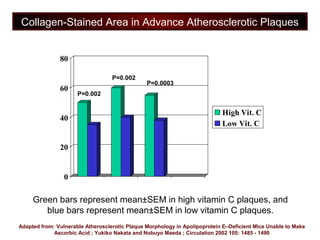
Collagen-Stained Area in Advance Atherosclerotic Plaques
0
20
40
60
80
High Vit. C
Low Vit. C
P=0.002
P=0.002
P=0.0003
Green bars represent mean±SEM in high vitamin C plaques, and
blue bars represent mean±SEM in low vitamin C plaques.
Adapted from: Vulnerable Atherosclerotic Plaque Morphology in Apolipoprotein E–Deficient Mice Unable to Make
Ascorbic Acid ; Yukiko Nakata and Nobuyo Maeda ; Circulation 2002 105: 1485 - 1490
Conclusion:
I. Vitamin C does not alter either foam cell formation
or the size of atherosclerotic plaques.
II. Vitamin C deficiency compromises deposition of
collagen in the atherosclerotic plaques and
significantly influences their collagen content and
collagen in the adventitia surrounding vessels with
plaques.
Questions:
I. This study only shows the effect of lack of vitamin
C on atherosclerosis and plaque vulnerability. The
question is whether excess vitamin C can reverse
atherosclerosis or stabilize plaque.
II. Vitamin C has been long known for its wound
healing properties, knowing vulnerable plaques as
sites of injury/wound in arterial wall, would vitamin
C administration help increase plaque stability?
III. If so, should the treatment be administered
systemic or locally?
Questions:
IV. Vitamin C has two major roles, collagen production
and antioxidation, which one is more dominant as
far as atherosclerosis and vulnerable plaque?
Suggestion:
VP.org Editorial Suggestion:
- Please email your thoughts to:
Discussion-Group@VP.org or DG@VP.org
1. Witztum JL, Steinberg D. Role of oxidized low density lipoprotein in atherogenesis. J Clin Invest. 1991; 88: 1785–1792.[Medline]
2. Heinecke JW. Oxidants and antioxidants in the pathogenesis of atherosclerosis: implications for the oxidized low density lipoprotein
hypothesis. Atherosclerosis. 1998; 141: 1–15.[Medline]
3. Buettner GR. The pecking order of free radicals and antioxidants: lipid peroxidation, -tocopherol, and ascorbate. Arch Biochem
Biophys. 1993; 300: 535–543.[Medline]
4. Martin A, Frei B. Both intracellular and extracellular vitamin C inhibit atherogenic modification of LDL by human vascular endothelial
cells. Arterioscler Thromb Vasc Biol. 1997; 17: 1583–1590.[Abstract/Full Text]
5. Bowie AG, O’Neill LA. Vitamin C inhibits NF- B activation by TNF via the activation of p38 mitogen-activated protein kinase. J
Immunol.;. 2000; 165: 7180–7188.[Abstract/Full Text]
6. Maeda N, Hagihara H, Nakata Y, et al. Aortic wall damage in mice unable to synthesize ascorbic acid. Proc Natl Acad Sci U S A.
2000; 97: 841–846.[Abstract/Full Text]
7. Silverstein RJ, Landsman AS.; The effects of a moderate and high dose of vitamin C on wound healing in a controlled guinea pig
model. J Foot Ankle Surg. 1999 Sep-Oct;38(5):333
8. Naghavi M, Madjid M, Khan MR, Mohammadi RM, Willerson JT, Casscells SW.; New developments in the detection of vulnerable
plaque. ; Curr Atheroscler Rep. 2001 Mar;3(2):125-35. Review.
9. Free Radic Res 2001 Dec;35(6):967-78; Supplementation with vitamin E but not with vitamin C lowers lipid peroxidation in vivo in
mildly hypercholesterolemic men.Kaikkonen J, Porkkala-Sarataho E, Morrow JD, Roberts LJ 2nd, Nyyssonen K, Salonen R,
Tuomainen TP, Ristonmaa U, Poulsen HE, Salonen JT.
10. Gale CR, Ashurst HE, Powers HJ, Martyn CN.; Antioxidant vitamin status and carotid atherosclerosis in the elderly.
Am J Clin Nutr 2001 Sep;74(3):402-8
11. Vulnerable Atherosclerotic Plaque Morphology in Apolipoprotein E–Deficient Mice Unable to Make Ascorbic Acid
Yukiko Nakata and Nobuyo Maeda ; Circulation 2002 105: 1485 – 1490
12. Rocnik EF, Chan BM, Pickering JG. Evidence for a role of collagen synthesis in arterial smooth muscle cell migration. J
Clin Invest. 1998; 101: 1889–1898.[Abstract/Full Text]
References

E sv2n12

  • 1.
    Editorial Slides VP Watch,March 27, 2002, Volume 2, Issue 12 Ascorbic Acid, Wound Healing, and Vulnerable Plaque Vitamin C; Pro-Collagen vs. Antioxidant
  • 2.
     Free radicalshave been suggested for decades as the major factor involved in pathophysiology of chronic disorders like Alzheimer, rheumatoid arthritis, and atherosclerosis.  Oxidation of LDL by free radicals is known as the major factor for initiation of atherosclerosis. 1,2  Therefore antioxidant therapy (Vitamin C and E) has been studied for prevention or treatment of atherosclerosis.  However despite many epidemiological evidence the controversy about antioxidant therapy in atherosclerosis remains an issue.
  • 3.
     Vitamin Cis more than antioxidant:  Coenzyme for collagen production  Anti-oxidant • Antiinflammatory effects  Decreasing leukocyte adhesion to the endothelium  Inhibits OxLDL-induced leukocyte adhesion to endothelium  Inhibits activation of nuclear factor- kappa B • Improving endothelial dysfunction
  • 4.
     Insufficient ascorbicacid, a required cofactor for prolylhydroxylase in collagen biosynthesis, causes the formation of unstable collagen. 2  Studies show greater wound integrity in animals that received higher dose of vitamin C compare to moderate dose of the vitamin. 7  In 1999 Nobuyo Maeda and his colleagues generated L-gulono-gamma-lactone oxidase deficient mice (Gulo-/-), a key enzyme for ascorbic acid synthesis, in their lab. The mutant mice, like humans, entirely depend on dietary vitamin C. 6
  • 5.
     As highlightedin VP Watch of this week, Nakata and Maeda from University of North Carolina crossed Gulo-/- mice with ApoE-/- KO mice to study the effect of vitamin C deficiency on atherosclerosis.  They showed that low versus high vitamin C had no effect on the size of the atherosclerotic plaques that developed in the Gulo-/- Apoe-/- mice.
  • 6.
    Aortic lesions ataortic sinus of the Gulo-/- Apoe-/- mice with high and low vitamin C High Vit. C Low Vit. C Low Vit. CHigh Vit. C Sections A, B, E, and F were stained for lipids with Sudan IVB and counterstained with hematoxylin. Their neighboring sections C, D, G, and H were stained for collagen with Sirius red. Sections A through D are from 4-month-old females fed Western-type diet. Sections E through H are from 9-month-old males fed normal chow. Arrows in E indicate small vessels in adventitia. Bar=100 µm. From: Yukiko Nakata and Nobuyo Maeda; Circulation 2002 105: 1485 - 1490; published online before print March 4 2002, doi:10.1161/01.CIR.0000012142.69612.25
  • 7.
    Collagen-Stained Area inAdvance Atherosclerotic Plaques 0 20 40 60 80 High Vit. C Low Vit. C P=0.002 P=0.002 P=0.0003 Green bars represent mean±SEM in high vitamin C plaques, and blue bars represent mean±SEM in low vitamin C plaques. Adapted from: Vulnerable Atherosclerotic Plaque Morphology in Apolipoprotein E–Deficient Mice Unable to Make Ascorbic Acid ; Yukiko Nakata and Nobuyo Maeda ; Circulation 2002 105: 1485 - 1490
  • 8.
    Conclusion: I. Vitamin Cdoes not alter either foam cell formation or the size of atherosclerotic plaques. II. Vitamin C deficiency compromises deposition of collagen in the atherosclerotic plaques and significantly influences their collagen content and collagen in the adventitia surrounding vessels with plaques.
  • 9.
    Questions: I. This studyonly shows the effect of lack of vitamin C on atherosclerosis and plaque vulnerability. The question is whether excess vitamin C can reverse atherosclerosis or stabilize plaque. II. Vitamin C has been long known for its wound healing properties, knowing vulnerable plaques as sites of injury/wound in arterial wall, would vitamin C administration help increase plaque stability? III. If so, should the treatment be administered systemic or locally?
  • 10.
    Questions: IV. Vitamin Chas two major roles, collagen production and antioxidation, which one is more dominant as far as atherosclerosis and vulnerable plaque?
  • 11.
    Suggestion: VP.org Editorial Suggestion: -Please email your thoughts to: Discussion-Group@VP.org or DG@VP.org
  • 12.
    1. Witztum JL,Steinberg D. Role of oxidized low density lipoprotein in atherogenesis. J Clin Invest. 1991; 88: 1785–1792.[Medline] 2. Heinecke JW. Oxidants and antioxidants in the pathogenesis of atherosclerosis: implications for the oxidized low density lipoprotein hypothesis. Atherosclerosis. 1998; 141: 1–15.[Medline] 3. Buettner GR. The pecking order of free radicals and antioxidants: lipid peroxidation, -tocopherol, and ascorbate. Arch Biochem Biophys. 1993; 300: 535–543.[Medline] 4. Martin A, Frei B. Both intracellular and extracellular vitamin C inhibit atherogenic modification of LDL by human vascular endothelial cells. Arterioscler Thromb Vasc Biol. 1997; 17: 1583–1590.[Abstract/Full Text] 5. Bowie AG, O’Neill LA. Vitamin C inhibits NF- B activation by TNF via the activation of p38 mitogen-activated protein kinase. J Immunol.;. 2000; 165: 7180–7188.[Abstract/Full Text] 6. Maeda N, Hagihara H, Nakata Y, et al. Aortic wall damage in mice unable to synthesize ascorbic acid. Proc Natl Acad Sci U S A. 2000; 97: 841–846.[Abstract/Full Text] 7. Silverstein RJ, Landsman AS.; The effects of a moderate and high dose of vitamin C on wound healing in a controlled guinea pig model. J Foot Ankle Surg. 1999 Sep-Oct;38(5):333 8. Naghavi M, Madjid M, Khan MR, Mohammadi RM, Willerson JT, Casscells SW.; New developments in the detection of vulnerable plaque. ; Curr Atheroscler Rep. 2001 Mar;3(2):125-35. Review. 9. Free Radic Res 2001 Dec;35(6):967-78; Supplementation with vitamin E but not with vitamin C lowers lipid peroxidation in vivo in mildly hypercholesterolemic men.Kaikkonen J, Porkkala-Sarataho E, Morrow JD, Roberts LJ 2nd, Nyyssonen K, Salonen R, Tuomainen TP, Ristonmaa U, Poulsen HE, Salonen JT. 10. Gale CR, Ashurst HE, Powers HJ, Martyn CN.; Antioxidant vitamin status and carotid atherosclerosis in the elderly. Am J Clin Nutr 2001 Sep;74(3):402-8 11. Vulnerable Atherosclerotic Plaque Morphology in Apolipoprotein E–Deficient Mice Unable to Make Ascorbic Acid Yukiko Nakata and Nobuyo Maeda ; Circulation 2002 105: 1485 – 1490 12. Rocnik EF, Chan BM, Pickering JG. Evidence for a role of collagen synthesis in arterial smooth muscle cell migration. J Clin Invest. 1998; 101: 1889–1898.[Abstract/Full Text] References