E-learning for Education

Multimedia University

MULTIMEDIA UNIVERSITY
What is E-learning?

The use of Internet technologies
to deliver a broad array of
solutions that enhance
knowledge and performance

E-learning is Internet-enabled
learning
http://www.cisco.com

Rosenberg, 2001

MULTIMEDIA UNIVERSITY
Truth of e-learning
Internet has started reshaping education.
Education will not be the same in the next decade
There is no going back. The traditional classroom
has to be transformed
Web-based Education Commission, US

Many universities/colleges may not survive
by the end of this decade

MULTIMEDIA UNIVERSITY
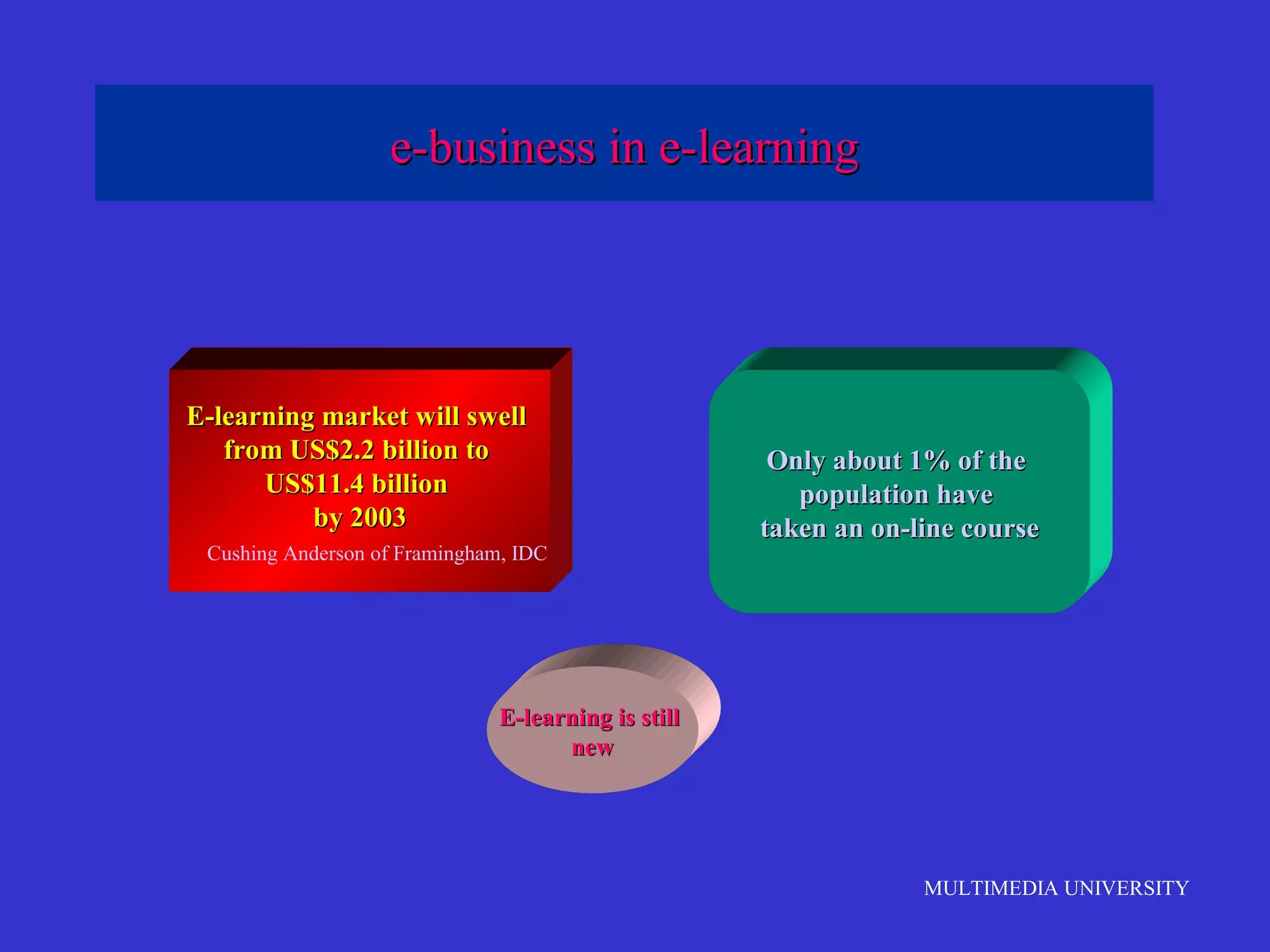
e-business in e-learning

E-learning market will swell
from US$2.2 billion to
US$11.4 billion
by 2003
Cushing Anderson of Framingham, IDC

Only about 1% of the
population have
taken an on-line course

E-learning is still
new

MULTIMEDIA UNIVERSITY
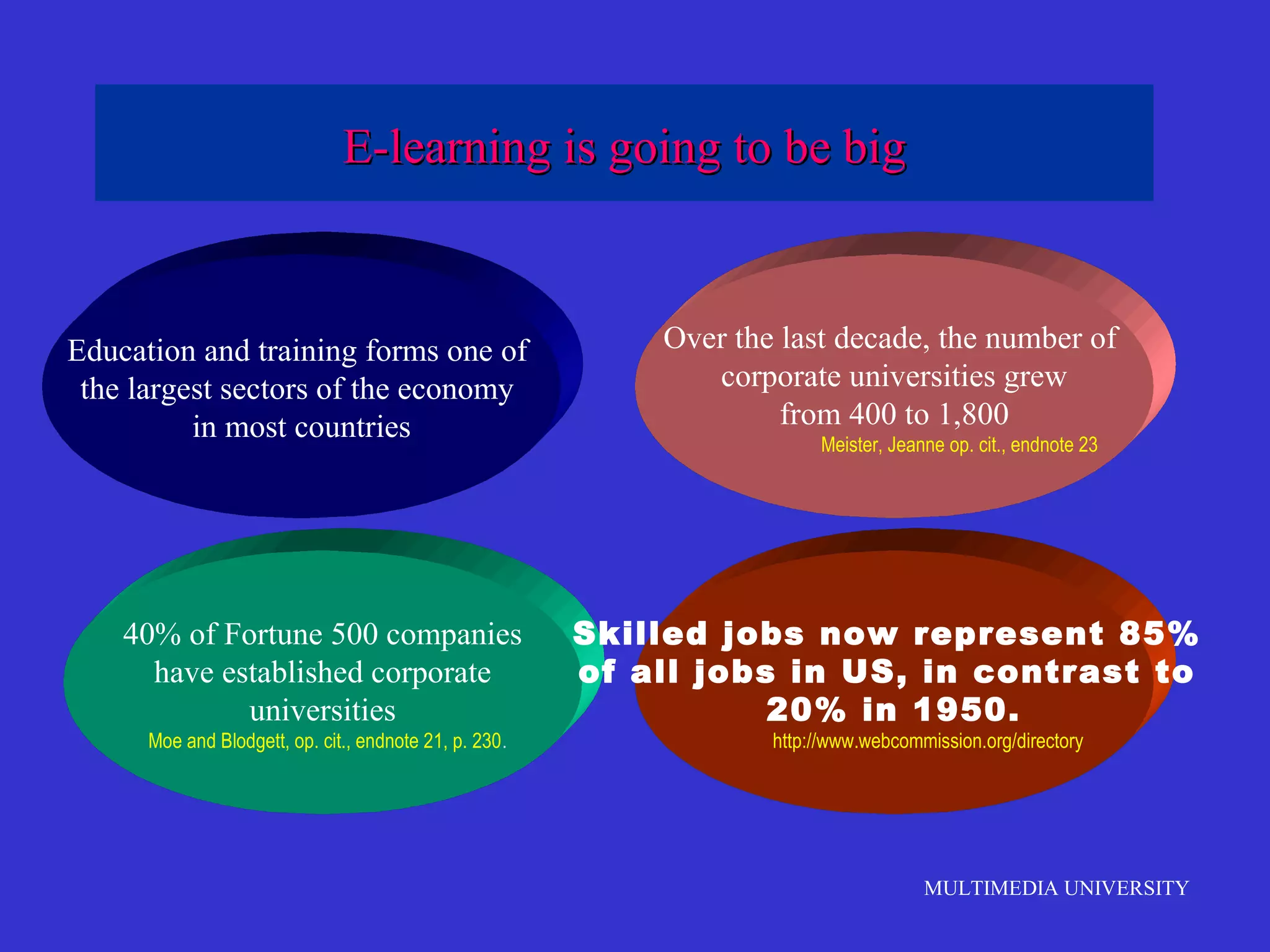
E-learning is going to be big

Education and training forms one of
the largest sectors of the economy
in most countries

40% of Fortune 500 companies
have established corporate
universities
Moe and Blodgett, op. cit., endnote 21, p. 230.

Over the last decade, the number of
corporate universities grew
from 400 to 1,800
Meister, Jeanne op. cit., endnote 23

Skilled jobs now represent 85%
of all jobs in US, in contrast to
20% in 1950.
http://www.webcommission.org/directory

MULTIMEDIA UNIVERSITY
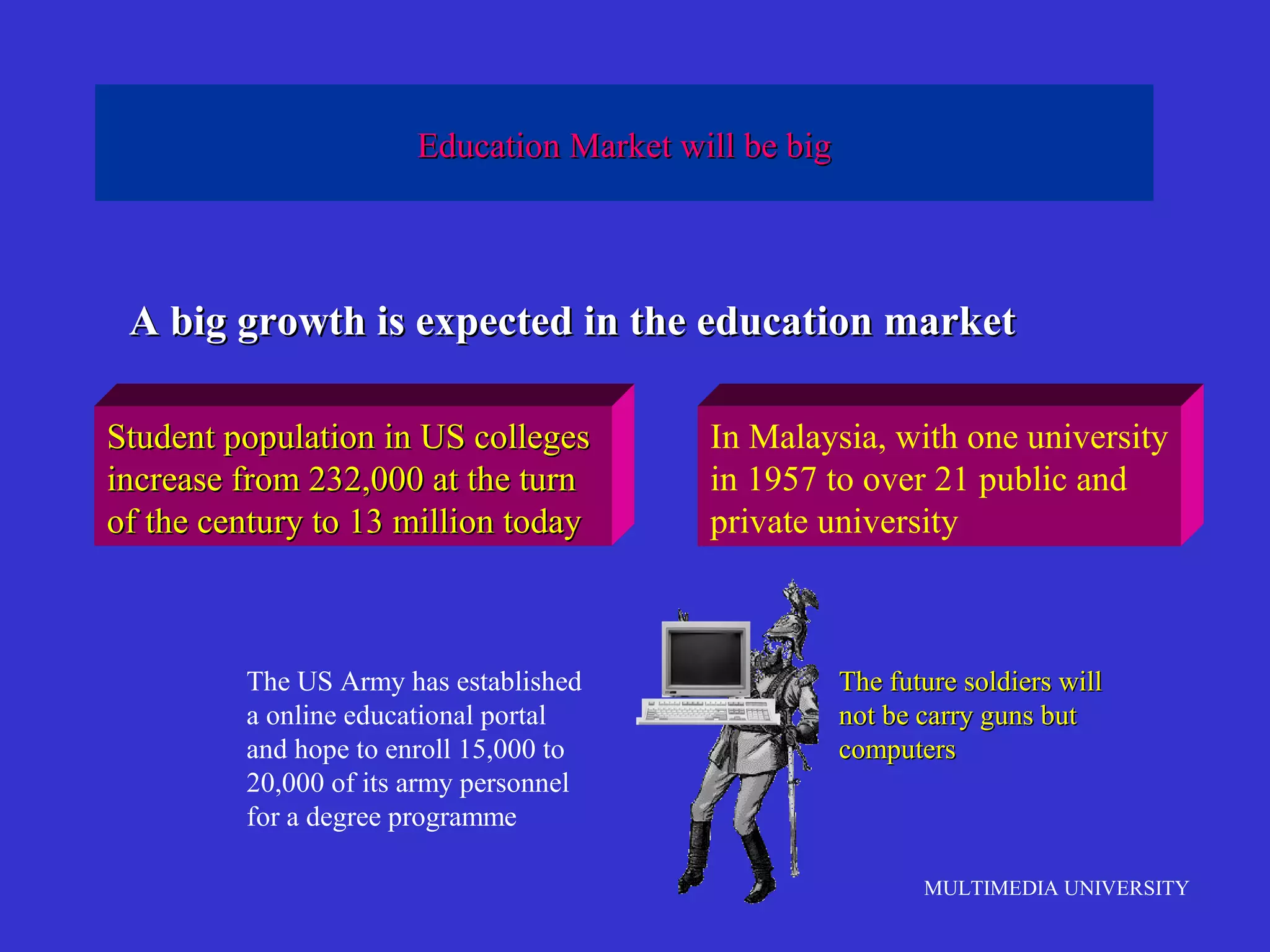
Education Market will be big

A big growth is expected in the education market
Student population in US colleges
increase from 232,000 at the turn
of the century to 13 million today

The US Army has established
a online educational portal
and hope to enroll 15,000 to
20,000 of its army personnel
for a degree programme

In Malaysia, with one university
in 1957 to over 21 public and
private university

The future soldiers will
not be carry guns but
computers

MULTIMEDIA UNIVERSITY
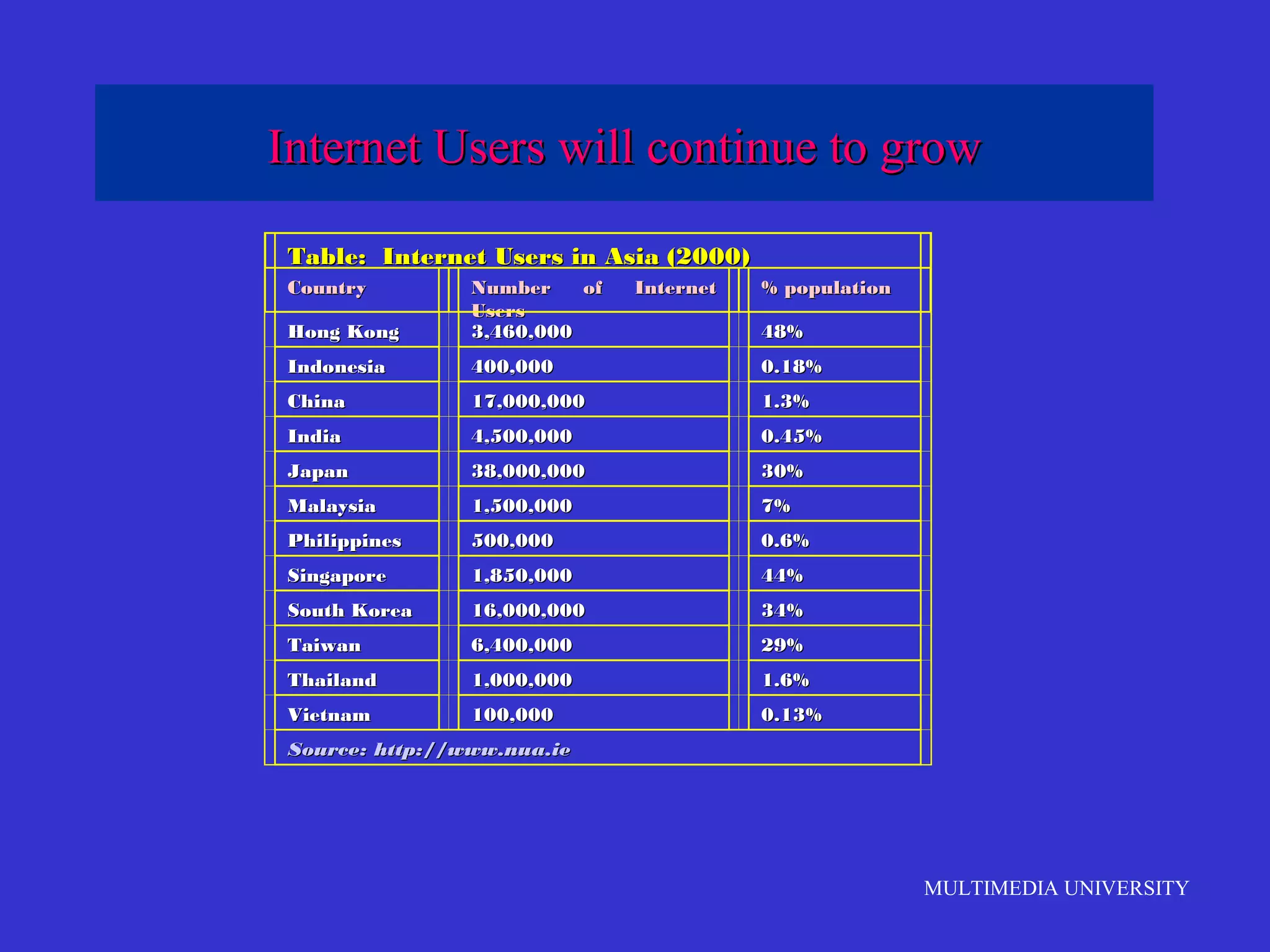
Internet Users will continue to grow
Table: Internet Users in Asia (2000)
Country
Hong Kong

Number
of
Users
3,460,000

Internet

% population

Indonesia

400,000

0.18%

China

17,000,000

1.3%

India

4,500,000

0.45%

Japan

38,000,000

30%

Malaysia

1,500,000

7%

Philippines

500,000

0.6%

Singapore

1,850,000

44%

South Korea

16,000,000

34%

Taiwan

6,400,000

29%

Thailand

1,000,000

1.6%

Vietnam

100,000

0.13%

48%

Source: http://www.nua.ie

MULTIMEDIA UNIVERSITY
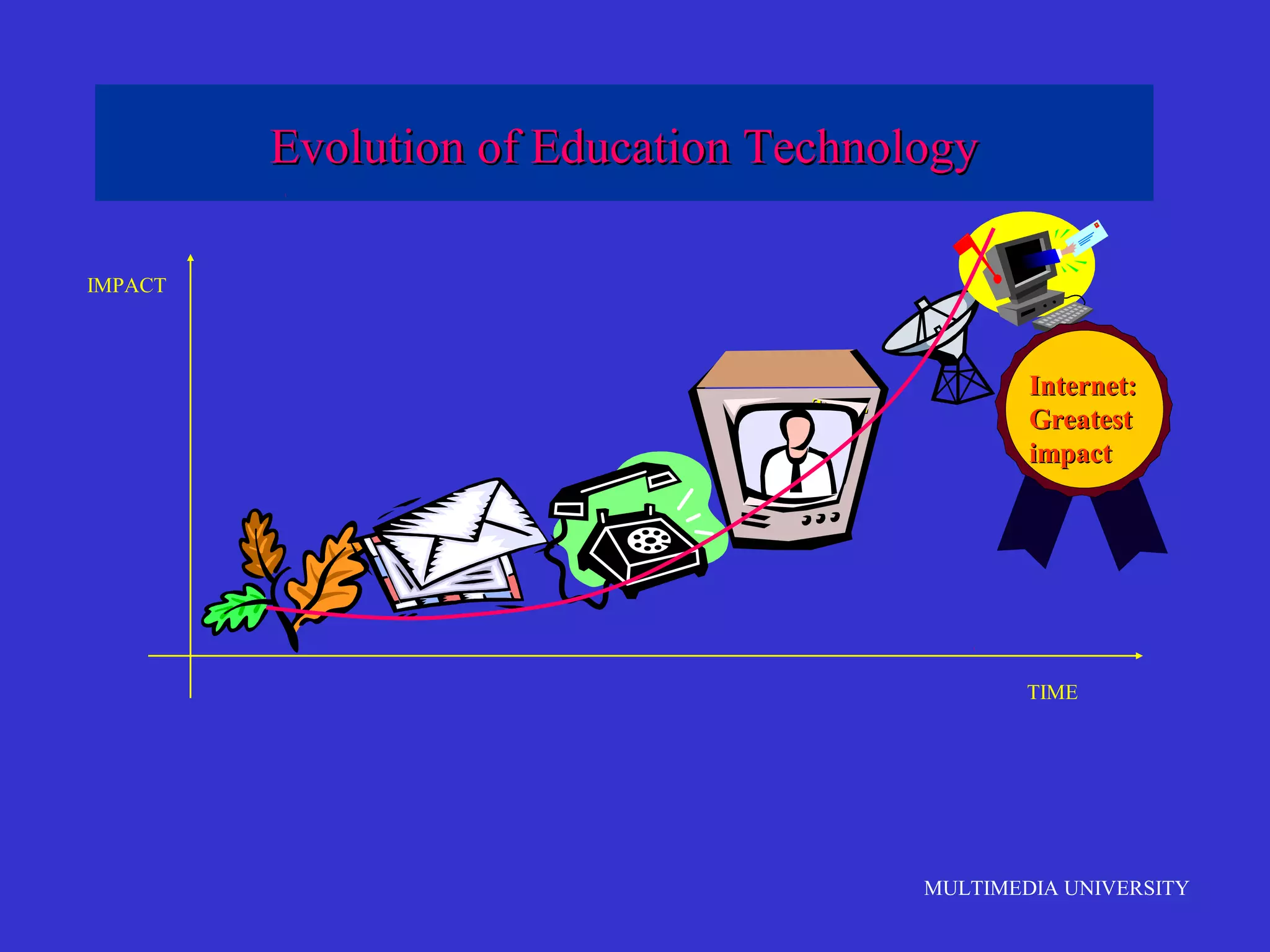
Evolution of Education Technology
IMPACT

TIME

Internet:
Greatest
impact

TIME

MULTIMEDIA UNIVERSITY
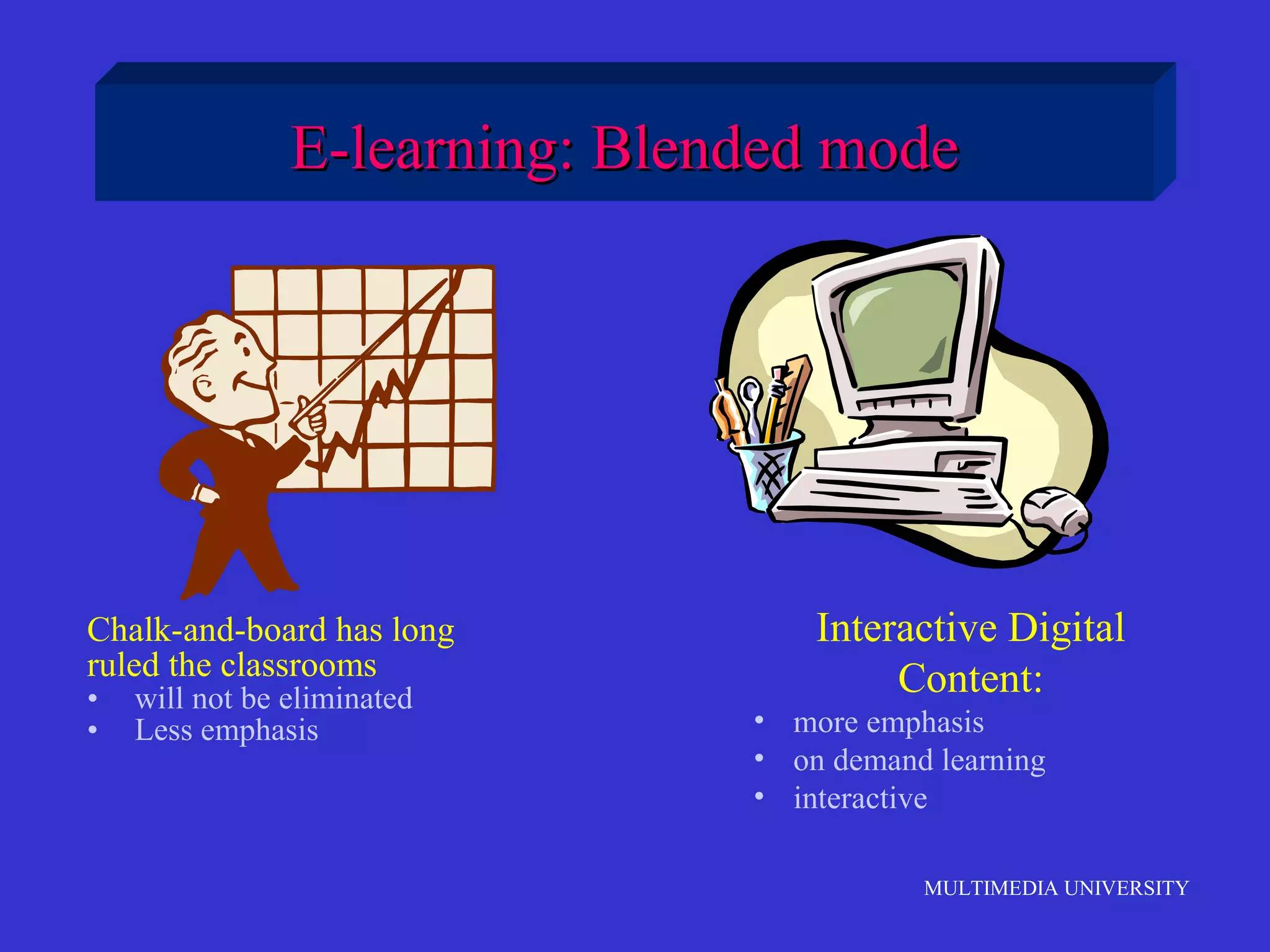
E-learning: Blended mode

Chalk-and-board has long
ruled the classrooms
•
•

will not be eliminated
Less emphasis

Interactive Digital
Content:
• more emphasis
• on demand learning
• interactive
MULTIMEDIA UNIVERSITY
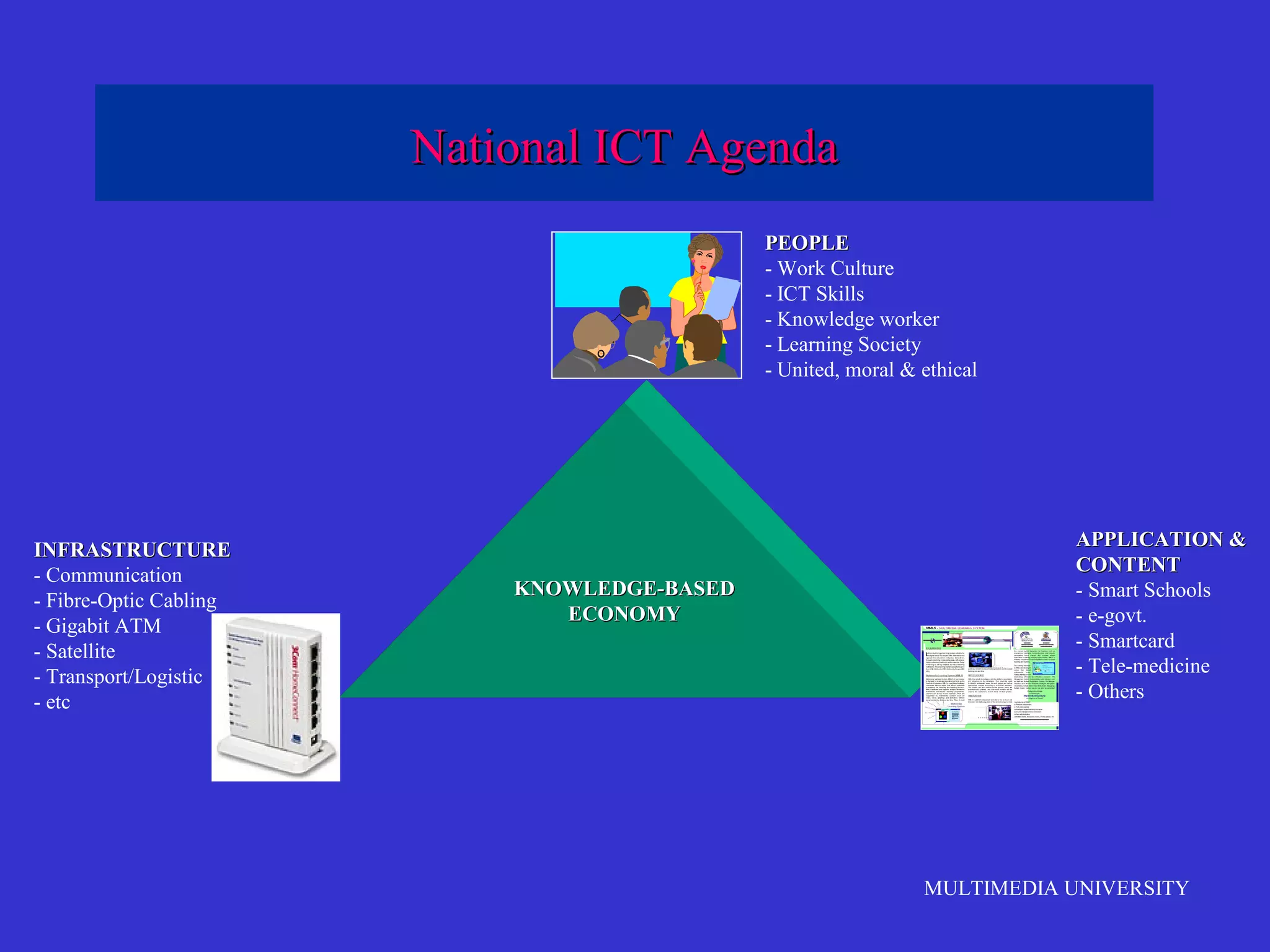
National ICT Agenda
PEOPLE
- Work Culture
- ICT Skills
- Knowledge worker
- Learning Society
- United, moral & ethical

INFRASTRUCTURE
- Communication
- Fibre-Optic Cabling
- Gigabit ATM
- Satellite
- Transport/Logistic
- etc

KNOWLEDGE-BASED
ECONOMY

APPLICATION &
CONTENT
- Smart Schools
- e-govt.
- Smartcard
- Tele-medicine
- Others

MULTIMEDIA UNIVERSITY
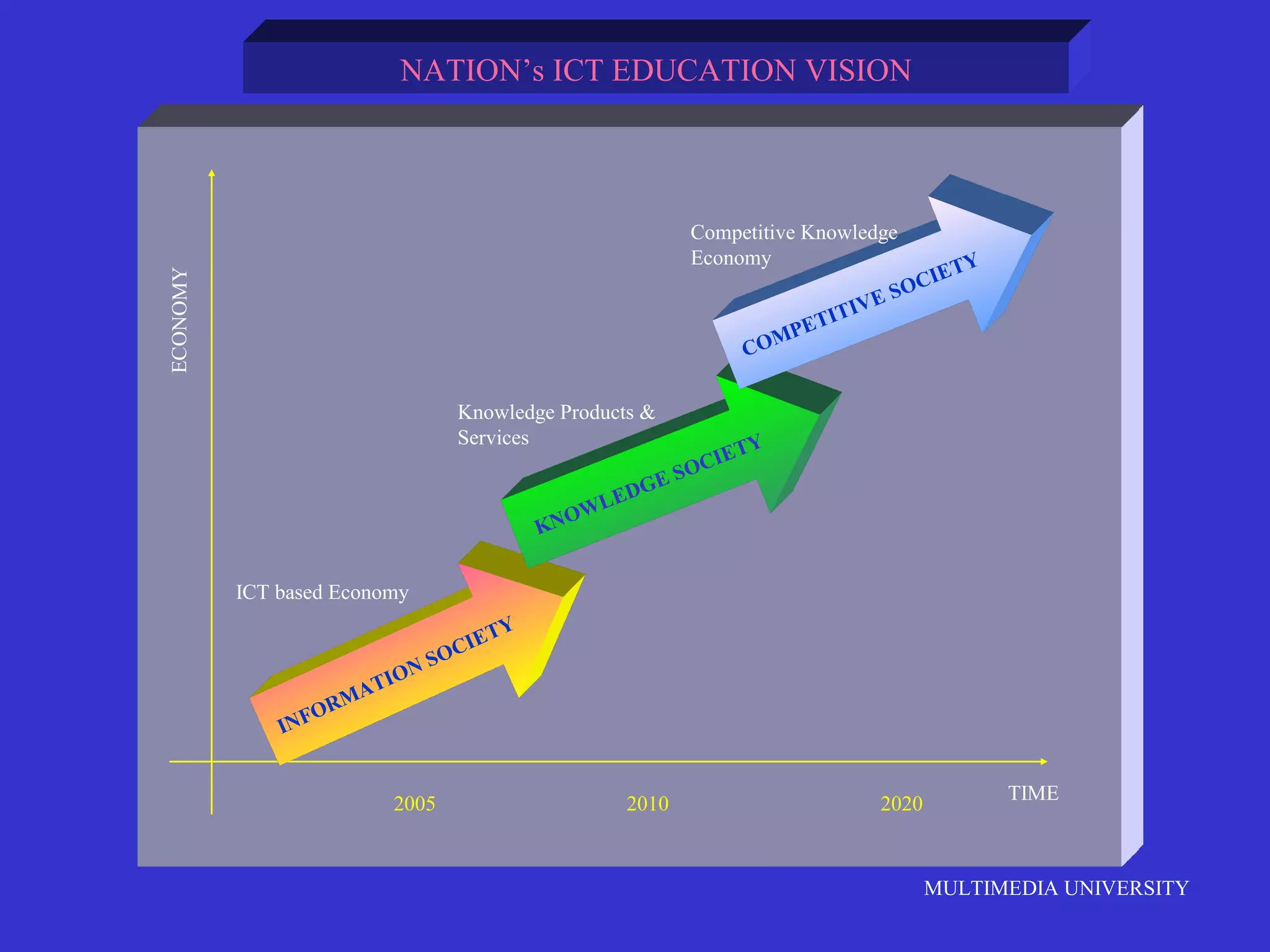
NATION’s ICT EDUCATION VISION

ECONOMY

Competitive Knowledge
Economy
V
ITI
PET
M
CO

Knowledge Products &
Services

KN

GE
LED
OW

Y
IET
OC
ES

Y
IE T
OC
S

ICT based Economy

OR
INF

MA

N
TI O

S

2005

IE T
OC

Y

2010

2020

TIME

MULTIMEDIA UNIVERSITY
&
es
es s
te urs on
te urs tiion
va co ra
va co ra , ,
ri e n o e
ri en bo es tc
P dr v aus i ng
P driiv Colllausttr ng,, e
C d
i
i
t
et ,, i d nd
ke ch in en
pe
a ar th Sp
ar ar th
M e i
M e i
t
es
e s w e nt
R
R
d
d
ru
ru
P
P

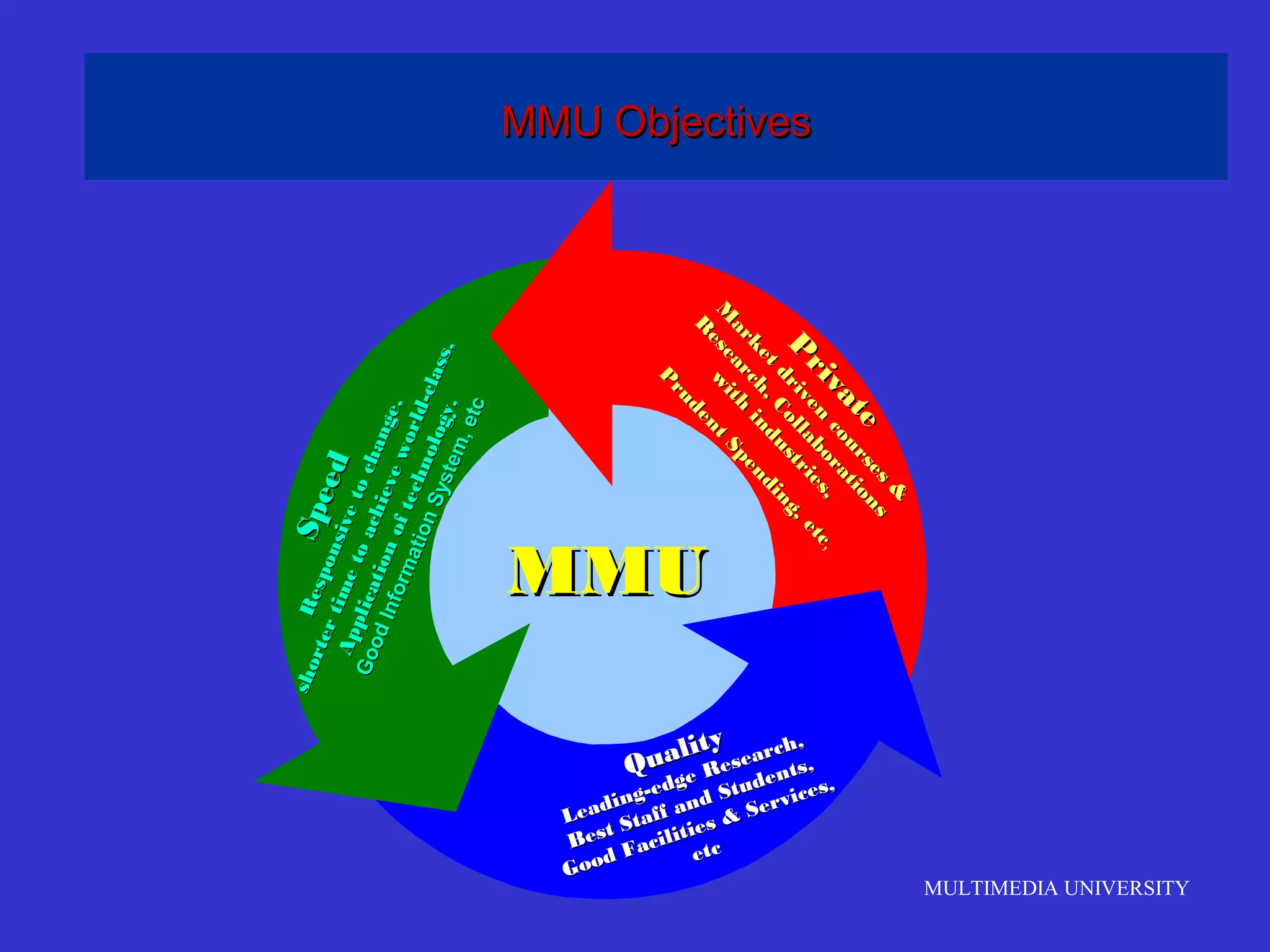
MMU

sho
rte Resp Spe
on
r
ed
Ap time sive
Go p lica to ac to ch
h
od
t
a
I nfo i on o ieve nge,
wo
f te
rm
rl
a tio
ch
n S nolo d-cla s
yst
g
s,
em y,
, et
c

MMU Objectives

lity rch,
Quage Resea ents,
d

MULTIMEDIA UNIVERSITY
,
Stu
g-ed
ices
adin aff and & Serv
Le
t St
ies
Bes Facilit tc
e
d
Goo
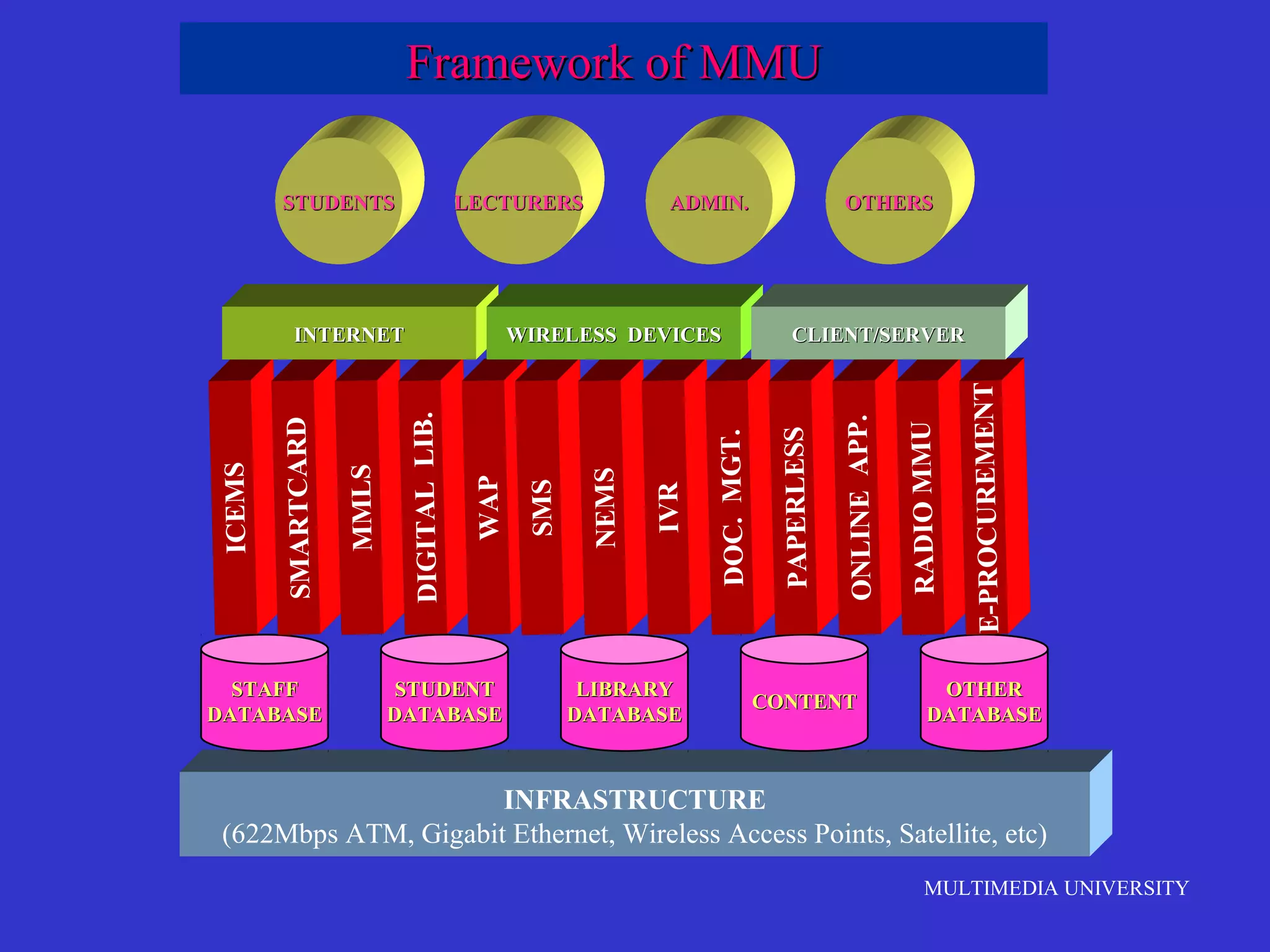
Framework of MMU

STAFF
DATABASE

STUDENT
DATABASE

LIBRARY
DATABASE

OTHERS

CONTENT

E-PROCUREMENT

CLIENT/SERVER

RADIO MMU

DOC. MGT.

IVR

NEMS

SMS

WAP

WIRELESS DEVICES

DIGITAL LIB.

MMLS

SMARTCARD

ICEMS

INTERNET

ADMIN.

ONLINE APP.

LECTURERS

PAPERLESS

STUDENTS

OTHER
DATABASE

INFRASTRUCTURE
(622Mbps ATM, Gigabit Ethernet, Wireless Access Points, Satellite, etc)
MULTIMEDIA UNIVERSITY
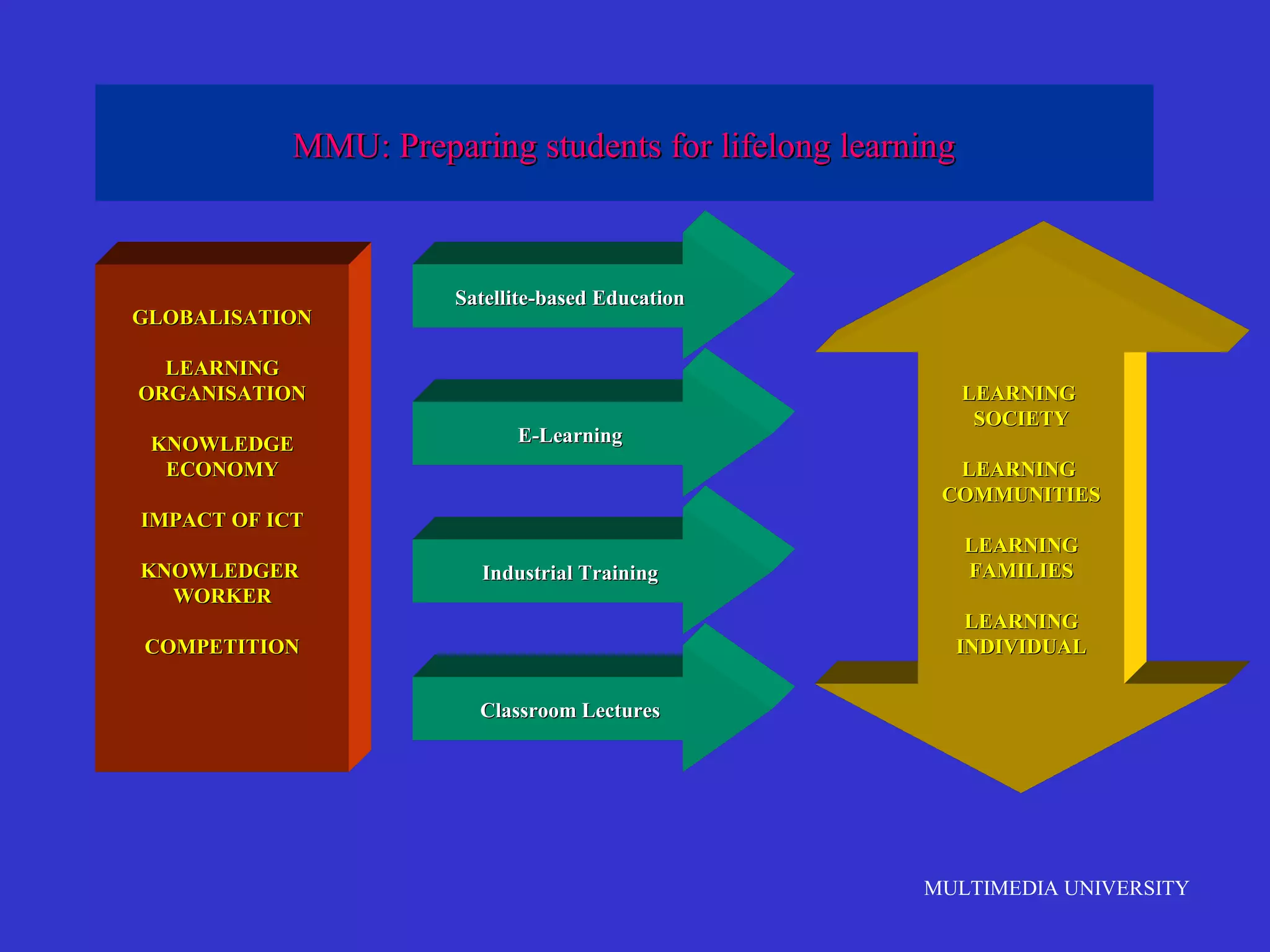
MMU: Preparing students for lifelong learning

GLOBALISATION

Satellite-based Education

LEARNING
ORGANISATION
KNOWLEDGE
ECONOMY

E-Learning

LEARNING
SOCIETY
LEARNING
COMMUNITIES

IMPACT OF ICT
KNOWLEDGER
WORKER

Industrial Training

LEARNING
FAMILIES
LEARNING
INDIVIDUAL

COMPETITION
Classroom Lectures

MULTIMEDIA UNIVERSITY
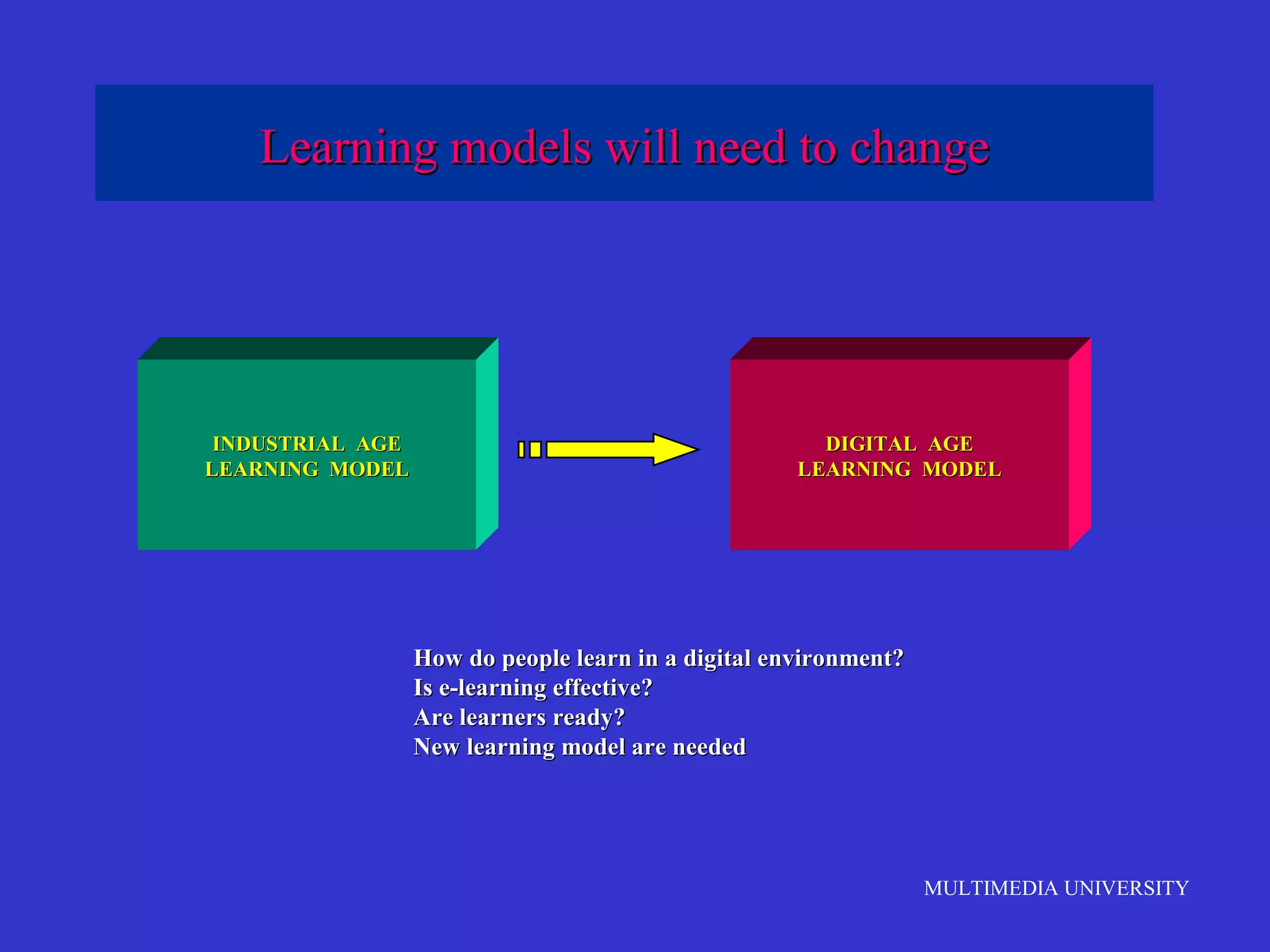
Learning models will need to change

INDUSTRIAL AGE
LEARNING MODEL

DIGITAL AGE
LEARNING MODEL

How do people learn in a digital environment?
Is e-learning effective?
Are learners ready?
New learning model are needed

MULTIMEDIA UNIVERSITY
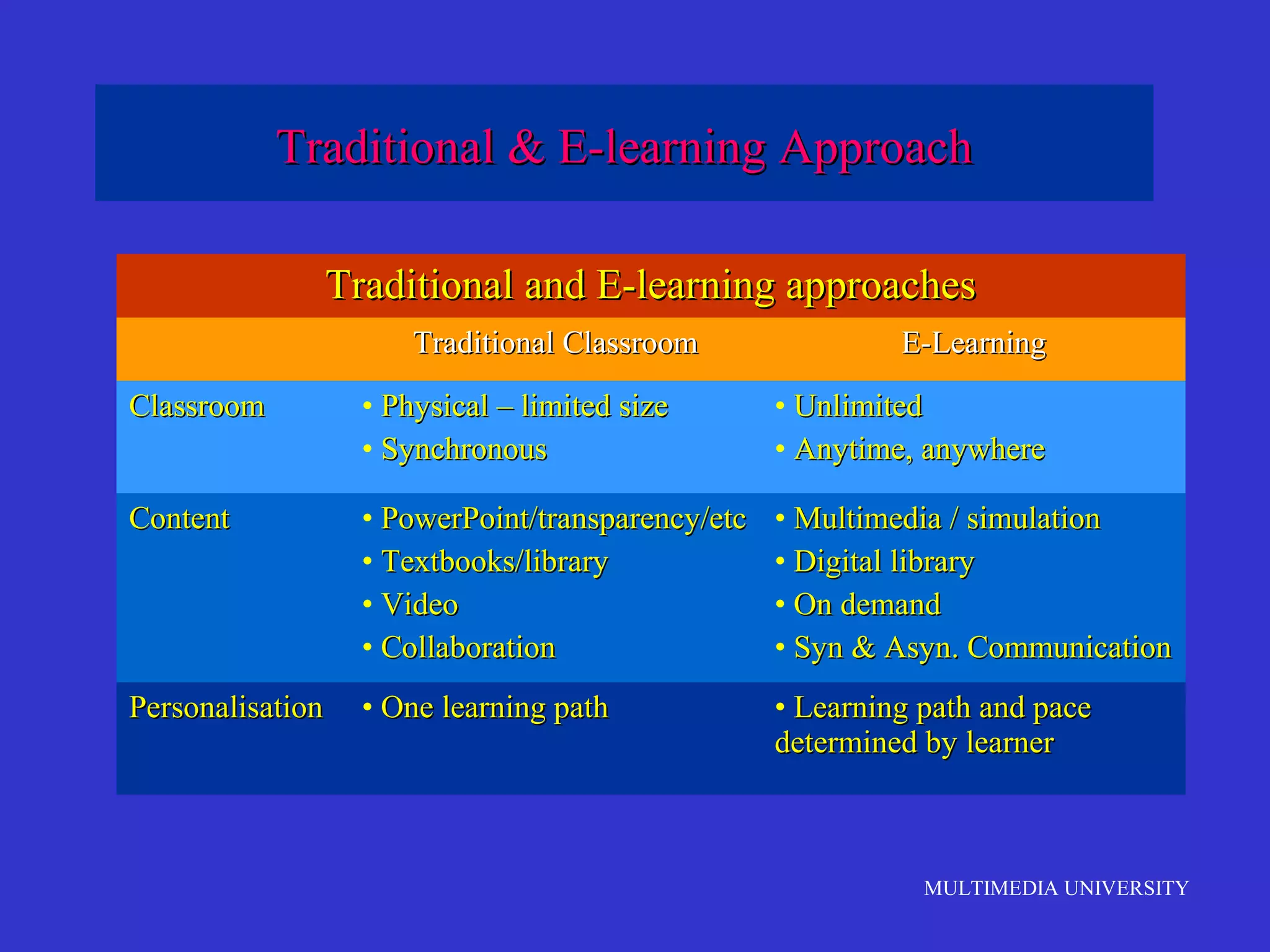
Traditional & E-learning Approach
Traditional and E-learning approaches
Traditional Classroom

E-Learning

Classroom

• Physical – limited size
• Synchronous

• Unlimited
• Anytime, anywhere

Content

• PowerPoint/transparency/etc
• Textbooks/library
• Video
• Collaboration

• Multimedia / simulation
• Digital library
• On demand
• Syn & Asyn. Communication

Personalisation

• One learning path

• Learning path and pace
determined by learner

MULTIMEDIA UNIVERSITY
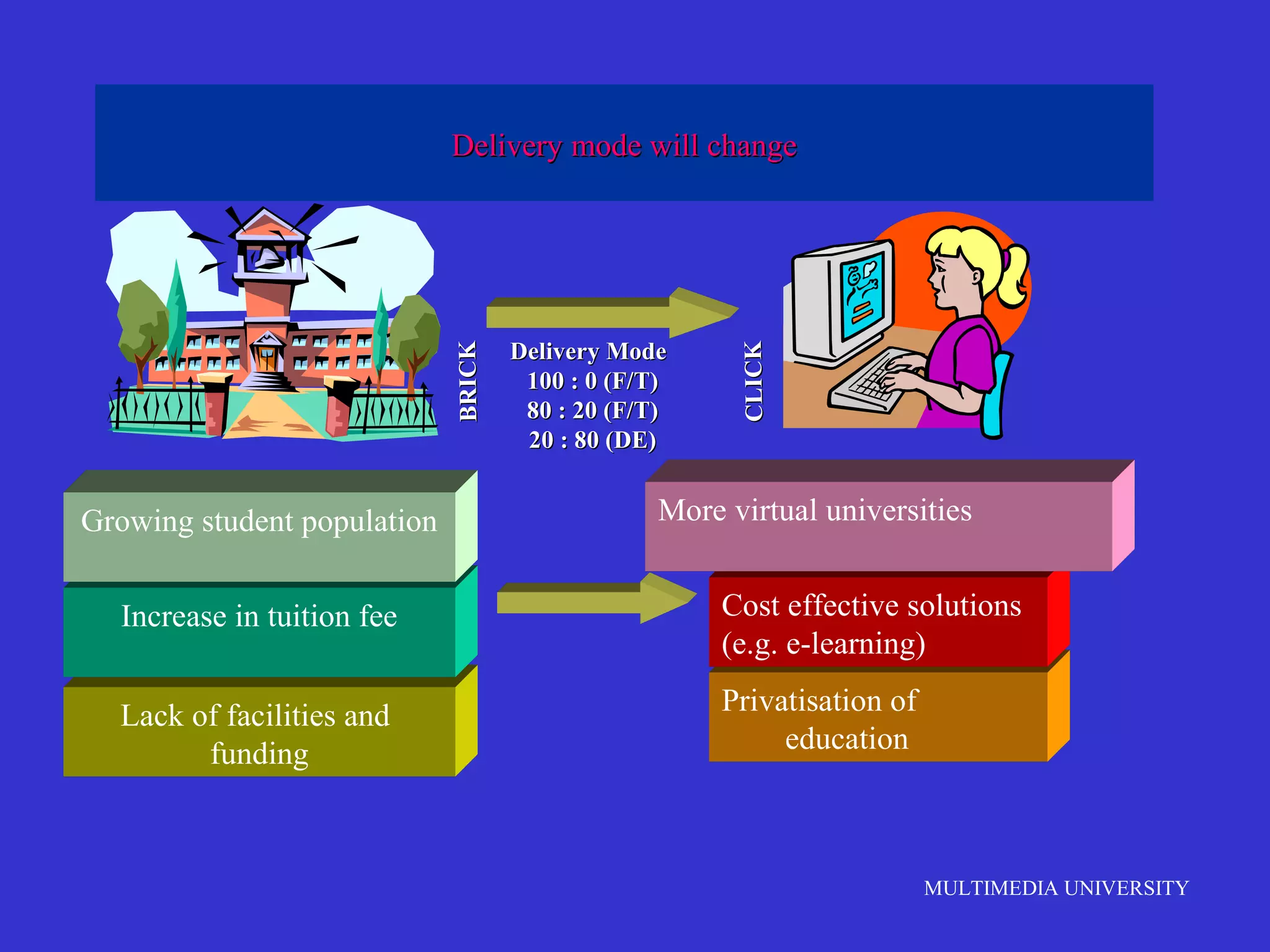
Growing student population

Delivery Mode
100 : 0 (F/T)
80 : 20 (F/T)
20 : 80 (DE)

CLIC K

BRICK

Delivery mode will change

More virtual universities

Increase in tuition fee

Cost effective solutions
(e.g. e-learning)

Lack of facilities and
funding

Privatisation of
education

MULTIMEDIA UNIVERSITY
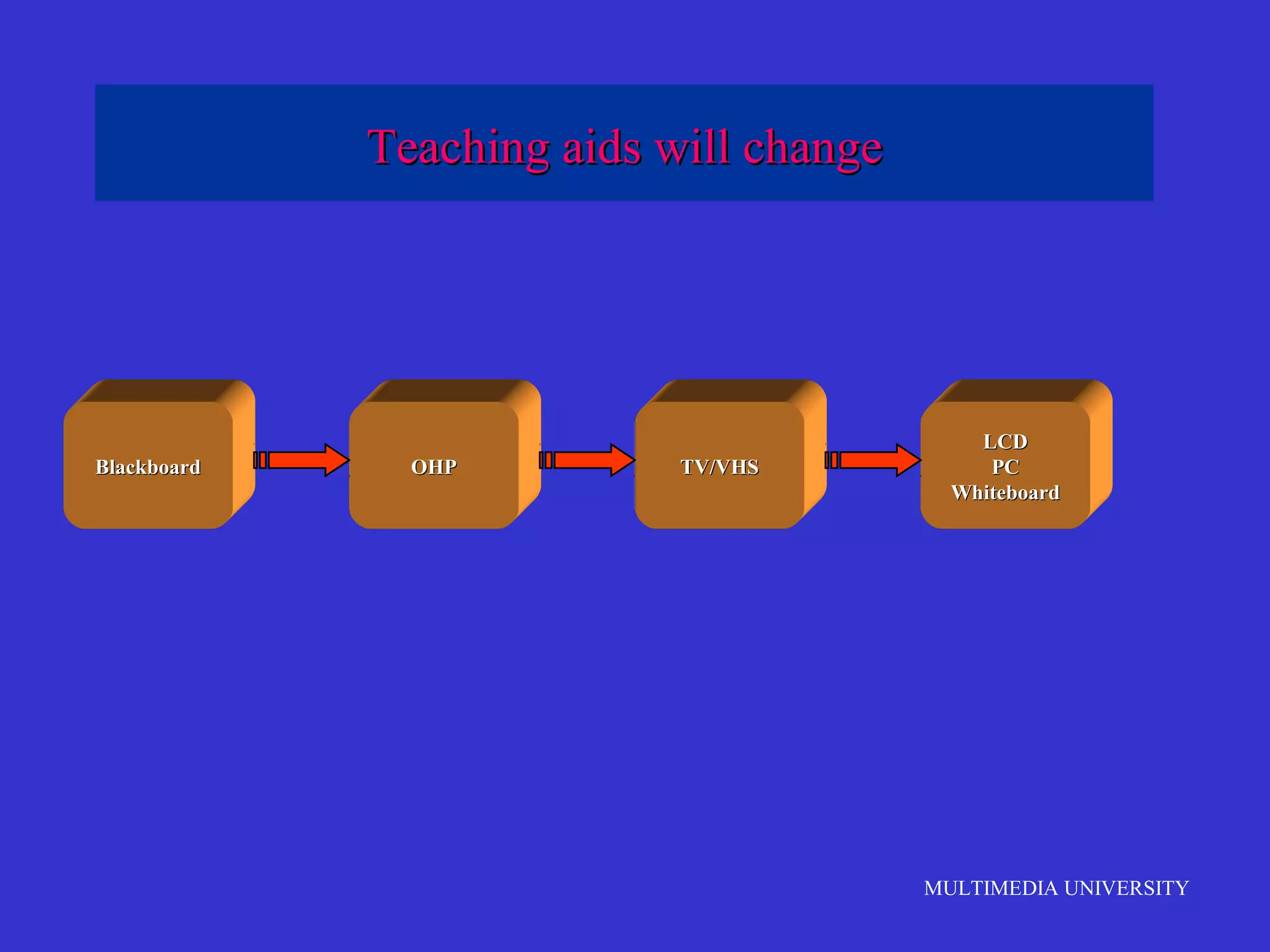
Teaching aids will change

Blackboard

OHP

TV/VHS

LCD
PC
Whiteboard

MULTIMEDIA UNIVERSITY
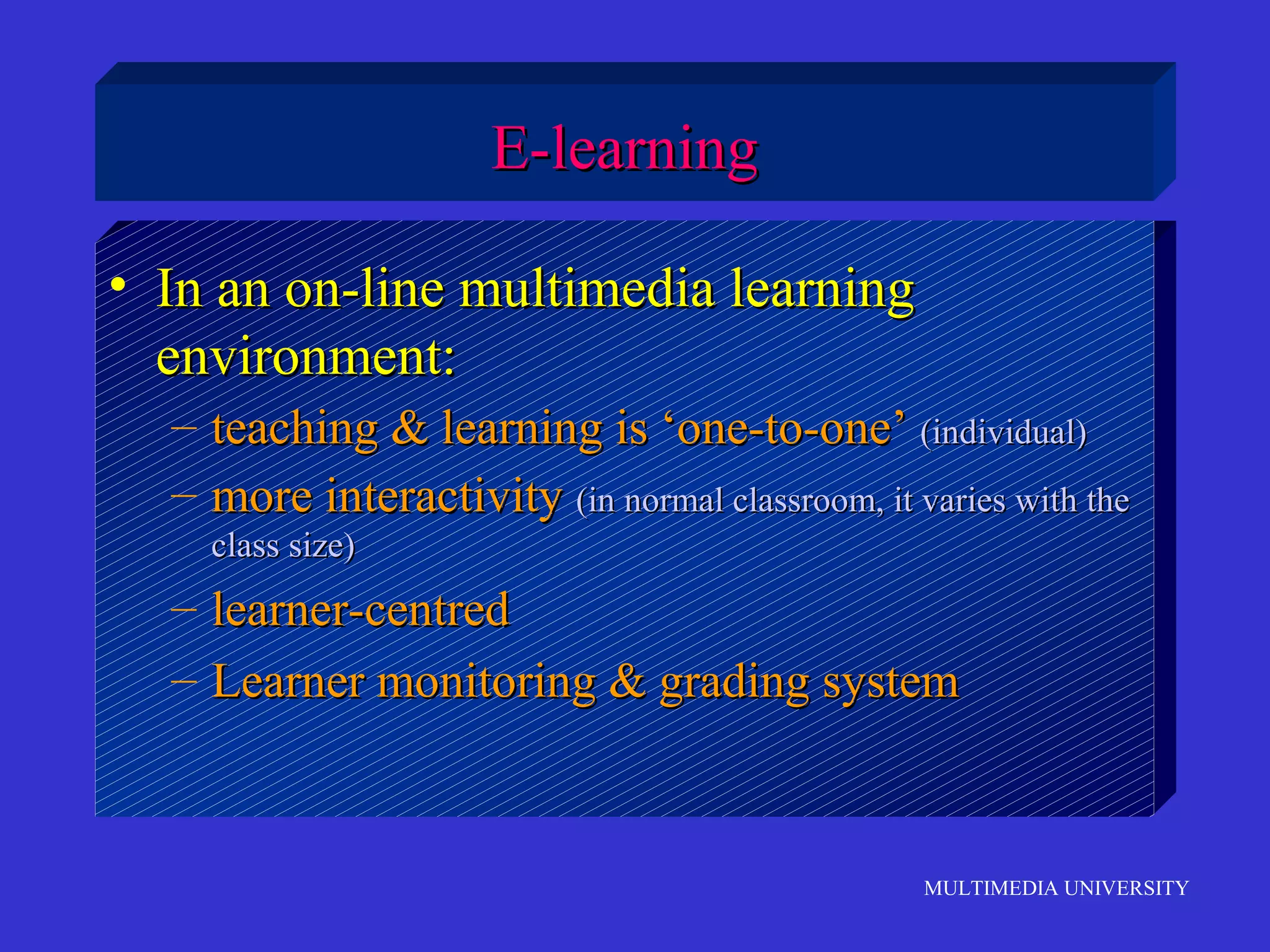
E-learning
• In an on-line multimedia learning
environment:
– teaching & learning is ‘one-to-one’ (individual)
– more interactivity (in normal classroom, it varies with the
class size)

– learner-centred
– Learner monitoring & grading system

MULTIMEDIA UNIVERSITY
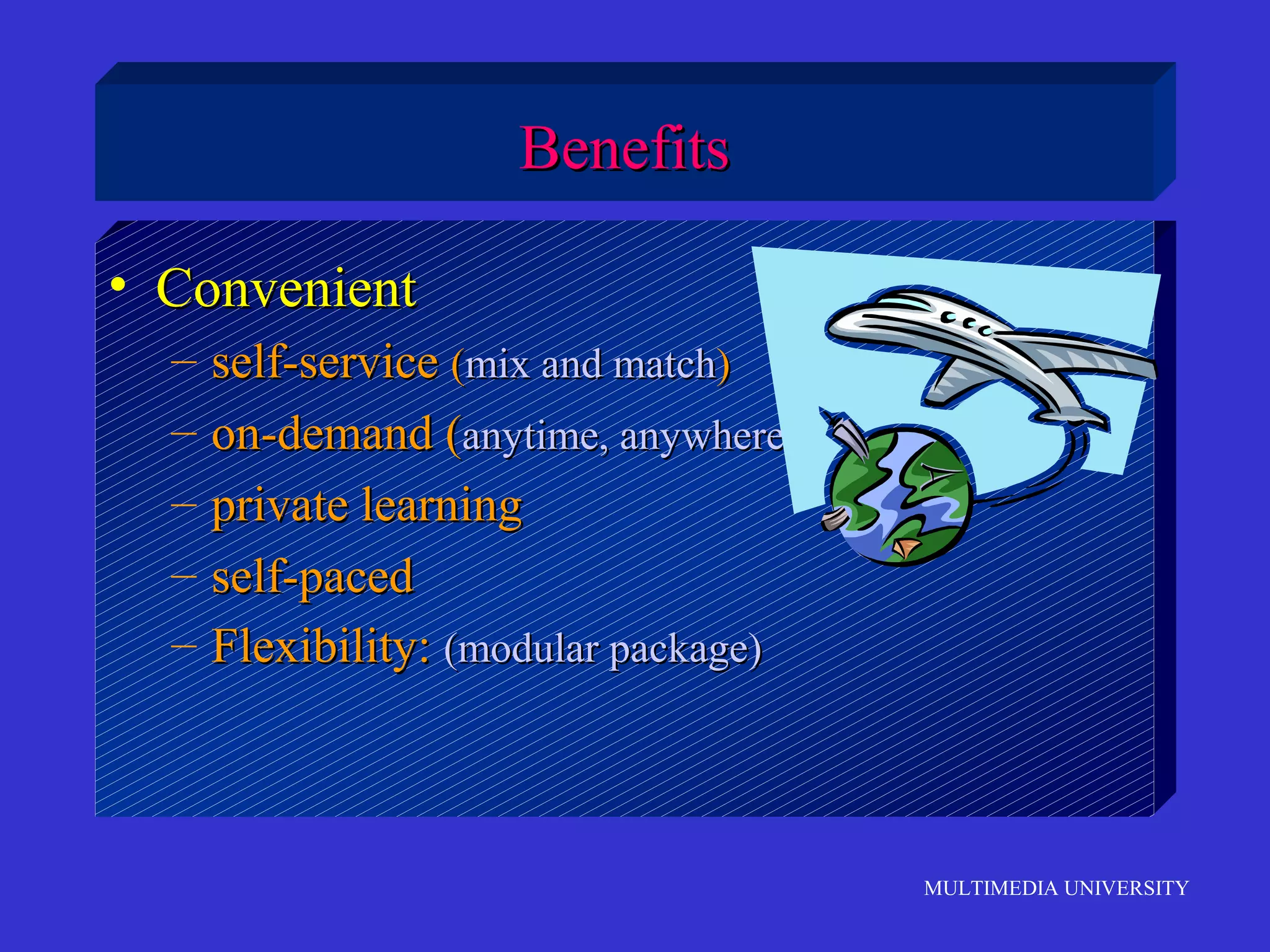
Benefits
• Convenient
–
–
–
–
–

self-service (mix and match)
on-demand (anytime, anywhere)
private learning
self-paced
Flexibility: (modular package)

MULTIMEDIA UNIVERSITY
Benefits
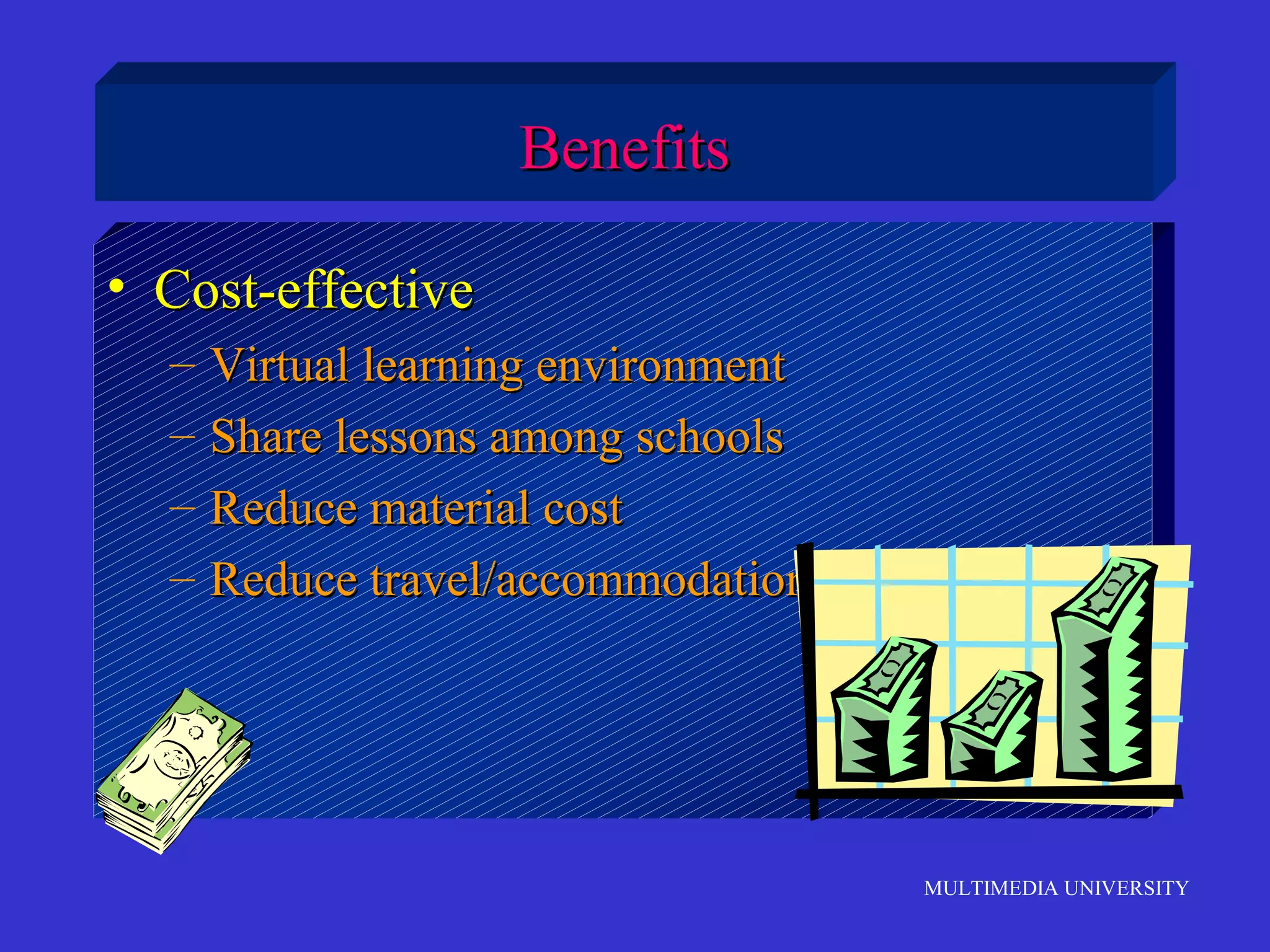
• Cost-effective
–
–
–
–

Virtual learning environment
Share lessons among schools
Reduce material cost
Reduce travel/accommodation costs

MULTIMEDIA UNIVERSITY
Benefits
• Consistent
–
–
–

Central control of content
Same quality of content for all
Same quality of education for all

MULTIMEDIA UNIVERSITY
Benefits
• media-rich
– Easier to understand & more engaging

• repeatable
– As many times as you like

• easier to monitor progress
– less administrative work
– can be more precise
MULTIMEDIA UNIVERSITY
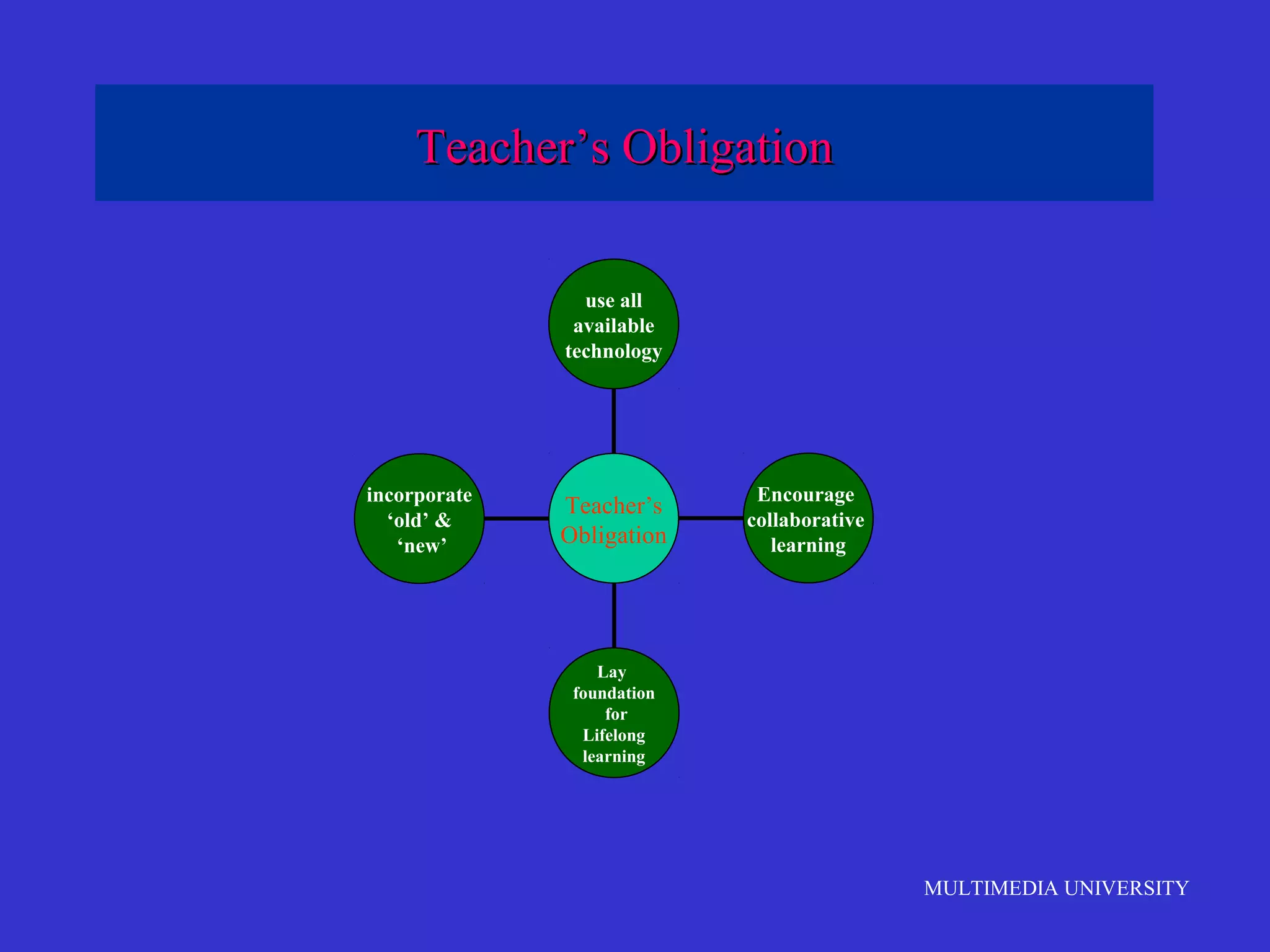
Teacher’s Obligation
use all
available
technology

incorporate
‘old’ &
‘new’

Teacher’s
Obligation

Encourage
collaborative
learning

Lay
foundation
for
Lifelong
learning

MULTIMEDIA UNIVERSITY
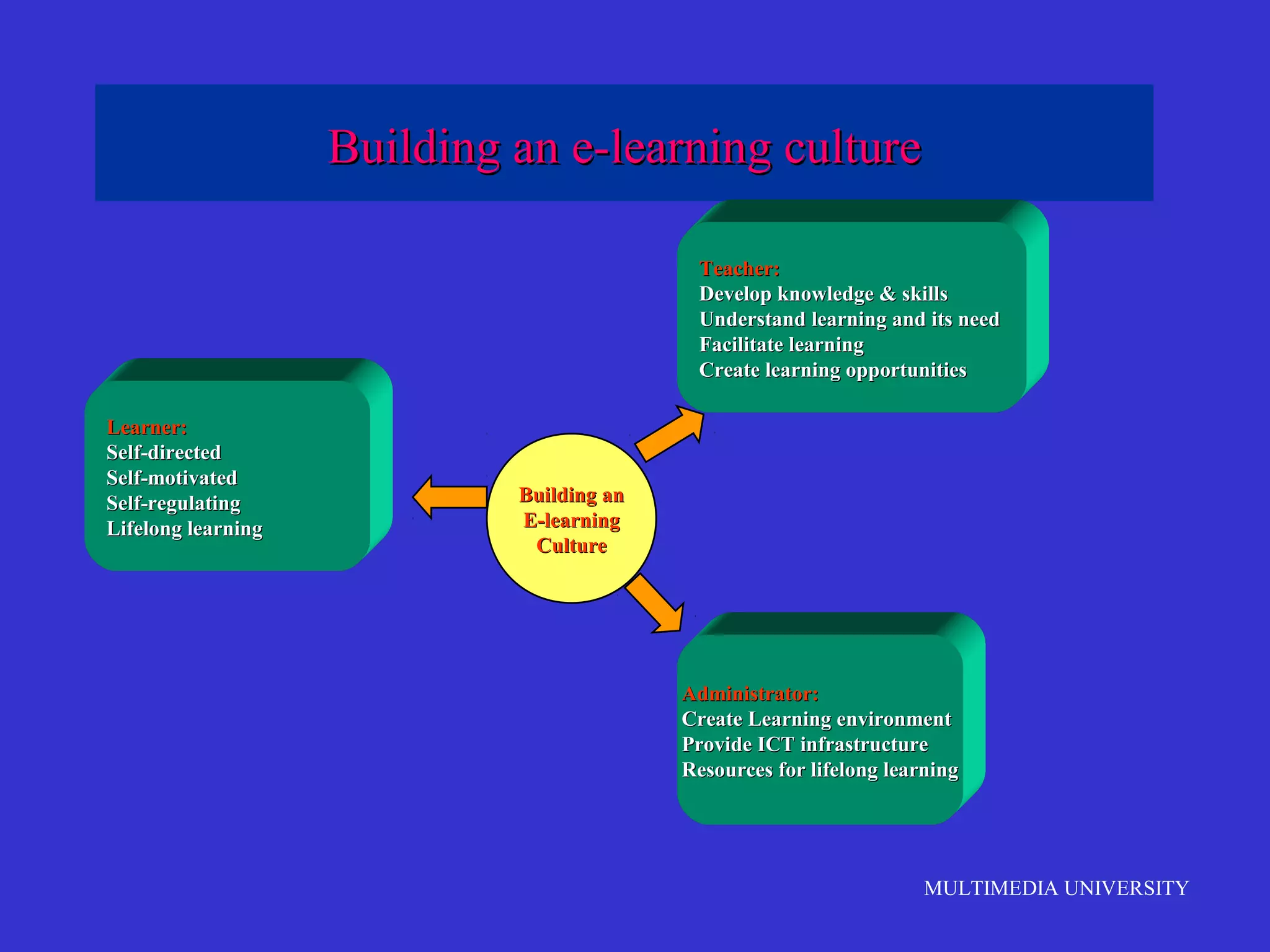
Building an e-learning culture
Teacher:
Develop knowledge & skills
Understand learning and its need
Facilitate learning
Create learning opportunities
Learner:
Self-directed
Self-motivated
Self-regulating
Lifelong learning

Building an
E-learning
Culture

Administrator:
Create Learning environment
Provide ICT infrastructure
Resources for lifelong learning

MULTIMEDIA UNIVERSITY
E-learning tools: E-mail
•
•
•
•
•
•
•
•

Every teacher should have an e-mail account
Communicate with students
Communicate with parents
Students can submit assignment
Can have attachments
Create a paperless environment
Simple but effective
Efficient and cost effective

MULTIMEDIA UNIVERSITY
E-learning tools: Chat
•
•
•
•
•

Synchronous communication tool
Communicate with students
Communicate with parents
More students participate
Collaborative learning

MULTIMEDIA UNIVERSITY
E-learning tools: Online Forum
•
•
•
•
•
•
•

Asynchronous discussion forum
Teacher can create discussion groups
Teacher could post a question and request students to comment
Students can post their comments
Can encourage community participation
Collaborative learning can be fostered
Feedback from diverse culture

MULTIMEDIA UNIVERSITY
E-learning Tools: Web
•
•
•
•
•

Wide range of materials available
Teacher will need to narrow down
It is a resource centre
Sharing of resources
Supported by images, audio, simulation and multimedia

MULTIMEDIA UNIVERSITY
E-learning tools: Video Conference
•
•
•
•
•
•
•

Can conduct a live lecture
Communication with students
Communication with parents
Support by audio, chat and whiteboard
Support sharing of applications
Can be recorded and later be used for on demand lectures
Demo…

MULTIMEDIA UNIVERSITY
Tools: Learning Management System (LMS)
•
•
•
•
•
•

Management of content
Tracking students
Administrative features
Integration with various tools such as chat, forum, e-mail, etc.
Reporting
Demo... of Multimedia Learning System (MMLS)

MULTIMEDIA UNIVERSITY
Where to start?
•

Traditional
–
–
–
–

•

Beginning
–
–
–
–
–
–

•

Pen and paper
Personal presentation
MS Word
Use Kid pictures
Use MS Publisher
Use MS Powerpoint
Use creative writing
Regularly access the Internet
Students can navigate your Network
Students frequently use a Digital Camera

Evolving
–
–
–
–

I.C.T. is formally taught to every student
Students manage the school Internet
Students and teachers use a wide range of CD ROM
Student can craft web pages

MULTIMEDIA UNIVERSITY
Where to start?
•

Consolidating
–
–
–

•

Advanced
–
–
–
–
–
–

•

School website is current and reflects school culture
School website has educational value for students and the wider community
Students can use multi media
Teacher use the Intranet to display and initiate learning
Teachers can design web pages
Students submit learning using floppy, Network, Print format
Use selected software to source knowledge
Use the Internet to compliment learning outcomes
Use of personal web pages to link to a variety of program

e-learning / digital classroom
–
–
–
–
–

Teacher use the Intranet to initiate and measure learning
E Mail is a focal educational exchange medium
Students are able to manage and produce digitally edited movies
Multimedia visual literacy is a valued learning focus
Teachers can comfortably use digital multimedia to enhance learning

MULTIMEDIA UNIVERSITY
Conclusion
• ICT and e-learning offers opportunity to raise educational
standards in schools
• Large range of ICT tools are available for teaching and
learning
• Closes the gap of “Digital Divide”
• Involvement of teachers and parents is important
• Schools will need funding, access and training

MULTIMEDIA UNIVERSITY

E learning-for-education

  • 1.
    E-learning for Education MultimediaUniversity MULTIMEDIA UNIVERSITY
  • 2.
    What is E-learning? Theuse of Internet technologies to deliver a broad array of solutions that enhance knowledge and performance E-learning is Internet-enabled learning http://www.cisco.com Rosenberg, 2001 MULTIMEDIA UNIVERSITY
  • 3.
    Truth of e-learning Internethas started reshaping education. Education will not be the same in the next decade There is no going back. The traditional classroom has to be transformed Web-based Education Commission, US Many universities/colleges may not survive by the end of this decade MULTIMEDIA UNIVERSITY
  • 4.
    e-business in e-learning E-learningmarket will swell from US$2.2 billion to US$11.4 billion by 2003 Cushing Anderson of Framingham, IDC Only about 1% of the population have taken an on-line course E-learning is still new MULTIMEDIA UNIVERSITY
  • 5.
    E-learning is goingto be big Education and training forms one of the largest sectors of the economy in most countries 40% of Fortune 500 companies have established corporate universities Moe and Blodgett, op. cit., endnote 21, p. 230. Over the last decade, the number of corporate universities grew from 400 to 1,800 Meister, Jeanne op. cit., endnote 23 Skilled jobs now represent 85% of all jobs in US, in contrast to 20% in 1950. http://www.webcommission.org/directory MULTIMEDIA UNIVERSITY
  • 6.
    Education Market willbe big A big growth is expected in the education market Student population in US colleges increase from 232,000 at the turn of the century to 13 million today The US Army has established a online educational portal and hope to enroll 15,000 to 20,000 of its army personnel for a degree programme In Malaysia, with one university in 1957 to over 21 public and private university The future soldiers will not be carry guns but computers MULTIMEDIA UNIVERSITY
  • 7.
    Internet Users willcontinue to grow Table: Internet Users in Asia (2000) Country Hong Kong Number of Users 3,460,000 Internet % population Indonesia 400,000 0.18% China 17,000,000 1.3% India 4,500,000 0.45% Japan 38,000,000 30% Malaysia 1,500,000 7% Philippines 500,000 0.6% Singapore 1,850,000 44% South Korea 16,000,000 34% Taiwan 6,400,000 29% Thailand 1,000,000 1.6% Vietnam 100,000 0.13% 48% Source: http://www.nua.ie MULTIMEDIA UNIVERSITY
  • 8.
    Evolution of EducationTechnology IMPACT TIME Internet: Greatest impact TIME MULTIMEDIA UNIVERSITY
  • 9.
    E-learning: Blended mode Chalk-and-boardhas long ruled the classrooms • • will not be eliminated Less emphasis Interactive Digital Content: • more emphasis • on demand learning • interactive MULTIMEDIA UNIVERSITY
  • 10.
    National ICT Agenda PEOPLE -Work Culture - ICT Skills - Knowledge worker - Learning Society - United, moral & ethical INFRASTRUCTURE - Communication - Fibre-Optic Cabling - Gigabit ATM - Satellite - Transport/Logistic - etc KNOWLEDGE-BASED ECONOMY APPLICATION & CONTENT - Smart Schools - e-govt. - Smartcard - Tele-medicine - Others MULTIMEDIA UNIVERSITY
  • 11.
    NATION’s ICT EDUCATIONVISION ECONOMY Competitive Knowledge Economy V ITI PET M CO Knowledge Products & Services KN GE LED OW Y IET OC ES Y IE T OC S ICT based Economy OR INF MA N TI O S 2005 IE T OC Y 2010 2020 TIME MULTIMEDIA UNIVERSITY
  • 12.
    & es es s te urson te urs tiion va co ra va co ra , , ri e n o e ri en bo es tc P dr v aus i ng P driiv Colllausttr ng,, e C d i i t et ,, i d nd ke ch in en pe a ar th Sp ar ar th M e i M e i t es e s w e nt R R d d ru ru P P MMU sho rte Resp Spe on r ed Ap time sive Go p lica to ac to ch h od t a I nfo i on o ieve nge, wo f te rm rl a tio ch n S nolo d-cla s yst g s, em y, , et c MMU Objectives lity rch, Quage Resea ents, d MULTIMEDIA UNIVERSITY , Stu g-ed ices adin aff and & Serv Le t St ies Bes Facilit tc e d Goo
  • 13.
    Framework of MMU STAFF DATABASE STUDENT DATABASE LIBRARY DATABASE OTHERS CONTENT E-PROCUREMENT CLIENT/SERVER RADIOMMU DOC. MGT. IVR NEMS SMS WAP WIRELESS DEVICES DIGITAL LIB. MMLS SMARTCARD ICEMS INTERNET ADMIN. ONLINE APP. LECTURERS PAPERLESS STUDENTS OTHER DATABASE INFRASTRUCTURE (622Mbps ATM, Gigabit Ethernet, Wireless Access Points, Satellite, etc) MULTIMEDIA UNIVERSITY
  • 14.
    MMU: Preparing studentsfor lifelong learning GLOBALISATION Satellite-based Education LEARNING ORGANISATION KNOWLEDGE ECONOMY E-Learning LEARNING SOCIETY LEARNING COMMUNITIES IMPACT OF ICT KNOWLEDGER WORKER Industrial Training LEARNING FAMILIES LEARNING INDIVIDUAL COMPETITION Classroom Lectures MULTIMEDIA UNIVERSITY
  • 15.
    Learning models willneed to change INDUSTRIAL AGE LEARNING MODEL DIGITAL AGE LEARNING MODEL How do people learn in a digital environment? Is e-learning effective? Are learners ready? New learning model are needed MULTIMEDIA UNIVERSITY
  • 16.
    Traditional & E-learningApproach Traditional and E-learning approaches Traditional Classroom E-Learning Classroom • Physical – limited size • Synchronous • Unlimited • Anytime, anywhere Content • PowerPoint/transparency/etc • Textbooks/library • Video • Collaboration • Multimedia / simulation • Digital library • On demand • Syn & Asyn. Communication Personalisation • One learning path • Learning path and pace determined by learner MULTIMEDIA UNIVERSITY
  • 17.
    Growing student population DeliveryMode 100 : 0 (F/T) 80 : 20 (F/T) 20 : 80 (DE) CLIC K BRICK Delivery mode will change More virtual universities Increase in tuition fee Cost effective solutions (e.g. e-learning) Lack of facilities and funding Privatisation of education MULTIMEDIA UNIVERSITY
  • 18.
    Teaching aids willchange Blackboard OHP TV/VHS LCD PC Whiteboard MULTIMEDIA UNIVERSITY
  • 19.
    E-learning • In anon-line multimedia learning environment: – teaching & learning is ‘one-to-one’ (individual) – more interactivity (in normal classroom, it varies with the class size) – learner-centred – Learner monitoring & grading system MULTIMEDIA UNIVERSITY
  • 20.
    Benefits • Convenient – – – – – self-service (mixand match) on-demand (anytime, anywhere) private learning self-paced Flexibility: (modular package) MULTIMEDIA UNIVERSITY
  • 21.
    Benefits • Cost-effective – – – – Virtual learningenvironment Share lessons among schools Reduce material cost Reduce travel/accommodation costs MULTIMEDIA UNIVERSITY
  • 22.
    Benefits • Consistent – – – Central controlof content Same quality of content for all Same quality of education for all MULTIMEDIA UNIVERSITY
  • 23.
    Benefits • media-rich – Easierto understand & more engaging • repeatable – As many times as you like • easier to monitor progress – less administrative work – can be more precise MULTIMEDIA UNIVERSITY
  • 24.
    Teacher’s Obligation use all available technology incorporate ‘old’& ‘new’ Teacher’s Obligation Encourage collaborative learning Lay foundation for Lifelong learning MULTIMEDIA UNIVERSITY
  • 25.
    Building an e-learningculture Teacher: Develop knowledge & skills Understand learning and its need Facilitate learning Create learning opportunities Learner: Self-directed Self-motivated Self-regulating Lifelong learning Building an E-learning Culture Administrator: Create Learning environment Provide ICT infrastructure Resources for lifelong learning MULTIMEDIA UNIVERSITY
  • 26.
    E-learning tools: E-mail • • • • • • • • Everyteacher should have an e-mail account Communicate with students Communicate with parents Students can submit assignment Can have attachments Create a paperless environment Simple but effective Efficient and cost effective MULTIMEDIA UNIVERSITY
  • 27.
    E-learning tools: Chat • • • • • Synchronouscommunication tool Communicate with students Communicate with parents More students participate Collaborative learning MULTIMEDIA UNIVERSITY
  • 28.
    E-learning tools: OnlineForum • • • • • • • Asynchronous discussion forum Teacher can create discussion groups Teacher could post a question and request students to comment Students can post their comments Can encourage community participation Collaborative learning can be fostered Feedback from diverse culture MULTIMEDIA UNIVERSITY
  • 29.
    E-learning Tools: Web • • • • • Widerange of materials available Teacher will need to narrow down It is a resource centre Sharing of resources Supported by images, audio, simulation and multimedia MULTIMEDIA UNIVERSITY
  • 30.
    E-learning tools: VideoConference • • • • • • • Can conduct a live lecture Communication with students Communication with parents Support by audio, chat and whiteboard Support sharing of applications Can be recorded and later be used for on demand lectures Demo… MULTIMEDIA UNIVERSITY
  • 31.
    Tools: Learning ManagementSystem (LMS) • • • • • • Management of content Tracking students Administrative features Integration with various tools such as chat, forum, e-mail, etc. Reporting Demo... of Multimedia Learning System (MMLS) MULTIMEDIA UNIVERSITY
  • 32.
    Where to start? • Traditional – – – – • Beginning – – – – – – • Penand paper Personal presentation MS Word Use Kid pictures Use MS Publisher Use MS Powerpoint Use creative writing Regularly access the Internet Students can navigate your Network Students frequently use a Digital Camera Evolving – – – – I.C.T. is formally taught to every student Students manage the school Internet Students and teachers use a wide range of CD ROM Student can craft web pages MULTIMEDIA UNIVERSITY
  • 33.
    Where to start? • Consolidating – – – • Advanced – – – – – – • Schoolwebsite is current and reflects school culture School website has educational value for students and the wider community Students can use multi media Teacher use the Intranet to display and initiate learning Teachers can design web pages Students submit learning using floppy, Network, Print format Use selected software to source knowledge Use the Internet to compliment learning outcomes Use of personal web pages to link to a variety of program e-learning / digital classroom – – – – – Teacher use the Intranet to initiate and measure learning E Mail is a focal educational exchange medium Students are able to manage and produce digitally edited movies Multimedia visual literacy is a valued learning focus Teachers can comfortably use digital multimedia to enhance learning MULTIMEDIA UNIVERSITY
  • 34.
    Conclusion • ICT ande-learning offers opportunity to raise educational standards in schools • Large range of ICT tools are available for teaching and learning • Closes the gap of “Digital Divide” • Involvement of teachers and parents is important • Schools will need funding, access and training MULTIMEDIA UNIVERSITY