eChat for business
Mike Ekey
Welcome
● Introduce basic principles of online chat
communications.
● Walk through several best practices for conducting
business via chat.
● Discuss online etiquette rules and norms.
● Review some commonly made mistakes (spelling,
grammar, etc.).
● Practice with some hands-on examples.
● Wrap up discussion.
Welcome
Mike Ekey
— 10 years of online communications and marketing experience.
— Managed, delivered, create online communications plans for Metropolitan
Community College, Teach for America, Brooklyn Museum of Art, Children and
Nature Network.
— Teach courses in small business marketing, online marketing, social media,
direct mail marketing for various organizations in the region.
Welcome
A demonstration.
Three keys
1) Timeliness — 2) Purpose — 3) Clarity
Customers, in situations that could involve high
emotions, are expecting you to quickly and
efficiently solve their problems within only a few
minutes.
1) Timeliness — 2) Purpose — 3) Clarity
Customers, in situations that could involve high emotions, are expecting you to
quickly and efficiently solve their problems within only a few minutes.
What is biggest challenge in working with
eChat customers?
Timeliness
From first response to the final signoff, you will
be on the clock.
● On average, users stay on a website for 2 minutes.
● Users will wait, on average, 30 seconds for a website to load.
● Users will scan a search results page, on average for 10 seconds.
There is are entire businesses built around responding to user requests to
websites and ensuring that a client’s message is delivered within these time
constraints.
Purpose
Expect your customers will be coming to you
with some level of heightened emotion.
● Anger
● Frustration
● Anxiety
It will be your challenge to determine the ultimate purpose
of the exchange through the emotion.
Clarity
You are the expert, but you will need to take
extra care to explain your process and how you
are resolving their request.
The average reading level of typical internet
users is at a 6th grade reading level.
A positive users experience rests in your ability to provide clear, quick answers.
Before the eChat
Developing a plan
Before the eChat
Understand the pieces that create a successful
eChat interaction.
Before the eChat
Understand the pieces that create a successful
eChat interaction.
● Greeting (emotional response)
● Beginning of chat interaction
● Questioning/Discussion
● Answer
● Closing
Before the eChat
1) Identify goals and priorities
Develop a set of goals for each eChat session
and the eChat reps.
These should be written and reviewed on a
regular basis.
Before the eChat
2) Identify common customer segments
This might fall more with your marketing or
customer service departments, but it will be
important data to match with your chat data.
Different segments will interact in different ways
and expect different things (Guiding, nurturing,
teaching, tell-it-how-it-is mentality).
Before the eChat
3) Develop pre-written interactions and answers
— Understand the 80-20 rule and follow it as closely
as possible.
— Develop responses based on keywords and FAQ.
You can also develop emotional responses based on
previous interactions.
— Review (along with goals) how pre-written
responses are received or how they help/hurt a
conversation.
Before the eChat
DO NOT discount the 20
percent of original human
interaction.
Before the eChat
4) Know your product (or know who knows
your product)
Despite the time requirements and speed at
which these conversations might go, it is not
required that you memorize everything.
Create a system where you know how to
search, inquire and pull records quickly.
During the eChat
Best Practices and Etiquette.
During the eChat
1) Respond immediately - even if it is only a
greeting.
An eChat user will remain on the line (on
average) for 30 seconds before logging off.
Respond FIRST to the emotion of the chat with
empathy, when appropriate.
During the eChat
During the eChat
During the eChat
2) NEVER use abbreviations, emoticons,
acronyms or 1337 (leet) speak.
If you would not send it in an email to your
client, do not use it in an eChat.
“LOL, all ur $$$ are belong to us.”
During the eChat
3) “Speak” with a positive, polite and upbeat
attitude toward your own company.
Don’t belittle and mock how your company
does something (even if you disagree) with
users as an attempt to connect with them or get
them to do something.
During the eChat
4) DO NOT engage in negative or hateful
speech from customers.
Just because they are customers does not give
them the right to call you names, harass you or
ask you personal questions.
Develop a set of rules for empowerment ahead
of time and make them clear to all eChat reps.
During the eChat
5) Explain everything you are doing.
It is OK to put someone on hold, but remember to:
● Tell the users what you are going to do.
● Explain what you will be doing (speaking with a supervisor, researching,
pulling a record)
● Tell them how long it will take.
● Check in if it takes longer than the time you originally stated.
● Apologize and thank the user for remaining online regardless of how long
you were away.
During the eChat
6) ALWAYS ask if it is OK to send a user a
URL.
Only send URLs to trusted sites or pages within
your own website.
During the eChat
7) Establish a transfer protocol.
● Let the user know that you will need to
transfer them.
● Tell them where they will be transferred
● Tell them why are being transferred.
During the eChat
8) Keep gaps in interactions to less than 2
minutes regardless of who spoke/wrote last.
This is important in keeping the chat flowing
and moving forward (despite any possible
technical hurdles).
During the eChat
9) Be clear when you are signing off and
ensure that your user had their questions
answered fully.
During the eChat
An eChat, like a story, should have a:
● Beginning
● Middle
● End
During the eChat
Understand that your eChat interaction can
help or hurt your brand’s reputation.
Whether you bring your eChat to a successful
resolution, your interaction is what is key.
How to say it.
Proper tone, grammar and spelling.
How to say it.
Misspelled words, improper use of grammar,
the use of slang or emoticons can all have a
negative influence on your customer’s
experience during your interaction.
Credibility - Credibility - Credibility.
How to say it.
REMEMBER!
● We are only writing at a 6th grade level.
● Don’t feel like you have to speak differently
or in another voice just to interact with your
customers.
● They selected the eChat to speak with a
person, not a robot.
How to say it.
Recommended reading:
Elements of Style
Strunk and White
Eats, Shoots, Leaves
Lynne Truss
Associate Press Style Book
Associated Press
How to say it.
When you are left with only text, then you must focus
exclusively on the words you use:
● No body language.
● No vocal intonation.
● No indication of active listening.
● No clear indication that you are actively working on their
problem.
How to say it.
Sarcasm, jokes and humor should be avoided.
Try to recall the last time you received an email
that you thought was rude - did you apply that
person’s voice to the email or you own?
How to say it.
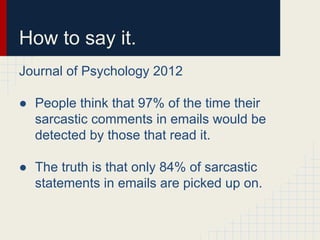
Journal of Psychology 2012
● People think that 97% of the time their
sarcastic comments in emails would be
detected by those that read it.
● The truth is that only 84% of sarcastic
statements in emails are picked up on.
How to say it.
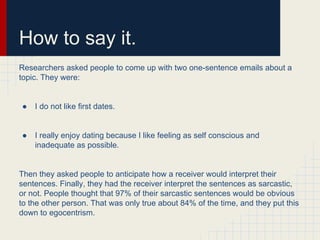
Researchers asked people to come up with two one-sentence emails about a
topic. They were:
● I do not like first dates.
● I really enjoy dating because I like feeling as self conscious and
inadequate as possible.
Then they asked people to anticipate how a receiver would interpret their
sentences. Finally, they had the receiver interpret the sentences as sarcastic,
or not. People thought that 97% of their sarcastic sentences would be obvious
to the other person. That was only true about 84% of the time, and they put this
down to egocentrism.
How to say it.
How do we set the right tone for any eChat?
● Read your responses out loud to yourself.
● Remain professional and unemotional in
your responses - Just The Facts.
● Do not feel like you cannot repeat yourself,
but do not point out that you are repeating
yourself.
Spellcheck?
Know its limitations.
Pop Quiz
Take the next few minutes to correct as many
of the errors that you can find in the handout.
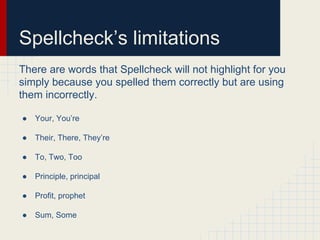
Spellcheck’s limitations
There are words that Spellcheck will not highlight for you
simply because you spelled them correctly but are using
them incorrectly.
● Your, You’re
● Their, There, They’re
● To, Two, Too
● Principle, principal
● Profit, prophet
● Sum, Some
Spellcheck’s limitations
Spellcheck will NOT check your grammar.
Effective proofing
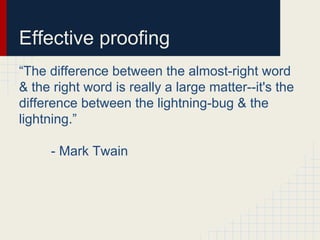
“The difference between the almost-right word
& the right word is really a large matter--it's the
difference between the lightning-bug & the
lightning.”
- Mark Twain
Effective proofing
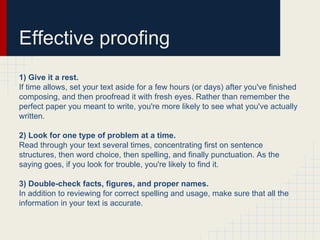
1) Give it a rest.
If time allows, set your text aside for a few hours (or days) after you've finished
composing, and then proofread it with fresh eyes. Rather than remember the
perfect paper you meant to write, you're more likely to see what you've actually
written.
2) Look for one type of problem at a time.
Read through your text several times, concentrating first on sentence
structures, then word choice, then spelling, and finally punctuation. As the
saying goes, if you look for trouble, you're likely to find it.
3) Double-check facts, figures, and proper names.
In addition to reviewing for correct spelling and usage, make sure that all the
information in your text is accurate.
Effective proofing
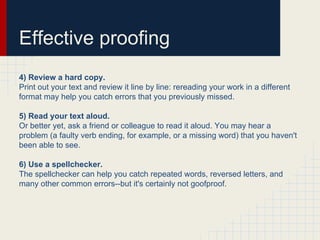
4) Review a hard copy.
Print out your text and review it line by line: rereading your work in a different
format may help you catch errors that you previously missed.
5) Read your text aloud.
Or better yet, ask a friend or colleague to read it aloud. You may hear a
problem (a faulty verb ending, for example, or a missing word) that you haven't
been able to see.
6) Use a spellchecker.
The spellchecker can help you catch repeated words, reversed letters, and
many other common errors--but it's certainly not goofproof.
Effective proofing
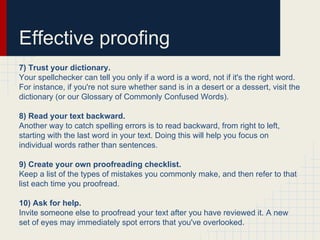
7) Trust your dictionary.
Your spellchecker can tell you only if a word is a word, not if it's the right word.
For instance, if you're not sure whether sand is in a desert or a dessert, visit the
dictionary (or our Glossary of Commonly Confused Words).
8) Read your text backward.
Another way to catch spelling errors is to read backward, from right to left,
starting with the last word in your text. Doing this will help you focus on
individual words rather than sentences.
9) Create your own proofreading checklist.
Keep a list of the types of mistakes you commonly make, and then refer to that
list each time you proofread.
10) Ask for help.
Invite someone else to proofread your text after you have reviewed it. A new
set of eyes may immediately spot errors that you've overlooked.
Discussion
Questions?
Let’s try it out.
Open up a Microsoft Word and begin a new
document. You will be timed.
Hi, I need to order a new
ATM card. I lost mine.
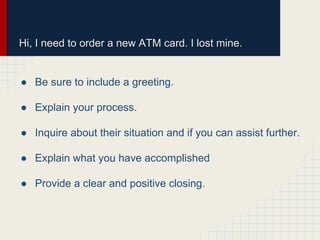
Hi, I need to order a new ATM card. I lost mine.
● Be sure to include a greeting.
● Explain your process.
● Inquire about their situation and if you can assist further.
● Explain what you have accomplished
● Provide a clear and positive closing.
You're stealing my
money! It is not showing
up on the website.
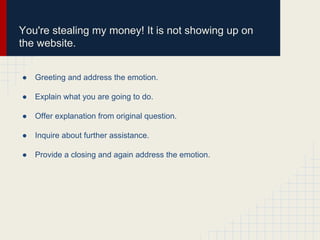
You're stealing my money! It is not showing up on
the website.
● Greeting and address the emotion.
● Explain what you are going to do.
● Offer explanation from original question.
● Inquire about further assistance.
● Provide a closing and again address the emotion.
You guys are the worst! I
can’t believe you denied
my disputed charge.
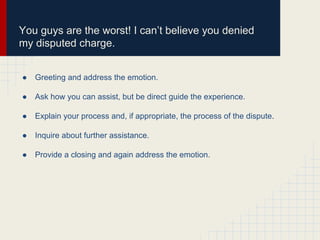
You guys are the worst! I can’t believe you denied
my disputed charge.
● Greeting and address the emotion.
● Ask how you can assist, but be direct guide the experience.
● Explain your process and, if appropriate, the process of the dispute.
● Inquire about further assistance.
● Provide a closing and again address the emotion.
Other examples?
Discussion
Thank you.
@Mike_Ekey — mike.ekey@mcckc.edu
Further reading
Chat Agent Best Practices and Benchmarks
http://www.telusinternational.com/online_chat_study
Chat Customer Service at its best
http://web.telusinternational.com/blog
Understanding Customer Personas in Customer Service:
http://hd.egain.com/wp-content/uploads/2013/04/egain_whitepaper_customer_journeys.pdf
11 Best Practices for your Chat Session
http://www.itbusinessedge.com/slideshows/show.aspx?c=87760
Address the pain, then act: 5 tips for a successful online customer relationship
http://www.comm100.com/blog/customer-service/5-best-practices-online-customer-support.html

eChat for business

  • 1.
  • 2.
    Welcome ● Introduce basicprinciples of online chat communications. ● Walk through several best practices for conducting business via chat. ● Discuss online etiquette rules and norms. ● Review some commonly made mistakes (spelling, grammar, etc.). ● Practice with some hands-on examples. ● Wrap up discussion.
  • 3.
    Welcome Mike Ekey — 10years of online communications and marketing experience. — Managed, delivered, create online communications plans for Metropolitan Community College, Teach for America, Brooklyn Museum of Art, Children and Nature Network. — Teach courses in small business marketing, online marketing, social media, direct mail marketing for various organizations in the region.
  • 4.
  • 5.
    Three keys 1) Timeliness— 2) Purpose — 3) Clarity
  • 6.
    1) Timeliness —2) Purpose — 3) Clarity Customers, in situations that could involve high emotions, are expecting you to quickly and efficiently solve their problems within only a few minutes.
  • 7.
    1) Timeliness —2) Purpose — 3) Clarity Customers, in situations that could involve high emotions, are expecting you to quickly and efficiently solve their problems within only a few minutes. What is biggest challenge in working with eChat customers?
  • 8.
    Timeliness From first responseto the final signoff, you will be on the clock. ● On average, users stay on a website for 2 minutes. ● Users will wait, on average, 30 seconds for a website to load. ● Users will scan a search results page, on average for 10 seconds. There is are entire businesses built around responding to user requests to websites and ensuring that a client’s message is delivered within these time constraints.
  • 9.
    Purpose Expect your customerswill be coming to you with some level of heightened emotion. ● Anger ● Frustration ● Anxiety It will be your challenge to determine the ultimate purpose of the exchange through the emotion.
  • 10.
    Clarity You are theexpert, but you will need to take extra care to explain your process and how you are resolving their request. The average reading level of typical internet users is at a 6th grade reading level. A positive users experience rests in your ability to provide clear, quick answers.
  • 11.
  • 12.
    Before the eChat Understandthe pieces that create a successful eChat interaction.
  • 13.
    Before the eChat Understandthe pieces that create a successful eChat interaction. ● Greeting (emotional response) ● Beginning of chat interaction ● Questioning/Discussion ● Answer ● Closing
  • 14.
    Before the eChat 1)Identify goals and priorities Develop a set of goals for each eChat session and the eChat reps. These should be written and reviewed on a regular basis.
  • 15.
    Before the eChat 2)Identify common customer segments This might fall more with your marketing or customer service departments, but it will be important data to match with your chat data. Different segments will interact in different ways and expect different things (Guiding, nurturing, teaching, tell-it-how-it-is mentality).
  • 16.
    Before the eChat 3)Develop pre-written interactions and answers — Understand the 80-20 rule and follow it as closely as possible. — Develop responses based on keywords and FAQ. You can also develop emotional responses based on previous interactions. — Review (along with goals) how pre-written responses are received or how they help/hurt a conversation.
  • 17.
    Before the eChat DONOT discount the 20 percent of original human interaction.
  • 18.
    Before the eChat 4)Know your product (or know who knows your product) Despite the time requirements and speed at which these conversations might go, it is not required that you memorize everything. Create a system where you know how to search, inquire and pull records quickly.
  • 19.
    During the eChat BestPractices and Etiquette.
  • 20.
    During the eChat 1)Respond immediately - even if it is only a greeting. An eChat user will remain on the line (on average) for 30 seconds before logging off. Respond FIRST to the emotion of the chat with empathy, when appropriate.
  • 21.
    During the eChat Duringthe eChat During the eChat 2) NEVER use abbreviations, emoticons, acronyms or 1337 (leet) speak. If you would not send it in an email to your client, do not use it in an eChat. “LOL, all ur $$$ are belong to us.”
  • 22.
    During the eChat 3)“Speak” with a positive, polite and upbeat attitude toward your own company. Don’t belittle and mock how your company does something (even if you disagree) with users as an attempt to connect with them or get them to do something.
  • 23.
    During the eChat 4)DO NOT engage in negative or hateful speech from customers. Just because they are customers does not give them the right to call you names, harass you or ask you personal questions. Develop a set of rules for empowerment ahead of time and make them clear to all eChat reps.
  • 24.
    During the eChat 5)Explain everything you are doing. It is OK to put someone on hold, but remember to: ● Tell the users what you are going to do. ● Explain what you will be doing (speaking with a supervisor, researching, pulling a record) ● Tell them how long it will take. ● Check in if it takes longer than the time you originally stated. ● Apologize and thank the user for remaining online regardless of how long you were away.
  • 25.
    During the eChat 6)ALWAYS ask if it is OK to send a user a URL. Only send URLs to trusted sites or pages within your own website.
  • 26.
    During the eChat 7)Establish a transfer protocol. ● Let the user know that you will need to transfer them. ● Tell them where they will be transferred ● Tell them why are being transferred.
  • 27.
    During the eChat 8)Keep gaps in interactions to less than 2 minutes regardless of who spoke/wrote last. This is important in keeping the chat flowing and moving forward (despite any possible technical hurdles).
  • 28.
    During the eChat 9)Be clear when you are signing off and ensure that your user had their questions answered fully.
  • 29.
    During the eChat AneChat, like a story, should have a: ● Beginning ● Middle ● End
  • 30.
    During the eChat Understandthat your eChat interaction can help or hurt your brand’s reputation. Whether you bring your eChat to a successful resolution, your interaction is what is key.
  • 31.
    How to sayit. Proper tone, grammar and spelling.
  • 32.
    How to sayit. Misspelled words, improper use of grammar, the use of slang or emoticons can all have a negative influence on your customer’s experience during your interaction. Credibility - Credibility - Credibility.
  • 33.
    How to sayit. REMEMBER! ● We are only writing at a 6th grade level. ● Don’t feel like you have to speak differently or in another voice just to interact with your customers. ● They selected the eChat to speak with a person, not a robot.
  • 34.
    How to sayit. Recommended reading: Elements of Style Strunk and White Eats, Shoots, Leaves Lynne Truss Associate Press Style Book Associated Press
  • 35.
    How to sayit. When you are left with only text, then you must focus exclusively on the words you use: ● No body language. ● No vocal intonation. ● No indication of active listening. ● No clear indication that you are actively working on their problem.
  • 36.
    How to sayit. Sarcasm, jokes and humor should be avoided. Try to recall the last time you received an email that you thought was rude - did you apply that person’s voice to the email or you own?
  • 37.
    How to sayit. Journal of Psychology 2012 ● People think that 97% of the time their sarcastic comments in emails would be detected by those that read it. ● The truth is that only 84% of sarcastic statements in emails are picked up on.
  • 38.
    How to sayit. Researchers asked people to come up with two one-sentence emails about a topic. They were: ● I do not like first dates. ● I really enjoy dating because I like feeling as self conscious and inadequate as possible. Then they asked people to anticipate how a receiver would interpret their sentences. Finally, they had the receiver interpret the sentences as sarcastic, or not. People thought that 97% of their sarcastic sentences would be obvious to the other person. That was only true about 84% of the time, and they put this down to egocentrism.
  • 39.
    How to sayit. How do we set the right tone for any eChat? ● Read your responses out loud to yourself. ● Remain professional and unemotional in your responses - Just The Facts. ● Do not feel like you cannot repeat yourself, but do not point out that you are repeating yourself.
  • 40.
  • 41.
    Pop Quiz Take thenext few minutes to correct as many of the errors that you can find in the handout.
  • 42.
    Spellcheck’s limitations There arewords that Spellcheck will not highlight for you simply because you spelled them correctly but are using them incorrectly. ● Your, You’re ● Their, There, They’re ● To, Two, Too ● Principle, principal ● Profit, prophet ● Sum, Some
  • 43.
  • 44.
    Effective proofing “The differencebetween the almost-right word & the right word is really a large matter--it's the difference between the lightning-bug & the lightning.” - Mark Twain
  • 45.
    Effective proofing 1) Giveit a rest. If time allows, set your text aside for a few hours (or days) after you've finished composing, and then proofread it with fresh eyes. Rather than remember the perfect paper you meant to write, you're more likely to see what you've actually written. 2) Look for one type of problem at a time. Read through your text several times, concentrating first on sentence structures, then word choice, then spelling, and finally punctuation. As the saying goes, if you look for trouble, you're likely to find it. 3) Double-check facts, figures, and proper names. In addition to reviewing for correct spelling and usage, make sure that all the information in your text is accurate.
  • 46.
    Effective proofing 4) Reviewa hard copy. Print out your text and review it line by line: rereading your work in a different format may help you catch errors that you previously missed. 5) Read your text aloud. Or better yet, ask a friend or colleague to read it aloud. You may hear a problem (a faulty verb ending, for example, or a missing word) that you haven't been able to see. 6) Use a spellchecker. The spellchecker can help you catch repeated words, reversed letters, and many other common errors--but it's certainly not goofproof.
  • 47.
    Effective proofing 7) Trustyour dictionary. Your spellchecker can tell you only if a word is a word, not if it's the right word. For instance, if you're not sure whether sand is in a desert or a dessert, visit the dictionary (or our Glossary of Commonly Confused Words). 8) Read your text backward. Another way to catch spelling errors is to read backward, from right to left, starting with the last word in your text. Doing this will help you focus on individual words rather than sentences. 9) Create your own proofreading checklist. Keep a list of the types of mistakes you commonly make, and then refer to that list each time you proofread. 10) Ask for help. Invite someone else to proofread your text after you have reviewed it. A new set of eyes may immediately spot errors that you've overlooked.
  • 48.
  • 49.
    Let’s try itout. Open up a Microsoft Word and begin a new document. You will be timed.
  • 50.
    Hi, I needto order a new ATM card. I lost mine.
  • 51.
    Hi, I needto order a new ATM card. I lost mine. ● Be sure to include a greeting. ● Explain your process. ● Inquire about their situation and if you can assist further. ● Explain what you have accomplished ● Provide a clear and positive closing.
  • 52.
    You're stealing my money!It is not showing up on the website.
  • 53.
    You're stealing mymoney! It is not showing up on the website. ● Greeting and address the emotion. ● Explain what you are going to do. ● Offer explanation from original question. ● Inquire about further assistance. ● Provide a closing and again address the emotion.
  • 54.
    You guys arethe worst! I can’t believe you denied my disputed charge.
  • 55.
    You guys arethe worst! I can’t believe you denied my disputed charge. ● Greeting and address the emotion. ● Ask how you can assist, but be direct guide the experience. ● Explain your process and, if appropriate, the process of the dispute. ● Inquire about further assistance. ● Provide a closing and again address the emotion.
  • 56.
  • 57.
    Thank you. @Mike_Ekey —mike.ekey@mcckc.edu
  • 58.
    Further reading Chat AgentBest Practices and Benchmarks http://www.telusinternational.com/online_chat_study Chat Customer Service at its best http://web.telusinternational.com/blog Understanding Customer Personas in Customer Service: http://hd.egain.com/wp-content/uploads/2013/04/egain_whitepaper_customer_journeys.pdf 11 Best Practices for your Chat Session http://www.itbusinessedge.com/slideshows/show.aspx?c=87760 Address the pain, then act: 5 tips for a successful online customer relationship http://www.comm100.com/blog/customer-service/5-best-practices-online-customer-support.html