



> > > > > > > >
E-Business: Doing
Business Online
1
MADE BY- DARAIN ANAMUL HAQUE
ASHISH GOSWAMI
Define e-business and discuss
how it can help achieve business
success.
Distinguish between a corporate
and a marketing Web site.
List the major forms of B2B
e-business.
Explain B2C e-business and
identify the products most often
sold online.
Describe some of the challenges
associated with e-business.
Discuss how organizations use
Internet communications to
advance their objectives.
Discuss Web sites and identify
methods for measuring
Web site effectiveness.
Explain the global scope
of e-business.
1
2
3
4
5
6
7
Learning Goals
8
DARAIN & ASHISH 2
Electronic business (e-business) - Conducting business
via the Internet.
1. E-tailing, or virtual storefronts on Web sites.
2. Online business-to-business transactions.
3. Electronic data interchange (EDI), the business-to-business
exchange of data using compatible software.
4. E-mail, instant messaging, and other Web-enabled communication
tools and their use as media for reaching prospective and existing
customers.
5. The gathering and use of demographic, product, and other
information through Web contacts.
What is E-Business?
DARAIN & ASHISH 3
• Global Reach. Goods and services can be sold to
customers worldwide.
• Personalization. Companies can customize products and
reduce inventory.
• Interactivity. Customers and suppliers can negotiate
prices online.
• Right-time and integrated marketing. Online retailers
provide products when and where customers want them
and promotions can be directed to individual customers.
• Cost savings. E-business can reduce costs.
Capabilities and
Benefits of E-Business
DARAIN & ASHISH 4
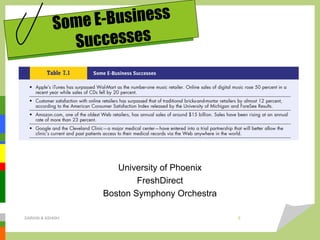
University of Phoenix
FreshDirect
Boston Symphony Orchestra
Some E-Business
Successes
DARAIN & ASHISH 5
 Increase a firm’s visibility, promote its offerings, and provide
information to interested parties.
 Build customer goodwill and assist retailers and other
resellers in their marketing efforts.
 Disseminate financial information to investors.
 Enable prospective employees to apply online for jobs.
 Provide e-mail communication.
.
Business Web Sites
Web sites are frequently used for marketing to attract
visitors/customers.
DARAIN & ASHISH 6
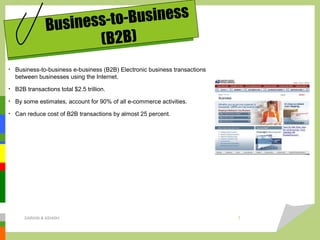
Business-to-Business
(B2B)
• Business-to-business e-business (B2B) Electronic business transactions
between businesses using the Internet.
• B2B transactions total $2.5 trillion.
• By some estimates, account for 90% of all e-commerce activities.
• Can reduce cost of B2B transactions by almost 25 percent.
DARAIN & ASHISH 7
Electronic Data Interchanges,
Extranets, & Private Exchanges
 Electronic data interchange (EDI) is a
computer-to-computer exchange of invoices,
purchase orders, price quotations and other
sales information.
 Extranets offer an efficient way for business to
collaborate with vendors, partners and
customers.
 Private Exchanges are the next generation of
extranets where all types of data related to e-
business is shared.DARAIN & ASHISH 8
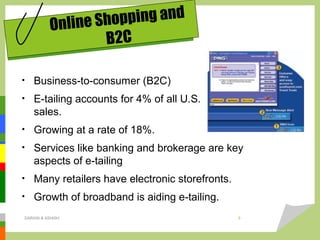
• Business-to-consumer (B2C)
• E-tailing accounts for 4% of all U.S.
sales.
• Growing at a rate of 18%.
• Services like banking and brokerage are key
aspects of e-tailing
• Many retailers have electronic storefronts.
• Growth of broadband is aiding e-tailing.
Online Shopping and
B2C
DARAIN & ASHISH 9
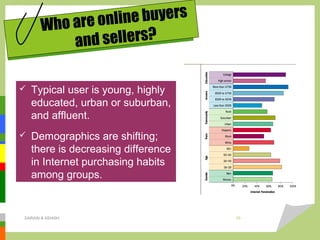
Who are online buyers
and sellers?
 Typical user is young, highly
educated, urban or suburban,
and affluent.
 Demographics are shifting;
there is decreasing difference
in Internet purchasing habits
among groups.
DARAIN & ASHISH 10
Lower Prices
• Many products cost less online.
• Internet allows customers to easily compare prices from multiple
sellers.
Convenience
• Can order products from around the world anytime, day or night.
• Can register customer information to streamline transactions.
Personalization
• Emphasis on personalized, one-on-one marketing to increase
repeat purchases.
Benefits of B2C
E-Business
DARAIN & ASHISH 11
• Through encryption, data is encoded for security
purposes.
• Many companies use Secure Sockets Layer (SSL)
technology to encrypt information and verify senders
and receivers.
• An electronic wallet contains credit card and
identification information. Customers can avoid
retyping purchase information.
Developing Safe Online
Payment Systems
DARAIN & ASHISH 12
 Privacy is among the top concerns of Internet users.
 E-business sites often require passwords and use electronic
signatures, an electronic form of identity verification.
 Companies can track customers’ shopping and viewing habits through
cookies.
 Customers usually prefer that companies do not share their personal
information. Merchants have responded by joining privacy
organizations.
 Privacy protections may soon become legally required.
 Employees also have concerns that employers are monitoring their
Internet behavior.
 Companies worry about data theft.
E-Business Challenges
(privacy)
DARAIN & ASHISH 13
• Internet Crime Complaint Center logs more than 200,000
complaints annually.
• 50% of the complaints referred to law enforcement
agencies deal with online auctions.
• Phishing is a growing form of Internet fraud that uses e-
mail or pop-up messages to get unsuspecting victims to
disclose personal information.
• Vishing, or voice phishing, involves phone calls to credit
card customers to obtain personal and banking
information.
• Payment fraud is growing.
E-Business Challenges
(Internet Fraud)
DARAIN & ASHISH 14
• 50% of shopping carts are abandoned before any
purchase is made.
– Lack of Information
– Inability to find the information they need
– Feeling overwhelmed by too much information
• Companies that have brick-and-mortar experience often
have better success satisfying customers than Internet-
only retailers.
• Online sales can compete with business partners such
as retailers and distributors causing disputes called
channel conflict.
E-Business Challenges
(poor website design)
DARAIN & ASHISH 15
• Web has four main functions: e-business,
entertainment, information, and communication.
• Communication is Web’s most popular function.
• Firms use e-mail to communicate with customers,
suppliers, and other partners.
• Online Communities: Internet forums, newsgroups,
electronic bulletin boards, and Web communities that
appeal to people who share common interests.
• Spam is junk e-mail.
Using the Web’s
Communication Function
DARAIN & ASHISH 16
• Blog - short for Web log, an online journal written by
a blogger.
• May incorporate wikis, a Web page that anyone can
edit.
• Some incorporate podcasts, video & audio
recordings. Feedburner services more than 200,000
podcasts.
• Corporate blogs can help build brand trust.
– Example: Apple’s iLounge builds the iPod brand and gives
Apple ideas for product improvement.
• Employee blogs may present ethical issues.
Web Communication
Blogs
DARAIN & ASHISH 17
• Banner Ads – messages placed on frequently visited
websites
• Pop-up Ads – ads that appear in separate windows
• Pre-roll Video Ads – advertisements that roll as
soon as a page is loaded
• Search marketing – companies pay for top visibility
in search results
Some companies, such as ValPak Marketing
Systems, offer virtual, searchable coupons.
Web Communication
Web Based Promotion
DARAIN & ASHISH 18
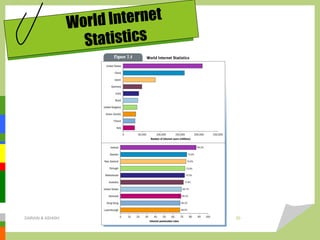
 Future growth of many companies is linked to a global
strategy that incorporates e-business.
 U.S. leads world in Internet users but ranks only 5th in
Internet penetration.
 E-Bay may dominate most markets, but Chinese company
Alibaba.com has 83% of the auction business in China.
 Three of four Web pages are written in English.
 E-business can heighten competition in the global
marketplace...
Global Environment of
E-Business
DARAIN & ASHISH 19
World Internet
Statistics
DARAIN & ASHISH 20
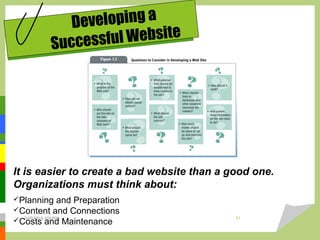
Developing a
Successful Website
It is easier to create a bad website than a good one.
Organizations must think about:
Planning and Preparation
Content and Connections
Costs and Maintenance
DARAIN & ASHISH 21
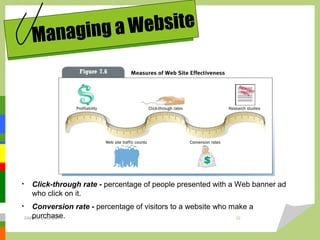
• Click-through rate - percentage of people presented with a Web banner ad
who click on it.
• Conversion rate - percentage of visitors to a website who make a
purchase.
Managing a Website
DARAIN & ASHISH 22
DARAIN & ASHISH 23
THANK YOU EVERYONE
DEAR WAGH SIR AND MY
CLASSMATES

E business

  • 1.
    > > >> > > > > E-Business: Doing Business Online 1 MADE BY- DARAIN ANAMUL HAQUE ASHISH GOSWAMI
  • 2.
    Define e-business anddiscuss how it can help achieve business success. Distinguish between a corporate and a marketing Web site. List the major forms of B2B e-business. Explain B2C e-business and identify the products most often sold online. Describe some of the challenges associated with e-business. Discuss how organizations use Internet communications to advance their objectives. Discuss Web sites and identify methods for measuring Web site effectiveness. Explain the global scope of e-business. 1 2 3 4 5 6 7 Learning Goals 8 DARAIN & ASHISH 2
  • 3.
    Electronic business (e-business)- Conducting business via the Internet. 1. E-tailing, or virtual storefronts on Web sites. 2. Online business-to-business transactions. 3. Electronic data interchange (EDI), the business-to-business exchange of data using compatible software. 4. E-mail, instant messaging, and other Web-enabled communication tools and their use as media for reaching prospective and existing customers. 5. The gathering and use of demographic, product, and other information through Web contacts. What is E-Business? DARAIN & ASHISH 3
  • 4.
    • Global Reach.Goods and services can be sold to customers worldwide. • Personalization. Companies can customize products and reduce inventory. • Interactivity. Customers and suppliers can negotiate prices online. • Right-time and integrated marketing. Online retailers provide products when and where customers want them and promotions can be directed to individual customers. • Cost savings. E-business can reduce costs. Capabilities and Benefits of E-Business DARAIN & ASHISH 4
  • 5.
    University of Phoenix FreshDirect BostonSymphony Orchestra Some E-Business Successes DARAIN & ASHISH 5
  • 6.
     Increase afirm’s visibility, promote its offerings, and provide information to interested parties.  Build customer goodwill and assist retailers and other resellers in their marketing efforts.  Disseminate financial information to investors.  Enable prospective employees to apply online for jobs.  Provide e-mail communication. . Business Web Sites Web sites are frequently used for marketing to attract visitors/customers. DARAIN & ASHISH 6
  • 7.
    Business-to-Business (B2B) • Business-to-business e-business(B2B) Electronic business transactions between businesses using the Internet. • B2B transactions total $2.5 trillion. • By some estimates, account for 90% of all e-commerce activities. • Can reduce cost of B2B transactions by almost 25 percent. DARAIN & ASHISH 7
  • 8.
    Electronic Data Interchanges, Extranets,& Private Exchanges  Electronic data interchange (EDI) is a computer-to-computer exchange of invoices, purchase orders, price quotations and other sales information.  Extranets offer an efficient way for business to collaborate with vendors, partners and customers.  Private Exchanges are the next generation of extranets where all types of data related to e- business is shared.DARAIN & ASHISH 8
  • 9.
    • Business-to-consumer (B2C) •E-tailing accounts for 4% of all U.S. sales. • Growing at a rate of 18%. • Services like banking and brokerage are key aspects of e-tailing • Many retailers have electronic storefronts. • Growth of broadband is aiding e-tailing. Online Shopping and B2C DARAIN & ASHISH 9
  • 10.
    Who are onlinebuyers and sellers?  Typical user is young, highly educated, urban or suburban, and affluent.  Demographics are shifting; there is decreasing difference in Internet purchasing habits among groups. DARAIN & ASHISH 10
  • 11.
    Lower Prices • Manyproducts cost less online. • Internet allows customers to easily compare prices from multiple sellers. Convenience • Can order products from around the world anytime, day or night. • Can register customer information to streamline transactions. Personalization • Emphasis on personalized, one-on-one marketing to increase repeat purchases. Benefits of B2C E-Business DARAIN & ASHISH 11
  • 12.
    • Through encryption,data is encoded for security purposes. • Many companies use Secure Sockets Layer (SSL) technology to encrypt information and verify senders and receivers. • An electronic wallet contains credit card and identification information. Customers can avoid retyping purchase information. Developing Safe Online Payment Systems DARAIN & ASHISH 12
  • 13.
     Privacy isamong the top concerns of Internet users.  E-business sites often require passwords and use electronic signatures, an electronic form of identity verification.  Companies can track customers’ shopping and viewing habits through cookies.  Customers usually prefer that companies do not share their personal information. Merchants have responded by joining privacy organizations.  Privacy protections may soon become legally required.  Employees also have concerns that employers are monitoring their Internet behavior.  Companies worry about data theft. E-Business Challenges (privacy) DARAIN & ASHISH 13
  • 14.
    • Internet CrimeComplaint Center logs more than 200,000 complaints annually. • 50% of the complaints referred to law enforcement agencies deal with online auctions. • Phishing is a growing form of Internet fraud that uses e- mail or pop-up messages to get unsuspecting victims to disclose personal information. • Vishing, or voice phishing, involves phone calls to credit card customers to obtain personal and banking information. • Payment fraud is growing. E-Business Challenges (Internet Fraud) DARAIN & ASHISH 14
  • 15.
    • 50% ofshopping carts are abandoned before any purchase is made. – Lack of Information – Inability to find the information they need – Feeling overwhelmed by too much information • Companies that have brick-and-mortar experience often have better success satisfying customers than Internet- only retailers. • Online sales can compete with business partners such as retailers and distributors causing disputes called channel conflict. E-Business Challenges (poor website design) DARAIN & ASHISH 15
  • 16.
    • Web hasfour main functions: e-business, entertainment, information, and communication. • Communication is Web’s most popular function. • Firms use e-mail to communicate with customers, suppliers, and other partners. • Online Communities: Internet forums, newsgroups, electronic bulletin boards, and Web communities that appeal to people who share common interests. • Spam is junk e-mail. Using the Web’s Communication Function DARAIN & ASHISH 16
  • 17.
    • Blog -short for Web log, an online journal written by a blogger. • May incorporate wikis, a Web page that anyone can edit. • Some incorporate podcasts, video & audio recordings. Feedburner services more than 200,000 podcasts. • Corporate blogs can help build brand trust. – Example: Apple’s iLounge builds the iPod brand and gives Apple ideas for product improvement. • Employee blogs may present ethical issues. Web Communication Blogs DARAIN & ASHISH 17
  • 18.
    • Banner Ads– messages placed on frequently visited websites • Pop-up Ads – ads that appear in separate windows • Pre-roll Video Ads – advertisements that roll as soon as a page is loaded • Search marketing – companies pay for top visibility in search results Some companies, such as ValPak Marketing Systems, offer virtual, searchable coupons. Web Communication Web Based Promotion DARAIN & ASHISH 18
  • 19.
     Future growthof many companies is linked to a global strategy that incorporates e-business.  U.S. leads world in Internet users but ranks only 5th in Internet penetration.  E-Bay may dominate most markets, but Chinese company Alibaba.com has 83% of the auction business in China.  Three of four Web pages are written in English.  E-business can heighten competition in the global marketplace... Global Environment of E-Business DARAIN & ASHISH 19
  • 20.
  • 21.
    Developing a Successful Website Itis easier to create a bad website than a good one. Organizations must think about: Planning and Preparation Content and Connections Costs and Maintenance DARAIN & ASHISH 21
  • 22.
    • Click-through rate- percentage of people presented with a Web banner ad who click on it. • Conversion rate - percentage of visitors to a website who make a purchase. Managing a Website DARAIN & ASHISH 22
  • 23.
    DARAIN & ASHISH23 THANK YOU EVERYONE DEAR WAGH SIR AND MY CLASSMATES