






Information Technology 
Amrit Barotia, BCA 3rd year 
Bachelor of Computer Application 
Dezyne E’cole College,Ajmer 
www.dezyneecole.com 
Submitted By 
Electronic Commerce
ACKNOWLEDGEMENT 
I Am Thankful To Dezyne E’cole College To Help In Making This Project On E-Commerce. A Special Thanks To Ms. Jyoti Phulwani to Guide Us Step By Step in the Marking of This Project Report. 
Thanking You 
Amrit Barotia, BCA-3rd Year 
Bachelor Application Computer
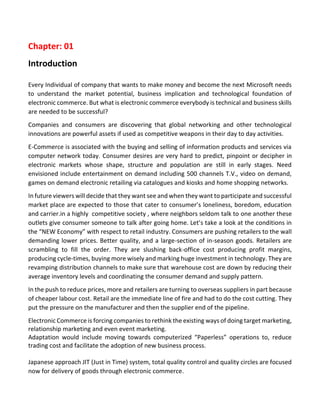
CONTENTS 
1. Chapter 1 
 Introduction 
2. Chapter 2 
 Electronic Commerce and the World Wide Web 
3. Chapter 3 
 Architectural Framework for Electronic Commerce 
4. Chapter 4 
 Technology Behind the Web 
5. Chapter 5 
 Network Security and Firewalls 
6. Chapter 6 
 Electronic Commerce Companies 
7. Chapter 7 
 Pictorial Representation: E-Buying Methodology 
8. Chapter 8 
 Conclusion
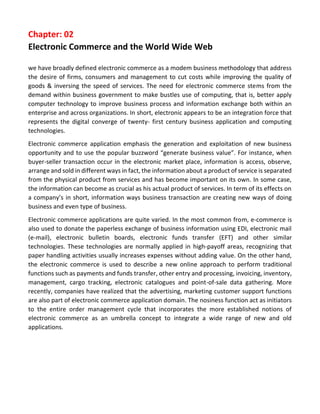
Chapter: 01 
Introduction 
Every Individual of company that wants to make money and become the next Microsoft needs to understand the market potential, business implication and technological foundation of electronic commerce. But what is electronic commerce everybody is technical and business skills are needed to be successful? 
Companies and consumers are discovering that global networking and other technological innovations are powerful assets if used as competitive weapons in their day to day activities. 
E-Commerce is associated with the buying and selling of information products and services via computer network today. Consumer desires are very hard to predict, pinpoint or decipher in electronic markets whose shape, structure and population are still in early stages. Need envisioned include entertainment on demand including 500 channels T.V., video on demand, games on demand electronic retailing via catalogues and kiosks and home shopping networks. 
In future viewers will decide that they want see and when they want to participate and successful market place are expected to those that cater to consumer’s loneliness, boredom, education and carrier.in a highly competitive society , where neighbors seldom talk to one another these outlets give consumer someone to talk after going home. Let’s take a look at the conditions in the “NEW Economy” with respect to retail industry. Consumers are pushing retailers to the wall demanding lower prices. Better quality, and a large-section of in-season goods. Retailers are scrambling to fill the order. They are slushing back-office cost producing profit margins, producing cycle-times, buying more wisely and marking huge investment in technology. They are revamping distribution channels to make sure that warehouse cost are down by reducing their average inventory levels and coordinating the consumer demand and supply pattern. 
In the push to reduce prices, more and retailers are turning to overseas suppliers in part because of cheaper labour cost. Retail are the immediate line of fire and had to do the cost cutting. They put the pressure on the manufacturer and then the supplier end of the pipeline. 
Electronic Commerce is forcing companies to rethink the existing ways of doing target marketing, relationship marketing and even event marketing. 
Adaptation would include moving towards computerized “Paperless” operations to, reduce trading cost and facilitate the adoption of new business process. 
Japanese approach JIT (Just in Time) system, total quality control and quality circles are focused now for delivery of goods through electronic commerce.
Chapter: 02 
Electronic Commerce and the World Wide Web 
we have broadly defined electronic commerce as a modem business methodology that address the desire of firms, consumers and management to cut costs while improving the quality of goods & inversing the speed of services. The need for electronic commerce stems from the demand within business government to make bustles use of computing, that is, better apply computer technology to improve business process and information exchange both within an enterprise and across organizations. In short, electronic appears to be an integration force that represents the digital converge of twenty- first century business application and computing technologies. 
Electronic commerce application emphasis the generation and exploitation of new business opportunity and to use the popular buzzword “generate business value”. For instance, when buyer-seller transaction occur in the electronic market place, information is access, observe, arrange and sold in different ways in fact, the information about a product of service is separated from the physical product from services and has become important on its own. In some case, the information can become as crucial as his actual product of services. In term of its effects on a company’s in short, information ways business transaction are creating new ways of doing business and even type of business. 
Electronic commerce applications are quite varied. In the most common from, e-commerce is also used to donate the paperless exchange of business information using EDI, electronic mail (e-mail), electronic bulletin boards, electronic funds transfer (EFT) and other similar technologies. These technologies are normally applied in high-payoff areas, recognizing that paper handling activities usually increases expenses without adding value. On the other hand, the electronic commerce is used to describe a new online approach to perform traditional functions such as payments and funds transfer, other entry and processing, invoicing, inventory, management, cargo tracking, electronic catalogues and point-of-sale data gathering. More recently, companies have realized that the advertising, marketing customer support functions are also part of electronic commerce application domain. The nosiness function act as initiators to the entire order management cycle that incorporates the more established notions of electronic commerce as an umbrella concept to integrate a wide range of new and old applications.
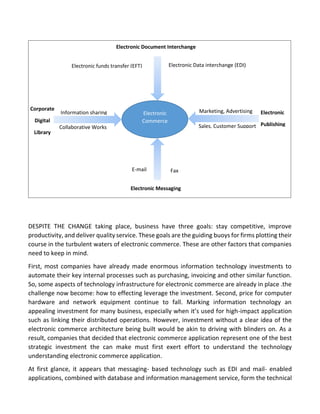
DESPITE THE CHANGE taking place, business have three goals: stay competitive, improve productivity, and deliver quality service. These goals are the guiding buoys for firms plotting their course in the turbulent waters of electronic commerce. These are other factors that companies need to keep in mind. 
First, most companies have already made enormous information technology investments to automate their key internal processes such as purchasing, invoicing and other similar function. So, some aspects of technology infrastructure for electronic commerce are already in place .the challenge now become: how to effecting leverage the investment. Second, price for computer hardware and network equipment continue to fall. Marking information technology an appealing investment for many business, especially when it’s used for high-impact application such as linking their distributed operations. However, investment without a clear idea of the electronic commerce architecture being built would be akin to driving with blinders on. As a result, companies that decided that electronic commerce application represent one of the best strategic investment the can make must first exert effort to understand the technology understanding electronic commerce application. 
At first glance, it appears that messaging- based technology such as EDI and mail- enabled applications, combined with database and information management service, form the technical 
Electronic Document Interchange 
Electronic Commerce 
Information sharing 
Electronic funds transfer (EFT) 
Electronic Data interchange (EDI) 
Collaborative Works 
Sales, Customer Support 
Marketing, Advertising 
Corporate 
Digital 
Library 
Electronic Messaging 
E-mail 
Fax 
Electronic 
Publishing
foundation for effecting electronic commerce solution. No single one of these technologies can delivers the fall potential of electronic commerce , however we require is an integrated architecture the likes of which has never been seen before . This integrated architecture is emerging in the form of the wide web (www). As electronic commerce becomes more mature, we are beginning to see sophisticated application being developed on the www. Technically and commercially, the www client-server model seems poised to become a dominant technology.
Chapter: 03 
Architectural framework for electronic commerce 
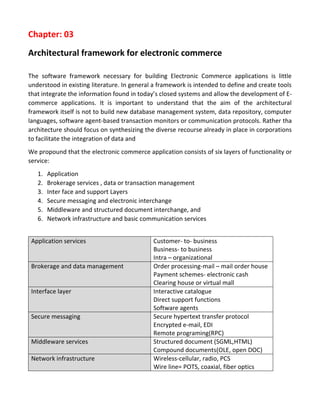
The software framework necessary for building Electronic Commerce applications is little understood in existing literature. In general a framework is intended to define and create tools that integrate the information found in today’s closed systems and allow the development of E- commerce applications. It is important to understand that the aim of the architectural framework itself is not to build new database management system, data repository, computer languages, software agent-based transaction monitors or communication protocols. Rather tha architecture should focus on synthesizing the diverse recourse already in place in corporations to facilitate the integration of data and 
We propound that the electronic commerce application consists of six layers of functionality or service: 
1. Application 
2. Brokerage services , data or transaction management 
3. Inter face and support Layers 
4. Secure messaging and electronic interchange 
5. Middleware and structured document interchange, and 
6. Network infrastructure and basic communication services 
Application services 
Customer- to- business 
Business- to business 
Intra – organizational Brokerage and data management 
Order processing-mail – mail order house 
Payment schemes- electronic cash 
Clearing house or virtual mall Interface layer 
Interactive catalogue 
Direct support functions 
Software agents Secure messaging 
Secure hypertext transfer protocol 
Encrypted e-mail, EDI 
Remote programing(RPC) Middleware services 
Structured document (SGML,HTML) 
Compound documents(OLE, open DOC) Network infrastructure 
Wireless-cellular, radio, PCS 
Wire line= POTS, coaxial, fiber optics
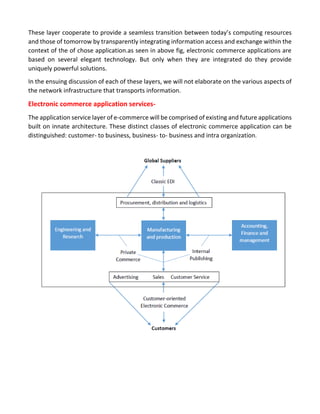
These layer cooperate to provide a seamless transition between today’s computing resources and those of tomorrow by transparently integrating information access and exchange within the context of the of chose application.as seen in above fig, electronic commerce applications are based on several elegant technology. But only when they are integrated do they provide uniquely powerful solutions. 
In the ensuing discussion of each of these layers, we will not elaborate on the various aspects of the network infrastructure that transports information. 
Electronic commerce application services- 
The application service layer of e-commerce will be comprised of existing and future applications built on innate architecture. These distinct classes of electronic commerce application can be distinguished: customer- to business, business- to- business and intra organization.
Customer-to-business Transaction- 
We call this category marketplace transaction. In a marketplace transaction, customers learn about products differently through electronic publishing, buy differently electronic cash and secure payment systems, and have them delivered differently. Also, how customer allocate their loyalty may also be different. 
In light of this, organization itself has to adapt to a word where the traditional concepts of band differentiation no longer hold-where “quality” has a new meaning, where “content” may not be equated to “product”, where “distribution” may not automatically mean “physical transport”. In this new environment, brand equity can rapidly evaporate forcing firms to develop new way of doing business 
Business-to-business transactions- 
We call this category market-link transaction. Here, business, government and other organizations depend on computer- to- computer communication as a fact, an economical and a dependable way to conduct business transactions. Small companies are also beginning to see the benefits of adopting the some methods. Business-to-business transactions include the use of EDI and electronic mail for purchasing goods and services, buying information and consulting services, submitting requests for proposals and receive proposals. 
For example, the current accounts payable process occurs through the exchange of paper document. Each year the trading partners exchange millions of invoices, checks, purchase orders, financial reports and other transactions. Most of the document are in electronic form at their point of origin but are printed and key-entered at the point receipt. The current manual process of printing, mailing and rekeying is costly, time-consuming and error-prove. Given this situation and faced with the need to reduce costs, small business are looking towards electronic commerce as a possible saviour. 
Intra-organizational Transactions- 
We call this category market-driven transactions. A company becomes market driven by dispersing throughout the firm information about its customers and competitions; by spreading strategic and tactical decision marking so that all units can participate; and by continuously monitoring their customer commitment by marking improved customer satisfaction an ongoing objective. To maintain the relationship that are critical to delivering superiors customer value, management must pay close attention to service, both before and after sales.
Information Brokerage and Management 
The Information brokerage and management provides service integration though the notion of information brokerages the development of which is necessitated by the increasing information resource fragmentation. We use the notion of information brokerage to represent an intermediary who provides service integration between customers and information provides, given some constraint such as a low price, fast service of profit minimization for client. 
Information brokers, for example are rapidly becoming necessary in dealing with the voluminous amounts of information on the networks. As on-line database migrate to consumer information utilities, consumers and information professionals will have to keep up the knowledge and ownership of all these systems. Who’s got what? How do you use it? What do they charge? Most professionals have enough trouble keeping track of files of interest on one or two database services. Will all the complicity associated with larger number of on-line databases and service bureaus, it’s impossible to expect humans to do the searching.it will have to be software programs- information brokers or software agents, to use the more popular terms-that act on searcher’s behalf. Information brokerage dose more than just searching. 
Interface and support services 
The third layer, interface and support services, will provide interface for electronic commerce application such as interactive catalogues and will support directory services-functions necessary for information search and access. These two concepts are very different. Interactive catalogues are the customized interface to consumer application such home shopping. An interactive catalogue is an extension of the paper-based catalogue and incorporates additional feature such as sophisticated graphics and video to make advertising more attracts. 
Directories, on the other hand, operate behind the scenes and attempt to organize the enormous amount of information and transaction generated to facilitate electronic commerce. Directory service database make data from any server appear as a local file. A classic example of a directory is the telephone white pages, allows us to locate people and telephone numbers. In the case of electronic commerce, directories would play an important role in information management functions. For instance, take the case of buying an airline ticket with several stopovers with the caveat that the time between layovers be minimized. This search would require several queries to various on-line directories to find empty seats on various airline and then the availability of seats would be coordinated with the amount of times spent in the airport terminals. 
Secure messaging and structure document Interchange service 
The important fourth layer, secure messaging, is clear. Everyone is business know that electronic messing is a critical business issue. Consider a familiar business scenario: you rand over an urgent fax on Monday and find out on Tuesday that it’s still setting on your fax operator’s disk. What
happened? The line was busy and he thought he do try again later. Or the number was wrong, he forgot to let you know or you are in London and you need to send a spreadsheet that details a marketing plan for a product introduction strategy to a co- worker in New York. This must be done today, not tomorrow when the courier services would deliver. There is a solution to these common and frustrating problems. It’s called integrated messaging: a group of computer service that through the use of a network send, receive and combine message, 
Faxes and larger data files. Some better known examples are electronic mail, enhance fact and electronic data interchange. 
Broadly define messaging is the software that sits between the network infrastructure and the client or electronic commerce application, masking the peculiarities of the environment. Other define messaging as frame work for the total implementation of portable application divorcing you from the architectural primitive of your system, in general, messaging products are not application that solve problems; they are enablers of the application that solve problems. 
Messaging services offer solutions for communicating non-formatted (unstructured) data such orders, shipping notices and in voices. Unstructured messaging consist of facts, e-mail and form based system like Lotus Notes. Structure documents messaging consist of the automated interchange of standardized and approve messages between, via telecommunication line. Example of structured document messaging include EDI. 
Messaging is gaining momentum in electronic commerce and seems to have many advantages. It supports both synchronous (immediate) and asynchronous (delayed) message delivery and processing. With asynchronous messaging, when a message is sent, work continues (software doesn’t wait for a response). This allows the transfer of messages through store-and-forward methods. 
The main disadvantages of messaging are the new types of applications it enables-which appear to be more complex, especially to traditional programmers-and the jungle of standards it involves. Because of the lack of standards, there is often no interoperability between different messaging vendors leading to islands of messaging. Also, security, privacy and confidentiality through data encryption and authentication techniques are important issues that need to be resolved for ensuring the legality of the message-based transactions themselves. 
Middleware services 
Middleware is a relatively new concept that emerged only recently. Like so many other innovations, it came in being out of necessity. Users in the 1970’s, when vendors delivered
homogenous systems that worked, didn’t have a need for middleware. When conditions changed-along with the hardware and the software the organizations couldn’t: The tools were inadequate, the backlog was enormous, and the pressure was over whelming. And, the users were dissatisfied. Something was needed to solve all the interface, translation, transformation and interpretation problems that were driving application developers crazy. 
With the growth of networks, client-server technology, and all other forms of communicating between/among unlike platforms, the problems of getting all pieces to work together grew from formidable to horrendous. As the cry for distributed computing spread, users demanded interaction between dissimilar system, networks that permitted shared resources, and applications that could be accessed by multiple software programs. In simple terms, middleware is the ultimate mediator between diverse software programs that enables them talk to one another. 
Transparency 
Transparency implies that users should be unaware that they are accessing multiple systems. Transparency is essential for dealing with higher-level issues than physical media and interconnection that the underlying network infrastructure is in charge of. The ideal picture is one of a “Virtual” network: a collection of work-group, departmental, enterprise and inter- enterprise LANs that appears to the end user or client application to be a seamless and easily accessed whole. 
Transparency is accomplished using middleware that facilities a distributed computing environment. This gives users and applications transparent access to data, computation, and other resources across collections of multivendor, heterogeneous systems. The strategic architectures of every major system vendor are now based on some form of middleware. The key to realizing the theoretical benefits of such an architecture is transparency. Users need not spend their time to understand where something is. Nor should application developers have to code into their applications the exact locations of resources over the network. The goal is for the applications to send a request to the middleware layer, which then satisfies the request any way it can, using remote information. 
Transaction Security and Management 
Support for transaction processing (TP) is fundamental to success in the electronic commerce market. Security and management are essential to all layers in the electronic commerce model. Transaction integrity must be given for businesses that cannot afford any loss or inconsistency in data. For electronic commerce, middleware provides the qualities expected in the standard TP System: the so-called ACID properties (Atomicity, Consistency, Isolation and Durability).
World Wide Web (WWW) As the Architecture 
Electronic commerce depends on the unspoken assumption that computers cooperate efficiently for seamless information sharing. Unfortunately, this assumption of interoperability has been supported by the realities of practical computing. Computing is still a world made up of many technical directions, product implementations and competing vendors. This diversity, while good for innovation causes problem as the e-commerce applications try to impose a certain discipline on the proliferating computers and networks. It is ironic that real effect of computing is all too often then prevention of data sharing due to incompatibilities- architectures, data formats and communication protocols. 
What does the Web Encompass? 
The web has become an umbrella for wide range of concepts and technologies that differ markedly in purpose and scope. These include the global hypertext publishing concept, the universal reader concept and the client-server concept. 
The global hypertext publishing concept promotes the idea of a seamless information world in which all on-line information can be accessed and retrieved in a consistent and simple way. To access information in this seamless world, we will need the ability to address many types of data-text files, images, sound files and animation sequences. 
The universal readership concept promotes the idea that, unlike the segmented applications of the past, we can use one application-a universal (or common) user interface-to read a variety of documents. This concept implies that once information is published it is accessible from any type of computer, in any country and that any (authorized) person merely needs to use one simple program to access it. This is accomplished in the web by using a core browser or application that is augmented by supporting applications. The core browser implements only minimal functionality and attempts to offload more specialized work onto the supporting applications. 
The client server concept allows the web to grow easily without any centralized control. Anyone can publish information and anyone (as long as he or she is authorized) can read and download it. Publishing information requires a server program and reading data requires a client browser. All the clients and all the servers are connected to one another by the Internet. The various standard protocols allows all clients to communicate with all servers. In practice the web hangs on a number of essential concepts, including the following: 
•The addressing scheme known as uniform resource locator (URL) makes the hyper media world possible despite many different protocols.
•A network protocol known as hypertext transfer protocol (HTTP) used by client browsers and servers offers performance and features not otherwise available. 
•A mark-up language (HTML), which every web client is required to understand, is used for the representation of hypertext documents containing text, list boxes and graphics information across the net.
Chapter- 04 
Technology behind the web 
Information providers (or publishers) run programs (called server) from which the browsers (clients) can obtain information. The programs can either be Web server that understand the hypertext transfer protocol (HTTP), “gateway” programs that convert an existing information format to hypertext, or a non-HTTP server that Web browser can access-anonymous FTP or Gopher server. 
Web server are composed of two major parts: the hypertext transport protocol for transmitting document between server and client and the hypertext mark-up language(HTML) format for document. The link between HTML file and the HTTP servers is provided by the uniform resource locaters (URLs). 
 Uniform resource locater 
The document that the browsers display are hypertext that contains pointers to other document. The browsers let you deal with the pointer in a transparent way select the pointer and you are presented with text to witch it point. This pointer is implemented using a concept that is central to Web browser: uniforms resource locaters (URLs). One way to think about URLs is to use the libraries and location on a shelf as a metaphor. A URLs for a digital library would be a unique call number that provide the exact location of every book in the world, including the country, city, street and library shelf location. 
In practice, URLs are the strings used as addresses of objects (documents, images) the Web. Think of them as analogues to your e-mail address. Just as your address is unique and maybe used by any other Internet user to send you mail without knowing exactly where you are, URL marks unique location on Internet where a file or service can be found. 
URLs follow a fairly consistent pattern. The first part describes the type of resource; the second part gives the name of server housing the resources; and the third part gives full file name of the resources. URLs are universal in that they provide access to wild range of network services witch required separate application. For a new network protocol one can easily form an address as the set of parameters. Necessary to retrieve the object. If these parameter are encoded into a concise string, with a prefix to identify the protocol and encoding, one has a new URL scheme. Take a look at the URL formats below. 
FTP: ftp://server.address/compelete.file.name 
Gopher: gopher://server.adress:port/directory/filename 
TELNET: telnet://server.address:port
HTTP: http://server.address:port/homepage.html 
News: news:misc.stocks.invest 
These are URLs for Internet news articles and newsgroups (the NNTP protocol) and for HTTP archives for TELNET destination, e-mail addresses and so on. The same can be done name of objects in given name space. For example, the URL of the main page for the Web project happens to be: http://web.w3.org/hypertext/web/TheProject.html. The prefix “http” in the preceding example indicate the address the space and define the interpretation of the rest of the string. The HTTP protocol is to be used, so the string contains the address of the server to be contacted and a substring to be passed to the server. 
As noted earlier, different protocols use different syntaxes, but they do have a small amount in common. For example, the common URL syntax reserves the solidus(/) as way of representing a hierarchical space, the pound label(#) as way of pointing inside of document and question mark(?) as separator between the address of an object and query operation applied to it. Hierarchical spaces useful for hypertext, where one “work” may be split up into many interlinked documents. # allows related names to exploit the hierarchical structure and allows links to be made within the work independent of higher parts the URL, such as server name. 
URLs are center to the Web architecture. The fact that it is to address an object anywhere on the Internet is essential for the system to scale and for the information space to be independent of the network server topology
Chapter- 05 
Network Security and Firewalls 
The ability to conduct business on a public network has strong attraction- and the potential for big savings. Security and confidentiality are essential, however, before business can conduct financial transaction over the Internet and a lack of widespread security measures remains at this time.at present, credit card numbers, financial records and other important information are not encrypted can be intercepted by any savvy Internet hacker. The discussion of security concerns in electronic commerce can be divided into two broad types:- 
1. Client-server security uses various authorization methods to make sure that only valid users and programs have access to information resource such as databases. Access control mechanisms must be set up to ensure that popularly authenticated are allowed access only to those resource that they are entitled to use. Such mechanisms include password protection, encrypted smart cards, biometrics and firewall 
2. Data and transaction security ensures the privacy and confidentiality in electronic message and data packets, including the authentication of remote users in network transaction for activists such as on-line payment. The goal is to defeat any attempt to assume another identity while involved with electronic mail or other forms of data communication. Prevent measures include data encryption using various cryptographic methods. 
Data and Message security 
The lack of data and message security in the Internet has become a higher profile problem due to increasing number merchants trying to spur commerce on the global network. For instance, credit card numbers in their plain text form create a risk when transmitted across the Internet where the possibility of the number following into the wrong hands is relatively high. Would you billing to type in your credit card number knowing the risk? 
Even worse, would you expose your customer to that risk? Just the thought of “sniffer” programs that collect credit card numbers en masse is enough to keep merchants away from on-line shopping given the possible lawsuits and other liability issues. In short, the lack of business transaction security is widely acknowledge as a major impediment the widespread e-commerce. 
Encrypted Document and Electronic mail 
E-mail users who desire confidentiality and sender authentication are using encryption. Encryption is simply intended to keep personal thoughts personal. Some users are already using Pretty Good Privacy (PGP); other are starting to use Privacy Enhanced Mail (PEM). 
E-mail is typically encrypted for the reason that all network correspondence is open for eavesdropping.
Internet e-mail is obviously then the postal system, where envelops protect corresponded form casual snooping. A glance at the header area of any e-mail message, by contrast will show that it has passed through a number of node on its way to you. Every one of these nodes present the opportunity for snooping.
Chapter- 06 
E-Commerce Companies
Chapter-07 
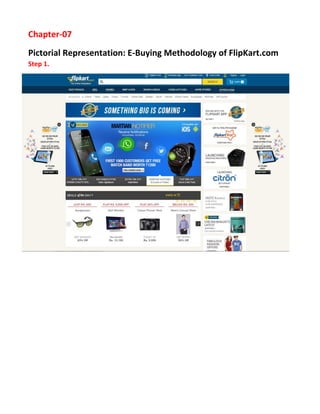
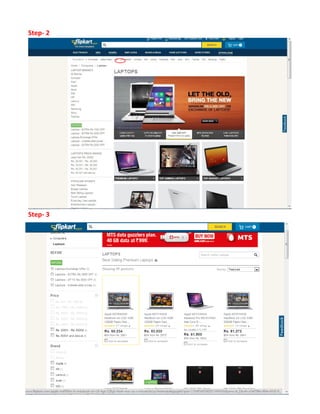
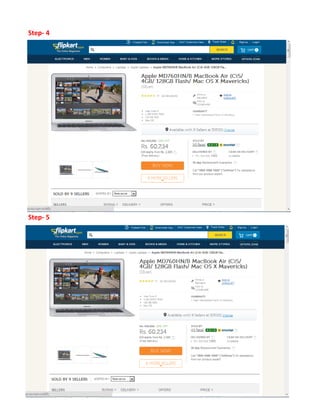
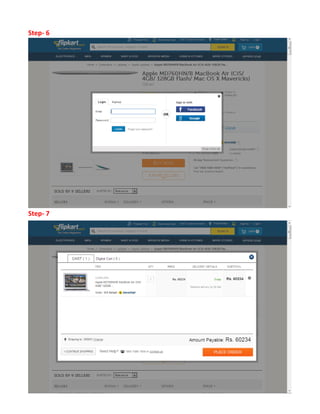
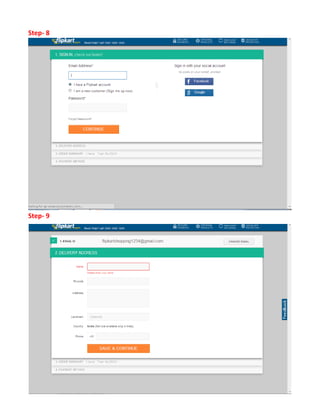
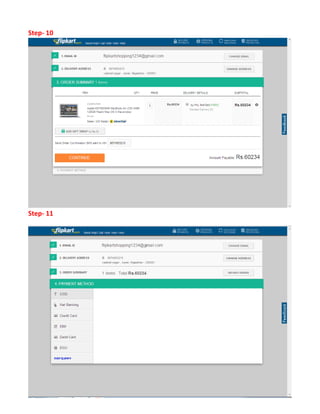
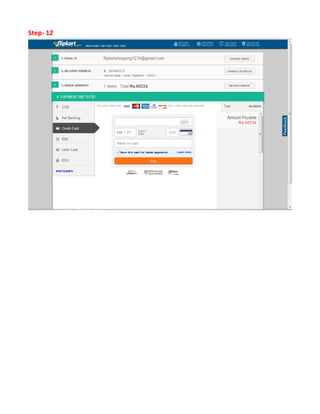
Pictorial Representation: E-Buying Methodology of FlipKart.com 
Step 1.
Step- 2 
Step- 3
Step- 4 
Step- 5
Step- 6 
Step- 7
Step- 8 
Step- 9
Step- 10 
Step- 11
Step- 12
Chapter- 08 
Conclusion 
E-commerce is growing tremendously. A lot of companies have joined between the period July and August. 
Online retail is still a tiny spot in India’s retail market of about $500 billion a year, but it is growing at a quick pace. A study retail consultancy technopark predicts India’s e-tailing market will reach $32 billion by 2020 from $2.3 billion in 2014. 
Ethnic Indian clothes and casual wear are favorite products but unusual products like pets- too are being offered online. 
With huge growth that e-commerce has witnessed in recent times analysts like Devanshu Dutta, says there in scope for more player is coming. But some also warn about the risks the space is fraught with, as only few may have changes of making it big. They also see consolidation in the sector going forward.
Bibliography 
 Frontier of Electronic Commerce by Ravi kalakota and Ander B. Whinston 
 Big E-Commerce deals stir up sector-Economic Times 
 www.Flipkart.com 
 www.yepme.com

Amrit E-commerce project

  • 1.
    Information Technology AmritBarotia, BCA 3rd year Bachelor of Computer Application Dezyne E’cole College,Ajmer www.dezyneecole.com Submitted By Electronic Commerce
  • 2.
    ACKNOWLEDGEMENT I AmThankful To Dezyne E’cole College To Help In Making This Project On E-Commerce. A Special Thanks To Ms. Jyoti Phulwani to Guide Us Step By Step in the Marking of This Project Report. Thanking You Amrit Barotia, BCA-3rd Year Bachelor Application Computer
  • 3.
    CONTENTS 1. Chapter1  Introduction 2. Chapter 2  Electronic Commerce and the World Wide Web 3. Chapter 3  Architectural Framework for Electronic Commerce 4. Chapter 4  Technology Behind the Web 5. Chapter 5  Network Security and Firewalls 6. Chapter 6  Electronic Commerce Companies 7. Chapter 7  Pictorial Representation: E-Buying Methodology 8. Chapter 8  Conclusion
  • 4.
    Chapter: 01 Introduction Every Individual of company that wants to make money and become the next Microsoft needs to understand the market potential, business implication and technological foundation of electronic commerce. But what is electronic commerce everybody is technical and business skills are needed to be successful? Companies and consumers are discovering that global networking and other technological innovations are powerful assets if used as competitive weapons in their day to day activities. E-Commerce is associated with the buying and selling of information products and services via computer network today. Consumer desires are very hard to predict, pinpoint or decipher in electronic markets whose shape, structure and population are still in early stages. Need envisioned include entertainment on demand including 500 channels T.V., video on demand, games on demand electronic retailing via catalogues and kiosks and home shopping networks. In future viewers will decide that they want see and when they want to participate and successful market place are expected to those that cater to consumer’s loneliness, boredom, education and carrier.in a highly competitive society , where neighbors seldom talk to one another these outlets give consumer someone to talk after going home. Let’s take a look at the conditions in the “NEW Economy” with respect to retail industry. Consumers are pushing retailers to the wall demanding lower prices. Better quality, and a large-section of in-season goods. Retailers are scrambling to fill the order. They are slushing back-office cost producing profit margins, producing cycle-times, buying more wisely and marking huge investment in technology. They are revamping distribution channels to make sure that warehouse cost are down by reducing their average inventory levels and coordinating the consumer demand and supply pattern. In the push to reduce prices, more and retailers are turning to overseas suppliers in part because of cheaper labour cost. Retail are the immediate line of fire and had to do the cost cutting. They put the pressure on the manufacturer and then the supplier end of the pipeline. Electronic Commerce is forcing companies to rethink the existing ways of doing target marketing, relationship marketing and even event marketing. Adaptation would include moving towards computerized “Paperless” operations to, reduce trading cost and facilitate the adoption of new business process. Japanese approach JIT (Just in Time) system, total quality control and quality circles are focused now for delivery of goods through electronic commerce.
  • 5.
    Chapter: 02 ElectronicCommerce and the World Wide Web we have broadly defined electronic commerce as a modem business methodology that address the desire of firms, consumers and management to cut costs while improving the quality of goods & inversing the speed of services. The need for electronic commerce stems from the demand within business government to make bustles use of computing, that is, better apply computer technology to improve business process and information exchange both within an enterprise and across organizations. In short, electronic appears to be an integration force that represents the digital converge of twenty- first century business application and computing technologies. Electronic commerce application emphasis the generation and exploitation of new business opportunity and to use the popular buzzword “generate business value”. For instance, when buyer-seller transaction occur in the electronic market place, information is access, observe, arrange and sold in different ways in fact, the information about a product of service is separated from the physical product from services and has become important on its own. In some case, the information can become as crucial as his actual product of services. In term of its effects on a company’s in short, information ways business transaction are creating new ways of doing business and even type of business. Electronic commerce applications are quite varied. In the most common from, e-commerce is also used to donate the paperless exchange of business information using EDI, electronic mail (e-mail), electronic bulletin boards, electronic funds transfer (EFT) and other similar technologies. These technologies are normally applied in high-payoff areas, recognizing that paper handling activities usually increases expenses without adding value. On the other hand, the electronic commerce is used to describe a new online approach to perform traditional functions such as payments and funds transfer, other entry and processing, invoicing, inventory, management, cargo tracking, electronic catalogues and point-of-sale data gathering. More recently, companies have realized that the advertising, marketing customer support functions are also part of electronic commerce application domain. The nosiness function act as initiators to the entire order management cycle that incorporates the more established notions of electronic commerce as an umbrella concept to integrate a wide range of new and old applications.
  • 6.
    DESPITE THE CHANGEtaking place, business have three goals: stay competitive, improve productivity, and deliver quality service. These goals are the guiding buoys for firms plotting their course in the turbulent waters of electronic commerce. These are other factors that companies need to keep in mind. First, most companies have already made enormous information technology investments to automate their key internal processes such as purchasing, invoicing and other similar function. So, some aspects of technology infrastructure for electronic commerce are already in place .the challenge now become: how to effecting leverage the investment. Second, price for computer hardware and network equipment continue to fall. Marking information technology an appealing investment for many business, especially when it’s used for high-impact application such as linking their distributed operations. However, investment without a clear idea of the electronic commerce architecture being built would be akin to driving with blinders on. As a result, companies that decided that electronic commerce application represent one of the best strategic investment the can make must first exert effort to understand the technology understanding electronic commerce application. At first glance, it appears that messaging- based technology such as EDI and mail- enabled applications, combined with database and information management service, form the technical Electronic Document Interchange Electronic Commerce Information sharing Electronic funds transfer (EFT) Electronic Data interchange (EDI) Collaborative Works Sales, Customer Support Marketing, Advertising Corporate Digital Library Electronic Messaging E-mail Fax Electronic Publishing
  • 7.
    foundation for effectingelectronic commerce solution. No single one of these technologies can delivers the fall potential of electronic commerce , however we require is an integrated architecture the likes of which has never been seen before . This integrated architecture is emerging in the form of the wide web (www). As electronic commerce becomes more mature, we are beginning to see sophisticated application being developed on the www. Technically and commercially, the www client-server model seems poised to become a dominant technology.
  • 8.
    Chapter: 03 Architecturalframework for electronic commerce The software framework necessary for building Electronic Commerce applications is little understood in existing literature. In general a framework is intended to define and create tools that integrate the information found in today’s closed systems and allow the development of E- commerce applications. It is important to understand that the aim of the architectural framework itself is not to build new database management system, data repository, computer languages, software agent-based transaction monitors or communication protocols. Rather tha architecture should focus on synthesizing the diverse recourse already in place in corporations to facilitate the integration of data and We propound that the electronic commerce application consists of six layers of functionality or service: 1. Application 2. Brokerage services , data or transaction management 3. Inter face and support Layers 4. Secure messaging and electronic interchange 5. Middleware and structured document interchange, and 6. Network infrastructure and basic communication services Application services Customer- to- business Business- to business Intra – organizational Brokerage and data management Order processing-mail – mail order house Payment schemes- electronic cash Clearing house or virtual mall Interface layer Interactive catalogue Direct support functions Software agents Secure messaging Secure hypertext transfer protocol Encrypted e-mail, EDI Remote programing(RPC) Middleware services Structured document (SGML,HTML) Compound documents(OLE, open DOC) Network infrastructure Wireless-cellular, radio, PCS Wire line= POTS, coaxial, fiber optics
  • 9.
    These layer cooperateto provide a seamless transition between today’s computing resources and those of tomorrow by transparently integrating information access and exchange within the context of the of chose application.as seen in above fig, electronic commerce applications are based on several elegant technology. But only when they are integrated do they provide uniquely powerful solutions. In the ensuing discussion of each of these layers, we will not elaborate on the various aspects of the network infrastructure that transports information. Electronic commerce application services- The application service layer of e-commerce will be comprised of existing and future applications built on innate architecture. These distinct classes of electronic commerce application can be distinguished: customer- to business, business- to- business and intra organization.
  • 10.
    Customer-to-business Transaction- Wecall this category marketplace transaction. In a marketplace transaction, customers learn about products differently through electronic publishing, buy differently electronic cash and secure payment systems, and have them delivered differently. Also, how customer allocate their loyalty may also be different. In light of this, organization itself has to adapt to a word where the traditional concepts of band differentiation no longer hold-where “quality” has a new meaning, where “content” may not be equated to “product”, where “distribution” may not automatically mean “physical transport”. In this new environment, brand equity can rapidly evaporate forcing firms to develop new way of doing business Business-to-business transactions- We call this category market-link transaction. Here, business, government and other organizations depend on computer- to- computer communication as a fact, an economical and a dependable way to conduct business transactions. Small companies are also beginning to see the benefits of adopting the some methods. Business-to-business transactions include the use of EDI and electronic mail for purchasing goods and services, buying information and consulting services, submitting requests for proposals and receive proposals. For example, the current accounts payable process occurs through the exchange of paper document. Each year the trading partners exchange millions of invoices, checks, purchase orders, financial reports and other transactions. Most of the document are in electronic form at their point of origin but are printed and key-entered at the point receipt. The current manual process of printing, mailing and rekeying is costly, time-consuming and error-prove. Given this situation and faced with the need to reduce costs, small business are looking towards electronic commerce as a possible saviour. Intra-organizational Transactions- We call this category market-driven transactions. A company becomes market driven by dispersing throughout the firm information about its customers and competitions; by spreading strategic and tactical decision marking so that all units can participate; and by continuously monitoring their customer commitment by marking improved customer satisfaction an ongoing objective. To maintain the relationship that are critical to delivering superiors customer value, management must pay close attention to service, both before and after sales.
  • 11.
    Information Brokerage andManagement The Information brokerage and management provides service integration though the notion of information brokerages the development of which is necessitated by the increasing information resource fragmentation. We use the notion of information brokerage to represent an intermediary who provides service integration between customers and information provides, given some constraint such as a low price, fast service of profit minimization for client. Information brokers, for example are rapidly becoming necessary in dealing with the voluminous amounts of information on the networks. As on-line database migrate to consumer information utilities, consumers and information professionals will have to keep up the knowledge and ownership of all these systems. Who’s got what? How do you use it? What do they charge? Most professionals have enough trouble keeping track of files of interest on one or two database services. Will all the complicity associated with larger number of on-line databases and service bureaus, it’s impossible to expect humans to do the searching.it will have to be software programs- information brokers or software agents, to use the more popular terms-that act on searcher’s behalf. Information brokerage dose more than just searching. Interface and support services The third layer, interface and support services, will provide interface for electronic commerce application such as interactive catalogues and will support directory services-functions necessary for information search and access. These two concepts are very different. Interactive catalogues are the customized interface to consumer application such home shopping. An interactive catalogue is an extension of the paper-based catalogue and incorporates additional feature such as sophisticated graphics and video to make advertising more attracts. Directories, on the other hand, operate behind the scenes and attempt to organize the enormous amount of information and transaction generated to facilitate electronic commerce. Directory service database make data from any server appear as a local file. A classic example of a directory is the telephone white pages, allows us to locate people and telephone numbers. In the case of electronic commerce, directories would play an important role in information management functions. For instance, take the case of buying an airline ticket with several stopovers with the caveat that the time between layovers be minimized. This search would require several queries to various on-line directories to find empty seats on various airline and then the availability of seats would be coordinated with the amount of times spent in the airport terminals. Secure messaging and structure document Interchange service The important fourth layer, secure messaging, is clear. Everyone is business know that electronic messing is a critical business issue. Consider a familiar business scenario: you rand over an urgent fax on Monday and find out on Tuesday that it’s still setting on your fax operator’s disk. What
  • 12.
    happened? The linewas busy and he thought he do try again later. Or the number was wrong, he forgot to let you know or you are in London and you need to send a spreadsheet that details a marketing plan for a product introduction strategy to a co- worker in New York. This must be done today, not tomorrow when the courier services would deliver. There is a solution to these common and frustrating problems. It’s called integrated messaging: a group of computer service that through the use of a network send, receive and combine message, Faxes and larger data files. Some better known examples are electronic mail, enhance fact and electronic data interchange. Broadly define messaging is the software that sits between the network infrastructure and the client or electronic commerce application, masking the peculiarities of the environment. Other define messaging as frame work for the total implementation of portable application divorcing you from the architectural primitive of your system, in general, messaging products are not application that solve problems; they are enablers of the application that solve problems. Messaging services offer solutions for communicating non-formatted (unstructured) data such orders, shipping notices and in voices. Unstructured messaging consist of facts, e-mail and form based system like Lotus Notes. Structure documents messaging consist of the automated interchange of standardized and approve messages between, via telecommunication line. Example of structured document messaging include EDI. Messaging is gaining momentum in electronic commerce and seems to have many advantages. It supports both synchronous (immediate) and asynchronous (delayed) message delivery and processing. With asynchronous messaging, when a message is sent, work continues (software doesn’t wait for a response). This allows the transfer of messages through store-and-forward methods. The main disadvantages of messaging are the new types of applications it enables-which appear to be more complex, especially to traditional programmers-and the jungle of standards it involves. Because of the lack of standards, there is often no interoperability between different messaging vendors leading to islands of messaging. Also, security, privacy and confidentiality through data encryption and authentication techniques are important issues that need to be resolved for ensuring the legality of the message-based transactions themselves. Middleware services Middleware is a relatively new concept that emerged only recently. Like so many other innovations, it came in being out of necessity. Users in the 1970’s, when vendors delivered
  • 13.
    homogenous systems thatworked, didn’t have a need for middleware. When conditions changed-along with the hardware and the software the organizations couldn’t: The tools were inadequate, the backlog was enormous, and the pressure was over whelming. And, the users were dissatisfied. Something was needed to solve all the interface, translation, transformation and interpretation problems that were driving application developers crazy. With the growth of networks, client-server technology, and all other forms of communicating between/among unlike platforms, the problems of getting all pieces to work together grew from formidable to horrendous. As the cry for distributed computing spread, users demanded interaction between dissimilar system, networks that permitted shared resources, and applications that could be accessed by multiple software programs. In simple terms, middleware is the ultimate mediator between diverse software programs that enables them talk to one another. Transparency Transparency implies that users should be unaware that they are accessing multiple systems. Transparency is essential for dealing with higher-level issues than physical media and interconnection that the underlying network infrastructure is in charge of. The ideal picture is one of a “Virtual” network: a collection of work-group, departmental, enterprise and inter- enterprise LANs that appears to the end user or client application to be a seamless and easily accessed whole. Transparency is accomplished using middleware that facilities a distributed computing environment. This gives users and applications transparent access to data, computation, and other resources across collections of multivendor, heterogeneous systems. The strategic architectures of every major system vendor are now based on some form of middleware. The key to realizing the theoretical benefits of such an architecture is transparency. Users need not spend their time to understand where something is. Nor should application developers have to code into their applications the exact locations of resources over the network. The goal is for the applications to send a request to the middleware layer, which then satisfies the request any way it can, using remote information. Transaction Security and Management Support for transaction processing (TP) is fundamental to success in the electronic commerce market. Security and management are essential to all layers in the electronic commerce model. Transaction integrity must be given for businesses that cannot afford any loss or inconsistency in data. For electronic commerce, middleware provides the qualities expected in the standard TP System: the so-called ACID properties (Atomicity, Consistency, Isolation and Durability).
  • 14.
    World Wide Web(WWW) As the Architecture Electronic commerce depends on the unspoken assumption that computers cooperate efficiently for seamless information sharing. Unfortunately, this assumption of interoperability has been supported by the realities of practical computing. Computing is still a world made up of many technical directions, product implementations and competing vendors. This diversity, while good for innovation causes problem as the e-commerce applications try to impose a certain discipline on the proliferating computers and networks. It is ironic that real effect of computing is all too often then prevention of data sharing due to incompatibilities- architectures, data formats and communication protocols. What does the Web Encompass? The web has become an umbrella for wide range of concepts and technologies that differ markedly in purpose and scope. These include the global hypertext publishing concept, the universal reader concept and the client-server concept. The global hypertext publishing concept promotes the idea of a seamless information world in which all on-line information can be accessed and retrieved in a consistent and simple way. To access information in this seamless world, we will need the ability to address many types of data-text files, images, sound files and animation sequences. The universal readership concept promotes the idea that, unlike the segmented applications of the past, we can use one application-a universal (or common) user interface-to read a variety of documents. This concept implies that once information is published it is accessible from any type of computer, in any country and that any (authorized) person merely needs to use one simple program to access it. This is accomplished in the web by using a core browser or application that is augmented by supporting applications. The core browser implements only minimal functionality and attempts to offload more specialized work onto the supporting applications. The client server concept allows the web to grow easily without any centralized control. Anyone can publish information and anyone (as long as he or she is authorized) can read and download it. Publishing information requires a server program and reading data requires a client browser. All the clients and all the servers are connected to one another by the Internet. The various standard protocols allows all clients to communicate with all servers. In practice the web hangs on a number of essential concepts, including the following: •The addressing scheme known as uniform resource locator (URL) makes the hyper media world possible despite many different protocols.
  • 15.
    •A network protocolknown as hypertext transfer protocol (HTTP) used by client browsers and servers offers performance and features not otherwise available. •A mark-up language (HTML), which every web client is required to understand, is used for the representation of hypertext documents containing text, list boxes and graphics information across the net.
  • 16.
    Chapter- 04 Technologybehind the web Information providers (or publishers) run programs (called server) from which the browsers (clients) can obtain information. The programs can either be Web server that understand the hypertext transfer protocol (HTTP), “gateway” programs that convert an existing information format to hypertext, or a non-HTTP server that Web browser can access-anonymous FTP or Gopher server. Web server are composed of two major parts: the hypertext transport protocol for transmitting document between server and client and the hypertext mark-up language(HTML) format for document. The link between HTML file and the HTTP servers is provided by the uniform resource locaters (URLs).  Uniform resource locater The document that the browsers display are hypertext that contains pointers to other document. The browsers let you deal with the pointer in a transparent way select the pointer and you are presented with text to witch it point. This pointer is implemented using a concept that is central to Web browser: uniforms resource locaters (URLs). One way to think about URLs is to use the libraries and location on a shelf as a metaphor. A URLs for a digital library would be a unique call number that provide the exact location of every book in the world, including the country, city, street and library shelf location. In practice, URLs are the strings used as addresses of objects (documents, images) the Web. Think of them as analogues to your e-mail address. Just as your address is unique and maybe used by any other Internet user to send you mail without knowing exactly where you are, URL marks unique location on Internet where a file or service can be found. URLs follow a fairly consistent pattern. The first part describes the type of resource; the second part gives the name of server housing the resources; and the third part gives full file name of the resources. URLs are universal in that they provide access to wild range of network services witch required separate application. For a new network protocol one can easily form an address as the set of parameters. Necessary to retrieve the object. If these parameter are encoded into a concise string, with a prefix to identify the protocol and encoding, one has a new URL scheme. Take a look at the URL formats below. FTP: ftp://server.address/compelete.file.name Gopher: gopher://server.adress:port/directory/filename TELNET: telnet://server.address:port
  • 17.
    HTTP: http://server.address:port/homepage.html News:news:misc.stocks.invest These are URLs for Internet news articles and newsgroups (the NNTP protocol) and for HTTP archives for TELNET destination, e-mail addresses and so on. The same can be done name of objects in given name space. For example, the URL of the main page for the Web project happens to be: http://web.w3.org/hypertext/web/TheProject.html. The prefix “http” in the preceding example indicate the address the space and define the interpretation of the rest of the string. The HTTP protocol is to be used, so the string contains the address of the server to be contacted and a substring to be passed to the server. As noted earlier, different protocols use different syntaxes, but they do have a small amount in common. For example, the common URL syntax reserves the solidus(/) as way of representing a hierarchical space, the pound label(#) as way of pointing inside of document and question mark(?) as separator between the address of an object and query operation applied to it. Hierarchical spaces useful for hypertext, where one “work” may be split up into many interlinked documents. # allows related names to exploit the hierarchical structure and allows links to be made within the work independent of higher parts the URL, such as server name. URLs are center to the Web architecture. The fact that it is to address an object anywhere on the Internet is essential for the system to scale and for the information space to be independent of the network server topology
  • 18.
    Chapter- 05 NetworkSecurity and Firewalls The ability to conduct business on a public network has strong attraction- and the potential for big savings. Security and confidentiality are essential, however, before business can conduct financial transaction over the Internet and a lack of widespread security measures remains at this time.at present, credit card numbers, financial records and other important information are not encrypted can be intercepted by any savvy Internet hacker. The discussion of security concerns in electronic commerce can be divided into two broad types:- 1. Client-server security uses various authorization methods to make sure that only valid users and programs have access to information resource such as databases. Access control mechanisms must be set up to ensure that popularly authenticated are allowed access only to those resource that they are entitled to use. Such mechanisms include password protection, encrypted smart cards, biometrics and firewall 2. Data and transaction security ensures the privacy and confidentiality in electronic message and data packets, including the authentication of remote users in network transaction for activists such as on-line payment. The goal is to defeat any attempt to assume another identity while involved with electronic mail or other forms of data communication. Prevent measures include data encryption using various cryptographic methods. Data and Message security The lack of data and message security in the Internet has become a higher profile problem due to increasing number merchants trying to spur commerce on the global network. For instance, credit card numbers in their plain text form create a risk when transmitted across the Internet where the possibility of the number following into the wrong hands is relatively high. Would you billing to type in your credit card number knowing the risk? Even worse, would you expose your customer to that risk? Just the thought of “sniffer” programs that collect credit card numbers en masse is enough to keep merchants away from on-line shopping given the possible lawsuits and other liability issues. In short, the lack of business transaction security is widely acknowledge as a major impediment the widespread e-commerce. Encrypted Document and Electronic mail E-mail users who desire confidentiality and sender authentication are using encryption. Encryption is simply intended to keep personal thoughts personal. Some users are already using Pretty Good Privacy (PGP); other are starting to use Privacy Enhanced Mail (PEM). E-mail is typically encrypted for the reason that all network correspondence is open for eavesdropping.
  • 19.
    Internet e-mail isobviously then the postal system, where envelops protect corresponded form casual snooping. A glance at the header area of any e-mail message, by contrast will show that it has passed through a number of node on its way to you. Every one of these nodes present the opportunity for snooping.
  • 20.
  • 21.
    Chapter-07 Pictorial Representation:E-Buying Methodology of FlipKart.com Step 1.
  • 22.
  • 23.
  • 24.
  • 25.
  • 26.
  • 27.
  • 28.
    Chapter- 08 Conclusion E-commerce is growing tremendously. A lot of companies have joined between the period July and August. Online retail is still a tiny spot in India’s retail market of about $500 billion a year, but it is growing at a quick pace. A study retail consultancy technopark predicts India’s e-tailing market will reach $32 billion by 2020 from $2.3 billion in 2014. Ethnic Indian clothes and casual wear are favorite products but unusual products like pets- too are being offered online. With huge growth that e-commerce has witnessed in recent times analysts like Devanshu Dutta, says there in scope for more player is coming. But some also warn about the risks the space is fraught with, as only few may have changes of making it big. They also see consolidation in the sector going forward.
  • 29.
    Bibliography  Frontierof Electronic Commerce by Ravi kalakota and Ander B. Whinston  Big E-Commerce deals stir up sector-Economic Times  www.Flipkart.com  www.yepme.com