Dr.A.Vini Infanta
Assistant Professor,
SRCAS, Cbe.
E-BANKING
• E-Banking or Electronic Banking is a major
innovation in the field of Banking.
• Earlier Banking was conducted in a very traditional
manner, there were no such innovations.
• Information revolution led to the evolution of
internet , which lead to E-Commerce continued by
evolution of E-Banking.
DEBIT CARD & CREDIT CARD
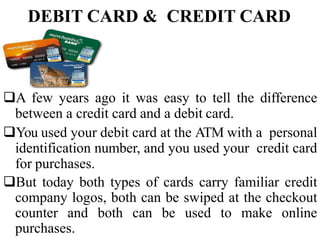
A few years ago it was easy to tell the difference
between a credit card and a debit card.
You used your debit card at the ATM with a personal
identification number, and you used your credit card
for purchases.
But today both types of cards carry familiar credit
company logos, both can be swiped at the checkout
counter and both can be used to make online
purchases.
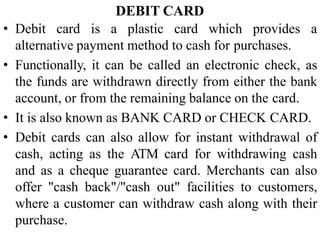
DEBIT CARD
• Debit card is a plastic card which provides a
alternative payment method to cash for purchases.
• Functionally, it can be called an electronic check, as
the funds are withdrawn directly from either the bank
account, or from the remaining balance on the card.
• It is also known as BANK CARD or CHECK CARD.
• Debit cards can also allow for instant withdrawal of
cash, acting as the ATM card for withdrawing cash
and as a cheque guarantee card. Merchants can also
offer "cash back"/"cash out" facilities to customers,
where a customer can withdraw cash along with their
purchase.
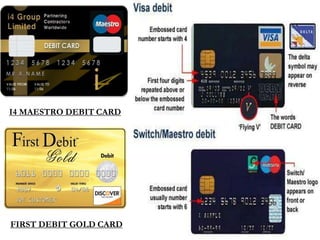
I4 MAESTRO DEBIT CARD
FIRST DEBIT GOLD CARD
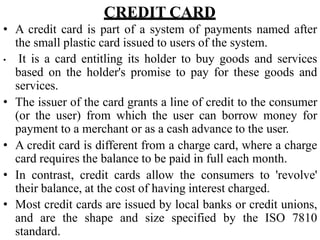
CREDIT CARD
• A credit card is part of a system of payments named after
the small plastic card issued to users of the system.
• It is a card entitling its holder to buy goods and services
based on the holder's promise to pay for these goods and
services.
• The issuer of the card grants a line of credit to the consumer
(or the user) from which the user can borrow money for
payment to a merchant or as a cash advance to the user.
• A credit card is different from a charge card, where a charge
card requires the balance to be paid in full each month.
• In contrast, credit cards allow the consumers to 'revolve'
their balance, at the cost of having interest charged.
• Most credit cards are issued by local banks or credit unions,
and are the shape and size specified by the ISO 7810
standard.
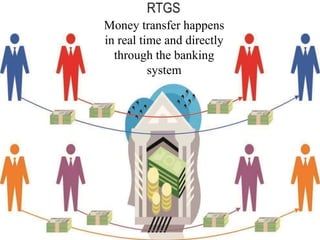
Money transfer happens
in real time and directly
through the banking
system
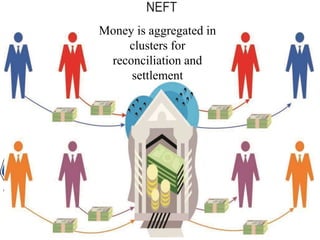
Money is aggregated in
clusters for
reconciliation and
settlement
How does one transfer
money from one bank to
another?
Obvious answer – By
Cheque
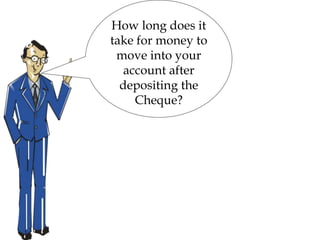
How long does it
take for money to
move into your
account after
depositing the
Cheque?
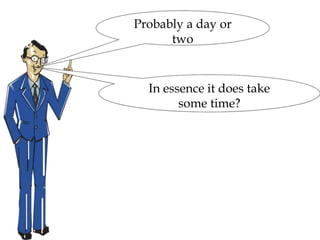
Probably a day or
two
In essence it does take
some time?
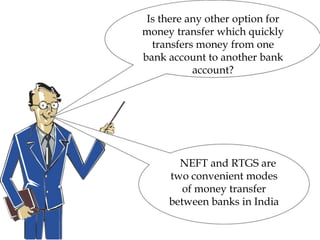
Is there any other option for
money transfer which quickly
transfers money from one
bank account to another bank
account?
NEFT and RTGS are
two convenient modes
of money transfer
between banks in India
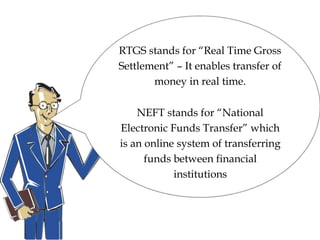
RTGS stands for “Real Time Gross
Settlement” – It enables transfer of
money in real time.
NEFT stands for “National
Electronic Funds Transfer” which
is an online system of transferring
funds between financial
institutions
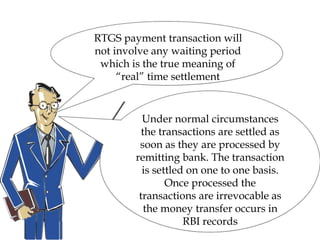
Under normal circumstances
the transactions are settled as
soon as they are processed by
remitting bank. The transaction
is settled on one to one basis.
Once processed the
transactions are irrevocable as
the money transfer occurs in
RBI records
RTGS payment transaction will
not involve any waiting period
which is the true meaning of
“real” time settlement
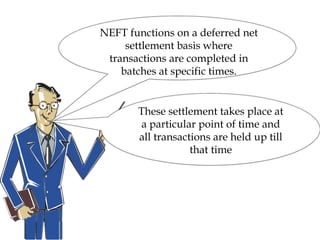
NEFT functions on a deferred net
settlement basis where
transactions are completed in
batches at specific times.
These settlement takes place at
a particular point of time and
all transactions are held up till
that time
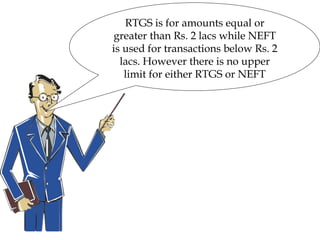
RTGS is for amounts equal or
greater than Rs. 2 lacs while NEFT
is used for transactions below Rs. 2
lacs. However there is no upper
limit for either RTGS or NEFT
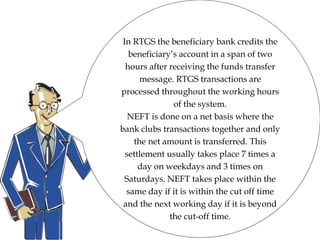
In RTGS the beneficiary bank credits the
beneficiary’s account in a span of two
hours after receiving the funds transfer
message. RTGS transactions are
processed throughout the working hours
of the system.
NEFT is done on a net basis where the
bank clubs transactions together and only
the net amount is transferred. This
settlement usually takes place 7 times a
day on weekdays and 3 times on
Saturdays. NEFT takes place within the
same day if it is within the cut off time
and the next working day if it is beyond
the cut-off time.
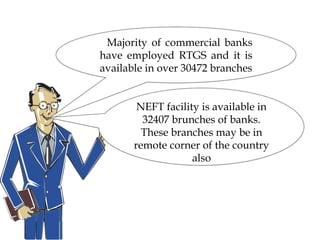
Majority of commercial banks
have employed RTGS and it is
available in over 30472 branches
NEFT facility is available in
32407 brunches of banks.
These branches may be in
remote corner of the country
also
RTGS
✔Introduced in India since March 2004.
✔It stands for ‘Real Time Gross Settlement System.
✔It is a fund transfer mechanism where transfer of
money takes place from one bank to another on a
‘real time’ and on ‘gross basis’.
✔This is the fastest possible money transfer system
through the banking channel. It runs on ‘Real Time
basis’.
✔It is different from EFT and NEFT
✔It is primarily for large volume transaction.
✔The time taken for effecting funds transfer from one
account to another is normally 2 hours.
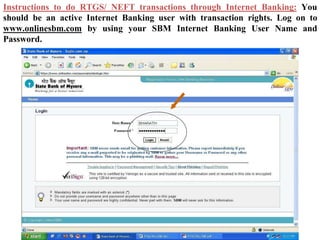
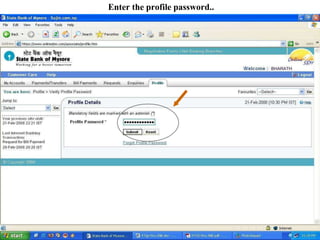
Instructions to do RTGS/ NEFT transactions through Internet Banking: You
should be an active Internet Banking user with transaction rights. Log on to

www.onlinesbm.com by using your SBM Internet Banking User Name and
Password.
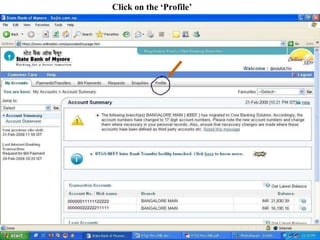
Click on the ‘Profile’
tab.
Enter the profile password..
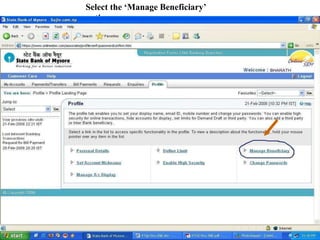
Select the ‘Manage Beneficiary’
option.
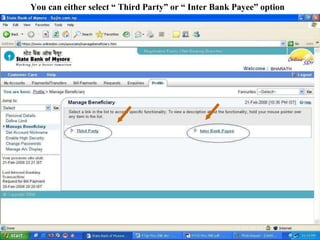
You can either select “ Third Party” or “ Inter Bank Payee” option
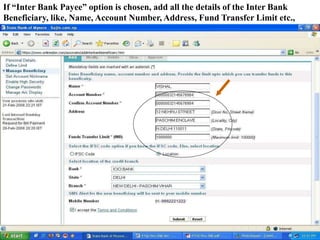
If “Inter Bank Payee” option is chosen, add all the details of the Inter Bank
Beneficiary, like, Name, Account Number, Address, Fund Transfer Limit etc.,
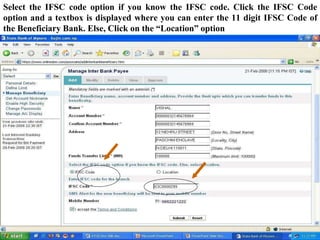
Select the IFSC code option if you know the IFSC code. Click the IFSC Code
option and a textbox is displayed where you can enter the 11 digit IFSC Code of
the Beneficiary Bank. Else, Click on the “Location” option
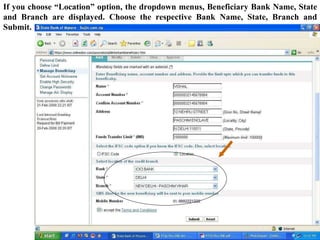
If you choose “Location” option, the dropdown menus, Beneficiary Bank Name, State
and Branch are displayed. Choose the respective Bank Name, State, Branch and
Submit.
The Submit button will be enabled only after checking
the button, I accept the Terms and Conditions. After providing

all the details, the beneficiary is added. It is displayed whether
the added beneficiary bank is RTGS or NEFT enabled.
After adding the Beneficiary, you will receive a high
security password in your mobile number. This is done to
double check your identity. Provide the password to authorize
the Beneficiary. After a Beneficiary is authorized you can start
transferring funds.
You can proceed to make payments by clicking the
‘Inter bank Transfer’ link in the ‘Payments/Transfers tab.
According to the transaction type selected
(RTGS/NEFT), the credit account details will be
displayed depending upon whether the branch is RTGS or
NEFT enabled or both. Select the Beneficiary from the
list of registered Beneficiaries. You can either confirm or
cancel the transaction.
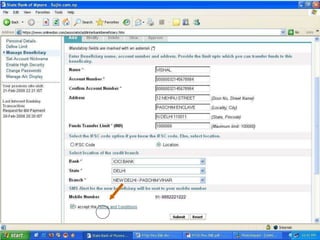
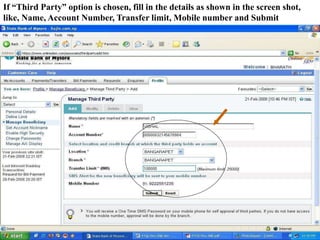
If “Third Party” option is chosen, fill in the details as shown in the screen shot,
like, Name, Account Number, Transfer limit, Mobile number and Submit
BENEFITS OF RTGS
• Real-time Payment Settlement: Payments settled in real time on a
transaction-by-transaction basis, as soon as they are accepted by the
system.
• No Credit Risk :- There is no credit and settlement risk involved in
RTGS system for receiving participant as each payment transaction is
settled instantly.
• Predictability of Cash Flows:- RTGS facilitates predictability of cash
flows as customers know when their accounts will be debited or
credited.
• Benefits to Economy : The instant finality of payments ensures fast,
secure and irrevocable settlement of major business and financial
market transactions
BENEFITS TO CUSTOMER
• due to intense competition in credit card industry, credit card
providers offer incentives such as
• frequent flyer points
• gift certificates
• cash back
• low interest credit cards
• even 0% interest credit cards are available
BENEFITS TO MERCHANTS
• A credit card transaction is often more secure than other forms of
payment, such as checks, because the issuing bank commits to pay
the merchant the moment the transaction is authorized, regardless of
whether the consumer defaults on the credit card payment.
• More secure than cash, because they discourage theft by the
amount of cash on the
merchant's employees and reduce the
premises.
• Prior to credit cards, each merchant had to evaluate each customer's
credit history before extending credit.
E banking
E banking

E banking

  • 1.
  • 2.
    E-BANKING • E-Banking orElectronic Banking is a major innovation in the field of Banking. • Earlier Banking was conducted in a very traditional manner, there were no such innovations. • Information revolution led to the evolution of internet , which lead to E-Commerce continued by evolution of E-Banking.
  • 3.
    DEBIT CARD &CREDIT CARD A few years ago it was easy to tell the difference between a credit card and a debit card. You used your debit card at the ATM with a personal identification number, and you used your credit card for purchases. But today both types of cards carry familiar credit company logos, both can be swiped at the checkout counter and both can be used to make online purchases.
  • 4.
    DEBIT CARD • Debitcard is a plastic card which provides a alternative payment method to cash for purchases. • Functionally, it can be called an electronic check, as the funds are withdrawn directly from either the bank account, or from the remaining balance on the card. • It is also known as BANK CARD or CHECK CARD. • Debit cards can also allow for instant withdrawal of cash, acting as the ATM card for withdrawing cash and as a cheque guarantee card. Merchants can also offer "cash back"/"cash out" facilities to customers, where a customer can withdraw cash along with their purchase.
  • 5.
    I4 MAESTRO DEBITCARD FIRST DEBIT GOLD CARD
  • 6.
    CREDIT CARD • Acredit card is part of a system of payments named after the small plastic card issued to users of the system. • It is a card entitling its holder to buy goods and services based on the holder's promise to pay for these goods and services. • The issuer of the card grants a line of credit to the consumer (or the user) from which the user can borrow money for payment to a merchant or as a cash advance to the user. • A credit card is different from a charge card, where a charge card requires the balance to be paid in full each month. • In contrast, credit cards allow the consumers to 'revolve' their balance, at the cost of having interest charged. • Most credit cards are issued by local banks or credit unions, and are the shape and size specified by the ISO 7810 standard.
  • 8.
    Money transfer happens inreal time and directly through the banking system
  • 9.
    Money is aggregatedin clusters for reconciliation and settlement
  • 10.
    How does onetransfer money from one bank to another?
  • 11.
  • 12.
    How long doesit take for money to move into your account after depositing the Cheque?
  • 13.
    Probably a dayor two In essence it does take some time?
  • 14.
    Is there anyother option for money transfer which quickly transfers money from one bank account to another bank account? NEFT and RTGS are two convenient modes of money transfer between banks in India
  • 15.
    RTGS stands for“Real Time Gross Settlement” – It enables transfer of money in real time. NEFT stands for “National Electronic Funds Transfer” which is an online system of transferring funds between financial institutions
  • 16.
    Under normal circumstances thetransactions are settled as soon as they are processed by remitting bank. The transaction is settled on one to one basis. Once processed the transactions are irrevocable as the money transfer occurs in RBI records RTGS payment transaction will not involve any waiting period which is the true meaning of “real” time settlement
  • 17.
    NEFT functions ona deferred net settlement basis where transactions are completed in batches at specific times. These settlement takes place at a particular point of time and all transactions are held up till that time
  • 18.
    RTGS is foramounts equal or greater than Rs. 2 lacs while NEFT is used for transactions below Rs. 2 lacs. However there is no upper limit for either RTGS or NEFT
  • 19.
    In RTGS thebeneficiary bank credits the beneficiary’s account in a span of two hours after receiving the funds transfer message. RTGS transactions are processed throughout the working hours of the system. NEFT is done on a net basis where the bank clubs transactions together and only the net amount is transferred. This settlement usually takes place 7 times a day on weekdays and 3 times on Saturdays. NEFT takes place within the same day if it is within the cut off time and the next working day if it is beyond the cut-off time.
  • 20.
    Majority of commercialbanks have employed RTGS and it is available in over 30472 branches NEFT facility is available in 32407 brunches of banks. These branches may be in remote corner of the country also
  • 21.
    RTGS ✔Introduced in Indiasince March 2004. ✔It stands for ‘Real Time Gross Settlement System. ✔It is a fund transfer mechanism where transfer of money takes place from one bank to another on a ‘real time’ and on ‘gross basis’. ✔This is the fastest possible money transfer system through the banking channel. It runs on ‘Real Time basis’. ✔It is different from EFT and NEFT ✔It is primarily for large volume transaction. ✔The time taken for effecting funds transfer from one account to another is normally 2 hours.
  • 22.
    Instructions to doRTGS/ NEFT transactions through Internet Banking: You should be an active Internet Banking user with transaction rights. Log on to www.onlinesbm.com by using your SBM Internet Banking User Name and Password.
  • 23.
    Click on the‘Profile’ tab.
  • 24.
  • 25.
    Select the ‘ManageBeneficiary’ option.
  • 26.
    You can eitherselect “ Third Party” or “ Inter Bank Payee” option
  • 27.
    If “Inter BankPayee” option is chosen, add all the details of the Inter Bank Beneficiary, like, Name, Account Number, Address, Fund Transfer Limit etc.,
  • 28.
    Select the IFSCcode option if you know the IFSC code. Click the IFSC Code option and a textbox is displayed where you can enter the 11 digit IFSC Code of the Beneficiary Bank. Else, Click on the “Location” option
  • 29.
    If you choose“Location” option, the dropdown menus, Beneficiary Bank Name, State and Branch are displayed. Choose the respective Bank Name, State, Branch and Submit.
  • 31.
    The Submit buttonwill be enabled only after checking the button, I accept the Terms and Conditions. After providing all the details, the beneficiary is added. It is displayed whether the added beneficiary bank is RTGS or NEFT enabled. After adding the Beneficiary, you will receive a high security password in your mobile number. This is done to double check your identity. Provide the password to authorize the Beneficiary. After a Beneficiary is authorized you can start transferring funds.
  • 32.
    You can proceedto make payments by clicking the ‘Inter bank Transfer’ link in the ‘Payments/Transfers tab. According to the transaction type selected (RTGS/NEFT), the credit account details will be displayed depending upon whether the branch is RTGS or NEFT enabled or both. Select the Beneficiary from the list of registered Beneficiaries. You can either confirm or cancel the transaction.
  • 33.
    If “Third Party”option is chosen, fill in the details as shown in the screen shot, like, Name, Account Number, Transfer limit, Mobile number and Submit
  • 34.
    BENEFITS OF RTGS •Real-time Payment Settlement: Payments settled in real time on a transaction-by-transaction basis, as soon as they are accepted by the system. • No Credit Risk :- There is no credit and settlement risk involved in RTGS system for receiving participant as each payment transaction is settled instantly. • Predictability of Cash Flows:- RTGS facilitates predictability of cash flows as customers know when their accounts will be debited or credited. • Benefits to Economy : The instant finality of payments ensures fast, secure and irrevocable settlement of major business and financial market transactions
  • 35.
    BENEFITS TO CUSTOMER •due to intense competition in credit card industry, credit card providers offer incentives such as • frequent flyer points • gift certificates • cash back • low interest credit cards • even 0% interest credit cards are available BENEFITS TO MERCHANTS • A credit card transaction is often more secure than other forms of payment, such as checks, because the issuing bank commits to pay the merchant the moment the transaction is authorized, regardless of whether the consumer defaults on the credit card payment. • More secure than cash, because they discourage theft by the amount of cash on the merchant's employees and reduce the premises. • Prior to credit cards, each merchant had to evaluate each customer's credit history before extending credit.