Different Systems in Banking
UNIT BANKING
MEANING
Unit banking refers to banking practice in which all banking activities are handled by a single
branch that is located in a specific area. It is run by either the board members or a dedicated
regulatory body. Since no other person, bank, or corporate body has power over it, it has a
separate status.
A unit bank uses the corresponding banking system instead of having any physical branches.
It is to provide services relating to money transfers and fund collections. A financial
institution is referred to as a "correspondent bank" if it engages in a contract with another
bank. It is to provide services to its clients on behalf of that bank.
Example of unit banking
The Reserve Bank of India is a prime example of India's unit banking system. In contrast to
banking services, which transfer funding to other areas, unit banking only uses its assets to
improve the region in question.
Importance of unit banking
Unit banking is a sort of banking system used in many nations where there is just one tiny,
autonomous bank serving a specific area.
 Unit banks are unaffected by fluctuations in the regional economy.
 A unit bank is more autonomous in its activities than a branch bank.
 A unit bank will spend more money when related to supervision costs.
 The sources of funding of a unit banking system are exclusive to that one unit.
 The interest rate is not set in the unit banking system because each unit bank has its
own set of rules and regulations.
 In a unit banking system, the bank's profits are put to use either for internal growth or
to fulfil the requirements of the neighbourhood.
 A unit bank can make crucial choices on its own because it is an independent
institution.
Dr.A.Vini Infanta, Assistant Professor, Department of BCom PA, Sri Ramakrishna College of Arts &
Science, Coimbatore-06.
Different Systems in Banking
12 advantages of the unit banking system are;
1. Local funds for local people.
2. Intimate Knowledge of Customer.
3. Efficient Management supervision and control.
4. Discontinuance of inefficient branches.
5. Better Service.
6. Close Customer-banker Relations.
7. No Effects Due to Strikes or Closure.
8. No Monopolistic Practices.
9. No Risks of Fraud.
10. Closure of Inefficient Banks.
11. Local Development.
12. Promotes Regional Balance.
1. Local funds for local people
The unit banking of a particular locality utilizes its resources to develop its locality only and
does not transfer them to other localities like branch banking.
2. Intimate Knowledge of the Customer
The Managers of the local unit bank can easily acquire the personal knowledge of customers
and the specialized knowledge of the local industries and occupations.
Therefore, he is better positioned to serve the local borrowers’ needs; lie has greater chances
of cultivating a friendly and personal relationship with the individual entrepreneurs of his
locality.
3. Efficient Management supervision and control
One of the most important advantages of the unit banking system is that it can be managed
efficiently because of its size and work. Coordination and control become effective.
4. Discontinuance of inefficient branches.
Dr.A.Vini Infanta, Assistant Professor, Department of BCom PA, Sri Ramakrishna College of Arts &
Science, Coimbatore-06.
Different Systems in Banking
Unit banks need to operate very efficiently, or the branch will have close down due to losses.
5. Better Service
Unit banks can render efficient service to their customers. Their area of operation is limited.
They can concentrate well on that limited area and provide the best possible service.
6. Close Customer-banker Relations
Since the area of operation is limited, the customers can have direct contact. Their grievances
can be redressed then and there.
7. No Effects Due to Strikes or Closure
If there is a strike or closure of a unit, it does not impact the trade and industry because of its
small size.
8. No Monopolistic Practices
Since the size of the bank and the area of its operation are limited, it is difficult for the bank
to adopt monopolistic practices.
9. No Risks of Fraud
Due to the small size of the bank, there is stricter and closer control of management.
10. Closure of Inefficient Banks
Inefficient banks will be automatically closed as they would not satisfy their customers by
providing efficient service.
11. Local Development
Unit banking is localized banking. The unit bank has the specialized knowledge of the local
problems and serves the requirement of the local people in a better manner than branch
banking.
12. Promotes Regional Balance
Under the unit banking system, there is no transfer of resources from rural and backward
areas to the big industrial and commercial centers.
Dr.A.Vini Infanta, Assistant Professor, Department of BCom PA, Sri Ramakrishna College of Arts &
Science, Coimbatore-06.
Different Systems in Banking
9 disadvantages of the unit banking system are;
1. No Economies of Large Scale.
2. Lack of Uniformity in Interest Rates.
3. Lack of Control.
4. Risks of Bank’s Failure.
5. Limited Resources.
6. Unhealthy Competition.
7. Wastage of National Resources.
8. No Banking Development in Backward Areas.
9. Local Pressure.
1. No Economies of Large Scale
Since the size of a unit bank is small, it cannot reap the advantages of a large scale.
2. Lack of Uniformity in Interest Rates
In a unit banking system, there will be a large number of banks in operation. Transfer of
funds will be difficult and costly.
3. Lack of Control
Since the number of unit banks is huge, their coordination and control would become very
difficult.
4. Risks of Bank’s Failure
Unit banks are more exposed to closure risks.
5. Limited Resources
Dr.A.Vini Infanta, Assistant Professor, Department of BCom PA, Sri Ramakrishna College of Arts &
Science, Coimbatore-06.
Different Systems in Banking
Under the unit banking system, the size of banks is small, so they cannot meet the
requirements of large-scale industries.
6. Unhealthy Competition
Some unit banks come into existence at an important business center.
7. Wastage of National Resources
Unit banks concentrate in big metropolitan cities, whereas they do not have their workplaces
in rural areas.
8. No Banking Development in Backward Areas
Unit banks cannot open branches.
9. Local Pressure
Since unit banks are highly localized in their business, local pressures and interferences
generally disrupt their normal functioning.
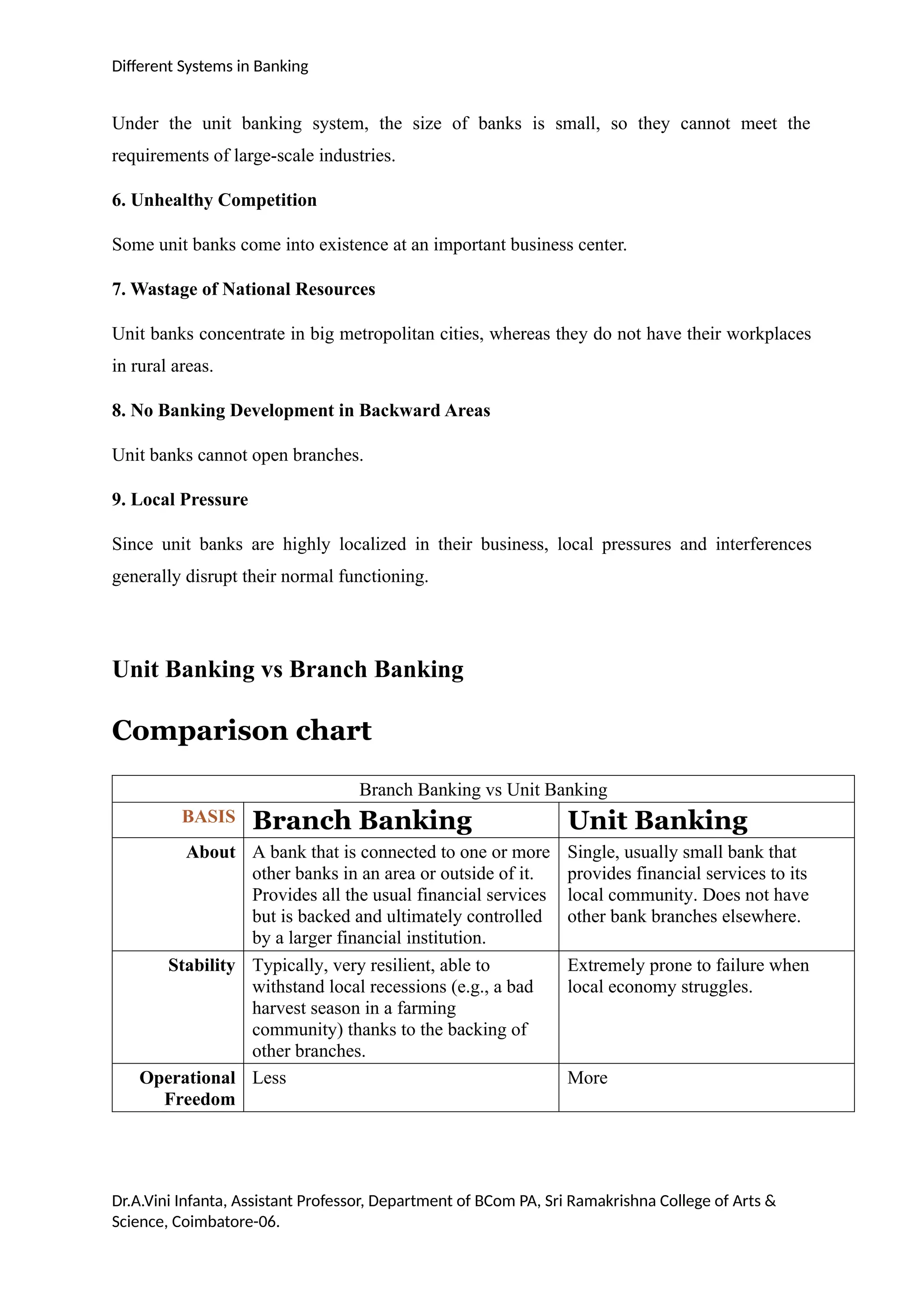
Unit Banking vs Branch Banking
Comparison chart
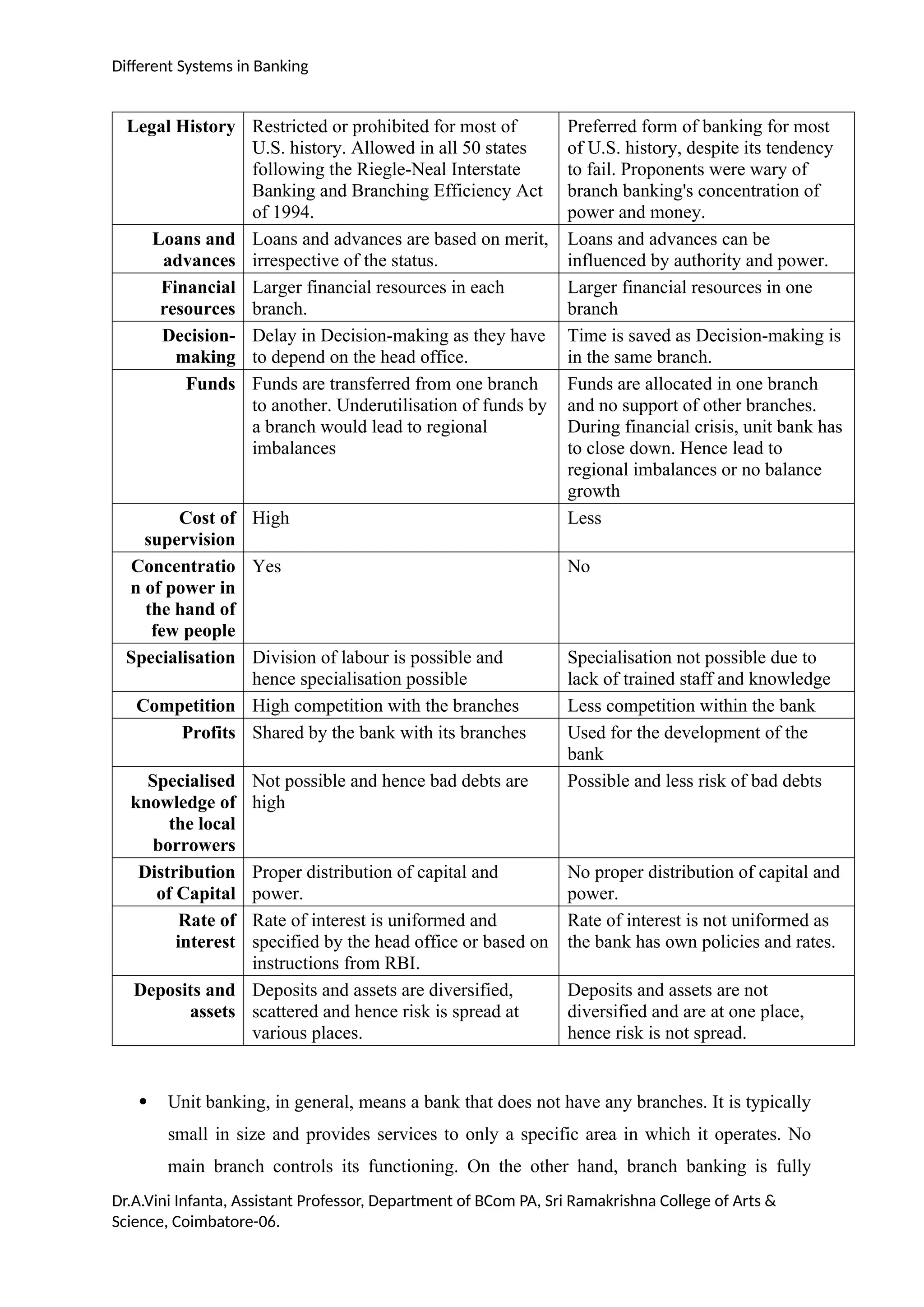
Branch Banking vs Unit Banking
BASIS Branch Banking Unit Banking
About A bank that is connected to one or more
other banks in an area or outside of it.
Provides all the usual financial services
but is backed and ultimately controlled
by a larger financial institution.
Single, usually small bank that
provides financial services to its
local community. Does not have
other bank branches elsewhere.
Stability Typically, very resilient, able to
withstand local recessions (e.g., a bad
harvest season in a farming
community) thanks to the backing of
other branches.
Extremely prone to failure when
local economy struggles.
Operational
Freedom
Less More
Dr.A.Vini Infanta, Assistant Professor, Department of BCom PA, Sri Ramakrishna College of Arts &
Science, Coimbatore-06.
Different Systems in Banking
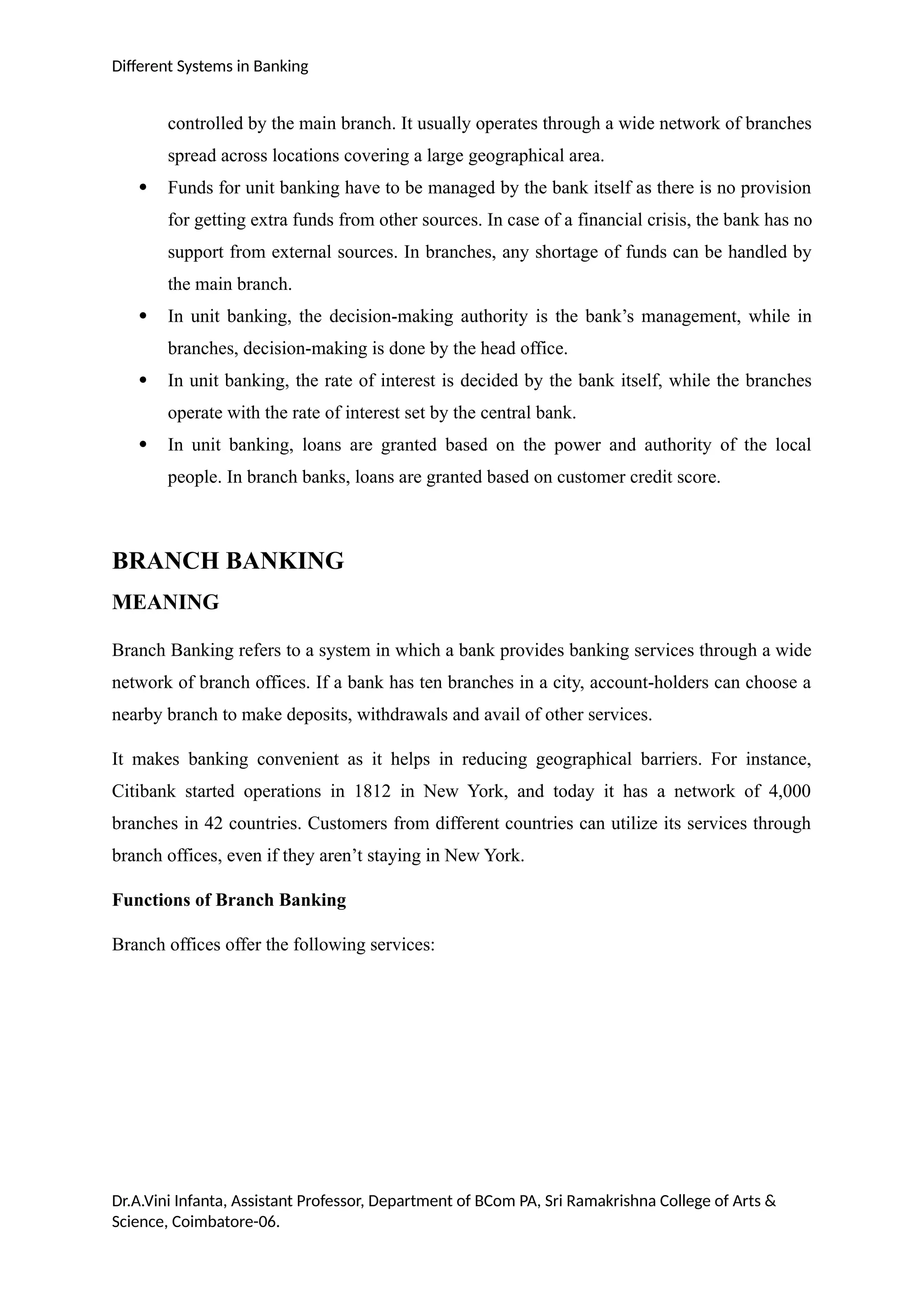
Legal History Restricted or prohibited for most of
U.S. history. Allowed in all 50 states
following the Riegle-Neal Interstate
Banking and Branching Efficiency Act
of 1994.
Preferred form of banking for most
of U.S. history, despite its tendency
to fail. Proponents were wary of
branch banking's concentration of
power and money.
Loans and
advances
Loans and advances are based on merit,
irrespective of the status.
Loans and advances can be
influenced by authority and power.
Financial
resources
Larger financial resources in each
branch.
Larger financial resources in one
branch
Decision-
making
Delay in Decision-making as they have
to depend on the head office.
Time is saved as Decision-making is
in the same branch.
Funds Funds are transferred from one branch
to another. Underutilisation of funds by
a branch would lead to regional
imbalances
Funds are allocated in one branch
and no support of other branches.
During financial crisis, unit bank has
to close down. Hence lead to
regional imbalances or no balance
growth
Cost of
supervision
High Less
Concentratio
n of power in
the hand of
few people
Yes No
Specialisation Division of labour is possible and
hence specialisation possible
Specialisation not possible due to
lack of trained staff and knowledge
Competition High competition with the branches Less competition within the bank
Profits Shared by the bank with its branches Used for the development of the
bank
Specialised
knowledge of
the local
borrowers
Not possible and hence bad debts are
high
Possible and less risk of bad debts
Distribution
of Capital
Proper distribution of capital and
power.
No proper distribution of capital and
power.
Rate of
interest
Rate of interest is uniformed and
specified by the head office or based on
instructions from RBI.
Rate of interest is not uniformed as
the bank has own policies and rates.
Deposits and
assets
Deposits and assets are diversified,
scattered and hence risk is spread at
various places.
Deposits and assets are not
diversified and are at one place,
hence risk is not spread.
 Unit banking, in general, means a bank that does not have any branches. It is typically
small in size and provides services to only a specific area in which it operates. No
main branch controls its functioning. On the other hand, branch banking is fully
Dr.A.Vini Infanta, Assistant Professor, Department of BCom PA, Sri Ramakrishna College of Arts &
Science, Coimbatore-06.
Different Systems in Banking
controlled by the main branch. It usually operates through a wide network of branches
spread across locations covering a large geographical area.
 Funds for unit banking have to be managed by the bank itself as there is no provision
for getting extra funds from other sources. In case of a financial crisis, the bank has no
support from external sources. In branches, any shortage of funds can be handled by
the main branch.
 In unit banking, the decision-making authority is the bank’s management, while in
branches, decision-making is done by the head office.
 In unit banking, the rate of interest is decided by the bank itself, while the branches
operate with the rate of interest set by the central bank.
 In unit banking, loans are granted based on the power and authority of the local
people. In branch banks, loans are granted based on customer credit score.
BRANCH BANKING
MEANING
Branch Banking refers to a system in which a bank provides banking services through a wide
network of branch offices. If a bank has ten branches in a city, account-holders can choose a
nearby branch to make deposits, withdrawals and avail of other services.
It makes banking convenient as it helps in reducing geographical barriers. For instance,
Citibank started operations in 1812 in New York, and today it has a network of 4,000
branches in 42 countries. Customers from different countries can utilize its services through
branch offices, even if they aren’t staying in New York.
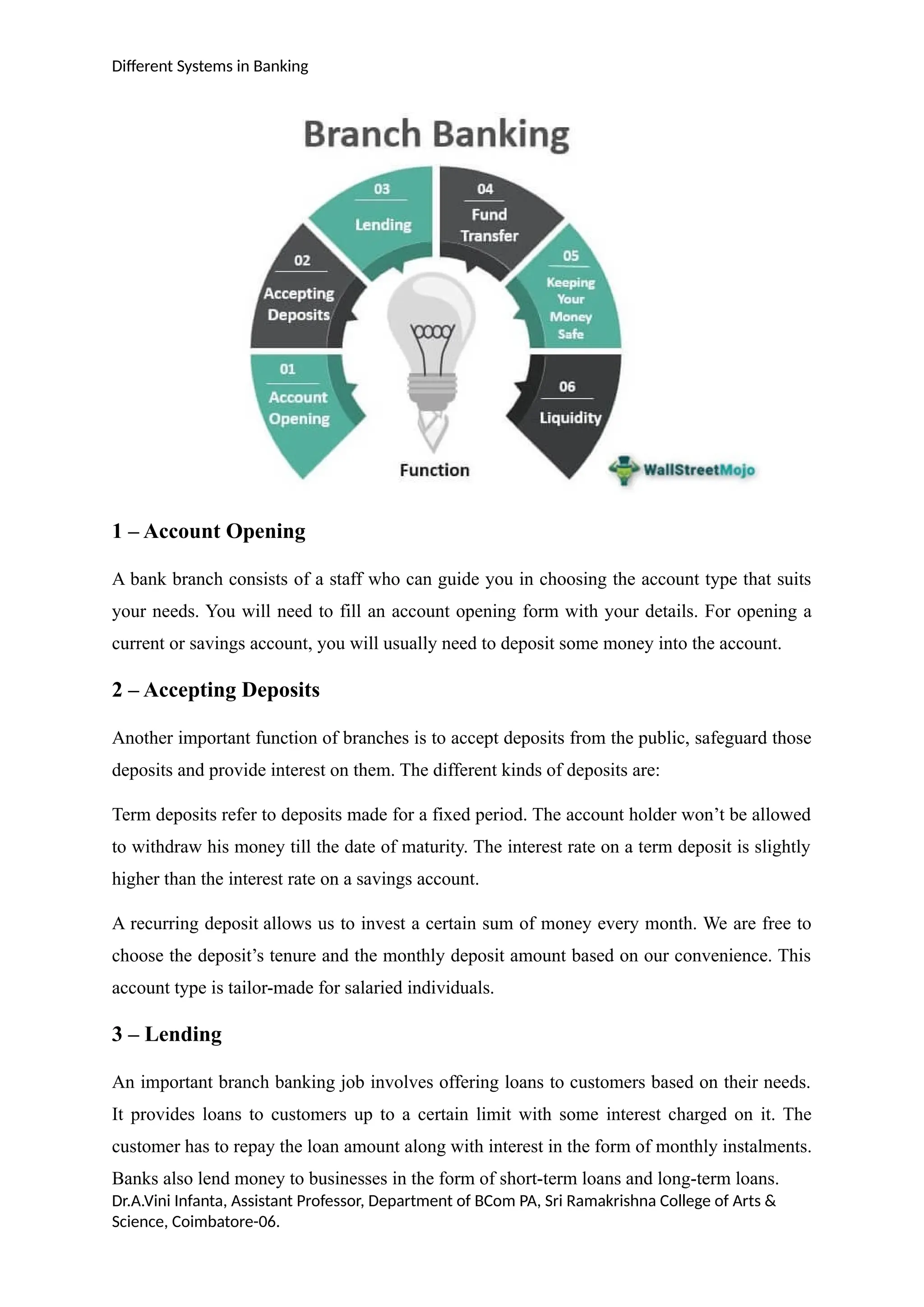
Functions of Branch Banking
Branch offices offer the following services:
Dr.A.Vini Infanta, Assistant Professor, Department of BCom PA, Sri Ramakrishna College of Arts &
Science, Coimbatore-06.
Different Systems in Banking
1 – Account Opening
A bank branch consists of a staff who can guide you in choosing the account type that suits
your needs. You will need to fill an account opening form with your details. For opening a
current or savings account, you will usually need to deposit some money into the account.
2 – Accepting Deposits
Another important function of branches is to accept deposits from the public, safeguard those
deposits and provide interest on them. The different kinds of deposits are:
Term deposits refer to deposits made for a fixed period. The account holder won’t be allowed
to withdraw his money till the date of maturity. The interest rate on a term deposit is slightly
higher than the interest rate on a savings account.
A recurring deposit allows us to invest a certain sum of money every month. We are free to
choose the deposit’s tenure and the monthly deposit amount based on our convenience. This
account type is tailor-made for salaried individuals.
3 – Lending
An important branch banking job involves offering loans to customers based on their needs.
It provides loans to customers up to a certain limit with some interest charged on it. The
customer has to repay the loan amount along with interest in the form of monthly instalments.
Banks also lend money to businesses in the form of short-term loans and long-term loans.
Dr.A.Vini Infanta, Assistant Professor, Department of BCom PA, Sri Ramakrishna College of Arts &
Science, Coimbatore-06.
Different Systems in Banking
4 – Fund Transfer
A fund transfer is the movement of funds from one person to another through the banking
system. Apart from the electronic transfer of funds, you can also transfer money from one
account to another by check.
5 – Keeping Your Money Safe
Safeguarding public wealth is another important function that a bank performs. Banks also
provide a safe deposit locker facility. Customers can use them to store their valuables, gold,
documents, and other things.
6 – Demat Services
Opening and maintaining a Demat account (dematerialization account) is also a function of
branches. The purpose of the account is to hold the shares and securities in an electronic
format. A Demat account allows you to buy shares and keep track of your investments online.
INVESTMENT BANKING
Investment banking is essentially a financial service provided by a finance company or a
banking division to help large multinational corporations in their investment plans. Along
with large companies and organisations, this service also helps high net worth individuals and
governments to raise or create capital. Some of the important roles that an investment bank
plays are to underwrite new securities for all types of organisations, assist in sales of
securities, and to arrange for mergers, acquisitions and reorganisations.
Dr.A.Vini Infanta, Assistant Professor, Department of BCom PA, Sri Ramakrishna College of Arts &
Science, Coimbatore-06.
Different Systems in Banking
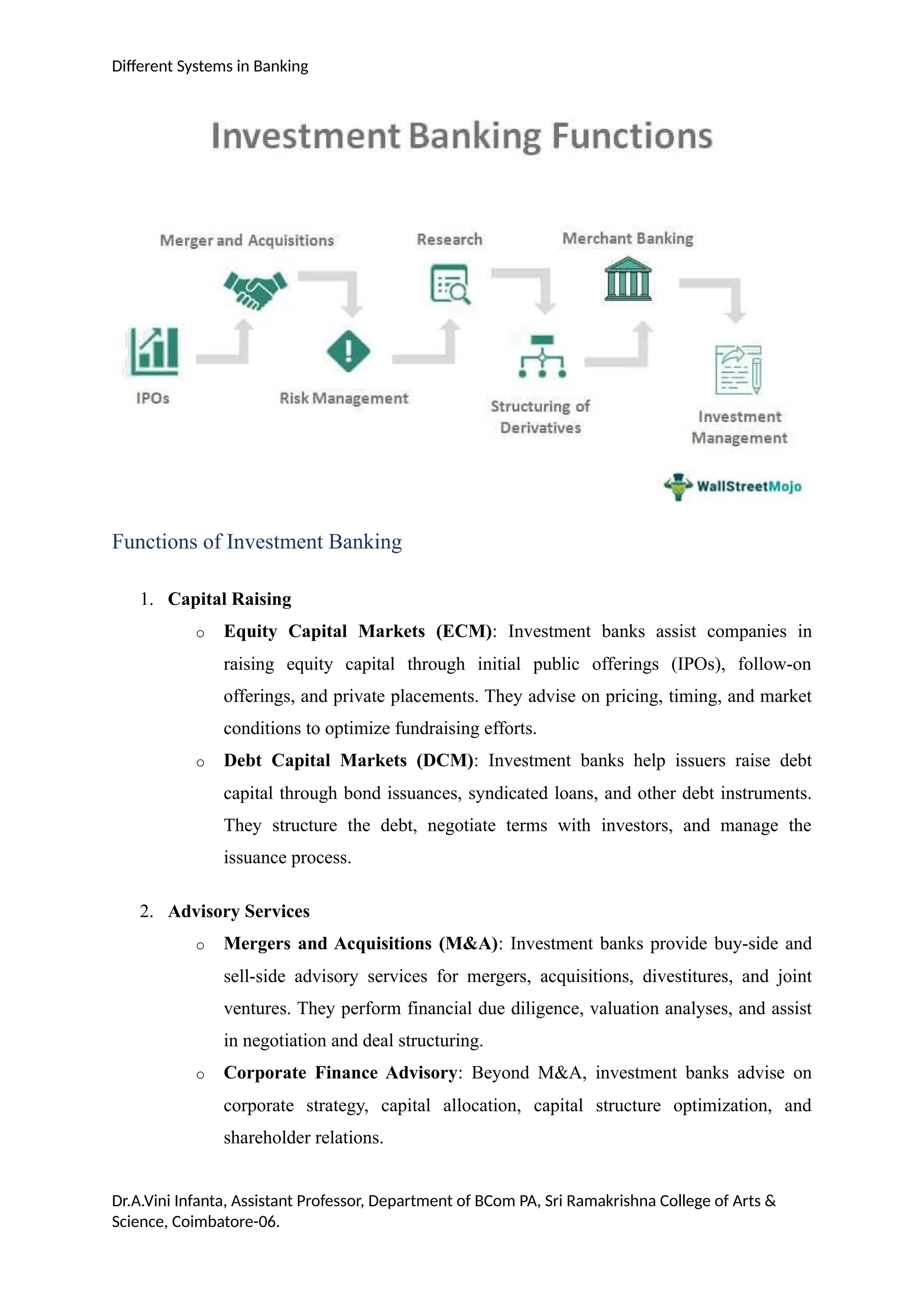
Functions of Investment Banking
1. Capital Raising
o Equity Capital Markets (ECM): Investment banks assist companies in
raising equity capital through initial public offerings (IPOs), follow-on
offerings, and private placements. They advise on pricing, timing, and market
conditions to optimize fundraising efforts.
o Debt Capital Markets (DCM): Investment banks help issuers raise debt
capital through bond issuances, syndicated loans, and other debt instruments.
They structure the debt, negotiate terms with investors, and manage the
issuance process.
2. Advisory Services
o Mergers and Acquisitions (M&A): Investment banks provide buy-side and
sell-side advisory services for mergers, acquisitions, divestitures, and joint
ventures. They perform financial due diligence, valuation analyses, and assist
in negotiation and deal structuring.
o Corporate Finance Advisory: Beyond M&A, investment banks advise on
corporate strategy, capital allocation, capital structure optimization, and
shareholder relations.
Dr.A.Vini Infanta, Assistant Professor, Department of BCom PA, Sri Ramakrishna College of Arts &
Science, Coimbatore-06.
Different Systems in Banking
3. Market Making and Trading
o Trading Desks: Investment banks operate trading desks that facilitate buying
and selling of financial instruments such as stocks, bonds, derivatives,
currencies, and commodities. They provide liquidity to markets and execute
trades on behalf of clients and their own accounts.
o Market Making: Investment banks act as market makers by quoting bid and
ask prices for securities, thereby enhancing market liquidity and efficiency.
4. Research
o Investment banks conduct comprehensive research on companies, industries,
and economic trends. Research reports provide insights into investment
opportunities, market trends, and macroeconomic developments. This
information guides institutional investors and clients in making informed
investment decisions.
5. Risk Management
o Hedging Strategies: Investment banks offer hedging solutions to manage
risks associated with interest rates, foreign exchange rates, commodities, and
other market variables. Derivative products such as swaps, options, and
futures are used to hedge against potential losses.
Services Offered by Investment Banks
1. Underwriting
o Investment banks underwrite new securities issuances to ensure successful
placement with investors. They assume the financial risk of buying securities
from issuers and sell them to the public or institutional investors. Underwriting
ensures capital is efficiently allocated to companies seeking funding.
2. Financial Structuring
o Investment banks structure complex financial transactions to meet specific
client needs. This includes designing financing packages, creating securities
with varying risk profiles, and optimizing tax and accounting considerations.
3. Private Equity and Venture Capital
Dr.A.Vini Infanta, Assistant Professor, Department of BCom PA, Sri Ramakrishna College of Arts &
Science, Coimbatore-06.
Different Systems in Banking
o Some investment banks have divisions or affiliations dedicated to private
equity and venture capital investments. They raise funds from institutional and
high-net-worth investors to invest in private companies, startups, and growth-
stage firms.
4. Asset Management
o Investment banks manage assets on behalf of institutional investors and
private clients through discretionary portfolio management, advisory services,
and customized investment strategies. Asset management divisions aim to
achieve long-term financial goals and optimize investment returns.
5. Wealth Management
o Investment banks provide personalized wealth management services to high-
net-worth individuals and families. Services include investment advisory,
estate planning, tax optimization, philanthropic planning, and comprehensive
financial planning.
Key Players in Investment Banking
1. Bulge Bracket Banks
o Large global investment banks with diversified capabilities across multiple
regions and financial services. Examples include Goldman Sachs, JPMorgan
Chase, Morgan Stanley, and Bank of America Merrill Lynch.
2. Middle Market and Boutique Banks
o Smaller firms that specialize in specific industries, geographic regions, or
types of transactions. They offer niche expertise, personalized service, and
often play significant roles in middle-market M&A and corporate finance.
3. Investment Banking Divisions (IBDs)
o Within universal banks, dedicated divisions focus on investment banking
activities such as advisory services, underwriting, capital markets, and trading.
These divisions collaborate with other parts of the bank to provide
comprehensive financial solutions.
Dr.A.Vini Infanta, Assistant Professor, Department of BCom PA, Sri Ramakrishna College of Arts &
Science, Coimbatore-06.
Different Systems in Banking
Market Dynamics and Trends
1. Technology and Digital Transformation
o Investment banks are increasingly leveraging technology to enhance trading
platforms, automate processes, and improve client interaction through digital
channels. Fintech partnerships and investments in blockchain, AI, and data
analytics are reshaping operational efficiency and client services.
2. Regulatory Environment
o Investment banking operates in a highly regulated environment to ensure
market integrity, investor protection, and financial stability. Regulatory
changes impact capital requirements, compliance costs, and business strategies
across the industry.
3. Globalization and Emerging Markets
o Investment banks are expanding their presence in emerging markets to
capitalize on economic growth opportunities, cross-border transactions, and
rising demand for financial services. They provide local expertise and access
to international capital markets for clients worldwide.
4. Sustainability and ESG (Environmental, Social, and Governance)
o There is growing emphasis on sustainable finance and ESG criteria in
investment banking. Banks are developing ESG-related products, integrating
sustainability into investment decisions, and advising clients on ESG strategies
and disclosures.
Impact on the Financial Industry
1. Economic Development
o Investment banking plays a vital role in economic development by channeling
capital to productive investments, fostering entrepreneurship, and supporting
infrastructure projects. It facilitates job creation, innovation, and economic
growth.
2. Financial Market Efficiency
Dr.A.Vini Infanta, Assistant Professor, Department of BCom PA, Sri Ramakrishna College of Arts &
Science, Coimbatore-06.
Different Systems in Banking
o Investment banks contribute to financial market efficiency by providing
liquidity, price discovery, and risk management tools. They enhance market
transparency, facilitate capital flows, and ensure fair and orderly markets.
3. Risk Management and Stability
o Investment banks help clients manage financial risks through hedging
strategies and derivatives. They mitigate market volatility, stabilize financial
markets, and enhance resilience against economic downturns and external
shocks.
Challenges of investment banks
1. Regulatory Compliance
o Compliance with evolving regulatory requirements poses challenges for
investment banks, affecting capital adequacy, risk management practices, and
operational frameworks. Regulatory scrutiny focuses on market conduct,
systemic risk, and financial stability.
2. Conflicts of Interest
o Investment banks face conflicts of interest related to dual roles as advisors and
underwriters, proprietary trading activities, and relationships with clients.
Managing conflicts requires transparency, ethical standards, and adherence to
regulatory guidelines.
3. Market Volatility and Uncertainty
o Investment banks are exposed to risks associated with market fluctuations,
geopolitical events, interest rate changes, and global economic conditions.
They must navigate volatility, adapt to changing market dynamics, and protect
client interests.
Innovations in Banking
Innovations in banking have significantly transformed the financial services industry, driven
by technological advancements, changing consumer expectations, and evolving regulatory
Dr.A.Vini Infanta, Assistant Professor, Department of BCom PA, Sri Ramakrishna College of Arts &
Science, Coimbatore-06.
Different Systems in Banking
landscapes. These innovations span various areas, from customer experience enhancements to
operational efficiencies and regulatory compliance.
1. Digital Payments and Mobile Wallets
 Contactless Payments: Innovations such as Near Field Communication (NFC)
technology enable secure contactless payments using smartphones, smartwatches, or
other devices.
 Mobile Wallets: Apps like Apple Pay, Google Pay, and Samsung Pay allow users to
store payment information securely and make transactions digitally, reducing the
reliance on physical cards.
2. Artificial Intelligence (AI) and Machine Learning (ML)
 Customer Insights: AI-powered analytics help banks analyze customer behavior and
preferences to personalize services and improve customer experience.
 Chatbots and Virtual Assistants: AI-driven chatbots provide instant customer
support, handle routine inquiries, and streamline interactions, enhancing efficiency
and reducing operational costs.
3. Blockchain and Distributed Ledger Technology (DLT)
 Cryptocurrency and Digital Assets: Blockchain facilitates secure and transparent
transactions, enabling the rise of cryptocurrencies like Bitcoin and Ethereum.
 Smart Contracts: Automated contracts executed on blockchain networks streamline
processes such as loan agreements, trade finance, and regulatory compliance.
4. Open Banking and APIs
 API Integration: Banks adopt Open Banking APIs to share customer data securely
with third-party providers, fostering innovation in financial services and enabling
personalized offerings.
 Fintech Collaboration: Partnerships between banks and fintech startups leverage
APIs to offer enhanced services such as budgeting tools, investment platforms, and
alternative lending solutions.
Dr.A.Vini Infanta, Assistant Professor, Department of BCom PA, Sri Ramakrishna College of Arts &
Science, Coimbatore-06.
Different Systems in Banking
5. Biometric Authentication
 Enhanced Security: Biometric authentication methods such as fingerprint scanning,
facial recognition, and voice recognition provide robust security measures for
accessing banking services and authorizing transactions.
 Convenience: Biometric authentication enhances user convenience by replacing
traditional passwords or PINs with more secure and user-friendly verification
methods.
6. Robotic Process Automation (RPA)
 Operational Efficiency: RPA automates repetitive tasks such as data entry, account
reconciliation, and compliance reporting, reducing errors and operational costs.
 Workflow Optimization: Banks use RPA to streamline back-office operations,
accelerate transaction processing, and improve regulatory compliance.
7. Cybersecurity Innovations
 Threat Detection: Advanced cybersecurity technologies, including AI-driven threat
detection systems and behavioral analytics, strengthen defenses against cyber threats
such as phishing attacks and data breaches.
 Data Protection: Encryption techniques, secure cloud storage solutions, and
proactive monitoring protocols safeguard sensitive customer data and ensure
regulatory compliance.
8. RegTech (Regulatory Technology)
 Compliance Automation: RegTech solutions automate regulatory compliance
processes, helping banks adhere to complex regulatory requirements and reduce
compliance costs.
 KYC (Know Your Customer): AI-powered KYC solutions enhance due diligence
processes, verify customer identities, and detect suspicious activities to combat
financial crimes.
Dr.A.Vini Infanta, Assistant Professor, Department of BCom PA, Sri Ramakrishna College of Arts &
Science, Coimbatore-06.
Different Systems in Banking
Future Trends in Banking Innovation
1. Personalized Banking Experiences: AI and data analytics will further personalize
customer interactions, anticipate needs, and deliver tailored financial products and
services.
2. Decentralized Finance (DeFi): Expansion of blockchain and DLT applications will
enable decentralized financial services such as lending, borrowing, and trading
without traditional intermediaries.
3. 5G and IoT Integration: Faster connectivity through 5G networks and IoT devices
will enable real-time data processing, enhance payment security, and support smart
banking applications.
4. Sustainability and Green Finance: Banks will integrate environmental, social, and
governance (ESG) criteria into their operations, offering sustainable investing options
and promoting responsible banking practices.
5. Enhanced Data Privacy: Continued advancements in data encryption, zero-trust
architecture, and privacy-preserving technologies will strengthen data protection
measures and build consumer trust.
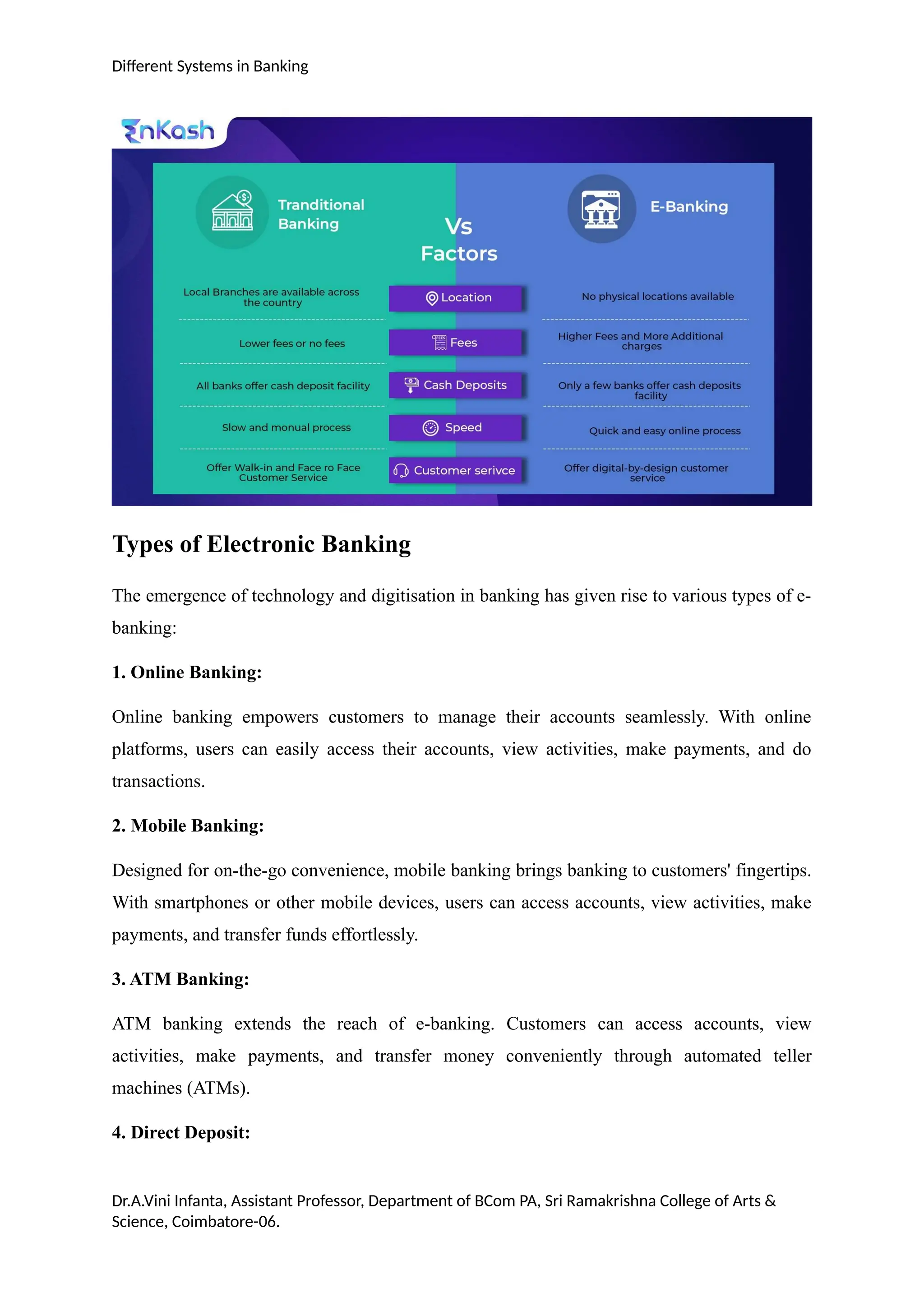
E-Banking
Meaning of E-Banking:
Banks give administrations or bank services to draw in clients, from giving advances, issuing
of debit cards and credit cards, computerised monetary services, and surprisingly personal
services or administrations. Even so, some fundamental present-day administrations are
presented by many commercial banks.
Electronic banking has many names like web-based banking, e-banking, virtual banking, or
web banking, and online banking. It is just the utilisation of telecommunications networks
and electronic networks for conveying different financial services and products. Through e-
banking, a client can acquire his record and manage numerous exchanges utilising his cell
phone or personal computer.
Dr.A.Vini Infanta, Assistant Professor, Department of BCom PA, Sri Ramakrishna College of Arts &
Science, Coimbatore-06.
Different Systems in Banking
Types of Electronic Banking
The emergence of technology and digitisation in banking has given rise to various types of e-
banking:
1. Online Banking:
Online banking empowers customers to manage their accounts seamlessly. With online
platforms, users can easily access their accounts, view activities, make payments, and do
transactions.
2. Mobile Banking:
Designed for on-the-go convenience, mobile banking brings banking to customers' fingertips.
With smartphones or other mobile devices, users can access accounts, view activities, make
payments, and transfer funds effortlessly.
3. ATM Banking:
ATM banking extends the reach of e-banking. Customers can access accounts, view
activities, make payments, and transfer money conveniently through automated teller
machines (ATMs).
4. Direct Deposit:
Dr.A.Vini Infanta, Assistant Professor, Department of BCom PA, Sri Ramakrishna College of Arts &
Science, Coimbatore-06.
Different Systems in Banking
Direct deposit simplifies income management. Users can have salaries, government
subsidies, or other income directly deposited into their bank accounts, streamlining financial
transactions.
5. Electronic Funds Transfer (EFT):
It is helpful for electronic payments and money transfers, providing a fast and secure means
for customers to manage their finances.
6. Electronic Bill Payment:
This e-banking branch enables customers to settle bills electronically, offering a convenient
and efficient way to manage financial obligations.
7. Online Investing:
For those venturing into financial markets, online investing within e-banking allows
customers to conveniently purchase stocks, bonds, and mutual funds through online
platforms.
Features and Benefits of E-banking
Key features
 Account Management
E-banking allows users to effortlessly manage different accounts from a single online
platform, including current and savings accounts, credit cards, and loans.
 Fund Transfers
Another important feature of e-banking is that it enables quick and secure fund transfers
through NEFT, RTGS, IMPS, or UPI modes.
 Bill Payment
Online banking simplifies bill payments, allowing users to settle utility bills, credit card
payments, loan repayments, online mobile recharges, etc.
 Online Statements and Alerts
Dr.A.Vini Infanta, Assistant Professor, Department of BCom PA, Sri Ramakrishna College of Arts &
Science, Coimbatore-06.
Different Systems in Banking
E-banking offers access to online account statements, eliminating the need for paper
statements.
Key benefits
 Transferring Funds
E-banking provides swift fund transfers between accounts, ensuring efficiency and
convenience without physical bank visits.
 24/7 Availability
With 24/7 accessibility, e-banking allows users to manage their accounts and conduct
transactions at their convenience from anywhere.
 Easy to Operate
User-friendly interfaces and available tutorials make e-banking platforms easy to navigate,
ensuring a seamless and straightforward banking experience.
 Convenience
E-banking eliminates the need for physical bank visits, offering users the flexibility to
perform transactions from anywhere and anytime, thus saving time.
 Activity Tracking
Users can track their account activities in real-time, gaining visibility and control over their
finances with features like transaction history and account balance updates.
Online E-Banking Services
 Mobile Banking (M-banking)
M-banking facilitates financial transactions through mobile devices, allowing users to
perform account transfers, bill payments, credit applications, balance checks, and other
transactions via smartphones.
 Electronic Clearing System (ECS)
Dr.A.Vini Infanta, Assistant Professor, Department of BCom PA, Sri Ramakrishna College of Arts &
Science, Coimbatore-06.
Different Systems in Banking
An innovative solution for busy individuals, ECS automatically debits credit card bills or loan
EMIs from the user's savings account, eliminating concerns about missed or late payments.
 Electronic Fund Transfers (EFTs)
EFTs enable electronic money transfers between individual and multiple accounts, within or
across financial institutions, using computer-based systems without direct bank staff
intervention.
 Internet Banking
Internet banking, accessible day or night, empowers users to conduct routine transactions,
inquire about balances, stop payments, and even apply for credit cards or loans through
traditional or online banks.
The Significance of Electronic Banking
For Clients
 Cost Efficiency
E-banking streamlines transactions, saving clients time and money without frequent branch
visits.
 No Geographic Barriers
E-banking eliminates geographical constraints, allowing seamless transactions from
anywhere.
 Convenience
Clients enjoy 24/7 access to their accounts, managing finances quickly and flexibly.
For Businesses
 Enhanced Efficiency
E-banking automates routine tasks, enhancing business productivity and facilitating seamless
operations.
 Cost Reduction
Dr.A.Vini Infanta, Assistant Professor, Department of BCom PA, Sri Ramakrishna College of Arts &
Science, Coimbatore-06.
Different Systems in Banking
Internet banking cuts costs associated with various financial services, presenting substantial
savings for businesses.
 Error Reduction
Electronic banking minimises transaction errors, ensuring precision and preventing
potentially costly mistakes.
 Fraud Prevention
Improved transaction visibility through e-banking acts as a deterrent to fraudulent activities.
For Banks
 Lower Transaction Costs
Electronic transactions prove cost-effective for banks, thus contributing to financial
efficiency.
 Error Prevention
The electronic relay of information eradicates the risk of human errors in banking processes.
 Paperwork Reduction
Digital records reduce paperwork, simplify internal processes, and align with environmental
goals.
 Customer Loyalty
Banks offering convenient e-banking services foster higher customer loyalty and satisfaction.
Online Banking
Definition: Online banking, also known as internet banking or electronic banking, refers to
the provision of banking services and transactions over the internet through a bank's website
or mobile application. It has revolutionized the way customers interact with their banks,
offering convenience, accessibility, and efficiency in managing financial activities remotely.
Features and Functions of Online Banking
1. Basic Banking Services:
Dr.A.Vini Infanta, Assistant Professor, Department of BCom PA, Sri Ramakrishna College of Arts &
Science, Coimbatore-06.
Different Systems in Banking
o Account Management: Customers can view account balances, transaction
histories, and statements online. They can also monitor their spending, track
deposits and withdrawals, and reconcile accounts.
o Fund Transfers: Online banking allows customers to transfer funds between
their own accounts or to other accounts within the same bank or different
financial institutions. This includes bill payments and setting up recurring
payments.
o Deposit Services: Many online banking platforms offer remote deposit
capture (RDC), allowing customers to deposit checks electronically using their
smartphones or scanners.
2. Advanced Services:
o Investment Management: Some online banking platforms provide tools for
managing investments, including buying and selling stocks, bonds, mutual
funds, and other securities.
o Loan Applications: Customers can apply for loans, mortgages, and credit
cards online, often receiving instant approvals or pre-approvals based on their
financial profiles.
o Financial Planning Tools: Online banking portals may offer budgeting tools,
calculators for loan payments and savings goals, and personalized financial
advice.
3. Security Measures:
o Encryption: Online banking platforms use encryption protocols (such as
SSL/TLS) to secure communication between the user's browser and the bank's
servers, protecting sensitive data from interception by unauthorized parties.
o Multi-Factor Authentication (MFA): To enhance security, banks often
require customers to provide multiple forms of verification (e.g., password,
SMS code, biometric authentication) before accessing their accounts.
o Fraud Detection: Advanced monitoring systems detect unusual or suspicious
transactions and may automatically flag or block potentially fraudulent
activities, protecting customers from identity theft and financial fraud.
4. Customer Support:
Dr.A.Vini Infanta, Assistant Professor, Department of BCom PA, Sri Ramakrishna College of Arts &
Science, Coimbatore-06.
Different Systems in Banking
o Online Chat and Support: Many banks offer real-time customer support
through online chat, email, or phone, allowing customers to resolve issues or
get assistance with transactions and account inquiries.
o 24/7 Accessibility: Online banking services are available round-the-clock,
providing customers with flexibility to manage their finances at any time and
from anywhere with internet access.
Advantages of Online Banking
 Convenience: Customers can perform banking transactions and manage their finances
from the comfort of their homes or while traveling, without the need to visit physical
bank branches.
 Cost Savings: Online banking reduces overhead costs for banks associated with
maintaining physical branches, potentially leading to lower fees and higher interest
rates on deposits for customers.
 Efficiency: Transactions are processed faster compared to traditional methods, with
immediate updates on account balances and transaction statuses.
 Accessibility: Online banking bridges geographic barriers, making financial services
accessible to individuals in remote or underserved areas.
Disadvantages of Online Banking
 Security Risks: Despite robust security measures, online banking is vulnerable to
cyber threats such as phishing attacks, malware, and data breaches. Customers must
be vigilant about protecting their login credentials and personal information.
 Dependence on Technology: Service interruptions due to system maintenance,
internet connectivity issues, or cyber-attacks can disrupt access to online banking
services.
 Digital Divide: Some individuals, particularly older adults or those in rural areas with
limited internet access, may face challenges in adopting online banking due to
technological barriers or digital literacy gaps.
Dr.A.Vini Infanta, Assistant Professor, Department of BCom PA, Sri Ramakrishna College of Arts &
Science, Coimbatore-06.
Different Systems in Banking
 Limited Personal Interaction: Online banking lacks face-to-face interaction with
bank staff, which may be necessary for complex transactions, financial advice, or
dispute resolutions.
Offshore Banking
Definition: Offshore banking refers to banking and financial services provided by banks
located outside the depositor's country of residence or in offshore financial centers (OFCs).
These jurisdictions typically offer favorable regulatory environments, tax incentives,
financial privacy, and asset protection benefits.
Features and Functions of Offshore Banking
1. Tax Optimization and Asset Protection:
o Tax Efficiency: Offshore jurisdictions may offer lower or zero tax rates on
interest income, dividends, capital gains, and inheritance, allowing individuals
and corporations to legally minimize tax liabilities.
o Asset Protection: Offshore banks provide confidentiality and legal protections
against political instability, legal disputes, currency controls, and seizure of
assets in the depositor's home country.
2. Financial Privacy and Confidentiality:
o Banking Secrecy: Offshore banks operate under strict banking secrecy laws
that protect the identity and financial information of depositors. This provides
privacy for individuals and entities concerned about financial transparency or
exposure.
3. Global Access and Diversification:
o International Transactions: Offshore banks facilitate cross-border
transactions, currency exchange, and investments in multiple currencies and
markets worldwide.
o Investment Opportunities: Offshore banking offers access to a broader range
of financial products and services, including offshore trusts, mutual funds,
hedge funds, and structured investment products.
Dr.A.Vini Infanta, Assistant Professor, Department of BCom PA, Sri Ramakrishna College of Arts &
Science, Coimbatore-06.
Different Systems in Banking
4. Corporate and Wealth Management Services:
o Corporate Banking: Offshore banks provide corporate finance solutions,
including financing for international trade, project finance, and syndicated
loans.
o Wealth Management: Offshore banks offer tailored wealth management
services to high-net-worth individuals (HNWIs) and families, including estate
planning, trust administration, and philanthropic advisory services.
Advantages of Offshore Banking
 Tax Benefits: Potential tax savings through legal structures and favorable tax regimes
in offshore jurisdictions.
 Asset Protection: Safeguarding assets from political instability, legal risks, and
economic uncertainties in the depositor's home country.
 Confidentiality: Banking secrecy laws protect client privacy and financial
information from public disclosure or government scrutiny.
 Diversification: Access to international investments and financial markets, reducing
dependency on a single jurisdiction or currency.
Disadvantages of Offshore Banking
 Regulatory Complexity: Compliance with international regulations, anti-money
laundering (AML), and know-your-customer (KYC) requirements may be more
stringent and complex in offshore jurisdictions.
 Perception and Reputation: Offshore banking may be perceived negatively due to
concerns about tax evasion, money laundering, and financial opacity, leading to
regulatory scrutiny and reputational risks.
 Costs: Higher fees, maintenance costs, and minimum deposit requirements associated
with offshore accounts and financial services.
 Currency Risks: Exposure to currency fluctuations and exchange rate risks when
holding assets denominated in foreign currencies.
INTERNET BANKING
Dr.A.Vini Infanta, Assistant Professor, Department of BCom PA, Sri Ramakrishna College of Arts &
Science, Coimbatore-06.
Different Systems in Banking
Internet banking, also known as online banking or e-banking or Net Banking is a facility
offered by banks and financial institutions that allow customers to use banking services over
the internet. Customers need not visit their bank’s branch office to avail each and every small
service. Not all account holders get access to internet banking. If you would like to use
internet banking services, you must register for the facility while opening the account or later.
You have to use the registered customer ID and password to log into your internet banking
account.
Features of Online Banking
 Check the account statement online.
 Open a fixed deposit account.
 Pay utility bills such as water bill and electricity bill.
 Make merchant payments.
 Transfer funds.
 Order for a cheque book.
 Buy general insurance.
 Recharge prepaid mobile/DTH.
Advantages of Internet Banking
The advantages of internet banking are as follows:
 Availability: You can avail the banking services round the clock throughout the year.
Most of the services offered are not time-restricted; you can check your account
balance at any time and transfer funds without having to wait for the bank to open.
 Easy to Operate: Using the services offered by online banking is simple and easy.
Many find transacting online a lot easier than visiting the branch for the same.
 Convenience: You need not leave your chores behind and go stand in a queue at the
bank branch. You can complete your transactions from wherever you are. Pay utility
bills, recurring deposit account instalments, and others using online banking.
 Time Efficient: You can complete any transaction in a matter of a few minutes via
internet banking. Funds can be transferred to any account within the country or open a
fixed deposit account within no time on net banking.
 Activity Tracking: When you make a transaction at the bank branch, you will receive
an acknowledgement receipt. There are possibilities of you losing it. In contrast, all
Dr.A.Vini Infanta, Assistant Professor, Department of BCom PA, Sri Ramakrishna College of Arts &
Science, Coimbatore-06.
Different Systems in Banking
the transactions you perform on a bank’s internet banking portal will be recorded. You
can show this as proof of the transaction if need be. Details such as the payee’s name,
bank account number, the amount paid, the date and time of payment, and remarks if
any will be recorded as well.
Disadvantages of Internet/Online Banking
The disadvantages of internet banking are as follows:
 Internet Requirement: An uninterrupted internet connection is a foremost
requirement to use internet banking services. If you do not have access to the internet,
you cannot make use of any facilities offered online. Similarly, if the bank servers are
down due to any technical issues on their part, you cannot access net banking
services.
 Transaction Security: No matter how much precautions banks take to provide a
secure network, online banking transactions are still susceptible to hackers.
Irrespective of the advanced encryption methods used to keep user data safe, there
have been cases where the transaction data is compromised. This may cause a major
threat such as using the data illegally for the hacker’s benefit.
 Difficult for Beginners: There are people in India who have been living lives far
away from the web of the internet. It might seem a whole new deal for them to
understand how internet banking works. Worse still, if there is nobody who can
explain them on how internet banking works and the process flow of how to go about
it. It will be very difficult for inexperienced beginners to figure it out for themselves.
 Securing Password: Every internet banking account requires the password to be
entered in order to access the services. Therefore, the password plays a key role in
maintaining integrity. If the password is revealed to others, they may utilise the
information to devise some fraud. Also, the chosen password must comply with the
rules stated by the banks. Individuals must change the password frequently to avoid
password theft which can be a hassle to remember by the account holder himself.
ANYWHERE BANKING
"Anywhere banking" refers to a banking concept that allows customers to conduct financial
transactions and access banking services from anywhere, using various channels and devices.
Dr.A.Vini Infanta, Assistant Professor, Department of BCom PA, Sri Ramakrishna College of Arts &
Science, Coimbatore-06.
Different Systems in Banking
This term emphasizes the convenience and flexibility provided by modern banking
technology, enabling customers to manage their finances without being limited to physical
bank branches.
Components of Anywhere Banking
1. Digital Channels
o Online Banking: Allows customers to access their accounts via a secure
website using a desktop or laptop computer. Features typically include account
balance inquiries, transaction history, bill payments, fund transfers, and
account management.
o Mobile Banking: Mobile apps provided by banks enable customers to
perform similar banking functions as online banking but from their
smartphones or tablets. This includes features like mobile check deposit,
account alerts, ATM locator, and person-to-person payments (P2P).
o ATMs (Automated Teller Machines): ATMs are part of anywhere banking
as they provide 24/7 access to basic banking services such as cash
withdrawals, deposits (including check deposits), balance inquiries, funds
transfers, and PIN changes.
2. Electronic Funds Transfer
o ACH Transfers: Automated Clearing House transfers are electronic payments
that allow customers to transfer funds between accounts at different financial
institutions within the United States.
o Wire Transfers: Secure and direct electronic transfers of funds between
banks globally, used for urgent or large-value transactions.
o Mobile Wallets: Integration with mobile payment apps (e.g., Apple Pay,
Google Pay) allows customers to store payment card information securely on
their mobile devices and make contactless payments at retail stores or online.
3. Remote Deposit Capture (RDC)
o Check Deposit: Many banks offer RDC through their mobile banking apps,
enabling customers to deposit checks remotely by taking photos of the front
and back of the check with their mobile devices. Some banks also offer
desktop scanners for check deposits.
Dr.A.Vini Infanta, Assistant Professor, Department of BCom PA, Sri Ramakrishna College of Arts &
Science, Coimbatore-06.
Different Systems in Banking
4. Customer Service and Support
o Online Chat and Messaging: Real-time customer support through online
chat, messaging platforms, or virtual assistants allows customers to get
immediate assistance with account inquiries, transaction issues, and technical
support.
o Phone and Email Support: Traditional customer service channels such as
phone calls and emails provide additional options for resolving banking-
related queries and issues remotely.
5. Security Measures
o Encryption: All digital transactions and communications are secured using
encryption technologies (e.g., SSL/TLS) to protect sensitive information such
as account numbers, passwords, and personal details.
o Multi-Factor Authentication (MFA): To enhance security, banks often
require customers to provide multiple forms of verification (e.g., passwords,
security questions, biometric data) to access their accounts and perform
transactions.
Advantages of Anywhere Banking
 Convenience: Customers can manage their finances anytime and anywhere, without
being limited to the operating hours of physical bank branches.
 Accessibility: Anywhere banking extends banking services to individuals in remote
areas or with limited mobility, ensuring financial inclusion.
 Efficiency: Transactions are processed faster compared to traditional methods, with
immediate updates on account balances and transaction statuses.
 Cost Savings: Reduced overhead costs for banks may lead to lower fees and higher
interest rates for customers.
 Flexibility: Customers have the flexibility to choose the most convenient channel
(online, mobile, ATM) for their banking needs, enhancing their overall banking
experience.
Dr.A.Vini Infanta, Assistant Professor, Department of BCom PA, Sri Ramakrishna College of Arts &
Science, Coimbatore-06.
Different Systems in Banking
Challenges and Considerations
 Security Concerns: Anywhere banking introduces risks such as phishing attacks,
malware, and data breaches. Banks must implement robust security measures to
protect customer information and ensure transaction integrity.
 Digital Literacy: Some individuals, particularly older adults or those in rural areas
with limited internet access, may face challenges in adopting anywhere banking due
to technological barriers or digital literacy gaps.
 Regulatory Compliance: Banks must adhere to regulatory requirements for data
protection, financial transactions, and customer authentication across different
jurisdictions. Compliance with regulations such as GDPR (General Data Protection
Regulation) in Europe and PSD2 (Payment Services Directive 2) further complicates
the landscape.
 Customer Support: While digital channels provide convenience, customers may still
require personalized assistance for complex transactions, dispute resolutions, or issues
that cannot be resolved through automated systems.
Future Trends in Anywhere Banking
 Integration of AI and Automation: Artificial intelligence (AI) and machine learning
technologies will play a crucial role in enhancing personalized customer experiences,
improving fraud detection, and streamlining banking processes.
 Expansion of Mobile Payments: Mobile wallets and contactless payments will
continue to gain popularity, offering seamless and secure payment options for
customers.
 Enhanced Security Measures: Banks will invest in advanced cybersecurity
technologies such as biometric authentication, behavioral analytics, and blockchain-
based solutions to protect customer data and prevent cyber threats.
 Innovative Banking Services: The evolution of anywhere banking will see the
introduction of innovative services such as voice banking (using virtual assistants like
Alexa or Google Assistant), augmented reality (AR) for interactive banking
experiences, and predictive analytics for personalized financial advice.
Dr.A.Vini Infanta, Assistant Professor, Department of BCom PA, Sri Ramakrishna College of Arts &
Science, Coimbatore-06.
Different Systems in Banking
AUTOMATED TELLER MACHINES (ATM)
Automated Teller Machines (ATMs) are integral components of modern banking
infrastructure, providing customers with convenient access to a range of financial services
outside of traditional banking hours and locations.
Features and Functions of ATMs
1. Cash Withdrawals:
o Basic Functionality: ATMs allow customers to withdraw cash using their
debit or credit cards linked to their bank accounts.
o Withdrawal Limits: Banks set daily withdrawal limits to mitigate risks
associated with theft or loss.
2. Deposits:
o Cash Deposits: Many ATMs accept cash deposits, allowing customers to
deposit money directly into their accounts without visiting a bank branch.
o Check Deposits: Some ATMs support check deposits through envelope-free
or image-based deposit methods, where customers can deposit checks without
an envelope.
3. Balance Inquiries:
o Account Information: Customers can check their account balances and recent
transactions at an ATM, providing real-time updates on their financial status.
4. Funds Transfers:
o Internal Transfers: Some ATMs allow customers to transfer funds between
their own accounts within the same bank.
o Interbank Transfers: ATMs may facilitate transfers between accounts held at
different banks, though this capability varies by ATM network and banking
agreements.
5. Bill Payments:
Dr.A.Vini Infanta, Assistant Professor, Department of BCom PA, Sri Ramakrishna College of Arts &
Science, Coimbatore-06.
Different Systems in Banking
o Utilities and Services: Certain ATMs enable customers to pay bills for
utilities, credit cards, loans, and other services directly from their bank
accounts.
6. PIN Changes and Other Services:
o PIN Management: Customers can change their ATM PINs or request PIN
reminders through the ATM interface.
o Mini-Statements: Some ATMs provide mini-statements showing recent
transactions, providing a summary without printing a full statement.
7. Accessibility Features:
o Braille Keypads and Audio Assistance: ATMs often include Braille keypads
and audio guidance to assist visually impaired users.
o Height and Reach Adjustments: Some ATMs are designed with adjustable
features to accommodate users of different heights and mobility needs.
Advantages of ATMs
 24/7 Accessibility: ATMs provide round-the-clock access to banking services,
allowing customers to perform transactions at any time, even outside of regular
banking hours.
 Convenience: Located in various accessible locations such as shopping malls,
airports, gas stations, and neighborhoods, ATMs offer convenient access to cash and
banking services.
 Speed and Efficiency: Transactions at ATMs are typically faster than conducting
them inside bank branches, reducing wait times and enhancing customer satisfaction.
 Privacy: ATMs offer privacy for transactions like withdrawals and balance inquiries,
minimizing the need for face-to-face interactions with bank staff.
 Cash Management: ATMs facilitate cash withdrawals and deposits outside of
banking hours, supporting businesses and individuals with their cash flow needs.
Dr.A.Vini Infanta, Assistant Professor, Department of BCom PA, Sri Ramakrishna College of Arts &
Science, Coimbatore-06.
Different Systems in Banking
Challenges and Considerations
 Security Risks: Despite advanced security measures, ATMs remain vulnerable to
card skimming, PIN theft, and physical attacks. Banks continually upgrade security
protocols to mitigate risks.
 Maintenance and Reliability: ATMs require regular maintenance to ensure
operational efficiency. Technical issues such as cash jams, software glitches, or
network outages can disrupt service availability.
 Accessibility Issues: While efforts are made to enhance accessibility (e.g., Braille
keypads, audio guidance), some ATMs may still pose challenges for individuals with
disabilities due to design limitations or location constraints.
 Transaction Fees: Using ATMs outside of one's bank network or region may incur
fees, particularly for withdrawals and balance inquiries, impacting overall banking
costs for customers.
Future Trends in ATM Technology
 Biometric Authentication: Integration of biometric technologies such as fingerprint
scanning or facial recognition for secure and convenient user authentication.
 Contactless Transactions: Adoption of NFC (Near Field Communication)
technology to support contactless payments and transactions at ATMs, reducing
physical contact and enhancing convenience.
 AI and Predictive Analytics: Implementation of artificial intelligence (AI) and
machine learning algorithms to analyze customer behavior, personalize services, and
detect fraudulent activities in real-time.
 Enhanced User Experience: Development of intuitive user interfaces, interactive
screens, and voice recognition capabilities to improve the overall ATM experience for
customers.
 Environmental Sustainability: Adoption of energy-efficient ATM designs, paperless
transactions, and sustainable materials in manufacturing to reduce the environmental
footprint of ATM operations.
ATMs play a vital role in modern banking by providing accessible, convenient, and efficient
access to a wide range of financial services. Ongoing advancements in technology and
Dr.A.Vini Infanta, Assistant Professor, Department of BCom PA, Sri Ramakrishna College of Arts &
Science, Coimbatore-06.
Different Systems in Banking
security measures continue to enhance their capabilities, ensuring they meet the evolving
needs of customers in the digital age.
RTGS
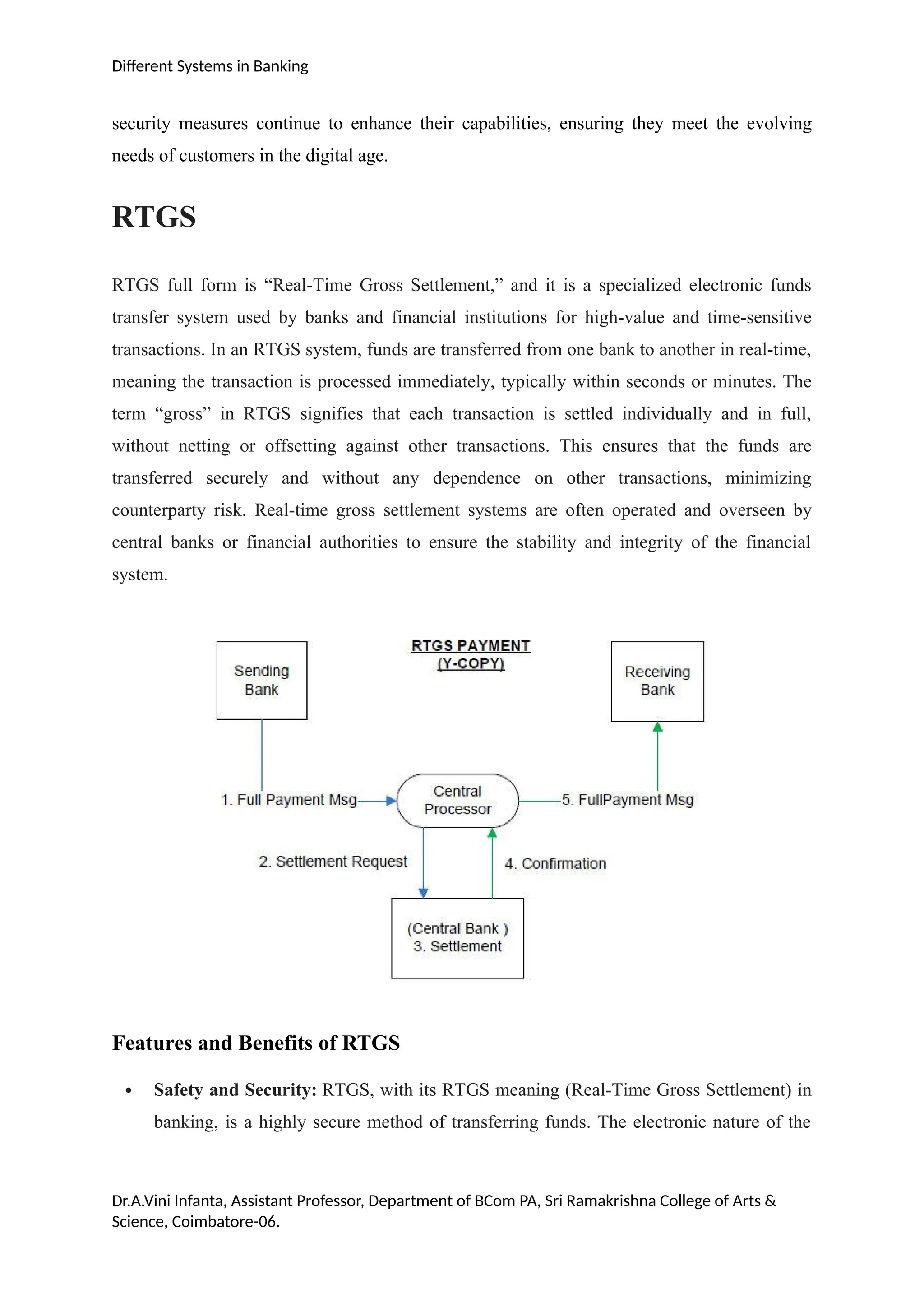
RTGS full form is “Real-Time Gross Settlement,” and it is a specialized electronic funds
transfer system used by banks and financial institutions for high-value and time-sensitive
transactions. In an RTGS system, funds are transferred from one bank to another in real-time,
meaning the transaction is processed immediately, typically within seconds or minutes. The
term “gross” in RTGS signifies that each transaction is settled individually and in full,
without netting or offsetting against other transactions. This ensures that the funds are
transferred securely and without any dependence on other transactions, minimizing
counterparty risk. Real-time gross settlement systems are often operated and overseen by
central banks or financial authorities to ensure the stability and integrity of the financial
system.
Features and Benefits of RTGS
 Safety and Security: RTGS, with its RTGS meaning (Real-Time Gross Settlement) in
banking, is a highly secure method of transferring funds. The electronic nature of the
Dr.A.Vini Infanta, Assistant Professor, Department of BCom PA, Sri Ramakrishna College of Arts &
Science, Coimbatore-06.
Different Systems in Banking
transaction significantly reduces the risk of loss, theft, or fraudulent activity compared
to physical instruments like checks or demand drafts.
 No Maximum limit: Real-time gross settlement transactions made through the bank
branch typically do not have a maximum limit, making it suitable for transferring both
small and large sums of money within the real-time gross settlement framework.
 Real-time transfer: RTGS, being a key component of real-time gross settlement in
banking, offers real-time fund transfers. This ensures that the recipient’s account is
credited immediately upon initiation of the transaction, adding to its efficiency.
 Seven days a week: RTGS operates on all days, including weekends and holidays, as
part of its real-time gross settlement functionality, providing uninterrupted access for
users to transfer funds when needed, enhancing convenience and accessibility.
 No physical instruments: Real-time gross settlement eliminates the need for physical
instruments like cheques or demand drafts, as it is entirely electronic. This not only
streamlines the process but also reduces the risk associated with physical
documentation.
 Reduced risk: The absence of physical instruments in RTGS significantly reduces the
risk of these instruments being lost, stolen, or fraudulently encashed by unauthorized
individuals or parties, reinforcing its security.
 Convenience of internet banking: RTGS transactions, within the real-time gross
settlement system, can be initiated conveniently from the user’s home or workplace
through internet banking. This added convenience offers flexibility and ease of use in
electronic fund transfers.
 No fees or charges: While some banks may charge nominal fees for Real-time gross
settlement transactions, many banks offer this service free of charge, making it a cost-
effective method for transferring funds within the real-time gross settlement framework.
 Legal backing: RTGS transactions, being legally recognized and regulated as part of
the real-time gross settlement system, provide users with a sense of security and
Dr.A.Vini Infanta, Assistant Professor, Department of BCom PA, Sri Ramakrishna College of Arts &
Science, Coimbatore-06.
Different Systems in Banking
assurance that their financial transactions are protected by the law, further enhancing
trust in the process.
Advantages of RTGS:
o Liquidity Management: Provides efficient liquidity management for
financial institutions by ensuring immediate and predictable settlement of
high-value transactions.
o Certainty and Finality: Transactions settled through RTGS are final and
irrevocable, offering certainty to both the sender and receiver.
o Enhanced Efficiency: Reduces settlement risks, operational costs, and delays
associated with traditional paper-based or batch processing systems.
o Supports Financial Stability: Contributes to overall financial stability by
facilitating timely and secure settlement of large financial transactions.
Challenges and Considerations:
o Cost: Establishing and operating an RTGS system involves significant initial
setup costs, ongoing maintenance expenses, and potentially transaction fees
for participants.
o Technical Complexity: Requires robust IT infrastructure, connectivity, and
compliance with stringent security and regulatory requirements.
o Liquidity Risks: Financial institutions must manage liquidity effectively to
meet RTGS settlement obligations in real time, which can be challenging
during periods of high transaction volumes or market volatility.
How do Real-time gross settlement Transactions Work?
RTGS (Real-Time Gross Settlement) in banking is a vital system for facilitating the
immediate and secure transfer of funds between two financial institutions or banks. RTGS
transactions ensure swift and reliable fund transfers, promoting efficiency in the financial
sector.
 Initiation by sender: The RTGS process begins when a sender, whether an individual
or an organization, instructs their bank to transfer a specific amount of money to a
Dr.A.Vini Infanta, Assistant Professor, Department of BCom PA, Sri Ramakrishna College of Arts &
Science, Coimbatore-06.
Different Systems in Banking
recipient’s account at another bank. This instruction can be given through various
channels, including online banking, mobile banking, or by visiting a bank branch.
 Verification and authorization: The sender’s bank verifies the availability of
sufficient funds in the sender’s account to cover the requested transfer amount. If the
funds are available, the bank authorizes the transaction.
 Transmission to RTGS system: Once authorized, the sender’s bank initiates the RTGS
transaction by transmitting the payment instructions to the RTGS system. In many
cases, this system is operated and overseen by the central bank.
 Central bank processing: The central bank plays a crucial role in Real-time gross
settlement transactions. It receives and processes the transaction details, ensuring that
they meet all regulatory and security requirements. The central bank also maintains
settlement accounts for participating banks.
 Interbank settlement: The central bank then debits the sender’s bank’s settlement
account and credits the recipient’s bank’s settlement account with the transaction
amount. This step is critical in ensuring the settlement of the transaction in real-time
and in gross, meaning each transaction is settled individually without netting against
others.
 Notification to recipient bank: The recipient’s bank receives a notification of the
incoming funds from the central bank. This notification triggers the crediting of the
recipient’s account with the transferred amount.
 Recipient account crediting: Upon receiving the notification from the central bank, the
recipient’s bank immediately credits the funds to the recipient’s account, making them
available for use.
 Confirmation to sender: The sender’s bank sends an instant confirmation to the
sender, notifying them that the RTGS transaction has been successfully completed. This
confirmation provides both the sender and the recipient with assurance that the funds
have been transferred securely and in real time.
Dr.A.Vini Infanta, Assistant Professor, Department of BCom PA, Sri Ramakrishna College of Arts &
Science, Coimbatore-06.
Different Systems in Banking
 Transaction records: Both the sender’s and recipient’s banks maintain transaction
records for their customers. These records serve as proof of the transaction and can be
used for reconciliation and auditing purposes.
Different Modes for Initiating RTGS Transactions in India
 Internet banking: Banks offer internet banking services that allow customers to
initiate RTGS transfers online. Users can log in to their internet banking accounts and
follow the steps provided by their bank to complete the RTGS transaction.
 Mobile banking apps: Banks also provide mobile banking applications that enable
customers to perform RTGS transactions using their smartphones or tablets. These apps
are user-friendly and convenient for on-the-go banking.
 Bank branch: Customers can visit their bank’s physical branch and request an RTGS
transfer in person. Bank staff will assist in processing the transaction and ensure that all
necessary details are provided.
Information Is Necessary to Begin an RTGS Transaction
 The name of the beneficiary bank and branch.
 Recipient’s full name.
 IFSC code of the receiving bank.
 Amount to be transferred.
 Any relevant remarks or notes, if necessary.
 Sender’s account particulars.
 Beneficiary’s account number.
RTGS Transaction Fees in Banking in India
As of July 01, 2019, the Reserve Bank of India (RBI) has implemented significant changes
regarding processing and service charges associated with RTGS transactions, including
RTGS charges. These changes are aimed at making RTGS transfers more accessible and cost-
effective for customers.
Dr.A.Vini Infanta, Assistant Professor, Department of BCom PA, Sri Ramakrishna College of Arts &
Science, Coimbatore-06.
Different Systems in Banking
Broad Framework of Service Charges: In order to standardize service charges, including
RTGS charges, across banks and ensure transparency, a framework of charges has been
established. This framework is designed to guide banks in setting their service charges for
RTGS transactions.
a) Inward Transactions – Free: Banks are not permitted to charge any fee for processing
incoming RTGS transactions. This ensures that recipients do not incur any charges for
receiving funds via RTGS.
b) Outward Transactions – 2,00,000/- to 5,00,000/-: For outward RTGS transactions
₹ ₹
falling within the 2,00,000/- to 5,00,000/- range, banks can charge a fee of up to 25/-
₹ ₹ ₹
(exclusive of tax, if applicable).
c) Outward Transactions Above 5,00,000/-: For outward RTGS transactions exceeding
₹
5,00,000/-, banks can charge a fee of up to 50/- (exclusive of tax, if applicable).
₹ ₹
Initiate RTGS Fund Transfer Online
 Log into your online banking account.
 Navigate to the “Funds Transfer” or “Payments” section
 Choose “RTGS Transfer” as the transfer method.
 Fill in beneficiary details: account number, beneficiary’s name, beneficiary bank’s
details (name, branch), and IFSC code.
 Specify the transfer amount.
 Review and confirm the transaction details.
 Authorize the transfer using authentication methods like OTP.
 Receive a transaction confirmation with a reference number.
 The recipient will be notified of the incoming funds in real-time.
 Keep the confirmation details for your records.
RTGS Transaction Timings in India
Dr.A.Vini Infanta, Assistant Professor, Department of BCom PA, Sri Ramakrishna College of Arts &
Science, Coimbatore-06.
Different Systems in Banking
RTGS (Real-Time Gross Settlement) services are available 24 hours a day and seven days a
week, including weekends and bank holidays in India. This continuous availability allows
customers the flexibility to perform RTGS transactions at any time, ensuring quick RTGS
transaction time. Furthermore, it’s noted that RTGS can be used for transferring amounts
above 2 lakhs, subject to the third-party transfer limits established by the customer and the
₹
specific policies of the bank
Processing Time for RTGS Funds Transfer
Here’s the expected timeline for effecting funds transfer from one account to another through
RTGS:
 Real-Time Transfer: In normal circumstances, the funds transfer through RTGS is
processed in real-time, which means that the beneficiary bank receives the funds as
soon as they are transferred by the remitting bank.
 Crediting Beneficiary’s Account: Once the beneficiary bank receives the funds
transfer message, it is required to credit the beneficiary’s account promptly. Under
standard guidelines, this should be done within 30 minutes of receiving the funds
transfer message
Understanding RTGS Transaction Limits in India
 Minimum amount: The minimum amount that can be transferred via RTGS is Rs. 2
lakh.
 RTGS Limit per day via bank branch: There is no specified upper limit for RTGS
transactions when conducted through a bank branch. This means you can transfer any
amount above the minimum threshold of Rs. 2 lakh.
 RTGS Limit per day via internet banking: If you choose to perform an RTGS
transaction through internet banking, there is typically a maximum limit in place. This
limit is often set at Rs. 25 lakh, but it may vary from one bank to another. Some banks
may have higher or lower limits for internet banking RTGS transactions.
Important Considerations for Initiating an RTGS Transaction
Dr.A.Vini Infanta, Assistant Professor, Department of BCom PA, Sri Ramakrishna College of Arts &
Science, Coimbatore-06.
Different Systems in Banking
When initiating an RTGS (Real-Time Gross Settlement) transaction, it’s crucial to exercise
care and attention to ensure the accuracy and security of the transfer.
 Network compatibility: Verify that both the originating and destination bank branches
are part of the RTGS network. RTGS transactions can only be processed between banks
that are part of this system.
 Beneficiary details: Ensure that you have accurate beneficiary details, including the
beneficiary’s full name, account number, and account type. Additionally, you need the
name and IFSC (Indian Financial System Code) of the beneficiary bank branch.
 Account number accuracy: Extreme caution should be taken when providing the
beneficiary’s account number. RTGS transactions rely heavily on the accuracy of this
information. Any errors in the account number can result in the funds being credited to
the wrong account.
 Transaction documentation: Keep records of the RTGS remittance instruction or
message. These records serve as proof of the transaction and can be valuable in case of
any disputes or discrepancies.
 Bank’s policies: Familiarize yourself with your bank’s specific RTGS policies,
including transaction limits, charges (if applicable), and any additional requirements or
procedures they may have in place.
NEFT
NEFT National Electronic Fund Transfer (NEFT) is an inter-bank/inter-branch online
fund transfer within India.
Currently MCA21 payments are allowed via Credit Card, Internet Banking & Physical
Challan. The Ministry has authorized 5 banks (Indian Bank, HDFC, ICICI, PNB, UBI and
SBI) for collection of MCA21 fees, which means that only the account holders of these banks
can avail Internet banking facility. Further, payment via challan can only be made in the
authorized branches of these above five banks. Though this was a major improvement
compared to the earlier manual system, it caused delays in incorporation of companies and
processing of other e-Forms. In order to eliminate inconveniences caused due to payment
Dr.A.Vini Infanta, Assistant Professor, Department of BCom PA, Sri Ramakrishna College of Arts &
Science, Coimbatore-06.
Different Systems in Banking
processing delays, Ministry is introducing payment of MCA fees via NEFT (National
Electronic Fund Transfer) mode, in addition to already exiting payment methods.
NEFT offers the following advantages for funds transfer or receipt:
 Round the clock availability on all days of the year.
 Near-real-time funds transfer to the beneficiary account and settlement in a secure
manner.
 Pan-India coverage through large network of branches of all types of banks.
 The beneficiary need not visit a bank branch for depositing the paper instruments.
Remitter can initiate the remittances from his / her home / place of work using
internet banking, if his / her bank offers such service.
 Positive confirmation to the remitter by SMS / e-mail on credit to beneficiary account.
 Penal interest provision for delay in credit or return of transactions.
 No levy of charges by RBI from banks.
Dr.A.Vini Infanta, Assistant Professor, Department of BCom PA, Sri Ramakrishna College of Arts &
Science, Coimbatore-06.
Different Systems in Banking
 No charges to savings bank account customers for online NEFT transactions.
 The transaction charges have been capped by RBI.
 Besides funds transfer, NEFT system can be used for a variety of transactions
including payment of credit card dues to the card issuing banks, payment of loan EMI,
inward foreign exchange remittances, etc.
 The transaction has legal backing.
 Available for one-way funds transfers from India to Nepal.
IMPS
Dr.A.Vini Infanta, Assistant Professor, Department of BCom PA, Sri Ramakrishna College of Arts &
Science, Coimbatore-06.
Different Systems in Banking
Immediate Payment Service, which is the IMPS full form in banking, is a payment service for
instant money transfers. It is facilitated by NPCI (National Payment Corporation of India).
Through IMPS, one can send or receive funds instantly and do inter-bank transactions using
mobile or online banking. The IMPS services are available 24x7, thus, making it a highly
flexible payment service.
Features of IMPS
Here are the important features of IMPS in banking and money transfers:
 Flexibility: IMPS allows users to transfer funds at any time and from any location
online. This service runs smoothly throughout the year, even on public and bank
holidays.
 Fast and Easy Payment: IMPS allows for quick and easy fund transfers where the
users can access bank accounts via mobile phones and make secure inter-bank fund
transfers. As soon as the funds are transmitted, the sender and the receiver receive
instant credit and debit notices.
Dr.A.Vini Infanta, Assistant Professor, Department of BCom PA, Sri Ramakrishna College of Arts &
Science, Coimbatore-06.
Different Systems in Banking
 Versatile Platform: The fundamental aspect of IMPS is its versatility, as it may be
utilised in various modes. P2M (Person to Merchant) payments can also be made with
IMPS. It can be used to pay for insurance premiums, internet shopping, over-the-
counter purchases, utility bill payments, transport and ticketing, and school, college,
and university fees.
 Easy to use: IMPS is quite easy to use compared to other electronic fund transfer
methods. For quick and simple transactions, IMPS necessitates mobile banking. To
utilize these services, you must have a mobile facility in your associated bank
account, as they work through the bank's mobile application.
IMPS Limit and Timings
The Reserve Bank of India imposed a daily transaction limit on IMPS transactions. Currently,
the maximum IMPS limit for daily transactions is Rs. 5 lakhs. However, it might vary from
bank to bank. The mimimum amount that can be transferred using IMPS is Rs. 1.
Usually, IMPS services are available 24x7 for transactions, but a few banks may have
restricted IMPS timings from 8 a.m. to 8 p.m. due to fraudulent activities and theft.
Benefits of IMPS
There are several benefits of IMPS services over any other mode of transaction. A few of
these points are given below:
 IMPS is a fast and reliable process of transferring money online.
 The quick and simple payment service of IMPS works on both internet banking and
mobile platforms.
 To add beneficiaries through IMPS mobile platforms, one can just provide the
receiver’s mobile number and MMID.
 IMPS transactions done through mobile banking do not require bank account
numbers.
Dr.A.Vini Infanta, Assistant Professor, Department of BCom PA, Sri Ramakrishna College of Arts &
Science, Coimbatore-06.
Different Systems in Banking
 IMPS can also be used to make online payments to other merchants, perform mobile
banking transactions, receive payments, do online shopping, pay insurance bills, etc.
Things to Consider Before Using IMPS Services
These are the essential factors that we should keep in mind while making an IMPS
transaction:
 It is necessary to have mobile banking services while using IMPS for fund transfers.
Also, if anyone is using IMPS online for transferring funds, they need to have the
MMID of both parties, and it cannot be generated without mobile banking.
 IMPS, through net banking, will require the beneficiary details such as bank account
number, IFSC code, mobile number of the receiver, name of the receiver, and MMID.
 IMPS requires an internet connection to transfer funds since it is an online process.
SWIFT
SWIFT is a cooperative society owned by its member financial institutions. It provides a
secure and standardized messaging platform for the exchange of financial transactions and
information globally. Founded in 1973, SWIFT's primary objective is to facilitate secure and
efficient communication and transaction processing between banks and other financial
institutions worldwide.
Structure and Functionality
1. Global Network:
o Membership: SWIFT connects over 11,000 financial institutions in more than
200 countries and territories. Membership includes banks, broker-dealers,
asset managers, corporations, and other financial entities.
Dr.A.Vini Infanta, Assistant Professor, Department of BCom PA, Sri Ramakrishna College of Arts &
Science, Coimbatore-06.
Different Systems in Banking
o Secure Messaging: SWIFT operates a highly secure network that ensures
confidentiality, integrity, and availability of financial messages transmitted
between its members.
o Round-the-Clock Operations: SWIFT operates 24/7 to facilitate real-time
communication and transaction processing across different time zones.
2. Messaging Standards:
o MT Messages: SWIFT messages are categorized into different types known as
MT messages (Message Types), each serving a specific purpose and
containing standardized fields for transmitting financial information.
o Standardized Formats: MT messages adhere to strict formatting rules
defined by SWIFT, ensuring uniformity and interoperability across the
network.
o Examples: MT103 (Single Customer Credit Transfer), MT202 (General
Financial Institution Transfer), MT300 (Foreign Exchange Confirmation),
among others.
SWIFT Services and Products
1. Payments and Clearing:
o SWIFT gpi (Global Payments Innovation): Enhances cross-border
payments by providing faster, more transparent, and traceable transactions. It
includes features like end-to-end payment tracking and real-time confirmation
of credit to beneficiary accounts.
o SWIFTNet: A suite of secure messaging services that supports payment
processing, securities trading, trade finance, and other financial transactions.
2. Securities Transactions:
o SWIFT for Securities: Facilitates automation and standardization of
securities transactions, including settlement instructions, corporate actions,
and regulatory reporting.
o ISO 20022 Adoption: SWIFT is transitioning to ISO 20022, a global standard
for financial messaging, to enhance data richness and improve the efficiency
of securities transactions.
Dr.A.Vini Infanta, Assistant Professor, Department of BCom PA, Sri Ramakrishna College of Arts &
Science, Coimbatore-06.
Different Systems in Banking
3. Trade Finance:
o SWIFT for Trade Finance: Enables secure communication and document
exchange for trade finance activities, such as letters of credit, documentary
collections, and trade-related payments.
Advantages of SWIFT
1. Global Reach and Connectivity:
o SWIFT's extensive network enables seamless communication and transaction
processing among financial institutions worldwide, supporting global trade
and economic activities.
o Standardized messaging formats promote interoperability and reduce
operational complexities for participants.
2. Security and Reliability:
o SWIFT employs robust security measures, including encryption, digital
signatures, and secure messaging protocols, to protect sensitive financial
information from unauthorized access and cyber threats.
o The reliability of SWIFT's infrastructure ensures high availability and uptime,
essential for critical financial messaging and transaction processing.
3. Efficiency and Cost Effectiveness:
o SWIFT's standardized messaging and streamlined processes enhance
operational efficiency, reduce manual errors, and lower transaction costs for
financial institutions.
o Automated workflows and real-time payment tracking (e.g., SWIFT gpi)
improve transaction speed and transparency, enhancing overall payment
processing efficiency.
Challenges and Considerations
1. Costs and Fees:
Dr.A.Vini Infanta, Assistant Professor, Department of BCom PA, Sri Ramakrishna College of Arts &
Science, Coimbatore-06.
Different Systems in Banking
o Participation in SWIFT and use of its services involve setup costs, messaging
fees, and ongoing maintenance expenses, which can vary based on transaction
volumes and service levels.
2. Technological Integration:
o Integration with existing IT systems and infrastructure of member institutions
can be complex and resource-intensive, requiring ongoing investment in
technology and cybersecurity.
3. Regulatory Compliance:
o Financial institutions must comply with regulatory requirements and
international standards related to financial messaging, data privacy, anti-
money laundering (AML), and counter-terrorism financing (CTF) when using
SWIFT services.
Regulatory Aspects
1. Regulatory Oversight:
o SWIFT is subject to oversight and regulation by financial authorities and
central banks in various jurisdictions to ensure compliance with legal and
regulatory requirements.
o Regulatory frameworks aim to safeguard financial stability, protect consumer
interests, and mitigate risks associated with cross-border transactions and
financial messaging.
Future Trends in SWIFT
1. Enhanced Security Measures:
o Continued investment in advanced cybersecurity technologies and practices to
mitigate evolving cyber threats and enhance the resilience of SWIFT's
network.
2. Adoption of ISO 20022:
Dr.A.Vini Infanta, Assistant Professor, Department of BCom PA, Sri Ramakrishna College of Arts &
Science, Coimbatore-06.
Different Systems in Banking
o SWIFT's transition to ISO 20022 messaging standards aims to standardize and
enrich financial data across payment and securities transactions, improving
efficiency and data analytics capabilities.
3. Innovation in Payment Services:
o Expansion of real-time payment capabilities (e.g., SWIFT gpi) to further
improve transaction speed, transparency, and end-to-end payment tracking for
cross-border transactions.
4. Blockchain Integration:
o Exploration of blockchain and distributed ledger technology (DLT) to
potentially enhance transaction transparency, reduce costs, and streamline
cross-border payments and settlement processes.
SWIFT plays a pivotal role in facilitating secure, standardized, and efficient communication
for global financial transactions. Its extensive network, standardized messaging formats,
robust security measures, and continuous innovation support financial institutions in
conducting cross-border payments, securities trading, and trade finance activities with
reliability and confidence.
Dr.A.Vini Infanta, Assistant Professor, Department of BCom PA, Sri Ramakrishna College of Arts &
Science, Coimbatore-06.
Different Systems in Banking
Mobile banking
Mobile banking, also known as M-banking or mobile financial services (MFS), refers to the
provision of banking services through mobile devices such as smartphones and tablets. It has
revolutionized the way individuals and businesses manage their finances by providing
convenient, secure, and accessible banking solutions anytime and anywhere.
Definition:
Mobile banking allows users to perform various banking activities using mobile apps
provided by banks or financial institutions. It encompasses a wide range of services including
account balance inquiries, fund transfers, bill payments, mobile wallet transactions, loan
applications, investment management, and more.
Functionalities of Mobile Banking
Mobile banking apps offer a wide range of functionalities that provide users with convenient
access to financial services:
1. Basic Services:
o Account Management: Users can check account balances, view transaction
history, and receive real-time account alerts.
o Fund Transfers: Facilitates transfers between accounts within the same bank
and to other banks (interbank transfers).
2. Advanced Services:
o Bill Payments: Allows users to pay bills such as utilities, credit cards, loans,
and subscriptions directly through the app.
o Mobile Wallet Integration: Supports mobile wallet functionalities for
contactless payments, peer-to-peer transfers, and in-store purchases.
3. Additional Features:
o Loan Applications: Enables users to apply for personal loans, mortgages, and
other financial products.
Dr.A.Vini Infanta, Assistant Professor, Department of BCom PA, Sri Ramakrishna College of Arts &
Science, Coimbatore-06.
Different Systems in Banking
o Investment Management: Provides tools for portfolio management, stock
trading, and investment tracking.
Security Measures:
o Encryption: Mobile banking apps use encryption protocols to secure data
transmission and protect user information from unauthorized access.
o Authentication: Multi-factor authentication (MFA), biometric authentication
(fingerprint, face recognition), and PIN/password protection are commonly
used to verify user identity and ensure secure access.
o Remote Device Management: Remote wipe capabilities and device
registration processes enhance security by allowing users to manage their
mobile banking access remotely.
Advantages of Mobile Banking
1. Convenience and Accessibility:
o Users can access banking services anytime and anywhere, reducing the need to
visit physical bank branches.
o Provides flexibility for busy individuals and enables banking transactions on
the go.
2. Efficiency and Time Savings:
o Conducting transactions through mobile apps is faster than traditional
methods, such as visiting a bank branch or using ATMs.
o Immediate access to account information and transaction history enhances
financial management capabilities.
3. Cost-Effectiveness:
o Reduces operational costs for banks by promoting self-service transactions
through digital channels.
o Saves customers potential fees associated with traditional banking services,
such as ATM withdrawal fees.
4. Enhanced Customer Experience:
Dr.A.Vini Infanta, Assistant Professor, Department of BCom PA, Sri Ramakrishna College of Arts &
Science, Coimbatore-06.
Different Systems in Banking
o Personalized notifications and alerts keep users informed about their account
activities and promotions.
o Integration with customer support features allows for quick resolution of
queries and issues.
Disadvantages of Mobile Banking
1. Security Concerns:
o Cybersecurity Risks: Mobile devices are susceptible to malware, phishing
attacks, and data breaches, which can compromise sensitive financial
information.
o Loss or Theft: If a mobile device is lost or stolen, unauthorized access to
banking apps and personal data becomes a significant risk.
o Public Wi-Fi Vulnerabilities: Conducting banking transactions over public
Wi-Fi networks exposes users to potential interception of data by hackers.
2. Technological Limitations:
o Device Compatibility: Older mobile devices or those with outdated operating
systems may not support the latest security updates or feature enhancements,
posing risks to users.
o Network Reliability: Mobile banking relies on stable internet connectivity;
disruptions or poor network coverage can affect transaction processing and
user experience.
3. User Experience Challenges:
o Complexity: Some users may find mobile banking apps complex to navigate,
especially older adults or those with limited digital literacy.
o Transaction Limits: Banks may impose transaction limits or restrictions on
certain mobile banking functionalities, which can inconvenience users for
larger transactions or specific services.
4. Fraud and Scams:
Dr.A.Vini Infanta, Assistant Professor, Department of BCom PA, Sri Ramakrishna College of Arts &
Science, Coimbatore-06.
Different Systems in Banking
o Phishing Attacks: Users may be targeted by fraudulent emails, messages, or
apps impersonating legitimate banking services to steal login credentials or
personal information.
o Social Engineering: Scammers may exploit trust and manipulate users into
disclosing sensitive information through deceptive tactics.
5. Dependence on Digital Infrastructure:
o Internet Dependence: Users in regions with poor internet connectivity or
limited access to mobile networks may face challenges in accessing mobile
banking services.
o Technical Support: Resolving technical issues or troubleshooting mobile
banking problems may require timely and responsive customer support, which
can vary among financial institutions.
6. Regulatory Compliance:
o Data Privacy: Compliance with data protection regulations (e.g., GDPR in
Europe) requires banks to secure and manage user data responsibly, imposing
strict requirements on mobile banking operations.
o Cross-Border Transactions: Regulatory differences across countries may
complicate cross-border mobile banking transactions and compliance with
international standards.
Challenges and Considerations
1. Security Risks:
o Mobile devices may be susceptible to malware, phishing attacks, and data
breaches, posing risks to user privacy and financial information.
o Users must be vigilant in safeguarding their devices, using secure networks,
and adopting recommended security practices.
2. Digital Divide:
o Access to mobile banking services may be limited in regions with poor
internet connectivity or where mobile device penetration is low.
o Financial literacy and technological proficiency are essential for maximizing
the benefits of mobile banking.
Dr.A.Vini Infanta, Assistant Professor, Department of BCom PA, Sri Ramakrishna College of Arts &
Science, Coimbatore-06.
Different Systems in Banking
3. Regulatory Compliance:
o Banks and financial institutions must comply with regulatory requirements
related to data protection, customer privacy, and transaction security in mobile
banking operations.
Future Trends in Mobile Banking
1. Advancements in Technology:
o Continued integration of artificial intelligence (AI) and machine learning
(ML) for personalized banking experiences, fraud detection, and customer
service automation.
o Adoption of blockchain technology for enhancing security, transparency, and
efficiency in mobile banking transactions.
2. Expansion of Mobile Wallets:
o Growth in mobile wallet adoption for contactless payments, loyalty programs,
and seamless integration with banking services.
o Collaboration between banks, fintech companies, and mobile operators to
expand mobile wallet functionalities.
3. Regulatory Developments:
o Evolution of regulatory frameworks to address emerging risks and ensure
consumer protection in mobile banking and digital financial services.
o Promotion of interoperability and standardization to facilitate cross-border
mobile banking transactions and financial inclusion initiatives.
Dr.A.Vini Infanta, Assistant Professor, Department of BCom PA, Sri Ramakrishna College of Arts &
Science, Coimbatore-06.

Different Types of Banking Systems Document

  • 1.
    Different Systems inBanking UNIT BANKING MEANING Unit banking refers to banking practice in which all banking activities are handled by a single branch that is located in a specific area. It is run by either the board members or a dedicated regulatory body. Since no other person, bank, or corporate body has power over it, it has a separate status. A unit bank uses the corresponding banking system instead of having any physical branches. It is to provide services relating to money transfers and fund collections. A financial institution is referred to as a "correspondent bank" if it engages in a contract with another bank. It is to provide services to its clients on behalf of that bank. Example of unit banking The Reserve Bank of India is a prime example of India's unit banking system. In contrast to banking services, which transfer funding to other areas, unit banking only uses its assets to improve the region in question. Importance of unit banking Unit banking is a sort of banking system used in many nations where there is just one tiny, autonomous bank serving a specific area.  Unit banks are unaffected by fluctuations in the regional economy.  A unit bank is more autonomous in its activities than a branch bank.  A unit bank will spend more money when related to supervision costs.  The sources of funding of a unit banking system are exclusive to that one unit.  The interest rate is not set in the unit banking system because each unit bank has its own set of rules and regulations.  In a unit banking system, the bank's profits are put to use either for internal growth or to fulfil the requirements of the neighbourhood.  A unit bank can make crucial choices on its own because it is an independent institution. Dr.A.Vini Infanta, Assistant Professor, Department of BCom PA, Sri Ramakrishna College of Arts & Science, Coimbatore-06.
  • 2.
    Different Systems inBanking 12 advantages of the unit banking system are; 1. Local funds for local people. 2. Intimate Knowledge of Customer. 3. Efficient Management supervision and control. 4. Discontinuance of inefficient branches. 5. Better Service. 6. Close Customer-banker Relations. 7. No Effects Due to Strikes or Closure. 8. No Monopolistic Practices. 9. No Risks of Fraud. 10. Closure of Inefficient Banks. 11. Local Development. 12. Promotes Regional Balance. 1. Local funds for local people The unit banking of a particular locality utilizes its resources to develop its locality only and does not transfer them to other localities like branch banking. 2. Intimate Knowledge of the Customer The Managers of the local unit bank can easily acquire the personal knowledge of customers and the specialized knowledge of the local industries and occupations. Therefore, he is better positioned to serve the local borrowers’ needs; lie has greater chances of cultivating a friendly and personal relationship with the individual entrepreneurs of his locality. 3. Efficient Management supervision and control One of the most important advantages of the unit banking system is that it can be managed efficiently because of its size and work. Coordination and control become effective. 4. Discontinuance of inefficient branches. Dr.A.Vini Infanta, Assistant Professor, Department of BCom PA, Sri Ramakrishna College of Arts & Science, Coimbatore-06.
  • 3.
    Different Systems inBanking Unit banks need to operate very efficiently, or the branch will have close down due to losses. 5. Better Service Unit banks can render efficient service to their customers. Their area of operation is limited. They can concentrate well on that limited area and provide the best possible service. 6. Close Customer-banker Relations Since the area of operation is limited, the customers can have direct contact. Their grievances can be redressed then and there. 7. No Effects Due to Strikes or Closure If there is a strike or closure of a unit, it does not impact the trade and industry because of its small size. 8. No Monopolistic Practices Since the size of the bank and the area of its operation are limited, it is difficult for the bank to adopt monopolistic practices. 9. No Risks of Fraud Due to the small size of the bank, there is stricter and closer control of management. 10. Closure of Inefficient Banks Inefficient banks will be automatically closed as they would not satisfy their customers by providing efficient service. 11. Local Development Unit banking is localized banking. The unit bank has the specialized knowledge of the local problems and serves the requirement of the local people in a better manner than branch banking. 12. Promotes Regional Balance Under the unit banking system, there is no transfer of resources from rural and backward areas to the big industrial and commercial centers. Dr.A.Vini Infanta, Assistant Professor, Department of BCom PA, Sri Ramakrishna College of Arts & Science, Coimbatore-06.
  • 4.
    Different Systems inBanking 9 disadvantages of the unit banking system are; 1. No Economies of Large Scale. 2. Lack of Uniformity in Interest Rates. 3. Lack of Control. 4. Risks of Bank’s Failure. 5. Limited Resources. 6. Unhealthy Competition. 7. Wastage of National Resources. 8. No Banking Development in Backward Areas. 9. Local Pressure. 1. No Economies of Large Scale Since the size of a unit bank is small, it cannot reap the advantages of a large scale. 2. Lack of Uniformity in Interest Rates In a unit banking system, there will be a large number of banks in operation. Transfer of funds will be difficult and costly. 3. Lack of Control Since the number of unit banks is huge, their coordination and control would become very difficult. 4. Risks of Bank’s Failure Unit banks are more exposed to closure risks. 5. Limited Resources Dr.A.Vini Infanta, Assistant Professor, Department of BCom PA, Sri Ramakrishna College of Arts & Science, Coimbatore-06.
  • 5.
    Different Systems inBanking Under the unit banking system, the size of banks is small, so they cannot meet the requirements of large-scale industries. 6. Unhealthy Competition Some unit banks come into existence at an important business center. 7. Wastage of National Resources Unit banks concentrate in big metropolitan cities, whereas they do not have their workplaces in rural areas. 8. No Banking Development in Backward Areas Unit banks cannot open branches. 9. Local Pressure Since unit banks are highly localized in their business, local pressures and interferences generally disrupt their normal functioning. Unit Banking vs Branch Banking Comparison chart Branch Banking vs Unit Banking BASIS Branch Banking Unit Banking About A bank that is connected to one or more other banks in an area or outside of it. Provides all the usual financial services but is backed and ultimately controlled by a larger financial institution. Single, usually small bank that provides financial services to its local community. Does not have other bank branches elsewhere. Stability Typically, very resilient, able to withstand local recessions (e.g., a bad harvest season in a farming community) thanks to the backing of other branches. Extremely prone to failure when local economy struggles. Operational Freedom Less More Dr.A.Vini Infanta, Assistant Professor, Department of BCom PA, Sri Ramakrishna College of Arts & Science, Coimbatore-06.
  • 6.
    Different Systems inBanking Legal History Restricted or prohibited for most of U.S. history. Allowed in all 50 states following the Riegle-Neal Interstate Banking and Branching Efficiency Act of 1994. Preferred form of banking for most of U.S. history, despite its tendency to fail. Proponents were wary of branch banking's concentration of power and money. Loans and advances Loans and advances are based on merit, irrespective of the status. Loans and advances can be influenced by authority and power. Financial resources Larger financial resources in each branch. Larger financial resources in one branch Decision- making Delay in Decision-making as they have to depend on the head office. Time is saved as Decision-making is in the same branch. Funds Funds are transferred from one branch to another. Underutilisation of funds by a branch would lead to regional imbalances Funds are allocated in one branch and no support of other branches. During financial crisis, unit bank has to close down. Hence lead to regional imbalances or no balance growth Cost of supervision High Less Concentratio n of power in the hand of few people Yes No Specialisation Division of labour is possible and hence specialisation possible Specialisation not possible due to lack of trained staff and knowledge Competition High competition with the branches Less competition within the bank Profits Shared by the bank with its branches Used for the development of the bank Specialised knowledge of the local borrowers Not possible and hence bad debts are high Possible and less risk of bad debts Distribution of Capital Proper distribution of capital and power. No proper distribution of capital and power. Rate of interest Rate of interest is uniformed and specified by the head office or based on instructions from RBI. Rate of interest is not uniformed as the bank has own policies and rates. Deposits and assets Deposits and assets are diversified, scattered and hence risk is spread at various places. Deposits and assets are not diversified and are at one place, hence risk is not spread.  Unit banking, in general, means a bank that does not have any branches. It is typically small in size and provides services to only a specific area in which it operates. No main branch controls its functioning. On the other hand, branch banking is fully Dr.A.Vini Infanta, Assistant Professor, Department of BCom PA, Sri Ramakrishna College of Arts & Science, Coimbatore-06.
  • 7.
    Different Systems inBanking controlled by the main branch. It usually operates through a wide network of branches spread across locations covering a large geographical area.  Funds for unit banking have to be managed by the bank itself as there is no provision for getting extra funds from other sources. In case of a financial crisis, the bank has no support from external sources. In branches, any shortage of funds can be handled by the main branch.  In unit banking, the decision-making authority is the bank’s management, while in branches, decision-making is done by the head office.  In unit banking, the rate of interest is decided by the bank itself, while the branches operate with the rate of interest set by the central bank.  In unit banking, loans are granted based on the power and authority of the local people. In branch banks, loans are granted based on customer credit score. BRANCH BANKING MEANING Branch Banking refers to a system in which a bank provides banking services through a wide network of branch offices. If a bank has ten branches in a city, account-holders can choose a nearby branch to make deposits, withdrawals and avail of other services. It makes banking convenient as it helps in reducing geographical barriers. For instance, Citibank started operations in 1812 in New York, and today it has a network of 4,000 branches in 42 countries. Customers from different countries can utilize its services through branch offices, even if they aren’t staying in New York. Functions of Branch Banking Branch offices offer the following services: Dr.A.Vini Infanta, Assistant Professor, Department of BCom PA, Sri Ramakrishna College of Arts & Science, Coimbatore-06.
  • 8.
    Different Systems inBanking 1 – Account Opening A bank branch consists of a staff who can guide you in choosing the account type that suits your needs. You will need to fill an account opening form with your details. For opening a current or savings account, you will usually need to deposit some money into the account. 2 – Accepting Deposits Another important function of branches is to accept deposits from the public, safeguard those deposits and provide interest on them. The different kinds of deposits are: Term deposits refer to deposits made for a fixed period. The account holder won’t be allowed to withdraw his money till the date of maturity. The interest rate on a term deposit is slightly higher than the interest rate on a savings account. A recurring deposit allows us to invest a certain sum of money every month. We are free to choose the deposit’s tenure and the monthly deposit amount based on our convenience. This account type is tailor-made for salaried individuals. 3 – Lending An important branch banking job involves offering loans to customers based on their needs. It provides loans to customers up to a certain limit with some interest charged on it. The customer has to repay the loan amount along with interest in the form of monthly instalments. Banks also lend money to businesses in the form of short-term loans and long-term loans. Dr.A.Vini Infanta, Assistant Professor, Department of BCom PA, Sri Ramakrishna College of Arts & Science, Coimbatore-06.
  • 9.
    Different Systems inBanking 4 – Fund Transfer A fund transfer is the movement of funds from one person to another through the banking system. Apart from the electronic transfer of funds, you can also transfer money from one account to another by check. 5 – Keeping Your Money Safe Safeguarding public wealth is another important function that a bank performs. Banks also provide a safe deposit locker facility. Customers can use them to store their valuables, gold, documents, and other things. 6 – Demat Services Opening and maintaining a Demat account (dematerialization account) is also a function of branches. The purpose of the account is to hold the shares and securities in an electronic format. A Demat account allows you to buy shares and keep track of your investments online. INVESTMENT BANKING Investment banking is essentially a financial service provided by a finance company or a banking division to help large multinational corporations in their investment plans. Along with large companies and organisations, this service also helps high net worth individuals and governments to raise or create capital. Some of the important roles that an investment bank plays are to underwrite new securities for all types of organisations, assist in sales of securities, and to arrange for mergers, acquisitions and reorganisations. Dr.A.Vini Infanta, Assistant Professor, Department of BCom PA, Sri Ramakrishna College of Arts & Science, Coimbatore-06.
  • 10.
    Different Systems inBanking Functions of Investment Banking 1. Capital Raising o Equity Capital Markets (ECM): Investment banks assist companies in raising equity capital through initial public offerings (IPOs), follow-on offerings, and private placements. They advise on pricing, timing, and market conditions to optimize fundraising efforts. o Debt Capital Markets (DCM): Investment banks help issuers raise debt capital through bond issuances, syndicated loans, and other debt instruments. They structure the debt, negotiate terms with investors, and manage the issuance process. 2. Advisory Services o Mergers and Acquisitions (M&A): Investment banks provide buy-side and sell-side advisory services for mergers, acquisitions, divestitures, and joint ventures. They perform financial due diligence, valuation analyses, and assist in negotiation and deal structuring. o Corporate Finance Advisory: Beyond M&A, investment banks advise on corporate strategy, capital allocation, capital structure optimization, and shareholder relations. Dr.A.Vini Infanta, Assistant Professor, Department of BCom PA, Sri Ramakrishna College of Arts & Science, Coimbatore-06.
  • 11.
    Different Systems inBanking 3. Market Making and Trading o Trading Desks: Investment banks operate trading desks that facilitate buying and selling of financial instruments such as stocks, bonds, derivatives, currencies, and commodities. They provide liquidity to markets and execute trades on behalf of clients and their own accounts. o Market Making: Investment banks act as market makers by quoting bid and ask prices for securities, thereby enhancing market liquidity and efficiency. 4. Research o Investment banks conduct comprehensive research on companies, industries, and economic trends. Research reports provide insights into investment opportunities, market trends, and macroeconomic developments. This information guides institutional investors and clients in making informed investment decisions. 5. Risk Management o Hedging Strategies: Investment banks offer hedging solutions to manage risks associated with interest rates, foreign exchange rates, commodities, and other market variables. Derivative products such as swaps, options, and futures are used to hedge against potential losses. Services Offered by Investment Banks 1. Underwriting o Investment banks underwrite new securities issuances to ensure successful placement with investors. They assume the financial risk of buying securities from issuers and sell them to the public or institutional investors. Underwriting ensures capital is efficiently allocated to companies seeking funding. 2. Financial Structuring o Investment banks structure complex financial transactions to meet specific client needs. This includes designing financing packages, creating securities with varying risk profiles, and optimizing tax and accounting considerations. 3. Private Equity and Venture Capital Dr.A.Vini Infanta, Assistant Professor, Department of BCom PA, Sri Ramakrishna College of Arts & Science, Coimbatore-06.
  • 12.
    Different Systems inBanking o Some investment banks have divisions or affiliations dedicated to private equity and venture capital investments. They raise funds from institutional and high-net-worth investors to invest in private companies, startups, and growth- stage firms. 4. Asset Management o Investment banks manage assets on behalf of institutional investors and private clients through discretionary portfolio management, advisory services, and customized investment strategies. Asset management divisions aim to achieve long-term financial goals and optimize investment returns. 5. Wealth Management o Investment banks provide personalized wealth management services to high- net-worth individuals and families. Services include investment advisory, estate planning, tax optimization, philanthropic planning, and comprehensive financial planning. Key Players in Investment Banking 1. Bulge Bracket Banks o Large global investment banks with diversified capabilities across multiple regions and financial services. Examples include Goldman Sachs, JPMorgan Chase, Morgan Stanley, and Bank of America Merrill Lynch. 2. Middle Market and Boutique Banks o Smaller firms that specialize in specific industries, geographic regions, or types of transactions. They offer niche expertise, personalized service, and often play significant roles in middle-market M&A and corporate finance. 3. Investment Banking Divisions (IBDs) o Within universal banks, dedicated divisions focus on investment banking activities such as advisory services, underwriting, capital markets, and trading. These divisions collaborate with other parts of the bank to provide comprehensive financial solutions. Dr.A.Vini Infanta, Assistant Professor, Department of BCom PA, Sri Ramakrishna College of Arts & Science, Coimbatore-06.
  • 13.
    Different Systems inBanking Market Dynamics and Trends 1. Technology and Digital Transformation o Investment banks are increasingly leveraging technology to enhance trading platforms, automate processes, and improve client interaction through digital channels. Fintech partnerships and investments in blockchain, AI, and data analytics are reshaping operational efficiency and client services. 2. Regulatory Environment o Investment banking operates in a highly regulated environment to ensure market integrity, investor protection, and financial stability. Regulatory changes impact capital requirements, compliance costs, and business strategies across the industry. 3. Globalization and Emerging Markets o Investment banks are expanding their presence in emerging markets to capitalize on economic growth opportunities, cross-border transactions, and rising demand for financial services. They provide local expertise and access to international capital markets for clients worldwide. 4. Sustainability and ESG (Environmental, Social, and Governance) o There is growing emphasis on sustainable finance and ESG criteria in investment banking. Banks are developing ESG-related products, integrating sustainability into investment decisions, and advising clients on ESG strategies and disclosures. Impact on the Financial Industry 1. Economic Development o Investment banking plays a vital role in economic development by channeling capital to productive investments, fostering entrepreneurship, and supporting infrastructure projects. It facilitates job creation, innovation, and economic growth. 2. Financial Market Efficiency Dr.A.Vini Infanta, Assistant Professor, Department of BCom PA, Sri Ramakrishna College of Arts & Science, Coimbatore-06.
  • 14.
    Different Systems inBanking o Investment banks contribute to financial market efficiency by providing liquidity, price discovery, and risk management tools. They enhance market transparency, facilitate capital flows, and ensure fair and orderly markets. 3. Risk Management and Stability o Investment banks help clients manage financial risks through hedging strategies and derivatives. They mitigate market volatility, stabilize financial markets, and enhance resilience against economic downturns and external shocks. Challenges of investment banks 1. Regulatory Compliance o Compliance with evolving regulatory requirements poses challenges for investment banks, affecting capital adequacy, risk management practices, and operational frameworks. Regulatory scrutiny focuses on market conduct, systemic risk, and financial stability. 2. Conflicts of Interest o Investment banks face conflicts of interest related to dual roles as advisors and underwriters, proprietary trading activities, and relationships with clients. Managing conflicts requires transparency, ethical standards, and adherence to regulatory guidelines. 3. Market Volatility and Uncertainty o Investment banks are exposed to risks associated with market fluctuations, geopolitical events, interest rate changes, and global economic conditions. They must navigate volatility, adapt to changing market dynamics, and protect client interests. Innovations in Banking Innovations in banking have significantly transformed the financial services industry, driven by technological advancements, changing consumer expectations, and evolving regulatory Dr.A.Vini Infanta, Assistant Professor, Department of BCom PA, Sri Ramakrishna College of Arts & Science, Coimbatore-06.
  • 15.
    Different Systems inBanking landscapes. These innovations span various areas, from customer experience enhancements to operational efficiencies and regulatory compliance. 1. Digital Payments and Mobile Wallets  Contactless Payments: Innovations such as Near Field Communication (NFC) technology enable secure contactless payments using smartphones, smartwatches, or other devices.  Mobile Wallets: Apps like Apple Pay, Google Pay, and Samsung Pay allow users to store payment information securely and make transactions digitally, reducing the reliance on physical cards. 2. Artificial Intelligence (AI) and Machine Learning (ML)  Customer Insights: AI-powered analytics help banks analyze customer behavior and preferences to personalize services and improve customer experience.  Chatbots and Virtual Assistants: AI-driven chatbots provide instant customer support, handle routine inquiries, and streamline interactions, enhancing efficiency and reducing operational costs. 3. Blockchain and Distributed Ledger Technology (DLT)  Cryptocurrency and Digital Assets: Blockchain facilitates secure and transparent transactions, enabling the rise of cryptocurrencies like Bitcoin and Ethereum.  Smart Contracts: Automated contracts executed on blockchain networks streamline processes such as loan agreements, trade finance, and regulatory compliance. 4. Open Banking and APIs  API Integration: Banks adopt Open Banking APIs to share customer data securely with third-party providers, fostering innovation in financial services and enabling personalized offerings.  Fintech Collaboration: Partnerships between banks and fintech startups leverage APIs to offer enhanced services such as budgeting tools, investment platforms, and alternative lending solutions. Dr.A.Vini Infanta, Assistant Professor, Department of BCom PA, Sri Ramakrishna College of Arts & Science, Coimbatore-06.
  • 16.
    Different Systems inBanking 5. Biometric Authentication  Enhanced Security: Biometric authentication methods such as fingerprint scanning, facial recognition, and voice recognition provide robust security measures for accessing banking services and authorizing transactions.  Convenience: Biometric authentication enhances user convenience by replacing traditional passwords or PINs with more secure and user-friendly verification methods. 6. Robotic Process Automation (RPA)  Operational Efficiency: RPA automates repetitive tasks such as data entry, account reconciliation, and compliance reporting, reducing errors and operational costs.  Workflow Optimization: Banks use RPA to streamline back-office operations, accelerate transaction processing, and improve regulatory compliance. 7. Cybersecurity Innovations  Threat Detection: Advanced cybersecurity technologies, including AI-driven threat detection systems and behavioral analytics, strengthen defenses against cyber threats such as phishing attacks and data breaches.  Data Protection: Encryption techniques, secure cloud storage solutions, and proactive monitoring protocols safeguard sensitive customer data and ensure regulatory compliance. 8. RegTech (Regulatory Technology)  Compliance Automation: RegTech solutions automate regulatory compliance processes, helping banks adhere to complex regulatory requirements and reduce compliance costs.  KYC (Know Your Customer): AI-powered KYC solutions enhance due diligence processes, verify customer identities, and detect suspicious activities to combat financial crimes. Dr.A.Vini Infanta, Assistant Professor, Department of BCom PA, Sri Ramakrishna College of Arts & Science, Coimbatore-06.
  • 17.
    Different Systems inBanking Future Trends in Banking Innovation 1. Personalized Banking Experiences: AI and data analytics will further personalize customer interactions, anticipate needs, and deliver tailored financial products and services. 2. Decentralized Finance (DeFi): Expansion of blockchain and DLT applications will enable decentralized financial services such as lending, borrowing, and trading without traditional intermediaries. 3. 5G and IoT Integration: Faster connectivity through 5G networks and IoT devices will enable real-time data processing, enhance payment security, and support smart banking applications. 4. Sustainability and Green Finance: Banks will integrate environmental, social, and governance (ESG) criteria into their operations, offering sustainable investing options and promoting responsible banking practices. 5. Enhanced Data Privacy: Continued advancements in data encryption, zero-trust architecture, and privacy-preserving technologies will strengthen data protection measures and build consumer trust. E-Banking Meaning of E-Banking: Banks give administrations or bank services to draw in clients, from giving advances, issuing of debit cards and credit cards, computerised monetary services, and surprisingly personal services or administrations. Even so, some fundamental present-day administrations are presented by many commercial banks. Electronic banking has many names like web-based banking, e-banking, virtual banking, or web banking, and online banking. It is just the utilisation of telecommunications networks and electronic networks for conveying different financial services and products. Through e- banking, a client can acquire his record and manage numerous exchanges utilising his cell phone or personal computer. Dr.A.Vini Infanta, Assistant Professor, Department of BCom PA, Sri Ramakrishna College of Arts & Science, Coimbatore-06.
  • 18.
    Different Systems inBanking Types of Electronic Banking The emergence of technology and digitisation in banking has given rise to various types of e- banking: 1. Online Banking: Online banking empowers customers to manage their accounts seamlessly. With online platforms, users can easily access their accounts, view activities, make payments, and do transactions. 2. Mobile Banking: Designed for on-the-go convenience, mobile banking brings banking to customers' fingertips. With smartphones or other mobile devices, users can access accounts, view activities, make payments, and transfer funds effortlessly. 3. ATM Banking: ATM banking extends the reach of e-banking. Customers can access accounts, view activities, make payments, and transfer money conveniently through automated teller machines (ATMs). 4. Direct Deposit: Dr.A.Vini Infanta, Assistant Professor, Department of BCom PA, Sri Ramakrishna College of Arts & Science, Coimbatore-06.
  • 19.
    Different Systems inBanking Direct deposit simplifies income management. Users can have salaries, government subsidies, or other income directly deposited into their bank accounts, streamlining financial transactions. 5. Electronic Funds Transfer (EFT): It is helpful for electronic payments and money transfers, providing a fast and secure means for customers to manage their finances. 6. Electronic Bill Payment: This e-banking branch enables customers to settle bills electronically, offering a convenient and efficient way to manage financial obligations. 7. Online Investing: For those venturing into financial markets, online investing within e-banking allows customers to conveniently purchase stocks, bonds, and mutual funds through online platforms. Features and Benefits of E-banking Key features  Account Management E-banking allows users to effortlessly manage different accounts from a single online platform, including current and savings accounts, credit cards, and loans.  Fund Transfers Another important feature of e-banking is that it enables quick and secure fund transfers through NEFT, RTGS, IMPS, or UPI modes.  Bill Payment Online banking simplifies bill payments, allowing users to settle utility bills, credit card payments, loan repayments, online mobile recharges, etc.  Online Statements and Alerts Dr.A.Vini Infanta, Assistant Professor, Department of BCom PA, Sri Ramakrishna College of Arts & Science, Coimbatore-06.
  • 20.
    Different Systems inBanking E-banking offers access to online account statements, eliminating the need for paper statements. Key benefits  Transferring Funds E-banking provides swift fund transfers between accounts, ensuring efficiency and convenience without physical bank visits.  24/7 Availability With 24/7 accessibility, e-banking allows users to manage their accounts and conduct transactions at their convenience from anywhere.  Easy to Operate User-friendly interfaces and available tutorials make e-banking platforms easy to navigate, ensuring a seamless and straightforward banking experience.  Convenience E-banking eliminates the need for physical bank visits, offering users the flexibility to perform transactions from anywhere and anytime, thus saving time.  Activity Tracking Users can track their account activities in real-time, gaining visibility and control over their finances with features like transaction history and account balance updates. Online E-Banking Services  Mobile Banking (M-banking) M-banking facilitates financial transactions through mobile devices, allowing users to perform account transfers, bill payments, credit applications, balance checks, and other transactions via smartphones.  Electronic Clearing System (ECS) Dr.A.Vini Infanta, Assistant Professor, Department of BCom PA, Sri Ramakrishna College of Arts & Science, Coimbatore-06.
  • 21.
    Different Systems inBanking An innovative solution for busy individuals, ECS automatically debits credit card bills or loan EMIs from the user's savings account, eliminating concerns about missed or late payments.  Electronic Fund Transfers (EFTs) EFTs enable electronic money transfers between individual and multiple accounts, within or across financial institutions, using computer-based systems without direct bank staff intervention.  Internet Banking Internet banking, accessible day or night, empowers users to conduct routine transactions, inquire about balances, stop payments, and even apply for credit cards or loans through traditional or online banks. The Significance of Electronic Banking For Clients  Cost Efficiency E-banking streamlines transactions, saving clients time and money without frequent branch visits.  No Geographic Barriers E-banking eliminates geographical constraints, allowing seamless transactions from anywhere.  Convenience Clients enjoy 24/7 access to their accounts, managing finances quickly and flexibly. For Businesses  Enhanced Efficiency E-banking automates routine tasks, enhancing business productivity and facilitating seamless operations.  Cost Reduction Dr.A.Vini Infanta, Assistant Professor, Department of BCom PA, Sri Ramakrishna College of Arts & Science, Coimbatore-06.
  • 22.
    Different Systems inBanking Internet banking cuts costs associated with various financial services, presenting substantial savings for businesses.  Error Reduction Electronic banking minimises transaction errors, ensuring precision and preventing potentially costly mistakes.  Fraud Prevention Improved transaction visibility through e-banking acts as a deterrent to fraudulent activities. For Banks  Lower Transaction Costs Electronic transactions prove cost-effective for banks, thus contributing to financial efficiency.  Error Prevention The electronic relay of information eradicates the risk of human errors in banking processes.  Paperwork Reduction Digital records reduce paperwork, simplify internal processes, and align with environmental goals.  Customer Loyalty Banks offering convenient e-banking services foster higher customer loyalty and satisfaction. Online Banking Definition: Online banking, also known as internet banking or electronic banking, refers to the provision of banking services and transactions over the internet through a bank's website or mobile application. It has revolutionized the way customers interact with their banks, offering convenience, accessibility, and efficiency in managing financial activities remotely. Features and Functions of Online Banking 1. Basic Banking Services: Dr.A.Vini Infanta, Assistant Professor, Department of BCom PA, Sri Ramakrishna College of Arts & Science, Coimbatore-06.
  • 23.
    Different Systems inBanking o Account Management: Customers can view account balances, transaction histories, and statements online. They can also monitor their spending, track deposits and withdrawals, and reconcile accounts. o Fund Transfers: Online banking allows customers to transfer funds between their own accounts or to other accounts within the same bank or different financial institutions. This includes bill payments and setting up recurring payments. o Deposit Services: Many online banking platforms offer remote deposit capture (RDC), allowing customers to deposit checks electronically using their smartphones or scanners. 2. Advanced Services: o Investment Management: Some online banking platforms provide tools for managing investments, including buying and selling stocks, bonds, mutual funds, and other securities. o Loan Applications: Customers can apply for loans, mortgages, and credit cards online, often receiving instant approvals or pre-approvals based on their financial profiles. o Financial Planning Tools: Online banking portals may offer budgeting tools, calculators for loan payments and savings goals, and personalized financial advice. 3. Security Measures: o Encryption: Online banking platforms use encryption protocols (such as SSL/TLS) to secure communication between the user's browser and the bank's servers, protecting sensitive data from interception by unauthorized parties. o Multi-Factor Authentication (MFA): To enhance security, banks often require customers to provide multiple forms of verification (e.g., password, SMS code, biometric authentication) before accessing their accounts. o Fraud Detection: Advanced monitoring systems detect unusual or suspicious transactions and may automatically flag or block potentially fraudulent activities, protecting customers from identity theft and financial fraud. 4. Customer Support: Dr.A.Vini Infanta, Assistant Professor, Department of BCom PA, Sri Ramakrishna College of Arts & Science, Coimbatore-06.
  • 24.
    Different Systems inBanking o Online Chat and Support: Many banks offer real-time customer support through online chat, email, or phone, allowing customers to resolve issues or get assistance with transactions and account inquiries. o 24/7 Accessibility: Online banking services are available round-the-clock, providing customers with flexibility to manage their finances at any time and from anywhere with internet access. Advantages of Online Banking  Convenience: Customers can perform banking transactions and manage their finances from the comfort of their homes or while traveling, without the need to visit physical bank branches.  Cost Savings: Online banking reduces overhead costs for banks associated with maintaining physical branches, potentially leading to lower fees and higher interest rates on deposits for customers.  Efficiency: Transactions are processed faster compared to traditional methods, with immediate updates on account balances and transaction statuses.  Accessibility: Online banking bridges geographic barriers, making financial services accessible to individuals in remote or underserved areas. Disadvantages of Online Banking  Security Risks: Despite robust security measures, online banking is vulnerable to cyber threats such as phishing attacks, malware, and data breaches. Customers must be vigilant about protecting their login credentials and personal information.  Dependence on Technology: Service interruptions due to system maintenance, internet connectivity issues, or cyber-attacks can disrupt access to online banking services.  Digital Divide: Some individuals, particularly older adults or those in rural areas with limited internet access, may face challenges in adopting online banking due to technological barriers or digital literacy gaps. Dr.A.Vini Infanta, Assistant Professor, Department of BCom PA, Sri Ramakrishna College of Arts & Science, Coimbatore-06.
  • 25.
    Different Systems inBanking  Limited Personal Interaction: Online banking lacks face-to-face interaction with bank staff, which may be necessary for complex transactions, financial advice, or dispute resolutions. Offshore Banking Definition: Offshore banking refers to banking and financial services provided by banks located outside the depositor's country of residence or in offshore financial centers (OFCs). These jurisdictions typically offer favorable regulatory environments, tax incentives, financial privacy, and asset protection benefits. Features and Functions of Offshore Banking 1. Tax Optimization and Asset Protection: o Tax Efficiency: Offshore jurisdictions may offer lower or zero tax rates on interest income, dividends, capital gains, and inheritance, allowing individuals and corporations to legally minimize tax liabilities. o Asset Protection: Offshore banks provide confidentiality and legal protections against political instability, legal disputes, currency controls, and seizure of assets in the depositor's home country. 2. Financial Privacy and Confidentiality: o Banking Secrecy: Offshore banks operate under strict banking secrecy laws that protect the identity and financial information of depositors. This provides privacy for individuals and entities concerned about financial transparency or exposure. 3. Global Access and Diversification: o International Transactions: Offshore banks facilitate cross-border transactions, currency exchange, and investments in multiple currencies and markets worldwide. o Investment Opportunities: Offshore banking offers access to a broader range of financial products and services, including offshore trusts, mutual funds, hedge funds, and structured investment products. Dr.A.Vini Infanta, Assistant Professor, Department of BCom PA, Sri Ramakrishna College of Arts & Science, Coimbatore-06.
  • 26.
    Different Systems inBanking 4. Corporate and Wealth Management Services: o Corporate Banking: Offshore banks provide corporate finance solutions, including financing for international trade, project finance, and syndicated loans. o Wealth Management: Offshore banks offer tailored wealth management services to high-net-worth individuals (HNWIs) and families, including estate planning, trust administration, and philanthropic advisory services. Advantages of Offshore Banking  Tax Benefits: Potential tax savings through legal structures and favorable tax regimes in offshore jurisdictions.  Asset Protection: Safeguarding assets from political instability, legal risks, and economic uncertainties in the depositor's home country.  Confidentiality: Banking secrecy laws protect client privacy and financial information from public disclosure or government scrutiny.  Diversification: Access to international investments and financial markets, reducing dependency on a single jurisdiction or currency. Disadvantages of Offshore Banking  Regulatory Complexity: Compliance with international regulations, anti-money laundering (AML), and know-your-customer (KYC) requirements may be more stringent and complex in offshore jurisdictions.  Perception and Reputation: Offshore banking may be perceived negatively due to concerns about tax evasion, money laundering, and financial opacity, leading to regulatory scrutiny and reputational risks.  Costs: Higher fees, maintenance costs, and minimum deposit requirements associated with offshore accounts and financial services.  Currency Risks: Exposure to currency fluctuations and exchange rate risks when holding assets denominated in foreign currencies. INTERNET BANKING Dr.A.Vini Infanta, Assistant Professor, Department of BCom PA, Sri Ramakrishna College of Arts & Science, Coimbatore-06.
  • 27.
    Different Systems inBanking Internet banking, also known as online banking or e-banking or Net Banking is a facility offered by banks and financial institutions that allow customers to use banking services over the internet. Customers need not visit their bank’s branch office to avail each and every small service. Not all account holders get access to internet banking. If you would like to use internet banking services, you must register for the facility while opening the account or later. You have to use the registered customer ID and password to log into your internet banking account. Features of Online Banking  Check the account statement online.  Open a fixed deposit account.  Pay utility bills such as water bill and electricity bill.  Make merchant payments.  Transfer funds.  Order for a cheque book.  Buy general insurance.  Recharge prepaid mobile/DTH. Advantages of Internet Banking The advantages of internet banking are as follows:  Availability: You can avail the banking services round the clock throughout the year. Most of the services offered are not time-restricted; you can check your account balance at any time and transfer funds without having to wait for the bank to open.  Easy to Operate: Using the services offered by online banking is simple and easy. Many find transacting online a lot easier than visiting the branch for the same.  Convenience: You need not leave your chores behind and go stand in a queue at the bank branch. You can complete your transactions from wherever you are. Pay utility bills, recurring deposit account instalments, and others using online banking.  Time Efficient: You can complete any transaction in a matter of a few minutes via internet banking. Funds can be transferred to any account within the country or open a fixed deposit account within no time on net banking.  Activity Tracking: When you make a transaction at the bank branch, you will receive an acknowledgement receipt. There are possibilities of you losing it. In contrast, all Dr.A.Vini Infanta, Assistant Professor, Department of BCom PA, Sri Ramakrishna College of Arts & Science, Coimbatore-06.
  • 28.
    Different Systems inBanking the transactions you perform on a bank’s internet banking portal will be recorded. You can show this as proof of the transaction if need be. Details such as the payee’s name, bank account number, the amount paid, the date and time of payment, and remarks if any will be recorded as well. Disadvantages of Internet/Online Banking The disadvantages of internet banking are as follows:  Internet Requirement: An uninterrupted internet connection is a foremost requirement to use internet banking services. If you do not have access to the internet, you cannot make use of any facilities offered online. Similarly, if the bank servers are down due to any technical issues on their part, you cannot access net banking services.  Transaction Security: No matter how much precautions banks take to provide a secure network, online banking transactions are still susceptible to hackers. Irrespective of the advanced encryption methods used to keep user data safe, there have been cases where the transaction data is compromised. This may cause a major threat such as using the data illegally for the hacker’s benefit.  Difficult for Beginners: There are people in India who have been living lives far away from the web of the internet. It might seem a whole new deal for them to understand how internet banking works. Worse still, if there is nobody who can explain them on how internet banking works and the process flow of how to go about it. It will be very difficult for inexperienced beginners to figure it out for themselves.  Securing Password: Every internet banking account requires the password to be entered in order to access the services. Therefore, the password plays a key role in maintaining integrity. If the password is revealed to others, they may utilise the information to devise some fraud. Also, the chosen password must comply with the rules stated by the banks. Individuals must change the password frequently to avoid password theft which can be a hassle to remember by the account holder himself. ANYWHERE BANKING "Anywhere banking" refers to a banking concept that allows customers to conduct financial transactions and access banking services from anywhere, using various channels and devices. Dr.A.Vini Infanta, Assistant Professor, Department of BCom PA, Sri Ramakrishna College of Arts & Science, Coimbatore-06.
  • 29.
    Different Systems inBanking This term emphasizes the convenience and flexibility provided by modern banking technology, enabling customers to manage their finances without being limited to physical bank branches. Components of Anywhere Banking 1. Digital Channels o Online Banking: Allows customers to access their accounts via a secure website using a desktop or laptop computer. Features typically include account balance inquiries, transaction history, bill payments, fund transfers, and account management. o Mobile Banking: Mobile apps provided by banks enable customers to perform similar banking functions as online banking but from their smartphones or tablets. This includes features like mobile check deposit, account alerts, ATM locator, and person-to-person payments (P2P). o ATMs (Automated Teller Machines): ATMs are part of anywhere banking as they provide 24/7 access to basic banking services such as cash withdrawals, deposits (including check deposits), balance inquiries, funds transfers, and PIN changes. 2. Electronic Funds Transfer o ACH Transfers: Automated Clearing House transfers are electronic payments that allow customers to transfer funds between accounts at different financial institutions within the United States. o Wire Transfers: Secure and direct electronic transfers of funds between banks globally, used for urgent or large-value transactions. o Mobile Wallets: Integration with mobile payment apps (e.g., Apple Pay, Google Pay) allows customers to store payment card information securely on their mobile devices and make contactless payments at retail stores or online. 3. Remote Deposit Capture (RDC) o Check Deposit: Many banks offer RDC through their mobile banking apps, enabling customers to deposit checks remotely by taking photos of the front and back of the check with their mobile devices. Some banks also offer desktop scanners for check deposits. Dr.A.Vini Infanta, Assistant Professor, Department of BCom PA, Sri Ramakrishna College of Arts & Science, Coimbatore-06.
  • 30.
    Different Systems inBanking 4. Customer Service and Support o Online Chat and Messaging: Real-time customer support through online chat, messaging platforms, or virtual assistants allows customers to get immediate assistance with account inquiries, transaction issues, and technical support. o Phone and Email Support: Traditional customer service channels such as phone calls and emails provide additional options for resolving banking- related queries and issues remotely. 5. Security Measures o Encryption: All digital transactions and communications are secured using encryption technologies (e.g., SSL/TLS) to protect sensitive information such as account numbers, passwords, and personal details. o Multi-Factor Authentication (MFA): To enhance security, banks often require customers to provide multiple forms of verification (e.g., passwords, security questions, biometric data) to access their accounts and perform transactions. Advantages of Anywhere Banking  Convenience: Customers can manage their finances anytime and anywhere, without being limited to the operating hours of physical bank branches.  Accessibility: Anywhere banking extends banking services to individuals in remote areas or with limited mobility, ensuring financial inclusion.  Efficiency: Transactions are processed faster compared to traditional methods, with immediate updates on account balances and transaction statuses.  Cost Savings: Reduced overhead costs for banks may lead to lower fees and higher interest rates for customers.  Flexibility: Customers have the flexibility to choose the most convenient channel (online, mobile, ATM) for their banking needs, enhancing their overall banking experience. Dr.A.Vini Infanta, Assistant Professor, Department of BCom PA, Sri Ramakrishna College of Arts & Science, Coimbatore-06.
  • 31.
    Different Systems inBanking Challenges and Considerations  Security Concerns: Anywhere banking introduces risks such as phishing attacks, malware, and data breaches. Banks must implement robust security measures to protect customer information and ensure transaction integrity.  Digital Literacy: Some individuals, particularly older adults or those in rural areas with limited internet access, may face challenges in adopting anywhere banking due to technological barriers or digital literacy gaps.  Regulatory Compliance: Banks must adhere to regulatory requirements for data protection, financial transactions, and customer authentication across different jurisdictions. Compliance with regulations such as GDPR (General Data Protection Regulation) in Europe and PSD2 (Payment Services Directive 2) further complicates the landscape.  Customer Support: While digital channels provide convenience, customers may still require personalized assistance for complex transactions, dispute resolutions, or issues that cannot be resolved through automated systems. Future Trends in Anywhere Banking  Integration of AI and Automation: Artificial intelligence (AI) and machine learning technologies will play a crucial role in enhancing personalized customer experiences, improving fraud detection, and streamlining banking processes.  Expansion of Mobile Payments: Mobile wallets and contactless payments will continue to gain popularity, offering seamless and secure payment options for customers.  Enhanced Security Measures: Banks will invest in advanced cybersecurity technologies such as biometric authentication, behavioral analytics, and blockchain- based solutions to protect customer data and prevent cyber threats.  Innovative Banking Services: The evolution of anywhere banking will see the introduction of innovative services such as voice banking (using virtual assistants like Alexa or Google Assistant), augmented reality (AR) for interactive banking experiences, and predictive analytics for personalized financial advice. Dr.A.Vini Infanta, Assistant Professor, Department of BCom PA, Sri Ramakrishna College of Arts & Science, Coimbatore-06.
  • 32.
    Different Systems inBanking AUTOMATED TELLER MACHINES (ATM) Automated Teller Machines (ATMs) are integral components of modern banking infrastructure, providing customers with convenient access to a range of financial services outside of traditional banking hours and locations. Features and Functions of ATMs 1. Cash Withdrawals: o Basic Functionality: ATMs allow customers to withdraw cash using their debit or credit cards linked to their bank accounts. o Withdrawal Limits: Banks set daily withdrawal limits to mitigate risks associated with theft or loss. 2. Deposits: o Cash Deposits: Many ATMs accept cash deposits, allowing customers to deposit money directly into their accounts without visiting a bank branch. o Check Deposits: Some ATMs support check deposits through envelope-free or image-based deposit methods, where customers can deposit checks without an envelope. 3. Balance Inquiries: o Account Information: Customers can check their account balances and recent transactions at an ATM, providing real-time updates on their financial status. 4. Funds Transfers: o Internal Transfers: Some ATMs allow customers to transfer funds between their own accounts within the same bank. o Interbank Transfers: ATMs may facilitate transfers between accounts held at different banks, though this capability varies by ATM network and banking agreements. 5. Bill Payments: Dr.A.Vini Infanta, Assistant Professor, Department of BCom PA, Sri Ramakrishna College of Arts & Science, Coimbatore-06.
  • 33.
    Different Systems inBanking o Utilities and Services: Certain ATMs enable customers to pay bills for utilities, credit cards, loans, and other services directly from their bank accounts. 6. PIN Changes and Other Services: o PIN Management: Customers can change their ATM PINs or request PIN reminders through the ATM interface. o Mini-Statements: Some ATMs provide mini-statements showing recent transactions, providing a summary without printing a full statement. 7. Accessibility Features: o Braille Keypads and Audio Assistance: ATMs often include Braille keypads and audio guidance to assist visually impaired users. o Height and Reach Adjustments: Some ATMs are designed with adjustable features to accommodate users of different heights and mobility needs. Advantages of ATMs  24/7 Accessibility: ATMs provide round-the-clock access to banking services, allowing customers to perform transactions at any time, even outside of regular banking hours.  Convenience: Located in various accessible locations such as shopping malls, airports, gas stations, and neighborhoods, ATMs offer convenient access to cash and banking services.  Speed and Efficiency: Transactions at ATMs are typically faster than conducting them inside bank branches, reducing wait times and enhancing customer satisfaction.  Privacy: ATMs offer privacy for transactions like withdrawals and balance inquiries, minimizing the need for face-to-face interactions with bank staff.  Cash Management: ATMs facilitate cash withdrawals and deposits outside of banking hours, supporting businesses and individuals with their cash flow needs. Dr.A.Vini Infanta, Assistant Professor, Department of BCom PA, Sri Ramakrishna College of Arts & Science, Coimbatore-06.
  • 34.
    Different Systems inBanking Challenges and Considerations  Security Risks: Despite advanced security measures, ATMs remain vulnerable to card skimming, PIN theft, and physical attacks. Banks continually upgrade security protocols to mitigate risks.  Maintenance and Reliability: ATMs require regular maintenance to ensure operational efficiency. Technical issues such as cash jams, software glitches, or network outages can disrupt service availability.  Accessibility Issues: While efforts are made to enhance accessibility (e.g., Braille keypads, audio guidance), some ATMs may still pose challenges for individuals with disabilities due to design limitations or location constraints.  Transaction Fees: Using ATMs outside of one's bank network or region may incur fees, particularly for withdrawals and balance inquiries, impacting overall banking costs for customers. Future Trends in ATM Technology  Biometric Authentication: Integration of biometric technologies such as fingerprint scanning or facial recognition for secure and convenient user authentication.  Contactless Transactions: Adoption of NFC (Near Field Communication) technology to support contactless payments and transactions at ATMs, reducing physical contact and enhancing convenience.  AI and Predictive Analytics: Implementation of artificial intelligence (AI) and machine learning algorithms to analyze customer behavior, personalize services, and detect fraudulent activities in real-time.  Enhanced User Experience: Development of intuitive user interfaces, interactive screens, and voice recognition capabilities to improve the overall ATM experience for customers.  Environmental Sustainability: Adoption of energy-efficient ATM designs, paperless transactions, and sustainable materials in manufacturing to reduce the environmental footprint of ATM operations. ATMs play a vital role in modern banking by providing accessible, convenient, and efficient access to a wide range of financial services. Ongoing advancements in technology and Dr.A.Vini Infanta, Assistant Professor, Department of BCom PA, Sri Ramakrishna College of Arts & Science, Coimbatore-06.
  • 35.
    Different Systems inBanking security measures continue to enhance their capabilities, ensuring they meet the evolving needs of customers in the digital age. RTGS RTGS full form is “Real-Time Gross Settlement,” and it is a specialized electronic funds transfer system used by banks and financial institutions for high-value and time-sensitive transactions. In an RTGS system, funds are transferred from one bank to another in real-time, meaning the transaction is processed immediately, typically within seconds or minutes. The term “gross” in RTGS signifies that each transaction is settled individually and in full, without netting or offsetting against other transactions. This ensures that the funds are transferred securely and without any dependence on other transactions, minimizing counterparty risk. Real-time gross settlement systems are often operated and overseen by central banks or financial authorities to ensure the stability and integrity of the financial system. Features and Benefits of RTGS  Safety and Security: RTGS, with its RTGS meaning (Real-Time Gross Settlement) in banking, is a highly secure method of transferring funds. The electronic nature of the Dr.A.Vini Infanta, Assistant Professor, Department of BCom PA, Sri Ramakrishna College of Arts & Science, Coimbatore-06.
  • 36.
    Different Systems inBanking transaction significantly reduces the risk of loss, theft, or fraudulent activity compared to physical instruments like checks or demand drafts.  No Maximum limit: Real-time gross settlement transactions made through the bank branch typically do not have a maximum limit, making it suitable for transferring both small and large sums of money within the real-time gross settlement framework.  Real-time transfer: RTGS, being a key component of real-time gross settlement in banking, offers real-time fund transfers. This ensures that the recipient’s account is credited immediately upon initiation of the transaction, adding to its efficiency.  Seven days a week: RTGS operates on all days, including weekends and holidays, as part of its real-time gross settlement functionality, providing uninterrupted access for users to transfer funds when needed, enhancing convenience and accessibility.  No physical instruments: Real-time gross settlement eliminates the need for physical instruments like cheques or demand drafts, as it is entirely electronic. This not only streamlines the process but also reduces the risk associated with physical documentation.  Reduced risk: The absence of physical instruments in RTGS significantly reduces the risk of these instruments being lost, stolen, or fraudulently encashed by unauthorized individuals or parties, reinforcing its security.  Convenience of internet banking: RTGS transactions, within the real-time gross settlement system, can be initiated conveniently from the user’s home or workplace through internet banking. This added convenience offers flexibility and ease of use in electronic fund transfers.  No fees or charges: While some banks may charge nominal fees for Real-time gross settlement transactions, many banks offer this service free of charge, making it a cost- effective method for transferring funds within the real-time gross settlement framework.  Legal backing: RTGS transactions, being legally recognized and regulated as part of the real-time gross settlement system, provide users with a sense of security and Dr.A.Vini Infanta, Assistant Professor, Department of BCom PA, Sri Ramakrishna College of Arts & Science, Coimbatore-06.
  • 37.
    Different Systems inBanking assurance that their financial transactions are protected by the law, further enhancing trust in the process. Advantages of RTGS: o Liquidity Management: Provides efficient liquidity management for financial institutions by ensuring immediate and predictable settlement of high-value transactions. o Certainty and Finality: Transactions settled through RTGS are final and irrevocable, offering certainty to both the sender and receiver. o Enhanced Efficiency: Reduces settlement risks, operational costs, and delays associated with traditional paper-based or batch processing systems. o Supports Financial Stability: Contributes to overall financial stability by facilitating timely and secure settlement of large financial transactions. Challenges and Considerations: o Cost: Establishing and operating an RTGS system involves significant initial setup costs, ongoing maintenance expenses, and potentially transaction fees for participants. o Technical Complexity: Requires robust IT infrastructure, connectivity, and compliance with stringent security and regulatory requirements. o Liquidity Risks: Financial institutions must manage liquidity effectively to meet RTGS settlement obligations in real time, which can be challenging during periods of high transaction volumes or market volatility. How do Real-time gross settlement Transactions Work? RTGS (Real-Time Gross Settlement) in banking is a vital system for facilitating the immediate and secure transfer of funds between two financial institutions or banks. RTGS transactions ensure swift and reliable fund transfers, promoting efficiency in the financial sector.  Initiation by sender: The RTGS process begins when a sender, whether an individual or an organization, instructs their bank to transfer a specific amount of money to a Dr.A.Vini Infanta, Assistant Professor, Department of BCom PA, Sri Ramakrishna College of Arts & Science, Coimbatore-06.
  • 38.
    Different Systems inBanking recipient’s account at another bank. This instruction can be given through various channels, including online banking, mobile banking, or by visiting a bank branch.  Verification and authorization: The sender’s bank verifies the availability of sufficient funds in the sender’s account to cover the requested transfer amount. If the funds are available, the bank authorizes the transaction.  Transmission to RTGS system: Once authorized, the sender’s bank initiates the RTGS transaction by transmitting the payment instructions to the RTGS system. In many cases, this system is operated and overseen by the central bank.  Central bank processing: The central bank plays a crucial role in Real-time gross settlement transactions. It receives and processes the transaction details, ensuring that they meet all regulatory and security requirements. The central bank also maintains settlement accounts for participating banks.  Interbank settlement: The central bank then debits the sender’s bank’s settlement account and credits the recipient’s bank’s settlement account with the transaction amount. This step is critical in ensuring the settlement of the transaction in real-time and in gross, meaning each transaction is settled individually without netting against others.  Notification to recipient bank: The recipient’s bank receives a notification of the incoming funds from the central bank. This notification triggers the crediting of the recipient’s account with the transferred amount.  Recipient account crediting: Upon receiving the notification from the central bank, the recipient’s bank immediately credits the funds to the recipient’s account, making them available for use.  Confirmation to sender: The sender’s bank sends an instant confirmation to the sender, notifying them that the RTGS transaction has been successfully completed. This confirmation provides both the sender and the recipient with assurance that the funds have been transferred securely and in real time. Dr.A.Vini Infanta, Assistant Professor, Department of BCom PA, Sri Ramakrishna College of Arts & Science, Coimbatore-06.
  • 39.
    Different Systems inBanking  Transaction records: Both the sender’s and recipient’s banks maintain transaction records for their customers. These records serve as proof of the transaction and can be used for reconciliation and auditing purposes. Different Modes for Initiating RTGS Transactions in India  Internet banking: Banks offer internet banking services that allow customers to initiate RTGS transfers online. Users can log in to their internet banking accounts and follow the steps provided by their bank to complete the RTGS transaction.  Mobile banking apps: Banks also provide mobile banking applications that enable customers to perform RTGS transactions using their smartphones or tablets. These apps are user-friendly and convenient for on-the-go banking.  Bank branch: Customers can visit their bank’s physical branch and request an RTGS transfer in person. Bank staff will assist in processing the transaction and ensure that all necessary details are provided. Information Is Necessary to Begin an RTGS Transaction  The name of the beneficiary bank and branch.  Recipient’s full name.  IFSC code of the receiving bank.  Amount to be transferred.  Any relevant remarks or notes, if necessary.  Sender’s account particulars.  Beneficiary’s account number. RTGS Transaction Fees in Banking in India As of July 01, 2019, the Reserve Bank of India (RBI) has implemented significant changes regarding processing and service charges associated with RTGS transactions, including RTGS charges. These changes are aimed at making RTGS transfers more accessible and cost- effective for customers. Dr.A.Vini Infanta, Assistant Professor, Department of BCom PA, Sri Ramakrishna College of Arts & Science, Coimbatore-06.
  • 40.
    Different Systems inBanking Broad Framework of Service Charges: In order to standardize service charges, including RTGS charges, across banks and ensure transparency, a framework of charges has been established. This framework is designed to guide banks in setting their service charges for RTGS transactions. a) Inward Transactions – Free: Banks are not permitted to charge any fee for processing incoming RTGS transactions. This ensures that recipients do not incur any charges for receiving funds via RTGS. b) Outward Transactions – 2,00,000/- to 5,00,000/-: For outward RTGS transactions ₹ ₹ falling within the 2,00,000/- to 5,00,000/- range, banks can charge a fee of up to 25/- ₹ ₹ ₹ (exclusive of tax, if applicable). c) Outward Transactions Above 5,00,000/-: For outward RTGS transactions exceeding ₹ 5,00,000/-, banks can charge a fee of up to 50/- (exclusive of tax, if applicable). ₹ ₹ Initiate RTGS Fund Transfer Online  Log into your online banking account.  Navigate to the “Funds Transfer” or “Payments” section  Choose “RTGS Transfer” as the transfer method.  Fill in beneficiary details: account number, beneficiary’s name, beneficiary bank’s details (name, branch), and IFSC code.  Specify the transfer amount.  Review and confirm the transaction details.  Authorize the transfer using authentication methods like OTP.  Receive a transaction confirmation with a reference number.  The recipient will be notified of the incoming funds in real-time.  Keep the confirmation details for your records. RTGS Transaction Timings in India Dr.A.Vini Infanta, Assistant Professor, Department of BCom PA, Sri Ramakrishna College of Arts & Science, Coimbatore-06.
  • 41.
    Different Systems inBanking RTGS (Real-Time Gross Settlement) services are available 24 hours a day and seven days a week, including weekends and bank holidays in India. This continuous availability allows customers the flexibility to perform RTGS transactions at any time, ensuring quick RTGS transaction time. Furthermore, it’s noted that RTGS can be used for transferring amounts above 2 lakhs, subject to the third-party transfer limits established by the customer and the ₹ specific policies of the bank Processing Time for RTGS Funds Transfer Here’s the expected timeline for effecting funds transfer from one account to another through RTGS:  Real-Time Transfer: In normal circumstances, the funds transfer through RTGS is processed in real-time, which means that the beneficiary bank receives the funds as soon as they are transferred by the remitting bank.  Crediting Beneficiary’s Account: Once the beneficiary bank receives the funds transfer message, it is required to credit the beneficiary’s account promptly. Under standard guidelines, this should be done within 30 minutes of receiving the funds transfer message Understanding RTGS Transaction Limits in India  Minimum amount: The minimum amount that can be transferred via RTGS is Rs. 2 lakh.  RTGS Limit per day via bank branch: There is no specified upper limit for RTGS transactions when conducted through a bank branch. This means you can transfer any amount above the minimum threshold of Rs. 2 lakh.  RTGS Limit per day via internet banking: If you choose to perform an RTGS transaction through internet banking, there is typically a maximum limit in place. This limit is often set at Rs. 25 lakh, but it may vary from one bank to another. Some banks may have higher or lower limits for internet banking RTGS transactions. Important Considerations for Initiating an RTGS Transaction Dr.A.Vini Infanta, Assistant Professor, Department of BCom PA, Sri Ramakrishna College of Arts & Science, Coimbatore-06.
  • 42.
    Different Systems inBanking When initiating an RTGS (Real-Time Gross Settlement) transaction, it’s crucial to exercise care and attention to ensure the accuracy and security of the transfer.  Network compatibility: Verify that both the originating and destination bank branches are part of the RTGS network. RTGS transactions can only be processed between banks that are part of this system.  Beneficiary details: Ensure that you have accurate beneficiary details, including the beneficiary’s full name, account number, and account type. Additionally, you need the name and IFSC (Indian Financial System Code) of the beneficiary bank branch.  Account number accuracy: Extreme caution should be taken when providing the beneficiary’s account number. RTGS transactions rely heavily on the accuracy of this information. Any errors in the account number can result in the funds being credited to the wrong account.  Transaction documentation: Keep records of the RTGS remittance instruction or message. These records serve as proof of the transaction and can be valuable in case of any disputes or discrepancies.  Bank’s policies: Familiarize yourself with your bank’s specific RTGS policies, including transaction limits, charges (if applicable), and any additional requirements or procedures they may have in place. NEFT NEFT National Electronic Fund Transfer (NEFT) is an inter-bank/inter-branch online fund transfer within India. Currently MCA21 payments are allowed via Credit Card, Internet Banking & Physical Challan. The Ministry has authorized 5 banks (Indian Bank, HDFC, ICICI, PNB, UBI and SBI) for collection of MCA21 fees, which means that only the account holders of these banks can avail Internet banking facility. Further, payment via challan can only be made in the authorized branches of these above five banks. Though this was a major improvement compared to the earlier manual system, it caused delays in incorporation of companies and processing of other e-Forms. In order to eliminate inconveniences caused due to payment Dr.A.Vini Infanta, Assistant Professor, Department of BCom PA, Sri Ramakrishna College of Arts & Science, Coimbatore-06.
  • 43.
    Different Systems inBanking processing delays, Ministry is introducing payment of MCA fees via NEFT (National Electronic Fund Transfer) mode, in addition to already exiting payment methods. NEFT offers the following advantages for funds transfer or receipt:  Round the clock availability on all days of the year.  Near-real-time funds transfer to the beneficiary account and settlement in a secure manner.  Pan-India coverage through large network of branches of all types of banks.  The beneficiary need not visit a bank branch for depositing the paper instruments. Remitter can initiate the remittances from his / her home / place of work using internet banking, if his / her bank offers such service.  Positive confirmation to the remitter by SMS / e-mail on credit to beneficiary account.  Penal interest provision for delay in credit or return of transactions.  No levy of charges by RBI from banks. Dr.A.Vini Infanta, Assistant Professor, Department of BCom PA, Sri Ramakrishna College of Arts & Science, Coimbatore-06.
  • 44.
    Different Systems inBanking  No charges to savings bank account customers for online NEFT transactions.  The transaction charges have been capped by RBI.  Besides funds transfer, NEFT system can be used for a variety of transactions including payment of credit card dues to the card issuing banks, payment of loan EMI, inward foreign exchange remittances, etc.  The transaction has legal backing.  Available for one-way funds transfers from India to Nepal. IMPS Dr.A.Vini Infanta, Assistant Professor, Department of BCom PA, Sri Ramakrishna College of Arts & Science, Coimbatore-06.
  • 45.
    Different Systems inBanking Immediate Payment Service, which is the IMPS full form in banking, is a payment service for instant money transfers. It is facilitated by NPCI (National Payment Corporation of India). Through IMPS, one can send or receive funds instantly and do inter-bank transactions using mobile or online banking. The IMPS services are available 24x7, thus, making it a highly flexible payment service. Features of IMPS Here are the important features of IMPS in banking and money transfers:  Flexibility: IMPS allows users to transfer funds at any time and from any location online. This service runs smoothly throughout the year, even on public and bank holidays.  Fast and Easy Payment: IMPS allows for quick and easy fund transfers where the users can access bank accounts via mobile phones and make secure inter-bank fund transfers. As soon as the funds are transmitted, the sender and the receiver receive instant credit and debit notices. Dr.A.Vini Infanta, Assistant Professor, Department of BCom PA, Sri Ramakrishna College of Arts & Science, Coimbatore-06.
  • 46.
    Different Systems inBanking  Versatile Platform: The fundamental aspect of IMPS is its versatility, as it may be utilised in various modes. P2M (Person to Merchant) payments can also be made with IMPS. It can be used to pay for insurance premiums, internet shopping, over-the- counter purchases, utility bill payments, transport and ticketing, and school, college, and university fees.  Easy to use: IMPS is quite easy to use compared to other electronic fund transfer methods. For quick and simple transactions, IMPS necessitates mobile banking. To utilize these services, you must have a mobile facility in your associated bank account, as they work through the bank's mobile application. IMPS Limit and Timings The Reserve Bank of India imposed a daily transaction limit on IMPS transactions. Currently, the maximum IMPS limit for daily transactions is Rs. 5 lakhs. However, it might vary from bank to bank. The mimimum amount that can be transferred using IMPS is Rs. 1. Usually, IMPS services are available 24x7 for transactions, but a few banks may have restricted IMPS timings from 8 a.m. to 8 p.m. due to fraudulent activities and theft. Benefits of IMPS There are several benefits of IMPS services over any other mode of transaction. A few of these points are given below:  IMPS is a fast and reliable process of transferring money online.  The quick and simple payment service of IMPS works on both internet banking and mobile platforms.  To add beneficiaries through IMPS mobile platforms, one can just provide the receiver’s mobile number and MMID.  IMPS transactions done through mobile banking do not require bank account numbers. Dr.A.Vini Infanta, Assistant Professor, Department of BCom PA, Sri Ramakrishna College of Arts & Science, Coimbatore-06.
  • 47.
    Different Systems inBanking  IMPS can also be used to make online payments to other merchants, perform mobile banking transactions, receive payments, do online shopping, pay insurance bills, etc. Things to Consider Before Using IMPS Services These are the essential factors that we should keep in mind while making an IMPS transaction:  It is necessary to have mobile banking services while using IMPS for fund transfers. Also, if anyone is using IMPS online for transferring funds, they need to have the MMID of both parties, and it cannot be generated without mobile banking.  IMPS, through net banking, will require the beneficiary details such as bank account number, IFSC code, mobile number of the receiver, name of the receiver, and MMID.  IMPS requires an internet connection to transfer funds since it is an online process. SWIFT SWIFT is a cooperative society owned by its member financial institutions. It provides a secure and standardized messaging platform for the exchange of financial transactions and information globally. Founded in 1973, SWIFT's primary objective is to facilitate secure and efficient communication and transaction processing between banks and other financial institutions worldwide. Structure and Functionality 1. Global Network: o Membership: SWIFT connects over 11,000 financial institutions in more than 200 countries and territories. Membership includes banks, broker-dealers, asset managers, corporations, and other financial entities. Dr.A.Vini Infanta, Assistant Professor, Department of BCom PA, Sri Ramakrishna College of Arts & Science, Coimbatore-06.
  • 48.
    Different Systems inBanking o Secure Messaging: SWIFT operates a highly secure network that ensures confidentiality, integrity, and availability of financial messages transmitted between its members. o Round-the-Clock Operations: SWIFT operates 24/7 to facilitate real-time communication and transaction processing across different time zones. 2. Messaging Standards: o MT Messages: SWIFT messages are categorized into different types known as MT messages (Message Types), each serving a specific purpose and containing standardized fields for transmitting financial information. o Standardized Formats: MT messages adhere to strict formatting rules defined by SWIFT, ensuring uniformity and interoperability across the network. o Examples: MT103 (Single Customer Credit Transfer), MT202 (General Financial Institution Transfer), MT300 (Foreign Exchange Confirmation), among others. SWIFT Services and Products 1. Payments and Clearing: o SWIFT gpi (Global Payments Innovation): Enhances cross-border payments by providing faster, more transparent, and traceable transactions. It includes features like end-to-end payment tracking and real-time confirmation of credit to beneficiary accounts. o SWIFTNet: A suite of secure messaging services that supports payment processing, securities trading, trade finance, and other financial transactions. 2. Securities Transactions: o SWIFT for Securities: Facilitates automation and standardization of securities transactions, including settlement instructions, corporate actions, and regulatory reporting. o ISO 20022 Adoption: SWIFT is transitioning to ISO 20022, a global standard for financial messaging, to enhance data richness and improve the efficiency of securities transactions. Dr.A.Vini Infanta, Assistant Professor, Department of BCom PA, Sri Ramakrishna College of Arts & Science, Coimbatore-06.
  • 49.
    Different Systems inBanking 3. Trade Finance: o SWIFT for Trade Finance: Enables secure communication and document exchange for trade finance activities, such as letters of credit, documentary collections, and trade-related payments. Advantages of SWIFT 1. Global Reach and Connectivity: o SWIFT's extensive network enables seamless communication and transaction processing among financial institutions worldwide, supporting global trade and economic activities. o Standardized messaging formats promote interoperability and reduce operational complexities for participants. 2. Security and Reliability: o SWIFT employs robust security measures, including encryption, digital signatures, and secure messaging protocols, to protect sensitive financial information from unauthorized access and cyber threats. o The reliability of SWIFT's infrastructure ensures high availability and uptime, essential for critical financial messaging and transaction processing. 3. Efficiency and Cost Effectiveness: o SWIFT's standardized messaging and streamlined processes enhance operational efficiency, reduce manual errors, and lower transaction costs for financial institutions. o Automated workflows and real-time payment tracking (e.g., SWIFT gpi) improve transaction speed and transparency, enhancing overall payment processing efficiency. Challenges and Considerations 1. Costs and Fees: Dr.A.Vini Infanta, Assistant Professor, Department of BCom PA, Sri Ramakrishna College of Arts & Science, Coimbatore-06.
  • 50.
    Different Systems inBanking o Participation in SWIFT and use of its services involve setup costs, messaging fees, and ongoing maintenance expenses, which can vary based on transaction volumes and service levels. 2. Technological Integration: o Integration with existing IT systems and infrastructure of member institutions can be complex and resource-intensive, requiring ongoing investment in technology and cybersecurity. 3. Regulatory Compliance: o Financial institutions must comply with regulatory requirements and international standards related to financial messaging, data privacy, anti- money laundering (AML), and counter-terrorism financing (CTF) when using SWIFT services. Regulatory Aspects 1. Regulatory Oversight: o SWIFT is subject to oversight and regulation by financial authorities and central banks in various jurisdictions to ensure compliance with legal and regulatory requirements. o Regulatory frameworks aim to safeguard financial stability, protect consumer interests, and mitigate risks associated with cross-border transactions and financial messaging. Future Trends in SWIFT 1. Enhanced Security Measures: o Continued investment in advanced cybersecurity technologies and practices to mitigate evolving cyber threats and enhance the resilience of SWIFT's network. 2. Adoption of ISO 20022: Dr.A.Vini Infanta, Assistant Professor, Department of BCom PA, Sri Ramakrishna College of Arts & Science, Coimbatore-06.
  • 51.
    Different Systems inBanking o SWIFT's transition to ISO 20022 messaging standards aims to standardize and enrich financial data across payment and securities transactions, improving efficiency and data analytics capabilities. 3. Innovation in Payment Services: o Expansion of real-time payment capabilities (e.g., SWIFT gpi) to further improve transaction speed, transparency, and end-to-end payment tracking for cross-border transactions. 4. Blockchain Integration: o Exploration of blockchain and distributed ledger technology (DLT) to potentially enhance transaction transparency, reduce costs, and streamline cross-border payments and settlement processes. SWIFT plays a pivotal role in facilitating secure, standardized, and efficient communication for global financial transactions. Its extensive network, standardized messaging formats, robust security measures, and continuous innovation support financial institutions in conducting cross-border payments, securities trading, and trade finance activities with reliability and confidence. Dr.A.Vini Infanta, Assistant Professor, Department of BCom PA, Sri Ramakrishna College of Arts & Science, Coimbatore-06.
  • 52.
    Different Systems inBanking Mobile banking Mobile banking, also known as M-banking or mobile financial services (MFS), refers to the provision of banking services through mobile devices such as smartphones and tablets. It has revolutionized the way individuals and businesses manage their finances by providing convenient, secure, and accessible banking solutions anytime and anywhere. Definition: Mobile banking allows users to perform various banking activities using mobile apps provided by banks or financial institutions. It encompasses a wide range of services including account balance inquiries, fund transfers, bill payments, mobile wallet transactions, loan applications, investment management, and more. Functionalities of Mobile Banking Mobile banking apps offer a wide range of functionalities that provide users with convenient access to financial services: 1. Basic Services: o Account Management: Users can check account balances, view transaction history, and receive real-time account alerts. o Fund Transfers: Facilitates transfers between accounts within the same bank and to other banks (interbank transfers). 2. Advanced Services: o Bill Payments: Allows users to pay bills such as utilities, credit cards, loans, and subscriptions directly through the app. o Mobile Wallet Integration: Supports mobile wallet functionalities for contactless payments, peer-to-peer transfers, and in-store purchases. 3. Additional Features: o Loan Applications: Enables users to apply for personal loans, mortgages, and other financial products. Dr.A.Vini Infanta, Assistant Professor, Department of BCom PA, Sri Ramakrishna College of Arts & Science, Coimbatore-06.
  • 53.
    Different Systems inBanking o Investment Management: Provides tools for portfolio management, stock trading, and investment tracking. Security Measures: o Encryption: Mobile banking apps use encryption protocols to secure data transmission and protect user information from unauthorized access. o Authentication: Multi-factor authentication (MFA), biometric authentication (fingerprint, face recognition), and PIN/password protection are commonly used to verify user identity and ensure secure access. o Remote Device Management: Remote wipe capabilities and device registration processes enhance security by allowing users to manage their mobile banking access remotely. Advantages of Mobile Banking 1. Convenience and Accessibility: o Users can access banking services anytime and anywhere, reducing the need to visit physical bank branches. o Provides flexibility for busy individuals and enables banking transactions on the go. 2. Efficiency and Time Savings: o Conducting transactions through mobile apps is faster than traditional methods, such as visiting a bank branch or using ATMs. o Immediate access to account information and transaction history enhances financial management capabilities. 3. Cost-Effectiveness: o Reduces operational costs for banks by promoting self-service transactions through digital channels. o Saves customers potential fees associated with traditional banking services, such as ATM withdrawal fees. 4. Enhanced Customer Experience: Dr.A.Vini Infanta, Assistant Professor, Department of BCom PA, Sri Ramakrishna College of Arts & Science, Coimbatore-06.
  • 54.
    Different Systems inBanking o Personalized notifications and alerts keep users informed about their account activities and promotions. o Integration with customer support features allows for quick resolution of queries and issues. Disadvantages of Mobile Banking 1. Security Concerns: o Cybersecurity Risks: Mobile devices are susceptible to malware, phishing attacks, and data breaches, which can compromise sensitive financial information. o Loss or Theft: If a mobile device is lost or stolen, unauthorized access to banking apps and personal data becomes a significant risk. o Public Wi-Fi Vulnerabilities: Conducting banking transactions over public Wi-Fi networks exposes users to potential interception of data by hackers. 2. Technological Limitations: o Device Compatibility: Older mobile devices or those with outdated operating systems may not support the latest security updates or feature enhancements, posing risks to users. o Network Reliability: Mobile banking relies on stable internet connectivity; disruptions or poor network coverage can affect transaction processing and user experience. 3. User Experience Challenges: o Complexity: Some users may find mobile banking apps complex to navigate, especially older adults or those with limited digital literacy. o Transaction Limits: Banks may impose transaction limits or restrictions on certain mobile banking functionalities, which can inconvenience users for larger transactions or specific services. 4. Fraud and Scams: Dr.A.Vini Infanta, Assistant Professor, Department of BCom PA, Sri Ramakrishna College of Arts & Science, Coimbatore-06.
  • 55.
    Different Systems inBanking o Phishing Attacks: Users may be targeted by fraudulent emails, messages, or apps impersonating legitimate banking services to steal login credentials or personal information. o Social Engineering: Scammers may exploit trust and manipulate users into disclosing sensitive information through deceptive tactics. 5. Dependence on Digital Infrastructure: o Internet Dependence: Users in regions with poor internet connectivity or limited access to mobile networks may face challenges in accessing mobile banking services. o Technical Support: Resolving technical issues or troubleshooting mobile banking problems may require timely and responsive customer support, which can vary among financial institutions. 6. Regulatory Compliance: o Data Privacy: Compliance with data protection regulations (e.g., GDPR in Europe) requires banks to secure and manage user data responsibly, imposing strict requirements on mobile banking operations. o Cross-Border Transactions: Regulatory differences across countries may complicate cross-border mobile banking transactions and compliance with international standards. Challenges and Considerations 1. Security Risks: o Mobile devices may be susceptible to malware, phishing attacks, and data breaches, posing risks to user privacy and financial information. o Users must be vigilant in safeguarding their devices, using secure networks, and adopting recommended security practices. 2. Digital Divide: o Access to mobile banking services may be limited in regions with poor internet connectivity or where mobile device penetration is low. o Financial literacy and technological proficiency are essential for maximizing the benefits of mobile banking. Dr.A.Vini Infanta, Assistant Professor, Department of BCom PA, Sri Ramakrishna College of Arts & Science, Coimbatore-06.
  • 56.
    Different Systems inBanking 3. Regulatory Compliance: o Banks and financial institutions must comply with regulatory requirements related to data protection, customer privacy, and transaction security in mobile banking operations. Future Trends in Mobile Banking 1. Advancements in Technology: o Continued integration of artificial intelligence (AI) and machine learning (ML) for personalized banking experiences, fraud detection, and customer service automation. o Adoption of blockchain technology for enhancing security, transparency, and efficiency in mobile banking transactions. 2. Expansion of Mobile Wallets: o Growth in mobile wallet adoption for contactless payments, loyalty programs, and seamless integration with banking services. o Collaboration between banks, fintech companies, and mobile operators to expand mobile wallet functionalities. 3. Regulatory Developments: o Evolution of regulatory frameworks to address emerging risks and ensure consumer protection in mobile banking and digital financial services. o Promotion of interoperability and standardization to facilitate cross-border mobile banking transactions and financial inclusion initiatives. Dr.A.Vini Infanta, Assistant Professor, Department of BCom PA, Sri Ramakrishna College of Arts & Science, Coimbatore-06.