Submitted by
HARISANKAR S
S4 MBA SMBS
• Background of RTGS
• Definition
• Why RTGS ?
• Making RTGS Payments
• Information Needed for Effective Remittance
• Working of RTGS
• Features of RTGS transaction
• Conclusion
• Reference
Modern banking and financial services 2
Background of RTGS
The first system that had the attributes of a RTGS system
was the US Fedwire system which was launched in 1970
 By 1997, a number of countries had introduced real-time
gross settlement systems for large-value funds transfers.
In India this system was launched on March 26, 2004 (on
pilot basis by involving 4 banks) by RBI for large value
transactions for banks and their clients.
Modern banking and financial services 3
• RTGS system is a funds transfer mechanism where transfer of
money takes place from one bank to another on a “real time”
and on “gross” basis.
• This is the fastest possible money transfer system through the
banking channel.
• Settlement in “real time” means payment transaction is not
subjected to any waiting period. The transactions are settled
as soon as they are processed.
• “Gross settlement” means the transaction is settled on one to
one basis without bunching with any other transaction.
Modern banking and financial services 4
• Reduces the cost of exchanging goods and services
• A RTGS electronic fund transfer facilitates fund transfer on real
time basis.
• In case of a holiday, the amount gets credited on the next
working day.
• RTGS could also be done offline by submission of the
remittance form at the bank branch of the remitter.
• RTGS avoids the cost involved in other instruments of fund
transfer such as demand draft.
Modern banking and financial services 5
• In India, payments through RTGS are made only for large
sums. The minimum limit for any person to send money
through RTGS is Rs. 2,00,000.
• To make an RTGS payment, following methods are used:
• use of online means
• use of offline means, which can be availed directly from the bank
Modern banking and financial services 6
• Amount to be remitted
• Remitting customer’s account number which is to be
debited.
• Name of the beneficiary bank.
• Name of the beneficiary.
• Account number of the beneficiary.
• IFSC code of the destination bank branch
Modern banking and financial services 7
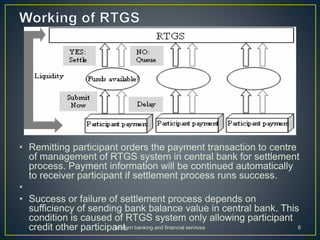
• Remitting participant orders the payment transaction to centre
of management of RTGS system in central bank for settlement
process. Payment information will be continued automatically
to receiver participant if settlement process runs success.
•
• Success or failure of settlement process depends on
sufficiency of sending bank balance value in central bank. This
condition is caused of RTGS system only allowing participant
credit other participant.Modern banking and financial services 8
• Activation
• Internet banking should be activated for conducting transactions
through RTGS.
• Beneficiary
• The person to whom the payment is to be made needs to be
added as a 'beneficiary' and his bank account details provided in
order to transfer the funds. These include the name of the
beneficiary account holder, account number, bank and branch
name, and the IFSC code of the beneficiary bank branch.
• Processing
• The bank requires 12-24 hours for authenticating the details of the
beneficiary.
• Transfer
• Select the type of transfer option (NEFT or RTGS), beneficiary
name, amount, and the reason/description of transfer. On
submission of the details and the security password, the transfer
instruction is processed. The RTGS transfer is carried out on a
real-time basis. Modern banking and financial services 9
• The fund transfer occurs in real time
• The transfer can occur online
• RTGS is predominantly used for high-value transactions
• The system is highly reliable and is powered by the RBI
• It offers an immediate clearing
• The process follows a one-to-one basis for crediting the
funds
• One can execute these transactions on an individual
basis
• Organizations can execute these transactions on a gross
basis
Modern banking and financial services 10
• RTGS is a convenient transaction mode that is ideal for
high-value transactions.
• As it does not have an upper limit, individuals can use
this form of payment for large investments and payments
quite easily.
• Having said that, if one wants the ease of making
payments at any given time, then perhaps RTGS is not
the way to go unless you can be absolutely sure that all
your payment needs can be taken care of within the
banking hours.
Modern banking and financial services 11
• Saiful Bukhori, ‘Decision Making In Serious Game Of
Real Time Gross Settlement (RTGS) For Settlement
Process Based On Hybrid Sandpile’,(2012)
• Ravindrakumar , Manish Deshpande,’E-Banking ’ ,
Pacific books international(2012)
• https://m.rbi.org.in/Scripts/FAQView.aspx?Id=65
• https://www.paisabazaar.com/banking/rtgs-payment/
• https://www.investopedia.com/terms/r/rtgs.asp
• https://razorpay.com/learn/what-is-rtgs/
Modern banking and financial services 12

Rtgs minor 1

  • 1.
  • 2.
    • Background ofRTGS • Definition • Why RTGS ? • Making RTGS Payments • Information Needed for Effective Remittance • Working of RTGS • Features of RTGS transaction • Conclusion • Reference Modern banking and financial services 2
  • 3.
    Background of RTGS Thefirst system that had the attributes of a RTGS system was the US Fedwire system which was launched in 1970  By 1997, a number of countries had introduced real-time gross settlement systems for large-value funds transfers. In India this system was launched on March 26, 2004 (on pilot basis by involving 4 banks) by RBI for large value transactions for banks and their clients. Modern banking and financial services 3
  • 4.
    • RTGS systemis a funds transfer mechanism where transfer of money takes place from one bank to another on a “real time” and on “gross” basis. • This is the fastest possible money transfer system through the banking channel. • Settlement in “real time” means payment transaction is not subjected to any waiting period. The transactions are settled as soon as they are processed. • “Gross settlement” means the transaction is settled on one to one basis without bunching with any other transaction. Modern banking and financial services 4
  • 5.
    • Reduces thecost of exchanging goods and services • A RTGS electronic fund transfer facilitates fund transfer on real time basis. • In case of a holiday, the amount gets credited on the next working day. • RTGS could also be done offline by submission of the remittance form at the bank branch of the remitter. • RTGS avoids the cost involved in other instruments of fund transfer such as demand draft. Modern banking and financial services 5
  • 6.
    • In India,payments through RTGS are made only for large sums. The minimum limit for any person to send money through RTGS is Rs. 2,00,000. • To make an RTGS payment, following methods are used: • use of online means • use of offline means, which can be availed directly from the bank Modern banking and financial services 6
  • 7.
    • Amount tobe remitted • Remitting customer’s account number which is to be debited. • Name of the beneficiary bank. • Name of the beneficiary. • Account number of the beneficiary. • IFSC code of the destination bank branch Modern banking and financial services 7
  • 8.
    • Remitting participantorders the payment transaction to centre of management of RTGS system in central bank for settlement process. Payment information will be continued automatically to receiver participant if settlement process runs success. • • Success or failure of settlement process depends on sufficiency of sending bank balance value in central bank. This condition is caused of RTGS system only allowing participant credit other participant.Modern banking and financial services 8
  • 9.
    • Activation • Internetbanking should be activated for conducting transactions through RTGS. • Beneficiary • The person to whom the payment is to be made needs to be added as a 'beneficiary' and his bank account details provided in order to transfer the funds. These include the name of the beneficiary account holder, account number, bank and branch name, and the IFSC code of the beneficiary bank branch. • Processing • The bank requires 12-24 hours for authenticating the details of the beneficiary. • Transfer • Select the type of transfer option (NEFT or RTGS), beneficiary name, amount, and the reason/description of transfer. On submission of the details and the security password, the transfer instruction is processed. The RTGS transfer is carried out on a real-time basis. Modern banking and financial services 9
  • 10.
    • The fundtransfer occurs in real time • The transfer can occur online • RTGS is predominantly used for high-value transactions • The system is highly reliable and is powered by the RBI • It offers an immediate clearing • The process follows a one-to-one basis for crediting the funds • One can execute these transactions on an individual basis • Organizations can execute these transactions on a gross basis Modern banking and financial services 10
  • 11.
    • RTGS isa convenient transaction mode that is ideal for high-value transactions. • As it does not have an upper limit, individuals can use this form of payment for large investments and payments quite easily. • Having said that, if one wants the ease of making payments at any given time, then perhaps RTGS is not the way to go unless you can be absolutely sure that all your payment needs can be taken care of within the banking hours. Modern banking and financial services 11
  • 12.
    • Saiful Bukhori,‘Decision Making In Serious Game Of Real Time Gross Settlement (RTGS) For Settlement Process Based On Hybrid Sandpile’,(2012) • Ravindrakumar , Manish Deshpande,’E-Banking ’ , Pacific books international(2012) • https://m.rbi.org.in/Scripts/FAQView.aspx?Id=65 • https://www.paisabazaar.com/banking/rtgs-payment/ • https://www.investopedia.com/terms/r/rtgs.asp • https://razorpay.com/learn/what-is-rtgs/ Modern banking and financial services 12