Banking Theory - Introduction
Banking
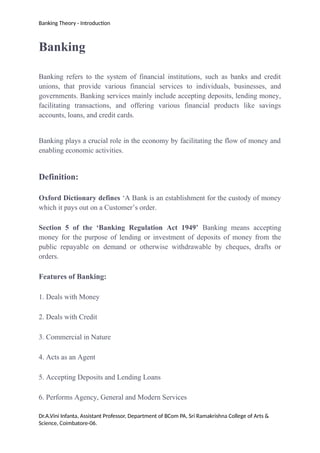
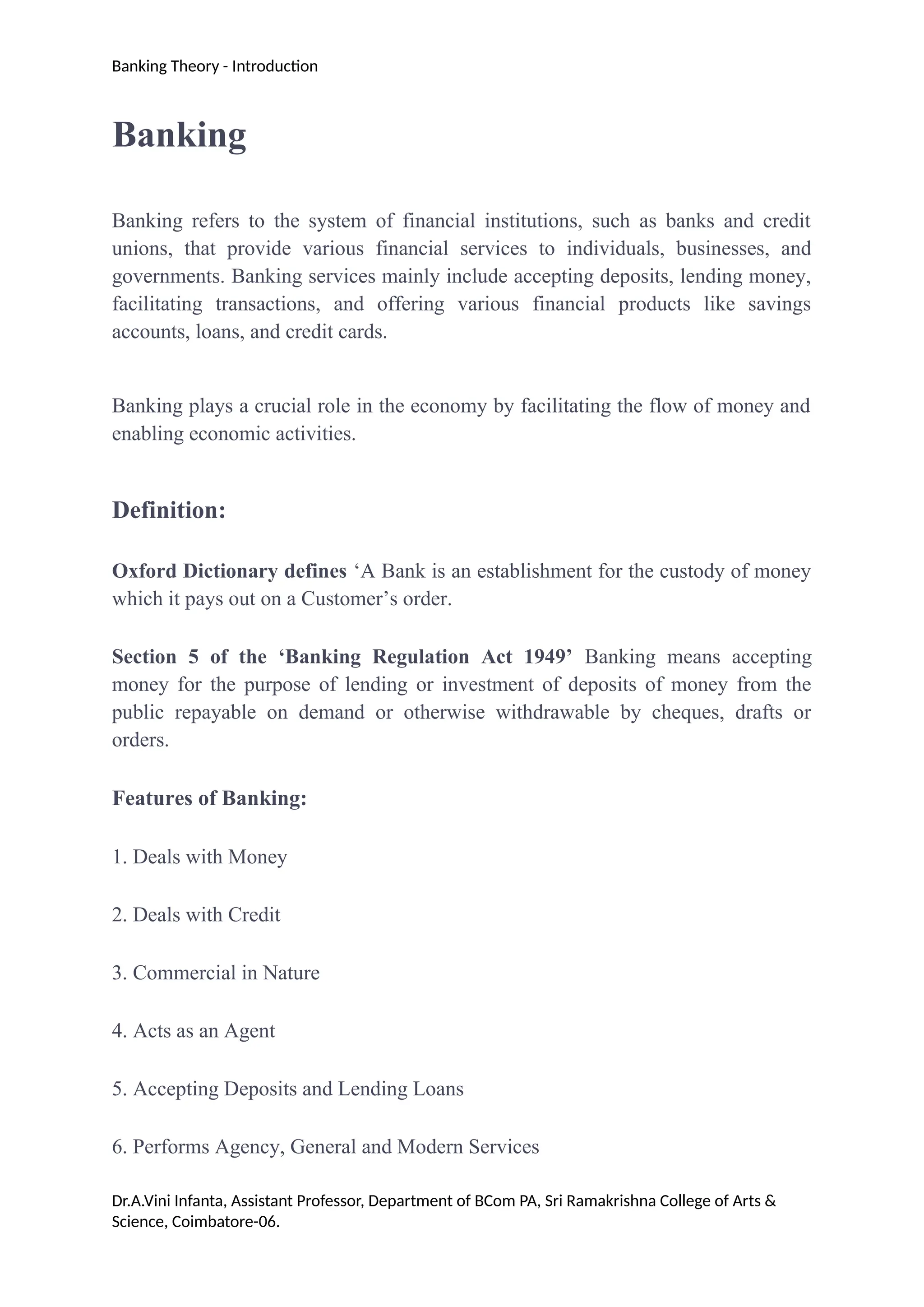
Banking refers to the system of financial institutions, such as banks and credit
unions, that provide various financial services to individuals, businesses, and
governments. Banking services mainly include accepting deposits, lending money,
facilitating transactions, and offering various financial products like savings
accounts, loans, and credit cards.
Banking plays a crucial role in the economy by facilitating the flow of money and
enabling economic activities.
Definition:
Oxford Dictionary defines ‘A Bank is an establishment for the custody of money
which it pays out on a Customer’s order.
Section 5 of the ‘Banking Regulation Act 1949’ Banking means accepting
money for the purpose of lending or investment of deposits of money from the
public repayable on demand or otherwise withdrawable by cheques, drafts or
orders.
Features of Banking:
1. Deals with Money
2. Deals with Credit
3. Commercial in Nature
4. Acts as an Agent
5. Accepting Deposits and Lending Loans
6. Performs Agency, General and Modern Services
Dr.A.Vini Infanta, Assistant Professor, Department of BCom PA, Sri Ramakrishna College of Arts &
Science, Coimbatore-06.
Banking Theory - Introduction
7. Performs Banking Business.
Functions of Banks
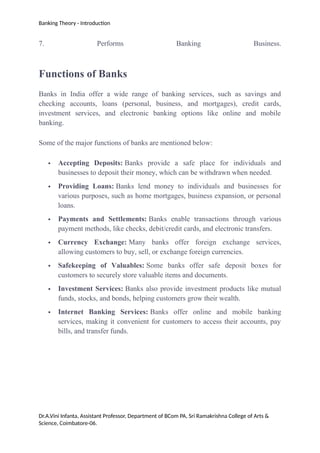
Banks in India offer a wide range of banking services, such as savings and
checking accounts, loans (personal, business, and mortgages), credit cards,
investment services, and electronic banking options like online and mobile
banking.
Some of the major functions of banks are mentioned below:
 Accepting Deposits: Banks provide a safe place for individuals and
businesses to deposit their money, which can be withdrawn when needed.
 Providing Loans: Banks lend money to individuals and businesses for
various purposes, such as home mortgages, business expansion, or personal
loans.
 Payments and Settlements: Banks enable transactions through various
payment methods, like checks, debit/credit cards, and electronic transfers.
 Currency Exchange: Many banks offer foreign exchange services,
allowing customers to buy, sell, or exchange foreign currencies.
 Safekeeping of Valuables: Some banks offer safe deposit boxes for
customers to securely store valuable items and documents.
 Investment Services: Banks also provide investment products like mutual
funds, stocks, and bonds, helping customers grow their wealth.
 Internet Banking Services: Banks offer online and mobile banking
services, making it convenient for customers to access their accounts, pay
bills, and transfer funds.
Dr.A.Vini Infanta, Assistant Professor, Department of BCom PA, Sri Ramakrishna College of Arts &
Science, Coimbatore-06.
Banking Theory - Introduction
Types of Banks in India
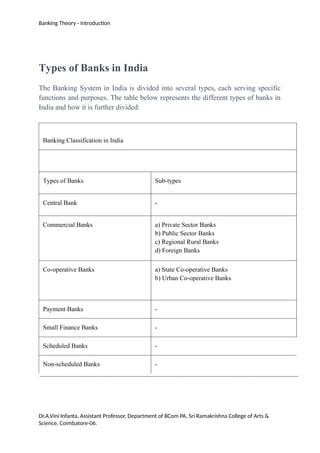
The Banking System in India is divided into several types, each serving specific
functions and purposes. The table below represents the different types of banks in
India and how it is further divided:
Banking Classification in India
Types of Banks Sub-types
Central Bank -
Commercial Banks a) Private Sector Banks
b) Public Sector Banks
c) Regional Rural Banks
d) Foreign Banks
Co-operative Banks a) State Co-operative Banks
b) Urban Co-operative Banks
Payment Banks -
Small Finance Banks -
Scheduled Banks -
Non-scheduled Banks -
Dr.A.Vini Infanta, Assistant Professor, Department of BCom PA, Sri Ramakrishna College of Arts &
Science, Coimbatore-06.
Banking Theory - Introduction
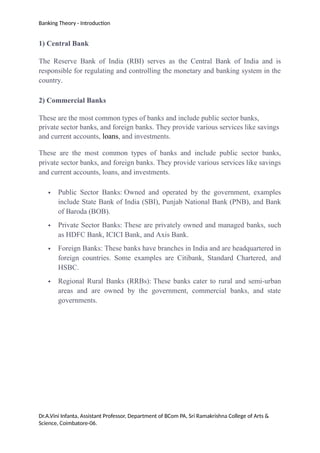
1) Central Bank
The Reserve Bank of India (RBI) serves as the Central Bank of India and is
responsible for regulating and controlling the monetary and banking system in the
country.
2) Commercial Banks
These are the most common types of banks and include public sector banks,
private sector banks, and foreign banks. They provide various services like savings
and current accounts, loans, and investments.
These are the most common types of banks and include public sector banks,
private sector banks, and foreign banks. They provide various services like savings
and current accounts, loans, and investments.
 Public Sector Banks: Owned and operated by the government, examples
include State Bank of India (SBI), Punjab National Bank (PNB), and Bank
of Baroda (BOB).
 Private Sector Banks: These are privately owned and managed banks, such
as HDFC Bank, ICICI Bank, and Axis Bank.
 Foreign Banks: These banks have branches in India and are headquartered in
foreign countries. Some examples are Citibank, Standard Chartered, and
HSBC.
 Regional Rural Banks (RRBs): These banks cater to rural and semi-urban
areas and are owned by the government, commercial banks, and state
governments.
Dr.A.Vini Infanta, Assistant Professor, Department of BCom PA, Sri Ramakrishna College of Arts &
Science, Coimbatore-06.
Banking Theory - Introduction
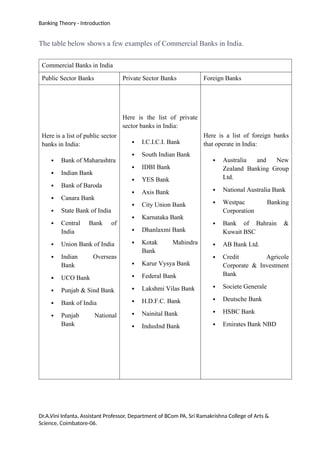
The table below shows a few examples of Commercial Banks in India.
Commercial Banks in India
Public Sector Banks Private Sector Banks Foreign Banks
Here is a list of public sector
banks in India:
 Bank of Maharashtra
 Indian Bank
 Bank of Baroda
 Canara Bank
 State Bank of India
 Central Bank of
India
 Union Bank of India
 Indian Overseas
Bank
 UCO Bank
 Punjab & Sind Bank
 Bank of India
 Punjab National
Bank
Here is the list of private
sector banks in India:
 I.C.I.C.I. Bank
 South Indian Bank
 IDBI Bank
 YES Bank
 Axis Bank
 City Union Bank
 Karnataka Bank
 Dhanlaxmi Bank
 Kotak Mahindra
Bank
 Karur Vysya Bank
 Federal Bank
 Lakshmi Vilas Bank
 H.D.F.C. Bank
 Nainital Bank
 IndusInd Bank
Here is a list of foreign banks
that operate in India:
 Australia and New
Zealand Banking Group
Ltd.
 National Australia Bank
 Westpac Banking
Corporation
 Bank of Bahrain &
Kuwait BSC
 AB Bank Ltd.
 Credit Agricole
Corporate & Investment
Bank
 Societe Generale
 Deutsche Bank
 HSBC Bank
 Emirates Bank NBD
Dr.A.Vini Infanta, Assistant Professor, Department of BCom PA, Sri Ramakrishna College of Arts &
Science, Coimbatore-06.
Banking Theory - Introduction
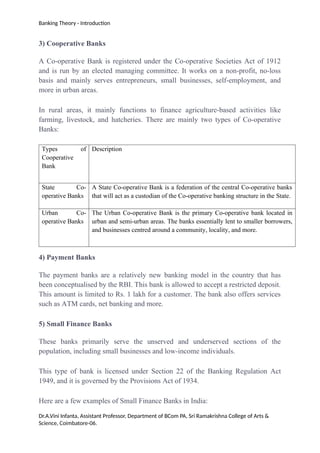
3) Cooperative Banks
A Co-operative Bank is registered under the Co-operative Societies Act of 1912
and is run by an elected managing committee. It works on a non-profit, no-loss
basis and mainly serves entrepreneurs, small businesses, self-employment, and
more in urban areas.
In rural areas, it mainly functions to finance agriculture-based activities like
farming, livestock, and hatcheries. There are mainly two types of Co-operative
Banks:
Types of
Cooperative
Bank
Description
State Co-
operative Banks
A State Co-operative Bank is a federation of the central Co-operative banks
that will act as a custodian of the Co-operative banking structure in the State.
Urban Co-
operative Banks
The Urban Co-operative Bank is the primary Co-operative bank located in
urban and semi-urban areas. The banks essentially lent to smaller borrowers,
and businesses centred around a community, locality, and more.
4) Payment Banks
The payment banks are a relatively new banking model in the country that has
been conceptualised by the RBI. This bank is allowed to accept a restricted deposit.
This amount is limited to Rs. 1 lakh for a customer. The bank also offers services
such as ATM cards, net banking and more.
5) Small Finance Banks
These banks primarily serve the unserved and underserved sections of the
population, including small businesses and low-income individuals.
This type of bank is licensed under Section 22 of the Banking Regulation Act
1949, and it is governed by the Provisions Act of 1934.
Here are a few examples of Small Finance Banks in India:
Dr.A.Vini Infanta, Assistant Professor, Department of BCom PA, Sri Ramakrishna College of Arts &
Science, Coimbatore-06.
Banking Theory - Introduction
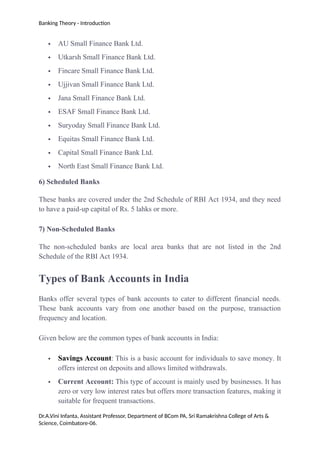
 AU Small Finance Bank Ltd.
 Utkarsh Small Finance Bank Ltd.
 Fincare Small Finance Bank Ltd.
 Ujjivan Small Finance Bank Ltd.
 Jana Small Finance Bank Ltd.
 ESAF Small Finance Bank Ltd.
 Suryoday Small Finance Bank Ltd.
 Equitas Small Finance Bank Ltd.
 Capital Small Finance Bank Ltd.
 North East Small Finance Bank Ltd.
6) Scheduled Banks
These banks are covered under the 2nd Schedule of RBI Act 1934, and they need
to have a paid-up capital of Rs. 5 lahks or more.
7) Non-Scheduled Banks
The non-scheduled banks are local area banks that are not listed in the 2nd
Schedule of the RBI Act 1934.
Types of Bank Accounts in India
Banks offer several types of bank accounts to cater to different financial needs.
These bank accounts vary from one another based on the purpose, transaction
frequency and location.
Given below are the common types of bank accounts in India:
 Savings Account: This is a basic account for individuals to save money. It
offers interest on deposits and allows limited withdrawals.
 Current Account: This type of account is mainly used by businesses. It has
zero or very low interest rates but offers more transaction features, making it
suitable for frequent transactions.
Dr.A.Vini Infanta, Assistant Professor, Department of BCom PA, Sri Ramakrishna College of Arts &
Science, Coimbatore-06.
Banking Theory - Introduction
 Fixed Deposit Account: In this account, you deposit a lump sum for a fixed
tenure at a higher interest rate compared to savings accounts. Funds are
locked in until maturity.
 Recurring Deposit Account: It is a savings plan where you deposit a fixed
amount every month, and at the end of a specified period, you receive the
principal and interest.
 NRI (Non-Resident Indian) Account: These are for Indians living
abroad. NRE (Non-Resident External), NRO (Non-Resident Ordinary) and
FCNR (Foreign Currency Non-Residential) accounts are major types of NRI
accounts.
 Senior Citizen Savings Account: Created for senior citizens, these
accounts offer higher interest rates and additional benefits.
 Salary Account: This account is used by an employer to credit the salary of
an employee every month. It does not have any minimum balance
requirement.
 Demat Account: This account is created primarily for holding and trading
in securities electronically, such as stocks and bonds.
 Joint Account: It is shared by two or more individuals, often used for
family or business purposes.
 Minor Account: Opened on behalf of minors by parents or guardians. The
minor gains control upon reaching a certain age.
 Corporate Account: Used by companies and corporations for their
banking needs, including payroll and transactions.
Commercial Bank
A commercial bank is a kind of financial institution that carries all the operations related to
deposit and withdrawal of money for the general public, providing loans for investment, and
other such activities. These banks are profit-making institutions and do business only to make
a profit.
The two primary characteristics of a commercial bank are lending and borrowing. The bank
receives the deposits and gives money to various projects to earn interest (profit). The rate of
interest that a bank offers to the depositors is known as the borrowing rate, while the rate at
which a bank lends money is known as the lending rate.
Dr.A.Vini Infanta, Assistant Professor, Department of BCom PA, Sri Ramakrishna College of Arts &
Science, Coimbatore-06.
Banking Theory - Introduction
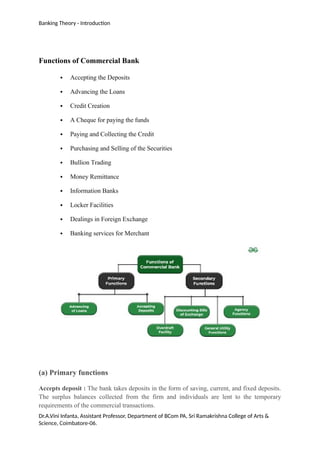
Functions of Commercial Bank
 Accepting the Deposits
 Advancing the Loans
 Credit Creation
 A Cheque for paying the funds
 Paying and Collecting the Credit
 Purchasing and Selling of the Securities
 Bullion Trading
 Money Remittance
 Information Banks
 Locker Facilities
 Dealings in Foreign Exchange
 Banking services for Merchant
(a) Primary functions
Accepts deposit : The bank takes deposits in the form of saving, current, and fixed deposits.
The surplus balances collected from the firm and individuals are lent to the temporary
requirements of the commercial transactions.
Dr.A.Vini Infanta, Assistant Professor, Department of BCom PA, Sri Ramakrishna College of Arts &
Science, Coimbatore-06.
Banking Theory - Introduction
Provides loan and advances : Another critical function of this bank is to offer loans and
advances to the entrepreneurs and business people, and collect interest. For every bank, it is
the primary source of making profits. In this process, a bank retains a small number of
deposits as a reserve and offers (lends) the remaining amount to the borrowers in demand
loans, overdraft, cash credit, short-run loans, and more such banks.
Credit cash: When a customer is provided with credit or loan, they are not provided with
liquid cash. First, a bank account is opened for the customer and then the money is
transferred to the account. This process allows the bank to create money.
(b) Secondary functions
Discounting bills of exchange: It is a written agreement acknowledging the amount of
money to be paid against the goods purchased at a given point of time in the future. The
amount can also be cleared before the quoted time through a discounting method of a
commercial bank.
Overdraft facility: It is an advance given to a customer by keeping the current account to
overdraw up to the given limit.
Purchasing and selling of the securities: The bank offers you with the facility of selling
and buying the securities.
Locker facilities: A bank provides locker facilities to the customers to keep their valuables
or documents safely. The banks charge a minimum of an annual fee for this service.
Paying and gathering the credit : It uses different instruments like a promissory note,
cheques, and bill of exchange.
CREDIT CREATION
Credit creation is the expansion of deposits. And, banks can expand their demand deposits as
a multiple of their cash reserves because demand deposits serve as the principal medium of
exchange. Credit creation separates a bank from other financial institutions.
Demand deposits are an important constituent of money supply and the expansion of demand
deposits means the expansion of money supply. The entire structure of banking is based on
credit. Credit basically means getting the purchasing power now and promising to pay at
some time in the future. Bank credit means bank loans and advances.
A bank keeps a certain part of its deposits as a minimum reserve to meet the demands of its
depositors and lends out the remaining to earn income. The loan is credited to the account of
the borrower. Every bank loan creates an equivalent deposit in the bank. Therefore, credit
creation means expansion of bank deposits.
The two most important aspects of credit creation are:
Dr.A.Vini Infanta, Assistant Professor, Department of BCom PA, Sri Ramakrishna College of Arts &
Science, Coimbatore-06.
Banking Theory - Introduction
1. Liquidity – The bank must pay cash to its depositors when they exercise their right to
demand cash against their deposits.
2. Profitability – Banks are profit-driven enterprises. Therefore, a bank must grant loans in a
manner which earns higher interest than what it pays on its deposits
Some Concepts:
1. Bank as a business institution – Bank is a business institution which tries to maximize
profits through loans and advances from the deposits.
2. Bank Deposits – Bank deposits form the basis for credit creation and are of two types:
a) Primary Deposits – A bank accepts cash from the customer and opens a deposit in his
name. This is a primary deposit. This does not mean credit creation. These deposits simply
convert currency money into deposit money. However, these deposits form the basis for the
creation of credit.
b) Secondary or Derivative Deposits – A bank grants loans and advances and instead of
giving cash to the borrower, opens a deposit account in his name. This is the secondary or
derivative deposit. Every loan creates a deposit. The creation of a derivative deposit means
the creation of credit.
3. Cash Reserve Ratio (CRR) – Banks know that all depositors will not withdrawal deposits
at the same time. Therefore, they keep a fraction of the total deposits for meeting the cash
demand of the depositors and lend the remaining excess deposits. CRR is the percentage of
total deposits which the banks must hold in cash reserves for meeting the depositors’ demand
for cash.
4. Excess Reserves – The reserves over and above the cash reserves are the excess reserves.
These reserves are used for loans and credit creation.
5. Credit Multiplier – Given a certain amount of cash, a bank can create multiple times
credit. In the process of multiple credit creation, the total amount of derivative deposits that a
bank creates is a multiple of the initial cash reserves.
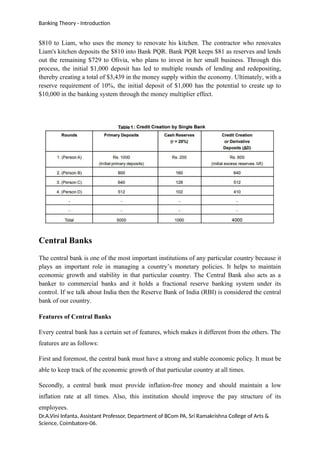
EXAMPLE OF CREDIT CREATION
John receives his monthly paycheck of $1,000 and deposits it into Bank ABC. The central
bank's reserve requirement is set at 10%, so Bank ABC keeps $100 as reserves and lends out
the remaining $900 to Emma, who needs a loan to purchase a laptop. Emma buys the laptop
from a local electronics store, which deposits the $900 into its account at Bank XYZ. Bank
XYZ, adhering to the same 10% reserve requirement, keeps $90 in reserves and lends out
Dr.A.Vini Infanta, Assistant Professor, Department of BCom PA, Sri Ramakrishna College of Arts &
Science, Coimbatore-06.
Banking Theory - Introduction
$810 to Liam, who uses the money to renovate his kitchen. The contractor who renovates
Liam's kitchen deposits the $810 into Bank PQR. Bank PQR keeps $81 as reserves and lends
out the remaining $729 to Olivia, who plans to invest in her small business. Through this
process, the initial $1,000 deposit has led to multiple rounds of lending and redepositing,
thereby creating a total of $3,439 in the money supply within the economy. Ultimately, with a
reserve requirement of 10%, the initial deposit of $1,000 has the potential to create up to
$10,000 in the banking system through the money multiplier effect.
Central Banks
The central bank is one of the most important institutions of any particular country because it
plays an important role in managing a country’s monetary policies. It helps to maintain
economic growth and stability in that particular country. The Central Bank also acts as a
banker to commercial banks and it holds a fractional reserve banking system under its
control. If we talk about India then the Reserve Bank of India (RBI) is considered the central
bank of our country.
Features of Central Banks
Every central bank has a certain set of features, which makes it different from the others. The
features are as follows:
First and foremost, the central bank must have a strong and stable economic policy. It must be
able to keep track of the economic growth of that particular country at all times.
Secondly, a central bank must provide inflation-free money and should maintain a low
inflation rate at all times. Also, this institution should improve the pay structure of its
employees.
Dr.A.Vini Infanta, Assistant Professor, Department of BCom PA, Sri Ramakrishna College of Arts &
Science, Coimbatore-06.
Banking Theory - Introduction
Lastly, a central bank should be in contact with the international banking community and it
should take part in making policies through Treasury securities auctions as well as bond sales.
Role of Central Banks in the Economy
Along with monetary and banking policies, the central bank of any country also plays an
important role in the economic growth and development of that particular country. Here are
some important roles of a central bank in the economy:
First and foremost, it must play an important role in providing money supply to the economy
at all times.
Secondly, it must keep track of economic indicators like exchange rate, gross domestic
product (GDP), etc on a regular basis so that it can take necessary actions to improve these
measures.
Thirdly, a central bank must always maintain an optimum level of liquidity so that banks can
provide credit facilities to their customers at all times.
Commercial Banks
The main objective of a commercial bank is to provide financial services to the general
public. The main clients of commercial banks are small and medium industries, agriculture,
households, and business. Commercial banks also play an important role in the safe custody
of bank deposits.
Special Features of Commercial Banks
First, commercial banks must maintain a low rate of inflation at all times. Also, it should be
capable of following prudent economic policies and maintaining an adequate level of reserves
in its vault.
Secondly, a commercial bank should always look to improve the rate structure of its
employees. Last but not least, a commercial bank should be capable of investing in the fund
which is available in its vault at better rates.
Lastly, a commercial bank should maintain steady contact with other central banks of other
countries in order to improve its monetary policies.
Dr.A.Vini Infanta, Assistant Professor, Department of BCom PA, Sri Ramakrishna College of Arts &
Science, Coimbatore-06.
Banking Theory - Introduction
Role of Commercial Banks in the Economy
It is very important to note that the commercial bank plays a great role in the economy of a
particular country. These banks provide financial services to their customers in all fields and
they should not waste the financial messages which come from their bank.
1) Financial services: It provides necessary financial services with proper regulation as well
as management. It helps to provide cash for lending and other business activities, which are
being performed by the general public.
2) Safe custody: Commercial banks are known for depositing and safekeeping of cash and
deposit money. This institution must be able to properly keep and store all the money
deposited by the general public in its vault.
3) Other Financial Services: Commercial banks offer many other financial services such as
payment of salaries, business loans, etc. This bank plays an important role in the economic
growth of a particular country.
4) Keep track of their Clients: Commercial banks are known for developing their own
database and database management system. Banks take strict concern about the development
of database systems and hiring trained staff for this purpose.
Commercial Bank v/s Central Bank
Basis Commercial Bank Central Bank
Meaning
An institution that
performs different
functions like accepting
deposits, making
investments with the
motive of earning profits,
and granting loans.
An apex body that
controls, operates,
regulates, and directs a
country’s banking and
monetary structure.
Ownership A commercial bank can be The central bank is
Dr.A.Vini Infanta, Assistant Professor, Department of BCom PA, Sri Ramakrishna College of Arts &
Science, Coimbatore-06.
Banking Theory - Introduction
Basis Commercial Bank Central Bank
owned and governed by
the private sector or
government sector.
usually owned and
governed by the
government.
Status
A commercial bank is just
a unit of a country’s
banking structure that
operates under the control
of the Central Bank.
The central bank is an
apex institution in the
money market.
Issue of Currency
A commercial bank does
not have the power to
issue currency.
The central bank has a
sole monopoly on issue of
currency.
Objective
The basic aim of a
commercial bank is
maximisation of profits.
The central bank does not
have a profit motive and
works in the public
interest.
Public Dealing
A commercial bank
directly deals with the
public.
The central bank does not
directly deal with the
public.
Number of Banks
There are a huge number
of commercial banks in a
country. For example,
different commercial
banks in India are the
State Bank of India,
Canara Bank, Punjab
National Bank, etc.
There is only one central
bank in a country. For
example, the central bank
of India is the Reserve
Bank of India.
Dr.A.Vini Infanta, Assistant Professor, Department of BCom PA, Sri Ramakrishna College of Arts &
Science, Coimbatore-06.

BANKING THEORY AND INTRODUCTION DOCUMENT.

  • 1.
    Banking Theory -Introduction Banking Banking refers to the system of financial institutions, such as banks and credit unions, that provide various financial services to individuals, businesses, and governments. Banking services mainly include accepting deposits, lending money, facilitating transactions, and offering various financial products like savings accounts, loans, and credit cards. Banking plays a crucial role in the economy by facilitating the flow of money and enabling economic activities. Definition: Oxford Dictionary defines ‘A Bank is an establishment for the custody of money which it pays out on a Customer’s order. Section 5 of the ‘Banking Regulation Act 1949’ Banking means accepting money for the purpose of lending or investment of deposits of money from the public repayable on demand or otherwise withdrawable by cheques, drafts or orders. Features of Banking: 1. Deals with Money 2. Deals with Credit 3. Commercial in Nature 4. Acts as an Agent 5. Accepting Deposits and Lending Loans 6. Performs Agency, General and Modern Services Dr.A.Vini Infanta, Assistant Professor, Department of BCom PA, Sri Ramakrishna College of Arts & Science, Coimbatore-06.
  • 2.
    Banking Theory -Introduction 7. Performs Banking Business. Functions of Banks Banks in India offer a wide range of banking services, such as savings and checking accounts, loans (personal, business, and mortgages), credit cards, investment services, and electronic banking options like online and mobile banking. Some of the major functions of banks are mentioned below:  Accepting Deposits: Banks provide a safe place for individuals and businesses to deposit their money, which can be withdrawn when needed.  Providing Loans: Banks lend money to individuals and businesses for various purposes, such as home mortgages, business expansion, or personal loans.  Payments and Settlements: Banks enable transactions through various payment methods, like checks, debit/credit cards, and electronic transfers.  Currency Exchange: Many banks offer foreign exchange services, allowing customers to buy, sell, or exchange foreign currencies.  Safekeeping of Valuables: Some banks offer safe deposit boxes for customers to securely store valuable items and documents.  Investment Services: Banks also provide investment products like mutual funds, stocks, and bonds, helping customers grow their wealth.  Internet Banking Services: Banks offer online and mobile banking services, making it convenient for customers to access their accounts, pay bills, and transfer funds. Dr.A.Vini Infanta, Assistant Professor, Department of BCom PA, Sri Ramakrishna College of Arts & Science, Coimbatore-06.
  • 3.
    Banking Theory -Introduction Types of Banks in India The Banking System in India is divided into several types, each serving specific functions and purposes. The table below represents the different types of banks in India and how it is further divided: Banking Classification in India Types of Banks Sub-types Central Bank - Commercial Banks a) Private Sector Banks b) Public Sector Banks c) Regional Rural Banks d) Foreign Banks Co-operative Banks a) State Co-operative Banks b) Urban Co-operative Banks Payment Banks - Small Finance Banks - Scheduled Banks - Non-scheduled Banks - Dr.A.Vini Infanta, Assistant Professor, Department of BCom PA, Sri Ramakrishna College of Arts & Science, Coimbatore-06.
  • 4.
    Banking Theory -Introduction 1) Central Bank The Reserve Bank of India (RBI) serves as the Central Bank of India and is responsible for regulating and controlling the monetary and banking system in the country. 2) Commercial Banks These are the most common types of banks and include public sector banks, private sector banks, and foreign banks. They provide various services like savings and current accounts, loans, and investments. These are the most common types of banks and include public sector banks, private sector banks, and foreign banks. They provide various services like savings and current accounts, loans, and investments.  Public Sector Banks: Owned and operated by the government, examples include State Bank of India (SBI), Punjab National Bank (PNB), and Bank of Baroda (BOB).  Private Sector Banks: These are privately owned and managed banks, such as HDFC Bank, ICICI Bank, and Axis Bank.  Foreign Banks: These banks have branches in India and are headquartered in foreign countries. Some examples are Citibank, Standard Chartered, and HSBC.  Regional Rural Banks (RRBs): These banks cater to rural and semi-urban areas and are owned by the government, commercial banks, and state governments. Dr.A.Vini Infanta, Assistant Professor, Department of BCom PA, Sri Ramakrishna College of Arts & Science, Coimbatore-06.
  • 5.
    Banking Theory -Introduction The table below shows a few examples of Commercial Banks in India. Commercial Banks in India Public Sector Banks Private Sector Banks Foreign Banks Here is a list of public sector banks in India:  Bank of Maharashtra  Indian Bank  Bank of Baroda  Canara Bank  State Bank of India  Central Bank of India  Union Bank of India  Indian Overseas Bank  UCO Bank  Punjab & Sind Bank  Bank of India  Punjab National Bank Here is the list of private sector banks in India:  I.C.I.C.I. Bank  South Indian Bank  IDBI Bank  YES Bank  Axis Bank  City Union Bank  Karnataka Bank  Dhanlaxmi Bank  Kotak Mahindra Bank  Karur Vysya Bank  Federal Bank  Lakshmi Vilas Bank  H.D.F.C. Bank  Nainital Bank  IndusInd Bank Here is a list of foreign banks that operate in India:  Australia and New Zealand Banking Group Ltd.  National Australia Bank  Westpac Banking Corporation  Bank of Bahrain & Kuwait BSC  AB Bank Ltd.  Credit Agricole Corporate & Investment Bank  Societe Generale  Deutsche Bank  HSBC Bank  Emirates Bank NBD Dr.A.Vini Infanta, Assistant Professor, Department of BCom PA, Sri Ramakrishna College of Arts & Science, Coimbatore-06.
  • 6.
    Banking Theory -Introduction 3) Cooperative Banks A Co-operative Bank is registered under the Co-operative Societies Act of 1912 and is run by an elected managing committee. It works on a non-profit, no-loss basis and mainly serves entrepreneurs, small businesses, self-employment, and more in urban areas. In rural areas, it mainly functions to finance agriculture-based activities like farming, livestock, and hatcheries. There are mainly two types of Co-operative Banks: Types of Cooperative Bank Description State Co- operative Banks A State Co-operative Bank is a federation of the central Co-operative banks that will act as a custodian of the Co-operative banking structure in the State. Urban Co- operative Banks The Urban Co-operative Bank is the primary Co-operative bank located in urban and semi-urban areas. The banks essentially lent to smaller borrowers, and businesses centred around a community, locality, and more. 4) Payment Banks The payment banks are a relatively new banking model in the country that has been conceptualised by the RBI. This bank is allowed to accept a restricted deposit. This amount is limited to Rs. 1 lakh for a customer. The bank also offers services such as ATM cards, net banking and more. 5) Small Finance Banks These banks primarily serve the unserved and underserved sections of the population, including small businesses and low-income individuals. This type of bank is licensed under Section 22 of the Banking Regulation Act 1949, and it is governed by the Provisions Act of 1934. Here are a few examples of Small Finance Banks in India: Dr.A.Vini Infanta, Assistant Professor, Department of BCom PA, Sri Ramakrishna College of Arts & Science, Coimbatore-06.
  • 7.
    Banking Theory -Introduction  AU Small Finance Bank Ltd.  Utkarsh Small Finance Bank Ltd.  Fincare Small Finance Bank Ltd.  Ujjivan Small Finance Bank Ltd.  Jana Small Finance Bank Ltd.  ESAF Small Finance Bank Ltd.  Suryoday Small Finance Bank Ltd.  Equitas Small Finance Bank Ltd.  Capital Small Finance Bank Ltd.  North East Small Finance Bank Ltd. 6) Scheduled Banks These banks are covered under the 2nd Schedule of RBI Act 1934, and they need to have a paid-up capital of Rs. 5 lahks or more. 7) Non-Scheduled Banks The non-scheduled banks are local area banks that are not listed in the 2nd Schedule of the RBI Act 1934. Types of Bank Accounts in India Banks offer several types of bank accounts to cater to different financial needs. These bank accounts vary from one another based on the purpose, transaction frequency and location. Given below are the common types of bank accounts in India:  Savings Account: This is a basic account for individuals to save money. It offers interest on deposits and allows limited withdrawals.  Current Account: This type of account is mainly used by businesses. It has zero or very low interest rates but offers more transaction features, making it suitable for frequent transactions. Dr.A.Vini Infanta, Assistant Professor, Department of BCom PA, Sri Ramakrishna College of Arts & Science, Coimbatore-06.
  • 8.
    Banking Theory -Introduction  Fixed Deposit Account: In this account, you deposit a lump sum for a fixed tenure at a higher interest rate compared to savings accounts. Funds are locked in until maturity.  Recurring Deposit Account: It is a savings plan where you deposit a fixed amount every month, and at the end of a specified period, you receive the principal and interest.  NRI (Non-Resident Indian) Account: These are for Indians living abroad. NRE (Non-Resident External), NRO (Non-Resident Ordinary) and FCNR (Foreign Currency Non-Residential) accounts are major types of NRI accounts.  Senior Citizen Savings Account: Created for senior citizens, these accounts offer higher interest rates and additional benefits.  Salary Account: This account is used by an employer to credit the salary of an employee every month. It does not have any minimum balance requirement.  Demat Account: This account is created primarily for holding and trading in securities electronically, such as stocks and bonds.  Joint Account: It is shared by two or more individuals, often used for family or business purposes.  Minor Account: Opened on behalf of minors by parents or guardians. The minor gains control upon reaching a certain age.  Corporate Account: Used by companies and corporations for their banking needs, including payroll and transactions. Commercial Bank A commercial bank is a kind of financial institution that carries all the operations related to deposit and withdrawal of money for the general public, providing loans for investment, and other such activities. These banks are profit-making institutions and do business only to make a profit. The two primary characteristics of a commercial bank are lending and borrowing. The bank receives the deposits and gives money to various projects to earn interest (profit). The rate of interest that a bank offers to the depositors is known as the borrowing rate, while the rate at which a bank lends money is known as the lending rate. Dr.A.Vini Infanta, Assistant Professor, Department of BCom PA, Sri Ramakrishna College of Arts & Science, Coimbatore-06.
  • 9.
    Banking Theory -Introduction Functions of Commercial Bank  Accepting the Deposits  Advancing the Loans  Credit Creation  A Cheque for paying the funds  Paying and Collecting the Credit  Purchasing and Selling of the Securities  Bullion Trading  Money Remittance  Information Banks  Locker Facilities  Dealings in Foreign Exchange  Banking services for Merchant (a) Primary functions Accepts deposit : The bank takes deposits in the form of saving, current, and fixed deposits. The surplus balances collected from the firm and individuals are lent to the temporary requirements of the commercial transactions. Dr.A.Vini Infanta, Assistant Professor, Department of BCom PA, Sri Ramakrishna College of Arts & Science, Coimbatore-06.
  • 10.
    Banking Theory -Introduction Provides loan and advances : Another critical function of this bank is to offer loans and advances to the entrepreneurs and business people, and collect interest. For every bank, it is the primary source of making profits. In this process, a bank retains a small number of deposits as a reserve and offers (lends) the remaining amount to the borrowers in demand loans, overdraft, cash credit, short-run loans, and more such banks. Credit cash: When a customer is provided with credit or loan, they are not provided with liquid cash. First, a bank account is opened for the customer and then the money is transferred to the account. This process allows the bank to create money. (b) Secondary functions Discounting bills of exchange: It is a written agreement acknowledging the amount of money to be paid against the goods purchased at a given point of time in the future. The amount can also be cleared before the quoted time through a discounting method of a commercial bank. Overdraft facility: It is an advance given to a customer by keeping the current account to overdraw up to the given limit. Purchasing and selling of the securities: The bank offers you with the facility of selling and buying the securities. Locker facilities: A bank provides locker facilities to the customers to keep their valuables or documents safely. The banks charge a minimum of an annual fee for this service. Paying and gathering the credit : It uses different instruments like a promissory note, cheques, and bill of exchange. CREDIT CREATION Credit creation is the expansion of deposits. And, banks can expand their demand deposits as a multiple of their cash reserves because demand deposits serve as the principal medium of exchange. Credit creation separates a bank from other financial institutions. Demand deposits are an important constituent of money supply and the expansion of demand deposits means the expansion of money supply. The entire structure of banking is based on credit. Credit basically means getting the purchasing power now and promising to pay at some time in the future. Bank credit means bank loans and advances. A bank keeps a certain part of its deposits as a minimum reserve to meet the demands of its depositors and lends out the remaining to earn income. The loan is credited to the account of the borrower. Every bank loan creates an equivalent deposit in the bank. Therefore, credit creation means expansion of bank deposits. The two most important aspects of credit creation are: Dr.A.Vini Infanta, Assistant Professor, Department of BCom PA, Sri Ramakrishna College of Arts & Science, Coimbatore-06.
  • 11.
    Banking Theory -Introduction 1. Liquidity – The bank must pay cash to its depositors when they exercise their right to demand cash against their deposits. 2. Profitability – Banks are profit-driven enterprises. Therefore, a bank must grant loans in a manner which earns higher interest than what it pays on its deposits Some Concepts: 1. Bank as a business institution – Bank is a business institution which tries to maximize profits through loans and advances from the deposits. 2. Bank Deposits – Bank deposits form the basis for credit creation and are of two types: a) Primary Deposits – A bank accepts cash from the customer and opens a deposit in his name. This is a primary deposit. This does not mean credit creation. These deposits simply convert currency money into deposit money. However, these deposits form the basis for the creation of credit. b) Secondary or Derivative Deposits – A bank grants loans and advances and instead of giving cash to the borrower, opens a deposit account in his name. This is the secondary or derivative deposit. Every loan creates a deposit. The creation of a derivative deposit means the creation of credit. 3. Cash Reserve Ratio (CRR) – Banks know that all depositors will not withdrawal deposits at the same time. Therefore, they keep a fraction of the total deposits for meeting the cash demand of the depositors and lend the remaining excess deposits. CRR is the percentage of total deposits which the banks must hold in cash reserves for meeting the depositors’ demand for cash. 4. Excess Reserves – The reserves over and above the cash reserves are the excess reserves. These reserves are used for loans and credit creation. 5. Credit Multiplier – Given a certain amount of cash, a bank can create multiple times credit. In the process of multiple credit creation, the total amount of derivative deposits that a bank creates is a multiple of the initial cash reserves. EXAMPLE OF CREDIT CREATION John receives his monthly paycheck of $1,000 and deposits it into Bank ABC. The central bank's reserve requirement is set at 10%, so Bank ABC keeps $100 as reserves and lends out the remaining $900 to Emma, who needs a loan to purchase a laptop. Emma buys the laptop from a local electronics store, which deposits the $900 into its account at Bank XYZ. Bank XYZ, adhering to the same 10% reserve requirement, keeps $90 in reserves and lends out Dr.A.Vini Infanta, Assistant Professor, Department of BCom PA, Sri Ramakrishna College of Arts & Science, Coimbatore-06.
  • 12.
    Banking Theory -Introduction $810 to Liam, who uses the money to renovate his kitchen. The contractor who renovates Liam's kitchen deposits the $810 into Bank PQR. Bank PQR keeps $81 as reserves and lends out the remaining $729 to Olivia, who plans to invest in her small business. Through this process, the initial $1,000 deposit has led to multiple rounds of lending and redepositing, thereby creating a total of $3,439 in the money supply within the economy. Ultimately, with a reserve requirement of 10%, the initial deposit of $1,000 has the potential to create up to $10,000 in the banking system through the money multiplier effect. Central Banks The central bank is one of the most important institutions of any particular country because it plays an important role in managing a country’s monetary policies. It helps to maintain economic growth and stability in that particular country. The Central Bank also acts as a banker to commercial banks and it holds a fractional reserve banking system under its control. If we talk about India then the Reserve Bank of India (RBI) is considered the central bank of our country. Features of Central Banks Every central bank has a certain set of features, which makes it different from the others. The features are as follows: First and foremost, the central bank must have a strong and stable economic policy. It must be able to keep track of the economic growth of that particular country at all times. Secondly, a central bank must provide inflation-free money and should maintain a low inflation rate at all times. Also, this institution should improve the pay structure of its employees. Dr.A.Vini Infanta, Assistant Professor, Department of BCom PA, Sri Ramakrishna College of Arts & Science, Coimbatore-06.
  • 13.
    Banking Theory -Introduction Lastly, a central bank should be in contact with the international banking community and it should take part in making policies through Treasury securities auctions as well as bond sales. Role of Central Banks in the Economy Along with monetary and banking policies, the central bank of any country also plays an important role in the economic growth and development of that particular country. Here are some important roles of a central bank in the economy: First and foremost, it must play an important role in providing money supply to the economy at all times. Secondly, it must keep track of economic indicators like exchange rate, gross domestic product (GDP), etc on a regular basis so that it can take necessary actions to improve these measures. Thirdly, a central bank must always maintain an optimum level of liquidity so that banks can provide credit facilities to their customers at all times. Commercial Banks The main objective of a commercial bank is to provide financial services to the general public. The main clients of commercial banks are small and medium industries, agriculture, households, and business. Commercial banks also play an important role in the safe custody of bank deposits. Special Features of Commercial Banks First, commercial banks must maintain a low rate of inflation at all times. Also, it should be capable of following prudent economic policies and maintaining an adequate level of reserves in its vault. Secondly, a commercial bank should always look to improve the rate structure of its employees. Last but not least, a commercial bank should be capable of investing in the fund which is available in its vault at better rates. Lastly, a commercial bank should maintain steady contact with other central banks of other countries in order to improve its monetary policies. Dr.A.Vini Infanta, Assistant Professor, Department of BCom PA, Sri Ramakrishna College of Arts & Science, Coimbatore-06.
  • 14.
    Banking Theory -Introduction Role of Commercial Banks in the Economy It is very important to note that the commercial bank plays a great role in the economy of a particular country. These banks provide financial services to their customers in all fields and they should not waste the financial messages which come from their bank. 1) Financial services: It provides necessary financial services with proper regulation as well as management. It helps to provide cash for lending and other business activities, which are being performed by the general public. 2) Safe custody: Commercial banks are known for depositing and safekeeping of cash and deposit money. This institution must be able to properly keep and store all the money deposited by the general public in its vault. 3) Other Financial Services: Commercial banks offer many other financial services such as payment of salaries, business loans, etc. This bank plays an important role in the economic growth of a particular country. 4) Keep track of their Clients: Commercial banks are known for developing their own database and database management system. Banks take strict concern about the development of database systems and hiring trained staff for this purpose. Commercial Bank v/s Central Bank Basis Commercial Bank Central Bank Meaning An institution that performs different functions like accepting deposits, making investments with the motive of earning profits, and granting loans. An apex body that controls, operates, regulates, and directs a country’s banking and monetary structure. Ownership A commercial bank can be The central bank is Dr.A.Vini Infanta, Assistant Professor, Department of BCom PA, Sri Ramakrishna College of Arts & Science, Coimbatore-06.
  • 15.
    Banking Theory -Introduction Basis Commercial Bank Central Bank owned and governed by the private sector or government sector. usually owned and governed by the government. Status A commercial bank is just a unit of a country’s banking structure that operates under the control of the Central Bank. The central bank is an apex institution in the money market. Issue of Currency A commercial bank does not have the power to issue currency. The central bank has a sole monopoly on issue of currency. Objective The basic aim of a commercial bank is maximisation of profits. The central bank does not have a profit motive and works in the public interest. Public Dealing A commercial bank directly deals with the public. The central bank does not directly deal with the public. Number of Banks There are a huge number of commercial banks in a country. For example, different commercial banks in India are the State Bank of India, Canara Bank, Punjab National Bank, etc. There is only one central bank in a country. For example, the central bank of India is the Reserve Bank of India. Dr.A.Vini Infanta, Assistant Professor, Department of BCom PA, Sri Ramakrishna College of Arts & Science, Coimbatore-06.