Introduction to Banking
Definition of Banks
“A bank is a person or corporation which holds itself out to receive from the public, deposits
payable on demand by cheque.” -- Walter Leaf
“Bank as a manufacture of credit and a machine for facilitating exchange.” --Horace White
“A Bank is a financial institution which accepts money from the public for the purpose of
lending or investment repayable on demand or otherwise withdrawal by cheque, drafts or
order or otherwise.” --Banking Companies Act of India
What is banking?
Basic Definition:
✓A system of trading money which provides a safe place to save excess cash, known as
deposits.
✓It also supplies liquidity to the economy by loaning this money out to help businesses grow
and to allow consumers to purchase consumer products, homes, cars etc.
Banking Regulation Act of India, 1949 Sec 5 defines Banking as “accepting, for the purpose
of lending or of investment of deposits of money from the public, repayable on demand or
otherwise or withdrawable by cheque, draft order or otherwise.” The Reserve Bank of India
Act, 1934 and the Banking Regulation Act, 1949, govern the banking operations in India.
Banking involves the activities of accepting deposits from individuals and businesses,
providing loans, and offering various financial services to facilitate transactions and manage
money. Essentially, banking serves as a critical intermediary in the financial system, ensuring
the flow of funds from savers to borrowers and supporting economic growth and stability.
key functions and services typically associated with banking:
1.Accepting Deposits: Banks provide a safe place for individuals and businesses to store
their money. These deposits can be in the form of savings accounts, checking accounts, or
fixed deposits.
2.Providing Loans: Banks lend money to individuals, businesses, and governments for
various purposes such as buying homes, starting or expanding businesses, or funding public
projects. The interest earned on these loans is a primary source of income for banks.
Dr.A.Vini Infanta, Assistant Professor, Department of BCom PA, Sri Ramakrishna College of Arts &
Science, Coimbatore-06.
Introduction to Banking
3.Payment and Settlement Services: Banks facilitate the transfer of money through various
means such as checks, electronic funds transfers, credit and debit cards, and online banking
services.
4.Investment Services: Banks may offer investment products such as mutual funds,
insurance, and wealth management services to help customers grow their wealth.
5.Foreign Exchange Services: Banks provide currency exchange services for individuals
and businesses involved in international trade and travel.
6.Safekeeping and Custodial Services: Banks offer safe deposit boxes and custodial
services for the safekeeping of valuable items and documents.
CENTRAL BANKING
Central banking refers to the role and functions of a central bank, which is a national
institution responsible for overseeing the monetary system and regulating the banking
industry within a country. Central banks play a pivotal role in maintaining financial
stability, controlling inflation, and fostering economic growth.
Key Functions of Central Banking
1.Monetary Policy Implementation:
-Controlling Inflation: Central banks manage the money supply and interest rates to
control inflation and ensure price stability.
-Economic Growth: They use monetary policy tools to promote sustainable economic
growth and employment.
2.Regulation and Supervision:
-Banking Regulation: Central banks establish and enforce regulations to ensure the safety
and soundness of the banking system.
-Supervision: They oversee commercial banks and other financial institutions to maintain
public confidence and financial stability.
3.Issuing Currency:
- Currency Management: Central banks have the exclusive authority to issue and manage
the national currency, ensuring an adequate supply of money in the economy.
4.Lender of Last Resort:
-Emergency Support: In times of financial crisis, central banks provide liquidity to banks
facing temporary shortages to prevent bank runs and maintain stability.
5.Managing Foreign Exchange and Reserves:
Dr.A.Vini Infanta, Assistant Professor, Department of BCom PA, Sri Ramakrishna College of Arts &
Science, Coimbatore-06.
Introduction to Banking
-Foreign Exchange Reserves: Central banks manage the country's foreign exchange
reserves to influence exchange rates and stabilize the currency.
-Exchange Rate Policies: They may intervene in foreign exchange markets to prevent
excessive volatility.
6.Government Banking:
-Fiscal Agent: Central banks often act as the banker and financial advisor to the
government, managing public debt and conducting transactions on behalf of the government.
7.Payment Systems Oversight:
-Payment Infrastructure: They oversee and ensure the smooth functioning of the national
payment systems, including interbank transfers and electronic payments.
Examples of Central Banks
-Federal Reserve (Fed) in the United States: Manages monetary policy, regulates banks,
and provides financial services.
-European Central Bank (ECB): Manages the euro, conducts monetary policy for the
Eurozone, and ensures financial stability.
-Bank of England (BoE): Responsible for monetary policy, issuing currency, and regulating
banks in the UK.
-Bank of Japan (BoJ): Controls monetary policy, manages the yen, and oversees the
financial system in Japan.
RBI - Reserve Bank of India
Reserve Bank of India was established in 1935, under the Reserve Bank of India Act,1934. In
1960, the State Banks of India was given control of eight state-associated banks under the
State Bank of India (Subsidiary Banks) Act, 1959. These are now called its associate banks.
In 1969 the Indian government nationalised 14 major private banks. In 1980, 6 more private
banks were nationalized. These nationalized banks are the majority of lenders in the Indian
economy The Indian banking sector is broadly classified into scheduled banks and non-
scheduled banks
The scheduled banks are further classified into: nationalised banks; State Bank of India and
its associates; Regional Rural Banks (RRBs); foreign banks; and other Indian private sector
Dr.A.Vini Infanta, Assistant Professor, Department of BCom PA, Sri Ramakrishna College of Arts &
Science, Coimbatore-06.
Introduction to Banking
banks. The term commercial banks refer to both scheduled and non-scheduled commercial
banks which are regulated under the Banking Regulation Act, 1949.
In the early 1990s, the then government embarked on a policy of liberalization, licensing a
small number of private banks. These came to be known as New Generation tech-savvy
banks, and included Global Trust Bank (the first of such new generation banks to be set up),
which later amalgamated with Oriental Bank of Commerce, UTI Bank (since renamed Axis
Bank), ICICI Bank and HDFC Bank.
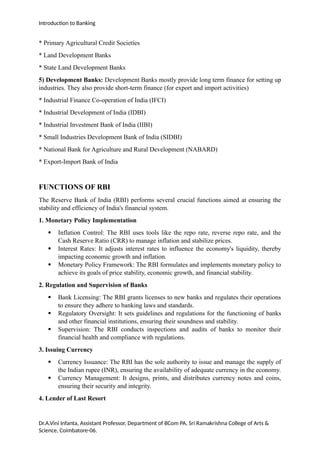
Classification of Banks in India
1) The RBI: The RBI is the supreme monetary and banking authority in the country and has
the responsibility to control the banking system in the country. It keeps the reserves of all
scheduled banks and hence is known as the “Reserve Bank”.
2) Public Sector Banks:
* State Bank of India
* Nationalized Banks(19)
* Regional Rural Banks Sponsored by Public Sector Banks(196)
3) Private Sector Banks:
* Old Generation Private Banks(22)
* Foreign New Generation Private Banks(8)
* Banks in India (40)
4) Co-operative Sector Banks:
* State Co-operative Banks
* Central Co-operative Banks
Dr.A.Vini Infanta, Assistant Professor, Department of BCom PA, Sri Ramakrishna College of Arts &
Science, Coimbatore-06.
Introduction to Banking
* Primary Agricultural Credit Societies
* Land Development Banks
* State Land Development Banks
5) Development Banks: Development Banks mostly provide long term finance for setting up
industries. They also provide short-term finance (for export and import activities)
* Industrial Finance Co-operation of India (IFCI)
* Industrial Development of India (IDBI)
* Industrial Investment Bank of India (IIBI)
* Small Industries Development Bank of India (SIDBI)
* National Bank for Agriculture and Rural Development (NABARD)
* Export-Import Bank of India
FUNCTIONS OF RBI
The Reserve Bank of India (RBI) performs several crucial functions aimed at ensuring the
stability and efficiency of India's financial system.
1. Monetary Policy Implementation
 Inflation Control: The RBI uses tools like the repo rate, reverse repo rate, and the
Cash Reserve Ratio (CRR) to manage inflation and stabilize prices.
 Interest Rates: It adjusts interest rates to influence the economy's liquidity, thereby
impacting economic growth and inflation.
 Monetary Policy Framework: The RBI formulates and implements monetary policy to
achieve its goals of price stability, economic growth, and financial stability.
2. Regulation and Supervision of Banks
 Bank Licensing: The RBI grants licenses to new banks and regulates their operations
to ensure they adhere to banking laws and standards.
 Regulatory Oversight: It sets guidelines and regulations for the functioning of banks
and other financial institutions, ensuring their soundness and stability.
 Supervision: The RBI conducts inspections and audits of banks to monitor their
financial health and compliance with regulations.
3. Issuing Currency
 Currency Issuance: The RBI has the sole authority to issue and manage the supply of
the Indian rupee (INR), ensuring the availability of adequate currency in the economy.
 Currency Management: It designs, prints, and distributes currency notes and coins,
ensuring their security and integrity.
4. Lender of Last Resort
Dr.A.Vini Infanta, Assistant Professor, Department of BCom PA, Sri Ramakrishna College of Arts &
Science, Coimbatore-06.
Introduction to Banking
 Liquidity Support: In times of financial distress or crisis, the RBI provides emergency
funding to banks facing liquidity shortages to prevent bank runs and ensure financial
stability.
5. Managing Foreign Exchange and Reserves
 Foreign Exchange Reserves: The RBI manages India’s foreign exchange reserves to
maintain a buffer against external shocks and ensure stability in the exchange rate.
 Exchange Rate Management: It intervenes in the foreign exchange market to prevent
excessive volatility and maintain a stable exchange rate for the Indian rupee.
6. Government Banking
 Fiscal Agent: The RBI acts as the banker to the central and state governments,
managing their accounts, facilitating transactions, and providing financial advice.
 Public Debt Management: It manages the issuance and servicing of government
securities, helping the government to raise funds efficiently.
7. Payment Systems Oversight
 Payment and Settlement Systems: The RBI oversees and ensures the smooth
functioning of payment and settlement systems, including electronic payment
systems, to facilitate secure and efficient transactions.
 Innovation in Payments: It promotes the development and adoption of new payment
technologies and systems to enhance the efficiency and security of payment
transactions.
8. Developmental Role
 Financial Inclusion: The RBI promotes policies and initiatives to ensure that banking
and financial services are accessible to all sections of society, particularly the
underserved and unbanked populations.
 Development Initiatives: It supports various initiatives aimed at the development of
the financial sector, including promoting digital banking, improving financial literacy,
and encouraging the growth of microfinance institutions.
9. Consumer Protection
 Grievance Redressal: The RBI has mechanisms in place to address complaints and
grievances from bank customers, ensuring fair treatment and resolution of issues.
 Regulatory Framework: It formulates and enforces regulations aimed at protecting
consumers’ interests in the financial sector.
Banking Regulation Act, 1949
The Banking Regulation Act, 1949 is a legislation in India that regulates all banking firms in
India. Passed as the Banking Companies Act 1949, it came into force from 16 March 1949
and changed to Banking Regulation Act 1949 from 1 March 1966. It is applicable in Jammu
and Kashmir from 1956. Initially, the law was applicable only to banking companies. But, in
1965 it was amended to make it applicable to cooperative banks and to introduce other
Dr.A.Vini Infanta, Assistant Professor, Department of BCom PA, Sri Ramakrishna College of Arts &
Science, Coimbatore-06.
Introduction to Banking
changes. In 2020 it was amended to bring the cooperative banks under the supervision of
the Reserve Bank of India.
The Act provides a framework under which commercial banking in India is supervised and
regulated. The Act supplements the Companies Act, 1956. Primary Agricultural Credit
Society and cooperative land mortgage banks are excluded from the Act.
The Act gives the Reserve Bank of India (RBI) the power to license banks, have regulation
over shareholding and voting rights of shareholders; supervise the appointment of the boards
and management; regulate the operations of banks; lay down instructions for audits;
control moratorium, mergers and liquidation; issue directives in the interests of public good
and on banking policy, and impose penalties.
In 1965, the Act was amended to include cooperative banks under its purview by adding the
Section 56. Cooperative banks, which operate only in one state, are formed and run by the
state government. But, RBI controls the licensing and regulates the business operations. The
Banking Act was a supplement to the previous acts related to banking.
Significance of the Act
The Banking Regulation Act, 1949 is significant for several reasons:
 Financial Stability: It ensures the stability and soundness of the banking system by
setting rigorous standards for capital, reserves, and management.
 Consumer Protection: By regulating the activities of banks and ensuring proper
management, the Act protects the interests of depositors and promotes confidence in
the banking system.
 Regulatory Framework: It provides the RBI with the necessary tools and powers to
regulate, supervise, and control banks, ensuring a well-functioning banking sector.
 Adaptability: The Act has been periodically updated to address new challenges and
incorporate international best practices, making it a dynamic and robust regulatory
framework.
COMMERCIAL BANKS
A commercial bank is a financial institution that provides a range of services to individuals,
businesses, and governments. The primary functions of commercial banks include accepting
deposits, providing loans, and offering various financial products and services.
Key Functions of Commercial Banks
1. Accepting Deposits:
 Savings Accounts: These accounts allow customers to deposit money, earn interest,
and withdraw funds as needed.
 Current Accounts: Also known as checking accounts, these provide customers with
the ability to conduct day-to-day transactions, including writing checks and making
electronic payments.
Dr.A.Vini Infanta, Assistant Professor, Department of BCom PA, Sri Ramakrishna College of Arts &
Science, Coimbatore-06.
Introduction to Banking
 Fixed Deposits: Customers can deposit money for a fixed term at a predetermined
interest rate, which typically offers higher returns than savings accounts.
 Recurring Deposits: Customers make regular deposits over a fixed period, earning
interest on the cumulative amount.
2. Providing Loans and Advances:
 Personal Loans: These include loans for various personal needs such as education,
medical expenses, and travel.
 Home Loans: Loans provided for the purchase, construction, or renovation of
residential properties.
 Business Loans: These are loans given to businesses for working capital, expansion,
and other operational needs.
 Vehicle Loans: Loans for the purchase of vehicles.
 Overdraft and Cash Credit: Short-term credit facilities allowing customers to
withdraw more than their account balance up to a pre-approved limit.
3. Payment and Settlement Services:
 Electronic Fund Transfers: Services such as NEFT (National Electronic Funds
Transfer), RTGS (Real Time Gross Settlement), and IMPS (Immediate Payment
Service) for transferring money electronically.
 Debit and Credit Cards: Issuing cards for making purchases and withdrawing cash
from ATMs.
 Internet and Mobile Banking: Providing online platforms for managing accounts,
making transactions, and accessing various banking services.
4. Investment Services:
 Mutual Funds: Offering investment products that pool money from various
investors to invest in diversified portfolios.
 Wealth Management: Providing advisory services and investment solutions to high-
net-worth individuals.
 Insurance Products: Selling life, health, and general insurance policies.
5. Foreign Exchange Services:
 Currency Exchange: Facilitating the exchange of foreign currencies for customers.
 Foreign Currency Accounts: Providing accounts in foreign currencies for individuals
and businesses involved in international trade.
 Trade Finance: Offering services such as letters of credit and export-import financing.
6. Safekeeping and Custodial Services:
 Safe Deposit Boxes: Providing secure storage for valuable items and documents.
 Custodial Services: Safeguarding financial assets such as stocks and bonds on
behalf of clients.
7. Advisory Services:
Dr.A.Vini Infanta, Assistant Professor, Department of BCom PA, Sri Ramakrishna College of Arts &
Science, Coimbatore-06.
Introduction to Banking
 Financial Advisory: Providing advice on investments, retirement planning, and
wealth management.
 Loan and Mortgage Advisory: Assisting customers in choosing the right loan
products and managing their debt.
Importance of Commercial Banks
1.Economic Growth: By providing loans and advances, commercial banks facilitate
investment and consumption, driving economic growth.
2.Financial Inclusion: Commercial banks play a critical role in promoting financial
inclusion by providing banking services to a wide range of customers, including those in rural
and underserved areas.
3.Liquidity Management: Banks help manage liquidity in the economy by mobilizing
savings and channeling them into productive investments.
4.Payment Systems: They ensure the smooth functioning of payment systems, which is
essential for day-to-day transactions and overall economic activity.
5.Job Creation: By supporting businesses through loans and other financial services,
commercial banks contribute to job creation and economic development.
Examples of Commercial Banks
 Public Sector Banks: State Bank of India (SBI), Bank of Baroda, Punjab National
Bank.
 Private Sector Banks: HDFC Bank, ICICI Bank, Axis Bank.
 Foreign Banks: Citibank, HSBC, Standard Chartered Bank.
 Regional Rural Banks: Banks that focus on serving rural areas and promoting
agricultural development.
ROLES OF COMMERCIAL BANKS
Commercial banks play several important roles in the economy, acting as financial
intermediaries between savers and borrowers. Here are the key roles of commercial banks:
1. Accepting Deposits
Commercial banks accept deposits from individuals, businesses, and other entities, which
form a significant portion of their funding base. Types of deposits include savings accounts,
current accounts, fixed deposits, and recurring deposits. By accepting deposits, banks provide
a safe place for customers to store their money while offering them liquidity through various
withdrawal options.
2. Providing Loans and Advances
One of the primary functions of commercial banks is to provide loans and advances to
individuals and businesses. This includes personal loans, home loans, vehicle loans, business
Dr.A.Vini Infanta, Assistant Professor, Department of BCom PA, Sri Ramakrishna College of Arts &
Science, Coimbatore-06.
Introduction to Banking
loans, and overdraft facilities. Banks play a crucial role in allocating credit to productive
sectors of the economy, thereby supporting economic growth, entrepreneurship, and
consumption.
3. Credit Creation
Commercial banks facilitate credit creation through the process of fractional reserve banking.
When banks receive deposits, they are required to hold only a fraction of these deposits as
reserves (as per regulatory requirements like Cash Reserve Ratio, CRR). The remainder can
be lent out to borrowers, effectively creating new money in the form of loans. This process of
credit creation stimulates economic activity by increasing the money supply and supporting
investment and consumption.
4. Payment Services
Commercial banks provide essential payment and settlement services, facilitating the transfer
of funds between individuals, businesses, and other entities. They offer services such as
electronic funds transfer (NEFT, RTGS, IMPS), issuance of cheques and demand drafts, and
provision of debit and credit cards. These services enable smooth and efficient transactions,
contributing to the overall functioning of the economy.
5. Investment Banking Services
Commercial banks often provide investment banking services to corporate clients. This
includes underwriting of securities (such as IPOs and bonds), advisory services for mergers
and acquisitions (M&A), and assistance in raising capital through equity and debt
instruments. Investment banking activities help companies access financial markets and
manage their capital structure effectively.
6. Foreign Exchange Services
Commercial banks facilitate foreign exchange transactions and provide services related to
international trade and travel. They offer currency exchange, trade finance (such as letters of
credit and export-import financing), and hedging services to manage foreign exchange risks.
These services support global business operations and facilitate cross-border transactions.
7. Safekeeping and Custodial Services
Commercial banks offer safe deposit lockers and custodial services to safeguard valuable
items, documents, and financial assets on behalf of their customers. These services provide
security and peace of mind to individuals and businesses needing secure storage for important
belongings.
8. Advisory and Wealth Management Services
Many commercial banks provide advisory services to help customers manage their finances
and make informed investment decisions. This includes financial planning, wealth
management, retirement planning, and insurance advisory services. Banks offer personalized
advice and solutions tailored to the financial goals and risk tolerance of their clients.
9. Promoting Financial Inclusion
Dr.A.Vini Infanta, Assistant Professor, Department of BCom PA, Sri Ramakrishna College of Arts &
Science, Coimbatore-06.
Introduction to Banking
Commercial banks play a crucial role in promoting financial inclusion by extending banking
services to underserved and unbanked populations. They establish branches and deploy
technology to reach remote areas, offering basic banking services and products to previously
excluded segments of society.
10. Economic Development
Overall, commercial banks contribute significantly to economic development by mobilizing
savings, allocating credit efficiently, facilitating payments and transactions, and supporting
financial inclusion. They play a pivotal role in the functioning of a modern economy by
channeling funds from savers to borrowers, thereby stimulating investment, consumption,
and economic growth.
FUNCTIONS OF COMMERCIAL BANKS
Commercial banks perform a variety of functions that are essential for the functioning of an
economy. These functions can be broadly categorized into primary functions, secondary
functions, and modern functions. Here's an overview of each:
Primary Functions of Commercial Banks:
1.Accepting Deposits:
- Commercial banks accept various types of deposits from the public, including savings
accounts, current accounts, fixed deposits, and recurring deposits. Deposits serve as a major
source of funds for banks to lend and invest.
2.Providing Loans and Advances:
- One of the core functions of commercial banks is to provide loans and advances to
individuals, businesses, and other entities. These loans can be for various purposes such as
personal expenses, business expansion, home purchase, vehicle acquisition, and more.
3.Credit Creation:
- Commercial banks facilitate credit creation through the process of fractional reserve
banking. When banks receive deposits, they can lend out a portion of these funds while
keeping a fraction as reserves. This process effectively increases the money supply and
supports economic activities.
Secondary Functions of Commercial Banks:
1.Agency Services:
- Banks act as agents for their customers in conducting various financial transactions, such
as collecting cheques, paying insurance premiums, purchasing and selling securities, and
handling foreign exchange transactions.
2.Collection and Payment of Credit Instruments:
Dr.A.Vini Infanta, Assistant Professor, Department of BCom PA, Sri Ramakrishna College of Arts &
Science, Coimbatore-06.
Introduction to Banking
- Banks facilitate the collection of cheques, drafts, bills of exchange, and other credit
instruments on behalf of their customers. They also make payments on behalf of customers
through electronic transfers, cheques, and demand drafts.
3.Facilitating Foreign Exchange Transactions:
- Commercial banks provide foreign exchange services to facilitate international trade and
travel. They buy and sell foreign currencies, issue letters of credit, and offer trade finance
services to importers and exporters.
4.Locker Facility and Custodial Services:
- Banks offer safe deposit lockers for customers to store valuable items and documents
securely. They also provide custodial services for holding securities and other financial assets
on behalf of clients.
Modern Functions of Commercial Banks:
1.Investment Banking Services:
- Some commercial banks offer investment banking services such as underwriting of
securities (IPOs, bonds), advisory services for mergers and acquisitions (M&A), and capital
market activities.
2.Advisory and Wealth Management Services:
- Banks provide financial advisory services to help customers manage their finances, plan
for retirement, and invest in financial instruments. Wealth management services cater to high-
net-worth individuals and include portfolio management and estate planning.
3.Internet and Mobile Banking:
- Banks offer online banking services that allow customers to perform transactions, check
account balances, pay bills, and transfer funds electronically through internet banking and
mobile banking apps.
4.Supporting Government Programs:
- Banks participate in government schemes and programs aimed at promoting financial
inclusion, rural development, agriculture financing, and other socio-economic objectives.
5.Innovation in Financial Products:
- Banks innovate and introduce new financial products and services such as digital wallets,
contactless payments, prepaid cards, and customized loan products to meet evolving
customer needs and preferences.
Dr.A.Vini Infanta, Assistant Professor, Department of BCom PA, Sri Ramakrishna College of Arts &
Science, Coimbatore-06.

INTRODUCTION TO BANKING IN INDIA .docx.

  • 1.
    Introduction to Banking Introductionto Banking Definition of Banks “A bank is a person or corporation which holds itself out to receive from the public, deposits payable on demand by cheque.” -- Walter Leaf “Bank as a manufacture of credit and a machine for facilitating exchange.” --Horace White “A Bank is a financial institution which accepts money from the public for the purpose of lending or investment repayable on demand or otherwise withdrawal by cheque, drafts or order or otherwise.” --Banking Companies Act of India What is banking? Basic Definition: ✓A system of trading money which provides a safe place to save excess cash, known as deposits. ✓It also supplies liquidity to the economy by loaning this money out to help businesses grow and to allow consumers to purchase consumer products, homes, cars etc. Banking Regulation Act of India, 1949 Sec 5 defines Banking as “accepting, for the purpose of lending or of investment of deposits of money from the public, repayable on demand or otherwise or withdrawable by cheque, draft order or otherwise.” The Reserve Bank of India Act, 1934 and the Banking Regulation Act, 1949, govern the banking operations in India. Banking involves the activities of accepting deposits from individuals and businesses, providing loans, and offering various financial services to facilitate transactions and manage money. Essentially, banking serves as a critical intermediary in the financial system, ensuring the flow of funds from savers to borrowers and supporting economic growth and stability. key functions and services typically associated with banking: 1.Accepting Deposits: Banks provide a safe place for individuals and businesses to store their money. These deposits can be in the form of savings accounts, checking accounts, or fixed deposits. 2.Providing Loans: Banks lend money to individuals, businesses, and governments for various purposes such as buying homes, starting or expanding businesses, or funding public projects. The interest earned on these loans is a primary source of income for banks. Dr.A.Vini Infanta, Assistant Professor, Department of BCom PA, Sri Ramakrishna College of Arts & Science, Coimbatore-06.
  • 2.
    Introduction to Banking 3.Paymentand Settlement Services: Banks facilitate the transfer of money through various means such as checks, electronic funds transfers, credit and debit cards, and online banking services. 4.Investment Services: Banks may offer investment products such as mutual funds, insurance, and wealth management services to help customers grow their wealth. 5.Foreign Exchange Services: Banks provide currency exchange services for individuals and businesses involved in international trade and travel. 6.Safekeeping and Custodial Services: Banks offer safe deposit boxes and custodial services for the safekeeping of valuable items and documents. CENTRAL BANKING Central banking refers to the role and functions of a central bank, which is a national institution responsible for overseeing the monetary system and regulating the banking industry within a country. Central banks play a pivotal role in maintaining financial stability, controlling inflation, and fostering economic growth. Key Functions of Central Banking 1.Monetary Policy Implementation: -Controlling Inflation: Central banks manage the money supply and interest rates to control inflation and ensure price stability. -Economic Growth: They use monetary policy tools to promote sustainable economic growth and employment. 2.Regulation and Supervision: -Banking Regulation: Central banks establish and enforce regulations to ensure the safety and soundness of the banking system. -Supervision: They oversee commercial banks and other financial institutions to maintain public confidence and financial stability. 3.Issuing Currency: - Currency Management: Central banks have the exclusive authority to issue and manage the national currency, ensuring an adequate supply of money in the economy. 4.Lender of Last Resort: -Emergency Support: In times of financial crisis, central banks provide liquidity to banks facing temporary shortages to prevent bank runs and maintain stability. 5.Managing Foreign Exchange and Reserves: Dr.A.Vini Infanta, Assistant Professor, Department of BCom PA, Sri Ramakrishna College of Arts & Science, Coimbatore-06.
  • 3.
    Introduction to Banking -ForeignExchange Reserves: Central banks manage the country's foreign exchange reserves to influence exchange rates and stabilize the currency. -Exchange Rate Policies: They may intervene in foreign exchange markets to prevent excessive volatility. 6.Government Banking: -Fiscal Agent: Central banks often act as the banker and financial advisor to the government, managing public debt and conducting transactions on behalf of the government. 7.Payment Systems Oversight: -Payment Infrastructure: They oversee and ensure the smooth functioning of the national payment systems, including interbank transfers and electronic payments. Examples of Central Banks -Federal Reserve (Fed) in the United States: Manages monetary policy, regulates banks, and provides financial services. -European Central Bank (ECB): Manages the euro, conducts monetary policy for the Eurozone, and ensures financial stability. -Bank of England (BoE): Responsible for monetary policy, issuing currency, and regulating banks in the UK. -Bank of Japan (BoJ): Controls monetary policy, manages the yen, and oversees the financial system in Japan. RBI - Reserve Bank of India Reserve Bank of India was established in 1935, under the Reserve Bank of India Act,1934. In 1960, the State Banks of India was given control of eight state-associated banks under the State Bank of India (Subsidiary Banks) Act, 1959. These are now called its associate banks. In 1969 the Indian government nationalised 14 major private banks. In 1980, 6 more private banks were nationalized. These nationalized banks are the majority of lenders in the Indian economy The Indian banking sector is broadly classified into scheduled banks and non- scheduled banks The scheduled banks are further classified into: nationalised banks; State Bank of India and its associates; Regional Rural Banks (RRBs); foreign banks; and other Indian private sector Dr.A.Vini Infanta, Assistant Professor, Department of BCom PA, Sri Ramakrishna College of Arts & Science, Coimbatore-06.
  • 4.
    Introduction to Banking banks.The term commercial banks refer to both scheduled and non-scheduled commercial banks which are regulated under the Banking Regulation Act, 1949. In the early 1990s, the then government embarked on a policy of liberalization, licensing a small number of private banks. These came to be known as New Generation tech-savvy banks, and included Global Trust Bank (the first of such new generation banks to be set up), which later amalgamated with Oriental Bank of Commerce, UTI Bank (since renamed Axis Bank), ICICI Bank and HDFC Bank. Classification of Banks in India 1) The RBI: The RBI is the supreme monetary and banking authority in the country and has the responsibility to control the banking system in the country. It keeps the reserves of all scheduled banks and hence is known as the “Reserve Bank”. 2) Public Sector Banks: * State Bank of India * Nationalized Banks(19) * Regional Rural Banks Sponsored by Public Sector Banks(196) 3) Private Sector Banks: * Old Generation Private Banks(22) * Foreign New Generation Private Banks(8) * Banks in India (40) 4) Co-operative Sector Banks: * State Co-operative Banks * Central Co-operative Banks Dr.A.Vini Infanta, Assistant Professor, Department of BCom PA, Sri Ramakrishna College of Arts & Science, Coimbatore-06.
  • 5.
    Introduction to Banking *Primary Agricultural Credit Societies * Land Development Banks * State Land Development Banks 5) Development Banks: Development Banks mostly provide long term finance for setting up industries. They also provide short-term finance (for export and import activities) * Industrial Finance Co-operation of India (IFCI) * Industrial Development of India (IDBI) * Industrial Investment Bank of India (IIBI) * Small Industries Development Bank of India (SIDBI) * National Bank for Agriculture and Rural Development (NABARD) * Export-Import Bank of India FUNCTIONS OF RBI The Reserve Bank of India (RBI) performs several crucial functions aimed at ensuring the stability and efficiency of India's financial system. 1. Monetary Policy Implementation  Inflation Control: The RBI uses tools like the repo rate, reverse repo rate, and the Cash Reserve Ratio (CRR) to manage inflation and stabilize prices.  Interest Rates: It adjusts interest rates to influence the economy's liquidity, thereby impacting economic growth and inflation.  Monetary Policy Framework: The RBI formulates and implements monetary policy to achieve its goals of price stability, economic growth, and financial stability. 2. Regulation and Supervision of Banks  Bank Licensing: The RBI grants licenses to new banks and regulates their operations to ensure they adhere to banking laws and standards.  Regulatory Oversight: It sets guidelines and regulations for the functioning of banks and other financial institutions, ensuring their soundness and stability.  Supervision: The RBI conducts inspections and audits of banks to monitor their financial health and compliance with regulations. 3. Issuing Currency  Currency Issuance: The RBI has the sole authority to issue and manage the supply of the Indian rupee (INR), ensuring the availability of adequate currency in the economy.  Currency Management: It designs, prints, and distributes currency notes and coins, ensuring their security and integrity. 4. Lender of Last Resort Dr.A.Vini Infanta, Assistant Professor, Department of BCom PA, Sri Ramakrishna College of Arts & Science, Coimbatore-06.
  • 6.
    Introduction to Banking Liquidity Support: In times of financial distress or crisis, the RBI provides emergency funding to banks facing liquidity shortages to prevent bank runs and ensure financial stability. 5. Managing Foreign Exchange and Reserves  Foreign Exchange Reserves: The RBI manages India’s foreign exchange reserves to maintain a buffer against external shocks and ensure stability in the exchange rate.  Exchange Rate Management: It intervenes in the foreign exchange market to prevent excessive volatility and maintain a stable exchange rate for the Indian rupee. 6. Government Banking  Fiscal Agent: The RBI acts as the banker to the central and state governments, managing their accounts, facilitating transactions, and providing financial advice.  Public Debt Management: It manages the issuance and servicing of government securities, helping the government to raise funds efficiently. 7. Payment Systems Oversight  Payment and Settlement Systems: The RBI oversees and ensures the smooth functioning of payment and settlement systems, including electronic payment systems, to facilitate secure and efficient transactions.  Innovation in Payments: It promotes the development and adoption of new payment technologies and systems to enhance the efficiency and security of payment transactions. 8. Developmental Role  Financial Inclusion: The RBI promotes policies and initiatives to ensure that banking and financial services are accessible to all sections of society, particularly the underserved and unbanked populations.  Development Initiatives: It supports various initiatives aimed at the development of the financial sector, including promoting digital banking, improving financial literacy, and encouraging the growth of microfinance institutions. 9. Consumer Protection  Grievance Redressal: The RBI has mechanisms in place to address complaints and grievances from bank customers, ensuring fair treatment and resolution of issues.  Regulatory Framework: It formulates and enforces regulations aimed at protecting consumers’ interests in the financial sector. Banking Regulation Act, 1949 The Banking Regulation Act, 1949 is a legislation in India that regulates all banking firms in India. Passed as the Banking Companies Act 1949, it came into force from 16 March 1949 and changed to Banking Regulation Act 1949 from 1 March 1966. It is applicable in Jammu and Kashmir from 1956. Initially, the law was applicable only to banking companies. But, in 1965 it was amended to make it applicable to cooperative banks and to introduce other Dr.A.Vini Infanta, Assistant Professor, Department of BCom PA, Sri Ramakrishna College of Arts & Science, Coimbatore-06.
  • 7.
    Introduction to Banking changes.In 2020 it was amended to bring the cooperative banks under the supervision of the Reserve Bank of India. The Act provides a framework under which commercial banking in India is supervised and regulated. The Act supplements the Companies Act, 1956. Primary Agricultural Credit Society and cooperative land mortgage banks are excluded from the Act. The Act gives the Reserve Bank of India (RBI) the power to license banks, have regulation over shareholding and voting rights of shareholders; supervise the appointment of the boards and management; regulate the operations of banks; lay down instructions for audits; control moratorium, mergers and liquidation; issue directives in the interests of public good and on banking policy, and impose penalties. In 1965, the Act was amended to include cooperative banks under its purview by adding the Section 56. Cooperative banks, which operate only in one state, are formed and run by the state government. But, RBI controls the licensing and regulates the business operations. The Banking Act was a supplement to the previous acts related to banking. Significance of the Act The Banking Regulation Act, 1949 is significant for several reasons:  Financial Stability: It ensures the stability and soundness of the banking system by setting rigorous standards for capital, reserves, and management.  Consumer Protection: By regulating the activities of banks and ensuring proper management, the Act protects the interests of depositors and promotes confidence in the banking system.  Regulatory Framework: It provides the RBI with the necessary tools and powers to regulate, supervise, and control banks, ensuring a well-functioning banking sector.  Adaptability: The Act has been periodically updated to address new challenges and incorporate international best practices, making it a dynamic and robust regulatory framework. COMMERCIAL BANKS A commercial bank is a financial institution that provides a range of services to individuals, businesses, and governments. The primary functions of commercial banks include accepting deposits, providing loans, and offering various financial products and services. Key Functions of Commercial Banks 1. Accepting Deposits:  Savings Accounts: These accounts allow customers to deposit money, earn interest, and withdraw funds as needed.  Current Accounts: Also known as checking accounts, these provide customers with the ability to conduct day-to-day transactions, including writing checks and making electronic payments. Dr.A.Vini Infanta, Assistant Professor, Department of BCom PA, Sri Ramakrishna College of Arts & Science, Coimbatore-06.
  • 8.
    Introduction to Banking Fixed Deposits: Customers can deposit money for a fixed term at a predetermined interest rate, which typically offers higher returns than savings accounts.  Recurring Deposits: Customers make regular deposits over a fixed period, earning interest on the cumulative amount. 2. Providing Loans and Advances:  Personal Loans: These include loans for various personal needs such as education, medical expenses, and travel.  Home Loans: Loans provided for the purchase, construction, or renovation of residential properties.  Business Loans: These are loans given to businesses for working capital, expansion, and other operational needs.  Vehicle Loans: Loans for the purchase of vehicles.  Overdraft and Cash Credit: Short-term credit facilities allowing customers to withdraw more than their account balance up to a pre-approved limit. 3. Payment and Settlement Services:  Electronic Fund Transfers: Services such as NEFT (National Electronic Funds Transfer), RTGS (Real Time Gross Settlement), and IMPS (Immediate Payment Service) for transferring money electronically.  Debit and Credit Cards: Issuing cards for making purchases and withdrawing cash from ATMs.  Internet and Mobile Banking: Providing online platforms for managing accounts, making transactions, and accessing various banking services. 4. Investment Services:  Mutual Funds: Offering investment products that pool money from various investors to invest in diversified portfolios.  Wealth Management: Providing advisory services and investment solutions to high- net-worth individuals.  Insurance Products: Selling life, health, and general insurance policies. 5. Foreign Exchange Services:  Currency Exchange: Facilitating the exchange of foreign currencies for customers.  Foreign Currency Accounts: Providing accounts in foreign currencies for individuals and businesses involved in international trade.  Trade Finance: Offering services such as letters of credit and export-import financing. 6. Safekeeping and Custodial Services:  Safe Deposit Boxes: Providing secure storage for valuable items and documents.  Custodial Services: Safeguarding financial assets such as stocks and bonds on behalf of clients. 7. Advisory Services: Dr.A.Vini Infanta, Assistant Professor, Department of BCom PA, Sri Ramakrishna College of Arts & Science, Coimbatore-06.
  • 9.
    Introduction to Banking Financial Advisory: Providing advice on investments, retirement planning, and wealth management.  Loan and Mortgage Advisory: Assisting customers in choosing the right loan products and managing their debt. Importance of Commercial Banks 1.Economic Growth: By providing loans and advances, commercial banks facilitate investment and consumption, driving economic growth. 2.Financial Inclusion: Commercial banks play a critical role in promoting financial inclusion by providing banking services to a wide range of customers, including those in rural and underserved areas. 3.Liquidity Management: Banks help manage liquidity in the economy by mobilizing savings and channeling them into productive investments. 4.Payment Systems: They ensure the smooth functioning of payment systems, which is essential for day-to-day transactions and overall economic activity. 5.Job Creation: By supporting businesses through loans and other financial services, commercial banks contribute to job creation and economic development. Examples of Commercial Banks  Public Sector Banks: State Bank of India (SBI), Bank of Baroda, Punjab National Bank.  Private Sector Banks: HDFC Bank, ICICI Bank, Axis Bank.  Foreign Banks: Citibank, HSBC, Standard Chartered Bank.  Regional Rural Banks: Banks that focus on serving rural areas and promoting agricultural development. ROLES OF COMMERCIAL BANKS Commercial banks play several important roles in the economy, acting as financial intermediaries between savers and borrowers. Here are the key roles of commercial banks: 1. Accepting Deposits Commercial banks accept deposits from individuals, businesses, and other entities, which form a significant portion of their funding base. Types of deposits include savings accounts, current accounts, fixed deposits, and recurring deposits. By accepting deposits, banks provide a safe place for customers to store their money while offering them liquidity through various withdrawal options. 2. Providing Loans and Advances One of the primary functions of commercial banks is to provide loans and advances to individuals and businesses. This includes personal loans, home loans, vehicle loans, business Dr.A.Vini Infanta, Assistant Professor, Department of BCom PA, Sri Ramakrishna College of Arts & Science, Coimbatore-06.
  • 10.
    Introduction to Banking loans,and overdraft facilities. Banks play a crucial role in allocating credit to productive sectors of the economy, thereby supporting economic growth, entrepreneurship, and consumption. 3. Credit Creation Commercial banks facilitate credit creation through the process of fractional reserve banking. When banks receive deposits, they are required to hold only a fraction of these deposits as reserves (as per regulatory requirements like Cash Reserve Ratio, CRR). The remainder can be lent out to borrowers, effectively creating new money in the form of loans. This process of credit creation stimulates economic activity by increasing the money supply and supporting investment and consumption. 4. Payment Services Commercial banks provide essential payment and settlement services, facilitating the transfer of funds between individuals, businesses, and other entities. They offer services such as electronic funds transfer (NEFT, RTGS, IMPS), issuance of cheques and demand drafts, and provision of debit and credit cards. These services enable smooth and efficient transactions, contributing to the overall functioning of the economy. 5. Investment Banking Services Commercial banks often provide investment banking services to corporate clients. This includes underwriting of securities (such as IPOs and bonds), advisory services for mergers and acquisitions (M&A), and assistance in raising capital through equity and debt instruments. Investment banking activities help companies access financial markets and manage their capital structure effectively. 6. Foreign Exchange Services Commercial banks facilitate foreign exchange transactions and provide services related to international trade and travel. They offer currency exchange, trade finance (such as letters of credit and export-import financing), and hedging services to manage foreign exchange risks. These services support global business operations and facilitate cross-border transactions. 7. Safekeeping and Custodial Services Commercial banks offer safe deposit lockers and custodial services to safeguard valuable items, documents, and financial assets on behalf of their customers. These services provide security and peace of mind to individuals and businesses needing secure storage for important belongings. 8. Advisory and Wealth Management Services Many commercial banks provide advisory services to help customers manage their finances and make informed investment decisions. This includes financial planning, wealth management, retirement planning, and insurance advisory services. Banks offer personalized advice and solutions tailored to the financial goals and risk tolerance of their clients. 9. Promoting Financial Inclusion Dr.A.Vini Infanta, Assistant Professor, Department of BCom PA, Sri Ramakrishna College of Arts & Science, Coimbatore-06.
  • 11.
    Introduction to Banking Commercialbanks play a crucial role in promoting financial inclusion by extending banking services to underserved and unbanked populations. They establish branches and deploy technology to reach remote areas, offering basic banking services and products to previously excluded segments of society. 10. Economic Development Overall, commercial banks contribute significantly to economic development by mobilizing savings, allocating credit efficiently, facilitating payments and transactions, and supporting financial inclusion. They play a pivotal role in the functioning of a modern economy by channeling funds from savers to borrowers, thereby stimulating investment, consumption, and economic growth. FUNCTIONS OF COMMERCIAL BANKS Commercial banks perform a variety of functions that are essential for the functioning of an economy. These functions can be broadly categorized into primary functions, secondary functions, and modern functions. Here's an overview of each: Primary Functions of Commercial Banks: 1.Accepting Deposits: - Commercial banks accept various types of deposits from the public, including savings accounts, current accounts, fixed deposits, and recurring deposits. Deposits serve as a major source of funds for banks to lend and invest. 2.Providing Loans and Advances: - One of the core functions of commercial banks is to provide loans and advances to individuals, businesses, and other entities. These loans can be for various purposes such as personal expenses, business expansion, home purchase, vehicle acquisition, and more. 3.Credit Creation: - Commercial banks facilitate credit creation through the process of fractional reserve banking. When banks receive deposits, they can lend out a portion of these funds while keeping a fraction as reserves. This process effectively increases the money supply and supports economic activities. Secondary Functions of Commercial Banks: 1.Agency Services: - Banks act as agents for their customers in conducting various financial transactions, such as collecting cheques, paying insurance premiums, purchasing and selling securities, and handling foreign exchange transactions. 2.Collection and Payment of Credit Instruments: Dr.A.Vini Infanta, Assistant Professor, Department of BCom PA, Sri Ramakrishna College of Arts & Science, Coimbatore-06.
  • 12.
    Introduction to Banking -Banks facilitate the collection of cheques, drafts, bills of exchange, and other credit instruments on behalf of their customers. They also make payments on behalf of customers through electronic transfers, cheques, and demand drafts. 3.Facilitating Foreign Exchange Transactions: - Commercial banks provide foreign exchange services to facilitate international trade and travel. They buy and sell foreign currencies, issue letters of credit, and offer trade finance services to importers and exporters. 4.Locker Facility and Custodial Services: - Banks offer safe deposit lockers for customers to store valuable items and documents securely. They also provide custodial services for holding securities and other financial assets on behalf of clients. Modern Functions of Commercial Banks: 1.Investment Banking Services: - Some commercial banks offer investment banking services such as underwriting of securities (IPOs, bonds), advisory services for mergers and acquisitions (M&A), and capital market activities. 2.Advisory and Wealth Management Services: - Banks provide financial advisory services to help customers manage their finances, plan for retirement, and invest in financial instruments. Wealth management services cater to high- net-worth individuals and include portfolio management and estate planning. 3.Internet and Mobile Banking: - Banks offer online banking services that allow customers to perform transactions, check account balances, pay bills, and transfer funds electronically through internet banking and mobile banking apps. 4.Supporting Government Programs: - Banks participate in government schemes and programs aimed at promoting financial inclusion, rural development, agriculture financing, and other socio-economic objectives. 5.Innovation in Financial Products: - Banks innovate and introduce new financial products and services such as digital wallets, contactless payments, prepaid cards, and customized loan products to meet evolving customer needs and preferences. Dr.A.Vini Infanta, Assistant Professor, Department of BCom PA, Sri Ramakrishna College of Arts & Science, Coimbatore-06.