

Chiro and Learning
Difficulties
How Neuro-Musculo-Skeletal care may
help brain function.

   Merlene Dilger B.Sc.M.Chir G.Dip.Cl.Nutr
   Chiropractor
   Nutritionist


   Betterhealthpractices.com.au
   info@betterhealthpractices.com.au
   4340 5154
My Story.

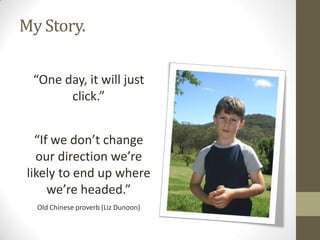
  “One day, it will just
        click.”


   “If we don’t change
   our direction we’re
 likely to end up where
      we’re headed.”
  Old Chinese proverb (Liz Dunoon)
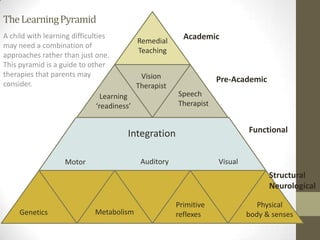
The Learning Pyramid
A child with learning difficulties                       Academic
                                           Remedial
may need a combination of
                                           Teaching
approaches rather than just one.
This pyramid is a guide to other
therapies that parents may                  Vision
consider.
                                                                   Pre-Academic
                                           Therapist
                               Learning                Speech
                             ‘readiness’               Therapist


                                       Integration                          Functional


                   Motor                    Auditory               Visual
                                                                                  Structural
                                                                                  Neurological

                                                       Primitive               Physical
     Genetics                Metabolism                reflexes             body & senses
A team approach

Behavioural Optometrist
Biomedically – trained GPs
Learning Difficulties Specialist Tutors
Osteopaths / Chiropractors (cranial work)
Herbalist / Naturopath / Nutritionist
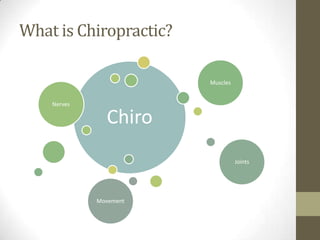
What is Chiropractic?

                        Muscles


    Nerves

               Chiro
                                  Joints


             Movement
Definition

“Chiropractic is based on the now
scientifically proven hypothesis that proper
structure of the spine is required for proper
function of the nervous system as it relates
to the control and regulation of global
physiology and health.”
Cranial Chiropractic
      (craniosacral technique)


The human skull (cranium) houses and protects the very delicate
tissue of the brain. It consists of 22 different bones that are
separated from each other by joints or seams. These are called
sutures.
Sutures are sites of flexibility between the more rigid skull bones.
In healthy individuals the bones of the skull make subtle, almost
imperceptible movements.
The proper movement of cranial bones is critical to proper brain
function. Their primary function is to allow bone expansion and
brain growth.
Parts of the brain

1. Brain Stem
Heart rate, respiration, primitive reflexes


2. Mid brain
Emotions, stress response, language


3. Frontal cortex
Interprets senses, reasoning, decisions
What 4 things are essential for brain
function?

 1.   •Fuel (glucose)

 2.   •Oxygen

 3.   •Nutrition – EFA’s etc

 4.   •Stimulation (sensory input)
90% of stimulation and nutrition to the brain is generated through
movement of the spine, via input from mechanoreceptors (nerve
endings) in joints, ligaments, tendons, and muscles, especially the
  upper neck area (cervical spine) as we move through gravity.


 Other sensory input includes sight, hearing, olfactory (smell),
 taste, temperature, pressure, and proprioception (positional
                           sense).


Everything we learn enters through our sensory pathways. How
well we attend to and retain this sensory input determines our
  learning. Simultaneous access to multiple sensory pathways
                increases our potential to learn.
Learning Retention

We retain:
10% of what is read
20% of what is heard
30% of what is seen
50% of what is seen and heard
70% of what is said as you talk
90% of what is said as you do a thing
Everything we learn enters through our sensory pathways.
Multi-sensory approach helps dyslexics store and retrieve info.
Retained Primitive Reflexes

Primitive reflexes are those reflexes that a baby is born with that
are designed to insure immediate response to their new
environment. They are automatic, stereotyped movements,
directed from the brain stem. The brain stem is our ‘primitive’
brain. It controls our physiology, monitors the world through our
senses, and activates the body to physically respond.
These reflexes become obsolete as a baby starts to respond to a
gravity-based environment and gain more purposeful movement.
In fact, if they are kept they become a barrier to easy natural
movement development.
Keeping primitive reflexes beyond their usefulness can affect
both academic learning and social interaction.
Retained Primitive Reflexes

The ongoing presence of primitive reflexes at school age indicates
that the lower part of the brain (brain stem) has not reached full
maturity. It may result in immature patterns of behaviour or may
cause immature systems to remain prevalent, despite the
acquisition of later skills.
This poor organisation of brain nerve fibres can affect one or all
of the following areas of functioning:
Gross and fine muscle co-ordination
Sensory perception
Cognition
Avenues of expression
Retained Primitive Reflexes

It is as if later skills remain tethered to an earlier stage of
development and instead of becoming automatic, can only be
mastered through continuous conscious effort.
Inhibition of a reflex frequently correlates with the acquisition of
a new skill. Preschool play activity plays an important role in the
maturation of these primitive reflexes, but for some children this
natural pre-academic phase of learning and development is not
completed.
The lower part of the brain then will not automatically pick up
and send good information to the higher thinking, judging,
talking, understanding and remembering parts of the brain.
MORO REFLEX
• Earliest form of fight / flight response.
• Integrated 2 – 4 months of age.
Failure to integrate:
• Over-reactiveness to stimulation (sight, sounds, touch).
• Easily distracted / difficulty relaxing
• Allergies / lowered immunity
• Vestibular problems – motion sickness, poor balance/co-ord
• Poor pupillary reaction to light – photosensitivity
• Poor Stamina
PALMAR REFLEX
• Continuation of an earlier stage of evolution
• Direct link between reflex and sucking (mouth movements)
• Inhibited 2-3 months
Failure to integrate:
• poor manual dexterity
• Tight pencil grip
• Accessory mouth movements when writing / drawing
• Speech difficulties
ASYMMETRICAL TONIC NECK REFLEX
• Movement of the head to one side causes extension of arm
  and leg on that side and flexion on the opposite side.
• Inhibited: 6 months
Failure to integrate:
• Invisible barrier to crossing the vertical midline
• Homolateral crawling, walking, marching
• Poor ‘ocular pursuit’ – tracking
• Poor handwriting/writing posture – rotate page
• Mixed laterality
SPINAL GALANT
• Stimulation of back to one side causes hip flexion to that side.
• Integrated at 3-9months
Failure to Integrate:
• Ticklish / restless / “ants in pants”
• Extended bedwetting
• Poor concentration
• Poor short term memory
• Hip rotation when walking / scoliosis
TONIC LABYRINTHINE REFLEX
• Early primitive method of response to gravity.
• Head movement beyond midplane causes flexion/extension
  throughout the entire body.
• Integrated at 4 months – 3 years
Failure to Integrate:
• Difficulty holding holding head and body up against gravity.
• Can’t sit still in a chair.
• Hypotonic/hypertonic muscles
• Balance problems, clumsy, motion sickness
• Walks on toes
• Poor sequencing skills / organisational skills
The Plastic Brain

The primary source of activation of the brain is through the
motor system. High frequency, low intensity activity of the motor
system has powerful effects on the global activation, arousal and
attention of all centres of the brain.
If the primitive reflexes haven’t integrated properly and/or the
sequential movement patterns haven’t progressed as they are
supposed to it is possible to do it at a later stage.
Stylized sequential movements give the brain a second chance.
Neurologically we are creating super highways from neural
pathways.
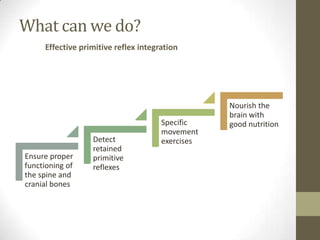
What can we do?
     Effective primitive reflex integration


                                                  Nourish the
                                                  brain with
                                      Specific    good nutrition
                                      movement
                  Detect              exercises
                  retained
Ensure proper     primitive
functioning of    reflexes
the spine and
cranial bones
MOVE TO LEARN

Barbara Pheloung
We need to move to learn.
Movement enables neurological development, but it has to be
the right kind of movement and done in the appropriate order.
Each skill builds on the one just gained, to form a solid
foundation.
Developed an easily followed, correctly ordered movement
programme that has proven to be an effective means of
increasing neurological maturity and integration.
BRAIN GYM

• Bases its exercises on the premise that the lower sections of
  our brains (brain stem) must be settled before learning can
  take place.
• The brain gym movements consciously activate the whole
  mind/body system, stimulating nervous system activity in all
  parts of the brain and lessening the fight/flight reaction.
• Describes brain function in 3 dimensions:
① Laterality – between 2 sides of the brain
② Focus – between the back and front of the brain
③ Centering – between the top and bottom of the brain
THE EXTRA LESSON
Programme based on the premise that learning difficulties are
often due to disruptions in the developmental stages of the first
7 years of life. This can result in :
Poor spatial orientation and body awareness
Sensory processing challenges
Retained early movement patterns
Co-ordination difficulties
Research supports the connection between learning difficulties
and early childhood development and shows that regular
movement and physical activity can help develop neural
pathways in the brain.
Works on the underlying barriers to learning.
ESSENTIAL FATTY ACIDS
EFA’s are nutrients that are considered ‘essential’ because they are
required for optimal health but cannot be produced by the body, and
must, therefore, be obtained from the diet or supplementation.
The most beneficial omega-3’s are EPA and DHA. Fish is the best food
source but due to concerns about toxins a purified fish oil supplement is
the safest source.
Omega-3’s from plants (like flax oil) contain ALA which must be
converted to DHA and EPA. Our body is not efficient at this conversion.
EPA and DHA work together, however each fatty acid has unique
benefits.
Insufficient consumption may mean inadequate formation of the myelin
sheath surrounding nerve and brain cells.
Docosahexaenic Acid (DHA)
 Essential for healthy brain function
 Protects the aging mind
 Supports a healthy pregnancy
 Promotes good mood and emotional well-being
 Improves behaviour, focus, and ability to learn in children*
 Supports developing brain and eye
 Reduces the harmful effects of stress
*(References include Journal of Clinical Nutrition, Journal of the
Academy of Child and Adolescent Psychiatry)
Dr. Alex Richardson – FAB (food and behaviour research)
Eicosapentaenoic Acid (EPA)
 Promotes a healthy heart and circulatory system
 Promotes healthy triglyceride levels
 Supports proper immune function
 Promotes good mood and general well-being
 Improves symptoms of arthritis, including joint flexibility
 Supports the body’s natural anti-inflammatory response
 Helps maintain balanced blood sugar levels
QUALITY ISSUES
Fish oils can contain impurities such as mercury and other heavy
metals.
Exposure to heat or light during manufacturing oxidises the fats.
Chemicals such as hexane are often used to to remove heavy metals.
Dioxins are not specified under Australian Standards testing. Dioxins are
a known neurotoxin.
Freshness is very important. Indicator is PV (peroxide value).
PV’s
Australian Standard:       <10meq/kg
Metagenics fish oil:       <5meq/kg
Nordic Naturals:           <1meq/kg
Triglyceride (natural) form better than ‘ethyl ester’ (new to nature)
EFA DEFICIENCY
 Dry, scaly, flaky skin          Susceptibility to infection
 Cracking, peeling fingertips    Thick, cracked calluses (heel)
 Small bumps on upper arms  Quilted skin
 Soft, splitting fingernails     Decreased growth in kids
 Dry eyes, mouth, throat
 Excessive ear wax
 Excessive thirst
 Allergies
 Crave fatty foods
 Poor wound healing
Dietary Sources of EPA, DHA
 Oily fish (sardines, anchovies, not krill)
 Grass-fed meat
 Grass-fed, free-range chook eggs
What we subtract from our diet may be as important as what we
add.
Omega-6: Recommended 2:1 ratio with omega-3.
Western diet 15:1 ratio
Omega-6 found in grains
 Decrease grains and increase oily fish, eat organic, pasture-fed
  meat and eggs
HOW MUCH?
MINDD Foundation recommendations (children):
Starting dose:
750 mg EPA
250mg DHA
Nordic Naturals recommendations (adult):
Avoid deficiency:     500mg EPA and DHA
Proactive support:    1g EPA and DHA
High intensity support: 2-4g EPA and DHA
ZINC
Zinc is important for the production of hundreds of enzymes
within the body.
 Formation of neurotransmitters (dopamine and
  noradrenaline)
 Detoxification systems
 Immune function
 Protein and collagen synthesis
 Cell reproduction
 Wound healing
 Zinc : copper important
Signs of Zinc deficiency
 Disrupted sleep patterns     Frequent sore throats
 Poor concentration           Taste/smell impairment
 Memory impairment            Fussy/picky eater
 Mental apathy                White spots on nails
 Eczema, asthma, allergies    Transverse lines on nails
 Mouth ulcers                 Poor nail growth
 Hair loss                    Positive zinc taste test
 Growth retardation
 Acne, skin lesions
 Frequent colds
Dietary sources of Zinc
 Pumpkin seeds
 Sunflower seeds
 Seafood
 Brewer’s yeast
 Animal protein
 Mushrooms
 Wholegrains
High phytate diet (cereal grains) can block zinc absorption.
Our bodies only absorb about 30% of dietary zinc.
How much?
From Encyclopaedia of Nutritional Supplements-M. Murray
Adults:
General health support:          15-20mg
Specific needs:                  Men: 30-60mg
                                 Women: 30-45mg
MINDD Foundation
Children:
Zinc (as picolinate):            20-60mg/day
(20mg plus 1mg per pound of body weight)
If picolinate not available, use amino acid chelate or sulphate.
WHAT I DO
 SPINAL ASSESSMENT
 CRANIAL ASSESSMENT
 ASSESSMENT OF PRIMITIVE REFLEXES
 NUTRITIONAL ASSESSMENT
 CHIROPRACTIC CARE
 CRANIAL WORK
 FAR-INFRARED LIGHT THERAPY
 EXERCISE PROGRAM FOR INTEGRATION OF REFLEXES
 REFERRAL TO APPROPRIATE ALLIED THERAPISTS
For More Information
Merlene Dilger   betterhealthpractices.com.au
                 info@betterhealthpractices.com.au
                 4340 5154

Chiro and Learning Difficulties

  • 1.
    Chiro and Learning Difficulties HowNeuro-Musculo-Skeletal care may help brain function. Merlene Dilger B.Sc.M.Chir G.Dip.Cl.Nutr Chiropractor Nutritionist Betterhealthpractices.com.au info@betterhealthpractices.com.au 4340 5154
  • 2.
    My Story. “One day, it will just click.” “If we don’t change our direction we’re likely to end up where we’re headed.” Old Chinese proverb (Liz Dunoon)
  • 3.
    The Learning Pyramid Achild with learning difficulties Academic Remedial may need a combination of Teaching approaches rather than just one. This pyramid is a guide to other therapies that parents may Vision consider. Pre-Academic Therapist Learning Speech ‘readiness’ Therapist Integration Functional Motor Auditory Visual Structural Neurological Primitive Physical Genetics Metabolism reflexes body & senses
  • 4.
    A team approach BehaviouralOptometrist Biomedically – trained GPs Learning Difficulties Specialist Tutors Osteopaths / Chiropractors (cranial work) Herbalist / Naturopath / Nutritionist
  • 5.
    What is Chiropractic? Muscles Nerves Chiro Joints Movement
  • 6.
    Definition “Chiropractic is basedon the now scientifically proven hypothesis that proper structure of the spine is required for proper function of the nervous system as it relates to the control and regulation of global physiology and health.”
  • 7.
    Cranial Chiropractic (craniosacral technique) The human skull (cranium) houses and protects the very delicate tissue of the brain. It consists of 22 different bones that are separated from each other by joints or seams. These are called sutures. Sutures are sites of flexibility between the more rigid skull bones. In healthy individuals the bones of the skull make subtle, almost imperceptible movements. The proper movement of cranial bones is critical to proper brain function. Their primary function is to allow bone expansion and brain growth.
  • 8.
    Parts of thebrain 1. Brain Stem Heart rate, respiration, primitive reflexes 2. Mid brain Emotions, stress response, language 3. Frontal cortex Interprets senses, reasoning, decisions
  • 9.
    What 4 thingsare essential for brain function? 1. •Fuel (glucose) 2. •Oxygen 3. •Nutrition – EFA’s etc 4. •Stimulation (sensory input)
  • 10.
    90% of stimulationand nutrition to the brain is generated through movement of the spine, via input from mechanoreceptors (nerve endings) in joints, ligaments, tendons, and muscles, especially the upper neck area (cervical spine) as we move through gravity. Other sensory input includes sight, hearing, olfactory (smell), taste, temperature, pressure, and proprioception (positional sense). Everything we learn enters through our sensory pathways. How well we attend to and retain this sensory input determines our learning. Simultaneous access to multiple sensory pathways increases our potential to learn.
  • 11.
    Learning Retention We retain: 10%of what is read 20% of what is heard 30% of what is seen 50% of what is seen and heard 70% of what is said as you talk 90% of what is said as you do a thing Everything we learn enters through our sensory pathways. Multi-sensory approach helps dyslexics store and retrieve info.
  • 12.
    Retained Primitive Reflexes Primitivereflexes are those reflexes that a baby is born with that are designed to insure immediate response to their new environment. They are automatic, stereotyped movements, directed from the brain stem. The brain stem is our ‘primitive’ brain. It controls our physiology, monitors the world through our senses, and activates the body to physically respond. These reflexes become obsolete as a baby starts to respond to a gravity-based environment and gain more purposeful movement. In fact, if they are kept they become a barrier to easy natural movement development. Keeping primitive reflexes beyond their usefulness can affect both academic learning and social interaction.
  • 13.
    Retained Primitive Reflexes Theongoing presence of primitive reflexes at school age indicates that the lower part of the brain (brain stem) has not reached full maturity. It may result in immature patterns of behaviour or may cause immature systems to remain prevalent, despite the acquisition of later skills. This poor organisation of brain nerve fibres can affect one or all of the following areas of functioning: Gross and fine muscle co-ordination Sensory perception Cognition Avenues of expression
  • 14.
    Retained Primitive Reflexes Itis as if later skills remain tethered to an earlier stage of development and instead of becoming automatic, can only be mastered through continuous conscious effort. Inhibition of a reflex frequently correlates with the acquisition of a new skill. Preschool play activity plays an important role in the maturation of these primitive reflexes, but for some children this natural pre-academic phase of learning and development is not completed. The lower part of the brain then will not automatically pick up and send good information to the higher thinking, judging, talking, understanding and remembering parts of the brain.
  • 15.
    MORO REFLEX • Earliestform of fight / flight response. • Integrated 2 – 4 months of age. Failure to integrate: • Over-reactiveness to stimulation (sight, sounds, touch). • Easily distracted / difficulty relaxing • Allergies / lowered immunity • Vestibular problems – motion sickness, poor balance/co-ord • Poor pupillary reaction to light – photosensitivity • Poor Stamina
  • 16.
    PALMAR REFLEX • Continuationof an earlier stage of evolution • Direct link between reflex and sucking (mouth movements) • Inhibited 2-3 months Failure to integrate: • poor manual dexterity • Tight pencil grip • Accessory mouth movements when writing / drawing • Speech difficulties
  • 17.
    ASYMMETRICAL TONIC NECKREFLEX • Movement of the head to one side causes extension of arm and leg on that side and flexion on the opposite side. • Inhibited: 6 months Failure to integrate: • Invisible barrier to crossing the vertical midline • Homolateral crawling, walking, marching • Poor ‘ocular pursuit’ – tracking • Poor handwriting/writing posture – rotate page • Mixed laterality
  • 18.
    SPINAL GALANT • Stimulationof back to one side causes hip flexion to that side. • Integrated at 3-9months Failure to Integrate: • Ticklish / restless / “ants in pants” • Extended bedwetting • Poor concentration • Poor short term memory • Hip rotation when walking / scoliosis
  • 19.
    TONIC LABYRINTHINE REFLEX •Early primitive method of response to gravity. • Head movement beyond midplane causes flexion/extension throughout the entire body. • Integrated at 4 months – 3 years Failure to Integrate: • Difficulty holding holding head and body up against gravity. • Can’t sit still in a chair. • Hypotonic/hypertonic muscles • Balance problems, clumsy, motion sickness • Walks on toes • Poor sequencing skills / organisational skills
  • 20.
    The Plastic Brain Theprimary source of activation of the brain is through the motor system. High frequency, low intensity activity of the motor system has powerful effects on the global activation, arousal and attention of all centres of the brain. If the primitive reflexes haven’t integrated properly and/or the sequential movement patterns haven’t progressed as they are supposed to it is possible to do it at a later stage. Stylized sequential movements give the brain a second chance. Neurologically we are creating super highways from neural pathways.
  • 21.
    What can wedo? Effective primitive reflex integration Nourish the brain with Specific good nutrition movement Detect exercises retained Ensure proper primitive functioning of reflexes the spine and cranial bones
  • 22.
    MOVE TO LEARN BarbaraPheloung We need to move to learn. Movement enables neurological development, but it has to be the right kind of movement and done in the appropriate order. Each skill builds on the one just gained, to form a solid foundation. Developed an easily followed, correctly ordered movement programme that has proven to be an effective means of increasing neurological maturity and integration.
  • 23.
    BRAIN GYM • Basesits exercises on the premise that the lower sections of our brains (brain stem) must be settled before learning can take place. • The brain gym movements consciously activate the whole mind/body system, stimulating nervous system activity in all parts of the brain and lessening the fight/flight reaction. • Describes brain function in 3 dimensions: ① Laterality – between 2 sides of the brain ② Focus – between the back and front of the brain ③ Centering – between the top and bottom of the brain
  • 24.
    THE EXTRA LESSON Programmebased on the premise that learning difficulties are often due to disruptions in the developmental stages of the first 7 years of life. This can result in : Poor spatial orientation and body awareness Sensory processing challenges Retained early movement patterns Co-ordination difficulties Research supports the connection between learning difficulties and early childhood development and shows that regular movement and physical activity can help develop neural pathways in the brain. Works on the underlying barriers to learning.
  • 25.
    ESSENTIAL FATTY ACIDS EFA’sare nutrients that are considered ‘essential’ because they are required for optimal health but cannot be produced by the body, and must, therefore, be obtained from the diet or supplementation. The most beneficial omega-3’s are EPA and DHA. Fish is the best food source but due to concerns about toxins a purified fish oil supplement is the safest source. Omega-3’s from plants (like flax oil) contain ALA which must be converted to DHA and EPA. Our body is not efficient at this conversion. EPA and DHA work together, however each fatty acid has unique benefits. Insufficient consumption may mean inadequate formation of the myelin sheath surrounding nerve and brain cells.
  • 26.
    Docosahexaenic Acid (DHA) Essential for healthy brain function  Protects the aging mind  Supports a healthy pregnancy  Promotes good mood and emotional well-being  Improves behaviour, focus, and ability to learn in children*  Supports developing brain and eye  Reduces the harmful effects of stress *(References include Journal of Clinical Nutrition, Journal of the Academy of Child and Adolescent Psychiatry) Dr. Alex Richardson – FAB (food and behaviour research)
  • 27.
    Eicosapentaenoic Acid (EPA) Promotes a healthy heart and circulatory system  Promotes healthy triglyceride levels  Supports proper immune function  Promotes good mood and general well-being  Improves symptoms of arthritis, including joint flexibility  Supports the body’s natural anti-inflammatory response  Helps maintain balanced blood sugar levels
  • 28.
    QUALITY ISSUES Fish oilscan contain impurities such as mercury and other heavy metals. Exposure to heat or light during manufacturing oxidises the fats. Chemicals such as hexane are often used to to remove heavy metals. Dioxins are not specified under Australian Standards testing. Dioxins are a known neurotoxin. Freshness is very important. Indicator is PV (peroxide value). PV’s Australian Standard: <10meq/kg Metagenics fish oil: <5meq/kg Nordic Naturals: <1meq/kg Triglyceride (natural) form better than ‘ethyl ester’ (new to nature)
  • 29.
    EFA DEFICIENCY  Dry,scaly, flaky skin  Susceptibility to infection  Cracking, peeling fingertips  Thick, cracked calluses (heel)  Small bumps on upper arms  Quilted skin  Soft, splitting fingernails  Decreased growth in kids  Dry eyes, mouth, throat  Excessive ear wax  Excessive thirst  Allergies  Crave fatty foods  Poor wound healing
  • 30.
    Dietary Sources ofEPA, DHA  Oily fish (sardines, anchovies, not krill)  Grass-fed meat  Grass-fed, free-range chook eggs What we subtract from our diet may be as important as what we add. Omega-6: Recommended 2:1 ratio with omega-3. Western diet 15:1 ratio Omega-6 found in grains  Decrease grains and increase oily fish, eat organic, pasture-fed meat and eggs
  • 31.
    HOW MUCH? MINDD Foundationrecommendations (children): Starting dose: 750 mg EPA 250mg DHA Nordic Naturals recommendations (adult): Avoid deficiency: 500mg EPA and DHA Proactive support: 1g EPA and DHA High intensity support: 2-4g EPA and DHA
  • 32.
    ZINC Zinc is importantfor the production of hundreds of enzymes within the body.  Formation of neurotransmitters (dopamine and noradrenaline)  Detoxification systems  Immune function  Protein and collagen synthesis  Cell reproduction  Wound healing  Zinc : copper important
  • 33.
    Signs of Zincdeficiency  Disrupted sleep patterns  Frequent sore throats  Poor concentration  Taste/smell impairment  Memory impairment  Fussy/picky eater  Mental apathy  White spots on nails  Eczema, asthma, allergies  Transverse lines on nails  Mouth ulcers  Poor nail growth  Hair loss  Positive zinc taste test  Growth retardation  Acne, skin lesions  Frequent colds
  • 34.
    Dietary sources ofZinc  Pumpkin seeds  Sunflower seeds  Seafood  Brewer’s yeast  Animal protein  Mushrooms  Wholegrains High phytate diet (cereal grains) can block zinc absorption. Our bodies only absorb about 30% of dietary zinc.
  • 35.
    How much? From Encyclopaediaof Nutritional Supplements-M. Murray Adults: General health support: 15-20mg Specific needs: Men: 30-60mg Women: 30-45mg MINDD Foundation Children: Zinc (as picolinate): 20-60mg/day (20mg plus 1mg per pound of body weight) If picolinate not available, use amino acid chelate or sulphate.
  • 36.
  • 37.
     SPINAL ASSESSMENT CRANIAL ASSESSMENT  ASSESSMENT OF PRIMITIVE REFLEXES  NUTRITIONAL ASSESSMENT  CHIROPRACTIC CARE  CRANIAL WORK  FAR-INFRARED LIGHT THERAPY  EXERCISE PROGRAM FOR INTEGRATION OF REFLEXES  REFERRAL TO APPROPRIATE ALLIED THERAPISTS
  • 38.
    For More Information MerleneDilger betterhealthpractices.com.au info@betterhealthpractices.com.au 4340 5154

Editor's Notes

  • #5 .
  • #7 James Chestnut
  • #13 Lancet 2000:355:53-41 Research on effects on learning of RPR’s. Primitive reflexes support survival in the 1st 6m, then higher connections should become established.
  • #16 .
  • #20 Hypotonic – flexionHypertonic – extension, toe-walker
  • #29 As peroxides are further oxidised they form other compounds, measured by AV (anisidine value). AV is a measure of past oxidation, PV is a measure of current oxidation. Lower the values, the fresher to oil.
  • #31 Krill not biologically sustainable. Less stable, not as much scientific research, and not as high a concentration of omega 3’s.
  • #33 Zinc Copper ratio problems can cause anxiety, and tethering brain to lower sections.
  • #38 Far-Infrared red light stimulates nerves either peripherally or at the level of the brain stem and increases their functional threshold. This improves their function – they can do more before they ‘fail’. Use kinesiology to test for neurological weaknesses and then stimulate nerve whilst asking it to function. This increases its metabolic rate which brings its functional threshold higher.