UNIT VI
Balancing
By
Prof. Y.L.MASKE
Balancing
 A machine has many moving parts, some machines have rotating motion
and some of them have reciprocating motion.
 If the moving parts are not in complete balance, inertia force are set up
which may cause excessive noise, vibration, wear, and tear of the system.
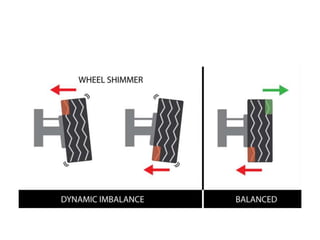
 Balancing is the process of designing or modifying machinery so that
the unbalance is reduced to an acceptable level and if possible is
eliminated entirely.
 Types of balancing
• Balancing of rotating masses
• Balancing of reciprocating masses
• Combined balancing of rotating and reciprocating masses.
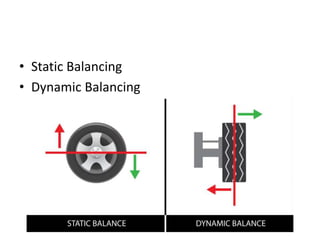
• Static Balancing
• Dynamic Balancing
Balancing of rotating masses
1. Balancing of a single rotating mass by a single mass rotating
in the same plane.
2. Balancing of a single rotating mass by two masses rotating in
different planes.
3. Balancing of different masses rotating in the same plane.
4. Balancing of different masses rotating in different planes.
Balancing of a Single Rotating Mass By a Single Mass
Rotating in the Same Plane
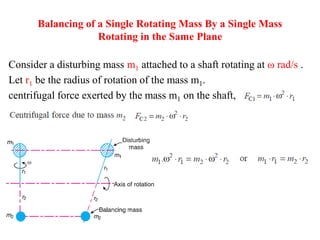
Consider a disturbing mass m1 attached to a shaft rotating at ω rad/s .
Let r1 be the radius of rotation of the mass m1.
centrifugal force exerted by the mass m1 on the shaft,
Balancing of a Single Rotating Mass By Two Masses Rotating
in Different Planes
Two balancing masses are placed in two different planes, parallel to the plane of
rotation of the disturbing mass, in such a way that they satisfy the following
two conditions of equilibrium.
1. The net dynamic force acting on the shaft is equal to zero. This requires that
the line of action of three centrifugal forces must be the same. This is the
condition for static balancing.
2. The net couple due to the dynamic forces acting on the shaft is equal to zero.
the algebraic sum of the moments about any point in the plane must be zero.
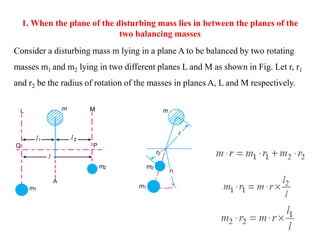
1. When the plane of the disturbing mass lies in between the planes of the
two balancing masses
Consider a disturbing mass m lying in a plane A to be balanced by two rotating
masses m1 and m2 lying in two different planes L and M as shown in Fig. Let r, r1
and r2 be the radius of rotation of the masses in planes A, L and M respectively.
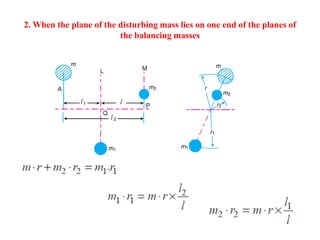
2. When the plane of the disturbing mass lies on one end of the planes of
the balancing masses
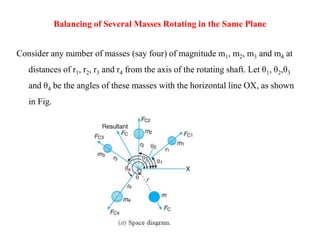
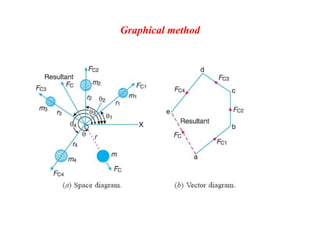
Balancing of Several Masses Rotating in the Same Plane
Consider any number of masses (say four) of magnitude m1, m2, m3 and m4 at
distances of r1, r2, r3 and r4 from the axis of the rotating shaft. Let θ1, θ2,θ3
and θ4 be the angles of these masses with the horizontal line OX, as shown
in Fig.
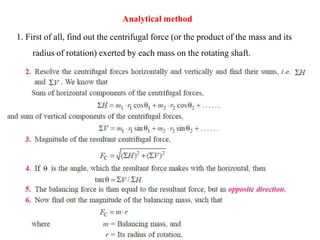
Analytical method
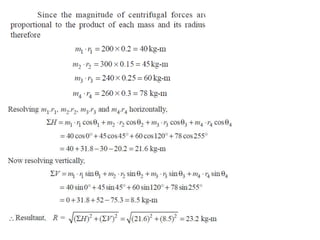
1. First of all, find out the centrifugal force (or the product of the mass and its
radius of rotation) exerted by each mass on the rotating shaft.
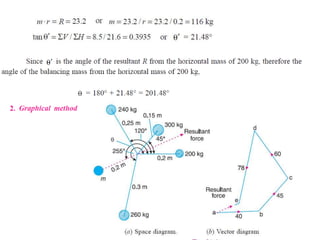
Graphical method
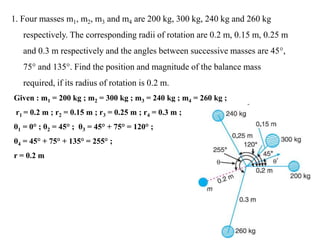
1. Four masses m1, m2, m3 and m4 are 200 kg, 300 kg, 240 kg and 260 kg
respectively. The corresponding radii of rotation are 0.2 m, 0.15 m, 0.25 m
and 0.3 m respectively and the angles between successive masses are 45°,
75° and 135°. Find the position and magnitude of the balance mass
required, if its radius of rotation is 0.2 m.
Given : m1 = 200 kg ; m2 = 300 kg ; m3 = 240 kg ; m4 = 260 kg ;
r1 = 0.2 m ; r2 = 0.15 m ; r3 = 0.25 m ; r4 = 0.3 m ;
θ1 = 0° ; θ2 = 45° ; θ3 = 45° + 75° = 120° ;
θ4 = 45° + 75° + 135° = 255° ;
r = 0.2 m
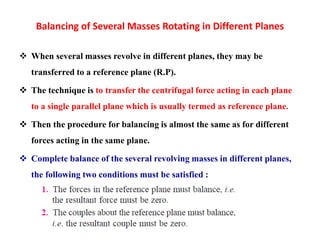
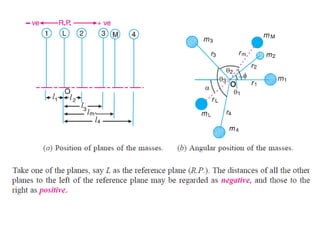
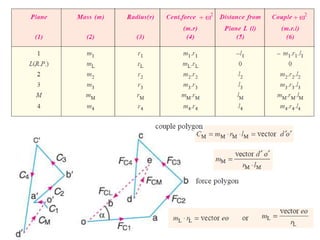
Balancing of Several Masses Rotating in Different Planes
 When several masses revolve in different planes, they may be
transferred to a reference plane (R.P).
 The technique is to transfer the centrifugal force acting in each plane
to a single parallel plane which is usually termed as reference plane.
 Then the procedure for balancing is almost the same as for different
forces acting in the same plane.
 Complete balance of the several revolving masses in different planes,
the following two conditions must be satisfied :
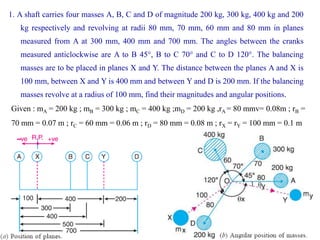
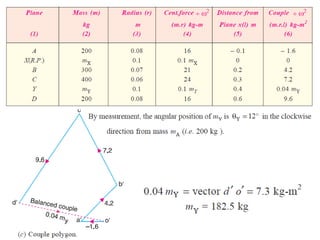
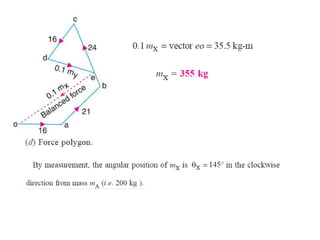
1. A shaft carries four masses A, B, C and D of magnitude 200 kg, 300 kg, 400 kg and 200
kg respectively and revolving at radii 80 mm, 70 mm, 60 mm and 80 mm in planes
measured from A at 300 mm, 400 mm and 700 mm. The angles between the cranks
measured anticlockwise are A to B 45°, B to C 70° and C to D 120°. The balancing
masses are to be placed in planes X and Y. The distance between the planes A and X is
100 mm, between X and Y is 400 mm and between Y and D is 200 mm. If the balancing
masses revolve at a radius of 100 mm, find their magnitudes and angular positions.
Given : mA = 200 kg ; mB = 300 kg ; mC = 400 kg ;mD = 200 kg ,rA = 80 mmv= 0.08m ; rB =
70 mm = 0.07 m ; rC = 60 mm = 0.06 m ; rD = 80 mm = 0.08 m ; rX = rY = 100 mm = 0.1 m
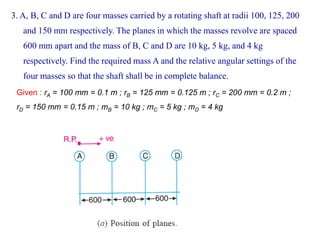
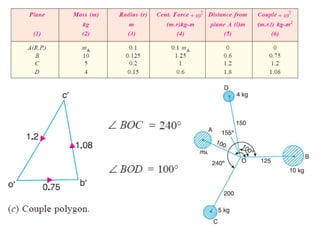
3. A, B, C and D are four masses carried by a rotating shaft at radii 100, 125, 200
and 150 mm respectively. The planes in which the masses revolve are spaced
600 mm apart and the mass of B, C and D are 10 kg, 5 kg, and 4 kg
respectively. Find the required mass A and the relative angular settings of the
four masses so that the shaft shall be in complete balance.
Given : rA = 100 mm = 0.1 m ; rB = 125 mm = 0.125 m ; rC = 200 mm = 0.2 m ;
rD = 150 mm = 0.15 m ; mB = 10 kg ; mC = 5 kg ; mD = 4 kg
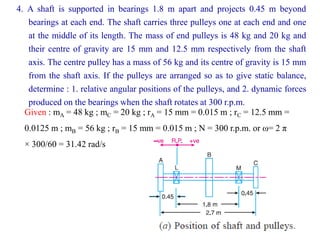
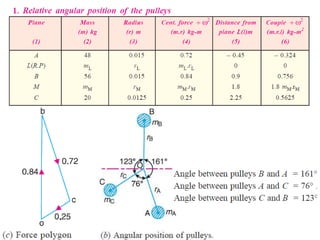
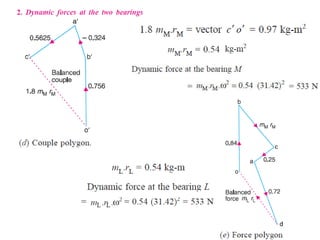
4. A shaft is supported in bearings 1.8 m apart and projects 0.45 m beyond
bearings at each end. The shaft carries three pulleys one at each end and one
at the middle of its length. The mass of end pulleys is 48 kg and 20 kg and
their centre of gravity are 15 mm and 12.5 mm respectively from the shaft
axis. The centre pulley has a mass of 56 kg and its centre of gravity is 15 mm
from the shaft axis. If the pulleys are arranged so as to give static balance,
determine : 1. relative angular positions of the pulleys, and 2. dynamic forces
produced on the bearings when the shaft rotates at 300 r.p.m.
Given : mA = 48 kg ; mC = 20 kg ; rA = 15 mm = 0.015 m ; rC = 12.5 mm =
0.0125 m ; mB = 56 kg ; rB = 15 mm = 0.015 m ; N = 300 r.p.m. or ω= 2 π
× 300/60 = 31.42 rad/s
Unit 6 Balancing (3).pptx

Unit 6 Balancing (3).pptx

  • 1.
  • 2.
    Balancing  A machinehas many moving parts, some machines have rotating motion and some of them have reciprocating motion.  If the moving parts are not in complete balance, inertia force are set up which may cause excessive noise, vibration, wear, and tear of the system.  Balancing is the process of designing or modifying machinery so that the unbalance is reduced to an acceptable level and if possible is eliminated entirely.  Types of balancing • Balancing of rotating masses • Balancing of reciprocating masses • Combined balancing of rotating and reciprocating masses.
  • 4.
    • Static Balancing •Dynamic Balancing
  • 6.
    Balancing of rotatingmasses 1. Balancing of a single rotating mass by a single mass rotating in the same plane. 2. Balancing of a single rotating mass by two masses rotating in different planes. 3. Balancing of different masses rotating in the same plane. 4. Balancing of different masses rotating in different planes.
  • 7.
    Balancing of aSingle Rotating Mass By a Single Mass Rotating in the Same Plane Consider a disturbing mass m1 attached to a shaft rotating at ω rad/s . Let r1 be the radius of rotation of the mass m1. centrifugal force exerted by the mass m1 on the shaft,
  • 8.
    Balancing of aSingle Rotating Mass By Two Masses Rotating in Different Planes Two balancing masses are placed in two different planes, parallel to the plane of rotation of the disturbing mass, in such a way that they satisfy the following two conditions of equilibrium. 1. The net dynamic force acting on the shaft is equal to zero. This requires that the line of action of three centrifugal forces must be the same. This is the condition for static balancing. 2. The net couple due to the dynamic forces acting on the shaft is equal to zero. the algebraic sum of the moments about any point in the plane must be zero.
  • 9.
    1. When theplane of the disturbing mass lies in between the planes of the two balancing masses Consider a disturbing mass m lying in a plane A to be balanced by two rotating masses m1 and m2 lying in two different planes L and M as shown in Fig. Let r, r1 and r2 be the radius of rotation of the masses in planes A, L and M respectively.
  • 10.
    2. When theplane of the disturbing mass lies on one end of the planes of the balancing masses
  • 11.
    Balancing of SeveralMasses Rotating in the Same Plane Consider any number of masses (say four) of magnitude m1, m2, m3 and m4 at distances of r1, r2, r3 and r4 from the axis of the rotating shaft. Let θ1, θ2,θ3 and θ4 be the angles of these masses with the horizontal line OX, as shown in Fig.
  • 12.
    Analytical method 1. Firstof all, find out the centrifugal force (or the product of the mass and its radius of rotation) exerted by each mass on the rotating shaft.
  • 13.
  • 14.
    1. Four massesm1, m2, m3 and m4 are 200 kg, 300 kg, 240 kg and 260 kg respectively. The corresponding radii of rotation are 0.2 m, 0.15 m, 0.25 m and 0.3 m respectively and the angles between successive masses are 45°, 75° and 135°. Find the position and magnitude of the balance mass required, if its radius of rotation is 0.2 m. Given : m1 = 200 kg ; m2 = 300 kg ; m3 = 240 kg ; m4 = 260 kg ; r1 = 0.2 m ; r2 = 0.15 m ; r3 = 0.25 m ; r4 = 0.3 m ; θ1 = 0° ; θ2 = 45° ; θ3 = 45° + 75° = 120° ; θ4 = 45° + 75° + 135° = 255° ; r = 0.2 m
  • 17.
    Balancing of SeveralMasses Rotating in Different Planes  When several masses revolve in different planes, they may be transferred to a reference plane (R.P).  The technique is to transfer the centrifugal force acting in each plane to a single parallel plane which is usually termed as reference plane.  Then the procedure for balancing is almost the same as for different forces acting in the same plane.  Complete balance of the several revolving masses in different planes, the following two conditions must be satisfied :
  • 20.
    1. A shaftcarries four masses A, B, C and D of magnitude 200 kg, 300 kg, 400 kg and 200 kg respectively and revolving at radii 80 mm, 70 mm, 60 mm and 80 mm in planes measured from A at 300 mm, 400 mm and 700 mm. The angles between the cranks measured anticlockwise are A to B 45°, B to C 70° and C to D 120°. The balancing masses are to be placed in planes X and Y. The distance between the planes A and X is 100 mm, between X and Y is 400 mm and between Y and D is 200 mm. If the balancing masses revolve at a radius of 100 mm, find their magnitudes and angular positions. Given : mA = 200 kg ; mB = 300 kg ; mC = 400 kg ;mD = 200 kg ,rA = 80 mmv= 0.08m ; rB = 70 mm = 0.07 m ; rC = 60 mm = 0.06 m ; rD = 80 mm = 0.08 m ; rX = rY = 100 mm = 0.1 m
  • 23.
    3. A, B,C and D are four masses carried by a rotating shaft at radii 100, 125, 200 and 150 mm respectively. The planes in which the masses revolve are spaced 600 mm apart and the mass of B, C and D are 10 kg, 5 kg, and 4 kg respectively. Find the required mass A and the relative angular settings of the four masses so that the shaft shall be in complete balance. Given : rA = 100 mm = 0.1 m ; rB = 125 mm = 0.125 m ; rC = 200 mm = 0.2 m ; rD = 150 mm = 0.15 m ; mB = 10 kg ; mC = 5 kg ; mD = 4 kg
  • 26.
    4. A shaftis supported in bearings 1.8 m apart and projects 0.45 m beyond bearings at each end. The shaft carries three pulleys one at each end and one at the middle of its length. The mass of end pulleys is 48 kg and 20 kg and their centre of gravity are 15 mm and 12.5 mm respectively from the shaft axis. The centre pulley has a mass of 56 kg and its centre of gravity is 15 mm from the shaft axis. If the pulleys are arranged so as to give static balance, determine : 1. relative angular positions of the pulleys, and 2. dynamic forces produced on the bearings when the shaft rotates at 300 r.p.m. Given : mA = 48 kg ; mC = 20 kg ; rA = 15 mm = 0.015 m ; rC = 12.5 mm = 0.0125 m ; mB = 56 kg ; rB = 15 mm = 0.015 m ; N = 300 r.p.m. or ω= 2 π × 300/60 = 31.42 rad/s