Cross-Domain Internet of Things
Application Development:
M3 Framework and Evaluation
FiCloud 24-26 August 2015, Rome, Italy
Amelie Gyrard, Insight, Ireland
Soumya Kanti Datta, Eurecom, France
Christian Bonnet, Eurecom, France
Karima Boudaoud, University of Nice Sophia Antipolis France
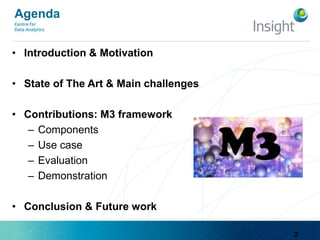
Agenda
• Introduction & Motivation
• State of The Art & Main challenges
• Contributions: M3 framework
– Components
– Use case
– Evaluation
– Demonstration
• Conclusion & Future work
2
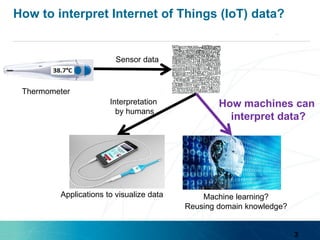
How to interpret Internet of Things (IoT) data?
Thermometer
Sensor data
Applications to visualize data
Interpretation
by humans
How machines can
interpret data?
3
Machine learning?
Reusing domain knowledge?
4
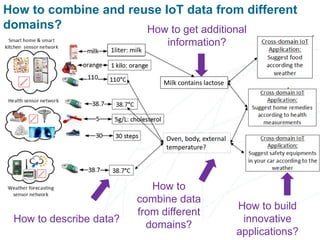
How to combine and reuse IoT data from different
domains?
How to build
innovative
applications?
How to describe data?
How to
combine data
from different
domains?
How to get additional
information?
Milk contains lactose
Oven, body, external
temperature?
1liter: milk
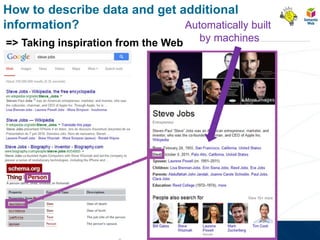
How to describe data and get additional
information?
=> Taking inspiration from the Web
Automatically built
by machines
“Semantic Web of Things: an analysis of the application semantics for the IoT moving towards the IoT
convergence” [Jara et al. 2014]
How to apply semantic web technologies to Internet of
Things?
Global
interoperability
⇒ How to provide a common
description of sensor data
to later reason on it?
Common description
Common App. Protocol
Device Abstraction
Common Nwk. Protocol
6
• Machine-understandable data
• Describe data with common
vocabularies
• Reuse domain knowledge
• Link to other data
• Ease the reasoning
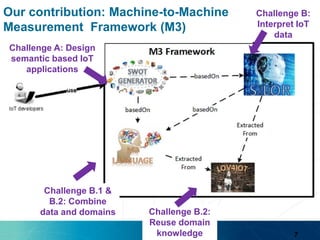
Our contribution: Machine-to-Machine
Measurement Framework (M3)
Challenge A: Design
semantic based IoT
applications
Challenge B.1 &
B.2: Combine
data and domains
Challenge B:
Interpret IoT
data
Challenge B.2:
Reuse domain
knowledge 7
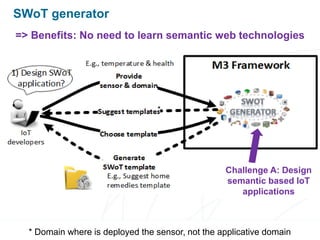
SWoT generator
8
*
Challenge A: Design
semantic based IoT
applications
* Domain where is deployed the sensor, not the applicative domain
=> Benefits: No need to learn semantic web technologies
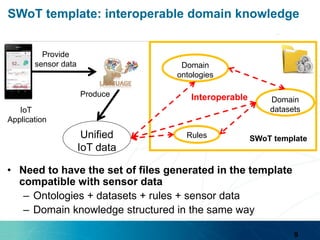
SWoT template: interoperable domain knowledge
• Need to have the set of files generated in the template
compatible with sensor data
– Ontologies + datasets + rules + sensor data
– Domain knowledge structured in the same way
Domain
ontologies
Domain
datasets
Rules
Interoperable
IoT
Application
Provide
sensor data
SWoT templateUnified
IoT data
Produce
9
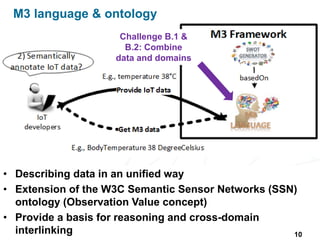
M3 language & ontology
Challenge B.1 &
B.2: Combine
data and domains
• Describing data in an unified way
• Extension of the W3C Semantic Sensor Networks (SSN)
ontology (Observation Value concept)
• Provide a basis for reasoning and cross-domain
interlinking 10
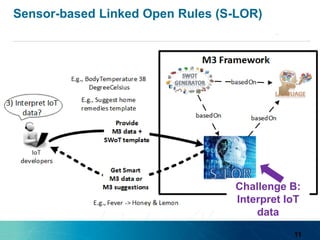
Sensor-based Linked Open Rules (S-LOR)
11
Challenge B:
Interpret IoT
data
Demo paper: Helping IoT application developers with Sensor-based Linked Open
Rules [Gyrard et al., ISWC 2014, SSN workshop]
S-LOR: Deducing new knowledge
• How to deduce new knowledge?
– S-LOR: a dataset of interoperable SWRL rules
• Rules example:
– If Domain == Health && MeasurementType == Temperature
then NewType = BodyTemperature
– If BodyTemperature > 38,7°C then “Fever”
• BodyTemperature and Fever are already described in
domain ontologies or datasets!
12
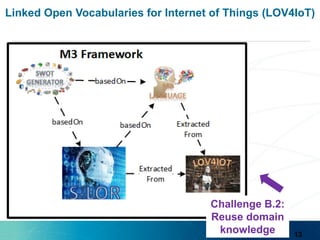
Linked Open Vocabularies for Internet of Things (LOV4IoT)
Challenge B.2:
Reuse domain
knowledge 13
LOV4IoT
http://www.sensormeasurement.appspot.com/?p=ontologies
http://lov.okfn.org/dataset/lov/
Collect
Classify Interoperability
SWoT
template
14
A second life for ontologies!
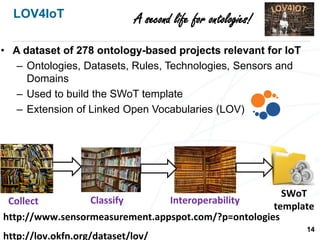
• A dataset of 278 ontology-based projects relevant for IoT
– Ontologies, Datasets, Rules, Technologies, Sensors and
Domains
– Used to build the SWoT template
– Extension of Linked Open Vocabularies (LOV)
Collect
Paper: Enrich Machine-to-Machine Data with Semantic Web Technologies for Cross-Domain
Applications [Gyrard et al., WF-IoT 2014]
M3 semantic engine : An entire chain to interpret IoT
and build cross-domain applications
15
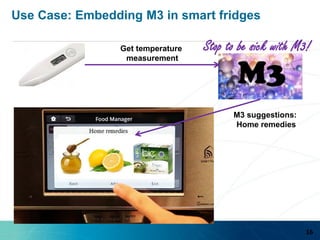
Use Case: Embedding M3 in smart fridges
M3 suggestions:
Home remedies
Get temperature
measurement
Stop to be sick with M3!
16
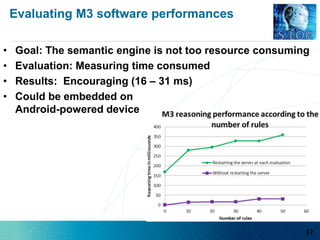
Evaluating M3 software performances
• Goal: The semantic engine is not too resource consuming
• Evaluation: Measuring time consumed
• Results: Encouraging (16 – 31 ms)
• Could be embedded on
Android-powered device
17
Demo
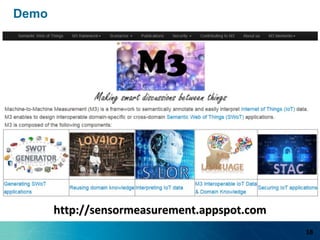
• Demo
http://sensormeasurement.appspot.com
18
⇒ Our proposed
approach:
M3 framework
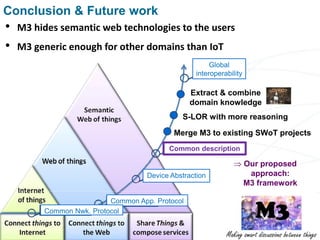
Conclusion & Future work
Extract & combine
domain knowledge
Merge M3 to existing SWoT projects
Global
interoperability
Common description
Device Abstraction
Common App. Protocol
Common Nwk. Protocol
19
S-LOR with more reasoning
• M3 hides semantic web technologies to the users
• M3 generic enough for other domains than IoT
Thank you!
• Thanks to FIESTA-IoT and Martin Serrano
• amelie.gyrard@insight-centre.org
• http://sensormeasurement.appspot.com/
• Slideshare
• Twitter
20

Fi cloudpresentationgyrardaugust2015 v2

  • 1.
    Cross-Domain Internet ofThings Application Development: M3 Framework and Evaluation FiCloud 24-26 August 2015, Rome, Italy Amelie Gyrard, Insight, Ireland Soumya Kanti Datta, Eurecom, France Christian Bonnet, Eurecom, France Karima Boudaoud, University of Nice Sophia Antipolis France
  • 2.
    Agenda • Introduction &Motivation • State of The Art & Main challenges • Contributions: M3 framework – Components – Use case – Evaluation – Demonstration • Conclusion & Future work 2
  • 3.
    How to interpretInternet of Things (IoT) data? Thermometer Sensor data Applications to visualize data Interpretation by humans How machines can interpret data? 3 Machine learning? Reusing domain knowledge?
  • 4.
    4 How to combineand reuse IoT data from different domains? How to build innovative applications? How to describe data? How to combine data from different domains? How to get additional information? Milk contains lactose Oven, body, external temperature? 1liter: milk
  • 5.
    How to describedata and get additional information? => Taking inspiration from the Web Automatically built by machines
  • 6.
    “Semantic Web ofThings: an analysis of the application semantics for the IoT moving towards the IoT convergence” [Jara et al. 2014] How to apply semantic web technologies to Internet of Things? Global interoperability ⇒ How to provide a common description of sensor data to later reason on it? Common description Common App. Protocol Device Abstraction Common Nwk. Protocol 6 • Machine-understandable data • Describe data with common vocabularies • Reuse domain knowledge • Link to other data • Ease the reasoning
  • 7.
    Our contribution: Machine-to-Machine MeasurementFramework (M3) Challenge A: Design semantic based IoT applications Challenge B.1 & B.2: Combine data and domains Challenge B: Interpret IoT data Challenge B.2: Reuse domain knowledge 7
  • 8.
    SWoT generator 8 * Challenge A:Design semantic based IoT applications * Domain where is deployed the sensor, not the applicative domain => Benefits: No need to learn semantic web technologies
  • 9.
    SWoT template: interoperabledomain knowledge • Need to have the set of files generated in the template compatible with sensor data – Ontologies + datasets + rules + sensor data – Domain knowledge structured in the same way Domain ontologies Domain datasets Rules Interoperable IoT Application Provide sensor data SWoT templateUnified IoT data Produce 9
  • 10.
    M3 language &ontology Challenge B.1 & B.2: Combine data and domains • Describing data in an unified way • Extension of the W3C Semantic Sensor Networks (SSN) ontology (Observation Value concept) • Provide a basis for reasoning and cross-domain interlinking 10
  • 11.
    Sensor-based Linked OpenRules (S-LOR) 11 Challenge B: Interpret IoT data
  • 12.
    Demo paper: HelpingIoT application developers with Sensor-based Linked Open Rules [Gyrard et al., ISWC 2014, SSN workshop] S-LOR: Deducing new knowledge • How to deduce new knowledge? – S-LOR: a dataset of interoperable SWRL rules • Rules example: – If Domain == Health && MeasurementType == Temperature then NewType = BodyTemperature – If BodyTemperature > 38,7°C then “Fever” • BodyTemperature and Fever are already described in domain ontologies or datasets! 12
  • 13.
    Linked Open Vocabulariesfor Internet of Things (LOV4IoT) Challenge B.2: Reuse domain knowledge 13
  • 14.
    LOV4IoT http://www.sensormeasurement.appspot.com/?p=ontologies http://lov.okfn.org/dataset/lov/ Collect Classify Interoperability SWoT template 14 A secondlife for ontologies! • A dataset of 278 ontology-based projects relevant for IoT – Ontologies, Datasets, Rules, Technologies, Sensors and Domains – Used to build the SWoT template – Extension of Linked Open Vocabularies (LOV) Collect
  • 15.
    Paper: Enrich Machine-to-MachineData with Semantic Web Technologies for Cross-Domain Applications [Gyrard et al., WF-IoT 2014] M3 semantic engine : An entire chain to interpret IoT and build cross-domain applications 15
  • 16.
    Use Case: EmbeddingM3 in smart fridges M3 suggestions: Home remedies Get temperature measurement Stop to be sick with M3! 16
  • 17.
    Evaluating M3 softwareperformances • Goal: The semantic engine is not too resource consuming • Evaluation: Measuring time consumed • Results: Encouraging (16 – 31 ms) • Could be embedded on Android-powered device 17
  • 18.
  • 19.
    ⇒ Our proposed approach: M3framework Conclusion & Future work Extract & combine domain knowledge Merge M3 to existing SWoT projects Global interoperability Common description Device Abstraction Common App. Protocol Common Nwk. Protocol 19 S-LOR with more reasoning • M3 hides semantic web technologies to the users • M3 generic enough for other domains than IoT
  • 20.
    Thank you! • Thanksto FIESTA-IoT and Martin Serrano • amelie.gyrard@insight-centre.org • http://sensormeasurement.appspot.com/ • Slideshare • Twitter 20