The Internet of Things,
Ambient Intelligence and the
Move Towards Intelligent
Systems
Santa Clara (IEEE Region 6) Event
September [28 or 29], 2012
Dr. George Vaněček, Jr.
Senior Principal Scientist, FutureWei Technologies, Inc.
Our Next 40 Minutes…
1. From Internet to Internet of Things (IoT)
and Beyond
2. Growing Intelligence in the IoT
3. Something about Sensing, Real-world
Perception, and Context-Awareness
4. The Tools of the trade
5. Key Takeaways
6. Key Technologies
2
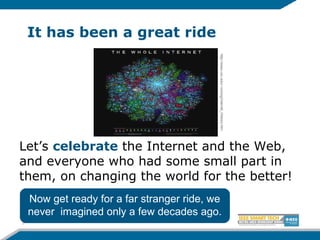
It has been a great ride
Let’s celebrate the Internet and the Web,
and everyone who had some small part in
them, on changing the world for the better!
3
http://www.unc.edu/~unclng/Internet_History.htm
Now get ready for a far stranger ride, we
never imagined only a few decades ago.
Looking ahead to Future Internet/Web,
more Challenges remain…
Ubiquitous personalization and individualization
– Global Identity, Trust, Presence, Ownership, …
Portability between Silos
– Of Identities, Profiles, and Content
Information Overload
Ability to scale beyond human-only usage
– More addresses, storage/transport capacity, devices, …
Machines Understanding of Data
– Unstructured, Semi-structured and Structured data
Interoperability with
– Open Data, Formats, and APIs
Context/Situation/Intent Awareness
Digital-world is becoming aware of the
physical-world: Internet of all things
Here comes the Internet of Things
The Internet will connect billions of people through
mobile and embedded smart devices.
Real-time communication and the accessibility to
any information on-line will enrich people and
machines; …
the Internet will connect everyday things integrated
into people’s every day lives.
– More equipment will be connected to the Internet than
people by a factor of 8 to 1 (50 Billion by 2020).
IoT will integrate many industry verticals
(e.g., healthcare, energy, transportations) into smart
*/city/building/home environments.
IoT will be centric to people’s needs and
every day existence.
Ambient Intelligence will expand.
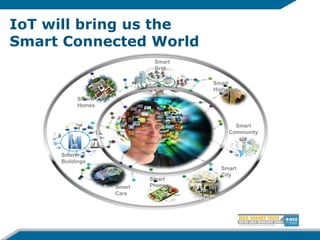
IoT will bring us the
Smart Connected World
Smart
Homes
Smart
Buildings
Smart
Cars
Smart
Phones
Smart
City
Smart
Grid
Smart
Community
Smart
Highways
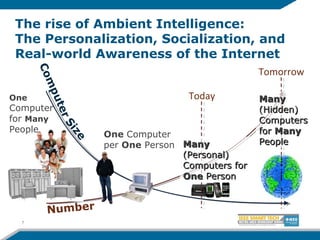
The rise of Ambient Intelligence:
The Personalization, Socialization, and
Real-world Awareness of the Internet
7
Today
ManyMany
(Personal)(Personal)
Computers forComputers for
OneOne PersonPerson
Size
Number
Computer
One
Computer
for Many
People
Tomorrow
ManyMany
(Hidden)(Hidden)
ComputersComputers
forfor ManyMany
PeoplePeople
One Computer
per One Person
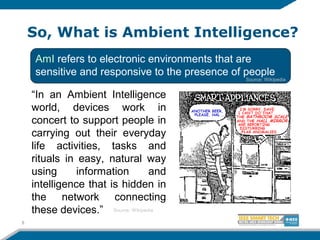
So, What is Ambient Intelligence?
8
AmI refers to electronic environments that are
sensitive and responsive to the presence of people
“In an Ambient Intelligence
world, devices work in
concert to support people in
carrying out their everyday
life activities, tasks and
rituals in easy, natural way
using information and
intelligence that is hidden in
the network connecting
these devices.” Source: Wikipedia
Source: Wikipedia
The Challenge for the Industry
Create an infrastructure and middleware to
•enable heterogeneous devices to
interoperate,
•to perform assigned tasks, and
•be able to sense, perceive and react
appropriately
•with minimal human intervention
(Organic Computing).
From Existing to Intelligent
(Organic Computing) Systems
Need intelligence in systems that
dynamically adapt to their environment
and tasks, and are
Self-Configuring,
Self-Describing/Explaining,
Self-Healing,
Self-Protecting,
Self-Organizing,
Context-aware, and
Reactive and Proactive.
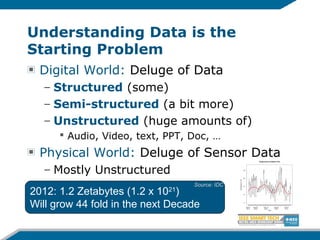
2012: 1.2 Zetabytes (1.2 x 10²¹
)
Will grow 44 fold in the next Decade
Understanding Data is the
Starting Problem
Digital World: Deluge of Data
– Structured (some)
– Semi-structured (a bit more)
– Unstructured (huge amounts of)
 Audio, Video, text, PPT, Doc, …
Physical World: Deluge of Sensor Data
– Mostly Unstructured
Source: IDC
Increasing Intelligence in Systems
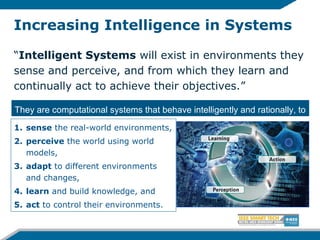
“Intelligent Systems will exist in environments they
sense and perceive, and from which they learn and
continually act to achieve their objectives.”
1. sense the real-world environments,
2. perceive the world using world
models,
3. adapt to different environments
and changes,
4. learn and build knowledge, and
5. act to control their environments.
They are computational systems that behave intelligently and rationally, to
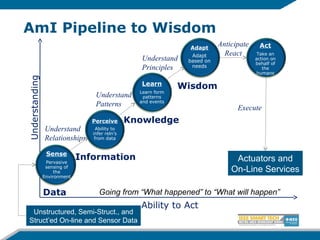
AmI Pipeline to WisdomUnderstanding
Ability to Act
Information
Understand
Relationships
Knowledge
Understand
Patterns
Wisdom
Understand
Principles
Going from “What happened” to “What will happen”
Sense
Pervasive
sensing of
the
Environment
Perceive
Ability to
infer reln’s
from data
Act
Take an
action on
behalf of
the
humans
Learn
Learn form
patterns
and events
Adapt
Adapt
based on
needs
Data
Actuators and
On-Line Services
Anticipate
React
Execute
Unstructured, Semi-Struct., and
Struct’ed On-line and Sensor Data
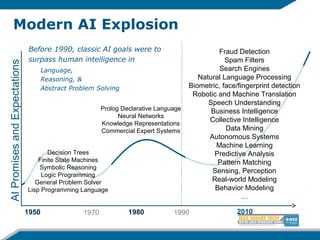
Modern AI Explosion
1950 1980 1990 2010
AIPromisesandExpectations
1970
Decision Trees
Finite State Machines
Symbolic Reasoning
Logic Programming
General Problem Solver
Lisp Programming Language
Fraud Detection
Spam Filters
Search Engines
Natural Language Processing
Biometric, face/fingerprint detection
Robotic and Machine Translation
Speech Understanding
Business Intelligence
Collective Intelligence
Data Mining
Autonomous Systems
Machine Learning
Predictive Analysis
Pattern Matching
Sensing, Perception
Real-world Modeling
Behavior Modeling
…
Prolog Declarative Language
Neural Networks
Knowledge Representations
Commercial Expert Systems
Before 1990, classic AI goals were to
surpass human intelligence in
Language,
Reasoning, &
Abstract Problem Solving
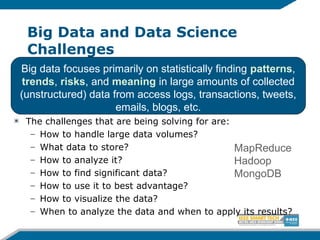
Big Data and Data Science
Challenges
The challenges that are being solving for are:
– How to handle large data volumes?
– What data to store?
– How to analyze it?
– How to find significant data?
– How to use it to best advantage?
– How to visualize the data?
– When to analyze the data and when to apply its results?
Big data focuses primarily on statistically finding patterns,
trends, risks, and meaning in large amounts of collected
(unstructured) data from access logs, transactions, tweets,
emails, blogs, etc.
MapReduce
Hadoop
MongoDB
Machine Learning
Supervised Learning Algorithms
– K-Nearest Neighbor
– Naïve Bayes
– Support Vector Machines
– Decision Tree Induction
– Etc.
Unsupervised Learning Alg.s
– K-Means
– Expectation Maximization
– Etc.
16
ML refers to a statistical suite of algorithms and
paradigms for finding patterns in data.
Training
Set {x}
Training
Algorithm:
X’
D
{[Patterni,Di]}
{D}
{}
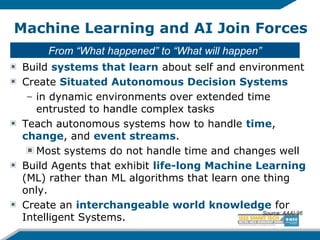
Machine Learning and AI Join Forces
Build systems that learn about self and environment
Create Situated Autonomous Decision Systems
– in dynamic environments over extended time
entrusted to handle complex tasks
Teach autonomous systems how to handle time,
change, and event streams.
Most systems do not handle time and changes well
Build Agents that exhibit life-long Machine Learning
(ML) rather than ML algorithms that learn one thing
only.
Create an interchangeable world knowledge for
Intelligent Systems.
Source: AAAI-96
From “What happened” to “What will happen”
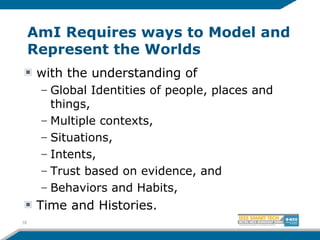
AmI Requires ways to Model and
Represent the Worlds
with the understanding of
– Global Identities of people, places and
things,
– Multiple contexts,
– Situations,
– Intents,
– Trust based on evidence, and
– Behaviors and Habits,
Time and Histories.
18
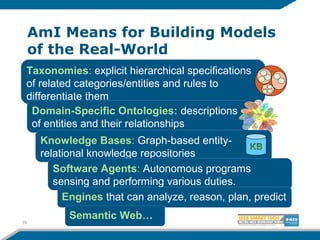
Taxonomies: explicit hierarchical specifications
of related categories/entities and rules to
differentiate them
Domain-Specific Ontologies: descriptions
of entities and their relationships
AmI Means for Building Models
of the Real-World
19
Knowledge Bases: Graph-based entity-
relational knowledge repositories
Software Agents: Autonomous programs
sensing and performing various duties.
Engines that can analyze, reason, plan, predict
Semantic Web…
Semantic Web, the Web of Data and
the Meaning of Data
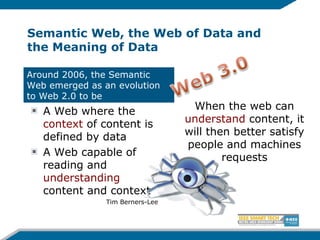
When the web can
understand content, it
will then better satisfy
people and machines
requests
A Web where the
context of content is
defined by data
A Web capable of
reading and
understanding
content and context
Tim Berners-Lee
Around 2006, the Semantic
Web emerged as an evolution
to Web 2.0 to be
Refocusing on Context-AwarenessRefocusing on Context-Awareness
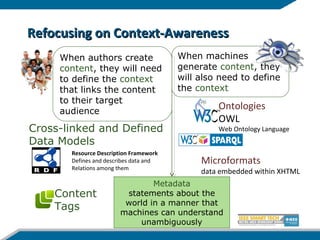
Microformats
data embedded within XHTML
Metadata
statements about the
world in a manner that
machines can understand
unambiguously
When authors create
content, they will need
to define the context
that links the content
to their target
audience
Cross-linked and Defined
Data Models
Resource Description Framework
Defines and describes data and
Relations among them
Content
Tags
When machines
generate content, they
will also need to define
the context
Ontologies
OWL
Web Ontology Language
“The Internet is a Changing”
Key Takeaways
– The digital world is becoming more aware of
the real world
– Systems are becoming more intelligent and
autonomous
– Everyday things are getting connected
– Technology and computing is becoming
transparent
– Rapid innovation is driving major changes in
the IoT
– Ambient Intelligence and Organic Computing
is gaining Industry focus22
Key Technologies to Follow
Semantic Web
– Meta Data
– Ontologies and
Taxonomies
HTML5 and D3js
RTW and WebSockets
Data Fusion
– Processing
unstructured/semi-
structured Data
Machine Learning
Information/Knowledge
Repositories
– NoSQL Databases
– Graph Databases
– Knowledge Bases
Dynamic and Post-
Functional Languages
– Scala, Python,
Java 8, Groovy,
Haskell, Lisp,
Javascript, …
23
24
Thank You
George.Vanecek@gmail.com
Santa Clara, CA

The Internet of Things, Ambient Intelligence, and the Move Towards Intelligent Systems

  • 1.
    The Internet ofThings, Ambient Intelligence and the Move Towards Intelligent Systems Santa Clara (IEEE Region 6) Event September [28 or 29], 2012 Dr. George Vaněček, Jr. Senior Principal Scientist, FutureWei Technologies, Inc.
  • 2.
    Our Next 40Minutes… 1. From Internet to Internet of Things (IoT) and Beyond 2. Growing Intelligence in the IoT 3. Something about Sensing, Real-world Perception, and Context-Awareness 4. The Tools of the trade 5. Key Takeaways 6. Key Technologies 2
  • 3.
    It has beena great ride Let’s celebrate the Internet and the Web, and everyone who had some small part in them, on changing the world for the better! 3 http://www.unc.edu/~unclng/Internet_History.htm Now get ready for a far stranger ride, we never imagined only a few decades ago.
  • 4.
    Looking ahead toFuture Internet/Web, more Challenges remain… Ubiquitous personalization and individualization – Global Identity, Trust, Presence, Ownership, … Portability between Silos – Of Identities, Profiles, and Content Information Overload Ability to scale beyond human-only usage – More addresses, storage/transport capacity, devices, … Machines Understanding of Data – Unstructured, Semi-structured and Structured data Interoperability with – Open Data, Formats, and APIs Context/Situation/Intent Awareness Digital-world is becoming aware of the physical-world: Internet of all things
  • 5.
    Here comes theInternet of Things The Internet will connect billions of people through mobile and embedded smart devices. Real-time communication and the accessibility to any information on-line will enrich people and machines; … the Internet will connect everyday things integrated into people’s every day lives. – More equipment will be connected to the Internet than people by a factor of 8 to 1 (50 Billion by 2020). IoT will integrate many industry verticals (e.g., healthcare, energy, transportations) into smart */city/building/home environments. IoT will be centric to people’s needs and every day existence. Ambient Intelligence will expand.
  • 6.
    IoT will bringus the Smart Connected World Smart Homes Smart Buildings Smart Cars Smart Phones Smart City Smart Grid Smart Community Smart Highways
  • 7.
    The rise ofAmbient Intelligence: The Personalization, Socialization, and Real-world Awareness of the Internet 7 Today ManyMany (Personal)(Personal) Computers forComputers for OneOne PersonPerson Size Number Computer One Computer for Many People Tomorrow ManyMany (Hidden)(Hidden) ComputersComputers forfor ManyMany PeoplePeople One Computer per One Person
  • 8.
    So, What isAmbient Intelligence? 8 AmI refers to electronic environments that are sensitive and responsive to the presence of people “In an Ambient Intelligence world, devices work in concert to support people in carrying out their everyday life activities, tasks and rituals in easy, natural way using information and intelligence that is hidden in the network connecting these devices.” Source: Wikipedia Source: Wikipedia
  • 9.
    The Challenge forthe Industry Create an infrastructure and middleware to •enable heterogeneous devices to interoperate, •to perform assigned tasks, and •be able to sense, perceive and react appropriately •with minimal human intervention (Organic Computing).
  • 10.
    From Existing toIntelligent (Organic Computing) Systems Need intelligence in systems that dynamically adapt to their environment and tasks, and are Self-Configuring, Self-Describing/Explaining, Self-Healing, Self-Protecting, Self-Organizing, Context-aware, and Reactive and Proactive.
  • 11.
    2012: 1.2 Zetabytes(1.2 x 10²¹ ) Will grow 44 fold in the next Decade Understanding Data is the Starting Problem Digital World: Deluge of Data – Structured (some) – Semi-structured (a bit more) – Unstructured (huge amounts of)  Audio, Video, text, PPT, Doc, … Physical World: Deluge of Sensor Data – Mostly Unstructured Source: IDC
  • 12.
    Increasing Intelligence inSystems “Intelligent Systems will exist in environments they sense and perceive, and from which they learn and continually act to achieve their objectives.” 1. sense the real-world environments, 2. perceive the world using world models, 3. adapt to different environments and changes, 4. learn and build knowledge, and 5. act to control their environments. They are computational systems that behave intelligently and rationally, to
  • 13.
    AmI Pipeline toWisdomUnderstanding Ability to Act Information Understand Relationships Knowledge Understand Patterns Wisdom Understand Principles Going from “What happened” to “What will happen” Sense Pervasive sensing of the Environment Perceive Ability to infer reln’s from data Act Take an action on behalf of the humans Learn Learn form patterns and events Adapt Adapt based on needs Data Actuators and On-Line Services Anticipate React Execute Unstructured, Semi-Struct., and Struct’ed On-line and Sensor Data
  • 14.
    Modern AI Explosion 19501980 1990 2010 AIPromisesandExpectations 1970 Decision Trees Finite State Machines Symbolic Reasoning Logic Programming General Problem Solver Lisp Programming Language Fraud Detection Spam Filters Search Engines Natural Language Processing Biometric, face/fingerprint detection Robotic and Machine Translation Speech Understanding Business Intelligence Collective Intelligence Data Mining Autonomous Systems Machine Learning Predictive Analysis Pattern Matching Sensing, Perception Real-world Modeling Behavior Modeling … Prolog Declarative Language Neural Networks Knowledge Representations Commercial Expert Systems Before 1990, classic AI goals were to surpass human intelligence in Language, Reasoning, & Abstract Problem Solving
  • 15.
    Big Data andData Science Challenges The challenges that are being solving for are: – How to handle large data volumes? – What data to store? – How to analyze it? – How to find significant data? – How to use it to best advantage? – How to visualize the data? – When to analyze the data and when to apply its results? Big data focuses primarily on statistically finding patterns, trends, risks, and meaning in large amounts of collected (unstructured) data from access logs, transactions, tweets, emails, blogs, etc. MapReduce Hadoop MongoDB
  • 16.
    Machine Learning Supervised LearningAlgorithms – K-Nearest Neighbor – Naïve Bayes – Support Vector Machines – Decision Tree Induction – Etc. Unsupervised Learning Alg.s – K-Means – Expectation Maximization – Etc. 16 ML refers to a statistical suite of algorithms and paradigms for finding patterns in data. Training Set {x} Training Algorithm: X’ D {[Patterni,Di]} {D} {}
  • 17.
    Machine Learning andAI Join Forces Build systems that learn about self and environment Create Situated Autonomous Decision Systems – in dynamic environments over extended time entrusted to handle complex tasks Teach autonomous systems how to handle time, change, and event streams. Most systems do not handle time and changes well Build Agents that exhibit life-long Machine Learning (ML) rather than ML algorithms that learn one thing only. Create an interchangeable world knowledge for Intelligent Systems. Source: AAAI-96 From “What happened” to “What will happen”
  • 18.
    AmI Requires waysto Model and Represent the Worlds with the understanding of – Global Identities of people, places and things, – Multiple contexts, – Situations, – Intents, – Trust based on evidence, and – Behaviors and Habits, Time and Histories. 18
  • 19.
    Taxonomies: explicit hierarchicalspecifications of related categories/entities and rules to differentiate them Domain-Specific Ontologies: descriptions of entities and their relationships AmI Means for Building Models of the Real-World 19 Knowledge Bases: Graph-based entity- relational knowledge repositories Software Agents: Autonomous programs sensing and performing various duties. Engines that can analyze, reason, plan, predict Semantic Web…
  • 20.
    Semantic Web, theWeb of Data and the Meaning of Data When the web can understand content, it will then better satisfy people and machines requests A Web where the context of content is defined by data A Web capable of reading and understanding content and context Tim Berners-Lee Around 2006, the Semantic Web emerged as an evolution to Web 2.0 to be
  • 21.
    Refocusing on Context-AwarenessRefocusingon Context-Awareness Microformats data embedded within XHTML Metadata statements about the world in a manner that machines can understand unambiguously When authors create content, they will need to define the context that links the content to their target audience Cross-linked and Defined Data Models Resource Description Framework Defines and describes data and Relations among them Content Tags When machines generate content, they will also need to define the context Ontologies OWL Web Ontology Language
  • 22.
    “The Internet isa Changing” Key Takeaways – The digital world is becoming more aware of the real world – Systems are becoming more intelligent and autonomous – Everyday things are getting connected – Technology and computing is becoming transparent – Rapid innovation is driving major changes in the IoT – Ambient Intelligence and Organic Computing is gaining Industry focus22
  • 23.
    Key Technologies toFollow Semantic Web – Meta Data – Ontologies and Taxonomies HTML5 and D3js RTW and WebSockets Data Fusion – Processing unstructured/semi- structured Data Machine Learning Information/Knowledge Repositories – NoSQL Databases – Graph Databases – Knowledge Bases Dynamic and Post- Functional Languages – Scala, Python, Java 8, Groovy, Haskell, Lisp, Javascript, … 23
  • 24.

Editor's Notes

  • #2 Course Description : With the successful adoption of cloud-based services and the increasing capabilities of smart connected/wireless devices, the software and consumer electronics industries are turning towards innovating solutions within the Internet-of-Things (IoT) to offer consumers (and enterprises) smart solutions that take the dynamics of the real-world into consideration.      The vision is to bring the awareness of what happens in the real-world, how people live and how smart devices operate in the real world into the view and control of the digital world.  Here the digital world is the totality of the Internet, the Web, and the private and public cloud services.   In this session, we will look at key technical trends and their increasing interdependency in the areas of real-world Sensing, Perception, Machine Learning, Context-awareness, dynamic Trust Determination, Semantic Web and Artificial Intelligence which are now enabling ambient intelligence and driving the emergence of Intelligence Systems within the Internet of Things.  We will also look at the challenges that such interdependencies expose, and the opportunities that their solutions offer to the industry.
  • #8 So, where this all heading and why?
  • #11 Scalability
  • #13 George, can you reword this with simpler words
  • #14 This is the How.
  • #16 Xerox now staff its 50K call center jobs using based on algorithms that try it separate creative from inquisitive people, and hire only the creative one. [source: WSJ 2012, Meet the new Boss> Big Data]
  • #18 http://research.microsoft.com/en-us/um/people/horvitz/seltext.htm http://groups.engin.umd.umich.edu/CIS/course.des/cis479/projects/frame/welcome.html
  • #20 Ontologies Taxonomies World Models Knowledge Bases Intelligent Agents
  • #21 Microformats are data embedded within XHTML