Duodenal polyp
CASE PRESENTATION
DR THANA RAM PATEL
DEPARTMENT OF GENERAL SURGERY
SMS MEDICAL COLLEGE , JAIPUR
Demographic profile
• CR No 1011903055508
• Maya w/o Kailash Chand
• Age- 32 yrs
• Sex – female
• Religion – hindu
• Khudiyana ,Laxmangarh,Alwar rajasthan
• DOA- 25-02-2019 (gastroenterology dept then
transfer to general surgery )
• DOO- 07-03-2019
• at present patient in ward
history
c/o
abdomen pain * 1 yr
Nausea * 1 yr
Bloating * 1 yr
Vomitting – off and on since *1 yr
HOPI – patient is apparently healthy 1 yr back then patient having abdomen pain that
is insidious onset , localized upper abdomen, non radiating, not relieved by
medication, associated with nausea, bloating , but n/o of abdominal distension
n/h/o fever
n/h/o unconsciousness,seizure
n/h/o dizziness/fainting
n/h/o breathlessness/ dyspnea
n/h/o hemetemesis / bleeding per rectum/ constipation
n/h/o jaundice
n/h/o hematuria
Past history (no history of comorbidities)
N/H/O TB/DM/HTN/ASTHMA/ALLERGY
N/H/O TRAUMA / SURGERY
Family history
Younger brother having history of bleeding per rectum * 1
month duration * 1 yr back relieved by alternative medicine
prescription , no further evaluated
Personal history - veg
n/h/o smoking / tobacco chewing
Obs histoy – regular menstruation cycle
Clinical exams
• Patient is conscious , cooperative, well oriented to time, place , persons
• No -Icterus / palor / cynosis/ clubbing / lymphadenopathy/ pedal edema
• Average build
• afebrile
• BP 130/90 mmHg
• Pulse 96 bpm
• E4V5M6
• Heart sound S1S2 present
• Bilateral air entry present
• Per abdomen exams
• Abdomen – soft , no tenderness/ rigidity/gaurdening
• No lump palpable
• scaphoid
• Bowel sound present
• PR-NAD
endoscopy
• Antrum- extrensic impression present
• Pylorus- normal
• Duodenum – large pedunculated polyp
starting from D1 upto D3-D4 junction,
protruding into lumen
• Interpretation – large polyp in duodenum
endoscopy
USG
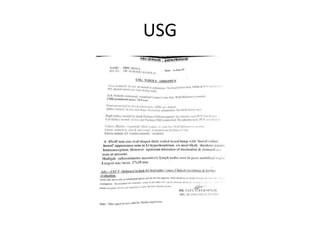
• A 49 * 45 mm size oval shaped thick walled bowel
lump with “bowel within bowel” appearance
seen in left hypochondrium s/o most likely
duodeno-jejunal intussusception. However
upstream dilatation of duodenum & stomach not
seen at present
• Multiple subcentimeter mesenteric lymph nodes
seen in para-umbilical region, largest one
measures 17*10mm
• CBD prominent measures 10mm
USG
CECT whole abdomen
• Oral contrast filled stomach is distended
shows pyloric antrum within duodenum with
evidence of mildly enhancing well define
5.8*4.9*4.4cm soft tissue density nodular sol
towards left flank with pedicle s/o
intussusception with?polyp
• Impression – s/o gastroduodenal
intussusception with possibility of large polyp
CECT whole abdomen
evaluation
• Diagnosis – duodenal polyp
Executed procedure
• Duodenostomy and polypectomy and primary
closure with drain placement & feeding
jejunostomy under GA
• 5*5*4 cm pedunculated polyp present at D1
causing intussusception
• Duodeum opened , polyp excised with base and
duodenum closed
• Feeding jejunostomy made
• Drain placed in subhepatic space
• Specimen taken for HPE
Intraop images
Intra-op polyp with duodenum
specimen
Post op histopathology
Specimen – excision biopsy – duodenal polyp
Gross description – single large polypoidal soft tissue with
stalk , measures 5*5*4 cm
Miscroscopic description – section examined show polypoidal
fragments of duodenal mucosa with a tubule forming &
villous forming epithelium that has cellular
pseudostratification and focally hyperchromatic nuclei ,
from the crypt base to the luminal aspect (dysplasis)
Cribriforming of glands is identified at multiple foci
No definitive evidence of invasive malignancy ,
base is free of tumor
Diagnosis – tubulovillious adenoma with low grade dysplasia
Post op histopathology
Duodenal Adenomatous polyp
introduction
• Adenomas account for approximately 15% of all benign
small bowel tumors
• Familial adenomas typically occur in the presence of
FAP syndrome.
• adenomas in the duodenum can be found in 50% to
90% of cases,
• Adenomas of the remaining small bowel also occur
more frequently in patients with FAP but are not as
prevalent as duodenal disease in this population of
patients.
• increasing age was identified as an independent risk
factor for adenoma development.
Cause- Inherited adenoma syndrome
• Cause inherited adenoma syndrome ( Adenomatous polyposis syndrome)
a) Familial adenomatous polyposis / FAP
• Adenomatous polyposis coli / APC gene on 5q  tumor suppressor gene 
gatekeeper for tumorigenesis
• Variant
 Gardner syndrome
 Turcot’s syndrome(AR)  FAP variant  medulloblastoma
 MYH variant
• Screening
• Flexible sigmoidoscopy
• APC gene testing
b) hereditary nonpolyposis colorectal cancer (HNPCC/HPNCC or Lynch’S syndrome)
 nonpolyposis (<100 colonic polyp)
– Muir-Torre syndrome: HNPCC variant with sebaceous tumours keratoacanthocytomas
– Turcot syndrome: HNPCC variant with CNS tumours  indolent glioblastoma multiforme (CNS
tumors)
pathogenesis
• Although these neoplasms grow slowly, FAP
patients carry a 5% lifetime risk for
development of duodenal adenocarcinoma,
which represents the leading cause of cancer-
related mortality in these patients; therefore,
routine lifelong surveillance is a priority.
• adenomas are
20% found in the duodenum,
30% are found in the jejunum
50% are found in the ileum.
adenomas are thought to proceed along a
similar adenoma-carcinoma sequence as
colorectal adenomas and should be
considered premalignant.
pathogenesis
Morphological manifestation
Clinical manifestation
• Most of these lesions are asymptomatic; most occur singly and are
found incidentally at autopsy.
• The most common presenting symptoms are bleeding and
obstruction.
• Villous adenomas of the small bowel are rare but do occur, are
most commonly found in the duodenum, and may be associated
with the familial polyposis syndrome.
• Villous adenomas have a particular propensity for malignant
degeneration and may be of relatively large size (>5 cm) in
diameter. They are usually noted occur. The malignant potential of
these lesions is reportedly between 35% and 55%.
• Adenoma most common in the periampullary region, they can
develop throughout the small bowel mucosa. Large, periampullary
duodenal adenomas may present with obstructive jaundice.
Endoscopic ultrasound
• Endoscopic ultrasound has recently emerged
as a useful modality in the preintervention
evaluation and may help guide management
planning.
• Endoscopic ultrasound is most useful in the
evaluation of duodenal adenomas to evaluate
depth and to determine if mucosal excision or
surgical resection is more appropriate.
• ultrasound will reveal evidence of biliary
obstruction, prompting upper endoscopy with
endoscopic retrograde biliary and pancreatic
duct evaluation (endoscopic retrograde
cholangiopancreatography), which will reveal
the presence of the ampullary lesion.
• CT scan may differentiate adenoma from
carcinoma, as carcinomas are often associated
with bowel wall thickening.
Definition
Adenoma  conventional adenoma / adenomatous polyp
1. Adenomatous  flate , papillary & >2.5 cm have more premalignant potential
2. dysplasia
• Low grade dysplasia  m/c
• High grade dysplasia (outdated terms carcinoma-in-situ & intramucosal carcinoma  should be
designated HGD)
• Advanced adenoma
3. Gross appearance
• Flate/ sessile
• Pedunculated / stalked
4. Histology
• Papillary / villous  Mc kittrick Wheellock syndrome  PG-E2  cAMP  profuse watery diarrhea
  Na , K & Cl
• Tubular _ m/c
• tubulovillous
5. Size
• <1.5cm
• 1.5-2.5 cm
• >2.5
Spigelman classification
• Recommended Surveillance Interval for Upper Gastrointestinal
Endoscopic Examination in Relation to Spigelman Classification -
Spigelman Classification (Surveillance Interval in Years)
• 0/I (5)
• II (3)
• III (1-2)
• IV (consider surgery)
To direct surveillance and treatment, patients are classified by the Spigelman
classification .
Screening endoscopy with a forward and side-viewing endoscope is
performed at regular intervals with biopsy of all suspicious, villous, or
large (>3 cm) adenomas in addition to random duodenal biopsy
specimens.
Frequency of endoscopic screening is 1 to 5 years, depending on the
Spigelman Classification.
Evaluation & DD
• Serrated adenoma/ serrated polyp (saw tooth appearance
or stellate shaped)
 Hyperplastic polyp  m/c serrated adenoma
• Goblet cell rich serrated polyp
• Microvesicular serrated polyp (traditional hyperplastic
polyp)  m/c sub type
• Mucin poor serrated polyp
 Sessile serrated adenoma / polyp (SSA)
 Traditional serrated adenoma (TSA)  usually
pedunculated or broad base polypoid pattern of growth
• Serrated polyp of large intestine (colon)
• Hamatamatous polyp  Hamartomatous / juvenile  Juvenile polyp
/retention polyp
• Cause
• Sporadic juvenile polyp  not associated with colorectal cancer risk
• hereditary  Hamartomous polyposis syndrome
 CCS
 FJP
 Juvenile polyposis syndrome /JPS
 Peutz Jeghers syndrome /PJS
 PTEN associated hamartomatous syndrome  cowden’s syndrome/CS
• Inflammatory polyp / pseudopolyp  Cause
• IBD
• Amoebic & ischemic colitis
treatment
• Treatment is determined by location and adenoma type.
• The options for treatment are endoscopic and surgical.
• Endoscopic or surgical polypectomy can be performed for
large adenomas.
• In the jejunum and ileum, the treatment of choice is
segmental resection.
• Although only 5% of adenomas occur in the duodenum,
they cause symptoms more frequently, and decisions about
surgical management must be carefully planned because of
the potential morbidity (20% to 30%) associated with
duodenal resection by pancreaticoduodenectomy or
pancreas-preserving duodenectomy.
Brunner gland adenoma
• Brunner gland adenomas represent benign
hyperplastic lesions arising from the Brunner glands of
the proximal duodenum.
• These adenomas may produce symptoms mimicking
those of peptic ulcer disease.
• Diagnosis can usually be accomplished by endoscopy
and biopsy, and
• symptomatic lesions in an accessible region can be
resected by simple excision, either endoscopically or
surgically.
• There is no malignant potential for Brunner gland
adenomas, and a radical resection should not be used.
Endoscopic treatment
• Endoscopic resection of these neoplasms is a safe alternative and
may delay a more aggressive and potentially morbid surgical
procedure;
• the lifelong risk of recurrence is approximately 50% after
endoscopic treatment
• endoscopic treatment
 snare excision,
 thermal ablation,
 argon plasma coagulation,
 photodynamic therapy.
• Endoscopic mucosal resection is gaining acceptance as a useful
technique for the treatment of duodenal adenomas and Brunner
gland tumors.
Endoscopic mucosal resection
• endoscopic mucosal resection, even in the setting of
large (>2 cm) sessile duodenal adenomas, had a high
success rate for complete removal; however, the risk of
delayed bleeding is significant.
• endoscopic mucosal resection is associated with an
approximate 17% risk of other complications, including
perforation, hemorrhage, and pancreatitis.
• Ablative therapy in the form of argon beam
coagulation or photodynamic therapy has been
attempted for these patients but with disappointing
results.
Surgical management
• The presence of high-grade dysplasia,
carcinoma in situ, or a Spigelman stage IV
classification necessitates
pancreaticoduodenectomy or pancreas-
preserving duodenectomy.
• Invasive changes or a recurrence after
polypectomy necessitates a more definitive
approach (e.g., pancreaticoduodenectomy).
Duodenal polyp

Duodenal polyp

  • 1.
    Duodenal polyp CASE PRESENTATION DRTHANA RAM PATEL DEPARTMENT OF GENERAL SURGERY SMS MEDICAL COLLEGE , JAIPUR
  • 2.
    Demographic profile • CRNo 1011903055508 • Maya w/o Kailash Chand • Age- 32 yrs • Sex – female • Religion – hindu • Khudiyana ,Laxmangarh,Alwar rajasthan • DOA- 25-02-2019 (gastroenterology dept then transfer to general surgery ) • DOO- 07-03-2019 • at present patient in ward
  • 3.
    history c/o abdomen pain *1 yr Nausea * 1 yr Bloating * 1 yr Vomitting – off and on since *1 yr HOPI – patient is apparently healthy 1 yr back then patient having abdomen pain that is insidious onset , localized upper abdomen, non radiating, not relieved by medication, associated with nausea, bloating , but n/o of abdominal distension n/h/o fever n/h/o unconsciousness,seizure n/h/o dizziness/fainting n/h/o breathlessness/ dyspnea n/h/o hemetemesis / bleeding per rectum/ constipation n/h/o jaundice n/h/o hematuria
  • 4.
    Past history (nohistory of comorbidities) N/H/O TB/DM/HTN/ASTHMA/ALLERGY N/H/O TRAUMA / SURGERY Family history Younger brother having history of bleeding per rectum * 1 month duration * 1 yr back relieved by alternative medicine prescription , no further evaluated Personal history - veg n/h/o smoking / tobacco chewing Obs histoy – regular menstruation cycle
  • 5.
    Clinical exams • Patientis conscious , cooperative, well oriented to time, place , persons • No -Icterus / palor / cynosis/ clubbing / lymphadenopathy/ pedal edema • Average build • afebrile • BP 130/90 mmHg • Pulse 96 bpm • E4V5M6 • Heart sound S1S2 present • Bilateral air entry present • Per abdomen exams • Abdomen – soft , no tenderness/ rigidity/gaurdening • No lump palpable • scaphoid • Bowel sound present • PR-NAD
  • 6.
    endoscopy • Antrum- extrensicimpression present • Pylorus- normal • Duodenum – large pedunculated polyp starting from D1 upto D3-D4 junction, protruding into lumen • Interpretation – large polyp in duodenum
  • 7.
  • 8.
    USG • A 49* 45 mm size oval shaped thick walled bowel lump with “bowel within bowel” appearance seen in left hypochondrium s/o most likely duodeno-jejunal intussusception. However upstream dilatation of duodenum & stomach not seen at present • Multiple subcentimeter mesenteric lymph nodes seen in para-umbilical region, largest one measures 17*10mm • CBD prominent measures 10mm
  • 9.
  • 10.
    CECT whole abdomen •Oral contrast filled stomach is distended shows pyloric antrum within duodenum with evidence of mildly enhancing well define 5.8*4.9*4.4cm soft tissue density nodular sol towards left flank with pedicle s/o intussusception with?polyp • Impression – s/o gastroduodenal intussusception with possibility of large polyp
  • 11.
  • 12.
  • 13.
    Executed procedure • Duodenostomyand polypectomy and primary closure with drain placement & feeding jejunostomy under GA • 5*5*4 cm pedunculated polyp present at D1 causing intussusception • Duodeum opened , polyp excised with base and duodenum closed • Feeding jejunostomy made • Drain placed in subhepatic space • Specimen taken for HPE
  • 14.
  • 15.
  • 16.
  • 18.
    Post op histopathology Specimen– excision biopsy – duodenal polyp Gross description – single large polypoidal soft tissue with stalk , measures 5*5*4 cm Miscroscopic description – section examined show polypoidal fragments of duodenal mucosa with a tubule forming & villous forming epithelium that has cellular pseudostratification and focally hyperchromatic nuclei , from the crypt base to the luminal aspect (dysplasis) Cribriforming of glands is identified at multiple foci No definitive evidence of invasive malignancy , base is free of tumor Diagnosis – tubulovillious adenoma with low grade dysplasia
  • 19.
  • 20.
  • 21.
    introduction • Adenomas accountfor approximately 15% of all benign small bowel tumors • Familial adenomas typically occur in the presence of FAP syndrome. • adenomas in the duodenum can be found in 50% to 90% of cases, • Adenomas of the remaining small bowel also occur more frequently in patients with FAP but are not as prevalent as duodenal disease in this population of patients. • increasing age was identified as an independent risk factor for adenoma development.
  • 22.
    Cause- Inherited adenomasyndrome • Cause inherited adenoma syndrome ( Adenomatous polyposis syndrome) a) Familial adenomatous polyposis / FAP • Adenomatous polyposis coli / APC gene on 5q  tumor suppressor gene  gatekeeper for tumorigenesis • Variant  Gardner syndrome  Turcot’s syndrome(AR)  FAP variant  medulloblastoma  MYH variant • Screening • Flexible sigmoidoscopy • APC gene testing b) hereditary nonpolyposis colorectal cancer (HNPCC/HPNCC or Lynch’S syndrome)  nonpolyposis (<100 colonic polyp) – Muir-Torre syndrome: HNPCC variant with sebaceous tumours keratoacanthocytomas – Turcot syndrome: HNPCC variant with CNS tumours  indolent glioblastoma multiforme (CNS tumors)
  • 23.
    pathogenesis • Although theseneoplasms grow slowly, FAP patients carry a 5% lifetime risk for development of duodenal adenocarcinoma, which represents the leading cause of cancer- related mortality in these patients; therefore, routine lifelong surveillance is a priority.
  • 24.
    • adenomas are 20%found in the duodenum, 30% are found in the jejunum 50% are found in the ileum. adenomas are thought to proceed along a similar adenoma-carcinoma sequence as colorectal adenomas and should be considered premalignant.
  • 25.
  • 26.
  • 27.
    Clinical manifestation • Mostof these lesions are asymptomatic; most occur singly and are found incidentally at autopsy. • The most common presenting symptoms are bleeding and obstruction. • Villous adenomas of the small bowel are rare but do occur, are most commonly found in the duodenum, and may be associated with the familial polyposis syndrome. • Villous adenomas have a particular propensity for malignant degeneration and may be of relatively large size (>5 cm) in diameter. They are usually noted occur. The malignant potential of these lesions is reportedly between 35% and 55%. • Adenoma most common in the periampullary region, they can develop throughout the small bowel mucosa. Large, periampullary duodenal adenomas may present with obstructive jaundice.
  • 28.
    Endoscopic ultrasound • Endoscopicultrasound has recently emerged as a useful modality in the preintervention evaluation and may help guide management planning. • Endoscopic ultrasound is most useful in the evaluation of duodenal adenomas to evaluate depth and to determine if mucosal excision or surgical resection is more appropriate.
  • 29.
    • ultrasound willreveal evidence of biliary obstruction, prompting upper endoscopy with endoscopic retrograde biliary and pancreatic duct evaluation (endoscopic retrograde cholangiopancreatography), which will reveal the presence of the ampullary lesion. • CT scan may differentiate adenoma from carcinoma, as carcinomas are often associated with bowel wall thickening.
  • 30.
    Definition Adenoma  conventionaladenoma / adenomatous polyp 1. Adenomatous  flate , papillary & >2.5 cm have more premalignant potential 2. dysplasia • Low grade dysplasia  m/c • High grade dysplasia (outdated terms carcinoma-in-situ & intramucosal carcinoma  should be designated HGD) • Advanced adenoma 3. Gross appearance • Flate/ sessile • Pedunculated / stalked 4. Histology • Papillary / villous  Mc kittrick Wheellock syndrome  PG-E2  cAMP  profuse watery diarrhea   Na , K & Cl • Tubular _ m/c • tubulovillous 5. Size • <1.5cm • 1.5-2.5 cm • >2.5
  • 31.
  • 32.
    Spigelman classification • RecommendedSurveillance Interval for Upper Gastrointestinal Endoscopic Examination in Relation to Spigelman Classification - Spigelman Classification (Surveillance Interval in Years) • 0/I (5) • II (3) • III (1-2) • IV (consider surgery) To direct surveillance and treatment, patients are classified by the Spigelman classification . Screening endoscopy with a forward and side-viewing endoscope is performed at regular intervals with biopsy of all suspicious, villous, or large (>3 cm) adenomas in addition to random duodenal biopsy specimens. Frequency of endoscopic screening is 1 to 5 years, depending on the Spigelman Classification.
  • 33.
    Evaluation & DD •Serrated adenoma/ serrated polyp (saw tooth appearance or stellate shaped)  Hyperplastic polyp  m/c serrated adenoma • Goblet cell rich serrated polyp • Microvesicular serrated polyp (traditional hyperplastic polyp)  m/c sub type • Mucin poor serrated polyp  Sessile serrated adenoma / polyp (SSA)  Traditional serrated adenoma (TSA)  usually pedunculated or broad base polypoid pattern of growth • Serrated polyp of large intestine (colon)
  • 34.
    • Hamatamatous polyp Hamartomatous / juvenile  Juvenile polyp /retention polyp • Cause • Sporadic juvenile polyp  not associated with colorectal cancer risk • hereditary  Hamartomous polyposis syndrome  CCS  FJP  Juvenile polyposis syndrome /JPS  Peutz Jeghers syndrome /PJS  PTEN associated hamartomatous syndrome  cowden’s syndrome/CS • Inflammatory polyp / pseudopolyp  Cause • IBD • Amoebic & ischemic colitis
  • 35.
    treatment • Treatment isdetermined by location and adenoma type. • The options for treatment are endoscopic and surgical. • Endoscopic or surgical polypectomy can be performed for large adenomas. • In the jejunum and ileum, the treatment of choice is segmental resection. • Although only 5% of adenomas occur in the duodenum, they cause symptoms more frequently, and decisions about surgical management must be carefully planned because of the potential morbidity (20% to 30%) associated with duodenal resection by pancreaticoduodenectomy or pancreas-preserving duodenectomy.
  • 36.
    Brunner gland adenoma •Brunner gland adenomas represent benign hyperplastic lesions arising from the Brunner glands of the proximal duodenum. • These adenomas may produce symptoms mimicking those of peptic ulcer disease. • Diagnosis can usually be accomplished by endoscopy and biopsy, and • symptomatic lesions in an accessible region can be resected by simple excision, either endoscopically or surgically. • There is no malignant potential for Brunner gland adenomas, and a radical resection should not be used.
  • 37.
    Endoscopic treatment • Endoscopicresection of these neoplasms is a safe alternative and may delay a more aggressive and potentially morbid surgical procedure; • the lifelong risk of recurrence is approximately 50% after endoscopic treatment • endoscopic treatment  snare excision,  thermal ablation,  argon plasma coagulation,  photodynamic therapy. • Endoscopic mucosal resection is gaining acceptance as a useful technique for the treatment of duodenal adenomas and Brunner gland tumors.
  • 38.
  • 39.
    • endoscopic mucosalresection, even in the setting of large (>2 cm) sessile duodenal adenomas, had a high success rate for complete removal; however, the risk of delayed bleeding is significant. • endoscopic mucosal resection is associated with an approximate 17% risk of other complications, including perforation, hemorrhage, and pancreatitis. • Ablative therapy in the form of argon beam coagulation or photodynamic therapy has been attempted for these patients but with disappointing results.
  • 40.
    Surgical management • Thepresence of high-grade dysplasia, carcinoma in situ, or a Spigelman stage IV classification necessitates pancreaticoduodenectomy or pancreas- preserving duodenectomy. • Invasive changes or a recurrence after polypectomy necessitates a more definitive approach (e.g., pancreaticoduodenectomy).