Definitive Guide to LED Lighting
1) What is LED Lighting?
Light-emitting diodes (LEDs) are solid-state semiconductor devices that emit light when an
electrical current flows through them. One or more LEDs may be assembled into conventional
lamp housing together with other electronic circuitry to provide a durable replacement light
source. No fragile, easily damaged or toxic components in comparison to traditional lamps
and CFL devices.
2) What are the Advantages of changing to LED Lighting?
1) Dramatic Reduction in Energy Consumption and therefore reduced lighting costs.
2) Hugely increased product lifespan and durability.
3) Dramatically reduced CO2 emissions.
4) Flicker free instant illumination even at cold temperatures.
5) Reduced maintenance costs.
3) What savings can I make from LED?
It depends what you are replacing with what, but on average our customers will save 86% by
switching their existing halogen or incandescent lamps to our LED Lighting products. When it
comes to replacing CFLs with LEDs, the savings are about 50%.
4) What makes a quality LED bulb?
To properly evaluate if an LED is a quality product or not you need to assess
1) The efficacy of the LED Chip.
2) The efficiency of the heat dissipation system.
3) The quality of the components.
4) The experience and build quality of the manufacturer and quality control.
5) Determine the point the product loses 30% of initial luminance (LED Lifespan).
5) Do LEDs fit straight into my existing fittings?
For the vast majority of LED products the answer to this is yes, but there can be exceptions to
this, specifically with some existing halogen spotlights fittings; there is an easy check. Confirm
with the company you are buying from and if you have any concerns make sure they have a
money back period in case of issues that cannot be resolved.
6) Do LEDs really last as long as the claims?
Our years of testing LED lamps here in the UK suggest that some of the claimed lifespan
figures are misleading to say the least. As a general guide, a quality LED lamp currently will
have an effective lifespan of 25,000 hours.
Anything claiming to have a lifespan of 40,000 to 50,000 hours is either an exceptional
product or is one based on figures extrapolated from a few thousand hours of operation. It
may still be working but how bright will it be? The price tag should indicate the product
category, but this is not always the case. Heat has a detrimental effect on the LED lamp and
excessive heat can cause components to fail prematurely. Products at the economy end of
the market have reduced costs and components which impact on product reliability and
longevity – ironically, it’s the economy products that usually claim the inflated lifespan figures.
On the left you can see an effective thermal management in action as it is taking the
generated heat away from the center of the product and on the right a product with non-
existent thermal management as the heat remains in the center of the products.
7) How is a LEDs lifespan determined?
Nearly every LED lamp retailer in the UK simply uses the information supplied by the lamp
manufacturer and they generally take the figures from the LED manufacturer; we believe this
leads to inaccurate information as the LED is only one component of many in the lamp itself.
The power supply uses many more components and if one were to fail the entire lamp would
be useless even with a perfectly functional LED. We test all LED products here in the UK both
practically and by independent optometric labs using an algorithm which, after 6,000 hours of
testing, projects the number of hours remaining before the LED deteriorates 30% from the
original luminance output.
8) What type of LED chips are there?
LED devices have been commonly produced since the 2 wire pin indicator devices of the 60s.
Packaging types continue to progress to suit applications and requirements.
DIP (Dual In-line package) Large 2-pin wire devices where the wire pins go through the circuit
board and make electrical contact on the reverse side of the mounting. Typically used in
on/off indicator circuits. Multiple devices packaged on board gives a relatively very low
lumens per watt.
SMD (surface mounted device) Smaller devices, contact at both ends of package. Mount and
electrical connections on the same side of the mounting board permits compact packaging of
multiple devices. Gives better 50-80 lumens per watt efficacy.
COB (Chips on board) Even smaller multi SMD style chips manufactured as one integrated
very compact package. With a comparatively larger cooling area, better thermal resistance
provides higher lighting efficacy.
9) Lumens and Kelvin Explained
Lumens – The number of lumens indicates how “bright” the bulb will be. Generally the higher
the lumen rating the “brighter” the bulb, but this does depend on the colour temperature of the
lamp expressed in Kelvins.
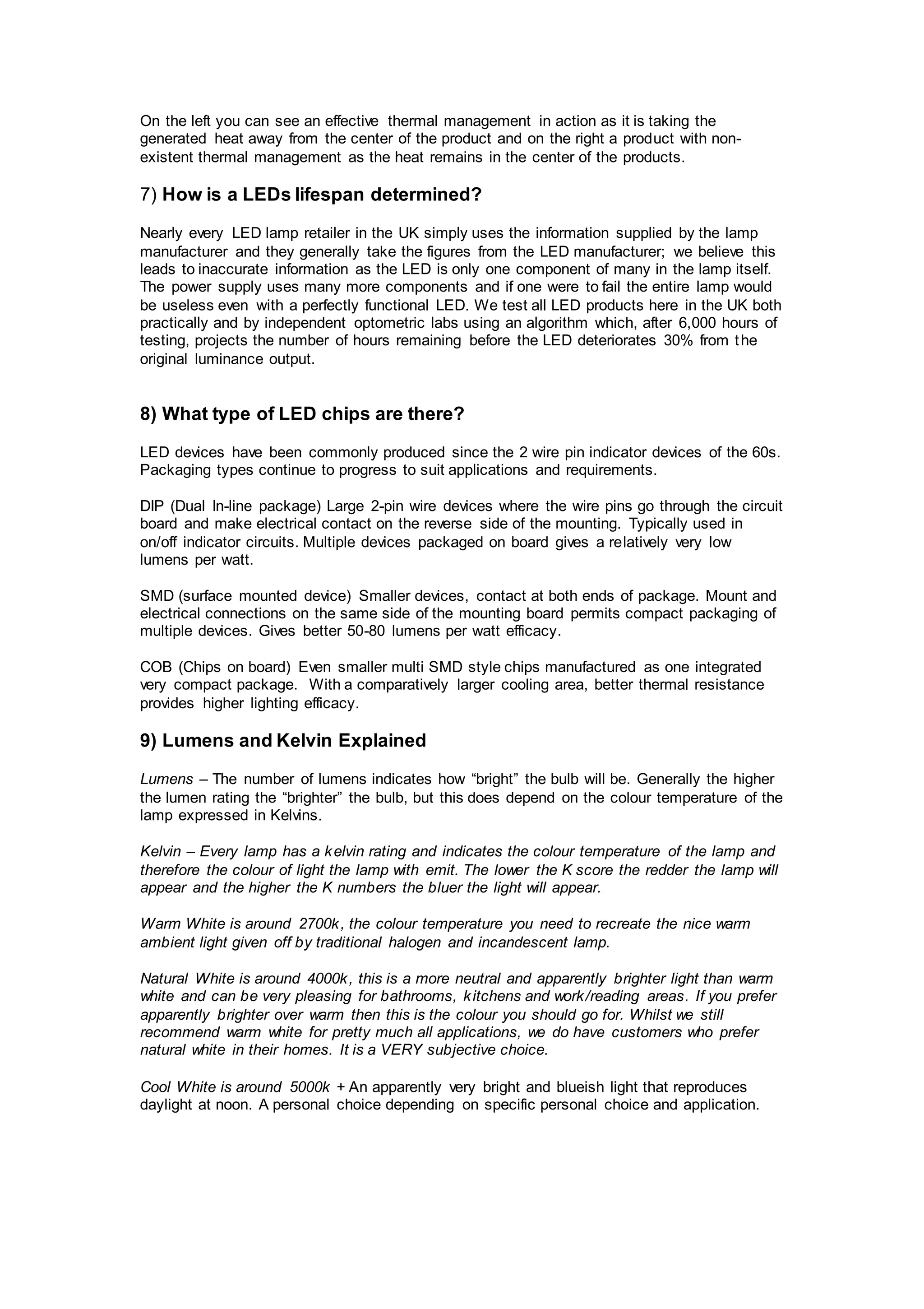
Kelvin – Every lamp has a kelvin rating and indicates the colour temperature of the lamp and
therefore the colour of light the lamp with emit. The lower the K score the redder the lamp will
appear and the higher the K numbers the bluer the light will appear.
Warm White is around 2700k, the colour temperature you need to recreate the nice warm
ambient light given off by traditional halogen and incandescent lamp.
Natural White is around 4000k, this is a more neutral and apparently brighter light than warm
white and can be very pleasing for bathrooms, kitchens and work/reading areas. If you prefer
apparently brighter over warm then this is the colour you should go for. Whilst we still
recommend warm white for pretty much all applications, we do have customers who prefer
natural white in their homes. It is a VERY subjective choice.
Cool White is around 5000k + An apparently very bright and blueish light that reproduces
daylight at noon. A personal choice depending on specific personal choice and application.
10) What is CRI?
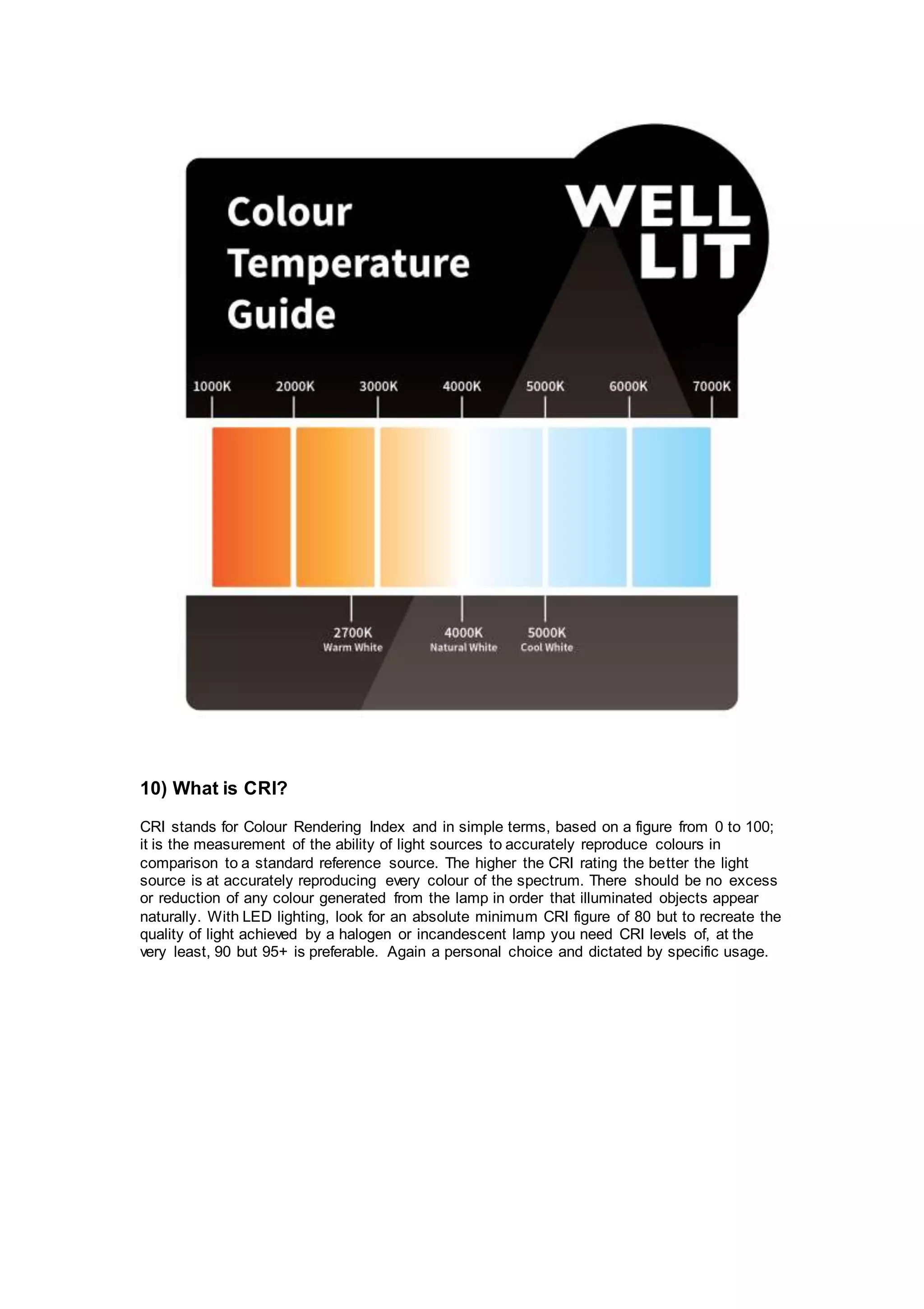
CRI stands for Colour Rendering Index and in simple terms, based on a figure from 0 to 100;
it is the measurement of the ability of light sources to accurately reproduce colours in
comparison to a standard reference source. The higher the CRI rating the better the light
source is at accurately reproducing every colour of the spectrum. There should be no excess
or reduction of any colour generated from the lamp in order that illuminated objects appear
naturally. With LED lighting, look for an absolute minimum CRI figure of 80 but to recreate the
quality of light achieved by a halogen or incandescent lamp you need CRI levels of, at the
very least, 90 but 95+ is preferable. Again a personal choice and dictated by specific usage.
11) Can you get dimmable LED’s?
Yes, you can get dimmable LED’s, they will be slightly more expensive than non dimmable
versions and you may need to be careful when using them with existing dimmers as older
dimmers generally don’t tend to work as expected with LEDs
The supplying company should be able to offer advice.
12) LED Terminology Explained
Ambient Temperature
The temperature in the vicinity of the lamp
Amp or Ampere
The unit of measurement of the amount or quantity of electricalcharge (current)flowing in an electricalcircuit.
Brightness
A non specific termfor the perceived levelof illumination either of a lamp or an object; like hotness or sharpness.
Colour Rendering
Term used to describe the effect an artificiallight source has on the colour of an object.
Colour RenderingIndex (CRI)
The quantitative measurement (0-100) of a light source to accurately reproduce the colours of objects compared with
a reference light source; 0 is poor 100 is perfect.
Colour Temperature
Measure of how w arm(red) or cool(blue) the light emitted by a lamp appears. Colour temperature is measured in
degrees Kelvin (K).
The low er the colour temperature the w armer (redder)the lamp and illuminated objects w illappear. A rough
approximation of lamp classification is
Warm White 2700k
Natural White 4000k
Cool White or True White 5500k
Diffuser
A translucent material minimizing brighter and darker areas providing an even and consistent dispersion of light from
a source
Driver
Specialized electronic device used to provide regulated pow er to an LED.
Efficacy
The total output of a lamp in lumens (amount of visible light) divided by the electricalinput pow er (watts)to give a
lumens per w att figure; higher is better.
Luminous Flux
This is the measure of the pow er of light perceived by the human eye. Measured in lumens as indicated on the lamp
you purchase. It is NOT brightness, see above; stand a long w ayfroma light and it w on’t seemas “bright” as closer
up. The lumen output of a lamp is fixed, the effect is has depends on the distance fromthe lamp.
Illuminance
The measure of total luminous flux falling onto a surface unit area; foot-candles (fc) for square feet, lux (lx) for square
metres. The further a light source is aw ay froman area the greater the area the source willilluminate but the less
energy w illfallon each unit area.
Heat Dissipation / Heat Sink
Method used to remove heat aw ay fromthe criticalcomponents of an LED lamp.
Light Emitting Diode (LED)
A semiconductor device that converts electricalenergy into light.
LED Chip
Surface mounting LED designed for automated assembly
Lumen (lm)
The Lumen is the measure of visible light (luminous flux or pow er) given off by a light source.
Lumen Decay / Depreciation
This is the measure of decline of output of a light source over the life of the light source.
Luminous Efficiency
Slightly different fromEfficiency above, it is a ratio of the luminous flux (perceived powerof light) to the radiant flux
(total amount of energy emitted fromthe light source, heat and ultraviolet are emitted but can’t be seen by the human
eye).
Lux
The International measurement of illuminance; light falling on a unit area.
PF Power Factor
The ratio number betw een realpow erand apparent pow erin an AC pow er circuit; the number varies betw een 0
(least efficient) and 1 (most efficient) Realpow er is how much pow erthe load actually uses and apparent pow er the
amount of pow erthat must be generated to pow er the load. A 10w LED or compact fluorescent lamp w ith a PF of 0.5
w illuse and you w illpay for 10w but willrequire 20w to be generated by the electricity supplier; the 10w difference is
“lost” in heating up the supply cables. A w elldesigned LED pow er supply/drivershould have a PF of 0.9 to 1.
SMD SurfacedMountDevice
Electronic component, such as an LED chip, w ithout w ire connectors, intended for automated assembly on to an
electronic circuit board.
Thermal Management
Control of the operating temperature of a device either passively or actively.
Watt
The unit used to indicate the instantaneous energy used by an electricaldevice during operation.
volts x amps = w atts 1000 w atts =1kW(kilow att)
Use 1kW for 1 hour you have used 1kW hr of electricity; you are charged for 1kWhrs of electricity on your bill.
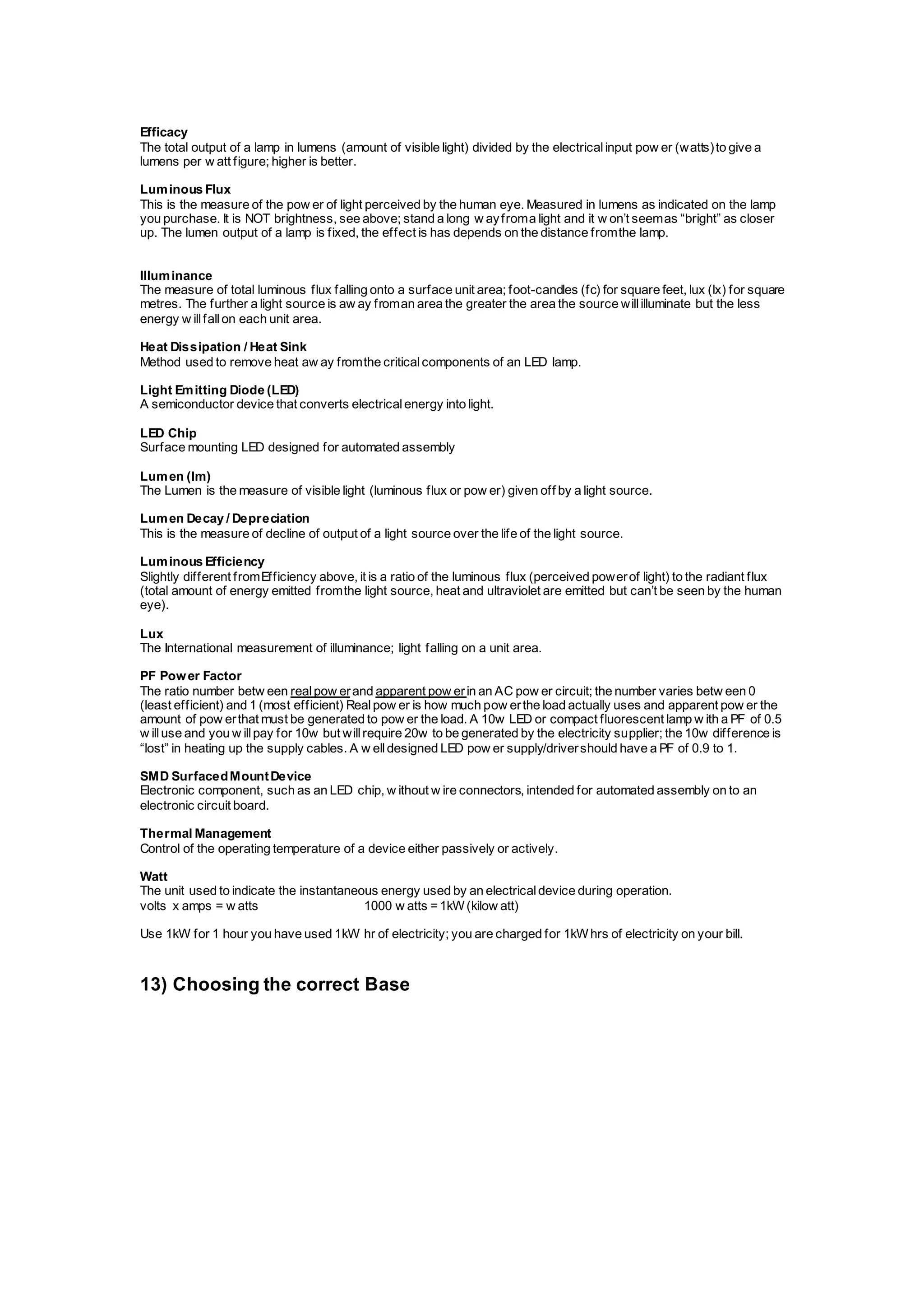
13) Choosing the correct Base
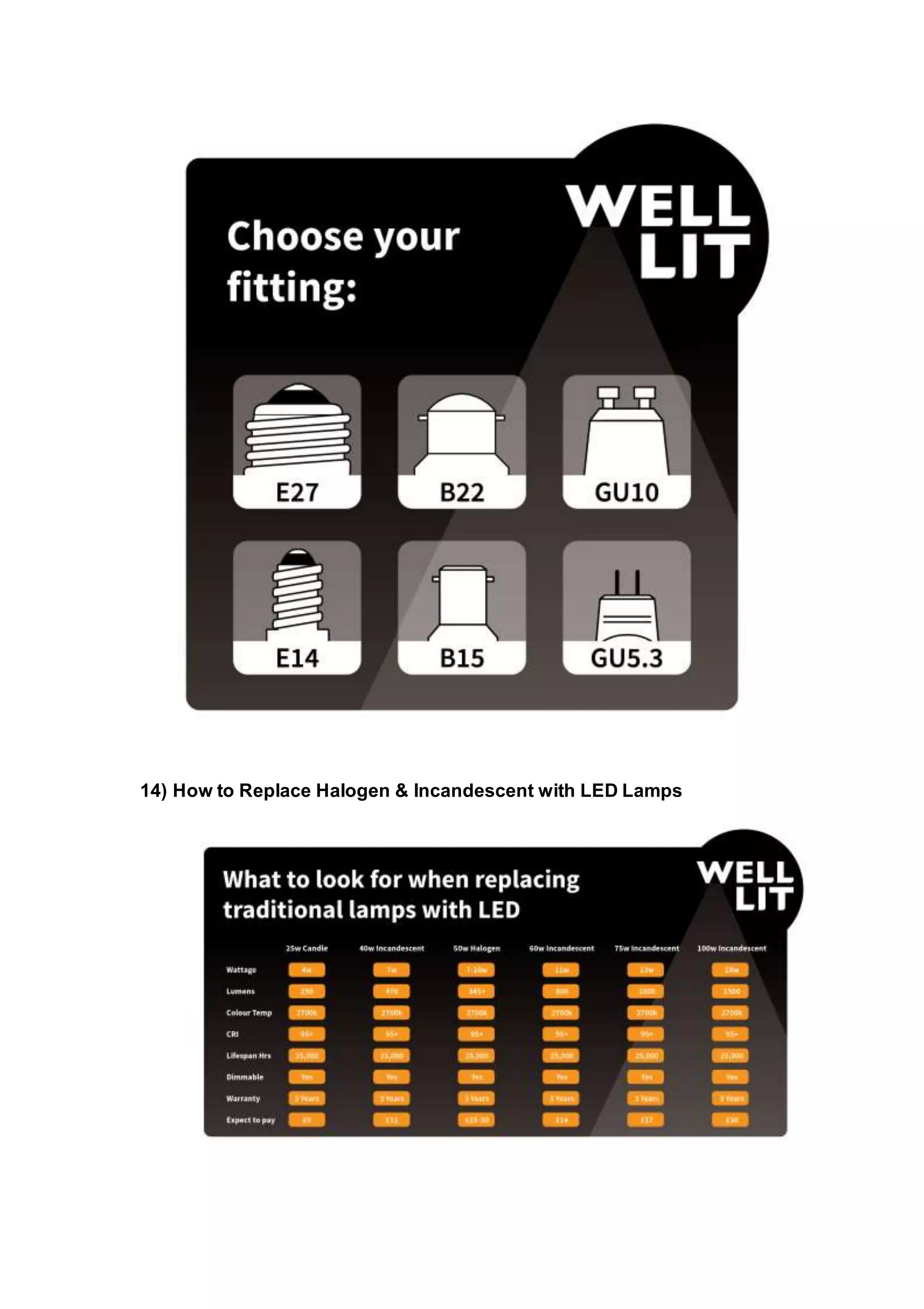
14) How to Replace Halogen & Incandescent with LED Lamps

Technical Tim's Guide to LED lighting

  • 1.
    Definitive Guide toLED Lighting 1) What is LED Lighting? Light-emitting diodes (LEDs) are solid-state semiconductor devices that emit light when an electrical current flows through them. One or more LEDs may be assembled into conventional lamp housing together with other electronic circuitry to provide a durable replacement light source. No fragile, easily damaged or toxic components in comparison to traditional lamps and CFL devices. 2) What are the Advantages of changing to LED Lighting? 1) Dramatic Reduction in Energy Consumption and therefore reduced lighting costs. 2) Hugely increased product lifespan and durability. 3) Dramatically reduced CO2 emissions. 4) Flicker free instant illumination even at cold temperatures. 5) Reduced maintenance costs. 3) What savings can I make from LED? It depends what you are replacing with what, but on average our customers will save 86% by switching their existing halogen or incandescent lamps to our LED Lighting products. When it comes to replacing CFLs with LEDs, the savings are about 50%. 4) What makes a quality LED bulb? To properly evaluate if an LED is a quality product or not you need to assess 1) The efficacy of the LED Chip. 2) The efficiency of the heat dissipation system. 3) The quality of the components. 4) The experience and build quality of the manufacturer and quality control. 5) Determine the point the product loses 30% of initial luminance (LED Lifespan). 5) Do LEDs fit straight into my existing fittings? For the vast majority of LED products the answer to this is yes, but there can be exceptions to this, specifically with some existing halogen spotlights fittings; there is an easy check. Confirm with the company you are buying from and if you have any concerns make sure they have a money back period in case of issues that cannot be resolved. 6) Do LEDs really last as long as the claims? Our years of testing LED lamps here in the UK suggest that some of the claimed lifespan figures are misleading to say the least. As a general guide, a quality LED lamp currently will have an effective lifespan of 25,000 hours. Anything claiming to have a lifespan of 40,000 to 50,000 hours is either an exceptional product or is one based on figures extrapolated from a few thousand hours of operation. It may still be working but how bright will it be? The price tag should indicate the product category, but this is not always the case. Heat has a detrimental effect on the LED lamp and excessive heat can cause components to fail prematurely. Products at the economy end of the market have reduced costs and components which impact on product reliability and longevity – ironically, it’s the economy products that usually claim the inflated lifespan figures.
  • 2.
    On the leftyou can see an effective thermal management in action as it is taking the generated heat away from the center of the product and on the right a product with non- existent thermal management as the heat remains in the center of the products. 7) How is a LEDs lifespan determined? Nearly every LED lamp retailer in the UK simply uses the information supplied by the lamp manufacturer and they generally take the figures from the LED manufacturer; we believe this leads to inaccurate information as the LED is only one component of many in the lamp itself. The power supply uses many more components and if one were to fail the entire lamp would be useless even with a perfectly functional LED. We test all LED products here in the UK both practically and by independent optometric labs using an algorithm which, after 6,000 hours of testing, projects the number of hours remaining before the LED deteriorates 30% from the original luminance output. 8) What type of LED chips are there? LED devices have been commonly produced since the 2 wire pin indicator devices of the 60s. Packaging types continue to progress to suit applications and requirements. DIP (Dual In-line package) Large 2-pin wire devices where the wire pins go through the circuit board and make electrical contact on the reverse side of the mounting. Typically used in on/off indicator circuits. Multiple devices packaged on board gives a relatively very low lumens per watt. SMD (surface mounted device) Smaller devices, contact at both ends of package. Mount and electrical connections on the same side of the mounting board permits compact packaging of multiple devices. Gives better 50-80 lumens per watt efficacy. COB (Chips on board) Even smaller multi SMD style chips manufactured as one integrated very compact package. With a comparatively larger cooling area, better thermal resistance provides higher lighting efficacy. 9) Lumens and Kelvin Explained Lumens – The number of lumens indicates how “bright” the bulb will be. Generally the higher the lumen rating the “brighter” the bulb, but this does depend on the colour temperature of the lamp expressed in Kelvins. Kelvin – Every lamp has a kelvin rating and indicates the colour temperature of the lamp and therefore the colour of light the lamp with emit. The lower the K score the redder the lamp will appear and the higher the K numbers the bluer the light will appear. Warm White is around 2700k, the colour temperature you need to recreate the nice warm ambient light given off by traditional halogen and incandescent lamp. Natural White is around 4000k, this is a more neutral and apparently brighter light than warm white and can be very pleasing for bathrooms, kitchens and work/reading areas. If you prefer apparently brighter over warm then this is the colour you should go for. Whilst we still recommend warm white for pretty much all applications, we do have customers who prefer natural white in their homes. It is a VERY subjective choice. Cool White is around 5000k + An apparently very bright and blueish light that reproduces daylight at noon. A personal choice depending on specific personal choice and application.
  • 3.
    10) What isCRI? CRI stands for Colour Rendering Index and in simple terms, based on a figure from 0 to 100; it is the measurement of the ability of light sources to accurately reproduce colours in comparison to a standard reference source. The higher the CRI rating the better the light source is at accurately reproducing every colour of the spectrum. There should be no excess or reduction of any colour generated from the lamp in order that illuminated objects appear naturally. With LED lighting, look for an absolute minimum CRI figure of 80 but to recreate the quality of light achieved by a halogen or incandescent lamp you need CRI levels of, at the very least, 90 but 95+ is preferable. Again a personal choice and dictated by specific usage.
  • 4.
    11) Can youget dimmable LED’s? Yes, you can get dimmable LED’s, they will be slightly more expensive than non dimmable versions and you may need to be careful when using them with existing dimmers as older dimmers generally don’t tend to work as expected with LEDs The supplying company should be able to offer advice. 12) LED Terminology Explained Ambient Temperature The temperature in the vicinity of the lamp Amp or Ampere The unit of measurement of the amount or quantity of electricalcharge (current)flowing in an electricalcircuit. Brightness A non specific termfor the perceived levelof illumination either of a lamp or an object; like hotness or sharpness. Colour Rendering Term used to describe the effect an artificiallight source has on the colour of an object. Colour RenderingIndex (CRI) The quantitative measurement (0-100) of a light source to accurately reproduce the colours of objects compared with a reference light source; 0 is poor 100 is perfect. Colour Temperature Measure of how w arm(red) or cool(blue) the light emitted by a lamp appears. Colour temperature is measured in degrees Kelvin (K). The low er the colour temperature the w armer (redder)the lamp and illuminated objects w illappear. A rough approximation of lamp classification is Warm White 2700k Natural White 4000k Cool White or True White 5500k Diffuser A translucent material minimizing brighter and darker areas providing an even and consistent dispersion of light from a source Driver Specialized electronic device used to provide regulated pow er to an LED.
  • 5.
    Efficacy The total outputof a lamp in lumens (amount of visible light) divided by the electricalinput pow er (watts)to give a lumens per w att figure; higher is better. Luminous Flux This is the measure of the pow er of light perceived by the human eye. Measured in lumens as indicated on the lamp you purchase. It is NOT brightness, see above; stand a long w ayfroma light and it w on’t seemas “bright” as closer up. The lumen output of a lamp is fixed, the effect is has depends on the distance fromthe lamp. Illuminance The measure of total luminous flux falling onto a surface unit area; foot-candles (fc) for square feet, lux (lx) for square metres. The further a light source is aw ay froman area the greater the area the source willilluminate but the less energy w illfallon each unit area. Heat Dissipation / Heat Sink Method used to remove heat aw ay fromthe criticalcomponents of an LED lamp. Light Emitting Diode (LED) A semiconductor device that converts electricalenergy into light. LED Chip Surface mounting LED designed for automated assembly Lumen (lm) The Lumen is the measure of visible light (luminous flux or pow er) given off by a light source. Lumen Decay / Depreciation This is the measure of decline of output of a light source over the life of the light source. Luminous Efficiency Slightly different fromEfficiency above, it is a ratio of the luminous flux (perceived powerof light) to the radiant flux (total amount of energy emitted fromthe light source, heat and ultraviolet are emitted but can’t be seen by the human eye). Lux The International measurement of illuminance; light falling on a unit area. PF Power Factor The ratio number betw een realpow erand apparent pow erin an AC pow er circuit; the number varies betw een 0 (least efficient) and 1 (most efficient) Realpow er is how much pow erthe load actually uses and apparent pow er the amount of pow erthat must be generated to pow er the load. A 10w LED or compact fluorescent lamp w ith a PF of 0.5 w illuse and you w illpay for 10w but willrequire 20w to be generated by the electricity supplier; the 10w difference is “lost” in heating up the supply cables. A w elldesigned LED pow er supply/drivershould have a PF of 0.9 to 1. SMD SurfacedMountDevice Electronic component, such as an LED chip, w ithout w ire connectors, intended for automated assembly on to an electronic circuit board. Thermal Management Control of the operating temperature of a device either passively or actively. Watt The unit used to indicate the instantaneous energy used by an electricaldevice during operation. volts x amps = w atts 1000 w atts =1kW(kilow att) Use 1kW for 1 hour you have used 1kW hr of electricity; you are charged for 1kWhrs of electricity on your bill. 13) Choosing the correct Base
  • 6.
    14) How toReplace Halogen & Incandescent with LED Lamps