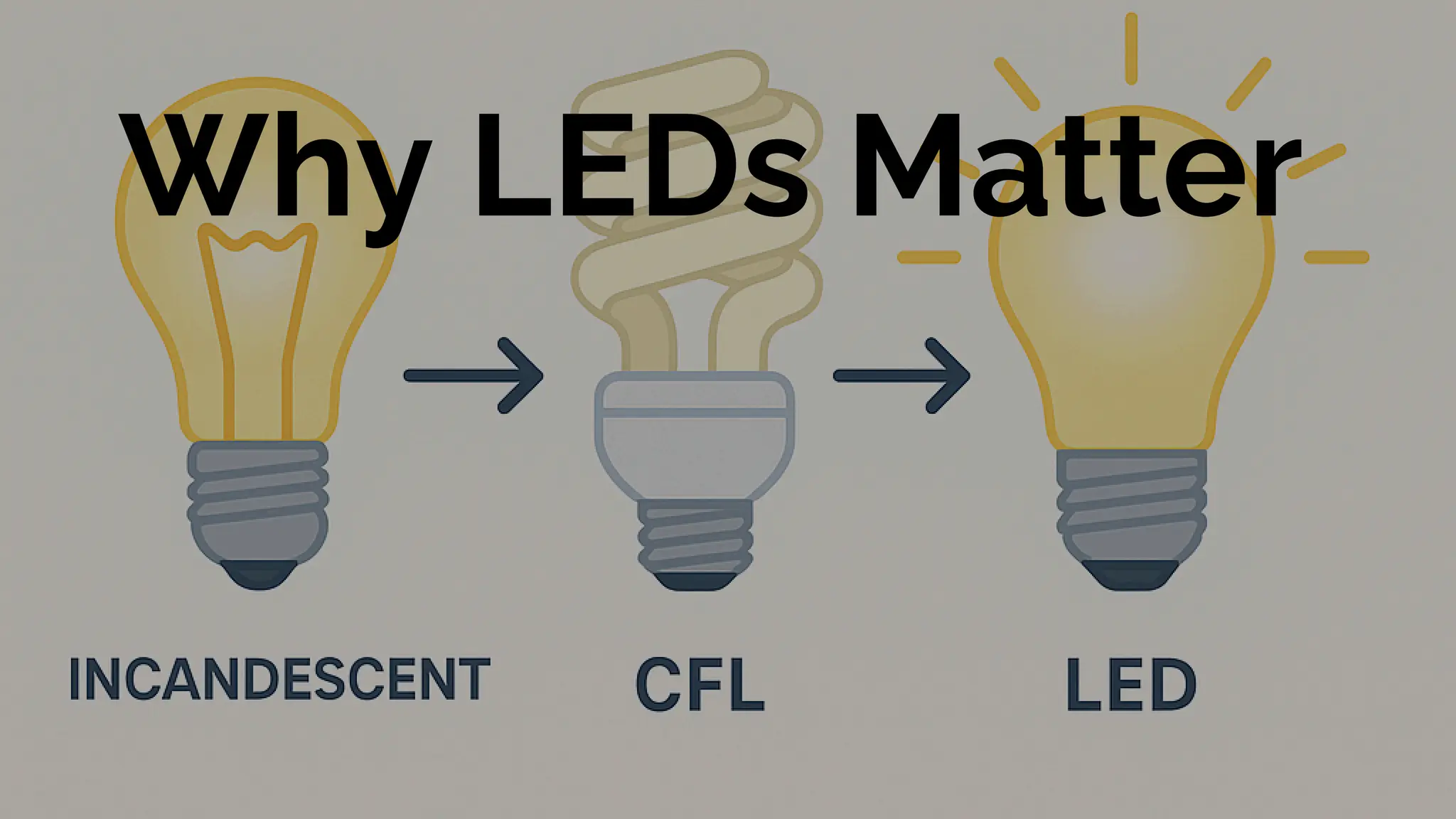
Why LEDs Matter
Introduction
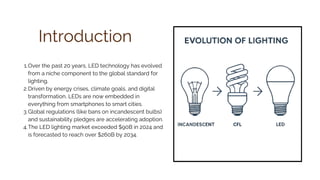
1.Over the past 20 years, LED technology has evolved
from a niche component to the global standard for
lighting.
2.Driven by energy crises, climate goals, and digital
transformation, LEDs are now embedded in
everything from smartphones to smart cities.
3.Global regulations (like bans on incandescent bulbs)
and sustainability pledges are accelerating adoption.
4.The LED lighting market exceeded $90B in 2024 and
is forecasted to reach over $260B by 2034.
Energy
Efficiency
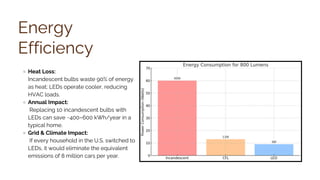
Heat Loss:
Incandescent bulbs waste 90% of energy
as heat; LEDs operate cooler, reducing
HVAC loads.
Annual Impact:
Replacing 10 incandescent bulbs with
LEDs can save ~400–600 kWh/year in a
typical home.
Grid & Climate Impact:
If every household in the U.S. switched to
LEDs, it would eliminate the equivalent
emissions of 8 million cars per year.
Longer Lifespan
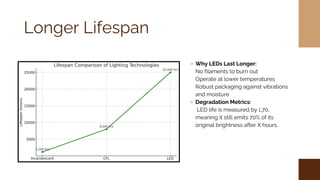
Why LEDs Last Longer:
No filaments to burn out
Operate at lower temperatures
Robust packaging against vibrations
and moisture
Degradation Metrics:
LED life is measured by L70,
meaning it still emits 70% of its
original brightness after X hours.
Environmentally
Friendly
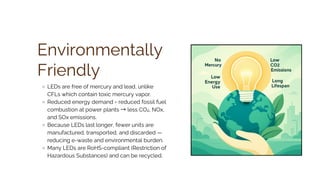
LEDs are free of mercury and lead, unlike
CFLs which contain toxic mercury vapor.
Reduced energy demand = reduced fossil fuel
combustion at power plants → less CO₂, NOx,
and SOx emissions.
Because LEDs last longer, fewer units are
manufactured, transported, and discarded —
reducing e-waste and environmental burden.
Many LEDs are RoHS-compliant (Restriction of
Hazardous Substances) and can be recycled.
Cost Savings
Over Time
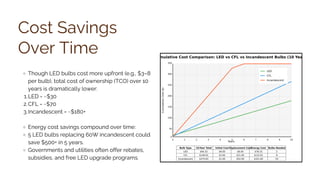
Though LED bulbs cost more upfront (e.g., $3–8
per bulb), total cost of ownership (TCO) over 10
years is dramatically lower:
1.LED = ~$30
2.CFL = ~$70
3.Incandescent = ~$180+
Energy cost savings compound over time:
5 LED bulbs replacing 60W incandescent could
save $500+ in 5 years.
Governments and utilities often offer rebates,
subsidies, and free LED upgrade programs.
Instant Light & Dimming Capability
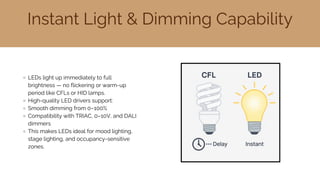
LEDs light up immediately to full
brightness — no flickering or warm-up
period like CFLs or HID lamps.
High-quality LED drivers support:
Smooth dimming from 0–100%
Compatibility with TRIAC, 0–10V, and DALI
dimmers
This makes LEDs ideal for mood lighting,
stage lighting, and occupancy-sensitive
zones.
Superior Light Quality
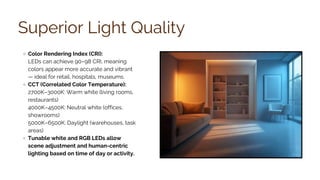
Color Rendering Index (CRI):
LEDs can achieve 90–98 CRI, meaning
colors appear more accurate and vibrant
— ideal for retail, hospitals, museums.
CCT (Correlated Color Temperature):
2700K–3000K: Warm white (living rooms,
restaurants)
4000K–4500K: Neutral white (offices,
showrooms)
5000K–6500K: Daylight (warehouses, task
areas)
Tunable white and RGB LEDs allow
scene adjustment and human-centric
lighting based on time of day or activity.
Design Flexibility
& Compact Size
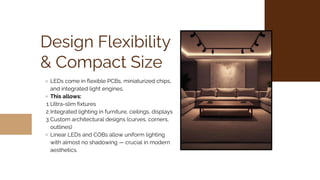
LEDs come in flexible PCBs, miniaturized chips,
and integrated light engines.
This allows:
1.Ultra-slim fixtures
2.Integrated lighting in furniture, ceilings, displays
3.Custom architectural designs (curves, corners,
outlines)
Linear LEDs and COBs allow uniform lighting
with almost no shadowing — crucial in modern
aesthetics.
Smart Control Compatibility
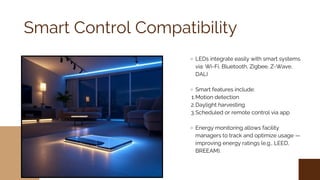
LEDs integrate easily with smart systems
via: Wi-Fi, Bluetooth, Zigbee, Z-Wave,
DALI
Smart features include:
1.Motion detection
2.Daylight harvesting
3.Scheduled or remote control via app
Energy monitoring allows facility
managers to track and optimize usage —
improving energy ratings (e.g., LEED,
BREEAM).
Low Heat Emission & Safety
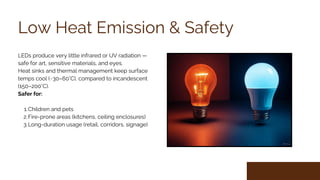
LEDs produce very little infrared or UV radiation —
safe for art, sensitive materials, and eyes.
Heat sinks and thermal management keep surface
temps cool (~30–60°C), compared to incandescent
(150–200°C).
Safer for:
1.Children and pets
2.Fire-prone areas (kitchens, ceiling enclosures)
3.Long-duration usage (retail, corridors, signage)
Contribution to
Sustainability Goals
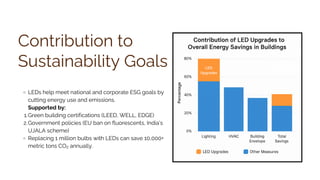
LEDs help meet national and corporate ESG goals by
cutting energy use and emissions.
Supported by:
1.Green building certifications (LEED, WELL, EDGE)
2.Government policies (EU ban on fluorescents, India’s
UJALA scheme)
Replacing 1 million bulbs with LEDs can save 10,000+
metric tons CO₂ annually.
Conclusion – The Smart Choice
Switching to LED lighting is no longer optional — it’s
an economic, environmental, and technological
upgrade.
LED systems offer:
1.Lower TCO
2.Smart compatibility
3.Longer lifespan
4.Better lighting quality
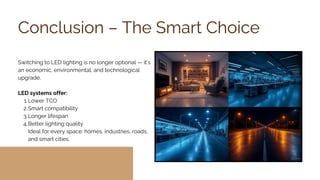
Ideal for every space: homes, industries, roads,
and smart cities.

Why LEDs Matter in lighting industry.pdf

  • 1.
  • 2.
    Introduction 1.Over the past20 years, LED technology has evolved from a niche component to the global standard for lighting. 2.Driven by energy crises, climate goals, and digital transformation, LEDs are now embedded in everything from smartphones to smart cities. 3.Global regulations (like bans on incandescent bulbs) and sustainability pledges are accelerating adoption. 4.The LED lighting market exceeded $90B in 2024 and is forecasted to reach over $260B by 2034.
  • 3.
    Energy Efficiency Heat Loss: Incandescent bulbswaste 90% of energy as heat; LEDs operate cooler, reducing HVAC loads. Annual Impact: Replacing 10 incandescent bulbs with LEDs can save ~400–600 kWh/year in a typical home. Grid & Climate Impact: If every household in the U.S. switched to LEDs, it would eliminate the equivalent emissions of 8 million cars per year.
  • 4.
    Longer Lifespan Why LEDsLast Longer: No filaments to burn out Operate at lower temperatures Robust packaging against vibrations and moisture Degradation Metrics: LED life is measured by L70, meaning it still emits 70% of its original brightness after X hours.
  • 5.
    Environmentally Friendly LEDs are freeof mercury and lead, unlike CFLs which contain toxic mercury vapor. Reduced energy demand = reduced fossil fuel combustion at power plants → less CO₂, NOx, and SOx emissions. Because LEDs last longer, fewer units are manufactured, transported, and discarded — reducing e-waste and environmental burden. Many LEDs are RoHS-compliant (Restriction of Hazardous Substances) and can be recycled.
  • 6.
    Cost Savings Over Time ThoughLED bulbs cost more upfront (e.g., $3–8 per bulb), total cost of ownership (TCO) over 10 years is dramatically lower: 1.LED = ~$30 2.CFL = ~$70 3.Incandescent = ~$180+ Energy cost savings compound over time: 5 LED bulbs replacing 60W incandescent could save $500+ in 5 years. Governments and utilities often offer rebates, subsidies, and free LED upgrade programs.
  • 7.
    Instant Light &Dimming Capability LEDs light up immediately to full brightness — no flickering or warm-up period like CFLs or HID lamps. High-quality LED drivers support: Smooth dimming from 0–100% Compatibility with TRIAC, 0–10V, and DALI dimmers This makes LEDs ideal for mood lighting, stage lighting, and occupancy-sensitive zones.
  • 8.
    Superior Light Quality ColorRendering Index (CRI): LEDs can achieve 90–98 CRI, meaning colors appear more accurate and vibrant — ideal for retail, hospitals, museums. CCT (Correlated Color Temperature): 2700K–3000K: Warm white (living rooms, restaurants) 4000K–4500K: Neutral white (offices, showrooms) 5000K–6500K: Daylight (warehouses, task areas) Tunable white and RGB LEDs allow scene adjustment and human-centric lighting based on time of day or activity.
  • 9.
    Design Flexibility & CompactSize LEDs come in flexible PCBs, miniaturized chips, and integrated light engines. This allows: 1.Ultra-slim fixtures 2.Integrated lighting in furniture, ceilings, displays 3.Custom architectural designs (curves, corners, outlines) Linear LEDs and COBs allow uniform lighting with almost no shadowing — crucial in modern aesthetics.
  • 10.
    Smart Control Compatibility LEDsintegrate easily with smart systems via: Wi-Fi, Bluetooth, Zigbee, Z-Wave, DALI Smart features include: 1.Motion detection 2.Daylight harvesting 3.Scheduled or remote control via app Energy monitoring allows facility managers to track and optimize usage — improving energy ratings (e.g., LEED, BREEAM).
  • 11.
    Low Heat Emission& Safety LEDs produce very little infrared or UV radiation — safe for art, sensitive materials, and eyes. Heat sinks and thermal management keep surface temps cool (~30–60°C), compared to incandescent (150–200°C). Safer for: 1.Children and pets 2.Fire-prone areas (kitchens, ceiling enclosures) 3.Long-duration usage (retail, corridors, signage)
  • 12.
    Contribution to Sustainability Goals LEDshelp meet national and corporate ESG goals by cutting energy use and emissions. Supported by: 1.Green building certifications (LEED, WELL, EDGE) 2.Government policies (EU ban on fluorescents, India’s UJALA scheme) Replacing 1 million bulbs with LEDs can save 10,000+ metric tons CO₂ annually.
  • 13.
    Conclusion – TheSmart Choice Switching to LED lighting is no longer optional — it’s an economic, environmental, and technological upgrade. LED systems offer: 1.Lower TCO 2.Smart compatibility 3.Longer lifespan 4.Better lighting quality Ideal for every space: homes, industries, roads, and smart cities.