Duck-billed platypus
Made by Mohamed Elebiary
University of Massachusetts Boston
Duck-Billed platypus
Duck-Billed Platypus are also known
as: Platypus Duck Bill
Watermole Duckmole
Definition:
is a semiaquatic egg-laying mammal.
he only mammals that lay eggs
instead of giving birth
Platypus is Latin derived from the
Greek words "Platys" and "Pous"
meaning "Flat Foot"
classification
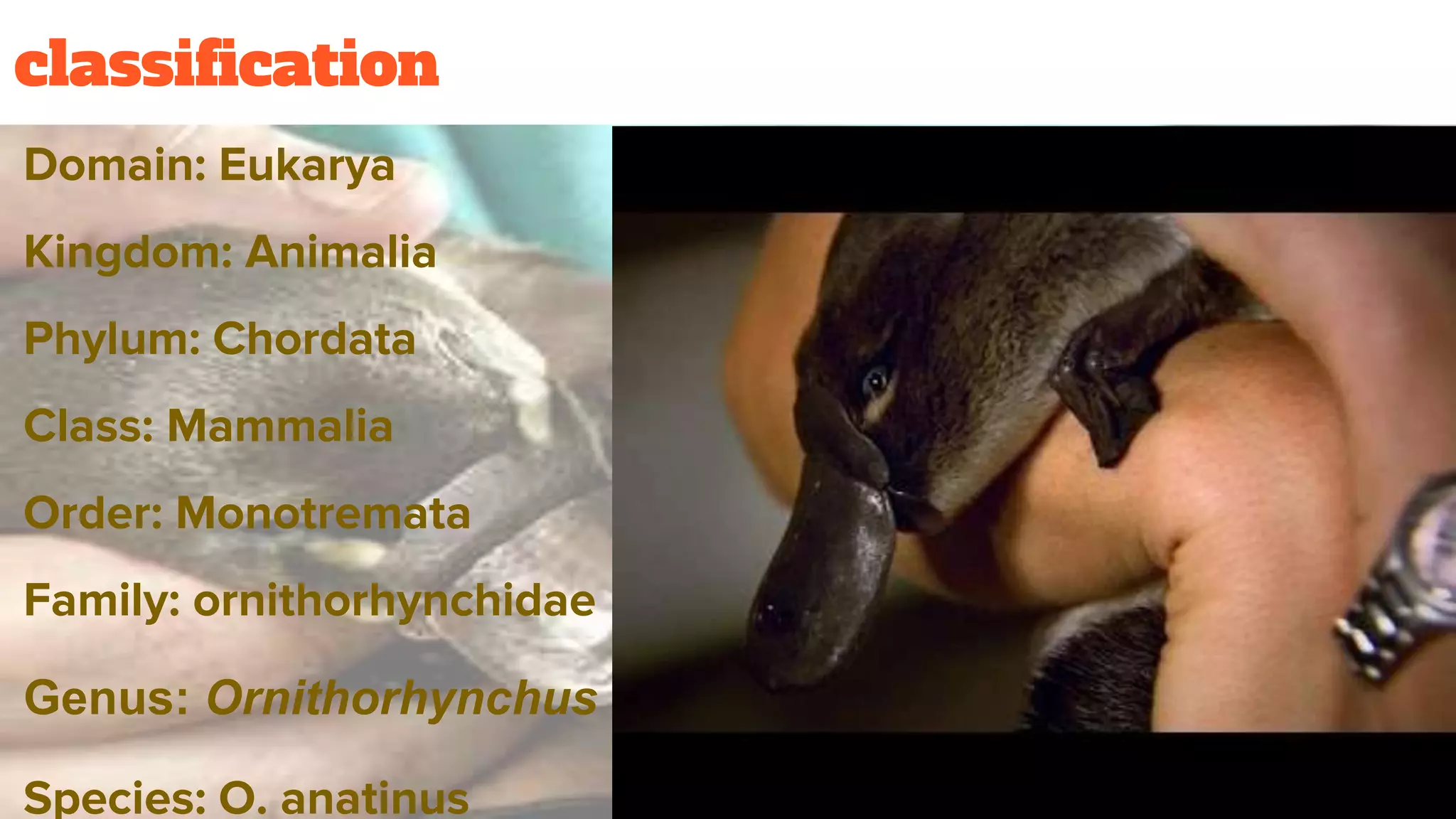
Domain: Eukarya
Kingdom: Animalia
Phylum: Chordata
Class: Mammalia
Order: Monotremata
Family: ornithorhynchidae
Genus: Ornithorhynchus
Species: O. anatinus
Latin Name Ornithorhynchus anatinus
Conservation Status Least Concern
movement knuckling 30% _ swimming
Colour Brown
Length 40 - 60 cms (16 - 23.5 inches)
Tail 8.5 - 15 cms (3.25 - 6 inches)
Weight 0.8 - 2.5 Kgs (1.75 - 5.5 lbs)
Life Expectancy 10 Yrs (Wild)
17 Yrs (in Captivity)
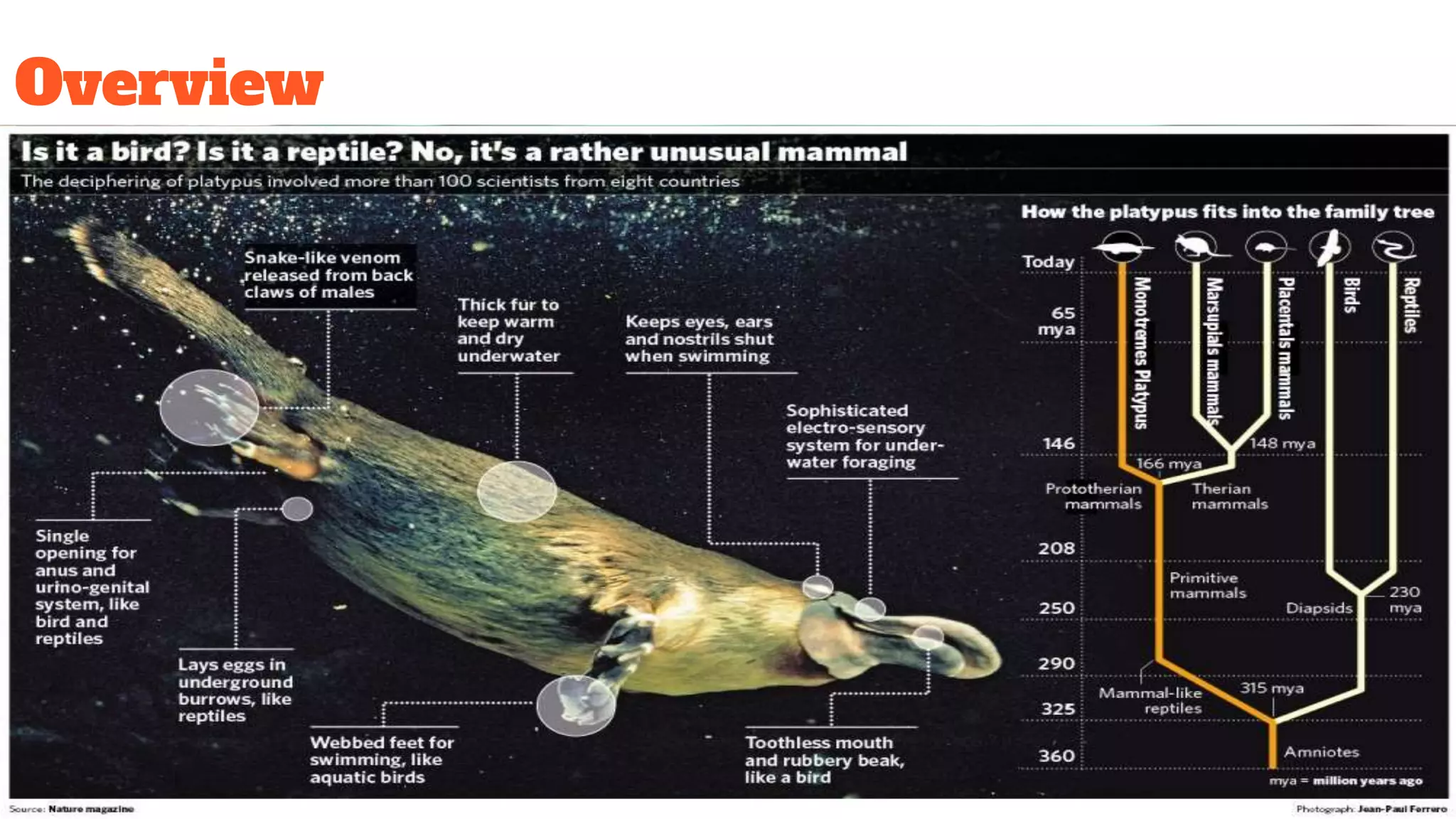
Overview
LOCATION
• Eastern Australia
• Tasmania
• They live near
freshwater lakes and
rivers.
Habitat
Duck-Billed Platypuses are found in the lakes, streams and
rivers. They build their burrows in banks, with the
entrance being approximately 30 cms (12 inches)
above the surface of the water.
_They have territories of up to 7 kms
(4.4 miles) and the territory of a male will
overlap withthe territories of 3 - 4 females.
SIZE AND COLOR• Body is 14 inches long
• Tail is 5 inches long
• Males are usually
slightly larger than
females.
• it weighs about 3 lbs
• has a fur it`s Colors vary
from yellowish to dark
brown.
FOODThey are (carnivore).
they eat primarily aquatic
invertebrates in streams and
lakes
Worms.
Fish. Tadpoles.
Frogs. Crustaceans.
20%_ 12hrs
human _snakes_large fish
Adaptation
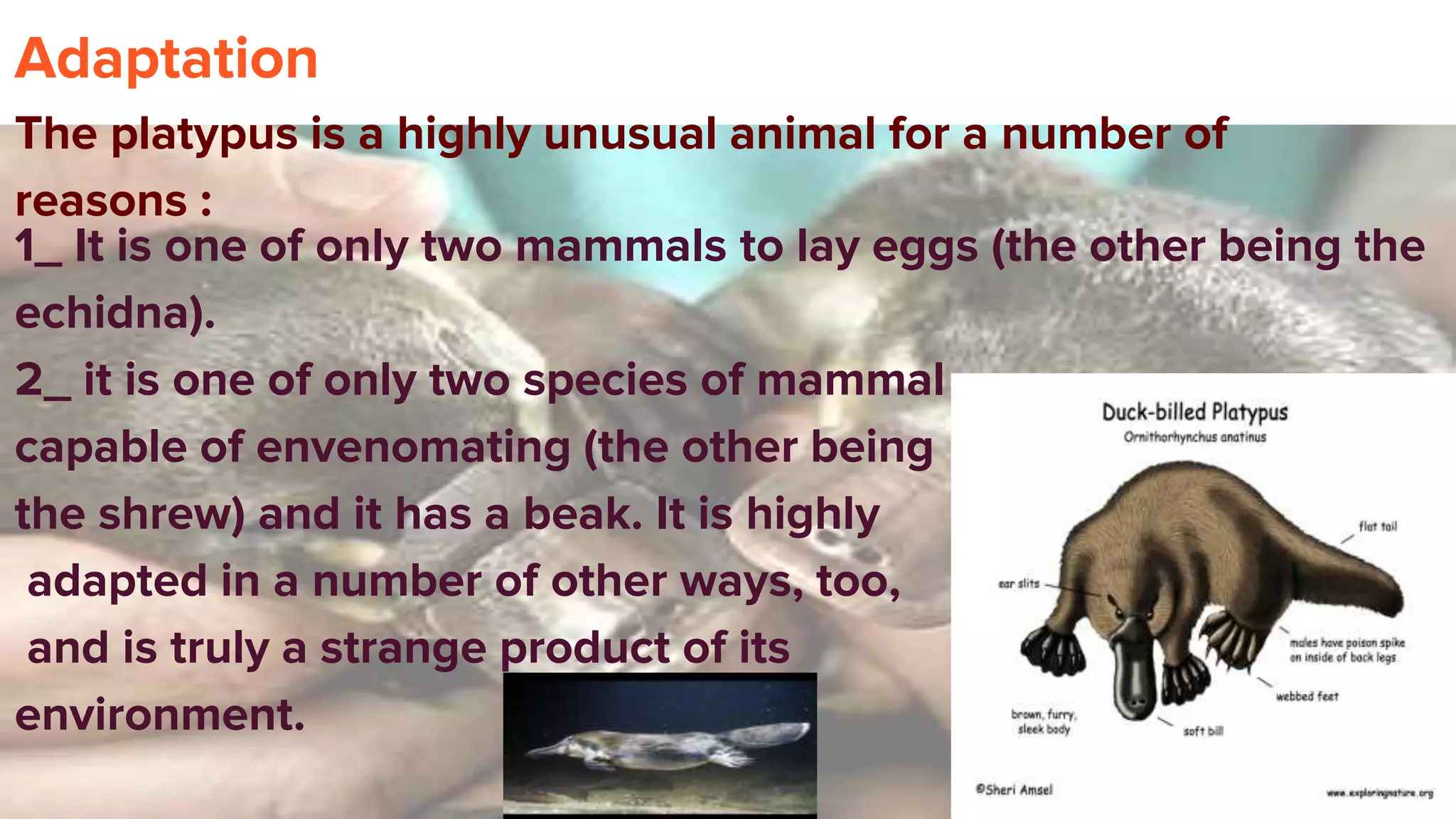
The platypus is a highly unusual animal for a number of
reasons :
1_ It is one of only two mammals to lay eggs (the other being the
echidna).
2_ it is one of only two species of mammal
capable of envenomating (the other being
the shrew) and it has a beak. It is highly
adapted in a number of other ways, too,
and is truly a strange product of its
environment.
Adaptation
Egg Laying
Egg laying mammals are called monotremes, and there are only
five species that do so -- four of which are echidna. Little fossil
evidence of monotremes exists, but scientists believe that before
evolving to deliver live young, most mammals laid eggs. In that
regard, the platypus is a historic relic.
Poison Spur
Male platypuses have a spur on each foot, from which
they can deliver a venomous sting. This capacity to deliver
poison is extremely rare for mammals. Shrews are capable
of doing it, too, but the platypus is the only creature on Earth
to have a venomous spur.
Adaptation
Duck Bill
This feature enable the platypus to hear and breathe while diving
for prey.It is remarkably similar to a duck’s bill, hence the name,
but it most likely evolved independently of the duck,
despite this similarity.
Strong Claws
As well as being good at swimming, platypodes are good
diggers. They have adapted to have strong, shovel-like claws
that enable them to move and disturb thick, heavy soil and mud.
They dig in order to burrow. This is especially important for
females, who use a nesting burrow for raising their young.
Adaptation
Fat Tail
The platypus tail is fat and flat. Its flatness assists with swimming,functioning almost
like a rudder. But the tail is also a fat store. this adaptation is especially important for
females, who require stores of fat for nesting in their burrow. However, males store fat
as well, for periods when they are unable to find food.
Webbed Feet
Platypuses have evolved to have webbed feet.
The webs enable them to swim more efficiently
and move around on soft,muddy surfaces with
ease. The front feet are fully webbed, the hind
feet are only partially webbed.
duck billed platypus life cycle
-How the platypus finds a mate is the male produces a musky odor during the
breeding season.
~It reproduces by laying eggs, which hatch into young platypuses that initially
feed off of mother's milk.
~The gestation period for a platypus is 2-3 weeks.
~The platypuses take care of their young by feeding them their mother's milk
which is secreted from her pores and collects on grooves in her abdomen.
~The offspring leaves the burrow and their parents when they reach
approximately 4 months old.
The life cycle of platypus
Babies
• Females usually lay two soft, leathery eggs
but may lay up to four.
• She clasps the eggs against her abdomen
with her tail for about two weeks.
• Milk is produced by glands under mother’s
skin, and the baby licks milk from her fur.
A fact: There is a higher proportion
of spur wounds in males than
females, which may be explained by
aggressive encounters between
males during mating season.
Their Features
• Have no fur
• Blind for about two months
• Have teeth for a short time
• Helpless
Relationship to human
Platypuses are shy animals which avoid contact with humans
as much as possible.
Humans have had considerable impact on platypuses in the
past, such as killing platypuses for their fur, or using fishing
nets in rivers which caused entangled platypuses to drown
as they could not come to the surface to breathe.
However, now the platypus is a protected native species.
They are elusive creatures, rarely even studied by scientists,
as research can be too intrusive in their environment.
Interesting facts
1. It Was Believed to Be a Hoax Animal.
2. Females Produce Milk Like Sweat.
3. It Has No Stomach, No Teeth.
4. It Shares Certain Bone Structures with Reptiles.
Thank you

Duck billed platypus

  • 1.
    Duck-billed platypus Made byMohamed Elebiary University of Massachusetts Boston
  • 2.
    Duck-Billed platypus Duck-Billed Platypusare also known as: Platypus Duck Bill Watermole Duckmole Definition: is a semiaquatic egg-laying mammal. he only mammals that lay eggs instead of giving birth Platypus is Latin derived from the Greek words "Platys" and "Pous" meaning "Flat Foot"
  • 3.
    classification Domain: Eukarya Kingdom: Animalia Phylum:Chordata Class: Mammalia Order: Monotremata Family: ornithorhynchidae Genus: Ornithorhynchus Species: O. anatinus
  • 4.
    Latin Name Ornithorhynchusanatinus Conservation Status Least Concern movement knuckling 30% _ swimming Colour Brown Length 40 - 60 cms (16 - 23.5 inches) Tail 8.5 - 15 cms (3.25 - 6 inches) Weight 0.8 - 2.5 Kgs (1.75 - 5.5 lbs) Life Expectancy 10 Yrs (Wild) 17 Yrs (in Captivity) Overview
  • 5.
    LOCATION • Eastern Australia •Tasmania • They live near freshwater lakes and rivers.
  • 6.
    Habitat Duck-Billed Platypuses arefound in the lakes, streams and rivers. They build their burrows in banks, with the entrance being approximately 30 cms (12 inches) above the surface of the water. _They have territories of up to 7 kms (4.4 miles) and the territory of a male will overlap withthe territories of 3 - 4 females.
  • 7.
    SIZE AND COLOR•Body is 14 inches long • Tail is 5 inches long • Males are usually slightly larger than females. • it weighs about 3 lbs • has a fur it`s Colors vary from yellowish to dark brown.
  • 8.
    FOODThey are (carnivore). theyeat primarily aquatic invertebrates in streams and lakes Worms. Fish. Tadpoles. Frogs. Crustaceans. 20%_ 12hrs human _snakes_large fish
  • 9.
    Adaptation The platypus isa highly unusual animal for a number of reasons : 1_ It is one of only two mammals to lay eggs (the other being the echidna). 2_ it is one of only two species of mammal capable of envenomating (the other being the shrew) and it has a beak. It is highly adapted in a number of other ways, too, and is truly a strange product of its environment.
  • 10.
    Adaptation Egg Laying Egg layingmammals are called monotremes, and there are only five species that do so -- four of which are echidna. Little fossil evidence of monotremes exists, but scientists believe that before evolving to deliver live young, most mammals laid eggs. In that regard, the platypus is a historic relic. Poison Spur Male platypuses have a spur on each foot, from which they can deliver a venomous sting. This capacity to deliver poison is extremely rare for mammals. Shrews are capable of doing it, too, but the platypus is the only creature on Earth to have a venomous spur.
  • 11.
    Adaptation Duck Bill This featureenable the platypus to hear and breathe while diving for prey.It is remarkably similar to a duck’s bill, hence the name, but it most likely evolved independently of the duck, despite this similarity. Strong Claws As well as being good at swimming, platypodes are good diggers. They have adapted to have strong, shovel-like claws that enable them to move and disturb thick, heavy soil and mud. They dig in order to burrow. This is especially important for females, who use a nesting burrow for raising their young.
  • 12.
    Adaptation Fat Tail The platypustail is fat and flat. Its flatness assists with swimming,functioning almost like a rudder. But the tail is also a fat store. this adaptation is especially important for females, who require stores of fat for nesting in their burrow. However, males store fat as well, for periods when they are unable to find food. Webbed Feet Platypuses have evolved to have webbed feet. The webs enable them to swim more efficiently and move around on soft,muddy surfaces with ease. The front feet are fully webbed, the hind feet are only partially webbed.
  • 13.
    duck billed platypuslife cycle -How the platypus finds a mate is the male produces a musky odor during the breeding season. ~It reproduces by laying eggs, which hatch into young platypuses that initially feed off of mother's milk. ~The gestation period for a platypus is 2-3 weeks. ~The platypuses take care of their young by feeding them their mother's milk which is secreted from her pores and collects on grooves in her abdomen. ~The offspring leaves the burrow and their parents when they reach approximately 4 months old.
  • 14.
    The life cycleof platypus
  • 15.
    Babies • Females usuallylay two soft, leathery eggs but may lay up to four. • She clasps the eggs against her abdomen with her tail for about two weeks. • Milk is produced by glands under mother’s skin, and the baby licks milk from her fur. A fact: There is a higher proportion of spur wounds in males than females, which may be explained by aggressive encounters between males during mating season. Their Features • Have no fur • Blind for about two months • Have teeth for a short time • Helpless
  • 16.
    Relationship to human Platypusesare shy animals which avoid contact with humans as much as possible. Humans have had considerable impact on platypuses in the past, such as killing platypuses for their fur, or using fishing nets in rivers which caused entangled platypuses to drown as they could not come to the surface to breathe. However, now the platypus is a protected native species. They are elusive creatures, rarely even studied by scientists, as research can be too intrusive in their environment.
  • 17.
    Interesting facts 1. ItWas Believed to Be a Hoax Animal. 2. Females Produce Milk Like Sweat. 3. It Has No Stomach, No Teeth. 4. It Shares Certain Bone Structures with Reptiles.
  • 18.