English class

Poisonous Animal

Professor : Christopher YUKNA
Michitaka UCHINO
Jan. 2014
Description
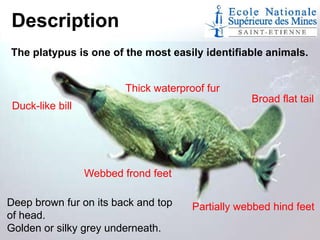
The platypus is one of the most easily identifiable animals.
Thick waterproof fur

Broad flat tail

Duck-like bill

Webbed frond feet
Deep brown fur on its back and top
of head.
Golden or silky grey underneath.

Partially webbed hind feet
Description
Weight [g] Length [cm]
Females
43
900

Males

1700

50

All platypus are born with ankle spurs,
Only males has two venom glands attached to spurs on hind feet.
Distribution
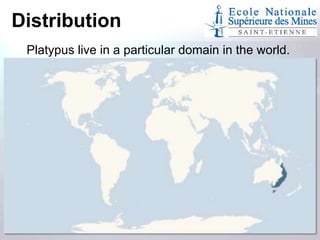
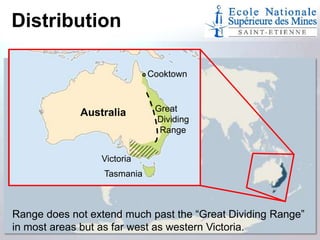
Platypus live in a particular domain in the world.
Distribution
Cooktown

Australia

Great
Dividing
Range

Victoria
Tasmania

Range does not extend much past the “Great Dividing Range”
in most areas but as far west as western Victoria.
Habitat
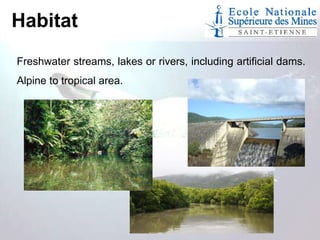
Freshwater streams, lakes or rivers, including artificial dams.
Alpine to tropical area.
Dietary pattern
Foods
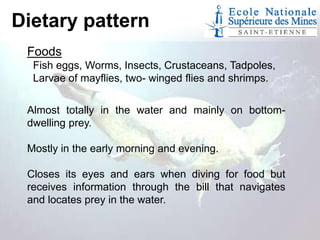
Fish eggs, Worms, Insects, Crustaceans, Tadpoles,
Larvae of mayflies, two- winged flies and shrimps.
Almost totally in the water and mainly on bottomdwelling prey.
Mostly in the early morning and evening.
Closes its eyes and ears when diving for food but
receives information through the bill that navigates
and locates prey in the water.
Venom
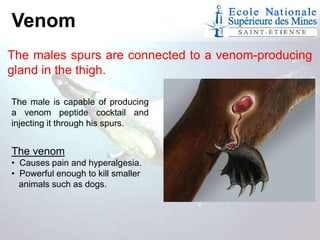
The males spurs are connected to a venom-producing
gland in the thigh.
The male is capable of producing
a venom peptide cocktail and
injecting it through his spurs.

The venom
• Causes pain and hyperalgesia.
• Powerful enough to kill smaller
animals such as dogs.
Venom
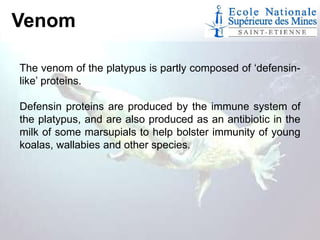
The venom of the platypus is partly composed of „defensinlike‟ proteins.
Defensin proteins are produced by the immune system of
the platypus, and are also produced as an antibiotic in the
milk of some marsupials to help bolster immunity of young
koalas, wallabies and other species.
Summary

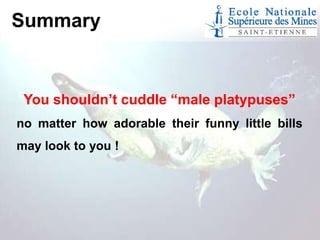
You shouldn’t cuddle “male platypuses”
no matter how adorable their funny little bills
may look to you !
Thank you for your attention !
Reference material
http://www.wildlife.org.au/wildlife/speciesprofile/mammals/platypus.html
http://www.australianfauna.com/platypus.php
http://www.bbc.co.uk/nature/life/Platypus

http://bookofbeasts.wordpress.com/2012/06/29/platypus/
http://ferrebeekeeper.wordpress.com/2011/01/18/1953/
http://www.cosmosmagazine.com/news/evolution-platypus-venom-revealed/

Platypus_Poisonous animal