IEEE/ACM TRAS. ON NETWORKING, VOL. 6, NO. 1, JUNE 2008                                                                                      1


                             Dual-resource TCP/AQM
                       for Processing-constrained Networks
    Minsu Shin, Student Member, IEEE, Song Chong, Member, IEEE, and Injong Rhee, Senior Member, IEEE


   Abstract—This paper examines congestion control issues for                 processing capacity in the network components. New router
TCP flows that require in-network processing on the fly in                      technologies such as extensible routers [3] or programmable
network elements such as gateways, proxies, firewalls and even                 routers [4] also need to deal with scheduling of CPU usage
routers. Applications of these flows are increasingly abundant in
the future as the Internet evolves. Since these flows require use of           per packet as well as bandwidth usage per packet. Moreover,
CPUs in network elements, both bandwidth and CPU resources                    the standardization activities to embrace various network ap-
can be a bottleneck and thus congestion control must deal                     plications especially at network edges are found in [5] [6] as
with “congestion” on both of these resources. In this paper, we               the name of Open Pluggable Edge Services.
show that conventional TCP/AQM schemes can significantly lose                     In this paper, we examine congestion control issues for
throughput and suffer harmful unfairness in this environment,
particularly when CPU cycles become more scarce (which is likely              an environment where both bandwidth and CPU resources
the trend given the recent explosive growth rate of bandwidth). As            can be a bottleneck. We call this environment dual-resource
a solution to this problem, we establish a notion of dual-resource            environment. In the dual-resource environment, different flows
proportional fairness and propose an AQM scheme, called Dual-                 could have different processing demands per byte.
Resource Queue (DRQ), that can closely approximate propor-                       Traditionally, congestion control research has focused on
tional fairness for TCP Reno sources with in-network processing
requirements. DRQ is scalable because it does not maintain per-               managing only bandwidth. However, we envision (also it is
flow states while minimizing communication among different                     indeed happening now to some degree) that diverse network
resource queues, and is also incrementally deployable because                 services reside somewhere inside the network, most likely at
of no required change in TCP stacks. The simulation study                     the edge of the Internet, processing, storing or forwarding
shows that DRQ approximates proportional fairness without                     data packets on the fly. As the in-network processing is likely
much implementation cost and even an incremental deployment
of DRQ at the edge of the Internet improves the fairness and                  to be popular in the future, our work that examines whether
throughput of these TCP flows. Our work is at its early stage and              the current congestion control theory can be applied without
might lead to an interesting development in congestion control                modification, or if not, then what scalable solutions can be
research.                                                                     applied to fix the problem, is highly timely.
  Index Terms—TCP-AQM, transmission link capacity, CPU                           In our earlier work [7], we extended proportional fairness
capacity, fairness, efficiency, proportional fairness.                         to the dual-resource environment and proposed a distributed
                                                                              congestion control protocol for the same environment where
                         I. I NTRODUCTION                                     end-hosts are cooperative and explicit signaling is available
                                                                              for congestion control. In this paper, we propose a scal-

A      DVANCES in optical network technology enable fast
       pace increase in physical bandwidth whose growth rate
has far surpassed that of other resources such as CPU and
                                                                              able active queue management (AQM) strategy, called Dual-
                                                                              Resource Queue (DRQ), that can be used by network routers
                                                                              to approximate proportional fairness, without requiring any
memory bus. This phenomenon causes network bottlenecks                        change in end-host TCP stacks. Since it does not require any
to shift from bandwidth to other resources. The rise of new                   change in TCP stacks, our solution is incrementally deployable
applications that require in-network processing hastens this                  in the current Internet. Furthermore, DRQ is highly scalable in
shift, too. For instance, a voice-over-IP call made from a cell               the number of flows it can handle because it does not maintain
phone to a PSTN phone must go through a media gateway that                    per-flow states or queues. DRQ maintains only one queue per
performs audio transcoding “on the fly” as the two end points                  resource and works with classes of application flows whose
often use different audio compression standards. Examples                     processing requirements are a priori known or measurable.
of in-network processing services are increasingly abundant                      Resource scheduling and management of one resource
from security, performance-enhancing proxies (PEP), to media                  type in network environments where different flows could
translation [1] [2]. These services add additional loads to                   have different demands are a well-studied area of research.
  An early version of this paper was presented at the IEEE INFOCOM 2006,      Weighted-fair queuing (WFQ) [8] and its variants such as
Barcelona, Spain, 2006. This work was supported by the center for Broadband   deficit round robin (DRR) [9] are well known techniques to
OFDM Mobile Access (BrOMA) at POSTECH through the ITRC program                achieve fair and efficient resource allocation. However, the
of the Korean MIC, supervised by IITA. (IITA-2006-C1090-0603-0037).
Minsu Shin and Song Chong are with the School of Electrical Engineering       solutions are not scalable and implementing them in a high-
and Computer Science, Korea Advanced Institute of Science and Technol-        speed router with many flows is difficult since they need to
ogy (KAIST), Daejeon 305-701, Korea (email: msshin@netsys.kaist.ac.kr;        maintain per-flow queues and states. Another extreme is to
song@ee.kaist.ac.kr). Injong Rhee is with the Department of Computer
Science, North Carolina State University, Raleigh, NC 27695, USA (email:      have routers maintain simpler queue management schemes
rhee@csc.ncsu.edu).                                                           such as RED [10], REM [11] or PI [12]. Our study finds that
IEEE/ACM TRAS. ON NETWORKING, VOL. 6, NO. 1, JUNE 2008                                                                             2


these solutions may yield extremely unfair allocation of CPU        These constraints are called dual-resource constraints and a
and bandwidth and sometimes lead to very inefficient resource        nonnegative rate vector r = [r1 , · · · , rS ]T satisfying these
usages.                                                             dual constraints for all CPUs k ∈ K and all links l ∈ L is
   Some fair queueing algorithms such as Core-Stateless Fair        said to be feasible.
Queueing (CSFQ) [13] and Rainbow Fair Queueing (RFQ)
[14] have been proposed to eliminate the problem of main-             A1: We assume that each CPU k ∈ K knows the processing
                                                                               k
taining per-flow queues and states in routers. However, those        densities ws ’s for all the flows s ∈ S(k).
schemes are concerned about bandwidth sharing only and do
not consider joint allocation of bandwidth and CPU cycles.              This assumption is reasonable because a majority of Internet
Estimation-based Fair Queueing (EFQ) [15] and Prediction            applications are known and their processing requirements can
Based Fair Queueing (PBFQ) [16] have been also proposed             be measured either off-line or on-line as discussed below. In
for fair CPU sharing but they require per-flow queues and do         practice, network flows could be readily classified into a small
not consider joint allocation of bandwidth and CPU cycles           number of application types [15], [17]–[19]. That is, there
either.                                                             is a finite set of application types, a flow is an instance of
   Our study, to the best of our knowledge, is the first in          an application type, and flows will have different processing
examining the issues of TCP and AQM under the dual-                 densities only if they belong to different application types.
resource environment and we show that by simulation DRQ             In [17], applications have been divided into two categories:
achieves fair and efficient resource allocation without imposing     header-processing applications and payload-processing appli-
much implementation cost. The remainder of this paper is            cations, and each category has been further divided into a
organized as follows. In Section II, we define the problem and       set of benchmark applications. In particular, authors in [15]
fairness in the dual-resource environment, in Sections III and      experimentally measure the per-packet processing times for
IV, we present DRQ and its simulation study, and in Section         several benchmark applications such as encryption, compres-
V, we conclude our paper.                                           sion, and forward error correction. The measurement results
                                                                    find the network processing workloads to be highly regular and
        II. P RELIMINARIES : N ETWORK M ODEL AND                    predictable. Based on the results, they propose an empirical
        D UAL - RESOURCE P ROPORTIONAL FAIRNESS                     model for the per-packet processing time of these applications
                                                                    for a given processing platform. Interestingly, it is a simple
A. Network model
                                                                    affine function of packet size M , i.e., µk +νa M where µk and
                                                                                                              a
                                                                                                                 k
                                                                                                                              a
   We consider a network that consists of a set of unidirectional     k
                                                                    νa are the parameters specific to each benchmark application a
links, L = {1, · · · , L}, and a set of CPUs, K = {1, · · · , K}.   for a given processing platform k. Thus, the processing density
The transmission capacity (or bandwidth) of link l is Bl            (in cycles/bit) of a packet of size M from application a at
(bits/sec) and the processing capacity of CPU k is Ck (cy-                                          µk      k
                                                                    platform k can be modelled as M +νa . Therefore, the average
                                                                                                     a

cles/sec). These network resources are shared by a set of flows                             k
                                                                    processing density wa of application a at platform k can be
(or data sources), S = {1, · · · , S}. Each flow s is associated     computed upon arrival of a packet using an exponentially
with its data rate rs (bits/sec) and its end-to-end route (or       weighted moving average (EWMA) filter:
path) which is defined by a set of links, L(s) ⊂ L, and a
set of CPUs, K(s) ⊂ K, that flow s travels through. Let                      k           k          µk
                                                                                                    a    k
                                                                           wa ← (1 − λ)wa + λ(        + νa ),    0 < λ < 1.      (1)
S(l) = {s ∈ S|l ∈ L(s)} be the set of flows that travel                                             M
through link l and let S(k) = {s ∈ S|k ∈ K(s)} be the set                                                            µk     k
                                                                       One could also directly measure the quantity M +νa in Eq.
                                                                                                                      a
of flows that travel through CPU k. Note that this model is
                                                                    (1) as a whole instead of relying on the empirical model by
general enough to include various types of router architecture
                                                                    counting the number of CPU cycles actually consumed by a
and network element with multiple CPUs and transmission
                                                                    packet while the packet is being processed. Lastly, determining
links.
                                                                    the application type an arriving packet belongs to is an easy
   Flows can have different CPU demands. We represent this
                                 k                                  task in many commercial routers today since L3/L4 packet
notion by processing density ws , k ∈ K, of each flow s, which
                                                                    classification is a default functionality.
is defined to be the average number of CPU cycles required
                                                 k
per bit when flow s is processed by CPU k. ws depends on k
since different processing platforms (CPU, OS, and software)        B. Proportional fairness in the dual-resource environment
would require a different number of CPU cycles to process              Fairness and efficiency are two main objectives in re-
the same flow s. The processing demand of flow s at CPU k             source allocation. The notion of fairness and efficiency has
           k
is then ws rs (cycles/sec).                                         been extensively studied and well understood with respect
   Since there are limits on CPU and bandwidth capacities,          to bandwidth sharing. In particular, proportionally fair (PF)
the amount of processing and bandwidth usage by all                 rate allocation has been considered as the bandwidth sharing
flows sharing these resources must be less than or equal             strategy that can provide a good balance between fairness and
to the capacities at anytime. We represent this notion              efficiency [20], [21].
by the following two constraints: for each CPU k ∈ K,                  In our recent work [7], we extended the notion of pro-
             k
   s∈S(k) ws rs ≤ Ck (processing constraint) and for each           portional fairness to the dual-resource environment where
link l ∈ L,          s∈S(l) rs ≤ Bl (bandwidth constraint).         processing and bandwidth resources are jointly constrained.
IEEE/ACM TRAS. ON NETWORKING, VOL. 6, NO. 1, JUNE 2008                                                                                                                                                                                                                      3


               flows                                                                                                     1.25                                                                                    1.25
                                                        Link queue                                                                  Processing-              Jointly-      Bandwidth-                                       Processing-          Jointly-      Bandwidth-
               s∈S                CPU queue


                                                                                                                                                                                          Normalized CPU usage
                                                                                               Normalized throughput
                                                                                                                                    limited                  limited       limited                                          limited              limited       limited
                                                                                                                         1.00                                                                                    1.00
            rs (bits/sec)                                                                                                             ∑ rs      B
          ws (cycles/bit)                                                                                                             r1    B                                                                                  ∑ws rs C
                                             CPU                      Link                                               0.75         r2    B                                                                    0.75          w1 r1 C
                                                                                                                                      r3    B                                                                                  w2 r2 C
                                       C (cycles/sec)                B (bits/sec)                                                     r4    B                                                                                  w3 r3 C
                                                                                                                         0.50                                                                                    0.50          w4 r4 C


Fig. 1.     Single-CPU and single-link network                                                                           0.25                                                                                    0.25


                                                                                                                           0                    1.5    2                         4.5 5                             0                1.5    2                        4.5 5
                                                                                                                               0    0.5 1                   2.5 3       3.5 4                                           0   0.5 1               2.5 3       3.5 4
                                                                                                                                                       wh                                                                                  wh
                                                                                                                                                             C B wa                                                                               C B wa
In the following, we present this notion and its potential                                                                                            (a)                                                                                 (b)
advantages for the dual-resource environment to define our                                                                1.25                                                                                    1.25
goal for our main study of this paper on TCP/AQM.                                                                                   Processing-              Jointly-     Bandwidth-                                        Processing-          Jointly-     Bandwidth-


                                                                                                                                                                                         Normalized CPU usage
                                                                                                 Normalized throughput
                                                                                                                                    limited                  limited      limited                                           limited              limited      limited
                                                                                                                         1.00                                                                                    1.00
  Consider an aggregate log utility maximization problem (P)                                                                           ∑ rs
                                                                                                                                       r1   B
                                                                                                                                                 B
                                                                                                                                                                                                                               ∑ws rs C
                                                                                                                                       r2
with dual constraints:
                                                                                                                                            B                                                                                  w1 r1 C
                                                                                                                         0.75                                                                                    0.75
                                                                                                                                       r3   B                                                                                  w2 r2 C
                                                                                                                                       r4   B
                                                                                                                         0.50                                                                                    0.50
                                                                                                                                                                                                                              w3 r3 C
                            P:     max             αs log rs                          (2)                                                                                                                                     w4 r4 C
                                       r                                                                                 0.25                                                                                    0.25
                                             s∈S
                                                                                                                           0                    1.5    2                         4.5 5                             0                1.5    2                        4.5 5
                                                                                                                                0   0.5 1                   2.5 3       3.5 4                                          0    0.5 1               2.5 3       3.5 4
                                                                                                                                                       wh                                                                                  wh
            subject to                   k                                                                                                                   C B wa                                                                              C B wa
                                 s∈S(k) ws rs      ≤ Ck ,      ∀k∈K                   (3)
                                                                                                                                                      (c)                                                                                 (d)
                                   s∈S(l) rs  ≤ Bl , ∀ l ∈ L                          (4)
                                        rs ≥ 0, ∀ s ∈ S                               (5)   Fig. 2. Fairness and efficiency in the dual-resource environment (single-
                                                                                            CPU and single-link network): (a) and (b) respectively show the normalized
where αs is the weight (or willingness to pay) of flow                                       bandwidth and CPU allocations enforced by PF rate allocation, and (c) and (d)
                                                                                            respectively show the normalized bandwidth and CPU allocations enforced by
s. The solution r∗ of this problem is unique since it is                                    TCP-like rate allocation. When C/B < wa , TCP-like rate allocation gives
                                                                                                                                       ¯
a strictly concave maximization problem over a convex                                       lower bandwidth utilization than PF rate allocation (shown in (a) and (c)) and
                                                                                            has an unfair allocation of CPU cycles (shown in (d)).
set [22]. Furthermore, r∗ is weighted proportionally fair since
                 ∗
           rs −rs
   s∈S αs rs   ∗    ≤ 0 holds for all feasible rate vectors r
by the optimality condition of the problem. We define this
allocation to be (dual-resource) PF rate allocation. Note that                                 •                         Bandwidth(BW)-limited case (θ∗ = 0 and π ∗ > 0): rs =  ∗
                                                                                                                         αs                       ∗                   ∗
this allocation can be different from Kelly’s PF allocation [20]                                                         π∗ , ∀s ∈ S, s∈S ws rs ≤ C and s∈S rs = B. From
                                                                                                                                                                        C
since the set of feasible rate vectors can be different from that                                                        these, we know that this case occurs when B ≥ wa and
                                                                                                                                                                            ¯
                                                                                                                                                       ∗     αs B
of Kelly’s formulation due to the extra processing constraint                                                            PF rate allocation becomes rs =            , ∀s ∈ S.
                                                                                                                                                             s∈S αs
(3).                                                                                           •                         Jointly-limited case (θ∗ > 0 and π ∗ > 0): This case
   From the duality theory [22], r∗ satisfies that                                                                        occurs when wh < B < wa . By plugging rs = ws θαs ∗ ,
                                                                                                                                       ¯      C
                                                                                                                                                    ¯                 ∗
                                                                                                                                                                             ∗ +π
                                                                                                                                                    ∗                    ∗
                              αs                                                                                         ∀s ∈ S, into s∈S ws rs = C and s∈S rs = B, we
         ∗
        rs =               k θ∗ +           ∗,   ∀ s ∈ S,     (6)                                                        can obtain θ∗ , π ∗ and consequently rs , ∀s ∈ S.
                                                                                                                                                               ∗
                   k∈K(s) ws k      l∈L(s) πl
                                                                                               We can apply other increasing and concave utility func-
where θ∗ =[θ1 , · · · , θK ]T and π ∗ =[π1 , · · · , πL ]T are Lagrange
              ∗           ∗              ∗            ∗
                                                                                            tions (including the one from TCP itself [23]) in the dual-
                                                                       ∗
multiplier vectors for Eqs. (3) and (4), respectively, and θk                               resource problem in Eqs. (2)-(5). The reason why we give
       ∗
and πl can be interpreted as congestion prices of CPU k                                     a special attention to proportional fairness by choosing log
and link l, respectively. Eq. (6) reveals an interesting property                           utility function is that it automatically yields weighted fair
that the PF rate of each flow is inversely proportional to the                               CPU sharing (ws rs = αs Cαs , ∀s ∈ S) if CPU is limited,
                                                                                                                ∗
aggregate congestion price of its route with the contribution                                                                                                                   s∈S

          ∗                           k                             ∗                       and weighted fair bandwidth sharing (rs = αs Bαs , ∀s ∈ S)
                                                                                                                                       ∗
of each θk being weighted by ws . The congestion price θk or                                                                                 s∈S
  ∗                                                                                         if bandwidth is limited, as illustrated in the example of Figure
πl is positive only when the corresponding resource becomes
                                                                                            1. This property is obviously what is desirable and a direct
a bottleneck, and is zero, otherwise.
                                                                                            consequence of the particular form of rate-price relationship
   To illustrate the characteristics of PF rate allocation in
                                                                                            given in Eq. (6). Thus, this property is not achievable when
the dual-resource environment, let us consider a limited case
                                                                                            other utility functions are used.
where there are only one CPU and one link in the network, as
                                                                                               Figures 2 (a) and (b) illustrate the bandwidth and CPU
shown in Figure 1. For now, we drop k and l in the notation
                                                                                            allocations enforced by PF rate allocation in the single-CPU
for simplicity. Let wa and wh be the weighted arithmetic and
                        ¯       ¯
                                                                                            and single-link case using an example of four flows with
harmonic means of the processing densities of flows sharing
                                                                 ws αs                      identical weights (αs =1, ∀s) and different processing densities
the CPU and link, respectively. So, wa =       ¯           s∈S        αs
                                              −1
                                                                                s∈S         (w1 , w2 , w3 , w4 ) = (1, 2, 4, 8) where wh =2.13 and wa =3.75.
                                                                                                                                      ¯            ¯
and wh =
    ¯         s∈S ws s∈S αs
                                  αs
                                 . There exist three cases as                               For comparison, we also consider a rate allocation in which
below.                                                                                      flows with an identical end-to-end path get an equal share of
                          ∗            ∗           ∗     α                                  the maximally achievable throughput of the path and call it
  • CPU-limited case (θ > 0 and π = 0): rs = w s ∗ ,
                                                         sθ                                 TCP-like rate allocation. That is, if TCP flows run on the
                         ∗                    ∗
    ∀s ∈ S,      s∈S ws rs = C and       s∈S rs ≤ B. From
                                                 C                                          example network in Figure 1 with ordinary AQM schemes
    these, we know that this case occurs when B ≤ wh and
                                                      ¯
                                 ∗       αs C                                               such as RED on both CPU and link queues, they would have
    PF rate allocation becomes rs = ws        αs , ∀s ∈ S.     s∈S
IEEE/ACM TRAS. ON NETWORKING, VOL. 6, NO. 1, JUNE 2008                                                                                   4


the same long-term throughput. Thus, in our example, TCP-              A2: We assume that each TCP flow s has a constant RTT
like rate allocation is defined to be the maximum equal rate        τs , as customary in the fluid modeling of TCP dynamics
vector satisfying the dual constraints, which is rs = B , ∀s,
                                                         S         [23]–[28].
if B ≥ wa , and rs = wCS , ∀s, otherwise. The bandwidth
    C
           ¯               ¯a
and CPU allocations enforced by TCP-like rate allocation are         Let yl (t) be the average queue length at link l at time t,
shown in Figures 2 (c) and (d).                                    measured in bits. Then,
   From Figure 2, we observe that TCP-like rate allocation
                                                                                   s∈S(l) xs (t − τsl ) − Bl    yl (t) > 0
yields far less aggregate throughput than PF rate allocation        yl (t) =
                                                                     ˙                                        +              (7)
when C/B < wa , i.e., in both CPU-limited and jointly-
                   ¯                                                                s∈S(l) xs (t − τsl ) − Bl   yl (t) = 0.
limited cases. Intuitively, this is because TCP-like allocation    Similarly, let zk (t) be the average queue length at CPU k at
which finds an equal rate allocation yields unfair sharing          time t, measured in CPU cycles. Then,
of CPU cycles as CPU becomes a bottleneck (see Figure 2                                      k
                                                                                            ws xs (t − τsk ) − Ck           zk (t) > 0
(d)), which causes the severe aggregate throughput drop. In                        s∈S(k)
                                                                    zk (t) =
                                                                    ˙                            k
                                                                                                                        +
contrast, PF allocation yields equal sharing of CPU cycles,                         s∈S(k)      ws xs (t − τsk ) − Ck   zk (t) = 0.
i.e., ws rs become equal for all s ∈ S, as CPU becomes a                                                                           (8)
bottleneck (see Figure 2 (b)), which mitigates the aggregate          Let ps (t) be the end-to-end marking (or loss) probability
throughput drop. This problem in TCP-like allocation would         at time t to which TCP source s reacts. Then, the rate-
get more severe when the processing densities of flows have         adaptation dynamics of TCP Reno or its variants, particularly
a more skewed distribution.                                        in the timescale of tens (or hundreds) of RTTs, can be readily
   In summary, in a single-CPU and single-link network,            described by [23]
PF rate allocation achieves equal bandwidth sharing when                                            2
                                                                                Ms (1−p2 (t)) − 2 xs (t)ps (t)
                                                                                          s
                                                                                                                    xs (t) > 0
bandwidth is a bottleneck, equal CPU sharing when CPU is                             Ns τs        3 Ns Ms
                                                                     xs (t) =
                                                                      ˙                                2          +                (9)
a bottleneck, and a good balance between equal bandwidth                          Ms (1−ps (t))   2 xs (t)ps (t)
                                                                                                 − 3 Ns Ms          xs (t) = 0
                                                                                       Ns τ 2
sharing and equal CPU sharing when bandwidth and CPU                                        s


form a joint bottleneck. Moreover, in comparison to TCP-           where Ms is the average packet size in bits of TCP flow
like rate allocation, such consideration of CPU fairness in PF     s and Ns is the number of consecutive data packets that
rate allocation can increase aggregate throughput significantly     are acknowledged by an ACK packet in TCP flow s (Ns is
when CPU forms a bottleneck either alone or jointly with           typically 2).
bandwidth.                                                            In DRQ, we employ one RED queue per one resource. Each
                                                                   RED queue computes a probability (we refer to it as pre-
 III. M AIN R ESULT: S CALABLE TCP/AQM A LGORITHM                  marking probability) in the same way as an ordinary RED
                                                                   queue computes its marking probability.
   In this section, we present a scalable AQM scheme, called          That is, the RED queue at link l computes a pre-marking
Dual-Resource Queue (DRQ), that can approximately imple-           probability ρl (t) at time t by
ment dual-resource PF rate allocation described in Section II                 
for TCP-Reno flows. DRQ modifies RED [10] to achieve PF                          0
                                                                                                       yl (t) ≤ bl
                                                                                                        ˆ
                                                                               ml
                                                                              
allocation without incurring per-flow operations (queueing or                     bl −bl
                                                                                        (ˆl (t) − bl )
                                                                                         y              bl ≤ yl (t) ≤ bl
                                                                                                               ˆ
                                                                     ρl (t) =    1−ml                                    (10)
state management). DRQ does not require any change in TCP                      b (ˆl (t) − bl ) + ml bl ≤ yl (t) ≤ 2bl
                                                                                        y                     ˆ
                                                                              
                                                                                    l
stacks.                                                                          1                      yl (t) ≥ 2bl
                                                                                                        ˆ

                                                                        ˙        loge (1 − λl )          loge (1 − λl )
A. DRQ objective and optimality                                         yl (t) =
                                                                        ˆ                       yl (t) −
                                                                                                ˆ                       yl (t)       (11)
                                                                                       ηl                      ηl
   We describe a TCP/AQM network using the fluid model as
                                                                   where ml ∈(0, 1], 0 ≤ bl < bl and Eq. (11) is the continuous-
in the literature [23]-[28]. In the fluid model, the dynamics
                                                                   time representation of the EWMA filter [25] used by the RED,
whose timescale is shorter than several tens (or hundreds) of
                                                                   i.e.,
round-trip times (RTTs) are neglected. Instead, it is convenient
to study the longer timescale dynamics and so adequate to           yl ((k +1)ηl ) = (1−λl )ˆl (kηl )+λl yl (kηl ), λl ∈ (0, 1). (12)
                                                                    ˆ                       y
model the macroscopic dynamics of long-lived TCP flows that         Eq. (11) does not model the case where the averaging
we are concerning.                                                 timescale of the EWMA filter is smaller than the averaging
   Let xs (t) (bits/sec) be the average data rate of TCP           timescale ∆ on which yl (t) is defined. In this case, Eq. (11)
source s at time t where the average is taken over the             must be replaced by yl (t) = yl (t).
                                                                                            ˆ
time interval ∆ (seconds) and ∆ is assumed to be on the               Similarly, the RED queue at CPU k computes a pre-marking
order of tens (or hundreds) of RTTs, i.e., large enough to         probability σk (t) at time t by
average out the additive-increase and multiplicative decrease                 
(AIMD) oscillation of TCP. Define the RTT τs of source s                        0
                                                                               m                          vk (t) ≤ bk
                                                                                                           ˆ
                                                                              
                                                                              
by τs = τsi + τis where τsi denotes forward-path delay from
                                                                                       k
                                                                                   bk −bk
                                                                                          (ˆk (t) − bk )
                                                                                           v               bk ≤ vk (t) ≤ bk
                                                                                                                  ˆ
                                                                     σk (t) =      1−mk
source s to resource i and τis denotes backward-path delay                     b (ˆk (t) − bk ) + mk bk ≤ vk (t) ≤ 2bk
                                                                                          v                      ˆ
                                                                              
                                                                                     k
from resource i to source s.                                                      1                        vk (t) ≥ 2bk
                                                                                                           ˆ
                                                                                                                            (13)
IEEE/ACM TRAS. ON NETWORKING, VOL. 6, NO. 1, JUNE 2008                                                                                                         5


     ˙        loge (1 − λk )          loge (1 − λk )                                        In the current Internet environment, however, these condi-
     vk (t) =
     ˆ                       vk (t) −
                             ˆ                       vk (t)                (14)
                    ηk                      ηk                                           tions will hardly be violated particularly as the bandwidth-
where vk (t) is the translation of zk (t) in bits.                                       delay products of flows increase. By applying C1 and C2 to
   Given these pre-marking probabilities, the objective of DRQ                           the Lagrangian optimality condition of Problem P in Eq. (6)
                                                                                                     √
                                                                                                       3/2Ms
is to mark (or discard) packets in such a way that the end-to-                           with αs =           , we have
                                                                                                        τs
end marking (or loss) probability ps (t) seen by each TCP flow
                                                                                                         ∗                     3/2
s at time t becomes                                                                                     rs τs
                                                                                                                =           k ∗                       ∗     (18)
                           k
                                                                               2                        Ms          k∈K(s) ws θk +          l∈L(s)   πl
                   k∈K(s) ws σk (t − τks ) +           l∈L(s) ρl (t − τls )
ps (t) =                                                                            2.
                                                                                                                           3/2
                              k
                                                                                                                >                                           (19)
           1+         k∈K(s) ws σk (t − τks ) +       l∈L(s) ρl (t − τls )                                          k∈K(s)
                                                                                                                            k
                                                                                                                           ws + |L(s)|
                                                                       (15)                      r∗ τ
The actual marking scheme that can closely approximate this                              where Mss is the bandwidth-delay product (or window size) of
                                                                                                  s


objective function will be given in Section III-B.                                       flow s, measured in packets. The maximum packet size in the
   The Reno/DRQ network model given by Eqs. (7)-(15) is                                  Internet is Ms = 1, 536 bytes (i.e., maximum Ethernet packet
called average Reno/DRQ network as the model describes the                               size). Flows that have the minimum processing density are IP
interaction between DRQ and Reno dynamics in long-term                                   forwarding applications with maximum packet size [17]. For
average rates rather than explicitly capturing instantaneous                             instance, a measurement study in [15] showed that per-packet
TCP rates in the AIMD form. This average network model                                   processing time required for NetBSD radix-tree routing table
enables us to study fixed-valued equilibrium and consequently                             lookup on a Pentium 167 MHz processor is 51 µs (for a
establish in an average sense the equilibrium equivalence of a                           faster CPU, the processing time reduces; so as what matters
Reno/DRQ network and a network with the same configuration                                is the number of cycles per bit, this estimate applies to the
but under dual-resource PF congestion control.                                           other CPUs). Thus, the processing density for this application
                                                                                                              k
   Let x = [x1 , · · · , xS ]T , σ                = [σ1 , · · · , σK ]T ,                flow is about ws =51(µsec)x167(MHz)/1,536(bytes)=0.69
ρ = [ρ1 , · · · , ρL ] , p = [p1 , · · · , pS ] , y = [y1 , · · · , yL ]T ,
                      T                        T                                         (cycles/bit). Therefore, from Eq. (19), ∗the worst-case lower
                                                                                                                                 rs τ
z = [z1 , · · · , zK ]T , v = [v1 , · · · , vK ]T , y = [ˆ1 , · · · , yL ]T
                                                    ˆ     y           ˆ                  bound on the window size becomes Mss > 1.77 (packets),
and v = [ˆ1 , · · · , vK ]T .
     ˆ    v           ˆ                                                                  which occurs when the flow traverses a CPU only in the
                                                                                         path (i.e., |K(s)| = 1 and |L(s)| = 0) . This concludes that
   Proposition 1: Consider an average Reno/DRQ network                                   the conditions C1 and C2 will never be violated as long as
given by Eqs. (7)-(15) and formulate the corresponding ag-                               the steady-state average TCP window size is sustainable at a
gregate log utility maximization problem (Problem P) as in
                         √                                                               value greater than or equal to 2 packets, even in the worst case.
                               s   3/2M
Eqs. (2)-(5) with αs =     τs    . If the Lagrange multiplier
          ∗       ∗
vectors, θ and π , of this corresponding Problem P satisfy
the following conditions:                                                                B. DRQ implementation
              C1 :       ∗
                        θk < 1, ∀k ∈ K(s), ∀s ∈ S,                         (16)             In this section, we present a simple scalable packet marking
                          ∗                                                              (or discarding) scheme that closely approximates the DRQ
              C2 :       πl < 1, ∀l ∈ L(s), ∀s ∈ S,                        (17)
                                                                                         objective function we laid out in Eq. (15).
then, the average Reno/DRQ network has a unique equilibrium
point (x∗ , σ ∗ , ρ∗ , p∗ , y ∗ , z ∗ , v ∗ , y ∗ , v ∗ ) and (x∗ , σ ∗ , ρ∗ ) is
                                              ˆ ˆ                                            A3: We assume that for all times
the primal-dual optimal solution of the corresponding Problem                                                                               2
                   ∗               ∗                       ∗
P. In addition, vk > bk if σk > 0 and 0 ≤ vk ≤ bk otherwise,                             
       ∗              ∗                         ∗
                                                                                                     k
                                                                                                    ws σk (t − τks ) +            ρl (t − τls )      1, ∀ s ∈ S.
and yl > bl if ρl > 0 and 0 ≤ yl ≤ bl otherwise, for all
                                                                                           k∈K(s)                        l∈L(s)
k ∈ K and l ∈ L.                                                                                                                                            (20)

      Proof: The proof is given in Appendix.                                             This assumption implies that (ws σk (t))2
                                                                                                                             k
                                                                                                                                           1, ∀k ∈ K,
    Proposition 1 implies that once the Reno/DRQ network                                 ρl (t) 2                                            k
                                                                                                        1, ∀l ∈ L, and any product of ws σk (t) and
reaches its steady state (i.e., equilibrium), the average data                           ρl (t) is also much smaller than 1. Note that our analysis
rates of Reno sources satisfy weighted proportional fairness
                       √                                                                 is based on long-term average values of σk (t) and ρl (t).
                         3/2Ms
with weights αs =         τs    . In addition, if a CPU k is a                           The typical operating points of TCP in the Internet during
                   ∗
bottleneck (i.e., σk > 0), its average equilibrium queue length                          steady state where TCP shows a reasonable performance are
  ∗
vk stays at a constant value greater than bk , and if not, it stays                      under low end-to-end loss probabilities (less than 1%) [29].
at a constant value between 0 and bk . The same is true for                              Since the end-to-end average probabilities are low, the marking
link congestion.                                                                         probabilities at individual links and CPUs can be much lower.
    The existence and uniqueness of such an equilibrium point                               Let R be the set of all the resources (including CPUs and
in the Reno/DRQ network is guaranteed if conditions C1                                   links) in the network. Also, for each flow s, let R(s) =
and C2 hold in the corresponding Problem P. Otherwise, the                               {1, · · · , |R(s)|} ⊂ R be the set of all the resources that it
Reno/DRQ networks do not have an equilibrium point.                                      traverses along its path and let i ∈ R(s) denote the i-th
IEEE/ACM TRAS. ON NETWORKING, VOL. 6, NO. 1, JUNE 2008                                                                                                                            6


                                                                                           i in R(s). Then, the proposed ECN marking scheme can be
                                                                                           expressed by the following recursion. For i = 1, 2, · · · , |R(s)|,
When a packet arrives at resource i at                  time t:
                                                                                                 i                 i−1        i−1       i−1
    if (ECN = 11)                                                                               P11       =       P11 + (1 − P11 )δi + P10 (1 − δi )               i          (24)
                 set ECN to 11 with                     probability δi (t);                               = 1 − (1 − δi )(1 −                 i−1
                                                                                                                                             P11        i−1
                                                                                                                                                    − P10 i ),                (25)
    if (ECN == 00)                                                                               i
                                                                                                P10           i−1
                                                                                                          = P10 (1 − δi )(1 −                         i−1
                                                                                                                                               i ) + P00 (1 − δi ) i ,        (26)
                 set ECN to 10 with                     probability        i (t);
    else if (ECN == 10)
                                                                                                 i
                                                                                                P00       =       pi−1 (1 − δi )(1 − i )
                                                                                                                   00                                                         (27)
                 set ECN to 11 with                     probability        i (t);
                                                                                                                            0        0        0
                                                                                           with the initial condition that P00 = 1, P10 = 0, P11 = 0.
                                                                                             Evolving i from 0 to |R(s)|, we obtain
                                                                                                                                                
                                                                                                                  |R(s)|                       |R(s)| i−1
Fig. 3.    DRQ’s ECN marking algorithm                                                       |R(s)|
                                                                                            P11       = 1−                 (1 − δi ) 1 −                     i i   + Θ (28)
                                                                                                                   i=1                          i=2 i =1

resource along its path and indicate whether it is a CPU or a                              where Θ is the higher-order terms (order ≥ 3) of                              i ’s.   By
link. Then, some manipulation after applying Assumption A3                                 Assumption A3, we have
                                                                                                                                                                            
to Eq. (15) gives                                                                                                            |R(s)|                       |R(s)| i−1
                                                     2                                        |R(s)|
                                                                                              P11          ≈ 1−                       (1 − δi ) 1 −                   i i
                                                                                                                                                                             (29)
                                                                                                                               i=1                         i=2 i =1
 ps (t) ≈                 k
                          ws σk (t − τks ) +               ρl (t − τls )
                                                                                                                      |R(s)|           |R(s)| i−1
                 k∈K(s)                           l∈L(s)
                                                                                    (21)                   ≈                   δi +                                           (30)
      |R(s)|                      |R(s)| i−1                                                                                                        i i
                                                                                                                       i=1              i=2 i =1
  =             δi (t − τis ) +                i (t   − τis )   i   (t − τi s )
          i=1                      i=2 i =1
                                                                                           which concludes that the proposed ECN marking scheme
                                                                                           approximately implements the DRQ objective function in Eq.
where                                                                                                    |R(s)|
                                                                                           (21) since P11       = ps .
                        (ws σi (t))2
                            i
                                         if i indicates CPU                                   Disclaimer: DRQ requires alternative semantics for the
          δi (t) =                                                                  (22)
                        ρi (t)2          if i indicates link                               ECN field in the IP header, which are different from the default
and                                                                                        semantics defined in RFC 3168 [31]. What we have shown
                       √ i                                                                 here is that DRQ can be implemented using two-bit signaling
           i (t) =     √2ws σi (t) if i indicates CPU                               (23)   such as ECN. The coexistence of the default semantics and the
                        2ρi (t)    if i indicates link.                                    alternative semantics required by DRQ needs further study.
   Eq. (21) tells that each resource i ∈ R(s) (except the
first resource in R(s), i.e., i=1) contributes to ps (t) with                               C. DRQ stability
                                     i−1
two quantities, δi (t − τis ) and i =1 i (t − τis ) i (t − τi s ).                            In this section, we explore the stability of Reno/DRQ
Moreover, resource i can compute the former using its own                                  networks. Unfortunately, analyzing its global stability is an ex-
congestion information, i.e., σi (t) if it is a CPU or ρi (t)                              tremely difficult task since the dynamics involved are nonlinear
if it is a link, whereas it cannot compute the latter without                              and retarded. Here, we present a partial result concerning local
knowing the congestion information of its upstream resources                               stability, i.e., stability around the equilibrium point.
on its path (∀ l < l). That is, the latter requires an inter-                                 Define |R|x|S| matrix Γ(z) whose (i, s) element is given
resource signaling to exchange the congestion information.                                 by
For this reason, we refer to δi (t) as intra-resource marking                                             i −zτ
                                                                                                          ws e is if s ∈ S(i) and i indicates CPU
probability of resource i at time t and i (t) as inter-resource                              Γis (z) =       e−zτis       if s ∈ S(i) and i indicates link
marking probability of resource i at time t. We solve this intra-                                        
                                                                                                             0                       otherwise.
and inter-resource marking problem using two-bit ECN flags                                                                                                 (31)
without explicit communication between resources.                                             Proposition 2: An average Reno/DRQ network is locally
   Consider the two-bit ECN field in the IP header [30].                                    stable if we choose the RED parameters in DRQ such
Among the four possible values of ECN bits, we use three val-                              that max{ b mk , 1−mk }Ck ∈ (0, ψ), ∀k ∈ K, and
                                                                                                            −b      b
                                                                                                          k                k
ues to indicate three cases: initial state (ECN=00), signaling-                                                   k
                                                                                           max{ b ml , 1−ml }Bl ∈ (0, ψ), ∀l ∈ L, and
marked (ECN=10) and congestion-marked (ECN=11). When                                              −b
                                                                                                  l   l b     l

a packet is congestion-marked (ECN=11), the packet is either                                                                      3/2φ2 [Γ(0)]
                                                                                                                                      min
marked (if TCP supports ECN) or discarded (if not). DRQ sets                                                          ψ≤                                                      (32)
                                                                                                                               |R|Λ2 τmax wmax
                                                                                                                                   max
                                                                                                                                       3
the ECN bits as shown in Figure 3.
   Below, we verify that the ECN marking scheme in Figure 3
                                                                                                                        max{Ck }
                                                                                           where Λmax = max{ min{wk } min{Ms } , min{Ms} }, τmax =
                                                                                                                                      max{Bl
                                                                                                                                             }
                                                                                                                          s
approximately implements the objective function in Eq. (21).                                                            k
                                                                                           max{τs }, wmax = max{ws , 1} and φmin [Γ(0)] denotes the
Consider a flow s with path R(s). For now, we drop the time                                 smallest singular values of the matrix Γ(z) evaluated at z = 0.
                                         i   i     i
index t to simplify the notation. Let P00 , P10 , P11 respectively                               Proof: The proof is given in Appendix and it is a
denote the probabilities that packets of flow s will have                                   straightforward application of the TCP/RED stability result in
ECN=00, ECN=10, ECN=11, upon departure from resource                                       [32].
IEEE/ACM TRAS. ON NETWORKING, VOL. 6, NO. 1, JUNE 2008                                                                                                                              7


                                                                                                        w=0.25      1     5ms                                      5ms          1
                      IV. P ERFORMANCE
                                                                                                        w=0.50      2                          L1
A. Simulation setup                                                                                     w=1.00      3
                                                                                                                              R1                            R2
                                                                                                                                            40Mbps
   In this section, we use simulation to verify the performance                                         w=2.00      4                        10ms                               4
of DRQ in the dual-resource environment with TCP Reno                                                             : 10 TCP sources                          : TCP sink
sources. We compare the performance of DRQ with that of the
two other AQM schemes that we discussed in the introduction.      Fig. 4.                        Single link scenario in dumbell topology
One scheme is to use the simplest approach where both CPU
and link queues use RED and the other is to use DRR (a                                                  2.2


                                                                            Average throughput (Mbps)
                                                                                                        2.0   Processing-limited         Jointly-limited    Bandwidth-limited
variant of WFQ) to schedule CPU usage among competing                                                   1.8
flows according to the processing density of each flow. DRR                                               1.6
                                                                                                        1.4
maintains per flow queues, and equalizes the CPU usage in a                                              1.2
round robin fashion when the processing demand is higher                                                1.0
                                                                                                        0.8
than the CPU capacity (i.e., CPU-limited). In some sense,                                               0.6                                                     SG1, w = 0.25
                                                                                                                                                                SG2, w = 0.50
these choices of AQM are two extreme; one is simple, but                                                0.4
                                                                                                        0.2
                                                                                                                                                                SG3, w = 1.00
                                                                                                                                                                SG4, w = 2.00
less fair in use of CPU as RED is oblivious to differing CPU                                              0
                                                                                                                    10             20          30          40             50
demands of flows and the other is complex, but fair in use                                                                          CPU capacity (Mcycles/sec)
of CPU as DRR installs equal shares of CPU among these                                                                             (a) RED-RED
flows. Our goal is to demonstrate through simulation that DRQ                                            2.2


                                                                            Average throughput (Mbps)
using two FIFO queues always offers provable fairness and                                               2.0   Processing-limited         Jointly-limited    Bandwidth-limited
                                                                                                        1.8
efficiency, which is defined as the dual-resource PF allocation.                                          1.6
Note that all three schemes use RED for link queues, but DRQ                                            1.4
                                                                                                        1.2
uses its own marking algorithm for link queues as shown in                                              1.0
Figure 3 which uses the marking probability obtained from the                                           0.8
                                                                                                        0.6                                                     SG1, w = 0.25
underlying RED queue for link queues. We call the scheme                                                0.4                                                     SG2, w = 0.50
                                                                                                                                                                SG3, w = 1.00
with DRR for CPU queues and RED for link queues, DRR-                                                   0.2
                                                                                                          0
                                                                                                                                                                SG4, w = 2.00

RED, the scheme with RED for CPU queues and RED for                                                                 10             20          30          40             50
                                                                                                                                   CPU capacity (Mcycles/sec)
link queues, RED-RED.
   The simulation is performed in the NS-2 [33] environment.                                                                       (b) DRR-RED
We modified NS-2 to emulate the CPU capacity by simply                                                   2.2
                                                                            Average throughput (Mbps)


                                                                                                        2.0   Processing-limited         Jointly-limited    Bandwidth-limited
holding a packet for its processing time duration. In the                                               1.8
simulation, TCP-NewReno sources are used at end hosts and                                               1.6
                                                                                                        1.4
RED queues are implemented using its default setting for the                                            1.2
                                                                                                        1.0
“gentle” RED mode [34] (mi = 0.1, bi = 50 pkts, bi = 550                                                0.8
pkts and λi = 10−4 . The packet size is fixed at 500 Bytes).                                             0.6                                                     SG1, w = 0.25
                                                                                                                                                                SG2, w = 0.50
                                                                                                        0.4
The same RED setting is used for the link queues of DRR-                                                0.2
                                                                                                                                                                SG3, w = 1.00
                                                                                                                                                                SG4, w = 2.00
RED and RED-RED, and also for both CPU and link queues                                                    0
                                                                                                                    10             20          30          40             50
of DRQ (DRQ uses a function of the marking probabilities                                                                           CPU capacity (Mcycles/sec)
to mark or drop packets for both queues). In our analytical                                                                             (c) DRQ
model, we separate CPU and link. To simplify the simulation
                                                                  Fig. 5. Average throughput of four different classes of long-lived TCP flows
setup and its description, when we refer to a “link” for the      in the dumbell topology. Each class has a different CPU demand per bit (w).
simulation setup, we assume that each link l consists of one      No other background traffic is added. The Dotted lines indicate the ideal PF
CPU and one Tx link (i.e., bandwidth).                            rate allocation for each class. In the figure, we find that DRQ and DRR-RED
                                                                  show good fairness under the CPU-limited region while RED-RED does not.
   By adjusting CPU capacity Cl , link bandwidth Bl , and the     Vertical bars indicate 95% confidence intervals.
amount of background traffic, we can control the bottleneck
conditions. Our simulation topologies are chosen from a vari-
ous set of Internet topologies from simple dumbell topologies     region to the BW-limited region. Four classes of long-lived
to more complex WAN topologies. Below we discuss these se-        TCP flows are added for simulation whose processing densities
tups and simulation scenarios in detail and their corresponding   are 0.25, 0.5, 1.0 and 2.0 respectively. We simulate ten TCP
results for the three schemes we discussed above.                 Reno flows for each class. All the flows have the same RTT
                                                                  of 40 ms.
B. Dumbell with long-lived TCP flows                                  In presenting our results, we take the average throughput
   To confirm our analysis in Section II-B, we run a single link   of TCP flows that belong to the same class. Figure 5 plots
bottleneck case. Figure 4 shows an instance of the dumbell        the average throughput of each class. To see whether DRQ
topology commonly used in congestion control research. We         achieves PF allocation, we also plot the ideal proportional fair
fix the bandwidth of the bottleneck link to 40 Mbps and vary       rate for each class (which is shown in a dotted line). As shown
its CPU capacity from 5 Mcycles/s to 55 Mcycles/s. This           in Figure 5(a), where we use typical RED schemes at both
variation allows the bottleneck to move from the CPU-limited      queues, all TCP flows achieve the same throughput regardless
IEEE/ACM TRAS. ON NETWORKING, VOL. 6, NO. 1, JUNE 2008                                                                                                                            8


                               1                                                                              0.8
                              0.9
      Bandwidth utilization
                                                                                                              0.7


                                                                                  Normalized CPU sharing of
                              0.8                                                                             0.6


                                                                                  high processing flows
                              0.7                                                                             0.5
                              0.6
                                                                                                              0.4
                              0.5
                                                                                                              0.3
                              0.4
                                                                    DRQ                                       0.2
                              0.3                                DRR-RED                                                                                          DRQ
                              0.2                                RED-RED                                      0.1                                              DRR-RED
                                                                                                                                                               RED-RED
                              0.1                                                                                0
                                    10   20       30        40         50                                            1    2    3        4     5     6      7    8        9   10
                                         CPU capacity (Mcycles/sec)                                                                Number of high processing flows
                                                                                                                                      (a) CPU sharing
Fig. 6.     Comparison of bandwidth utilization in the Dumbbell single                                      40


                                                                                  Total throughput (Mbps)
bottleneck topology. RED-RED achieves far less bandwidth utilization than
DRR-RED and DRQ when CPU becomes a bottleneck.                                                              35

                                                                                                            30

                                                                                                            25
of the CPU capacity of the link and their processing densities.
                                                                                                            20
Figures 5(b) and (c) show that the average throughput curves
                                                                                                                        DRQ
of DRR-RED and DRQ follow the ideal PF rates reasonably                                                     15       DRR-RED
                                                                                                                     RED-RED
well. When CPU is only a bottleneck resource, the PF rate of                                                10
                                                                                                                 1        2    3        4     5     6      7    8        9   10
each flow must be inversely proportional to its processing den-                                                                     Number of high processing flows
sity ws , in order to share CPU equally. Under the BW-limited                                                                       (b) Total throughput
region, the proportionally-fair rate of each flow is identical to
the equal share of the bandwidth. Under the jointly-limited                 Fig. 7. Impact of high processing flows. As the number of high processing
                                                                            flows increase, the network becomes more CPU-bound. Under RED-RED,
region, flows maintain the PF rates while fully utilizing both               these flows can dominate the use of CPU, reaching about 80% CPU usage
resources. Although DRQ does not employ the per-flow queue                   with only 10 flows, starving 40 competing, but low processing flows.
structure as DRR, its performance is comparable to that of
DRR-RED.
   Figure 6 shows that the aggregate throughput achieved                    link is in the jointly-limited region which is the reason why
by each scheme. It shows that RED-RED has much lower                        the CPU share of high-processing flows go beyond 20%.
bandwidth utilization than the two other schemes. This is be-
cause, as discussed in Section II-B, when CPU is a bottleneck               D. Dumbell with background Internet traffic
resource, the equilibrium operating points of TCP flows over                    No Internet links are without cross traffic. In order to
the RED CPU queue that achieve the equal bandwidth usage                    emulate more realistic Internet environments, we add cross
while keeping the total CPU usage below the CPU capacity                    traffic modelled from various observations on RTT distribu-
are much lower than those of the other schemes that need to                 tion [35], flow sizes [36] and flow arrival [37]. As modelling
ensure the equal sharing of CPU (not the bandwidth) under                   the Internet traffic in itself is a topic of research, we do not
the CPU-limited region.                                                     dwell on which model is more realistic. In this paper, we
                                                                            present one model that contains the statistical characteristics
C. Impact of flows with high processing demands                              that are commonly assumed or confirmed by researchers.
   In the introduction, we indicated that RED-RED can cause                 These characteristics include that the distribution of flow
extreme unfairness in use of resources. To show this by                     sizes has a long-range dependency [36], [38], the RTTs of
experiment, we construct a simulation run where we fix the                   flows is rather exponentially distributed [39] and the arrivals
CPU capacity to 40 Mcycles/s and add an increasing number                   of flows are exponentially distributed [37]. Following these
of flows with a high CPU demand (ws = 10) in the same setup                  characteristics, our cross traffic consists of a number of short
as the dumbell sink bottleneck environment in Section IV-B.                 and medium-lived TCP flows that follow a Poisson arrival
We call these flows high processing flows. From Figure 5, at                  process and send a random number of packets derived from
40 Mcycles/s, when no high processing flows are added, CPU                   a hybrid distribution of Lognormal (body) and Pareto (tail)
is not a bottleneck. But as the number of high processing                   distributions with cutoff 133KB (55% of packets are from
flows increases, the network moves into the CPU-limited                      flows larger than the cutoff size). We set the parameters of
region. Figure 7 shows the results of this simulation run. In               flow sizes identical to those from Internet traffic characteristics
Figure 7 (a), as we increase the number of high processing                  in [36] (Lognormal:µ = 9.357, σ = 1.318, Pareto:α = 1.1), so
flows, the aggregate CPU share of high processing flows                       that a continuous distribution of flow sizes is included in the
deviates significantly from the equal CPU share; under a larger              background traffic. Furthermore, we also generate reverse-path
number of high processing flows (e.g., 10 flows), these flows                  traffic consisting of 10 long-lived TCP flows and a number of
dominate the CPU usage over the other lower processing                      short and medium-lived flows to increase realism and also to
density flows, driving them to starvation. In contrast, DRQ and              reduce the phase effect. The RTT of each cross traffic flow
DRR approximately implement the equal CPU sharing policy.                   is randomly selected from a range of 20 to 60 ms. We fix
Even though the number of high processing flows increases,                   the bottleneck bandwidth and CPU capacities to 40 Mbps
the bandwidth remains a bottleneck resource as before, so the               and 40 Mcycles/s, respectively, and generate the same number
IEEE/ACM TRAS. ON NETWORKING, VOL. 6, NO. 1, JUNE 2008                                                                                                                                         9


                                   1.2

       Average throughput (Mbps)
                                                                                                                                           w=2.00
                                              SG1, w = 0.25
                                              SG2, w = 0.50                                                                                   6                 6
                                   1.0        SG3, w = 1.00
                                                                                                                 w=0.25    1 5ms                                                  5ms      1
                                              SG4, w = 2.00                                                      w=0.50    2          L1               L2              L3
                                    0.8                                                                          w=1.00    3
                                                                                                                                 R1 10ms      R2      10ms
                                                                                                                                                               R3     10ms       R4
                                                                                                                 w=2.00    4                                                               4
                                   0.6                                                                                            5             5        7 8 9 10            7        10
                                                                                                                               w=0.25               w=0.25, 0.5, 1.0, 2.0
                                   0.4
                                                                                                                        : 10 TCP sources                : 40Mcycles/sec, 50Mbps link
                                   0.2                                                                                                                  : 40Mcycles/sec, 20 ~ 80 Mbps link
                                         0               0.5           1         1.5      2             2.5             : TCP sink
                                               Processing density of background traffic (cycles/bit)
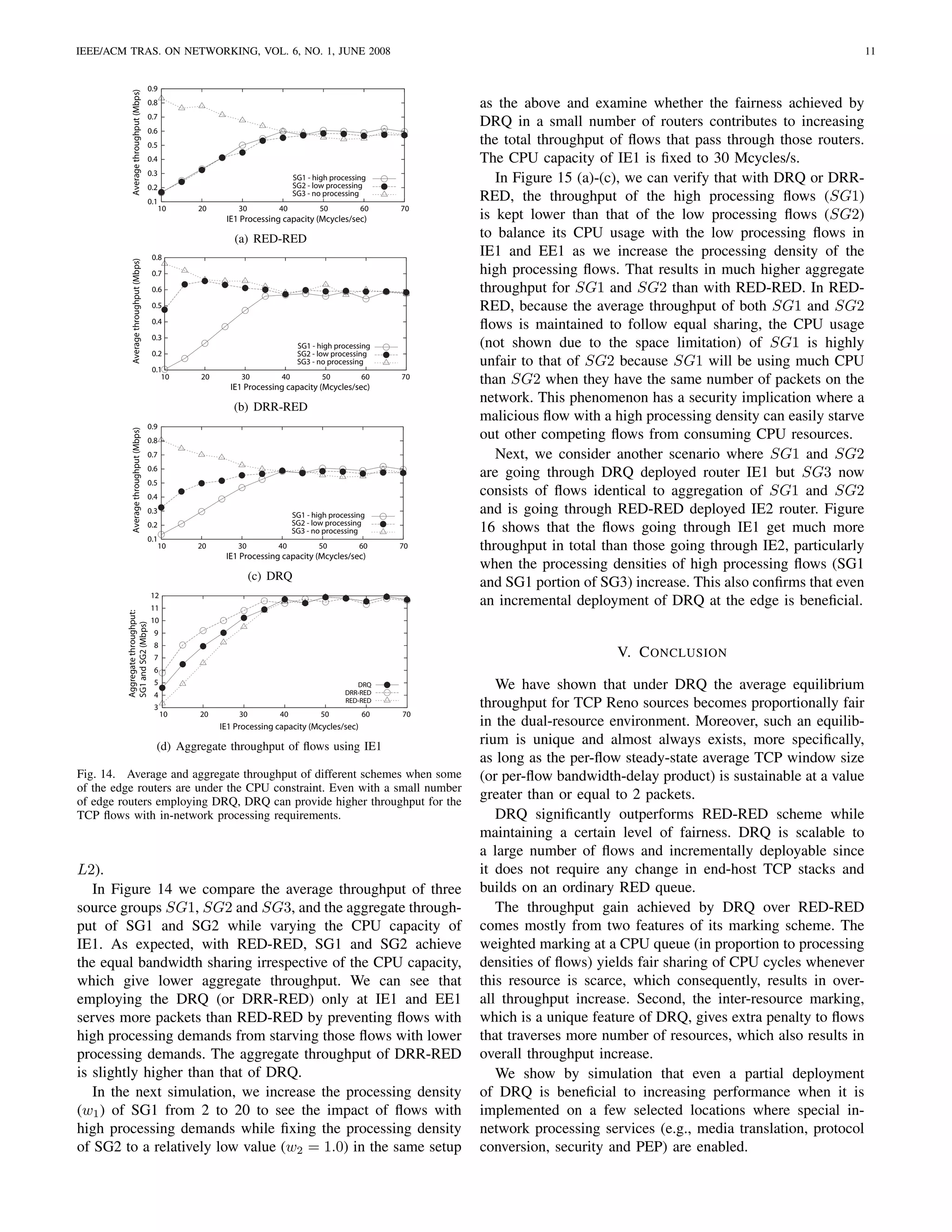
                                                                   (a) RED-RED                                Fig. 9.   Multiple link simulation scenario in parking lot topology.
                                   1.2
       Average throughput (Mbps)


                                             SG1, w = 0.25
                                             SG2, w = 0.50
                                   1.0       SG3, w = 1.00
                                             SG4, w = 2.00                                                    E. Parking lot simulation with multiple dual-resource bottle-
                                    0.8                                                                       neck links
                                   0.6                                                                           To increase realism in our simulation, we simulate the
                                   0.4                                                                        environment where multiple links can be dual-resource con-
                                                                                                              strained. Figure 9 shows a parking lot topology with following
                                   0.2
                                         0               0.5           1         1.5      2             2.5   link capacities B1 = B2 = 50 Mbps, C1 = C2 = C3 = 40
                                               Processing density of background traffic (cycles/bit)          Mcycles/s. We vary the bandwidth capacity of link L3 from
                                                                      (b) DRQ                                 20 to 80Mbps to create varying bottleneck conditions. Four
                                     1                                                                        class of long-lived TCP flows (denoted as SG1 to SG4)
                                                                                                              traverse links L1, L2 and L3 from sources 1-4 to sinks 1-4,
       Bandwidth utilization


                                   0.95
                                                                                                              respectively. One class of long-lived TCP flows from source 5
                                   0.
                                    9
                                                                                                              to sink 5 (denoted as SG5) traverses link L1 only and another
                                   0.85                                                                       class from source 6 to sink 6 (denoted as SG6) traverses
                                                DRQ                                                           link L2 only. Additional four sets of long-lived TCP flows
                                   0.
                                    8        DRR-RED
                                             RED-RED                                                          traverse link L3 only (denoted as SG7 to SG10). We report
                                   0.75
                                       0                 0.5           1         1.5      2             2.5
                                                                                                              the average throughput of long-lived flows (SG1 to SG4, and
                                                Processing density of background traffic (cycles/bit)         SG7 to SG10) that pass through link L3 as we vary the link
                                                              (c) Bandwidth utilization                       bandwidth of L3. On each path that long-lived TCP flows
                                                                                                              travel through, we add short and medium-lived background
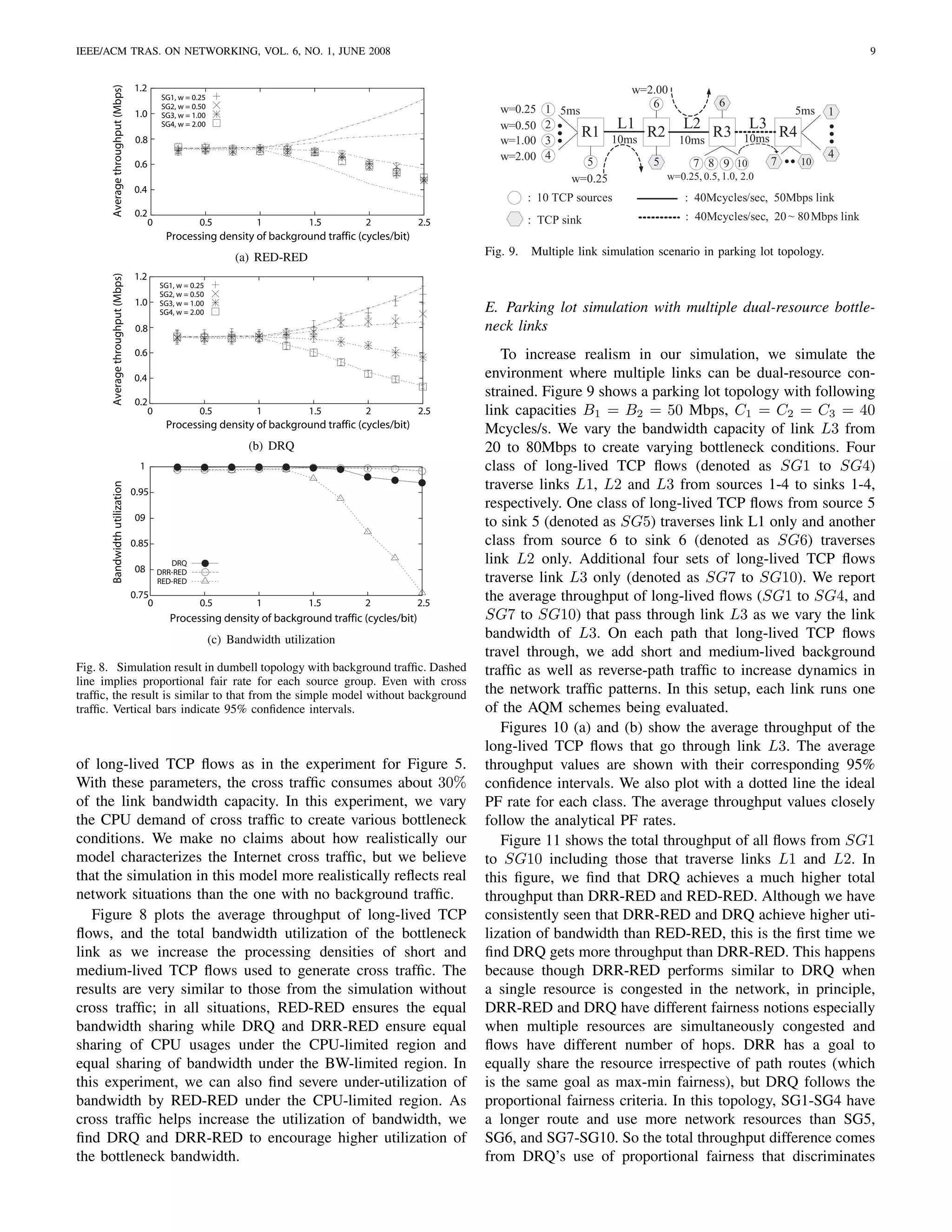
Fig. 8. Simulation result in dumbell topology with background traffic. Dashed                                  traffic as well as reverse-path traffic to increase dynamics in
line implies proportional fair rate for each source group. Even with cross
traffic, the result is similar to that from the simple model without background                                the network traffic patterns. In this setup, each link runs one
traffic. Vertical bars indicate 95% confidence intervals.                                                       of the AQM schemes being evaluated.
                                                                                                                 Figures 10 (a) and (b) show the average throughput of the
                                                                                                              long-lived TCP flows that go through link L3. The average
of long-lived TCP flows as in the experiment for Figure 5.                                                     throughput values are shown with their corresponding 95%
With these parameters, the cross traffic consumes about 30%                                                    confidence intervals. We also plot with a dotted line the ideal
of the link bandwidth capacity. In this experiment, we vary                                                   PF rate for each class. The average throughput values closely
the CPU demand of cross traffic to create various bottleneck                                                   follow the analytical PF rates.
conditions. We make no claims about how realistically our                                                        Figure 11 shows the total throughput of all flows from SG1
model characterizes the Internet cross traffic, but we believe                                                 to SG10 including those that traverse links L1 and L2. In
that the simulation in this model more realistically reflects real                                             this figure, we find that DRQ achieves a much higher total
network situations than the one with no background traffic.                                                    throughput than DRR-RED and RED-RED. Although we have
   Figure 8 plots the average throughput of long-lived TCP                                                    consistently seen that DRR-RED and DRQ achieve higher uti-
flows, and the total bandwidth utilization of the bottleneck                                                   lization of bandwidth than RED-RED, this is the first time we
link as we increase the processing densities of short and                                                     find DRQ gets more throughput than DRR-RED. This happens
medium-lived TCP flows used to generate cross traffic. The                                                      because though DRR-RED performs similar to DRQ when
results are very similar to those from the simulation without                                                 a single resource is congested in the network, in principle,
cross traffic; in all situations, RED-RED ensures the equal                                                    DRR-RED and DRQ have different fairness notions especially
bandwidth sharing while DRQ and DRR-RED ensure equal                                                          when multiple resources are simultaneously congested and
sharing of CPU usages under the CPU-limited region and                                                        flows have different number of hops. DRR has a goal to
equal sharing of bandwidth under the BW-limited region. In                                                    equally share the resource irrespective of path routes (which
this experiment, we can also find severe under-utilization of                                                  is the same goal as max-min fairness), but DRQ follows the
bandwidth by RED-RED under the CPU-limited region. As                                                         proportional fairness criteria. In this topology, SG1-SG4 have
cross traffic helps increase the utilization of bandwidth, we                                                  a longer route and use more network resources than SG5,
find DRQ and DRR-RED to encourage higher utilization of                                                        SG6, and SG7-SG10. So the total throughput difference comes
the bottleneck bandwidth.                                                                                     from DRQ’s use of proportional fairness that discriminates
IEEE/ACM TRAS. ON NETWORKING, VOL. 6, NO. 1, JUNE 2008                                                                                                                                                                          10


                                      0.6


          Average throughput (Mbps)


                                                                                                                  L3 bandwidth utilization
                                                 SG 1, w=0.25                                                                                  1
                                                 SG 2, w=0.50
                                      0.5        SG 3, w=1.0                                                                                 0.95
                                                 SG 4, w=2.0                                                                                  0.9
                                      0.4        PF rate - SG1
                                                 PF rate - SG2                                                                               0.85
                                                 PF rate - SG3
                                      0.3        PF rate - SG4                                                                                0.8
                                                                                                                                             0.75
                                      0.2
                                                                                                                                              0.7
                                                                                                                                                            DRQ
                                      0.1                                                                                                    0.65        DRR-RED
                                                                                                                                                         RED-RED
                                                                                                                                              0.6
                                       0                                                                                                            20             30    40           50            60          70         80
                                            20           30       40          50      60     70   80
                                                                  L3 link bandwidth (Mbps)                                                                               L3 link bandwidth (Mbps)

                                                                        (a)                            Fig. 12. L3 link bandwidth utilization comparison between DRQ, DRR-RED,
                                      2.5                                                              and RED-RED.
       Average throughput (Mbps)


                                                 SG 7, w=0.25
                                                 SG 8, w=0.50
                                       2         SG 9, w=1.0
                                                 SG10, w=2.0                                                                                                             SG4            SG5
                                                 PF rate - SG7                                                                                       Access network
                                      1.5        PF rate - SG8
                                                 PF rate - SG9                                                                                              100Mbps
                                                 PF rate - SG10                                                   SG3                                       [5~10]ms     IE3               IE4
                                       1                                                                           No
                                                                                                              processing                                      IE2                                                    EE2
                                                                                                                                                                                                 Core network
                                      0.5                                                                        flows
                                                                                                                                                               100Mbps           L1                L2
                                                                                                                                                                         C1                C2             C3
                                       0                                                                          SG2                                            5ms           40Mbps            60Mbps
                                            20           30       40          50      60     70   80              Low                                                           10ms              10ms               EE1
                                                                                                                                                                   IE1
                                                                  L3 link bandwidth (Mbps)                    processing
                                                                                                                 flows                                                                  EE3               EE4
                                                                        (b)
                                                                                                                                                            SG1
Fig. 10. Throughput of TCP/DRQ in multiple link simulations: (a) SG1-                                                                               High processing flows
SG4, (b) SG7-SG10. Even in cases where multiple links are dual-resource
constrained, DRQ achieves proportional fairness. Vertical bars indicate 95%                            Fig. 13.                              Simulation topology for edge deployment
confidence intervals.

                                      105
                                               DRQ                                                     F. Impact of incremental deployment
                                      100 DRR-RED
       Total throughput (Mbps)


                                            RED-RED
                                       95
                                                                                                          In this section, we examine the performance impact of
                                       90
                                       85                                                              incrementally deploying DRQ in the current Internet. The
                                       80                                                              natural places where DRQ can be initially deployed are likely
                                       75                                                              to be edges. This is because the current Internet trend is to keep
                                       70
                                       65
                                                                                                       the “middle” slim by pushing complicated tasks to the edges of
                                       60                                                              the Internet. Thus, while core routers focus on moving packets
                                         20       30              40          50      60     70   80
                                                                  L3 link bandwidth (Mbps)
                                                                                                       as fast as possible, routers, proxies and gateways located at
                                                                                                       edges of the Internet perform various in-network processing
Fig. 11. Total throughput comparison between DRQ, DRR-RED, and RED-                                    on packets.
RED. It shows the sum of throughput for all flows from SG1 to SG10. In                                     We consider an ISP environment where core routers and
this setup, DRQ achieves the best throughput over the other schemes. This
is because the PF rate allocation of DRQ installs fairness among flows that                             most edge routers are free from processing constraint but a
traverse different numbers of hops. RED-RED still consistently shows lower                             small number of designated edge gateways handle TCP flows
throughput.                                                                                            with in-network processing requirement. Figure 13 models one
                                                                                                       example of such environments. Our goal is to assess whether a
                                                                                                       small incremental deployment of DRQ gives any performance
SG1-SG4 over the other flows because it uses more hops.                                                 advantage while keeping the rest of the network intact. In
The comparison of L3 link utilization shows that DRQ and                                               the figure, SG’s denote TCP source groups, each with ten
DRR-RED use nearly the same amount, in Figure 12. This is                                              TCP sources, and C1 to C3 denote core routers, IE1 to IE4
because L3 lies in the CPU-limited region so the bandwidth                                             denote ingress edge routers and EE1 to EE4 denote egress edge
usage of the flows is governed by the fair usage of CPU. This                                           routers, respectively. Flows from IE1 are routed through the
means that the bandwidth usage difference between SG1-SG4,                                             shortest path to EE1 and etc. In this setup, all the routers except
and the other flows occur because of SG5 and SG6 flows that                                              IE1 and EE1 are conventional packet routers with no CPU
traverse only one link creating a bandwidth bottleneck on their                                        constraint and IE1 and EE1 are the media gateways/routers
corresponding link. However, it is incorrect to say that the                                           that may run in the CPU-limited region.
fairness notion of DRQ always guarantees higher throughput                                                In this simulation, we consider two different source groups,
than the fairness notion that DRR-RED follows as it is quite                                           SG1 and SG2, that traverse the same end-to-end path from
possible that there are other unique situations where DRR-                                             IE1 to EE1. SG1 consists of flows with a high processing
RED gets more throughput (which is indeed shown in the                                                 density (w1 = 2.5) while SG2 consists of flows with a low
next simulation). We leave as future study, studying the exact                                         processing density (w2 = 0.5). Flows from SG3 to SG5 do
conditions where DRR-RED can have better throughput than                                               not require any CPU processing. Note also that in this setup,
DRQ and vice versa.                                                                                    SG1, SG2 and SG3 share the same bottleneck links (L1 and
IEEE/ACM TRAS. ON NETWORKING, VOL. 6, NO. 1, JUNE 2008                                                                                                                       11


                                         0.9


             Average throughput (Mbps)
                                         0.8                                                                as the above and examine whether the fairness achieved by
                                         0.7
                                                                                                            DRQ in a small number of routers contributes to increasing
                                         0.6
                                         0.5                                                                the total throughput of flows that pass through those routers.
                                         0.4                                                                The CPU capacity of IE1 is fixed to 30 Mcycles/s.
                                         0.3
                                                                              SG1 - high processing
                                                                              SG2 - low processing
                                                                                                               In Figure 15 (a)-(c), we can verify that with DRQ or DRR-
                                         0.2
                                         0.1
                                                                              SG3 - no processing
                                                                                                            RED, the throughput of the high processing flows (SG1)
                                               10   20        30        40            50         60    70
                                                          IE1 Processing capacity (Mcycles/sec)             is kept lower than that of the low processing flows (SG2)
                                                            (a) RED-RED                                     to balance its CPU usage with the low processing flows in
                                          0.8
                                                                                                            IE1 and EE1 as we increase the processing density of the
             Average throughput (Mbps)


                                          0.7                                                               high processing flows. That results in much higher aggregate
                                          0.6                                                               throughput for SG1 and SG2 than with RED-RED. In RED-
                                          0.5                                                               RED, because the average throughput of both SG1 and SG2
                                          0.4
                                                                                                            flows is maintained to follow equal sharing, the CPU usage
                                          0.3
                                                                               SG1 - high processing        (not shown due to the space limitation) of SG1 is highly
                                          0.2                                  SG2 - low processing
                                          0.1
                                                                               SG3 - no processing          unfair to that of SG2 because SG1 will be using much CPU
                                             10     20        30         40           50
                                                           IE1 Processing capacity (Mcycles/sec)
                                                                                                  60   70
                                                                                                            than SG2 when they have the same number of packets on the
                                                                                                            network. This phenomenon has a security implication where a
                                                            (b) DRR-RED
                                                                                                            malicious flow with a high processing density can easily starve
                                         0.9
                                                                                                            out other competing flows from consuming CPU resources.
             Average throughput (Mbps)


                                         0.8
                                         0.7                                                                   Next, we consider another scenario where SG1 and SG2
                                         0.6
                                                                                                            are going through DRQ deployed router IE1 but SG3 now
                                         0.5
                                         0.4
                                                                                                            consists of flows identical to aggregation of SG1 and SG2
                                         0.3
                                                                              SG1 - high processing
                                                                                                            and is going through RED-RED deployed IE2 router. Figure
                                         0.2                                  SG2 - low processing
                                                                              SG3 - no processing           16 shows that the flows going through IE1 get much more
                                         0.1
                                               10   20       30         40           50          60    70   throughput in total than those going through IE2, particularly
                                                          IE1 Processing capacity (Mcycles/sec)
                                                                                                            when the processing densities of high processing flows (SG1
                                                                   (c) DRQ
                                                                                                            and SG1 portion of SG3) increase. This also confirms that even
                                         12
                                         11
                                                                                                            an incremental deployment of DRQ at the edge is beneficial.
         Aggregate throughput:


                                         10
         SG1 and SG2 (Mbps)


                                          9
                                          8
                                          7                                                                                       V. C ONCLUSION
                                          6
                                          5                                                     DRQ
                                                                                             DRR-RED
                                                                                                               We have shown that under DRQ the average equilibrium
                                          4
                                          3
                                                                                             RED-RED
                                                                                                            throughput for TCP Reno sources becomes proportionally fair
                                               10   20        30         40           50          60   70
                                                         IE1 Processing capacity (Mcycles/sec)              in the dual-resource environment. Moreover, such an equilib-
                                           (d) Aggregate throughput of flows using IE1                       rium is unique and almost always exists, more specifically,
                                                                                                            as long as the per-flow steady-state average TCP window size
Fig. 14. Average and aggregate throughput of different schemes when some                                    (or per-flow bandwidth-delay product) is sustainable at a value
of the edge routers are under the CPU constraint. Even with a small number
of edge routers employing DRQ, DRQ can provide higher throughput for the
                                                                                                            greater than or equal to 2 packets.
TCP flows with in-network processing requirements.                                                              DRQ significantly outperforms RED-RED scheme while
                                                                                                            maintaining a certain level of fairness. DRQ is scalable to
                                                                                                            a large number of flows and incrementally deployable since
L2).                                                                                                        it does not require any change in end-host TCP stacks and
   In Figure 14 we compare the average throughput of three                                                  builds on an ordinary RED queue.
source groups SG1, SG2 and SG3, and the aggregate through-                                                     The throughput gain achieved by DRQ over RED-RED
put of SG1 and SG2 while varying the CPU capacity of                                                        comes mostly from two features of its marking scheme. The
IE1. As expected, with RED-RED, SG1 and SG2 achieve                                                         weighted marking at a CPU queue (in proportion to processing
the equal bandwidth sharing irrespective of the CPU capacity,                                               densities of flows) yields fair sharing of CPU cycles whenever
which give lower aggregate throughput. We can see that                                                      this resource is scarce, which consequently, results in over-
employing the DRQ (or DRR-RED) only at IE1 and EE1                                                          all throughput increase. Second, the inter-resource marking,
serves more packets than RED-RED by preventing flows with                                                    which is a unique feature of DRQ, gives extra penalty to flows
high processing demands from starving those flows with lower                                                 that traverses more number of resources, which also results in
processing demands. The aggregate throughput of DRR-RED                                                     overall throughput increase.
is slightly higher than that of DRQ.                                                                           We show by simulation that even a partial deployment
   In the next simulation, we increase the processing density                                               of DRQ is beneficial to increasing performance when it is
(w1 ) of SG1 from 2 to 20 to see the impact of flows with                                                    implemented on a few selected locations where special in-
high processing demands while fixing the processing density                                                  network processing services (e.g., media translation, protocol
of SG2 to a relatively low value (w2 = 1.0) in the same setup                                               conversion, security and PEP) are enabled.
IEEE/ACM TRAS. ON NETWORKING, VOL. 6, NO. 1, JUNE 2008                                                                                                                                                                                             12


                                        1
                                                                                                                                                                    11


           Average throughput (Mbps)


                                                                                                                                      Aggregate throughput (Mbps)
                                                                                                                                                                    10
                                       0.8
                                                                                                                                                                    9
                                       0.6                                                                                                                          8
                                                                                                                                                                    7
                                                                                            SG1 - high processing
                                       0.4                                                  SG2 - low processing                                                    6
                                                                                            SG3 - no processing                                                     5
                                       0.2                                                                                                                          4
                                                                                                                                                                    3        SG1 and SG2
                                        0                                                                                                                                            SG 3
                                             2          4      6         8      10     12        14      16     18   20                                             2
                                                                                                                                                                         2       4          6      8      10     12     14      16       18   20
                                                                   Processing density of SG1 (cycles/bit)                                                                                       Processing density of SG1 (cycles/bit)

                                                                       (a) RED-RED
                                                                                                                          Fig. 16. Aggregate throughput comparison of flows going through DRQ
                                        1
                                                                                                                          deployed router and flows going through RED-RED deployed router.
           Average throughput (Mbps)


                                       0.8

                                       0.6

                                       0.4
                                                                                        SG1 - high processing                    services at network edges,” in Proc. of IEEE Open Architectures and
                                                                                        SG2 - low processing
                                                                                        SG3 - no processing                      Network Programming (OPENARCH), San Francisco, CA, 2003.
                                       0.2                                                                                 [7]   S. Chong, M. Shin, J. Mo, and H.-W. Lee, “Flow control with processing
                                                                                                                                 constraint,” IEEE Commun. Lett., vol. 9, no. 10, pp. 957–959, Oct. 2005.
                                        0
                                             2          4      6        8       10     12        14     16      18   20    [8]   A. Demers, S. Keshav, and S. Shenker, “Analysis and simulation of a
                                                                   Processing density of SG1 (cycles/bit)                        fair queueing algorithm,” ACM SIGCOMM Computer Communications
                                                                                                                                 Review, vol. 19, no. 4, pp. 1–12, 1989.
                                                                      (b) DRR-RED
                                                                                                                           [9]   M. Shreedhar and G. Varghese, “Efficient fair queueing using deficit
                                        1                                                                                        round robin,” in Proc. of ACM SIGCOMM, Sept. 1995, pp. 231–242.
           Average throughput (Mbps)


                                       0.8
                                                                                                                          [10]   S. Floyd and V. Jacobson, “Random Early Detection gateways for
                                                                                                                                 congestion avoidance,” IEEE/ACM Trans. Networking, vol. 1, pp. 397–
                                       0.6                                                                                       413, Aug. 1993.
                                                                                                                          [11]   S. Athuraliya, S. H. Low, V. H. Li, and Q. Yin, “REM: Active queue
                                       0.4                                              SG1 - high processing
                                                                                        SG2 - low processing                     management,” IEEE Network, vol. 15, pp. 48–53, May 2001.
                                       0.2                                              SG3 - no processing               [12]   C. V. Hollot, V. Misra, D. Towsley, and W. B. Gong, “On designing
                                                                                                                                 improved controllers for AQM routers supporting TCP flows,” in Proc.
                                        0
                                             2          4      6        8      10      12       14      16      18   20          of IEEE INFOCOM, Anchorage, Alaska, Apr. 2001, pp. 1726–1734.
                                                                   Processing density of SG1 (cycles/bit)                 [13]   I. Stoica, S. Shenker, and H. Zhang, “Core-stateless fair queueing:
                                                                                                                                 Achieving approximately fair bandwidth allocations in high speed net-
                                                                             (c) DRQ                                             works,” in Proc. of ACM SIGCOMM, Sept. 1998, pp. 118–130.
                                        12                                                                                [14]   Z. Cao, Z. Wang, and E. W. Zegura, “Rainbow fair queueing: Fair
                                        11
                                                                                                                                 bandwidth sharing without per-flow state,” in Proc. of IEEE INFOCOM,
           Aggregate throughput:


                                        10
           SG1 and SG2 (Mbps)


                                         9                                                                                       Tel Aviv, Israel, Mar. 2000, pp. 922–931.
                                         8                                                                                [15]   P. Pappu and T. Wolf, “Scheduling processing resources in program-
                                         7
                                         6
                                                                                                                                 mable routers,” in Proc. of IEEE INFOCOM, New York, NY, June 2002,
                                         5                                                                                       pp. 104–112.
                                         4              DRQ
                                                     DRR-RED
                                                                                                                          [16]   F. Sabrina, C. D. Nguyen, S. K. Jha, D. Platt, and F. Safaei, “Processing
                                         3
                                                     RED-RED                                                                     resource scheduling in programmable networks,” Computer Communi-
                                         2
                                                 2       4     6         8      10     12        14     16      18   20          cations, vol. 28, no. 6, pp. 676–687, Apr. 2005.
                                                                   Processing density of SG1 (cycles/bit)                 [17]   T. Wolf and M. A. Franklin, “CommBench - a telecommunications
                                         (d) Aggregate throughput of flows using IE1                                              benchmark for network processors,” in Proc. of IEEE International
                                                                                                                                 Symposium on Performance Analysis of Systems and Software (ISPASS),
Fig. 15. Average and aggregate throughput when processing density values                                                         Austin, TX, Apr. 2000, pp. 154–162.
of neighboring flows (SG1) are increased. This shows that DRQ and DRR-                                                     [18]   G. Memik, M. Smith, and W. Hu, “NetBench: A benchmarking suite
RED, even in a partial deployment, achieve fairness in the CPU usage when                                                        for network processors,” in Proc. of IEEE International Conference on
some portion of flows has increasingly higher processing demands.                                                                 Computer-Aided Design, San Jose, CA, Nov. 2001, pp. 39–42.
                                                                                                                          [19]   M. Tsai, C. Kulkarni, C. Sauer, N. Shah, and K. Keutzer, “A bench-
                                                                                                                                 marking methodology for network processors,” in Proc. of 1st Network
                                                                                                                                 Processor Workshop, 8th Int. Symp. on High Performance Computer
                                                                    R EFERENCES                                                  Architectures (HPCA), Cambridge, MA, Feb. 2002.
                                                                                                                          [20]   F. P. Kelly, A. K. Maulloo, and D. K. H. Tan, “Rate control in commu-
                                                                                                                                 nication networks: shadow prices, proportional fairness and stability,” J.
 [1] R. Ramaswamy, N. Weng, and T. Wolf, “Analysis of network processing                                                         of the Operational Research Society, vol. 49, pp. 237–252, Apr. 1998.
     workloads,” in Proc. of IEEE International Symposium on Performance                                                  [21]   S. H. Low and D. E. Lapsley, “Optimization flow control I: Basic
     Analysis of Systems and Software (ISPASS), Austin, TX, Mar. 2005, pp.                                                       algorithm and convergence,” IEEE/ACM Trans. Networking, vol. 7, pp.
     226–235.                                                                                                                    861–875, Dec. 1999.
 [2] P. Crowley, M. E. Fiuczynski, J.-L. Baer, and B. N. Bershad, “Workloads                                              [22]   D. P. Bertsekas, Nonlinear Programming, 2nd ed.           Belmont, MA:
     for programmable network interfaces,” in Workload Characterization for                                                      Athena Scientific, 1999.
     Computer System Design. Kluwer Academic Publishers, 2000, ch. 7.                                                     [23]   S. H. Low, “A duality model of TCP and queue management algorithms,”
 [3] Y. Gottlieb and L. Peterson, “A comparative study of extensible routers,”                                                   IEEE/ACM Trans. Networking, vol. 11, pp. 525–536, Aug. 2003.
     in Proc. of IEEE Open Architectures and Network Programming (OPE-                                                    [24]   F. P. Kelly, “Mathematical modelling of the internet,” in Mathematics
     NARCH), June 2002, pp. 51–62.                                                                                               Unlimited – 2001 and Beyond, B. Engquist and W. Schmid, Eds. Berlin:
 [4] A. T. Campbell, H. G. D. Meer, M. E. Kounavis, K. Miki, J. B. Vicente,                                                      Springer Verlag, 2001, pp. 685–702.
     and D. Villela, “A survey of programmable networks,” ACM SIGCOMM                                                     [25]   V. Misra, W. B. Gong, and D. Towsley, “Fluid-based analysis of a
     Computer Communications Review, vol. 29, no. 2, pp. 7–23, April 1999.                                                       network of AQM routers supporting TCP flows with an application to
 [5] A. Barbir, R. Penno, R. Chen, M. Hofmann, and H. Orman, “An                                                                 RED,” in Proc. of ACM SIGCOMM, Sept. 2000, pp. 151–160.
     architecture for open pluggable edge services (OPES),” IETF RFC 3835,                                                [26]   Y. Liu, F. Presti, V. Misra, and D. Towsley, “Fluid models and solutions
     2004.                                                                                                                       for large-scale IP networks,” in Proc. of ACM SIGMETRICS, San Diego,
 [6] B. Falchuk, J. Chiang, A. Hafid, Y.-H. Cheng, N. Natarjan, F. J. Lin,                                                        CA, June 2003, pp. 151–160.
     and H. Cheng, “An open service platform for deploying and managing                                                   [27]   C. V. Hollot, V. Misra, D. Towsley, and W.-B. Gong, “A control theoretic
IEEE/ACM TRAS. ON NETWORKING, VOL. 6, NO. 1, JUNE 2008                                                                                                               13


       analysis of RED,” in Proc. of IEEE INFOCOM, Anchorage, Alaska, Apr.          Lagrangian optimality condition of Problem P, we need to
       2001, pp. 1510–1519.                                                         show that
[28]   S. H. Low, F. Paganini, J. Wang, and J. C. Doyle, “Linear stability
       of TCP/RED and a scalable control,” Computer Networks, vol. 43, pp.                                 αs
       633–647, Dec. 2003.                                                              x∗ =
                                                                                          s              k σ∗ +           ∗,  ∀s∈S      (33)
[29]   “Internet end-to-end performance monitoring group (IEPM),” 2006.                         k∈K(s) ws k       l∈L(s) ρl
       [Online]. Available: http://www-iepm.slac.stanford.edu/                                                                 ∗
[30]   K. Ramakrishnan and S. Floyd, “A proposal to add explicit congestion         hold. Consider flow s. If we suppose that σk = 0, ∀k ∈ K(s),
       notification (ECN) to IP,” IETF RFC 2481, 1999.                                     ∗
                                                                                    and ρl = 0, ∀l ∈ L(s), for this flow s, then p∗ = 0 from
                                                                                                                                      s
[31]   K. Ramakrishnan, S. Floyd, and D. Black, “The addition of explicit           Eq. (15), which contradicts Eq. (9) since it cannot have an
       congestion notification (ECN) to IP,” IETF RFC 3168, 2001.
[32]   H. Han, C. V. Hollot, Y. Chait, and V. Misra, “TCP networks stabilized       equilibrium point satisfying p∗ = 0. Thus, at least one of σk ,
                                                                                                                  s
                                                                                                                                                ∗
                                                                                                     ∗
       by buffer-based AQMs,” in Proc. of IEEE INFOCOM, Hongkong, Mar.              k ∈ K(s), and ρl , l ∈ L(s), must be positive, which implies
       2004, pp. 964–974.                                                           that 0 < p∗ < 1 from Eq. (15) and consequently x∗ > 0 ∗  from
[33]   “ns-2      network      simulator,”    2000.     [Online].      Available:             s                                         s
                                                                                                                                      M (1−p )
       http://www.isi.edu/nsnam/ns/                                                 Eq. (9). Therefore, from Eq. (9), we know that s τ 2 s =
                                                                                                                                                               s
[34]   S. Floyd, “Recommendations on using the gentle variant of RED,” Mar.            ∗2 ∗
                                                                                    2 xs ps
       2000. [Online]. Available: http://www.aciri.org/floyd/red/gentle.html         3 Ms    (Ns is cancelled out). Solving x∗ from this equation by
                                                                                                                              s
[35]   J. Aikat, J. Kaur, F. D. Smith, and K. Jeffay, “Variability in TCP round-    substituting Eq. (15) at equilibrium for p∗ , we get Eq. (33) with
                                                                                           √                                  s
       trip times,” in Proc. of 3rd ACM SIGCOMM Conference on Internet                        3/2M    s
       Measurement Conference, Oct. 2003, pp. 279–284.                              αs =         τs     , which concludes the Lagrangian optimality of
[36]   P. Barford and M. Crovella, “Generating representative web workloads         (x , σ , ρ ). Lastly, we need to show that σk ( s∈S(k) ws x∗ −
                                                                                       ∗    ∗ ∗                                     ∗            k
                                                                                                                                                    s
       for network and server performance evaluation,” in Proc. of ACM
       SIGMETRICS, July 1998, pp. 151–160.                                          Ck ) = 0 and ρ∗ ( s∈S(l) x∗ −Bl ) = 0 for all k ∈ K and l ∈ L
                                                                                                        l           s
[37]   V. Paxson and S. Floyd, “Wide-area traffic: The failure of poisson            to check complementary slackness of (x∗ , σ ∗ , ρ∗ ). Consider
       modeling,” IEEE/ACM Trans. Networking, vol. 3, pp. 226–244, June             arbitrary k ∈ K. If we suppose that s∈S(k) ws x∗ − Ck < 0,
                                                                                                                                         k
                                                                                                                                            s
       1995.                                                                                ∗        ∗
[38]   K. Park, in Self–Similar Network Traffic and Performance Evaluation,                                                       ˆ∗
                                                                                    then zk = vk = 0 from Eq. (8). Thus, vk = 0 from Eq. (14)
                                                                                                               ∗
       W. Willinger, Ed. New York: John Wiley & Sons, 2000.                         and consequently σk = 0 from Eq. (13), which concludes
[39]   H. Jiang and C. Dovrolis, “Passive estimation of TCP round-trip times,”      σk ( s∈S(k) ws x∗ − Ck ) = 0. Similarly, ρ∗ ( s∈S(l) x∗ −
                                                                                      ∗                  k
                                                                                                           s                           l           s
       ACM SIGCOMM Computer Communications Review, vol. 32, pp. 75–
       88, July 2002.                                                               Bl ) = 0 for arbitrary l ∈ L. Therefore, we conclude that
                                                                                    (x∗ , σ ∗ , ρ∗ ) is the primal-dual optimal solution of Problem P.
                                  A PPENDIX                                         Moreover, x∗ is unique since the optimal solution of Problem
                                                                                                                                              ∗
                                                                                    P is unique. From Eq. (10), it is obvious that yl > bl if
    Proof of Proposition 1: First, we show that the √  primal-                      ρ∗ > 0 and 0 ≤ yl ≤ bl otherwise. The same argument can
                                                                                                             ∗
                                                         3/2Ms                       l
                      ∗ ∗  ∗
optimal solution (r , θ , π ) of Problem P with αs =       τs                       be applied to CPU queues from Eq. (13).
forms an equilibrium point (x , σ , ρ , p , y , z , v ∗ ,
                                  ∗    ∗   ∗   ∗   ∗     ∗
                                                                                       Proof of Proposition 2: First, we derive a linearized model
y ∗ , v ∗ ) in the average Reno/DRQ network where x∗ =
ˆ ˆ                                                                                 of Reno/DRQ network at the equilibrium point. In the DRQ
r∗ , σ ∗ = θ∗ , ρ∗ = π ∗ if θ∗ and π ∗ satisfy C1 and C2.                           network described by Eq. (15), the congestion window for
                   ∗                               k ∗
Since s∈S(l) rs ≤ Bl , ∀l ∈ L, and s∈S(k) ws rs ≤ Ck ,                              the sth TCP source, s , can be modelled by the nonlinear
                                                       ∗
∀k ∈ K, Eqs. (7) and (8) imply that there exist yl ≥ 0,                             differential equation
                 ∗ ∗
∀l ∈ L, and zk , vk ≥ 0, ∀k ∈ K. Thus, from Eqs. (11) and                                                                      2
                     ˆ∗   ∗
                                                ˆ∗
(14), there exist yl = yl ≥ 0, ∀l ∈ L, and vk = vk ≥ 0,∗                                                         1 − ps (t) 2 s (t)
                                                                                                     ˙ s (t) =             −        ps (t)                         (34)
∀k ∈ K, whose specific values can be obtained from Eqs.                                                             N s τs    3Ns τs
(10) and (13) for ρ∗ = πl and σk = θk since 0 ≤ πl < 1
                        l
                            ∗       ∗    ∗               ∗
                                                                                    where,
              ∗                     ∗
and 0 ≤ θk < 1. Finally, for xs > 0, Eqs. (9) and (15)
               √                                                                                                                                       2
                   3/2M                                                                                           |R|      T
yield x∗ =          ( k∈K(s) ws σk + l∈L(s) ρ∗ )−1 , which                                                        i=1 [Γ(0) ]si ϕi (t        − τis )
                  s             k ∗
       s      τs                               l
                 ∗ ∗     ∗
also holds for (r , θ , π ) by the Lagrangian optimality of                                   ps (t) =                                                     2       (35)
                                 √                                                                                    |R|      T
                                                3/2M                                                     1+           i=1 [Γ(0) ]si ϕi (t      − τis )
(r∗ , θ∗ , π ∗ ) in Eq. (6) with αs =         τs
                                                  s
                                                    .
    Next we prove the converse that if the average Reno/DRQ                         and ϕi (t) is the ith element of unified pre-marking probability
network has an equilibrium point (x∗ , σ ∗ , ρ∗ , p∗ , y ∗ , z ∗ , v ∗ ,            set as
y ∗ , v ∗ ), then (x∗ , σ ∗ , ρ∗ ) is the primal-dual optimal solution
ˆ ˆ                                                     √                                                    σi if i indicates CPU
                                                                  3/2M                              ϕi =
of the corresponding Problem P with αs =                    s
                                                              and,                                           ρi if i indicates link
                                                        τs
moreover, no other equilibrium points can exist in the network.
                                                                                      Using Eqs. (7)-(8), we model the ith congested resource
By the duality theory [22], the necessary and sufficient con-
                                                                                    queue by
dition for (x∗ , σ ∗ , ρ∗ ) to be the primal-dual optimal solution
of Problem P is that x∗ is primal feasible, (σ ∗ , ρ∗ ) is dual                                                       |S|
                                                                                                                                        Ms   s (t   − τis )
feasible, and (x∗ , σ ∗ , ρ∗ ) satisfies Lagrangian optimality and                         qi (t) = −˜i Iq>0 +
                                                                                          ˙         c                       [Γis (0)]                              (36)
complementary slackness. First, Eqs. (7) and (8) imply that                                                           s=1
                                                                                                                                              τs
           ∗                                           k ∗
   s∈S(l) xs ≤ Bl for all l ∈ L and            s∈S(k) ws xs ≤ Ck                    where qi (t) is the ith element of the resource queue length set
for all k ∈ K, and Eq. (9) implies that x ≥ 0. Thus, x∗
                                                 ∗
                                                                                    in bits (or cycles) as
is primal feasible. Second, the dual feasibility of (σ ∗ , ρ∗ ) is
obvious since σ ∗ and ρ∗ cannot be negative by the definition                                                     zi     if i indicates CPU
                                                                                                     qi =
of REDs in Eqs. (10) and (13). Third, since Eq. (6) is the                                                       yi     if i indicates link,
IEEE/ACM TRAS. ON NETWORKING, VOL. 6, NO. 1, JUNE 2008                                                                                                14


ci is the ith element of resource capacity set as
˜                                                                                                 Minsu Shin (S’99) received his B.S., M.S., and
                                                                                                  Ph.D. degrees in the School of Electrical Engineer-
                         Ci     if i indicates CPU                                                ing and Computer Science, Korea Advanced Institute
               ci =
               ˜
                         Bi     if i indicates link,                                              of Science and Technology (KAIST), Daejeon, Ko-
                                                                                                  rea, in 1998, 2000, and 2006, respectively. From July
Ms denotes the packet size in bits, and Iq>0 is the indicator                                     2006, he is a Visiting Postdoctoral Research Fellow
function.                                                                                         at the Dept. of Computer Science, North Carolina
  Linearizing Eqs. (34)-(36) about equilibrium ( ∗ , q ∗ , ϕ∗ )                                   State University, Raleigh. His research interests are
                                                                                                  in congestion control, programmable networks, and
and taking Laplace transforms gives                                                               wireless networks.
                           ˜
                  (z) = −F (z)Γ(−z)T ϕ(z)                 (37)
            q(z) = (zI + Ω)−1 Γ(z)M T −1 (z)                      (38)
      ˜             ˜
where F (z) = diag{fs (z)},
        ˜                e−zτs                     2
        fs (z) =         4 s∗                                 ,
                   z+               3
                                   ∗2
                                          Ns τs u∗ (1 + u∗ )2
                                                 s       s
                        3Ns τs 2   s +3

                                                 ˜
u∗ = Γ(0)T ϕ∗ , Ω = Γ(0)M W ∗ T −2 Γ(0)T C −1 , T =
diag{τs }, M = diag{Ms }, W ∗ = diag{ s } and C =
                                               ∗       ˜
diag{˜i }.
     c
  Next, let κi (z) denote the linearized RED dynamics which
                                                                                                  Song Chong (M’93) received the B.S. and M.S.
can be modelled as the low-pass filter [25],                                                       degrees in Control and Instrumentation Engineering
                           ϕi (z)       ψi                                                        from Seoul National University, Seoul, Korea, in
                  κi (z) =        =                     (39)                                      1988 and 1990, respectively, and the Ph.D. degree
                           qi (z)    z/ηi + 1                                                     in Electrical and Computer Engineering from the
                                                                                                  University of Texas at Austin in 1995. Since March
where ψi = b mi , and η = loge (1−λ) , where h is sampling
                                  h                                                               2000, he has been with the School of Electrical En-
               i −bi
interval of RED. Using linearized Eqs. (37)-(39), we can find                                      gineering and Computer Science, Korea Advanced
                                                                                                  Institute of Science and Technology (KAIST), Dae-
the return ratio function of the DRQ network.                                                     jeon, Korea where he is an Associate Professor,
           ˜                  ˜
  L(z) = F (z)Γ(−z)T D(z)C −1 (zI + Ω)−1 Γ(z)M T −1 (40)                                          leading the Network Systems Laboratory. Prior to
                                                                         joining KAIST, he was with the Performance Analysis Department, AT&T
where D(z) = diag{κi (z)˜i }. To invoke the Generalized
                              c                                          Bell Laboratories, Holmdel, New Jersey, as a Member of Technical Staff.
                                                                         His research interests include high speed networks, wireless networks and
Nyquist Stability Criterion [32], we should show that the                performance evaluation. He has published more than 60 papers in international
eigenvalues of L(jw) do not intersect (−∞, −1] for all w ≥ 0.            journals and conferences and holds three U.S. patents in these areas. He is
   From Theorem 1 and Proposition 1 in [32], these eigenval-             an Editor of the Journal of Communications and Networks and has served
                                                                         as a Technical Program Committee member of a number of international
ues lie in                                                               conferences
               max{|fs (jw)|}max{|di (jw)|}
                                               ,            (41)
                        min{|gi (jw)|}
                       ˜
where fs (jw) = µs fs (jw), µs is the number of congested
                     s
resources traversed by the sth source, di (jw) = κi (jw) · ci ,
                                                              ˜
                                               ˜ 1 ˜ 1
gi (jw) = jw + λi , and λi is an eigenvalue of C − 2 ΩC − 2 . To
be stable, Eq.(41) should be less than 1.
   Because min{|gi (jw)|} is an increasing function,
max{|fs (jw)|} and max{|di (jw)|} are decreasing, stability
condition can be replaced by,
               max{|fs (0)|}max{|di (0)|}
                                            < 1.            (42)                                  Injong Rhee (SM’89) received his Ph.D. from the
                       min{|gi (0)|}
                                                                                                  University of North Carolina at Chapel Hill. He is
   We can find the following relations                                                             an associate professor of Computer Science at North
                                                                                                  Carolina State University. His areas of research inter-
                                φ2 [Γ(0)]
                                 min                                                              ests include computer networks, congestion control,
                   |gi (0)| ≥       2
                                                                  (43)
                              Λmax τmax wmax                                                      wireless ad hoc networks and sensor networks. He
                                                                                                  works mainly on network protocol designs optimiz-
                               |R|Λmax τmax                                                       ing the transport performance of networks.
                    |fs (0)| ≤                                    (44)
                                     3/2
where Λmax = max{ min{wk } min{Ms } , min{Ms} }, τmax =
                             max{Ck }      max{Bl
                                                  }
                               s
                             k
max{τs }, wmax = max{ws , 1} and φmin [Γ(0)] denotes the
smallest singular values of the matrix Γ(z) evaluated at z = 0.
  From the Eqs. (42)-(44),
                                      3/2φ2 [Γ(0)]
                                          min
            max{|di (0)|} ≤                        .              (45)
                                   |R|Λ2 τmax wmax
                                       max
                                           3

Dual-resource TCPAQM for Processing-constrained Networks

  • 1.
    IEEE/ACM TRAS. ONNETWORKING, VOL. 6, NO. 1, JUNE 2008 1 Dual-resource TCP/AQM for Processing-constrained Networks Minsu Shin, Student Member, IEEE, Song Chong, Member, IEEE, and Injong Rhee, Senior Member, IEEE Abstract—This paper examines congestion control issues for processing capacity in the network components. New router TCP flows that require in-network processing on the fly in technologies such as extensible routers [3] or programmable network elements such as gateways, proxies, firewalls and even routers [4] also need to deal with scheduling of CPU usage routers. Applications of these flows are increasingly abundant in the future as the Internet evolves. Since these flows require use of per packet as well as bandwidth usage per packet. Moreover, CPUs in network elements, both bandwidth and CPU resources the standardization activities to embrace various network ap- can be a bottleneck and thus congestion control must deal plications especially at network edges are found in [5] [6] as with “congestion” on both of these resources. In this paper, we the name of Open Pluggable Edge Services. show that conventional TCP/AQM schemes can significantly lose In this paper, we examine congestion control issues for throughput and suffer harmful unfairness in this environment, particularly when CPU cycles become more scarce (which is likely an environment where both bandwidth and CPU resources the trend given the recent explosive growth rate of bandwidth). As can be a bottleneck. We call this environment dual-resource a solution to this problem, we establish a notion of dual-resource environment. In the dual-resource environment, different flows proportional fairness and propose an AQM scheme, called Dual- could have different processing demands per byte. Resource Queue (DRQ), that can closely approximate propor- Traditionally, congestion control research has focused on tional fairness for TCP Reno sources with in-network processing requirements. DRQ is scalable because it does not maintain per- managing only bandwidth. However, we envision (also it is flow states while minimizing communication among different indeed happening now to some degree) that diverse network resource queues, and is also incrementally deployable because services reside somewhere inside the network, most likely at of no required change in TCP stacks. The simulation study the edge of the Internet, processing, storing or forwarding shows that DRQ approximates proportional fairness without data packets on the fly. As the in-network processing is likely much implementation cost and even an incremental deployment of DRQ at the edge of the Internet improves the fairness and to be popular in the future, our work that examines whether throughput of these TCP flows. Our work is at its early stage and the current congestion control theory can be applied without might lead to an interesting development in congestion control modification, or if not, then what scalable solutions can be research. applied to fix the problem, is highly timely. Index Terms—TCP-AQM, transmission link capacity, CPU In our earlier work [7], we extended proportional fairness capacity, fairness, efficiency, proportional fairness. to the dual-resource environment and proposed a distributed congestion control protocol for the same environment where I. I NTRODUCTION end-hosts are cooperative and explicit signaling is available for congestion control. In this paper, we propose a scal- A DVANCES in optical network technology enable fast pace increase in physical bandwidth whose growth rate has far surpassed that of other resources such as CPU and able active queue management (AQM) strategy, called Dual- Resource Queue (DRQ), that can be used by network routers to approximate proportional fairness, without requiring any memory bus. This phenomenon causes network bottlenecks change in end-host TCP stacks. Since it does not require any to shift from bandwidth to other resources. The rise of new change in TCP stacks, our solution is incrementally deployable applications that require in-network processing hastens this in the current Internet. Furthermore, DRQ is highly scalable in shift, too. For instance, a voice-over-IP call made from a cell the number of flows it can handle because it does not maintain phone to a PSTN phone must go through a media gateway that per-flow states or queues. DRQ maintains only one queue per performs audio transcoding “on the fly” as the two end points resource and works with classes of application flows whose often use different audio compression standards. Examples processing requirements are a priori known or measurable. of in-network processing services are increasingly abundant Resource scheduling and management of one resource from security, performance-enhancing proxies (PEP), to media type in network environments where different flows could translation [1] [2]. These services add additional loads to have different demands are a well-studied area of research. An early version of this paper was presented at the IEEE INFOCOM 2006, Weighted-fair queuing (WFQ) [8] and its variants such as Barcelona, Spain, 2006. This work was supported by the center for Broadband deficit round robin (DRR) [9] are well known techniques to OFDM Mobile Access (BrOMA) at POSTECH through the ITRC program achieve fair and efficient resource allocation. However, the of the Korean MIC, supervised by IITA. (IITA-2006-C1090-0603-0037). Minsu Shin and Song Chong are with the School of Electrical Engineering solutions are not scalable and implementing them in a high- and Computer Science, Korea Advanced Institute of Science and Technol- speed router with many flows is difficult since they need to ogy (KAIST), Daejeon 305-701, Korea (email: msshin@netsys.kaist.ac.kr; maintain per-flow queues and states. Another extreme is to song@ee.kaist.ac.kr). Injong Rhee is with the Department of Computer Science, North Carolina State University, Raleigh, NC 27695, USA (email: have routers maintain simpler queue management schemes rhee@csc.ncsu.edu). such as RED [10], REM [11] or PI [12]. Our study finds that
  • 2.
    IEEE/ACM TRAS. ONNETWORKING, VOL. 6, NO. 1, JUNE 2008 2 these solutions may yield extremely unfair allocation of CPU These constraints are called dual-resource constraints and a and bandwidth and sometimes lead to very inefficient resource nonnegative rate vector r = [r1 , · · · , rS ]T satisfying these usages. dual constraints for all CPUs k ∈ K and all links l ∈ L is Some fair queueing algorithms such as Core-Stateless Fair said to be feasible. Queueing (CSFQ) [13] and Rainbow Fair Queueing (RFQ) [14] have been proposed to eliminate the problem of main- A1: We assume that each CPU k ∈ K knows the processing k taining per-flow queues and states in routers. However, those densities ws ’s for all the flows s ∈ S(k). schemes are concerned about bandwidth sharing only and do not consider joint allocation of bandwidth and CPU cycles. This assumption is reasonable because a majority of Internet Estimation-based Fair Queueing (EFQ) [15] and Prediction applications are known and their processing requirements can Based Fair Queueing (PBFQ) [16] have been also proposed be measured either off-line or on-line as discussed below. In for fair CPU sharing but they require per-flow queues and do practice, network flows could be readily classified into a small not consider joint allocation of bandwidth and CPU cycles number of application types [15], [17]–[19]. That is, there either. is a finite set of application types, a flow is an instance of Our study, to the best of our knowledge, is the first in an application type, and flows will have different processing examining the issues of TCP and AQM under the dual- densities only if they belong to different application types. resource environment and we show that by simulation DRQ In [17], applications have been divided into two categories: achieves fair and efficient resource allocation without imposing header-processing applications and payload-processing appli- much implementation cost. The remainder of this paper is cations, and each category has been further divided into a organized as follows. In Section II, we define the problem and set of benchmark applications. In particular, authors in [15] fairness in the dual-resource environment, in Sections III and experimentally measure the per-packet processing times for IV, we present DRQ and its simulation study, and in Section several benchmark applications such as encryption, compres- V, we conclude our paper. sion, and forward error correction. The measurement results find the network processing workloads to be highly regular and II. P RELIMINARIES : N ETWORK M ODEL AND predictable. Based on the results, they propose an empirical D UAL - RESOURCE P ROPORTIONAL FAIRNESS model for the per-packet processing time of these applications for a given processing platform. Interestingly, it is a simple A. Network model affine function of packet size M , i.e., µk +νa M where µk and a k a We consider a network that consists of a set of unidirectional k νa are the parameters specific to each benchmark application a links, L = {1, · · · , L}, and a set of CPUs, K = {1, · · · , K}. for a given processing platform k. Thus, the processing density The transmission capacity (or bandwidth) of link l is Bl (in cycles/bit) of a packet of size M from application a at (bits/sec) and the processing capacity of CPU k is Ck (cy- µk k platform k can be modelled as M +νa . Therefore, the average a cles/sec). These network resources are shared by a set of flows k processing density wa of application a at platform k can be (or data sources), S = {1, · · · , S}. Each flow s is associated computed upon arrival of a packet using an exponentially with its data rate rs (bits/sec) and its end-to-end route (or weighted moving average (EWMA) filter: path) which is defined by a set of links, L(s) ⊂ L, and a set of CPUs, K(s) ⊂ K, that flow s travels through. Let k k µk a k wa ← (1 − λ)wa + λ( + νa ), 0 < λ < 1. (1) S(l) = {s ∈ S|l ∈ L(s)} be the set of flows that travel M through link l and let S(k) = {s ∈ S|k ∈ K(s)} be the set µk k One could also directly measure the quantity M +νa in Eq. a of flows that travel through CPU k. Note that this model is (1) as a whole instead of relying on the empirical model by general enough to include various types of router architecture counting the number of CPU cycles actually consumed by a and network element with multiple CPUs and transmission packet while the packet is being processed. Lastly, determining links. the application type an arriving packet belongs to is an easy Flows can have different CPU demands. We represent this k task in many commercial routers today since L3/L4 packet notion by processing density ws , k ∈ K, of each flow s, which classification is a default functionality. is defined to be the average number of CPU cycles required k per bit when flow s is processed by CPU k. ws depends on k since different processing platforms (CPU, OS, and software) B. Proportional fairness in the dual-resource environment would require a different number of CPU cycles to process Fairness and efficiency are two main objectives in re- the same flow s. The processing demand of flow s at CPU k source allocation. The notion of fairness and efficiency has k is then ws rs (cycles/sec). been extensively studied and well understood with respect Since there are limits on CPU and bandwidth capacities, to bandwidth sharing. In particular, proportionally fair (PF) the amount of processing and bandwidth usage by all rate allocation has been considered as the bandwidth sharing flows sharing these resources must be less than or equal strategy that can provide a good balance between fairness and to the capacities at anytime. We represent this notion efficiency [20], [21]. by the following two constraints: for each CPU k ∈ K, In our recent work [7], we extended the notion of pro- k s∈S(k) ws rs ≤ Ck (processing constraint) and for each portional fairness to the dual-resource environment where link l ∈ L, s∈S(l) rs ≤ Bl (bandwidth constraint). processing and bandwidth resources are jointly constrained.
  • 3.
    IEEE/ACM TRAS. ONNETWORKING, VOL. 6, NO. 1, JUNE 2008 3 flows 1.25 1.25 Link queue Processing- Jointly- Bandwidth- Processing- Jointly- Bandwidth- s∈S CPU queue Normalized CPU usage Normalized throughput limited limited limited limited limited limited 1.00 1.00 rs (bits/sec) ∑ rs B ws (cycles/bit) r1 B ∑ws rs C CPU Link 0.75 r2 B 0.75 w1 r1 C r3 B w2 r2 C C (cycles/sec) B (bits/sec) r4 B w3 r3 C 0.50 0.50 w4 r4 C Fig. 1. Single-CPU and single-link network 0.25 0.25 0 1.5 2 4.5 5 0 1.5 2 4.5 5 0 0.5 1 2.5 3 3.5 4 0 0.5 1 2.5 3 3.5 4 wh wh C B wa C B wa In the following, we present this notion and its potential (a) (b) advantages for the dual-resource environment to define our 1.25 1.25 goal for our main study of this paper on TCP/AQM. Processing- Jointly- Bandwidth- Processing- Jointly- Bandwidth- Normalized CPU usage Normalized throughput limited limited limited limited limited limited 1.00 1.00 Consider an aggregate log utility maximization problem (P) ∑ rs r1 B B ∑ws rs C r2 with dual constraints: B w1 r1 C 0.75 0.75 r3 B w2 r2 C r4 B 0.50 0.50 w3 r3 C P: max αs log rs (2) w4 r4 C r 0.25 0.25 s∈S 0 1.5 2 4.5 5 0 1.5 2 4.5 5 0 0.5 1 2.5 3 3.5 4 0 0.5 1 2.5 3 3.5 4 wh wh subject to k C B wa C B wa s∈S(k) ws rs ≤ Ck , ∀k∈K (3) (c) (d) s∈S(l) rs ≤ Bl , ∀ l ∈ L (4) rs ≥ 0, ∀ s ∈ S (5) Fig. 2. Fairness and efficiency in the dual-resource environment (single- CPU and single-link network): (a) and (b) respectively show the normalized where αs is the weight (or willingness to pay) of flow bandwidth and CPU allocations enforced by PF rate allocation, and (c) and (d) respectively show the normalized bandwidth and CPU allocations enforced by s. The solution r∗ of this problem is unique since it is TCP-like rate allocation. When C/B < wa , TCP-like rate allocation gives ¯ a strictly concave maximization problem over a convex lower bandwidth utilization than PF rate allocation (shown in (a) and (c)) and has an unfair allocation of CPU cycles (shown in (d)). set [22]. Furthermore, r∗ is weighted proportionally fair since ∗ rs −rs s∈S αs rs ∗ ≤ 0 holds for all feasible rate vectors r by the optimality condition of the problem. We define this allocation to be (dual-resource) PF rate allocation. Note that • Bandwidth(BW)-limited case (θ∗ = 0 and π ∗ > 0): rs = ∗ αs ∗ ∗ this allocation can be different from Kelly’s PF allocation [20] π∗ , ∀s ∈ S, s∈S ws rs ≤ C and s∈S rs = B. From C since the set of feasible rate vectors can be different from that these, we know that this case occurs when B ≥ wa and ¯ ∗ αs B of Kelly’s formulation due to the extra processing constraint PF rate allocation becomes rs = , ∀s ∈ S. s∈S αs (3). • Jointly-limited case (θ∗ > 0 and π ∗ > 0): This case From the duality theory [22], r∗ satisfies that occurs when wh < B < wa . By plugging rs = ws θαs ∗ , ¯ C ¯ ∗ ∗ +π ∗ ∗ αs ∀s ∈ S, into s∈S ws rs = C and s∈S rs = B, we ∗ rs = k θ∗ + ∗, ∀ s ∈ S, (6) can obtain θ∗ , π ∗ and consequently rs , ∀s ∈ S. ∗ k∈K(s) ws k l∈L(s) πl We can apply other increasing and concave utility func- where θ∗ =[θ1 , · · · , θK ]T and π ∗ =[π1 , · · · , πL ]T are Lagrange ∗ ∗ ∗ ∗ tions (including the one from TCP itself [23]) in the dual- ∗ multiplier vectors for Eqs. (3) and (4), respectively, and θk resource problem in Eqs. (2)-(5). The reason why we give ∗ and πl can be interpreted as congestion prices of CPU k a special attention to proportional fairness by choosing log and link l, respectively. Eq. (6) reveals an interesting property utility function is that it automatically yields weighted fair that the PF rate of each flow is inversely proportional to the CPU sharing (ws rs = αs Cαs , ∀s ∈ S) if CPU is limited, ∗ aggregate congestion price of its route with the contribution s∈S ∗ k ∗ and weighted fair bandwidth sharing (rs = αs Bαs , ∀s ∈ S) ∗ of each θk being weighted by ws . The congestion price θk or s∈S ∗ if bandwidth is limited, as illustrated in the example of Figure πl is positive only when the corresponding resource becomes 1. This property is obviously what is desirable and a direct a bottleneck, and is zero, otherwise. consequence of the particular form of rate-price relationship To illustrate the characteristics of PF rate allocation in given in Eq. (6). Thus, this property is not achievable when the dual-resource environment, let us consider a limited case other utility functions are used. where there are only one CPU and one link in the network, as Figures 2 (a) and (b) illustrate the bandwidth and CPU shown in Figure 1. For now, we drop k and l in the notation allocations enforced by PF rate allocation in the single-CPU for simplicity. Let wa and wh be the weighted arithmetic and ¯ ¯ and single-link case using an example of four flows with harmonic means of the processing densities of flows sharing ws αs identical weights (αs =1, ∀s) and different processing densities the CPU and link, respectively. So, wa = ¯ s∈S αs −1 s∈S (w1 , w2 , w3 , w4 ) = (1, 2, 4, 8) where wh =2.13 and wa =3.75. ¯ ¯ and wh = ¯ s∈S ws s∈S αs αs . There exist three cases as For comparison, we also consider a rate allocation in which below. flows with an identical end-to-end path get an equal share of ∗ ∗ ∗ α the maximally achievable throughput of the path and call it • CPU-limited case (θ > 0 and π = 0): rs = w s ∗ , sθ TCP-like rate allocation. That is, if TCP flows run on the ∗ ∗ ∀s ∈ S, s∈S ws rs = C and s∈S rs ≤ B. From C example network in Figure 1 with ordinary AQM schemes these, we know that this case occurs when B ≤ wh and ¯ ∗ αs C such as RED on both CPU and link queues, they would have PF rate allocation becomes rs = ws αs , ∀s ∈ S. s∈S
  • 4.
    IEEE/ACM TRAS. ONNETWORKING, VOL. 6, NO. 1, JUNE 2008 4 the same long-term throughput. Thus, in our example, TCP- A2: We assume that each TCP flow s has a constant RTT like rate allocation is defined to be the maximum equal rate τs , as customary in the fluid modeling of TCP dynamics vector satisfying the dual constraints, which is rs = B , ∀s, S [23]–[28]. if B ≥ wa , and rs = wCS , ∀s, otherwise. The bandwidth C ¯ ¯a and CPU allocations enforced by TCP-like rate allocation are Let yl (t) be the average queue length at link l at time t, shown in Figures 2 (c) and (d). measured in bits. Then, From Figure 2, we observe that TCP-like rate allocation s∈S(l) xs (t − τsl ) − Bl yl (t) > 0 yields far less aggregate throughput than PF rate allocation yl (t) = ˙ + (7) when C/B < wa , i.e., in both CPU-limited and jointly- ¯ s∈S(l) xs (t − τsl ) − Bl yl (t) = 0. limited cases. Intuitively, this is because TCP-like allocation Similarly, let zk (t) be the average queue length at CPU k at which finds an equal rate allocation yields unfair sharing time t, measured in CPU cycles. Then, of CPU cycles as CPU becomes a bottleneck (see Figure 2 k ws xs (t − τsk ) − Ck zk (t) > 0 (d)), which causes the severe aggregate throughput drop. In s∈S(k) zk (t) = ˙ k + contrast, PF allocation yields equal sharing of CPU cycles, s∈S(k) ws xs (t − τsk ) − Ck zk (t) = 0. i.e., ws rs become equal for all s ∈ S, as CPU becomes a (8) bottleneck (see Figure 2 (b)), which mitigates the aggregate Let ps (t) be the end-to-end marking (or loss) probability throughput drop. This problem in TCP-like allocation would at time t to which TCP source s reacts. Then, the rate- get more severe when the processing densities of flows have adaptation dynamics of TCP Reno or its variants, particularly a more skewed distribution. in the timescale of tens (or hundreds) of RTTs, can be readily In summary, in a single-CPU and single-link network, described by [23] PF rate allocation achieves equal bandwidth sharing when  2  Ms (1−p2 (t)) − 2 xs (t)ps (t) s xs (t) > 0 bandwidth is a bottleneck, equal CPU sharing when CPU is Ns τs 3 Ns Ms xs (t) = ˙ 2 + (9) a bottleneck, and a good balance between equal bandwidth  Ms (1−ps (t)) 2 xs (t)ps (t) − 3 Ns Ms xs (t) = 0 Ns τ 2 sharing and equal CPU sharing when bandwidth and CPU s form a joint bottleneck. Moreover, in comparison to TCP- where Ms is the average packet size in bits of TCP flow like rate allocation, such consideration of CPU fairness in PF s and Ns is the number of consecutive data packets that rate allocation can increase aggregate throughput significantly are acknowledged by an ACK packet in TCP flow s (Ns is when CPU forms a bottleneck either alone or jointly with typically 2). bandwidth. In DRQ, we employ one RED queue per one resource. Each RED queue computes a probability (we refer to it as pre- III. M AIN R ESULT: S CALABLE TCP/AQM A LGORITHM marking probability) in the same way as an ordinary RED queue computes its marking probability. In this section, we present a scalable AQM scheme, called That is, the RED queue at link l computes a pre-marking Dual-Resource Queue (DRQ), that can approximately imple- probability ρl (t) at time t by ment dual-resource PF rate allocation described in Section II  for TCP-Reno flows. DRQ modifies RED [10] to achieve PF  0  yl (t) ≤ bl ˆ  ml  allocation without incurring per-flow operations (queueing or bl −bl (ˆl (t) − bl ) y bl ≤ yl (t) ≤ bl ˆ ρl (t) = 1−ml (10) state management). DRQ does not require any change in TCP  b (ˆl (t) − bl ) + ml bl ≤ yl (t) ≤ 2bl  y ˆ   l stacks. 1 yl (t) ≥ 2bl ˆ ˙ loge (1 − λl ) loge (1 − λl ) A. DRQ objective and optimality yl (t) = ˆ yl (t) − ˆ yl (t) (11) ηl ηl We describe a TCP/AQM network using the fluid model as where ml ∈(0, 1], 0 ≤ bl < bl and Eq. (11) is the continuous- in the literature [23]-[28]. In the fluid model, the dynamics time representation of the EWMA filter [25] used by the RED, whose timescale is shorter than several tens (or hundreds) of i.e., round-trip times (RTTs) are neglected. Instead, it is convenient to study the longer timescale dynamics and so adequate to yl ((k +1)ηl ) = (1−λl )ˆl (kηl )+λl yl (kηl ), λl ∈ (0, 1). (12) ˆ y model the macroscopic dynamics of long-lived TCP flows that Eq. (11) does not model the case where the averaging we are concerning. timescale of the EWMA filter is smaller than the averaging Let xs (t) (bits/sec) be the average data rate of TCP timescale ∆ on which yl (t) is defined. In this case, Eq. (11) source s at time t where the average is taken over the must be replaced by yl (t) = yl (t). ˆ time interval ∆ (seconds) and ∆ is assumed to be on the Similarly, the RED queue at CPU k computes a pre-marking order of tens (or hundreds) of RTTs, i.e., large enough to probability σk (t) at time t by average out the additive-increase and multiplicative decrease  (AIMD) oscillation of TCP. Define the RTT τs of source s  0  m vk (t) ≤ bk ˆ   by τs = τsi + τis where τsi denotes forward-path delay from k bk −bk (ˆk (t) − bk ) v bk ≤ vk (t) ≤ bk ˆ σk (t) = 1−mk source s to resource i and τis denotes backward-path delay  b (ˆk (t) − bk ) + mk bk ≤ vk (t) ≤ 2bk  v ˆ   k from resource i to source s. 1 vk (t) ≥ 2bk ˆ (13)
  • 5.
    IEEE/ACM TRAS. ONNETWORKING, VOL. 6, NO. 1, JUNE 2008 5 ˙ loge (1 − λk ) loge (1 − λk ) In the current Internet environment, however, these condi- vk (t) = ˆ vk (t) − ˆ vk (t) (14) ηk ηk tions will hardly be violated particularly as the bandwidth- where vk (t) is the translation of zk (t) in bits. delay products of flows increase. By applying C1 and C2 to Given these pre-marking probabilities, the objective of DRQ the Lagrangian optimality condition of Problem P in Eq. (6) √ 3/2Ms is to mark (or discard) packets in such a way that the end-to- with αs = , we have τs end marking (or loss) probability ps (t) seen by each TCP flow ∗ 3/2 s at time t becomes rs τs = k ∗ ∗ (18) k 2 Ms k∈K(s) ws θk + l∈L(s) πl k∈K(s) ws σk (t − τks ) + l∈L(s) ρl (t − τls ) ps (t) = 2. 3/2 k > (19) 1+ k∈K(s) ws σk (t − τks ) + l∈L(s) ρl (t − τls ) k∈K(s) k ws + |L(s)| (15) r∗ τ The actual marking scheme that can closely approximate this where Mss is the bandwidth-delay product (or window size) of s objective function will be given in Section III-B. flow s, measured in packets. The maximum packet size in the The Reno/DRQ network model given by Eqs. (7)-(15) is Internet is Ms = 1, 536 bytes (i.e., maximum Ethernet packet called average Reno/DRQ network as the model describes the size). Flows that have the minimum processing density are IP interaction between DRQ and Reno dynamics in long-term forwarding applications with maximum packet size [17]. For average rates rather than explicitly capturing instantaneous instance, a measurement study in [15] showed that per-packet TCP rates in the AIMD form. This average network model processing time required for NetBSD radix-tree routing table enables us to study fixed-valued equilibrium and consequently lookup on a Pentium 167 MHz processor is 51 µs (for a establish in an average sense the equilibrium equivalence of a faster CPU, the processing time reduces; so as what matters Reno/DRQ network and a network with the same configuration is the number of cycles per bit, this estimate applies to the but under dual-resource PF congestion control. other CPUs). Thus, the processing density for this application k Let x = [x1 , · · · , xS ]T , σ = [σ1 , · · · , σK ]T , flow is about ws =51(µsec)x167(MHz)/1,536(bytes)=0.69 ρ = [ρ1 , · · · , ρL ] , p = [p1 , · · · , pS ] , y = [y1 , · · · , yL ]T , T T (cycles/bit). Therefore, from Eq. (19), ∗the worst-case lower rs τ z = [z1 , · · · , zK ]T , v = [v1 , · · · , vK ]T , y = [ˆ1 , · · · , yL ]T ˆ y ˆ bound on the window size becomes Mss > 1.77 (packets), and v = [ˆ1 , · · · , vK ]T . ˆ v ˆ which occurs when the flow traverses a CPU only in the path (i.e., |K(s)| = 1 and |L(s)| = 0) . This concludes that Proposition 1: Consider an average Reno/DRQ network the conditions C1 and C2 will never be violated as long as given by Eqs. (7)-(15) and formulate the corresponding ag- the steady-state average TCP window size is sustainable at a gregate log utility maximization problem (Problem P) as in √ value greater than or equal to 2 packets, even in the worst case. s 3/2M Eqs. (2)-(5) with αs = τs . If the Lagrange multiplier ∗ ∗ vectors, θ and π , of this corresponding Problem P satisfy the following conditions: B. DRQ implementation C1 : ∗ θk < 1, ∀k ∈ K(s), ∀s ∈ S, (16) In this section, we present a simple scalable packet marking ∗ (or discarding) scheme that closely approximates the DRQ C2 : πl < 1, ∀l ∈ L(s), ∀s ∈ S, (17) objective function we laid out in Eq. (15). then, the average Reno/DRQ network has a unique equilibrium point (x∗ , σ ∗ , ρ∗ , p∗ , y ∗ , z ∗ , v ∗ , y ∗ , v ∗ ) and (x∗ , σ ∗ , ρ∗ ) is ˆ ˆ A3: We assume that for all times the primal-dual optimal solution of the corresponding Problem  2 ∗ ∗ ∗ P. In addition, vk > bk if σk > 0 and 0 ≤ vk ≤ bk otherwise,  ∗ ∗ ∗ k ws σk (t − τks ) + ρl (t − τls ) 1, ∀ s ∈ S. and yl > bl if ρl > 0 and 0 ≤ yl ≤ bl otherwise, for all k∈K(s) l∈L(s) k ∈ K and l ∈ L. (20) Proof: The proof is given in Appendix. This assumption implies that (ws σk (t))2 k 1, ∀k ∈ K, Proposition 1 implies that once the Reno/DRQ network ρl (t) 2 k 1, ∀l ∈ L, and any product of ws σk (t) and reaches its steady state (i.e., equilibrium), the average data ρl (t) is also much smaller than 1. Note that our analysis rates of Reno sources satisfy weighted proportional fairness √ is based on long-term average values of σk (t) and ρl (t). 3/2Ms with weights αs = τs . In addition, if a CPU k is a The typical operating points of TCP in the Internet during ∗ bottleneck (i.e., σk > 0), its average equilibrium queue length steady state where TCP shows a reasonable performance are ∗ vk stays at a constant value greater than bk , and if not, it stays under low end-to-end loss probabilities (less than 1%) [29]. at a constant value between 0 and bk . The same is true for Since the end-to-end average probabilities are low, the marking link congestion. probabilities at individual links and CPUs can be much lower. The existence and uniqueness of such an equilibrium point Let R be the set of all the resources (including CPUs and in the Reno/DRQ network is guaranteed if conditions C1 links) in the network. Also, for each flow s, let R(s) = and C2 hold in the corresponding Problem P. Otherwise, the {1, · · · , |R(s)|} ⊂ R be the set of all the resources that it Reno/DRQ networks do not have an equilibrium point. traverses along its path and let i ∈ R(s) denote the i-th
  • 6.
    IEEE/ACM TRAS. ONNETWORKING, VOL. 6, NO. 1, JUNE 2008 6 i in R(s). Then, the proposed ECN marking scheme can be expressed by the following recursion. For i = 1, 2, · · · , |R(s)|, When a packet arrives at resource i at time t: i i−1 i−1 i−1 if (ECN = 11) P11 = P11 + (1 − P11 )δi + P10 (1 − δi ) i (24) set ECN to 11 with probability δi (t); = 1 − (1 − δi )(1 − i−1 P11 i−1 − P10 i ), (25) if (ECN == 00) i P10 i−1 = P10 (1 − δi )(1 − i−1 i ) + P00 (1 − δi ) i , (26) set ECN to 10 with probability i (t); else if (ECN == 10) i P00 = pi−1 (1 − δi )(1 − i ) 00 (27) set ECN to 11 with probability i (t); 0 0 0 with the initial condition that P00 = 1, P10 = 0, P11 = 0. Evolving i from 0 to |R(s)|, we obtain   |R(s)| |R(s)| i−1 Fig. 3. DRQ’s ECN marking algorithm |R(s)| P11 = 1− (1 − δi ) 1 − i i + Θ (28) i=1 i=2 i =1 resource along its path and indicate whether it is a CPU or a where Θ is the higher-order terms (order ≥ 3) of i ’s. By link. Then, some manipulation after applying Assumption A3 Assumption A3, we have   to Eq. (15) gives |R(s)| |R(s)| i−1  2 |R(s)| P11 ≈ 1− (1 − δi ) 1 − i i (29) i=1 i=2 i =1 ps (t) ≈  k ws σk (t − τks ) + ρl (t − τls ) |R(s)| |R(s)| i−1 k∈K(s) l∈L(s) (21) ≈ δi + (30) |R(s)| |R(s)| i−1 i i i=1 i=2 i =1 = δi (t − τis ) + i (t − τis ) i (t − τi s ) i=1 i=2 i =1 which concludes that the proposed ECN marking scheme approximately implements the DRQ objective function in Eq. where |R(s)| (21) since P11 = ps . (ws σi (t))2 i if i indicates CPU Disclaimer: DRQ requires alternative semantics for the δi (t) = (22) ρi (t)2 if i indicates link ECN field in the IP header, which are different from the default and semantics defined in RFC 3168 [31]. What we have shown √ i here is that DRQ can be implemented using two-bit signaling i (t) = √2ws σi (t) if i indicates CPU (23) such as ECN. The coexistence of the default semantics and the 2ρi (t) if i indicates link. alternative semantics required by DRQ needs further study. Eq. (21) tells that each resource i ∈ R(s) (except the first resource in R(s), i.e., i=1) contributes to ps (t) with C. DRQ stability i−1 two quantities, δi (t − τis ) and i =1 i (t − τis ) i (t − τi s ). In this section, we explore the stability of Reno/DRQ Moreover, resource i can compute the former using its own networks. Unfortunately, analyzing its global stability is an ex- congestion information, i.e., σi (t) if it is a CPU or ρi (t) tremely difficult task since the dynamics involved are nonlinear if it is a link, whereas it cannot compute the latter without and retarded. Here, we present a partial result concerning local knowing the congestion information of its upstream resources stability, i.e., stability around the equilibrium point. on its path (∀ l < l). That is, the latter requires an inter- Define |R|x|S| matrix Γ(z) whose (i, s) element is given resource signaling to exchange the congestion information. by For this reason, we refer to δi (t) as intra-resource marking  i −zτ  ws e is if s ∈ S(i) and i indicates CPU probability of resource i at time t and i (t) as inter-resource Γis (z) = e−zτis if s ∈ S(i) and i indicates link marking probability of resource i at time t. We solve this intra-  0 otherwise. and inter-resource marking problem using two-bit ECN flags (31) without explicit communication between resources. Proposition 2: An average Reno/DRQ network is locally Consider the two-bit ECN field in the IP header [30]. stable if we choose the RED parameters in DRQ such Among the four possible values of ECN bits, we use three val- that max{ b mk , 1−mk }Ck ∈ (0, ψ), ∀k ∈ K, and −b b k k ues to indicate three cases: initial state (ECN=00), signaling- k max{ b ml , 1−ml }Bl ∈ (0, ψ), ∀l ∈ L, and marked (ECN=10) and congestion-marked (ECN=11). When −b l l b l a packet is congestion-marked (ECN=11), the packet is either 3/2φ2 [Γ(0)] min marked (if TCP supports ECN) or discarded (if not). DRQ sets ψ≤ (32) |R|Λ2 τmax wmax max 3 the ECN bits as shown in Figure 3. Below, we verify that the ECN marking scheme in Figure 3 max{Ck } where Λmax = max{ min{wk } min{Ms } , min{Ms} }, τmax = max{Bl } s approximately implements the objective function in Eq. (21). k max{τs }, wmax = max{ws , 1} and φmin [Γ(0)] denotes the Consider a flow s with path R(s). For now, we drop the time smallest singular values of the matrix Γ(z) evaluated at z = 0. i i i index t to simplify the notation. Let P00 , P10 , P11 respectively Proof: The proof is given in Appendix and it is a denote the probabilities that packets of flow s will have straightforward application of the TCP/RED stability result in ECN=00, ECN=10, ECN=11, upon departure from resource [32].
  • 7.
    IEEE/ACM TRAS. ONNETWORKING, VOL. 6, NO. 1, JUNE 2008 7 w=0.25 1 5ms 5ms 1 IV. P ERFORMANCE w=0.50 2 L1 A. Simulation setup w=1.00 3 R1 R2 40Mbps In this section, we use simulation to verify the performance w=2.00 4 10ms 4 of DRQ in the dual-resource environment with TCP Reno : 10 TCP sources : TCP sink sources. We compare the performance of DRQ with that of the two other AQM schemes that we discussed in the introduction. Fig. 4. Single link scenario in dumbell topology One scheme is to use the simplest approach where both CPU and link queues use RED and the other is to use DRR (a 2.2 Average throughput (Mbps) 2.0 Processing-limited Jointly-limited Bandwidth-limited variant of WFQ) to schedule CPU usage among competing 1.8 flows according to the processing density of each flow. DRR 1.6 1.4 maintains per flow queues, and equalizes the CPU usage in a 1.2 round robin fashion when the processing demand is higher 1.0 0.8 than the CPU capacity (i.e., CPU-limited). In some sense, 0.6 SG1, w = 0.25 SG2, w = 0.50 these choices of AQM are two extreme; one is simple, but 0.4 0.2 SG3, w = 1.00 SG4, w = 2.00 less fair in use of CPU as RED is oblivious to differing CPU 0 10 20 30 40 50 demands of flows and the other is complex, but fair in use CPU capacity (Mcycles/sec) of CPU as DRR installs equal shares of CPU among these (a) RED-RED flows. Our goal is to demonstrate through simulation that DRQ 2.2 Average throughput (Mbps) using two FIFO queues always offers provable fairness and 2.0 Processing-limited Jointly-limited Bandwidth-limited 1.8 efficiency, which is defined as the dual-resource PF allocation. 1.6 Note that all three schemes use RED for link queues, but DRQ 1.4 1.2 uses its own marking algorithm for link queues as shown in 1.0 Figure 3 which uses the marking probability obtained from the 0.8 0.6 SG1, w = 0.25 underlying RED queue for link queues. We call the scheme 0.4 SG2, w = 0.50 SG3, w = 1.00 with DRR for CPU queues and RED for link queues, DRR- 0.2 0 SG4, w = 2.00 RED, the scheme with RED for CPU queues and RED for 10 20 30 40 50 CPU capacity (Mcycles/sec) link queues, RED-RED. The simulation is performed in the NS-2 [33] environment. (b) DRR-RED We modified NS-2 to emulate the CPU capacity by simply 2.2 Average throughput (Mbps) 2.0 Processing-limited Jointly-limited Bandwidth-limited holding a packet for its processing time duration. In the 1.8 simulation, TCP-NewReno sources are used at end hosts and 1.6 1.4 RED queues are implemented using its default setting for the 1.2 1.0 “gentle” RED mode [34] (mi = 0.1, bi = 50 pkts, bi = 550 0.8 pkts and λi = 10−4 . The packet size is fixed at 500 Bytes). 0.6 SG1, w = 0.25 SG2, w = 0.50 0.4 The same RED setting is used for the link queues of DRR- 0.2 SG3, w = 1.00 SG4, w = 2.00 RED and RED-RED, and also for both CPU and link queues 0 10 20 30 40 50 of DRQ (DRQ uses a function of the marking probabilities CPU capacity (Mcycles/sec) to mark or drop packets for both queues). In our analytical (c) DRQ model, we separate CPU and link. To simplify the simulation Fig. 5. Average throughput of four different classes of long-lived TCP flows setup and its description, when we refer to a “link” for the in the dumbell topology. Each class has a different CPU demand per bit (w). simulation setup, we assume that each link l consists of one No other background traffic is added. The Dotted lines indicate the ideal PF CPU and one Tx link (i.e., bandwidth). rate allocation for each class. In the figure, we find that DRQ and DRR-RED show good fairness under the CPU-limited region while RED-RED does not. By adjusting CPU capacity Cl , link bandwidth Bl , and the Vertical bars indicate 95% confidence intervals. amount of background traffic, we can control the bottleneck conditions. Our simulation topologies are chosen from a vari- ous set of Internet topologies from simple dumbell topologies region to the BW-limited region. Four classes of long-lived to more complex WAN topologies. Below we discuss these se- TCP flows are added for simulation whose processing densities tups and simulation scenarios in detail and their corresponding are 0.25, 0.5, 1.0 and 2.0 respectively. We simulate ten TCP results for the three schemes we discussed above. Reno flows for each class. All the flows have the same RTT of 40 ms. B. Dumbell with long-lived TCP flows In presenting our results, we take the average throughput To confirm our analysis in Section II-B, we run a single link of TCP flows that belong to the same class. Figure 5 plots bottleneck case. Figure 4 shows an instance of the dumbell the average throughput of each class. To see whether DRQ topology commonly used in congestion control research. We achieves PF allocation, we also plot the ideal proportional fair fix the bandwidth of the bottleneck link to 40 Mbps and vary rate for each class (which is shown in a dotted line). As shown its CPU capacity from 5 Mcycles/s to 55 Mcycles/s. This in Figure 5(a), where we use typical RED schemes at both variation allows the bottleneck to move from the CPU-limited queues, all TCP flows achieve the same throughput regardless
  • 8.
    IEEE/ACM TRAS. ONNETWORKING, VOL. 6, NO. 1, JUNE 2008 8 1 0.8 0.9 Bandwidth utilization 0.7 Normalized CPU sharing of 0.8 0.6 high processing flows 0.7 0.5 0.6 0.4 0.5 0.3 0.4 DRQ 0.2 0.3 DRR-RED DRQ 0.2 RED-RED 0.1 DRR-RED RED-RED 0.1 0 10 20 30 40 50 1 2 3 4 5 6 7 8 9 10 CPU capacity (Mcycles/sec) Number of high processing flows (a) CPU sharing Fig. 6. Comparison of bandwidth utilization in the Dumbbell single 40 Total throughput (Mbps) bottleneck topology. RED-RED achieves far less bandwidth utilization than DRR-RED and DRQ when CPU becomes a bottleneck. 35 30 25 of the CPU capacity of the link and their processing densities. 20 Figures 5(b) and (c) show that the average throughput curves DRQ of DRR-RED and DRQ follow the ideal PF rates reasonably 15 DRR-RED RED-RED well. When CPU is only a bottleneck resource, the PF rate of 10 1 2 3 4 5 6 7 8 9 10 each flow must be inversely proportional to its processing den- Number of high processing flows sity ws , in order to share CPU equally. Under the BW-limited (b) Total throughput region, the proportionally-fair rate of each flow is identical to the equal share of the bandwidth. Under the jointly-limited Fig. 7. Impact of high processing flows. As the number of high processing flows increase, the network becomes more CPU-bound. Under RED-RED, region, flows maintain the PF rates while fully utilizing both these flows can dominate the use of CPU, reaching about 80% CPU usage resources. Although DRQ does not employ the per-flow queue with only 10 flows, starving 40 competing, but low processing flows. structure as DRR, its performance is comparable to that of DRR-RED. Figure 6 shows that the aggregate throughput achieved link is in the jointly-limited region which is the reason why by each scheme. It shows that RED-RED has much lower the CPU share of high-processing flows go beyond 20%. bandwidth utilization than the two other schemes. This is be- cause, as discussed in Section II-B, when CPU is a bottleneck D. Dumbell with background Internet traffic resource, the equilibrium operating points of TCP flows over No Internet links are without cross traffic. In order to the RED CPU queue that achieve the equal bandwidth usage emulate more realistic Internet environments, we add cross while keeping the total CPU usage below the CPU capacity traffic modelled from various observations on RTT distribu- are much lower than those of the other schemes that need to tion [35], flow sizes [36] and flow arrival [37]. As modelling ensure the equal sharing of CPU (not the bandwidth) under the Internet traffic in itself is a topic of research, we do not the CPU-limited region. dwell on which model is more realistic. In this paper, we present one model that contains the statistical characteristics C. Impact of flows with high processing demands that are commonly assumed or confirmed by researchers. In the introduction, we indicated that RED-RED can cause These characteristics include that the distribution of flow extreme unfairness in use of resources. To show this by sizes has a long-range dependency [36], [38], the RTTs of experiment, we construct a simulation run where we fix the flows is rather exponentially distributed [39] and the arrivals CPU capacity to 40 Mcycles/s and add an increasing number of flows are exponentially distributed [37]. Following these of flows with a high CPU demand (ws = 10) in the same setup characteristics, our cross traffic consists of a number of short as the dumbell sink bottleneck environment in Section IV-B. and medium-lived TCP flows that follow a Poisson arrival We call these flows high processing flows. From Figure 5, at process and send a random number of packets derived from 40 Mcycles/s, when no high processing flows are added, CPU a hybrid distribution of Lognormal (body) and Pareto (tail) is not a bottleneck. But as the number of high processing distributions with cutoff 133KB (55% of packets are from flows increases, the network moves into the CPU-limited flows larger than the cutoff size). We set the parameters of region. Figure 7 shows the results of this simulation run. In flow sizes identical to those from Internet traffic characteristics Figure 7 (a), as we increase the number of high processing in [36] (Lognormal:µ = 9.357, σ = 1.318, Pareto:α = 1.1), so flows, the aggregate CPU share of high processing flows that a continuous distribution of flow sizes is included in the deviates significantly from the equal CPU share; under a larger background traffic. Furthermore, we also generate reverse-path number of high processing flows (e.g., 10 flows), these flows traffic consisting of 10 long-lived TCP flows and a number of dominate the CPU usage over the other lower processing short and medium-lived flows to increase realism and also to density flows, driving them to starvation. In contrast, DRQ and reduce the phase effect. The RTT of each cross traffic flow DRR approximately implement the equal CPU sharing policy. is randomly selected from a range of 20 to 60 ms. We fix Even though the number of high processing flows increases, the bottleneck bandwidth and CPU capacities to 40 Mbps the bandwidth remains a bottleneck resource as before, so the and 40 Mcycles/s, respectively, and generate the same number
  • 9.
    IEEE/ACM TRAS. ONNETWORKING, VOL. 6, NO. 1, JUNE 2008 9 1.2 Average throughput (Mbps) w=2.00 SG1, w = 0.25 SG2, w = 0.50 6 6 1.0 SG3, w = 1.00 w=0.25 1 5ms 5ms 1 SG4, w = 2.00 w=0.50 2 L1 L2 L3 0.8 w=1.00 3 R1 10ms R2 10ms R3 10ms R4 w=2.00 4 4 0.6 5 5 7 8 9 10 7 10 w=0.25 w=0.25, 0.5, 1.0, 2.0 0.4 : 10 TCP sources : 40Mcycles/sec, 50Mbps link 0.2 : 40Mcycles/sec, 20 ~ 80 Mbps link 0 0.5 1 1.5 2 2.5 : TCP sink Processing density of background traffic (cycles/bit) (a) RED-RED Fig. 9. Multiple link simulation scenario in parking lot topology. 1.2 Average throughput (Mbps) SG1, w = 0.25 SG2, w = 0.50 1.0 SG3, w = 1.00 SG4, w = 2.00 E. Parking lot simulation with multiple dual-resource bottle- 0.8 neck links 0.6 To increase realism in our simulation, we simulate the 0.4 environment where multiple links can be dual-resource con- strained. Figure 9 shows a parking lot topology with following 0.2 0 0.5 1 1.5 2 2.5 link capacities B1 = B2 = 50 Mbps, C1 = C2 = C3 = 40 Processing density of background traffic (cycles/bit) Mcycles/s. We vary the bandwidth capacity of link L3 from (b) DRQ 20 to 80Mbps to create varying bottleneck conditions. Four 1 class of long-lived TCP flows (denoted as SG1 to SG4) traverse links L1, L2 and L3 from sources 1-4 to sinks 1-4, Bandwidth utilization 0.95 respectively. One class of long-lived TCP flows from source 5 0. 9 to sink 5 (denoted as SG5) traverses link L1 only and another 0.85 class from source 6 to sink 6 (denoted as SG6) traverses DRQ link L2 only. Additional four sets of long-lived TCP flows 0. 8 DRR-RED RED-RED traverse link L3 only (denoted as SG7 to SG10). We report 0.75 0 0.5 1 1.5 2 2.5 the average throughput of long-lived flows (SG1 to SG4, and Processing density of background traffic (cycles/bit) SG7 to SG10) that pass through link L3 as we vary the link (c) Bandwidth utilization bandwidth of L3. On each path that long-lived TCP flows travel through, we add short and medium-lived background Fig. 8. Simulation result in dumbell topology with background traffic. Dashed traffic as well as reverse-path traffic to increase dynamics in line implies proportional fair rate for each source group. Even with cross traffic, the result is similar to that from the simple model without background the network traffic patterns. In this setup, each link runs one traffic. Vertical bars indicate 95% confidence intervals. of the AQM schemes being evaluated. Figures 10 (a) and (b) show the average throughput of the long-lived TCP flows that go through link L3. The average of long-lived TCP flows as in the experiment for Figure 5. throughput values are shown with their corresponding 95% With these parameters, the cross traffic consumes about 30% confidence intervals. We also plot with a dotted line the ideal of the link bandwidth capacity. In this experiment, we vary PF rate for each class. The average throughput values closely the CPU demand of cross traffic to create various bottleneck follow the analytical PF rates. conditions. We make no claims about how realistically our Figure 11 shows the total throughput of all flows from SG1 model characterizes the Internet cross traffic, but we believe to SG10 including those that traverse links L1 and L2. In that the simulation in this model more realistically reflects real this figure, we find that DRQ achieves a much higher total network situations than the one with no background traffic. throughput than DRR-RED and RED-RED. Although we have Figure 8 plots the average throughput of long-lived TCP consistently seen that DRR-RED and DRQ achieve higher uti- flows, and the total bandwidth utilization of the bottleneck lization of bandwidth than RED-RED, this is the first time we link as we increase the processing densities of short and find DRQ gets more throughput than DRR-RED. This happens medium-lived TCP flows used to generate cross traffic. The because though DRR-RED performs similar to DRQ when results are very similar to those from the simulation without a single resource is congested in the network, in principle, cross traffic; in all situations, RED-RED ensures the equal DRR-RED and DRQ have different fairness notions especially bandwidth sharing while DRQ and DRR-RED ensure equal when multiple resources are simultaneously congested and sharing of CPU usages under the CPU-limited region and flows have different number of hops. DRR has a goal to equal sharing of bandwidth under the BW-limited region. In equally share the resource irrespective of path routes (which this experiment, we can also find severe under-utilization of is the same goal as max-min fairness), but DRQ follows the bandwidth by RED-RED under the CPU-limited region. As proportional fairness criteria. In this topology, SG1-SG4 have cross traffic helps increase the utilization of bandwidth, we a longer route and use more network resources than SG5, find DRQ and DRR-RED to encourage higher utilization of SG6, and SG7-SG10. So the total throughput difference comes the bottleneck bandwidth. from DRQ’s use of proportional fairness that discriminates
  • 10.
    IEEE/ACM TRAS. ONNETWORKING, VOL. 6, NO. 1, JUNE 2008 10 0.6 Average throughput (Mbps) L3 bandwidth utilization SG 1, w=0.25 1 SG 2, w=0.50 0.5 SG 3, w=1.0 0.95 SG 4, w=2.0 0.9 0.4 PF rate - SG1 PF rate - SG2 0.85 PF rate - SG3 0.3 PF rate - SG4 0.8 0.75 0.2 0.7 DRQ 0.1 0.65 DRR-RED RED-RED 0.6 0 20 30 40 50 60 70 80 20 30 40 50 60 70 80 L3 link bandwidth (Mbps) L3 link bandwidth (Mbps) (a) Fig. 12. L3 link bandwidth utilization comparison between DRQ, DRR-RED, 2.5 and RED-RED. Average throughput (Mbps) SG 7, w=0.25 SG 8, w=0.50 2 SG 9, w=1.0 SG10, w=2.0 SG4 SG5 PF rate - SG7 Access network 1.5 PF rate - SG8 PF rate - SG9 100Mbps PF rate - SG10 SG3 [5~10]ms IE3 IE4 1 No processing IE2 EE2 Core network 0.5 flows 100Mbps L1 L2 C1 C2 C3 0 SG2 5ms 40Mbps 60Mbps 20 30 40 50 60 70 80 Low 10ms 10ms EE1 IE1 L3 link bandwidth (Mbps) processing flows EE3 EE4 (b) SG1 Fig. 10. Throughput of TCP/DRQ in multiple link simulations: (a) SG1- High processing flows SG4, (b) SG7-SG10. Even in cases where multiple links are dual-resource constrained, DRQ achieves proportional fairness. Vertical bars indicate 95% Fig. 13. Simulation topology for edge deployment confidence intervals. 105 DRQ F. Impact of incremental deployment 100 DRR-RED Total throughput (Mbps) RED-RED 95 In this section, we examine the performance impact of 90 85 incrementally deploying DRQ in the current Internet. The 80 natural places where DRQ can be initially deployed are likely 75 to be edges. This is because the current Internet trend is to keep 70 65 the “middle” slim by pushing complicated tasks to the edges of 60 the Internet. Thus, while core routers focus on moving packets 20 30 40 50 60 70 80 L3 link bandwidth (Mbps) as fast as possible, routers, proxies and gateways located at edges of the Internet perform various in-network processing Fig. 11. Total throughput comparison between DRQ, DRR-RED, and RED- on packets. RED. It shows the sum of throughput for all flows from SG1 to SG10. In We consider an ISP environment where core routers and this setup, DRQ achieves the best throughput over the other schemes. This is because the PF rate allocation of DRQ installs fairness among flows that most edge routers are free from processing constraint but a traverse different numbers of hops. RED-RED still consistently shows lower small number of designated edge gateways handle TCP flows throughput. with in-network processing requirement. Figure 13 models one example of such environments. Our goal is to assess whether a small incremental deployment of DRQ gives any performance SG1-SG4 over the other flows because it uses more hops. advantage while keeping the rest of the network intact. In The comparison of L3 link utilization shows that DRQ and the figure, SG’s denote TCP source groups, each with ten DRR-RED use nearly the same amount, in Figure 12. This is TCP sources, and C1 to C3 denote core routers, IE1 to IE4 because L3 lies in the CPU-limited region so the bandwidth denote ingress edge routers and EE1 to EE4 denote egress edge usage of the flows is governed by the fair usage of CPU. This routers, respectively. Flows from IE1 are routed through the means that the bandwidth usage difference between SG1-SG4, shortest path to EE1 and etc. In this setup, all the routers except and the other flows occur because of SG5 and SG6 flows that IE1 and EE1 are conventional packet routers with no CPU traverse only one link creating a bandwidth bottleneck on their constraint and IE1 and EE1 are the media gateways/routers corresponding link. However, it is incorrect to say that the that may run in the CPU-limited region. fairness notion of DRQ always guarantees higher throughput In this simulation, we consider two different source groups, than the fairness notion that DRR-RED follows as it is quite SG1 and SG2, that traverse the same end-to-end path from possible that there are other unique situations where DRR- IE1 to EE1. SG1 consists of flows with a high processing RED gets more throughput (which is indeed shown in the density (w1 = 2.5) while SG2 consists of flows with a low next simulation). We leave as future study, studying the exact processing density (w2 = 0.5). Flows from SG3 to SG5 do conditions where DRR-RED can have better throughput than not require any CPU processing. Note also that in this setup, DRQ and vice versa. SG1, SG2 and SG3 share the same bottleneck links (L1 and
  • 11.
    IEEE/ACM TRAS. ONNETWORKING, VOL. 6, NO. 1, JUNE 2008 11 0.9 Average throughput (Mbps) 0.8 as the above and examine whether the fairness achieved by 0.7 DRQ in a small number of routers contributes to increasing 0.6 0.5 the total throughput of flows that pass through those routers. 0.4 The CPU capacity of IE1 is fixed to 30 Mcycles/s. 0.3 SG1 - high processing SG2 - low processing In Figure 15 (a)-(c), we can verify that with DRQ or DRR- 0.2 0.1 SG3 - no processing RED, the throughput of the high processing flows (SG1) 10 20 30 40 50 60 70 IE1 Processing capacity (Mcycles/sec) is kept lower than that of the low processing flows (SG2) (a) RED-RED to balance its CPU usage with the low processing flows in 0.8 IE1 and EE1 as we increase the processing density of the Average throughput (Mbps) 0.7 high processing flows. That results in much higher aggregate 0.6 throughput for SG1 and SG2 than with RED-RED. In RED- 0.5 RED, because the average throughput of both SG1 and SG2 0.4 flows is maintained to follow equal sharing, the CPU usage 0.3 SG1 - high processing (not shown due to the space limitation) of SG1 is highly 0.2 SG2 - low processing 0.1 SG3 - no processing unfair to that of SG2 because SG1 will be using much CPU 10 20 30 40 50 IE1 Processing capacity (Mcycles/sec) 60 70 than SG2 when they have the same number of packets on the network. This phenomenon has a security implication where a (b) DRR-RED malicious flow with a high processing density can easily starve 0.9 out other competing flows from consuming CPU resources. Average throughput (Mbps) 0.8 0.7 Next, we consider another scenario where SG1 and SG2 0.6 are going through DRQ deployed router IE1 but SG3 now 0.5 0.4 consists of flows identical to aggregation of SG1 and SG2 0.3 SG1 - high processing and is going through RED-RED deployed IE2 router. Figure 0.2 SG2 - low processing SG3 - no processing 16 shows that the flows going through IE1 get much more 0.1 10 20 30 40 50 60 70 throughput in total than those going through IE2, particularly IE1 Processing capacity (Mcycles/sec) when the processing densities of high processing flows (SG1 (c) DRQ and SG1 portion of SG3) increase. This also confirms that even 12 11 an incremental deployment of DRQ at the edge is beneficial. Aggregate throughput: 10 SG1 and SG2 (Mbps) 9 8 7 V. C ONCLUSION 6 5 DRQ DRR-RED We have shown that under DRQ the average equilibrium 4 3 RED-RED throughput for TCP Reno sources becomes proportionally fair 10 20 30 40 50 60 70 IE1 Processing capacity (Mcycles/sec) in the dual-resource environment. Moreover, such an equilib- (d) Aggregate throughput of flows using IE1 rium is unique and almost always exists, more specifically, as long as the per-flow steady-state average TCP window size Fig. 14. Average and aggregate throughput of different schemes when some (or per-flow bandwidth-delay product) is sustainable at a value of the edge routers are under the CPU constraint. Even with a small number of edge routers employing DRQ, DRQ can provide higher throughput for the greater than or equal to 2 packets. TCP flows with in-network processing requirements. DRQ significantly outperforms RED-RED scheme while maintaining a certain level of fairness. DRQ is scalable to a large number of flows and incrementally deployable since L2). it does not require any change in end-host TCP stacks and In Figure 14 we compare the average throughput of three builds on an ordinary RED queue. source groups SG1, SG2 and SG3, and the aggregate through- The throughput gain achieved by DRQ over RED-RED put of SG1 and SG2 while varying the CPU capacity of comes mostly from two features of its marking scheme. The IE1. As expected, with RED-RED, SG1 and SG2 achieve weighted marking at a CPU queue (in proportion to processing the equal bandwidth sharing irrespective of the CPU capacity, densities of flows) yields fair sharing of CPU cycles whenever which give lower aggregate throughput. We can see that this resource is scarce, which consequently, results in over- employing the DRQ (or DRR-RED) only at IE1 and EE1 all throughput increase. Second, the inter-resource marking, serves more packets than RED-RED by preventing flows with which is a unique feature of DRQ, gives extra penalty to flows high processing demands from starving those flows with lower that traverses more number of resources, which also results in processing demands. The aggregate throughput of DRR-RED overall throughput increase. is slightly higher than that of DRQ. We show by simulation that even a partial deployment In the next simulation, we increase the processing density of DRQ is beneficial to increasing performance when it is (w1 ) of SG1 from 2 to 20 to see the impact of flows with implemented on a few selected locations where special in- high processing demands while fixing the processing density network processing services (e.g., media translation, protocol of SG2 to a relatively low value (w2 = 1.0) in the same setup conversion, security and PEP) are enabled.
  • 12.
    IEEE/ACM TRAS. ONNETWORKING, VOL. 6, NO. 1, JUNE 2008 12 1 11 Average throughput (Mbps) Aggregate throughput (Mbps) 10 0.8 9 0.6 8 7 SG1 - high processing 0.4 SG2 - low processing 6 SG3 - no processing 5 0.2 4 3 SG1 and SG2 0 SG 3 2 4 6 8 10 12 14 16 18 20 2 2 4 6 8 10 12 14 16 18 20 Processing density of SG1 (cycles/bit) Processing density of SG1 (cycles/bit) (a) RED-RED Fig. 16. Aggregate throughput comparison of flows going through DRQ 1 deployed router and flows going through RED-RED deployed router. Average throughput (Mbps) 0.8 0.6 0.4 SG1 - high processing services at network edges,” in Proc. of IEEE Open Architectures and SG2 - low processing SG3 - no processing Network Programming (OPENARCH), San Francisco, CA, 2003. 0.2 [7] S. Chong, M. Shin, J. Mo, and H.-W. Lee, “Flow control with processing constraint,” IEEE Commun. Lett., vol. 9, no. 10, pp. 957–959, Oct. 2005. 0 2 4 6 8 10 12 14 16 18 20 [8] A. Demers, S. Keshav, and S. Shenker, “Analysis and simulation of a Processing density of SG1 (cycles/bit) fair queueing algorithm,” ACM SIGCOMM Computer Communications Review, vol. 19, no. 4, pp. 1–12, 1989. (b) DRR-RED [9] M. Shreedhar and G. Varghese, “Efficient fair queueing using deficit 1 round robin,” in Proc. of ACM SIGCOMM, Sept. 1995, pp. 231–242. Average throughput (Mbps) 0.8 [10] S. Floyd and V. Jacobson, “Random Early Detection gateways for congestion avoidance,” IEEE/ACM Trans. Networking, vol. 1, pp. 397– 0.6 413, Aug. 1993. [11] S. Athuraliya, S. H. Low, V. H. Li, and Q. Yin, “REM: Active queue 0.4 SG1 - high processing SG2 - low processing management,” IEEE Network, vol. 15, pp. 48–53, May 2001. 0.2 SG3 - no processing [12] C. V. Hollot, V. Misra, D. Towsley, and W. B. Gong, “On designing improved controllers for AQM routers supporting TCP flows,” in Proc. 0 2 4 6 8 10 12 14 16 18 20 of IEEE INFOCOM, Anchorage, Alaska, Apr. 2001, pp. 1726–1734. Processing density of SG1 (cycles/bit) [13] I. Stoica, S. Shenker, and H. Zhang, “Core-stateless fair queueing: Achieving approximately fair bandwidth allocations in high speed net- (c) DRQ works,” in Proc. of ACM SIGCOMM, Sept. 1998, pp. 118–130. 12 [14] Z. Cao, Z. Wang, and E. W. Zegura, “Rainbow fair queueing: Fair 11 bandwidth sharing without per-flow state,” in Proc. of IEEE INFOCOM, Aggregate throughput: 10 SG1 and SG2 (Mbps) 9 Tel Aviv, Israel, Mar. 2000, pp. 922–931. 8 [15] P. Pappu and T. Wolf, “Scheduling processing resources in program- 7 6 mable routers,” in Proc. of IEEE INFOCOM, New York, NY, June 2002, 5 pp. 104–112. 4 DRQ DRR-RED [16] F. Sabrina, C. D. Nguyen, S. K. Jha, D. Platt, and F. Safaei, “Processing 3 RED-RED resource scheduling in programmable networks,” Computer Communi- 2 2 4 6 8 10 12 14 16 18 20 cations, vol. 28, no. 6, pp. 676–687, Apr. 2005. Processing density of SG1 (cycles/bit) [17] T. Wolf and M. A. Franklin, “CommBench - a telecommunications (d) Aggregate throughput of flows using IE1 benchmark for network processors,” in Proc. of IEEE International Symposium on Performance Analysis of Systems and Software (ISPASS), Fig. 15. Average and aggregate throughput when processing density values Austin, TX, Apr. 2000, pp. 154–162. of neighboring flows (SG1) are increased. This shows that DRQ and DRR- [18] G. Memik, M. Smith, and W. Hu, “NetBench: A benchmarking suite RED, even in a partial deployment, achieve fairness in the CPU usage when for network processors,” in Proc. of IEEE International Conference on some portion of flows has increasingly higher processing demands. Computer-Aided Design, San Jose, CA, Nov. 2001, pp. 39–42. [19] M. Tsai, C. Kulkarni, C. Sauer, N. Shah, and K. Keutzer, “A bench- marking methodology for network processors,” in Proc. of 1st Network Processor Workshop, 8th Int. Symp. on High Performance Computer R EFERENCES Architectures (HPCA), Cambridge, MA, Feb. 2002. [20] F. P. Kelly, A. K. Maulloo, and D. K. H. Tan, “Rate control in commu- nication networks: shadow prices, proportional fairness and stability,” J. [1] R. Ramaswamy, N. Weng, and T. Wolf, “Analysis of network processing of the Operational Research Society, vol. 49, pp. 237–252, Apr. 1998. workloads,” in Proc. of IEEE International Symposium on Performance [21] S. H. Low and D. E. Lapsley, “Optimization flow control I: Basic Analysis of Systems and Software (ISPASS), Austin, TX, Mar. 2005, pp. algorithm and convergence,” IEEE/ACM Trans. Networking, vol. 7, pp. 226–235. 861–875, Dec. 1999. [2] P. Crowley, M. E. Fiuczynski, J.-L. Baer, and B. N. Bershad, “Workloads [22] D. P. Bertsekas, Nonlinear Programming, 2nd ed. Belmont, MA: for programmable network interfaces,” in Workload Characterization for Athena Scientific, 1999. Computer System Design. Kluwer Academic Publishers, 2000, ch. 7. [23] S. H. Low, “A duality model of TCP and queue management algorithms,” [3] Y. Gottlieb and L. Peterson, “A comparative study of extensible routers,” IEEE/ACM Trans. Networking, vol. 11, pp. 525–536, Aug. 2003. in Proc. of IEEE Open Architectures and Network Programming (OPE- [24] F. P. Kelly, “Mathematical modelling of the internet,” in Mathematics NARCH), June 2002, pp. 51–62. Unlimited – 2001 and Beyond, B. Engquist and W. Schmid, Eds. Berlin: [4] A. T. Campbell, H. G. D. Meer, M. E. Kounavis, K. Miki, J. B. Vicente, Springer Verlag, 2001, pp. 685–702. and D. Villela, “A survey of programmable networks,” ACM SIGCOMM [25] V. Misra, W. B. Gong, and D. Towsley, “Fluid-based analysis of a Computer Communications Review, vol. 29, no. 2, pp. 7–23, April 1999. network of AQM routers supporting TCP flows with an application to [5] A. Barbir, R. Penno, R. Chen, M. Hofmann, and H. Orman, “An RED,” in Proc. of ACM SIGCOMM, Sept. 2000, pp. 151–160. architecture for open pluggable edge services (OPES),” IETF RFC 3835, [26] Y. Liu, F. Presti, V. Misra, and D. Towsley, “Fluid models and solutions 2004. for large-scale IP networks,” in Proc. of ACM SIGMETRICS, San Diego, [6] B. Falchuk, J. Chiang, A. Hafid, Y.-H. Cheng, N. Natarjan, F. J. Lin, CA, June 2003, pp. 151–160. and H. Cheng, “An open service platform for deploying and managing [27] C. V. Hollot, V. Misra, D. Towsley, and W.-B. Gong, “A control theoretic
  • 13.
    IEEE/ACM TRAS. ONNETWORKING, VOL. 6, NO. 1, JUNE 2008 13 analysis of RED,” in Proc. of IEEE INFOCOM, Anchorage, Alaska, Apr. Lagrangian optimality condition of Problem P, we need to 2001, pp. 1510–1519. show that [28] S. H. Low, F. Paganini, J. Wang, and J. C. Doyle, “Linear stability of TCP/RED and a scalable control,” Computer Networks, vol. 43, pp. αs 633–647, Dec. 2003. x∗ = s k σ∗ + ∗, ∀s∈S (33) [29] “Internet end-to-end performance monitoring group (IEPM),” 2006. k∈K(s) ws k l∈L(s) ρl [Online]. Available: http://www-iepm.slac.stanford.edu/ ∗ [30] K. Ramakrishnan and S. Floyd, “A proposal to add explicit congestion hold. Consider flow s. If we suppose that σk = 0, ∀k ∈ K(s), notification (ECN) to IP,” IETF RFC 2481, 1999. ∗ and ρl = 0, ∀l ∈ L(s), for this flow s, then p∗ = 0 from s [31] K. Ramakrishnan, S. Floyd, and D. Black, “The addition of explicit Eq. (15), which contradicts Eq. (9) since it cannot have an congestion notification (ECN) to IP,” IETF RFC 3168, 2001. [32] H. Han, C. V. Hollot, Y. Chait, and V. Misra, “TCP networks stabilized equilibrium point satisfying p∗ = 0. Thus, at least one of σk , s ∗ ∗ by buffer-based AQMs,” in Proc. of IEEE INFOCOM, Hongkong, Mar. k ∈ K(s), and ρl , l ∈ L(s), must be positive, which implies 2004, pp. 964–974. that 0 < p∗ < 1 from Eq. (15) and consequently x∗ > 0 ∗ from [33] “ns-2 network simulator,” 2000. [Online]. Available: s s M (1−p ) http://www.isi.edu/nsnam/ns/ Eq. (9). Therefore, from Eq. (9), we know that s τ 2 s = s [34] S. Floyd, “Recommendations on using the gentle variant of RED,” Mar. ∗2 ∗ 2 xs ps 2000. [Online]. Available: http://www.aciri.org/floyd/red/gentle.html 3 Ms (Ns is cancelled out). Solving x∗ from this equation by s [35] J. Aikat, J. Kaur, F. D. Smith, and K. Jeffay, “Variability in TCP round- substituting Eq. (15) at equilibrium for p∗ , we get Eq. (33) with √ s trip times,” in Proc. of 3rd ACM SIGCOMM Conference on Internet 3/2M s Measurement Conference, Oct. 2003, pp. 279–284. αs = τs , which concludes the Lagrangian optimality of [36] P. Barford and M. Crovella, “Generating representative web workloads (x , σ , ρ ). Lastly, we need to show that σk ( s∈S(k) ws x∗ − ∗ ∗ ∗ ∗ k s for network and server performance evaluation,” in Proc. of ACM SIGMETRICS, July 1998, pp. 151–160. Ck ) = 0 and ρ∗ ( s∈S(l) x∗ −Bl ) = 0 for all k ∈ K and l ∈ L l s [37] V. Paxson and S. Floyd, “Wide-area traffic: The failure of poisson to check complementary slackness of (x∗ , σ ∗ , ρ∗ ). Consider modeling,” IEEE/ACM Trans. Networking, vol. 3, pp. 226–244, June arbitrary k ∈ K. If we suppose that s∈S(k) ws x∗ − Ck < 0, k s 1995. ∗ ∗ [38] K. Park, in Self–Similar Network Traffic and Performance Evaluation, ˆ∗ then zk = vk = 0 from Eq. (8). Thus, vk = 0 from Eq. (14) ∗ W. Willinger, Ed. New York: John Wiley & Sons, 2000. and consequently σk = 0 from Eq. (13), which concludes [39] H. Jiang and C. Dovrolis, “Passive estimation of TCP round-trip times,” σk ( s∈S(k) ws x∗ − Ck ) = 0. Similarly, ρ∗ ( s∈S(l) x∗ − ∗ k s l s ACM SIGCOMM Computer Communications Review, vol. 32, pp. 75– 88, July 2002. Bl ) = 0 for arbitrary l ∈ L. Therefore, we conclude that (x∗ , σ ∗ , ρ∗ ) is the primal-dual optimal solution of Problem P. A PPENDIX Moreover, x∗ is unique since the optimal solution of Problem ∗ P is unique. From Eq. (10), it is obvious that yl > bl if Proof of Proposition 1: First, we show that the √ primal- ρ∗ > 0 and 0 ≤ yl ≤ bl otherwise. The same argument can ∗ 3/2Ms l ∗ ∗ ∗ optimal solution (r , θ , π ) of Problem P with αs = τs be applied to CPU queues from Eq. (13). forms an equilibrium point (x , σ , ρ , p , y , z , v ∗ , ∗ ∗ ∗ ∗ ∗ ∗ Proof of Proposition 2: First, we derive a linearized model y ∗ , v ∗ ) in the average Reno/DRQ network where x∗ = ˆ ˆ of Reno/DRQ network at the equilibrium point. In the DRQ r∗ , σ ∗ = θ∗ , ρ∗ = π ∗ if θ∗ and π ∗ satisfy C1 and C2. network described by Eq. (15), the congestion window for ∗ k ∗ Since s∈S(l) rs ≤ Bl , ∀l ∈ L, and s∈S(k) ws rs ≤ Ck , the sth TCP source, s , can be modelled by the nonlinear ∗ ∀k ∈ K, Eqs. (7) and (8) imply that there exist yl ≥ 0, differential equation ∗ ∗ ∀l ∈ L, and zk , vk ≥ 0, ∀k ∈ K. Thus, from Eqs. (11) and 2 ˆ∗ ∗ ˆ∗ (14), there exist yl = yl ≥ 0, ∀l ∈ L, and vk = vk ≥ 0,∗ 1 − ps (t) 2 s (t) ˙ s (t) = − ps (t) (34) ∀k ∈ K, whose specific values can be obtained from Eqs. N s τs 3Ns τs (10) and (13) for ρ∗ = πl and σk = θk since 0 ≤ πl < 1 l ∗ ∗ ∗ ∗ where, ∗ ∗ and 0 ≤ θk < 1. Finally, for xs > 0, Eqs. (9) and (15) √ 2 3/2M |R| T yield x∗ = ( k∈K(s) ws σk + l∈L(s) ρ∗ )−1 , which i=1 [Γ(0) ]si ϕi (t − τis ) s k ∗ s τs l ∗ ∗ ∗ also holds for (r , θ , π ) by the Lagrangian optimality of ps (t) = 2 (35) √ |R| T 3/2M 1+ i=1 [Γ(0) ]si ϕi (t − τis ) (r∗ , θ∗ , π ∗ ) in Eq. (6) with αs = τs s . Next we prove the converse that if the average Reno/DRQ and ϕi (t) is the ith element of unified pre-marking probability network has an equilibrium point (x∗ , σ ∗ , ρ∗ , p∗ , y ∗ , z ∗ , v ∗ , set as y ∗ , v ∗ ), then (x∗ , σ ∗ , ρ∗ ) is the primal-dual optimal solution ˆ ˆ √ σi if i indicates CPU 3/2M ϕi = of the corresponding Problem P with αs = s and, ρi if i indicates link τs moreover, no other equilibrium points can exist in the network. Using Eqs. (7)-(8), we model the ith congested resource By the duality theory [22], the necessary and sufficient con- queue by dition for (x∗ , σ ∗ , ρ∗ ) to be the primal-dual optimal solution of Problem P is that x∗ is primal feasible, (σ ∗ , ρ∗ ) is dual |S| Ms s (t − τis ) feasible, and (x∗ , σ ∗ , ρ∗ ) satisfies Lagrangian optimality and qi (t) = −˜i Iq>0 + ˙ c [Γis (0)] (36) complementary slackness. First, Eqs. (7) and (8) imply that s=1 τs ∗ k ∗ s∈S(l) xs ≤ Bl for all l ∈ L and s∈S(k) ws xs ≤ Ck where qi (t) is the ith element of the resource queue length set for all k ∈ K, and Eq. (9) implies that x ≥ 0. Thus, x∗ ∗ in bits (or cycles) as is primal feasible. Second, the dual feasibility of (σ ∗ , ρ∗ ) is obvious since σ ∗ and ρ∗ cannot be negative by the definition zi if i indicates CPU qi = of REDs in Eqs. (10) and (13). Third, since Eq. (6) is the yi if i indicates link,
  • 14.
    IEEE/ACM TRAS. ONNETWORKING, VOL. 6, NO. 1, JUNE 2008 14 ci is the ith element of resource capacity set as ˜ Minsu Shin (S’99) received his B.S., M.S., and Ph.D. degrees in the School of Electrical Engineer- Ci if i indicates CPU ing and Computer Science, Korea Advanced Institute ci = ˜ Bi if i indicates link, of Science and Technology (KAIST), Daejeon, Ko- rea, in 1998, 2000, and 2006, respectively. From July Ms denotes the packet size in bits, and Iq>0 is the indicator 2006, he is a Visiting Postdoctoral Research Fellow function. at the Dept. of Computer Science, North Carolina Linearizing Eqs. (34)-(36) about equilibrium ( ∗ , q ∗ , ϕ∗ ) State University, Raleigh. His research interests are in congestion control, programmable networks, and and taking Laplace transforms gives wireless networks. ˜ (z) = −F (z)Γ(−z)T ϕ(z) (37) q(z) = (zI + Ω)−1 Γ(z)M T −1 (z) (38) ˜ ˜ where F (z) = diag{fs (z)}, ˜ e−zτs 2 fs (z) = 4 s∗ , z+ 3 ∗2 Ns τs u∗ (1 + u∗ )2 s s 3Ns τs 2 s +3 ˜ u∗ = Γ(0)T ϕ∗ , Ω = Γ(0)M W ∗ T −2 Γ(0)T C −1 , T = diag{τs }, M = diag{Ms }, W ∗ = diag{ s } and C = ∗ ˜ diag{˜i }. c Next, let κi (z) denote the linearized RED dynamics which Song Chong (M’93) received the B.S. and M.S. can be modelled as the low-pass filter [25], degrees in Control and Instrumentation Engineering ϕi (z) ψi from Seoul National University, Seoul, Korea, in κi (z) = = (39) 1988 and 1990, respectively, and the Ph.D. degree qi (z) z/ηi + 1 in Electrical and Computer Engineering from the University of Texas at Austin in 1995. Since March where ψi = b mi , and η = loge (1−λ) , where h is sampling h 2000, he has been with the School of Electrical En- i −bi interval of RED. Using linearized Eqs. (37)-(39), we can find gineering and Computer Science, Korea Advanced Institute of Science and Technology (KAIST), Dae- the return ratio function of the DRQ network. jeon, Korea where he is an Associate Professor, ˜ ˜ L(z) = F (z)Γ(−z)T D(z)C −1 (zI + Ω)−1 Γ(z)M T −1 (40) leading the Network Systems Laboratory. Prior to joining KAIST, he was with the Performance Analysis Department, AT&T where D(z) = diag{κi (z)˜i }. To invoke the Generalized c Bell Laboratories, Holmdel, New Jersey, as a Member of Technical Staff. His research interests include high speed networks, wireless networks and Nyquist Stability Criterion [32], we should show that the performance evaluation. He has published more than 60 papers in international eigenvalues of L(jw) do not intersect (−∞, −1] for all w ≥ 0. journals and conferences and holds three U.S. patents in these areas. He is From Theorem 1 and Proposition 1 in [32], these eigenval- an Editor of the Journal of Communications and Networks and has served as a Technical Program Committee member of a number of international ues lie in conferences max{|fs (jw)|}max{|di (jw)|} , (41) min{|gi (jw)|} ˜ where fs (jw) = µs fs (jw), µs is the number of congested s resources traversed by the sth source, di (jw) = κi (jw) · ci , ˜ ˜ 1 ˜ 1 gi (jw) = jw + λi , and λi is an eigenvalue of C − 2 ΩC − 2 . To be stable, Eq.(41) should be less than 1. Because min{|gi (jw)|} is an increasing function, max{|fs (jw)|} and max{|di (jw)|} are decreasing, stability condition can be replaced by, max{|fs (0)|}max{|di (0)|} < 1. (42) Injong Rhee (SM’89) received his Ph.D. from the min{|gi (0)|} University of North Carolina at Chapel Hill. He is We can find the following relations an associate professor of Computer Science at North Carolina State University. His areas of research inter- φ2 [Γ(0)] min ests include computer networks, congestion control, |gi (0)| ≥ 2 (43) Λmax τmax wmax wireless ad hoc networks and sensor networks. He works mainly on network protocol designs optimiz- |R|Λmax τmax ing the transport performance of networks. |fs (0)| ≤ (44) 3/2 where Λmax = max{ min{wk } min{Ms } , min{Ms} }, τmax = max{Ck } max{Bl } s k max{τs }, wmax = max{ws , 1} and φmin [Γ(0)] denotes the smallest singular values of the matrix Γ(z) evaluated at z = 0. From the Eqs. (42)-(44), 3/2φ2 [Γ(0)] min max{|di (0)|} ≤ . (45) |R|Λ2 τmax wmax max 3