This article has been accepted for publication in a future issue of this journal, but has not been fully edited. Content may change prior to final publication.
 IEEE TRANSACTIONS ON MOBILE COMPUTING

                                                                                                                                                                         1


               Estimating Parameters of Multiple
         Heterogeneous Target Objects Using Composite
                        Sensor Nodes
          Hiroshi Saito, Fellow, IEEE, Shinsuke Shimogawa, Sadaharu Tanaka, and Shigeo Shioda, Member, IEEE

                 Abstract—We propose a method for estimating parameters of multiple target objects by using networked binary sensors whose
                 locations are unknown. These target objects may have different parameters, such as size and perimeter length. Each sensors, which is
                 incapable of monitoring the target object’s parameters, sends only binary data describing whether or not it detects target objects coming
                 into, moving around, or leaving the sensing area at every moment. We previously developed a parameter estimation method for a single
                 target object. However, a straight-forward extension of this method is not applicable for estimating multiple heterogeneous target objects.
                 This is because a networked binary sensor at an unknown location cannot provide information that distinguishes individual target
                 objects, but it can provide information on the total perimeter length and size of multiple target objects. Therefore, we propose composite
                 sensor nodes with multiple sensors in a predetermined layout for obtaining additional information for estimating the parameter of each
                 target object. As an example of a composite sensor node, we consider a two-sensor composite sensor node, which consists of two
                 sensors, one at each of the two end points of a line segment of known length. For the two-sensor composite sensor node, measures
                 are derived such as the two sensors detecting target objects. These derived measures are the basis for identifying the shape of each
                 target object among a given set of categories (for example, disks and rectangles) and estimating parameters such as the radius and
                 lengths of two sides of each target object. Numerical examples demonstrate that networked composite sensor nodes consisting of two
                 binary sensors enable us to estimate the parameters of target objects.

                 Index Terms—Sensor network, estimation, target object, composite sensor node, ubiquitous network, integral geometry, geometric
                 probability.

                                                                                        ✦


         1      I NTRODUCTION                                                               extract significant information. This sensing paradigm is
                                                                                            appropriate for the described situation.
         Small and low-cost sensors can be used to build wireless
                                                                                              Unfortunately, we have not determined a theory that
         sensor networks [1], [2], [3]. They have communication
                                                                                            enables us to implement this paradigm. As a typical
         capabilities and built-in batteries to communicate via a
                                                                                            and challenging application, we investigated a problem
         wireless link for transmitting sensed data of detected
                                                                                            of estimating parameters related to the shape and size
         events of interest. A newly proposed development, such
                                                                                            of target objects moving in a monitored area by using
         as a wide area ubiquitous network [4], supports sensors
                                                                                            many simple randomly distributed sensors. We address
         with low performance and functionalities and a long-
                                                                                            this problem and present a theory for estimating the
         range, low-speed wireless link with very low power con-
                                                                                            parameters of multiple target objects by using networked
         sumption. These sensors can be implemented as single
                                                                                            binary sensors whose locations are unknown. An in-
         chips, lowering their cost. As a result, we can deploy
                                                                                            dividual sensor is simple. It monitors its environment
         such sensors like the scattering of dust [5]. Because there
                                                                                            and reports whether or not it detects a target object. It
         are many sensors, we cannot carefully design the loca-
                                                                                            does not have a positioning function, such as a GPS, or
         tion of each one. GPS cannot be used because the sensors
                                                                                            functions for monitoring the target object size and shape,
         should have limited capability and power consumption.
                                                                                            such as a camera, and it can be placed without careful
            This situation leads us to a new sensing paradigm.
                                                                                            design. However, by collecting reports from individual
         That is, instead of having a few sensors with advanced
                                                                                            sensors, we can statistically estimate the parameters of
         functions and high performance, many sensors with
                                                                                            target objects.
         simple functions and low performance are distributed
                                                                                              In addition to theoretical contributions, this work is
         randomly. They are networked and send reports, each of
                                                                                            useful to some application scenarios that require low
         which includes only an insignificant amount of informa-
                                                                                            cost, a wide coverage, and low power consumption
         tion, over a wireless link. However, as a whole, we can
                                                                                            and accept rough estimation of the size and shape of
                                                                                            target objects. For example, we may need to identify the
         ¯ H. Saito and S. Shimogawa are with NTT Service Integration Laboratories,
           3-9-11, Midori-cho, Musashino-shi, Tokyo, 180-8585, Japan.
                                                                                            number and kinds of animals and vehicles in a large
           E-mail: saito.hiroshi@lab.ntt.co.jp                                              area to observe the wildlife, prevent poaching, or limit
         ¯ S. Tanaka and S. Shioda are with Chiba University.                               the number of tourist vehicles. We can easily obtain bi-
                                                                                            nary sensors of sound volume, acceleration, infrared, or


Digital Object Indentifier 10.1109/TMC.2011.65                         1536-1233/11/$26.00 © 2011 IEEE
This article has been accepted for publication in a future issue of this journal, but has not been fully edited. Content may change prior to final publication.
IEEE TRANSACTIONS ON MOBILE COMPUTING

                                                                                                                                                                        2


       magnetic sensors for such scenarios. These sensors with                            for such a purpose. In particular, [8] and [14] directly
       normal detection ranges are not expensive. Therefore, we                           apply the results of integral geometry discussed in
       can provide a large number of these sensors to cover a                             Chapter 5 and Section 6.7 in [15] to the analysis of
       large area at a reasonable cost. By distributing these bi-                         detecting an object moving in a straight line and to the
       nary sensors without expensive power-consuming GPSs                                evaluation of the probability of -coverage. In addition,
       or time-consuming carefully-designed placement in a                                [16] applies integral geometry to the analysis of straight
       large area, our proposed method can work.                                          line routing, which is an approximation of the shortest
          This research is an extension of our prior study [6],                           path routing, and [17] uses it to operate sensors in an
       which was based on the coverage process theory [7]                                 energy-conserving way.
       and its application to sensor networks [8], [9], [10]. This                           The rest of this paper is organized as follows.
       study emphasized the robustness of the derived formula                                Section 2 describes a basic model and previous results
       for a number of sensors detecting a target object. In                              for the model. In Section 3, we introduce composite
       [6], sensors that measure the size of a detected part                              sensor nodes and describe an extended model (static
       of a target object are used for estimating the overall                             submodel). We discuss the analysis for deriving mea-
       size. However, in [11], we developed a shape and size                              sures in Section 4. In Section 5, we discuss the dynamic
       estimation method using binary sensors for sending                                 submodel of the extended submodel. We then propose
       reports on whether or not they detect the target object.                           an estimation method that uses composite sensor nodes
       That study assumed that both the target object and the                             for target objects with different parameters in Section 6.
       sensing area are convex or that the sensing area is disk-                          We show numerical examples in Section 7, and conclude
       shaped. This developed method [11] was evaluated in                                this paper in Section 8.
       an experiment where the target object was a box and
       the sensor was an infrared distance measurement sensor
       [12]. We also extended the estimation method in [11] to                            2     P REVIOUS          WORK
       apply to non-convex target objects [13].
                                                                                          2.1    Basic model
          These methods we developed in [11], [13] did not
       take into account when multiple target objects are in the                          To describe the results of the previous work, which is
       monitored area. This work addresses such a case, i.e.,                             the basis of the current work, we discuss the basic model
       multiple target objects that may have different shapes                             that the previous work used.
       and sizes coming into, moving around, and leaving the                                 A sensor network operator deploys sensors in a con-
       area monitored by sensors. Each sensor, whose location                             vex area ¨ in 2-dimensional space ʾ , but the operator
       is unknown, sends a report on whether or not at least                              does not know the sensor locations. Each sensor has
       one target object is detected within its sensing area. The                         a sensing area, monitors the environment, and detects
       sensor network operator collects these reports to identify                         events within that area. (This model is called the Boolean
       the shape and to estimate parameters, such as sizes                                sensing model [9], [18], [19], [20] because it is clear
       and perimeter lengths, of the target objects. However,                             whether a point is within a sensing area or not.) A sensor
       identifying the shape and estimating the parameters of                             sends a detection report if a target object is in its sensing
       multiple heterogeneous (i.e., having different parame-                             area, and it sends a no-detection report if there is no
       ters) target objects is difficult, and a straight-forward                           target object in that area. (It is possible to assume that a
       extension of the estimation method we previously de-                               sensor does not send a report if there is no target object
       veloped [11] is not applicable. Thus, we introduce the                             in that area and that the sensor network operator judges
       concept of composite sensor nodes where multiple sim-                              no-detection if there is no report within a timeout. This
       ple binary sensors are arranged in a predetermined                                 scenario can reduce the power consumption of sensors,
       layout, such as a line. Sensors in a composite sensor                              but the sensor network operator cannot distinguish no-
       node provide local and relative information even if the                            detection from the loss of reports. For simplicity, this
       location of that node is unknown. This is because the                              paper assumes that no-report is sent if there is no target
       relative locations of these sensors are predetermined. In                          object in that area.)
       this sense, the composite sensor node is an intermediate                              Assume that the -th sensor is located at ´Ü Ý µ and
       concept between a simple and an advanced sensor node                               the sensing area is rotated by          from the referenced
       equipped with GPS. With these sensors, we can estimate                             position. Let ´Ü Ý         µ       ʾ be the sensing area
       the parameters of multiple heterogeneous target objects.                           where        ½ ¾ . The -th sensor has communication
          The estimation method using composite sensor nodes                              capability and can send a report Á . Here, Á is 1 if
       is derived from integral geometry and geometric prob-                              it detects the target object and 0 if otherwise. That is,
       ability, which are useful tools for analyzing a geometric                          Á    ½´ ´Ü Ý µ Ì              µ, where ½´ µ is an indicator
       or spatial structure. Ubiquitous access networks, such                             function that becomes 1 if a statement is true and 0 if
       as wireless sensor networks, require analysis of the                               otherwise. At Ø Ø , the -th sensor sends a report, Á ´Ø µ,
       geometric or spatial structure of an object, and there is                          describing whether or not it detects the target object. The
       literature (including one of our papers [11]) describing                           sensor network operator receives the report from each
       the use of integral geometry and geometric probability                             sensor through the network.
This article has been accepted for publication in a future issue of this journal, but has not been fully edited. Content may change prior to final publication.
IEEE TRANSACTIONS ON MOBILE COMPUTING

                                                                                                                                                                                    3


          Sensors are classified into multiple types according to                                             3     C OMPOSITE           SENSOR NODE
       their sensing areas. That is, different types of sensors                                              Estimating the unknown parameters of multiple target
       have different sensing area sizes or shapes. (A different                                             objects is difficult. Even when the number of target
       sensing area can often be implemented by changing the                                                 objects is known, a straight-forward extension of the
       sensitivity parameter of a sensor.) Type- sensors, of                                                 estimation method for a single target object to one for
       which sensing area is denoted by        , are deployed with                                           multiple target objects is not applicable if the parameters
       mean density . Assume that the first to Ò½ -th sensors                                                 of each target object are different. To estimate the pa-
       are type-1 sensors, the ´Ò½ · ½µ-th to Ò¾ -th sensors are                                             rameters of each target object, we introduce a composite
       type-2 sensors, ... In general, Ò  ½ · ½ ¡ ¡ ¡ Ò -th sensors
       are type- sensors. Á
                                       ØÑ
                                       Ø Ø½
                                              Ò    È È
                                                 Ò  ½ ·½ Á ´Øµ Ñ de-
                                                                                                             sensor node, which consists of multiple sensors arranged
                                                                                                             in a predetermined layout, such as a line. Instead of
       notes the time average of the number of type- sensors                                                 deploying individual sensors, the sensor network op-
       detecting the target object at each measurement epoch.                                                erator deploys composite sensor nodes. Although the
       We assume that the sensor network operator knows the                                                  locations of the composite sensor nodes are unknown,
       sensor type of each sensor sending a report.                                                          local and relative information among multiple sensors
          Consider a target object Ì in 2-dimensional space ʾ .                                             in a predetermined layout of a composite sensor node
       Its size is Ì , and its perimeter length is Ì . (In the                                               becomes available because the relative locations of these
       remainder of this paper, Ü denotes the size of Ü and                                                  sensors are known.
        Ü denotes the perimeter length of Ü.)
          Define a detectable area         such that sensors will                                             3.1 Straight-forward extension to multiple target ob-
       detect the target object if and only if they are located                                              jects
       in a detectable area       with a certain rotation angle.
       That is, ½´ ´Ü Ý µ        Ì        µ      ½ if and only if
                                                                                                             Before introducing composite sensor nodes, we explain
       ´Ü Ý µ ¾
                                                                                                             an extension of Eq. (1) to an equation applicable to
                     . Equivalently,           ´Ü Ý µ ´Ü Ý µ
       Ì           ÊÊÊ
                 . The detectable area size           is defined as
                                                                                                             multiple target objects.
                                                                                                             Proposition 1: Assume that there are Ò Ì convex and
                     ÜÝ ¾
                              Ü Ý    ¾ . We should note that
                              and Ì . When
                                                                                                             bounded target objects and that the sensing area     is
       depends on both                           is disk-shaped,
                                                                                                             also bounded and convex. Let    be the detectable areas
                                                                                                             of the -th target object and £
       does not depend on . When            does not depend on ,
                         ´Ü Ý µ ´Ü Ý µ Ì
                                                                                                                                                   . If
       we define                                    for simplicity.
                                                                                                             for any    ,
                                                                                                                                    Ì
                                                                                                                                    Ò                      Ò   Ì
       2.2       Previous results for basic model
                                                                                                                     £      ½
                                                                                                                                ´           Ì µ¡       ·           Ì   · ÒÌ       (5)
                                                                                                                           ¾
                                                                                                                                        ½                      ½
       In this section, we summarize our previous results,
       which are used in the current work. For the convex target
                                                                                                               This is because
                                                                                                                                                   È
                                                                                                             where Ì denotes the -th target object ´½
                                                                                                                                                  and because
                                                                                                                                                              ÒÌ µ. £
       object, we have obtained the following equation, and a
       shape and size estimation method was developed based                                                  satisfies Eq. (1).
                                                                                                               Therefore, we can estimate
                                                                                                                                              ÒÌ
                                                                                                                                                ½ Ì and
                                                                                                                                                       È      ÒÌ
                                                                                                                                                                 ½ Ì
                                                                                                                                                                              È
       on this equation [11]: Assume that both the target object
       Ì and the sensing area are bounded and convex. Then,                                                  instead of Ì and Ì in Eqs. (3) and (4), respectively.
                                                                                                             Consequently, if we can assume that all the target objects
                                      ½
                                      ¾
                                            Ì ¡            ·   Ì       ·                               (1)
                                                                                                             have the same shape and size, we can estimate the size
                                                                                                             and shape (size and perimeter length) of each target
                                                                                                             object. However, if not, we cannot estimate the size and
          Based on the fact that Á                 , we developed                                            shape (size and perimeter length) of each target object
       the following estimation method. (1) At Ø , receive the re-
                                          È È
                                                                                                             no matter how many types of sensors we introduce.
       port Á ´Ø µ from each sensor whose location is unknown.
                                Ñ     Ò
       (2) Calculate Á             ½    Ò  ½ ·½ Á ´Ø µ Ñ for each
       sensor type (     ½ ¾). (3) For two unknown parameters
                                                                                                             3.2   Extended model (static submodel)
        Ì and Ì , use Eq. (1) with the estimator Á of                                                        For analyzing an estimation method for multiple hetero-
       and solve the following equations for         ½ ¾.                                                    geneous target objects, we introduce a new model.
                                                                                                               A sensor network operator deploys composite sensor
                        ´
                            ½
                            ¾
                                  Ì ¡          ·       Ì       ·               µ       Á               (2)   nodes in a convex area ¨ in 2-dimensional space ʾ , but
                                                                                                             the operator does not know their locations. A composite
       where       Ì Ì           are estimators of                 Ì Ì             . That is,
                                                                                                             sensor node consists of multiple sensors arranged in a
                                                                                                             predetermined layout. We now consider a two-sensor

             Ì           ¾ ´Á½        ½       Á¾       ¾           ½       ·        ¾ µ
                                                                                                             composite sensor node, i.e., a composite sensor node
                                                   ½           ¾
                                                                                                       (3)   with two sensors. These two sensors are the same as
                                                                                                             those described in the basic model. That is, they are
           Ì                    ¾ ´     ½      Á½          ½µ ·        ½ ´         ¾         Á¾   ¾µ         simple binary sensors. For simplicity, in the remainder
                                                           ¾           ½
                                                                                                       (4)
                                                                                                             of this paper, we assume that the sensing area of each
This article has been accepted for publication in a future issue of this journal, but has not been fully edited. Content may change prior to final publication.
IEEE TRANSACTIONS ON MOBILE COMPUTING

                                                                                                                                                                        4


       individual sensor in a composite sensor node is disk-                              4  A NALYSIS FOR EXTENDED MODEL                                   ( STATIC
       shaped.                                                                            SUBMODEL )
                                                                                          4.1 General results
          There are multiple types of composite sensor nodes.
       Type- composite sensor nodes are randomly deployed                                 In this subsection, we provide general measure proposi-
       with mean density          ¼. Each of the two sensors in a                         tions that only one (both) of the sensors in a composite
       type- composite sensor node has a disk-shaped sensing                              sensor node detects a target object. Let ѽ ´Ì µ be the
       area with radius Ö and is located at each of the two end                           measure of a set of composite sensor nodes in which one
       points of a line segment of length Ð . Assume that the first                        of the two sensors in each composite sensor node detects
       to Ò½ -th composite sensor nodes are type-1 composite                              a target object Ì and the other does not. (According to
       sensor nodes and the ´Ò½ · ½µ-th to Ò¾ -th composite
                                                                                          ѽ ´Ì µ
                                                                                                         Ê
                                                                                          Appendix A, ѽ ´Ì µ can be written by an integral form:
                                                                                                                              Ø.) Roughly, ѽ ´Ì µ is a
       sensor nodes are type-2 composite sensor nodes, ... In                                         ´Ü½ ܾ µ¾ ×       Ô
       general, Ò  ½ · ½ ¡ ¡ ¡ Ò -th composite sensor nodes are                           non-normalized probability that one of the two sensors
       type- composite sensor nodes for           ½ ¡ ¡ ¡ Â , where                       in a composite sensor node detects a target object Ì and
       Â is the number of composite sensor node types. (For                               the other does not, where the normalizing constant is Ñ
        ½     ¾, Ð ½  Ð ¾ or Ö ½  Ö ¾ .)                                                  (the measure of a set of composite sensor nodes placed

          Let Á be the report of the -th sensor of the -th                                A. Similarly, let Ѿ ´Ì µ
                                                                                                                                Ê
                                                                                          in (included in or intersects with) ¨), given in Appendix
                                                                                                                        ´Ü½ ܾ µ¾        Ô    Ø be the
       composite sensor node for           ½ ¾, and Á is 1 if it                          measure of a set of composite sensor nodes in which
       È
       detects the target object and 0 if otherwise. Let Á¾
          Ò
            Ò  ½ ·½ ½´Á½     Á¾      ½µ be the number of type-
                                                                                          both sensors of each composite sensor node detect a
                                                                                          target object Ì . Ѿ ´Ì µ is a non-normalized probability
       composite sensor nodes in each of which two sensors                                that both of the two sensors in a composite sensor node
                                              Ò       È
       detect at least one target object at a single measurement                          detect a target object Ì . (When we need to indicate
       epoch. Similarly, define Á½               Ò  ½ ·½ ½´ Á½ ´½                          the parameters Ð Ö of the composite sensor node to
       Á¾ µ · ´½   Á½ µÁ¾         ½µ, which denotes the number                            evaluate the measures, we use the notations ѽ ´Ì Ð Öµ
       of type- composite sensor nodes in each of which one                               and Ѿ ´Ì Ð Öµ. When we need to indicate the parameters
       of two sensors detects at least one target object at a single                      of the -th target object in Ѿ for the type- composite
       measurement epoch.                                                                 sensor node, we use the notation Ѿ ´¢ Ð Ö µ instead
                                                                                          of Ѿ ´Ì Ð Ö µ, where ¢ is defined later.)
          There are ÒÌ target objects in 2-dimensional space                              Proposition 2: Let ѽ ´ µ be the measure of a set of type-
       ʾ , where ÒÌ    is known. Let Ì be the -th target object                            composite sensor nodes in which only one of the two
       (½        ÒÌ ). (We propose the stochastic geometric filter,                        sensors in each composite sensor node detects any target
       which can estimate the number of target objects [21].) In                          object, and let Ѿ ´ µ be the measure of a set of type-
       this static submodel, target objects do not move.                                  composite sensor nodes in which both sensors of each
                                                                                          composite sensor node detect any target object. If there
          For type-      composite sensor nodes, define a                                  is no overlap between composite-detectable areas ½
       composite-detectable area         such that the sensors of                                   for any ½ ¾ (½       ½ ¾      ÒÌ ),
                                                                                             ¾
       the composite sensor nodes will detect the -th target                                                                   ÒÌ
       object if and only if they are located in a composite-
                                                                                                             ѽ ´   µ                   ѽ ´Ì Ð   Ö   µ              (6)
       detectable area            Ê . That is, when the locations                                                                   ½
       of the two sensors of a composite sensor node at the                                                                    ÒÌ
       two end points of a line segment of length Ð are Ü and                                                Ѿ ´   µ                   Ѿ ´Ì Ð   Ö   µ              (7)
       their disk-shaped sensing areas are ´Ü µ (                ½ ¾),                                                              ½
       ½´´ ´Ü½ µ Ì µ ´ ´Ü¾ µ Ì µ             µ     ½ if and only if                       £
       ´Ü½ ܾ µ ¾       , where ܽ   ܾ ¾         о . Similarly, we                        This is because, if there is no overlap of detectable
                                          ×
       define a single detectable area         (a double detectable                        areas, then the event that one of the two sensors (both
       area      ) such that only one (both) of the two sensors                           of the two sensors) in a composite sensor node detects
       of type- composite sensor nodes will detect the -th                                Ì or Ì is the sum of the two events. One is the event
       target object if and only if they are located in a single                          that one of the two sensors (both of the two sensors) in
       detectable area ×             Ê (in a double detectable                            the composite sensor node detects Ì , and the other is
       area           Ê ). That is, when the locations of the                             the event that one of the two sensors (both of the two
       two sensors of a composite sensor node at the two                                  sensors) in the composite sensor node detects Ì .
       end points of a line segment of length Ð are Ü and                                   We can derive other measures on this basis. For ex-
       their disk-shaped sensing areas are ´Ü µ (                ½ ¾),                    ample, the measure for at least one sensor in a type-
       ½´ ´Ü½ µ Ì          µ ¡ ½´ ´Ü¾ µ Ì       µ      ½ if and only                        composite sensor node detecting a target object is
       if ´Ü½ ܾ µ ¾       , where ܽ   ܾ ¾        о . In addition,                     ѽ ´ µ · Ѿ ´ µ.
         ×
                          . (We may remove        in       , × ,                          Remark 1: If there are overlaps of detectable areas of
       to simplify the notation, when        are not specified.)                           individual target objects (i.e., if ½      ¾
                                                                                                                                            ), the
This article has been accepted for publication in a future issue of this journal, but has not been fully edited. Content may change prior to final publication.
IEEE TRANSACTIONS ON MOBILE COMPUTING

                                                                                                                                                                        5


       estimation error may increase (see Section 7. Numerical                            4.2.1     Definitions and notations
       examples). To avoid overlap, small sensing areas are                               Here, we provide a list of definitions and notations used
       preferable. In a large sensing area, it may not be able                            in this subsection.
       to detect a small gap between two target objects. This is
                                                                                            ¯ ¢ : a vector of parameters describing the -th target
       similar to the phenomenon of a large-sensing-area sensor
                                                                                               object.
       not detecting a small hole or a small concave part of a
                                                                                            ¯ ÒÔ ´ µ: the number of parameters in ¢ . (For simplic-
       target object, causing a large estimation error [11], [13].
                                                                                               ity, ÒÔ ´ µ is constant in the following if not explicitly
          For no overlaps between composite-detectable areas,
                                                                                               indicated.)
       two conditions are required. The first is that a single
       sensor in a composite sensor node should not simulta-                                ¯ ¢´ µ          ´¢ ¡ ¡ ¡ ¢ µ.
       neously detect multiple target objects. The second is that                           ¯ ¢       ¢´½ ÒÌ µ.
       the two sensors in a composite sensor node should not                                ¯   Û       ´Ð Ö µ.
       simultaneously detect multiple target objects. The first                              ¯   Ï Û ÈÛ  ´ ½ ¡ ¡ ¡ Â µ.
       condition is identical to that in which the detectable
       areas of individual target objects for a simple sensor
                                                                                                Ú Û
                                                                                            ¯ ´¢ µ                  ÒÌ
                                                                                                                       ½ Ѿ ´¢     µ.   Û
       do not overlap, and is also required in Proposition 1,                                   Ú Ï
                                                                                            ¯ ´¢ µ  Ú Û                              Ú Û
                                                                                                               ´ ´¢ ½ µ ¡ ¡ ¡ ´¢ Â µµ.
       which does not use a composite sensor node. However,
       the second condition is not needed when we do not use
                                                                                          4.3     Definition and proposition of observability
       the composite sensor node. This can be a new cause of
       errors, although composite sensor nodes can obtain new                             Definition 1: A value vector ¢ of parameter vector ¢ is
       information. To reduce this error, a shorter Ð is better.                          observable if there exists a set of composite sensor node
       Both conditions can be easily satisfied when the target                             parameter values           Ï  ´Ð½ Ö½ µ ¡ ¡ ¡ ´Ð Ö µ satisfying
       object’s density is low. £                                                               Ú Ï
                                                                                          that ´¢ µ              Ú
                                                                                                                ´¢¼      Ï
                                                                                                                       µ for any ¢¼       ¢ ¢¼ ¾ ËÔ for a
          The following proposition means that the expected                               given feasible parameter space Ë Ô . Here,                Ï
                                                                                                                                                is called an
       number of type- composite sensor nodes in which only                               observing parameter set. £
       one (both) of the two sensors detects a target object is                              Under an ideal situation (that is, there are no
       proportional to ѽ ´ µ (Ѿ ´ µ). This is natural because                           approximation or measurement errors), ´¢ µ                    Ú Ï
       of the definition of ѽ ´ µ (Ѿ ´ µ). See Appendix A for                              ´Á¾ ½ ¡ ¡ ¡ Á¾  µ. Therefore, roughly speaking, Definition
       mathematical details. In addition, the following propo-                            1 implies that if obtained sensor reports can uniquely
       sition is valid for any shaped target object.                                      determine ¢ under an ideal situation when we use a
       Proposition 3: Let Æ ´½ µ be the number of type-                                   certain set of composite sensor node parameter values
       composite sensor nodes in which one of the two sensors                             Ï  , ¢ is said to be “observable.” The statement that
       detects a target object, and let Æ ´¾ µ be the number                              obtained sensor reports can uniquely determine ¢ means
       of type- composite sensor nodes in each of which two                               that any other value vector ¢¼ of parameter vector ¢ is
       sensors detect a target object. If the composite sensor                            not consistent with the obtained sensor reports.
       nodes are distributed in a sufficiently large area,                                    The definition of observability requires the uniqueness
                                                                                          of the parameter value vector that is consistent to sensor
                               Æ   ´½ µ              ѽ   ´ µ                     (8)     reports. However, it does not require the uniqueness of
                               Æ   ´¾ µ              Ѿ   ´ µ                     (9)     Ú Ï
                                                                                            ´¢ µ over the entire domain of ¢. In addition, an
                                                                                          observing parameter set can depend on ¢.
       £                                                                                     Thus, the following proposition is directly derived
          Precisely, Eqs. (8) and (9) are affected by the shape                           from the definition of observability.
       of ¨, the sensor-deployed area (Appendix A). However,                                                      Ú Ï
                                                                                          Proposition 4: If ´¢ µ is given and if ¢ is observable
       if the border effect (the number of composite sensor                               with an observing parameter set                   Ï
                                                                                                                                        , we can uniquely
       nodes intersecting the border of ¨) is small, they are                             and exactly estimate ¢. £
       independent of the shape of ¨. Practically, this is the                               Because ´¢ µ Ú Ï            ´Á¾ ½ ¡ ¡ ¡ Á¾  µ if there is no
       case.                                                                              approximation or measurement errors, we can uniquely
          Note that the sample of the random variable Æ ´½ µ                              and exactly estimate observable parameter values by
       is Á½ and that of Æ ´¾ µ is Á¾ , and that Æ ´½ µ                                   using an observing parameter set               Ï
                                                                                                                                        and sensor reports.
          Á½   and Æ ´¾ µ          Á¾  .                                                  Equivalently, if ¢ is observable, there exists an observing
                                                                                          parameter set, and we can uniquely and exactly estimate
       4.2 Observability                                                                  ¢ by using it and sensor reports if there is no approxi-
                                                                                          mation or measurement errors. On the other hand, even
       In the remainder of this section, target objects are as-                           for observable parameter values, if the parameters of
       sumed to be convex. Without loss of generality, we can                             composite sensor nodes are not appropriately chosen,
       assume that ½ ¡ ¡ ¡         ÒÌ and н   ¾Ö½    ¡ ¡ ¡ Р  ¾Ö .                    we may not be able to appropriately estimate them.
       Here,
                                           Ô
                is the diameter of the -th target object, that is                         Unfortunately, we cannot judge whether a given                   is    Ï
             Ñ Ü´Ü½ ݽ µ ´Ü¾ ݾ µ¾Ì    ´Ü½   ܾ µ¾ · ´Ý½   ݾ µ¾ .                        an observing parameter set without knowing values of
This article has been accepted for publication in a future issue of this journal, but has not been fully edited. Content may change prior to final publication.
IEEE TRANSACTIONS ON MOBILE COMPUTING

                                                                                                                                                                        6


                                    Ï
       ¢ or cannot provide , which is an observing parameter                              4.4    Derivation of measures
       set for any values of ¢.                                                           In the following subsections, we derive the measures
          If ½       ¡¡¡       ÒÌ , we can get a simplified sufficient                      ѽ and Ѿ for a certain class of target objects (disk-
       condition for observability. This condition can be deter-                          shaped and rectangular target objects) as examples.
       mined by an individual target object.                                              (Consequently, through Eqs. (6), (7), (8), and (9), Ñ ½ and
                                                                                          Ѿ , Æ ´½ µ and Æ ´¾ µ can be obtained.) We first
                                        Ï
       Lemma 1: If there exists a set of composite sensor
       node parameter values                 ´Ð½ Ö½ µ ¡ ¡ ¡ ´ÐÒÔ ÒÌ ÖÒÔ ÒÌ µ              derive the measures ѽ and Ѿ for a disk-shaped target
       satisfying that  ½            д  ½µÒÔ ·½   ¾Ö´  ½µÒÔ ·½       ¡¡¡
                                                                                          object. Second, we derive measures for rectangular target
       д  ½µÒÔ ·ÒÔ   ¾Ö´  ½µÒÔ ·ÒÔ                for ½
                               Û                                Û
                                                                          ÒÌ
       and that ´Ñ¾ ´¢¼ ´  ½µÒÔ ·½ µ ¡ ¡ ¡ Ѿ ´¢¼ ´  ½µÒÔ ·ÒÔ µµ
                                                                                          objects. Finally, they are derived when there are disk-

                  Û                                Û
       ´Ñ¾ ´¢ ´  ½µÒÔ ·½ µ ¡ ¡ ¡ Ѿ ´¢ ´  ½µÒÔ ·ÒÔ µµ when ¢¼
                                                                                          shaped and rectangular target objects.

       ¢ ¢¼ ¾ ËÔ ´ µ for a given feasible parameter space ËÔ ´ µ                          4.4.1 Disk-shaped target objects
       for ½                ÒÌ , ¢ is observable with an observing
       parameter set       Ï  .£
       Proof: Assume that ¢¼ £ ¢ £ and ¢¼ ¢ for £
                                                                                          When a target object is disk-shaped, we can obtain
                                                                                          explicit formulas. We derive ѽ and Ѿ under the as-
                                                                                          sumption that there is a single target object whose radius
       ÒÌ .                                                                               is Ê, the radius of each sensing area in a composite
          Suppose that  ½             д  ½µÒÔ ·½   ¾Ö´  ½µÒÔ ·½      ¡¡¡
                                                                                          sensor node is Ö, and the distance between the two
       д  ½µÒÔ ·ÒÔ   ¾Ö´  ½µÒÔ ·ÒÔ               for ½                   ÒÌ .            sensors in the node is Ð.
       Consider the type- composite sensor nodes where
       ´ £   ½µÒÔ · ½                   ´ £   ½µÒÔ · ÒÔ . Note that, if                      From Appendix B,
               Û È
               £ , Ѿ ´¢        µ ¼Ò because               Ð   ¾Ö . There-                          ѽ ´Ê Ð Öµ
         È Ú Û
       fore, ´¢         Ú Û
                         µ             Ì Ñ ´¢ µ and ´¢¼
                                          £  ¾
                           ¼ µ for ´ £  ½µÒÔ ·½
                                                                        µ                            ¾ ¾´Ê · Öµ¾ × Ò ½ ´ ¾´Êзֵ µ
                                                                                                           Ô
              ÒÌ
                  £ Ѿ ´¢                                    ´ £  ½µÒÔ ·ÒÔ .                         ·Ð ´Ê · Öµ¾   о                                ¾´Ê · Öµ
            Ú Û Ú Û
       Hence, ´¢           µ   ´¢¼ µ ´Ñ¾ ´¢ £ µ   Ѿ ´¢¼ £ µµ.                                       ¾ ¾ ´Ê · Öµ¾
                                                                                                                                   for
                                                                                                                                   for               ¾´Ê · Öµ
                                                                                                                                                                     Ð
                                                                                                                                                                     Ð.


        Ú Û Ú Û Ú Û Ú Û
       According to the assumption of this lemma, for                                                                                                               (10)
       ¢¼ £ ¢ £ , ´ ´¢ ´ £  ½µÒÔ ·½ µ ¡ ¡ ¡ ´¢ ´ £  ½µÒÔ ·ÒÔ µµ                                     Ѿ ´Ê Ð Öµ
       ´ ´¢¼ ´ £  ½µÒÔ ·½ µ ¡ ¡ ¡ ´¢¼ ´ £  ½µÒÔ ·ÒÔ µµ.                                                  ´Ê Ð Ö µ       for ¾´Ê · Öµ
                Ú Ï Ú Ï
                                                                                                                                               Ð,
          Consequently, ´¢ µ                ´¢¼ µ if ¢¼ ¢. £                                        ¼                   otherwise,
                                                                                                                                                                    (11)
          In practice, we are likely to face the following situ-
       ation: The target object shape can be categorized into                             where ´Ê Ð Öµ
                                                                                           Ô                             ´Ê · Öµ¾ ´             ¾ × Ò ½ ´ ¾´Êзֵ µµ    

       several categories, such as disks and rectangles, and                              Ð ´ Ê · Ö µ¾ Ð ¾  .
       we may not know how many target objects belong to                                  Remark 2: When there are Ò Ì disk-shaped target objects
       each category. Note that ÒÔ ´ µ is likely to depend on the
                                                                                                                     Ï
                                                                                          and the radius Ê of the -th target object satisfies
       category to which the -th target object belongs. Let be                            ʽ      ¡¡¡   ÊÒÌ ,     that satisfies н   ¾Ö½     ¾Ê½
       the number of target objects in the -th category and Ò                             о   ¾Ö¾ ¾Ê¾ ¡ ¡ ¡ ÐÒÌ   ¾ÖÒÌ ¾ÊÒÌ is an observing
       the number of categories. ½ ¡ ¡ ¡ Ò are also unknown                               parameter set, due to Lemma 1. This is because ´Ê Ð Öµ
       parameters. Similar to Proposition 4, the following corol-                         is an increasing function of Ê. £
       lary shows that we can estimate ½ ¡ ¡ ¡ Ò as well as                                  In the remainder of this paper, if we need to explicitly
       other observable parameters ¢.
                             Ú Ï
                                                                                          indicate “disk-shaped target object” for these measures
       Corollary 1: If ´¢ µ is given and if ¢ and values of                               ѽ and Ѿ , we use the notations ѽ and Ѿ .
        ½ ¡ ¡ ¡ Ò are observable, we can uniquely and exactly
       estimate them. £                                                                   4.4.2 Rectangular target objects
          Proposition 4, Lemma 1, and the corollary mentioned
       above mean that if we can provide more than
                                                                          È
                                                                       ÒÔ ´ µ
                                                                                          This subsection analyzes rectangular target objects. Con-
                                                                                          sider a single rectangular target object with two sides
       types of composite sensor nodes with appropriate Ð Ö                               and a single type of composite sensor node whose sen-
       and a sufficiently large number of samples of sensed re-                            sors’ sensing-area radius is Ö and where the distance be-
       sults, we can estimate observable values of parameters of                          tween the sensors is Ð. The necessary and sufficient con-
       any convex target object by using two-sensor composite                             dition of the first (second) sensor in a composite sensor
       sensor nodes. To concretely obtain estimates, a calcu-                             node detecting the target object is that the location of the
       lation method for Ѿ ´¢ Ð Öµ is required. As examples,                             first (second) sensor is in . Here, is the detectable area
       we provide formulas to calculate Ѿ ´¢ Ð Öµ for a certain                          of this rectangular target object when a basic (i.e., non-
       class of target objects. Theoretically, a simulation is ap-                        composite) disk-shaped sensing area with a radius Ö is
       plicable by doing a simulation for various values of ¢                             used. That is,         ´Ü ݵ Ñ Ò  ¾ ܼ ¾   ¾ ݼ ¾ ´Ü 
       for each pair of ´Ð Ö µ to obtain Ѿ ´¢ Ð Ö µ. However,                            ܼ µ¾ · ´Ý   Ý ¼ µ¾    Ö¾ . To simplify the calculation, we
       practically, the applicability of the simulation is limited                        introduce           ´Ü ݵ   ¾   Ö Ü        ¾· Ö   ¾   Ö
       to special cases, for example, those in which the shapes                           Ý        ¾ · Ö instead of (Fig. 1). That is,               .
       of the target objects and the ranges of parameter values                           Then, the necessary and sufficient condition of the first
       are roughly known in advance.                                                      (second) sensor in a composite sensor node detecting the
This article has been accepted for publication in a future issue of this journal, but has not been fully edited. Content may change prior to final publication.
IEEE TRANSACTIONS ON MOBILE COMPUTING

                                                                                                                                                                                               7


                                                                                                                       of ´Ð Ö µ, which satisfies Ð   ¾Ö      Ñ Ò´ µ is not
                     D

                                                                                                                                                                                             Ï
               D                                                                                                       included in an observing parameter set.
                                                                                                                         On the other hand, if ¾ · ¾
                                                                                                                                              Ô ½   ½    ¡¡¡
                                                                                                                                                                 ¾ · ¾ ,
                                                                                                                                                                 ÒÌ     ÒÌ
                                                                                                                       that satisfies Ñ Ü´ ´  ½ · ¾Ö¾ µ ¾·´
                                                                                                                                                               ½ · ¾Ö¾ µ¾ ·
                                                                                                                                                                     Ô · ·¾
                                                                         l
                                                                                                                       ¾Ö¾    · ¾Ö¾ µ         о  ½    о        ¾   ¾    Ö¾ Ö¾
                                                             t
                                                                 p
                                                                     H
                                                                                     r                                 Ö¾  ½ о    о  ½  ·   Æ is an observing parameter set where
                                                                                                                       Æ is a sufficiently small positive scalar. See Appendix D
                         b                                                                                             for details. £
                                                          a                                                              In the remainder of this paper, if we need to explicitly
                                                                                                                       indicate “rectangle” for these measures Ñ ½ and Ѿ , we
                                                                                                                       use the notations ѽ Ö and Ѿ Ö .
                                                     r                           G
                                                                                                                       4.4.3 Combinations of disk-shaped and rectangular tar-
                                                                                                                       get objects
                                                                                                                       Let Ò be the number of disk-shaped target objects and
       Fig. 1. Analysis of two-sensor composite sensor node for                                                        ÒÖ   ÒÌ   Ò be the number of rectangular target objects.
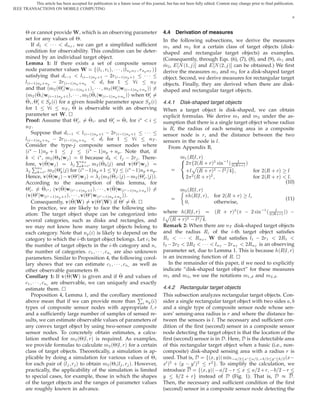
       rectangular target object                                                                                       Ò and ÒÖ are unknown parameters. As the measures are
                                                                                                                       additive if ½         ¾
                                                                                                                                                      for any ½ ¾ (½    ½ ¾
                                                                                                                       ÒÌ ½     ¾ ), we can easily obtain
       target object is approximately equivalent to the location                                                                                 Ò
       of the first (second) sensor being in . We use this                                                                       ѽ   ´µ                  ѽ   ´Ê     Ð Ö      µ
       approximation and derive measures. Because brute-force                                                                                        ½
                                                                                                                                                              ÒÖ
       but lengthy computations are needed, we show only the
       results here. The computation details are in Appendix C.                                                                                          ·         ѽ Ö   ´       Ð Ö   µ   (14)
           Define           · ¾Ö ,         · ¾Ö, « Ñ Ò´ µ, and                           Ò
                                                                                                                                                               ½

       ¬       Ñ Ü´ µ.                                                    Ѿ ´ µ            Ѿ ´Ê Ð Ö µ
                                                                                          ½
               ѽ ´    Ð Öµ                                                                    ÒÖ
                   д · µ ¾Ð     ¾              for Ð «,                                    · Ѿ Ö ´         Ð Ö µ     (15)
                   «¬ Ó×  ½ ´« е · Ь                                                           ½
                     ¬ о «¾ · «¾
                              Ô
                                                for « Ð ¬ ,      where Ê is the radius of the -th disk-shaped target ob-
                     ´Ô  ½ ´ Ð µ · Ó× ½ ´ Ð µµ
                      Ó×                                    (12) ject and       are the side lengths of the -th rectangular
                                                                                               Ô¾
                                                         Ô
                                  о   ¾                     о   ¾                                                    target object.
                   ·¾´ · · µ  ¾        ¾        о                           Ô ¾Ð
                                                                         for ¬                           ·        ¾,

                   ¾                                                     for             ·     ¾        Ð,             5     E XTENDED        MODEL ( DYNAMIC SUBMODEL )
                                                                                                                       5.1   Model description
                Ѿ   ´        Ð Ö  µ
                       · ¾´ · µÐ¾   Ð                                            for Ð             «,
                                                                                                                       The difference between the static and dynamic sub-
                   ¾«¬ ´ ¾ Ó× ½ ´« еµ ¾Ð¬
                                                                      
                                                                                                                       models is as follows: The target objects can move and
                   ·¾¬ о «¾ «¾
                              Ô
                                                                                                                       every composite sensor node sends a report at each
                                                                                 for «             Ð         ¬,
                   ¾ ´Ô ¾ Ó× ½ ´ Ð µ Ó× ½ ´ Ð µµ
                                                              
                                                                                                                       measurement epoch. There are no other differences.
                                                                                                                          More precisely, the dynamic submodel is as follows.
                   ·¾ о ¾ · ¾ о ¾
                                                         Ô
                                                                  
                                                                                                                       Each of the ÒÌ target objects may move along an
                    
                          ¾    
                                   ¾       о                                    for ¬   ԾР                          unknown route with unknown (maybe time-variant)
                                                                                         Ô ¾·           ¾,
                                                                                                                       speed. Every composite sensor node sends a report at
                   ¼                                                             for                ·        ¾
                                                                                                                       each measurement epoch. The -th sensor of the -th
                                                                                          Ð,                           composite sensor node sends the report Á ´Ø µ at time
                                                                                                        (13)
                                                                                                                       Ø , where         ½ ¾,      ½ ¡ ¡ ¡  . Redefine Á¾ as the
       Remark 3: When there are multiple rectangular target                                                            time average of the number of type- composite sensor
       objects with side lengths     (½         ÒÌ ) satisfy                                                           nodes in each of which two sensors detect at least
       Ð   ¾Ö       Ñ Ò´ µ, Eqs. (7), (13), and (9) show                                                                          È       È
                                                                                                                                                         Ƚ È
               Æ ´¾ µ
                                                 È
                                ´ ´ · ¾Ö µ´ · ¾Ö µ · о  
                                                                                                                       one target object at a single measurement epoch, that
                                                                                                                                     ØÑ     Ò
                                                                                                                                              Ò  ½ ·½ ´Á½ ´Øµ       Á¾ ´Øµ   ½µ Ñ.
                                                         ´ È                                 È´ ·                      is Á¾
       that
       ¾Ð ´ · · Ö µµ                  · ¾´ Ö                                             Ð µ
                                                                                                                                     Ø Ø½
                                                                                                                       Similarly, redefine Á½
                                                                                                                                                     ØÑ
                                                                                                                                                     Ø Ø½
                                                                                                                                                             Ò
                                                                                                                                                               Ò  ½ ·½            ½
                                                                                                                                                                       ´ Á½ ´Øµ´½  
         µ · ´ Ö¾ · о Ð Ö µÒÌ µ . Thus, if we can use
                                                                                                                       Á¾ ´Øµµ · ´½   Á½ ´ØµµÁ¾ ´Øµ        ½µ Ñ, which denotes the
          Æ ´¾ È withÈ
                µ    various Ð Ö simultaneously, we can es-                                                            time average of the number of type- composite sensor
       timate          ´ · µ. However, we cannot estimate                                                              nodes in each of which one of two sensors detects at
       each              . Therefore, it is often the case that a pair                                                 least one target object at a single measurement epoch.
This article has been accepted for publication in a future issue of this journal, but has not been fully edited. Content may change prior to final publication.
IEEE TRANSACTIONS ON MOBILE COMPUTING

                                                                                                                                                                                  8


       5.2     Analyzed results for dynamic submodel                                                             where ÈÈ     Ò
                                                                                                                                Ò
                                                                                                                                  Ñ ½ ´Ê Û½ µ
                                                                                                                                                    ÈÈ
                                                                                                                                       is an estimator of Ò ,
                                                                                                                                                       ÒÌ  Ò
                                                                                                                                                                       Ù¾
                                                                                                                                                                             Û½ µµ
                                                                                                                       ÈÈ                           ÈÈ
                                                                                                                 ´   ½´                         ·             ѽ Ö ´
                                                                                                                                                      ÒÌ  Ò
       It should be noted that the analyzed results originally                                                                  ½                          ½
                                                                                                                                       Ñ ½ ´Ê ÛÂ µ ·                        ÛÂ µµ
                                                                                                                                  Ò
                                                                                                                 ¡¡¡          ´                              ѽ Ö ´
                                                                                                                                                       ÒÌ  Ò
       derived for the static submodel are valid for the dy-                                                              Â          ½                   ½
                                                                                                                               ½ Ѿ ´Ê Û½ µ                                  Û½ µµ
                                                                                                                          Ò
       namic submodel. The reasons are as follows. (1) At each                                                       ½´                         ·             Ѿ Ö ´
                                                                                                                                                     ÒÌ  Ò
                                                                                                                                                           ½
                                                                                                                                       Ѿ ´Ê Û µ ·                         Û µµµ.
                                                                                                                                  Ò
       measurement epoch, the dynamic submodel is identical                                                      ¡¡¡      Â   ´
                                                                                                                                     ½                  ½    Ѿ Ö ´
       to the static submodel. (2) Only the quantity affected
       by multiple measurement epochs is Á , but it is no                                                        7        N UMERICAL      EXAMPLES
       included in derived formulas.          Æ´ µ         Á    is
                                                                                                                 This section provides numerical examples. The following
       valid both for the static and dynamic submodels. The
                                                                                                                 conditions were used as a basic pattern for the simula-
       fact Ú´¢ ϵ      ´Á¾ ½ ¡ ¡ ¡ Á¾  µ under the assumption of
                                                                                                                 tion. We used a monitored rectangular area, ¾¼ ¼¼¼ ¢ ½¼¼
       no approximation errors or measurement errors is also
                                                                                                                 square units, in which composite sensor nodes were
       valid.
                                                                                                                 deployed. Three target objects moved at a speed equal to
                                                                                                                 10 units of length per unit time along a straight line that
       6       E STIMATION                METHOD                                                                 was parallel to the bottom line of the monitored area.
       Based on the analysis in the previous section, we propose                                                 Two of the objects were disk-shaped with radiuses of 3
       an estimation method for multiple target objects that                                                     and 30, and the other one was rectangular with sides
       may have different parameters.                                                                            (3, 10). We used six composite sensor nodes of which
         Note that    Á          Æ ´ µ for        ½ ¾. Thus, Á¾                                                  parameters ´Ð Ö µ were (3, 1), (4, 1), (9, 2), (12, 3), (20,
       can be an estimator of Æ ´¾ µ .                                                                           2), and (22, 1) for ½        . We set      ¼    per square
                                                                                                                 unit length for all , and composite senor nodes were
                               Á½      ·     ½                      Æ ´½     µ                            (16)   placed in a homogeneous Poisson process. (As a result,
                               Á¾      ·     ¾                      Æ ´¾     µ                            (17)   the mean density of the sensors was 1 per square unit
                                                                                                                 length.) The mean distance between the target objects
       where            Á      Á    is an error of Á from its                                                    was 1,000. One simulation yields 2000 measurement
       expectation. By using Eqs. (6), (7), (8), and (9),                                                        epochs, and 10 simulation were run to obtain each result.
                                                          ÒÌ

                         Á½   ·    ½                            ѽ ´Ì Ð          Ö   µ                    (18)
                                                                                                                 7.1 Approximation errors and sensitivities to vari-
                                                           ½
                                                          ÒÌ                                                     ous conditions
                         Á¾   ·    ¾                            Ѿ ´Ì Ð          Ö   µ                    (19)   We first confirmed the agreement of the simulation re-
                                                           ½                                                     sults and the theoretically-derived results and evaluated
       The right-hand sides of these two equations are given                                                     approximation errors under various conditions and sen-
       by derived measures for each class of target object. For                                                  sitivities of Á½ (Á¾ ) to various conditions. (In 7.2.1 and
       example, if the target objects are disk-shaped (rectan-                                                   7.2.2, the impact of these conditions and errors on the
       gles), Eqs. (10) and (11) (Eqs. (12) and (13)) can be used.                                               estimation accuracy is shown.) We compared Á½ (Á¾ )


               ÈÈ                                    ÈÈ
       When there may be both disk-shaped and rectangular                                                        with Æ ´½ µ ( Æ ´¾ µ ), that is, the right-hand side
       objects, the right-hand sides of Eqs. (18) and (19) should                                                of Eq. (8) (Eq. (9)). For the disk-shaped target objects,
                  Ò                       ÒÖ
       be ´         ½ ѽ ´Ê Ð Ö µ ·          ½ ѽ Ö ´    Ð Ö µµ ,                                                Eqs. (10) and (11) were used, and for the rectangular
             Ò                       ÒÖ
         ´
                ½ Ѿ ´Ê Ð Ö µ ·         ½ Ѿ Ö ´      Ð Ö µµ .                                                   target object, Eqs. (12) and (13) were used.
         In general,
                                                                                                                 7.1.1 Basic pattern
                                          Á·                    Ù                                         (20)
                                                                                                                 For the basic pattern, Figure 2 shows the relative errors
                     Á                 ´Á½   ½ Á½ ¾             Á½         Á¾ ½ Á¾ ¾                 Á¾  µ,    of the theoretical values (that is, the relative error =

               È                                          È
       where                                              ¡¡¡                                  ¡¡¡
                                                                                                                 theoretical value/simulation result -1). Æ ´½ µ shows
                 ´   ½½       ½¾    ¡¡¡      ½   Â    ¾½        ¾¾    ¡¡¡        ¾   Â µ  , and           Ù
                                                                                                                 a positive bias because we approximated           by    for
       ´   ½
                ÒÌ
                     ½ ѽ ´¢        Û½ µ     ¡¡¡      Â
                                                                ÒÌ
                                                                     ½ ѽ ´¢         Û        µ   Ú µ.
                                                                                                                 the rectangular target object (see Fig. 1). Æ ´¾ µ also
           A set of that minimizes the square error Ì ´Á  
                          ¢
                                                                                                                 can have a positive bias, but it was within a range
       Ù µ´Á   Ù µÌ can be an estimator ¢ of ¢, where Ì is
                                                                                                                 of simulation error (see Figure 4 for the variance of
       a transpose operator.
                                                                                                                 the simulation results). In total, the relative errors were
                          ¢         Ö Ñ Ò¢ ´         Á Ù         µ´   Á Ù            µ
                                                                                      Ì
                                                                                                          (21)   small, and we concluded that the theoretical results are
                                                                                                                 valid.
       When the target object shape can be categorized into sev-
       eral categories, such as disks and rectangles, the number                                                 7.1.2 Independence to speed, monitored area, and
       of target objects in each category is also a parameter to                                                 moving directions
       be estimated. For example, when there may be both disk-
       shaped and rectangular objects,                                                                           Fig. 3 provides Á¾ when one condition such as the target
                                                                                                                 object speed is modified among conditions used in the
               ´¢    Ò    µ       Ö Ñ Ò¢ Ò ´         Á   Ù¾           µ´   Á   Ù¾          µ
                                                                                            Ì
                                                                                                          (22)   basic pattern.
This article has been accepted for publication in a future issue of this journal, but has not been fully edited. Content may change prior to final publication.
IEEE TRANSACTIONS ON MOBILE COMPUTING

                                                                                                                                                                                                       9


                                                                                                           graph for Á½ because it is similar.) “Low density” in this
                                  0.006
                                                                                                           figure means the results with        ¼ ¼ , which is 1/10 of
                                  0.005                                                                    used in the basic pattern, and “Small num. epoch” means
                                                E[N(1,j)]
                                  0.004
                 Relative error

                                                E[N(2,j)]                                                  the results with 200 consecutive measurement epochs,
                                  0.003                                                                    which is 1/10 the number of measurement epochs in the
                                  0.002                                                                    basic pattern. (Other conditions used in the basic pattern
                                  0.001                                                                    are maintained.) Coefficient variation (thus, variance) of
                                      0                                                                                                              Ô
                                                                                                           “Low density” and that of “Small num. epoch” for each
                                  -0.001   (3, 1) (4, 1) (9, 2) (12, 3) (20, 2) (22, 1)                    ´Ð Öµ are similar and approximately ½¼ times larger
                                                                       (l, r)
                                                                                                           than that of the basic pattern. This is because the number
                                                                                                           of sensed samples (that is, the number of composite
                                                                                                           sensor nodes times the number of measurement epochs)
                                                                                                           is the same for “Low density” and “Small num. epoch”
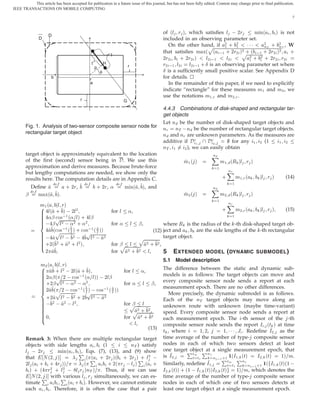
       Fig. 2. Relative errors (basic pattern)
                                                                                                           and ½ ½¼ times smaller than that of the basic pattern. As
                                                                                                                                                             Ô
                                                                                                           suggested in the central limit theorem, if all the samples
                                                                                                           are independent, the coefficient of variation is ½¼ times
                                                                                    Basic pattern          larger than that of the basic pattern.
                           1600
                           1400
                                                                                    Different area            In general, if the number of sensed samples is fixed
                                                                                    Different directions
                           1200                                                                            and each sample is statistically independent of each
                                                                                    Different speed
                           1000                                                                            other, the low composite sensor node density with many
                            800                                                                            measurement epochs is equivalent to the high density
                            600
                            400
                                                                                                           of composite sensor nodes with a small number of mea-
                            200                                                                            surement epochs. A low target object speed with a short
                              0                                                                            measurement interval results in correlations between the
                                       (3, 1)   (4, 1)      (9, 2)        (12, 3)   (20, 2)   (22, 1)      sensed data measured consecutively. Thus, the short
                                                                     (l, r)                                measurement interval may not be effective. Generally,
                                                                                                           if the number of composite sensor nodes is fixed and
                                                                                                           we can monitor the target objects in a monitored area, a
       Fig. 3. Impact of monitored area and moving speed and                                               low density of sensors placed in a wide monitored area
       directions                                                                                          is more effective than a high density of sensors placed in
                                                                                                           a limited monitored area because it is not likely to result
                                                                                                           in a large correlation among samples.
          We should note that the theoretical results derived in
       this paper are not dependent on the speed or route of
       the target object or the monitored area ¨ if there is no
                                                                                                                                                             Basic pattern
                                                                                                                                                0.006        Small num. epochs
       overlap of detections ( ½          ¾
                                                    for any ½ ¾                                                                                              Low density
       (½
                                                                                                                 Coefficient of variation for


                                                                                                                                                0.005
              ½ ¾    ÒÌ )). To numerically validate this fact, Fig.
       3 shows Á¾ for the basic pattern, for a different speed                                                                                  0.004
       (speed = 100 length units per unit of time), for a different                                                                             0.003
       monitored area ¼¼¼ ¢ ¼¼¼, and for different moving di-                                                                                   0.002
       rections (the two disk-shaped target objects move along                                                                                  0.001
       the Ü-axis and the rectangular target object moves along                                                                                    0
       the Ý -axis in the monitored area ¼¼¼ ¢ ¼¼¼). We can                                                                                             (3, 1) (4, 1) (9, 2) (12, 3) (20, 2) (22, 1)
       clearly see that Á¾ is independent of the speed or the                                                                                                              (r, l)
       route of the target object, or the monitored area ¨. Due
       to limited space, we omit the results for Á½ , although it
       is also shown to be independent of the speed or route                                               Fig. 4. Impact of density and number of measurement
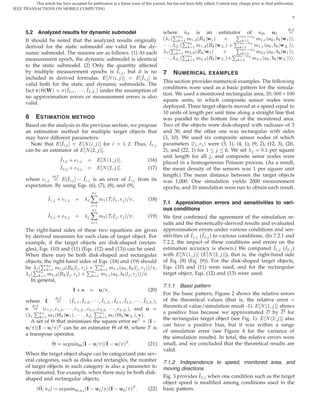
       of the target object or the monitored area ¨.                                                       epochs

       7.1.3 Impact of density and number of measurement
       epochs                                                                                              7.1.4 Non-homogeneous deployment
       We then evaluated the impact of (the composite sensor                                               We also investigated the sensor deployment that does
       node density) and the number of measurement epochs                                                  not follow a homogeneous Poisson process. In the mon-
       on the variance of Á . (It is clear that they have no                                               itored area ¾¼ ¼¼¼ ¢ ½¼¼, along the Ü-axis starting from
       impact on the average of Á       . Therefore, we omit                                               0, we deployed the composite sensor nodes in a Possion
       its graph.) Figure 4 plots the results (the coefficient                                              process with the density          ¼ ½ for Ü ¾ ¼ ¼¼¼µ
       of variation with different and that with a different                                               or ½ ¼¼¼ ¾¼¼¼¼µ and the density             ¼ for Ü ¾
       number of measurement epochs) for Á¾ . (We omit a                                                     ¼¼¼ ½ ¼¼¼µ. (Other conditions used in the basic pattern
This article has been accepted for publication in a future issue of this journal, but has not been fully edited. Content may change prior to final publication.
IEEE TRANSACTIONS ON MOBILE COMPUTING

                                                                                                                                                                       10


       are maintained.) Figure 5 plots Á¾ averaged over every
       200 measurement epochs (that is, every 2000 length unit
       movement along the Ü-axis) and its total average (Á¾                                                                                          30
       averaging over 2000 measurement epochs) for ´Ð Öµ                                                   10
                                                                                                                  Distance       Distance
       ´¿ ½µ. Although the Á¾ averaging over every 200 mea-                                     3                            3

       surement epochs changes according to the movement of
       the target objects, we cannot see the difference between
       the total average and that of the basic pattern (i.e., a
       homogeneous Poisson process). That is, the total time
       average of Á¾ under this non-homogeneous deployment
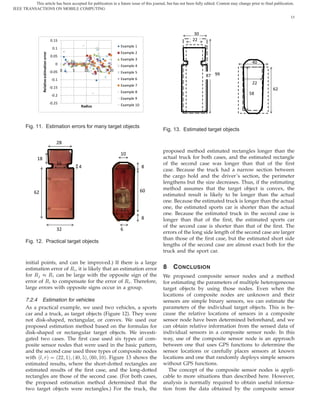
       is identical to that under the basic pattern. Our proposed                         Fig. 6. Placement for overlap detections
       estimation method uses the total time average of Á¾ and
       provides us the same estimation result if Á¾ is the same.
       This fact suggests that our estimation method can work
                                                                                          not detect multiple target objects. However, in a practical
       with non-homogeneous deployment.
                                                                                          situation, this is not the case. We evaluated the impact
          Theoretically, we do not require a homogeneous Pois-
                                                                                          of the overlaps of detections for the basic pattern. As
       son process or homogenous density to validate the the-
                                                                                          shown in Figure 6, we placed three target objects, which
       oretical results. As long as the average density can be
                                                                                          went along the Ü-axis (the bottom line) in this figure
       defined over the monitored area ¨ and takes the same
                                                                                          without changing their relative positions. Figure 7 plots
       value, Æ ´½ µ ( Æ ´¾ µ ) does not change. Thus, a
                                                                                          the relative errors of overlapped detections when the
       doubly stochastic Poisson process, for example, is also
                                                                                          distance of each pair of neighbor target objects were 10
       possible [11]. However, non-homogeneous density may
                                                                                          and 2. Due to the overlapped detections, Á¾ increased
       cause a bias and additional variance for each sample.
                                                                                          for any ´Ð Öµ. When the distance was 10, the event in
       Generally, if the average density over the route of a target
                                                                                          which a single sensor simultaneously detects multiple
       object is equal to that over the monitored area, there is no
                                                                                          target objects did not occur. Thus, the total number
       bias. The total average in Figure 5 is one such example.
                                                                                          of sensors detecting at least one target object did not
       If the average density over the route of a target object
                                                                                          include errors. Thus, Á½ decreased for any ´Ð Öµ. (In
       is not equal to that over the monitored area, should
                                                                                          fact, Á¾ for small Ð does not change when distance =
       be defined as the average density over the route. If we
                                                                                          10 because the distance is large. Therefore, Á½ does not
       can monitor the same target objects multiple times, the
                                                                                          decrease.) When the distance was 2, Á¾ increased and
       ensemble average of the density over trajectories can be
                                                                                          the total number of sensors detecting at least one target
       a definition of . Otherwise, bias may occur. In such a
                                                                                          object slightly decreased.
       case, the results can be route dependent. An advanced
       method useful for the route dependence is to estimate                              7.1.6 Impacts of target objects
       the average density over the route. This is for further
                                                                                          In addition, we investigated cases in which the target
       study.
                                                                                          objects different from the basic pattern and are homoge-
                                                                                          neous. Other conditions are the same with the basic pat-
                                                                                          tern. We used three examples where all the target objects
                     3000
                                                               (l, r) = (3, 1)
                                                                                          were disk-shaped, and their radiuses Ê (½           ¿) were
                     2500                                                                 the same for each example, 3, 10, and 30, respectively.
                     2000                                                                 Afterwards, we used three examples where all the target
                     1500                                                                 objects were rectangular and all of their sides ´         µ

                     1000                   Every 200                                     (½        ¿) were the same for each example, (20, 20), (10,
                                            Total average                                 30), and (30, 30), respectively. The relative errors when
                      500
                                            Average (basic pattern)                       all the target objects were disk-shaped with Ê       ¿¼ and
                         0                                                                those when all the target objects were rectangular with
                             <200     < 600 < 1000 < 1400 < 1800                          ´     µ     ´¿¼ ¿¼µ are shown in Figure 8. As shown in
                                         Measurement epochs                               this figure, the relative errors for the disk-shaped target
                                                                                          objects are negligible. However, those for the rectangular
                                                                                          target objects can be positive or negligible. The reason of
       Fig. 5. Non-homogeneous density
                                                                                          the positive bias is the proposed approximation uses
                                                                                          instead of . The relative errors for other examples are
                                                                                          similar.
       7.1.5     Detection overlaps
       In the theoretical analysis, we assumed that there are                             7.2       Examples of estimation
       no overlaps of detections. That is, at each measurement                            This subsection provides some examples of estimation.
       epoch, we assume that each composite sensor node does                              We used a sample algorithm shown in Appendix E, but
This article has been accepted for publication in a future issue of this journal, but has not been fully edited. Content may change prior to final publication.
IEEE TRANSACTIONS ON MOBILE COMPUTING

                                                                                                                                                                                      11


                                                                                                                         7.2.1   Under various errors
                                                     0.03
                                                               Distance between target object = 10
                                                     0.02                                                                For all the cases (the basic pattern and its modifications)
                                                     0.01                                                                in which we evaluated in the previous subsection, we
                              Relative difference

                                                        0                                                                used the proposed estimation method. As described in
                                                    -0.01     (3, 1)     (4, 1)     (9, 2) (12, 3) (20, 2) (22, 1)       the beginning of this section, there were three target ob-
                                                    -0.02                                                                jects (two of the objects were disk-shaped with radiuses
                                                    -0.03                                                                of 3 and 30, and the other one was rectangular with sides
                                                    -0.04
                                                                                                                         (3, 10)) in the basic pattern.
                                                    -0.05            Number of sensors detecting
                                                    -0.06
                                                                                                                            Figure 9 plots the results. Small variations of sensed
                                                                                        (l, r)                           results have a different impact on the estimated param-
                                                                                                                         eters. The estimation for ʾ , the radius of the largest
                                                      0.1
                                                                                                                         disk-shaped target object, is very accurate, and there
                                                               Distance between target object = 2                        is almost no errors for all cases. This is because other
                                                    0.05                                                                 target objects have nothing to do with the sensed results
                              Relative difference


                                                                                                                         with ´Ð Öµ ´¾¼ ¾µ ´¾¾ ½µ for any cases and the sensed
                                                       0                                                                 results with ´Ð Öµ      ´¾¼ ¾µ ´¾¾ ½µ can dedicatedly be
                                                              (3, 1)     (4, 1)     (9, 2) (12, 3) (20, 2) (22, 1)       used to estimate ʾ . Two other reasons are there is no
                                                    -0.05
                                                                                                                         approximation error for a disk-shaped target object and
                                                     -0.1                                                                the approximation errors for a rectangular target object
                                                                     Number of sensors detecting                         does not affect the largest disk-shaped target object.
                                                    -0.15                                                                On the other hand, small variations and approximation
                                                                                        (l, r)
                                                                                                                         errors of sensed results cause estimation errors of the
                                                                                                                         other three parameters. This is mainly because there
       Fig. 7. Relative errors due to overlap detections                                                                 is an approximation error for a rectangular target ob-
                                                                                                                         ject, and the small variations can change the results
                                                                                                                         around the minimum square point. The fact is that,
                                                                                                                         for three unknown parameters, four sensed results with
                               0.008
                               0.007
                                                                                                 E[N(1, j)]: rectangle   ´Ð Öµ      ´¿ ½µ ´ ½µ ´ ¾µ ´½¾ ¿µ may not be enough
                                                                                                 E[N(2, j)]: rectangle   under erroneous conditions. In total, there can be 20%
                               0.006
             Relative error


                               0.005                                                             E[N(1, j)]: disk
                                                                                                                         of estimations errors for many cases. However, overlap
                               0.004                                                             E[N(2, j)]: disk
                                                                                                                         detections cause more serious estimation errors. One of
                               0.003
                               0.002
                                                                                                                         the main reasons is that they causes serious bias. Another
                               0.001                                                                                     reason is that, due to the approximation analysis for
                                   0                                                                                     a rectangular target object, errors that give smaller Á
                              -0.001                        (3, 1)     (4, 1)     (9, 2) (12, 3) (20, 2) (22, 1)         increase estimation errors. For the distance of each pair
                                                                                       (l, r)                            of neighbor target object is 2, the proposed estimation
                                             Side length of rectangles : (30, 30).
                                             Radius of disks : 30.
                                                                                                                         method fails to detect that there are two disks and one
                                                                                                                         rectangle. It estimated as three disks. “Overlap” in this
                                                                                                                         figure corresponds to the case in which the distance of
       Fig. 8. Relative errors (Three homogenous disks or three                                                          each pair of neighbor target objects is 10.
       homogeneous rectangles)
                                                                                                                         7.2.2   Homogeneous target objects
                                                                                                                         When multiple target objects have similar parameter
       it is not a special one. We start the estimation algorithm                                                        values, it may be difficult to estimate them. This is
       with the initial values of ¢ ´½¼ ¡ ¡ ¡ ½¼µ for each pair of                                                       because it is difficult to judge whether a given set of
       (Ò ÒÖ ), where ¼ Ò         ÒÌ , ÒÖ  ÒÌ   Ò . (Eqs. (21) and                                                       composite sensor nodes is an observing parameter set.
       (22) may have a local minimum in our experience. Thus,                                                            Thus, we estimated when all the three target objects have
       the obtained estimates may depend on the initial values.                                                          the same parameter values: they were all disk-shaped
       However, we cannot try all initial values. Therefore, we                                                          target objects with Ê         ¿ ½¼ or 30, or they were all
       fixed the initial values and evaluated the results.) For all                                                       rectangular target objects with ´        µ= (20, 20), (10, 30),
       examples, the total number of target objects are known,                                                           or (30, 30). (The relative errors are shown in the previous
       and any of the target object can be disk-shaped and                                                               subsection.)
       rectangular. The number of disk-shaped target objects is                                                            Figure 10 plots the relative estimation errors. Clearly,
       unknown (equivalently, the number of rectangular target                                                           the disk radius estimates are accurate. The possibility
       objects is unknown) and can take any integer from 0 to                                                            of estimation for the homogeneous disk-shaped target
       ÒÌ . Therefore, all examples use Eq. (22) instead of Eq.                                                          objects with Ê       ¿ (½         ¿) is a unique feature for
       (21).                                                                                                             the homogeneous target objects. When Ê            Ð   ¾Ö , the
This article has been accepted for publication in a future issue of this journal, but has not been fully edited. Content may change prior to final publication.
IEEE TRANSACTIONS ON MOBILE COMPUTING

                                                                                                                                                                                        12


                                                                                                                             0.4


                                                                                                 Relative estimation error
                                                                                                                                      Three rectangles               Three disks
                                             b_1 = 10                                                                        0.3
                                                                                                                                    *) with additional
                                                                                                                             0.2    types of composite
                                                                                                                                    sensor nodes.
                  Overlap                                                                                                    0.1
                                               a_1 = 3
                  Small number epochs                                                                                          0
                  Low speed                                                                                                         (20, 20) (10, 30) (30, 30)   3       10        30
                                                                                                                             -0.1
                  Different direction                                                                                                           *
                                             R_2 = 30
                  Different area                                                                                             -0.2
                                                                                                                                       (Side 1, Side 2)              (Radius)
                  Non-homo density
                  Different density            R_1 = 3
                  Basic pattern                                                           Fig. 10. Estimation errors for multiple homogeneous
                                                                                          target objects
                 -0.8     -0.6       -0.4    -0.2        0       0.2      0.4
                                   Relative estimation errors
                                                                                          7.2.3 Many target objects
                                                                                          It is difficult to apply this proposed method when the
                                                                                          number ÒÌ of target objects is large. Practically, there
       Fig. 9. Relative estimation errors                                                 are two reasons. The first is that, for a fixed number
                                                                                          of composite sensor nodes, it is likely that a given set
                                                                                          of parameter values of composite sensor nodes is not
                                                                                          an observing parameter set when ÒÌ is large. Therefore,
        -th composite sensor node cannot offer new informa-                               we may not be able to estimate all the parameters of
       tion that is not offered by a non-composite disk-shaped                            the target objects. To avoid such a situation, we may
       simple sensing area, although multiple non-composite
               È                   È
                                                                                          need a large number of composite sensor node types.
       disk-shaped sensing areas with different radiuses can                              The second reason is that it becomes computationally
       offer       Ì    and       Ì  (See Eq.(5)). Thus, normally,
       È
                                                                                          difficult to find the minimum square error solution.
       each Ê cannot be estimated. In practice, however, when
       È  ÒÌ                                                                              However, difficulties of such a problem that may have
            ½ Ì        ÒÌ Ê ( Ê      ʽ      ʾ      Ê¿ ) is given,

       È                                          ʾ for all
                                                                    È
          ÒÌ                                                                              local minimums with large unknown parameters are not
            ½  Ì    is minimized at Ì                          and
                         ÒÌ Ê¾ . (The actual sensed
          ÒÌ                                             ÒÌ                               specific to our problem.
            ½  Ì
                                                           ½ Ì    is
       È                                    È
         ÒÌ Ê¾ if there are no measurement errors.) If the sensed
                                                                                             We estimated the parameters of 20 target objects,
          ÒÌ                ¾          ÒÌ                                                 which were all disk-shaped. When estimating, we did
            ½ Ì is ÒÌ Ê with             ½ Ì     ÒÌ Ê, every target
                                                                                          not use the information that all the target objects are
       object is disk-shaped with the radius Ê. Therefore, even
                     Ð   ¾Ö for many , we can conclude that all
                                                                                          disk-shaped. To estimate the 20 target object radiuses
       when Ê                                                                             randomly distributed according to the uniform distribu-
       the target objects are disk-shaped with the same radius.                           tion over the range of [1, 20] and the number Ò of disk-
       As a whole, for disk-shaped homogeneous target objects,                            shaped target objects, we used 100 types of composite
       we can accurately estimate their parameters.                                       sensor nodes where             ¼ ,Ö      ¼ £ ´ · ½µ for
          However, for the rectangles, the estimation accuracy                                     ´ ½¼µ £ ½¼, Ð       ¼ ¾ £ ´ · ½µ · ¾Ö . (Ð   ¾Ö
       for the second and third examples is poor. In particular,                          is at a regular interval of 0.2 from 0.2 to 20.) We used
       for the second example, the proposed method did not                                the theoretical value of     Á¾ as sensed data because
       correctly estimate the number of rectangular target ob-                            the simulation requires so many hours. (As mentioned
       jects. Therefore, we were not able to define the relative                           in the example of homogeneous target objects, we did
       estimation error. Thus, we introduced an additional type                           not use Á½ for estimation because there are many types
       of composite sensor node of ´Ð Öµ=(35, 2). In addition,                            of composite sensor nodes.) We tried 10 examples.
       we did not use Á½ for estimation. This is because, as                                 Figure 11 plots the relative errors of estimated ra-
       the number of composite sensor node types increase,
       Á½ does not provide any new information, but              ¾
                                                                 ½
                                                                            È             diuses. (For every example, the number Ò of disk-
                                                                                          shaped target objects was correctly estimated. That is,
       increases. Thus, Á¾ does not affect the estimation for the                         the estimated Ò      ¾¼.) The estimation-error range was
       additional composite sensor nodes.                                                 approximately between -0.1 and 0.1, except for Example
          By introducing this additional type of composite sen-                           10. (The estimated radiuses in Example 10 may have
       sor node of ´Ð Öµ=(35, 2), the proposed method correctly                           shown local minimum square errors, but not global min-
       estimates the number of rectangular target objects and                             imum square errors, because the square errors obtained
       the relative estimation error can be defined and plotted.                           were fairly large. Thus, the results of Example 10 may
       (If we use Á½ , additional types of composite sensor                               be dependent of the minimum-search algorithm, the
       nodes are necessary.)                                                              parameters of the minimum-search algorithm, and the
This article has been accepted for publication in a future issue of this journal, but has not been fully edited. Content may change prior to final publication.
IEEE TRANSACTIONS ON MOBILE COMPUTING

                                                                                                                                                                       13


                                                                                                                30
                                               0.15                                                            22
                                                                                Example 1
                                                0.1
                                                                                Example 2
                   Relative estimation error

                                               0.05
                                                                                Example 3
                                                  0                                                                                            40
                                                                                Example 4
                                               -0.05 0   5       10   15   20
                                                                                Example 5
                                                                                                                     87 99
                                                -0.1                            Example 6
                                                                                Example 7
                                                                                                                                               22
                                               -0.15                                                                                                        62
                                                                                Example 8                                                     58
                                                -0.2
                                                                                Example 9
                                               -0.25                            Example 10
                                                             Radius


       Fig. 11. Estimation errors for many target objects
                                                                                                  Fig. 13. Estimated target objects

                                                   28
                                                                                                  proposed method estimated rectangles longer than the
                                                                                10
              18                                                                                  actual truck for both cases, and the estimated rectangle
                                                   16                                             of the second case was longer than that of the first
                                                             4                       8       8
                                                                                26                case. Because the truck had a narrow section between
                                                                                                  the cargo hold and the driver’s section, the perimeter
                                                                                                  lengthens but the size decreases. Thus, if the estimating
                                                                                             60   method assumes that the target object is convex, the
            62                                                                                    estimated result is likely to be longer than the actual
                                                                                                  one. Because the estimated truck is longer than the actual
                                                                                                  one, the estimated sports car is shorter than the actual
                                                                                22
                                                                                                  one. Because the estimated truck in the second case is
                                                                                8            8    longer than that of the first, the estimated sports car
                                                                                                  of the second case is shorter than that of the first. The
                                                   32                           6
                                                                                                  errors of the long side length of the second case are larger
                                                                                                  than those of the first case, but the estimated short side
       Fig. 12. Practical target objects
                                                                                                  lengths of the second case are almost exact both for the
                                                                                                  truck and the sport car.

       initial points, and can be improved.) If there is a large
       estimation error of Ê , it is likely that an estimation error                              8   C ONCLUSION
       for Ê      Ê can be large with the opposite sign of the                                    We proposed composite sensor nodes and a method
       error of Ê to compensate for the error of Ê . Therefore,                                   for estimating the parameters of multiple heterogeneous
       large errors with opposite signs occur in a group.                                         target objects by using those nodes. Even when the
                                                                                                  locations of composite nodes are unknown and their
       7.2.4 Estimation for vehicles                                                              sensors are simple binary sensors, we can estimate the
       As a practical example, we used two vehicles, a sports                                     parameters of the individual target objects. This is be-
       car and a truck, as target objects (Figure 12). They were                                  cause the relative locations of sensors in a composite
       not disk-shaped, rectangular, or convex. We used our                                       sensor node have been determined beforehand, and we
       proposed estimation method based on the formulas for                                       can obtain relative information from the sensed data of
       disk-shaped or rectangular target objects. We investi-                                     individual sensors in a composite sensor node. In this
       gated two cases. The first case used six types of com-                                      way, use of the composite sensor node is an approach
       posite sensor nodes that were used in the basic pattern,                                   between one that uses GPS functions to determine the
       and the second case used three types of composite nodes                                    sensor locations or carefully places sensors at known
       with ´Ð Öµ ´¾¾ ½µ ´ ¼ µ ´ ¼ ½¼µ. Figure 13 shows the                                       locations and one that randomly deploys simple sensors
       estimated results, where the short-dotted rectangles are                                   without GPS functions.
       estimated results of the first case, and the long-dotted                                       The concept of the composite sensor nodes is appli-
       rectangles are those of the second case. (For both cases,                                  cable to more situations than described here. However,
       the proposed estimation method determined that the                                         analysis is normally required to obtain useful informa-
       two target objects were rectangles.) For the truck, the                                    tion from the data obtained by the composite sensor
This article has been accepted for publication in a future issue of this journal, but has not been fully edited. Content may change prior to final publication.
IEEE TRANSACTIONS ON MOBILE COMPUTING

                                                                                                                                                                       14


       nodes. In general, more complex composite sensor nodes                             Young Engineer Award of the Institute of Electronics, Information and
       yield more detailed information, but analysis then be-                             Communication Engineers (IEICE) in 1990, the Telecommunication Ad-
                                                                                          vancement Institute Award in 1995 and 2010, and the excellent papers
       comes complicated. We will continue to develop the                                 award of the Operations Research Society of Japan (ORSJ) in 1998.
       use of these composite sensor nodes for estimating the                             His research interests include traffic technologies of communications
       parameters of multiple target objects and will investigate                         systems, network architecture, and ubiquitous systems. Dr. Saito is a
                                                                                          fellow of IEEE, IEICE and ORSJ, and a member of IFIP WG 7.3.
       other applications for which these composite sensor
       nodes are useful.

       R EFERENCES
       [1]    G. J. Pottie and W. J. Kaiser, Wireless Integrated Network Sensors,
              Commun. ACM, 43, 5, pp. 51–58, May 2000.
       [2]    I. F. Akyildiz, W. Su, Y. Sankarasubramaniam, and E. Cayirci, A
              Survey on Sensor Networks, IEEE Communications Magazine, 40,
              8, pp. 102–114, 2002.
       [3]    B. W. Cook, S. Lanzisera, and K. S. J. Pister, SoC Issues for RF
              Smart Dust, Proceedings of IEEE, 94, 6, pp. 1177–1196, June 2006.
       [4]    H. Saito, M. Umehira, O. Kagami, and Y. Kado, Wide Area
              Ubiquitous Network: The Network Operator’s View of a Sensor                 Shinsuke Shimogawa graduated from Osaka University with a B.SC.
              Network, IEEE Commun. Magazine, 46, 12, pp. 112–120, 2008.                  degree and an M.SC. degree in Mathematics. He received a Ph.D.
       [5]    http://robotics.eecs.berkeley.edu/˜pister/SmartDust/                        degree from Kyushu University. He joined NTT in 1986 and is currently
       [6]    H. Saito, S. Shioda, and J. Harada, Shape and Size Estimation               working at the NTT Service Integration Laboratories.
              Using Stochastically Deployed Networked Sensors, IEEE SMC
              2008, Singapore, 2008.
       [7]    P. Hall, Introduction to the Theory of Coverage Processes, John
              Wiley & Sons, 1988.
       [8]    L. Lazos and R. Poovendran, Stochastic Coverage in Heteroge-
              neous Sensor Networks, ACM Transactions on Sensor Networks,
              2, 3, pp. 325–358, 2006.
       [9]    B. Liu and D. Towsley, A Study on the Coverage of Large-scale
              Sensor Networks, First IEEE International Conference on Mobile
              Ad-hoc and Sensor Systems, 2004.
       [10]   P. Manohar, S. S. Ram, and D. Manjunath, On the Path Coverage
              by a Non-homogeneous Sensor Field, Proc. IEEE Globecom, 2006.
       [11]   H. Saito, K. Shimogawa, S. Shioda, and J. Harada, Shape Estima-
              tion Using Networked Binary Sensors, INFOCOM 2009, 2009.
       [12]   H. Saito, Y. Arakawa, K. Tano, and S. Shioda, Experiments on                Sadaharu Tanaka received the B.E. and M.E. degrees in communica-
              Binary Sensor Networks for Estimation of Target Perimeter and               tion system engineering from Chiba University, Japan, in 2008 and 2010,
              Size, IEEE SECON 2009, Rome, 2009.                                          respectively. Currently, he is with the Yahoo Japan Corporation. His
       [13]   H. Saito, S. Tanaka, and S. Shioda, Estimating Size and Shape of            research interest includes the performance analysis of sensor networks.
              Non-convex Target Object Using Networked Binary Sensors, IEEE
              SUTC 2010, Newport Beach, California, USA.
       [14]   L. Lazos, R. Poovendran, and J. A. Ritcey, Probabilistic Detection
              of Mobile Targets in Heterogeneous Sensor Networks, IPSN07,
              pp. 519–528, 2007.
       [15]   L. A. Santalo, Integral Geometry and Geometric Probability, Sec-
                            ´
              ond edition. Cambridge University Press, Cambridge, 2004.
       [16]   S. Kwon and N. B. Shroff, Analysis of Shortest Path Routing for
              Large Multi-hop Wireless Networks, IEEE/ACM Trans. Network-
              ing, 17, 3, pp. 857–869, 2009.
       [17]   W. Choi and S. K. Das, A Novel Framework for Energy-
              Conserving Data Gathering in Wireless Sensor Networks, INFO-
              COM2005, pp. 1985–1996, 2005.
       [18]   D. Tian and N. Georganas, A Coverage-preserving Node Schedul-               Shigeo Shioda received the B.S. degree in physics from Waseda
              ing Scheme for Large Wireless Sensor Networks, First ACM                    University in 1986, the M.S. degree in physics from University of Tokyo
              International Workshop on Wireless Sensor Networks and Ap-                  in 1988, and the Ph.D degree in teletraffic engineering from University
              plications, pp. 32–41, 2002.                                                of Tokyo, Tokyo, Japan, in 1998. In 1988 he joined NTT, where he
       [19]   F. Ye, G. Zhong, S. Lu, and L. Zhang, Peas: A Robust Energy                 was engaged in research on measurements, dimensioning and controls
              Conserving Protocol for Long-lived Sensor Networks, Proc. IEEE              for ATM-based networks. Since March 2001, he has been with the
              ICDCS, 2003.                                                                graduate school of engineering, Chiba University, Japan, where he is
       [20]   S. Shakkottai, R. Srikant, and N. Shroff, Unreliable Sensor Grids:          now Professor. His research interests are in the field of performance
              Coverage, Connectivity and Diameter, Proc. IEEE INFOCOM,                    evaluation of wireless networks, P2P systems, queueing theory, and
              2003.                                                                       complex networks. Prof. Shioda is a member of the ACM, the IEEE,
       [21]   H. Saito, S. Tanaka, and S. Shioda, Stochastic Geometric Filter and         the IEICE, and the Operation Research Society of Japan.
              its Application, submitted for publication.


       Hiroshi Saito graduated from the University of Tokyo with a B.E.
       degree in Mathematical Engineering in 1981, an M.E. degree in Control
       Engineering in 1983 and received Dr.Eng. in Teletraffic Engineering
       in 1992. He joined NTT in 1983. He is currently an Executive Re-
       search Engineer at NTT Service Integration Labs. He received the

Estimating Parameters of Multiple Heterogeneous Target Objects Using Composite Sensor Nodes

  • 1.
    This article hasbeen accepted for publication in a future issue of this journal, but has not been fully edited. Content may change prior to final publication. IEEE TRANSACTIONS ON MOBILE COMPUTING 1 Estimating Parameters of Multiple Heterogeneous Target Objects Using Composite Sensor Nodes Hiroshi Saito, Fellow, IEEE, Shinsuke Shimogawa, Sadaharu Tanaka, and Shigeo Shioda, Member, IEEE Abstract—We propose a method for estimating parameters of multiple target objects by using networked binary sensors whose locations are unknown. These target objects may have different parameters, such as size and perimeter length. Each sensors, which is incapable of monitoring the target object’s parameters, sends only binary data describing whether or not it detects target objects coming into, moving around, or leaving the sensing area at every moment. We previously developed a parameter estimation method for a single target object. However, a straight-forward extension of this method is not applicable for estimating multiple heterogeneous target objects. This is because a networked binary sensor at an unknown location cannot provide information that distinguishes individual target objects, but it can provide information on the total perimeter length and size of multiple target objects. Therefore, we propose composite sensor nodes with multiple sensors in a predetermined layout for obtaining additional information for estimating the parameter of each target object. As an example of a composite sensor node, we consider a two-sensor composite sensor node, which consists of two sensors, one at each of the two end points of a line segment of known length. For the two-sensor composite sensor node, measures are derived such as the two sensors detecting target objects. These derived measures are the basis for identifying the shape of each target object among a given set of categories (for example, disks and rectangles) and estimating parameters such as the radius and lengths of two sides of each target object. Numerical examples demonstrate that networked composite sensor nodes consisting of two binary sensors enable us to estimate the parameters of target objects. Index Terms—Sensor network, estimation, target object, composite sensor node, ubiquitous network, integral geometry, geometric probability. ✦ 1 I NTRODUCTION extract significant information. This sensing paradigm is appropriate for the described situation. Small and low-cost sensors can be used to build wireless Unfortunately, we have not determined a theory that sensor networks [1], [2], [3]. They have communication enables us to implement this paradigm. As a typical capabilities and built-in batteries to communicate via a and challenging application, we investigated a problem wireless link for transmitting sensed data of detected of estimating parameters related to the shape and size events of interest. A newly proposed development, such of target objects moving in a monitored area by using as a wide area ubiquitous network [4], supports sensors many simple randomly distributed sensors. We address with low performance and functionalities and a long- this problem and present a theory for estimating the range, low-speed wireless link with very low power con- parameters of multiple target objects by using networked sumption. These sensors can be implemented as single binary sensors whose locations are unknown. An in- chips, lowering their cost. As a result, we can deploy dividual sensor is simple. It monitors its environment such sensors like the scattering of dust [5]. Because there and reports whether or not it detects a target object. It are many sensors, we cannot carefully design the loca- does not have a positioning function, such as a GPS, or tion of each one. GPS cannot be used because the sensors functions for monitoring the target object size and shape, should have limited capability and power consumption. such as a camera, and it can be placed without careful This situation leads us to a new sensing paradigm. design. However, by collecting reports from individual That is, instead of having a few sensors with advanced sensors, we can statistically estimate the parameters of functions and high performance, many sensors with target objects. simple functions and low performance are distributed In addition to theoretical contributions, this work is randomly. They are networked and send reports, each of useful to some application scenarios that require low which includes only an insignificant amount of informa- cost, a wide coverage, and low power consumption tion, over a wireless link. However, as a whole, we can and accept rough estimation of the size and shape of target objects. For example, we may need to identify the ¯ H. Saito and S. Shimogawa are with NTT Service Integration Laboratories, 3-9-11, Midori-cho, Musashino-shi, Tokyo, 180-8585, Japan. number and kinds of animals and vehicles in a large E-mail: saito.hiroshi@lab.ntt.co.jp area to observe the wildlife, prevent poaching, or limit ¯ S. Tanaka and S. Shioda are with Chiba University. the number of tourist vehicles. We can easily obtain bi- nary sensors of sound volume, acceleration, infrared, or Digital Object Indentifier 10.1109/TMC.2011.65 1536-1233/11/$26.00 © 2011 IEEE
  • 2.
    This article hasbeen accepted for publication in a future issue of this journal, but has not been fully edited. Content may change prior to final publication. IEEE TRANSACTIONS ON MOBILE COMPUTING 2 magnetic sensors for such scenarios. These sensors with for such a purpose. In particular, [8] and [14] directly normal detection ranges are not expensive. Therefore, we apply the results of integral geometry discussed in can provide a large number of these sensors to cover a Chapter 5 and Section 6.7 in [15] to the analysis of large area at a reasonable cost. By distributing these bi- detecting an object moving in a straight line and to the nary sensors without expensive power-consuming GPSs evaluation of the probability of -coverage. In addition, or time-consuming carefully-designed placement in a [16] applies integral geometry to the analysis of straight large area, our proposed method can work. line routing, which is an approximation of the shortest This research is an extension of our prior study [6], path routing, and [17] uses it to operate sensors in an which was based on the coverage process theory [7] energy-conserving way. and its application to sensor networks [8], [9], [10]. This The rest of this paper is organized as follows. study emphasized the robustness of the derived formula Section 2 describes a basic model and previous results for a number of sensors detecting a target object. In for the model. In Section 3, we introduce composite [6], sensors that measure the size of a detected part sensor nodes and describe an extended model (static of a target object are used for estimating the overall submodel). We discuss the analysis for deriving mea- size. However, in [11], we developed a shape and size sures in Section 4. In Section 5, we discuss the dynamic estimation method using binary sensors for sending submodel of the extended submodel. We then propose reports on whether or not they detect the target object. an estimation method that uses composite sensor nodes That study assumed that both the target object and the for target objects with different parameters in Section 6. sensing area are convex or that the sensing area is disk- We show numerical examples in Section 7, and conclude shaped. This developed method [11] was evaluated in this paper in Section 8. an experiment where the target object was a box and the sensor was an infrared distance measurement sensor [12]. We also extended the estimation method in [11] to 2 P REVIOUS WORK apply to non-convex target objects [13]. 2.1 Basic model These methods we developed in [11], [13] did not take into account when multiple target objects are in the To describe the results of the previous work, which is monitored area. This work addresses such a case, i.e., the basis of the current work, we discuss the basic model multiple target objects that may have different shapes that the previous work used. and sizes coming into, moving around, and leaving the A sensor network operator deploys sensors in a con- area monitored by sensors. Each sensor, whose location vex area ¨ in 2-dimensional space ʾ , but the operator is unknown, sends a report on whether or not at least does not know the sensor locations. Each sensor has one target object is detected within its sensing area. The a sensing area, monitors the environment, and detects sensor network operator collects these reports to identify events within that area. (This model is called the Boolean the shape and to estimate parameters, such as sizes sensing model [9], [18], [19], [20] because it is clear and perimeter lengths, of the target objects. However, whether a point is within a sensing area or not.) A sensor identifying the shape and estimating the parameters of sends a detection report if a target object is in its sensing multiple heterogeneous (i.e., having different parame- area, and it sends a no-detection report if there is no ters) target objects is difficult, and a straight-forward target object in that area. (It is possible to assume that a extension of the estimation method we previously de- sensor does not send a report if there is no target object veloped [11] is not applicable. Thus, we introduce the in that area and that the sensor network operator judges concept of composite sensor nodes where multiple sim- no-detection if there is no report within a timeout. This ple binary sensors are arranged in a predetermined scenario can reduce the power consumption of sensors, layout, such as a line. Sensors in a composite sensor but the sensor network operator cannot distinguish no- node provide local and relative information even if the detection from the loss of reports. For simplicity, this location of that node is unknown. This is because the paper assumes that no-report is sent if there is no target relative locations of these sensors are predetermined. In object in that area.) this sense, the composite sensor node is an intermediate Assume that the -th sensor is located at ´Ü Ý µ and concept between a simple and an advanced sensor node the sensing area is rotated by from the referenced equipped with GPS. With these sensors, we can estimate position. Let ´Ü Ý µ ʾ be the sensing area the parameters of multiple heterogeneous target objects. where ½ ¾ . The -th sensor has communication The estimation method using composite sensor nodes capability and can send a report Á . Here, Á is 1 if is derived from integral geometry and geometric prob- it detects the target object and 0 if otherwise. That is, ability, which are useful tools for analyzing a geometric Á ½´ ´Ü Ý µ Ì µ, where ½´ µ is an indicator or spatial structure. Ubiquitous access networks, such function that becomes 1 if a statement is true and 0 if as wireless sensor networks, require analysis of the otherwise. At Ø Ø , the -th sensor sends a report, Á ´Ø µ, geometric or spatial structure of an object, and there is describing whether or not it detects the target object. The literature (including one of our papers [11]) describing sensor network operator receives the report from each the use of integral geometry and geometric probability sensor through the network.
  • 3.
    This article hasbeen accepted for publication in a future issue of this journal, but has not been fully edited. Content may change prior to final publication. IEEE TRANSACTIONS ON MOBILE COMPUTING 3 Sensors are classified into multiple types according to 3 C OMPOSITE SENSOR NODE their sensing areas. That is, different types of sensors Estimating the unknown parameters of multiple target have different sensing area sizes or shapes. (A different objects is difficult. Even when the number of target sensing area can often be implemented by changing the objects is known, a straight-forward extension of the sensitivity parameter of a sensor.) Type- sensors, of estimation method for a single target object to one for which sensing area is denoted by , are deployed with multiple target objects is not applicable if the parameters mean density . Assume that the first to Ò½ -th sensors of each target object are different. To estimate the pa- are type-1 sensors, the ´Ò½ · ½µ-th to Ò¾ -th sensors are rameters of each target object, we introduce a composite type-2 sensors, ... In general, Ò  ½ · ½ ¡ ¡ ¡ Ò -th sensors are type- sensors. Á ØÑ Ø Ø½ Ò È È Ò  ½ ·½ Á ´Øµ Ñ de- sensor node, which consists of multiple sensors arranged in a predetermined layout, such as a line. Instead of notes the time average of the number of type- sensors deploying individual sensors, the sensor network op- detecting the target object at each measurement epoch. erator deploys composite sensor nodes. Although the We assume that the sensor network operator knows the locations of the composite sensor nodes are unknown, sensor type of each sensor sending a report. local and relative information among multiple sensors Consider a target object Ì in 2-dimensional space ʾ . in a predetermined layout of a composite sensor node Its size is Ì , and its perimeter length is Ì . (In the becomes available because the relative locations of these remainder of this paper, Ü denotes the size of Ü and sensors are known. Ü denotes the perimeter length of Ü.) Define a detectable area such that sensors will 3.1 Straight-forward extension to multiple target ob- detect the target object if and only if they are located jects in a detectable area with a certain rotation angle. That is, ½´ ´Ü Ý µ Ì µ ½ if and only if Before introducing composite sensor nodes, we explain ´Ü Ý µ ¾ an extension of Eq. (1) to an equation applicable to . Equivalently, ´Ü Ý µ ´Ü Ý µ Ì ÊÊÊ . The detectable area size is defined as multiple target objects. Proposition 1: Assume that there are Ò Ì convex and ÜÝ ¾ Ü Ý ¾ . We should note that and Ì . When bounded target objects and that the sensing area is depends on both is disk-shaped, also bounded and convex. Let be the detectable areas of the -th target object and £ does not depend on . When does not depend on , ´Ü Ý µ ´Ü Ý µ Ì . If we define for simplicity. for any , Ì Ò Ò Ì 2.2 Previous results for basic model £ ½ ´ Ì µ¡ · Ì · ÒÌ (5) ¾ ½ ½ In this section, we summarize our previous results, which are used in the current work. For the convex target This is because È where Ì denotes the -th target object ´½ and because ÒÌ µ. £ object, we have obtained the following equation, and a shape and size estimation method was developed based satisfies Eq. (1). Therefore, we can estimate ÒÌ ½ Ì and È ÒÌ ½ Ì È on this equation [11]: Assume that both the target object Ì and the sensing area are bounded and convex. Then, instead of Ì and Ì in Eqs. (3) and (4), respectively. Consequently, if we can assume that all the target objects ½ ¾ Ì ¡ · Ì · (1) have the same shape and size, we can estimate the size and shape (size and perimeter length) of each target object. However, if not, we cannot estimate the size and Based on the fact that Á , we developed shape (size and perimeter length) of each target object the following estimation method. (1) At Ø , receive the re- È È no matter how many types of sensors we introduce. port Á ´Ø µ from each sensor whose location is unknown. Ñ Ò (2) Calculate Á ½ Ò  ½ ·½ Á ´Ø µ Ñ for each sensor type ( ½ ¾). (3) For two unknown parameters 3.2 Extended model (static submodel) Ì and Ì , use Eq. (1) with the estimator Á of For analyzing an estimation method for multiple hetero- and solve the following equations for ½ ¾. geneous target objects, we introduce a new model. A sensor network operator deploys composite sensor ´ ½ ¾ Ì ¡ · Ì · µ Á (2) nodes in a convex area ¨ in 2-dimensional space ʾ , but the operator does not know their locations. A composite where Ì Ì are estimators of Ì Ì . That is, sensor node consists of multiple sensors arranged in a predetermined layout. We now consider a two-sensor Ì ¾ ´Á½ ½   Á¾ ¾  ½ · ¾ µ composite sensor node, i.e., a composite sensor node ½   ¾ (3) with two sensors. These two sensors are the same as those described in the basic model. That is, they are Ì ¾ ´ ½   Á½ ½µ · ½ ´ ¾   Á¾ ¾µ simple binary sensors. For simplicity, in the remainder ¾   ½ (4) of this paper, we assume that the sensing area of each
  • 4.
    This article hasbeen accepted for publication in a future issue of this journal, but has not been fully edited. Content may change prior to final publication. IEEE TRANSACTIONS ON MOBILE COMPUTING 4 individual sensor in a composite sensor node is disk- 4 A NALYSIS FOR EXTENDED MODEL ( STATIC shaped. SUBMODEL ) 4.1 General results There are multiple types of composite sensor nodes. Type- composite sensor nodes are randomly deployed In this subsection, we provide general measure proposi- with mean density ¼. Each of the two sensors in a tions that only one (both) of the sensors in a composite type- composite sensor node has a disk-shaped sensing sensor node detects a target object. Let ѽ ´Ì µ be the area with radius Ö and is located at each of the two end measure of a set of composite sensor nodes in which one points of a line segment of length Ð . Assume that the first of the two sensors in each composite sensor node detects to Ò½ -th composite sensor nodes are type-1 composite a target object Ì and the other does not. (According to sensor nodes and the ´Ò½ · ½µ-th to Ò¾ -th composite ѽ ´Ì µ Ê Appendix A, ѽ ´Ì µ can be written by an integral form: Ø.) Roughly, ѽ ´Ì µ is a sensor nodes are type-2 composite sensor nodes, ... In ´Ü½ ܾ µ¾ × Ô general, Ò  ½ · ½ ¡ ¡ ¡ Ò -th composite sensor nodes are non-normalized probability that one of the two sensors type- composite sensor nodes for ½ ¡ ¡ ¡  , where in a composite sensor node detects a target object Ì and  is the number of composite sensor node types. (For the other does not, where the normalizing constant is Ñ ½ ¾, Ð ½ Ð ¾ or Ö ½ Ö ¾ .) (the measure of a set of composite sensor nodes placed Let Á be the report of the -th sensor of the -th A. Similarly, let Ѿ ´Ì µ Ê in (included in or intersects with) ¨), given in Appendix ´Ü½ ܾ µ¾ Ô Ø be the composite sensor node for ½ ¾, and Á is 1 if it measure of a set of composite sensor nodes in which È detects the target object and 0 if otherwise. Let Á¾ Ò Ò  ½ ·½ ½´Á½ Á¾ ½µ be the number of type- both sensors of each composite sensor node detect a target object Ì . Ѿ ´Ì µ is a non-normalized probability composite sensor nodes in each of which two sensors that both of the two sensors in a composite sensor node Ò È detect at least one target object at a single measurement detect a target object Ì . (When we need to indicate epoch. Similarly, define Á½ Ò  ½ ·½ ½´ Á½ ´½   the parameters Ð Ö of the composite sensor node to Á¾ µ · ´½   Á½ µÁ¾ ½µ, which denotes the number evaluate the measures, we use the notations ѽ ´Ì Ð Öµ of type- composite sensor nodes in each of which one and Ѿ ´Ì Ð Öµ. When we need to indicate the parameters of two sensors detects at least one target object at a single of the -th target object in Ѿ for the type- composite measurement epoch. sensor node, we use the notation Ѿ ´¢ Ð Ö µ instead of Ѿ ´Ì Ð Ö µ, where ¢ is defined later.) There are ÒÌ target objects in 2-dimensional space Proposition 2: Let ѽ ´ µ be the measure of a set of type- ʾ , where ÒÌ is known. Let Ì be the -th target object composite sensor nodes in which only one of the two (½ ÒÌ ). (We propose the stochastic geometric filter, sensors in each composite sensor node detects any target which can estimate the number of target objects [21].) In object, and let Ѿ ´ µ be the measure of a set of type- this static submodel, target objects do not move. composite sensor nodes in which both sensors of each composite sensor node detect any target object. If there For type- composite sensor nodes, define a is no overlap between composite-detectable areas ½ composite-detectable area such that the sensors of for any ½ ¾ (½ ½ ¾ ÒÌ ), ¾ the composite sensor nodes will detect the -th target ÒÌ object if and only if they are located in a composite- ѽ ´ µ ѽ ´Ì Ð Ö µ (6) detectable area Ê . That is, when the locations ½ of the two sensors of a composite sensor node at the ÒÌ two end points of a line segment of length Ð are Ü and Ѿ ´ µ Ѿ ´Ì Ð Ö µ (7) their disk-shaped sensing areas are ´Ü µ ( ½ ¾), ½ ½´´ ´Ü½ µ Ì µ ´ ´Ü¾ µ Ì µ µ ½ if and only if £ ´Ü½ ܾ µ ¾ , where ܽ   ܾ ¾ о . Similarly, we This is because, if there is no overlap of detectable × define a single detectable area (a double detectable areas, then the event that one of the two sensors (both area ) such that only one (both) of the two sensors of the two sensors) in a composite sensor node detects of type- composite sensor nodes will detect the -th Ì or Ì is the sum of the two events. One is the event target object if and only if they are located in a single that one of the two sensors (both of the two sensors) in detectable area × Ê (in a double detectable the composite sensor node detects Ì , and the other is area Ê ). That is, when the locations of the the event that one of the two sensors (both of the two two sensors of a composite sensor node at the two sensors) in the composite sensor node detects Ì . end points of a line segment of length Ð are Ü and We can derive other measures on this basis. For ex- their disk-shaped sensing areas are ´Ü µ ( ½ ¾), ample, the measure for at least one sensor in a type- ½´ ´Ü½ µ Ì µ ¡ ½´ ´Ü¾ µ Ì µ ½ if and only composite sensor node detecting a target object is if ´Ü½ ܾ µ ¾ , where ܽ   ܾ ¾ о . In addition, ѽ ´ µ · Ѿ ´ µ. ×   . (We may remove in , × , Remark 1: If there are overlaps of detectable areas of to simplify the notation, when are not specified.) individual target objects (i.e., if ½ ¾ ), the
  • 5.
    This article hasbeen accepted for publication in a future issue of this journal, but has not been fully edited. Content may change prior to final publication. IEEE TRANSACTIONS ON MOBILE COMPUTING 5 estimation error may increase (see Section 7. Numerical 4.2.1 Definitions and notations examples). To avoid overlap, small sensing areas are Here, we provide a list of definitions and notations used preferable. In a large sensing area, it may not be able in this subsection. to detect a small gap between two target objects. This is ¯ ¢ : a vector of parameters describing the -th target similar to the phenomenon of a large-sensing-area sensor object. not detecting a small hole or a small concave part of a ¯ ÒÔ ´ µ: the number of parameters in ¢ . (For simplic- target object, causing a large estimation error [11], [13]. ity, ÒÔ ´ µ is constant in the following if not explicitly For no overlaps between composite-detectable areas, indicated.) two conditions are required. The first is that a single sensor in a composite sensor node should not simulta- ¯ ¢´ µ ´¢ ¡ ¡ ¡ ¢ µ. neously detect multiple target objects. The second is that ¯ ¢ ¢´½ ÒÌ µ. the two sensors in a composite sensor node should not ¯ Û ´Ð Ö µ. simultaneously detect multiple target objects. The first ¯ Ï Û ÈÛ ´ ½ ¡ ¡ ¡  µ. condition is identical to that in which the detectable areas of individual target objects for a simple sensor Ú Û ¯ ´¢ µ ÒÌ ½ Ѿ ´¢ µ. Û do not overlap, and is also required in Proposition 1, Ú Ï ¯ ´¢ µ Ú Û Ú Û ´ ´¢ ½ µ ¡ ¡ ¡ ´¢  µµ. which does not use a composite sensor node. However, the second condition is not needed when we do not use 4.3 Definition and proposition of observability the composite sensor node. This can be a new cause of errors, although composite sensor nodes can obtain new Definition 1: A value vector ¢ of parameter vector ¢ is information. To reduce this error, a shorter Ð is better. observable if there exists a set of composite sensor node Both conditions can be easily satisfied when the target parameter values Ï ´Ð½ Ö½ µ ¡ ¡ ¡ ´Ð Ö µ satisfying object’s density is low. £ Ú Ï that ´¢ µ Ú ´¢¼ Ï µ for any ¢¼ ¢ ¢¼ ¾ ËÔ for a The following proposition means that the expected given feasible parameter space Ë Ô . Here, Ï is called an number of type- composite sensor nodes in which only observing parameter set. £ one (both) of the two sensors detects a target object is Under an ideal situation (that is, there are no proportional to ѽ ´ µ (Ѿ ´ µ). This is natural because approximation or measurement errors), ´¢ µ Ú Ï of the definition of ѽ ´ µ (Ѿ ´ µ). See Appendix A for ´Á¾ ½ ¡ ¡ ¡ Á¾  µ. Therefore, roughly speaking, Definition mathematical details. In addition, the following propo- 1 implies that if obtained sensor reports can uniquely sition is valid for any shaped target object. determine ¢ under an ideal situation when we use a Proposition 3: Let Æ ´½ µ be the number of type- certain set of composite sensor node parameter values composite sensor nodes in which one of the two sensors Ï , ¢ is said to be “observable.” The statement that detects a target object, and let Æ ´¾ µ be the number obtained sensor reports can uniquely determine ¢ means of type- composite sensor nodes in each of which two that any other value vector ¢¼ of parameter vector ¢ is sensors detect a target object. If the composite sensor not consistent with the obtained sensor reports. nodes are distributed in a sufficiently large area, The definition of observability requires the uniqueness of the parameter value vector that is consistent to sensor Æ ´½ µ ѽ ´ µ (8) reports. However, it does not require the uniqueness of Æ ´¾ µ Ѿ ´ µ (9) Ú Ï ´¢ µ over the entire domain of ¢. In addition, an observing parameter set can depend on ¢. £ Thus, the following proposition is directly derived Precisely, Eqs. (8) and (9) are affected by the shape from the definition of observability. of ¨, the sensor-deployed area (Appendix A). However, Ú Ï Proposition 4: If ´¢ µ is given and if ¢ is observable if the border effect (the number of composite sensor with an observing parameter set Ï , we can uniquely nodes intersecting the border of ¨) is small, they are and exactly estimate ¢. £ independent of the shape of ¨. Practically, this is the Because ´¢ µ Ú Ï ´Á¾ ½ ¡ ¡ ¡ Á¾  µ if there is no case. approximation or measurement errors, we can uniquely Note that the sample of the random variable Æ ´½ µ and exactly estimate observable parameter values by is Á½ and that of Æ ´¾ µ is Á¾ , and that Æ ´½ µ using an observing parameter set Ï and sensor reports. Á½ and Æ ´¾ µ Á¾ . Equivalently, if ¢ is observable, there exists an observing parameter set, and we can uniquely and exactly estimate 4.2 Observability ¢ by using it and sensor reports if there is no approxi- mation or measurement errors. On the other hand, even In the remainder of this section, target objects are as- for observable parameter values, if the parameters of sumed to be convex. Without loss of generality, we can composite sensor nodes are not appropriately chosen, assume that ½ ¡ ¡ ¡ ÒÌ and н   ¾Ö½ ¡ ¡ ¡ Р  ¾Ö . we may not be able to appropriately estimate them. Here, Ô is the diameter of the -th target object, that is Unfortunately, we cannot judge whether a given is Ï Ñ Ü´Ü½ ݽ µ ´Ü¾ ݾ µ¾Ì ´Ü½   ܾ µ¾ · ´Ý½   ݾ µ¾ . an observing parameter set without knowing values of
  • 6.
    This article hasbeen accepted for publication in a future issue of this journal, but has not been fully edited. Content may change prior to final publication. IEEE TRANSACTIONS ON MOBILE COMPUTING 6 Ï ¢ or cannot provide , which is an observing parameter 4.4 Derivation of measures set for any values of ¢. In the following subsections, we derive the measures If ½ ¡¡¡ ÒÌ , we can get a simplified sufficient ѽ and Ѿ for a certain class of target objects (disk- condition for observability. This condition can be deter- shaped and rectangular target objects) as examples. mined by an individual target object. (Consequently, through Eqs. (6), (7), (8), and (9), Ñ ½ and Ѿ , Æ ´½ µ and Æ ´¾ µ can be obtained.) We first Ï Lemma 1: If there exists a set of composite sensor node parameter values ´Ð½ Ö½ µ ¡ ¡ ¡ ´ÐÒÔ ÒÌ ÖÒÔ ÒÌ µ derive the measures ѽ and Ѿ for a disk-shaped target satisfying that  ½ д  ½µÒÔ ·½   ¾Ö´  ½µÒÔ ·½ ¡¡¡ object. Second, we derive measures for rectangular target д  ½µÒÔ ·ÒÔ   ¾Ö´  ½µÒÔ ·ÒÔ for ½ Û Û ÒÌ and that ´Ñ¾ ´¢¼ ´  ½µÒÔ ·½ µ ¡ ¡ ¡ Ѿ ´¢¼ ´  ½µÒÔ ·ÒÔ µµ objects. Finally, they are derived when there are disk- Û Û ´Ñ¾ ´¢ ´  ½µÒÔ ·½ µ ¡ ¡ ¡ Ѿ ´¢ ´  ½µÒÔ ·ÒÔ µµ when ¢¼ shaped and rectangular target objects. ¢ ¢¼ ¾ ËÔ ´ µ for a given feasible parameter space ËÔ ´ µ 4.4.1 Disk-shaped target objects for ½ ÒÌ , ¢ is observable with an observing parameter set Ï .£ Proof: Assume that ¢¼ £ ¢ £ and ¢¼ ¢ for £ When a target object is disk-shaped, we can obtain explicit formulas. We derive ѽ and Ѿ under the as- sumption that there is a single target object whose radius ÒÌ . is Ê, the radius of each sensing area in a composite Suppose that  ½ д  ½µÒÔ ·½   ¾Ö´  ½µÒÔ ·½ ¡¡¡ sensor node is Ö, and the distance between the two д  ½µÒÔ ·ÒÔ   ¾Ö´  ½µÒÔ ·ÒÔ for ½ ÒÌ . sensors in the node is Ð. Consider the type- composite sensor nodes where ´ £   ½µÒÔ · ½ ´ £   ½µÒÔ · ÒÔ . Note that, if From Appendix B, Û È £ , Ѿ ´¢ µ ¼Ò because Ð   ¾Ö . There- ѽ ´Ê Ð Öµ È Ú Û fore, ´¢ Ú Û µ Ì Ñ ´¢ µ and ´¢¼ £ ¾ ¼ µ for ´ £  ½µÒÔ ·½ µ ¾ ¾´Ê · Öµ¾ × Ò ½ ´ ¾´Êзֵ µ Ô ÒÌ £ Ѿ ´¢ ´ £  ½µÒÔ ·ÒÔ . ·Ð ´Ê · Öµ¾   о ¾´Ê · Öµ Ú Û Ú Û Hence, ´¢ µ   ´¢¼ µ ´Ñ¾ ´¢ £ µ   Ѿ ´¢¼ £ µµ. ¾ ¾ ´Ê · Öµ¾ for for ¾´Ê · Öµ Ð Ð. Ú Û Ú Û Ú Û Ú Û According to the assumption of this lemma, for (10) ¢¼ £ ¢ £ , ´ ´¢ ´ £  ½µÒÔ ·½ µ ¡ ¡ ¡ ´¢ ´ £  ½µÒÔ ·ÒÔ µµ Ѿ ´Ê Ð Öµ ´ ´¢¼ ´ £  ½µÒÔ ·½ µ ¡ ¡ ¡ ´¢¼ ´ £  ½µÒÔ ·ÒÔ µµ. ´Ê Ð Ö µ for ¾´Ê · Öµ Ú Ï Ú Ï Ð, Consequently, ´¢ µ ´¢¼ µ if ¢¼ ¢. £ ¼ otherwise, (11) In practice, we are likely to face the following situ- ation: The target object shape can be categorized into where ´Ê Ð Öµ Ô ´Ê · Öµ¾ ´   ¾ × Ò ½ ´ ¾´Êзֵ µµ   several categories, such as disks and rectangles, and Ð ´ Ê · Ö µ¾ Ð ¾  . we may not know how many target objects belong to Remark 2: When there are Ò Ì disk-shaped target objects each category. Note that ÒÔ ´ µ is likely to depend on the Ï and the radius Ê of the -th target object satisfies category to which the -th target object belongs. Let be ʽ ¡¡¡ ÊÒÌ , that satisfies н   ¾Ö½ ¾Ê½ the number of target objects in the -th category and Ò Ð¾   ¾Ö¾ ¾Ê¾ ¡ ¡ ¡ ÐÒÌ   ¾ÖÒÌ ¾ÊÒÌ is an observing the number of categories. ½ ¡ ¡ ¡ Ò are also unknown parameter set, due to Lemma 1. This is because ´Ê Ð Öµ parameters. Similar to Proposition 4, the following corol- is an increasing function of Ê. £ lary shows that we can estimate ½ ¡ ¡ ¡ Ò as well as In the remainder of this paper, if we need to explicitly other observable parameters ¢. Ú Ï indicate “disk-shaped target object” for these measures Corollary 1: If ´¢ µ is given and if ¢ and values of ѽ and Ѿ , we use the notations ѽ and Ѿ . ½ ¡ ¡ ¡ Ò are observable, we can uniquely and exactly estimate them. £ 4.4.2 Rectangular target objects Proposition 4, Lemma 1, and the corollary mentioned above mean that if we can provide more than È ÒÔ ´ µ This subsection analyzes rectangular target objects. Con- sider a single rectangular target object with two sides types of composite sensor nodes with appropriate Ð Ö and a single type of composite sensor node whose sen- and a sufficiently large number of samples of sensed re- sors’ sensing-area radius is Ö and where the distance be- sults, we can estimate observable values of parameters of tween the sensors is Ð. The necessary and sufficient con- any convex target object by using two-sensor composite dition of the first (second) sensor in a composite sensor sensor nodes. To concretely obtain estimates, a calcu- node detecting the target object is that the location of the lation method for Ѿ ´¢ Ð Öµ is required. As examples, first (second) sensor is in . Here, is the detectable area we provide formulas to calculate Ѿ ´¢ Ð Öµ for a certain of this rectangular target object when a basic (i.e., non- class of target objects. Theoretically, a simulation is ap- composite) disk-shaped sensing area with a radius Ö is plicable by doing a simulation for various values of ¢ used. That is, ´Ü ݵ Ñ Ò  ¾ ܼ ¾   ¾ ݼ ¾ ´Ü  for each pair of ´Ð Ö µ to obtain Ѿ ´¢ Ð Ö µ. However, ܼ µ¾ · ´Ý   Ý ¼ µ¾ Ö¾ . To simplify the calculation, we practically, the applicability of the simulation is limited introduce ´Ü ݵ   ¾   Ö Ü ¾· Ö   ¾   Ö to special cases, for example, those in which the shapes Ý ¾ · Ö instead of (Fig. 1). That is, . of the target objects and the ranges of parameter values Then, the necessary and sufficient condition of the first are roughly known in advance. (second) sensor in a composite sensor node detecting the
  • 7.
    This article hasbeen accepted for publication in a future issue of this journal, but has not been fully edited. Content may change prior to final publication. IEEE TRANSACTIONS ON MOBILE COMPUTING 7 of ´Ð Ö µ, which satisfies Ð   ¾Ö Ñ Ò´ µ is not D Ï D included in an observing parameter set. On the other hand, if ¾ · ¾ Ô ½ ½ ¡¡¡ ¾ · ¾ , ÒÌ ÒÌ that satisfies Ñ Ü´ ´  ½ · ¾Ö¾ µ ¾·´  ½ · ¾Ö¾ µ¾ · Ô · ·¾ l ¾Ö¾ · ¾Ö¾ µ о  ½ о ¾ ¾ Ö¾ Ö¾ t p H r Ö¾  ½ о о  ½ · Æ is an observing parameter set where Æ is a sufficiently small positive scalar. See Appendix D b for details. £ a In the remainder of this paper, if we need to explicitly indicate “rectangle” for these measures Ñ ½ and Ѿ , we use the notations ѽ Ö and Ѿ Ö . r G 4.4.3 Combinations of disk-shaped and rectangular tar- get objects Let Ò be the number of disk-shaped target objects and Fig. 1. Analysis of two-sensor composite sensor node for ÒÖ ÒÌ   Ò be the number of rectangular target objects. rectangular target object Ò and ÒÖ are unknown parameters. As the measures are additive if ½ ¾ for any ½ ¾ (½ ½ ¾ ÒÌ ½ ¾ ), we can easily obtain target object is approximately equivalent to the location Ò of the first (second) sensor being in . We use this ѽ ´µ ѽ ´Ê Ð Ö µ approximation and derive measures. Because brute-force ½ ÒÖ but lengthy computations are needed, we show only the results here. The computation details are in Appendix C. · ѽ Ö ´ Ð Ö µ (14) Define · ¾Ö , · ¾Ö, « Ñ Ò´ µ, and Ò ½ ¬ Ñ Ü´ µ. Ѿ ´ µ Ѿ ´Ê Ð Ö µ ½ ѽ ´ Ð Öµ ÒÖ Ð´ · µ ¾Ð ¾   for Ð «, · Ѿ Ö ´ Ð Ö µ (15) «¬ Ó×  ½ ´« е · Ь ½ ¬ о «¾ · «¾ Ô     for « Ð ¬ , where Ê is the radius of the -th disk-shaped target ob- ´Ô  ½ ´ Ð µ · Ó× ½ ´ Ð µµ Ó× (12) ject and are the side lengths of the -th rectangular Ô¾ Ô   о   ¾   о   ¾ target object. ·¾´ · · µ ¾ ¾ о Ô ¾Ð for ¬ · ¾, ¾ for · ¾ Ð, 5 E XTENDED MODEL ( DYNAMIC SUBMODEL ) 5.1 Model description Ѿ ´ Ð Ö µ · ¾´ · µÐ¾   Ð for Ð «, The difference between the static and dynamic sub- ¾«¬ ´ ¾ Ó× ½ ´« еµ ¾Ð¬     models is as follows: The target objects can move and ·¾¬ о «¾ «¾ Ô every composite sensor node sends a report at each     for « Ð ¬, ¾ ´Ô ¾ Ó× ½ ´ Ð µ Ó× ½ ´ Ð µµ     measurement epoch. There are no other differences. More precisely, the dynamic submodel is as follows. ·¾ о ¾ · ¾ о ¾ Ô     Each of the ÒÌ target objects may move along an   ¾   ¾   о for ¬ ԾРunknown route with unknown (maybe time-variant) Ô ¾· ¾, speed. Every composite sensor node sends a report at ¼ for · ¾ each measurement epoch. The -th sensor of the -th Ð, composite sensor node sends the report Á ´Ø µ at time (13) Ø , where ½ ¾, ½ ¡ ¡ ¡  . Redefine Á¾ as the Remark 3: When there are multiple rectangular target time average of the number of type- composite sensor objects with side lengths (½ ÒÌ ) satisfy nodes in each of which two sensors detect at least Ð   ¾Ö Ñ Ò´ µ, Eqs. (7), (13), and (9) show È È È½ È Æ ´¾ µ È ´ ´ · ¾Ö µ´ · ¾Ö µ · о   one target object at a single measurement epoch, that ØÑ Ò Ò  ½ ·½ ´Á½ ´Øµ Á¾ ´Øµ ½µ Ñ. ´ È È´ · is Á¾ that ¾Ð ´ · · Ö µµ · ¾´ Ö   Ð µ Ø Ø½ Similarly, redefine Á½ ØÑ Ø Ø½ Ò Ò  ½ ·½ ½ ´ Á½ ´Øµ´½   µ · ´ Ö¾ · о Ð Ö µÒÌ µ . Thus, if we can use   Á¾ ´Øµµ · ´½   Á½ ´ØµµÁ¾ ´Øµ ½µ Ñ, which denotes the Æ ´¾ È withÈ µ various Ð Ö simultaneously, we can es- time average of the number of type- composite sensor timate ´ · µ. However, we cannot estimate nodes in each of which one of two sensors detects at each . Therefore, it is often the case that a pair least one target object at a single measurement epoch.
  • 8.
    This article hasbeen accepted for publication in a future issue of this journal, but has not been fully edited. Content may change prior to final publication. IEEE TRANSACTIONS ON MOBILE COMPUTING 8 5.2 Analyzed results for dynamic submodel where ÈÈ Ò Ò Ñ ½ ´Ê Û½ µ ÈÈ is an estimator of Ò , ÒÌ  Ò Ù¾ Û½ µµ ÈÈ ÈÈ ´ ½´ · ѽ Ö ´ ÒÌ  Ò It should be noted that the analyzed results originally ½ ½ Ñ ½ ´Ê Û µ · Û µµ Ò ¡¡¡ ´ ѽ Ö ´ ÒÌ  Ò derived for the static submodel are valid for the dy-  ½ ½ ½ Ѿ ´Ê Û½ µ Û½ µµ Ò namic submodel. The reasons are as follows. (1) At each ½´ · Ѿ Ö ´ ÒÌ  Ò ½ Ѿ ´Ê Û µ · Û µµµ. Ò measurement epoch, the dynamic submodel is identical ¡¡¡  ´ ½ ½ Ѿ Ö ´ to the static submodel. (2) Only the quantity affected by multiple measurement epochs is Á , but it is no 7 N UMERICAL EXAMPLES included in derived formulas. Æ´ µ Á is This section provides numerical examples. The following valid both for the static and dynamic submodels. The conditions were used as a basic pattern for the simula- fact Ú´¢ ϵ ´Á¾ ½ ¡ ¡ ¡ Á¾  µ under the assumption of tion. We used a monitored rectangular area, ¾¼ ¼¼¼ ¢ ½¼¼ no approximation errors or measurement errors is also square units, in which composite sensor nodes were valid. deployed. Three target objects moved at a speed equal to 10 units of length per unit time along a straight line that 6 E STIMATION METHOD was parallel to the bottom line of the monitored area. Based on the analysis in the previous section, we propose Two of the objects were disk-shaped with radiuses of 3 an estimation method for multiple target objects that and 30, and the other one was rectangular with sides may have different parameters. (3, 10). We used six composite sensor nodes of which Note that Á Æ ´ µ for ½ ¾. Thus, Á¾ parameters ´Ð Ö µ were (3, 1), (4, 1), (9, 2), (12, 3), (20, can be an estimator of Æ ´¾ µ . 2), and (22, 1) for ½ . We set ¼ per square unit length for all , and composite senor nodes were Á½ · ½ Æ ´½ µ (16) placed in a homogeneous Poisson process. (As a result, Á¾ · ¾ Æ ´¾ µ (17) the mean density of the sensors was 1 per square unit length.) The mean distance between the target objects where Á   Á is an error of Á from its was 1,000. One simulation yields 2000 measurement expectation. By using Eqs. (6), (7), (8), and (9), epochs, and 10 simulation were run to obtain each result. ÒÌ Á½ · ½ ѽ ´Ì Ð Ö µ (18) 7.1 Approximation errors and sensitivities to vari- ½ ÒÌ ous conditions Á¾ · ¾ Ѿ ´Ì Ð Ö µ (19) We first confirmed the agreement of the simulation re- ½ sults and the theoretically-derived results and evaluated The right-hand sides of these two equations are given approximation errors under various conditions and sen- by derived measures for each class of target object. For sitivities of Á½ (Á¾ ) to various conditions. (In 7.2.1 and example, if the target objects are disk-shaped (rectan- 7.2.2, the impact of these conditions and errors on the gles), Eqs. (10) and (11) (Eqs. (12) and (13)) can be used. estimation accuracy is shown.) We compared Á½ (Á¾ ) ÈÈ ÈÈ When there may be both disk-shaped and rectangular with Æ ´½ µ ( Æ ´¾ µ ), that is, the right-hand side objects, the right-hand sides of Eqs. (18) and (19) should of Eq. (8) (Eq. (9)). For the disk-shaped target objects, Ò ÒÖ be ´ ½ ѽ ´Ê Ð Ö µ · ½ ѽ Ö ´ Ð Ö µµ , Eqs. (10) and (11) were used, and for the rectangular Ò ÒÖ ´ ½ Ѿ ´Ê Ð Ö µ · ½ Ѿ Ö ´ Ð Ö µµ . target object, Eqs. (12) and (13) were used. In general, 7.1.1 Basic pattern Á· Ù (20) For the basic pattern, Figure 2 shows the relative errors Á ´Á½ ½ Á½ ¾ Á½  Á¾ ½ Á¾ ¾ Á¾  µ, of the theoretical values (that is, the relative error = È È where ¡¡¡ ¡¡¡ theoretical value/simulation result -1). Æ ´½ µ shows ´ ½½ ½¾ ¡¡¡ ½  ¾½ ¾¾ ¡¡¡ ¾  µ , and Ù a positive bias because we approximated by for ´ ½ ÒÌ ½ ѽ ´¢ Û½ µ ¡¡¡  ÒÌ ½ ѽ ´¢ Û µ Ú µ. the rectangular target object (see Fig. 1). Æ ´¾ µ also A set of that minimizes the square error Ì ´Á   ¢ can have a positive bias, but it was within a range Ù µ´Á   Ù µÌ can be an estimator ¢ of ¢, where Ì is of simulation error (see Figure 4 for the variance of a transpose operator. the simulation results). In total, the relative errors were ¢ Ö Ñ Ò¢ ´ Á Ù µ´ Á Ù µ Ì (21) small, and we concluded that the theoretical results are valid. When the target object shape can be categorized into sev- eral categories, such as disks and rectangles, the number 7.1.2 Independence to speed, monitored area, and of target objects in each category is also a parameter to moving directions be estimated. For example, when there may be both disk- shaped and rectangular objects, Fig. 3 provides Á¾ when one condition such as the target object speed is modified among conditions used in the ´¢ Ò µ Ö Ñ Ò¢ Ò ´ Á   Ù¾ µ´ Á   Ù¾ µ Ì (22) basic pattern.
  • 9.
    This article hasbeen accepted for publication in a future issue of this journal, but has not been fully edited. Content may change prior to final publication. IEEE TRANSACTIONS ON MOBILE COMPUTING 9 graph for Á½ because it is similar.) “Low density” in this 0.006 figure means the results with ¼ ¼ , which is 1/10 of 0.005 used in the basic pattern, and “Small num. epoch” means E[N(1,j)] 0.004 Relative error E[N(2,j)] the results with 200 consecutive measurement epochs, 0.003 which is 1/10 the number of measurement epochs in the 0.002 basic pattern. (Other conditions used in the basic pattern 0.001 are maintained.) Coefficient variation (thus, variance) of 0 Ô “Low density” and that of “Small num. epoch” for each -0.001 (3, 1) (4, 1) (9, 2) (12, 3) (20, 2) (22, 1) ´Ð Öµ are similar and approximately ½¼ times larger (l, r) than that of the basic pattern. This is because the number of sensed samples (that is, the number of composite sensor nodes times the number of measurement epochs) is the same for “Low density” and “Small num. epoch” Fig. 2. Relative errors (basic pattern) and ½ ½¼ times smaller than that of the basic pattern. As Ô suggested in the central limit theorem, if all the samples are independent, the coefficient of variation is ½¼ times Basic pattern larger than that of the basic pattern. 1600 1400 Different area In general, if the number of sensed samples is fixed Different directions 1200 and each sample is statistically independent of each Different speed 1000 other, the low composite sensor node density with many 800 measurement epochs is equivalent to the high density 600 400 of composite sensor nodes with a small number of mea- 200 surement epochs. A low target object speed with a short 0 measurement interval results in correlations between the (3, 1) (4, 1) (9, 2) (12, 3) (20, 2) (22, 1) sensed data measured consecutively. Thus, the short (l, r) measurement interval may not be effective. Generally, if the number of composite sensor nodes is fixed and we can monitor the target objects in a monitored area, a Fig. 3. Impact of monitored area and moving speed and low density of sensors placed in a wide monitored area directions is more effective than a high density of sensors placed in a limited monitored area because it is not likely to result in a large correlation among samples. We should note that the theoretical results derived in this paper are not dependent on the speed or route of the target object or the monitored area ¨ if there is no Basic pattern 0.006 Small num. epochs overlap of detections ( ½ ¾ for any ½ ¾ Low density (½ Coefficient of variation for 0.005 ½ ¾ ÒÌ )). To numerically validate this fact, Fig. 3 shows Á¾ for the basic pattern, for a different speed 0.004 (speed = 100 length units per unit of time), for a different 0.003 monitored area ¼¼¼ ¢ ¼¼¼, and for different moving di- 0.002 rections (the two disk-shaped target objects move along 0.001 the Ü-axis and the rectangular target object moves along 0 the Ý -axis in the monitored area ¼¼¼ ¢ ¼¼¼). We can (3, 1) (4, 1) (9, 2) (12, 3) (20, 2) (22, 1) clearly see that Á¾ is independent of the speed or the (r, l) route of the target object, or the monitored area ¨. Due to limited space, we omit the results for Á½ , although it is also shown to be independent of the speed or route Fig. 4. Impact of density and number of measurement of the target object or the monitored area ¨. epochs 7.1.3 Impact of density and number of measurement epochs 7.1.4 Non-homogeneous deployment We then evaluated the impact of (the composite sensor We also investigated the sensor deployment that does node density) and the number of measurement epochs not follow a homogeneous Poisson process. In the mon- on the variance of Á . (It is clear that they have no itored area ¾¼ ¼¼¼ ¢ ½¼¼, along the Ü-axis starting from impact on the average of Á . Therefore, we omit 0, we deployed the composite sensor nodes in a Possion its graph.) Figure 4 plots the results (the coefficient process with the density ¼ ½ for Ü ¾ ¼ ¼¼¼µ of variation with different and that with a different or ½ ¼¼¼ ¾¼¼¼¼µ and the density ¼ for Ü ¾ number of measurement epochs) for Á¾ . (We omit a ¼¼¼ ½ ¼¼¼µ. (Other conditions used in the basic pattern
  • 10.
    This article hasbeen accepted for publication in a future issue of this journal, but has not been fully edited. Content may change prior to final publication. IEEE TRANSACTIONS ON MOBILE COMPUTING 10 are maintained.) Figure 5 plots Á¾ averaged over every 200 measurement epochs (that is, every 2000 length unit movement along the Ü-axis) and its total average (Á¾ 30 averaging over 2000 measurement epochs) for ´Ð Öµ 10 Distance Distance ´¿ ½µ. Although the Á¾ averaging over every 200 mea- 3 3 surement epochs changes according to the movement of the target objects, we cannot see the difference between the total average and that of the basic pattern (i.e., a homogeneous Poisson process). That is, the total time average of Á¾ under this non-homogeneous deployment is identical to that under the basic pattern. Our proposed Fig. 6. Placement for overlap detections estimation method uses the total time average of Á¾ and provides us the same estimation result if Á¾ is the same. This fact suggests that our estimation method can work not detect multiple target objects. However, in a practical with non-homogeneous deployment. situation, this is not the case. We evaluated the impact Theoretically, we do not require a homogeneous Pois- of the overlaps of detections for the basic pattern. As son process or homogenous density to validate the the- shown in Figure 6, we placed three target objects, which oretical results. As long as the average density can be went along the Ü-axis (the bottom line) in this figure defined over the monitored area ¨ and takes the same without changing their relative positions. Figure 7 plots value, Æ ´½ µ ( Æ ´¾ µ ) does not change. Thus, a the relative errors of overlapped detections when the doubly stochastic Poisson process, for example, is also distance of each pair of neighbor target objects were 10 possible [11]. However, non-homogeneous density may and 2. Due to the overlapped detections, Á¾ increased cause a bias and additional variance for each sample. for any ´Ð Öµ. When the distance was 10, the event in Generally, if the average density over the route of a target which a single sensor simultaneously detects multiple object is equal to that over the monitored area, there is no target objects did not occur. Thus, the total number bias. The total average in Figure 5 is one such example. of sensors detecting at least one target object did not If the average density over the route of a target object include errors. Thus, Á½ decreased for any ´Ð Öµ. (In is not equal to that over the monitored area, should fact, Á¾ for small Ð does not change when distance = be defined as the average density over the route. If we 10 because the distance is large. Therefore, Á½ does not can monitor the same target objects multiple times, the decrease.) When the distance was 2, Á¾ increased and ensemble average of the density over trajectories can be the total number of sensors detecting at least one target a definition of . Otherwise, bias may occur. In such a object slightly decreased. case, the results can be route dependent. An advanced method useful for the route dependence is to estimate 7.1.6 Impacts of target objects the average density over the route. This is for further In addition, we investigated cases in which the target study. objects different from the basic pattern and are homoge- neous. Other conditions are the same with the basic pat- tern. We used three examples where all the target objects 3000 (l, r) = (3, 1) were disk-shaped, and their radiuses Ê (½ ¿) were 2500 the same for each example, 3, 10, and 30, respectively. 2000 Afterwards, we used three examples where all the target 1500 objects were rectangular and all of their sides ´ µ 1000 Every 200 (½ ¿) were the same for each example, (20, 20), (10, Total average 30), and (30, 30), respectively. The relative errors when 500 Average (basic pattern) all the target objects were disk-shaped with Ê ¿¼ and 0 those when all the target objects were rectangular with <200 < 600 < 1000 < 1400 < 1800 ´ µ ´¿¼ ¿¼µ are shown in Figure 8. As shown in Measurement epochs this figure, the relative errors for the disk-shaped target objects are negligible. However, those for the rectangular target objects can be positive or negligible. The reason of Fig. 5. Non-homogeneous density the positive bias is the proposed approximation uses instead of . The relative errors for other examples are similar. 7.1.5 Detection overlaps In the theoretical analysis, we assumed that there are 7.2 Examples of estimation no overlaps of detections. That is, at each measurement This subsection provides some examples of estimation. epoch, we assume that each composite sensor node does We used a sample algorithm shown in Appendix E, but
  • 11.
    This article hasbeen accepted for publication in a future issue of this journal, but has not been fully edited. Content may change prior to final publication. IEEE TRANSACTIONS ON MOBILE COMPUTING 11 7.2.1 Under various errors 0.03 Distance between target object = 10 0.02 For all the cases (the basic pattern and its modifications) 0.01 in which we evaluated in the previous subsection, we Relative difference 0 used the proposed estimation method. As described in -0.01 (3, 1) (4, 1) (9, 2) (12, 3) (20, 2) (22, 1) the beginning of this section, there were three target ob- -0.02 jects (two of the objects were disk-shaped with radiuses -0.03 of 3 and 30, and the other one was rectangular with sides -0.04 (3, 10)) in the basic pattern. -0.05 Number of sensors detecting -0.06 Figure 9 plots the results. Small variations of sensed (l, r) results have a different impact on the estimated param- eters. The estimation for ʾ , the radius of the largest 0.1 disk-shaped target object, is very accurate, and there Distance between target object = 2 is almost no errors for all cases. This is because other 0.05 target objects have nothing to do with the sensed results Relative difference with ´Ð Öµ ´¾¼ ¾µ ´¾¾ ½µ for any cases and the sensed 0 results with ´Ð Öµ ´¾¼ ¾µ ´¾¾ ½µ can dedicatedly be (3, 1) (4, 1) (9, 2) (12, 3) (20, 2) (22, 1) used to estimate ʾ . Two other reasons are there is no -0.05 approximation error for a disk-shaped target object and -0.1 the approximation errors for a rectangular target object Number of sensors detecting does not affect the largest disk-shaped target object. -0.15 On the other hand, small variations and approximation (l, r) errors of sensed results cause estimation errors of the other three parameters. This is mainly because there Fig. 7. Relative errors due to overlap detections is an approximation error for a rectangular target ob- ject, and the small variations can change the results around the minimum square point. The fact is that, for three unknown parameters, four sensed results with 0.008 0.007 E[N(1, j)]: rectangle ´Ð Öµ ´¿ ½µ ´ ½µ ´ ¾µ ´½¾ ¿µ may not be enough E[N(2, j)]: rectangle under erroneous conditions. In total, there can be 20% 0.006 Relative error 0.005 E[N(1, j)]: disk of estimations errors for many cases. However, overlap 0.004 E[N(2, j)]: disk detections cause more serious estimation errors. One of 0.003 0.002 the main reasons is that they causes serious bias. Another 0.001 reason is that, due to the approximation analysis for 0 a rectangular target object, errors that give smaller Á -0.001 (3, 1) (4, 1) (9, 2) (12, 3) (20, 2) (22, 1) increase estimation errors. For the distance of each pair (l, r) of neighbor target object is 2, the proposed estimation Side length of rectangles : (30, 30). Radius of disks : 30. method fails to detect that there are two disks and one rectangle. It estimated as three disks. “Overlap” in this figure corresponds to the case in which the distance of Fig. 8. Relative errors (Three homogenous disks or three each pair of neighbor target objects is 10. homogeneous rectangles) 7.2.2 Homogeneous target objects When multiple target objects have similar parameter it is not a special one. We start the estimation algorithm values, it may be difficult to estimate them. This is with the initial values of ¢ ´½¼ ¡ ¡ ¡ ½¼µ for each pair of because it is difficult to judge whether a given set of (Ò ÒÖ ), where ¼ Ò ÒÌ , ÒÖ ÒÌ   Ò . (Eqs. (21) and composite sensor nodes is an observing parameter set. (22) may have a local minimum in our experience. Thus, Thus, we estimated when all the three target objects have the obtained estimates may depend on the initial values. the same parameter values: they were all disk-shaped However, we cannot try all initial values. Therefore, we target objects with Ê ¿ ½¼ or 30, or they were all fixed the initial values and evaluated the results.) For all rectangular target objects with ´ µ= (20, 20), (10, 30), examples, the total number of target objects are known, or (30, 30). (The relative errors are shown in the previous and any of the target object can be disk-shaped and subsection.) rectangular. The number of disk-shaped target objects is Figure 10 plots the relative estimation errors. Clearly, unknown (equivalently, the number of rectangular target the disk radius estimates are accurate. The possibility objects is unknown) and can take any integer from 0 to of estimation for the homogeneous disk-shaped target ÒÌ . Therefore, all examples use Eq. (22) instead of Eq. objects with Ê ¿ (½ ¿) is a unique feature for (21). the homogeneous target objects. When Ê Ð   ¾Ö , the
  • 12.
    This article hasbeen accepted for publication in a future issue of this journal, but has not been fully edited. Content may change prior to final publication. IEEE TRANSACTIONS ON MOBILE COMPUTING 12 0.4 Relative estimation error Three rectangles Three disks b_1 = 10 0.3 *) with additional 0.2 types of composite sensor nodes. Overlap 0.1 a_1 = 3 Small number epochs 0 Low speed (20, 20) (10, 30) (30, 30) 3 10 30 -0.1 Different direction * R_2 = 30 Different area -0.2 (Side 1, Side 2) (Radius) Non-homo density Different density R_1 = 3 Basic pattern Fig. 10. Estimation errors for multiple homogeneous target objects -0.8 -0.6 -0.4 -0.2 0 0.2 0.4 Relative estimation errors 7.2.3 Many target objects It is difficult to apply this proposed method when the number ÒÌ of target objects is large. Practically, there Fig. 9. Relative estimation errors are two reasons. The first is that, for a fixed number of composite sensor nodes, it is likely that a given set of parameter values of composite sensor nodes is not an observing parameter set when ÒÌ is large. Therefore, -th composite sensor node cannot offer new informa- we may not be able to estimate all the parameters of tion that is not offered by a non-composite disk-shaped the target objects. To avoid such a situation, we may simple sensing area, although multiple non-composite È È need a large number of composite sensor node types. disk-shaped sensing areas with different radiuses can The second reason is that it becomes computationally offer Ì and Ì (See Eq.(5)). Thus, normally, È difficult to find the minimum square error solution. each Ê cannot be estimated. In practice, however, when È ÒÌ However, difficulties of such a problem that may have ½ Ì ÒÌ Ê ( Ê Ê½ ʾ Ê¿ ) is given, È Ê¾ for all È ÒÌ local minimums with large unknown parameters are not ½ Ì is minimized at Ì and ÒÌ Ê¾ . (The actual sensed ÒÌ ÒÌ specific to our problem. ½ Ì ½ Ì is È È ÒÌ Ê¾ if there are no measurement errors.) If the sensed We estimated the parameters of 20 target objects, ÒÌ ¾ ÒÌ which were all disk-shaped. When estimating, we did ½ Ì is ÒÌ Ê with ½ Ì ÒÌ Ê, every target not use the information that all the target objects are object is disk-shaped with the radius Ê. Therefore, even Ð   ¾Ö for many , we can conclude that all disk-shaped. To estimate the 20 target object radiuses when Ê randomly distributed according to the uniform distribu- the target objects are disk-shaped with the same radius. tion over the range of [1, 20] and the number Ò of disk- As a whole, for disk-shaped homogeneous target objects, shaped target objects, we used 100 types of composite we can accurately estimate their parameters. sensor nodes where ¼ ,Ö ¼ £ ´ · ½µ for However, for the rectangles, the estimation accuracy   ´ ½¼µ £ ½¼, Ð ¼ ¾ £ ´ · ½µ · ¾Ö . (Ð   ¾Ö for the second and third examples is poor. In particular, is at a regular interval of 0.2 from 0.2 to 20.) We used for the second example, the proposed method did not the theoretical value of Á¾ as sensed data because correctly estimate the number of rectangular target ob- the simulation requires so many hours. (As mentioned jects. Therefore, we were not able to define the relative in the example of homogeneous target objects, we did estimation error. Thus, we introduced an additional type not use Á½ for estimation because there are many types of composite sensor node of ´Ð Öµ=(35, 2). In addition, of composite sensor nodes.) We tried 10 examples. we did not use Á½ for estimation. This is because, as Figure 11 plots the relative errors of estimated ra- the number of composite sensor node types increase, Á½ does not provide any new information, but ¾ ½ È diuses. (For every example, the number Ò of disk- shaped target objects was correctly estimated. That is, increases. Thus, Á¾ does not affect the estimation for the the estimated Ò ¾¼.) The estimation-error range was additional composite sensor nodes. approximately between -0.1 and 0.1, except for Example By introducing this additional type of composite sen- 10. (The estimated radiuses in Example 10 may have sor node of ´Ð Öµ=(35, 2), the proposed method correctly shown local minimum square errors, but not global min- estimates the number of rectangular target objects and imum square errors, because the square errors obtained the relative estimation error can be defined and plotted. were fairly large. Thus, the results of Example 10 may (If we use Á½ , additional types of composite sensor be dependent of the minimum-search algorithm, the nodes are necessary.) parameters of the minimum-search algorithm, and the
  • 13.
    This article hasbeen accepted for publication in a future issue of this journal, but has not been fully edited. Content may change prior to final publication. IEEE TRANSACTIONS ON MOBILE COMPUTING 13 30 0.15 22 Example 1 0.1 Example 2 Relative estimation error 0.05 Example 3 0 40 Example 4 -0.05 0 5 10 15 20 Example 5 87 99 -0.1 Example 6 Example 7 22 -0.15 62 Example 8 58 -0.2 Example 9 -0.25 Example 10 Radius Fig. 11. Estimation errors for many target objects Fig. 13. Estimated target objects 28 proposed method estimated rectangles longer than the 10 18 actual truck for both cases, and the estimated rectangle 16 of the second case was longer than that of the first 4 8 8 26 case. Because the truck had a narrow section between the cargo hold and the driver’s section, the perimeter lengthens but the size decreases. Thus, if the estimating 60 method assumes that the target object is convex, the 62 estimated result is likely to be longer than the actual one. Because the estimated truck is longer than the actual one, the estimated sports car is shorter than the actual 22 one. Because the estimated truck in the second case is 8 8 longer than that of the first, the estimated sports car of the second case is shorter than that of the first. The 32 6 errors of the long side length of the second case are larger than those of the first case, but the estimated short side Fig. 12. Practical target objects lengths of the second case are almost exact both for the truck and the sport car. initial points, and can be improved.) If there is a large estimation error of Ê , it is likely that an estimation error 8 C ONCLUSION for Ê Ê can be large with the opposite sign of the We proposed composite sensor nodes and a method error of Ê to compensate for the error of Ê . Therefore, for estimating the parameters of multiple heterogeneous large errors with opposite signs occur in a group. target objects by using those nodes. Even when the locations of composite nodes are unknown and their 7.2.4 Estimation for vehicles sensors are simple binary sensors, we can estimate the As a practical example, we used two vehicles, a sports parameters of the individual target objects. This is be- car and a truck, as target objects (Figure 12). They were cause the relative locations of sensors in a composite not disk-shaped, rectangular, or convex. We used our sensor node have been determined beforehand, and we proposed estimation method based on the formulas for can obtain relative information from the sensed data of disk-shaped or rectangular target objects. We investi- individual sensors in a composite sensor node. In this gated two cases. The first case used six types of com- way, use of the composite sensor node is an approach posite sensor nodes that were used in the basic pattern, between one that uses GPS functions to determine the and the second case used three types of composite nodes sensor locations or carefully places sensors at known with ´Ð Öµ ´¾¾ ½µ ´ ¼ µ ´ ¼ ½¼µ. Figure 13 shows the locations and one that randomly deploys simple sensors estimated results, where the short-dotted rectangles are without GPS functions. estimated results of the first case, and the long-dotted The concept of the composite sensor nodes is appli- rectangles are those of the second case. (For both cases, cable to more situations than described here. However, the proposed estimation method determined that the analysis is normally required to obtain useful informa- two target objects were rectangles.) For the truck, the tion from the data obtained by the composite sensor
  • 14.
    This article hasbeen accepted for publication in a future issue of this journal, but has not been fully edited. Content may change prior to final publication. IEEE TRANSACTIONS ON MOBILE COMPUTING 14 nodes. In general, more complex composite sensor nodes Young Engineer Award of the Institute of Electronics, Information and yield more detailed information, but analysis then be- Communication Engineers (IEICE) in 1990, the Telecommunication Ad- vancement Institute Award in 1995 and 2010, and the excellent papers comes complicated. We will continue to develop the award of the Operations Research Society of Japan (ORSJ) in 1998. use of these composite sensor nodes for estimating the His research interests include traffic technologies of communications parameters of multiple target objects and will investigate systems, network architecture, and ubiquitous systems. Dr. Saito is a fellow of IEEE, IEICE and ORSJ, and a member of IFIP WG 7.3. other applications for which these composite sensor nodes are useful. R EFERENCES [1] G. J. Pottie and W. J. Kaiser, Wireless Integrated Network Sensors, Commun. ACM, 43, 5, pp. 51–58, May 2000. [2] I. F. Akyildiz, W. Su, Y. Sankarasubramaniam, and E. Cayirci, A Survey on Sensor Networks, IEEE Communications Magazine, 40, 8, pp. 102–114, 2002. [3] B. W. Cook, S. Lanzisera, and K. S. J. Pister, SoC Issues for RF Smart Dust, Proceedings of IEEE, 94, 6, pp. 1177–1196, June 2006. [4] H. Saito, M. Umehira, O. Kagami, and Y. Kado, Wide Area Ubiquitous Network: The Network Operator’s View of a Sensor Shinsuke Shimogawa graduated from Osaka University with a B.SC. Network, IEEE Commun. Magazine, 46, 12, pp. 112–120, 2008. degree and an M.SC. degree in Mathematics. He received a Ph.D. [5] http://robotics.eecs.berkeley.edu/˜pister/SmartDust/ degree from Kyushu University. He joined NTT in 1986 and is currently [6] H. Saito, S. Shioda, and J. Harada, Shape and Size Estimation working at the NTT Service Integration Laboratories. Using Stochastically Deployed Networked Sensors, IEEE SMC 2008, Singapore, 2008. [7] P. Hall, Introduction to the Theory of Coverage Processes, John Wiley & Sons, 1988. [8] L. Lazos and R. Poovendran, Stochastic Coverage in Heteroge- neous Sensor Networks, ACM Transactions on Sensor Networks, 2, 3, pp. 325–358, 2006. [9] B. Liu and D. Towsley, A Study on the Coverage of Large-scale Sensor Networks, First IEEE International Conference on Mobile Ad-hoc and Sensor Systems, 2004. [10] P. Manohar, S. S. Ram, and D. Manjunath, On the Path Coverage by a Non-homogeneous Sensor Field, Proc. IEEE Globecom, 2006. [11] H. Saito, K. Shimogawa, S. Shioda, and J. Harada, Shape Estima- tion Using Networked Binary Sensors, INFOCOM 2009, 2009. [12] H. Saito, Y. Arakawa, K. Tano, and S. Shioda, Experiments on Sadaharu Tanaka received the B.E. and M.E. degrees in communica- Binary Sensor Networks for Estimation of Target Perimeter and tion system engineering from Chiba University, Japan, in 2008 and 2010, Size, IEEE SECON 2009, Rome, 2009. respectively. Currently, he is with the Yahoo Japan Corporation. His [13] H. Saito, S. Tanaka, and S. Shioda, Estimating Size and Shape of research interest includes the performance analysis of sensor networks. Non-convex Target Object Using Networked Binary Sensors, IEEE SUTC 2010, Newport Beach, California, USA. [14] L. Lazos, R. Poovendran, and J. A. Ritcey, Probabilistic Detection of Mobile Targets in Heterogeneous Sensor Networks, IPSN07, pp. 519–528, 2007. [15] L. A. Santalo, Integral Geometry and Geometric Probability, Sec- ´ ond edition. Cambridge University Press, Cambridge, 2004. [16] S. Kwon and N. B. Shroff, Analysis of Shortest Path Routing for Large Multi-hop Wireless Networks, IEEE/ACM Trans. Network- ing, 17, 3, pp. 857–869, 2009. [17] W. Choi and S. K. Das, A Novel Framework for Energy- Conserving Data Gathering in Wireless Sensor Networks, INFO- COM2005, pp. 1985–1996, 2005. [18] D. Tian and N. Georganas, A Coverage-preserving Node Schedul- Shigeo Shioda received the B.S. degree in physics from Waseda ing Scheme for Large Wireless Sensor Networks, First ACM University in 1986, the M.S. degree in physics from University of Tokyo International Workshop on Wireless Sensor Networks and Ap- in 1988, and the Ph.D degree in teletraffic engineering from University plications, pp. 32–41, 2002. of Tokyo, Tokyo, Japan, in 1998. In 1988 he joined NTT, where he [19] F. Ye, G. Zhong, S. Lu, and L. Zhang, Peas: A Robust Energy was engaged in research on measurements, dimensioning and controls Conserving Protocol for Long-lived Sensor Networks, Proc. IEEE for ATM-based networks. Since March 2001, he has been with the ICDCS, 2003. graduate school of engineering, Chiba University, Japan, where he is [20] S. Shakkottai, R. Srikant, and N. Shroff, Unreliable Sensor Grids: now Professor. His research interests are in the field of performance Coverage, Connectivity and Diameter, Proc. IEEE INFOCOM, evaluation of wireless networks, P2P systems, queueing theory, and 2003. complex networks. Prof. Shioda is a member of the ACM, the IEEE, [21] H. Saito, S. Tanaka, and S. Shioda, Stochastic Geometric Filter and the IEICE, and the Operation Research Society of Japan. its Application, submitted for publication. Hiroshi Saito graduated from the University of Tokyo with a B.E. degree in Mathematical Engineering in 1981, an M.E. degree in Control Engineering in 1983 and received Dr.Eng. in Teletraffic Engineering in 1992. He joined NTT in 1983. He is currently an Executive Re- search Engineer at NTT Service Integration Labs. He received the