Dual Process Theory
Teaching slides based on:
Schleifer JW, Centor RM, Heudebert GR, Estrada CA,
Morris JL.
NSTEMI or Not: A 59-Year-Old Man with Chest Pain and
Troponin Elevation
J Gen Intern Med 2013; 28:583–90.
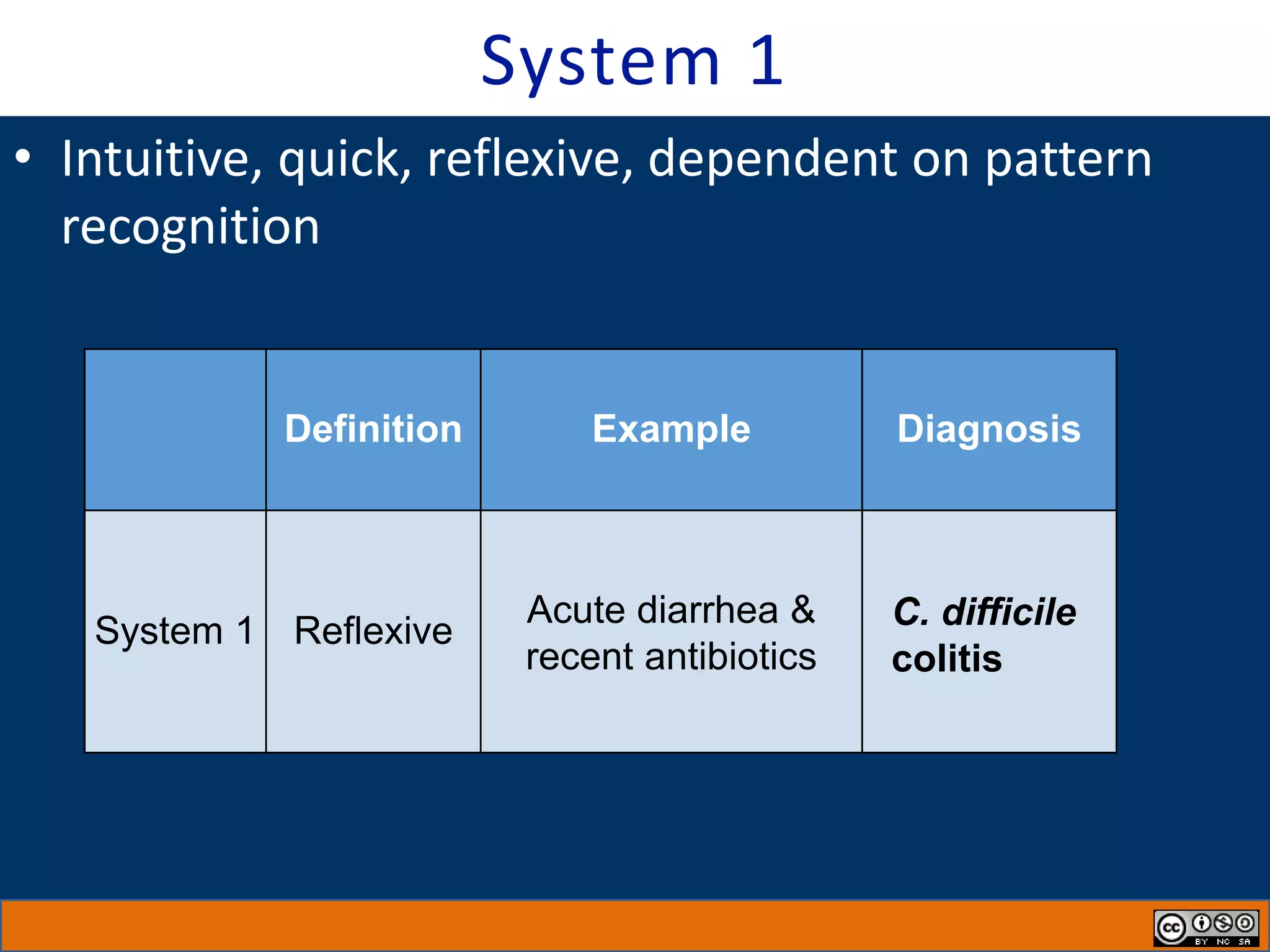
System 1
• Intuitive, quick, reflexive, dependent on pattern
recognition
Definition Example Diagnosis
System 1 Reflexive
Acute diarrhea &
recent antibiotics
C. difficile
colitis
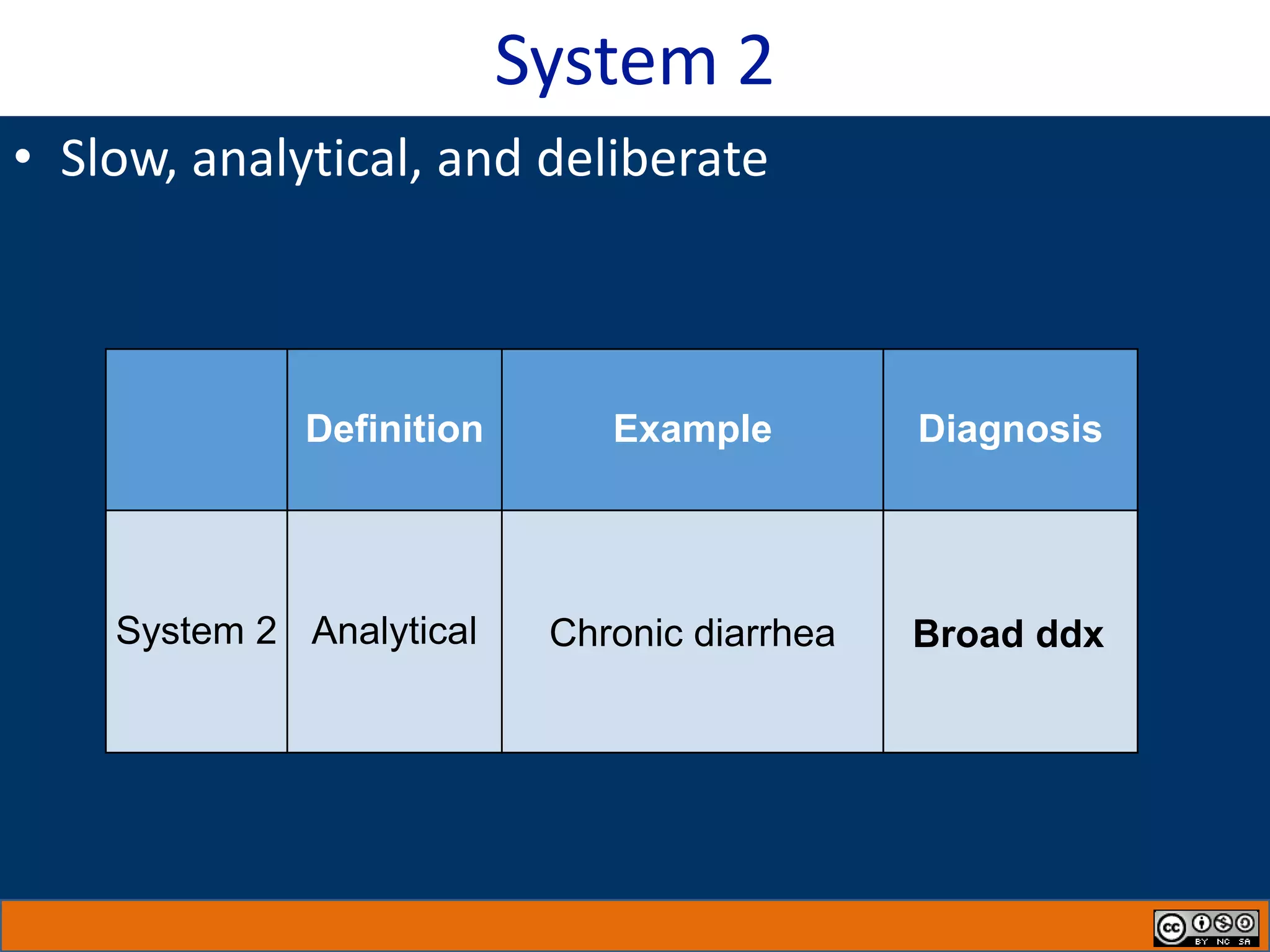
System 2
• Slow, analytical, and deliberate
Definition Example Diagnosis
System 2 Analytical Chronic diarrhea Broad ddx
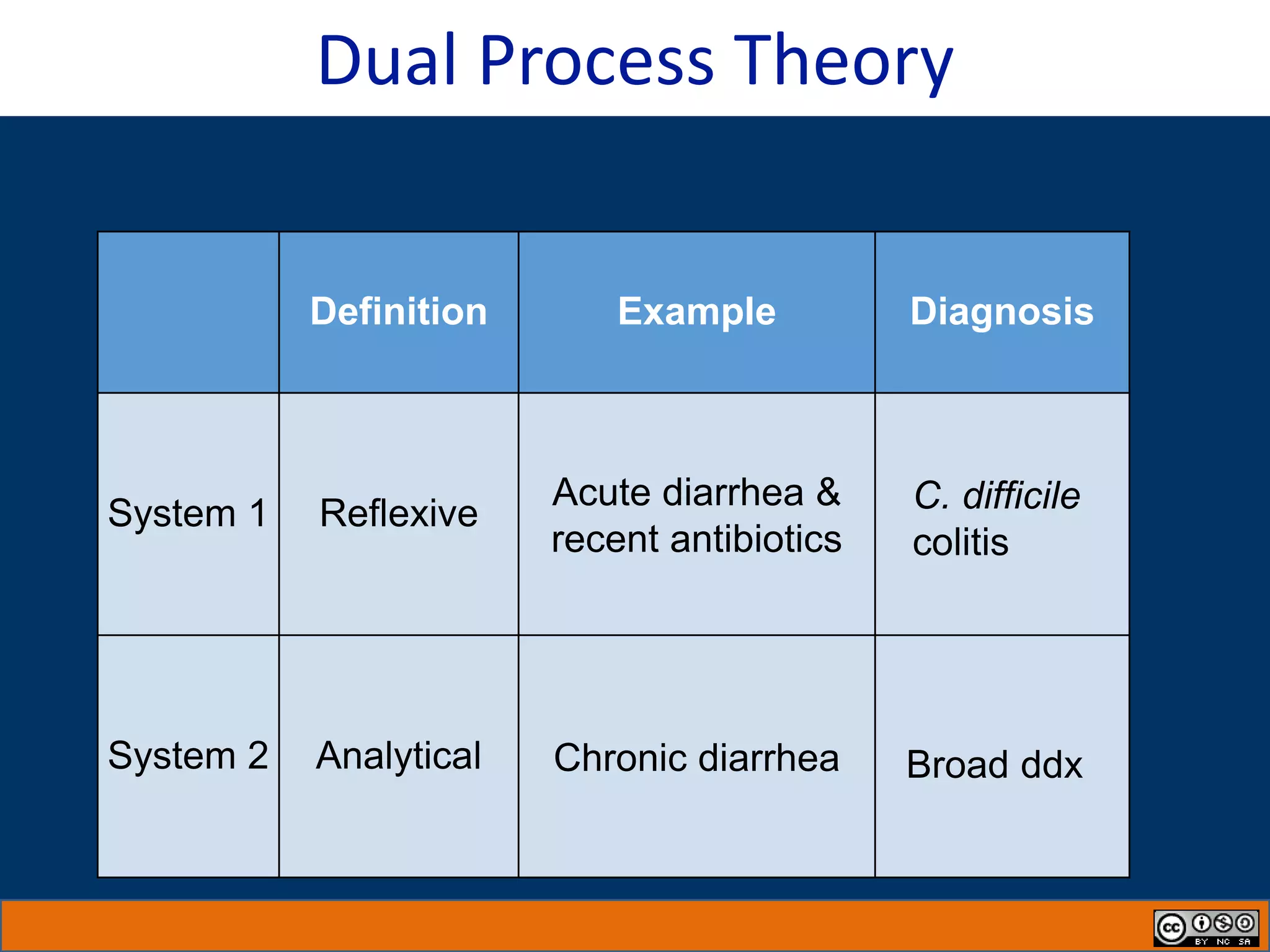
Dual Process Theory
Definition Example Diagnosis
System 1 Reflexive
Acute diarrhea &
recent antibiotics
System 2 Analytical Chronic diarrhea
C. difficile
colitis
Broad ddx
HPI
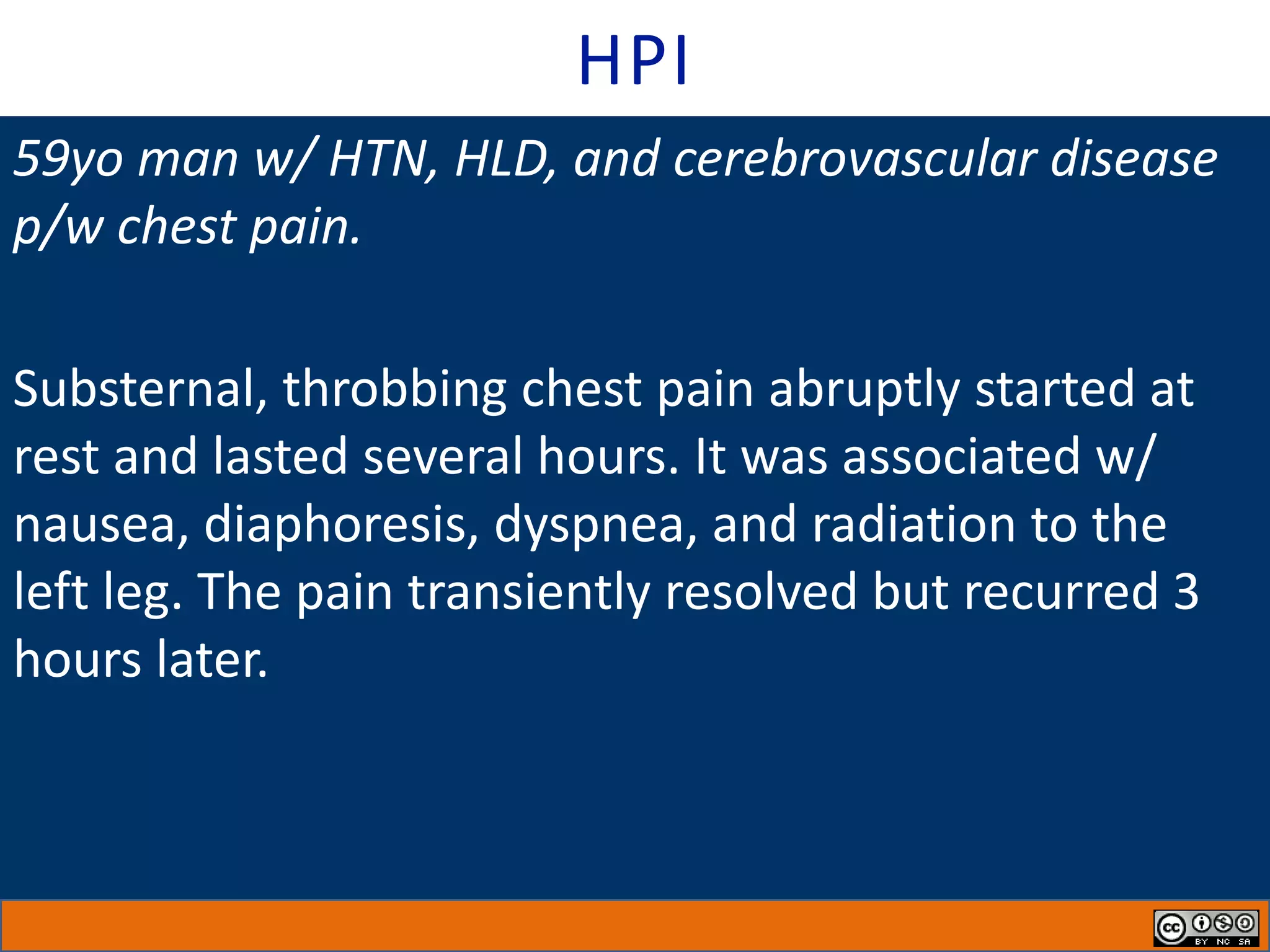
59yo man w/ HTN, HLD, and cerebrovascular disease
p/w chest pain.
Substernal, throbbing chest pain abruptly started at
rest and lasted several hours. It was associated w/
nausea, diaphoresis, dyspnea, and radiation to the
left leg. The pain transiently resolved but recurred 3
hours later.
Pause
• What is your problem representation or ‘one-
liner’?
• What is your differential diagnosis?
Physical exam
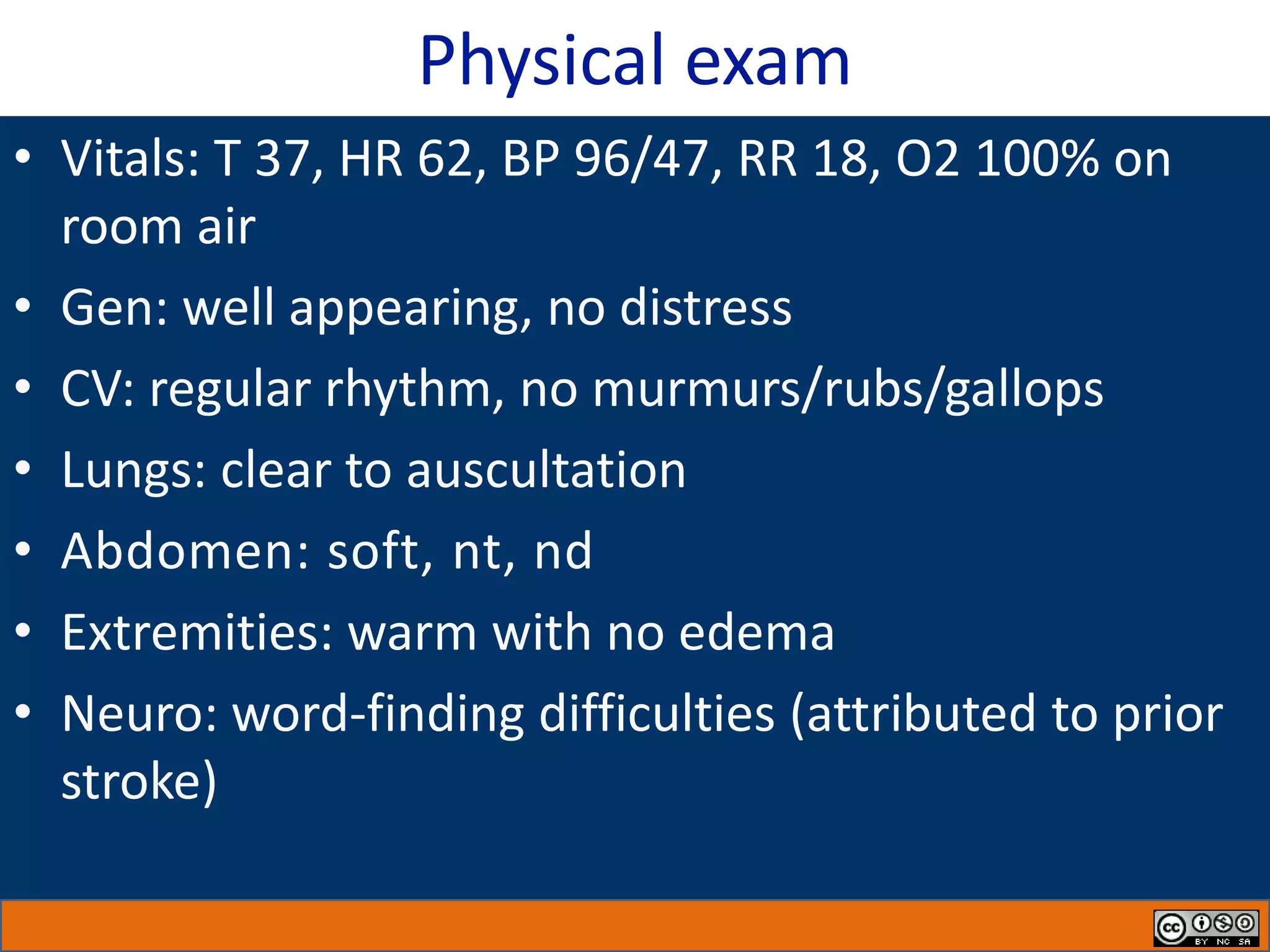
• Vitals: T 37, HR 62, BP 96/47, RR 18, O2 100% on
room air
• Gen: well appearing, no distress
• CV: regular rhythm, no murmurs/rubs/gallops
• Lungs: clear to auscultation
• Abdomen: soft, nt, nd
• Extremities: warm with no edema
• Neuro: word-finding difficulties (attributed to prior
stroke)
Data
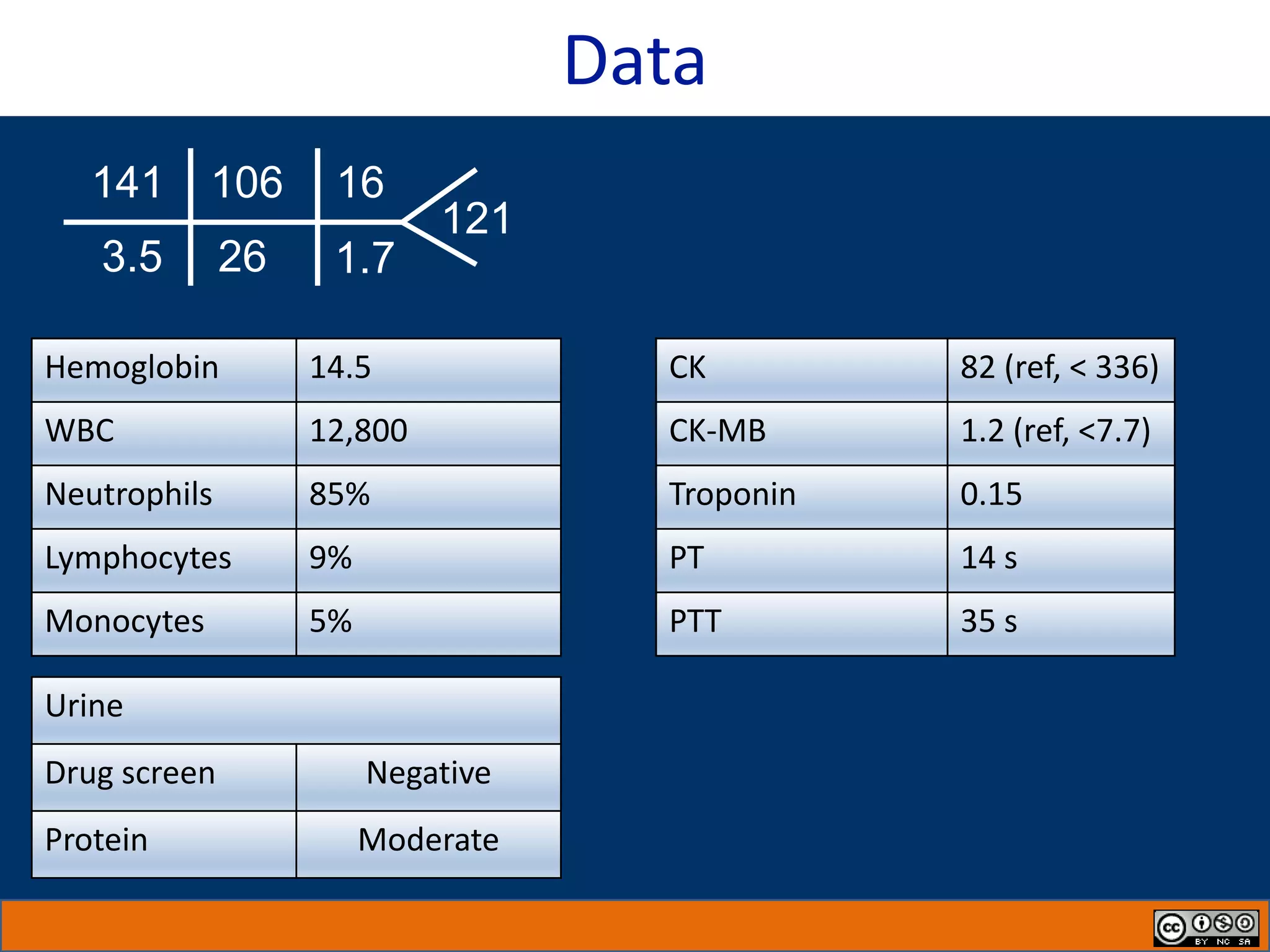
141
3.5
106
26
121
1.7
16
Hemoglobin 14.5
WBC 12,800
Neutrophils 85%
Lymphocytes 9%
Monocytes 5%
Urine
Drug screen Negative
Protein Moderate
CK 82 (ref, < 336)
CK-MB 1.2 (ref, <7.7)
Troponin 0.15
PT 14 s
PTT 35 s
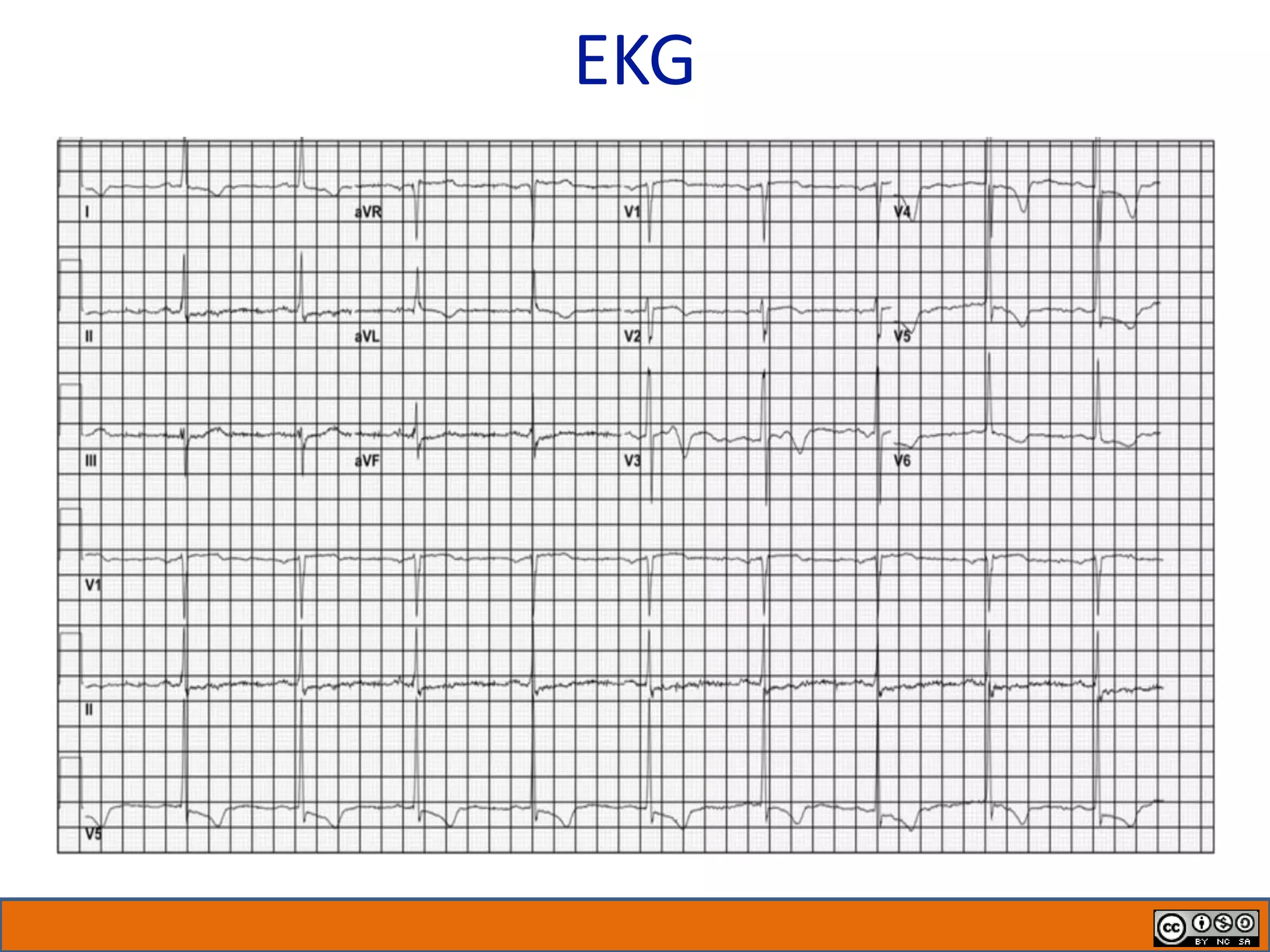
EKG
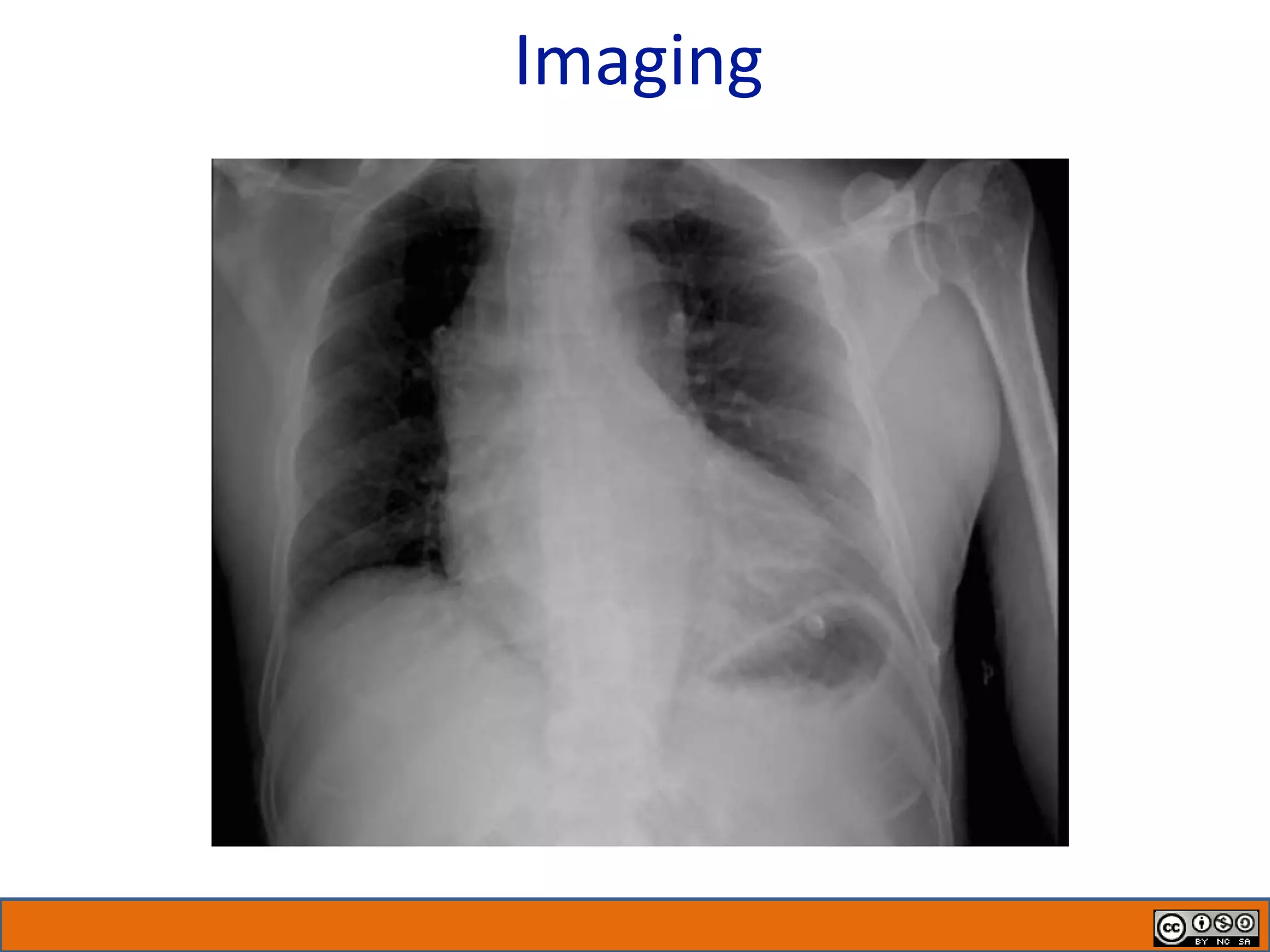
Imaging
Pause
• What data is consistent with your initial
diagnoses?
• What info is inconsistent with your initial
diagnoses?
Management
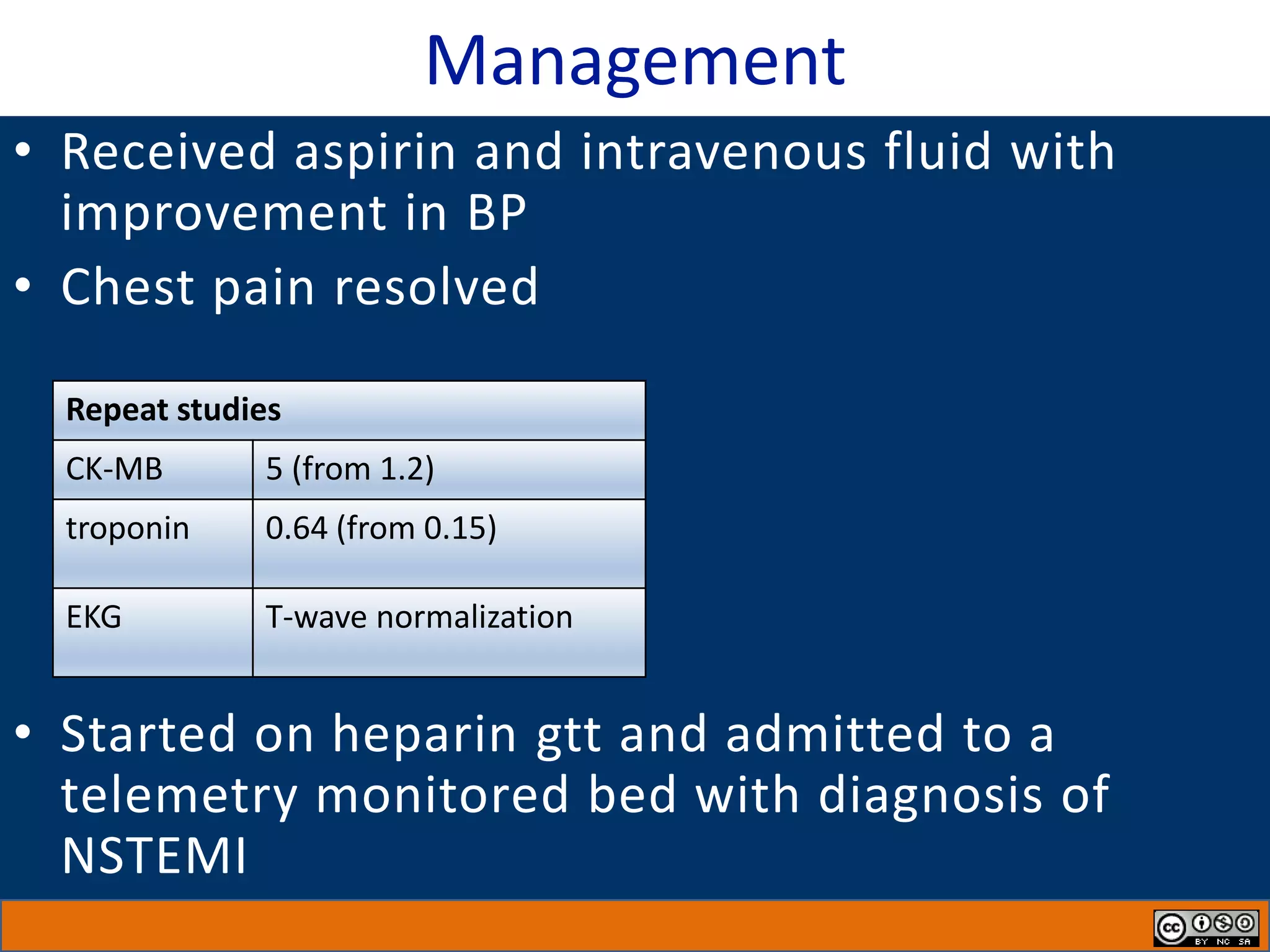
• Received aspirin and intravenous fluid with
improvement in BP
• Chest pain resolved
• Started on heparin gtt and admitted to a
telemetry monitored bed with diagnosis of
NSTEMI
Repeat studies
CK-MB 5 (from 1.2)
troponin 0.64 (from 0.15)
EKG T-wave normalization
Case continued
• Chest pain recurred upon arrival to floor
• BP 172/86
• Lungs clear to auscultation
• New 3/6 systolic murmur RUSB and LLSB and 2/6
diastolic murmur LLSB
• Subtle left-sided facial weakness, 4/5 strength LUE
and LLE
• Expressive aphasia
• Troponin 1.73 ng/mL
Pause
• What is your updated differential diagnosis?
• Did you apply S1 or S2 to create your new
differential?
Patient was administered high-dose atorvastatin, low-
dose metoprolol, and started on a nitroglycerin gtt
Case continued
• Three hours later chest pain recurred
• BP in left arm 180/60 mmHg & 120/40 mmHg in
right arm
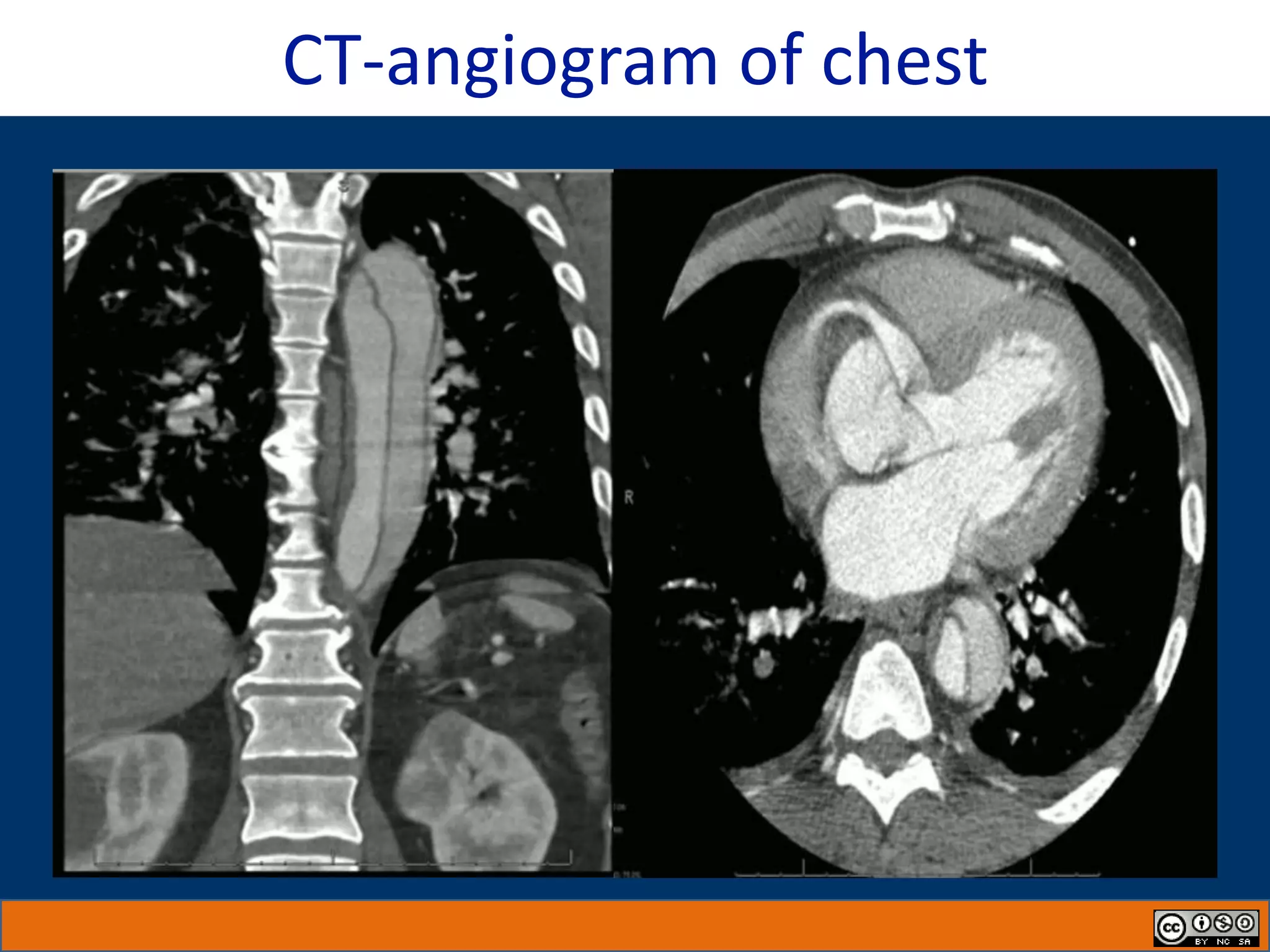
CT-angiogram of chest
Case Conclusion
• Patient underwent emergent surgical repair
• Discharged to inpatient rehabilitation
Dual Process Theory
• Define System 1 vs. 2
• When should we transition between the two?
What were clues in this case?
• Would an earlier transition have changed
management in this case?
Clinical Teaching Points
• 6 causes of life-threatening, acute chest pain
• Atypical features can lead to delays in diagnosis
of aortic dissection
• Asymmetric blood pressure in upper extremities
is highly suggestive, but only present in 10% of
cases (specific, not sensitive)
Acknowledgements
• Teaching slides are based on: Schleifer JW, Centor
RM, Heudebert GR, Estrada CA, Morris JL. NSTEMI
or Not: A 59-Year-Old Man with Chest Pain and
Troponin Elevation. J Gen Intern Med
2012;28(4):583-90.​
• This work by R Sedighi Manesh, J Kohlwes, DM
Connor is licensed under a Creative Commons
Attribution-NonCommercial-ShareAlike 4.0
International License
References
1. McCormic JS. Diagnosis: the need for
demystification. Lancet 1986;2:1434-5.
2. Elstein AS, Schwarz A. Clinical problem solving and
diagnostic decision making: selective review of the
cognitive literature. BMJ 2002;324:729-32.
3. Moulton CA, Regehr G, Mylopoulos M, MacRae
HM. Slowing down when you should: a new model
of expert judgment. Acad Med. 2007
Oct;82(10):S109-16.

Dual Process Theory Overview

  • 1.
    Dual Process Theory Teachingslides based on: Schleifer JW, Centor RM, Heudebert GR, Estrada CA, Morris JL. NSTEMI or Not: A 59-Year-Old Man with Chest Pain and Troponin Elevation J Gen Intern Med 2013; 28:583–90.
  • 2.
    System 1 • Intuitive,quick, reflexive, dependent on pattern recognition Definition Example Diagnosis System 1 Reflexive Acute diarrhea & recent antibiotics C. difficile colitis
  • 3.
    System 2 • Slow,analytical, and deliberate Definition Example Diagnosis System 2 Analytical Chronic diarrhea Broad ddx
  • 4.
    Dual Process Theory DefinitionExample Diagnosis System 1 Reflexive Acute diarrhea & recent antibiotics System 2 Analytical Chronic diarrhea C. difficile colitis Broad ddx
  • 5.
    HPI 59yo man w/HTN, HLD, and cerebrovascular disease p/w chest pain. Substernal, throbbing chest pain abruptly started at rest and lasted several hours. It was associated w/ nausea, diaphoresis, dyspnea, and radiation to the left leg. The pain transiently resolved but recurred 3 hours later.
  • 6.
    Pause • What isyour problem representation or ‘one- liner’? • What is your differential diagnosis?
  • 7.
    Physical exam • Vitals:T 37, HR 62, BP 96/47, RR 18, O2 100% on room air • Gen: well appearing, no distress • CV: regular rhythm, no murmurs/rubs/gallops • Lungs: clear to auscultation • Abdomen: soft, nt, nd • Extremities: warm with no edema • Neuro: word-finding difficulties (attributed to prior stroke)
  • 8.
    Data 141 3.5 106 26 121 1.7 16 Hemoglobin 14.5 WBC 12,800 Neutrophils85% Lymphocytes 9% Monocytes 5% Urine Drug screen Negative Protein Moderate CK 82 (ref, < 336) CK-MB 1.2 (ref, <7.7) Troponin 0.15 PT 14 s PTT 35 s
  • 9.
  • 10.
  • 11.
    Pause • What datais consistent with your initial diagnoses? • What info is inconsistent with your initial diagnoses?
  • 12.
    Management • Received aspirinand intravenous fluid with improvement in BP • Chest pain resolved • Started on heparin gtt and admitted to a telemetry monitored bed with diagnosis of NSTEMI Repeat studies CK-MB 5 (from 1.2) troponin 0.64 (from 0.15) EKG T-wave normalization
  • 13.
    Case continued • Chestpain recurred upon arrival to floor • BP 172/86 • Lungs clear to auscultation • New 3/6 systolic murmur RUSB and LLSB and 2/6 diastolic murmur LLSB • Subtle left-sided facial weakness, 4/5 strength LUE and LLE • Expressive aphasia • Troponin 1.73 ng/mL
  • 14.
    Pause • What isyour updated differential diagnosis? • Did you apply S1 or S2 to create your new differential? Patient was administered high-dose atorvastatin, low- dose metoprolol, and started on a nitroglycerin gtt
  • 15.
    Case continued • Threehours later chest pain recurred • BP in left arm 180/60 mmHg & 120/40 mmHg in right arm
  • 16.
  • 17.
    Case Conclusion • Patientunderwent emergent surgical repair • Discharged to inpatient rehabilitation
  • 18.
    Dual Process Theory •Define System 1 vs. 2 • When should we transition between the two? What were clues in this case? • Would an earlier transition have changed management in this case?
  • 19.
    Clinical Teaching Points •6 causes of life-threatening, acute chest pain • Atypical features can lead to delays in diagnosis of aortic dissection • Asymmetric blood pressure in upper extremities is highly suggestive, but only present in 10% of cases (specific, not sensitive)
  • 20.
    Acknowledgements • Teaching slidesare based on: Schleifer JW, Centor RM, Heudebert GR, Estrada CA, Morris JL. NSTEMI or Not: A 59-Year-Old Man with Chest Pain and Troponin Elevation. J Gen Intern Med 2012;28(4):583-90.​ • This work by R Sedighi Manesh, J Kohlwes, DM Connor is licensed under a Creative Commons Attribution-NonCommercial-ShareAlike 4.0 International License
  • 21.
    References 1. McCormic JS.Diagnosis: the need for demystification. Lancet 1986;2:1434-5. 2. Elstein AS, Schwarz A. Clinical problem solving and diagnostic decision making: selective review of the cognitive literature. BMJ 2002;324:729-32. 3. Moulton CA, Regehr G, Mylopoulos M, MacRae HM. Slowing down when you should: a new model of expert judgment. Acad Med. 2007 Oct;82(10):S109-16.

Editor's Notes

  • #3 Teacher’s Guide: S1 (Ref 1) Define: intuitive, quick, reflexive, dependent on pattern recognition Example: A patient recently treated with antibiotics who presents with diarrhea, abdominal pain, and leukocytosis likely has … (then click) … C. difficile colitis Invite trainees to share examples
  • #4 Teacher’s Guide: S2 (Ref 2) Define: slow, analytical, and deliberate Discuss example: A patient with no clear risk factors presents with chronic diarrhea, abdominal pain, and leukocytosis – the differential includes infection (i.e. community acquired C. diff), a noninfectious inflammatory cause (i.e. IBD), malignancy (i.e. GI tract lymphoma), malabsorption (i.e. pancreatic insufficiency) Invite trainees to share examples
  • #5 Teacher’s Guide: Clinicians alternate between System 1 and System 2 thinking—known as dual process theory of cognition Discuss when a clinician might transition from S1 to S2 reasoning (Ref 3): For example, an obese middle-aged woman presents with colicky RUQ pain; initially this presentation activates pattern recognition and consideration of acute cholecystitis, however, ultrasound rules out this diagnosis. The clinician should step back (transition to S2) and consider other diagnoses.
  • #7 Teacher’s guide: Request trainees describe whether their initial differential involved using S1 and/or S2 reasoning S1 reasoning for someone with chest pain includes ACS, PE, and aortic dissection The radiation to the left leg might cause the students to pause and activate S2 reasoning. (Only make explicit if students actually comment) Ask a trainee what they would focus on during the physical exam. This question forces the trainee to consider how a focused physical exam might impact the differential being considered.
  • #8 Teacher’s guide: Have trainee interpret physical exam and discuss next steps in management Ask: “What labs and imaging would you order, and why?” Keep forcing the trainees to think aloud.
  • #9 Teacher’s guide: Invite a trainee to interpret laboratory data and describe whether/how this review impacts his or her initial differential diagnosis
  • #10 Teacher’s guide: Invite a trainee to interpret the EKG Key Electrocardiogram on presentation to the emergency department. Note sinus rhythm, rate of 57 per minute, PR interval of 160 ms, QRS duration of 78 ms, and symmetric T wave inversions in leads V3 through V6 with evidence of left ventricular hypertrophy
  • #11 Teacher’s guide: Invite a trainee to interpret the CXR Describe the non-con head CT results (demonstrated old lacunar infarcts in the bilateral basal ganglia) Key: Chest radiograph in the emergency department (portable) revealed clear lung fields, possible cardiomegaly, a tortuous aorta, and possible widened mediastinum.
  • #12 Teacher’s guide: Explore how data that is inconsistent with initial diagnosis (often activated using pattern recognition) can be a trigger to slow down and utilize analytic/System 2 thinking After above questions, ask a trainee discuss his/her next steps in management (both diagnostically and therapeutically) and which unit they would admit the patient to
  • #15 Teacher’s guide: After discussion of questions above, ask a trainee to discuss his/her next steps Consider asking trainees to reflect on how they feel about this management decision (treatment team may be too tied to their initial diagnosis, may not have recognized clues that the patient’s presentation did not fit with this diagnosis)
  • #17 Key: Coronal image from the computed tomography angiogram of the chest, demonstrating a Sanford type A aortic dissection extending down the length of the thoracic descending aorta. Transverse image from the computed tomography angiogram of the chest, demonstrating the involvement of the left main coronary artery and the aortic valve annulus. The dissection flap in the descending aorta is also seen.
  • #18 Teacher guide: - Pause for reflections from trainees after revealing this info
  • #19 Teacher Guide: Utilize the above questions to stimulate critical thinking and reflection from trainees, concepts to consider include: Noting a lack of fit between the presumed diagnosis and prominent symptoms or signs in the case (i.e. does the diagnosis explain all of the patient’s major clinical findings?) Being aware of when we have limited knowledge of a particular diagnosis (i.e. we haven’t had significant experience to know clinical variations that might appear) Might ask trainees to reflect on their own experience – have there been times when they were slow to make a needed switch between System 1 and 2? Like most models, the Dual Process Theory oversimplifies reality. In real-world practice, a clinician’s reasoning process is unlikely to fall exclusively into either category, but rather oscillates between the two, even within a single case
  • #20 Teacher’s guide: 6 causes of life threatening, acute chest pain: acute coronary syndrome, pulmonary embolus, aortic dissection, pneumothorax, esophageal rupture, and tamponade