
Syntheses and characterization of Ruthenium terpyridine
complex and TiO2 Nano particles for Dye Sensitized Solar
Cells.
KIIT University, Bhubaneswar-24.
Presented
By
Jagannath Panda
I Introduction
II Dye Sensitized Solar Cell (DSSC)
III Lesson from nature.
IV Syntheses of Ruthenium terpyridine complex .
V Syntheses TiO2 nano particles .
VI Result and discussion on Ru-terpyridine dye & TiO2 nano particles
VII How to fabricate DSSC
VIII Results & Conclusion
OUTLINES
Humanity’s Top Ten
Problems for next 50 years
1.ENERGY
2.WATER
3.FOOD
4.ENVIRONMENT
5.POVERTY
6.TERRORISM & WAR
7.DISEASE
8.EDUCATION
9.DEMOCRACY
10.POPULATION
1-INTRODUCTION
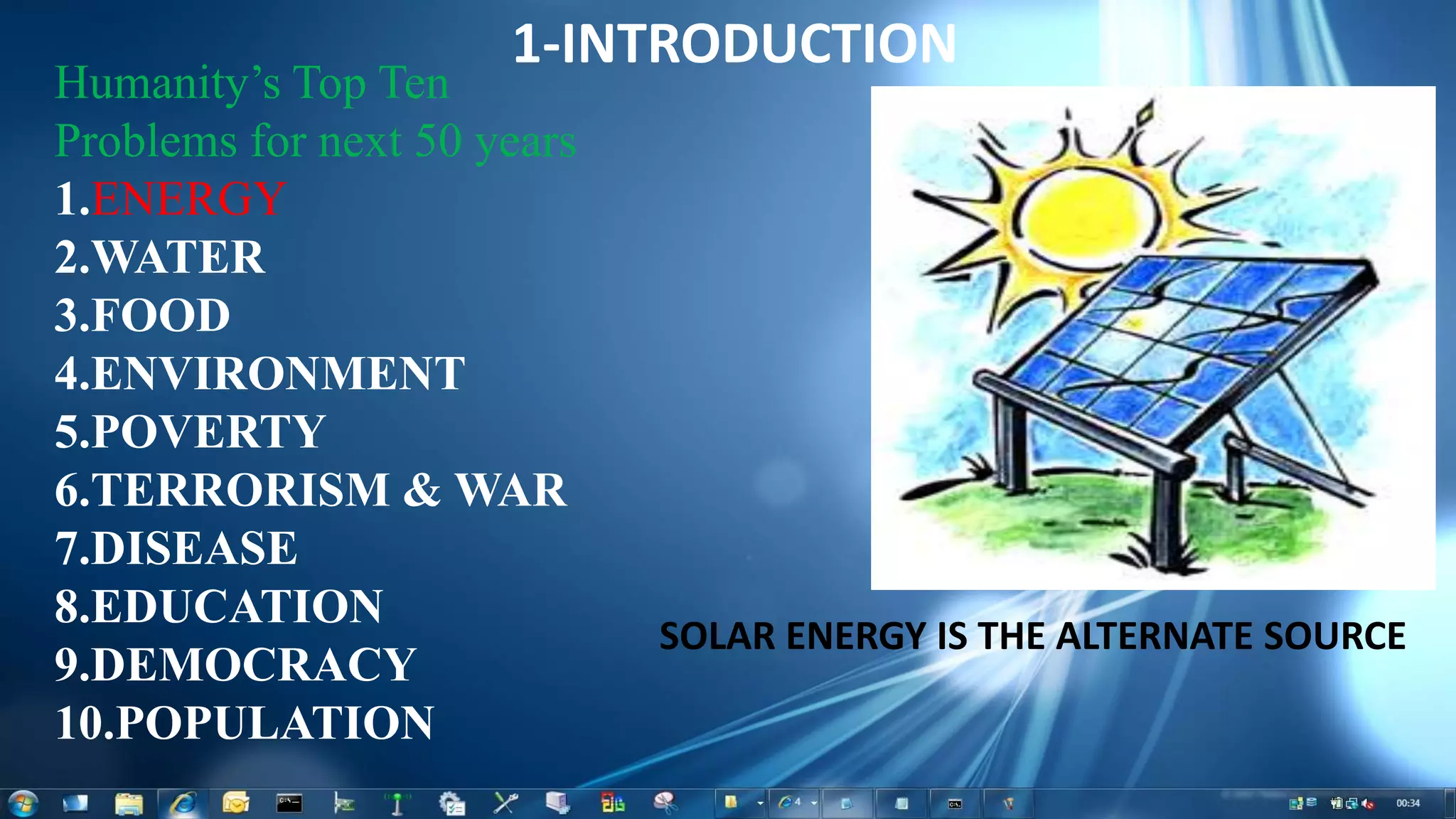
SOLAR ENERGY IS THE ALTERNATE SOURCE
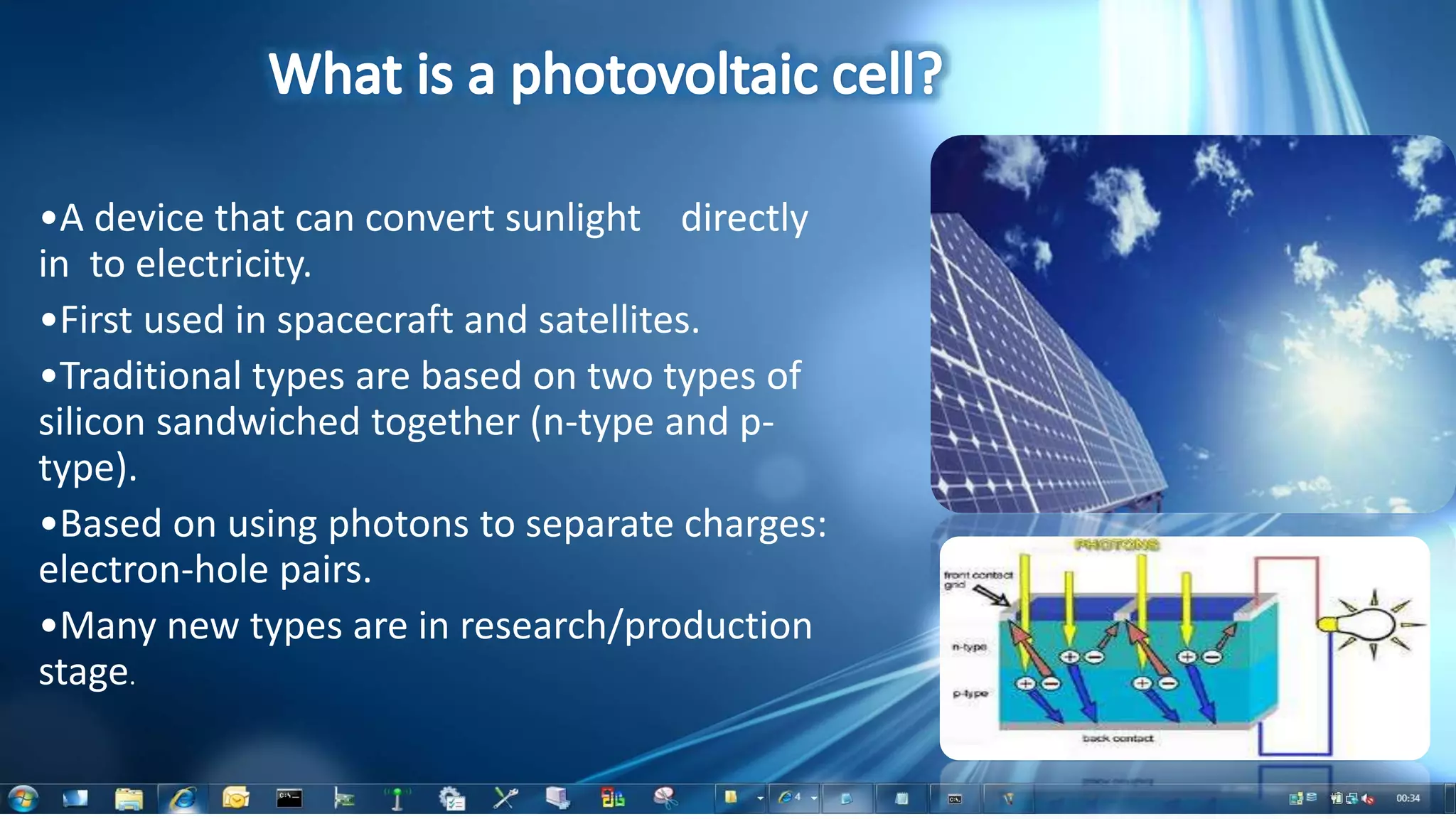
•A device that can convert sunlight directly
in to electricity.
•First used in spacecraft and satellites.
•Traditional types are based on two types of
silicon sandwiched together (n-type and p-
type).
•Based on using photons to separate charges:
electron-hole pairs.
•Many new types are in research/production
stage.
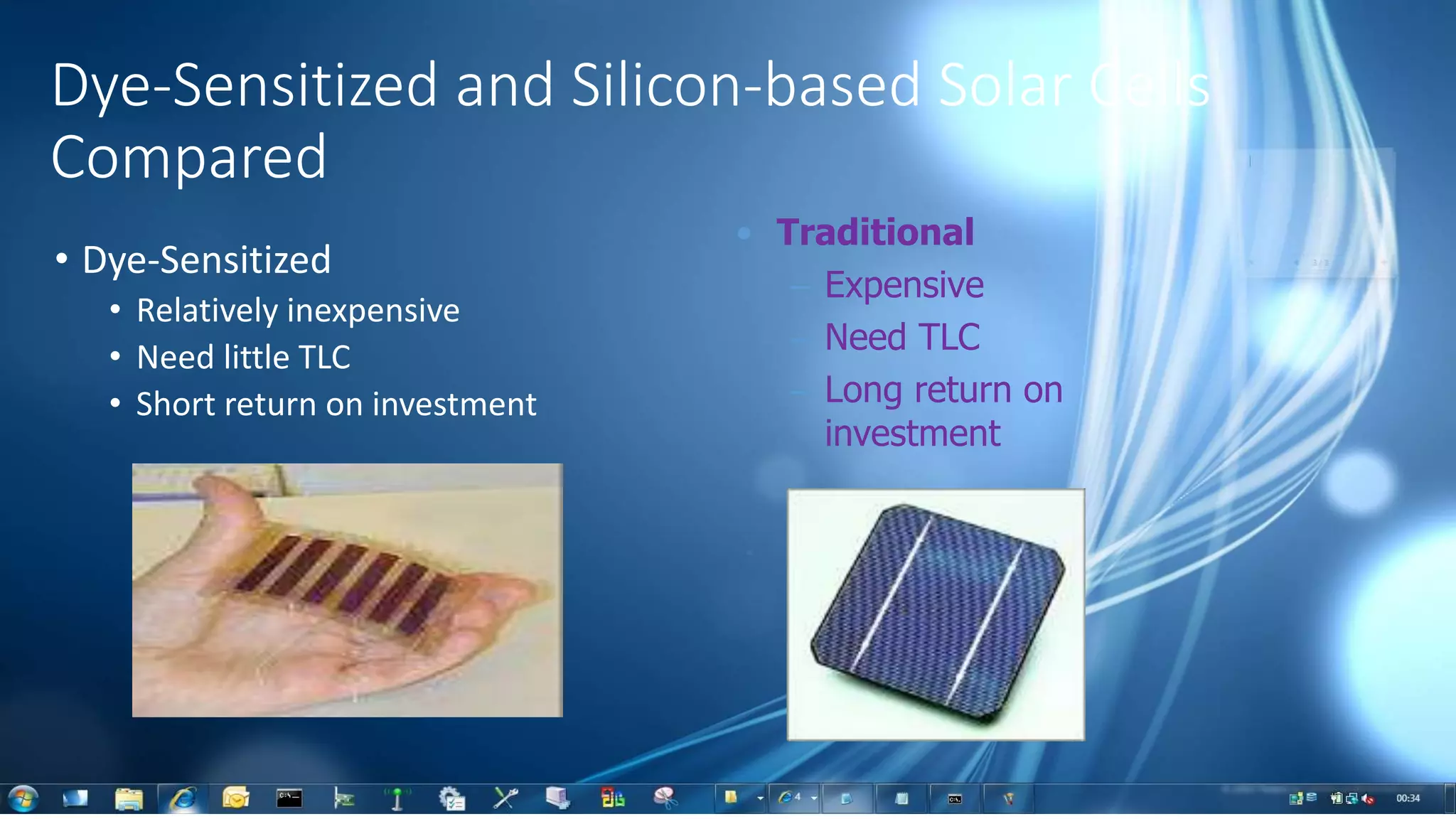
• Dye-Sensitized
• Relatively inexpensive
• Need little TLC
• Short return on investment
• Traditional
– Expensive
– Need TLC
– Long return on
investment
Dye-Sensitized and Silicon-based Solar Cells
Compared
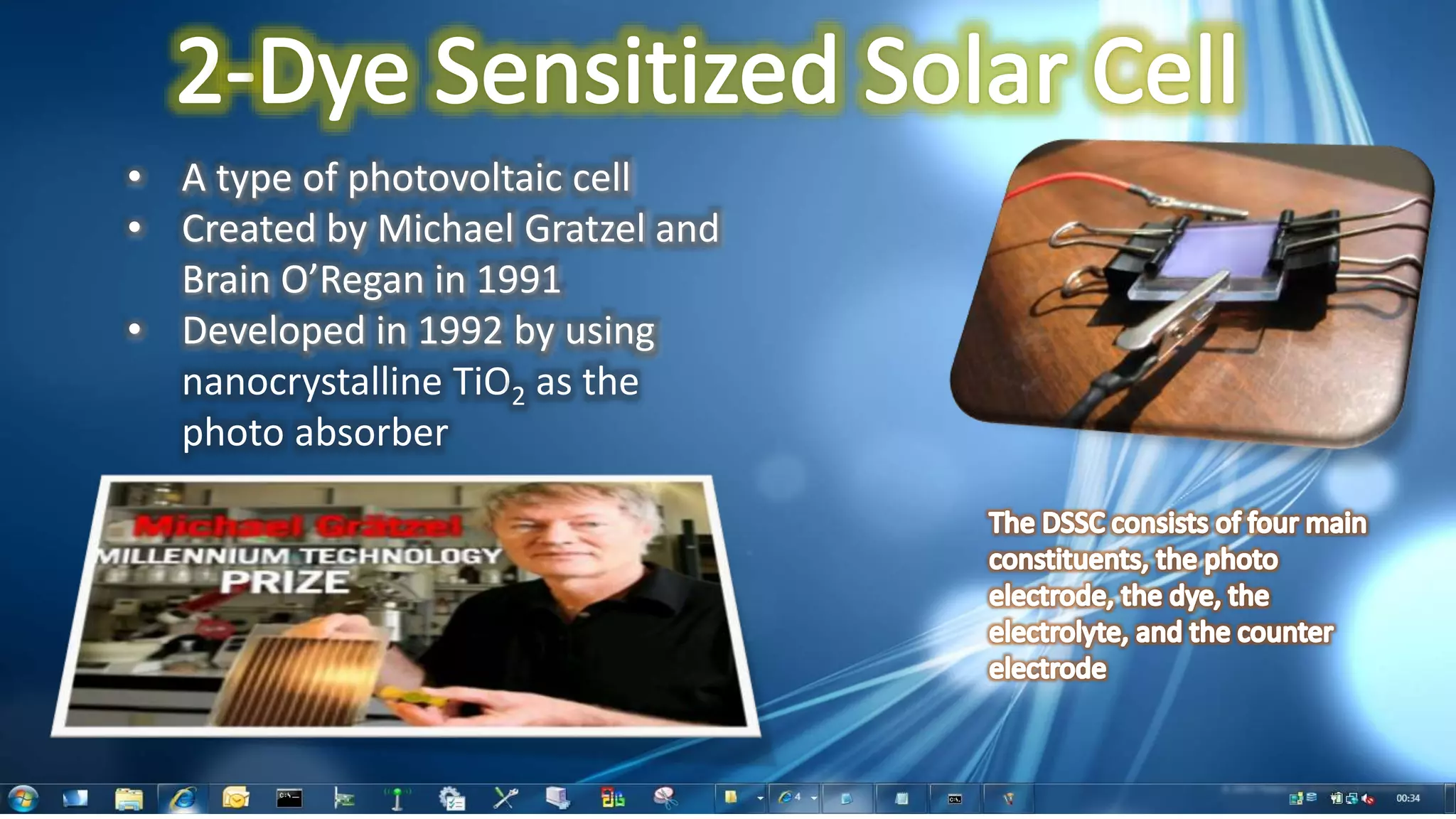
• A type of photovoltaic cell
• Created by Michael Gratzel and
Brain O’Regan in 1991
• Developed in 1992 by using
nanocrystalline TiO2 as the
photo absorber
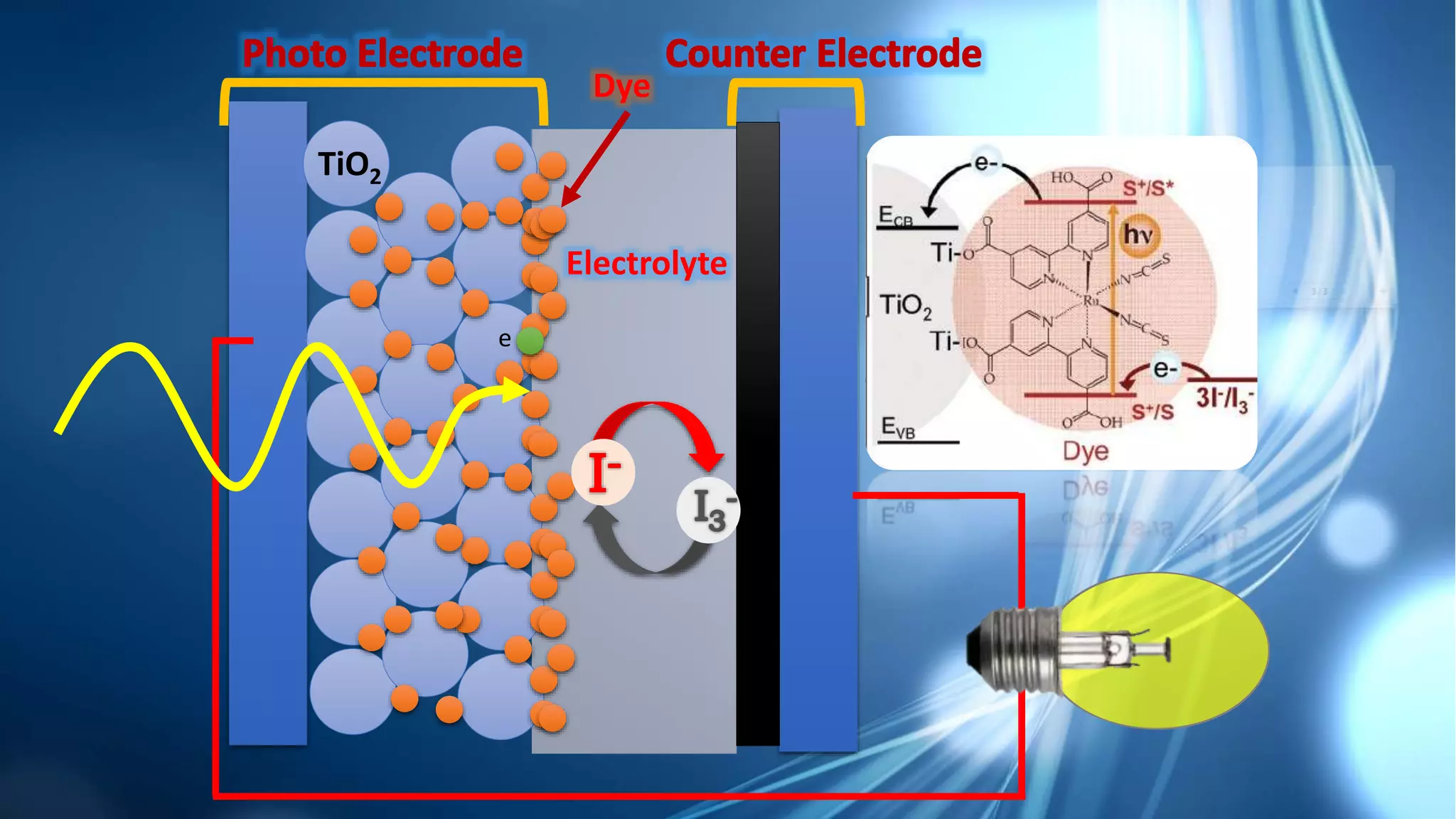
TiO2
e
Electrolyte
Dye
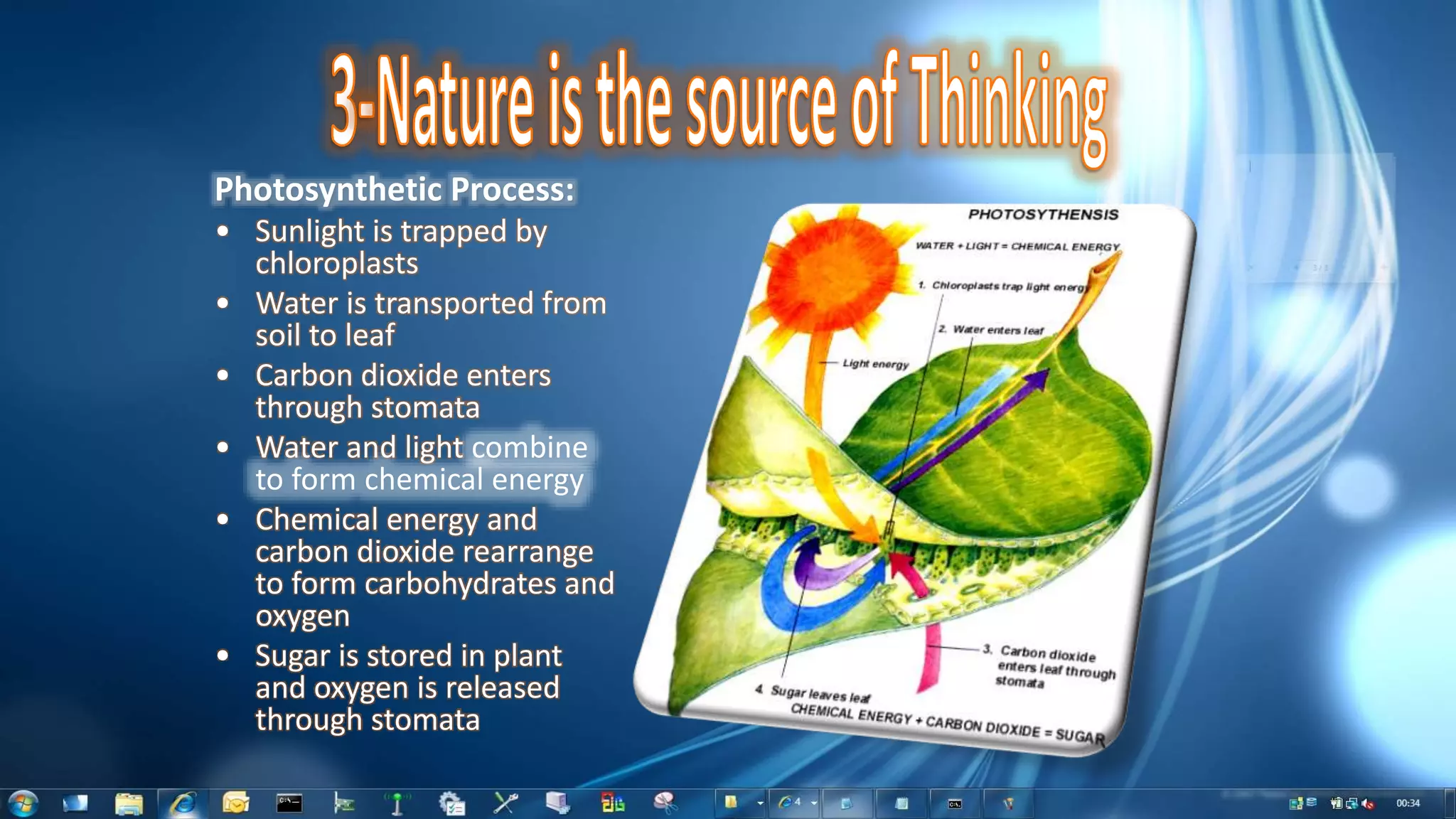
Photosynthetic Process:
• Sunlight is trapped by
chloroplasts
• Water is transported from
soil to leaf
• Carbon dioxide enters
through stomata
• Water and light combine
to form chemical energy
• Chemical energy and
carbon dioxide rearrange
to form carbohydrates and
oxygen
• Sugar is stored in plant
and oxygen is released
through stomata
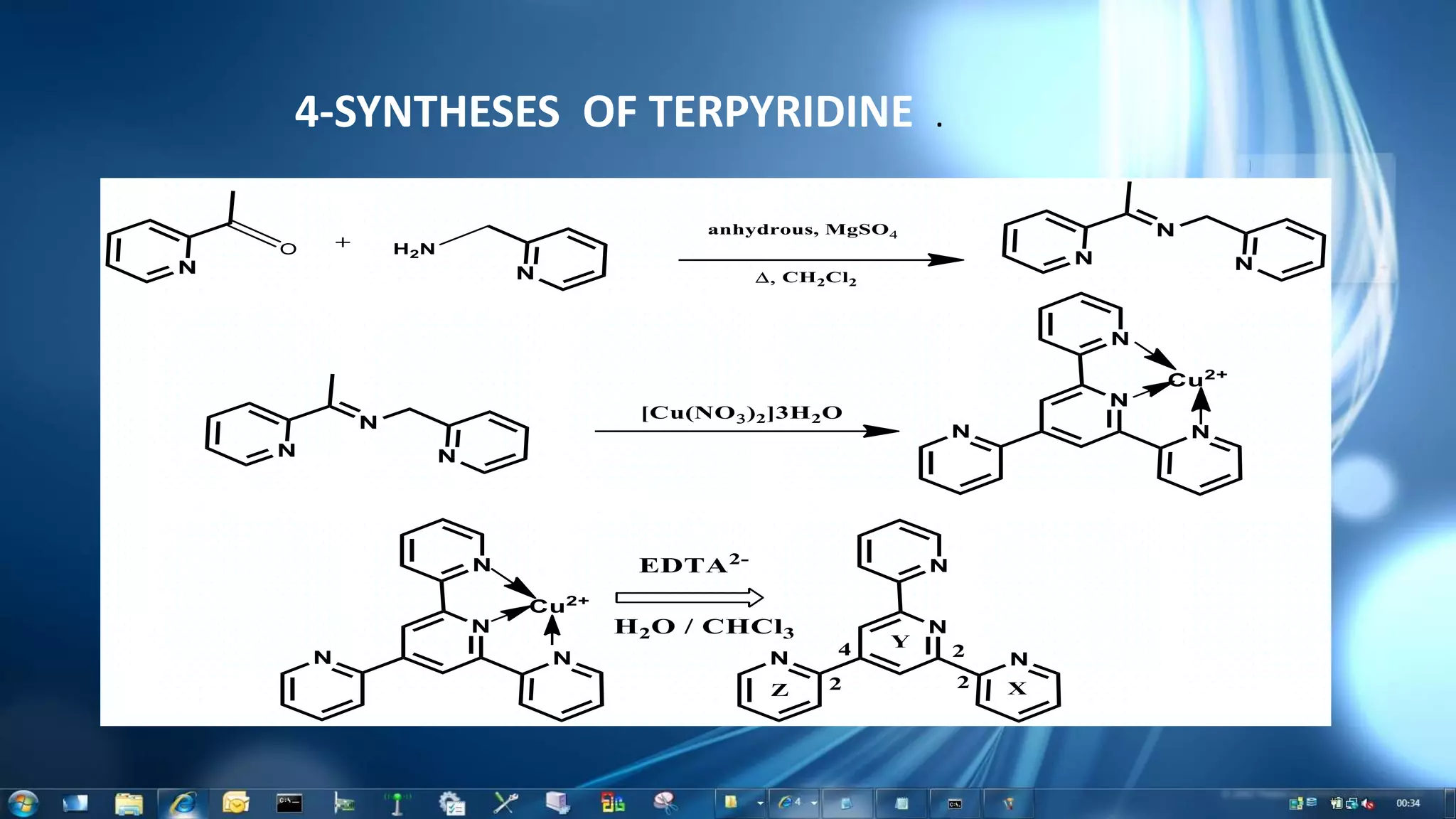
4-SYNTHESES OF TERPYRIDINE .
SYNTHESIS OF THE RU-TERPYRIDINE DYE
RuCl2(DMSO)4 (20 mg, 0.041 mmol) and Terpyridine (26
mg, 0.083 mmol) were heated at reflux in 95% ethanol (30
mL) for 30 min. The solvent was removed and the red-
solid was washed thoroughly with hot benzene. The solid
was dissolved in minimum amounts of acetonitrile and
the solution was left undisturbed. The dark-red crystals
obtained after a week were used for further studies.
5-SYNTHESES TiO2 NANO PARTICLES .
TiO2 Nanoparticles can be synthesized by
hydrothermal method. TiO2 macro particles
powder was mixed with 10M NaOH and
treated hydrothermally at 150°C in a autoclave
for 24 hour. Then the sample was washed by
0.1M HCl and make neutral. Then the sample
of white solid was dried at 80° C for 24 hour
and then drying the powder at 500°C in a hot
plate for 2 hour. The synthesized powder
sample were characterized.
6-RESULT AND DISCUSSION ON RU-TERPYRIDINE
DYE & TiO2 NANO PARTICLES
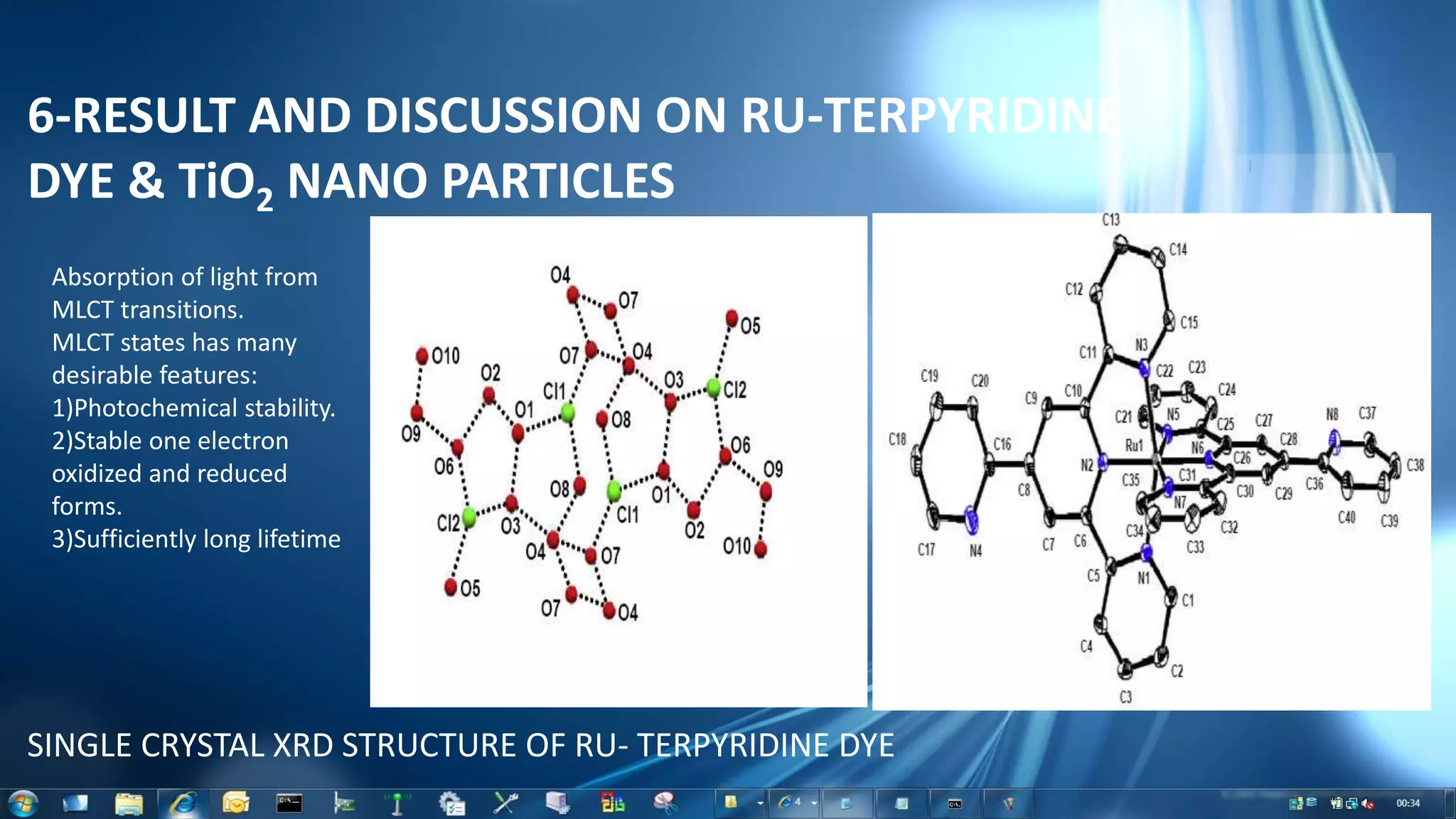
SINGLE CRYSTAL XRD STRUCTURE OF RU- TERPYRIDINE DYE
Absorption of light from
MLCT transitions.
MLCT states has many
desirable features:
1)Photochemical stability.
2)Stable one electron
oxidized and reduced
forms.
3)Sufficiently long lifetime
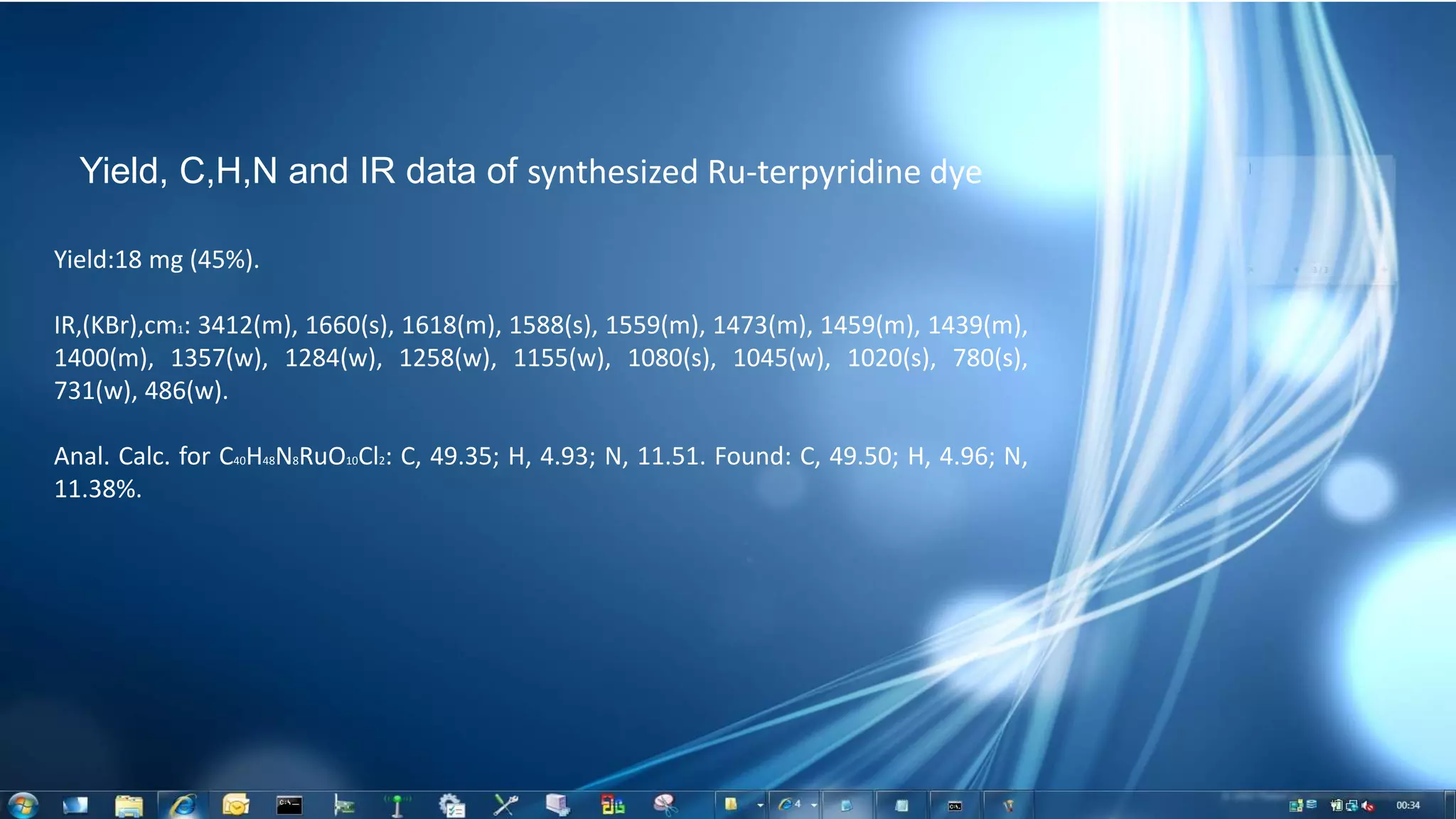
Yield, C,H,N and IR data of synthesized Ru-terpyridine dye
Yield:18 mg (45%).
IR,(KBr),cm1: 3412(m), 1660(s), 1618(m), 1588(s), 1559(m), 1473(m), 1459(m), 1439(m),
1400(m), 1357(w), 1284(w), 1258(w), 1155(w), 1080(s), 1045(w), 1020(s), 780(s),
731(w), 486(w).
Anal. Calc. for C40H48N8RuO10Cl2: C, 49.35; H, 4.93; N, 11.51. Found: C, 49.50; H, 4.96; N,
11.38%.
6-RESULT AND DISCUSSION ON RU-TERPYRIDINE
DYE & TiO2 NANO PARTICLES
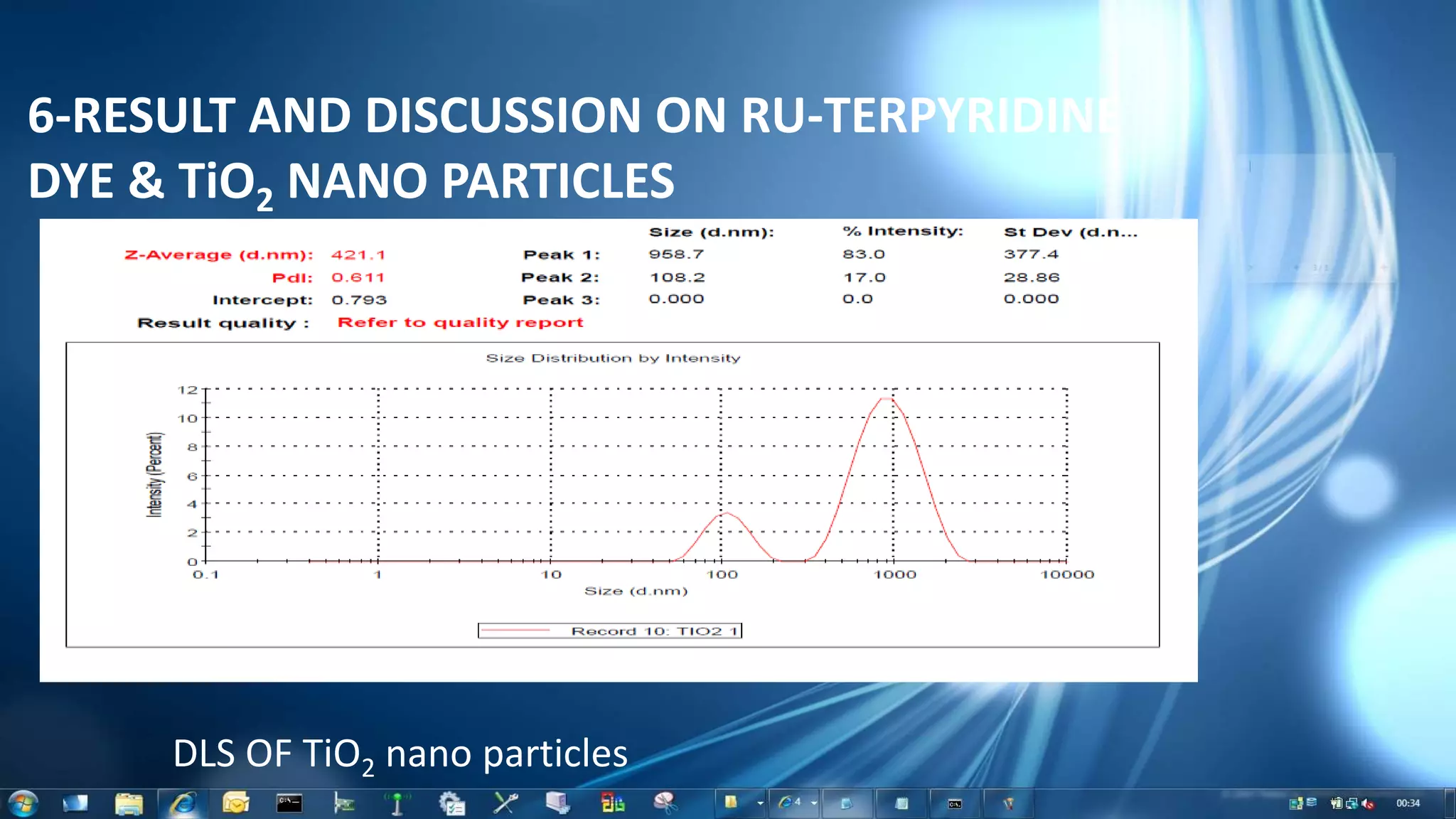
DLS OF TiO2 nano particles
6-RESULT AND DISCUSSION ON RU-TERPYRIDINE
DYE & TiO2 NANO PARTICLES
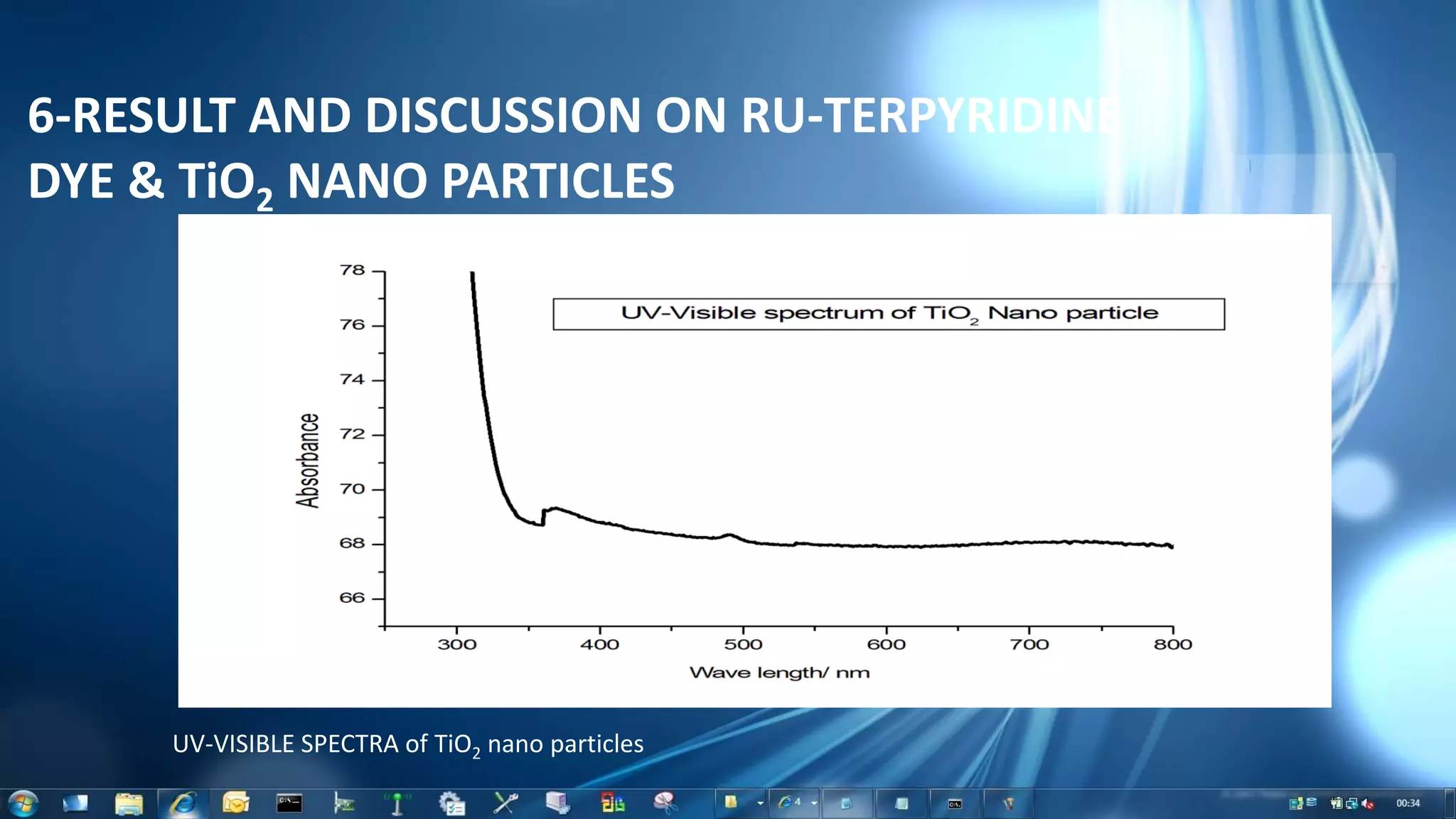
UV-VISIBLE SPECTRA of TiO2 nano particles
6-RESULT AND DISCUSSION ON RU-TERPYRIDINE
DYE & TiO2 NANO PARTICLES
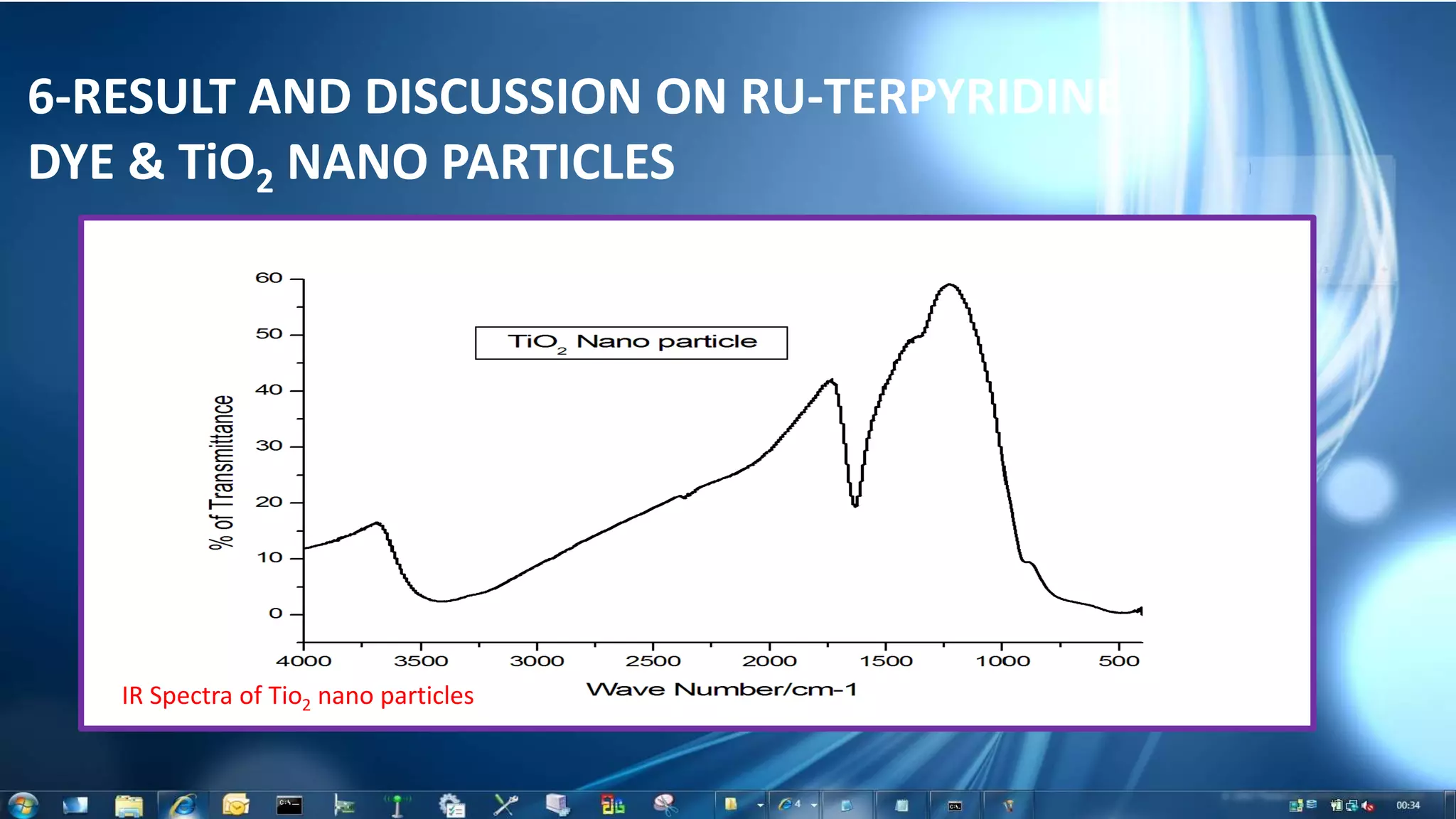
IR Spectra of Tio2 nano particles
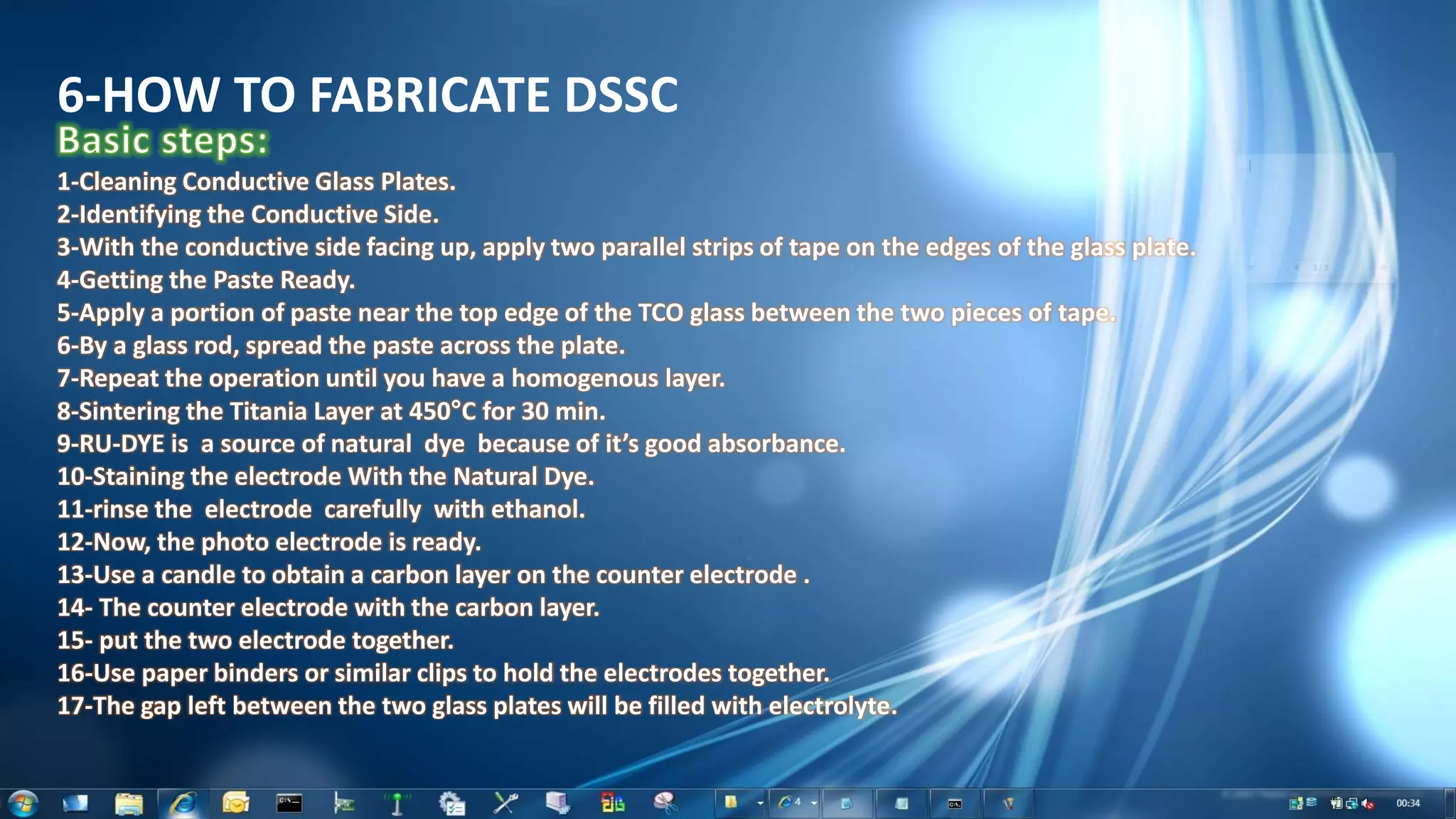
6-HOW TO FABRICATE DSSC
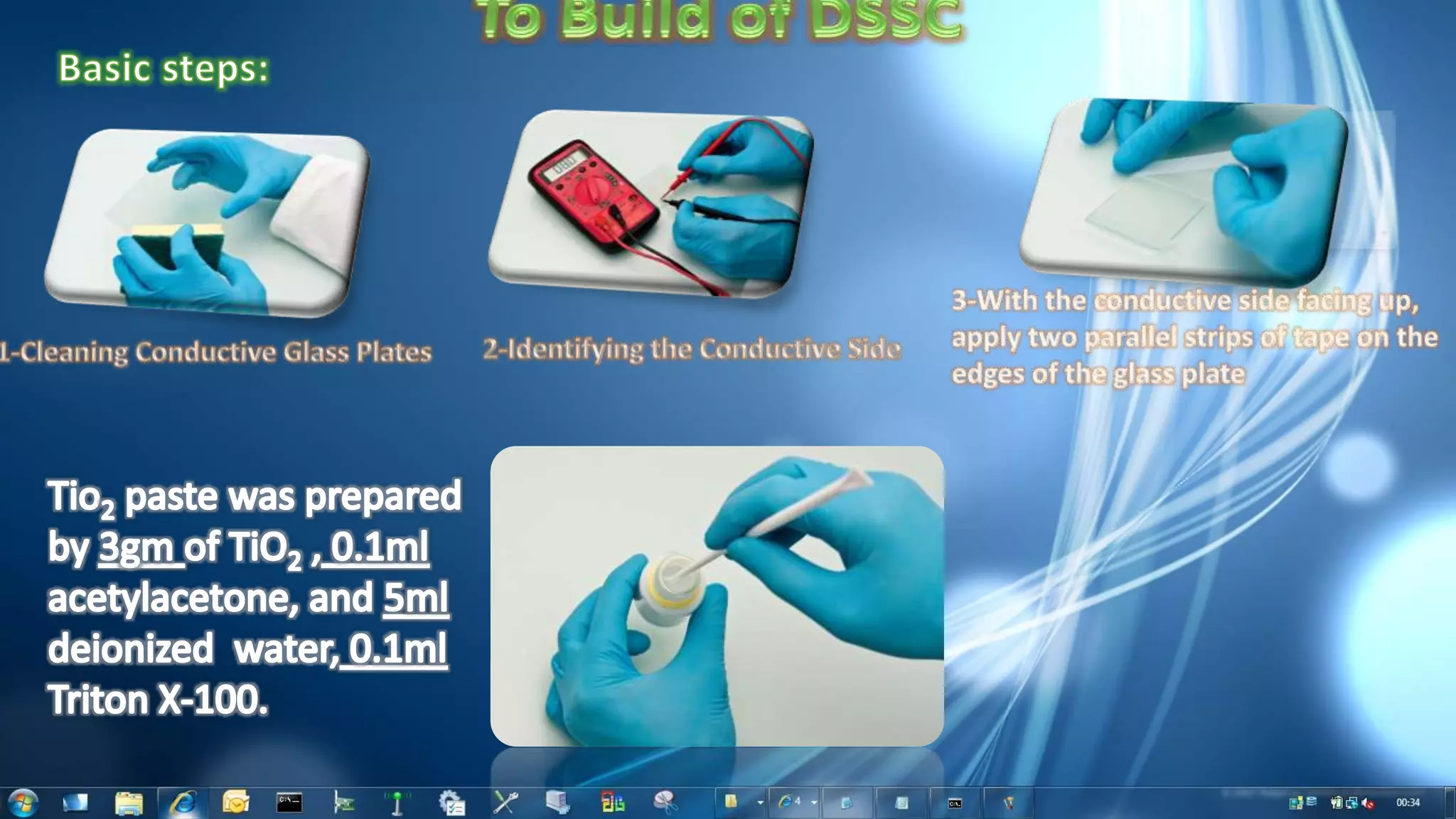
1-Cleaning Conductive Glass Plates.
2-Identifying the Conductive Side.
3-With the conductive side facing up, apply two parallel strips of tape on the edges of the glass plate.
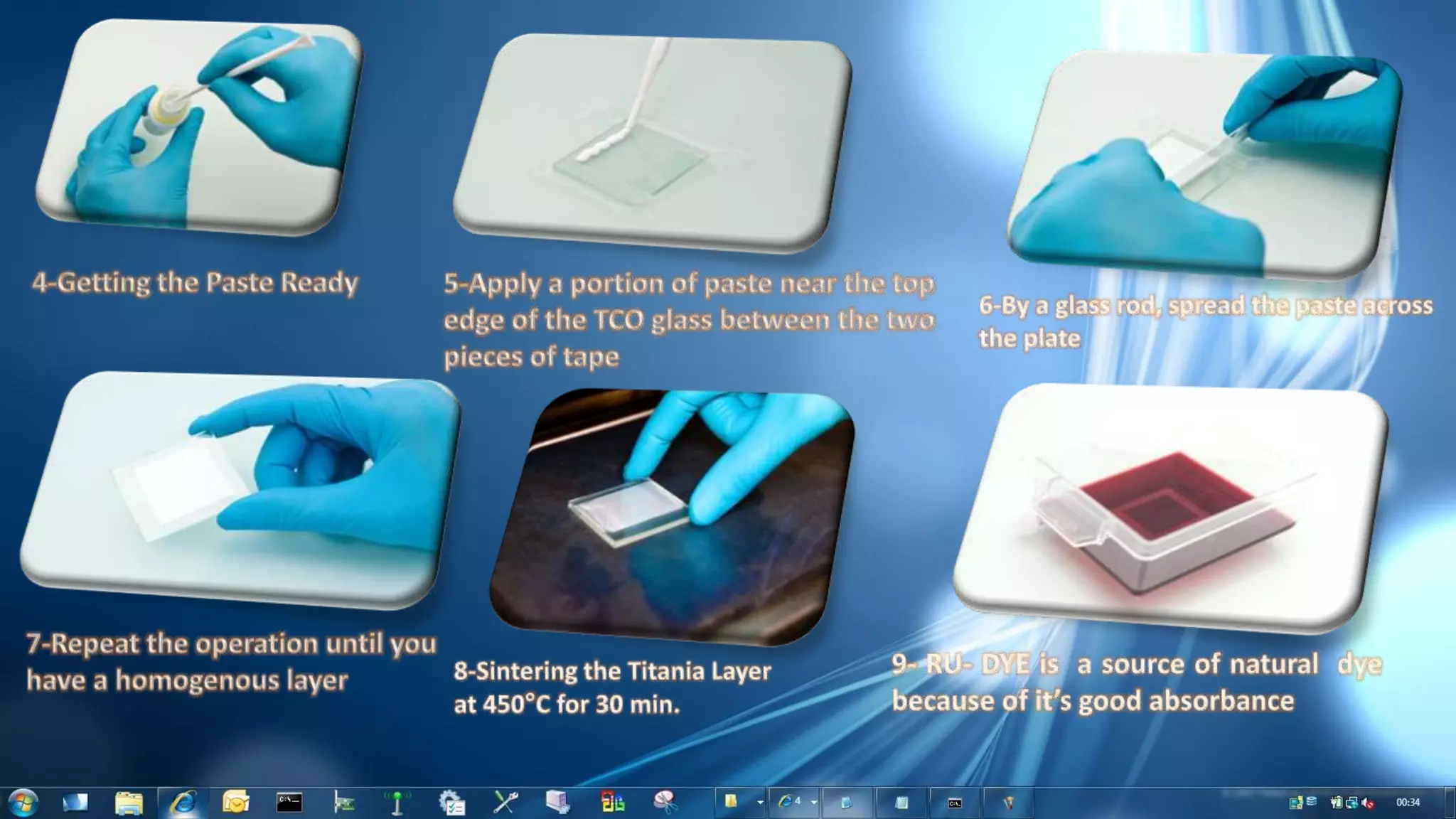
4-Getting the Paste Ready.
5-Apply a portion of paste near the top edge of the TCO glass between the two pieces of tape.
6-By a glass rod, spread the paste across the plate.
7-Repeat the operation until you have a homogenous layer.
8-Sintering the Titania Layer at 450°C for 30 min.
9-RU-DYE is a source of natural dye because of it’s good absorbance.
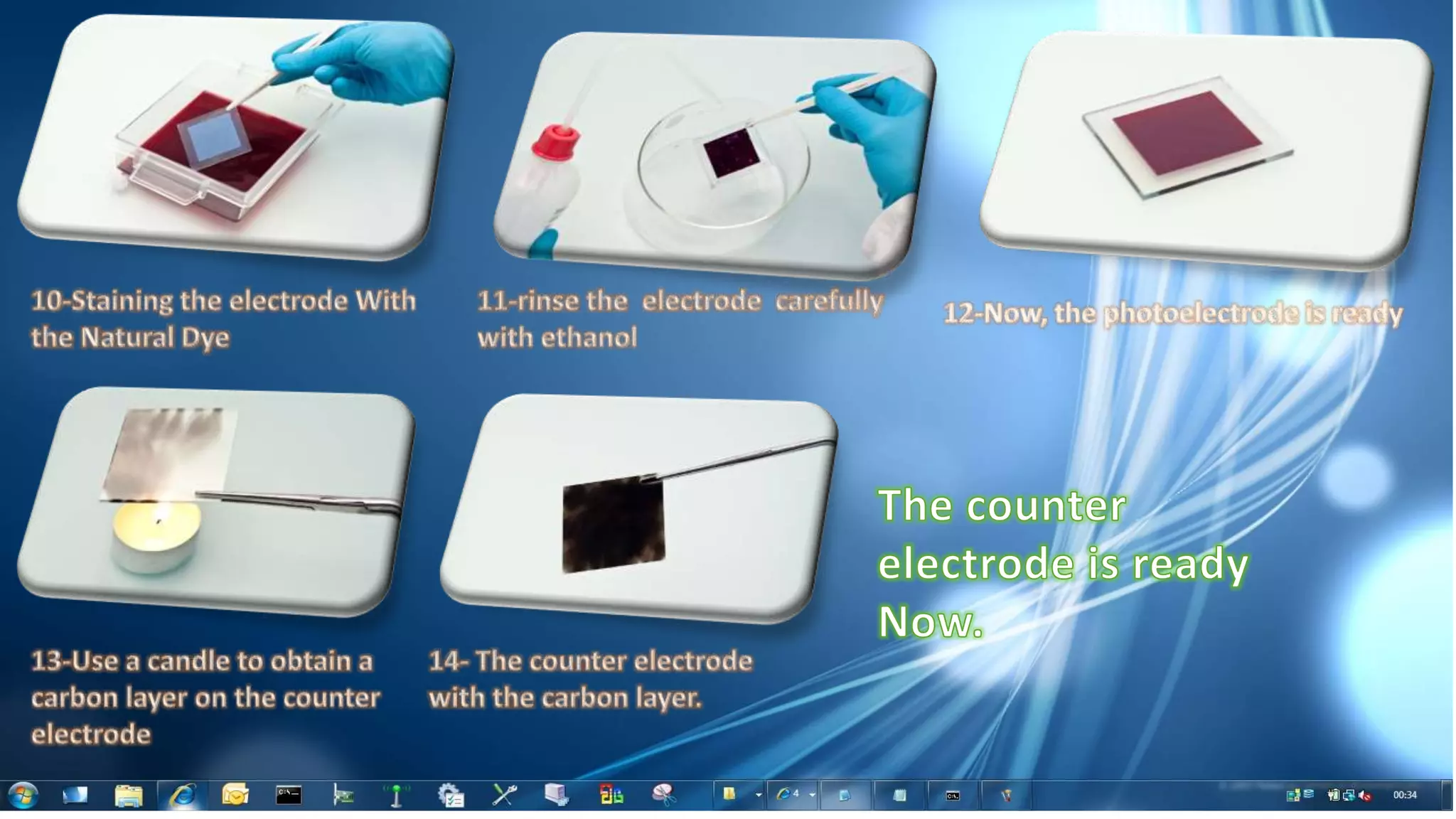
10-Staining the electrode With the Natural Dye.
11-rinse the electrode carefully with ethanol.
12-Now, the photo electrode is ready.
13-Use a candle to obtain a carbon layer on the counter electrode .
14- The counter electrode with the carbon layer.
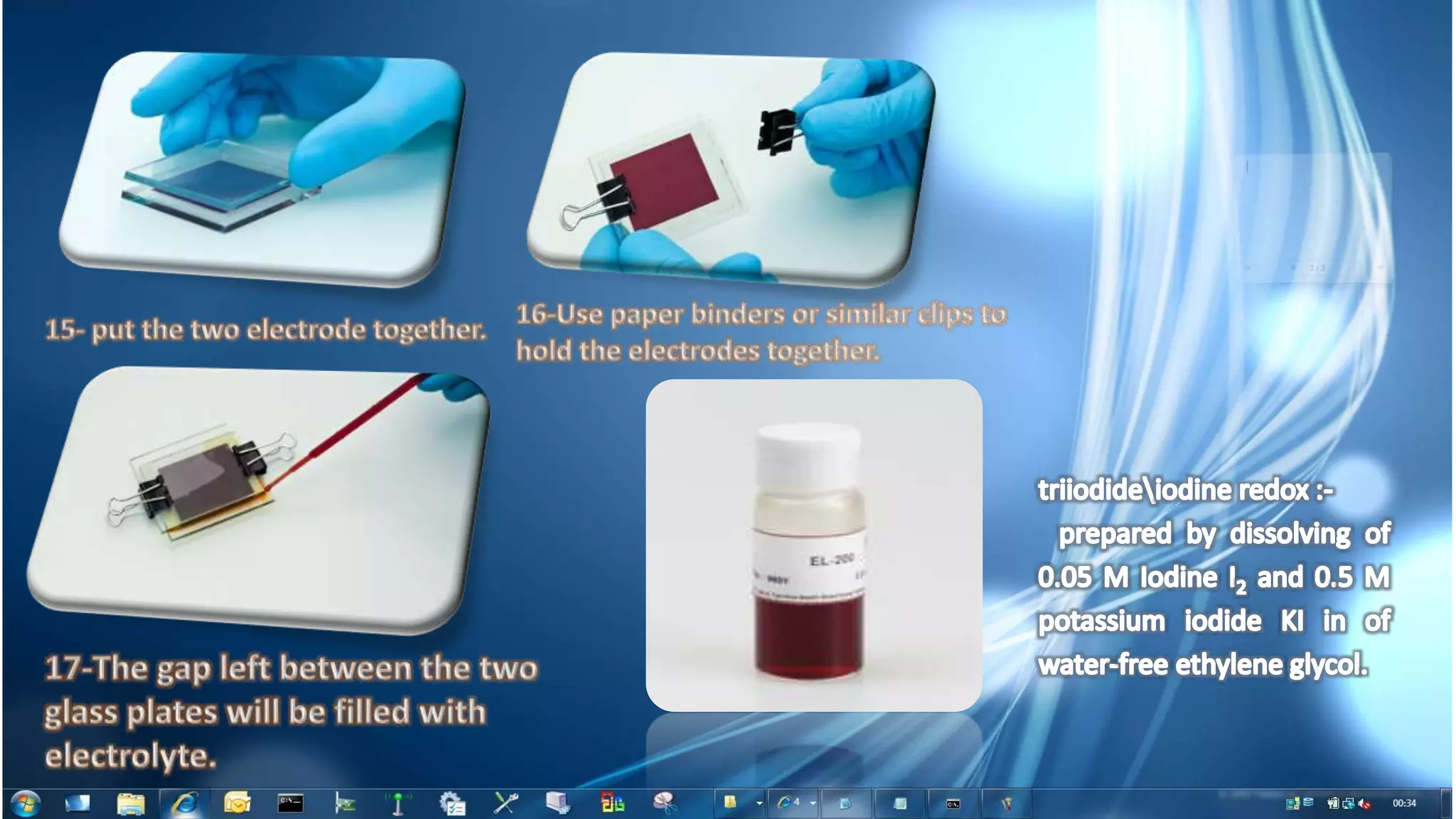
15- put the two electrode together.
16-Use paper binders or similar clips to hold the electrodes together.
17-The gap left between the two glass plates will be filled with electrolyte.
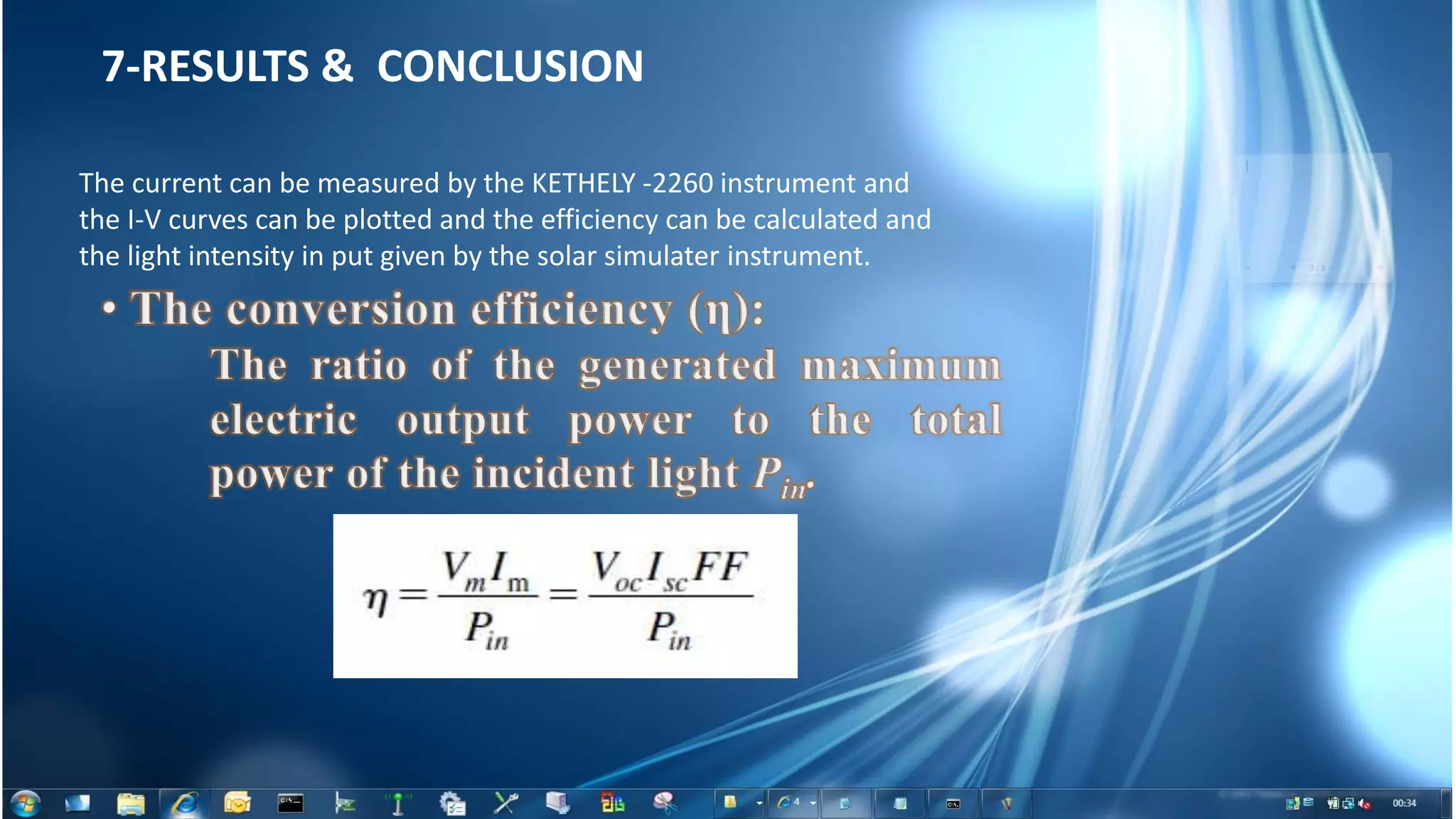
7-RESULTS & CONCLUSION
The current can be measured by the KETHELY -2260 instrument and
the I-V curves can be plotted and the efficiency can be calculated and
the light intensity in put given by the solar simulater instrument.
DSSC
DSSC

DSSC

  • 1.
    Syntheses and characterizationof Ruthenium terpyridine complex and TiO2 Nano particles for Dye Sensitized Solar Cells. KIIT University, Bhubaneswar-24. Presented By Jagannath Panda
  • 2.
    I Introduction II DyeSensitized Solar Cell (DSSC) III Lesson from nature. IV Syntheses of Ruthenium terpyridine complex . V Syntheses TiO2 nano particles . VI Result and discussion on Ru-terpyridine dye & TiO2 nano particles VII How to fabricate DSSC VIII Results & Conclusion OUTLINES
  • 3.
    Humanity’s Top Ten Problemsfor next 50 years 1.ENERGY 2.WATER 3.FOOD 4.ENVIRONMENT 5.POVERTY 6.TERRORISM & WAR 7.DISEASE 8.EDUCATION 9.DEMOCRACY 10.POPULATION 1-INTRODUCTION SOLAR ENERGY IS THE ALTERNATE SOURCE
  • 4.
    •A device thatcan convert sunlight directly in to electricity. •First used in spacecraft and satellites. •Traditional types are based on two types of silicon sandwiched together (n-type and p- type). •Based on using photons to separate charges: electron-hole pairs. •Many new types are in research/production stage.
  • 5.
    • Dye-Sensitized • Relativelyinexpensive • Need little TLC • Short return on investment • Traditional – Expensive – Need TLC – Long return on investment Dye-Sensitized and Silicon-based Solar Cells Compared
  • 6.
    • A typeof photovoltaic cell • Created by Michael Gratzel and Brain O’Regan in 1991 • Developed in 1992 by using nanocrystalline TiO2 as the photo absorber
  • 7.
  • 10.
    Photosynthetic Process: • Sunlightis trapped by chloroplasts • Water is transported from soil to leaf • Carbon dioxide enters through stomata • Water and light combine to form chemical energy • Chemical energy and carbon dioxide rearrange to form carbohydrates and oxygen • Sugar is stored in plant and oxygen is released through stomata
  • 11.
  • 12.
    SYNTHESIS OF THERU-TERPYRIDINE DYE RuCl2(DMSO)4 (20 mg, 0.041 mmol) and Terpyridine (26 mg, 0.083 mmol) were heated at reflux in 95% ethanol (30 mL) for 30 min. The solvent was removed and the red- solid was washed thoroughly with hot benzene. The solid was dissolved in minimum amounts of acetonitrile and the solution was left undisturbed. The dark-red crystals obtained after a week were used for further studies.
  • 13.
    5-SYNTHESES TiO2 NANOPARTICLES . TiO2 Nanoparticles can be synthesized by hydrothermal method. TiO2 macro particles powder was mixed with 10M NaOH and treated hydrothermally at 150°C in a autoclave for 24 hour. Then the sample was washed by 0.1M HCl and make neutral. Then the sample of white solid was dried at 80° C for 24 hour and then drying the powder at 500°C in a hot plate for 2 hour. The synthesized powder sample were characterized.
  • 14.
    6-RESULT AND DISCUSSIONON RU-TERPYRIDINE DYE & TiO2 NANO PARTICLES SINGLE CRYSTAL XRD STRUCTURE OF RU- TERPYRIDINE DYE Absorption of light from MLCT transitions. MLCT states has many desirable features: 1)Photochemical stability. 2)Stable one electron oxidized and reduced forms. 3)Sufficiently long lifetime
  • 15.
    Yield, C,H,N andIR data of synthesized Ru-terpyridine dye Yield:18 mg (45%). IR,(KBr),cm1: 3412(m), 1660(s), 1618(m), 1588(s), 1559(m), 1473(m), 1459(m), 1439(m), 1400(m), 1357(w), 1284(w), 1258(w), 1155(w), 1080(s), 1045(w), 1020(s), 780(s), 731(w), 486(w). Anal. Calc. for C40H48N8RuO10Cl2: C, 49.35; H, 4.93; N, 11.51. Found: C, 49.50; H, 4.96; N, 11.38%.
  • 16.
    6-RESULT AND DISCUSSIONON RU-TERPYRIDINE DYE & TiO2 NANO PARTICLES DLS OF TiO2 nano particles
  • 17.
    6-RESULT AND DISCUSSIONON RU-TERPYRIDINE DYE & TiO2 NANO PARTICLES UV-VISIBLE SPECTRA of TiO2 nano particles
  • 18.
    6-RESULT AND DISCUSSIONON RU-TERPYRIDINE DYE & TiO2 NANO PARTICLES IR Spectra of Tio2 nano particles
  • 19.
    6-HOW TO FABRICATEDSSC 1-Cleaning Conductive Glass Plates. 2-Identifying the Conductive Side. 3-With the conductive side facing up, apply two parallel strips of tape on the edges of the glass plate. 4-Getting the Paste Ready. 5-Apply a portion of paste near the top edge of the TCO glass between the two pieces of tape. 6-By a glass rod, spread the paste across the plate. 7-Repeat the operation until you have a homogenous layer. 8-Sintering the Titania Layer at 450°C for 30 min. 9-RU-DYE is a source of natural dye because of it’s good absorbance. 10-Staining the electrode With the Natural Dye. 11-rinse the electrode carefully with ethanol. 12-Now, the photo electrode is ready. 13-Use a candle to obtain a carbon layer on the counter electrode . 14- The counter electrode with the carbon layer. 15- put the two electrode together. 16-Use paper binders or similar clips to hold the electrodes together. 17-The gap left between the two glass plates will be filled with electrolyte.
  • 24.
    7-RESULTS & CONCLUSION Thecurrent can be measured by the KETHELY -2260 instrument and the I-V curves can be plotted and the efficiency can be calculated and the light intensity in put given by the solar simulater instrument.