DSS Construction:
Development Process
System Development Life Cycle
 As new and emerging technologies become
essential for survival in an increasingly global
economy, organizational change becomes a
necessity.
 SDLC is a systemic method for organizations to
successfully implement change.
What is SDLC?
 According to Dennis, Wixom, and Tegarden, “The SDLC is
the process of understanding how an information system
can support business needs by designing a system,
building it, and delivering it to users”
 A systemic strategy for large-scale development projects.
 A Conceptual model that guides in information system
development.
Phases in SDLC
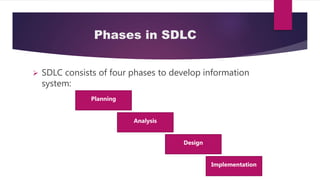
 SDLC consists of four phases to develop information
system:
Planning
Analysis
Design
Implementation
Planning
 Do a feasibility study and look at options.
 Economical (Can we afford to do this? Will it benefit our
organization?)
 Organizational and Operational (Will they use it? Do they need
it?)
 Technical (Can we build it? Do we have the technology to
support it?)
 Create a project plan.
 A plan will keep the project on track
 A plan can be used for evaluation .
Analysis
 Analyze by breaking down into parts (draw a
diagram).
 Gather requirements by talking to all stakeholders
and technical providers.
 Create a proposal to present to stakeholders.
Design
 Decide if the system will be created in house or out sourced.
 Identify how it will operate and how it will be used by the end
users.
 Reexamine the feasibility study done in the Analysis Phase.
Implementation
 The system is built or purchased and tested.
 Training is implemented for end users.
 A technical support plan is put into place.
 Use by end users is evaluated.
Maintenance and Support
 Include all activities that are required once the
system in in place.
 Phone Support for Users.
 Physical onsite user support.
 Resolving any issue that may arise with the new
system.
 Providing support materials and tools for users.
Prototyping
 Also known as iterative design or evolutionary
development.
 Aims at building a DSS in a series of short steps.
 Involves immediate feedback from users.
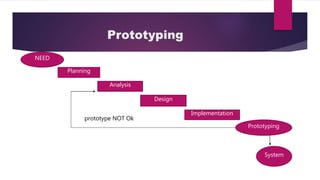
Prototyping
 Performs analysis, design, and implementation
phases concurrently and repeatedly.
 Users see system functionality quickly, and provide
feedback.
 Decision makers learn about the problem.
Prototyping
prototype NOT Ok
NEED
Planning
Analysis
Design
Implementation
Prototyping
System
Advantages of prototyping
 Users and managers are involved in every phase and
iteration.
 Learning is explicitly integrated into the design process.
 Improved user understanding.
 Prototyping bypasses the information requirement definition.
 Short development time
 Low Cost

Dss construction: Development Process (SDLC and Prototyping)

  • 1.
  • 2.
    System Development LifeCycle  As new and emerging technologies become essential for survival in an increasingly global economy, organizational change becomes a necessity.  SDLC is a systemic method for organizations to successfully implement change.
  • 3.
    What is SDLC? According to Dennis, Wixom, and Tegarden, “The SDLC is the process of understanding how an information system can support business needs by designing a system, building it, and delivering it to users”  A systemic strategy for large-scale development projects.  A Conceptual model that guides in information system development.
  • 4.
    Phases in SDLC SDLC consists of four phases to develop information system: Planning Analysis Design Implementation
  • 5.
    Planning  Do afeasibility study and look at options.  Economical (Can we afford to do this? Will it benefit our organization?)  Organizational and Operational (Will they use it? Do they need it?)  Technical (Can we build it? Do we have the technology to support it?)  Create a project plan.  A plan will keep the project on track  A plan can be used for evaluation .
  • 6.
    Analysis  Analyze bybreaking down into parts (draw a diagram).  Gather requirements by talking to all stakeholders and technical providers.  Create a proposal to present to stakeholders.
  • 7.
    Design  Decide ifthe system will be created in house or out sourced.  Identify how it will operate and how it will be used by the end users.  Reexamine the feasibility study done in the Analysis Phase.
  • 8.
    Implementation  The systemis built or purchased and tested.  Training is implemented for end users.  A technical support plan is put into place.  Use by end users is evaluated.
  • 9.
    Maintenance and Support Include all activities that are required once the system in in place.  Phone Support for Users.  Physical onsite user support.  Resolving any issue that may arise with the new system.  Providing support materials and tools for users.
  • 10.
    Prototyping  Also knownas iterative design or evolutionary development.  Aims at building a DSS in a series of short steps.  Involves immediate feedback from users.
  • 11.
    Prototyping  Performs analysis,design, and implementation phases concurrently and repeatedly.  Users see system functionality quickly, and provide feedback.  Decision makers learn about the problem.
  • 12.
  • 13.
    Advantages of prototyping Users and managers are involved in every phase and iteration.  Learning is explicitly integrated into the design process.  Improved user understanding.  Prototyping bypasses the information requirement definition.  Short development time  Low Cost